World

Global pledging event raises 10.1 bn euros for Ukraine

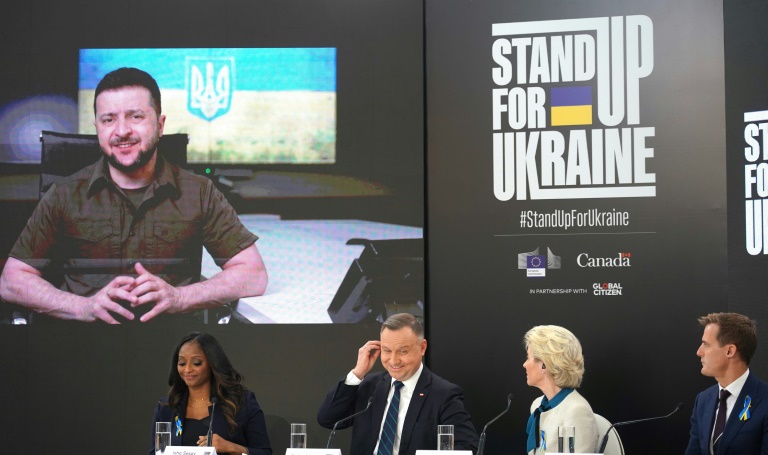
A global pledging event for Ukrainian refugees called “Stand Up for Ukraine” has raised 10.1 billion euros ($11 billion), European Commission chief Ursula von der Leyen said in Warsaw on Saturday.

“The ‘Stand Up For Ukraine’ campaign has raised 9.1 billion euros for people fleeing bombs, inside and outside Ukraine, with an additional billion pledged by EBRD (the European Bank for Reconstruction and Development),” von der Leyen said.

The event, convened by the EU and Canadian Prime Minister Justin Trudeau, was to raise money for internally displaced people in Ukraine and refugees from the war-ravaged country, organisers said.

More than 4.4 million refugees have fled Ukraine since the Russian invasion began on February 24.

Most of them have headed to EU countries including neighbouring Poland, which has taken in more than 2.5 million refugees so far.

The event, partnered by the Global Citizen movement battling poverty, comprised a social media rally on Friday and a pledging conference on Saturday.

Artists including Elton John, Alanis Morissette, Billie Eilish, Annie Lennox and Chris Rock joined the campaign alongside global leaders pledging for their countries.

“We are devastated to see the suffering of people in Ukraine as this conflict unfolds,” Elton John said on Facebook.

The 75-year-old rock legend called on his fans to “help people whose lives have been turned upside down and leave everything behind for a safer life.

“No one should have to experience this kind of tragedy,” John said.

Von der Leyen hailed the income from the event as “fantastic” at Saturday’s pledging conference in Warsaw.

As part of the fundraising efforts, the European Investment Bank (EIB) announced on its website a four-billion euro programme  “to support EU Member States hosting Ukrainian war refugees and to develop vital social infrastructure”.

EIB President Werner Hoyer said “the horror we are witnessing strengthens our determination to act”.

The European Commission alone has pledged a billion euros, of which 600 million will go to Ukrainian authorities and 400 million to “the frontline states that are doing such an outstanding job in helping the refugees that are coming,” von der Leyen added.

In a statement, she promised that “more will come.

“The solidarity of countries, companies and people worldwide offers some light in this dark hour,” von der Leyen added.

“And once the bombs have stopped falling, we will help the people of Ukraine rebuild their country. We will continue to Stand up for Ukraine.”

The Warsaw conference was also addressed by Ukrainian President Volodymyr Zelensky.

“Ukrainian courage has already united the whole democratic world,” he said in a video message, calling on the West to apply more sanctions on Russian banks and stop buying Russian oil.

One dead as Israel army raids W.Bank after deadly attacks

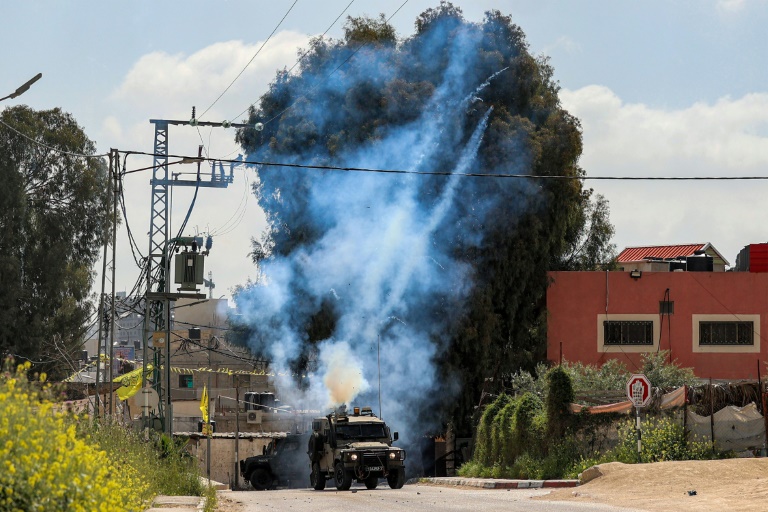
Israeli security forces raided the flashpoint West Bank district of Jenin on Saturday killing a Palestinian and wounding 12 others, after vowing there will “not be limits” to curb surging violence.

The operation, which lasted several hours, came after a gunman from Jenin went on a shooting rampage in a popular Tel Aviv nightlife area on Thursday evening, killing three Israelis and wounding more than a dozen others.

Following the attack, Israeli Prime Minister Naftali Bennett gave security agencies “full freedom” to end deadly violence that has surged since March 22 “in order to defeat terror”.

“There are not and will not be limits for this war,” Bennett said.

On Saturday, the army said security forces had launched the operation in the city of Jenin, in the north of the occupied West Bank, its adjacent refugee camp and nearby villages.

The Palestinian health ministry said at least one Palestinian was killed by Israeli gunfire, while the Red Crescent said 12 others were wounded.

The Islamic Jihad militant group said that one of its fighters, whom it identified as 23-year-old Ahmed al-Saadi, died during clashes in the camp.

A crowd of mourners marched through the streets carrying Saadi’s body on a stretcher covered with the group’s flag.

– ‘Armed assailants’ –

Palestinian security sources said part of Saturday’s operation was to identify the home of the Tel Aviv assailant ahead of demolishing it.

Human rights activists have repeatedly denounced Israel’s policy of demolishing the homes of Palestinian attackers, saying that those affected are often relatives or neighbours unconnected to the crime. Israel says it acts as a deterrent.

The Israeli army said troops and border police were “conducting counterterrorism activity” in the Jenin area, when gunmen had opened fire “endangering their lives.”

In response, troops opened fire “towards the armed assailants”, the army said, adding there were no casualties in Israeli ranks.

“An M16 assault rifle used by an assailant to attack the troops was confiscated.”

The Jenin refugee camp is a stronghold of armed factions, where three other Palestinians linked to an anti-Israeli attack were killed by the army last week. 

Saturday’s raid comes a day after Israel said it had killed Raad Hazem, 28, the alleged Tel Aviv attacker.

In addition to giving security forces free rein to curb a surge in violence, Bennett on Friday ordered the closure of the Jalameh checkpoint between the Jenin area and Israel.

On Saturday evening, the Israeli defence ministry body responsible for civil affairs in the Palestinian territories (COGAT) announced the closure of a second checkpoint in the area and an “intensification” of checks.

“We will do whatever it takes, whatever is necessary, for however long and wherever needed, until both safety and the sense of security are restored,” army chief Lieutenant General Aviv Kochavi told soldiers in the West Bank, in a video released by the military.

On Friday, the father of the Tel Aviv attacker, Fathi Hazem — a retired Palestinian security forces officer according to Palestinian sources — struck a defiant tone.

Speaking to hundreds at the family home in Jenin, he said the Palestinian people were looking for “freedom and independence”.

– Ramadan violence –

A total of 14 people have been killed in attacks in Israel since March 22, including some carried out by assailants linked to or inspired by the Islamic State group.

Over the same period, at least 10 Palestinians have been killed, including assailants.

Islamic Jihad and fellow Islamist movement Hamas praised the Tel Aviv attack — drawing criticism from the UN — but did not claim responsibility.

Palestinian leader Mahmud Abbas denounced the Tel Aviv attack, while the United States stressed anew its support of key ally Israel.

The Tel Aviv attack killed three Israeli men: childhood friends Tomer Morad and Eytam Magini, as well as father of three Barak Lufan.

It came amid heightened tensions during Ramadan, after violence flared during the Muslim holy month last year leading to 11 days of devastating conflict between Israel and Palestinian militants in the Hamas-ruled Gaza Strip.

Earlier this month, Israeli security forces killed three Islamic Jihad militants when they came under fire during an operation to arrest them in Jenin.

The raid, in which four Israeli soldiers were wounded, followed another deadly attack on March 29 in Bnei Brak, a largely ultra-Orthodox Jewish city near Tel Aviv. 

The Palestinian assailant, who had also come from Jenin, shot dead two Israeli civilians, two Ukrainians and an Arab-Israeli policeman.

Civilians flee eastern Ukraine after deadly railway station attack

Evacuations resumed on Saturday from Kramatorsk, in eastern Ukraine, where a missile strike killed 52 people at a railway station, as British Prime Minister Boris Johnson became the latest Western leader to visit Kyiv and Ukrainians were urged to flee a feared Russian offensive before it was too late.

Hailing the country’s response to the Russian invasion, Johnson offered Ukraine armoured vehicles and anti-ship missiles.

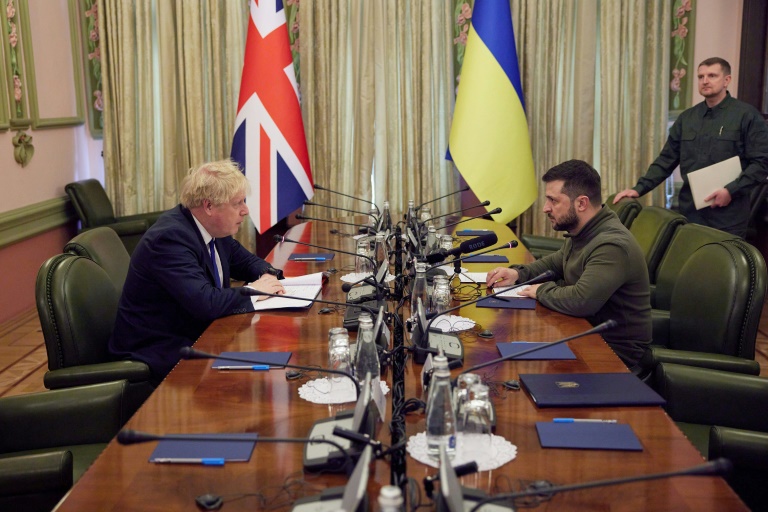
“It is because of President (Volodymyr) Zelensky’s resolute leadership and the invincible heroism and courage of the Ukrainian people that (Vladimir) Putin’s monstrous aims are being thwarted,” he said after meeting Zelensky.

Johnson, who a day earlier pledged to send Ukraine “high-grade military equipment” including Starstreak anti-aircraft missiles and 800 anti-tank missiles, added that the discovery of civilian bodies in Ukrainian towns had “permanently polluted” Russian President Vladimir Putin’s reputation. 

Former Italian Prime Minister Silvio Berlusconi, meanwhile, said he was “deeply disappointed” and pained by his friend Putin’s attack on Ukraine.

Six weeks into Russia’s invasion, Moscow has shifted its focus to eastern and southern Ukraine after stiff resistance thwarted plans to swiftly capture Kyiv.

EU leaders were meeting with President Zelensky on Friday as news emerged of the devastating attack on Kramatorsk’s station. The 52 victims included five children.

– Plea to evacuate –

With thousands killed in fighting and more than 11 million fleeing their homes or the country, Zelensky called on the West to follow the UK’s example on military aid.

US President Joe Biden on Friday accused Russia of being behind a “horrific atrocity” in the de facto capital of the Ukrainian-controlled Donetsk region, and France condemned the strike as a “crime against humanity”.

Moscow denied responsibility for the rocket attack on Friday morning, which also wounded 109 people, according to the latest official count.

With the conflict moving away from areas first occupied by Russian forces after the February 24 invasion, the mayor of eastern Lysychansk Oleksandr Zaika called on the city’s residents to evacuate as soon as possible due to constant shelling by the Russian army.

“I ask you to evacuate. It has become very difficult in the city, enemy shells are already flying into different places,” Zaika said in a video message.

Stressing that “no one is going to give up the Luhansk region”, he added that there were stocks of humanitarian aid in the city “but that doesn’t mean it will save your life if an enemy shell arrives”.

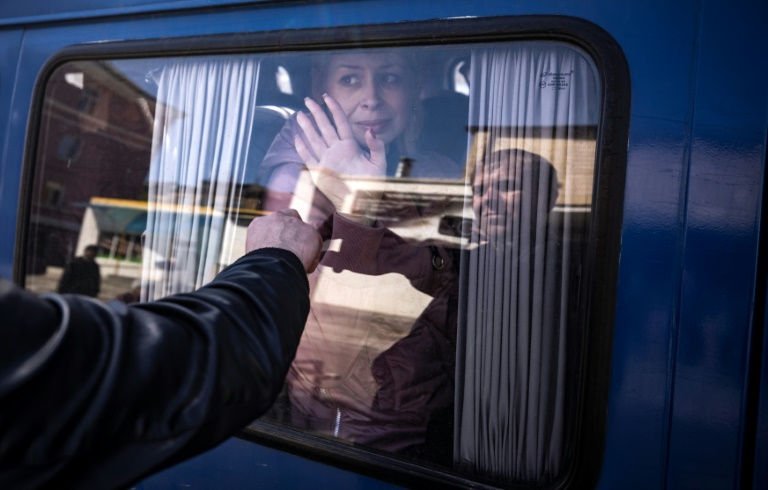
Minibuses assembled at a church in Kramatorsk to collect shaken evacuees on Saturday. Almost 80 people, most of them elderly, took shelter overnight in a building, not far from the targeted station.

“There were around 300 to 400 people who rushed here after the strike,” Yevgeny, a member of the Protestant church, told AFP.

“They were traumatised. Half of them ran to shelter in the cellar, others wanted to leave as soon as possible. Some were evacuated by bus in the afternoon (on Friday).”

The station in Kramatorsk was being used as the main evacuation hub for refugees from the parts of the eastern Donbas region still under Ukrainian control.

AFP reporters at the station saw the remains of the missile tagged in white paint with the words “for our children” in Russian. The expression is frequently used by pro-Russian separatists in reference to their losses since the start of the first Donbas war in 2014.

The governor of Donetsk claimed a missile with cluster munitions was used in the attack, according to remarks published by the Interfax news agency.

– ‘All this horror’ –

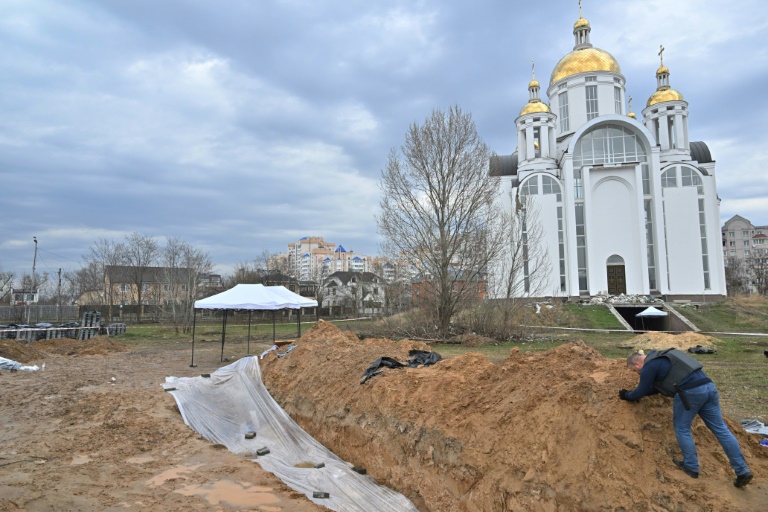
The strike came as European Commission President Ursula von der Leyen and EU foreign policy chief Josep Borrell were in Kyiv for talks with Zelensky and to visit the scene of civilian killings in Bucha.

Russia faced “decay” because of ever tougher sanctions and Ukraine had a “European future”, von der Leyen said at a news conference with Zelensky on Friday.

“My instinct says: If this is not a war crime, what is a war crime?” she said of the Bucha killings, calling for a thorough investigation.

Joining the Western solidarity campaign, Austrian Chancellor Karl Nehammer also arrived in Kyiv and on Saturday visited Bucha.

Russian troops appear to be seeking to create a long-sought land link between occupied Crimea and the Moscow-backed separatist territories of Donetsk and Lugansk in the Donbas region.

Ukraine said it had agreed a third prisoner exchange with Russia and that 12 soldiers and 14 civilians would be returning home.

Moscow’s defence ministry said Russian forces had destroyed an ammunition depot in the Dnipro region, and struck 85 Ukrainian military targets in the previous 24 hours.

Moscow added that Russian troops had opened fire on a Ukrainian vessel trying to evacuate commanders of the Azov battalion from the besieged city of Mariupol.

Members of the Azov Special Operations Detachment have been fighting Russian forces in southeastern Mariupol located between Russia-occupied Crimea and pro-Russian separatist regions in Ukraine’s east.

Bucha — where authorities say hundreds were killed, some with their hands bound — has become a byword for the brutality allegedly inflicted under Russian occupation.

But Zelensky has warned that worse is being uncovered.

“They have started sorting through the ruins in Borodianka,” northwest of Kyiv, he said on Friday. “It is much more horrific there. There are even more victims of Russian occupiers.”

Conflict in the area has wrought massive destruction and bodies are only now being retrieved, with 27 recovered from two destroyed buildings, according to Prosecutor General Iryna Venediktova.

Fresh allegations also emerged from Obukhovychi, northwest of Kyiv, where villagers told AFP they were used as human shields.

– ‘Help us now’ –

Moscow has denied targeting civilians, but growing evidence of atrocities has galvanised Ukraine’s allies in the EU, which has approved an embargo on Russian coal and the closure of its ports to Russian vessels.

The bloc has frozen 30 billion euros ($33 billion) in assets from blacklisted Russian and Belarusian individuals and companies, it said Friday.

It also blacklisted Putin’s two adult daughters and more than 200 others as part of its latest sanctions package, according to an official list.

The United States and Britain had already sanctioned the Russian leader’s daughters.

Borrell has pledged the EU would supply 7.5 million euros to train Ukrainian prosecutors to investigate war crimes allegedly committed by Russia.

Ukraine has welcomed the new pressure on Moscow, but continues to push for harsher sanctions and more heavy weaponry.

Western companies have joined the bid to isolate Russia, US video hosting service YouTube blocking the channel of the Russian lower house of parliament. Russian officials have warned of reprisals.

As sanctions bite, credit rating agency Standard and Poor’s Global Ratings downgraded Russia’s foreign currency payments rating to “selective default” after Moscow paid a dollar-denominated debt in rubles this week.

burs-dlc-har/jj

Searching for the missing in the ruins of Borodianka

In the small town of Borodyanka, not far from Kyiv, diggers sort through the rubble of houses destroyed by russian bombardments, looking for the missing. 

Her eyes read from tears and lack of sleep, Antonina is watching as one picks through the remains of the building where her son used to live on the third floor.

The slow process is unbearable for the 65-year-old mother, whose own home was spared by the fighting.

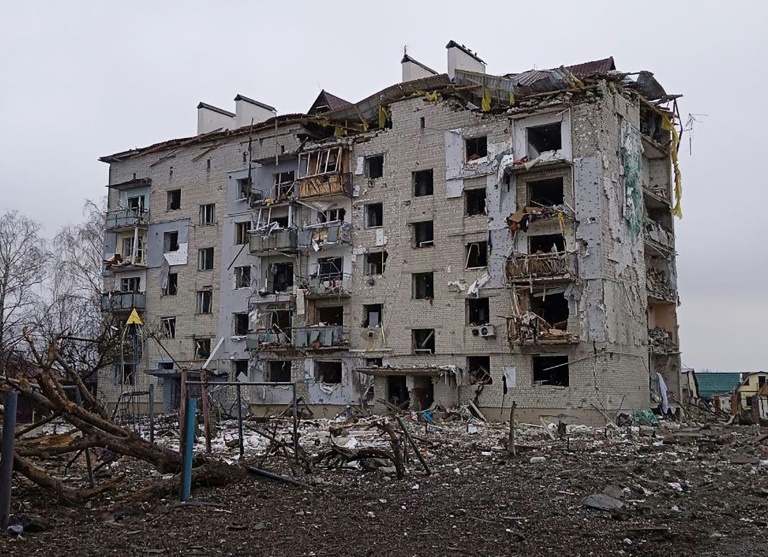
There’s a gaping hole in the middle of the five-storey building, where the it was hit by a bomb dropped from a Russian plane on the evening of March 1, a few days after the start of the invasion.

In a few seconds, the ten apartments that used to stand here were turned into a heap of concrete and twisted metal.

“There were people in this building, it was night,” says Antonia, wearing a brown coat and a blue woollen hat.

Antonina sits alone on a chair in the corner of what used to be the building’s garden. She holds a cane in front of her in both hands and rests her head on top, a sad, thoughtful look on her face as she watches the diggers do their work.

“The people who stayed in the two blocks on the sides of the building were hurt but they’re still alive,” she says. “Those that stayed (in the middle section), they’re all dead.”

– ‘Maybe he is still there’ –

Antonina has not heard from her son Yuri, 43, since the night the bomb fell.

“Maybe he managed to get out, maybe he is hurt, maybe he is still there (under the rubble). I can’t say, I don’t know,” she says, before bursting into tears.

Scattered in the ruins of the building there’s a pair of shoes, a book, a water-pistol, some cushions, clothes and three stuffed animals, a bear, a giraffe and a hippo, all next to each other.

A mattress is caught in the branches of a tree. 

On the ground floor of one of the still-standing blocks, Lyubov Yaremenko’s apartment used to have a little terrace.

With the forecast for rain, she puts a plastic tarp over the brown sofa she’s placed where the patio was.

It is the only piece of furniture she was able to save from her house, where everything else was devastated by the explosion.

Doors came off their hinges, windows smashed, the cupboards were knocked over and clothes thrown everywhere.

– ‘More horrific’ –

When the bomb hit, Lyubov, an olderly lady of around 70, was not in her apartment but in the cellar. 

“We stayed so long underground, almost a month and a half, first here, then we ran to the cellar on the other side of the street as they were bombing… I fell and hurt my ribs,” says Lyubov still shocked. 

“It seems there was a family with young children in this cellar, that they can’t yet reach,” she says.

The main road in Borodyanka is now nothing more than a near-two-kilometre-long strip of ruins and devastation.  

The town, which numbered around 13,000 inhabitants before the war, was retaken by Ukrainian forces at the end of March after the withdrawal of Russian troops from the region around Kyiv.

Ukraine’s president Volodymyr Zelensky warned on Saturday that worse was still being uncovered.

“They have started sorting through the ruins in Borodianka,” northwest of Kyiv, he said. “It is much more horrific there. There are even more victims of Russian occupiers.”

He has said that the situation in Borodyanka is “much more horrific” than in Bucha, where dead civilians were discovered, some of them with their hands tied behind their backs.

Ukraine’s Prosecutor General Iryna Venediktova said on Thursday that 26 bodies had been recovered from two destroyed apartment buildings in Borodyanka so far.

Across from the main square, another, taller building of eight storeys has also seen one third of its mass shorn off by a bomb. A crane is working to remove hulking pieces of its walls, blackened by the explosion. 

Two rescue workers in a cherry picker look through the windows of the standing apartments one by one, looking for bodies.

“We would have liked it to be a simple rescue operation but the strikes were end of February, early March,” says Svetlana Vodolaha, an emergency services worker from Kyiv.

“We don’t have an exact figure for the number of people that could still be trapped under the collapsed buildings, but we have to search all of them,” she says.

War in Ukraine: Latest developments

Here are the latest developments in the war in Ukraine:

– Third prisoner swap underway –

Ukraine says 12 Ukrainian soldiers and 14 civilians are returning home following a prisoner exchange with Russia.

“On the order of President (Volodymyr) Zelensky, the third prisoner exchange took place today. Twelve of our servicemen are returning home, including one female officer,” deputy prime minister Iryna Vereshchuk says on Telegram.

Fourteen civilians including nine women were also on their way home, she added.

– Johnson offers more arms –

British Prime Minister Boris Johnson pays an unannounced visit to Kyiv and pledges armoured vehicles and anti-ship missiles to Ukraine.

“It is because of President (Volodymyr) Zelensky’s resolute leadership and the invincible heroism and courage of the Ukrainian people that (Vladimir) Putin’s monstrous aims are being thwarted,” Johnson says after meeting Zelensky, according to a Downing Street statement.

Zelensky in turn calls on the West to “follow the UK” in providing military aide to Ukraine and imposing sanctions on Russia.

– Global event raises 10.1 bn euros –

A global pledging event for Ukrainian refugees called “Stand Up for Ukraine” has raised 10.1 billion euros ($11 billion), European Commission chief Ursula von der Leyen says in Warsaw. 

“The ‘Stand Up For Ukraine’ campaign has raised 9.1 billion euros for people fleeing bombs, inside and outside Ukraine, with an additional billion pledged by EBRD (the European Bank for Reconstruction and Development),” Von der Leyen says.

– Ukraine ‘still ready’ for talks –

Ukraine is “still ready” to continue negotiations with Moscow, which have stalled since the discovery of atrocities in Bucha and other areas near Kyiv, the Ukrainian President Volodymyr Zelensky says.

“We are ready to fight and to look in parallel to end this war through diplomacy,” Zelensky said at a news conference with the Austrian Chancellor Karl Nehammer, who was visiting the capital and Bucha.

– 4.4 million flee Ukraine war – 

More than 4.4 million Ukrainian refugees have fled their country since Russian President Vladimir Putin ordered an invasion on February 24, the UN refugee agency says.

Ninety percent of those who have fled Ukraine are women and children, as the Ukrainian authorities do not allow men of military age to leave.

– Evacuations from Kramatorsk resume –

Evacuations resume from the town in eastern Ukraine where a missile strike killed 52 people at a railway station as civilians fled a feared Russian offensive.

Ukrainian President Volodymyr Zelensky describes Russia as an “evil with no limits” after the attack and calls for a “firm global response”.

US President Joe Biden accuses Russia of being behind the attack, calling it a “horrific atrocity”, while French Foreign Minister Jean-Yves Le Drian deems it a “crime against humanity”.

Russia’s defence ministry accuses Kyiv of carrying out the attack, saying it wanted to use fleeing residents “as a ‘human shield’ to defend the positions of Ukraine’s Armed Forces”.

– Russia warns of YouTube reprisals –

Russian officials warn of reprisals after US video hosting service YouTube blocks the channel of the lower house of parliament due to US sanctions.

Vyacheslav Volodin, speaker at lower house of parliament, the State Duma, says Washington is breaching the rights of Russians.

– EU in talks with ICC prosecutor –

The EU is to discuss its support for war crimes probes in Ukraine in meetings over the next two days with the International Criminal Court’s chief prosecutor, the European Commission says.

Karim Khan, of The Hague-based court, is to meet EU foreign policy chief Josep Borrell on Sunday in Luxembourg, then take part in a meeting of EU foreign ministers in the city on Monday.

– EU sanctions Putin’s daughters –

Russian President Vladimir Putin’s two adult daughters and more than 200 other people are blacklisted by the EU.

Those on the list, which additionally includes 18 companies, face asset seizures and travel bans in the 27-nation European Union. 

The United States and Britain had already sanctioned Putin’s daughters, as well as the daughter of Foreign Minister Sergei Lavrov.


– Odessa curfew –  

A curfew is to start in Ukraine’s southern city of Odessa on Saturday evening to Monday evening over a “missile strike threat” from Russia, and after the shelling of the train station in Kramatorsk.

– Germany: ‘Limit’ in arms to Ukraine –

Germany has almost exhausted its ability to supply Ukraine with weapons from its army reserves, but is working on direct deliveries from the arms industry, German Defence Minister Christine Lambrecht says. 

“For deliveries coming from the Bundeswehr’s stocks, I have to say honestly that we have reached a limit,” she tells German daily Augsburger Allgemeine. 

Johnson says Putin reputation 'permanently polluted' after Bucha killings

The discovery of civilian bodies in Ukrainian towns has “permanently polluted” Russian President Vladimir Putin’s reputation, UK Prime Minister Boris Johnson said during a visit to Kyiv Saturday.

“What Putin has done in places like Bucha and Irpin is war crimes that have permanently polluted his reputation and the reputation of his government,” Johnson said, standing next to Ukrainian President Volodymyr Zelensky.

Johnson became the latest European leader to visit Kyiv this weekend after the bodies were discovered in several towns from where the Russian army retreated. 

Johnson praised Ukraine for “defying odds” and rebuffing a Russian offensive on Kyiv.

“The Russians believed Ukraine could be engulfed in a matter of days and that Kyiv would falls in hours to their armies,” he said, referring to Western intelligence. 

“How wrong they were.”

The Ukrainian people have “shown the courage of a lion”, he added.

“The world has found new heros and those heroes are the people of Ukraine.”

After talks with Zelensky, Johnson vowed UK armoured vehicles and anti-ship missiles for Ukraine.

Zelensky called on the West to follow the UK in providing military aide to Ukraine and imposing sanctions on Russia.

“Other Western democratic countries should follow the UK’s example,” Zelensky said after talks with Johnson. 

– Ukraine ‘defied odds’ –

“It is because of President (Volodymyr) Zelensky’s resolute leadership and the invincible heroism and courage of the Ukrainian people that (Vladimir) Putin’s monstrous aims are being thwarted,” Johnson said after meeting Zelensky, according to a Downing Street statement.

Johnson set out extra military aid of 120 armoured vehicles and new anti-ship missile systems, “to support Ukraine in this crucial phase while Russia’s illegal assault continues”, the statement added.

That is on top of UK aid announced Friday of more Starstreak anti-aircraft missiles and another 800 anti-tank missiles, along with “loitering” drones for “precision strikes” against the Russians.

As world powers held a fundraising round for Ukraine, Johnson also promised an extra $500 million via the World Bank.

Johnson said it had been a “privilege” to meet Zelensky in person on his surprise visit, which was not pre-announced in London.

“Ukraine has defied the odds and pushed back Russian forces from the gates of Kyiv, achieving the greatest feat of arms of the 21st century,” he said.

“I made clear today that the United Kingdom stands unwaveringly with them in this ongoing fight, and we are in it for the long run.”

Twitter stakeholder Elon Musk tweets 'Is Twitter dying?'

Twitter’s newest board member and largest stakeholder Elon Musk tweeted Saturday to ask if the social media network was “dying” and to call out users such as singer Justin Bieber, who are highly followed but rarely post.

“Most of these ‘top’ accounts tweet rarely and post very little content,” the Tesla boss wrote, captioning a list of the 10 profiles with the most followers — a list which includes himself at number eight, with 81 million followers.

“Is Twitter dying?” he wrote. 

Former US President Barack Obama appears at the top with 131 million followers, followed by stars such as Bieber, Katy Perry, Rihanna and Taylor Swift, as well as Indian prime minister Narendra Modi and football star Cristiano Ronaldo, among others. 

“For example, @taylorswift13 hasn’t posted anything in 3 months,” Musk continued.

“And @justinbieber only posted once this entire year.”

The social media company named Musk to the board on Tuesday after the outspoken and polarizing executive disclosed he had acquired a more than nine percent stake in the company, making him Twitter’s largest shareholder.

Musk said he looked forward to soon making “significant improvements to Twitter,” and began polling his followers on whether to add an “edit” button to the service, a long-discussed tweak.

Twitter has now said that it will start experimenting with one.

On Thursday, Musk tweeted a photo of himself smoking marijuana on a Joe Rogan podcast in 2018, with the caption, “Twitter’s next board meeting is gonna be lit.”

His antics often raise eyebrows and occasionally draw condemnation, as when Jewish groups blasted his tweet comparing Canadian leader Justin Trudeau to Adolf Hitler over Covid-19 vaccine mandates. Musk later deleted the tweet without apologizing.

The appointment has sparked misgivings among some employees, according to a Washington Post report.

Workers at the California-based social media company cited worries about Musk’s statements on transgender issues and his reputation as a difficult and driven leader, according to statements on Slack reviewed by the Post.

A California agency has sued Tesla, alleging discrimination and harassment against Black workers. The electric carmaker has rejected the charges, saying it opposes discrimination.

Global pledging event raises 10.1 bn euros for Ukraine

A global pledging event for Ukrainian refugees called “Stand Up for Ukraine” has raised 10.1 billion euros ($11 billion), European Commission chief Ursula von der Leyen said in Warsaw on Saturday.

“The ‘Stand Up For Ukraine’ campaign has raised 9.1 billion euros for people fleeing bombs, inside and outside Ukraine, with an additional billion pledged by EBRD (the European Bank for Reconstruction and Development),” von der Leyen said.

The event, convened by the EU and Canadian Prime Minister Justin Trudeau, sought to raise money for internally displaced people in Ukraine and refugees from the war-ravaged country, organisers said.

More than 4.4 million refugees have fled Ukraine since the Russian invasion began on February 24.

Most of them have headed to EU countries including neighbouring Poland which has taken in more than 2.5 million refugees so far.

The event, partnered by the Global Citizen movement battling poverty, comprised a social media rally on Friday and a pledging conference on Saturday.

Artists including Elton John, Alanis Morissette, Billie Eilish, Annie Lennox and Chris Rock joined the campaign alongside global leaders pledging for their countries.

“We are devastated to see the suffering of people in Ukraine as this conflict unfolds,” Elton John said on Facebook.

The 75-year-old rock legend called on his fans to “help people whose lives have been turned upside down and leave everything behind for a safer life.”

“No one should have to experience this kind of tragedy,” John said.

Von der Leyen hailed the income from the event as “fantastic” at Saturday’s pledging conference in Warsaw.

The European Commission alone has pledged a billion euros, of which 600 million will go to Ukrainian authorities and 400 million to “the frontline states that are doing such an outstanding job in helping the refugees that are coming,” von der Leyen added.

In a statement, she promised that “more will come”.

“The solidarity of countries, companies and people worldwide offers some light in this dark hour,” von der Leyen added.

“And once the bombs have stopped falling, we will help the people of Ukraine rebuild their country. We will continue to Stand up for Ukraine.”

The Warsaw conference was also addressed by Ukrainian President Volodymyr Zelensky.

“Ukrainian courage has already united the whole democratic world,” he said in a video message, calling on the West to slap more sanctions on Russian banks and stop buying Russian oil.

Dozens hospitalised as Iraq gripped by dust storm

A dust storm that has swept through much of Iraq has left dozens of people in hospital with  respiratory problems, a health ministry spokesman said Saturday.

The storm erupted in the north of the country on Thursday, prompting the cancellation of flights serving Arbil, capital of the autonomous Kurdistan region.

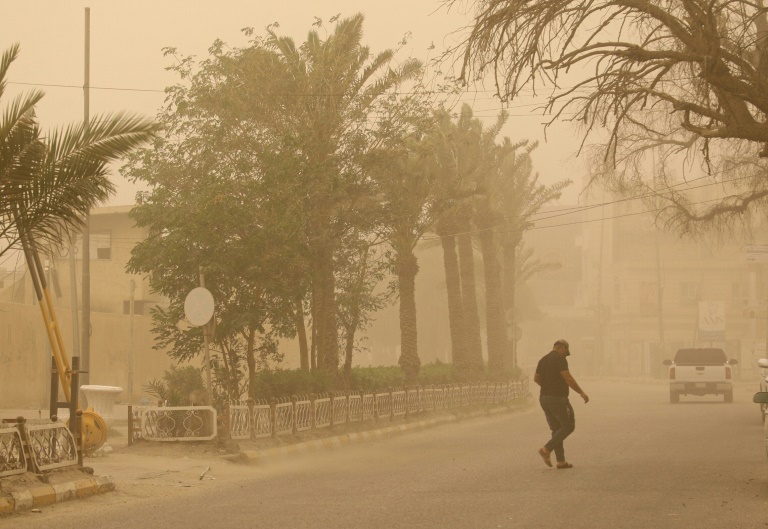
As the storm swept south, it shrouded Baghdad and cities as far south as Nasiriyah in a ghostly orange.

In the capital, buildings and vehicles were covered in ochre-coloured dust, AFP journalists reported.

The storm has caused “dozens of hospitalisations across Iraq due to respiratory problems”, health ministry spokesman Saif al-Badr told AFP.

The director of Iraq’s meteorological office, Amer al-Jabri, said that while dust storms were not uncommon in Iraq, they are becoming more frequent “due to drought, desertification and declining rainfall”.

Iraq is particularly vulnerable to climate change, having already witnessed record low rainfall and high temperatures in recent years.

Experts have said these factors threaten social and economic disaster in the war-scarred country.

In November, the World Bank warned that Iraq could suffer a 20 percent drop in water resources by 2050 due to climate change.

First private mission reaches International Space Station

The first fully private mission reached the International Space Station early Saturday with a four-member crew from startup company Axiom Space.

NASA has hailed the three-way partnership with Axiom and SpaceX as a key step towards commercializing the region of space known as “Low Earth Orbit,” leaving the agency to focus on more ambitious voyages deeper into the cosmos.

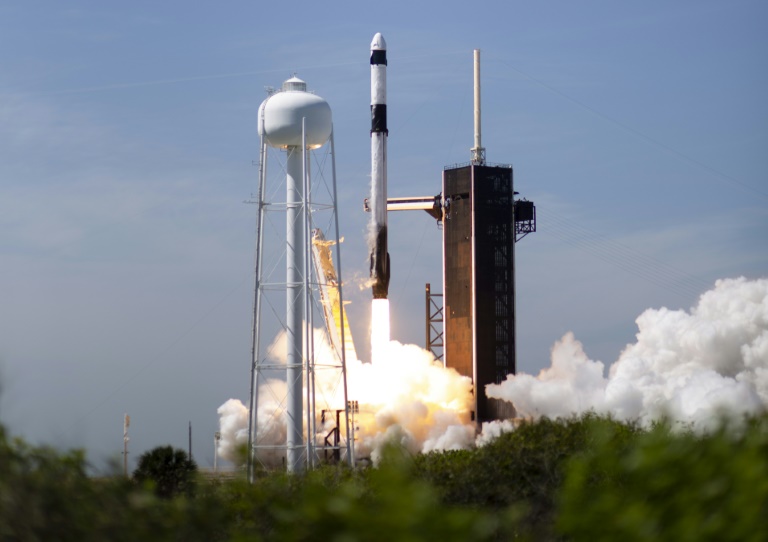
A SpaceX Falcon 9 rocket with the Crew Dragon capsule Endeavor docked at 1229 GMT Saturday and the crew entered the space station nearly two hours later, after launching from the Kennedy Space Center in Florida on Friday.

Commanding the Axiom Mission 1 (Ax-1) is former NASA astronaut Michael Lopez-Alegria, a dual citizen of the United States and Spain, who flew to space four times over his 20-year-career, and last visited the ISS in 2007.

He is joined by three paying crewmates: American real estate investor Larry Connor, Canadian investor and philanthropist Mark Pathy, and Israeli former fighter pilot, investor and philanthropist Eytan Stibbe.

“We’re here to experience this but we understand there’s a responsibility,” Connor said in comments shown on NASA’s live feed.

As the first civilian crew, he said, they “need to get it right.”

The widely reported price for tickets — which includes eight days on the outpost, before eventual splashdown in the Atlantic — is $55 million. 

While wealthy private citizens have visited the ISS before, Ax-1 is the first mission featuring an all-private crew flying a private spacecraft to the outpost. 

Houston-based Axiom pays SpaceX for transportation, and NASA also charges Axiom for use of the ISS.

– Research projects –

On board the ISS, which orbits 250 miles (400 kilometers) above sea level, the quartet will carry out 25 research projects, including an MIT technology demonstration of smart tiles that form a robotic swarm and self-assemble into space architecture.

Another experiment involves using cancer stem cells to grow mini tumors, and then leveraging the accelerated aging environment of microgravity to identify biomarkers for early detection of cancers.

“Our guys aren’t going up there and floating around for eight days taking pictures and looking out of the cupola,” Derek Hassmann, operations director of Axiom Space, told reporters at a pre-launch briefing.

In addition, crewmember Stibbe plans to pay tribute to his late friend Ilan Ramon, Israel’s first astronaut, who died in the 2003 Space Shuttle Columbia disaster when the spaceship disintegrated upon reentry.

Surviving pages from Ramon’s space diary, as well as mementos from his children, will be brought to the station by Stibbe.

The Axiom crew will live and work alongside the station’s regular crew: currently three Americans and a German on the US side, and three Russians on the Russian side.

The company has partnered for a total of four missions with SpaceX, and NASA has already approved in principle the second, Ax-2. 

Axiom sees the voyages as the first steps of a grander goal: to build its own private space station. The first module is due to launch in 2024.

The plan is for the station to initially be attached to the ISS, before eventually flying autonomously when the latter retires and is deorbited sometime after 2030.

Close Bitnami banner
Bitnami