World

As Ukraine's war bites, comedy offers light relief

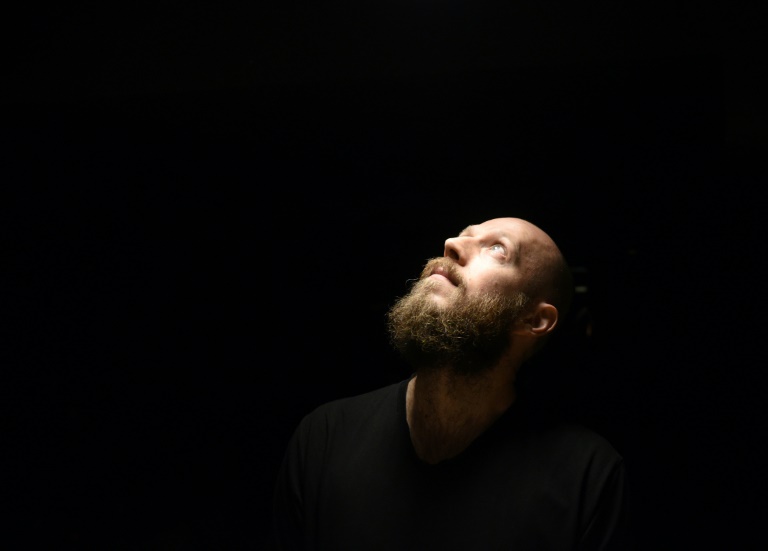
On stage in war-torn Ukraine, 32-year-old comedian Sergii Gromov says the army has called him up and he might have to fight the Russians.

But his wife’s chief concern does not seem to be that he could soon be on the frontline, he says.

Rather, she is extremely worried that he will be told to shave off the beard she likes so much.

Gentle laughter ripples through the comedy club in the western city of Lviv, at an event raising donations for the Ukrainian army.

More than six weeks after Russia invaded the country, men and women huddled at the bar and tables, many still in their jackets, hoping for a joke to lighten the mood.

“Humour is our shield and our defensive mechanism to live through this moment,” said the stand-up comic, exiting the stage.

Gromov, who is also a cinematographer, was forced to flee his home city of Kharkiv near the Russian border in the early days of the conflict.

He, his wife, and a friend travelled more than 1,000 kilometres (600 miles) west to seek safety at the other end of the country in Lviv.

The comedian thinks carefully about what kind of joke is acceptable, or even relatable, and was unsure  about returning to the floorboards earlier this week. 

“It was a little bit scary to perform, but after the first performance I understood that it’s necessary,” he said.

“It’s better to go on some comedy performance and to laugh one day a month or a week than to sit in your kitchen and drink alcohol.”

Laughing and crying provide the same degree of relief, he says, though preparing jokes is now much harder than before the invasion.

– ‘Sold out’ –

President Volodymyr Zelensky is likely the country’s most famous comedian, voted into office in 2019 after a wildly popular television series in which he played a teacher turned head of state.

But after weeks of killing and destruction, his oratory skills are firmly focused on rallying worldwide support to end the Russian onslaught.

After the war broke out on February 24, the Cult Comedy Hall in Lviv closed down for several weeks.

Comedians were busy volunteering as hundreds of thousands of displaced people flooded into the city, and nobody was in the mood to make jokes, says manager Bogdan Sepokura.

But the club reopened last month, because he felt people needed it.

Come, the advertisement said, you don’t need to worry about air raid sirens because the club is a bunker.

“In two hours, we sold out,” Sepokura said.

In the corridor, some of the evening’s performers scrolled through notes on their phones, waiting for their turn at the microphone.

Members of the audience smoked shisha or sipped beer, eyes riveted towards the latest act in front of the red curtain, convulsing every so often with chuckles.

As the start of night-time curfew approached, waiters moved around the tables with wireless payment machines, and patrons held their smartphones over them to settle their bills.

Veronika Azarova, 25, had come to see the show with her sister and a friend.

She too had been forced to abandon Kharkiv, arriving in the city just five days earlier, after witnessing Russian missiles rain down on her city.

They wanted a happy night out to forget.

“We need to look for ways to lift our spirits, because it’s really tough to go through such stress,” she said.

US warns of 'arbitrary' Covid measures in China

The United States on Saturday warned of “arbitrary” Covid-19 measures in China and said it would let some staff leave its Shanghai consulate amid a surge of infections in the locked-down megacity.

Until March, China had kept cases low with snap lockdowns, mass testing and travel restrictions, but more than 100,000 cases have been reported in Shanghai since March in a test of the country’s strict zero-Covid policy.

The city’s roughly 25 million inhabitants were locked down in phases last week, prompting complaints of food shortages and viral videos of disgruntled residents scuffling with officials.

The US State Department will now allow non-essential employees to leave its consulate in Shanghai “due to a surge in Covid-19 cases and the impact of restrictions related to the response”, a US embassy spokesperson said in a statement.

The statement warned citizens to reconsider travelling to China, “due to arbitrary enforcement of local laws and Covid-19-related restrictions”, adding that the embassy in Beijing had raised its concerns over the measures with the Chinese government.

Shanghai reported more than 23,000 new infections on Saturday — mostly asymptomatic, accounting for more than 90 percent of new domestic infections in the country.

City authorities have prepared thousands of new beds in more than 100 makeshift hospitals, Shanghai’s vice mayor Zong Ming said during a press conference Saturday.

The largest of these, a 50,000-bed hospital in the landmark National Exhibition and Convention Center, opened Saturday according to state news agency Xinhua.

As part of China’s zero-Covid policy, authorities are insisting on isolating every person who tests positive in hospital wards — which have left existing facilities overrun with patients, even if they show no severe symptoms.

Meanwhile locals have begun to chafe at lockdown restrictions, with many taking to social media to complain of food shortages and express outrage over the recent killing of a pet corgi by health workers, for fear of being infected.

An unpopular policy of separating infected children from their virus-free parents was softened this week after triggering public anger.

But Beijing is sticking to its zero-tolerance approach and is determined to squash the Shanghai outbreak, sending medical workers from around the country in as reinforcements.

Shanghai officials said Saturday they planned to perform a new round of PCR tests on the city’s entire population, after which it would begin relaxing rules in some neighbourhoods — provided they met the strict requirement of no infections in the past 14 days.

France prepares for first round of tight Macron re-election bid

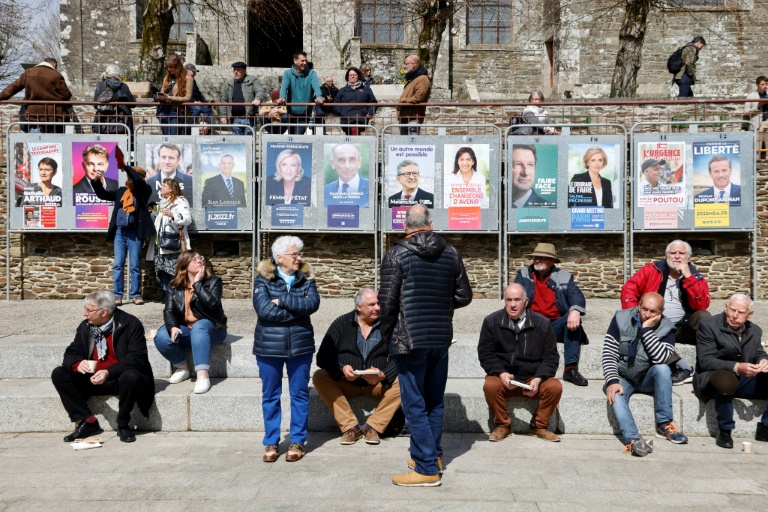
France on Saturday prepared for the first round of presidential elections projected to produce a run-off rematch between President Emmanuel Macron and far-right leader Marine Le Pen that will be far tighter than their duel five years ago.

All further political activity by candidates was banned on the final day before polls open in mainland France at 0600 GMT on Sunday, after a campaign overshadowed by Russia’s invasion of Ukraine.

French overseas territories will begin voting earlier to take account of the time difference, starting with Saint Pierre and Miquelon off the coast of Canada at 1000 GMT Saturday.

Territories in the Caribbean, the Pacific and finally the Indian Ocean will follow before polling stations open in mainland France. 

Polls predict that Macron will lead Le Pen by a handful of percentage points in round one, with the top two going through to a second round on April 24.

But analysts warn that the outcome remains highly volatile with uncertainty remaining over turnout and some observers fearing a quarter of the electorate may stay away in a possible record boycott of the vote.

Far-left candidate Jean-Luc Melenchon is snapping at their heels in third and still fancies his chances of reaching the second round at the expense of Le Pen or even — in an extraordinary upset — Macron himself.

Although her opponents accuse her of being an extremist bent on dividing society, Le Pen has with some success during the campaign sought to show a more moderate image and concern with voters’ daily worries such as rising prices.

Macron by contrast has campaigned relatively little, by his own admission entering the election campaign later than he would have wished due to the war in Ukraine.

– ‘Strange campaign’ –

If Macron and Le Pen as forecast reach the second round, analysts predict that their clash will be far tighter than in 2017 when the current president thrashed his rival with 66 percent of the vote. 

“There is an uncertainty ahead of the first round,” said French political scientist Pascal Perrineau, pointing to unprecedently high numbers of voters who were still undecided or who had changed their minds during the campaign as well as absentee voters.

Analysts fear that the 2002 record of the numbers of French voters boycotting a first round of 28.4 percent risks being beaten, with the 2017 absentee rate of 22.2 percent almost sure to be exceeded.

“We have experienced a strange campaign that was at odds with what we experienced in the past presidential elections,” Frederic Dabi, director of the Ifop polling institute, told AFP.

The stakes of the election are high for Macron, who came to power aged 39 as France’s youngest president with a pledge to shake up the country.

He would be the first French president since Jacques Chirac in 2002 to win a second term and thus cement a place in the country’s history.

If he wins he would have a five-year mandate to impose his vision of reform which would include a crack at reducing the pension age in defiance of union anger.

He would also seek to consolidate his position as the undisputed number one in Europe after the departure of German chancellor Angela Merkel.

A Le Pen victory would however be seen as a victory for right-wing populism and send shockwaves across Europe and markets.

– ‘Republican front illusion’ –

The candidates of France’s traditional parties, the right-wing Republicans and the Socialists on the left, are facing a debacle on election night, continuing a shake-up of French politics that began when Macron took power.

Greens candidate Yannick Jadot, the Republicans’ Valerie Pecresse and the flagging Socialist nominee Anne Hidalgo appear certain to be ejected in the first round.

Far-right former TV pundit Eric Zemmour made a stunning entry into the campaign last year but lost ground, and analysts say he has aided Le Pen by making her appear more moderate.

Even with the outcome of the first round still the subject of some uncertainty, attention is already turning to the second round and who the defeated first-round hopefuls will back.

Analysts question whether Macron would enjoy the same support from a broad anti-far right “Republican front” coalition that helped him win in 2017 and allowed Jacques Chirac to demolish Marine Le Pen’s father Jean-Marie in 2002.

“The Republican front hasn’t been what it used to be for a while,” the director of the Jean-Jaures Foundation, Gilles Finchelstein, told AFP, adding it could be source of votes for Macron in a round two but it would be an “illusion” to think it were enough.

Leader-in-waiting light on policy details in Hong Kong reboot vow

A former top cop set to become Hong Kong’s new leader vowed to reboot the city’s international competitiveness on Saturday, but revealed few concrete policy details on how that will be achieved.

John Lee, 64, is expected to be anointed the business hub’s new chief executive by a committee of Beijing loyalists next month.

A hardline former security chief, he is currently the only person to have announced a leadership bid in what Hong Kong media have widely reported will be a race with no rivals at Beijing’s request.

“Hong Kong must maintain its character of being an international metropolis,” Lee said during his first press conference since announcing his leadership bid.

“This will include ensuring Hong Kong is an attractive place to work and live.”

Whoever takes over the running of Hong Kong will inherit a city that has had its reputation battered by huge democracy protests, an ongoing crackdown on political freedoms and more than two years of strict pandemic curbs that have left residents and businesses cut off internationally.

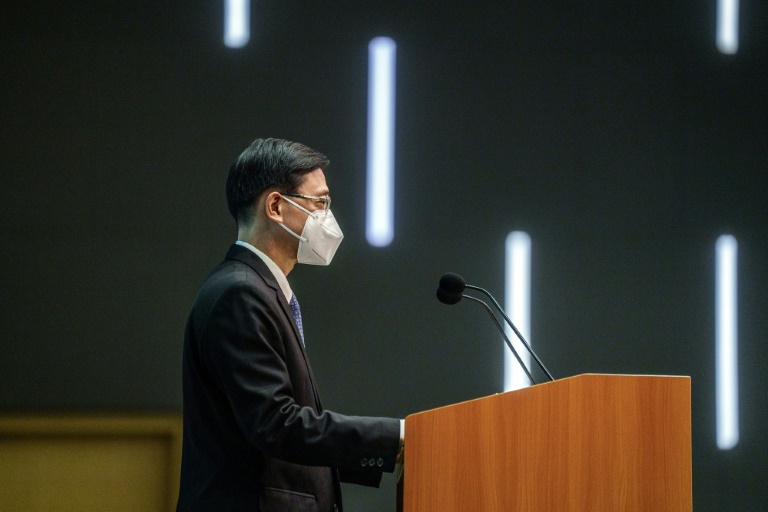
Speaking from behind a face mask at an online press conference, Lee laid out his vision for the future under the slogan “Starting a New Chapter for Hong Kong Together”.

But his stump speech stuck to aspirations and ideals without detailing any concrete policies or targets.

“I am a pragmatic man, and have always believed in being results-oriented,” Lee said. 

“This will be a new symphony and I am the conductor.”

– ‘Weak and unprepared’ –

Lee became Hong Kong’s number two official after four decades in the security services, overseeing the police response to the democracy protests three years ago and its subsequent crackdown.

He is one of 11 Hong Kong and Chinese officials, including outgoing leader Carrie Lam, who were sanctioned by the United States for their role in that clampdown.

Lee on Saturday justified his response to the 2019 protests by saying they involved “foreign interference, serious political interests” and attacks against the government.

Asked about his relative inexperience in the business sector, Lee said he will rely on his team and said his lack of connections meant he would have “no baggage” — making it easier to be fair.

On Hong Kong’s acute housing supply — a crisis successive administrations have all vowed and failed to tackle — Lee said he would speed up the government’s response. 

But he again gave no details on what his administration would do differently.

He spoke in both Cantonese, Mandarin and English throughout his appearance and only took questions from local, not international, media.

Kenneth Chan, a political scientist from the Baptist University, said he felt Lee was “surprisingly weak and unprepared” despite a “carefully choreographed” press conference.

“He didn’t seem to be prepared to offer any new ideas — not to mention any sense of hope — to people in Hong Kong who have been struggling,” Chan told AFP. 

“I think listeners would have to struggle to look for the substance.”

– ‘Patriotic candidate’ –

Former Hong Kong leader CY Leung — previously tipped as a potential rival — endorsed Lee’s bid on Saturday, urging the public to unite behind him as the next leader.

Another potential competitor, finance chief Paul Chan, earlier signalled he was out of the race by wishing Lee “all the best”.

Hong Kong’s next leader will be chosen on May 8 by a committee of around 1,500 elite figures vetted for their loyalty to Beijing — roughly 0.02 percent of the city’s population.

Top Beijing loyalists in Hong Kong, as well as several billionaire property and business moguls, have thrown their weight behind Lee this week.

Lee is an “experienced, courageous and patriotic candidate”, said Martin Lee, co-chair of Hong Kong developer Henderson Land.

But the public response to Lee’s bid has been tepid, compared with the heated contest five years ago between three candidates.

Senior government loyalists have sought to play down criticism that this year’s leadership race is unlikely to field any rivals to Lee. 

“Having one person run for (chief executive) does not mean we have fewer choices,” Maria Tam, a former lawmaker who sits on Beijing’s top lawmaking body, told a radio programme earlier this week.

Saudi Arabia to allow one million hajj pilgrims this year

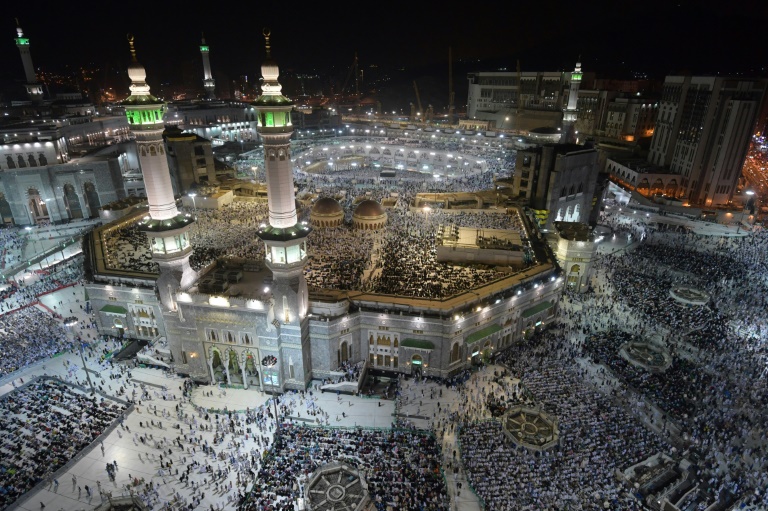
Saudi Arabia said Saturday it will permit one million Muslims from inside and outside the country to participate in this year’s hajj, a sharp uptick after pandemic restrictions forced two years of drastically pared-down pilgrimages.

The move, while falling short of reinstating normal hajj conditions, offered hopeful news for many Muslims outside the kingdom who have been barred from making the trip since 2019.

One of the five pillars of Islam, the hajj must be undertaken by all Muslims with the means at least once in their lives. Usually one of the world’s largest religious gatherings, about 2.5 million people took part in 2019.

But after the onset of the coronavirus pandemic in 2020, Saudi authorities allowed only 1,000 pilgrims to participate.

The following year, they upped the total to 60,000 fully vaccinated Saudi citizens and residents chosen through a lottery.

This year the Saudi hajj ministry “has authorised one million pilgrims, both foreign and domestic, to perform the hajj,” it said in a pre-dawn statement Saturday.

– Age cap criticised –

The pilgrimage, which will take place in July, will be limited to vaccinated Muslims under age 65, the statement said.

Those coming from outside Saudi Arabia, who must apply for hajj visas, will this year also be required to submit a negative Covid-19 PCR result from a test taken within 72 hours of travel. 

The government wants to promote pilgrims’ safety “while ensuring that the maximum number of Muslims worldwide can perform the hajj”, the statement said.

The hajj consists of a series of religious rites that are completed over five days in Islam’s holiest city, Mecca, and surrounding areas of western Saudi Arabia.

Authorities took a number of special measures to reduce the spread of the coronavirus last year, including dividing pilgrims into groups of 20 and handing out disinfectants, masks and sterilised pebbles for the “stoning of Satan” ritual.

But the relatively small crowds were distressing to Muslims abroad.

“We have been in great sadness and pain in the past two years because of the small number of pilgrims. The scene was horrible,” 36-year-old Cairo resident Mohamed Tamer said Saturday.

“I am very happy that the hajj will return to normality to some extent,” he added, though he also expressed worry about rising costs including for flights and hotels.

Reactions to Saturday’s announcement were generally positive on social media, though some Twitter users criticised the age cap.

“Such great news, but imposing age restrictions is heartbreaking for many aged hajj aspirants,” one user wrote in response to the hajj ministry’s announcement.

Others voiced concern about what would happen to pilgrims who financed trips to Mecca — only to have their plans ruined by a positive Covid-19 test. 

– Matter of prestige –

Hosting the hajj is a matter of prestige for Saudi rulers, as the custodianship of Islam’s holiest sites is the most powerful source of their political legitimacy.

Before the pandemic, Muslim pilgrimages were key revenue earners for the kingdom, bringing in some $12 billion annually.

The kingdom of approximately 34 million people has so far recorded more than 751,000 coronavirus cases, including 9,055 deaths, according to health ministry data.

In early March it announced the lifting of most Covid restrictions including social distancing in public spaces and quarantine for vaccinated arrivals, moves that were expected to facilitate an increase in Muslim pilgrims.

The decision included suspending “social distancing measures in all open and closed places” including mosques, while masks are now only required in closed spaces.

War in Ukraine: Latest developments

 not show up!Here are the latest developments in the war in Ukraine:

– 52 killed at train station – 

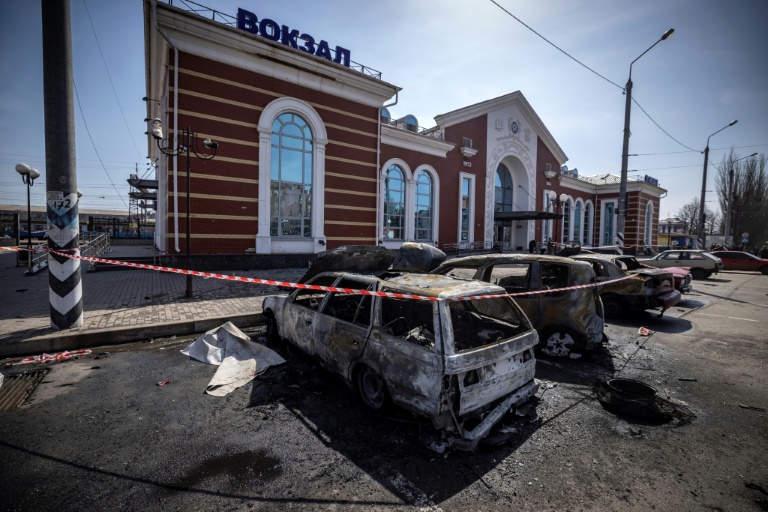
At least 52 people are killed, including five children, in a rocket attack on a train station in the eastern Ukrainian city of Kramatorsk that is being used for civilian evacuations, according to Donetsk region governor Pavlo Kyrylenko. 

Ukrainian President Volodymyr Zelensky describes Russia as an “evil with no limits” after the attack and calls for a “firm global response”.

US President Joe Biden accuses Russia of being behind the attack, calling it a “horrific atrocity”, while French Foreign Minister Jean-Yves Le Drian deems it a “crime against humanity”.

Russia’s defence ministry accuses Kyiv of carrying out the attack, saying it wanted to use fleeing residents “as a ‘human shield’ to defend the positions of Ukraine’s Armed Forces”.

– EU chief warns of Russian ‘decay’ –

European Commission President Ursula von der Leyen says Russia will descend into “economic, financial and technological decay, while Ukraine is marching towards a European future”, speaking after meeting Zelensky in Kyiv.

She met him after visiting a mass grave in Bucha, a town north of the capital where Russian forces are accused by Ukraine’s allies of carrying out atrocities against civilians.

“If this is not a war crime, what is a war crime?” Von der Leyen asks, saying it is “extremely important” that all crimes be documented, linked to a probe by the International Criminal Court in The Hague.  

– Odessa curfew –  

A curfew is to start in Ukraine’s southern city of Odessa on Saturday evening to Monday evening over a “missile strike threat” from Russia, and after the shelling of the train station in Kramatorsk.

– Eastern evacuation – 

Civilians in eastern Ukraine are struggling to evacuate, after officials tell them they have a “last chance” to avoid a major Russian offensive expected in the Donbas region.

Russia has redeployed its troops towards the east and south, aiming to create a land link between occupied Crimea and the Moscow-backed separatist regions of Donetsk and Lugansk in Donbas.

– Ukraine controls border region –

Ukrainian forces are in control of the northeast region of Sumy along the border with Russia, governor Dmytro Zhyvytsky says on social media.

He warns: “The region is not safe. There are many areas that have been mined and are still not cleared.”

– Russia shutters rights groups –  

Russia says it is shutting down the local offices of a number of international organisations including Human Rights Watch, Amnesty International and the Carnegie Endowment for International Peace.

The organisations have been taken off Russia’s registry of international organisations and foreign NGOs due to “violations of the current legislation of the Russian Federation”, the justice ministry says. 

– EU sanctions Putin’s daughters –

Russian President Vladimir Putin’s two adult daughters and more than 200 other people are blacklisted by the EU.

Those on the list, which additionally includes 18 companies, face asset seizures and travel bans in the 27-nation European Union. 

The United States and Britain had already sanctioned Putin’s daughters, as well as the daughter of Foreign Minister Sergey Lavrov.

– Ruble bounces back despite sanctions –

After a historic collapse in the wake of Russia’s military offensive in Ukraine, the ruble stages a spectacular bounceback, supported by strict capital controls and energy exports.

But analysts say that success is in many ways artificial and does not bode well for the health of the Russian economy.

– US-South Africa call –

South African President Cyril Ramaphosa holds telephone talks with his US counterpart, a day after the continental powerhouse abstained from voting on a resolution suspending Russia from a UN rights body over its aggression in Ukraine.

“We shared views on the conflict in Ukraine and agreed on the need for a ceasefire and dialogue between Ukraine and Russia,” Ramaphosa wrote on Twitter.

– UN says 1,000 seafarers trapped –

Two UN agencies call for “urgent action” to help and protect around 1,000 sailors on trading ships stranded in Ukrainian ports and waters since the Russian invasion.

The heads of the International Labour Organization (ILO) and the International Maritime Organization (IMO) said tat more than 100 trading ships cannot leave Ukrainian ports and waters.

Two European divers rescued after disappearing in Malaysia

A British man and French teenager were rescued Saturday three days after going missing while diving in Malaysia, police said, as hopes faded for the man’s son who is still unaccounted for. 

The trio and their instructor got into trouble Wednesday after they surfaced from a dive near a southern island but could not find their boat.

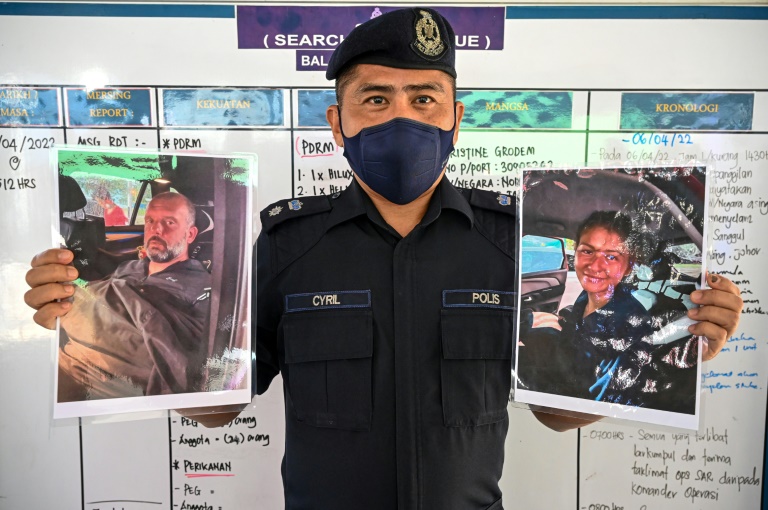
The Briton, 46-year-old Adrian Chesters, and Frenchwoman Alexia Molina, 18, were discovered by fishermen in the waters of neighbouring Indonesia, picked up by marine police and taken back to Malaysia. 

They were found about 30 kilometres (18 miles) north of Indonesia’s Bintan Island — having drifted some 130 kilometres from where they had been diving.

The pair have been admitted to a Malaysian hospital in a stable condition, said local police chief Cyril Edward Nuing in the coastal town of Mersing, the base for search operations.

The instructor, Norwegian woman Kristine Grodem, had already been rescued on Thursday in waters off southern Malaysia.

Chesters’s son, 14-year-old Nathen, who holds Dutch citizenship, remains missing and officials believe he has drifted into Indonesian waters.

There is a “high possibility that he is not in Malaysian waters, based on the flow of the current and the time and place where these two (Peters and Molina) were found”, said Nuing.

“We decided to stop the search and rescue in Malaysian waters and we have informed Indonesian parties to continue (it).”

Malaysian authorities remain on standby in case they need to resume the hunt, he added.

In recent days, Malaysia had deployed helicopters, a plane, boats, divers and jet skiers to hunt over a large area. 

– ‘Strong girl’ –

Authorities did not give details on how the rescued trio survived a long period drifting at sea, and said they have not yet been questioned in detail about their ordeal.

Previously, officials had expressed hope the divers would be found alive as they had substantial experience and were well equipped, including with a diving buoy.

They also said that light rains in recent days might help the divers survive by providing drinking water.

On Thursday, the French teen’s mother Esther Molina told AFP from Mersing that the family were “hoping for the best. She’s a strong girl, she’ll kick ass.”

Grodem had been instructing the divers close to a small island, Tokong Sanggol, about 15 kilometres (nine miles) off Malaysia’s southeast coast, when the accident happened.

After a dive lasting about 40 minutes, they surfaced but could not find their boat. They drifted together in strong currents, but ended up getting separated.

The captain of the boat who took them to the dive site has been arrested after testing positive for drugs.

The area where the accident happened is popular with foreign and domestic visitors — resorts dot the coast and the islands.

Diving accidents, while rare, do occasionally happen in Malaysia. 

In 2013, a British tourist died when she was struck by a passing boat’s propeller while diving off resort islands in the South China Sea. 

The tropical Southeast Asian nation’s borders reopened to foreign tourists on April 1 after a two-year coronavirus closure, and thousands of visitors have arrived.

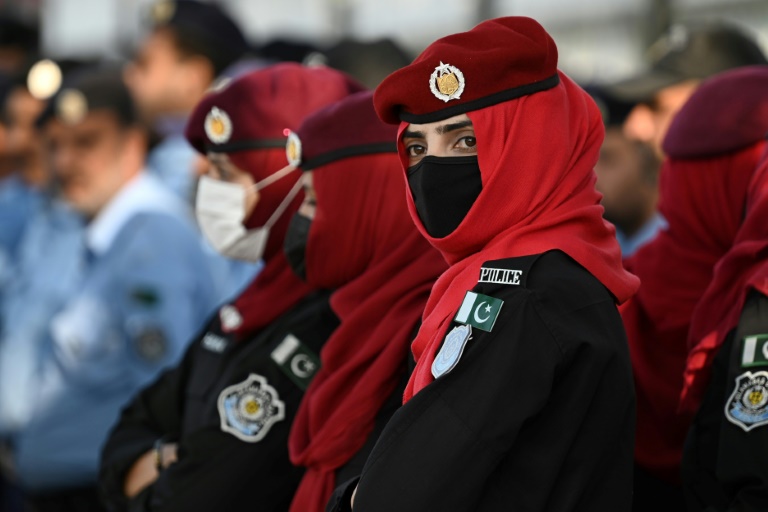
Pakistan lawmakers clash as PM no-confidence debate begins

Pakistan lawmakers clashed angrily in the national assembly Saturday ahead of a no-confidence vote on Prime Minister Imran Khan that will likely see him booted from office.

The speaker adjourned proceedings without giving a reason after just 30 rowdy minutes, ordering lawmakers to return in the afternoon.

Khan, who was not present, has lost his majority in the 342-seat assembly through defections by coalition partners and members of his own party, and the opposition need just 172 votes to dismiss him.

There is no vote for a new premier on the agenda, but that could change and Pakistan Muslim League-N (PML-N) leader Shehbaz Sharif is the anointed candidate.

Tempers rose as Shehbaz insisted a vote be held immediately — as ordered by the Supreme Court Thursday — but Khan loyalists demanded discussion first on their leader’s claims there had been foreign interference in the process.

“You will run proceedings of the house under the order of the Supreme Court,” said a furious Shehbaz, wagging his finger.

“Parliament is going to write a new history. Today, the parliament is going to defeat a… prime minister.”

“We intend to face it in accordance with law and constitution,” replied Foreign Minister Shah Mehmood Qureshi, adding: “It is my duty to defend the motion.”

Khan, 69, said late Friday he had accepted a Supreme Court ruling that ordered the no-confidence vote, but insisted he was victim of a “regime change” conspiracy involving the United States.

The former international cricket star said he would not cooperate with any incoming administration and called on his supporters to take to the streets.

– Security blanket –

A heavy security blanket was thrown over the capital Saturday, with thousands of police on the streets and a ring of steel containers blocking access to the government enclave.

The Supreme Court ruled Thursday that Khan acted illegally by dissolving parliament and calling fresh elections after the deputy speaker of the national assembly — a loyalist — refused to allow an earlier no-confidence vote because of “foreign interference”.

Khan said the PML-N and the Pakistan People’s Party (PPP) — two normally feuding dynastic groups who joined forces to oust him — had conspired with Washington to bring the no-confidence vote because of his opposition to US foreign policy, particularly in Muslim nations such as Iraq and Afghanistan.

With reference to the defections, he also accused the opposition of buying support in the assembly with “open horse-trading… selling of lawmakers like goats and sheep”.

“I was disappointed with the Supreme Court decision but I want to make it clear that I respect the Supreme Court and Pakistan’s judiciary,” he said.

“There is a conspiracy from abroad,” Khan said. “This is a very serious allegation… that a foreign country conspired to topple an entire government.”

Washington has denied any involvement.

Whoever takes over will still have to deal with the issues that bedevilled Khan — soaring inflation, a feeble rupee and crippling debt.

Militancy is also on the rise, with Pakistan’s Taliban emboldened by the return to power last year of the hardline Islamist group in neighbouring Afghanistan.

– ‘Vindictive probes’ –

How long the next government lasts is also a matter of speculation.

The opposition said previously they wanted an early election — which must be called by October next year — but taking power gives them the opportunity to set their own agenda and end a string of probes they said Khan launched vindictively against them.

Local media quoted an election commission official as saying it would take them at least seven months to prepare for a national vote.

Pakistan has been wracked by political crises for much of its 75-year existence, and no prime minister has ever seen out a full term.

Publicly the military appears to be keeping out of the current fray, but there have been four coups since independence in 1947 and the country has spent more than three decades under army rule.

US warns of 'arbitrary' Covid measures in China

The United States on Saturday warned of “arbitrary” Covid-19 measures in China and said it would let some staff leave its Shanghai consulate amid a surge of infections in the locked-down megacity.

Until March, China had kept cases low with snap lockdowns, mass testing and travel restrictions, but more than 100,000 cases have been reported in Shanghai since March in a test of the country’s strict zero-Covid policy.

The city’s roughly 25 million inhabitants were locked down in phases last week, prompting complaints of food shortages and viral videos of disgruntled residents scuffling with officials.

The US State Department will now allow non-essential employees to leave its consulate in Shanghai “due to a surge in Covid-19 cases and the impact of restrictions related to the response”, a US embassy spokesperson said in a statement.

The statement warned citizens to reconsider travelling to China, “due to arbitrary enforcement of local laws and Covid-19-related restrictions”, adding that the embassy in Beijing had raised its concerns over the measures with the Chinese government.

Shanghai reported more than 23,000 new infections on Saturday — mostly asymptomatic, accounting for more than 90 percent of new domestic infections in the country.

City authorities are preparing thousands of new beds in makeshift quarantine centres.

Meanwhile locals have begun to chafe at lockdown restrictions, with some using social media to complain of food shortages and express outrage over the recent killing of a pet corgi by health workers.

An unpopular policy of splitting infected children from their virus-free parents was softened this week after triggering public anger.

But Beijing is sticking to its zero-tolerance approach and is determined to squash the Shanghai outbreak, sending medical workers from around the country in as reinforcements.

Shanghai officials said on Saturday they planned to perform a new round of PCR tests on the city’s entire population, after which it would begin relaxing rules in some neighbourhoods — provided they met the strict requirement of no infections in the past 14 days.

In 'project of the century', Swiss seek to bury radioactive waste

Storing radioactive waste above ground is a risky business, but the Swiss think they have found the solution: burying spent nuclear fuel deep underground in clay.

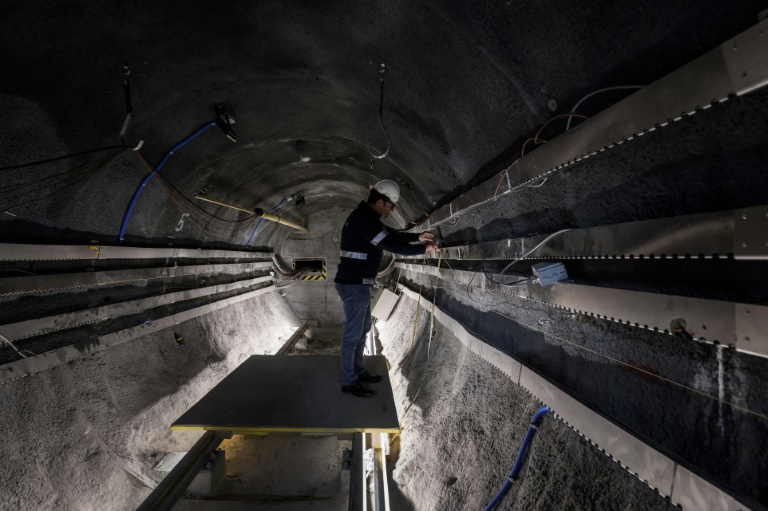
The Mont Terri international laboratory was built to study the effects of burying radioactive waste in clay which sits 300 metres (985 feet) below the surface near Saint-Ursanne in the northwestern Jura region.

The underground laboratory stretches across 1.2 kilometres (0.7 miles) of tunnels. Niches along the way, each around five metres high, are filled with various storage simulations, containing small quantities of radioactive material monitored by thousands of sensors.

More than 170 experiments have been carried out to simulate the different phases of the process — positioning the waste, sealing off the tunnels, surveillance — and to reproduce every imaginable physical and chemical effect.

According to experts, it takes 200,000 years for the radioactivity in the most toxic waste to return to natural levels.

Geologist Christophe Nussbaum, who heads the laboratory, said researchers wanted to determine what the possible effects could be “on storage that needs to last for nearly one million years.”

That “is the duration that we need to ensure safe confinement,” he said, adding that so far, “the results are positive.”

– Potential sites identified –

Three prospective sites in the northeast, near the German border, have been identified to receive such radioactive waste. 

Switzerland’s nuclear plant operators are expected to choose their preferred option in September.

The Swiss government is not due to make the final decision until 2029, but that is unlikely to be the last word as the issue would probably go to a referendum under Switzerland’s famous direct democracy system.

Despite the drawn-out process, environmental campaigners Greenpeace say Switzerland is moving too fast.

“There are a myriad of technical questions that have not been resolved,” Florian Kasser, in charge of nuclear issues for the environmental activist group, told AFP.

For starters, he said, it remains to be seen if the systems in place can “guarantee there will be no radioactive leakage in 100, 1,000 or 100,000 years.”

“We are putting the cart before the horse, because with numerous questions still unresolved, we are already looking for sites” to host the storage facilities, he said.

Kasser said Switzerland also needed to consider how it will signal where there sites are to ensure they are not forgotten, and that people many centuries from now remain aware of the dangers.

Swiss nuclear power plants have been pumping out radioactive waste for more than half a century.

Until now, it has been handled by the National Cooperative for the Disposal of Radioactive Waste, or NAGRA, founded in 1972 by the plant operators in conjunction with the state.

For now, the waste is being stored in an “intermediary depot” in Wurenlingen, some 15 kilometres from the German border.

– Horizon 2060 –

Switzerland hopes to join an elite club of countries closing in on deep geological storage.

So far, only Finland has built a site, in granite, and Sweden gave the green light in January to build its own site for burying spent nuclear fuel in granite. 

Next up is France, whose Cigeo project, led by the National Agency for Radioactive Waste Management (ANDRA), plans to store radioactive waste underground in clay.

“We are awaiting the declaration of public utility but in the meantime we will submit a request for a construction permit,” said ANDRA spokeswoman Emilie Grandidier during a visit to Mont Terri.

Following the 2011 nuclear accident at the Fukushima power station in Japan, Switzerland decided to phase out nuclear power gradually: its reactors can continue for as long as they remain safe.

A projected 83,000 cubic metres of radioactive waste, including some high activity waste, will have to be buried.

This volume corresponds to a 60-year operating life of the Beznau, Gosgen and Leibstadt nuclear power plants, and the 47 years that Muhleberg was in operation before closing in 2019.

Filling in the underground nuclear waste tombs should begin by 2060.

“It’s the project of the century: we have carried out the scientific research for 50 years, and we now have 50 years for the authorisation and the realisation of the project,” said Nagra spokesman Felix Glauser.

The monitoring period will span several decades before the site is sealed some time in the 22nd century.

Close Bitnami banner
Bitnami