World

War in Ukraine: Latest developments

Here are the latest developments in the war in Ukraine:

– 52 killed at train station – 

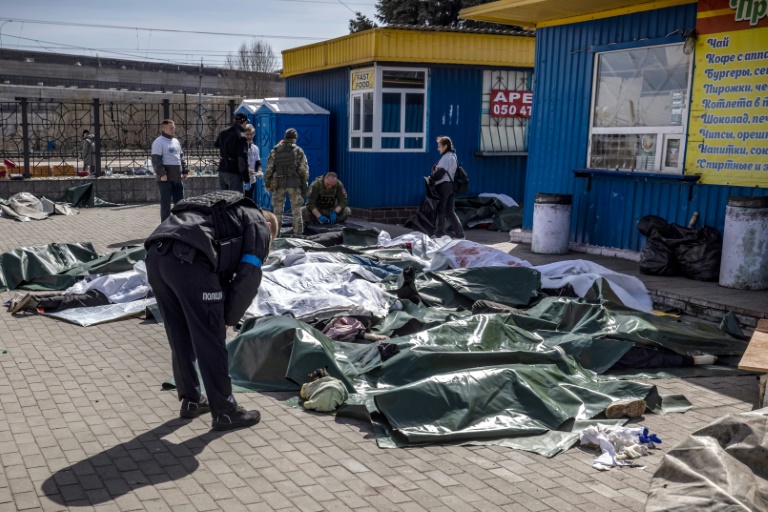
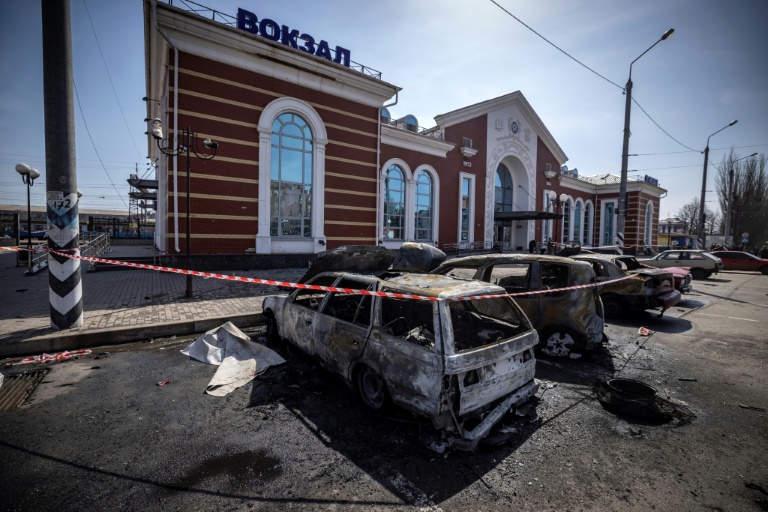
At least 52 people are killed, including five children, in a rocket attack on a train station in the eastern Ukrainian city of Kramatorsk that is being used for civilian evacuations, according to Donetsk region governor Pavlo Kyrylenko. 

Ukrainian President Volodymyr Zelensky describes Russia as an “evil with no limits” after the attack and calls for a “firm global response”.

US President Joe Biden accuses Russia of being behind the attack, calling it a “horrific atrocity”, while French Foreign Minister Jean-Yves Le Drian deems it a “crime against humanity”.

Russia’s defence ministry accuses Kyiv of carrying out the attack, saying it wanted to use fleeing residents “as a ‘human shield’ to defend the positions of Ukraine’s Armed Forces”.

– EU chief warns of Russian ‘decay’ –

European Commission President Ursula von der Leyen says Russia will descend into “economic, financial and technological decay, while Ukraine is marching towards a European future”, speaking after meeting Zelensky in Kyiv.

She met him after visiting a mass grave in Bucha, a town north of the capital where Russian forces are accused by Ukraine’s allies of carrying out atrocities against civilians.

Austrian Chancellor Karl Nehammer also leaves for Kyiv, one of the first EU leaders to visit Ukraine after images of corpses in Bucha came to light.

– Odessa curfew –  

Ukraine’s southern city of Odessa imposes a curfew from Saturday evening to Monday evening over a “missile strike threat” from Russia, and after the shelling of the train station in Kramatorsk.

– Eastern evacuation – 

Civilians in eastern Ukraine are struggling to evacuate, after officials tell them they have a “last chance” to avoid a major Russian offensive expected in the Donbas region.

Russia has redeployed its troops towards the east and south, aiming to create a land link between occupied Crimea and the Moscow-backed separatist regions of Donetsk and Lugansk in Donbas.

– Ukraine controls border region –

Ukrainian forces are in control of the northeast region of Sumy along the border with Russia, governor Dmytro Zhyvytsky says on social media.

He warns: “The region is not safe. There are many areas that have been mined and are still not cleared.”

– Russia shutters rights groups –  

Russia says it is shutting down the local offices of a number of international organisations including Human Rights Watch, Amnesty International and the Carnegie Endowment for International Peace.

The organisations have been taken off Russia’s registry of international organisations and foreign NGOs due to “violations of the current legislation of the Russian Federation”, the justice ministry says. 

– Britain sanctions Putin’s daughters –

Britain announces sanctions on the daughters of Russian President Vladimir Putin and Foreign Minister Sergey Lavrov.

It also sends Ukraine more “high-grade military equipment” including Starstreak anti-aircraft missiles and 800 anti-tank missiles.

– Ruble bounces back despite sanctions –

After a historic collapse in the wake of Russia’s military offensive in Ukraine, the ruble stages a spectacular bounceback, supported by strict capital controls and energy exports.

But analysts say that success is in many ways artificial and does not bode well for the health of the Russian economy.

– US-South Africa call –

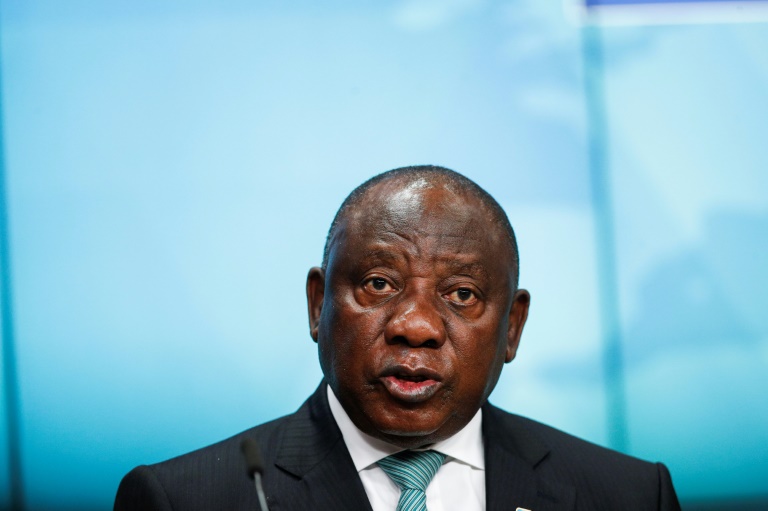
South African President Cyril Ramaphosa holds telephone talks with his US counterpart, a day after the continental powerhouse abstained from voting on a resolution suspending Russia from a UN rights body over its aggression in Ukraine.

“We shared views on the conflict in Ukraine and agreed on the need for a ceasefire and dialogue between Ukraine and Russia,” Ramaphosa wrote on Twitter.

– UN says 1,000 seafarers trapped –

Two UN agencies call for “urgent action” to help and protect around 1,000 sailors on trading ships stranded in Ukrainian ports and waters since the Russian invasion.

The heads of the International Labour Organization (ILO) and the International Maritime Organization (IMO) said that more than 100 trading ships cannot leave Ukrainian ports and waters.
Pakistan PM on way out as no-confidence vote looms

Pakistan Prime Minister Imran Khan looked certain to be kicked out of office Saturday by a no-confidence vote in parliament, but a political crisis in the nuclear-armed nation of 220 million will likely continue.

Khan lost his majority in the 342-seat national assembly through defections by coalition partners and members of his own Pakistan Tehreek-e-Insaf party (PTI), and the opposition need just 172 votes to dismiss him.

There is no vote for a new premier on the agenda Saturday, but that could change and Pakistan Muslim League-N (PML-N) leader Shehbaz Sharif is the anointed candidate.

But whoever takes over will still have to deal with the issues that bedevilled Khan — soaring inflation, a feeble rupee and crippling debt.

Militancy is also on the rise, with Pakistan’s Taliban emboldened by the return to power last year of the hardline Islamist group in neighbouring Afghanistan.

Khan, 69, said late Friday he had accepted a Supreme Court ruling that ordered the no-confidence vote, but insisted he was victim of a “regime change” conspiracy involving the United States.

The former international cricket star said he would not cooperate with any incoming administration and called on his supporters to take to the streets.

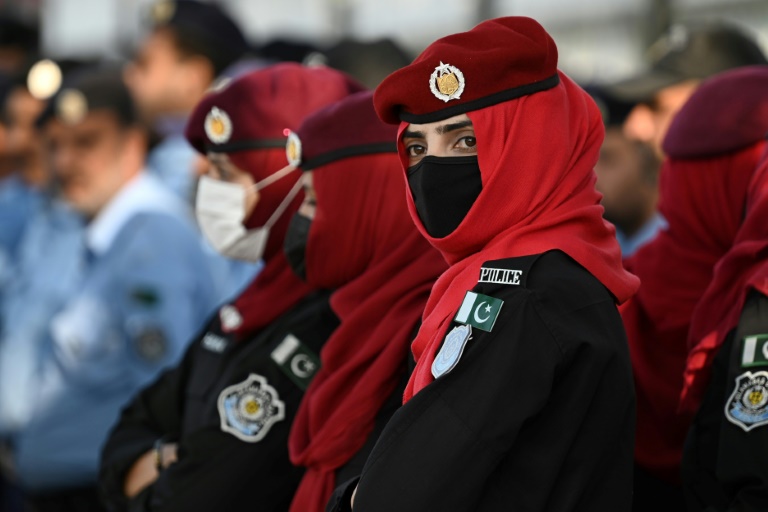
A heavy security blanket was thrown over the capital Saturday, with thousands of police on the streets and a ring of steel containers blocking access to the government enclave.

– ‘Foreign interference’ –

The Supreme Court ruled Thursday that Khan acted illegally by dissolving parliament and calling fresh elections after the deputy speaker of the national assembly — a loyalist — refused to allow an earlier no-confidence vote because of “foreign interference”.

Khan said the PML-N and the Pakistan People’s Party (PPP) — two normally feuding dynastic groups who joined forces to oust him — had conspired with Washington to bring the no-confidence vote because of his opposition to US foreign policy, particularly in Muslim nations such as Iraq and Afghanistan.

With reference to the defections, he also accused the opposition of buying support in the assembly with “open horse-trading… selling of lawmakers like goats and sheep”.

“I was disappointed with the Supreme Court decision but I want to make it clear that I respect the Supreme Court and Pakistan’s judiciary,” he said.

“There is a conspiracy from abroad,” Khan said. “This is a very serious allegation… that a foreign country conspired to topple an entire government.”

Washington has denied any involvement.

How long the next government lasts is also a matter of speculation.

The opposition said previously they wanted an early election — which must be called by October next year — but taking power gives them the opportunity to set their own agenda and end a string of probes they said Khan launched vindictively against them.

Local media quoted an election commission official as saying it would take them at least seven months to prepare for a national vote.

Pakistan has been wracked by political crises for much of its 75-year existence, and no prime minister has ever seen out a full term.

Publicly the military appears to be keeping out of the current fray, but there have been four coups since independence in 1947 and the country has spent more than three decades under army rule.

Ramaphosa, Biden talk after South Africa abstains from UN Russia vote

South African President Cyril Ramaphosa held telephone talks Friday with US President Joe Biden, a day after the continental powerhouse abstained from voting on a resolution suspending Russia from a UN rights body over its aggression in Ukraine.

Ramaphosa, whose government has been criticised for refusing to condemn Moscow’s bloody invasion, had a day earlier blasted the UN Security Council as “outdated” and in dire need of an overhaul.

Hours later, South Africa was among the 58 countries that abstained from voting on the UN General Assembly resolution that suspended Russia from the UN Human Rights Council as punishment for the invasion of Ukraine.

It was the third time South Africa abstained from voting on resolutions adopted over the war.

Ramaphosa tweeted Friday that he had “a productive” telephone call with Biden. 

“We shared views on the conflict in Ukraine and agreed on the need for a ceasefire and dialogue between Ukraine and Russia,” Ramaphosa wrote.

The White House said in a readout of the call that Biden “emphasized the strength of the bilateral partnership, as well as global challenges brought on by Russia’s further invasion of Ukraine”.

The American leader stressed “the need for a clear, unified international response to Russian aggression in Ukraine”, the statement said.

Local media suggested it was Biden who initiated the call to Ramaphosa.

The high-profile rebuke of Russia at the UN marked only the second ever suspension of a country from the global body’s human rights council — Libya was the first, in 2011.

On Thursday, Ramaphosa sharply criticised the UN Security Council for enabling powerful nations to use their clout to make decisions that were at times catastrophic.

“The current formation of the UN Security Council is outdated and unrepresentative,” he said. “It disadvantages countries with developing economies.”

South Africa has maintained a non-aligned stance on the conflict in Ukraine, touting negotiation as the best option to end the conflict despite international outrage and condemnation.

Zelensky calls for 'firm global response' to train station bombing

Ukrainian President Volodymyr Zelensky called for a “firm global response” Friday after a missile strike killed 52 people at a train station in eastern Ukraine where civilians had gathered to flee a feared Russian offensive.

“This is another Russian war crime for which everyone involved will be held accountable,” Zelensky said in a video message, referring to Friday’s missile strike, whose victims included five children. 

“World powers have already condemned Russia’s attack on Kramatorsk. We expect a firm global response to this war crime,” he continued.

World leaders condemned the attack in the Donetsk capital, with US President Joe Biden accusing Russia of being behind a “horrific atrocity” that the French condemned as a “crime against humanity.”

At least 52 people including five children were killed, the regional government said, while Zelensky reported 300 wounded, saying the strike showed “evil with no limits”.

Zelensky said the bombing had been reported in Russia before the missiles had even landed and called for more weaponry to counter Moscow’s aggression.

“I am sure that the victory of Ukraine is just a matter of time, and I will do everything to reduce this time,” he added.

AFP journalists saw the bodies of at least 30 people under plastic sheets next to the station.

Body parts, packed bags and stuffed animals were flung across the floor.

On the station forecourt, the remains of a missile were still visible.

It was tagged with white paint with the words “for our children” in Russian, an expression frequently used by pro-Russian separatists in reference to their losses since the start of the first Donbas war in 2014.

“I was in the station. I heard, like, a double explosion. I rushed to the wall for protection,” said Natalia, searching for her passport among the abandoned belongings.

Another woman in a state of shock told AFP: “I saw people covered in blood entering the station and bodies everywhere on the ground.”

Russia denied being behind the missile strike, which came with European Commission President Ursula von der Leyen and EU foreign policy chief Josep Borrell in Kyiv for talks with Zelensky and to visit the scene of civilian killings in the town of Bucha.

Russia faces “decay” because of ever tougher sanctions and Ukraine had a “European future”, Von der Leyen said at a news conference with Zelensky.

Six weeks into President Vladimir Putin’s invasion, Moscow has shifted its focus to eastern and southern Ukraine after stiff resistance ended plans to swiftly capture the capital Kyiv.

– ‘All this horror’ –

Russian troops appear set on creating a long-sought land link between occupied Crimea and the Moscow-backed separatist statelets of Donetsk and Lugansk in the Donbas region, where civilians have been urged to flee heavy shelling that has laid waste to towns and complicated evacuation efforts.

“There is no secret — the battle for Donbas will be decisive. What we have already experienced — all this horror — it can multiply,” warned Lugansk regional governor Sergiy Gaiday.

In the city of Lozova west of Kramatorsk, more than 15,000 people have fled, Oleg Sinegubov, head of the Kharkiv regional military administration, said on Telegram.

“There are still about 50 thousand [people]. A large number of people will leave. Departures are organized both by rail and own vehicles,” he said, adding that fighting was taking place nearby.

In the south, the Black Sea port city of Odessa girded for rocket attacks, imposing a weekend curfew.

Residents and Ukrainian officials returning after a Russian withdrawal from an area near Kyiv, meanwhile, were taking stock of the scale of the devastation.

Bucha, where authorities say hundreds were killed — some with their hands bound — has become a byword for the brutality allegedly inflicted under Russian occupation.

But Zelensky warned worse was being uncovered.

“They have started sorting through the ruins in Borodianka,” northwest of Kyiv, he said in his nightly address. “It is much more horrific there. There are even more victims of Russian occupiers.”

Conflict in the area has wrought massive destruction and bodies are only now being retrieved, with 27 recovered from two destroyed buildings, according to Prosecutor General Iryna Venediktova.

Fresh allegations also emerged from Obukhovychi, northwest of Kyiv, where villagers told AFP they were used as human shields.

– ‘Help us now’ –

Moscow has denied targeting civilians, but growing evidence of atrocities has galvanised Ukraine’s allies in the EU, which has approved an embargo on Russian coal and the closure of its ports to Russian vessels.

The bloc has frozen 30 billion euros ($32.6 billion) in assets from blacklisted Russian and Belarusian individuals and companies, it said Friday.

It also blacklisted Putin’s two adult daughters and more than 200 others as part of its latest sanctions package, according to an official list published late Friday.

The United States and Britain had already sanctioned the Russian leader’s daughters.

En route to Kyiv, Borrell told journalists the EU would supply 7.5 million euros to train Ukrainian prosecutors to investigate war crimes, which Russia is accused of committing.

At the United Nations General Assembly, 93 nations voted Thursday to suspend Russia from the body’s human rights council, prompting accusations from Moscow that the move was “illegal and politically motivated.”

“Russia’s lies are no match for the undeniable evidence of what is happening in Ukraine,” Biden said, calling the invasion “an outrage to our common humanity”.

Ukraine has welcomed new pressure on Moscow, but it continues to push for harsher sanctions and more heavy weaponry.

“Either you help us now — and I’m speaking about days, not weeks — or your help will come too late and many people will die, many civilians will lose their homes, many villages will be destroyed,” foreign minister Dmytro Kuleba said after meeting NATO foreign ministers in Brussels.

Britain said Friday it was sending Ukraine more “high-grade military equipment” including Starstreak anti-aircraft missiles and 800 anti-tank missiles, while Slovakia said it had given Ukraine an S-300 air defence system.

burs-ft/bgs/jfx/cwl

Two European divers rescued in Malaysia, one still missing

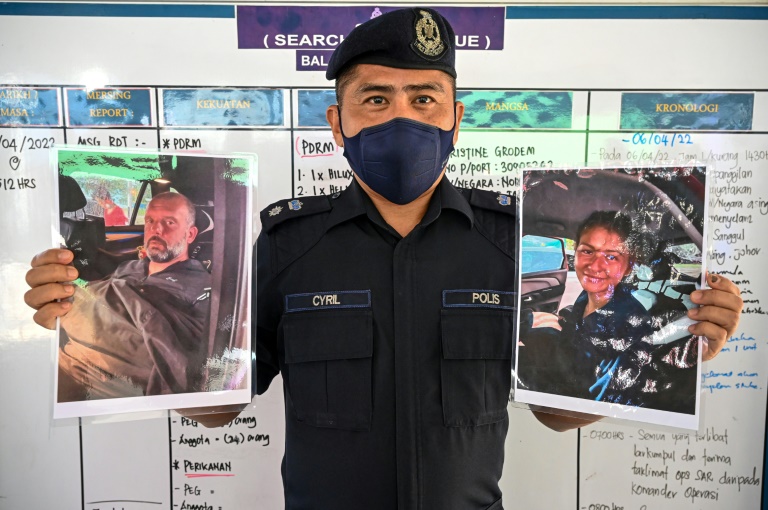
A British man and French teenager were rescued in Malaysia Saturday three days after going missing while diving, but the man’s son was still missing, police said.

The trio and their instructor got into trouble Wednesday after they surfaced from a dive near a southern island but could not find their boat.

The Briton, 46-year-old Adrian Peter Chesters, and Frenchwoman Alexia Alexandra Molina, 18, were discovered by local fishermen and picked up by marine police, said local police chief Cyril Edward Nuing.

“We have rescued two divers that were reported missing while doing scuba diving activities,” he told a press conference in the coastal town of Mersing, the base for search operations.

“They have survived, and are now in hospital in a stable condition.”

They were found off the southern state of Johor after drifting a substantial distance from their dive site and were taken to hospital in the city of Pasir Gudang.

Chesters’s son, 14-year-old Nathen, who holds Dutch citizenship, remains missing and search and rescue operations are continuing, he said. 

The instructor, 35-year-old Norwegian woman Kristine Grodem, was rescued Thursday and admitted to hospital in a stable condition.

The search and rescue operation has expanded, with helicopters, a plane, boats, divers and jet skiers looking at a large area. 

Nuing said officials would now focus their efforts further south, towards neighbouring Singapore and Indonesia.

– ‘Strong girl’ –

Authorities did not immediately give details on how the three survived a long period drifting at sea.

Previously, officials had expressed hope the divers would be found alive as they had substantial experience and were well-equipped, including with a diving buoy.

They also said that light rains in recent days might help the divers survive by providing drinking water.

On Thursday, the French teen’s mother Esther Molina told AFP from Mersing that the family were “hoping for the best. She’s a strong girl, she’ll kick ass”.

Grodem had been instructing the divers close to a small island, Tokong Sanggol, about 15 kilometres (nine miles) off Malaysia’s southeast coast, when the accident happened.

After a dive lasting about 40 minutes, they surfaced but could not find their boat. They drifted together in strong currents, but ended up getting separated.

The captain of the boat who took them to the dive site has been arrested after testing positive for drugs.

Resort and boat operators in the area have been asked to halt diving and snorkelling activities to make conditions easier for search and rescue teams.

The area where the accident happened is popular with foreign and domestic visitors — resorts dot the coast and the islands.

Diving accidents, while rare, do occasionally happen in Malaysia. 

In 2013, a British tourist died when she was struck by a passing boat’s propeller while diving off resort islands in the South China Sea. 

The tropical Southeast Asian nation’s borders reopened to foreign tourists on April 1 after a two-year coronavirus closure, and thousands of visitors have arrived.

Saudi Arabia to allow one million hajj pilgrims this year

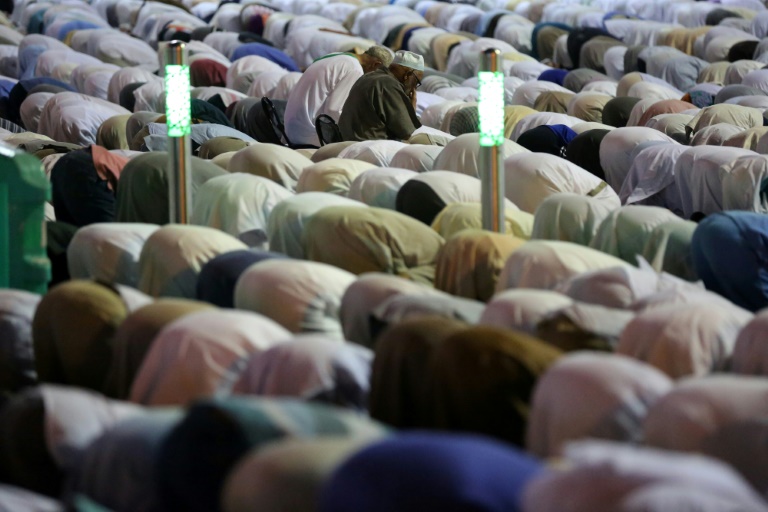
Saudi Arabia said Saturday it will permit one million Muslims from inside and outside the country to participate in this year’s hajj, a sharp uptick after pandemic restrictions forced two years of drastically pared-down pilgrimages. 

The hajj ministry “has authorised one million pilgrims, both foreign and domestic, to perform the hajj this year,” it said in a statement. 

One of the five pillars of Islam, the hajj must be undertaken by all Muslims with the means at least once in their lives. Usually one of the world’s largest religious gatherings, about 2.5 million people took part in 2019. 

But after the onset of the coronavirus pandemic in 2020, Saudi authorities allowed only 1,000 pilgrims to participate. 

The following year, they upped the total to 60,000 fully vaccinated citizens and residents chosen through a lottery. 

This year’s hajj, which will take place in July, will be limited to vaccinated pilgrims under age 65, Saturday’s announcement said.

Those coming from outside Saudi Arabia will be required to submit a negative Covid-19 PCR result from a test taken within 72 hours of travel. 

The government wants to promote pilgrims’ safety “while ensuring that the maximum number of Muslims worldwide can perform the hajj”, Saturday’s statement said. 

– Easing restrictions –

The hajj consists of a series of religious rites that are completed over five days in Islam’s holiest city, Mecca, and surrounding areas of western Saudi Arabia. 

Hosting the hajj is a matter of prestige for Saudi rulers, as the custodianship of Islam’s holiest sites is the most powerful source of their political legitimacy.

Before the pandemic, Muslim pilgrimages were key revenue earners for the kingdom, bringing in some $12 billion annually.

The restrictions in 2020 and 2021 stoked resentment among Muslims abroad who were barred.  

The kingdom of approximately 34 million people has so far recorded more than 751,000 coronavirus cases, including 9,055 deaths, according to health ministry data.

In early March it announced the lifting of most Covid restrictions including social distancing in public spaces and quarantine for vaccinated arrivals, moves that were expected to facilitate the arrival of Muslim pilgrims.

The decision included suspending “social distancing measures in all open and closed places” including mosques, while masks are now only required in closed spaces.

Guinea's ousted ex-president returns after treatment abroad

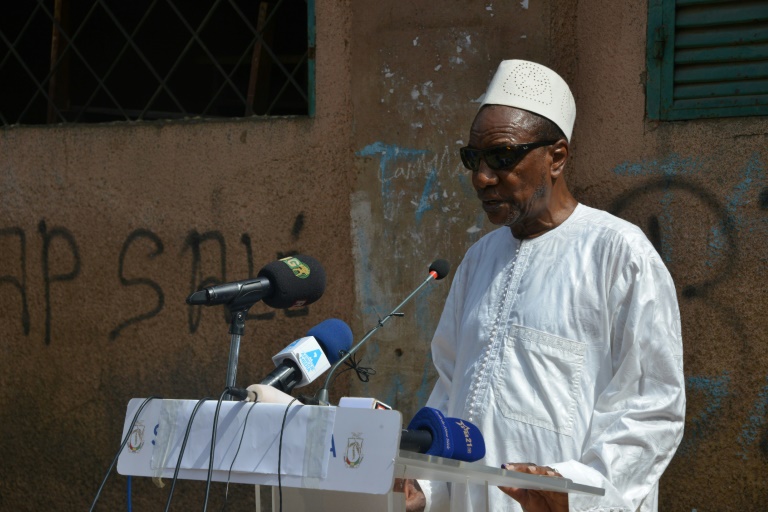
Guinea’s ousted ex-president Alpha Conde returned to the country Friday after a trip to the United Arab Emirates for medical treatment, the ruling junta said.

Conde “returned to Conakry this afternoon after medical treatment in the United Arab Emirates,” according to a junta statement read on television.

Conde became Guinea’s first democratically elected president in 2010.

But the 84-year-old was deposed by army officers last year and replaced by Colonel Mamady Doumbouya.

The coup followed fierce protests over Conde’s successful bid for a third term in office — a plan critics said breached the constitution.

He was then allowed to leave Guinea for the UAE in January. His release was one of the demands made by the West Africa bloc ECOWAS after the coup.

The junta was reportedly reluctant to let him go abroad for fear of potential plots against their newly established rule.

“The former president will remain in Guinea as long as his health permits. His integrity and dignity will always be respected in accordance with his rank and status,” the National Rallying Committee for Development (CNRD), the junta’s governing body, said in Friday’s statement.

But Conde’s Rally of the People of Guinea (RPG) party condemned the junta for “arbitrary actions” against him and his former administration.

On Wednesday, former Guinean prime minister Kassory Fofana and three ex-ministers who served under Conde were detained on embezzlement charges, in the latest probe targeting prominent figures since last year’s military coup.

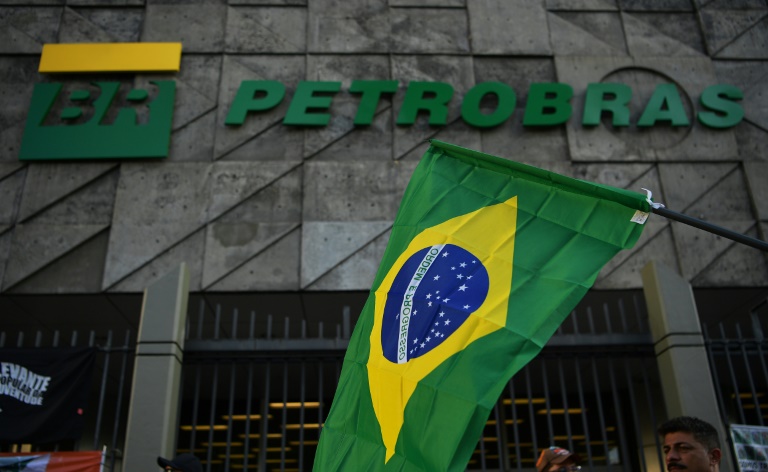
Rising petrol prices fuel uncertainty at oil giant Petrobras

Brazil’s state-run oil company Petrobras is once again in crisis: caught in a political tug of war over rising fuel costs.

Far-right President Jair Bolsonaro, seeking re-election in October, is widely blamed by voters for double-digit inflation, polls show, on the back of skyrocketing fuel prices.

Feeling the heat, Bolsonaro last week fired Petrobras CEO Joaquim Silva e Luna, saying the petrol price was “unaffordable” and amounted to a “crime” against Brazilians.

Tied to international market movement, fuel prices in Brazil rose 33 percent in the past year even as the economy recovers from the effects of the coronavirus pandemic.

Russia’s war in Ukraine has led to a spike in crude prices in recent weeks, adding to the pressure.

“Manipulating tariff policy is like manipulating the law of gravity,” Silva e Luna said after his firing last week.

Inflation in Brazil, meanwhile, rose more than 11 percent in a year, and opinion polls show that three-quarters of Brazilians blame Bolsonaro for their thinning wallets.

Bolsonaro’s main rival, leftist former president Luiz Inacio Lula da Silva, has also vowed to “Brazilianize the fuel price” — meaning to adapt it to the reality on the ground.

Lula, a former trade unionist and popular ex-leader, is the polled favorite ahead of October’s vote.

– Sacrificial firing –

With the fuel price in both men’s crosshairs, the future of Petrobras — which determines the price of petrol at the pump — depends very much on the outcome of October’s elections.

The company has hardly had time to settle after the 2014-2021 Operation Car Wash corruption probe that saw several top politicians and business executives convicted for embezzlement of billions of dollars from the oil giant.

After a tough year in 2020 due to the coronavirus pandemic freezing global travel, Petrobras posted a record net profit of nearly $20 billion in 2021.

But the results were not enough to satisfy the political bosses.

According to economist Gesner Oliveira, Silva e Luna was sacrificed by Bolsonaro “to satisfy his electorate”. 

Silva e Luna’s predecessor, Roberto Castello Branco, was fired by the president a year earlier for similar reasons.

But replacing the latest CEO has turned out to be more difficult than foreseen.

Bolsonaro’s pick, economist Adriano Pires, withdrew his name from the race this week due to a possible conflict of interest over his other role as head of an energy consulting firm.

Another nominee of the president, Rodolfo Landim, also withdrew to concentrate his attention on the Flamengo football club of which he is president.

Several other possible candidates had declined the job, according to the Brazilian press.

Then on Wednesday, the government nominated Jose Mauro Coelho, who was in charge of oil issues at the Ministry of Mines and Energy. 

His appointment could be approved at a shareholders’ meeting on April 13, making him the 40th Petrobras CEO in 68 years.

– ‘Complex economic problem’ –

Whoever is at the helm, the pressure from the top will be intense.

“This is a position exposed to very strong political pressure, and each dismissal is an easy political response to a complex economic problem,” Adriano Laureno of consulting firm Prospectiva told AFP.

Analysts say that internal regulations at Petrobras, which is listed on the New York and Sao Paulo stock exchanges, as well as Brazil’s reliance on imported oil, prevent any drastic change in pricing policy.

“A stabilization fund could be set up to mitigate price fluctuations, but it is not possible to change the tariff policy in depth,” said Oliveira.

Petrobras is also under threat of privatization, a move favored by Bolsonaro and several of his top political backers.

Rising petrol prices fuel uncertainty at oil giant Petrobras

Brazil’s state-run oil company Petrobras is once again in crisis: caught in a political tug of war over rising fuel costs.

Far-right President Jair Bolsonaro, seeking re-election in October, is widely blamed by voters for double-digit inflation, polls show, on the back of skyrocketing fuel prices.

Feeling the heat, Bolsonaro last week fired Petrobras CEO Joaquim Silva e Luna, saying the petrol price was “unaffordable” and amounted to a “crime” against Brazilians.

Tied to international market movement, fuel prices in Brazil rose 33 percent in the past year even as the economy recovers from the effects of the coronavirus pandemic.

Russia’s war in Ukraine has led to a spike in crude prices in recent weeks, adding to the pressure.

“Manipulating tariff policy is like manipulating the law of gravity,” Silva e Luna said after his firing last week.

Inflation in Brazil, meanwhile, rose more than 11 percent in a year, and opinion polls show that three-quarters of Brazilians blame Bolsonaro for their thinning wallets.

Bolsonaro’s main rival, leftist former president Luiz Inacio Lula da Silva, has also vowed to “Brazilianize the fuel price” — meaning to adapt it to the reality on the ground.

Lula, a former trade unionist and popular ex-leader, is the polled favorite ahead of October’s vote.

– Sacrificial firing –

With the fuel price in both men’s crosshairs, the future of Petrobras — which determines the price of petrol at the pump — depends very much on the outcome of October’s elections.

The company has hardly had time to settle after the 2014-2021 Operation Car Wash corruption probe that saw several top politicians and business executives convicted for embezzlement of billions of dollars from the oil giant.

After a tough year in 2020 due to the coronavirus pandemic freezing global travel, Petrobras posted a record net profit of nearly $20 billion in 2021.

But the results were not enough to satisfy the political bosses.

According to economist Gesner Oliveira, Silva e Luna was sacrificed by Bolsonaro “to satisfy his electorate”. 

Silva e Luna’s predecessor, Roberto Castello Branco, was fired by the president a year earlier for similar reasons.

But replacing the latest CEO has turned out to be more difficult than foreseen.

Bolsonaro’s pick, economist Adriano Pires, withdrew his name from the race this week due to a possible conflict of interest over his other role as head of an energy consulting firm.

Another nominee of the president, Rodolfo Landim, also withdrew to concentrate his attention on the Flamengo football club of which he is president.

Several other possible candidates had declined the job, according to the Brazilian press.

Then on Wednesday, the government nominated Jose Mauro Coelho, who was in charge of oil issues at the Ministry of Mines and Energy. 

His appointment could be approved at a shareholders’ meeting on April 13, making him the 40th Petrobras CEO in 68 years.

– ‘Complex economic problem’ –

Whoever is at the helm, the pressure from the top will be intense.

“This is a position exposed to very strong political pressure, and each dismissal is an easy political response to a complex economic problem,” Adriano Laureno of consulting firm Prospectiva told AFP.

Analysts say that internal regulations at Petrobras, which is listed on the New York and Sao Paulo stock exchanges, as well as Brazil’s reliance on imported oil, prevent any drastic change in pricing policy.

“A stabilization fund could be set up to mitigate price fluctuations, but it is not possible to change the tariff policy in depth,” said Oliveira.

Petrobras is also under threat of privatization, a move favored by Bolsonaro and several of his top political backers.

Space tourism: the arguments in favor

To its many detractors, space tourism amounts to nothing more than joy-rides for the global super rich that will worsen the planet’s climate crisis. 

But the nascent sector also has supporters, who, while not rejecting the criticism outright, argue the industry can bring humanity benefits too.

– More research opportunities –

The first argument is that private spaceflights, in addition to their customers, can send to space scientific experiments that require microgravity environments.

In the past, national agencies “it used to take quite a long time to work within government grant channels, get approval, get the funding, get picked to be among the very select few that could go,” Ariel Ekblaw, of the MIT Space Exploration Initiative told AFP.

By contrast, it took Ekblaw just six months from signing a contract to sending her research project to the International Space Station on board the private Ax-1 mission, which blasted off Friday thanks to the private entrepreneurs paying for the trip.

Her experiment, called TESSERAE, involves smart tiles that form a floating robotic swarm that can self-assemble into space architecture — which might be how future space stations are built.

An earlier prototype was flown to space for a few minutes aboard a Blue Origin suborbital spaceflight, paving the way for the new test.

“The proliferation of these commercial launch providers does allow us to do riskier, faster and more innovative projects,” said Ekblaw.

Virgin Galactic, for its part, has announced plans to take scientists on future flights.

– Better space technology – 

Space tourism, and the private space sector overall, also acts as an innovation driver for getting better at doing all things related to space.

Government agencies, which operate with taxpayers’ money, move cautiously and are deeply-averse to failure — while companies like Elon Musk’s SpaceX don’t mind blowing up prototype rockets until they get them right, speeding up development cycles.

Where NASA focuses on grand exploration goals, private companies seek to improve the rate, profitability and sustainability of launches, with reusable vessels — and in the case of Blue Origin, rockets that emit only water vapor.

For now, spaceflight remains a risky and expensive endeavor. 

“The more we go to space, the better we become at space, the more an industry base arises to support space technology,” said Mason Peck, an aeronautics professor at Cornell University who previously served as NASA’s chief technologist.

A parallel can be drawn with the early era of aviation, when flying was limited to the privileged few.

“We started out with lots of accidents, and lots of different companies with different kinds of ideas for how to build airplanes,” explained George Nield, former associate administrator for the Federal Aviation Administration (FAA) office of commercial space transportation.

“But gradually, we learned what works, what doesn’t work.” Today, commercial air travel is statistically the safest mode of transport.

But what will safer, more efficient spaceflight actually achieve?

According to experts, it is currently difficult to imagine the future impact space will have on transport.

“Just in the next 10 years, I’m pretty confident that we’re going to see companies that have systems that can have people take off from one point on the Earth, and travel to the other side of the Earth, in like an hour,” said Nield, who was on BlueOrigin’s last flight. 

Such point-to-point travel would probably eventually happen anyway, but space tourism is speeding up its advent, he added.

– Environmental benefit? –

The last argument, paradoxically, has to do with the climate. 

Many of those who have observed Earth from outer space have reported feeling deeply moved by how fragile the planet appears, and overwhelmed by a desire to protect it.

The phenomenon was dubbed the “overview effect” by space philosopher Frank White.

“It gives you a sense of urgency about needing to be part of the solution,” stressed Jane Poynter, co-founder of Space Perspective.

Her company plans to start flying tourists on a giant high-altitude balloon to observe the Earth’s curvature from a capsule with panoramic views.

The vessel was developed precisely for its minimal environmental impact, unlike some highly-polluting rockets. 

The overall contribution to climate change from rockets is currently minimal, but could become problematic if the number of launches increases.

Increased activity in space can also help the planet in more concrete, less philosophical ways, say industry advocates.

“Because of the advances in space technology, terrestrial solar cells have become more efficient over the years,” said Peck.

Close Bitnami banner
Bitnami