World

Amazon labor leader eyes national push after New York win

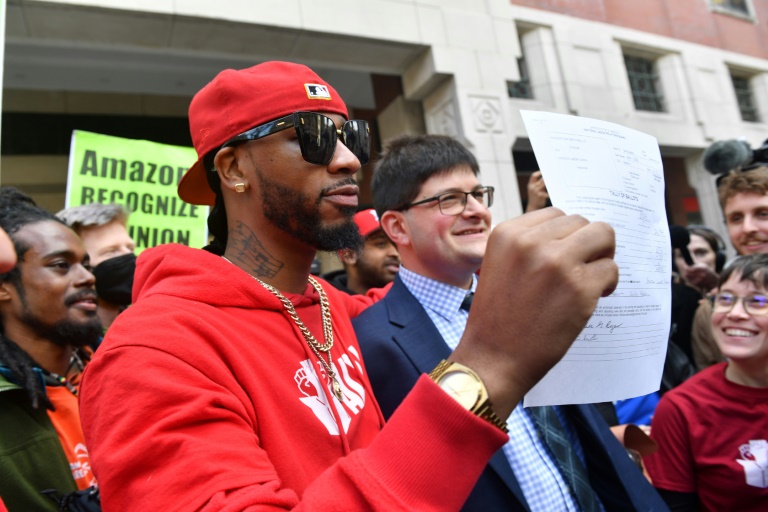
Leaders of the Amazon unionization campaign have heard from workers at some 100 other company facilities following last week’s upset election win in New York, the union’s president said Friday.

“We are witnessing a revolution,” Christian Smalls, president of Amazon Labor Union, said a week after the election at the JFK8 warehouse in Staten Island established the first union at a US Amazon facility.

Friday’s 90-minute event — part pep rally, part press conference — had a celebratory feel as Smalls and other leaders of the upstart union dismissed Amazon’s objections to the Staten Island vote and cheered a nascent campaigns at other Amazon facilities.

“All 50 states have contacted us, even overseas,” said Smalls, who plans a national conference call in May to share election tips with workers from other sites.

“We’re going to help them,” Smalls said. “I don’t know what that looks like, but we’re going to try.”

Amazon has signaled plans to fight the Staten Island result, telling the National Labor Relations Board it will file “substantial” objections to last week’s election based on alleged problematic election conduct on the part of the union and the board’s officials. 

The union has dismissed the Amazon statements as a stall tactic, with Smalls calling the allegations “trash.”

Smalls said he and other leaders in the New York campaign were willing to travel to other parts of the United States to assist organization and election drives.

He cited Starbucks as an example for growing a national movement. 

More than 180 Starbucks cafes have seen unionization campaigns after a pair of cafes in upstate New York voted to unionize in December. 

On Friday, three more Starbucks cafes in upstate New York voted to unionize, taking the national total to 16.

Honduras approves extradition of ex-police chief to US on drug charges

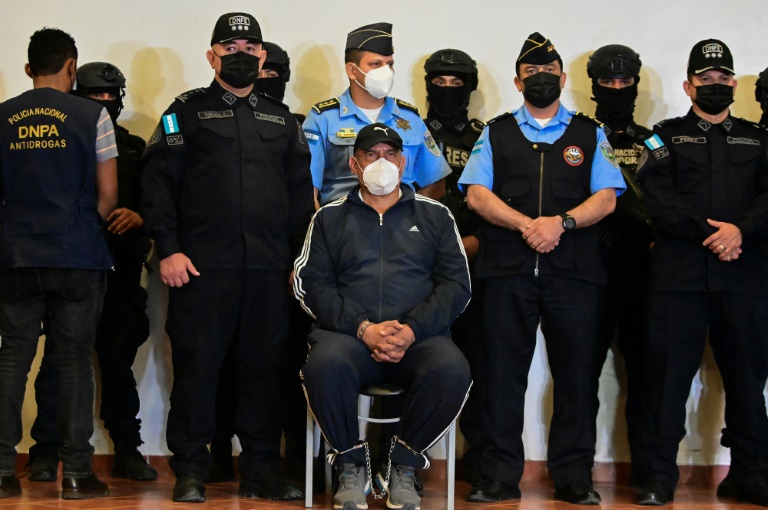
A Honduran judge on Friday authorized the extradition to the United States of former national police chief Juan Carlos Bonilla who is accused of running drug trafficking operations for former president Juan Orlando Hernandez. 

A judge approved the extradition of Juan Carlos “Tiger” Bonilla in response to a request from US authorities, said Melvin Duarte, a spokesman for the Supreme Court of Justice (CSJ).

Bonilla is alleged to have “participated in a conspiracy to import controlled substances into the United States (…) using or carrying weapons,” he added.

Duarte said the defense has until Monday to appeal the decision.

Bonilla was captured on March 9 north of the capital Tegucigalpa. 

Bonilla, who was chief of police from 2012 to 2013, had been named as a “co-conspirator” during the US drug trafficking trial of Tony Hernandez, the brother of former Honduran president Juan Orlando Hernandez.

The ex-president’s brother, a former Honduran congressman, was given a life sentence in the United States last year.

US prosecutors say Bonilla abused his powers in the Honduran police and played a key role in a violent international drug trafficking conspiracy.

Bonilla’s extradition green light follows that of former president Hernandez, whose extradition was approved last month.

Hernandez’s defense filed an appeal to stop the extradition, but it was denied. 

Duarte said that 12 magistrates have signed the extradition act for Hernandez, but three other signatures are needed in order to send the former president to the United States. 

In the petition, the United States accused Hernandez of crimes, including “conspiracy (…) to import controlled substances” such as cocaine and “possessing firearms, including machine guns and destructive devices” with the goal of importing narcotics.

US prosecutors say the former president turned Honduras into a “narco-state” by involving the military, police and civilians in drug trafficking to the United States. 

Rights Court urges Peru not to free ex-president Fujimori

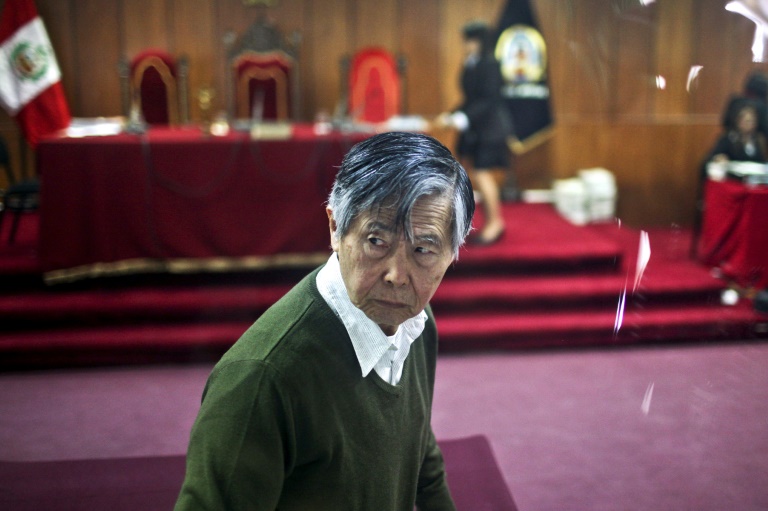
The Inter-American Court of Human Rights published a resolution Friday urging Peru not to grant 83-year-old ex-president Alberto Fujimori, serving time for rights violations, a release on humanitarian grounds.

Fujimori, who was president from 1990 to 2000, has since 2009 been serving a 25-year sentence for two massacres committed by army death squads during his presidency.

Twenty-five people, including a child, were killed in the supposed anti-terrorist operations in 1991 and 1992.

Last month, Peru’s Constitutional Court ordered the disgraced former leader’s release, reinstating a presidential “humanitarian pardon” granted in December 2017. 

It was revoked in 2018. 

The IACHR resolution, dated Thursday and published Friday, said the Constitutional Court decision failed to give adequate weight to the right to justice of Fujimori’s victims.

“The State of Peru must refrain from implementing the sentence handed down by the Constitutional Court of Peru on March 17, 2022, which reinstates the effects of the pardon ‘for humanitarian reasons granted to Alberto Fujimori on 24 December 2017,” it said. 

Lima has said it would abide by any decision of the IACHR.

Upon leaving office, Fujimori fled into exile in Japan, where his parents were from. 

He was extradited back to Peru from Chile in 2007 and jailed, having been convicted in his absence.

Fujimori, who suffers ill health, is the only inmate at the small Barbadillo jail at the barracks of the special operations police in eastern Lima.

There he grows flowers, paints and receives family visits.

His family has submitted several petitions to have him released on health grounds but those were all rejected.

His daughter Keiko Fujimori, who has lost three presidential election runoffs, said last year she would pardon her father if elected.

She was defeated in June by leftist Pedro Castillo and now faces prosecution over accusations of illegal campaign funding in her failed 2011 and 2016 presidential bids. 

US stocks pressured amid interest rate angst as euro gyrates

Wall Street stocks mostly fell Friday amid lingering unease over tightening US monetary policy, while the euro gyrated ahead of France’s presidential election.

Both the S&P 500 and Nasdaq retreated as the yield on the 10-year US Treasury note climbed above 2.7 percent, a signal markets are preparing for more Federal Reserve monetary tightening.

All three major US indices notched losses for the week.

“Uneasiness and trepidation appeared to drive a relatively quiet session as investors continued to weigh the potential implications of a highly aggressive Fed monetary policy tightening cycle,” Charles Schwab investment bank said in a note.

The euro sank as low to $1.0837 before bouncing back, a reflection of uncertainty ahead of Sunday’s first-round French presidential vote.

The single currency has also been dented by European officials’ reticence to move as aggressively as the Fed on tackling soaring inflation.

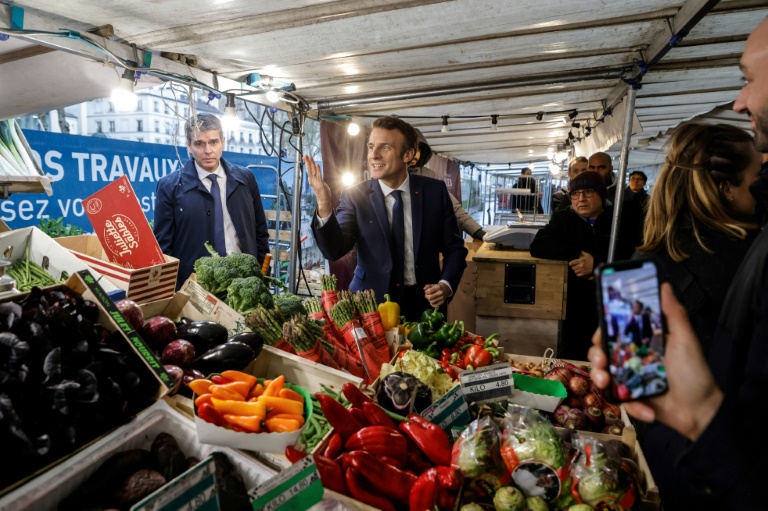
The volatility in the euro comes as polls show a tight race by French President Emmanuel Macron and his main election rival, far-right leader Marine Le Pen.

The president is projected to come out on top in Sunday’s first round of voting, but far short of the majority needed to avoid a run-off between the top two candidates on April 24 — and with Le Pen close behind.

The euro would experience a “knee-jerk” drop of about 1.5 percent in its value against the dollar if Le Pen ultimately is elected, and then will “continue falling,” Wells Fargo bank said in a note.

“Even if Le Pen wins the presidency, her party is very unlikely to garner a working parliamentary majority, but ousting or even weakening Macron could be a blow to EU integration and economic policy,” Wells Fargo said.

The lower euro helped boost bourses in Paris and Frankfurt, both of which rose more than one percent.

“Today’s positive session for European markets appears to have more to do with the fact that the strength of the US dollar has pushed both the pound and the euro lower, with the pound falling to its lowest levels since November 2020,” CMC Markets analyst Michael Hewson said.

– Key figures around 2050 GMT –

New York – Dow: UP 0.4 percent at 34,721.12 (close)

New York – S&P 500: DOWN 0.3 percent at 4,488.28 (close)

New York – Nasdaq: DOWN 1.3 percent at 13,711.00 (close)

London – FTSE 100: UP 1.6 percent at 7,669.56 (close)

Frankfurt – DAX: UP 1.5 percent at 14,283.67 (close)

Paris – CAC 40: UP 1.3 percent at 6,548.22 (close)

EURO STOXX 50: UP 1.4 percent at 3,858.37 (close)

Tokyo – Nikkei 225: UP 0.4 percent at 26,985.80 (close)

Hong Kong – Hang Seng Index: UP 0.3 percent at 21,872.01 (close)

Shanghai – Composite: UP 0.5 percent at 3,251.85 (close)

Euro/dollar: DOWN at $1.0878 from $1.0879 late Thursday

Pound/dollar: DOWN at $1.3036 from $1.3075

Euro/pound: UP at 83.43 pence from 83.20 pence

Dollar/yen: UP at 124.30 yen from 123.95 yen

Brent North Sea crude: UP 2.2 percent at $102.78 per barrel

West Texas Intermediate: UP 2.3 percent at $98.26 per barrel

burs-jmb/cs

Russia's ruble stages rebound despite Western sanctions

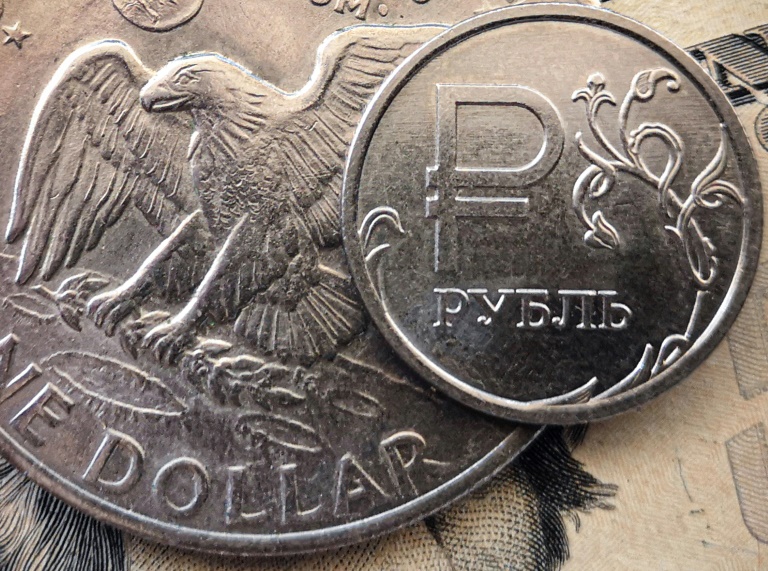
After a historic collapse in the wake of Russia’s military offensive in Ukraine, the ruble has staged a spectacular bounceback, supported by strict capital controls and energy exports. 

But analysts say that success is in many ways artificial and does not bode well for the health of the Russian economy.

The February 24 military operation triggered unprecedented Western sanctions on Moscow, sending the ruble into free-fall and accelerating already high inflation. 

Four days after President Vladimir Putin sent troops into the pro-Western country, the central bank more than doubled its key interest rate to 20 percent to prop up the financial system. 

In a surprise move on Friday, the central bank lowered the rate to 17 percent, saying risks to financial stability had “ceased to increase” for now.

“It’s clear that the Central Bank of Russia assesses that Russia’s economy is now emerging from the most acute phase of its crisis and that such restrictive monetary conditions are no longer warranted,” said Liam Peach, emerging Europe economist at Capital Economics.

The ruble’s return to levels last seen before the start of Moscow’s military campaign is a sign that the economy may be adjusting to the sanctions, economists say.

– ‘Exports are solid’ – 

Sofya Donets, chief economist at Renaissance Capital, said the ruble recovery has been aided by an unprecedented trade surplus amid high energy prices.

“There has been a decline in imports, partly because of sanctions, partly because of uncertainty and logistical disruptions,” she told AFP.

“But exports are solid, and with commodity prices high we expect a historically high account surplus of $20-25 billion in March.”

Oil and gas, Russia’s main exports, keep flowing abroad, filling Russia’s coffers. 

The United States has banned Russian oil imports and the EU adopted a ban on Russian steel imports but those penalties have largely spared key Russian exports.

“It only affects five percent of Russian exports, so it’s not that much,” said Donets.

Robust exports have been supplemented by harsh capital controls introduced by the central bank.

The West froze some $300 billion of Russia’s foreign currency reserves abroad, a move that Foreign Minister Sergei Lavrov has described as “theft”.

To counter the sanctions, exporting companies were forced to sell 80 percent of their export earnings to buy rubles. 

Russians have also been barred from withdrawing more than $10,000 in foreign currency or taking more than that amount out of the country, and foreign investors have been banned from selling Russian assets.

Late Friday the central bank relaxed some curbs, saying that from April 18 it was scrapping the ban on buying dollars and euros introduced in early March.

 – ‘PR campaign’ – 

The rapid ruble recovery does not equal a strong economy, however, analysts said.

“Russian equities and the ruble currently remain decoupled from global macro factors and news flow due to capital controls,” Alfa Bank said in a note.

The lender estimates that the ruble will be trading at around 80-85 to the dollar in the near future. 

Economists believe that the worst economic impact of the sanctions is still to come and expect Russia, which has relied heavily on imports of manufacturing equipment and consumer goods, to plunge into a deep recession.

Russia’s inflation rate reached 16.7 percent year-on-year in March, the state statistics agency said on Friday, a level not seen since 2015, while food prices have risen even more steeply.

Capital Economics pointed out that the 7.6 percent month on month rise in consumer prices in Russia in March was “the highest monthly increase since the 1990s.”

Renaissance Capital analysts predict that annual inflation will peak at 24 percent this summer.

Donets said that “the market is destroyed in a sense.”

“We have a closed financial system now,” she added.

“Where would the ruble rate be if there were no capital controls? It’s very hard to say, there has been no precedent.”

Timothy Ash, an emerging markets strategist at BlueBay Asset Management, was more blunt, saying the Bank of Russia was “heavily managing/manipulating this.”

“It’s not a liquid market,” he told AFP in emailed comments.

“This is a PR campaign by the Central Bank of Russia as a tool of the Kremlin.”

Crisis-hit Sri Lanka hikes rates as protests spiral

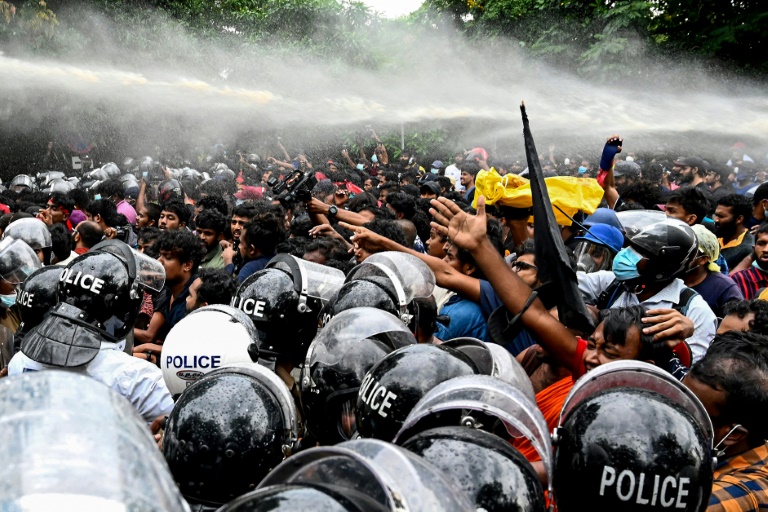
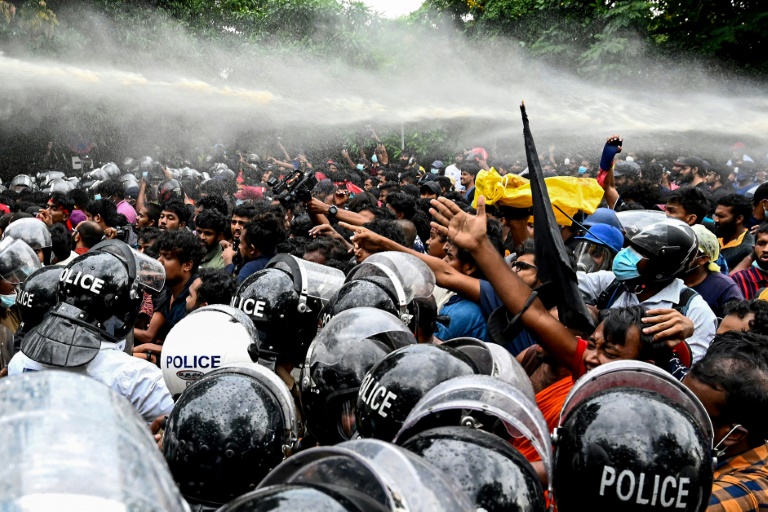
Cash-strapped Sri Lanka’s central bank hiked interest rates by a record 700 basis points Friday as police fired tear gas at hundreds of students protesting over the economic crisis.

Severe shortages of food and fuel, alongside lengthy electricity blackouts, have led to weeks of widespread anti-government demonstrations — with calls for President Gotabaya Rajapaksa to resign.

The latest protests saw students try to march Friday to the national parliament, and police used water cannons in efforts to disburse the angry crowds.

Monks, who had largely rallied the Sinhala-Buddhist majority to elect Rajapaksa at the November 2019 polls, were also seen joining demonstrations in the capital Colombo, where some defiantly stood opposite police wearing gas masks and holding riot shields.

Demonstrators nationwide carried placards saying “Gota go home”, demanding Rajapaksa and his administration step down over the country’s worst economic crisis since independence in 1948.

– Damage control –

The Central Bank of Sri Lanka said its benchmark lending rate had been raised to 14.5 percent to “stabilise the exchange rate” after the rupee tumbled over 35 percent in a month.

The rate for deposits was also increased by seven percentage points to 13.5 percent as reports said Sri Lanka’s rupee was the worst-performing currency in the world, edging out the Russian ruble.

The bank’s newly appointed governor, Nandalal Weerasinghe, said attempts to control foreign exchange markets and keep interest rates artificially low in the past year had contributed to the unprecedented economic chaos.

“We are now in damage control mode,” Weerasinghe said at his first press conference since replacing Ajith Cabraal, who was virtually forced out Monday with the country facing bankruptcy.

“We would not have had to make such a sharp increase if rates had been raised incrementally over a period of time,” Weerasinghe said, vowing to relax exchange controls introduced by his predecessor.

The bank said the shock-treatment rate hike was due to its belief that the embattled island’s inflation, already at record levels, could get worse.

The Colombo Consumer Price Index rose 18.7 percent in March while food inflation topped 25 percent, but private analysts placed inflation at over 50 percent in the month.

International rating agencies have downgraded Sri Lanka as fears grow it could default on its $51 billion external debt.

This week, Rajapaksa appointed a panel of experts to organise a restructuring of foreign debt.

His government is preparing for bailout negotiations with the International Monetary Fund, and finance ministry officials said the panel will prepare a programme for sovereign bond-holders and other creditors to take a haircut.

“What Sri Lanka is keen to do is avoid a hard default,” a source from the ministry who requested anonymity told AFP. 

“It will be a negotiated restructuring of the debt with the help of the IMF.”

Meetings with the IMF are set to begin by next week but finance minister Basil Rajapaksa, the president’s brother, resigned Sunday along with nearly the entire cabinet. 

The country is still without a replacement, with his successor Ali Sabry quitting after just one day in office. Sabry told parliament Friday he was still in the job because no one was willing to accept the finance portfolio.

– European push –

Colombo-based diplomats from European Union member states, which form a key export market for Sri Lanka, on Friday asked the government to immediately begin reforms to revive the economy.

“We stress the extreme urgency of the situation, which requires the authorities to start in-depth discussions with the International Monetary Fund,” the diplomats said in a joint statement.

Public anger is at fever pitch, and on Saturday thousands of people are expected to take part in what likely will be the biggest protest since the crisis began.

Opposition parties have rejected a presidential overture to form a unity administration and instead joined calls for Rajapaksa to step down.

The shortages of essentials have been caused by a wide-ranging import ban as Sri Lanka seeks to conserve its meagre foreign currency reserves to pay its debts.

In recent years the vital tourism sector has also been hit hard by Islamist bomb attacks in 2019 and the coronavirus pandemic, which dried up remittances from Sri Lankans abroad.

Economists say the crisis has been exacerbated by government mismanagement, years of accumulated borrowing and ill-advised tax cuts.

Crisis-hit Sri Lanka hikes rates as protests spiral

Cash-strapped Sri Lanka’s central bank hiked interest rates by a record 700 basis points Friday as police fired tear gas at hundreds of students protesting over the economic crisis.

Severe shortages of food and fuel, alongside lengthy electricity blackouts, have led to weeks of widespread anti-government demonstrations — with calls for President Gotabaya Rajapaksa to resign.

The latest protests saw students try to march Friday to the national parliament, and police used water cannons in efforts to disburse the angry crowds.

Monks, who had largely rallied the Sinhala-Buddhist majority to elect Rajapaksa at the November 2019 polls, were also seen joining demonstrations in the capital Colombo, where some defiantly stood opposite police wearing gas masks and holding riot shields.

Demonstrators nationwide carried placards saying “Gota go home”, demanding Rajapaksa and his administration step down over the country’s worst economic crisis since independence in 1948.

– Damage control –

The Central Bank of Sri Lanka said its benchmark lending rate had been raised to 14.5 percent to “stabilise the exchange rate” after the rupee tumbled over 35 percent in a month.

The rate for deposits was also increased by seven percentage points to 13.5 percent as reports said Sri Lanka’s rupee was the worst-performing currency in the world, edging out the Russian ruble.

The bank’s newly appointed governor, Nandalal Weerasinghe, said attempts to control foreign exchange markets and keep interest rates artificially low in the past year had contributed to the unprecedented economic chaos.

“We are now in damage control mode,” Weerasinghe said at his first press conference since replacing Ajith Cabraal, who was virtually forced out Monday with the country facing bankruptcy.

“We would not have had to make such a sharp increase if rates had been raised incrementally over a period of time,” Weerasinghe said, vowing to relax exchange controls introduced by his predecessor.

The bank said the shock-treatment rate hike was due to its belief that the embattled island’s inflation, already at record levels, could get worse.

The Colombo Consumer Price Index rose 18.7 percent in March while food inflation topped 25 percent, but private analysts placed inflation at over 50 percent in the month.

International rating agencies have downgraded Sri Lanka as fears grow it could default on its $51 billion external debt.

This week, Rajapaksa appointed a panel of experts to organise a restructuring of foreign debt.

His government is preparing for bailout negotiations with the International Monetary Fund, and finance ministry officials said the panel will prepare a programme for sovereign bond-holders and other creditors to take a haircut.

“What Sri Lanka is keen to do is avoid a hard default,” a source from the ministry who requested anonymity told AFP. 

“It will be a negotiated restructuring of the debt with the help of the IMF.”

Meetings with the IMF are set to begin by next week but finance minister Basil Rajapaksa, the president’s brother, resigned Sunday along with nearly the entire cabinet. 

The country is still without a replacement, with his successor Ali Sabry quitting after just one day in office. Sabry told parliament Friday he was still in the job because no one was willing to accept the finance portfolio.

– European push –

Colombo-based diplomats from European Union member states, which form a key export market for Sri Lanka, on Friday asked the government to immediately begin reforms to revive the economy.

“We stress the extreme urgency of the situation, which requires the authorities to start in-depth discussions with the International Monetary Fund,” the diplomats said in a joint statement.

Public anger is at fever pitch, and on Saturday thousands of people are expected to take part in what likely will be the biggest protest since the crisis began.

Opposition parties have rejected a presidential overture to form a unity administration and instead joined calls for Rajapaksa to step down.

The shortages of essentials have been caused by a wide-ranging import ban as Sri Lanka seeks to conserve its meagre foreign currency reserves to pay its debts.

In recent years the vital tourism sector has also been hit hard by Islamist bomb attacks in 2019 and the coronavirus pandemic, which dried up remittances from Sri Lankans abroad.

Economists say the crisis has been exacerbated by government mismanagement, years of accumulated borrowing and ill-advised tax cuts.

New Supreme Court justice Jackson hails US progress on racial equality

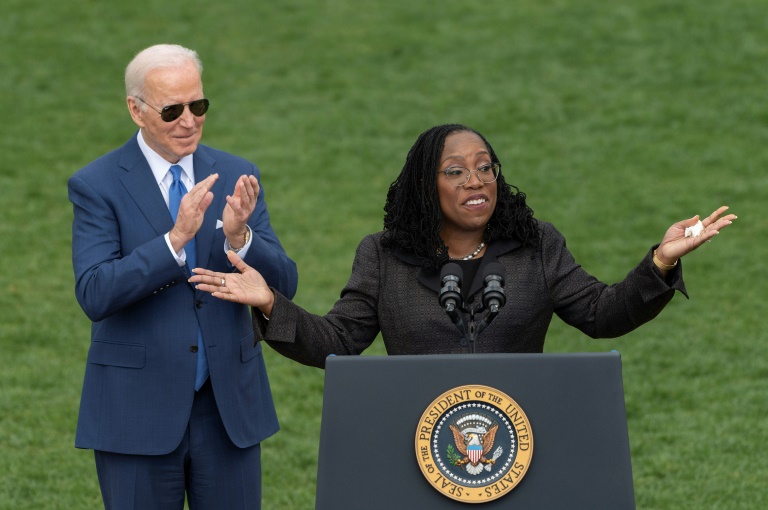
Ketanji Brown Jackson celebrated her rise “from segregation to the Supreme Court” at a White House event Friday marking her confirmation as the first Black woman appointed to the nation’s highest judicial bench.

In her first public remarks since the Senate endorsed her on Thursday, the 51-year-old judge shared the credit for a milestone that was 232 years in the making, telling her supporters: “We have made it — all of us.”

“In my family, it took just one generation to go from segregation to the Supreme Court of the United States,” she told around 150 guests invited to the South Lawn by President Joe Biden.

“And it is an honor, the honor of a lifetime, for me to have this chance to join the court.”

Jackson came out of the White House with Biden and Vice President Kamala Harris to cheers from the new justice’s family, current and former Supreme Court justices, administration officials and senators who voted for her. 

“It has taken 232 years and 115 prior appointments for a Black woman to appointed to serve on the Supreme Court of the United States, but we have made it — all of us,” she said.

“And our children are telling me that they see now more than ever that, here in America, anything is possible.”

Jackson was green-lit by the Senate in a 53-47 vote that capped a bruising confirmation battle, with just three Republicans joining Democrats in advancing Biden’s vision for a more diverse high court.

She was also with the president at the White House to watch the vote on Thursday, with the pair embracing as she was confirmed.

– ‘Moment of real change’ –

Introducing his first pick to the court, in front of a sun-drenched South Portico decked in US flags, Biden vowed future generations would be “proud of what we did” in choosing Jackson.

“This is going to let so much sunshine on so many young women, so many young Black men, so many minorities — it’s real,” the Democratic president said. 

“We’re going to look back and see this is a moment of real change in American history.”

Harris, who presided over the confirmation hearing, has broken down barriers of her own as the first woman and first Black and Asian American to be vice president.

“President George Washington once referred to America as a great experiment, a nation founded on the previously untested belief that the people — we, the people — could form a more perfect union,” Harris said.

“And that belief has pushed our nation forward for generations and it is that belief that we reaffirmed yesterday through the confirmation of the first Black woman to the United States Supreme Court.”

One Democrat-backed justice replacing another — the retiring Stephen Breyer — will not change the ideological balance of the court, which has a 6-3 conservative edge. 

But it will be the first time the bench has included four women, with Sonia Sotomayor and Elena Kagan nominated by Barack Obama and Amy Coney Barrett picked by Donald Trump.

Jackson will be the sixth woman in total to be elevated to the Supreme Court. Her confirmation comes 55 years after Thurgood Marshall became the first Black justice. 

Clarence Thomas, who assumed office in 1991, is the only other African American to have served on the bench.

UN seeks $80 mn to avert 'imminent' Yemen oil spill

The United Nations said Friday it is seeking nearly $80 million for an emergency operation to prevent a catastrophic oil spill in the Red Sea off war-ravaged Yemen.

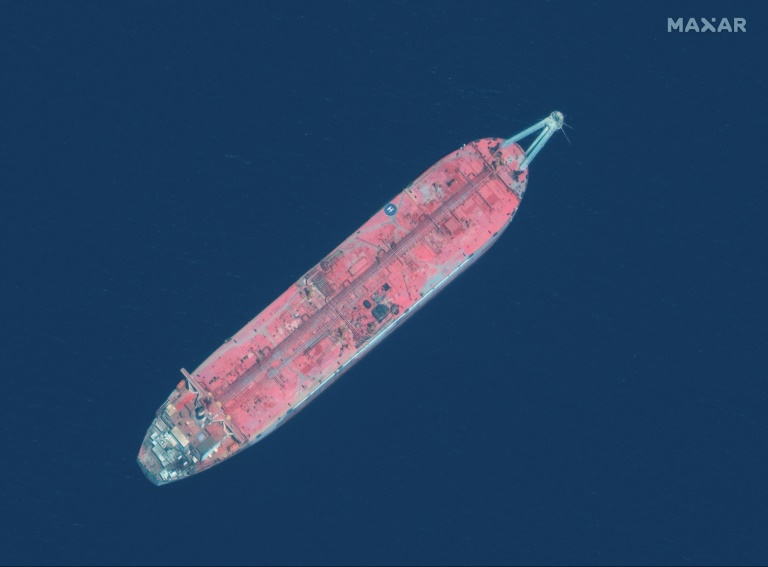
The 45-year-old tanker FSO Safer, long used as a floating oil storage platform with 1.1 million barrels of crude on board, has been moored off the rebel-held Yemeni port of Hodeida since 2015, without being serviced.

“The Safer is at imminent risk of a major spill, which would create a humanitarian and ecological catastrophe centred on a country already decimated by more than seven years of war,” the United Nations said in a statement. 

“International support – including funding – is needed now to implement the UN-coordinated plan to address the threat before it is too late.”

The UN said that the emergency part of a two-stage operation would see the toxic cargo pumped from the storage platform to a temporary replacement vessel at a cost of $79.6 million.

In a second phase, a replacement platform would be installed.

At a press conference in New York, the UN humanitarian coordinator for Yemen, David Gressly, said recourse to another ship would cost around $25 million.

“We need to finish this operation by the end of September to avoid the turbulent winds and currents that start in October, November, December, increasing the risk in conducting any operation,” Gressly said. 

The UN stressed that “the plan cannot begin without donor funding,” adding that the Netherlands will host a donor meeting. 

It said “rapid donor commitments of funds” were needed to begin work by the second half of May. 

Yemen’s Huthi rebels already agreed a “framework for cooperation” with the United Nations on the issue last month. 

The UN has said an oil spill could destroy ecosystems, shut down the fishing industry and close the lifeline port of Hodeida for six months.

Israel PM gives security forces free rein after deadly Tel Aviv attack

Israeli Prime Minister Naftali Bennett gave security agencies “full freedom” Friday to curb a surge in violence, after a Palestinian gunman killed three men in a popular nightlife district.

“There are not and will not be limits for this war,” Bennett said, speaking hours after Thursday night’s attack in the coastal city of Tel Aviv.

“We are granting full freedom of action to the army, the Shin Bet (the domestic security agency) and all security forces in order to defeat the terror,” he said.

The Palestinian Islamist movement Hamas, which controls the Gaza Strip, and the Islamic Jihad group praised the attack — drawing criticism from the UN — but did not claim responsibility.

After an all-night manhunt, Israeli police said they shot dead a Palestinian gunman who had opened fire on a street of crowded bars and restaurants, killing three people and wounding more than a dozen others.

About 1,000 heavily armed police and army troops had fanned out across Tel Aviv to track the assailant, as residents cowered in restaurant kitchens or their homes.

Defence Minister Benny Gantz said officers had made “around 200 arrests”, adding: “If necessary there will be thousands.”

– Engagement party becomes wake –

Israeli childhood friends Tomer Morad and Eytam Magini, both 27, were killed during the attack.

On Friday the third victim, Barak Lufan, died of his injuries, Tel Aviv’s Ichilov Hospital said.

Magini was due to celebrate his engagement Friday, his fiancee’s mother, Lia Arad, told public television.

“They were supposed to celebrate their engagement party tonight, Eytam’s cousins organised it in this house where we are now sitting in mourning,” she said.

Morad was an avid fan of the Hapoel Tel Aviv Basketball Club, which said in a condolence note it sent “a warm and loving hug”. The two friends are to be buried Sunday.

Special forces confronted the attacker in the old city of Jaffa, the historic Arab district of Tel Aviv, “eliminating the terrorist by exchange of fire”, police commissioner Yaakov Shabtai said.

The Shin Bet named him as Raad Hazem, 28, from Jenin in the north of the Israeli-occupied West Bank, where last week Israeli forces killed three people in a raid.

Chief of Staff Lieutenant General Aviv Kochavi ordered the military to step up its operations, particularly in the northern West Bank. Bennett ordered the closure of the Jalameh checkpoint between the Jenin area and Israel.

A total of 13 people have been killed in attacks in Israel since March 22, including some carried out by assailants linked to or inspired by the Islamic State group.

Over the same period, at least nine Palestinians have been killed, including assailants.

– ‘No glory in terror’ –

Palestinian president Mahmud Abbas condemned the latest attack, saying “the killing of Palestinian and Israeli civilians only leads to a further deterioration of the situation,” the Palestinians’ official Wafa news agency reported.

Secretary of State Antony Blinken said the United States stood with Israel “in the face of senseless terrorism and violence”.

Fathi Hazem, the attacker’s father, struck a defiant tone speaking to hundreds of well-wishers at the family home in Jenin. He said the Palestinians people were looking for “freedom and independence”.

Hamas praised what it called a “heroic operation”, while Islamic Jihad, another Gaza-based militant group, called it a “natural response” to Israel’s crimes. Lebanon’s Iran-backed Hezbollah lauded a “victorious” attack.

The UN envoy for Middle East peace, Tor Wennesland, denounced a “heinous attack” and criticised Hamas in a tweet.

“Deplore the welcoming of the attack by Hamas. There is no glory in terrorism,” he said.

– ‘A nightmare’ –

On Friday, mourners lit candles and left flowers outside the bar where the attack took place, and residents recounted the fear they felt.

“People on the street ran about shouting ‘there is a terrorist’ so we rushed inside a restaurant and people tripped as they panicked,” said Dror Yeheskel, 39, who was having a drink with a friend when the shooting started.

Noa Roberts, 21, who works at a bar across the street from the attack, said she heard dozens of bullets as terrified customers and staff raced to shelter and hid for two hours.

“It was so scary… it was like a nightmare,” Roberts said.

The attack came on the eve of the first Friday prayers of the Muslim fasting month of Ramadan, and with Israeli security forces on alert. 

The prayers passed off peacefully at Al-Aqsa Mosque in Israeli-annexed east Jerusalem, Islam’s third holiest site.

Police said 55,000 Palestinians took part, while several Palestinians said they were turned back by Israeli security forces at the Qalandia checkpoint outside Jerusalem.

Last year, nightly demonstrations in the Al-Aqsa compound and elsewhere in east Jerusalem escalated into 11 days of war between Israel and Hamas.

Close Bitnami banner
Bitnami