World

UN General Assembly suspends Russia from Human Rights Council

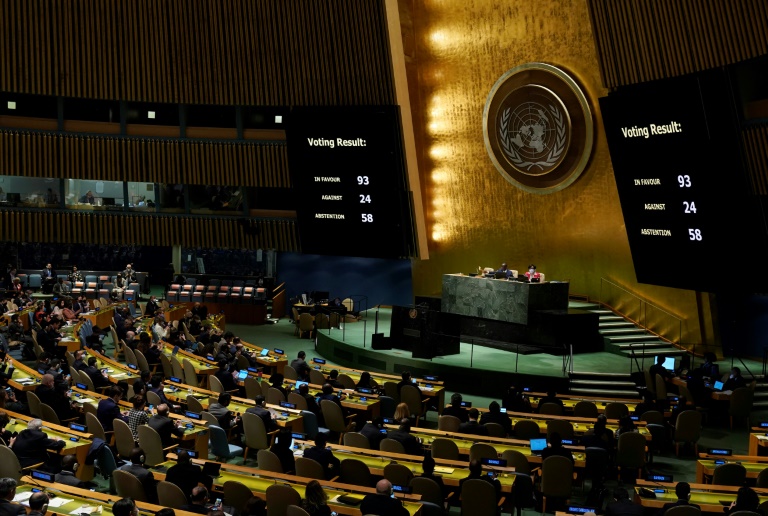
The UN General Assembly voted Thursday to suspend Russia from the global body’s Human Rights Council as punishment for its invasion of Ukraine.

The high-profile rebuke of Moscow marked only the second ever suspension of a country from the council — Libya was the first, in 2011 — and it earned praise from Ukraine’s President Volodymyr Zelensky and his American counterpart Joe Biden.

The expulsion confirmed Moscow as an “international pariah,” Biden said in a searing statement that addressed what he called “horrifying” images from Ukrainian towns like Bucha, where Russian forces are accused of atrocities against civilians.

“Russia’s lies are no match for the undeniable evidence of what is happening in Ukraine,” Biden said. 

“The signs of people being raped, tortured, executed — in some cases having their bodies desecrated — are an outrage to our common humanity.”

Zelensky, who has longed called for a tougher international position against Moscow, applauded the UN move as “an important step,” describing it on Twitter as “another punishment for RF’s (Russia’s) aggression” against Ukraine.

Of the 193 members of the General Assembly, 93 voted in favor of suspension as proposed by the United States, while 24 voted against. Fifty-eight abstained and the remainder did not participate, suggesting a weakening international unity against Russia at the United Nations.

Suspension required support from two-thirds of the member countries casting votes for or against; the abstentions and absences did not count.

Russia swiftly rejected the suspension, with its foreign ministry blasting the move as “illegal and politically motivated, aimed at ostentatiously punishing a sovereign UN member state that pursues an independent domestic and foreign policy.”

Biden’s top diplomat said Moscow got what it deserved.

“A country that is perpetrating gross and systematic violations of human rights should not sit on a body whose job it is to protect those rights,” Secretary of State Antony Blinken said in Brussels.

Countries voting against included China, a Moscow ally which has steadfastly abstained from criticizing the invasion. Others were Iran, the former Soviet republic of Kazakhstan and communist Cuba, as well as Russia itself, Belarus and Syria.

Despite pressure from Moscow for a no vote, several African countries only abstained, such as South Africa and Senegal. Also abstaining were Brazil, Mexico and India.

– ‘Held accountable’ –

The UN Human Rights Council was founded in 2006 and is composed of 47 member states chosen by the General Assembly.

Washington argues that suspending Russia from the Geneva-based organization that is the UN’s main human rights monitor is more than symbolic, and in fact intensifies Russia’s isolation after the assault on Ukraine that began February 24.

Zelensky has also called for Russia to be expelled from the UN Security Council “so it cannot block decisions about its own aggression, its own war.”

Washington has admitted there is little anyone can do about Russia’s position on the Security Council, where it holds veto power.

The world has been outraged by images of civilians apparently executed and left in the streets or buried in mass graves in areas formerly controlled by Russian troops. The carnage has led to new rounds of sanctions against Moscow.

Journalists including from AFP last weekend found corpses in civilian clothes, some with their hands bound, in the town of Bucha outside the capital Kyiv.

The Kremlin has denied Russian forces killed civilians, and alleged that the images of dead bodies in Bucha were “fakes.”
Canada budget amps military spending in response to Ukraine war

Canada’s finance minister, in response to Russia’s invasion of Ukraine, shelled out more money for the military in a budget Thursday that also aims to tackle soaring costs of living and a housing crisis.

But the additional Can$8 billion (US$6.4 billion) earmarked for defense over five years falls far short of a NATO target of spending two percent of GDP.

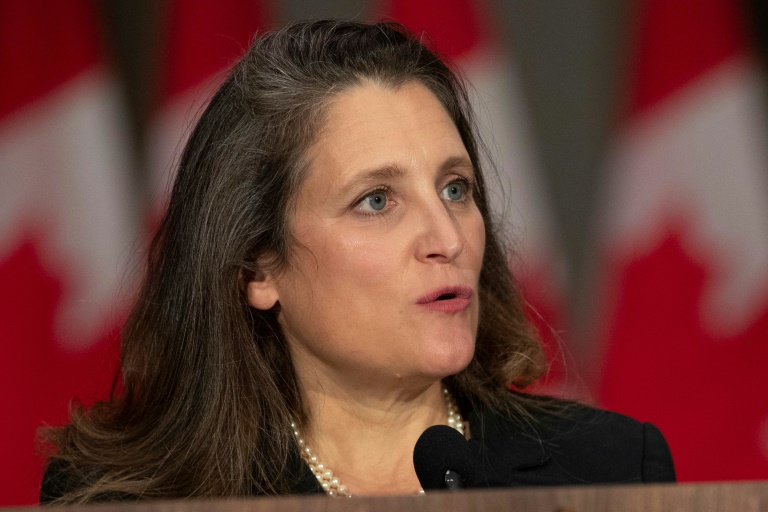
In a speech to parliament, Finance Minister Chrystia Freeland said: “Putin’s invasion of Ukraine has reminded us that our own peaceful democracy — like all the democracies of the world — depends ultimately on the defence of hard power.”

“We know that freedom does not come for free, and that peace is guaranteed only by our readiness to fight for it,” she said. “That is why this budget makes an immediate, additional investment in our armed forces.”

According to NATO, Canada currently spends 1.36 percent of GDP on the military, which is down slightly from just a few years ago.

To meet the two percent NATO target, Ottawa would have to set aside tens of billions of dollars more each year, according to parliament’s independent fiscal watchdog and other experts.

Freeland suggested Ottawa could still close that NATO gap soon, proposing “a swift defence policy review to equip Canada for a world that has become more dangerous.”

Canada, with one of the largest Ukrainian diasporas in the world, also announced an additional Can$1 billion in loans through the International Monetary Fund and Can$500 million in military aid for Ukraine this year.

The budget is the first since Prime Minster Justin Trudeau’s Liberals won a third term in elections last September. 

With support from a small leftist faction the minority government is expected to pass it in a soon-to-be held vote in the House of Commons.

– Slashing spending –

The budget will see spending slashed by Can$131 billion after the government doled out significant pandemic aid over the past two years that pushed the debt to a record Can$1.16 trillion this year.

At the same time, Freeland said she recognizes that Canadians are struggling with higher costs for almost everything and so the government is rolling out targeted measures to mitigate the impacts of inflation.

Notably, Ottawa aims to double the number of new homes built over the next decade to ease a supply crunch and soaring prices, as well as ban foreign investment in an overheated housing market. 

It also earmarked billions of dollars for a new dental care program, coming on the heels of a new national childcare program.

And Ottawa is setting up a fund to attract private foreign investment in Canada’s transition away from fossil fuels, raising taxes on banks and insurance companies, and supporting domestic exploration for critical minerals used to make electric vehicle batteries and semi-conductors.

After what Freeland described as having “teetered on the brink” in 2020 when the pandemic hit, the Canadian economy has rebounded strongly.

It has recovered 112 percent of the jobs lost in those early months, and the unemployment rate — at 5.5 percent — is now just shy of a pre-pandemic low, while economic growth is “1.2 percent above where it was before the pandemic,” she noted.

Private sector economists surveyed by Ottawa forecast slightly slower growth of 3.9 percent in 2022 and 3.1 percent next year. 

“After wave after wave and lockdown after lockdown, our economy has not just recovered, it is booming,” Freeland said.

But getting through the last two years came at a “significant cost” and now the government must reduce spending as it reaches for an eventual balanced budget, she said.

“We are absolutely determined that our debt-to-GDP ratio must continue to decline,” the minister said. 

“Our pandemic deficits are and must continue to be reduced. The extraordinary debts we incurred to keep Canadians safe and solvent must be paid down.”

The budget deficit is expected to fall from Can$113.8 billion in 2021-2022 to Can$52.8 billion in 2022-2023. 

The debt-to-GDP ratio, meanwhile, is forecast to fall from 46.5 percent in 2021-2022 to 45.1 percent in 2022-2023.

US recession fears grow as Fed plots aggressive course

The Federal Reserve has made clear it will come out guns blazing to battle the highest inflation rate in four decades, but that has sparked increasing fears their campaign will plunge the world’s largest economy into recession.

The US central bank is facing a daunting task as it tries to engineer a “soft landing” that preserves growth while tamping down worrying price pressures against an uncertain global backdrop.

It will require “exquisite calibration,” longtime Fed watcher David Wessel told AFP.

The United States has roared back from the Covid-19 pandemic, posting solid growth and record job gains thanks to massive government aid and aggressive stimulus from the Fed, which cut the benchmark lending rate to zero in March 2020.

But the rebound has hit multiple stumbling blocks, including renewed waves of the virus and shortages of key supplies and workers that sent prices surging. It must also now navigate the fallout from the war in Ukraine, which has caused a jump in oil prices.

The Fed last month raised interest rates by a quarter point in the first of a series of increases, and since then a chorus of officials — including Fed Chair Jerome Powell and Governor Lael Brainard — have signaled their openness to half-point rate increases, a more aggressive measure.

Wessel, director of the Hutchins Center on Fiscal and Monetary Policy at the Brookings Institution, cautioned that the Fed’s tough stance means policymakers are “more likely to overdo it than under do it.”

The Fed was caught by surprise at the speed with which inflation spiked late last year, initially driven by prices for cars and housing before spreading into other categories.

Consumer prices jumped 7.9 percent in February, the highest annual increase since 1982, but spending has nonetheless remained robust even amid new coronavirus variants.

Higher borrowing costs work by dampening consumer and business spending, bringing demand more in line with supply to lower prices.

Red-hot housing demand has already cooled as mortgage rates rose in anticipation of the Fed hikes, and data this week from the Mortgage Bankers Association indicate lenders are tightening credit availability.

– ‘Very careful’ –

Global stock markets have sagged in recent days amid the tough talk from Fed officials — including from Brainard, who this week called fighting inflation “paramount.”

Economists agree the Fed’s stance is appropriate to prevent high inflation from becoming embedded, eroding purchasing power and eating into recent wage gains.

The situation raises the specter of the 1980s, when a wage and price spiral and oil embargo from OPEC member states prompted then-Fed chief Paul Volcker to crank up interest rates, which ground down inflation but caused a recession.

But Dana Peterson, chief economist at The Conference Board, said the current situation is “very different,” notably because the economy and labor market are strong, and the Fed has built up its inflation-fighting credibility.

While the recession angst is understandable, “We need to give the Fed some credit,” Peterson told AFP.

Policymakers are looking at all the factors “and really want to calibrate this” to achieve a soft landing, and she predicted the Fed “will do everything in its power, not to ‘go too far.'” 

But she cautioned that the central bank cannot control the supply shocks that have hit the economy, including the ongoing pandemic.

– Offloading bond holdings –

Economists are expecting several rate hikes this year and next, including multiple half-point increases, with the first of those likely coming in early May when the policy-setting Federal Open Market Committee (FOMC) next meets.

The Fed also has another tool to deploy this time, which is to reduce their massive bond holdings built up during the pandemic that were meant to ensure financial markets had ample cash to support the economy.

The minutes of last month’s FOMC meeting released Wednesday indicated the $9 trillion balance sheet could be reduced by $95 billion a month, a much faster pace than in the wake of the 2008 global financial crisis.

But as an untested policy tool, it is unclear how that will interact with rate hikes.

“It’s tricky,” Wessel said, but given the strength of the economy “a mild and short recession… might be a tradeoff that policymakers are willing to make” to vanquish inflation.

At least two killed in Tel Aviv attack: hospital

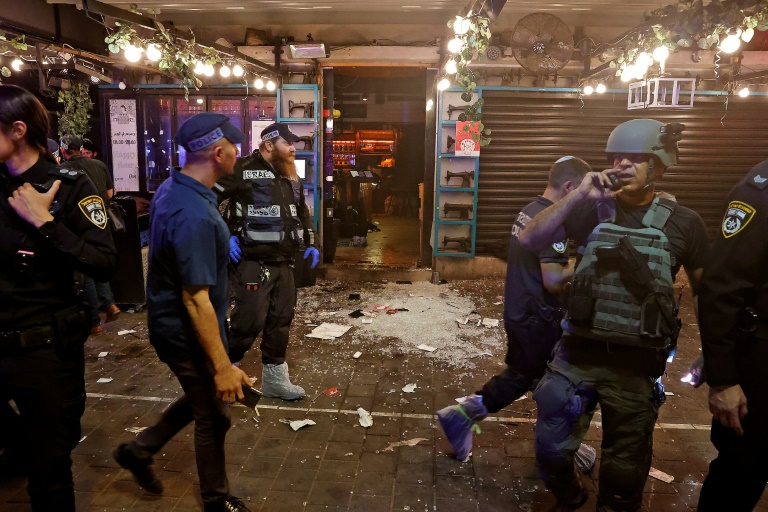
At least two people were killed Thursday and several wounded during an attack in the Israeli city of Tel Aviv, a hospital said.

It is the latest incident among a surge of violence in Israel and the West Bank since late March.

“So far, 10 wounded have arrived at the trauma room of Ichilov Hospital. But unfortunately, despite the doctors’ efforts, two of the wounded died,” Ichilov Hospital said in a statement.

It said four of those wounded in the attack were in “critical condition” and undergoing surgery.

Two witnesses told AFP that they heard gunshots in the centre of Tel Aviv, where police said they were being deployed.

In a statement, they asked residents to stay inside during the incident “which is still ongoing.”

Eli Bin, head of the Magen David Adom emergency responders, initially told public TV broadcaster Kan that five people were wounded and one was “in a critical state.” 

Outside a cafe where what appeared to be shattered glass carpeted the ground outside the entrance, a man comforted a woman sitting on a bar stool while police converged on the scene.

“It’s an atmosphere of war. Soldiers and police are everywhere… They searched the restaurant,” and people are crying, said Binyamin Blum who works in a restaurant near the scene of the attack.

Brenda Ehrlich, 31, an insurance agent from the Tel Aviv suburb of Holon, told AFP she heard about the attack as she rode a bus into the city to celebrate a friend’s birthday.

The group sat indoors and Ehrlich said she felt “like I need to look in all directions to not be caught by surprise, as police hunted for suspects.

“We were thinking of heading home but it feels a little dangerous so we might stay inside in Tel Aviv before we go home.”

Prime Minister Naftali Bennett was at army headquarters in the coastal city where he was receiving updates on this, the fourth attack in just over two weeks in Israel.

On March 29 a Palestinian gunman opened fire with an M-16 assault rifle in Bnei Brak, a mostly Jewish Orthodox city near Tel Aviv. 

He killed two Ukrainian men and two Israeli civilians. An Arab-Israeli officer died of wounds sustained in the ensuing gunfight that also killed the assailant.

Two days earlier “terrorists” opened fire and killed two police officers in the northern city of Hadera before officers shot the assailants dead, police said.

On March 22 a convicted Islamic State group sympathiser killed four Israelis in a stabbing and car-ramming spree in the southern city of Beersheba.

US ends normal trade ties with Russia over Ukraine invasion

The US Congress voted Thursday to end normal trade relations with Moscow and codify the ban on Russian oil, as the White House ratchets up pressure on President Vladimir Putin over his invasion of Ukraine.

The legislation — which also applies to Russia’s ally Belarus — enables President Joe Biden to inflict steep tariff hikes on imports from both countries.

Biden announced the steps in a speech last month arguing that Russia must “pay the price” for the bloodshed in its ex-Soviet neighbor, where it has denied accusations of committing atrocities.

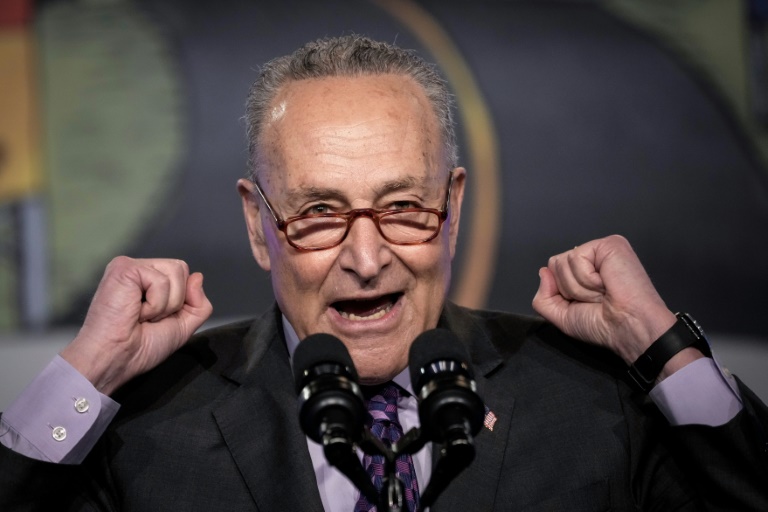
“Putin must absolutely be held accountable for the detestable, despicable war crimes he is committing against Ukraine: the images we have seen coming out of that country… are just pure evil,” said Senate Majority Leader Chuck Schumer.

“It reminds us of the worst moments in human history, caused by the evil man, Putin: hundreds of civilians murdered in cold blood.”

A key principle of the World Trade Organization, the so-called most favored nation status known in the United States as permanent normal trade relations (PNTR), requires countries to guarantee one another equal tariff and regulatory treatment.

The latest trade sanction, which passed the House with support from every Democrat and just a handful of Republicans voting no, caps several rounds of measures intended primarily to sever Moscow’s economic and financial ties with the rest of the world.

They have included banning Russian oil imports — a measure Biden already implemented by executive decree — seizing the assets of billionaires tied to Putin, and freezing the nation’s stockpile of cash.

– Unwavering support –

House Speaker Nancy Pelosi hailed the latest action as a sign that the United States was “unwavering” in its commitment to support Ukraine and hold Russia to account.

“Putin’s aggression and barbaric war crimes have horrified the world and demand a strong response,” she said in a statement. 

Together, the moves have already pushed Moscow to the brink of a debt default.

They have also caused prices for key commodities like gasoline and wheat to soar, harming US consumers already facing the highest inflation in four decades.

The United States imported just under $30 billion in goods from Russia last year, including $17.5 billion in crude oil.

The legislation includes a measure to reauthorize Magnitsky Act sanctions that target human rights violations and corruption with visa bans, asset freezes and other penalties.   

The United States moved Wednesday to block foreign investment in Russia and state-owned enterprises and levied further sanctions on the country’s banks and senior officials.   

Secretary of State Antony Blinken told NBC News that global punishments had put the Russian economy into a “deep recession.” 

“And what we’re seeing is a likely contraction of the Russian economy by about 15 percent,” he said.

“That is dramatic… We’ve seen an exodus from Russia of virtually every major company in the world. And Putin, in the space of a matter of weeks, has basically shut down Russia to the world.”   

US ends normal trade ties with Russia over Ukraine invasion

The US Congress voted Thursday to end normal trade relations with Moscow and codify the ban on Russian oil, as the White House ratchets up pressure on President Vladimir Putin over his invasion of Ukraine.

The legislation — which also applies to Russia’s ally Belarus — enables President Joe Biden to inflict steep tariff hikes on imports from both countries.

Biden announced the steps in a speech last month arguing that Russia must “pay the price” for the bloodshed in its ex-Soviet neighbor, where it has denied accusations of committing atrocities.

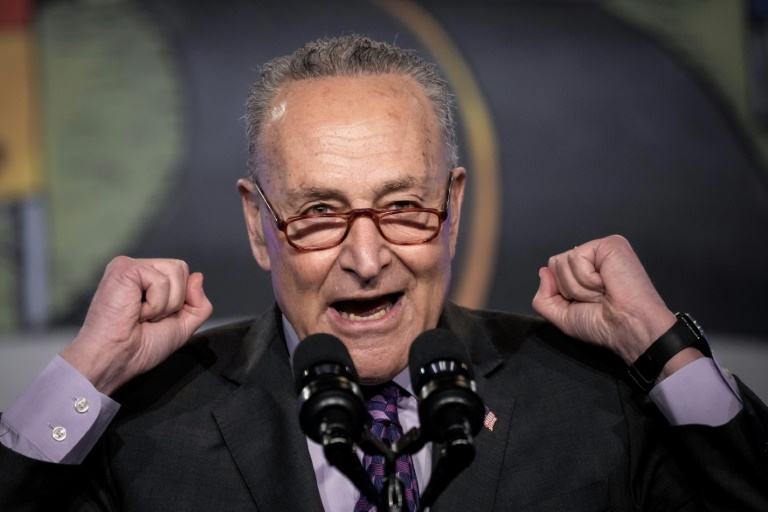
“Putin must absolutely be held accountable for the detestable, despicable war crimes he is committing against Ukraine: the images we have seen coming out of that country… are just pure evil,” said Senate Majority Leader Chuck Schumer.

“It reminds us of the worst moments in human history, caused by the evil man, Putin: hundreds of civilians murdered in cold blood.”

A key principle of the World Trade Organization, the so-called most favored nation status known in the United States as permanent normal trade relations (PNTR), requires countries to guarantee one another equal tariff and regulatory treatment.

The latest trade sanction, which passed the House with support from every Democrat and just a handful of Republicans voting no, caps several rounds of measures intended primarily to sever Moscow’s economic and financial ties with the rest of the world.

They have included banning Russian oil imports — a measure Biden already implemented by executive decree — seizing the assets of billionaires tied to Putin, and freezing the nation’s stockpile of cash.

– Unwavering support –

House Speaker Nancy Pelosi hailed the latest action as a sign that the United States was “unwavering” in its commitment to support Ukraine and hold Russia to account.

“Putin’s aggression and barbaric war crimes have horrified the world and demand a strong response,” she said in a statement. 

Together, the moves have already pushed Moscow to the brink of a debt default.

They have also caused prices for key commodities like gasoline and wheat to soar, harming US consumers already facing the highest inflation in four decades.

The United States imported just under $30 billion in goods from Russia last year, including $17.5 billion in crude oil.

The legislation includes a measure to reauthorize Magnitsky Act sanctions that target human rights violations and corruption with visa bans, asset freezes and other penalties.   

The United States moved Wednesday to block foreign investment in Russia and state-owned enterprises and levied further sanctions on the country’s banks and senior officials.   

Secretary of State Antony Blinken told NBC News that global punishments had put the Russian economy into a “deep recession.” 

“And what we’re seeing is a likely contraction of the Russian economy by about 15 percent,” he said.

“That is dramatic… We’ve seen an exodus from Russia of virtually every major company in the world. And Putin, in the space of a matter of weeks, has basically shut down Russia to the world.”   

IMF, Lebanon strike conditional deal on $3 bn aid

The IMF announced Thursday a conditional agreement to provide Lebanon with $3 billion in aid to help it emerge from a severe economic crisis, following months of negotiations.

The country has been battered by triple-digit inflation, soaring poverty rates and the collapse of its currency since a 2020 debt default.

Officials in Beirut applauded the announcement as it will open the door to additional financial support from foreign donors.

But experts reiterated doubts over the willingness of Lebanon’s political elite, widely blamed for endemic corruption, to implement the reforms needed to resuscitate the economy.

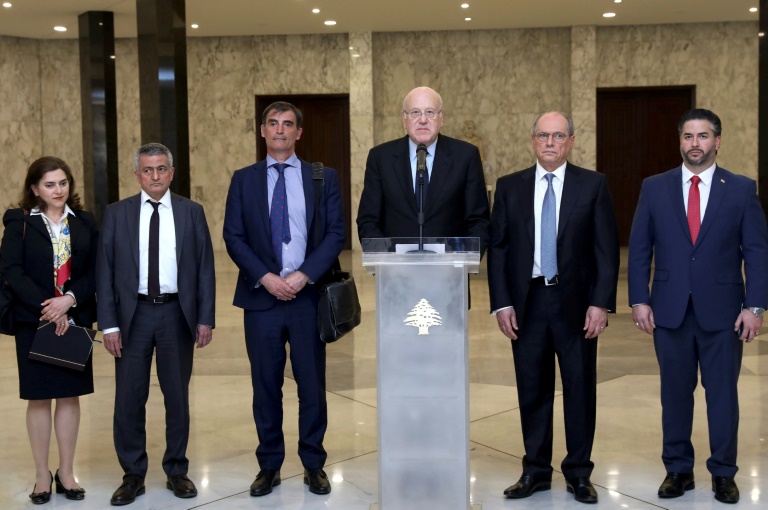
The deal is “a visa stamp for donor countries to begin co-operating with Lebanon and to put Lebanon back on the global finance map”, Prime Minister Najib Mikati told reporters on an upbeat note after the International Monetary Fund announcement of the “staff-level agreement”.

Saudi Arabia, a key financial backer, announced Thursday it was sending an ambassador to Lebanon for the first time since a row broke out five months ago over the Riyadh-led military intervention in Yemen. 

Fellow oil-rich Gulf state Kuwait, which sided with Riyadh in the row, also announced that its ambassador would return “in response to appeals of moderate national forces” in Lebanon.

Ernesto Ramirez Rigo, who led the IMF mission to Lebanon, said that once approved by the global crisis lender’s board, the 46-month financing programme will “support the authorities’ reform strategy to restore growth and financial sustainability”.

However, approval is contingent on “timely implementation of all prior actions and confirmation of international partners’ financial support”, he said in a statement.

Rigo blamed “many years of unsustainable macroeconomic policies” for the crisis in Lebanon that came to a head in 2020 when it defaulted on its sovereign debt for the first time in its history.

The Lebanese pound has lost about 90 percent of its value on the black market and four out of five Lebanese now live below the poverty line, according to the United Nations.

The situation has been exacerbated by soaring inflation, the Covid-19 pandemic and the devastating August 2020 explosion at Beirut port.

“Lebanon is facing an unprecedented crisis, which has led to a dramatic economic contraction and a large increase in poverty, unemployment, and emigration,” Rigo said, adding that the programme will support increased social spending.

– ‘Highly unlikely’ – 

The aid would be released under the global lender’s “Extended Fund Facility” but only after parliament in Beirut approves a 2022 budget and a new bank secrecy law to fight corruption.

It also will require cabinet approval of a debt restructuring plan, Rigo said.

The cabinet must likewise approve a bank restructuring strategy.

A former vice governor of Lebanon’s central bank, Nasser Saidi, said he had doubts that such reforms would ever materialise.

“This is good news if the set of Monetary-Fiscal-Governance-Structural reforms including banking sector restructuring are implemented. Highly unlikely!” he wrote on Twitter.

In a joint statement with President Michel Aoun, Mikati said the IMF deal would help “to revive Lebanon and put it on the path of recovery and solutions”.

Cabinet and parliament must approve the agreement and the reforms demanded by the IMF before the deal goes through.

For more than two years, the ruling elite has been unable to lift the country out of crisis, as it is beset by political horsetrading between rival factions that have repeatedly left Lebanon without a government.

Financial analyst Henri Chaoul dismissed the IMF agreement as a “non-event”.

“The prior actions will never be done. We are light years away,” he told AFP.

“We have 30 years of track record with a perfect-fit regression line.”

IMF, Lebanon strike conditional deal on $3 bn aid

The IMF announced Thursday a conditional agreement to provide Lebanon with $3 billion in aid to help it emerge from a severe economic crisis, following months of negotiations.

The country has been battered by triple-digit inflation, soaring poverty rates and the collapse of its currency since a 2020 debt default.

Officials in Beirut applauded the announcement as it will open the door to additional financial support from foreign donors.

But experts reiterated doubts over the willingness of Lebanon’s political elite, widely blamed for endemic corruption, to implement the reforms needed to resuscitate the economy.

The deal is “a visa stamp for donor countries to begin co-operating with Lebanon and to put Lebanon back on the global finance map”, Prime Minister Najib Mikati told reporters on an upbeat note after the International Monetary Fund announcement of the “staff-level agreement”.

Saudi Arabia, a key financial backer, announced Thursday it was sending an ambassador to Lebanon for the first time since a row broke out five months ago over the Riyadh-led military intervention in Yemen. 

Fellow oil-rich Gulf state Kuwait, which sided with Riyadh in the row, also announced that its ambassador would return “in response to appeals of moderate national forces” in Lebanon.

Ernesto Ramirez Rigo, who led the IMF mission to Lebanon, said that once approved by the global crisis lender’s board, the 46-month financing programme will “support the authorities’ reform strategy to restore growth and financial sustainability”.

However, approval is contingent on “timely implementation of all prior actions and confirmation of international partners’ financial support”, he said in a statement.

Rigo blamed “many years of unsustainable macroeconomic policies” for the crisis in Lebanon that came to a head in 2020 when it defaulted on its sovereign debt for the first time in its history.

The Lebanese pound has lost about 90 percent of its value on the black market and four out of five Lebanese now live below the poverty line, according to the United Nations.

The situation has been exacerbated by soaring inflation, the Covid-19 pandemic and the devastating August 2020 explosion at Beirut port.

“Lebanon is facing an unprecedented crisis, which has led to a dramatic economic contraction and a large increase in poverty, unemployment, and emigration,” Rigo said, adding that the programme will support increased social spending.

– ‘Highly unlikely’ – 

The aid would be released under the global lender’s “Extended Fund Facility” but only after parliament in Beirut approves a 2022 budget and a new bank secrecy law to fight corruption.

It also will require cabinet approval of a debt restructuring plan, Rigo said.

The cabinet must likewise approve a bank restructuring strategy.

A former vice governor of Lebanon’s central bank, Nasser Saidi, said he had doubts that such reforms would ever materialise.

“This is good news if the set of Monetary-Fiscal-Governance-Structural reforms including banking sector restructuring are implemented. Highly unlikely!” he wrote on Twitter.

In a joint statement with President Michel Aoun, Mikati said the IMF deal would help “to revive Lebanon and put it on the path of recovery and solutions”.

Cabinet and parliament must approve the agreement and the reforms demanded by the IMF before the deal goes through.

For more than two years, the ruling elite has been unable to lift the country out of crisis, as it is beset by political horsetrading between rival factions that have repeatedly left Lebanon without a government.

Financial analyst Henri Chaoul dismissed the IMF agreement as a “non-event”.

“The prior actions will never be done. We are light years away,” he told AFP.

“We have 30 years of track record with a perfect-fit regression line.”

France's Le Pen says 'so close' as election battle enters crucial stage

French far-right presidential candidate Marine Le Pen said Thursday she had never been “so close” to power at a jubilant final rally before this weekend’s election, which polls suggest is an increasingly tight battle between her and President Emmanuel Macron.

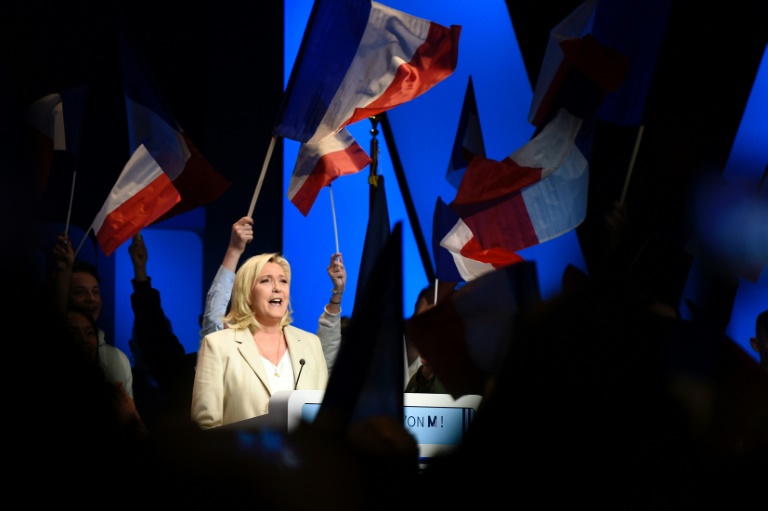
In front of around 4,000 upbeat supporters chanting “President Marine!” and “We’re going to win!”, Le Pen promised to help French families struggling with inflation and compared Macron to a “stunned boxer”.

“Never before has the prospect of a real change been so close, but it depends on you,” Le Pen told the crowd in far-right stronghold Perpignan in southern France.

“Never forget and tell people around you: if the people vote, the people will win,” she said in speech that repeatedly appealed to the roughly one quarter of French adults who are projected to abstain on Sunday. 

Last month, polls suggested Macron had an almost unassailable lead ahead heading into the first round and would go on to win the second-round run-off scheduled for April 24.

But all bets are off, with up to a quarter of voters thought to be undecided and surveys suggesting a major swing towards Le Pen, who is now shown as only marginally behind the president. 

With France’s traditional right- and left-wing parties facing electoral disaster, rising far-left candidate Jean-Luc Melenchon still believes he can sneak into a run-off and is shown running third. 

“We’re going to live the founding moment of a new era,” Le Pen, 53, added, a sentiment shared by many supporters in sun-drenched Perpignan, a short trip from the nearby Spanish border. 

“It’s the first time that I feel this confident” said Mireille Redon, 74, who has voted for the Le Pen and her father Jean-Marie for more than 20 years.  

“I feel like she’s ready. She’s learned from her mistakes and seems much more confident in herself,” she told AFP. 

The war in Ukraine as well as strains on the health system after two years of Covid-19 are high among voter concerns, behind the biggest worry of all: inflation and incomes. 

– Tight polling –

The latest OpinionWay-Kea Partners survey out Thursday showed Macron falling back to 26 percent in the first round and Le Pen edging up to 22 percent, with Melenchon also gaining ground on 17.

Macron was shown beating Le Pen in the second round with 53 percent to her 47 if it were held today — a narrower margin than the same pollsters forecast last week.

A new Ifop-Fidicual poll showed similar trends of Macron slipping and Le Pen gaining with the president on 26.5 percent in round one and Le Pen on 24 percent. 

It indicated Macron would win the second round with 52 percent compared with Le Pen’s 48.

“Our initial objective is to consolidate our lead and to prevent Marine Le Pen coming out ahead in the first round,” a figure in Macron’s ruling party, who asked not to be named, told AFP.

Another advisor added: “We see Marine Le Pen’s dynamic and we will need to put on turbo engines for round two… It’s not won until the end.”

Despite starting campaigning only two weeks ago after being distracted by his diplomatic efforts to end the war in Ukraine, Macron made no public appearance on Thursday. 

“I’ve acquired experience of crises, international experience. I’ve also learned from my mistakes,” Macron told Le Figaro newspaper in an interview published Thursday.

“Emmanuel Macron keeps talking to us about crises, like a stunned boxer who is stuck thinking about the uppercut that put him on the floor,” Le Pen replied in Perpignan.

– Chasing candidates –

Among the other chasing candidates, Melenchon is rising strongly in the polls and is talking up his chances of springing a surprise, helped by a confident rally Tuesday that saw him beamed by hologram into 11 French cities.

Greens candidate Yannick Jadot, conservative Valerie Pecresse, far-right former TV pundit Eric Zemmour and flagging Socialist nominee Anne Hidalgo also had rallies Thursday.

According to the Le Monde newspaper, Hidalgo hosted a secret dinner of Socialist grandees including ex-president Francois Hollande to discuss the party’s post-election future, prompting allegations she had capitulated before the poll had even taken place.

Le Pen’s speech in Perpignan underlined how she has toned down her anti-immigration rhetoric during campaigning this year in order to focus on household spending.

“Our programme is a social programme and I dare to say it and I take responsibility for it,” she added, detailing how she would slash fuel taxes and increase pensions.

In an interview with RTL radio earlier in the day, she explained how she would implement a planned ban on the Muslim headscarf in public spaces, which experts believe would be unconstitutional.  

“People will be given a fine in the same way that it is illegal to not wear your seat belt,” she said.

She laughed at the idea that she could be demonised on her third run for the presidency despite Macron’s intention of attacking her as economically reckless and xenophobic. 

“Scare-mongering which entails saying that unless Emmanuel Macron is re-elected, it will be a crisis, the sun will be extinguished, the sea will disappear and we’ll suffer an invasion of frogs, no longer works,” she told RTL.

Walmart hikes starting US trucker pay to as much as $110,000/year

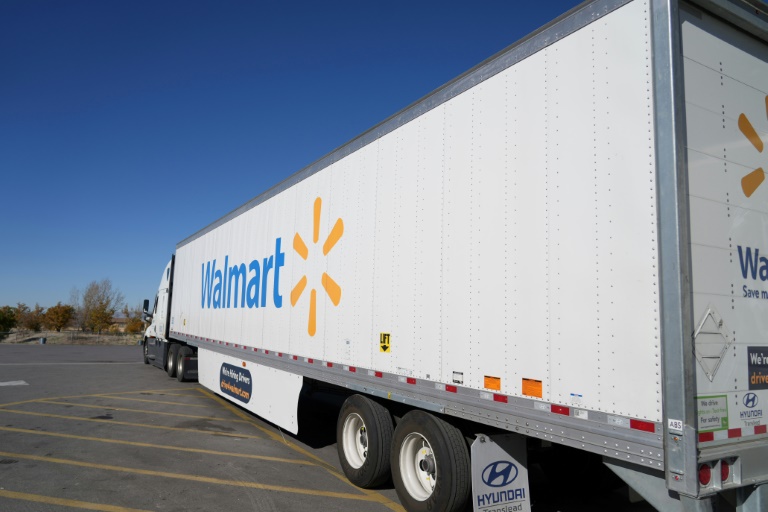
Walmart will lift starting pay for truckers to as much as $110,000 a year in the retail giant’s latest move to recruit and retain logistics staff in the tight US labor market.

The new salary level compares with current pay averaging $87,500 for first-year drivers and is roughly twice the average $56,491 annual pay for a long-haul driver, according to data cited by Walmart.

Whether a new driver can make the full $110,000 depends on factors such as miles driven and location, a Walmart spokesman said.

The aim is to make working as a driver for the company a “destination job,” Walmart supply chain executives Fernando Cortes and Karisa Sprague said in a blog post. 

“The investments in pay and training build on multiple recent driver bonuses and improved schedules that enable drivers to spend more time at home,” they said. “Once drivers are on board, this is a job many leave only for retirement.”

Walmart, which currently has 12,000 drivers in its fleet, is looking to add another 5,000 in 2022.

The company has also established an internal training program where staff from other parts of Walmart can train for 12 weeks and earn a commercial driver’s license. The goal is to bring on 400 to 800 drivers through the program by the end of the company’s 2023 fiscal year, a spokesman said.

The hiring push comes amid a period of significant revenue growth for Walmart and other big-box chains throughout the coronavirus pandemic, a period also characterized by port backlogs and supply chain snarls.

The crunch in drivers has prompted some larger trucking companies to argue for lowering the national driving age, a policy opposed by independent truckers who have called for more parking capacity, less unpaid waiting time and other improvements in working conditions to improve employee retention.

Close Bitnami banner
Bitnami