World

UN General Assembly suspends Russia from Human Rights Council

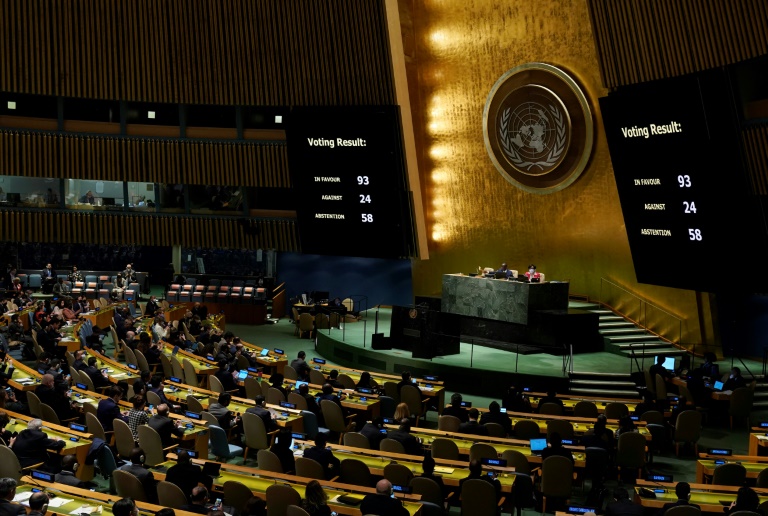
The UN General Assembly voted Thursday to suspend Russia from the UN Human Rights Council as punishment for the invasion of Ukraine.

Of the 193 members of the assembly, 93 voted in favor of suspension as proposed by the United States while 24 voted against and 58 abstained, suggesting weakening international unity against Russia at the United Nations.

It was the second ever suspension of a country from the council. Libya was the first, in 2011.

Suspension required two-thirds of the votes for and against; the abstentions did not count.

The countries voting against included China, a Moscow ally which has steadfastly abstained from criticizing the invasion. Others were Iran, the former Soviet republic of Kazakhstan and communist Cuba, as well as Russia itself, Belarus and Syria.

Despite pressure from Moscow for a no vote, several African countries only abstained, such as South Africa and Senegal. Also abstaining were Brazil, Mexico and India.

The US argues that this punishment — suspending Russia from the Geneva-based organization that is the UN’s main human rights monitor — is more than symbolic and in fact intensifies Russia’s isolation after the assault on Ukraine that began February 24.

Ukrainian President Volodymyr Zelensky has also called for Russia to be expelled from the UN Security Council “so it cannot block decisions about its own aggression, its own war.”

But Washington has admitted there is little anyone can do about Russia’s position on the Security Council, where it has a veto.

– Match words with ‘action’ –

More than 11 million people have been displaced since Russia invaded Ukraine on February 24.

The world has been outraged by images of scores of civilians apparently executed and left in mass graves in areas formerly controlled by Russian troops. This carnage has led to new rounds of sanctions against Russia.

Journalists including from AFP last weekend found corpses in civilian clothes, some with their hands bound in the town of Bucha outside Kyiv.

“The images out of Bucha and devastation across Ukraine require us to now match our words with action,” US ambassador Linda Thomas-Greenfield said Monday as she pressed for Russia’s suspension from the rights council.

“We cannot let a member state that is subverting every principle we hold dear to continue to participate” in the council, she said.

The Kremlin has denied Russian forces killed civilians, and alleged that the images of dead bodies in Bucha were “fakes.”

The UN Human Rights Council was founded in 2006 and is composed of 47 member states chosen by the General Assembly.

IMF reaches agreement on $3 bn deal for Lebanon

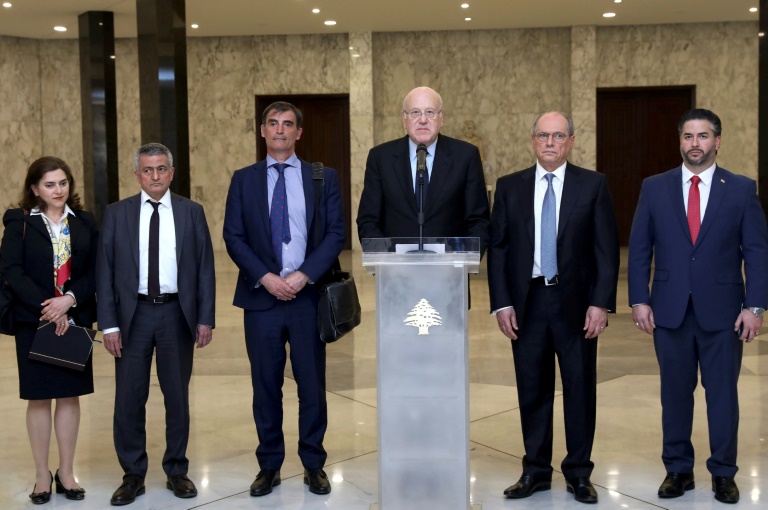
The IMF announced Thursday that after months of negotiations it reached a staff-level agreement to provide Lebanon with $3 billion in aid to help it emerge from a severe economic crisis.

The country has been battered by triple digit inflation, soaring poverty rates, and the collapse of its currency since a 2020 debt default, and officials in Beirut applauded the announcement as it will open the door to additional financial support. 

The deal is “a visa stamp for donor countries to begin co-operating with Lebanon and to put Lebanon back on the global finance map,” Prime Minister Najib Mikati told reporters after the IMF announcement.

Ernesto Ramirez Rigo, who led the IMF mission to Lebanon, said that once approved by the global crisis lender’s board, the 46-month financing program will “support the authorities’ reform strategy to restore growth and financial sustainability.”

However, approval is contingent on “timely implementation of all prior actions and confirmation of international partners’ financial support,” he said in a statement.

Rigo blamed “many years of unsustainable macroeconomic policies” for the crisis that came to a head in 2020 when Lebanon defaulted on its sovereign debt for the first time in its history.

The Lebanese pound has lost about 90 percent of its value on the black market and four out of five Lebanese now live below the poverty line, according to the United Nations.

The situation has been exacerbated by soaring inflation, the Covid-19 pandemic and the war in Ukraine, as well as the August 2020 port of Beirut explosion.

“Lebanon is facing an unprecedented crisis, which has led to a dramatic economic contraction and a large increase in poverty, unemployment, and emigration,” Rigo said, who stressed that the program will support increased social spending.

– ‘In Lebanon’s best interest’ – 

The aid would be released under the global lender’s Extended Fund Facility but only after the parliament in Beirut approves a 2022 budget and a new bank secrecy law to fight corruption.

It also will require cabinet approval of a debt restructuring plan, with “sufficient creditor participation to restore debt sustainability and close financing gaps,” Rigo said.

Officials “expressed their strong commitment to carry out this reform program and sustain decisive implementation during the upcoming parliamentary and Presidential elections,” Rigo said.

Mikati agreed that “these reforms are in Lebanon’s best interest,” and said they will be fully implemented.

In a joint statement with President Michel Aoun, he said the IMF deal will help “to revive Lebanon and put it on the path of recovery and solutions.”

IMF reaches agreement on $3 bn deal for Lebanon

The IMF announced Thursday that after months of negotiations it reached a staff-level agreement to provide Lebanon with $3 billion in aid to help it emerge from a severe economic crisis.

The country has been battered by triple digit inflation, soaring poverty rates, and the collapse of its currency since a 2020 debt default, and officials in Beirut applauded the announcement as it will open the door to additional financial support. 

The deal is “a visa stamp for donor countries to begin co-operating with Lebanon and to put Lebanon back on the global finance map,” Prime Minister Najib Mikati told reporters after the IMF announcement.

Ernesto Ramirez Rigo, who led the IMF mission to Lebanon, said that once approved by the global crisis lender’s board, the 46-month financing program will “support the authorities’ reform strategy to restore growth and financial sustainability.”

However, approval is contingent on “timely implementation of all prior actions and confirmation of international partners’ financial support,” he said in a statement.

Rigo blamed “many years of unsustainable macroeconomic policies” for the crisis that came to a head in 2020 when Lebanon defaulted on its sovereign debt for the first time in its history.

The Lebanese pound has lost about 90 percent of its value on the black market and four out of five Lebanese now live below the poverty line, according to the United Nations.

The situation has been exacerbated by soaring inflation, the Covid-19 pandemic and the war in Ukraine, as well as the August 2020 port of Beirut explosion.

“Lebanon is facing an unprecedented crisis, which has led to a dramatic economic contraction and a large increase in poverty, unemployment, and emigration,” Rigo said, who stressed that the program will support increased social spending.

– ‘In Lebanon’s best interest’ – 

The aid would be released under the global lender’s Extended Fund Facility but only after the parliament in Beirut approves a 2022 budget and a new bank secrecy law to fight corruption.

It also will require cabinet approval of a debt restructuring plan, with “sufficient creditor participation to restore debt sustainability and close financing gaps,” Rigo said.

Officials “expressed their strong commitment to carry out this reform program and sustain decisive implementation during the upcoming parliamentary and Presidential elections,” Rigo said.

Mikati agreed that “these reforms are in Lebanon’s best interest,” and said they will be fully implemented.

In a joint statement with President Michel Aoun, he said the IMF deal will help “to revive Lebanon and put it on the path of recovery and solutions.”

Kenya unveils $28 billion budget to spur recovery

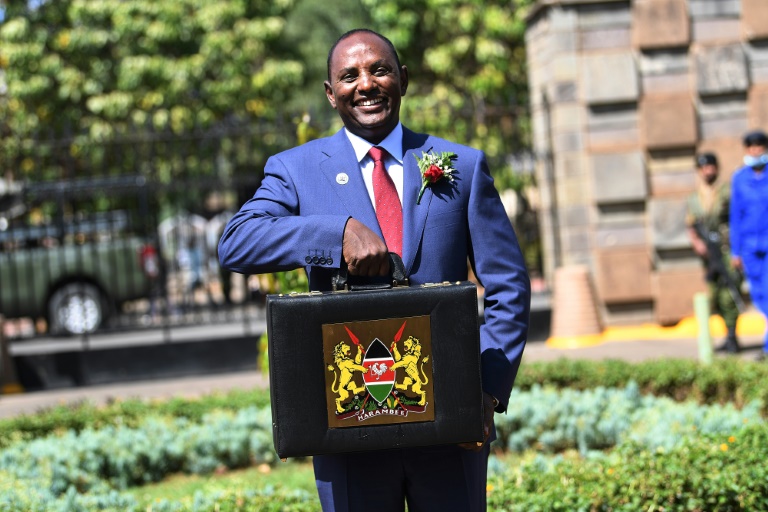
Kenya’s finance minister on Thursday unveiled a $28 billion budget aimed at helping the economy recover after the Covid-19 pandemic threw hundreds of thousands of people out of work.

The financial roadmap for the 2022/2023 fiscal year, announced just four months before the country goes to the polls, also pumps billions into outgoing President Uhuru Kenyatta’s so-called legacy projects and major infrastructure — much of it funded by China.

“We have outlined policies in this budget that are geared towards returning the economy back on a more sustainable growth path for improved livelihoods,” Treasury Cabinet Secretary Ukur Yatani told parliament.

He said the East African powerhouse’s economy was set to grow by six percent in the current calendar year, down from 7.6 percent last year but a marked improvement on the 0.3 percent contraction in 2020 — the first in three decades.

The 3.3 trillion shilling ($28 billion, 26 billion euro) budget illustrates the fine line the government is walking between trying to improve people’s livelihoods but also boost its own coffers by increasing taxes.

Yatani forecast a budget deficit of 6.2 percent of gross domestic product (GDP), down from 7.5 percent in the previous fiscal year.

If the budget is approved by parliament, the government will also splash out 146 billion shillings on Kenyatta’s legacy schemes under his so-called Big Four Agenda, which focuses on food security, affordable housing, affordable healthcare and manufacturing.

It is also planning to spend billions of dollars on infrastructure projects such as an expressway aimed at easing the capital Nairobi’s notoriously congested roads and the expansion of the nation’s railway network.

Kenya was battered by the coronavirus pandemic, which slashed income from the vital tourist sector, although agriculture — the backbone of the economy — proved more resilient.

Sri Lanka asks experts to plan debt restructure as protests rage

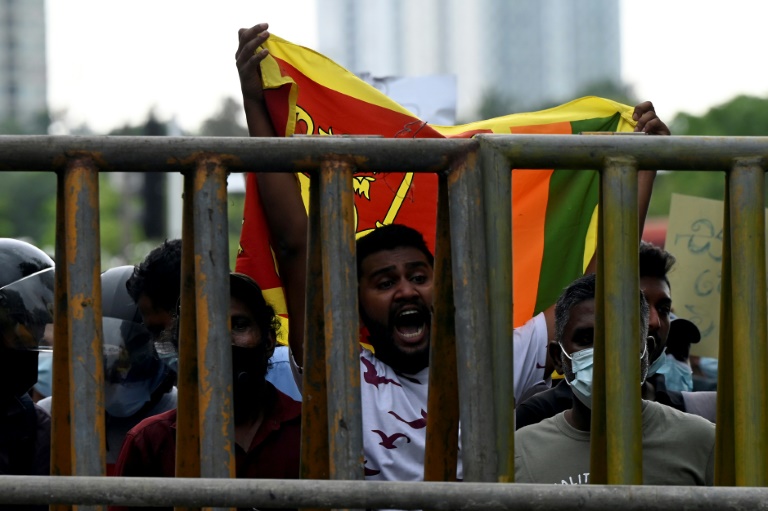
Sri Lanka’s president has appointed a panel of experts to organise a restructuring of foreign debt as he seeks a way out of a worsening economic crisis, with protests demanding his resignation escalating.

Shortages of food and fuel, along with record inflation and regular blackouts, have inflicted unprecedented misery on Sri Lankans in the most painful downturn since independence from Britain in 1948.

Ratings agencies have warned of a potential default on the nation’s $51 billion foreign debt, with authorities unable to secure more commercial loans because of credit downgrades.

President Gotabaya Rajapaksa’s office said late Wednesday that a three-member advisory panel had been tasked with guiding Sri Lanka through a “sustainable and inclusive recovery”.

His government is preparing for bailout negotiations with the International Monetary Fund, and finance ministry officials told AFP the trio will prepare a programme for sovereign bond holders and other creditors to take a haircut.

“What Sri Lanka is keen to do is avoid a hard default,” a source from the ministry who requested anonymity told AFP. 

“It will be a negotiated restructuring of the debt with the help of the IMF.”

The president appointed pro-IMF retired central banker Nandalal Weerasinghe as the new governor.

Parliamentary Speaker Mahinda Yapa Abeywardana warned Wednesday that the economic crisis could lead to starvation unless addressed within the week.

Meetings with the IMF are set to begin by next week but Finance Minister Basil Rajapaksa — the president’s brother — resigned on Sunday night along with nearly the entire cabinet. 

The country is still without a replacement, with his successor quitting after just one day in office.

Public anger is at fever pitch, with crowds attempting to storm the homes of several government figures and demanding President Rajapaksa’s resignation.

On Thursday a court in Colombo slapped a travel ban on the country’s recently resigned central bank chief over allegations he was responsible for the country’s predicament by not seeking IMF help earlier.

Ajith Cabraal, who quit Monday, was told to appear in court on April 18 to answer allegations of a criminal breach of trust.

Rights activist Keerthi Tennakoon has filed a petition with the court alleging the current shortages are due to Cabraal’s mismanagement of Sri Lanka’s foreign reserves.

Court proceedings were briefly held up when the power went off.

– Holidays declared –

Local media have reported that protests are escalating, with civil servants and schoolchildren joining demonstrations organised largely through social media.

In an apparent bid to head off more protests, the government on Thursday declared extra public holidays for next week to coincide with the traditional Sinhalese and Tamil New Year.

Security forces have dispersed some protests with tear gas, water cannon and rubber bullets, and dozens of people have been arrested, with many saying they were tortured in police custody. 

Opposition parties have rejected an overture from the president to form a unity administration and joined calls for him to step down.

But chief government whip Johnston Fernando reiterated Thursday that Rajapaksa would stay in office to lead the country out of the crisis.

Rajapaksa attended parliament Thursday but did not address the chamber, where he has lost his majority.

There has so far been no clear signal that opposition legislators will attempt a no-confidence motion to topple the administration.

The foreign currency shortage has left Sri Lanka struggling to import essential goods, with the coronavirus pandemic torpedoing vital revenue from tourism and remittances.

Economists say the crisis has been exacerbated by government mismanagement, years of accumulated borrowing and ill-advised tax cuts.

Kyiv warns of Russian attack as civilian deaths mar talks

Ukraine warned residents in the east of the country Thursday to take their “last chance” to flee a feared Russian assault, as outrage over civilian deaths around the capital Kyiv cast a shadow over halting negotiations to stop the six week-old conflict.

Six weeks after invading its neighbour, Russia’s troops have withdrawn from Kyiv and Ukraine’s north and are focusing on the country’s southeast, where desperate attempts are under way to evacuate civilians.

The retreat from Kyiv revealed scenes of carnage, including in the town of Bucha, that Ukraine said were evidence of Russian war crimes, and which triggered a fresh wave of Western sanctions against Moscow.

Ukrainian President Volodymyr Zelensky warned that Russia was now massing forces in a bid to realise its “ill ambitions” in the eastern Donbas region, home to Moscow-backed separatists.

“These few days may be the last chance to leave,” said Sergiy Gaiday, governor of the Donbas region of Lugansk, in an appeal to residents to leave, adding that all the cities in the region were under fire.

Meanwhile the prospect of a negotiated end to the war seemed to fade further as Russia accused Kyiv of changing its demands since face-to-face talks in Istanbul last month.

Foreign Minister Sergei Lavrov said a draft agreement presented by the Ukraine side on Wednesday suggested they were not interested in stopping the fighting.

Ukrainian presidential adviser Mykhaylo Podolyak hit back that if Moscow wanted to show its readiness to talk, “it should lower the degree of hostility”.

And Foreign Minister Dmytro Kuleba went further, saying Lavrov’s denials of Russian responsibility in Bucha and elsewhere “makes him an accomplice to these crimes”.

Foreign Minister Mevlut Cavusoglu of Turkey, which is hosting the negotiations, said the images of bodies from Bucha and other areas had “overshadowed” what had been an “emerging positive atmosphere”.

– ‘Nowhere to go’ –

Gaiday said previously that more than 1,200 people had been evacuated from Lugansk on Wednesday, but that efforts were being hampered by artillery fire, with some areas already inaccessible. 

For those unable to leave, he said, tonnes of food, medicine and hygiene products were being delivered as part of a massive humanitarian effort.

Shells and rockets were also slamming into the industrial city of Severodonetsk, the easternmost city held by Ukrainian forces. 

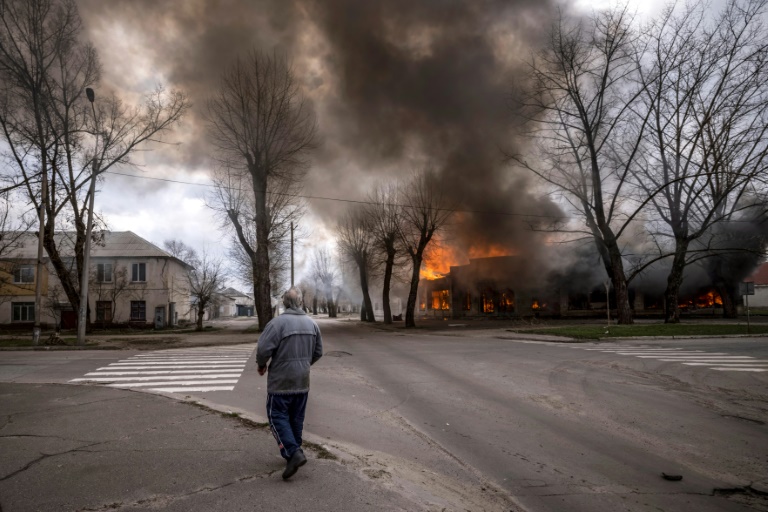
“We have nowhere to go, it’s been like this for days,” 38-year-old Volodymyr told AFP, standing opposite a burning building in Severodonetsk.

More than 11 million people have been displaced since Russia invaded on February 24, with the stated aim to “de-Nazify” and “demilitarise” Ukraine and support Moscow-backed separatists.

Moscow is currently believed to be trying to create a land link between occupied Crimea and the statelets in Donbas.

– ‘Weapons, weapons, weapons’ –

Ukrainian forces are also regrouping for the offensive, including on a two-lane highway through the rolling eastern plains connecting Kharkiv and Donetsk.

Trench positions were being dug, and the road was littered with anti-tank obstacles. 

“We’re waiting for them!” said a lieutenant tasked with reinforcing the positions, giving a thumbs up.

Western allies have already sent funds and weapons to Ukraine, but Kuleba on Thursday appealed for urgent heavy weaponry, including air defence systems, artillery, armoured vehicles and jets.

“Either you help us now — and I’m speaking about days, not weeks — or your help will come too late, and many people will die, many civilians will lose their homes, many villages will be destroyed,” he said after meeting NATO foreign ministers in Brussels.

Earlier he said he had only one item on his agenda: “It’s weapons, weapons, and weapons.”

– ‘Brutality and inhumanity’ –

The evacuation calls in eastern Ukraine are being fuelled by fears of fresh atrocities, after chilling discoveries in areas from which Moscow’s troops have withdrawn.

US President Joe Biden said “major war crimes” were being committed in Ukraine, where images have emerged in recent days of bodies with their hands bound or in shallow graves.

“Civilians executed in cold blood, bodies dumped into mass graves, the sense of brutality and inhumanity left for all the world to see, unapologetically,” Biden said. 

In one of the worst affected towns, Bucha, some residents were still trying to learn the fate of loved ones, while others were hoping to forget. 

Tetiana Ustymenko’s son and his two friends were gunned down in the street, and she buried them in the garden of the family home. 

“How can I live now?” she said.

The Kremlin denies responsibility for any civilian deaths and President Vladimir Putin on Wednesday accused Ukrainian authorities of “crude and cynical provocations” in Bucha.

But the German government pointed to satellite pictures taken while the town was still under Moscow’s control, which appear to show bodies in the streets.

Human rights groups say rape is also being used as a “weapon of war” in Ukraine.

Officials have alleged that Russian troops are now trying to cover up atrocities elsewhere to prevent further international outcry, including in the besieged city of Mariupol.

– Sanctions ‘not enough’ –

Western powers have already pummelled Russia with debilitating economic sanctions and on Wednesday the United States unveiled further measures targeting Russia’s top banks and two of Putin’s adult daughters.

Britain sanctioned two banks and vowed to eliminate all Russian oil and gas imports by the end of the year, while the European Union is poised to cut off Russian coal imports.

On the diplomatic front, EU nations this week have expelled more than 200 Russian diplomats and staff, mostly for alleged spying.

And the UN General Assembly will voted to exclude Moscow from the UN Human Rights Council.

But Zelensky has said the new sanctions were “not enough” and urged countries to completely cut off Russia’s banks from the international financial system, and to stop buying the country’s oil. 

burs-ar/yad

Pakistan court says parliament must reconvene, orders PM no-confidence vote

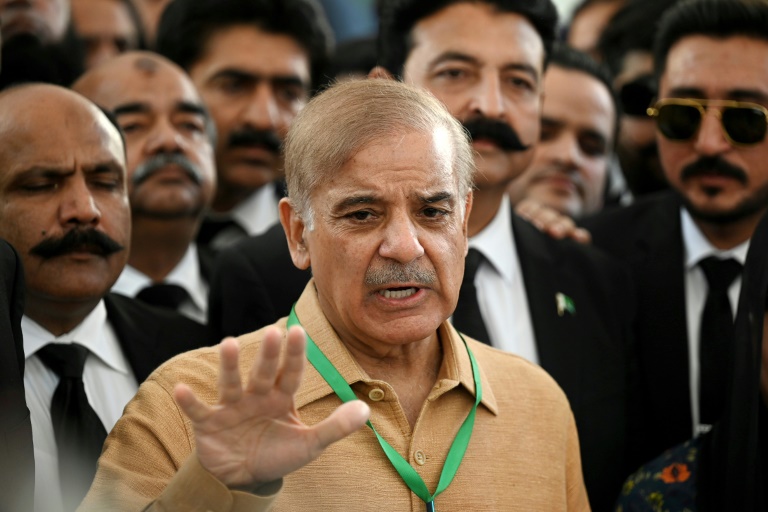
Pakistan’s Supreme Court ruled Thursday that the national assembly had been illegally dissolved, and ordered parliament to reconvene to hold a no-confidence vote that will likely see Prime Minister Imran Khan booted from office.

Khan asked the president to dissolve the assembly after the deputy speaker refused to allow a no-confidence vote against him on Sunday, but the Supreme Court said the action was illegal.

“All actions taken are of no legal effect and quashed,” the court ruling said.

“The national assembly continues to remain in session.”

The decision was met with jubilation by some in the capital, with cars loaded with opposition supporters racing through the streets and sounding their horns.

-‘Regime change’-

Khan claimed the opposition had colluded with the United States for “regime change” when the deputy speaker — a loyalist — refused to allow the no-confidence motion.

Simultaneously, Khan asked the presidency — a largely ceremonial office also held by a loyalist — to dissolve the assembly, meaning an election must be held within 90 days.

President Arif Alvi had already told the feuding factions to nominate candidates for interim prime minister and asked the country’s election commission to fix a date for a new national ballot.

The opposition had refused to cooperate.

There had been high hopes for Khan when he was elected in 2018 on a promise of sweeping away decades of entrenched corruption and cronyism, but he struggled to maintain support with soaring inflation, a feeble rupee and crippling debt.

On Thursday the rupee was trading at a historic low of 190 to the dollar, and the central bank raised the key interest rate by 250 basis points to 12.25 percent — the biggest hike in over a quarter of a century.

Pakistan has been wracked by political crises for much of its 75-year existence, and no prime minister has ever seen out a full term.

Khan has blown anti-US sentiment into the political atmosphere by saying the opposition had colluded with Washington.

The cricketer-turned-politician says Western powers wanted him removed because he will not stand with them against Russia and China, and the issue is sure to ignite any forthcoming election.

The Supreme Court is ostensibly independent, but rights activists say previous benches have been used by civilian and military administrations to do their bidding throughout Pakistan’s history.

Publicly the military appears to be keeping out of the current fray, but there have been four coups since independence in 1947 and the country has spent more than three decades under army rule.

Stocks wilt as investors brace for US Fed tightening

US and European stocks retreated Thursday after minutes from central banks showed US policymakers ready to aggressively wind back easy-money policies while their eurozone counterparts disagreed over their own way forward.

Meanwhile, oil prices continued to slide following heavy losses on Wednesday that had been triggered by concerns about weaker demand because of economic slowdown, with Brent crude falling below $100 per barrel.

A surge of Covid cases in major consumer China has raised concerns about demand, as has the surge in prices following the Russian invasion of Ukraine and Western sanctions.

On Wall Street all three major stock indices were lower in late morning trading, with Dow dropping 0.7 percent.

In Europe, London and Frankfurt ended the day down 0.5 percent, while Paris shed 0.6 percent.

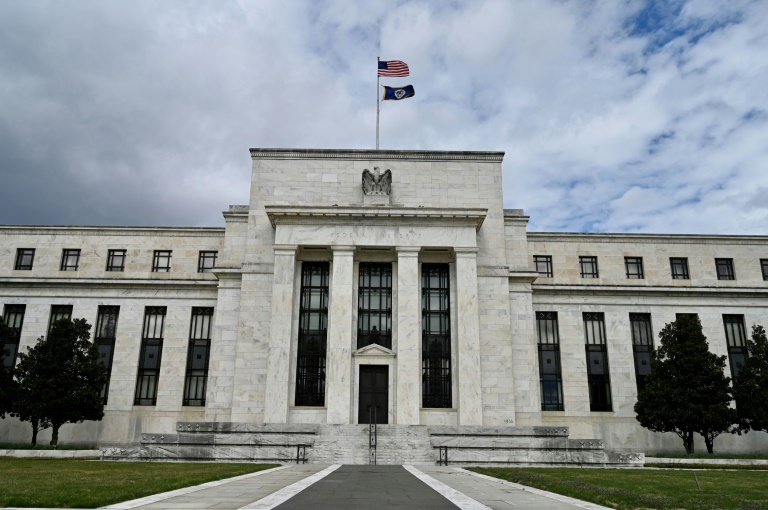
Minutes showed the Fed in March opted to raise US borrowing costs rates by a quarter percentage point, mindful of “greater near-term uncertainty associated with Russia’s invasion of Ukraine”.

But some policymakers had favoured lifting rates even higher, by half a percentage point, to rein in decades-high inflation which is threatening to derail the economic recovery.

“Last night’s Fed minutes have recommitted the central bank to its path of tightening policy, leaving equities vulnerable in the short term after the bounce from the March lows,” said Chris Beauchamp, chief market analyst at online trading platform IG.

– Inflation fight –

At their own meeting last month, European Central Bank policymakers disagreed on how to respond to runaway inflation and economic uncertainty caused by Russia’s invasion of Ukraine, minutes indicated Thursday.

“A large number of members held the view that the current high level of inflation and its persistence called for immediate further steps towards monetary policy normalisation,” the minutes read.

The ECB’s governing council played it safe at the March meeting, agreeing to wind down monthly bond purchases at an accelerated pace in the second quarter, while keeping the end date of the stimulus scheme flexible.

An interest rate hike would follow “some time” after the end of the bond-buying scheme, it said.

But the minutes revealed that some governors wanted to go further to combat inflation, as the war in Ukraine further pushes up prices for energy, food and raw materials.

The prospect of rates rising at a quicker pace over the coming months has added to a wave of uncertainty across trading floors.

Central banks across the world are under fierce pressure to tackle runaway inflation, which has soared further on a Ukraine-driven spike in commodities like gas, oil and wheat.

March was the first Fed hike since it slashed US rates to zero when the Covid-19 pandemic broke out two years ago.

Although current US data points to a healthy economy, commentators warn of possible hard times ahead.

“While the economy continues to grow, there is a clear lack of bullish momentum in this market at the moment,” said IG’s Beauchamp.

– Key figures around 1530 GMT –

New York – Dow: DOWN 0.7 percent at 34,240.39 points

EURO STOXX 50: DOWN 0.6 percent at 3,802.10

London – FTSE 100: DOWN 0.5 percent at 7,551.81 (close)

Frankfurt – DAX: UP DOWN 0.5 percent at 14,078.15 (close)

Paris – CAC 40: DOWN 0.6 percent at 6,461.68 (close)

Tokyo – Nikkei 225: DOWN 1.7 percent at 26,888.57 (close)

Hong Kong – Hang Seng Index: DOWN 1.2 percent at 21,808.98 (close)

Shanghai – Composite: DOWN 1.4 percent at 3,236.70 (close)

Brent North Sea crude: DOWN 2.3 percent at $98.73 per barrel

West Texas Intermediate: DOWN 2.1 percent at $94.23 per barrel

Euro/dollar: UP at $1.0903 from $1.0896 late Wednesday

Pound/dollar: DOWN at $1.3063 from $1.3069

Euro/pound: UP at 83.46 pence from 83.37 pence

Dollar/yen: UP at 123.87 yen from 123.80 yen

burs-rl/cdw

US Senate votes to end normal trade ties with Russia

The US Senate voted unanimously Thursday to end normal trade relations with Moscow and codify the ban on Russian oil, as the White House ratcheted up pressure on President Vladimir Putin over his invasion of Ukraine.

The legislation, which would enable Western nations to inflict steep tariff hikes on Russian goods, now heads back to the House, which is expected to take it up later in the day.

President Joe Biden announced the step in a speech last month arguing that Russia must “pay the price” for the bloodshed in its ex-Soviet neighbor, where it has denied accusations of committing atrocities.

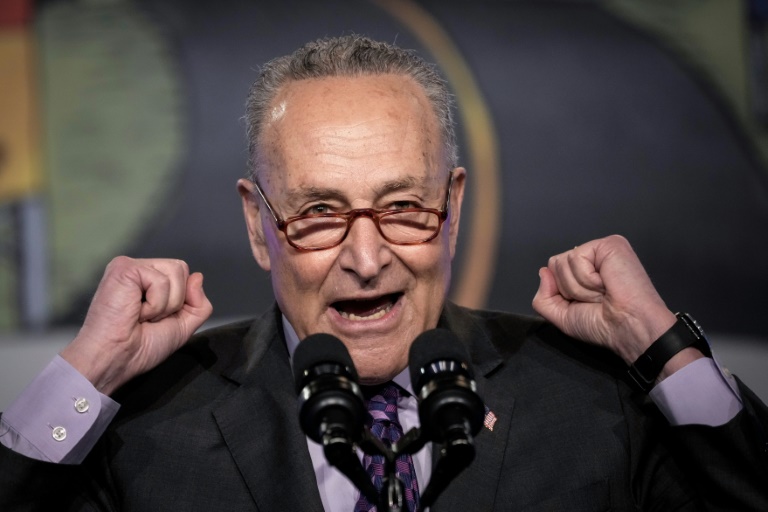
“Putin must absolutely be held accountable for the detestable, despicable war crimes he is committing against Ukraine: the images we have seen coming out of that country… are just pure evil,” said Senate Majority Leader Chuck Schumer.

“It reminds us of the worst moments in human history, caused by the evil man, Putin: hundreds of civilians murdered in cold blood.”

A key principle of the World Trade Organization, the so-called most favored nation status known in the United States as permanent normal trade relations (PNTR), requires countries to guarantee one another equal tariff and regulatory treatment.

The latest trade sanctions — which also apply to Russia’s ally Belarus — cap several rounds of measures intended primarily to sever Moscow’s economic and financial ties with the rest of the world.

They have included banning Russian oil imports, seizing the assets of billionaires tied to Putin, and freezing the nation’s stockpile of cash.

Together, the moves have already pushed Moscow to the brink of a debt default.

The steps have also caused prices for key commodities, like gasoline and wheat, to soar, harming US consumers already facing the highest inflation in four decades.

The United States imported just under $30 billion in goods from Russia last year, including $17.5 billion in crude oil.

The trade relations element of the legislation includes a measure to reauthorize Magnitsky Act sanctions that target human rights violations and corruption with visa bans, asset freezes and other penalties.   

The United States moved Wednesday to block foreign investment in Russia and state-owned enterprises and levied further sanctions on the country’s banks and senior officials.   

Secretary of State Antony Blinken told NBC News that global punishments had put the Russian economy into a “deep recession.” 

“And what we’re seeing is a likely contraction of the Russian economy by about 15 percent,” he said.

“That is dramatic… We’ve seen an exodus from Russia of virtually every major company in the world. And Putin, in the space of a matter of weeks, has basically shut down Russia to the world.”   

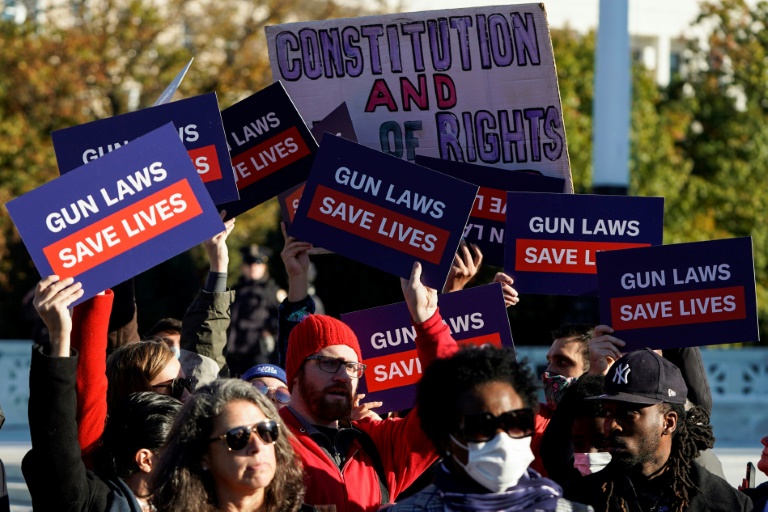
Advocacy groups ask US to crack down on gun industry ads

Likening “unfair and deceptive” firearms advertising to that of tobacco products, gun safety advocates Thursday asked US regulators to crack down on the industry.

A coalition of three groups asked the Federal Trade Commission (FTC), which regulates advertising, to “investigate and regulate the gun industry’s unfair and deceptive advertising,” according to their 40-page petition.

“The FTC is failing consumers, failing our democracy, and failing the millions of Americans who have lost their lives or their loved ones to gun violence,” the petition said.

“No industry — regardless of its political clout -— should be immune from scrutiny of its marketing and advertising.”

The effort, brought by the Giffords Law Center, Brady United and the March for our Lives, revives a 1996 appeal by Brady to the same agency that the groups said resulted in no public action.

An FTC spokesman said the agency had no comment on the petition. 

The groups cite data showing a shift in gun industry marketing from an emphasis on hunting and sports shooting in the decades through the early 2000s to an overwhelming focus on self-defense themes over the last decade.

These messages have been compounded by the heavy presence of arms companies like Remington, Smith & Wesson and Beretta on social media. 

“If the gun industry’s primary message were true — if guns actually made Americans safer -— then, as gun ownership has increased, violence should have decreased, making America an extraordinarily safe nation,” said the petition.

“But the horrifying reality shows the opposite,” the document said, citing mass shootings and data showing a gradual rise in firearms deaths.

Despite federal and state minimum age requirements to purchase or posses firearms, “the gun industry places no age-verification restrictions on its online content or advertising, making it an outlier among industries selling inherently dangerous products” such as alcohol and tobacco, the petition said.

The FTC did not immediately respond to a request for comment.

Close Bitnami banner
Bitnami