World

Greece to double coal output to reduce Russian gas use

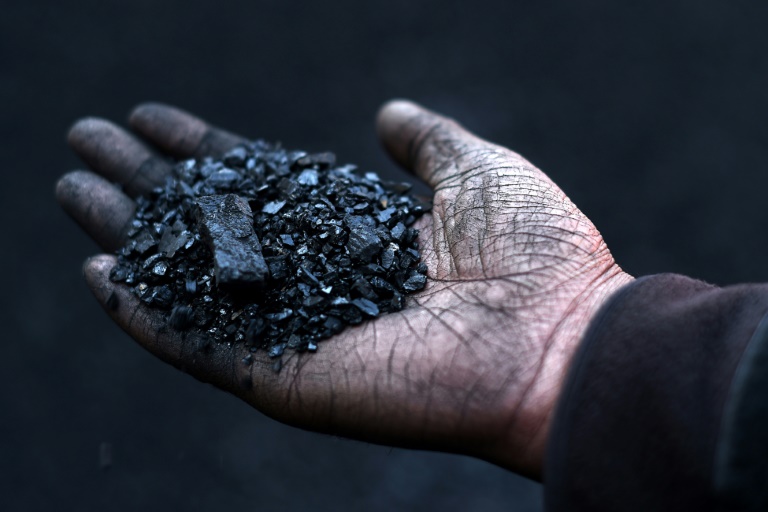
Greece’s government said Thursday it plans to double production of lignite, or brown coal, in the coming two years despite the pollution it causes as Athens aims to reduce its dependence upon Russian gas.

Greece depends upon Russia for 40 percent of its natural gas and since Moscow invaded Ukraine in February it has been searching for alternatives to ensure normal supplies.

“Lignite is polluting and in normal circumstances, natural gas is cheaper,” government spokesman Giannis Ekonomou said.

But given the conflict in Ukraine and the needed to diversify energy supplies, Ekonomou said increased brown coal production would be “necessary” for the next two years.

European countries have been seeking to reduce their use of brown coal to meet their climate pledges. Natural gas produces less emissions and has often been a relatively inexpensive alternative.

However, gas prices have surged this heating season as Russia reduced its sales on the European spot market, and deliveries under long-term contracts could be impacted by Western sanctions over Ukraine or Russian counter-sanctions.

Prime Minister Kyriakos Mitsotakis said Wednesday at the inauguration of a solar panel park that Greece’s energy policy needs to be flexible given the current circumstances.

But he also said that “in no case” would it affect the government’s objectives to reduce carbon emissions by 55 percent by 2030 and reach carbon neutrality by 2050.

Yet the increased coal production is a tacit abandonment of the goal to close the coal power plants by next year.

“It is an admission of failure,” said the Kinal socialist party.

UK denies climate retreat despite rethink on fossil fuels

Britain insisted Thursday it was sticking to its climate change goals despite announcing plans to drill for more North Sea fossil fuels as a way of preventing energy “blackmail” by Russia.

After weeks of cabinet infighting, the government finally released a long-promised energy strategy as Britons struggle with soaring prices, following Western sanctions against Russia over Ukraine.

The plan envisions eight new nuclear stations, a five-fold increase in solar generation and enough electricity from offshore wind to power every UK home by 2030.

But to the dismay of environmentalists, the politically charged issue of onshore wind turbines — cheaper and quicker to build than offshore — was left on the back burner. 

And campaign groups said plans to offer new licences to drill for North Sea oil and gas made a mockery of Prime Minister Boris Johnson’s legally enshrined commitment to make Britain carbon net zero by 2050.

Johnson, however, said he was taking a “sensible and pragmatic view” on hydrocarbons “in the interim to the transition to net zero” — a goal that he had proclaimed at November’s COP26 climate summit in Scotland.

“This is about tackling the mistakes of the past and making sure that we are set well for the future,” he told reporters.

“And we are never again subject to the vagaries of the global oil and gas prices and we can’t be subject to blackmail, as it were, from people such as Vladimir Putin, we have energy security here in the UK.”

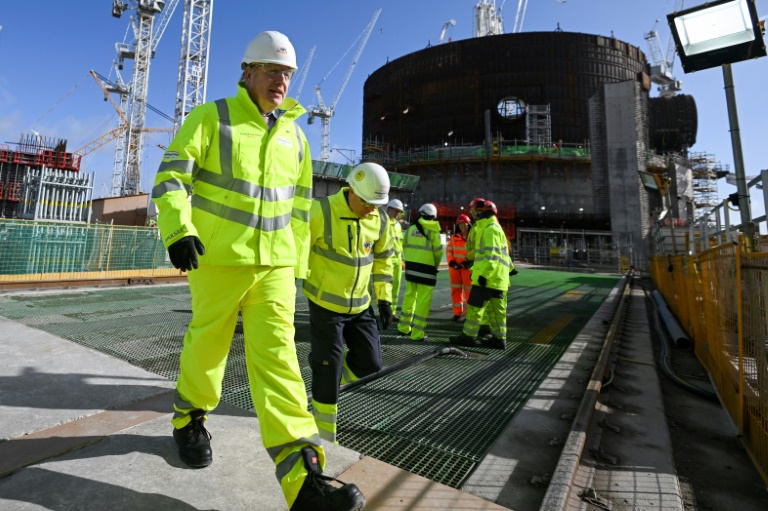
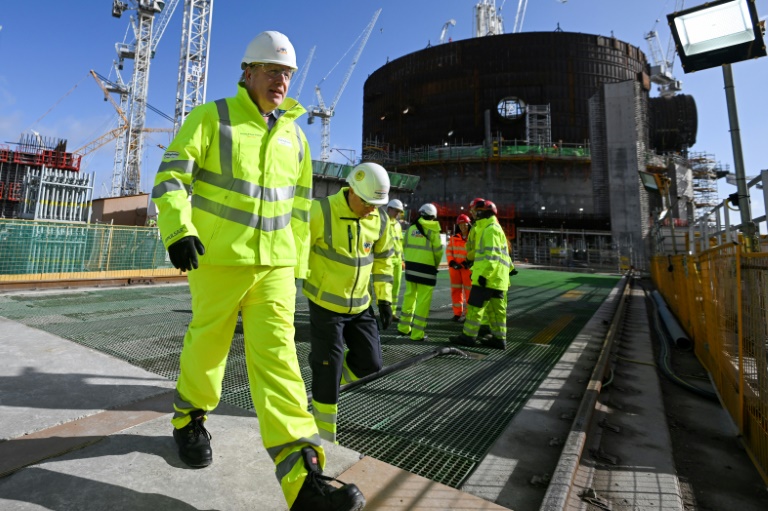
The prime minister was speaking on a visit to a giant nuclear plant under construction at Hinkley Point in southwest England — which is years overdue and billions over budget.

Johnson vowed that “instead of a new reactor every decade, we will have a new reactor every year” — including both large plants and smaller “modular” ones, although these have yet to be tested at industrial scale.

If all the bets come off, according to the strategy, Britain could derive 95 percent of its electricity from low-carbon sources by 2030.

The government acknowledges that the strategy will do little to curb household energy bills in the near term, which Johnson said had “absolutely soared” after the Russian president’s invasion of Ukraine.

Rebecca Newsom, head of politics at Greenpeace UK, said: “This strategy comprehensively fails to stand up to Putin’s violence, to take the sting out of soaring energy bills, or take control of the spiralling climate crisis.”

– ‘Madness’ –

The government plan flagged a new competition to find UK manufacturers of electric heat pumps — which are much more efficient than gas-fired household boilers, but also much more expensive.

Otherwise, as critics noted, it had nothing to say about cutting down on energy wastage and improving efficiency in homes, after the finance ministry reportedly vetoed new spending on that front.

“The first line of any new energy policy in the UK should read ‘insulate, insulate, insulate’,” commented Jon Gluyas, director of the Durham Energy Institute.

Instead, he said, the strategy was “an uninspiring mix of more of the same and … does very little to meet the nation’s zero-carbon mantra shouted so loudly at COP26”.

United Nations secretary-general Antonio Guterres, marking the launch Monday of the latest UN report on climate change, said it was “moral and economic madness” to invest any more in fossil fuels.

The 3,000-page report warned that countries risk ending up with trillions in worthless assets such as offshore platforms and pipelines when demand for fossil fuels wanes in coming decades.

For the UK government, however, political pressure to tackle the energy crisis has been heating up ahead of nationwide local elections on May 5.

Ed Miliband, climate spokesman for the opposition Labour party, said Conservative backbenchers opposed to onshore turbines in rural England were “holding the government’s energy policy to ransom”.

“And people are paying higher bills as a result,” he told BBC radio.

UK denies climate retreat despite rethink on fossil fuels

Britain insisted Thursday it was sticking to its climate change goals despite announcing plans to drill for more North Sea fossil fuels as a way of preventing energy “blackmail” by Russia.

After weeks of cabinet infighting, the government finally released a long-promised energy strategy as Britons struggle with soaring prices, following Western sanctions against Russia over Ukraine.

The plan envisions eight new nuclear stations, a five-fold increase in solar generation and enough electricity from offshore wind to power every UK home by 2030.

But to the dismay of environmentalists, the politically charged issue of onshore wind turbines — cheaper and quicker to build than offshore — was left on the back burner. 

And campaign groups said plans to offer new licences to drill for North Sea oil and gas made a mockery of Prime Minister Boris Johnson’s legally enshrined commitment to make Britain carbon net zero by 2050.

Johnson, however, said he was taking a “sensible and pragmatic view” on hydrocarbons “in the interim to the transition to net zero” — a goal that he had proclaimed at November’s COP26 climate summit in Scotland.

“This is about tackling the mistakes of the past and making sure that we are set well for the future,” he told reporters.

“And we are never again subject to the vagaries of the global oil and gas prices and we can’t be subject to blackmail, as it were, from people such as Vladimir Putin, we have energy security here in the UK.”

The prime minister was speaking on a visit to a giant nuclear plant under construction at Hinkley Point in southwest England — which is years overdue and billions over budget.

Johnson vowed that “instead of a new reactor every decade, we will have a new reactor every year” — including both large plants and smaller “modular” ones, although these have yet to be tested at industrial scale.

If all the bets come off, according to the strategy, Britain could derive 95 percent of its electricity from low-carbon sources by 2030.

The government acknowledges that the strategy will do little to curb household energy bills in the near term, which Johnson said had “absolutely soared” after the Russian president’s invasion of Ukraine.

Rebecca Newsom, head of politics at Greenpeace UK, said: “This strategy comprehensively fails to stand up to Putin’s violence, to take the sting out of soaring energy bills, or take control of the spiralling climate crisis.”

– ‘Madness’ –

The government plan flagged a new competition to find UK manufacturers of electric heat pumps — which are much more efficient than gas-fired household boilers, but also much more expensive.

Otherwise, as critics noted, it had nothing to say about cutting down on energy wastage and improving efficiency in homes, after the finance ministry reportedly vetoed new spending on that front.

“The first line of any new energy policy in the UK should read ‘insulate, insulate, insulate’,” commented Jon Gluyas, director of the Durham Energy Institute.

Instead, he said, the strategy was “an uninspiring mix of more of the same and … does very little to meet the nation’s zero-carbon mantra shouted so loudly at COP26”.

United Nations secretary-general Antonio Guterres, marking the launch Monday of the latest UN report on climate change, said it was “moral and economic madness” to invest any more in fossil fuels.

The 3,000-page report warned that countries risk ending up with trillions in worthless assets such as offshore platforms and pipelines when demand for fossil fuels wanes in coming decades.

For the UK government, however, political pressure to tackle the energy crisis has been heating up ahead of nationwide local elections on May 5.

Ed Miliband, climate spokesman for the opposition Labour party, said Conservative backbenchers opposed to onshore turbines in rural England were “holding the government’s energy policy to ransom”.

“And people are paying higher bills as a result,” he told BBC radio.

UN inaction on China abuses 'huge disappointment': Uyghur campaigner

The UN rights chief has miserably failed to address China’s “genocide” against the Uyghur minority, a leading campaigner told AFP, demanding that a long-delayed report on abuses be released “immediately”.

Uyghur campaigner Rushan Abbas, who is American, decried that Michelle Bachelet had, to date, been so restrained in her criticism of the well-reported rights violations taking place in China’s far-western Xinjiang region.

“I am very, very disappointed in her,” Abbas told AFP on the sidelines of the Geneva Summit for Human Rights and Democracy, insisting that what is happening “is clearly genocide”.

If the UN high commissioner for human rights herself “does not defend the founding principles of the United Nations and fundamental rights… who is going to be out there to defend innocent people like my sister?”

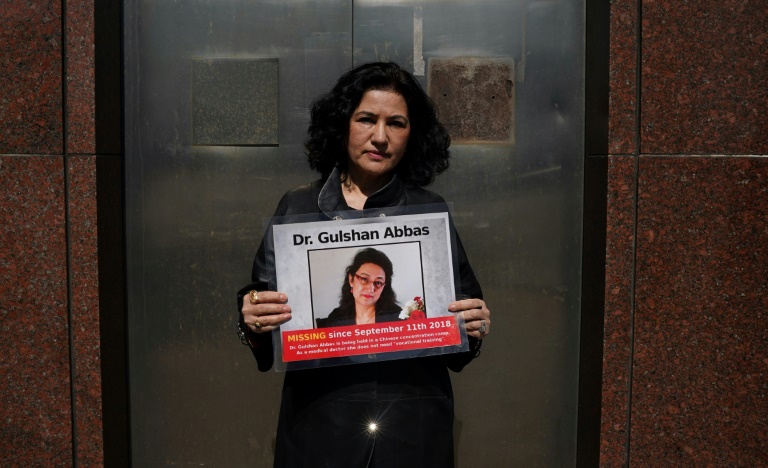
“We have been begging for her to speak up, to do something,” said Abbas, who maintains her activism led to China detaining her sister, retired doctor Gulshan Abbas, almost four years ago.

She said she had been very hopeful when Bachelet, a former Chilean president and torture survivor, became the UN rights chief in 2018.

“We thought she was going to remember and defend justice,” she said, lamenting that instead Bachelet has been all but “silent”.

“There can be no neutrality in genocide.”

The US government and lawmakers in a number of other Western countries have also labelled China’s treatment of the Uyghurs in Xinjiang “genocide” — a charge Beijing vehemently denies.

Rights groups say that at least one million mostly Muslim minorities have been incarcerated in “re-education camps” in the region, and face widespread rights abuses, including forced sterilisation and forced labour.

– ‘What is she waiting for?’ –

Bachelet has issued cautious criticism, but observers suggest she has refrained from more forceful statements as she has strived to negotiate a visit to Xinjiang with “meaningful and unfettered access”.

She recently announced that an agreement had finally been reached and she will visit the region in May.

Rights groups welcomed the visit, but voiced concern it might delay further a long-postponed report by Bachelet’s office on the rights situation in Xinjiang.

Diplomatic sources say the report has been ready since last August.

“She needs to release that report. She has all the evidence,” Abbas insisted, asking: “What is she waiting for? The green light from the Chinese government?”

Abbas insisted publishing the report was more important than the visit, which would certainly be “staged, with coached interviews”, and used by Beijing for “propaganda”.

“If she doesn’t release the report, and if she doesn’t have unfettered access, which she will not… this trip will hurt the Uyghur people.”

Abbas meanwhile said that if Bachelet does go, she hopes she will ask to meet with her sister, whom she has not heard from since her “abduction” in September 2018.

“At least give us a proof of life,” she said. “I don’t know where she is, what kind of health situation she has.”

– ‘Hypocrisy’ –

Abbas also slammed the “hypocrisy” of countries and companies continuing to do business with China, pointing to the stark difference in the reaction to Moscow’s invasion of Ukraine.

“All those companies rightfully left Russia so quickly, but they’re all doing business in China,” she said, suggesting the different approach might be because “these companies are not making enough money in Russia.”

“But everybody has double standards when it comes to (China’s) genocide,” she said, insisting that in the “information era, the 21st century, no one can claim ignorance” about what is happening in Xinjiang.

Abbas hailed Ukrainian President Volodymyr Zelensky’s blistering address to the UN this week, and his call for it to “dissolve” if it could not act to halt atrocities in his country.

“I couldn’t agree with him more,” she said. 

The UN’s lack of action “has been a huge disappointment for Uyghurs, and now they are being a huge disappointment for President Zelensky and the Ukrainian people.

“They must act.”

Eurozone stocks climb but London slips

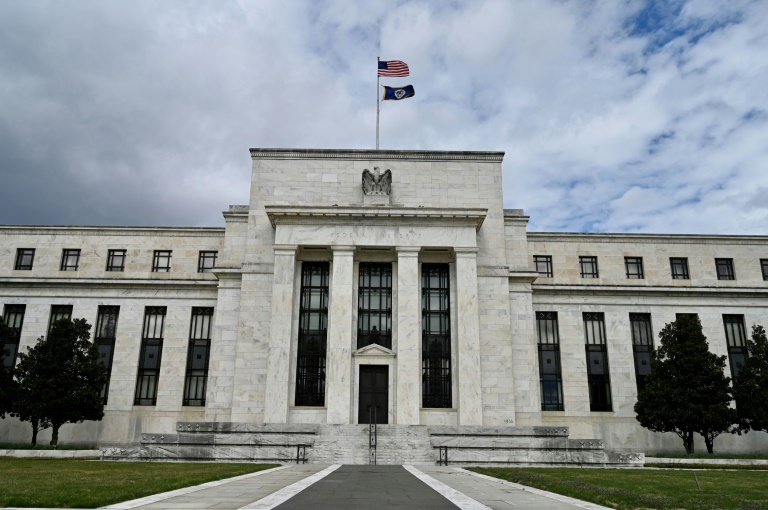
Eurozone stocks rose Thursday but London drooped as investors digested news that the Federal Reserve held off from a bigger interest rate hike last month owing to Ukraine turmoil, dealers said.

Asian equities closed lower as investors examined minutes from the US central bank’s March monetary policy gathering.

Oil prices recovered some of the previous day’s heavy losses that had been triggered by concerns about weaker demand because of economic slowdown.

The Fed in March opted to raise US borrowing costs rates by a quarter percentage point, mindful of “greater near-term uncertainty associated with Russia’s invasion of Ukraine”.

Some policymakers had been in favour of lifting rates half a percentage point.

“As suspected, the war in Ukraine did temper the Federal Reserve’s decision to hike rates at its meeting in March,” said CMC Markets chief analyst Michael Hewson.

“However, an abundance of caution prompted them to stay their hand until events became clearer knowing that they had the option to go harder and faster later on.”

– Inflation fight –

The prospect of rates rising at a quicker pace over the coming months has added to a wave of uncertainty across trading floors.

Central banks across the world are under fierce pressure to tackle runaway inflation, which has soared further on a Ukraine-driven spike in commodities like gas, oil and wheat.

March was the first Fed hike since it slashed US rates to zero when the Covid-19 pandemic broke out two years ago.

While current US data points to a healthy economy, commentators warn of possible hard times ahead.

Wall Street tumbled for the second day in a row on Wednesday, with the Nasdaq again losing more than two percent, as tech firms are more susceptible to higher rates.

In London on Thursday, shares in gambling group 888 surged 21 percent on the British capital’s second-tier FTSE 250 index after the company won a discount on its planned purchase of the non-US operations belonging to rival William Hill.

– Key figures around 1115 GMT –

London – FTSE 100: DOWN 0.1 percent at 7,581.52 points

Frankfurt – DAX: UP 0.7 percent at 14,250.18

Paris – CAC 40: UP 0.9 percent at 6,554.65

EURO STOXX 50: UP 0.9 percent at 3,859.29

Tokyo – Nikkei 225: DOWN 1.7 percent at 26,888.57 (close)

Hong Kong – Hang Seng Index: DOWN 1.2 percent at 21,808.98 (close)

Shanghai – Composite: DOWN 1.4 percent at 3,236.70 (close)

New York – Dow: DOWN 0.4 percent at 34,496.51 (close)

Brent North Sea crude: UP 1.2 percent at $102.27 per barrel

West Texas Intermediate: UP 1.1 percent at $97.26 per barrel

Euro/dollar: DOWN at $1.0889 from $1.0896 late Wednesday

Pound/dollar: UP at $1.3072 from $1.3069

Euro/pound: DOWN at 83.30 pence from 83.37 pence

Dollar/yen: DOWN at 123.73 yen from 123.80 yen

burs-rfj/bcp/lth

Australia, Myanmar junta meeting 'unacceptable': HRW

Human Rights Watch on Thursday slammed a meeting between Australia’s ambassador to Myanmar and the military junta chief, saying it was “lending credibility” to a regime accused of war crimes. 

Since a military-led coup ousted Aung San Suu Kyi’s administration last year, Myanmar has been increasingly isolated internationally — with foreign governments urging an end to deadly crackdowns on mass democracy protests. 

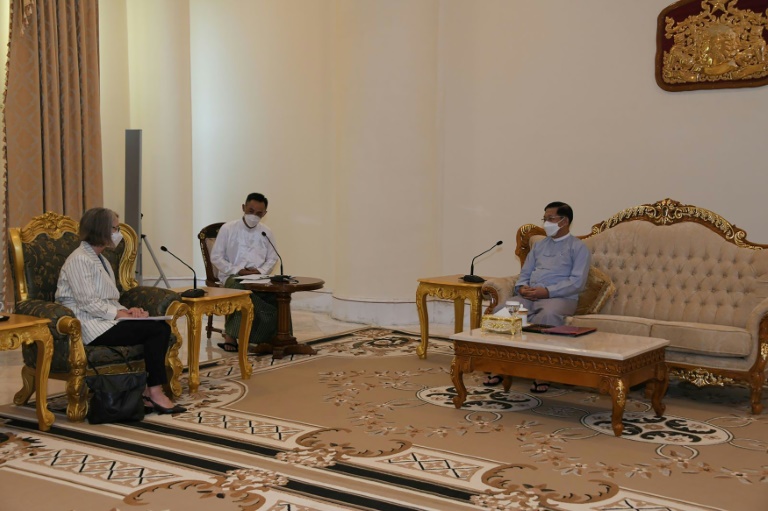
Australia’s outgoing ambassador Andrea Faulkner met with junta leader Min Aung Hlaing in Naypyidaw on Wednesday, with state-owned media outlet Global New Light of Myanmar reporting the pair discussed “enhancement of cooperation in various sectors”. 

The ambassador was accompanied by Australia’s defence attache to Myanmar, Colonel Tony Egan, according to a statement by Min Aung Hlaing’s office.

Katrina Cooper from Australia’s foreign affairs department said the ambassador had used the meeting to reiterate calls for Myanmar to cease violence and release detainees. 

“The Australian government does not consider that the outgoing meeting legitimises the current regime,” Cooper told a Senate committee in Canberra.

But HRW said the meeting and subsequent coverage in state media did just that. 

“This is meeting is not only deeply unacceptable, but it undercuts efforts by other governments to isolate the military commander implicated in serious abuses,” HRW’s Myanmar researcher Manny Maung said.

“By taking photo ops and accepting gifts, Australia only serves to lend credibility to a military junta that is accused of committing war crimes and crimes against humanity against its own population.” 

Maung urged Australia to “align with its traditional allies”  by avoiding further high-level meetings with the junta and immediately imposing sanctions. 

Australian officials outlined seven other meetings and phone calls with the junta since the coup, but denied any sectors were engaging with the regime. 

Canberra has repeatedly called for the release of Australian economist Sean Turnell, who was working as an adviser to Suu Kyi when he was detained shortly after the coup. 

He has been charged with violating Myanmar’s official secrets law and faces a maximum penalty of 14 years in prison if found guilty.

Myanmar has been in chaos since a putsch in February 2021, with more than 1,700 people killed in crackdowns on dissent, according to a local monitoring group.

Ukraine warns of 'last chance' to flee as Russia prepares eastern attack

Ukraine urged its residents in the east of the country Thursday to take their “last chance” to flee mounting Russian attacks, after devastation around the capital Kyiv shocked the world.

Six weeks after they invaded, Russian troops have withdrawn from Kyiv and Ukraine’s north and are focusing on the country’s southeast, where desperate attempts are under way to evacuate civilians.

The retreat from Kyiv revealed scenes of carnage, including in the town of Bucha, that Ukraine said were evidence of Russian war crimes, and which triggered a fresh wave of Western sanctions against Moscow.

On Thursday, Ukrainian President Volodymyr Zelensky warned that Russia — which denies responsibility for the killings of civilians — was undeterred and continued “to accumulate fighting force to realise their ill ambitions in (eastern) Donbas”.  

“They are preparing to resume an active offensive,” he said, while officials in Donbas’ Lugansk and Donetsk regions begged civilians to leave.

“These few days may be the last chance to leave,” Lugansk regional governor Sergiy Gaiday wrote on Facebook, saying that all cities in the region were under fire and one person had died in the town of Kreminna.

“Do not wait to evacuate,” he said, adding: “The enemy is trying to cut off all possible ways of getting people out.”

– ‘Nowhere to go’ –

Gaiday said previously that more than 1,200 people had been evacuated from Lugansk on Wednesday, but that efforts were being hampered by artillery fire, with some areas already inaccessible. 

For those unable to leave, he said, tonnes of food, medicine and hygiene products were being delivered as part of a massive humanitarian effort.

The head of the Donetsk Regional Military Administration said strikes had targeted aid points. 

“The enemy aimed directly there with a goal to destroy the civilians,” Pavlo Kyrylenko wrote on Facebook. 

He added that people were heeding calls to flee and he would be coordinating evacuation to make it “faster and more effective”. 

Large areas of Lugansk and the neighbouring Donetsk region have been controlled since 2014 by pro-Russian separatists.

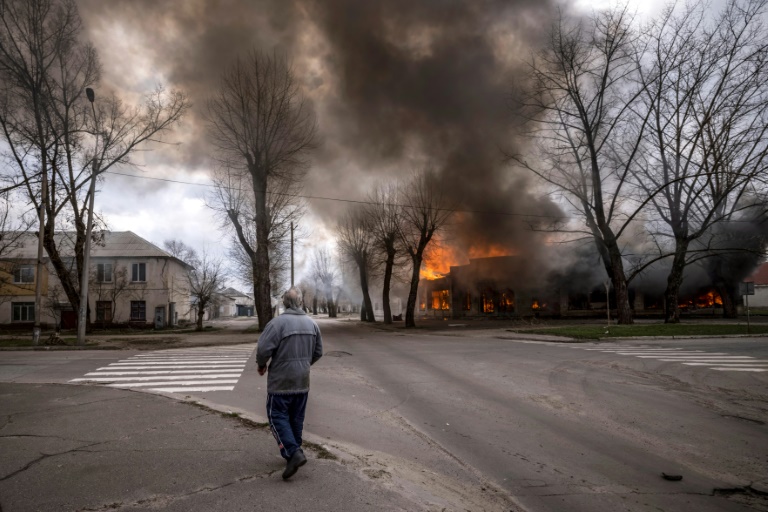
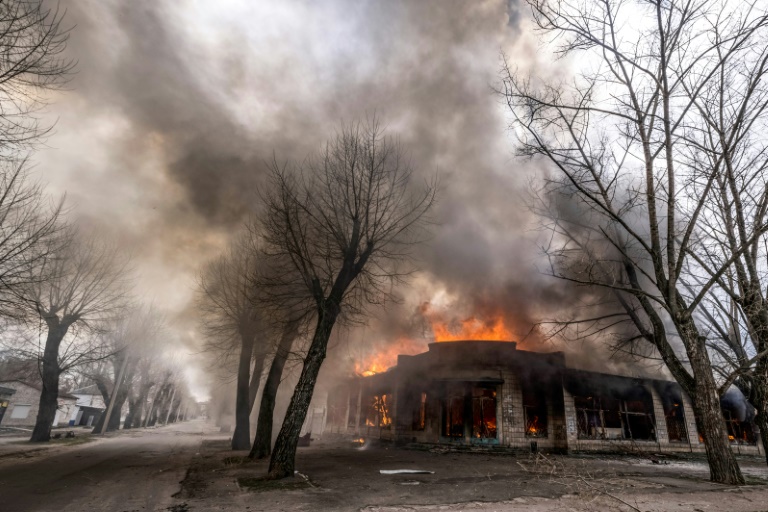
Shells and rockets were also slamming into the industrial city of Severodonetsk, the easternmost city held by Ukrainian forces. 

“We have nowhere to go, it’s been like this for days,” 38-year-old Volodymyr told AFP, standing opposite a burning building in Severodonetsk.

More than 11 million people have been displaced since Russia invaded on February 24, with the stated aim to “demilitarise” Ukraine and support Moscow-backed separatists.

It is currently believed to be trying to create a land link between occupied Crimea and the statelets in Donbas.

– ‘Weapons, weapons, weapons’ –

Ukrainian forces are also regrouping for the offensive, including on a two-lane highway through the rolling eastern plains connecting Kharkiv and Donetsk.

Trench positions were being dug, and the road was littered with anti-tank obstacles. 

“We’re waiting for them!” said a lieutenant tasked with reinforcing the positions, giving a thumbs up.

Western allies have already sent funds and weapons to help Ukraine, but Kyiv’s Foreign Minister Dmytro Kuleba on Thursday made a fresh appeal to NATO for heavy weaponry, including air defence systems, artillery, armoured vehicles and jets.

“My agenda is very simple. It has only three items on it. It’s weapons, weapons, and weapons,” he told journalists ahead of a meeting with NATO ministers in Brussels.

– ‘Brutality and inhumanity’ –

The evacuation calls are being fuelled by fears of fresh atrocities, after chilling discoveries in areas from which Moscow’s troops have withdrawn.

US President Joe Biden said “major war crimes” were being committed in Ukraine, where images have emerged in recent days of bodies with their hands bound or in shallow graves.

“Civilians executed in cold blood, bodies dumped into mass graves, the sense of brutality and inhumanity left for all the world to see, unapologetically,” Biden said. 

In one of the worst affected towns, Bucha, some residents were still trying to learn the fate of loved ones, while others were hoping to forget. 

Tetiana Ustymenko’s son and his two friends were gunned down in the street, and she buried them in the garden of the family home. 

“How can I live now?” she said.

The Kremlin denies responsibility for any civilian deaths and President Vladimir Putin on Wednesday accused Ukrainian authorities of “crude and cynical provocations” in Bucha.

But the German government pointed to satellite pictures taken while the town was still under Moscow’s control, which appear to show bodies in the streets.

Russia’s denials “are in our view not tenable”, said German government spokesman Steffen Hebestreit. 

Ukrainian officials have warned other areas may have suffered worse than Bucha, including nearby Borodianka.

“Locals talk about how planes came in during the first days of the war and fired rockets at them from low altitudes at these buildings,” Interior Minister Denys Monastyrsky told local media.

Officials have alleged that Russian troops are now trying to cover up atrocities elsewhere to prevent further international outcry, including in the besieged city of Mariupol.

Ukrainian human rights official Lyudmila Denisova said Wednesday, citing witness testimony, that Russian forces have brought mobile crematoria to burn bodies and other heavy equipment to clear debris in the city.

– Sanctions ‘not enough’ –

Western powers have already pummelled Russia with debilitating economic sanctions and on Wednesday the United States unveiled further measures targeting Russia’s top banks and two of Putin’s daughters.

Britain sanctioned two banks and vowed to eliminate all Russian oil and gas imports by the end of the year, while the European Union is poised to cut off Russian coal imports.

EU nations this week have also expelled more than 200 Russian diplomats and staff, while a vote will be held later Thursday in the UN General Assembly on excluding Moscow from the UN Human Rights Council.

“We are convinced that now is the time to suspend Russian membership of the Human Rights Council,” G7 foreign ministers from Canada, France, Germany, Italy, Japan, Britain and the United States said in a statement.

But in his nightly address, Zelensky said the new sanctions were “not enough”.

He urged countries to completely cut off Russia’s banks from the international financial system, and to stop buying the country’s oil. 

Oil exports are “one of the foundations of Russian aggression”, he said, which “allows the Russian leadership not to take seriously the negotiations on ending the war.” 

Peace talks between the sides have made little progress so far, and NATO chief Jens Stoltenberg has said there is no sign Putin has dropped “his ambition to control the whole of Ukraine”.

burs-reb/ar/kjm

Pakistan rupee nosedives against dollar as political crisis rocks confidence

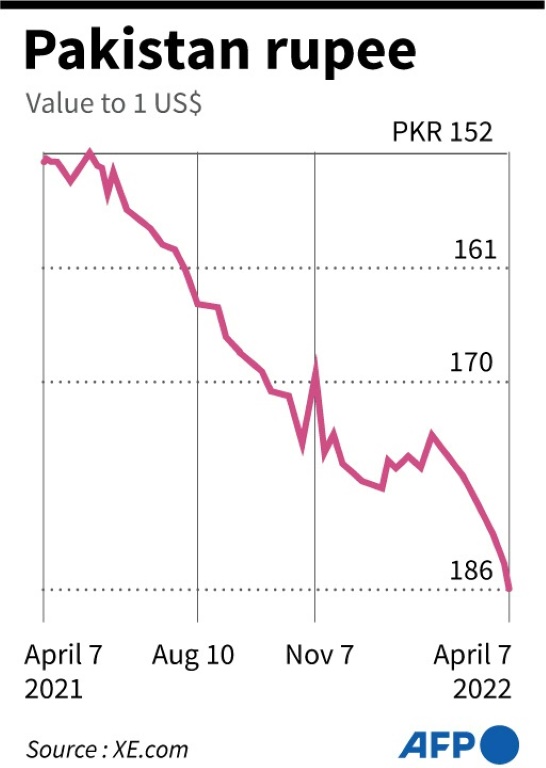
The Pakistan rupee dropped to a historic low of 191 rupees to the dollar Thursday as an ongoing political crisis rocked confidence in the currency.

The rupee has been declining for months, but the fall became precipitous in March when opposition parties tabled a no-confidence motion against Prime Minister Imran Khan that led to the dissolution of the national assembly last week.

The rupee has lost over six percent in a month, and on the open market Thursday was at 191 — and 189 at the interbank rate.

“The political mess has ensued from uncertainty and this badly reflects on the rupee,” said Mohammad Sohail, chief of Topline Securities, a Karachi based brokerage and economic research house.

Pakistan’s supreme court was sitting Thursday to rule on the legality of political manoeuvres that led Khan to dissolve the national assembly.

Pakistan’s foreign exchange reserves, which rely on remittances from the diaspora, have failed to stop a growing trade deficit.

Reserves have fallen to $12 billion from $16 billion since March as the deficit hit 70 percent for the nine months of the fiscal year spanning 2021-22.

Since July 2021, the rupee has lost 18 percent of its value against the dollar.

Relations with the United States and International Monetary Fund (IMF) are also critical factors.

The IMF has approved a $6 billion bailout package for Pakistan to support its balance of payment issue in 2019.

Half was disbursed, but the rest is being renegotiated.

War in Ukraine: Latest developments

Here are the latest developments in the war in Ukraine:

– ‘Last chance’ to leave East –

A Ukrainian official warns residents in the east that they have a “last chance” to flee before a major Russian offensive expected in the region.

“These few days may be the last chance to leave,” says Sergiy Gaiday, governor of the Lugansk region, where the city of Severodonetsk is coming under sustained artillery and rocket fire.

The head of the neighbouring Donetsk region vows to also step up evacuations.

– UN rights body suspension –

The UN General Assembly votes Thursday on suspending Russia from the UN Human Rights Council as punishment for invading Ukraine.

Russia has warned that expelling it from multilateral forums will make dialogue even more difficult.

– New plea for weapons –

Ukraine’s Foreign Minister Dmytro Kuleba calls on NATO members to provide Kyiv with all the weaponry it needs to fight Russia.

“My agenda is very simple. It has only three items on it. It’s weapons, weapons, and weapons,” Kuleba tells journalists at NATO headquarters in Brussels. 

– Hungary ‘helping’ Putin –

Ukraine accused its neighbour and Kremlin-ally Hungary of appeasing Russian aggression and undermining EU unity on sanctions in the wake of Viktor Orban’s reelection as prime minister.

Orban says he is prepared to pay for Russian gas in rubles, a demand of Putin’s that was rejected by the West. Orban has also offered to host peace talks.

– ‘Major war crimes’: Biden – 

US President Joe Biden denounces the killing of Ukrainian civilians in the town of Bucha allegedly by Russian troops as “major war crimes”.

Ukrainian officials warn other areas may have suffered worse, including nearby Borodianka.

“Locals talk about how planes came in during the first days of the war and fired rockets at them from low altitudes,” Ukraine’s Interior Minister Denys Monastyrsky tells local media.

– French anger over tweet –

The French government summons Russia’s ambassador to Paris in protest after his embassy posted a photo on Twitter claiming to show a Ukrainian “film set” used to stage civilian killings in Bucha.

French Foreign Minister Jean-Yves Le Drian calls the tweet “obscene”.

– Shell faces $5bn hit –

British energy giant Shell says its exit from Russia could cost it up to $5 billion (4.6 billion euros) in the first quarter of the year.

Shell announced it was selling its stakes in joint ventures with Russian state energy giant Gazprom shortly after the Kremlin launched its invasion of Ukraine.

– Putin daughters sanctioned –

The United States announces sanctions on two of Putin’s daughters, saying family members are known to hide the Russian president’s wealth.

It also declared “full blocking” sanctions on Russia’s largest public and private financial institutions, Sberbank and Alfa Bank, and says all new US investments in Russia are now prohibited.

The EU is also looking to add Putin’s daughters to its sanctions blacklist.

The UK also adds new energy and banking sanctions and bans new British investments in Russia.

– Marathon bars Russians, Belarusians –

Organisers of the Boston Marathon say Russian and Belarusian runners will be barred over the invasion of Ukraine.

burs-cb/spm

Le Pen vows headscarf fines in tight French election battle

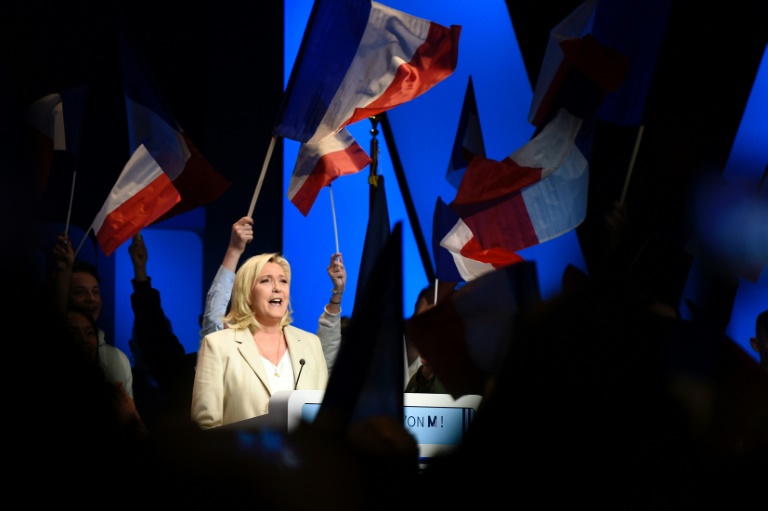
French far-right presidential candidate Marine Le Pen vowed Thursday to issue fines to Muslims who wear headscarves in public, as candidates made a final push for votes three days ahead of an election seen as increasingly close.

President Emmanuel Macron built what seemed an unassailable lead ahead of the first round of polls Sunday but Le Pen has eroded the margin and feels she has a real chance of winning the run-off on April 24.

With France’s traditional right- and left-wing parties facing electoral disaster, far-left candidate Jean-Luc Melenchon is on course to come third and he still believes he can sneak into a run-off. 

Speaking to RTL radio, Le Pen explained how her pledge to ban the headscarf in all public spaces would be implemented, saying it would be enforced by police in the same way as seatbelt-wearing in cars.

“People will be given a fine in the same way that it is illegal to not wear your seat belt. It seems to me that the police are very much able to enforce this measure,” she said. 

Le Pen has said she will use referendums to try to avoid constitutional challenges to many of her proposed laws on the basis that they are discriminatory and an infringement on personal freedoms.

Previous legislation in France banning obvious religious symbols in schools or full-face coverings in public was allowed on the basis that it applied to all citizens and in specific settings.

Le Pen, 53, has toned down her anti-immigration rhetoric during campaigning this year and has focused instead on household spending, putting her closer than ever to power, polls indicate.

The latest surveys suggest she is within striking distance of centrist Macron if the two of them come top in the first round of voting on Sunday.

A second round run-off is scheduled for April 24, with an average of polls indicating Macron has a slight lead of 54 percent versus 46 percent for Le Pen.

Melenchon is also rising strongly ahead of voting and is talking up his chances of springing a surprise.

The war in Ukraine as well as strains on the health system after two years of Covid-19 are high among voter concerns, behind the biggest priority: inflation and incomes. 

– Final rallies –

Le Pen is to hold her last campaign rally on Thursday evening in the southern stronghold of Perpignan where her National Rally party has long had strong support and runs the local council.

The slogan “Vote!” underlines the priority for Le Pen in encouraging supporters to turn out on Sunday after high abstention rates resulted in a disappointing result for her in regional elections last June.

Greens candidate Yannick Jadot, conservative Valerie Pecresse, far-right former TV pundit Eric Zemmour and flagging Socialist nominee Anne Hidalgo also have rallies planned Thursday. 

Macron will give an interview to the Aujourd’hui newspaper in which he is expected to continue his strategy of promising steady leadership in a time of crisis, while portraying Le Pen as a dangerous extremist.

Despite entering the campaign late after being distracted by the war in Ukraine, he has no scheduled public events on Thursday.

“I’ve acquired experience of crises, international experience. I’ve also learned from my mistakes,” he told Le Figaro newspaper in an interview published Thursday.

He acknowledged that “results on immigration were insufficient” and that new arrivals had increased at the start of his term in 2017-2019. 

“Worries were created at this point. I didn’t succeed in reducing them and they have fed the (political) extremes,” he said in reference to Le Pen and Zemmour, who is promising “zero immigration.”

A recent poll found that a slim majority of French people (51 percent) found Le Pen worrying, while 39 percent considered she had the stature of a president, up from 21 percent in 2017.

Around 65 percent of French people thought Macron had the stature of a president, the survey from the left-leaning Jean-Jaures Foundation showed.

Le Pen laughed at the idea that she could be demonised on her third run for the presidency despite Macron’s intention of attacking her as economically reckless and xenophobic. 

“Scare-mongering which entails saying that unless Emmanuel Macron is re-elected, it will be a crisis, the sun will be extinguished, the sea will disappear and we’ll suffer an invasion of frogs, no longer works,” Le Pen told RTL.

Close Bitnami banner
Bitnami