World

NASA delays final test for moon shot

The latest test of NASA’s giant Moon rocket SLS has been suspended to allow for a SpaceX rocket to launch later this week, the US space agency announced Tuesday.

The dress rehearsal for the giant Space Launch System is taking at launch pad 39B at Cape Canaveral, Florida — where SpaceX is scheduled to lift off from pad 39A on Friday.

The test of the rocket, which is to return humans to the Moon, is now expected to resume shortly after the take-off of the SpaceX flight, which is to carry three businessmen and a former astronaut to the International Space Station. 

The 322-foot (98 meters) SLS rocket will remain on its launch pad while waiting.

In this final test before blast-off for the Moon later this year, all the steps leading up to launch must be rehearsed, from filling the tanks to the final countdown, which will be stopped just before the engines fire. 

The run-through started last Friday and was originally scheduled to last two days, but was extended after NASA teams encountered “a whole myriad of technical challenges” as well as uncooperative weather on Saturday, said Mike Sarafin, the mission manager for the Artemis Moon landing.

Among the problems encountered were four lightning strikes hitting the launch pad during a thunderstorm, which at least proved that the protection system had worked as planned. 

But the problems were not “major issues,” Sarafin said. “We haven’t run into any fundamental design flaws or design issues.”

“We take pride in learning from these tests,” he said, calling the ones already carried out in recent days “partially successful.” 

Artemis 1 will mark the first flight of the SLS, whose development has lagged years behind schedule. 

The Orion capsule at its top will be propelled to the Moon, where it will be placed in orbit before returning to Earth. 

The first mission will not have astronauts on board. The take-off date is to be announced after the so-called “wet” dress rehearsal. 

A launch window is possible in early June, and Sarafin said he was “not ready to give up on it yet.” 

Another launch window is possible in early July.

West readies new sanctions on Russia over Ukraine killings

Western powers were readying new sanctions against Russia on Wednesday after Ukraine’s president called for tougher action and accused Moscow of atrocities during the six-week war.

The measures follow an international outcry over hundreds of civilians found dead in areas from which Russian troops have withdrawn around Ukraine’s capital, including the town of Bucha. 

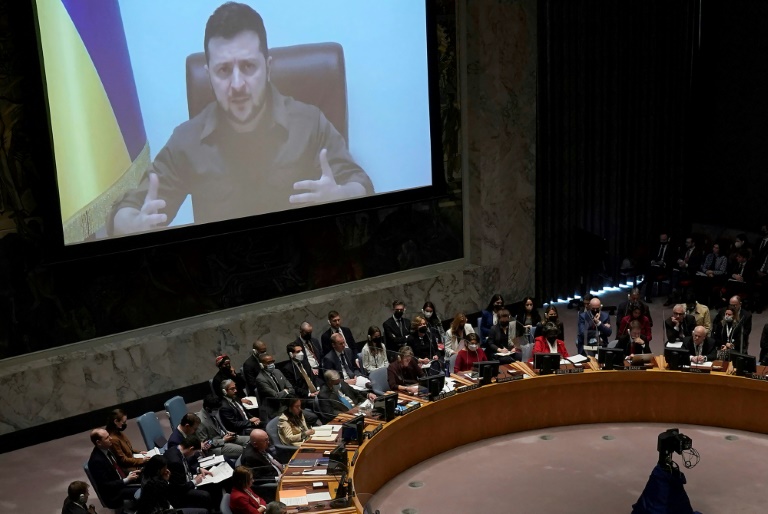
In a video address to the UN Security Council on Tuesday, Ukrainian leader Volodymyr Zelensky showed harrowing images of corpses — including of children — that he said were victims of Russian atrocities.

“They cut off limbs… slashed their throats. Women were raped and killed in front of their children,” he said, after earlier comparing Russia’s assault to the 1937 Nazi bombing of the town of Guernica.

The Kremlin has denied any civilian killings, claiming the images emerging from Bucha and other sites are fakes produced by Ukrainian forces, or that the deaths occurred after Russian soldiers pulled out.

Zelensky called for Russia’s exclusion from the UN Security Council, where it is one of five members with veto power, saying it was blocking the UN from carrying out “the functions for which it was created”.

On Wednesday, Pope Francis — who has repeatedly called for peace, while not naming Russia or President Vladimir Putin — also deplored the “powerlessness of international organisations”.

At his weekly audience at the Vatican, the 85-year-old pontiff kissed a flag he said had come from “that martyred city Bucha”, condemning “ever more horrendous cruelties” in Ukraine.

The UN General Assembly announced later it would vote Thursday on suspending Russia from the body’s Human Rights Council, after moves by the US and Britain to have it excluded.

– Push to isolate Moscow –

Thousands of people have been killed and more than 11 million displaced as refugees or within Ukraine since Russia’s invasion on February 24.

Western powers have already pummelled Russia with debilitating economic sanctions, which forced Moscow Wednesday to make foreign debt payments on dollar-denominated bonds in rubles.

But the killings in Bucha and elsewhere have galvanised support for Kyiv, with Washington announcing another $100 million in military aid, and produced new momentum for additional sanctions on Moscow.

Washington, in coordination with the G7 and the European Union, is expected on Wednesday to announce measures including a ban on all new investments in Russia.  

“You can expect… that they will target Russian government officials, their family members, Russian-owned financial institutions, also state-owned enterprises,” White House Press Secretary Jen Psaki told a briefing on Tuesday. 

The EU meanwhile was poised to implement a fifth round of sanctions cutting off Russian coal imports — and European Council chief Charles Michel said that “sooner or later”, it must also impose oil and gas sanctions.

Condemning “war crimes” in Russia, he said: “There must be, and there will be, severe consequences for all those responsible.”

But addressing the Irish parliament Wednesday, Zelensky condemned the “indecisiveness” on the part of EU nations, which are dependent on Russian energy.

“We still need to convince Europe that Russian oil cannot feed the Russian military machine with new sources of funding,” Zelensky added, calling also for the total exclusion of Russian banks from Western finance.

In Britain, which says it has so far frozen some $350 billion in assets from Putin’s “war chest”, Prime Minister Boris Johnson said what happened in Bucha “doesn’t look far short of genocide to me”.

He said the international community “will be moving again in lockstep to impose more sanctions and more penalties on Vladimir Putin’s regime”.

In other moves to isolate Moscow, a string of EU countries including Germany, France, Italy and Spain have expelled more than 200 Russian diplomats and staff between them this week.

The Kremlin called the mass expulsions a “short-sighted move” that would complicate efforts to negotiate an end to the hostilities.

Putin also warned of “reprisals” for recent European measures targeting Russian gas giant Gazprom — and said Moscow would “monitor” its food exports to “hostile” nations, raising the spectre of shortages and price spikes.

– Kremlin denials –

At the Security Council meeting, Moscow’s ambassador rejected Zelensky’s claims, saying the “ungrounded accusations… are not confirmed by any eyewitnesses”.

But satellite photos taken while Bucha was still under Moscow’s control show what appear to be bodies lying in streets where the dead were later found by Ukrainian forces and seen by journalists. 

And multiple Bucha residents told AFP they had seen Russian soldiers killing civilians.

“Right in front of my eyes, they fired on a man who was going to get food at the supermarket,” said 43-year-old Olena, who declined to give her family name.

During a grim cleanup, the remains of partially burned bodies in black bags were lifted into a van, with officials telling journalists “dozens of bodies” remained in apartments and in nearby woods.

European Commission chief Ursula von der Leyen, who will visit Kyiv this week, has offered the bloc’s assistance in documenting proof of war crimes.

– Cluster bombs –

Ukrainian authorities have warned that other areas may have suffered even worse fates than Bucha. 

Scenes of devastation have met those venturing into areas from which Russian forces have withdrawn. 

In the northern city of Chernigiv, which was besieged from the early days of the invasion, a charred children’s hospital, full of bullet and shrapnel holes, served as a shelter.

In the dank basement, children painted on walls — tiny handprints, a smeared rainbow, a fluttering Ukrainian flag.

“Cluster bombs were flying, we have traces of these bombs,” said 51-year-old Olena Makoviy. “The injured were brought to the children’s hospital, both adults and children.”

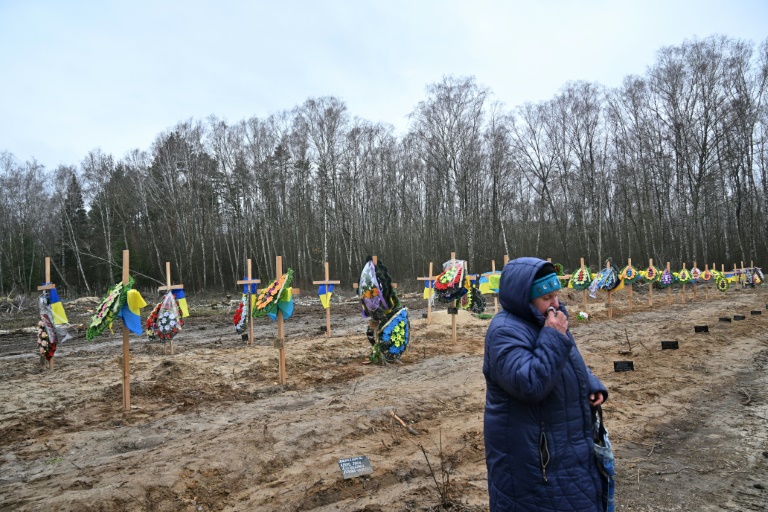
City officials estimate around 350 civilians have been killed in Chernigiv, with fellow residents digging mass graves to bury them. 

“It was very scary here from the first days of the war,” said Makoviy. “They brought guys, handsome, young, but no longer alive,”

– ‘We are ready’ –

The Russian withdrawal from areas around Kyiv and the north is part of a shift of focus towards Ukraine’s southeast, in a bid to create a land bridge between occupied Crimea and Moscow-backed separatist statelets in Donbas.

NATO chief Jens Stoltenberg said the alliance expects a Russian push in “coming weeks” to try to seize the entire Donbas. 

“We know the Russians are reinforcing and are getting ready to attack,” a senior Ukrainian officer in the village of Krasnopillia told AFP. 

“We are ready… we’ve planned some surprises for them along the way.”

Civilians have been asked to evacuate west and on Tuesday a line of cars stretching three kilometres was waiting to pass a checkpoint, while thousands of other residents boarded trains to leave.

Russian strikes on Wednesday killed at least two people and wounded five others near a humanitarian distribution point in the east Donetsk region, the regional governor said.

Meanwhile shells and rockets were landing at regular intervals in the industrial city of Severodonetsk, the easternmost city held by Ukrainian forces on the eastern frontline.

Peace talks between the sides have so far gone nowhere, though Moscow says it is “ready” to continue.

Ukraine has proposed an agreement where other countries would guarantee its security in return for Kyiv accepting a neutral and non-nuclear status, not joining NATO and refusing to host foreign military bases.

The proposal would also see Russia accept Kyiv joining  the European Union.

burs-ar/yad

Sri Lanka parliament speaker warns crisis risks starvation

Sri Lanka’s crippling economic crisis risks causing starvation across the island nation of 22 million while acute shortages of essentials and debilitating blackouts will get worse, the speaker of parliament warned Wednesday.

Scarce supplies of food and fuel, along with record inflation and electricity rationing, have inflicted widespread misery in the country’s most painful downturn since independence from Britain in 1948.

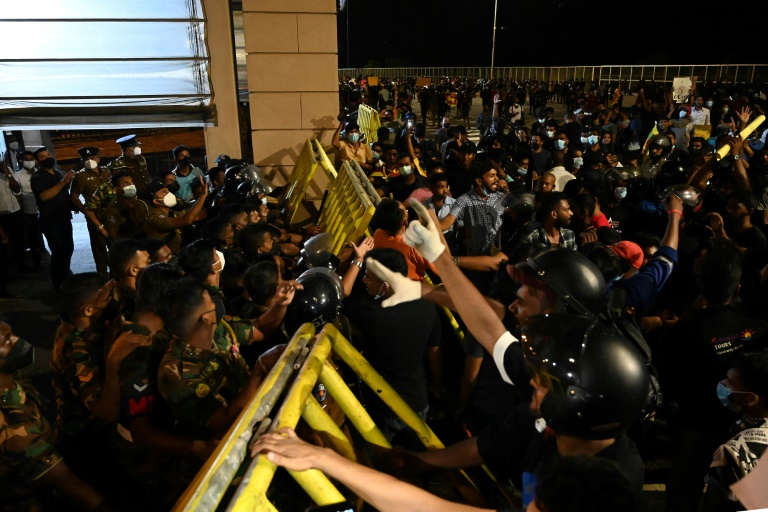
Public anger is at a fever pitch, with crowds attempting to storm the homes of several government figures — including President Gotabaya Rajapaksa — and large demonstrations elsewhere.

Parliamentary Speaker Mahinda Yapa Abeywardana told legislators that more hardships were to come as the country appeared at the brink of a political impasse.

“We are told this is the worst crisis, but I think this is just the beginning,” Abeywardana said at the start of a two-day debate on the worsening economic woes.

“The food, gas and electricity shortages will get worse. There will be very acute food shortages and starvation.”

The parliamentary session was disrupted twice as opposition lawmakers shouted slogans denouncing members of Rajapaksa’s once powerful ruling family and demanding they step down.

But chief government whip Johnston Fernando vowed that the president would stay in office to shepherd the country through the crisis.

“We say very clearly that he will not resign under any circumstances,” Fernando said, drawing loud catcalls from opposition MPs.

Security forces have dispersed protests with tear gas, water cannon and rubber bullets, but a state of emergency imposed by the president last week to quell demonstrations was lifted at midnight.

Hundreds of medical students stormed and occupied the health ministry in the capital Colombo on Wednesday while spontaneous protests were reported from across the island where people were queued to buy fuel.

More than 60 people had been arrested in connection with the unrest and many have said they were tortured in police custody.

– Minority government –

Legislators had pushed for a debate on the emergency decree during this week’s session of parliament, where the government has lost its majority after the desertion of political allies — several of whom have since called for Rajapaksa’s resignation.

Opposition parties had already rejected the president’s overture to form a unity administration after the resignation of nearly the entire cabinet late on Sunday.

But there has so far been no clear signal that opposition legislators will attempt a no-confidence motion to topple the Rajapaksa administration.

A critical foreign currency shortage has left Sri Lanka struggling to import essential goods, with the pandemic torpedoing vital revenue from tourism and remittances.

Rating agencies have warned of a potential default on Sri Lanka’s $51 billion foreign debt, and authorities are unable to raise more commercial loans because of credit downgrades.

Economists say the crisis has been exacerbated by government mismanagement, years of accumulated borrowing and ill-advised tax cuts.

Agriculture ministry secretary Udith Jayasinghe warned in December that the country could face a famine due to the government’s decision to ban agrochemical imports last year.

The decision, taken in an apparent effort to shore up foreign currency reserves, saw farmers leave their fields barren instead of toiling over crops without the aid of fertiliser and pesticides. 

Jayasinghe was sacked within hours of issuing his warning. 

Sri Lanka has said it will seek an IMF bailout to overcome the crisis but negotiations are yet to begin, and the country’s latest finance minister resigned Tuesday after just one day in office.

War in Ukraine: Latest developments

Here are the latest developments in the war in Ukraine:

– US, EU ready new sanctions –

The United States, European Union and G7 are set to toughen sanctions on Russia following allegations of war crimes in the Ukrainian town of Bucha.

The US will ban all new investment in Russia, a Washington source says. The White House says it will also add sanctions on government officials and “their family members”, among other measures.

The EU is set to ban Russian ships from European ports and halt Russian coal imports, but European Council president Charles Michel says the bloc would also have to act “sooner or later” on Russian oil and gas, the country’s top exports.

Ukrainian President Volodymyr Zelensky tells Ireland’s parliament he “cannot tolerate any indecisiveness” on the issue “after everything we have gone through”.

– Dollar debt paid in rubles –

Russia says it had made payments on dollar-denominated foreign debt in rubles, adding to fears the country is headed for a sovereign default.

The finance ministry says it was forced to make the $649.2-million payment in rubles after an intermediary bank refused to execute the payment.

It did not say whether the payment was accepted.

– ‘Not far short of genocide’: Johnson –

British Prime Minister Boris Johnson says the alleged massacre in Bucha “doesn’t look far short of genocide to me” and that Britain will also step up sanctions on Russia.

US President Joe Biden has branded Putin a war criminal.

– Pope slams ‘horrendous cruelties’ –

Pope Francis says during his weekly audience the “recent news about the war in Ukraine, instead of bringing relief and hope, instead attests to new atrocities, such as the Bucha massacre.”

– Two killed at aid station –

Russian strikes kill at least two people and wound five others near an aid distribution point on the town of Vugledar in the eastern Donetsk region which is bracing for a major Russian offensive.

The industrial city of Severodonetsk in eastern Ukraine also comes under sustained artillery and rocket fire, AFP journalists report.

Severodonetsk is the easternmost city held by Ukrainian forces.

– ‘Act immediately’ –

Zelensky challenges the United Nations to “act immediately” or “dissolve yourself altogether” during an address in which he shows harrowing footage of dead bodies — including children — he says were victims of Russian atrocities.

Likening Russia’s actions in Bucha and other Ukrainian cities to violence carried out by “terrorists” such as the Islamic State group, Zelensky calls on the Security Council to expel Russia “so it cannot block decisions about its own aggression, its own war.”

– Russian yachts seized –

Dutch authorities impound 14 yachts on order from Russian customers in Dutch shipyards, saying it needs to check whether the customers are on the sanctions list.

– Bid to ‘torpedo’ talks: Russia –

Russian Foreign Minister Sergei Lavrov says the images of bodies in Bucha, which the Kremlin claims are fakes, are a “provocation” aimed at scuppering talks between Moscow and Kyiv.

– 600,000 ‘evacuated’ to Russia –

Russia’s UN ambassador Vassily Nebenzia says over 600,000 people have been taken voluntarily to Russia since the start of the conflict in Ukraine, denying Kyiv’s claim of mass deportations.

“And we’re not talking about any kind of coercion or abduction, as our Western partners like to present this, but rather the voluntary decision by these people…” he tells the Security Council.

– Cluster munitions –

UN undersecretary-general for political and peace-building affairs, Rosemary DiCarlo, tells the Security Council of “credible” claims Russia has used indiscriminate cluster munitions two dozen times in populated parts of Ukraine.

burs-cb/jmy/yad

Good times: Luxury watchmakers face soaring demand

Times have been so good for luxury watchmakers that they are running behind demand, forcing some to delay the release of new collections and others to invest more in production capacity.

After the pandemic severely hit the global economy in 2020, the sector enjoyed a spectacular recovery last year and started 2022 with a bang, though Russia’s war in Ukraine created new uncertainties.

Watches were the best performing business for French luxury group Hermes, with sales soaring by 73 percent last year.

“We had an extraordinary year in the watches business,” Hermes vice president Guillaume de Seynes told AFP at Watches and Wonders in Geneva this week, one of the industry’s biggest annual showcases.

“We can feel a very strong dynamic for watchmaking everywhere in the world,” he said, adding that there was hot demand for a men’s watch model last year.

“We could have even sold more if we had been able to make more,” de Seynes said, noting that watchmakers face a “demand phenomenon that exceeds production capacity.”

His priority for 2022 is to invest in production. 

– Solid year –

The Oris brand also had “a very strong year”, said its chief executive, Rolf Studer.

Oris watches range between 1,800 and 7,200 Swiss francs ($1,928 and $7,710 or 1,767 euros and 7,064 euros).

The company had to delay the launch of a new collection in the higher price range because it did not produce enough watch movements — their internal mechanisms — in its workshops.

The watch was supposed to come out last summer but it is only launching now.

“We planned too conservatively,” Studer said.

“So we decided to keep the movements for the watches that were already out instead of launching new models and not be able to supply existing models already on the market,” he added.

Swiss watch exports rebounded last year, rising by 31.2 percent after a 21.8-percent contraction in 2020, when countries closed borders and went into strict Covid lockdowns.

Exports have not only exceeded pre-pandemic levels, they beat their 2014 record, too.

They went up by almost 16 percent in the first two months of this year, according to industry data, though the recovery has been seen only in watches worth more than 3,000 Swiss francs.

– Wait list –

The sector is now bracing for the fallout from the war in Ukraine and sanctions on Russia, which has a sizeable rich client base.

But the industry can rely on long wait lists for higher-end timepieces.

“Since we didn’t have enough watches for other markets, we will sell those that won’t be delivered to Russia elsewhere,” Edouard Meylan, CEO of H. Moser & Cie., told AFP.

All of his 2022 production is already pre-sold to retailers and partly pre-paid by final customers.

H. Moser only makes 2,000 watches per year at an average price of 45,000 Swiss francs. The watchmaker is even rejecting orders for timepieces that require a more than two-year wait.

“There’s uncertainty that can be created in other markets, particularly financial markets,” Meylan said.

“But we would have to have a big crash for an independent brand like ours to be affected,” he added.

Zhirinovsky: Russia's ultra-nationalist who predicted Ukraine conflict

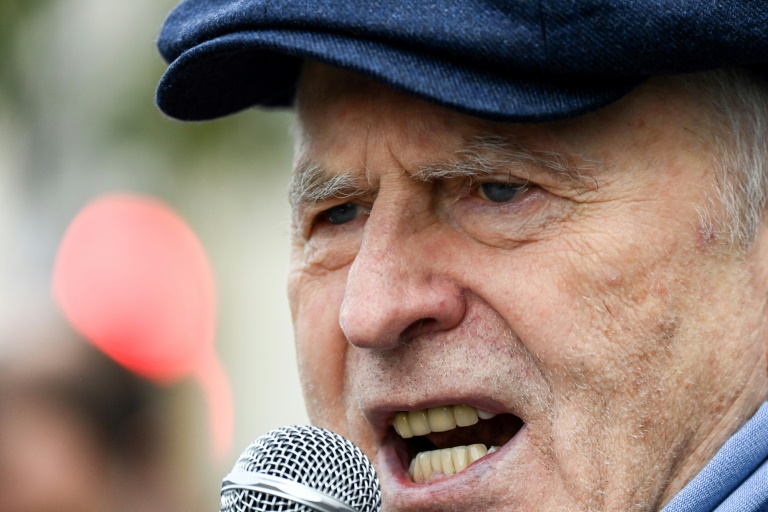
Vladimir Zhirinovsky, Russia’s veteran firebrand with a flair for political theatre who appeared to predict Russia’s military action in Ukraine, has died at the age of 75.  

The politician — who was reported to have been in grave condition after being hospitalised in early February with Covid — died after a “serious and prolonged illness”, the head of the lower house of parliament, Vyacheslav Volodin, said on Wednesday.

Known for his nationalist populism and a skill navigating the Kremlin’s political world, Zhirinovsky had reportedly been inoculated eight times with coronavirus vaccines.

Brash, confrontational and prone to eyebrow-raising antics, Zhirinovsky was a fixture on the Russian political scene for the past three decades and thrived on controversy.

In condolences from the Kremlin, President Vladimir Putin described Zhirinovsky as experienced and energetic, saying he “always, with any audience, in the most heated discussions, defended the patriotic position and the interests of Russia.”

Zhirinovsky co-founded and led the Liberal-Democratic Party of Russia (LDPR), one of the main forces in the country’s parliament, since 1990.

Zhirinovsky took part in all of post-Soviet Russia’s presidential elections and had been a member of parliament since 1993 when his party scored a major success with nearly 23 percent of the vote.

Often described as a clown in Russian political circles, he was known for his fiery anti-American, anti-liberal and anti-Communist speeches.

– ‘Not a peaceful year’ – 

He appeared to predict Russia’s military action in Ukraine when he addressed parliament in late December.

“This won’t be a peaceful year,” he said in reference to 2022, urging Russian forces to strike Ukraine.

“This will be a year when Russia will finally become a great country again and everyone will have to shut up.”

He even mentioned February 22 — the day President Vladimir Putin recognised Ukraine’s two breakaway regions as independent before he ordered troops into the pro-Western country two days later.

Since Moscow’s annexation of Crimea in 2014 and its subsequent stand-off with the West, Zhirinovsky had shifted into making anti-Kyiv public speeches.

After the annexation, Zhirinovsky arrived in parliament wearing a military uniform and launched into an anti-Ukrainian tirade from the podium.

Zhirinovsky’s wrath was also often directed against the United States.

“At night our scientists will slightly change the gravitational field of the Earth, and your country will be under water!” he said in a 2002 video, where he appeared to be visibly drunk.

Zhirinovsky was also known for making anti-Jewish statements, despite acknowledging his father’s Jewish heritage. 

Bad-boy reputation aside, Zhirinovsky was considered a skillful political operator and carefully toed the Kremlin line.

“Only the Russian leader decides what will happen to the world in the next 10 to 15 years,” he said in April 2021.

He will be remembered for his frequent nationalist outbursts and often outrageous behaviour, such as throwing a glass of juice at liberal opponent Boris Nemtsov during a televised debate and fighting in parliament’s lower house, the Duma. 

Supporters described him as a charismatic orator, who was popular with Russians nostalgic for the USSR as well as those disappointed with the Communists, democrats and Putin. Critics found his provocative nationalism shocking.

Russia’s liberal opposition despised him for being the Kremlin’s token opponent who helped channel discontent. 

– ‘Give each woman a man’ – 

Members of Zhirinovsky’s party were behind some of the country’s most attention-grabbing legislative initiatives. One LDPR lawmaker proposed stripping Russian women of citizenship for marrying foreigners. Another proposed banning the US dollar and allowing women to take two days of paid leave a month when they menstruate.

Zhirinovsky himself last year suggested pushing back the age of childhood to 30 because Russians “don’t understand a thing until they’re 30, they are all children.”

In 2007, Andrei Lugovoi, who is wanted in Britain in the murder of former Russian agent Alexander Litvinenko, was elected to Russia’s parliament as a representative of Zhirinovsky’s party and still sits in the Duma.

Born in 1946 in Soviet-era Kazakhstan, Zhirinovsky entered politics after studying Turkish, philosophy and law. 

Putin was only an adviser to the mayor of Saint Petersburg when Russians first heard Zhirinovsky’s outbursts during the post-Soviet country’s first free presidential election in 1991.

The politician promised to lower the prices of vodka and “give each woman a man”. He placed third with six million votes.

The LDPR has advocated for the return of Moscow’s many lost territories, including Alaska, which Russia sold to the United States in 1867.

Zhirinovsky famously said he hoped that one day Russian soldiers could “wash their boots in the waters of the Indian Ocean.”

Though marginalised in recent years, Zhirinovsky continued to deliver nationalist rants in parliament and regularly appeared on Russian television talk shows.

Hong Kong police arrest six for sedition over court 'nuisance'

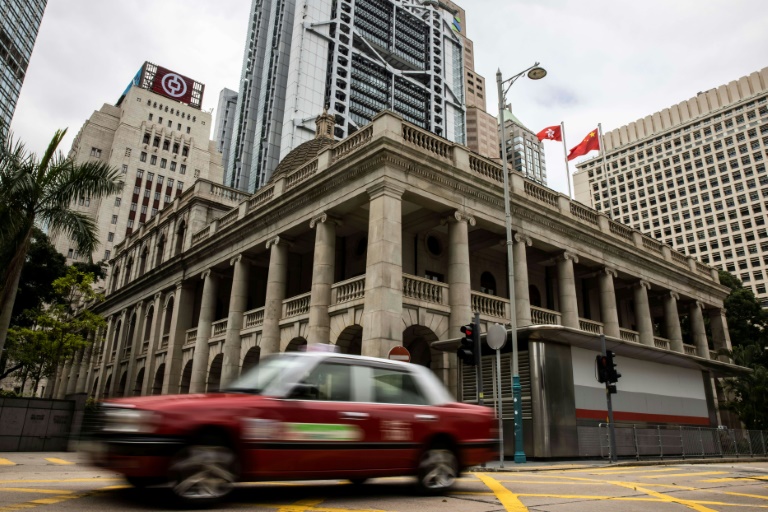
Six people accused of causing a nuisance in a Hong Kong courtroom were arrested for sedition Wednesday, as authorities ramp up use of the colonial-era law against critics.

Court disruptions are usually dealt with under contempt rules but authorities have chosen to deploy sedition, a charge treated as a national security offence.

Police said four men and two women were arrested over their behaviour at court hearings in December and January.

The suspects “purposely caused nuisance” and “severely affected jurisdictional dignity and court operations”, police said in a press release.

The statement did not detail what specific behaviour or actions were deemed seditious.

Hong Kong’s courts have become gathering places for democracy supporters as authorities prosecute thousands of activists and protesters following citywide rallies in 2019.

Most hearings are open to the public, and democracy supporters often applaud or shout words of encouragement to defendants appearing in the dock.

Hong Kong judges have previously chastised spectators for their behaviour and warned they could be in contempt of court, but none had been arrested before Wednesday.

Police said they had searched homes and seized records that allegedly show the suspects “conspiring” to commit disruptive acts.

Siew Yun-long, a citizen journalist known for his court reporting, was among those arrested, his family confirmed to AFP.

Leo Tang, a former leader of the now-disbanded Hong Kong Confederation of Trade Unions (HKCTU), was also arrested, according to local media.

The HKCTU is among scores of civil society groups and news outlets that have closed following the imposition of a sweeping national security law by Beijing in 2020 to stamp out dissent.

Police have arrested around 170 people under the security law, including opposition lawmakers, activists, journalists and students.

Authorities have also increasingly relied on sedition, a legacy law that until recently had not been deployed in decades.

The offence carries a maximum penalty of two years in jail.

Erwin van der Borght, Asia-Pacific regional director for Amnesty International, said the arrests showed the Hong Kong government will “stop at nothing to root out even the faintest murmurings of dissent”.

“These arrests also provide further evidence that Hong Kong’s national security police, who have virtually unchecked investigation powers… are increasingly involved in handling cases unrelated to national security,” van der Borght said in a statement.

In recent months, sedition charges have been brought against pro-democracy unionists who produced euphemistic children’s books, journalists, and people critical of the government’s response to the Covid pandemic.

'TikTok is having a bad war,' say disinformation experts

The war in Ukraine has rapidly positioned TikTok as the number one source of misinformation thanks to its gigantic number of users and minimal filtering of content, experts say. 

Every day, Shayan Sardarizadeh, a journalist with the BBC’s disinformation team, ploughs through a hallucinatory mix of fake and misleading information about the war being spewed out on the video-sharing site. 

“TikTok is really not having a good war,” he told AFP.

“I haven’t seen another platform with so much false content,” he added. 

“We’ve seen it all: videos from past conflicts being recycled, genuine footage presented in a misleading way, things that are so obviously false but still get tens of millions of views.”

He said the most disturbing were fake live-streams in which users pretended to be on the ground in Ukraine but were using footage from other conflicts or even video games — and then asking for money to support their “reporting”. 

“Millions tune in and watch. They even add fake gunshots and explosions,” said Sardarizadeh.

Anastasiya Zhyrmont of Access Now, an advocacy group, said it was no excuse to say that the war came as a surprise. 

“This conflict has been escalating since 2014 and these problems of Kremlin propaganda and misinformation have been raised with TikTok long before the invasion,” she told AFP. 

“They’ve promised to double their efforts and partner with content checkers, but I’m not sure they are taking this obligation seriously,” she added. 

– ‘No context’ –

Zhyrmont said the problem may lie with the lack of Ukrainian language content moderators, making it trickier for TikTok to spot false information. 

TikTok told AFP that it has Russian and Ukrainian speakers, but did not say how many, and said it had added resources specifically focused on the war but did not provide details. 

AFP is a partner of TikTok, providing fact-checking services in Australia, Indonesia, New Zealand, Pakistan and the Philippines. 

Some say the very nature of TikTok makes it problematic when subject matter becomes more serious than funny skits and dance routines. 

“The way you consume information on TikTok — scrolling from one video to another really quickly — means there is no context on any given piece of content,” said Chine Labbe of NewsGuard, which tracks online misinformation. 

NewsGuard ran an experiment to see how long it would take for new users to start receiving false information if they lingered on videos about the war. 

The answer was 40 minutes. 

“NewsGuard’s findings add to the body of evidence that TikTok’s lack of effective content-labelling and moderation, coupled with its skill at pushing users to content that keeps them on the app, have made the platform fertile ground for the spread of disinformation,” it concluded in its report. 

TikTok recognises the problem. 

In a blog post on March 4, it said it was using “a combination of technology and people to protect our platform” and partnering with independent fact-checkers to provide more context. 

– ‘Really troubling’ –

In the meantime, the particular concern with TikTok is the age of its users: a third in the United States, for example, are 19 or younger. 

“It’s hard enough for adults to decipher the real from the propaganda in Ukraine. For a young user to be fed all this false information is really troubling,” said Labbe.

All those interviewed emphasised that misinformation is rampant across all social media, but that TikTok had done even less than Facebook, Instagram or Twitter to combat it. 

TikTok’s relative infancy also means its own users have not yet joined the fight as they have on other platforms. 

“There are communities on Twitter and Instagram who are involved in disinformation,” said Sardarizadeh. 

“Some are starting to do fact-checking and educate people on TikTok, but we’re talking about a dozen or two dozen, compared with hundreds on Twitter.”

World stock markets beat retreat with all eyes on Fed

Global equities sank Wednesday on bets the Federal Reserve will act more aggressively to bring inflation under control, while oil prices rebounded.

Asian and European bourses retreated after heavy falls on Wall Street Tuesday.

The euro hit a one-month dollar low before minutes from the Fed’s latest policy meeting due Wednesday.

London stocks slid also as UK businesses and individuals saw a major tax hike kick in, worsening Britain’s cost-of-living crisis as domestic energy bills rocket.

Minutes from the Fed’s March meeting will be pored over for insights into the thinking of US central bankers, in light of the Ukraine war and recent data suggesting the world’s top economy remains resilient.

– ‘Significant headwinds’ –

“Investor confidence might have improved from the low point in early March when the Ukraine war was unfolding,” said AJ Bell investment director Russ Mould. 

“However, there remain significant headwinds for equities and the latest trouble spot is what the Federal Reserve might do to curb inflation.”

Investors are fretting also over how quickly officials will withdraw their vast pandemic-era financial support.

After last month’s 0.25-percentage-point hike in US interest rates, the focus is now on its plans for May’s meeting, with expectations growing that the Fed will announce a 0.50-point lift followed by several more before the end of the year.

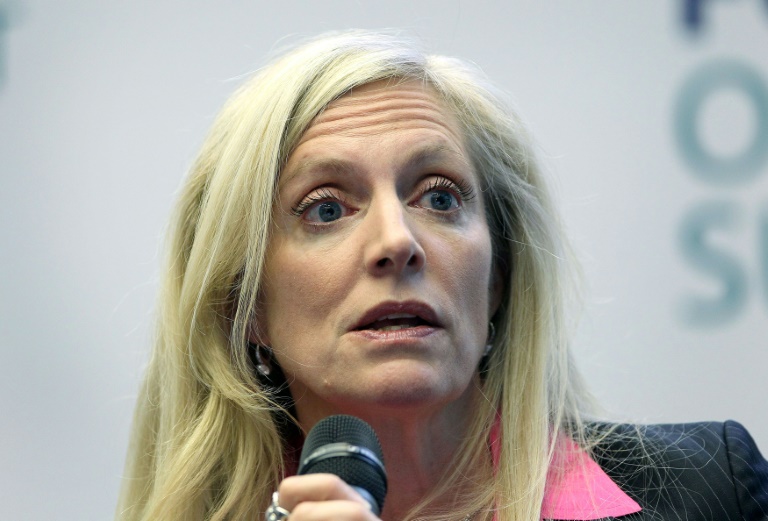
Fed governor Lael Brainard, who is considered a dove, on Tuesday spooked traders by saying bringing US inflation down from 40-year highs was of “paramount importance” and that the bank was “prepared to take stronger action” if warranted.

Brainard also said bank policymakers were ready to start reducing its vast bond holdings, which have helped keep borrowing costs down.

“Brainard’s hawkish comments rocked the markets,” said Swissquote analyst Ipek Ozkardeskaya.

“In this tense environment, investors will be closely watching the Fed minutes today. There would be no surprise if the Fed hinted a 50-basis-point hike (for) the next meeting,” she noted.

All three main indices on Wall Street ended Tuesday in the red, with the Nasdaq off more than two percent owing to tech firms being more susceptible to higher rates.

– Oil rebounds –

Oil prices rebounded on Wednesday, after European Council chief Charles Michel told the European Parliament that it must impose oil and gas sanctions on Russia “sooner or later”.

Crude futures had slid the previous day on the European Union’s decision not to include Russian oil in a fresh round of sanctions.

Adding to downward pressure on crude is a strong dollar thanks to the prospect of a series of US interest rate hikes. 

Oil is priced in dollars, making it more expensive for clients using other currencies.

– Key figures around 1030 GMT –

London – FTSE 100: DOWN 0.5 percent at 7,577.10 points

Frankfurt – DAX: DOWN 1.3 percent at 14,230.52

Paris – CAC 40: DOWN 1.2 percent at 6,564.72

EURO STOXX 50: DOWN 1.5 percent at 3,858.21

Tokyo – Nikkei 225: DOWN 1.9 percent at 27,080.52 (close)

Hong Kong – Hang Seng Index: DOWN 1.3 percent at 22,219.85 (close)

Shanghai – Composite: FLAT at 3,283.43 (close)

New York – Dow: DOWN 0.8 percent at 34,641.18 (close)

Brent North Sea crude: UP 1.5 percent at $108.24 per barrel

West Texas Intermediate: UP 1.8 percent at $103.78 per barrel

Euro/dollar: DOWN at $1.0903 from $1.0905 late Tuesday

Pound/dollar: UP at $1.3080 from $1.3074

Euro/pound: DOWN at 83.37 pence from 83.41 pence

Dollar/yen: UP at 123.96 yen from 123.60 yen

burs-rfj/bcp/lth

Sudanese plan mass anti-coup rallies on sit-in anniversary

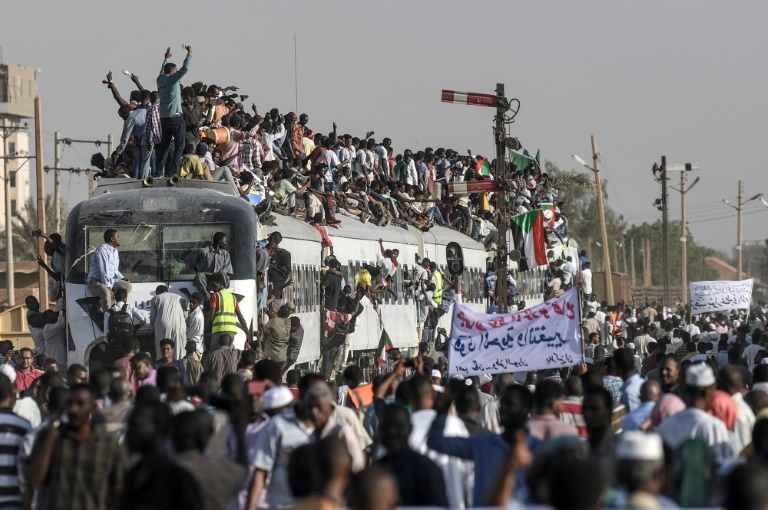
Sudanese protesters are gearing up for mass rallies demanding an end to military rule on Wednesday, the historic anniversary of events leading to the toppling of autocrats including Omar al-Bashir.

The planned demonstrations come as Sudan grapples with fallout from an October 25 coup led by army chief Fattah al-Burhan that has hammered its economy.

Security forces sealed off bridges linking Khartoum to other major cities and deployed around the presidential palace and army headquarters in the capital, witnesses said.

The protest has been organised to coincide with the anniversary a 1985 popular uprising that ousted president Jaafar Nimeiri after years of harsh rule.

April 6 also marks the third anniversary of the beginning of a mass sit-in demonstration outside the army headquarters, the culmination of months of protests calling for an end to Bashir’s iron-fisted three decades in power.

Generals bowed to the pressure to remove Bashir five days later, but the protesters stayed on to press for civilian rule, only to be dispersed violently in June that year by men in military fatigues.

At least 128 people were killed in an ensuing crackdown, according to medics.

Civilian and military leaders later agreed on a transition of power, but October’s coup upended those plans, leading to the current wave of protests.

Activists have mounted on online campaign for Wednesday’s protests, using hashtags such as “The storm of April 6” and “The earthquake of April 6”.

“The coup is more than five months old and has produced nothing but set fire to all aspects of life turning our country into an arena of crises,” said the Forces of Freedom and Change, or FFC, the main civilian alliance which was ousted after the coup.

– ‘Defeat the coup’ –

The government has declared Wednesday a public holiday.

“It is an important day… so we expect many to take to the streets despite the heat and Ramadan,” said Badwi Bashir, a protester from Khartoum.

“We just want to bring down the coup and end the prospect of any future coups.”

Jaafar Hassan, an FFC spokesman said, April was “the month of victories for the Sudanese”.

“We have to defeat the coup… We have to get out of this crisis,” he told a news conference last week.

Since grabbing power, the military has moved to tighten its grip, rounding up prominent civilian leaders and reversing appointments made during the transition.

“We want a unified front,” said Hassan. “We have tried a partnership with the military, and it failed, ending in this coup, and we shouldn’t do this again.”

Burhan said on Saturday he would only “hand over power to an honest, elected authority, accepted by the all the Sudanese people”.

At least 93 people have been killed and hundreds wounded in the latest crackdown, medics say.

On Wednesday, the United States urged against “the use of any violence” and demanded Sudanese authorities “keep their word and hold accountable those responsible for abuses.”

– Economic nosedive –

Since the coup, Sudan’s already ailing economy has suffered severe blows, as Western donors cut crucial aid pending the restoration of a transition to civilian rule.

Prices of food, fuel and basic commodities have soared and crime and has spiked.

Violence has intensified in remote areas, particularly the restive Darfur region, the UN says.

On Thursday, clashes between Arab and non-Arab tribes left at least 45 people dead in South Darfur state.

The UN has warned of growing humanitarian needs and food insecurity.

Last month, the World Food Programme said it expected the number of Sudanese facing acute hunger to double to more than 18 million by September.

Late Tuesday, Burhan welcomed an initiative for talks to resolve Sudan’s political crisis.

Burhan last week threatened to expel UN special representative Volker Perthes, accusing him of “interference” in the country’s affairs after Perthes warned of the deepening crisis in Sudan during a UN Security Council briefing.

Perthes’ mission, UNITAMS, along with the African Union and the regional bloc IGAD, have agreed on joint efforts to facilitate Sudanese-led talks to resolve the crisis — in a bid that earned support from the US and other Western nations.

Close Bitnami banner
Bitnami