World

Zelensky demands world 'act immediately' to halt Russian attacks

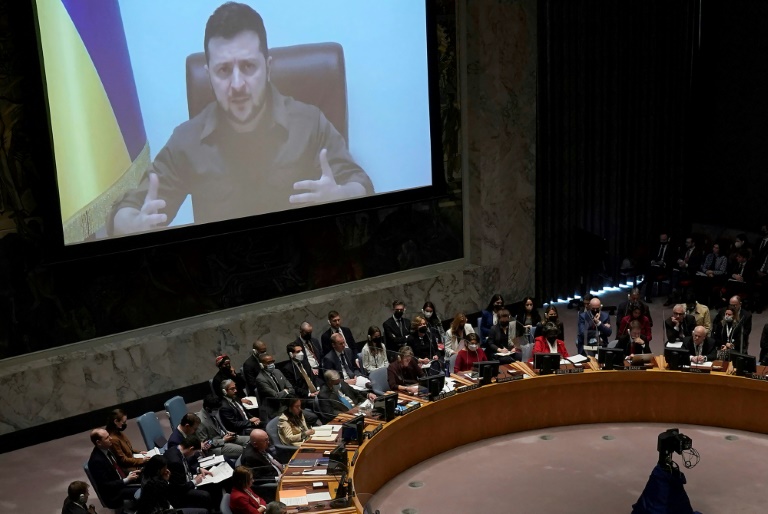
Ukraine’s president urged the UN Security Council on Tuesday to take immediate action against Moscow, calling for “accountability” for atrocities against civilians, as fears grow that Russia is preparing new offensives to seize territory in the east and south.

People “were killed in their apartments, houses… civilians were crushed by tanks while sitting in their cars in the middle of the road,” Volodymyr Zelensky said in a sombre video message to the UN council in New York.

“Accountability must be inevitable,” he said, while calling for Russia’s exclusion from the Security Council after six weeks of heavy bombardments of Ukraine.

“Are you ready to close the UN? And the time of international law is gone? If your answer is no, then you need to act immediately,” he said.

His address came after global outrage over the harrowing discoveries of civilian victims in Bucha and other towns near Kyiv after Russian troops pulled back, which Zelensky and other officials have denounced as war crimes and attempted “genocide”.

“What we’ve seen in Bucha is not the random act of a rogue unit. It’s a deliberate campaign to kill, to torture, to rape, to commit atrocities,” US Secretary of State Antony Blinken said before leaving for a NATO meeting in Europe starting Wednesday.

Washington and the EU have promised more sanctions to squeeze Russia’s economy and force President Vladimir Putin to halt the war he launched six weeks ago, purportedly to defend pro-Russia enclaves in Ukraine’s east.

“In the coming weeks, we expect a further Russian push in the eastern and southern Ukraine to try to take the entire Donbas and to create a land bridge to occupied Crimea,” NATO chief Jens Stoltenberg said.

The EU announced a fifth package of measures that would target oil and coal exports and prohibit Russian ships from European ports, while the US Treasury said Russia would no longer be able to pay its foreign debt with dollars held in American banks.

EU Commission chief Ursula von der Leyen, who said she would travel to Kyiv this week, has offered the bloc’s assistance in documenting proof of war crimes.

– ‘In front of my eyes’ –

The Kremlin has denied any civilian killings and claimed that the images are fakes produced by Ukraine forces, or that the deaths occurred after Russian soldiers pulled out of the areas.

But one resident in Bucha, Olena, told AFP she saw Russian soldiers shoot a man in cold blood as units of “brutal” older troops sowed fear in the town.

“Right in front of my eyes, they fired on a man who was going to get food at the supermarket,” said the 43-year-old, who did not wish to give her family name.

In response Spain, Italy, Denmark and Slovenia expelled dozens of Russian diplomats suspected of being intelligence operatives, after France and Germany did the same on Monday, for a total of some 180 expulsions in just 48 hours.

Putin warned of reprisals for what the Kremlin called a “short-sighted move” that would complicate efforts to negotiate an end to the hostilities.

He also said Moscow would “monitor” its food exports to “hostile” nations, raising the spectre of further inflation pressures worldwide as the conflict endures.

Europe’s worst conflict in decades has killed as many as 20,000 people, according to Ukrainian estimates. 

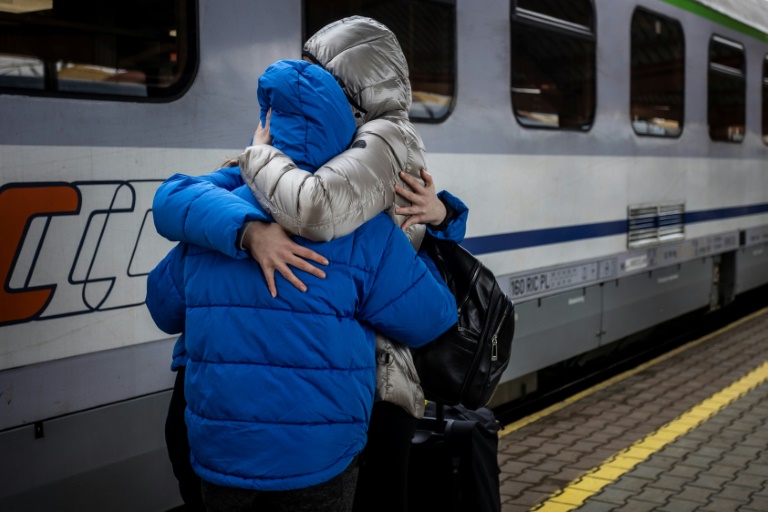
Nearly 4.25 million Ukrainians have fled the country during Russia’s invasion, while a further 7.1 million are thought be internally displaced within Ukraine, the United Nations said Tuesday.

– Mass graves –

Many in Ukraine are bracing for further Russian bombardments especially in the east and south, and air raid sirens rang out overnight across much of the country.

The full nature of the killings in Bucha and other areas from which Russian troops have withdrawn is still being pieced together.

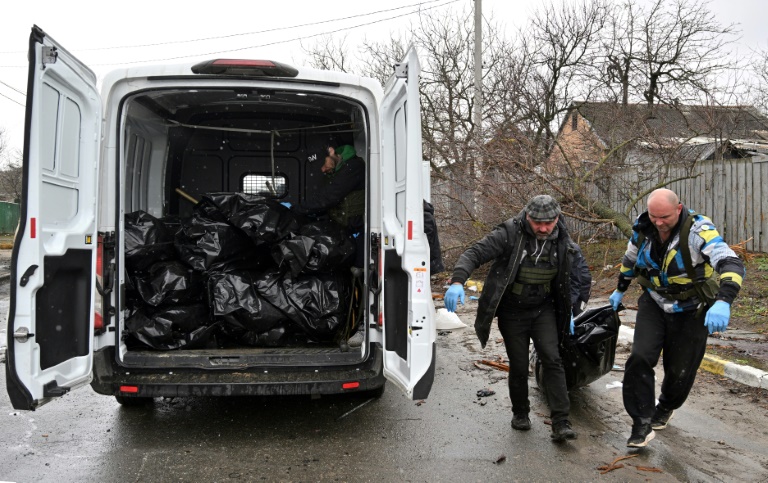
Ukrainian officials say over 400 civilian bodies have been recovered from the wider Kyiv region, many of whom have been buried in mass graves.

But Zelensky has warned that the deaths in Bucha could be only the tip of the iceberg, saying he had information that even more people had been killed in places like nearby Borodianka.

AFP reporters who briefly visited the area saw no bodies in the streets, but locals reported many deaths. The scale of devastation in the town saw buildings flayed open.

“I know five civilians were killed,” said 58-year-old Rafik Azimov. “But we don’t know how many more are left in the basements of the ruined buildings after the bombardments.”

“I buried six people,” another resident, Volodymyr Nahornyi, said. “More people are under the ruins.”

– Cluster bombs used? –

Even where troops have withdrawn, fears remain, with Kyiv’s Mayor Vitali Klitschko telling residents not to not return yet, citing the dangers of continued shelling and unexploded munitions.

On Monday, officials in Mykolaiv, on the Black Sea not far from Odessa, said cluster bombs were used against the city in strikes that killed 10 civilians and wounded 46.

Such weapons are banned under a 2008 UN convention that cites the danger of indiscriminate killing they pose by sending dozens of small bomblets over a large area, but it has not been signed by Russia or Ukraine.

The UN’s undersecretary-general for political and peacebuilding affairs, Rosemary DiCarlo, told the Security Council meeting there were “credible allegations” that Russia had used cluster munitions in populated areas at least 24 times.

Elsewhere in the south, concerns remain for civilians trapped in the city of Mariupol, which has been besieged by Russian forces for over a month, and where authorities say at least 5,000 people have been killed. 

Mayor Vadym Boichenko said the city was now “unlivable” for the approximately 120,000 residents that have remained despite persistent Russian shelling, characterising the situation as “beyond a humanitarian disaster.”

burs/js/pvh
Nearly 4.25 mn Ukrainians flee abroad, 7.1 mn IDPs: UN

Nearly 4.25 million Ukrainians have fled the country during Russia’s invasion, while a further 7.1 million are thought be internally displaced within Ukraine, the United Nations said Tuesday.

UNHCR, the UN refugee agency, said 4,244,595 Ukrainians had fled across the country’s borders since the war began on February 24 — a figure up 29,548 since Monday.

Meanwhile the UN’s International Organization for Migration estimated that 7.1 million internally displaced people (IDPs) had fled their homes but were still in Ukraine.

The IOM says that in addition to Ukrainian refugees, more than 206,000 non-Ukrainians living, studying or working in the country have also left. 

This means that in total, more than a quarter of the population have been forced to flee.

Before the Russian invasion, Ukraine had a population of 37 million in the regions under government control, excluding Russia-annexed Crimea and the pro-Russian separatist regions in the east.

“The cessation of hostilities in Ukraine is of utmost importance, to allow for humanitarian access to all affected populations,” the IOM said. 

Women and children account for 90 percent of those who have left Ukraine, with men aged 18 to 60 eligible for military call-up and unable to leave.

Speaking via video-link Tuesday to a conference of European mayors in Geneva organised by the UN, Kyiv mayor Vitali Klitschko decried a “genocide” in his country.

“If someone thinks the war is far away, and this war doesn’t touch you, it’s a mistake. This war can touch everyone in Europe,” he said.

Here is a breakdown of how many Ukrainian refugees have fled to neighbouring countries, according to UNHCR:

– Poland –

Nearly six out of 10 Ukrainian refugees — 2,469,657 so far — have crossed into Poland, according to the UN tally. Polish border guards said the number had reached 2.5 million on Tuesday.

Many people who go to Ukraine’s immediate western neighbours travel on to other states in Europe’s Schengen open-borders zone.

The Polish border guards said that since the war began, 471,000 people have left Poland for Ukraine.

Before the crisis, Poland was already home to around 1.5 million Ukrainians, chiefly migrant workers.

– Romania –

A total of 648,410 Ukrainians have entered the EU member state, including a large number who crossed over from Moldova, wedged between Romania and Ukraine. 

The vast majority are thought to have gone on to other countries. 

– Moldova –

The Moldovan border is the closest to the major port city of Odessa, which was hit by air strikes Sunday. Some 396,448 Ukrainians have crossed into the non-EU state, one of the poorest in Europe.

Most of those who have entered the former Soviet republic of 2.6 million people have moved on.

– Hungary –

A total of 394,728 Ukrainians have entered Hungary. 

– Russia –

Some 350,632 refugees had sought shelter in Russia as of March 29.

In addition, 113,000 people crossed into Russia from the separatist-held pro-Russian regions of Donetsk and Lugansk in eastern Ukraine between February 21 and 23. 

– Slovakia –

A total of 301,405 people have crossed Ukraine’s shortest border into Slovakia, according to latest figures up to Monday.

– Belarus –

Another 16,274 refugees had made it north to Russia’s close ally Belarus.

World's fossil fuel assets risk evaporating in climate fight

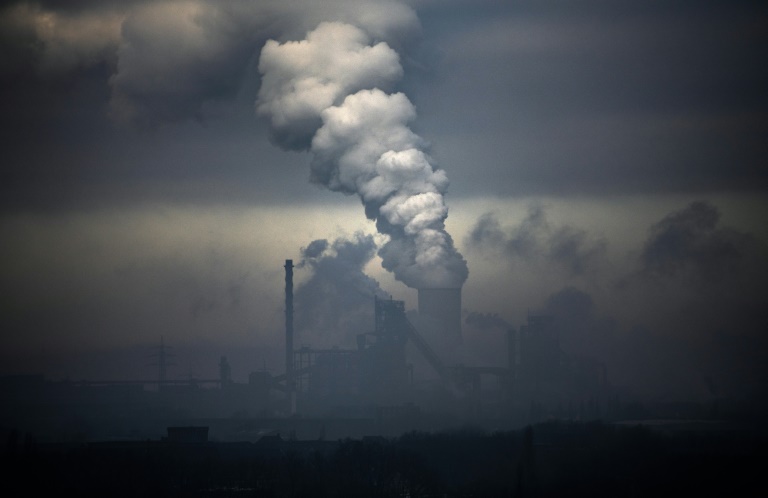
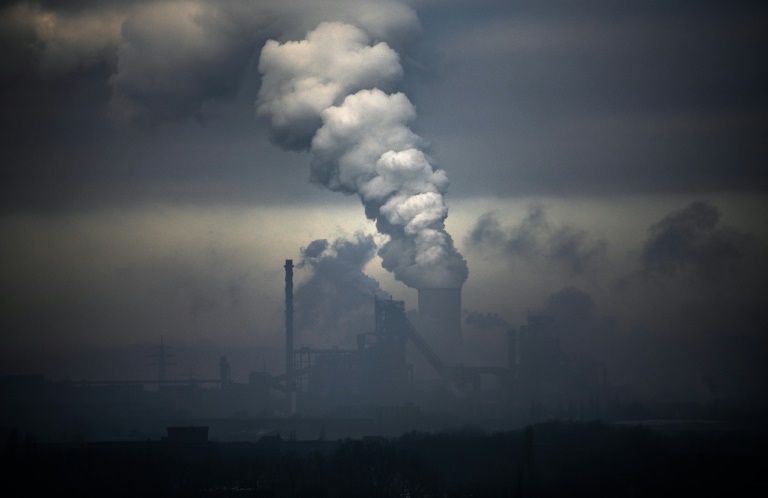
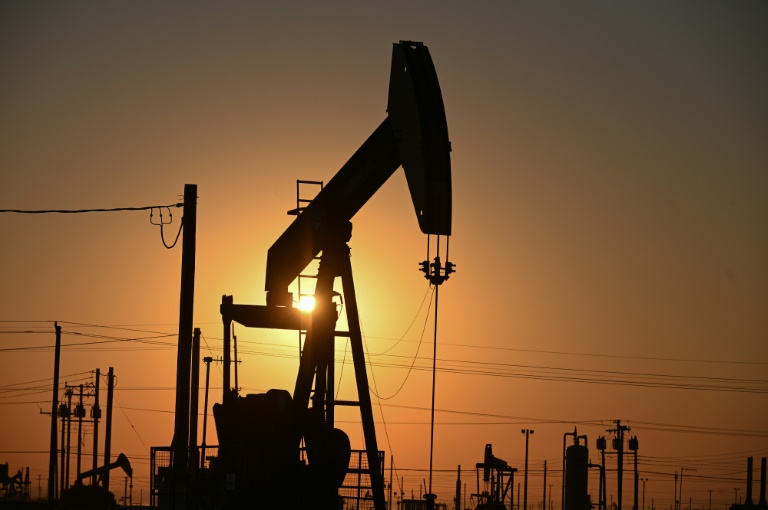
Oil platforms, pipelines, coal power plants and other fossil fuel assets could lose trillions of dollars in the battle against climate change in the coming decades, experts say.

The warning was issued in a 3,000-page report by UN experts who said fossil fuel assets must be retired and replaced with clean energy faster to mitigate financial losses.

Such assets will become “stranded” and worth less than expected because they may never be used since fossil fuel demand must fall in the near future to limit greenhouse gas emissions.

Limiting warming to the aspirational 1.5 degree Celsius target in the Paris Agreement, or the more conservative 2C goal, “will strand fossil-related assets”, said the UN’s Intergovernmental Panel on Climate Change (IPCC) in its latest report Monday.

“The combined global discounted value of the unburned fossil fuels and stranded fossil fuel infrastructure has been projected to be around 1–4 trillion dollars from 2015 to 2050 to limit global warming to approximately 2C, and it will be higher if global warming is limited to approximately 1.5C,” the IPCC said.

Any move to alleviate the impact of climate change means using less fossil fuel, thus rendering assets obsolete as companies are under pressure to move away from harmful energy production.

The IPCC said that if current oil, gas and coal energy infrastructure were to operate for their designed lifetime — without technology to capture and store carbon — capping global warming at the 1.5C target would be impossible.

It said nations should stop burning coal completely and cut oil and gas use by 60 and 70 percent respectively by 2050 to keep within the Paris deal goals, noting that both solar and wind were now cheaper than fossil fuels in many places.

The idea of “stranded assets” dates back to the 2010s and was put forward by think tank Carbon Tracker.

Companies could be further affected by governments taking decisions such as increasing the price of coal or even banning certain energies.

Consumers could also turn to other products like electric vehicles.

Other assets impacted include infrastructure such as drilling platforms, which have become useless quicker than expected.

Some fossil fuel reserves will become too costly to exploit due to falling prices.

– Risky bets –

For the IPCC, coal-related assets are the most vulnerable before 2030, than those that are oil- and gas-related towards mid-century.

The idea of stranded assets, taken up by both environmentalists and investors, has gained popularity and has been used in shareholder meetings of energy companies such as ExxonMobil or TotalEnergies.

The climate issue has in fact become central to some companies, even if it has taken three decades after the IPCC’s creation in 1988.

“It’s really the financial risk that originally created this spark, which took a long time,” said Hugues Chenet, research associate at Polytechnique and the University College London. 

That “convinced financial actors there was a problem.”

The idea of “stranded assets” — which Chenet prefers to call “obsolete” — has made it possible to pinpoint a “contradiction”.

There is one “path that says we must live without fossil fuels, facing an economy that is rather more geared up to do the opposite”.

Lucie Pinson of NGO Reclaim Finance, who does not find the climate commitments of major companies like TotalEnergies credible, also pointed out the inconsistency.

“We can see that (TotalEnergies) doesn’t believe in its own (climate) rhetoric, because if it believed it, it would not develop projects which have no future,” she added.

– Revenue losses –

It’s decision time for countries which get revenue from fossil fuels.

From Azerbaijan to Angola to Nigeria and Saudi Arabia, oil producers risk losing a significant amount of their revenue over the next 20 years, warned Carbon Tracker.

But “if they continue to invest, you’re betting on the failure of policy action on climate but you’re also betting on the failure of renewables and other low carbon technologies to displace oil and gas”, said Carbon Tracker’s Mike Coffin, who calls on countries to diversify.

Another risky bet would be to ignore acting against climate change, hoping to make profits from oil and gas. 

But “you’ll lose way more on all your other assets when you’ve got forest fires, global migrations, famine,” he said.

World's fossil fuel assets risk evaporating in climate fight

Oil platforms, pipelines, coal power plants and other fossil fuel assets could lose trillions of dollars in the battle against climate change in the coming decades, experts say.

The warning was issued in a 3,000-page report by UN experts who said fossil fuel assets must be retired and replaced with clean energy faster to mitigate financial losses.

Such assets will become “stranded” and worth less than expected because they may never be used since fossil fuel demand must fall in the near future to limit greenhouse gas emissions.

Limiting warming to the aspirational 1.5 degree Celsius target in the Paris Agreement, or the more conservative 2C goal, “will strand fossil-related assets”, said the UN’s Intergovernmental Panel on Climate Change (IPCC) in its latest report Monday.

“The combined global discounted value of the unburned fossil fuels and stranded fossil fuel infrastructure has been projected to be around 1–4 trillion dollars from 2015 to 2050 to limit global warming to approximately 2C, and it will be higher if global warming is limited to approximately 1.5C,” the IPCC said.

Any move to alleviate the impact of climate change means using less fossil fuel, thus rendering assets obsolete as companies are under pressure to move away from harmful energy production.

The IPCC said that if current oil, gas and coal energy infrastructure were to operate for their designed lifetime — without technology to capture and store carbon — capping global warming at the 1.5C target would be impossible.

It said nations should stop burning coal completely and cut oil and gas use by 60 and 70 percent respectively by 2050 to keep within the Paris deal goals, noting that both solar and wind were now cheaper than fossil fuels in many places.

The idea of “stranded assets” dates back to the 2010s and was put forward by think tank Carbon Tracker.

Companies could be further affected by governments taking decisions such as increasing the price of coal or even banning certain energies.

Consumers could also turn to other products like electric vehicles.

Other assets impacted include infrastructure such as drilling platforms, which have become useless quicker than expected.

Some fossil fuel reserves will become too costly to exploit due to falling prices.

– Risky bets –

For the IPCC, coal-related assets are the most vulnerable before 2030, than those that are oil- and gas-related towards mid-century.

The idea of stranded assets, taken up by both environmentalists and investors, has gained popularity and has been used in shareholder meetings of energy companies such as ExxonMobil or TotalEnergies.

The climate issue has in fact become central to some companies, even if it has taken three decades after the IPCC’s creation in 1988.

“It’s really the financial risk that originally created this spark, which took a long time,” said Hugues Chenet, research associate at Polytechnique and the University College London. 

That “convinced financial actors there was a problem.”

The idea of “stranded assets” — which Chenet prefers to call “obsolete” — has made it possible to pinpoint a “contradiction”.

There is one “path that says we must live without fossil fuels, facing an economy that is rather more geared up to do the opposite”.

Lucie Pinson of NGO Reclaim Finance, who does not find the climate commitments of major companies like TotalEnergies credible, also pointed out the inconsistency.

“We can see that (TotalEnergies) doesn’t believe in its own (climate) rhetoric, because if it believed it, it would not develop projects which have no future,” she added.

– Revenue losses –

It’s decision time for countries which get revenue from fossil fuels.

From Azerbaijan to Angola to Nigeria and Saudi Arabia, oil producers risk losing a significant amount of their revenue over the next 20 years, warned Carbon Tracker.

But “if they continue to invest, you’re betting on the failure of policy action on climate but you’re also betting on the failure of renewables and other low carbon technologies to displace oil and gas”, said Carbon Tracker’s Mike Coffin, who calls on countries to diversify.

Another risky bet would be to ignore acting against climate change, hoping to make profits from oil and gas. 

But “you’ll lose way more on all your other assets when you’ve got forest fires, global migrations, famine,” he said.

Compact, green and car-free. Can city living beat climate change?

With a whopping 70 percent of humanity predicted to be living in urban areas by the middle of the century, UN climate experts see a huge opportunity to create ideal cities that are walkable, leafy and energy efficient.

Urban areas currently account for around 70 percent of global greenhouse gas emissions, notes a comprehensive report on climate change solutions from the UN’s Intergovernmental Panel on Climate Change released this week. 

We are in the “urban century”, the report says, with nearly seven billion people expected to live in built-up areas by 2050. 

If this rapid expansion is chaotic, unplanned and inefficient it could cause emissions to explode.

But the IPCC says there is another option.   

“Although urbanisation is a global trend often associated with increased incomes and higher consumption, the growing concentration of people and activities is an opportunity to increase resource efficiency and decarbonise at scale,” the report says. 

Cities are already more efficient: For the same level of consumption, a city dweller often needs less energy than their neighbour in the countryside. 

That’s because of the economies of scale in densely populated areas, where people share infrastructure and services, it says.

The IPCC did not give specific price tags for the measures it outlines, since they would vary considerably from place to place, but stressed that electrification, for example, was a “feasible, scalable and affordable” way of decarbonising public transport systems.  

Overall, the IPCC makes clear that the economic benefits of cutting carbon pollution outweigh the costs of climate inaction. 

Air pollution, for example, causes some seven million premature deaths each year around the world. 

The report said the economic payback from reducing air pollution alone would be on the “same order of magnitude” as the investments needed to slash emissions, potentially even larger. 

And the value of improvements in health and quality of life go beyond money. 

So what would an ideal city look like? 

– Car-free –

The IPCC paints a picture of a “compact and walkable” urban area, with relatively high density of housing, shops and offices located close together, so that the journey from home to work and to services is short. 

“Larger cities around smaller communities,” said Diana Reckien, of Utwente University in the Netherlands, citing the example of recent restructuring of urban planning in Berlin. 

“A community is really four-by-four blocks, with only small streets, either a playground or a market square, mostly in the middle, and all basic services (grocery stores, stationery, doctors, hairdresser),” said the researcher, who was not involved in the IPCC analysis.  

Then you need to connect these districts together with cheap, reliable and plentiful public transport to wean households off their cars. 

– Two colours –

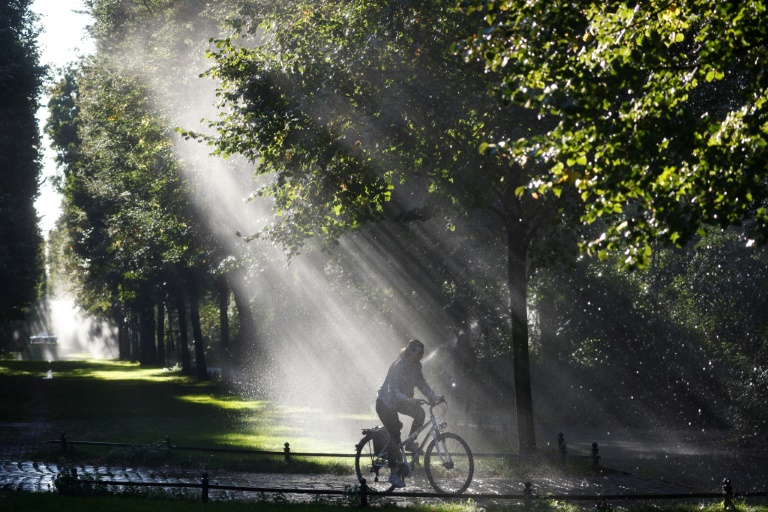
Green and blue — plants and water — are essential additions to the often monochrome urban landscape. 

Today, cities are net carbon emitters, but they could both reduce their emissions and absorb more carbon, according to the IPCC. 

Urban forests, tree-lined streets, green roofs or facades, parks or waterways are all examples. 

This “green and blue infrastructure” will not just help to suck up emissions but can also play an important role in protecting neighbourhoods from the impacts of global warming. 

For instance, if more plants grow in amongst the buildings then they can reduce the effects of what is known as “urban heat islands”, which are dense urban areas that amplify the suffocating effects of heatwaves.  

That has been done for example in Colombia, where the second-largest city, Medellin, transformed the verges of roads and waterways into 30 green corridors that reduce the impact of the heat island effect, the UN’s Environment Programme says.  

Basins, grass verges and waterways can absorb flooding, like a large-scale “Sponge City” project in China.

“Cities should combine their mitigation efforts with adaptation, which can often create visible local benefits,” said Tadashi Matsumoto, an expert at the OECD who was not involved in the report. 

“If you are only talking to citizens about global carbon emissions, they may not feel it is a priority. But if you’re talking to them about floods or the heat island effect, then they may feel these are their problems,” he told AFP. 

– From ideal to real –

Growing cities are the perfect places for green innovation, said Reckien.

But she added that people needed to be given sufficient information. 

“It’s important for people who live in cities to understand why it’s done, how they can use it, how it is improving their life. Especially since it’s usually done on tax money,” she said. 

Not all urban areas face the same challenges, the IPCC report makes clear. 

Older, established cities will have to replace or retrofit their existing building stock, electrify the energy system and overhaul transport systems — more costly than building new urban areas from scratch. 

Fast-growing cities must resist the urge to sprawl, it said, keeping distances between homes and offices short. 

And finally new or emerging cities have the chance to get it right the first time. 

They will have “unparallelled potential to become low- or net-zero emissions urban areas while achieving high quality of life”, the report said. 

With some 880 million people living in informal urban settlements, the IPCC added that much of the urban infrastructure of 2050 has yet to be built. 

“How these new cities of tomorrow will be designed and constructed will lock-in patterns of urban energy behaviour for decades if not generations,” it said. 

Europe warms up to Russian shipping blockade

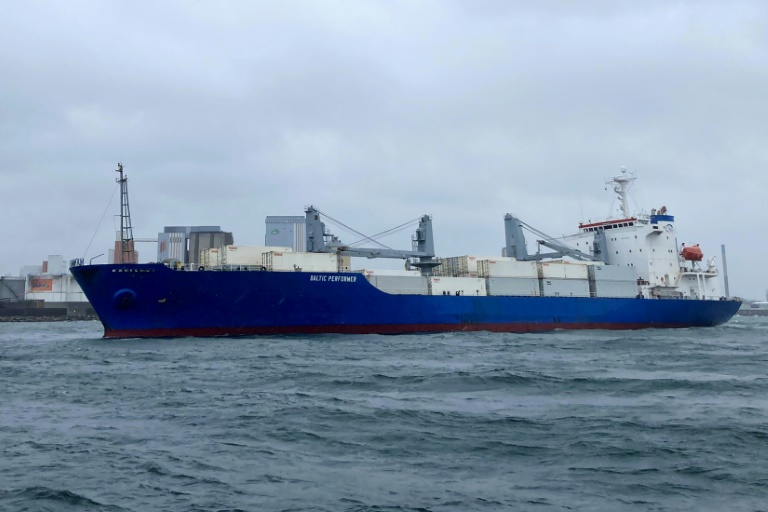
After several days of delays and uncertainty, the Baltic Performer, a blue cargo ship laden with bananas from Ecuador, finally docked under grey skies at the Helsingborg port in southern Sweden.

One of Sweden’s two main unions for dockworkers, the Swedish Dockworkers Union, decided at the end of March that it would not unload vessels with ties to Russia, in protest against Moscow’s invasion of Ukraine.

The 150-meter freighter, operated by a Swedish subsidiary of the Russian company Baltic Shipping, was one of the first ships affected by that decision.

“We’re blocking all goods linked to Russia and the regime”, Rolf Lyktoft, head of the local dockworkers’ chapter, told AFP.

Ukrainian President Volodymyr Zelensky has called for Russian vessels to be blocked from the ports of the “free world”.

On Tuesday, the EU executive proposed banning Russian ships from European ports.

So far, none of the 27 EU member states has instituted a national ban — unlike Britain, which did so in early March.

– 270 ships a month-

Analysts say Europe has been wary to move on the issue due to a fear of Russian reprisals over its oil deliveries. 

In Helsingborg, Lyktoft acknowledged that the decision taken by his 1,400 colleagues was largely symbolic, with only a small number of Russian-linked cargo ships passing through Sweden’s ports.

But he hoped for a snowball effect.

“We hope that the International Dockworkers Council will decide to take the next step, with a worldwide decision to not touch Russian goods”, he said. 

Helsingborg port officials have kept a low profile. The Baltic Performer was ultimately quietly unloaded late Monday.

The ship had been scheduled to arrive at the port on Saturday evening, but had to postpone its arrival by a few days as there were no dockers willing to unload it.

The blockade imposed by the Swedish Dockers’ Union includes Russian-flagged vessels, those owned by Russian companies but flying other flags, and those sailing to or from Russia.

The Baltic Performer was unloaded by dockers from the Transport Workers’ Union, Sweden’s other main dockers union.

“We think they shouldn’t have let the ship into the port, but the port authorities did,” said head of that union, Tommy Wreeth.

Last week, his organisation also announced a blockade due to take effect on May 1 — in order to give shipping companies time to make other arrangements.

According to Wreeth, 270 Russian-flagged vessels or with ties to Russia docked in EU ports in March, including four in Sweden.

– Short-term disruptions –

Britain blocked Russian-linked ships from its ports in early March, although Russian cargo — in particular oil — is still able to enter on other ships for the time being.

Few initiatives have been taken elsewhere in Europe so far.

Before the EU proposal was announced on Tuesday, the CGT dockers union at France’s second-biggest port Le Havre said any blockade decision had to “taken across Europe”.

“Otherwise, the port of Le Havre or other French ports would be shooting themselves in the foot, with traffic just going to other ports that turn a blind eye”, union representative Johan Fortier told AFP. 

On March 3, the port of Hamburg suspended all loading and unloading of ships to and from Russia.

But “limited” operations resumed three weeks later, a spokesman told AFP, since “not all goods are on the EU sanctions list.”

As in other European countries, German customs officials currently verify the contents of the containers and decide on a case-by-case basis.

EU ambassadors are to discuss the proposed ban at their meeting in Brussels on Wednesday. The proposal needs to be approved unanimously by all 27 member states.

If the EU introduces a blockade and Russia takes retaliatory measures against EU vessels, “this could significantly disrupt Russia’s exports in the short-term”, said Niels Rasmussen, chief analyst at shipowners’ association Bimco.

However, “in the medium-term it is likely that non-Russia and non-EU ships would reposition into Russia-Europe”, while the tankers hit by sanctions “would move into other markets”, he told AFP.

burs-cbw-map/po/rl

War in Ukraine: Latest developments

Here are the latest developments in the war in Ukraine:

– Zelensky to address UN –

Ukrainian President Volodymyr Zelensky is set to address the United Nations Security Council following the grisly discovery of bodies scattered on the street, in basements and in shallow graves in areas near Kyiv from which Russian forces have withdrawn.

He is expected to appeal for more sanctions and military aid.

During a visit on Monday to Bucha, where AFP counted 20 bodies on a single street, he accused Russia of “war crimes” and attempted “genocide” and asked Europe to apply the “most severe pressure”.

– US squeezes Russia payments –

The United States bars Moscow from making debt payments using funds held at American banks — a move that takes Russia a step closer to default.

“Russia must choose between draining remaining valuable dollar reserves or new revenue coming in, or default,” a Treasury spokesperson tells AFP.

– EU to target Russian coal –

The EU proposes a ban on Russian coal imports and on Russian ships entering European ports.

“Russia is waging a cruel, ruthless war, also against Ukraine’s civilian population. We need to sustain utmost pressure at this critical point,” European Commission President Ursula von der Leyen says.

– Putin warning on food –

Russian President Vladimir Putin retaliates by saying Moscow will “carefully monitor” food exports to “hostile” nations.

He cites “global food shortages” for the need in caution in exporting “to countries that are clearly hostile towards us.”

– Satellite images contradict Russia  –

Moscow denies killing civilians, saying the pictures of bodies are fakes or that the deaths occurred after Russian forces pulled out of the area.

But satellite photographs of Bucha from mid-March already show bodies in the street. Russia at the time still controlled the town.

– French probe –

French prosecutors open three probes into suspected war crimes committed against French citizens in Ukraine, relating to events in the southern city of Mariupol, in Hostomel outside Kyiv and in Chernihiv in northern Ukraine.

French prosectors can open cases into war crimes committed outside France if the victims are French.

– Donbas onslaught awaited –

NATO chief Jens Stoltenberg says that, after withdrawing most of its troops from northern Ukraine, Moscow aims to capture the “entire” Donbas region in the east, with the aim of creating a land corridor from Russia to annexed Crimea.

The governor of the Lugansk region, which is part of the Donbas, says Russian forces are preparing for a large-scale attack.

“We see that equipment is coming from different directions, they are bringing manpower, they are bringing fuel,” he says.

– Diplomats kicked out –

Italy, Spain and Denmark join EU allies in expelling a total of around 150 Russian diplomats to signal their outrage over the killings of civilians in Bucha and other Ukrainian towns.

The Kremlin laments a “short-sighted move” that will “further complicate our communication” with Europe.

– Don’t return yet: Kyiv mayor –

Kyiv’s mayor Vitali Klitschko warns residents who fled the capital not to return for “at least another week”, cautioning that explosives laid around the area are still a threat.

Some residents have begun returning to the region since the withdrawal of Russian forces.

– Red Cross team released – 

The Red Cross says a team that was detained on its way to help evacuate civilians from the besieged port city of Mariupol on Monday has been released.

The workers were detained in the town of Mangush, which is under Russian control.

burs-cb/spm/pvh

Sri Lanka president loses parliament majority as protests mount

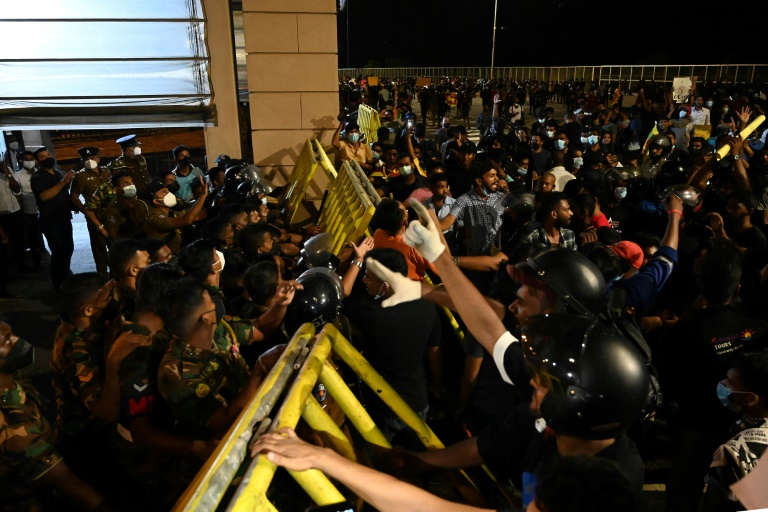
Sri Lanka’s president lost his parliamentary majority Tuesday as former allies urged his resignation following days of street protests over the island nation’s crippling economic crisis.

Unprecedented shortages of food and fuel along with record inflation and blackouts have inflicted widespread misery in the country’s most painful downturn since independence from Britain in 1948.

President Gotabaya Rajapaksa’s once-powerful ruling coalition is in turmoil after a string of defections, capped Tuesday by the new finance minister’s resignation just one day after taking office.

And as anti-Rajapaksa demonstrations continued for a fifth straight day, the government warned of retaliation if rallies turned violent.

“Security forces will not hesitate to enforce the law against those involved in violence,” defence ministry secretary Kamal Gunaratne said in a statement.

More than 60 people had been arrested in connection with unrest since Friday and many have said they were tortured in police custody.

The UN Human Rights Council said it was closely watching the deteriorating situation in Sri Lanka, which is already facing international censure over its human rights record.

“The drift towards militarisation and the weakening of institutional checks and balances in Sri Lanka have affected the state’s ability to effectively tackle the economic crisis,” the UNHRC said.

Public anger is at a fever pitch in Sri Lanka, where crowds have since the weekend attempted to storm the homes of several senior government officials.

“If we don’t act now, there will be a river of blood in the country,” said Wijeyadasa Rajapakshe, a newly independent lawmaker who broke ranks with the president’s party and joined calls for the leader to step down.

“We have to forget party politics and ensure an interim government.”

Tuesday’s parliamentary session was the first since dozens of MPs withdrew their support for Rajapaksa’s government, including 16 lawmakers from his own Sri Lanka Podujana Party (SLPP).

The government is now at least five short of a majority in the 225-member house, but there has been no clear signal that legislators will attempt a no-confidence motion to topple it.

Opposition parties have already rebuffed Rajapaksa’s call to join a unity administration led by him and his elder brother, Prime Minister Mahinda Rajapaksa.

Their government imposed a state of emergency last week in an effort to contain street protests, but the ordinance is set to expire next week unless ratified by parliament. 

Rejecting calls for a vote on the emergency decree, the government cut short Tuesday’s proceedings by two hours, but promised a debate on Wednesday.

Nimal Lanza, a former minister who has also abandoned Rajapaksa’s administration, conceded that the ruling party no longer had a mandate to govern.

“I beg and appeal to you to take the side of the protesters,” he told parliament, addressing the prime minister, who attended the session but remained silent. 

Every member of Sri Lanka’s cabinet except the president and prime minister resigned late Sunday.

Former justice minister Ali Sabry was appointed as finance minister on Monday, replacing the president’s brother Basil Rajapaksa, but abruptly resigned after just one day in office.

The finance ministry’s top civil servant also resigned Tuesday, a day after the central bank governor quit. 

– ‘Cry of the people’ –

Boisterous demonstrations have spread across the country of 22 million, despite emergency laws allowing troops to detain participants. A weekend curfew lapsed on Monday morning. 

Most demonstrations have been peaceful, with Catholic clergy and nuns led by Sri Lanka’s Cardinal Malcolm Ranjith leading a procession in the capital.

“This is a valuable country with intelligent people. But our intelligence, the people’s intelligence, has been insulted by corruption,” Ranjith said. 

“Therefore now we call out… please now listen to the cry of the people and step down.”

A critical lack of foreign currency has left Sri Lanka struggling to service its ballooning $51 billion foreign debt, with the pandemic torpedoing vital revenue from tourism and remittances.

The result has seen unprecedented shortages with no sign of an end to the economic woes.

Economists say Sri Lanka’s crisis has been exacerbated  by government mismanagement, years of accumulated borrowing and ill-advised tax cuts.

The foreign exchange shortage forced the government to announce the shutting of three of its diplomatic missions in Norway, Iraq and Australia. Three others in Nigeria, Germany and Cyprus were shut in January.

Oil extends rally as EU proposes more Russia sanctions

Oil prices jumped further Tuesday as the European Union proposed further sanctions against major crude producer Russia in response to killings in the Ukrainian town of Bucha that have prompted international condemnation.

Elsewhere, European and US stocks were mostly lower, while Asian equity markets rose. The dollar was mixed versus major rivals.

Oil rising again “is bad news for corporates looking to manage cost pressures, and for consumers already struggling to stomach higher energy bills”, noted Russ Mould, investment director at AJ Bell.

While countries in Europe — particularly Germany — rely heavily on energy from Russia, the possibility of an oil embargo sent both main crude contracts sharply higher Monday.

In the end the EU didn’t target oil, instead calling for sanctions on coal and shipping.

But Brent North Sea and WTI oil continued their rise on Tuesday, helping paring some of the sharp losses seen Friday in reaction to a pledge by Washington and other major economies to unleash millions of barrels from their stockpiles to keep a lid on prices, which are fanning already high inflation.

The additional EU sanctions came days after dozens of bodies were found on the streets in Bucha, northwest of Kyiv, though some countries remain worried of the potential economic fallout.

Ukrainian President Volodymyr Zelensky blames Russian troops for the killings, but the Kremlin has denied responsibility.

White House National Security Advisor Jake Sullivan signalled more US sanctions were on the way this week.

The US Treasury said Tuesday said that the United States will bar Russia from making debt payments using funds held at American banks, to ramp up the economic pain on Moscow.

Wall Street opened moderately lower after posting strong gains Monday despite continued uncertainty caused by the war in Ukraine.

But market analyst Patrick J. O’Hare at Briefing.com said investors were concerned that the rally by stocks off March lows won’t last.

Investors “will be battling the idea that further upside will be harder to come by given an existing backdrop that includes rising interest rates, persistently high inflation pressures around the globe, and Russia’s continued attack on Ukraine,” he said.

Traders will be keeping a close eye on the release this week of minutes from the Federal Reserve’s most recent policy meeting, hoping for an insight into officials’ thinking over future monetary policy.

After the Fed’s expected quarter-point interest rate hike last month, there are increasing bets on a half-point lift in May in light of soaring inflation and strong jobs data that suggest the US economy remains robust enough to absorb higher borrowing costs.

– Key figures around 1330 GMT –

Brent North Sea crude: UP 0.6 percent at $108.21 per barrel

West Texas Intermediate: UP 0.7 percent at $104.02 per barrel

London – FTSE 100: UP 0.2 percent at 7,570.62 points

Frankfurt – DAX: DOWN 0.6 percent at 14,429.87

Paris – CAC 40: DOWN 1.6 percent at 6,626.82

EURO STOXX 50: DOWN 0.8 at 3,921.07

New York – Dow: DOWN 0.3 percent at 34,835.12

Tokyo – Nikkei 225: UP 0.2 percent at 27,787.98 (close)

Hong Kong – Hang Seng Index: Closed for a holiday

Shanghai – Composite: Closed for a holiday

Euro/dollar: DOWN at $1.0960 from $1.0978 late Monday

Pound/dollar: UP at $1.3146 from $1.3114

Euro/pound: DOWN at 83.38 pence from 83.65 pence

Dollar/yen: UP at 122.82 yen from 122.78 yen

burs-rl/raz

Mother remembers 'brutal' soldiers who terrorised Bucha

A couple of weeks into the Russian occupation of Bucha, local resident Olena sensed a turn for the worse when older, rougher soldiers appeared and began to spread fear in the town.

They were “brutal” compared to the younger soldiers who captured the town at the start of the invasion, said the 43-year-old mother of two.

“Right in front of my eyes, they fired on a man who was going to get food at the supermarket,” said Olena, who did not wish to give her second name.

Located 30 kilometres (19 miles) northwest of Kyiv’s city centre, the town of Bucha was occupied by Russian forces on February 27 in the opening days of the war and remained under their control for a month.

After the bombardments stopped, Ukrainian forces were able to retake the town on Thursday.

Large numbers of bodies of men in civilian clothing have since been found in the streets.

Throughout March, Olena lived with her children, 7 and 9 years old, in a cellar with no electricity under a four-storey housing block, along with other residents.

“There was no Ukrainian army in town, only the territorial defence made up mostly of unarmed guards from local businesses. And then they fled” when the Russians arrived, she said.

“At the beginning, there were mostly young (Russian) soldiers. Then, two weeks later, there were others, older ones. They were more than 40 years old.

“They were brutal. They mistreated everyone. And that’s when the massacres started,” she said, before pausing, a dark, thoughtful look on her face.

On Monday, Russia “categorically” rejected all accusations in relation to civilian killings.

– ‘Lying in blood’ –

According to Olena, the older soldiers “were very well equipped and wore black and dark green uniforms” as opposed to standard Russian army fatigues.

“There were some good guys among the Russian soldiers and there were some very rough men, especially officers from the FSB”, the Russian security services, said Olena, who was dressed in a red beanie, a fleece jacket, tracksuit bottoms and trainers.

“I was going up to the soldiers to ask them what I should feed my children with and they brought us rations and food. 

“It was they who told us that it was the FSB that had banned us from moving around, that they were very violent special forces. It was Russians saying this about the Russians!” she said.

Only women were allowed to leave to fetch water or food. The men were not permitted to go out into the streets and had to stay where they were.

“Our neighbours went to put their rubbish out around 5:00 pm. They were two men and a woman. One of the men had served in the army. They didn’t come back.

“They were found by the women in our building when they went to get wood in the courtyard of a house. The corpses were lying in blood on the ground with bullet marks,” Olena said.

“When the FSB agents arrived, they asked, ‘why didn’t you leave?’ I told them I have lived here for 43 years and had a peaceful life, so where would I go? At that point, they started calling us traitors, because we didn’t leave.”

– Mass graves –

On Saturday, AFP saw the bodies of at least 22 people in civilian clothes on a single street. One of them was on the pavement near a bicycle, others had bags of provisions near them. The body of one man had his hands tied behind his back.

On Monday, the bodies of five men, their hands also tied, were found in the basement of a children’s sanatorium in Bucha, the Ukrainian prosecutor general’s office said.

According to the mayor of Bucha, 280 people were buried in mass graves dug by Ukrainians, as the number of dead mounted. 

In the centre of the town on Monday, one road was littered with the battered husks of around 20 vehicles, including troop transporters, tank trucks and Russian light armoured vehicles, some of them already beginning to rust.

The column was likely targeted by Ukrainian bombardments shortly after it rolled into town at the end of February.

In gardens, patches where the earth had been churned up could be seen surrounded by shell casings, an indication the site was used as an artillery position to pound the Kyiv region.

Kremlin spokesman Dmitry Peskov said on Monday that Russian “experts at the ministry of defence have identified signs of video fakes and various fakes” in the videos shared by Ukrainian authorities.

Close Bitnami banner
Bitnami