World

Zelensky urges tougher Western response to Russian 'war crimes'

Ukraine’s President Volodymyr Zelensky will press the UN Security Council on Tuesday for tougher sanctions aimed at forcing Russia to abandon its war against his country, as outrage grows against Moscow over the alleged slaughter of civilians.

Western officials have already promised new measures this week targeting Russia’s oil and coal exports, which are helping President Vladimir Putin pay for the invasion he launched nearly six weeks ago.

And Denmark and Italy became the latest European nations to expel a group of Russian “intelligence officers” registered as diplomats, following France and Germany on Monday.

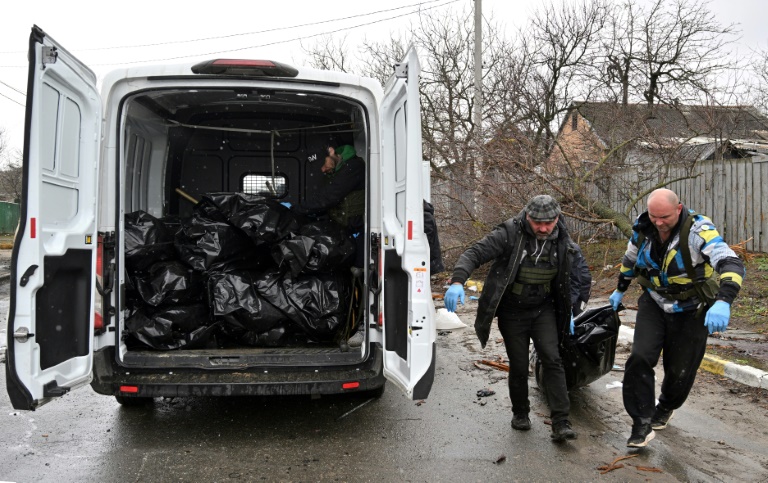
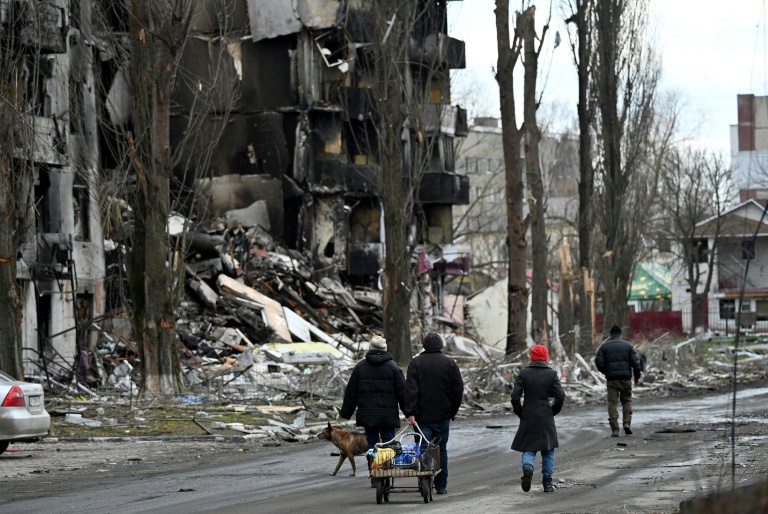
The moves follow the harrowing discoveries of scores of bodies in Bucha and other towns near Kyiv as Russian troops retreated to regroup in the east. 

Most of the bodies have been found in civilian clothes. Ukrainian officials have said some had their hands bound behind their backs.

Zelensky has denounced “war crimes” and attempted “genocide” and appealed for more Western weapons and defence aid, saying they could have helped save innocent lives.

“The sanctions response to Russia’s massacre of civilians must finally be powerful,” he said in a Telegram video posted late Monday after touring the devastated streets of Bucha.

“But… did hundreds of our people have to die in agony for some European leaders to finally understand that the Russian state deserves the most severe pressure?” he asked.

His address to the UN Security Council will be the first since the invasion began on February 24th, though it was not clear if it would be pre-recorded or live.

In Bucha, resident Olena told AFP she saw Russian soldiers shoot a man in cold blood as units of “brutal” older troops sowed fear in the town near Kyiv.

“Right in front of my eyes, they fired on a man who was going to get food at the supermarket,” said Olena, 43, who did not wish to give her second name.

EU Commission president Ursula von der Leyen will travel to Kyiv this week alongside EU foreign policy chief Joseph Borrell. 

– More weapons en route? –

Many in Ukraine however are bracing for further Russian bombardments especially in the east and south, and air raid sirens rang out overnight across much of the country.

Russian authorities have denied the charges of civilian killings in Bucha and other locations near the capital, with its defence ministry on Tuesday claiming they had been staged by Ukraine.

“Similar events are now being organised by the Ukrainian special services in Sumy, Konotop and other cities,” the Russian defence ministry said, referring to cities in northeastern Ukraine — without offering evidence to back up the assertion.

But US President Joe Biden told reporters Monday that there should be “a war crimes trial” for Putin, vowing that Washington would join the EU in announcing new sanctions this week.

But Germany warned again that it was too soon to cut off purchases of Russian natural gas, a key source of Russian income that several nations have called for, but which would cripple large swathes of the European economy.

“At the moment, it’s not possible to cut the gas supplies. We need some time,” Finance Minister Christian Lindner said.

But US National Security Adviser Jake Sullivan warned Monday that the “next phase” of Russia’s invasion, focusing on expanding territories it holds in the east and south, “could be measured in months or longer.”

He said Western allies were working on obtaining more weapons for Ukraine, with Secretary of State Antony Blinken traveling to Brussels on Wednesday and Thursday to attend a NATO foreign ministers’ meeting.

– Horrors emerge –

The full nature of the killings in Bucha and other areas from which Russian troops have withdrawn is still being pieced together.

On Monday, the bodies of five men were found in the basement of a children’s sanatorium basement in Bucha. Ukraine prosecutors said they were unarmed civilians who had been bound, beaten and killed by Russian troops.

And in Motyzhyn, west of Kyiv, Ukrainian police showed AFP journalists the bodies of five people with their hands tied, including those of the village’s mayor, her husband and son.

Ukrainian officials say over 400 civilian bodies have been recovered from the Kyiv region, many of whom have been buried in mass graves.

But Zelensky has warned that the deaths in Bucha could be only the tip of the iceberg, saying he had information that even more people had been killed in places like nearby Borodianka.

AFP reporters who briefly visited the area saw no bodies in the streets, but locals reported many deaths.

“I know five civilians were killed,” said 58-year-old Rafik Azimov. “But we don’t know how many more are left in the basements of the ruined buildings after the bombardments.”

“I buried six people,” another resident, Volodymyr Nahornyi, said. “More people are under the ruins.”

– Russians regroup –

The Ukrainian government has warned that Moscow is preparing a “full-scale” attack in the country’s east and regional officials urged civilians to evacuate Lugansk fearing a major Russian attack.

Even where troops have withdrawn, fears remain, with Kyiv’s Mayor Vitali Klitschko telling residents to wait before trying to return, citing the danger of continued shelling and the danger of unexploded munitions. 

On Monday, officials in Mykolaiv, on the Black Sea not far from Odessa, said cluster bombs were used against the city in strikes that killed 10 civilians and wounded 46.

A 2008 UN convention bans the production and use of cluster bombs, which kill indiscriminately by sending dozens of small bomblets over a large area, but it has not been signed by Russia or Ukraine.

Elsewhere in the south, concerns remain about civilians trapped in the besieged city of Mariupol, which has been besieged by Russian forces for over a month.

Authorities say at least 5,000 people have been killed in the city, 90 percent of which has been destroyed, according to Mayor Vadym Boichenko.

The Red Cross said Tuesday that Russian forces had released a team sent to help evacuate Mariupol residents that was detained en route Monday.

Europe’s worst conflict in decades has killed as many as 20,000 people since Russia’s February 24 invasion, according to Ukrainian estimates.

More than 4.2 million Ukrainians have fled the country and about 6.5 million have been internally displaced, UN agencies say.

burs/js/sjw/lc
Climate scorecard: good news and bad news

The task is clear — stop burning fossil fuels, radically reduce energy demand and slash all planet-warming emissions in order to keep the planet cool enough so humans, animals and plants can survive and thrive.

So how do the actions of the world so far match up to the challenge?  

Here is a rundown from the UN Intergovernmental Panel on Climate Change’s handbook on how to halt global warming: 

– Emissions growth is slowing –

While we are continuing to spew more carbon dioxide (CO2) into the atmosphere, the rate of that increase has slowed in recent years. 

Emissions actually fell in 2020 — by an estimated 5.8 percent compared to 2019 — as governments around the world imposed unprecedented lockdowns to try to halt the spread of Covid-19. 

Demand for energy shrank in almost all areas — except residential buildings. International aviation emissions were down some 45 percent.

Meanwhile, at least 24 countries in the world have managed to cut greenhouse gas emissions and consumption-based CO2 pollution for a decade or more. Almost all are in Europe, although the list also includes the United States and Jamaica. 

– But they need to fall, and fast –

Emissions have already rebounded from the pandemic.

Developing nations that have come from a low base per capita are seeing sharp increases.

And carbon footprints per person in rich countries remain stubbornly high, particularly in Australia, Canada.   

– We have most of the means –

There are a range of low-carbon technologies to produce electricity and these are becoming cheaper, better and more widely used. These include solar photovoltaics (PV), onshore and offshore wind, and batteries. 

“In many contexts solar PV and onshore wind power are now competitive with fossil-based generation,” the report said. 

Since 2010 emissions from coal have grown, but more slowly, as the US and Europe retired some old plants, while China added fewer new ones. A large number of planned coal plants around the world were either scrapped or converted so that they could also burn biomass. 

– But we struggle to kick the dirty fuel habit –

All of the world’s electricity will have to come from low-carbon generation by 2050 to meet the Paris Agreement global warming targets. This is “challenged” by growing electricity demand. 

Currently, solar PV and wind generation technologies account for less than 10 percent of the market.

Despite coal’s hefty C02 emissions, some countries and even international development banks continue to fund and develop new coal capacity. 

– We can transform transport, buildings and industry –

Electrification is a “feasible, scalable and affordable” option to decarbonise mass transportation. 

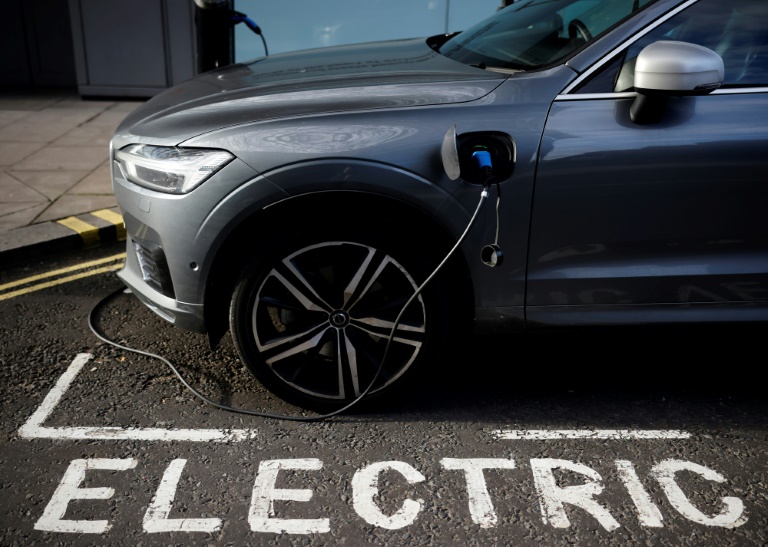
Electric vehicles (EVs) are the fastest-growing part of the automobile industry and if these cars and trucks are charged with low-carbon electricity they can significantly reduce emissions. 

It is possible to make existing and new buildings in all parts of the world either nearly zero-energy or low-energy. 

Most industrial processes in general can be decarbonised through a combination of technology using electricity and hydrogen, carbon capture and innovation in the circular use of materials (i.e. recycling and reusing). 

– But change is slow –

Transport emissions grew at an average of two percent a year per between 2010 and 2019, due to continued “high travel demand, heavier vehicles, low efficiencies and car-centric development”.

Beyond charging EVs with zero-emissions electricity, car manufacturing, shipping and aviation also need to be decarbonised, as do supply chains in general. 

As for construction, the low ambition of government policies is a particular concern, for both existing buildings in developed countries and new buildings in developing ones. 

The strong global demand for basic materials means industrial emissions continue to grow. This demand must be sharply reduced, alongside the rapid scale up of low-carbon innovations, otherwise there is a risk of locking in emissions “for decades to come”. 

– A crescendo of climate action – 

An increasing number of countries say they plan to achieve “net-zero” C02, or greenhouse gas, emissions by mid-century. 

Mandatory policies like pricing and regulation have expanded, while many businesses have promised to curb emissions. 

Climate activism is growing, labour unions are starting to engage with the issues, while media coverage of climate change is increasing and becoming better at accurately reflecting the science.

– But action needs to happen faster –

Current national pledges under the Paris Agreement will not limit global warming to the target of 1.5 degrees Celsius. 

Many net-zero targets are “ambiguously defined” and the policies to achieve them are not yet in place. 

Low-carbon alternatives need much more investment, while “status quo interests” are acting to block progress.  

People are also subjected to misinformation on online and in traditional media that has “undermined significantly” understanding of the science.  

Ukraine war brings bitter harvest to Moldovan orchards

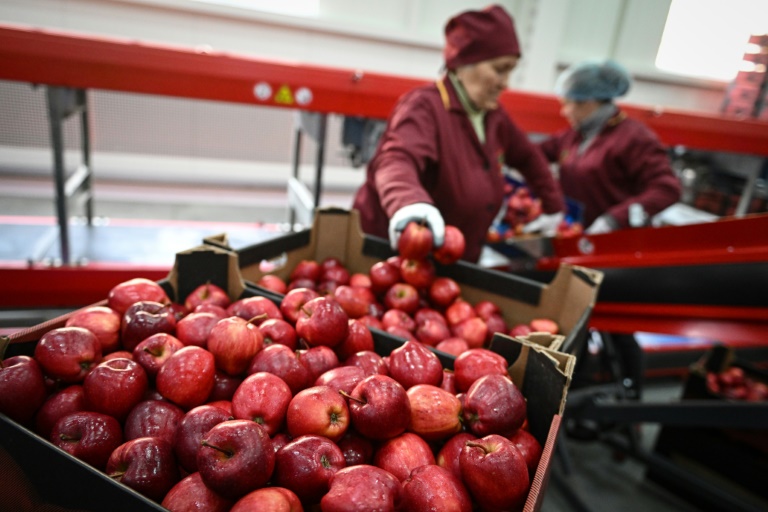
A warehouse in Moldova is piled high with crates of red apples but for an industry reeling from war in neighbouring Ukraine, the sight is far from appetising.

The conflict has all but ended apple exports to Russia, traditionally the main buyer of produce from Moldova’s orchards.

“I don’t know what we are going to do with the apples that are left over,” admits grower Valeriu Matcovschi.

“There are too many for us to sell on the Moldovan market,” he says in the northern village of Bilicenii-Vechi.

In normal times, lorries would arrive at least five times a week to take his 2,000-tonne yearly harvest to Russia.

Now he is scrambling to find new customers.

In late March he sent a first shipment to Kuwait, but he had to slash his prices by a third and accommodate clients with different demands about which varieties of apple they will take.

“I hope I won’t have to start pulping the fruit. That would be a tragedy,” he says.

Moldova is one of the poorest countries in Europe. The former Soviet republic of around 2.6 million people is sandwiched between Ukraine and Romania. 

– Desperate appeals –

Moldova is in a “difficult situation”, senior government official Dumitru Udrea told AFP.

More than 360,000 Ukrainians have fled into Moldova since the start of Russia’s invasion. The vast majority have travelled on elsewhere, but 90,000 have stayed.

Energy price hikes, already rising but now exacerbated by the war, could push inflation to 30 percent by the end of the year.

Udrea fears the effects of the war mean that “in 2022 we could see a recession of between three and 15 percent”.

The largely rural country, whose gross domestic product (GDP) is 0.4 percent that of Britain’s, was already struggling to recover from a string of political and economic crises.

These came on top of a 2014-15 banking scandal that led to the disappearance of around one billion dollars (911 million euros).

Responding to desperate appeals from Moldova — which formally asked to begin the process of joining the EU at the beginning of March — Germany, France and Romania are holding a donors’ conference in Berlin on Tuesday to help lighten the load.

Udrea says the government hopes for four billion euros from donors to boost energy security and protect Moldovans’ purchasing power.

Thanks in part to a 2014 association agreement with the EU — which drew the ire of Moscow — trade with countries to its west now accounts for more than 60 percent of Moldova’s total foreign trade.

– Ties to Russia –

But some traditional economic ties with Russia, Ukraine and Belarus have been less easy to replace.

“At first sight the share of exports to these countries — 15 percent — doesn’t seem huge but several sectors are very dependent on it, above all apple growers,” economist Adrian Lupusor, from the Expert-Grup think tank, told AFP. 

Construction and agriculture are dependent on materials shipped from Russia and Ukraine. “Even if importers find suppliers elsewhere, the prices will be much higher,” Lupusor says.

Udrea says the war could also see a plunge in the vital remittances sent back to Moldova by the more than one million people who have emigrated over the past 20 years.

That stream of income is a lifeline for many who remain in the country and represents some 15 percent of GDP.

Lupusor says that some of the 300,000 or so Moldovans working in Russia may decide to come back, putting the labour market and social security system under fresh pressure. 

Meanwhile in Bilicenii Vechi, as workers sort shiny apples and forklift trucks trundle around him, Matcovschi worries for the future of the 50 or so people he employs.

Asked about possible redundancies, he replies, “I dare not think about it.” 

“I hope we’ll be able to hold out.”

Hit by sanctions, Lada factory town braces for tough times

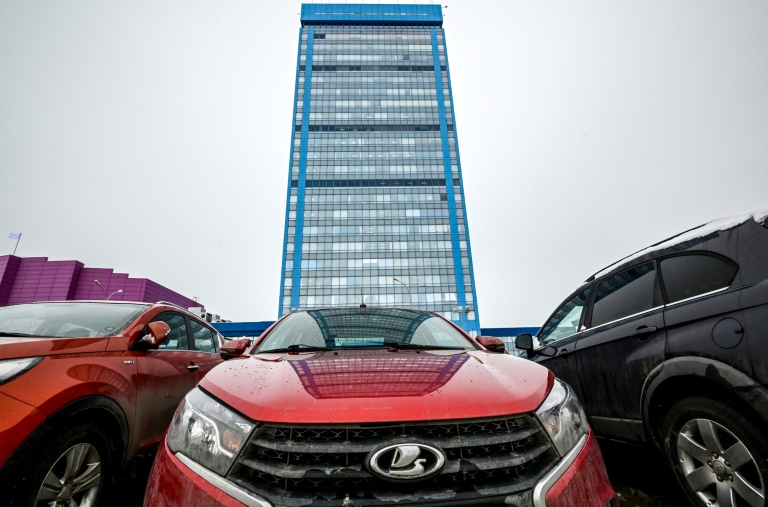
For generations the Russian city of Tolyatti has been synonymous with leading car manufacturer Avtovaz, maker of one of the country’s best-known brands, the Lada automobile.

But with the West piling sanctions on Russia over its military action in Ukraine, Tolyatti and the workers of Avtovaz are bracing for tough times.

Gathered in a small apartment in the city’s Avtozavodsky district, a residential area surrounding the sprawling factory, several workers from the “Yedinstvo” (Unity) trade union said they were worried about their future.

“It’s a factory town. Everyone here works either for the factory or for the police,” said Alexander Kalinin, 45, a freight elevator operator at Avtovaz for 15 years.

Founded in the 1960s for the Soviet Union to meet the growing demand for affordable cars, the Avtovaz factory’s flagship Lada vehicles became widely known for their simplicity and durability.

The factory was set up in the town of Stavropol about 780 kilometres (485 miles) southeast of Moscow, which was renamed Tolyatti after Italian Communist politician Palmiro Togliatti.

The plant survived the economic crisis that followed the 1991 collapse of the Soviet Union and was eventually taken over by French auto group Renault.

“For Tolyatti, the factory is everything. The whole city was built around it,” said 33-year-old Irina Myalkina, a worker in the spare parts warehouse for 11 years.

“When I started, I was full of enthusiasm, I hoped for a good income. I still hope,” Myalkina added with a sad smile.

– ‘People are nervous’ –

Most of the factory’s assembly lines stopped running after Moscow moved troops into Ukraine on February 24 and sanctions meant it could no longer receive components from aboard.

Workers are on paid leave, with two-thirds of their usual wage, which for Myalkina means receiving 13,000 rubles (about $140) instead of her usual 20,000 rubles ($215).

Prices for food and other basic goods are soaring, in Tolyatti as elsewhere in Russia.

“People are nervous,” Myalkina said.

After completing its acquisition of Avtovaz, Renault funnelled billions of euros into the Soviet-era factory, but also carried out huge staff cuts, leaving fewer than 40,000 workers out of 70,000.

“There were many problems with the departure of employees, but nevertheless there was a clear positive trend,” said Andrei Yakovlev, head of the Institute for Industrial and Market Studies at Moscow’s Higher School of Economics.

“A major Russian car manufacturer was being born.” 

Now its future is very much in doubt, with Renault, under intense pressure to boycott Russia, considering whether to withdraw from Avtovaz. 

No one from the company would agree to talk and it even refused to give access to the Lada Museum in Tolyatti during a recent visit.

When AFP was filming near the factory, Avtovaz security called police, who questioned and released the journalists after several hours.

The factory’s employees have been forced to take their three weeks of summer vacation in April, while Renault considers its options.

– Second jobs –

Many employees have already been forced to take up second jobs, like Leonid Emchanov, 31, a mechanic now moonlighting as a security guard to feed his family. 

“I am the only one in the family who works. I have two children, my wife… is on maternity leave. I have to work two jobs, but even this is not enough,” he said.

If Avtovaz is unable to survive this crisis, its demise would mark the end of an industrial era for Russia, and for its many Lada enthusiasts.

In an underground garage in Tolyatti, two men in vintage overalls were busy at work on an ’80s Lada Niva, a legendary four-wheel drive vehicle, that was shining with a fresh coat of red paint. 

“Since childhood, my whole life has been linked to the factory,” said one of the mechanics, Sergei Diogrik.

“All our relatives in Tolyatti worked at the factory and I myself worked there. I had no choice, everything is related to the company,” he added. 

The 43-year-old founded and runs the Lada History Club, bringing together fans of the Soviet car from all over the world.  

“It was a powerful producer. The record in the early 1980s was 720,000 cars per year,” he said, compared to nearly 300,000 cars produced in 2021.

“It was fashionable to come here. Now the fashion is for young people to go to Moscow or somewhere else,” Diogrik added.

He said he is trying to remain hopeful, pointing out that the factory and its workers already survived the economic hardships of the 1990s.

“A Russian person who survived the 90s, especially in Tolyatti, will cope now, everything will be fine.”

The suffering of those who cannot feel pain

Patrice Abela first knew something was wrong when his eldest daughter was learning to walk and her feet left trails of blood behind her, yet she showed no sign of distress.

She was soon diagnosed with congenital insensitivity to pain, an extremely rare and dangerous genetic disorder that dooms sufferers to a lifetime of hurting themselves in ways they cannot feel.

Abela, a 55-year-old software developer in the southern French city of Toulouse, then watched in horror as his youngest daughter was revealed to have the same condition.

Now aged 12 and 13, the two girls spend around three months of every year in hospital. 

“When they take a shower, they perceive hot and cold, but if it burns they don’t feel anything,” the father of four told AFP.

“Due to repeated infections, my eldest daughter lost the first joint of each of her fingers. She also had to have a toe amputated.”

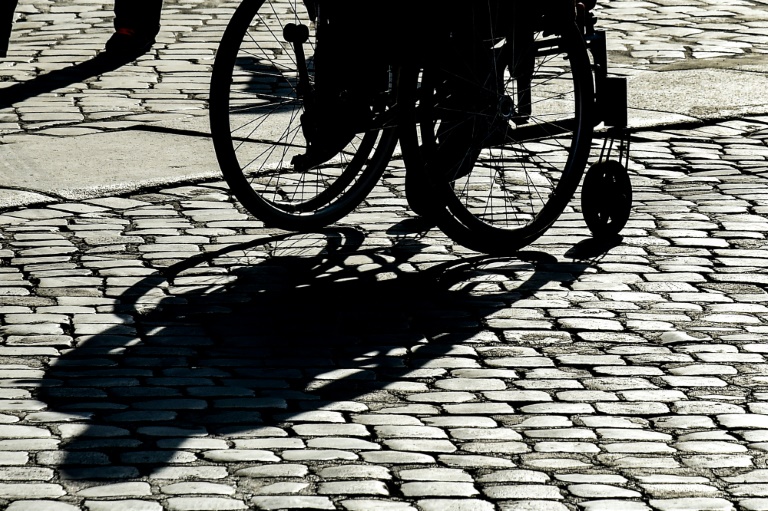
Repeated knee injuries have left both girls only able to move around using crutches or a wheelchair.

Abela said they may not feel physical pain but lamented their intense “psychological pain”.

Aiming to raise awareness about the disease and “challenge the scientific community”, Abela plans to run the equivalent of 90 marathons in fewer than four months. He plans to start on April 12, following the route of this year’s Tour de France from Copenhagen to Paris. 

– Danger everywhere –

A life without pain might sound like a dream come true but the reality is more like a nightmare.

There are only a few thousand known cases of the condition worldwide. The low number is believed to be partly due to sufferers often not living into adulthood.

“Pain plays a major physiological role in protecting us from the dangers of our environment,” said Didier Bouhassira, a doctor at the centre for pain evaluation and treatment at Ambroise-Pare hospital in Paris.

In the most extreme cases, babies will “mutilate their tongue or fingers while teething”, he told AFP.

Then comes “a lot of accidents, burns, walking on fractured limbs which heal badly”, he added.

“They have to be taught what is innate in others: to protect themselves.”

But when there are no warning signs, danger lurks everywhere.

Appendicitis, which announces itself in others via symptoms like pain and fever, can fester into a devastating general infection of the abdomen.

“Blindness can also occur because the eye must always be kept moist and the nervous system controls these processes via the so-called blink reflex,” said Ingo Kurth of Germany’s Institute of Human Genetics.

– New painkiller hopes –

Congenital insensitivity to pain (CIP) was first recognised in the 1930s, and numerous studies have since identified a genetic mutation that blocks a person’s ability feel pain.

“We have learned that there are now more than 20 genetic causes of congenital or progressive insensitivity to pain,” Kurth told AFP.

There is no cure and “no real drug breakthroughs have been made so far”, Kurth said.

“But our understanding of the molecular causes of CIP continues to reveal new targets, and based on this, hopefully new therapies will be developed in the coming years.”

There are also hopes that studying how CIP works could lead to the development of a new kind of painkiller, prompting huge interest from pharmaceutical giants seeking a fresh product in the billion-dollar industry of pain relief.

In this way, the unlucky few with CIP could contribute to the creation of a treatment that would help everyone in the world — except themselves.

Bucha witness saw soldiers fire on man 'going to supermarket'

In Bucha, resident Olena told AFP she saw Russian soldiers shoot a man in cold blood as units of “brutal” older troops sowed fear in the town near Kyiv.

“Right in front of my eyes, they fired on a man who was going to get food at the supermarket,” said Olena, 43, who did not wish to give her second name.

Located 30 kilometres (19 miles) to the northwest of Kyiv’s city centre, the town of Bucha was occupied by Russian forces on February 27 in the opening days of the war and remained under their control for a month.

After the bombardments stopped, Ukrainian forces were able to retake the town on Thursday.

Large numbers of bodies in civilian clothing have since been found in the town.

Throughout March, Olena lived with her children, seven and nine years old, in a cellar with no electricity under a four-storey housing block, along with other residents.

“There was no Ukrainian army in town, only the territorial defence made up mostly of unarmed guards from local businesses. And then they fled” when the Russians arrived, she said.

“At the beginning, there were mostly young (Russian) soldiers. Then, two weeks later, there were others, older ones. They were more than 40 years old.

“They were brutal. They mistreated everyone. And that’s when the massacres started,” she said, before interrupting herself, a dark, thoughtful look on her face.

On Monday, Russia “categorically” rejected all accusations in relation to civilian killings.

– ‘Lying in blood’ –

According to Olena, the older soldiers “were very well equipped and wore black and dark green uniforms” as opposed to standard Russian army fatigues.

“There were some good guys among the Russian soldiers and there were some very rough men, especially officers from the FSB”, the Russian security services, said Olena, who was dressed in a red beanie, a fleece jacket, tracksuit bottoms and trainers.

“I was going up to the soldiers to ask them what I should feed my children with and they brought us rations and food. 

“It was they who told us that it was the FSB that had banned us from moving around, that they were very violent special forces. It was Russians saying this about the Russians!” she said.

Only women were allowed to leave to fetch water or food. The men were not permitted to go out into the streets and had to stay where they were.

“Our neighbours went to put their rubbish out around 5:00 pm. They were two men and a woman. One of the men had served in the army. They didn’t come back. 

“They were found by the women in our building when they went to get wood in the courtyard of a house. The corpses were lying in blood on the ground with bullet marks,” Olena said.

“When the FSB agents arrived, they asked, ‘why didn’t you leave?’ I told them I have lived here for 43 years and had a peaceful life, so where would I go? At that point, they started calling us traitors, because we didn’t leave.”

– Mass graves –

On Saturday, AFP saw the bodies of at least 22 people in civilian clothes on a single street. One of them was on the pavement near a bicycle, others had bags of provisions near them. The body of one man had his hands tied behind his back.

On Monday, the bodies of five men, their hands also tied, were found in a children’s sanatorium basement in Bucha, the Ukrainian prosecutor general’s office said.

According to the mayor of Bucha, 280 people were buried in mass graves dug by Ukrainians, as the number of dead mounted. 

In the centre of the town on Monday, one road was littered with the battered husks of around 20 vehicles, including troop transporters, tank trucks and Russian light armoured vehicles, some of them already beginning to rust.

The column was probably targeted by Ukrainian bombardments shortly after it rolled into town at the end of February.

In gardens, patches where the earth had been churned up could be seen surrounded by shell casings, an indication the site was used as an artillery position to pound the Kyiv region.

Kremlin spokesman Dmitry Peskov said on Monday that Russian “experts at the ministry of defence have identified signs of video fakes and various fakes” in the videos shared by Ukrainian authorities.

Oil extends rally as EU considers more Russia sanctions

Oil prices jumped further Tuesday as the European Union considered further sanctions against major crude producer Russia in response to killings in the Ukrainian town of Bucha that have prompted international condemnation.

Elsewhere, European and Asian stock markets diverged and the dollar dipped versus major rivals.

Oil rising again “is bad news for corporates looking to manage cost pressures, and for consumers already struggling to stomach higher energy bills”, noted Russ Mould, investment director at AJ Bell.

While countries in Europe — particularly Germany — rely heavily on energy from Russia, the possibility of an oil embargo sent both main crude contracts sharply higher Monday.

Brent North Sea and WTI oil continued their rise on Tuesday, each putting on more than 1.5 percent.

That pared some of the sharp losses seen Friday in reaction to a pledge by Washington and other major economies to unleash millions of barrels from their stockpiles to keep a lid on prices, which are fanning already high inflation.

The EU is considering hitting Russia with sanctions on oil or coal, a top official said Tuesday, after dozens of bodies were found on the streets in Bucha, northwest of Kyiv, though some countries remain worried of the potential economic fallout.

Ukrainian President Volodymyr Zelensky blames Russian troops for the killings, but the Kremlin has denied responsibility.

White House National Security Advisor Jake Sullivan signalled more US sanctions were on the way this week.

The continued uncertainty caused by the war in Ukraine, and blow to the global economy it is expected to deal, was unable to prevent another healthy performance Monday on Wall Street.

“Despite all the concerns, equities remain the best bet to achieve returns above today’s elevated inflation,” said markets strategist Louis Navellier.

Equities trading was tepid in Asia on Tuesday, with Hong Kong, Shanghai and Taipei closed for holidays.

Tokyo’s blue-chip shares ended higher, driven by buying of high-tech shares, though the yen’s gyrations weighed on the market.

Traders will be keeping a close eye on the release this week of minutes from the Federal Reserve’s most recent policy meeting, hoping for an insight into officials’ thinking over future monetary policy.

After the Fed’s expected quarter-point interest rate hike last month, there are increasing bets on a half-point lift in May in light of soaring inflation and strong jobs data that suggest the US economy remains robust enough to absorb higher borrowing costs.

– Key figures around 0930 GMT –

Brent North Sea crude: UP 1.5 percent at $109.15 per barrel

West Texas Intermediate: UP 1.7 percent at $104.98 per barrel

London – FTSE 100: DOWN 0.1 percent at 7,551.11 points

Frankfurt – DAX: UP 0.3 percent at 14,557.93

Paris – CAC 40: DOWN 0.4 percent at 6,703.88

EURO STOXX 50: FLAT at 3,952.83

Tokyo – Nikkei 225: UP 0.2 percent at 27,787.98 (close)

Hong Kong – Hang Seng Index: Closed for a holiday

Shanghai – Composite: Closed for a holiday

New York – Dow: UP 0.3 percent at 34,921.88 (close)

Euro/dollar: UP at $1.0983 from $1.0978 late Monday

Pound/dollar: UP at $1.3138 from $1.3114

Euro/pound: DOWN at 83.59 pence from 83.65 pence

Dollar/yen: DOWN at 122.74 yen from 122.78 yen

War in Ukraine: Latest developments

Here are the latest developments in the war in Ukraine:

– Zelensky to address UN –

Ukrainian President Volodymyr Zelensky is set to address the United Nations Security Council for the first time since the invasion of his country.

Zelensky is expected to discuss the grisly discovery of dozens of bodies in Bucha and other towns around Kyiv from which Russian forces have withdrawn.

During a visit to Bucha on Monday he accused Russia of “genocide”.

– War crimes trial sought –

US President Joe Biden calls for a war crimes trial and more sanctions on Russia over the deaths in Bucha. 

The EU offers to send a team of investigators to Ukraine gather evidence and says it is discussing new punitive measures against Moscow. A top official says the EU is considering sanctions on Russian oil and coal.

– Ukraine ‘staging’ footage –

Moscow denies responsibility for civilian deaths, claiming images of dead bodies in Bucha and other Kyiv suburbs are “fakes”. 

The Russian defence ministry accuses the Ukrainian military of staging civilian deaths in a video it claims was made on Monday in the village of Moshchun northwest of Kyiv but provides no proof of its claims.

– More deaths uncovered –

Ukrainian authorities say they found the bodies of five civilians with their hands tied in the village of Motyzhyn, west of Kyiv, including those of the mayor, her husband and son.

Police show AFP journalists four bodies, including that of the mayor, half buried in a grave in a forest near her house and a fifth body in a nearby well.

Ukrainian prosecutor general Iryna Venediktova says on Twitter that the bodies of five men tortured and killed by Russian troops have been found in the basement of a children’s health resort in Bucha.

– Kyiv mayor warns against returns –

Kyiv’s mayor Vitali Klitschko warns residents who fled the capital not to return for “at least another week”, cautioning that explosives laid around the area are still a threat.

Some residents have begun returning to the region since the withdrawal of Russian forces.

– Red Cross team released – 

The Red Cross says a team that was detained on its way to help evacuate civilians from the besieged port city of Mariupol on Monday has been released.

The workers were detained in the town of Mangush, which is under Russian control. 

– ‘Big attack’ coming in East –

Russian troops are gearing up for a big attack in the Lugansk region of eastern Ukraine, the local governor Sergiy Gaiday says on Telegram.

“We see that equipment is coming from different directions, they are bringing manpower, they are bringing fuel,” he says.

– Diplomats kicked out –

Denmark says it is expelling 15 Russian diplomats for spying, a day after Germany and France also ordered dozens of Russian diplomats home.

The former Soviet republic of Lithuania expels the Russian ambassador to Vilnius over what it calls the “horrific massacre” in Bucha and atrocities in other cities.

– Bid to suspend Russia from rights council –

The United States and Britain announce plans to seek Russia’s suspension from the UN Human Rights Council over killings in Bucha.

Russia reacts furiously, deeming the bid “unbelievable” and “unprecedented”. 

– Over 4.2 million refugees –

More than 4.2 million Ukrainian refugees have fled the country since the Russian invasion, the UN says.

burs-cb/spm

Scottish town welcomes banking lifeline

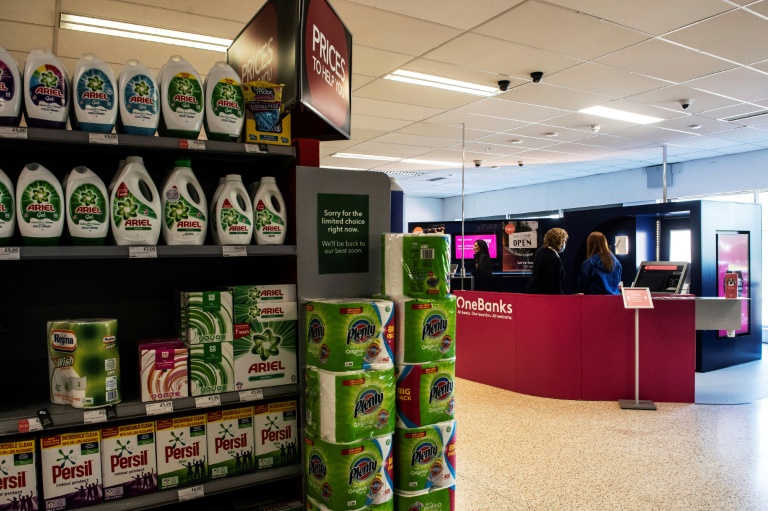
Donna Corrigan pops into her local supermarket to pay OneBanks a visit, laden with a heavy box of coins to deposit into her bank account.

After the closure of its last bank branch in 2018, the Scottish town of Denny has welcomed a hi-tech startup offering everyday banking services inside the town’s Co-op grocery store.

Looking onto shelves filled with Heinz baked beans and Kinder Surprise chocolate eggs, OneBanks’ kiosk — comprising staffed counter services, a cash machine and two computer tablets — opened in late 2020.

The kiosk offers Denny’s 8,000 inhabitants an alternative to traditional bank branches after the rise of online banking allowed lenders battered by the global financial crisis more than a decade ago to save costs by permanently closing outlets.

This is continuing to occur in big numbers.

Among Britain’s biggest banks, HSBC and Lloyds last month said they would close a further 129 branches combined as customers increasingly switched to online banking during the pandemic.

OneBanks, which has raised around five million pounds ($6.6 million, six million euros) from various investors, acts as a go-between for more than 30 banks and their customers.

– ‘Like a regular bank’ –

The OneBanks kiosk “can do everything — it’s like a regular bank for me”, Corrigan, 40, told AFP.

“I’m not a business, I’m just a normal customer who just wants to withdraw cash. So it’s useful for me.”

Behind the counter, a staff member drops spare change into a money-counting machine while making small talk.

OneBanks gives customers physical access to banking services for free. Banks subscribe to the startup’s services to connect with their clients.

Customers can deposit or withdraw cash and pay bills, while advisors provide help to the less tech-savvy.

The disappearance of Denny’s banks left inhabitants with a 20-minute drive to the nearest branches in Cumbernauld, Falkirk or Stirling near to Glasgow.

British consumer group Which? predicts about 5,000 UK bank branches, around half the total, will have disappeared between 2015 and 2022, with Scotland worst affected.

– Dependent on cash –

Swathes of Britain’s population remain dependent on cash, despite the surging popularity of both internet use and contactless payments during the coronavirus pandemic.

The Royal Society of Arts charity estimates almost 20 percent of Britons — particularly the elderly and those in rural areas — would find it hard to cope without cash.

Yet in Denny’s neighbouring town of Bridge of Allan, there is not a branch in sight.

The last bank “closed about four years ago”, said hardware store manager Jennifer Wilson.

“A lot of our customers prefer to pay in cash to keep an eye on what they’re spending,” she added.

Wilson takes 40 percent of payments in cash.

– ‘Cold and sterile’ –

Retired university professor Richard Kilborn laments the lack of human contact now that Bridge of Allan’s three branches have vanished.

“As a member of the older generation, you get used to certain changes, but I also actually relished the person-to-person contact within the bank,” he told AFP.

“Now things have become cold and sterile.”

OneBanks hopes to change that with plans to roll out about 15 additional UK banking kiosks by the end of the year, on top of the three that it has in Scotland.

The group also has international ambitions.

“The problem that banks have — in terms of needing to close branches but also still needing to have some sort of physical presence — is a global problem,” OneBanks founder and chief executive Duncan Cockburn told AFP.

“And therefore I really do see OneBanks as a global solution.”

The broader UK finance sector is working towards addressing the problem.

Top lenders like Barclays, HSBC, Lloyds and NatWest have agreed to fund alternative solutions.

The industry tested various options including OneBanks kiosks. It also wants to improve post office facilities and has trialled banking hub services in conjunction with lenders.

Watchmakers tinker with new materials to draw new buyers

Lab-made diamonds, recycled plastic and 3D printing: this year’s Geneva watch fair was teeming with timepieces crafted from new materials, aimed at seducing a new generation of luxury watch connoisseurs.

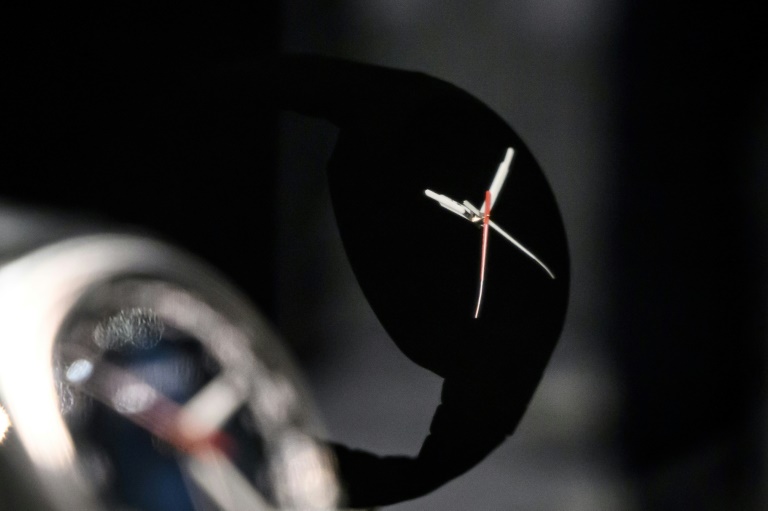
H. Moser, a niche brand producing 2,000 watches a year for wealthy collectors, this year presented a watch covered in Vantablack, a super-black coating that absorbs nearly all light.

Perched against a black background, the watch, which is still in the concept stage, creates the illusion of a black hole, with only the coloured hands visible to the naked eye.

The material, consisting of carbon nanotubes and made by NanoSystems, is considered the darkest pigment in the world.

“I wanted to bring something different than what will be on display in shop windows three months from now,” company chief Edouard Meylan told AFP at the Watches and Wonders fair.

“I wanted to show the future of materials,” he said adding that he had aimed to provide a view to how the watch industry might look five years down the line. 

While the luxury brand has already used Vantablack in its clock faces, this exhibit model is completely covered.

For now, it cannot be touched since the material could lose its properties. More work is needed before it can actually be worn.

– Handcrafted technology –

Black is in high demand this year with new luxury virtuosos, according to Vincent Gregoire, who heads men’s fashion and accessories for the Parisian fashion consultancy NellyRodi.

“This is a clientele that wants beauty, hyper-luxury, with materials of the future, full of technology, but expertly handcrafted,” he said.

Their taste evokes the “Anish Kapoor universe”, he said, referring to the British sculptor who sparked a scandal in 2016 when he bought the exclusive right to use Vantablack in the art field.

A new generation of luxury lovers is emerging, Gregoire said, including a category of “agitators” who are fans of street culture and salvaging, and who want to use their purchasing power for “activist action”.

At a stand dedicated to innovation, the Oris brand is showing off how it recycles plastic waste, shredding it to make a material that resembles multi-coloured marble for its clock faces.

– Lab diamonds-

Tag Heuer, owned by French luxury group LVMH, has meanwhile broken an industry taboo by, for the first time, using diamonds made in a laboratory in one of its flagship models.

These diamonds, crafted from chemical deposits, have not been used to replace their shiny, mine-derived peers.

Instead, they have been chosen to explore how the new technology, which can produce uniquely shaped stones, can provide the dial with a new light-catching texture.

The brand hopes this new technology will allow it to explore new possibilities while remaining firmly anchored in high-end luxury. 

This watch carries a price tag of 350,000 Swiss francs ($380,000, 345,000 euros).

“Lab diamonds have a place in the market,” said Tobias Kormind, head of online jewellery retailer 77Diamonds, enthusing over the watch displayed on Tag Heuer’s website.

“People buy lab diamonds for many reasons, some for affordability reasons, some for environmental reasons,” he said.

He stressed though that “over the long term, natural diamonds are the ones that remain rare and investable.”

Cartier’s stand certainly sparkles with plenty of natural diamonds.

But the jeweller, owned by Richemont, has also dabbled in new technologies this year.

Using 3D printing, it has created a new collection called “Coussin”, with a casing that cedes slightly to pressure before plumping back to its initial shape, like the cushion it is named after.

Close Bitnami banner
Bitnami