World

In a southern US capital, an unending water crisis

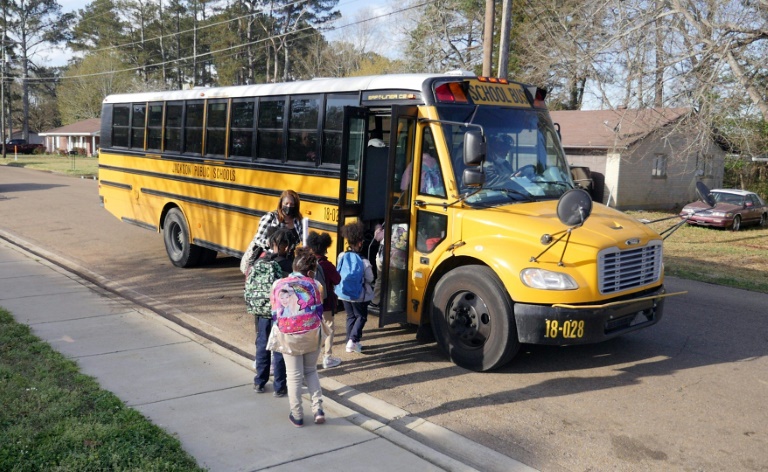
Every morning, 180 students at a school in Jackson, Mississippi have to board a bus to be taken to another nearby school. The reason? Their school lacks the water pressure needed to flush its own toilets.

Cheryl Brown, the principal at Wilkins Elementary — where 98 percent of the 400 students are African American and most come from underprivileged backgrounds — doesn’t hide her frustration.

“It’s hard. It’s very hard,” she told AFP. 

“It’s taxing on the boys and girls,” who spend much of the day at the other school before heading back to Wilkins in the afternoon. “It’s taxing on the staff members,” she said.

Jackson is undergoing a severe water crisis — despite its status as a state capital in one of the richest countries in the world.

Late last year, President Joe Biden signed into law a $1 trillion package to address badly deteriorated infrastructure like Jackson’s.

The city’s water system has suffered “significant deficiencies” since 2016, reports from the southern state’s health department found.

Both the causes and symptoms of the crisis are clear: water flows from old and unmaintained treatment plants — one is 100 years old — through leaking, century-old pipes. When it comes out of city taps, it’s sometimes rust-brown — and always contaminated with lead.  

“The distribution lines are aging, and a master plan for pipe replacement… is not being implemented,” the US Environmental Protection Agency (EPA) wrote in a 2020 report.

It said the city loses as much as 50 percent of its water — a stunning amount — through the decrepit system.

As a result, “three local hospitals have drilled their own wells… to have access to reliable sources of drinking water.”

– No isolated case –

Jackson, a city of 155,000, is not the only US city to face such a crisis.

One of the worst US public health scandals in years came when the details of poor water quality management were exposed in the northern industrial city of Flint, Michigan.

A budget crisis prompted that city to change its water source, leaving thousands of residents exposed to dangerously high lead levels. 

Both Flint and Jackson are majority Black, which for many observers confirms the existence of “environmental racism” — with African Americans disproportionately affected by pollution.

Brown, the Wilkins principal, does not like to dwell on the issue. 

But after relying for weeks on portable toilets — forcing students to stand in long lines to wait their turn — she now worries that the daily bus trips to another school are cutting into instruction time. 

Charles Williams, who will be retiring as Jackson public works director this month after a long, wearying battle with the water crisis, told AFP the problems facing Jackson are complex.

“This didn’t happen overnight,” he said. “This was delayed maintenance and lack of funding.”

He estimated the cost of updating the city’s water system at $3 billion to $5 billion — no small sum for a medium-sized city. 

How much help Jackson might get from the big US infrastructure package is not yet clear, though the EPA has encouraged “communities such as Jackson with critical water infrastructure needs” to apply.

A lengthy investigative article in the Mississippi Free Press by journalist Nick Judin identified two problems underlying Jackson’s woes: a past drop in EPA funding for local water projects and a population exodus from the city to the suburbs.

Having lost a fourth of its population since 1980, Jackson’s tax base has dropped accordingly.

Judin also blames the sometimes chaotic administration of the water system, which has resulted in some residents receiving bills intermittently while “some people don’t get billed at all.”

– ‘This is not normal’ –

In late 2012, the city contracted with German technology company Siemens to install new water meters, update the billing system and complete infrastructure work. 

But early in 2020, the group agreed to reimburse the city $90 million after the city said Siemens had failed to ensure its water meters and software system were compatible.

An unusually cold winter then resulted in the main water treatment plant shutting down and numerous old water pipes bursting. 

Since then, things have gotten no better, local residents told AFP.

“We haven’t drunk the (city) water in about 12 years,” said Priscilla Sterling, standing on the sidewalk of Farish Street in a once-prosperous Black business district. 

“You’re still taking a chance when you bathe in it.”

Barbara Davis works in a Jackson church. She turns on a tap to show the rust-brown water flowing out.

“This is not how you’re supposed to live,” she said. “You know, this is not normal. It’s not normal at all.”

In one hard-hit neighborhood, an NGO called 501CTHREE has brought in a water filtration device where residents can fill jugs with clean water.

“Everybody can’t go to the store and buy water,” said Terun Moore, who works with a local NGO, Strong Arms of Jackson. 

The city, for its part, insists that Jackson water, brown though it may be, is safe — except for pregnant women and children.

Not one local resident interviewed by AFP said they trust assessment.

James Foley's mother, brother testify at trial of IS 'Beatle'

The mother of slain American journalist James Foley said Monday at the trial of one of his alleged Islamic State captors that she initially hoped reports her son had been executed were “some cruel joke.”

“I didn’t want to believe it,” Diane Foley testified at the trial of El Shafee Elsheikh, 33, who is charged with the murders of James Foley and three other Americans in Syria.

“It just seemed too horrific,” Foley said. “I was hoping it was just some cruel joke.”

Foley said it sank in later that day when US president Barack Obama went on television to confirm that James had indeed been executed by his IS captors.

Elsheikh, a former British national, is accused of involvement in the murders of Foley, Steven Sotloff, who was also a journalist, and aid workers Peter Kassig and Kayla Mueller.

Diane Foley, who worked tirelessly to try to obtain her son’s release, said James, a seasoned combat reporter, left for Syria in October 2012 and promised to be back for Christmas.

The family began to worry when he did not call in November on Thanksgiving.

“Jim always called us on the holidays,” she said. “There was a deafening silence when we did not hear from him.”

She said the family was informed by a colleague of James that he had been kidnapped.

“Those first nine months, we didn’t know if Jim was alive or not,” she said.

The first tangible proof that James was alive came when his captors provided emailed answers to three questions that only he would know.

– ‘Ridiculous’ demands –

Michael Foley, 46, James’s younger brother, also testified on Monday and told the court the kidnappers never engaged in any serious negotiations.

At one point, he said, they asked the Foleys to “pressure the government to release Muslim prisoners.”

They then asked for a ransom of 100 million Euros.

“This was as ridiculous as the previous one,” he said. “There was no ability to secure either of those demands.”

There were no communications from the kidnappers from December 2013 to August 2014, when the Foleys received a threatening email.

It warned that James would be executed in retaliation for a US bombing campaign against the Islamic State.

He was killed several days later in a gruesome video that was released on the internet.

Michael Foley said he was also informed of his brother’s death in a call from a journalist seeking reaction.

He said he went online and watched the video of his brother in an orange jumpsuit and the knife-wielding IS executioner known as “Jihadi John.”

“I watched it once or twice,” he said. “I haven’t seen it since but it’s burned into my brain.”

Elsheikh was allegedly a member of the notorious IS kidnap-and-murder cell known to their captives as the “Beatles” because of their British accents.

The group abducted at least 27 people in Syria between 2012 and 2015, including a number of European journalists who were released after ransoms were paid.

Videos of the brutal executions of Foley, Sotloff and Kassig were released by IS for propaganda purposes. Mueller was reportedly handed over to IS leader Abu Bakr al-Baghdadi, who allegedly raped her repeatedly before killing her.

Elsheikh and another former British national, Alexanda Amon Kotey, were captured in January 2018 by a Kurdish militia in Syria while attempting to flee to Turkey.

They were turned over to US forces in Iraq and flown to Virginia in October 2020 to face charges of hostage-taking, conspiracy to murder US citizens and supporting a foreign terrorist organization.

Kotey pleaded guilty in September 2021 and is facing life in prison. Under his plea agreement, Kotey will serve 15 years in jail in the United States and then be extradited to Britain to face further charges.

“Beatles” executioner Mohamed Emwazi was killed by a US drone in Syria in November 2015, while the fourth member of the cell, Aine Davis, is imprisoned in Turkey after being convicted of terrorism.

Elsheikh has denied the charges, and his lawyers claim his arrest is a case of mistaken identity. He faces life in prison if convicted.

Fly less? Go vegan? How people can take climate action

Individuals along with economy-wide efficiencies can make a major difference in the drive to avert the worst of global warming, UN climate experts say, estimating that sharp cuts to demand for energy-guzzling services could slash emissions up to 70 percent by 2050.   

Avoiding airplanes, eating less meat, insulating your home could all make a dent, particularly when broad swathes of societies embrace change, says the United Nations Intergovernmental Panel on Climate Change.  

While research often focuses on cutting emissions in the supply of goods and services — energy generation, transport, agriculture, construction — the IPCC has for the first time dedicated a whole chapter of its climate solutions report to the demand that drives these industries.  

“Having the right policies, infrastructure and technology in place to enable changes to our lifestyles and behaviours can result in a 40-70 percent reduction in greenhouse gas emissions by 2050,” said Priyadarshi Shukla co-chair of IPCC working group that produced the 3,000 page report.

But where can “this untapped potential”, as Shukla calls it, be found?

– Day-to-day choices –

“Avoid, shift, improve” — these are the key ways to curb demand, the report says. 

You can avoid energy-intensive behaviour, switch to low-carbon technologies and improve the efficiency of existing tech. 

In general, there are plenty of opportunities for improvement in the ways people travel from point A to point B. 

You can change an internal combustion engine car to an electric one (“improve”), or even “shift” your daily commute to cycling or walking.   

The biggest potential for avoidance is reducing long-haul flights. If people took fewer long distance flights and took the train where possible, overall aviation emissions could be reduced by 10 to 40 percent by 2040. 

Meanwhile, increasing energy efficiency in homes and other buildings takes first place in the “improve” category. 

And the most important “shift” you can make is to adopt a plant-based diet. But becoming a vegetarian or even vegan would have less of an emissions impact than cutting out one long-haul flight a year. 

The report also highlights the need to reduce all types of waste, from energy or food for example. 

“Choosing low-carbon options, such as car-free living, plant-based diets without or very little animal products, low-carbon sources of electricity and heating at home as well as local holiday plans,” can reduce an individual’s carbon footprint by up to nine tonnes of CO2 equivalent, says the IPCC. 

– Unequal –

Most people in the world never take long-haul flights in the first place and do not have access to nutritious food. 

Billions of people have a carbon footprint far below nine tonnes of CO2 equivalent.  

For example, the average carbon footprint per inhabitant in Afghanistan is less than one tonne, according to the report, while in most western developed nations it is well over 10 tonnes. 

And within countries there can also be an enormous split between the lavish energy consumption of the rich and the meagre carbon footprint of poorer people. 

In fact, about half of the world’s emissions can be attributed to the consumption of the richest 10 percent of the global population, the report said.

At the bottom of the wealth pyramid, the poorest half of the world contributes around 10 percent of consumption emissions.  

“Wealthy individuals contribute disproportionately to higher emissions and have a high potential for emissions reductions while maintaining decent living standards and well-being,” the report said. 

– Beyond behaviour – 

The responsibility for transforming the world’s energy use and economic system to deal with climate change cannot be borne on the shoulders of individuals alone, the report stresses. 

While people can make a difference with their lifestyle choices, the IPCC says transformative change involves more than just individuals’ consumption choices. 

There also need to be shifts in culture and social norms, business investment, political drivers from institutions, and changes in infrastructure. 

Fly less? Go vegan? How people can take climate action

Individuals along with economy-wide efficiencies can make a major difference in the drive to avert the worst of global warming, UN climate experts say, estimating that sharp cuts to demand for energy-guzzling services could slash emissions up to 70 percent by 2050.   

Avoiding airplanes, eating less meat, insulating your home could all make a dent, particularly when broad swathes of societies embrace change, says the United Nations Intergovernmental Panel on Climate Change.  

While research often focuses on cutting emissions in the supply of goods and services — energy generation, transport, agriculture, construction — the IPCC has for the first time dedicated a whole chapter of its climate solutions report to the demand that drives these industries.  

“Having the right policies, infrastructure and technology in place to enable changes to our lifestyles and behaviours can result in a 40-70 percent reduction in greenhouse gas emissions by 2050,” said Priyadarshi Shukla co-chair of IPCC working group that produced the 3,000 page report.

But where can “this untapped potential”, as Shukla calls it, be found?

– Day-to-day choices –

“Avoid, shift, improve” — these are the key ways to curb demand, the report says. 

You can avoid energy-intensive behaviour, switch to low-carbon technologies and improve the efficiency of existing tech. 

In general, there are plenty of opportunities for improvement in the ways people travel from point A to point B. 

You can change an internal combustion engine car to an electric one (“improve”), or even “shift” your daily commute to cycling or walking.   

The biggest potential for avoidance is reducing long-haul flights. If people took fewer long distance flights and took the train where possible, overall aviation emissions could be reduced by 10 to 40 percent by 2040. 

Meanwhile, increasing energy efficiency in homes and other buildings takes first place in the “improve” category. 

And the most important “shift” you can make is to adopt a plant-based diet. But becoming a vegetarian or even vegan would have less of an emissions impact than cutting out one long-haul flight a year. 

The report also highlights the need to reduce all types of waste, from energy or food for example. 

“Choosing low-carbon options, such as car-free living, plant-based diets without or very little animal products, low-carbon sources of electricity and heating at home as well as local holiday plans,” can reduce an individual’s carbon footprint by up to nine tonnes of CO2 equivalent, says the IPCC. 

– Unequal –

Most people in the world never take long-haul flights in the first place and do not have access to nutritious food. 

Billions of people have a carbon footprint far below nine tonnes of CO2 equivalent.  

For example, the average carbon footprint per inhabitant in Afghanistan is less than one tonne, according to the report, while in most western developed nations it is well over 10 tonnes. 

And within countries there can also be an enormous split between the lavish energy consumption of the rich and the meagre carbon footprint of poorer people. 

In fact, about half of the world’s emissions can be attributed to the consumption of the richest 10 percent of the global population, the report said.

At the bottom of the wealth pyramid, the poorest half of the world contributes around 10 percent of consumption emissions.  

“Wealthy individuals contribute disproportionately to higher emissions and have a high potential for emissions reductions while maintaining decent living standards and well-being,” the report said. 

– Beyond behaviour – 

The responsibility for transforming the world’s energy use and economic system to deal with climate change cannot be borne on the shoulders of individuals alone, the report stresses. 

While people can make a difference with their lifestyle choices, the IPCC says transformative change involves more than just individuals’ consumption choices. 

There also need to be shifts in culture and social norms, business investment, political drivers from institutions, and changes in infrastructure. 

Starbucks interim CEO Schultz to suspend share buyback program

The newly installed interim chief executive of Starbucks Howard Schultz announced Monday he will suspend a share repurchase program as the chain navigates a challenging landscape amid a growing unionization push.

“Starting immediately, we are suspending our share repurchasing program,” the 68-year-old billionaire said in a letter to employees after he resumed leadership of the coffee giant he ran two times previously.

“This decision will allow us to invest more profit into our people and our stores — the only way to create long-term value for all stakeholders.”

Shares fell sharply on the news.

Buyback programs are popular with investors and generally have an appreciative impact on share price. 

But the buybacks have been a target of company critics, including union backers, who say they demonstrate the company’s indifference towards workers. 

Starbucks announced in October 2021 that it was reinstating its buyback program, planning $20 billion in repurchases and dividends over the next years, and as recently as last month confirmed the plans were still in place as it announced Schultz’s appointment as interim CEO and the departure of Kevin Johnson from the company’s helm.

Starbucks has struggled of late to manage rising costs, a tight labor market and supply chain problems caused by the ongoing Covid-19 pandemic.

– Rising union movement –

The company has largely been viewed positively by many political progressives in the United States for its stance on gay marriage, race relations, the environment and other issues. 

But the firm has struggled to find an effective response to the campaign by organized labor, which picked up momentum in December when two stores in upstate New York became the first in the United States to vote to unionize. 

The movement — which has been propelled by mostly younger staff frustrated over pandemic working conditions and seeking more say — has now spread to more than 150 stores.

“We are overworked, exhausted and still being asked to pick up the slack,” workers at a Boston store wrote in a letter to Schultz that announced a unionization campaign and was posted on Twitter by Starbucks Workers United.

“You and your company have said and written a lot about how much you care about your employees, and your vision for a company that does everything through the lens of humanity,” the letter read. “We simply want to help you make that vision a reality.”

Labor backers have also complained of illegal firings of union supporters.

Progressive Senator Bernie Sanders, who has criticized the share buybacks, slammed “union busting” at Starbucks and last month called for the company to recognize a “unionized workforce that can collectively bargain for better wages, better benefits, safer working conditions and reliable schedules.”

The coffee chain has said it respects the right of workers to organize, but that the issues raised by workers do not justify a union. It has also defended the company’s right to speak out against unionization.

Schultz, who grew Starbucks from a small Seattle coffee chain into a global juggernaut in his two prior stints as chief executive, did not mention the union in his missive, but said he would work to improve employee morale.

“My first work is to spend lots of time with partners. To lift up voices,” Schultz said as he called “for us each to be transparent with one another and become accountable for building the future of our company.”

A note from Briefing.com described Schultz’ announcement on buybacks as a “surprise” that “is leaving a bad taste in shareholders’ mouths today.”

Shares closed 3.7 percent lower at $88.09.

Satellite images show bodies in Bucha for weeks, rebutting Moscow claim

Satellite photographs released on Monday appear to rebut Russian assertions that dead bodies in civilian clothing found in Bucha had appeared there after Russian forces retreated from the devastated Ukrainian town.

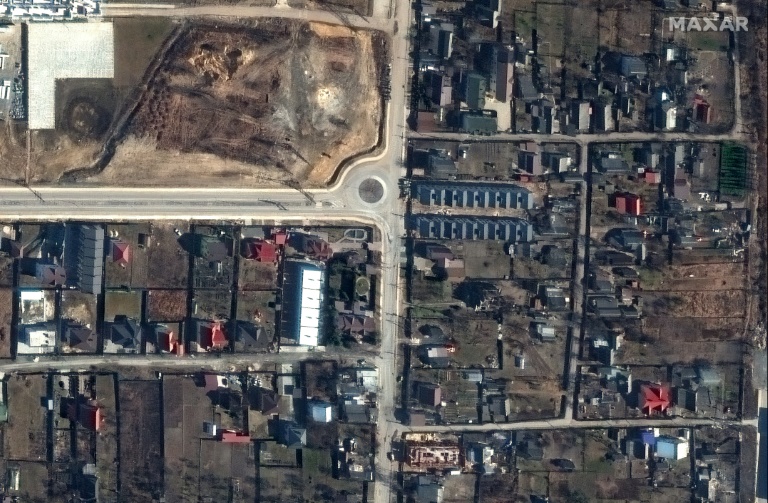
Mid-March satellite imagery of a Bucha street appears to show several bodies of civilians lying dead in or just off the roadway where Ukrainian officials recently said they found multiple corpses after Russian troops withdrew.

“High-resolution Maxar satellite imagery collected over Bucha, Ukraine (northwest of Kyiv) verifies and corroborates recent social media videos and photos that reveal bodies lying in the streets and left out in the open for weeks,” Maxar Technologies spokesman Stephen Wood said Monday in a statement.

The New York Times published an analysis of close-ups of Bucha’s Yablonska street, and concluded — after comparing it with video footage from April 1 and 2 of dead bodies along the street — that many had been there since at least three weeks ago, when Russian forces were in control of the town.

AFP photographers entered Bucha, northwest of Kyiv, on Saturday and directly confirmed the presence of some 20 bodies — all in civilian clothing, some with their hands bound — in scenes that have sparked global revulsion, and accusations of war crimes.

Russia’s defense ministry has denied responsibility, saying that all its units “withdrew completely from Bucha as early as March 30,” while the Kremlin has dismissed the graphic images emerging from the town as “fakes” concocted by Ukraine.

That claim was repeated at the United Nations on Monday, where Moscow’s envoy Vassily Nebenzia reiterated at a press conference the corpses pictured in Bucha were not there before Russian troops left the city.

“Suddenly they appear on the streets lying on the road, one by one, left and right, some of them are moving, some of them showing the signs of life,” he said, claiming the scenes were “arranged by the Ukrainian information, information warfare machine.”

But Maxar satellite images dated March 19 and March 21 show that multiple bodies were on Bucha’s Yablonska street at that time.

And according to the Times analysis, Maxar images show dark objects of similar size to human bodies appearing on the street between March 9 and 11.

Many of the bodies pictured in the satellite images appeared in the precise position on the ground as seen in video footage from the same street filmed by a Ukrainian local council member, and in photographs by international news outlets.

In a second side-by-side comparison, the Times studied a video posted on Instagram of a body in the street in front of two cars. A satellite image from March 21 shows the corpse and the vehicles in the same location.

North of Kyiv, a ruined town emerges after Russia leaves

Borodianka has been turned inside out. The buildings are flayed open, spilling clothing into the treetops.

A trip along the long straight road through the modest Ukrainian town is now a procession of the grimly absurd.

An apartment block is hollowed by a blast, a charred mattress hangs out in the open sky. A burnt out tank is parked in the guts of a savaged building. Children’s toys are strewn everywhere in the street, too many to count.

Nothing is where it should be. The details of devastation are infinite, the scale overwhelming. Some homes are simply no longer there.

The Russian retreat last week has left clues of the battle waged to keep a grip on Borodianka, just 50 kilometres (30 miles) north-west of the Ukrainian capital Kyiv.

Doddering down the muddied central road pushing a trolley of aid parcels, Mykola Kazmyrenko cannot comprehend it. 

“I can’t even look at it, it makes me want to cry,” the 57-year-old said. “People are void of their homes.”

Though AFP saw no bodies in a short trip to Borodianka, locals say many of their neighbours were slain here.

“I know five civilians were killed,” said 58-year-old Rafik Azimov. “But we don’t know how many more are left in the basements of the ruined buildings after the bombardments.”

“No-one tried to get them out yet, so it’s unknown.”

– ‘Love your Ukraine’ – 

In the town of Bucha — between Borodianka and Kyiv — AFP saw 20 dead bodies on a single street on Saturday.

Though the human cost in Borodianka is not yet fully apparent, the devastation is more complete. Every address presents a fresh, unfathomable vista.

Most windows are shattered and lives once lived inside are now visible from the street. A fridge peppered with magnets, a brown oriental carpet hanging on a wall, a block of kitchen knives somehow undisturbed.

Up the nine-storey apartment block whole rooms are disappeared, disgorged on the ground below.

Only the wallpaper is left behind: brown on the fourth floor, blue on the fifth, gold on the sixth.

Through a gaping hole in the building the sky is visible behind. Now these homes are a helter-skelter of tumbledown brickwork and dead metal, scraping in the harsh Ukrainian wind.

Shattered glass tinkles and stray cats mewl among the wreckage. The lawn on the roundabout leading into the town has been churned by tank tracks.

Mobile phone signal has evaporated here but two people have hiked to the top of a block of flats to scrounge for reception.

Other hardy residents venture into the homes, fishing out bundles of belongings. But explosive removal teams have yet to do their work — it is a risky gamble.

In the centre square a looming bust of poet Taras Shevchenko — an icon of Ukrainian culture — is still standing. But above his brow and on the dome of his head there are two bullet holes.

The verse inscribed beneath implores: “Love your Ukraine, love it. During ferocious times, and in the last of the difficult moments.”

– ‘Under the ruins’ – 

From the buckled, demolished bridge on the outskirts of the town Valentyna Petrenko has travelled from her nearby village to bear witness.

“When the Russians came, they took away our mobile phones and looted houses. We tried to behave normally with them not to provoke them,” said the 67-year-old.

“A missile hit our village, my house was ruined, everything was ruined,” she said. “The Russians committed atrocities, many atrocities.”

Volodymyr Nahornyi rides his bike out from Borodianka but must abandon it at the destroyed bridge. 

He picks his way down and then up the ruin made impassable by vehicle, likely to prevent the advance of Russian armour.

He joins Petrenko on the other side and looks back to where he came — the town where nothing is as it should be.

“All apartments were robbed and vandalised,” he says. “Everything is ruined, everything is damaged.”

“I buried six people,” he added. “More people are under the ruins.”

Twitter shares take wing, oil prices rebound

Stock markets were relatively subdued on Monday while oil prices rose as Western nations eyed more sanctions on Russia, but Twitter stood out as its shares soared after Elon Musk purchased a major stake in the social network.

Twitter’s stock soared more than 25 percent after news of the Tesla boss’s investment.

According to a document filed with the US Securities and Exchange Commission, Musk acquired nearly 73.5 million Twitter shares — a 9.2-percent stake in the company. 

While Twitter is not large enough in terms of capitalization to impact the wider market, market analyst Patrick O’Hare said the move has bolstered sentiment.

“What the market is really responding to is the timing of Musk’s purchase and the supposition that it is an encouraging signal that longer-term investment opportunities might be availing themselves now in former high-flying stocks,” he said.

European stock markets closed with modest gains, while Wall Street also forged higher.

The tech-rich Nasdaq had an especially buoyant session, climbing nearly two percent behind strong gains in Amazon, Apple and other tech giants.

The EU said it is urgently discussing a new round of sanctions on Russia as it condemned “atrocities” reported in Ukrainian towns that have been occupied by Moscow’s troops, while White House National Security Advisor Jake Sullivan signaled more US sanctions would also be announced this week.

“Even fresh sanctions talk does not appear to be having much of an effect, as the market learns to look past the immediate hit to earnings,” said analyst Chris Beauchamp at online trading platform IG.

“The strength of Friday’s payrolls report remains a motivating factor too, even if it has also emboldened Fed policy makers to think more seriously about a 50 basis point hike next time they meet,” he added.

The world’s top economy added 431,000 jobs in March while the US unemployment rate fell to just slightly above pre-pandemic levels, official data showed Friday. 

Oil prices rallied after falling last week on concerns about demand given Covid lockdowns in China and the 31-nation International Energy Agency agreeing to tap its vast reserves to offset the removal of Russian exports.

“Oil prices have rebounded after last week’s big falls with US prices recovering back above $100 a barrel, in the wake of renewed calls for further sanctions against Russian oil and gas imports,” said market analyst Michael Hewson at CMC Markets.

“This appears to be outweighing concerns over Chinese demand after the whole of Shanghai, a city of 25 million people, was put into a Covid lockdown,” he added.

– Key figures around 2115 GMT –

New York – Dow: UP 0.3 percent at 34,921.88 (close)

New York – S&P 500: UP 0.8 percent at 4,582.64 (close)

New York – Nasdaq: UP 1.9 percent at 14,532.55 (close)

London – FTSE 100: UP 0.3 percent at 7,558.92 (close)

Frankfurt – DAX: UP 0.5 at 14,518.16 (close)

Paris – CAC 40: UP 0.7 percent at 6,731.37 (close)

EURO STOXX 50: UP 0.8 percent at 3,951.12 (close)

Tokyo – Nikkei 225: UP 0.3 percent at 27,736.47 (close)

Hong Kong – Hang Seng Index: UP 2.1 percent at 22,502.31 (close)

Shanghai – Composite: Closed for a holiday

Brent North Sea crude: UP 3.0 percent at $107.53 per barrel

West Texas Intermediate: UP 4.0 percent at $103.28 per barrel

Euro/dollar: DOWN at $1.0978 from $1.1043 late Friday

Pound/dollar: FLAT at $1.3114

Euro/pound: DOWN at 83.65 pence from 84.21 pence 

Dollar/yen: UP at 122.78 yen from 122.52 yen

Twitter shares take wing, oil prices rebound

Global stock markets pushed higher Monday and oil prices rose as Western nations eyed more sanctions on Russia, but Twitter stood out as its shares soared after Elon Musk purchased a large stake in the social network.

Twitter’s stock soared more than 25 percent after news of the Tesla chief’s investment.

According to a document filed with the US Securities and Exchange Commission, Musk acquired nearly 73.5 million Twitter shares — a 9.2-percent stake in the company. 

While Twitter is not large enough in terms of capitalization to impact the wider market, Briefing.com analyst Patrick O’Hare said the move has bolstered sentiment.

“What the market is really responding to is the timing of Musk’s purchase and the supposition that it is an encouraging signal that longer-term investment opportunities might be availing themselves now in former high-flying stocks,” he said.

European stock markets closed with modest gains, while Wall Street also forged higher.

The tech-rich Nasdaq had an especially buoyant session, climbing nearly two percent behind strong gains in Amazon, Apple and other tech giants.

Meanwhile, the EU said it is urgently discussing a new round of sanctions on Russia as it condemned “atrocities” reported in Ukrainian towns that have been occupied by Moscow’s troops.

And White House National Security Advisor Jake Sullivan signaled more US sanctions also could be announced this week.

But that did not seem to rattle investors who are watching the Federal Reserve for more clues about its interest rate hikes especially following another solid employment report.

“Even fresh sanctions talk does not appear to be having much of an effect, as the market learns to look past the immediate hit to earnings,” said analyst Chris Beauchamp at online trading platform IG.

“The strength of Friday’s payrolls report remains a motivating factor too, even if it has also emboldened Fed policy makers to think more seriously about a 50 basis point hike next time they meet,” he added.

The world’s top economy added 431,000 jobs in March while the US unemployment rate fell to just slightly above pre-pandemic levels, official data showed Friday. 

Oil prices rallied after falling last week on concerns about demand given Covid lockdowns in China and after the 31-nation International Energy Agency agreed to tap its vast reserves to offset the hit from the drop in Russian exports due to sanctions.

“Oil prices have rebounded after last week’s big falls with US prices recovering back above $100 a barrel, in the wake of renewed calls for further sanctions against Russian oil and gas imports,” said market analyst Michael Hewson at CMC Markets.

“This appears to be outweighing concerns over Chinese demand after the whole of Shanghai, a city of 25 million people, was put into a Covid lockdown,” he added.

– Key figures around 2115 GMT –

New York – Dow: UP 0.3 percent at 34,921.88 (close)

New York – S&P 500: UP 0.8 percent at 4,582.64 (close)

New York – Nasdaq: UP 1.9 percent at 14,532.55 (close)

London – FTSE 100: UP 0.3 percent at 7,558.92 (close)

Frankfurt – DAX: UP 0.5 at 14,518.16 (close)

Paris – CAC 40: UP 0.7 percent at 6,731.37 (close)

EURO STOXX 50: UP 0.8 percent at 3,951.12 (close)

Tokyo – Nikkei 225: UP 0.3 percent at 27,736.47 (close)

Hong Kong – Hang Seng Index: UP 2.1 percent at 22,502.31 (close)

Shanghai – Composite: Closed for a holiday

Brent North Sea crude: UP 3.0 percent at $107.53 per barrel

West Texas Intermediate: UP 4.0 percent at $103.28 per barrel

Euro/dollar: DOWN at $1.0978 from $1.1043 late Friday

Pound/dollar: FLAT at $1.3114

Euro/pound: DOWN at 83.65 pence from 84.21 pence 

Dollar/yen: UP at 122.78 yen from 122.52 yen

Sri Lanka opposition rejects unity offer, demands president resign

Sri Lanka’s opposition on Monday dismissed President Gotabaya Rajapaksa’s invitation to join a unity government as “nonsensical” and instead demanded he resign over the country’s worsening shortages of food, fuel and medicines.

Rajapaksa’s overture came as armed troops looked to quell more demonstrations over what the government acknowledges is the country’s worst economic crisis since independence from Britain in 1948.

Police fired tear gas and water cannon to disperse thousands of protesters trying to storm the private home of the prime minister — the president’s elder brother and the head of the political clan — in Tangalle, once a bastion of support for the family in the island’s south.

Hundreds of men and women laid siege to the offices of the president and the prime minister in the capital Colombo for several hours late Monday as phalanxes of armed police prevented them from entering.

Earlier in the day, the president asked opposition parties represented in parliament to “join the effort to seek solutions to the national crisis,” after the late-night resignation of nearly all cabinet ministers to pave the way for a revamped administration.

That request was met with quick refusals.

“We will not be joining this government,” Eran Wickramaratne of the main opposition Samagi Jana Balawegaya (SJB) party told AFP. “The Rajapaksa family must step down.”

“He really must be a lunatic to think that opposition MPs will prop up a government that is crumbling,” lawmaker Anura Dissanayake of the leftist People’s Liberation Front (JVP) told reporters in the capital Colombo.

And Abraham Sumanthiran of the Tamil National Alliance told AFP: “His offer to reconstitute the cabinet with opposition MPs is nonsensical and infuriates the people who have been demanding his resignation.”

Every member of Sri Lanka’s cabinet except the president and his elder brother, Prime Minister Mahinda Rajapaksa, resigned late Sunday.

The country’s central bank governor Ajith Cabraal — who has long opposed the International Monetary Fund bailout now being sought by the South Asian island country — also stepped down on Monday.

A day after the mass resignations, the president reappointed four of the outgoing ministers — three of them to their old jobs — while replacing brother Basil Rajapaksa as finance minister with the previous justice chief.

– ‘Re-arranging deck chairs on the Titanic’ –

Political analysts said the offer of a unity government did not go far enough to address the economic crisis or restore confidence in the Rajapaksa administration.

“This is like re-arranging the deck chairs on the Titanic,” Bhavani Fonseka, a political analyst and human rights lawyer, told AFP. “This is a joke.”

Political columnist Victor Ivan told AFP that a cabinet reshuffle in the guise of a national unity government would not be acceptable to the public.

“What is needed is a serious reform programme, not just to revive the economy but address issues of governance,” Ivan told AFP. 

A critical lack of foreign currency has left Sri Lanka struggling to service its ballooning $51 billion foreign debt, with the pandemic torpedoing vital revenue from tourism and remittances.

The result has seen unprecedented food and fuel shortages along with record inflation and crippling power cuts, with no sign of an end to the economic woes.

Economists say Sri Lanka’s crisis has been exacerbated by government mismanagement, years of accumulated borrowing and ill-advised tax cuts.

– ‘Step down Rajapaksa’ –

Noisy demonstrations have spread across the country since Sunday evening with thousands of people joining. 

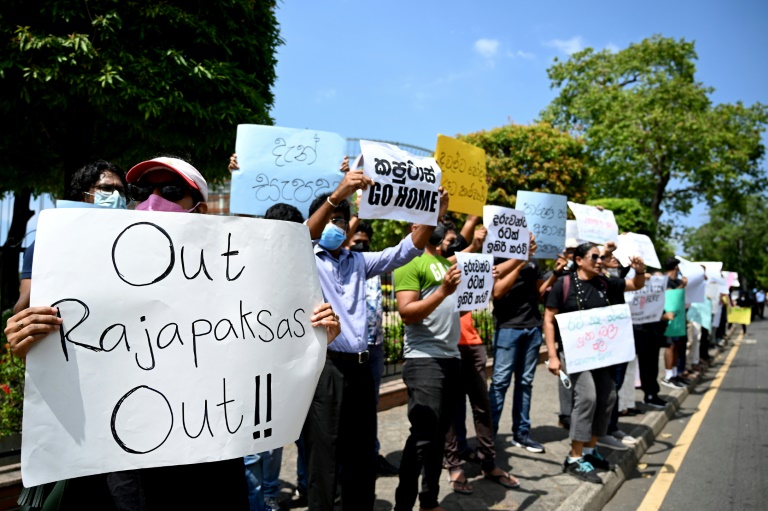
Thousands of young men and women dressed mostly in black and carrying hand-written posters and placards staged a noisy but peaceful demonstration at a busy roundabout in Colombo on Monday.

“Step down Rajapaksa,” said one placard, while another read: “Return the funds stolen from the republic.”

“Gota lunatic, go home Gota,” crowds chanted elsewhere in the city, referring to the president, who imposed a state of emergency last week, the day after a crowd attempted to storm his residence.

The homes of several senior administration figures in various parts of the island were surrounded by protesters, with police firing tear gas to disperse the crowds. 

Close Bitnami banner
Bitnami