World

Strong US economy faces unprecedented risks: JPMorgan's Dimon

Major economies worldwide including the United States are facing challenging times amid an unprecedented confluence of events, including the war in Ukraine and “unparalleled” inflation, JPMorgan Chase Chief Executive Jamie Dimon said Monday.

While prices and wages were rising even before the war, Russia’s invasion of its neighbor has caused a surge in energy prices, and Dimon warned in his annual letter to shareholders, “Along with the unpredictability of war itself and the uncertainty surrounding global commodity supply chains, this makes for a potentially explosive situation.”

The US economy remains strong and hopefully “has Covid-19 in its rearview mirror,” but competing factors facing the world’s largest economy “present completely different circumstances than what we’ve experienced in the past — and their confluence may dramatically increase the risks ahead.”

Dimon praised the Federal Reserve for making clear that it will raise interest rates as much and as fast as needed to contain inflation, while also starting to reduce its massive bond holdings.

US consumer price inflation jumped 7.9 percent in February compared to a year earlier, and the Fed last month raised the benchmark lending rate off zero for the first time since the start of the pandemic in March 2020.

Dimon wrote that he doesn’t envy the central bank, which “needs to deal with things it has never dealt with before (and are impossible to model).”

In the wide-ranging, nearly 50-page document, Dimon offered his prescriptions for American political and economic issues and geopolitical challenges, including relations with Russia and China, and also outlined his bank’s strategies.

He argued that US industries will have to restructure supply chains to improve resilience and protect national security.

“You simply cannot rely on countries with different strategic interests for critical goods and services,” he said, adding that change could take place over time to avoid disruption.

He also called on the United States to boost energy production and help Europe wean itself off Russian supply with a new “Marshall Plan.”

JPMorgan’s economists forecast Russia’s GDP will contract by 12.5 percent by midyear — worse than the drop after its 1998 debt default — while the euro area’s growth will be cut in half to about two percent, and the United States will see a 2.5 percent expansion, though Dimon warned those estimates are highly uncertain.

War in Ukraine: Latest developments

Here are the latest developments in the war in Ukraine:

– War crimes trial sought –

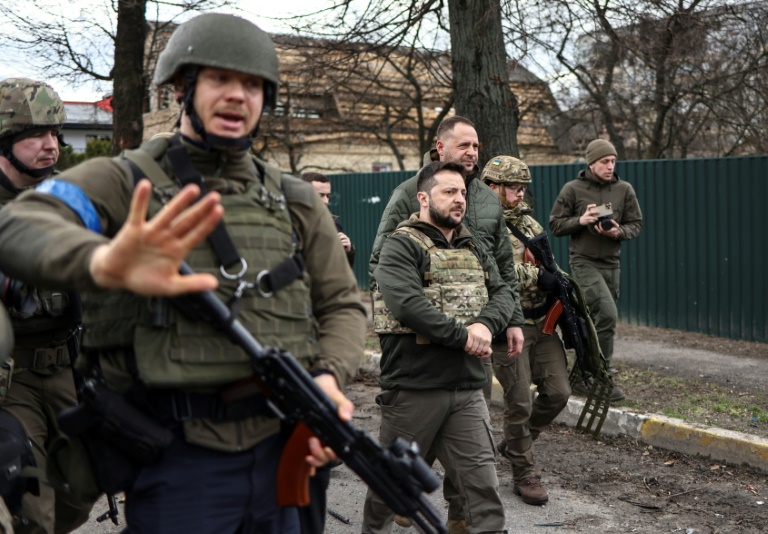
The discovery of bodies scattered on the streets of the Ukrainian town of Bucha after the withdrawal of Russian forces sparks global outrage.

US President Joe Biden calls for a war crimes trial and more sanctions on Russia.

European Commission chief Ursula von der Leyen says the EU is ready to send a team of investigators to gather evidence of possible war crimes after the discovery.

On a visit to the town, Ukrainian President Volodymyr Zelensky labels the killings “genocide”, a term echoed by the prime minister of Poland.

– Hundreds of bodies –

AFP saw at least 20 bodies strewn along a single street in Bucha.

Ukrainian prosecutor general Iryna Venediktova says 410 civilian bodies were recovered from areas around Kyiv recently retaken from Russian forces.

Bucha’s mayor Anatoly Fedoruk says 280 bodies were buried in mass graves during the fighting.

The bodies of another five men were found in a basement of a children’s health resort in Bucha, the Prosecutor General’s office says.

– Russian denial – 

The Kremlin denies Russian forces killed civilians, claiming that the images of dead bodies in Bucha are “fakes” produced by “Ukrainian radicals.”

“We categorically reject all allegations,” Kremlin spokesman Dmitry Peskov says.

Moscow has called for a special UN Security Council meeting to discuss the situation.

– ‘Big attack’ coming in East –

Russian troops are preparing for a big attack in the Lugansk region of eastern Ukraine, the local governor Sergiy Gaiday says on Telegram.

“We see that equipment is coming from different directions, they are bringing manpower, they are bringing fuel,” he says, adding that Russia is “preparing for a full-scale big breakthrough”.

A senior Pentagon official says Russia has removed about two-thirds of the troops it had around Kyiv, mostly sent back to Belarus with plans to redeploy elsewhere in Ukraine.

– Mariupol destroyed –

The south-eastern port city of Mariupol has been “90 percent” destroyed after being besieged by Russian forces, its mayor Vadym Boichenko says, adding 40 percent is “unrecoverable”. 

Around 130,000 people remain trapped in the city, which continues to be pounded by Russian bombardments, he says.

– More EU sanctions –

The EU’s foreign policy chief Josep Borrell says the bloc is urgently discussing a new round of sanctions on Russia over the “atrocities” reported in Bucha and other Ukrainian towns that were occupied by Russian forces.  

French President Emmanuel Macron says that they could target Russia’s oil and coal sectors, while Germany warns that cutting off the supply of Russian gas to Europe was not yet possible, despite calls to do so.

– Diplomats kicked out –

Germany and France each expel dozens of Russian diplomats after Moscow’s invasion of Ukraine.

And the former Soviet republic of Lithuania expels the Russian ambassador to Vilnius over what it calls the “horrific massacre” in Bucha and atrocities in other occupied Ukrainian cities. Moscow vows to retaliate.

– Germany controls Gazprom firm  –

Germany takes control of Gazprom’s German subsidiary after the Russian gas giant said it is withdrawing from Gazprom Germania.

Berlin says it is “doing what is necessary to ensure security of supplies in Germany.”

– Over 4.2 million refugees –

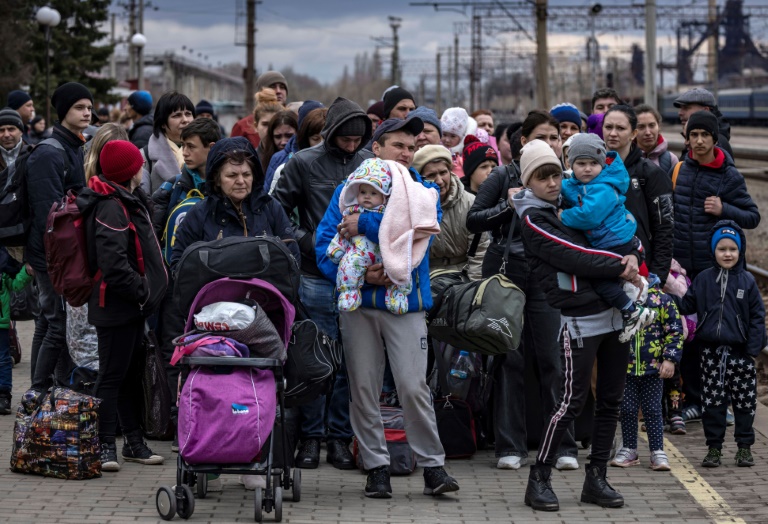
More than 4.2 million Ukrainian refugees have fled the country since the Russian invasion, the UN says.

'Now or never' to avoid climate catastrophe, warns UN

Humanity has less than three years to halt the rise of planet-warming carbon emissions and less than a decade to slash them by nearly half, UN climate experts said Monday, warning the world faced a last-gasp race to ensure a “liveable future”.

That daunting task is still — only just — possible, but current policies are leading the planet towards catastrophic temperature rises, the UN’s Intergovernmental Panel on Climate Change (IPCC) made clear.

The world’s nations, they said, are taking our future right to the wire. 

The 2,800-page report — by far the most comprehensive assessment of how to halt global heating ever produced — documents “a litany of broken climate promises”, said UN chief Antonio Guterres in a blistering judgement of governments and industry.

“Some government and business leaders are saying one thing — but doing another. Simply put, they are lying. And the results will be catastrophic,” Guterres said.

In recent months, the IPCC has published the first two instalments in a trilogy of mammoth scientific assessments covering how greenhouse gas emissions are heating the planet and what that means for life on Earth.

This third report outlines what we can do about it.

“We are at a crossroads,” said IPCC chief Hoesung Lee. “The decisions we make now can secure a liveable future. We have the tools and know-how required to limit warming.”

US Secretary of State Antony Blinken said these tools “are firmly within our grasp”: “Nations of the world must be brave enough to use them.” 

The solutions touch on virtually all aspects of modern life, require significant investment and need “immediate action”, the IPCC said.

The very first item on the global to-do list is to stop greenhouse gas emissions from rising any further. 

That must be done before 2025 to have a hope of keeping within even the Paris Agreement’s less ambitious warming target of two degrees Celsius above preindustrial levels.

Barely 1.1C of warming so far has ushered in a surge of deadly extreme weather across the globe.

The report makes clear that investments to cut emissions will be far less expensive than the cost of failing to limit warming. 

Scientists warn that any rise above 1.5C risks the collapse of ecosystems and the triggering of irreversible shifts in the climate system. 

To achieve that target, the report said carbon emissions need to drop 43 percent by 2030 and 84 percent by mid-century.  

“It’s now or never, if we want to limit global warming to 1.5C,” said Jim Skea, a professor at Imperial College London and co-chair of the working group behind the report. 

“Without immediate and deep emissions reductions across all sectors, it will be impossible.”

– Slashing coal, oil, gas –

To do that the world must radically reduce the fossil fuels behind the lion’s share of emissions. 

Nations should stop burning coal completely and cut oil and gas use by 60 and 70 percent respectively to keep within the Paris goals, the IPCC said, noting that both solar and wind were now cheaper than fossil fuels in many places.

But cutting emissions is no longer enough, the IPCC said. Technologies to suck CO2 out of the atmosphere — not yet operating to scale — will need to be ramped up enormously.

While government policies, investments and regulations will propel emissions cuts, the IPCC made clear that individuals can also make a big difference.

Cutting back on long-haul flights, switching to plant-based diets, climate-proofing buildings and other ways of cutting the consumption that drives energy demand could reduce greenhouse gas emissions 40 to 70 percent by 2050. 

Those with the most, also pollute the most, the report said. 

Households whose income is in the top 10 percent globally — two thirds of whom are in developed countries — emit up to 45 percent of carbon pollution. 

“Individuals with high socio-economic status contribute disproportionately to emissions and have the highest potential for emissions reductions — as citizens, investors, consumers, role models and professionals,” the IPCC said. 

– Fuel for war –

For 2019, if energy consumption is included, industry accounted for 34 percent of human-caused greenhouse gas emissions; agriculture, forestry and land use was 22 percent; transport 15 percent; buildings 16 percent; and the energy supply sector 12 percent.  

The report’s finding will feed into high-level UN political negotiations, which resume in November in Egypt at COP 27. 

Recently updated national climate pledges emerging from these talks still put the 1.5C target “beyond reach”, the report warned.

With war in Ukraine spurring efforts to transition away from Russian oil and gas in the West, observers said the report should sharpen nations’ focus on climate commitments. 

“It is heart-breaking for me, as a Ukrainian climate activist, to be living through a war which has fossil fuel money at its core,” said Olha Boiko, an activist from the Climate Action Network, based in Ukraine. 

“The money, that we begged not to invest in dirty energy, is now flying over our heads in the form of bombs.”

Fly less? Go vegan? How people can take climate action

Individuals along with economy-wide efficiencies can make a major difference in the drive to avert the worst of global warming, UN climate experts say, estimating that sharp cuts to demand for energy-guzzling services could slash emissions up to 70 percent by 2050.   

Avoiding airplanes, eating less meat, insulating your home could all make a dent, particularly when broad swathes of societies embrace change, says the United Nations Intergovernmental Panel on Climate Change.  

While research often focuses on cutting emissions in the supply of goods and services — energy generation, transport, agriculture, construction — the IPCC has for the first time dedicated a whole chapter of its climate solutions report to the demand that drives these industries.  

“Having the right policies, infrastructure and technology in place to enable changes to our lifestyles and behaviours can result in a 40-70 percent reduction in greenhouse gas emissions by 2050,” said Priyadarshi Shukla co-chair of IPCC working group that produced the 3,000 page report.

But where can “this untapped potential”, as Shukla calls it, be found?

– Day-to-day choices –

“Avoid, shift, improve” — these are the key ways to curb demand, the report says. 

You can avoid energy-intensive behaviour, switch to low-carbon technologies and improve the efficiency of existing tech. 

In general, there are plenty of opportunities for improvement in the ways people travel from point A to point B. 

You can change an internal combustion engine car to an electric one (“improve”), or even “shift” your daily commute to cycling or walking.   

The biggest potential for avoidance is reducing long-haul flights. If people took fewer long distance flights and took the train where possible, overall aviation emissions could be reduced by 10 to 40 percent by 2040. 

Meanwhile, increasing energy efficiency in homes and other buildings takes first place in the “improve” category. 

And the most important “shift” you can make is to adopt a plant-based diet. But becoming a vegetarian or even vegan would have less of an emissions impact than cutting out one long-haul flight a year. 

The report also highlights the need to reduce all types of waste, from energy or food for example. 

“Choosing low-carbon options, such as car-free living, plant-based diets without or very little animal products, low-carbon sources of electricity and heating at home as well as local holiday plans,” can reduce an individual’s carbon footprint by up to nine tonnes of CO2 equivalent, says the IPCC. 

– Unequal –

Most people in the world never take long-haul flights in the first place and do not have access to nutritious food. 

Billions of people have a carbon footprint far below nine tonnes of CO2 equivalent.  

For example, the average carbon footprint per inhabitant in Afghanistan is less than one tonne, according to the report, while in most western developed nations it is well over 10 tonnes. 

And within countries there can also be an enormous split between the lavish energy consumption of the rich and the meagre carbon footprint of poorer people. 

In fact, about half of the world’s emissions can be attributed to the consumption of the richest 10 percent of the global population, the report said.

At the bottom of the wealth pyramid, the poorest half of the world contributes around 10 percent of consumption emissions.  

“Wealthy individuals contribute disproportionately to higher emissions and have a high potential for emissions reductions while maintaining decent living standards and well-being,” the report said. 

– Beyond behaviour – 

The responsibility for transforming the world’s energy use and economic system to deal with climate change cannot be borne on the shoulders of individuals alone, the report stresses. 

While people can make a difference with their lifestyle choices, the IPCC says transformative change involves more than just individuals’ consumption choices. 

There also need to be shifts in culture and social norms, business investment, political drivers from institutions, and changes in infrastructure. 

Ukraine governor urges evacuations in region targeted by Russia

The situation in the Ukrainian controlled eastern region of Donbas is “tense”, a regional governor said Monday, asking people to evacuate as the army braced for a Russian advance.

Since Russia withdrew its troops near the capital Kyiv in the north and said it would focus on the “liberation” of the Donbas, residents have been living in fear of a major military offensive.

“We are firmly in control of all the territory… but the situation everywhere is tense,” the governor of the eastern Donetsk region Pavlo Kyrylenko told journalists in the city of Kramatorsk.

“The most difficult situation is in the direction of Izyum where we expect the situation to escalate,” Kyrylenko said, referring to a city recently captured by Russian forces in the neighbouring Kharkiv region.

“The enemy is bombing everywhere… a number of places along the line of control have been destroyed by bombardments,” he said.

The Kyiv government has said it expects the situation to get worse as Russian troops seek to encircle Ukrainian forces, arranged since 2014 along the frontline between Donetsk to the south and Lugansk in the east — the capitals of the two pro-Russian, breakaway “republics” of the same name — and now from Izyum to the northwest.

– Evacuations –

The de facto capital of the Ukrainian-controlled part of Donetsk, Kramatorsk sits between the pincers of the Russian army.

“I’ve said it before and I will say it again: the civilian population needs to leave the area now,” Kyrylenko said.

“We will share the logistical details of these evacuations. It’s an gradual process, not something we can do in a day… but the situation is going to become more difficult, that’s for sure,” he added.

While refusing to share the specifics of the evacuation, Kyrylenko said 146,000 people had “already left the region” by Sunday. 

A further 700,000 remained in the Ukrainian-controlled zone, he added.

“If the enemy respected the rules of war, the message would be different. As it is, we want as few citizens as possible to stay here, until the situation stabilises,” the governor said.

In Kramatorsk, hundreds of people again gathered at the train station to travel to the west of the country. 

Roughly four trains, carrying about 2,000 people, have been leaving the city every day for the past few days, with the operation managed by volunteers.

“Of course, we are aware of the concentration of enemy forces” in the east around Kramatorsk, Kyrylenko said.

Following the events in the town of Bucha, to the northwest of Kyiv, where dozens of civilians were found dead after Russian troops withdrew, “we can expect everything from the enemy”, the governor said.

The UN's 10,000-page red alert on climate change

Accelerating global warming is driving a rising tide of impacts that could cause profound human misery and ecological disaster, and there is only one way to avoid catastrophe: drastically reduce greenhouse gas emissions.

Spread across 10,000 pages, these are the main takeaways from a trio of UN reports on climate change published in August 2021, February 2022 and on Monday. The three tomes — each with its own roster of hundreds of authors — focus on physical science, impacts and the need to adapt, and finally how to slash carbon pollution. 

This will be the sixth such trilogy since the Intergovernmental Panel on Climate Change (IPCC) delivered its first report in 1990 and positioned itself as the final word on the science behind global warming.

Here are five key findings from the three reports:

– Beyond a doubt –

Whatever climate sceptics might say, scientific evidence has removed any lingering doubt that human activity is “unequivocally” responsible for global warming, which has seen the planet heat up an average of 1.1 degrees Celsius above preindustrial levels.

The atmospheric concentration of CO2 — the main driver of warming, emitted mainly by burning fossil fuels — rose at least 10 times faster between 1900 and 2019 than any time in the last 800,000 years, and is at its highest in two million years.

– Bye bye 1.5C? –

The 2015 Paris Agreement calls for capping global warming “well below” 2C, and 1.5C if possible. A crescendo of deadly impacts already being felt and a slew of new science has led most countries to embrace the more ambitious aspirational goal. 

But that ship may have sailed. 

In every IPCC projection for a liveable future, Earth’s average surface temperature increases by 1.5C or 1.6C by around 2030 — a decade earlier than estimates made only a few years ago. 

In theory, it will be possible to cap temperature increases to below the 1.5C threshold by the end of the century, but even a temporary “overshoot” could cause irreversible damage to fragile ecosystems at the poles, in the mountains, and in coastal areas. 

If countries do not improve on the emissions reduction pledges running to 2030, made under the Paris treaty, even staying under 2C will be a serious challenge. Current national policies would see Earth warm 3.2C by 2100.

– Avalanche of suffering –

Once a problem on the distant horizon, the devastating consequences of climate change have become a here-and-now reality. Nearly half the world’s population — between 3.3 and 3.6 billion — are “very vulnerable” to global warming’s deadly impacts, which are certain to get worse.

Heatwaves so extreme as to literally be unliveable; superstorms made more deadly by a water-logged atmosphere and rising seas; drought, water shortages, more disease-carrying mosquitoes and ticks… 

These and other impacts are set to become worse, and will disproportionately ravage Earth’s most vulnerable populations, including indigenous peoples. 

Hundreds of millions could eventually be forced from their homes by sea levels — pushed up mainly by melting ice sheets on Greenland and Antarctica — that will continue to rise across the next century no matter how quickly humanity draws down emissions.

Even if global heating is capped at 2C, oceans could gain half-a-metre by 2100 and two metres by 2300, double the IPCC’s estimate from 2019.

– Only option left – 

The IPCC insists that it does not provide recommendations, only background information and policy options so decision makers can make the right choices to ensure a “liveable future” for the planet and its inhabitants. 

But all roads leadiing to a 1.5C or even a 2C world “involve rapid and deep and in most cases immediate greenhouse gas emissions reductions in all sectors” — including industry, transportation, agriculture, energy and cities.  

Hitting those temperature goals will require a massive reduction in fossil fuel use, the IPCC says: 90 percent, 25 percent and 40 percent less coal, gas and oil, respectively, by 2050, and 90 percent, 40 percent and 80 percent less by 2100.

The use of coal plants that do not deploy carbon capture technology to offset some of their pollution to generate power must decline by 70 to 90 percent within eight years.

– Tipping points –

The new trio of IPCC reports emphasise as never before the danger of “tipping points”, temperature thresholds in the climate system that could, once crossed, result in catastrophic and irreversible change.  

The good news is that we seem to have pulled back from emissions scenarios from human sources that could by themselves result in a 4C or 5C world. The bad news is that “low probability/high impact” tipping point scenarios in nature could lead us there all the same. 

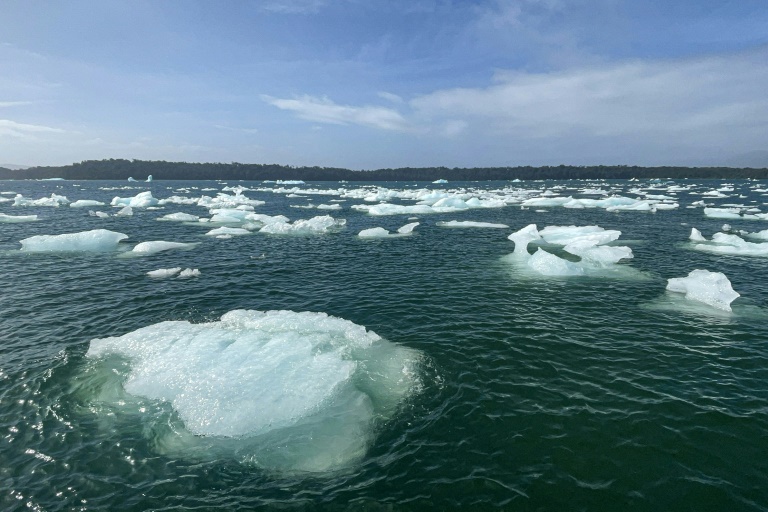
The disintegration of ice sheets that would lift ocean levels a dozen metres or more; the melting of permafrost containing vast stores of the same greenhouse gases we are desperately trying to keep out of the atmosphere; the transformation of the Amazon basin from tropical forest to savannah — all could be triggered by additional global warming.  

Where are those triggers? Scientists are not sure, but they do know that the risk is much higher in a world that has warmed 2C above 19th-century levels than one that has warmed 1.5C. 

Above 2.5C, the risk is “very high”.

Plan 'B'? What Russia plans next in Ukraine

Russia appears to have abandoned for now the initial aim in its invasion of Ukraine of seizing Kyiv and ousting the Ukrainian government, but is still pressing attacks in the east and south.

Even under this plan ‘B’ forced by Ukrainian resistance and military setbacks, Moscow has multiple aims that risk prolonging the conflict and causing yet more death and destruction.

Here AFP looks at five aims Russia has for the next phase of the war against Ukraine, almost one and a half months into the conflict.

– Symbolic victory

Even with full control over the media after a series of draconian measures, President Vladimir Putin will want to report some kind of success on May 9 when Russia marks its victory over Nazi Germany in World War II.

“Putin is obsessed by symbolic dates and history so he desperately needs a victory picture before May 9,” said Alexander Grinberg, an analyst at the Jerusalem Institute for Security and Strategy (JISS).

Sergei Karaganov, honorary chair of the Moscow think-tank the Council for Foreign and Defence Policy and a former Kremlin adviser, said Russia “cannot afford to ‘lose’ so we need a kind of a victory.”

“The stakes of the Russian elite are very high –- for them it is an existential war,” he told British weekly The New Statesman.

– Take Mariupol

While Russian forces appear to be moving away from Kyiv and other regions of the north, Russia is making no such move around the southeastern city of Mariupol, which has been besieged for weeks in defiance of an international outcry.

Seizing Mariupol would be a crucial step for Russia in realising its apparent aim to control territory linking the Ukrainian peninsula of Crimea, seized by Moscow in 2014, to Russia.

“I expect intense fighting until the final retreat of the (Ukrainian) resistance from Mariupol,” Grinberg said.

To the north lie the two pro-Moscow separatist Donbas regions of Donetsk and Lugansk, so taking the city would give Moscow control of a swathe of territory in Ukraine’s east.

With Mariupol, Russian forces could “go north up to grasp the rest of the Donbas and have continuous control of the south of Ukraine and the coast of the Sea of Azov,” Pierre Razoux, academic director of the Mediterranean Foundation for Strategic Studies, told AFP.

– Seize more territory

The breakaway Donetsk and Lugansk regions — recognised as independent by Russia in February — did not control the full extent of those two areas within Ukraine.

Moscow has insisted their breakaway rulers should have full administrative authority, and fully controlling them appears to be a key war aim.

“The war is far from over and could still turn Russia’s way if the Russian military can launch a successful operation in eastern Ukraine,” said analysts at the Institute for the Study of War (ISW).

Russia at the weekend launched strikes at the Western port of Odessa and Western sources have never ruled out an amphibious attack on the city, though this appears less likely.

“If a cease-fire is imposed under the principle of ‘keep what you hold,’ Russia could retain its hold over several new parts of Ukraine,” said Ivan U. Klyszcz, a doctoral candidate in International Relations at the University of Tartu, Estonia.

– Gain time

The invasion has proved hugely costly for Russian in terms of both human losses and destruction to military hardware in the face of Ukrainian resistance that was far tougher then the Kremlin expected.

Military analysts have noted that Russia’s spring draft started on April 1, and while Moscow insists conscripts are not sent to Ukraine, the new recruits could enter battle once they sign contracts and are trained.

“The war is far from over… Further offensives are to come,” said Gustav Gressel, senior policy fellow at the European Council on Foreign Relations (ECFR), adding that personnel is the “key resource” in short supply for Moscow.

But analysts also say that a long war of attrition would also be dangerous for Russia, given the success of Ukrainian guerilla tactics over the last weeks.

“If this eventually becomes a prolonged war of attrition, Ukraine seems overall in a more favourable position,” said Michael Kofman, director of the Russia Studies Program at the Center for Naval Analyses in the US.

– Divide the West

The longer the war grinds on, the more the Kremlin is expected to press one of its favourite tactics of seeking to divide the West between those states who want to take the hardest line against Moscow, and those with more conciliatory stances.

Putin on Monday was fast to congratulate one of his closest allies within the EU, Hungarian Prime Minister Viktor Orban, after his party won elections that saw him gain fourth term in office.

In a possible harbinger of strains to come, US President Joe Biden said that Putin should not remain in power but French President Emmanuel Macron retorted that such rhetoric was unhelpful.

Macron said Monday that the EU would consider more sanctions against Russian oil and coal industries but did not mention natural gas, on which Europe remains deeply reliant.

“The aim of the game is also to divide public opinion,” Razoux said.

French fruit, vineyards endure coldest April day in 75 years

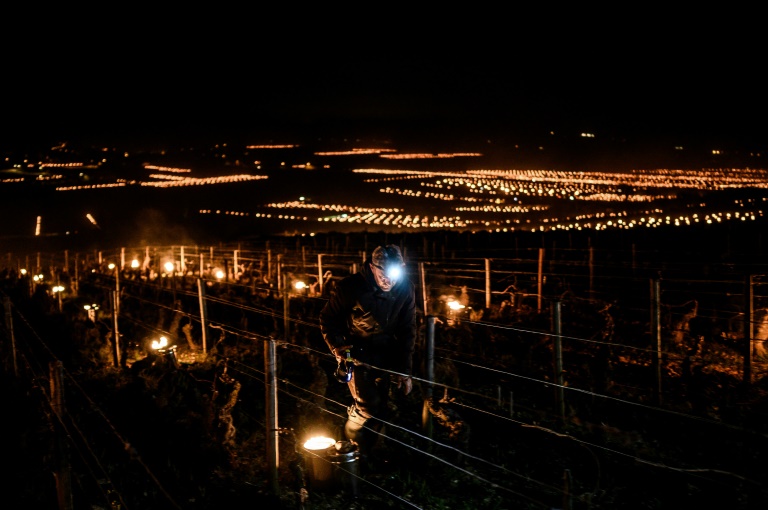
French wine and fruit growers were hit by the coldest April day since 1947 overnight Sunday and early Monday, the second straight year they have suffered freak spring weather.

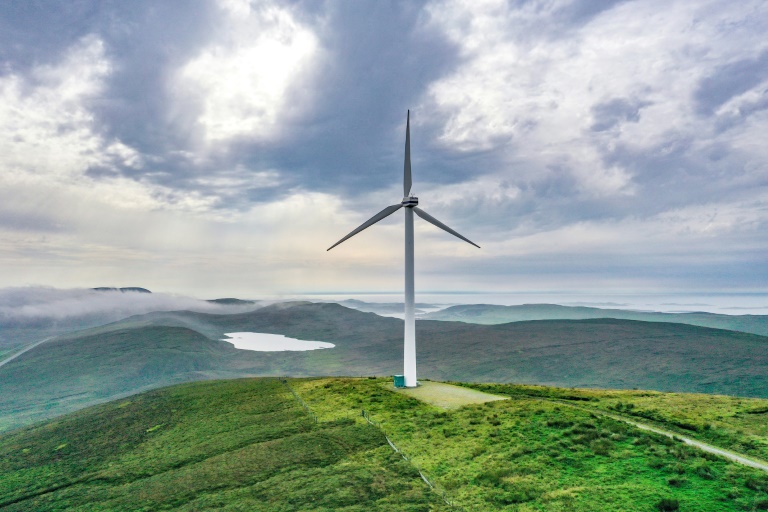
Growers burned candles, sprayed water and used wind turbines in efforts to protect their crops as temperatures fell below the freezing point, with a record minus 9.3C in Mourmelon in the Marne department east of Paris.

Experts say freak weather events are increasingly common due to climate change.

Temperatures rose on Monday, according to Meteo France forecaster Patrick Galois, but he warned that freezing weather would still occur between the southwest and central France.

Growers fear the worst.

“It’s very bad. It hit hard overnight. A lot of fruit growers are affected,” Christiane Lambert, president of the FNSEA farmers’ union, told AFP.

The agriculture ministry said it was “too early” to draw conclusions about the damage.

“The damage is only visible after a few days,” it said.

Fruit trees are more vulnerable than vineyards this year, the ministry said.

In the Tarn-et-Garonne department in the southwest, Damien Garrigues sprayed his apple trees to cover buds in ice in a bid to protect them from even lower temperatures.

“For now it’s not as bad as last year,” he said, noting he lost 20 percent of production in 2021.

In Agen in the neighbouring Lot-et-Garonne department, “big losses” are expected for plum growers but not as bad as last year, when “100 percent” were ruined by the cold snap, said Remy Muller, an adviser at the department’s chamber of agriculture.

A wind turbine was used in Eric Chadourne’s vineyard in Bergerac, also in the southwest, in a bit to limit the damage.

But elsewhere, “all early buds, merlot, white grapes and malbec are frozen,” Chadourne said.

A cold snap in April last year cut the harvest of apricots, cherries and pears by half compared to previous years, according to official statistics.

Wine production also fell to a historically low level, down 19 percent on an annual basis.

Prime Minister Jean Castex said money from an emergency fund may be released if necessary to help producers.

fby-ppy-apz-tsq-sb/lth/rl

French fruit, vineyards endure coldest April day in 75 years

French wine and fruit growers were hit by the coldest April day since 1947 overnight Sunday and early Monday, the second straight year they have suffered freak spring weather.

Growers burned candles, sprayed water and used wind turbines in efforts to protect their crops as temperatures fell below the freezing point, with a record minus 9.3C in Mourmelon in the Marne department east of Paris.

Experts say freak weather events are increasingly common due to climate change.

Temperatures rose on Monday, according to Meteo France forecaster Patrick Galois, but he warned that freezing weather would still occur between the southwest and central France.

Growers fear the worst.

“It’s very bad. It hit hard overnight. A lot of fruit growers are affected,” Christiane Lambert, president of the FNSEA farmers’ union, told AFP.

The agriculture ministry said it was “too early” to draw conclusions about the damage.

“The damage is only visible after a few days,” it said.

Fruit trees are more vulnerable than vineyards this year, the ministry said.

In the Tarn-et-Garonne department in the southwest, Damien Garrigues sprayed his apple trees to cover buds in ice in a bid to protect them from even lower temperatures.

“For now it’s not as bad as last year,” he said, noting he lost 20 percent of production in 2021.

In Agen in the neighbouring Lot-et-Garonne department, “big losses” are expected for plum growers but not as bad as last year, when “100 percent” were ruined by the cold snap, said Remy Muller, an adviser at the department’s chamber of agriculture.

A wind turbine was used in Eric Chadourne’s vineyard in Bergerac, also in the southwest, in a bit to limit the damage.

But elsewhere, “all early buds, merlot, white grapes and malbec are frozen,” Chadourne said.

A cold snap in April last year cut the harvest of apricots, cherries and pears by half compared to previous years, according to official statistics.

Wine production also fell to a historically low level, down 19 percent on an annual basis.

Prime Minister Jean Castex said money from an emergency fund may be released if necessary to help producers.

fby-ppy-apz-tsq-sb/lth/rl

Twitter shares take wing, oil prices rebound

Stock markets were relatively subdued on Monday while oil prices rose as Western nations eyed more sanctions on Russia, but Twitter stood out as its shares soared after Elon Musk purchased a major stake in the social network.

Twitter’s stock soared 25 percent after news of the Tesla boss’s investment.

According to a document filed with the US Securities and Exchange Commission, Musk acquired nearly 73.5 million Twitter shares — a 9.2-percent stake in the company. 

While Twitter is not large enough in terms of capitalisation to impact the wider market, market analyst Patrick O’Hare said the move has bolstered sentiment.

“What the market is really responding to is the timing of Musk’s purchase and the supposition that it is an encouraging signal that longer-term investment opportunities might be availing themselves now in former high-flying stocks,” he said.

European stock markets closed with modest gains, while Wall Street was flat to higher in late morning trade.

The EU said it is urgently discussing a new round of sanctions on Russia as it condemned “atrocities” reported in Ukrainian towns that have been occupied by Moscow’s troops, while US President Joe Biden also called for new punitive measures.

“Even fresh sanctions talk does not appear to be having much of an effect, as the market learns to look past the immediate hit to earnings,” said analyst Chris Beauchamp at online trading platform IG.

“The strength of Friday’s payrolls report remains a motivating factor too, even if it has also emboldened Fed policy makers to think more seriously about a 50 basis point hike next time they meet,” he added.

The world’s top economy added 431,000 jobs in March while the US unemployment rate fell to just slightly above pre-pandemic levels, official data showed Friday. 

Economists viewed the figures as reinforcing the Federal Reserve’s commitment to forcefully raising interest rates, perhaps by half a percentage point at its meeting next month, which would be double the increase it announced when it began hiking in March.

Oil prices rebounded after falling last week on concerns about demand given Covid lockdowns in China and the 31-nation International Energy Agency agreeing to tap its vast reserves to offset the removal of Russian exports.

“Oil prices have rebounded after last week’s big falls with US prices recovering back above $100 a barrel, in the wake of renewed calls for further sanctions against Russian oil and gas imports,” said market analyst Michael Hewson at CMC Markets.

“This appears to be outweighing concerns over Chinese demand after the whole of Shanghai, a city of 25 million people, was put into a covid lockdown,” he added.

– Sri Lanka crisis –

Elsewhere, Turkey’s lira held relatively steady against the dollar and euro after official data showed the country’s inflation had soared to a fresh record high.

In Sri Lanka, trading was halted on the stock exchange seconds after opening as the island nation’s president offered to share power with the opposition.

Protests demanding the resignation of Gotabaya Rajapaksa grew over unprecedented food and fuel shortages along with record inflation and crippling power cuts in the South Asian country.

Sri Lanka’s stock market slid more than the five percent in value — the threshold needed to trigger an automatic stop.

– Key figures around 1530 GMT –

New York – Dow: UP less than 0.1 percent at 34,830.12 points

EURO STOXX 50: UP 1.0 percent at 3,956.52

London – FTSE 100: UP 0.3 percent at 7,558.92 (close)

Frankfurt – DAX: UP 0.5 at 14,518.16 (close)

Paris – CAC 40: UP 0.7 percent at 6,731.37 (close)

Tokyo – Nikkei 225: UP 0.3 percent at 27,736.47 (close)

Hong Kong – Hang Seng Index: UP 2.1 percent at 22,502.31 (close)

Shanghai – Composite: Closed for a holiday

Brent North Sea crude: UP 3.8 percent at $108.38 per barrel

West Texas Intermediate: UP 4.2 percent at $103.48 per barrel

Euro/dollar: DOWN at $1.0992 from $1.1049 late Friday

Pound/dollar: UP at $1.3120 from $1.3118

Euro/pound: DOWN at 83.79 pence from 84.24 pence 

Dollar/yen: UP at 122.72 yen from 122.49 yen

burs/rl/lth

Close Bitnami banner
Bitnami