World

Hong Kong leader Carrie Lam to leave office

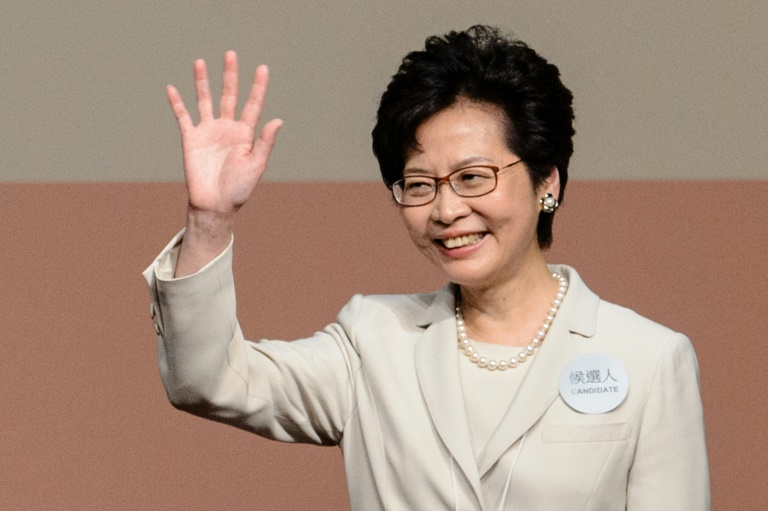
Hong Kong’s leader Carrie Lam announced Monday that she will step down in June, ending a divisive term that saw democracy protests squashed and strict pandemic curbs plunge the business hub into international isolation.

Ending months of speculation, Lam confirmed she would not seek a second term when a committee made up of the city’s political elite chooses a new leader next month. 

“I will complete my five-year term as chief executive on June 30, and officially conclude my 42-year career in government,” Lam told reporters.

She said China’s leaders “understood and respected” her choice not to seek another term and that she wanted to spend more time with her family. 

The 64-year-old had dodged questions for months over her future but revealed Monday she had informed Beijing of her plans to quit more than a year ago.  

A career bureaucrat, Lam became Hong Kong’s first woman leader in 2017 but she is on track to leave office with record-low approval ratings. 

Kenneth Chan, a political scientist at Baptist University, said Hong Kong leaders have always suffered from a “chronic legitimacy crisis” because they are not popularly elected.

But Lam had lost support across the political spectrum. 

“Not merely among the pro-democracy citizens but also increasingly among the pro-Beijing camp as she has done such a terrible job with the pandemic,” Chan told AFP.

– Security tsar next leader? –

Hong Kongers and businesses based in the finance hub have little clarity on who will be the next leader at a time when Beijing is increasingly calling the shots directly.

The chief executive position is selected by a 1,500-strong pro-Beijing committee, the equivalent of 0.02 percent of the city’s 7.4 million population. 

Lam’s successor will be chosen on May 8 but so far no one with a realistic prospect has publicly thrown their hat into the ring. 

Hong Kong’s number-two official, John Lee, who has a background in the security services, has been tipped by local press as the most likely contender.

Another potential candidate is finance chief Paul Chan.

The new leader will take office on July 1, the 25th anniversary of Hong Kong’s handover by Britain to China.

Supporters saw Lam as a staunch Beijing loyalist who steered the city through huge democracy protests and a debilitating pandemic. 

Starry Lee, who leads Hong Kong’s largest pro-Beijing party, described Lam on Monday as a “hard-working” official.

“Her merit… should be left to history to judge,” she said.

Critics, including many Western powers, viewed Lam as someone who oversaw the collapse of Hong Kong’s political freedoms and its reputation as a stable regional business hub.

Exiled activist and former legislator Nathan Law told AFP that Lam turned Hong Kong into an “authoritarian police state”, calling her five-year term a “complete mess and disaster for Hong Kong, most remarkably on her crackdown on protests and absurd Covid policy”.

The Hong Kong Democracy Council, a US-based group made up of opposition figures who have fled the city, described Lam’s administration as “disastrous”.

“(Lam) will just be replaced by another Chinese Communist Party puppet,” the group wrote on Twitter. “As ever, Hong Kongers want democracy.”

– Protests and pandemic –

After huge and sometimes violent protests swept Hong Kong in 2019 Beijing responded with a crackdown that has remoulded the once-outspoken city into a mirror of the authoritarian mainland. 

Lam was sanctioned by the United States because of her support for the crackdown, which has seen most of the city’s prominent democracy supporters arrested, jailed or flee overseas.

Her administration also hewed to China’s zero-Covid model, implementing some of the world’s toughest anti-coronavirus measures and exasperating international businesses.

The largely closed borders and strict quarantine rules kept infections at bay for some two years at the expense of Hong Kong being cut off internationally.

But the strategy collapsed when the highly transmissible Omicron variant broke through earlier this year, leaving Hong Kong with one of the developed world’s highest fatality rates. 

Hong Kongers have been leaving the city over the last two years at a rate not seen since the period before the handover.

Thousands of foreign residents have also departed, especially after the Omicron outbreak arrived and it became clear the city would remain cut off.

While a return of protests is unlikely in the current draconian political climate, Lam’s successor will need to reboot business confidence and tackle perennial Hong Kong problems such as a dismal shortage of housing and sky-high rents.

But Lam predicted on Monday that whoever replaces her will have an easier ride. 

“Compared to this term of government, the next government will be seeing a more stable political environment,” she told reporters. 
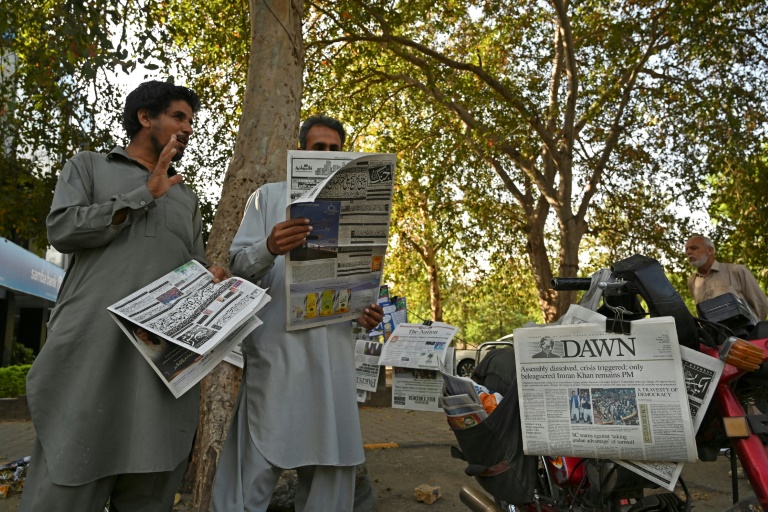
Pakistan's top court adjourns as constitutional crisis rages

Pakistan’s Supreme Court adjourned Monday without ruling on Prime Minister Imran Khan’s shock decision to dissolve parliament and call a snap election, sidestepping a no-confidence vote that would have seen him booted from office.

The court, which will sit again Tuesday, received a slew of suits and petitions from the government and opposition after the deputy speaker of the national assembly refused Sunday to allow debate on a no-confidence motion against Khan’s administration.

Simultaneously, Khan asked the presidency — a largely ceremonial office held by a loyalist — to dissolve the assembly, meaning an election must be held within 90 days.

According to the constitution, the prime minister cannot ask for the assembly to be dissolved while he is facing a no-confidence vote.

Farooq Naek, a lawyer representing petitioners seeking to overturn the assembly dissolution, told the supreme court it wasn’t in the “power and ambit” of the deputy speaker to reject the no-confidence motion.

“It was a constitutional irregularity coupled with ‘mala fide’,” he said, a legal term meaning “bad faith”.

The opposition had expected to take power on Sunday after mustering enough votes to oust Khan, but the deputy speaker — a member of the cricketer-turned-politician’s party — refused to allow the motion to proceed because of alleged “foreign interference”.

An alliance of usually feuding dynastic parties had plotted for weeks to unravel the tenuous coalition that made Khan premier in 2018, but he claimed they went too far by colluding with the United States for “regime change”.

– Washington denial –

Khan insists he has evidence — which he has declined to disclose publicly — of Washington’s involvement, although local media have reported it was merely a briefing letter from Pakistan’s ambassador following a meeting with a senior US official.

Western powers want him removed because he won’t stand with them on global issues against Russia and China, Khan said.

Washington has denied involvement.

On paper, and pending any court decision, Khan will remain in charge until an interim government is formed to oversee elections.

A notice Monday from President Arif Alvi to Khan and opposition leader Shehbaz Sharif said they should agree on a new interim prime minister, but Sharif declined to cooperate.

“How can we respond to a letter written by a person who has abrogated the constitution?” he told a press conference Monday.

Fawad Chaudhry, information minister in the outgoing cabinet, tweeted that Khan had proposed former chief justice Gulzar Ahmad for the role.

– ‘Constitutional crisis’ –

Khan appeared to have wrong-footed the opposition with his weekend manouvres.

“Khan’s ‘surprise’ triggers constitutional crisis,” thundered The Nation newspaper Monday, while its rival Dawn called it “A travesty of democracy” above a front-page editorial.

The supreme court is ostensibly independent, but rights activists say previous benches have been used by civilian and military administrations to do their bidding throughout Pakistan’s history.

It is unclear when the court may rule on the issue — or if Khan would even accept its decision — but there is precedent.

In 1988 Muhammad Khan Junejo appealed to the Supreme Court after the assembly was dissolved by President General Zia-ul-Haq, who had taken power in a military coup years earlier.

The court agreed his government had been dissolved unconstitutionally, but ruled that since elections had been announced anyway it was best to move on.

Khan was elected after promising to sweep away decades of entrenched corruption and cronyism, but has struggled to maintain support with inflation skyrocketing, a feeble rupee and crippling debt.

Some analysts said Khan had also lost the crucial support of the military, but it is unlikely he would have pulled off Sunday’s manoeuvres without its knowledge — if not blessing.

There have been four military coups — and at least as many unsuccessful ones — since independence in 1947, and the country has spent more than three decades under army rule.

“The best option in this situation are fresh elections to enable the new government to handle economic, political and external problems faced by the country,” said Talat Masood, a general-turned-political analyst.

As the opposition scrambled to react, Khan taunted them on Twitter.

“Astonished by the reaction,” he tweeted, adding the opposition had been “crying hoarse” about the government failing and losing the support of the people.

“So why the fear of elections now?”

War in Ukraine: Latest developments

Here are the latest developments in the war in Ukraine:

– Outrage over civilian killings –

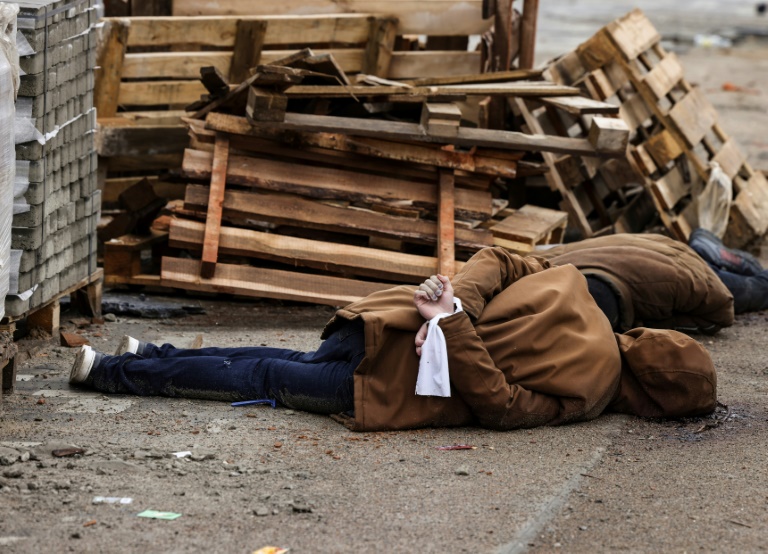
Global outrage grows over the discovery of dozens of bodies in the Ukrainian town of Bucha, some with their hands bound, after the withdrawal of Russian forces from the area west of Kyiv.

The UN’s human rights chief Michelle Bachelet says the images from Bucha point to “possible war crimes”, as does French President Emmanuel Macron.

Polish Prime Minister Mateusz Morawiecki calls for an international investigation into what he terms a “genocide” — a term also used by Spanish Prime Minister Pedro Sanchez.

Ukrainian President Volodymyr Zelensky brands Russian troops “murderers.”

– Russian denials –

The Kremlin denies Russian forces killed civilians, claiming that the images of dead bodies in Bucha are “fakes” produced by “Ukrainian radicals.”

“We categorically reject all allegations,” Kremlin spokesman Dmitry Peskov says.

Moscow has called for a special UN Security Council meeting to discuss the situation.

– More EU sanctions –

The EU’s foreign policy chief Josep Borrell says the bloc is urgently discussing a new round of sanctions on Russia over the “atrocities” reported in Bucha and other Ukrainian towns that were occupied by Russian forces.

“We stand in full solidarity with Ukraine and the Ukrainian people in these sombre hours for the whole world,” he says.

– Hundreds of bodies –

Ukrainian prosecutor general Iryna Venediktova says 410 civilian bodies were recovered from areas around Kyiv recently retaken from Russian forces.

AFP sees at least 20 bodies, all in civilian clothing, strewn across a single street in Bucha.

Bucha’s mayor Anatoly Fedoruk says 280 bodies were buried in mass graves while the fighting was ongoing and cemeteries were in the firing line.

– Eastern offensive –

As it withdraws from northern Ukraine, Russia steps up its attacks in the east and south.

Authorities in Kharkiv report seven people killed and 34 wounded in strikes on a residential area of Ukraine’s second-biggest city, close to the Russian border.

Russian forces also shell the Kharkiv suburb of Dergachi, leaving at least three civilians dead and wounding seven, its mayor says.

Six people are also reported killed in Donetsk, part of the Donbas region, which is bracing for a major offensive.

In the south, seven people are killed and 20 wounded in shelling of the town of Ochakiv on the Black Sea and one person is killed and 14 injured in a strike on the nearby city of Mykolaiv, Ukrainian authorities say.

– Putin hails Orban win –

An increasingly isolated Russian President Vladimir Putin congratulates Hungary’s nationalist Prime Minister Viktor Orban on winning a fourth term in office.

Putin hopes to deepen ties with a rare ally in Europe “despite the difficult international situation,” the Kremlin says.

– Zelensky addresses Grammys –

Zelensky makes a surprise appearance at the Grammy music awards, appearing in a pre-taped video urging support for his country.

“Our musicians wear body armour instead of tuxedos,” he says. “They sing to the wounded in hospitals — even to those who can’t hear them. But the music will break through anyway.”

– Too soon for peace summit –

Russia’s chief negotiator Vladimir Medinsky says it is too early for a top-level meeting between Zelensky and Putin on ending the conflict.

The two sides are scheduled to hold further video talks, a week after a meeting in Turkey which yielded progress on Russia’s demand that Ukraine become a neutral state.

– Over 4.2 million refugees –

More than 4.2 million Ukrainian refugees have fled the country since the Russian invasion, the UN says.

Indonesian teacher sentenced to death for raping 13 students

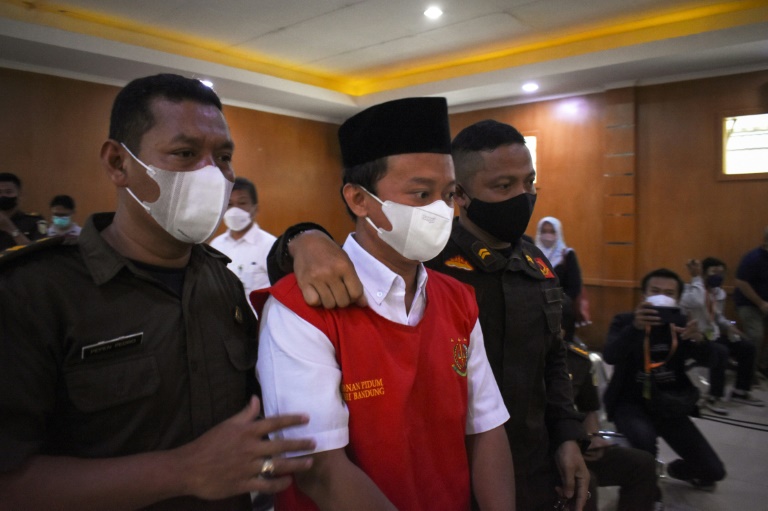
An Indonesian teacher found guilty of raping 13 students at an Islamic boarding school, and who impregnated at least eight of the victims, was sentenced to death on Monday.

Herry Wirawan, 36, had been sentenced to life in prison in February, in a case that drew national attention to sexual abuse in the country’s religious schools.

But prosecutors, who had requested the death penalty and chemical castration, filed an appeal.

“We accept the appeal of the prosecutors,” read the judge’s statement, published Monday on the website of the High Court in Bandung, West Java province.

“We hereby punish the defendant to a death sentence.”

Wirawan was not in court for the appeal, a spokesperson told AFP.

Indonesia has held off conducting executions for several years and the last known executions took place in 2016. 

Wirawan’s pattern of abuse at the school, also in Bandung, came to light when the family of a female student reported him to police for raping and impregnating their teenage daughter last year.

During his previous trial, it was revealed Wirawan had raped the female students — many from poor families and attending the school on scholarships — over a period of five years. He also impregnated at least eight of them.

Before the lower court, the defendant asked the judge for leniency, saying he wanted to be around to raise his children.

A relative of one of the victims told AFP that Monday’s sentence brought justice for the victims.

“We initially wanted punishments of life in prison and chemical castration so that he would feel the pain from his crime,” said Hidmat Dijaya, uncle of one of the victims.

“But, we still feel the death sentence represents justice.”

The case drew national outrage and increased pressure on parliament to approve a long-delayed bill on the “elimination of sexual violence”, that seeks to combat sex crimes and provide justice to victims, including in cases of marital rape. 

The Bandung rape case has also shone a spotlight on the problem of sexual abuse in the Indonesian education system, with 14 out of the 18 cases reported to the Child Protection Commission last year taking place in Islamic boarding schools.

The country has more than 25,000 Islamic boarding schools, with nearly five million students living and studying in their dorms.

Trail of destruction in southern Ukraine villages

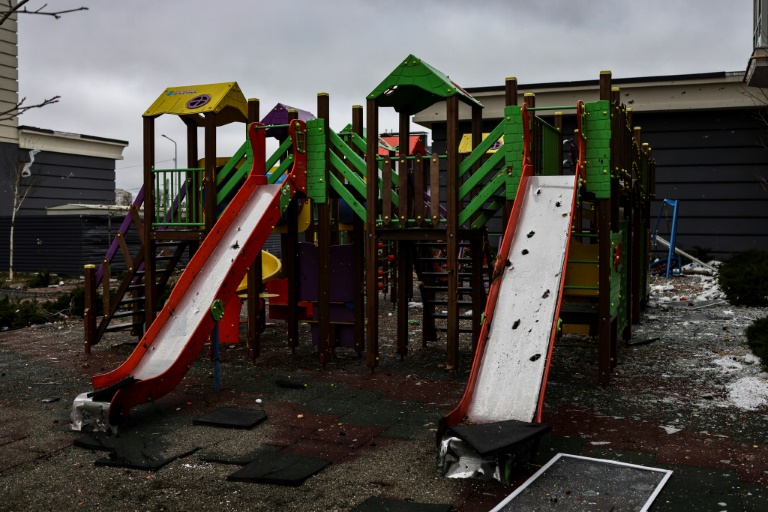
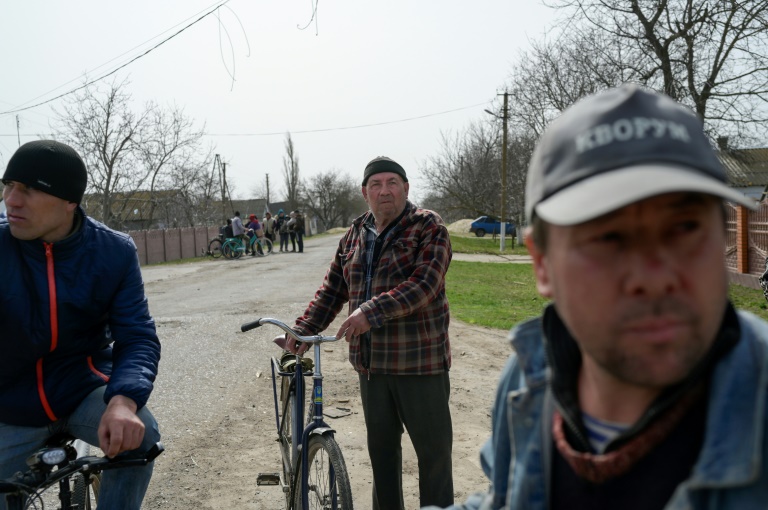
Devastated by intensive Russian bombardment, the village of Zeleny Gai near the frontline in southern Ukraine looks empty — except for a group of local men gathering to await an aid delivery.

The expected delivery “is the only reason why there are so many people out. Normally, this would be a ghost village,” said Yury Seka, 33, a farmer like many in this fertile agricultural region.

Another villager, Alexander Zlydar, 38, said: “I can’t remember the last time I slept in my own bed”.

Previously caught up in the midst of the fighting, the village has had some respite since the frontline moved a little further to the southeast closer to the Russian-occupied city of Kherson.

But Grad rockets continue to fall intermittently as Russia focuses its war effort on the south and east of the country after retreating from the northern cities of Kyiv and Chernigiv.

During a particularly heavy bombardment on March 13, a 250-kilogram bomb dropped by parachute landed on the roof of Andriy Koshmak’s house.

He pointed out the device, as well as the black streaks left by recent rocket attacks.

The 29-year-old said the bomb had likely drifted from its intended target because of strong winds.

Further along the road, the local school was turned into a pile of rubble by the bombing that day.

Lego pieces and textbooks could be seen in the ruins along with a parachute — likely one of the ones used to drop the bombs on Zeleny Gai.

Women and children had already been evacuated from the village, but the head of the local council was killed at the school and the headmaster suffered serious injuries to his legs.

“Many people had come to seek shelter inside the school,” Koshmak said.

“The Russians thought that some soldiers were hiding there, but it was only civilians”.

– ‘There was no pity’ –

Further along the road, a mobile anti-aircraft battery lay destroyed.

“It’s terrible. There was no pity for anyone,” Koshmak said as he looked at what remained of the school which he attended for nine years.

The nearby city of Mykolaiv hosts around 1,000 inhabitants of surrounding villages, the mayor, Oleksandr Senkevych said last week.

While the situation in Mykolaiv remains precarious, with several air raid alerts per day, the situation in the villages around “is worse,” he said.

Further south, on the road to Kherson, the village of Shevchenkove lies almost abandoned.

The police said the mayor of Shevchenkove is officially missing after being arrested by the Russian army during a humanitarian aid delivery.

Ivan Bolyakov, a 25-year-old with a ginger beard and a black hat, said he was the only one of 25 residents on his street who stayed behind.

“We arrested two looters in recent days. I have to watch out for what is happening in my village,” said Bolyakov, as the wind shook the ruins of a nearby home that had recently been hit by a strike.

More than 4.2 million Ukrainian refugees flee war

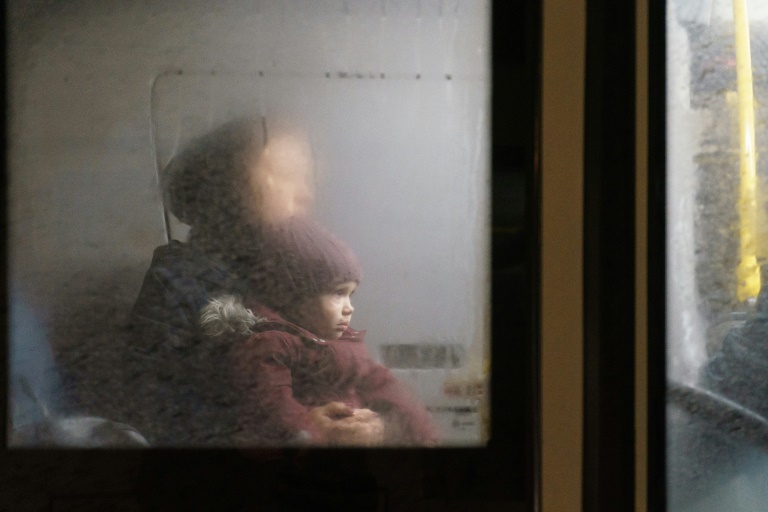
More than 4.2 million Ukrainian refugees have now fled the country since the Russian invasion, the United Nations said Monday, adding that the humanitarian situation was worsening.

UNHCR, the UN refugee agency, said 4,215,047 Ukrainians had fled the country since the war began on February 24 — a figure up 38,646 on the numbers for Sunday. 

“The humanitarian needs are growing by the minute as more people flee the war in Ukraine,” the UN’s International Organization for Migration said.

The IOM says that in addition to Ukrainian refugees, nearly 205,500 non-Ukrainians living, studying or working in the country have also left. 

Meanwhile, nearly 6.48 million people were estimated to be internally displaced within Ukraine as of mid-March, according IOM.

Before the Russian invasion, Ukraine had a population of 37 million in the regions under government control, excluding Russia-annexed Crimea and the pro-Russian separatist regions in the east. 

Women and children account for 90 percent of those who have left Ukraine, with men aged 18 to 60 eligible for military call-up and unable to leave.

The UN children’s agency UNICEF said in late March that more than half of the country’s estimated 7.5 million children had been displaced — 2.5 million internally and two million abroad.

Here is a breakdown of how many Ukrainian refugees have fled to neighbouring countries, according to UNHCR:

– Poland –

Nearly six out of 10 Ukrainian refugees — 2,451,342 so far — have crossed into Poland, according to the UN tally. 

Many people who go to Ukraine’s immediate western neighbours travel on to other states in Europe’s Schengen open-borders zone.

But Poland’s deputy interior minister said 1.5 million have remained in the country, of whom 600,000 have already obtained a Polish national identification number, used for accessing services.

Alexander Mundt, UNHCR’s senior emergency coordinator in Poland, said that as people crossed the border at Medyka, he wanted to make sure they had information as to what they could expect and how they could keep safe.

“All assistance is free, and here on this side of the border the response by the Polish civil society and volunteers in every town has been staggering. I’ve never seen anything like it,” he said.

– Romania –

A total of 643,058 Ukrainians have entered the EU member state, including a large number who crossed over from Moldova, wedged between Romania and Ukraine. 

The vast majority are thought to have gone on to other countries. 

– Moldova –

The Moldovan border is the closest to the major port city of Odessa, which was hit by air strikes on Sunday. Some 394,740 Ukrainians have crossed into the non-EU state, one of the poorest in Europe.

Most of those who have entered the former Soviet republic of 2.6 million people have moved on.

But around 93,000 have stayed, with the UN Development Programme saying that some 80 percent are being housed by private individuals.

– Hungary –

A total of 390,302 Ukrainians have entered Hungary. 

– Russia –

Some 350,632 refugees had sought shelter in Russia as of last Tuesday.

In addition, 113,000 people crossed into Russia from the separatist-held pro-Russian regions of Donetsk and Lugansk in eastern Ukraine between February 21 and 23. 

– Slovakia –

A total of 301,405 people have crossed Ukraine’s shortest border into Slovakia. 

– Belarus –

Another 15,281 refugees had made it north to Russia’s close ally Belarus.

More Ukrainians move west as Russia turns focus to Donbas

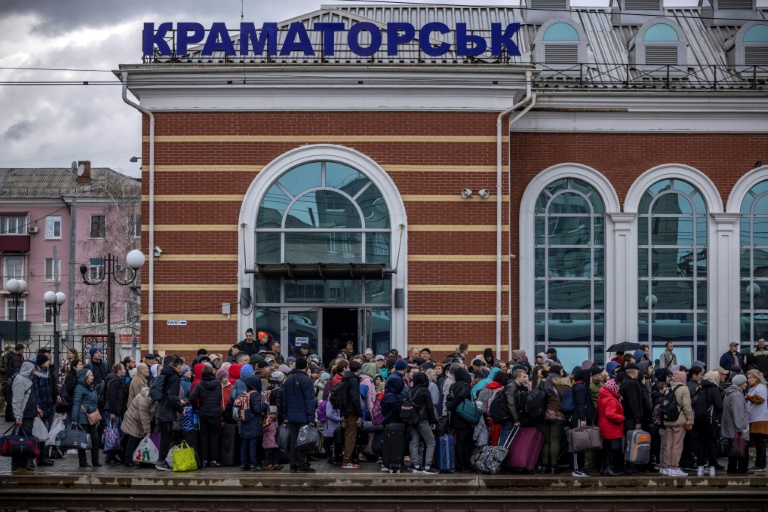
Hundreds wait for a train to take them west out of the path of the Russian advance at the station in Kramatorsk, the de facto capital of Ukrainian-controlled territory in Donbas.

“It’s been like this since the end of last week. Almost 2,000 people a day are boarding trains west for Lviv or elsewhere,” says Nasir, a humanitarian volunteer helping with the operation.

“It used to be two trains a day. Now it’s four,” he adds.

“The situation is bad. Lots of people have already left. The men are staying, our families are leaving,” says Andriy, whose wife and two children are taking shelter from the rain under the awning of a fast-food hut with their bags at their feet.

Sofia, his teenage daughter standing around with three friends also making their way west, admits she is “a bit sad” to be leaving.

“I’m sending my children to the west like everyone else, to my brother-in-law’s village” away from the frontline, says Andriy, holding on to his youngest child’s hand.

 – Next Mariupol? –

Since Russia announced its intention to concentrate its efforts on the “liberation” of Donbas, the traditional mining region in the east of Ukraine, residents have lived in fear of a major military offensive.

Authorities in Kyiv say they expect the situation to get worse as Russian troops seek to encircle Ukrainian forces arranged since 2014 along the frontline between Donetsk to the south and Lugansk in the east, the capitals of the two pro-Russian, breakaway “republics” of the same name.

The de facto capital of the rump region still under Ukrainian control, Kramatorsk sits between the pincers of the Russian army, which has just taken the city of Izyum, to the north-west of the city.

“According to the latest reports, Russia is moving its troops to the east and we will soon be surrounded,” says Viktoria, a medic.

“We hope our army will hold out. This could be the next Mariupol,” she says, a reference to the southern Ukrainian port, which has been pounded by the Russian army.

“Frankly, there has not really been a war in Kramatorsk so far,” Viktoria says.

Sat in the Don river basin, more than 150,000 people lived in Kramatorsk before the war. Relatively spread out, the city has so far only been targeted sparingly by Russian attacks.

The roads in the city are deserted and the situation calm, for now.

“The bombing could start at any moment,” says Andriy.

“People say something terrible is coming here,” says Svetlana, who has accompanied a friend to the station. Her children have left, she says.

But she has to stay behind with her husband, she adds, to look after the grandmother of the family.

 – ‘Time to go’ –

On the right of the platform, are the families with young children.

On the other end are older people and single women, including another Svetlana, sports bag over one shoulder and holding her Fox Terrier on a leash in the other hand.

The dog’s paws tremble. “She is nervous. She knows something is happening,” says Svetlana.

“Friends have found me an apartment in Rivne (in western Ukraine). We’re really scared now. I waited until the last moment but now it’s time to go.”

A policeman in a black uniform with his gun by his side squeezes his daughter in his arms. “Our children are our treasures,” he says.

The Rybalko family is waiting on a bench with their baggage on their laps. The boy is nibbling on some chocolate while their eldest daughter runs around their feet.

“Up until the very last moment, we wanted to stay, but with the kids it’s too risky,” says Tamara, one of the two grandmothers travelling with the family.

“They’re saying the front will reach here. I can’t quite believe it. My husband is staying here. He loves his home, his dogs and his garden too much.”

The departure proceeds in an orderly fashion, the mood among the travellers caught between anxiety, sadness and resignation.

The train arrives, bound for Khmelnytsky, 14 hours and 800 km (497 miles) to the west, and passengers are helped on.

“In normal times it’s four people per compartment. At the moment, it’s eight, so 700 passengers in total,” says the train conductor Sergiy Popatienko.

Within a few minutes, everyone is on board, leaving just enough time for a hug and a quick kiss goodbye.

“Why am I staying?” says Ivan, Tamara’s husband. “My city will probably need me. I was born here. I’ve lived here. We’re going to wait for these bad times to pass.”

Stocks up, oil steady on easing supply, inflation concerns

Stock markets climbed and oil prices steadied Monday on easing concerns over tight crude supplies and decades-high inflation, traders said.

Turkey’s lira was stable against the dollar and euro after official data showed the country’s inflation had soared to a fresh record high.

Elsewhere, trading was halted on Sri Lanka’s stock exchange seconds after opening Monday as the island nation’s president offered to share power with the opposition.

Protests demanding the resignation of Gotabaya Rajapaksa grew over unprecedented food and fuel shortages along with record inflation and crippling power cuts in the South Asian country.

Sri Lanka’s stock market slid more than the five percent in value — the threshold needed to trigger an automatic stop.

On the corporate front, Twitter’s stock soared by more than 25 percent in pre-market trade after Tesla boss Elon Musk took a major stake in the social media giant.

According to a document filed with the US Securities and Exchange Commission, Musk acquired nearly 73.5 million Twitter shares — a 9.2-percent stake in the company. 

Ahead of Wall Street’s reopening, other major stock markets “continued their cautious grind higher, as investors took solace from a US economy which is showing increasing signs of being able to withstand the likely onslaught of interest rate rises to come”, noted Richard Hunter, head of markets at Interactive Investor.

The world’s top economy added 431,000 jobs in March while the US unemployment rate fell to just slightly above pre-pandemic levels, official data showed Friday. 

Economists viewed the figures as reinforcing the Federal Reserve’s commitment to forcefully raising interest rates, perhaps by half a percentage point at its meeting next month, which would be double the increase it announced when it began hiking in March.

Stock markets Monday were helped by steadier oil prices after recent surges triggered by tight supply concerns, notably owing to the invasion of Ukraine by major crude producer Russia.

The 31-nation International Energy Agency on Friday agreed to tap its vast reserves to offset the removal of Russian exports.

There was some cheer also from news of a 60-day ceasefire in Yemen’s six-year civil war that has seen several attacks on Saudi facilities, in turn hitting output from the world’s biggest oil producer.

– Key figures around 1100 GMT –

London – FTSE 100: UP 0.2 percent at 7,555.73 points

Frankfurt – DAX: FLAT at 14,450.49

Paris – CAC 40: UP 0.2 percent at 6,700.38

EURO STOXX 50: UP 0.1 percent at 3,924.35

Tokyo – Nikkei 225: UP 0.3 percent at 27,736.47 (close)

Hong Kong – Hang Seng Index: UP 2.1 percent at 22,502.31 (close)

Shanghai – Composite: Closed for a holiday

New York – Dow: UP 0.4 percent at 34,818.27 (close)

Brent North Sea crude: FLAT at $104.37 per barrel

West Texas Intermediate: FLAT at $99.31 per barrel

Euro/dollar: DOWN at $1.1002 from $1.1049 late Friday

Pound/dollar: DOWN at $1.3098 from $1.3118

Euro/pound: DOWN at 84.00 pence from 84.24 pence 

Dollar/yen: UP at 122.76 yen from 122.49 yen

Tougher Russia sanctions urged over Ukraine 'war crimes'

EU officials said Monday they were weighing new sanctions targeting Moscow in response to alleged atrocities against Ukrainian civilians by Russian forces that sparked a wave of international outrage.

Despite Russian denials of responsibility, condemnation was swift, with Western leaders, NATO and the UN all voicing horror at images of dead bodies in Bucha, northwest of Kyiv, and elsewhere.

Local authorities said they had been forced to dig communal graves to bury the dead accumulating in the streets, including one in Bucha found with his hands bound behind his back.

Ukraine’s President Volodymyr Zelensky called Russian troops “murderers, torturers, rapists, looters” and warned in his nightly video message that “concentrated evil has come to our land.” 

EU foreign policy chief Josep Borrell said the bloc was urgently discussing a new round of sanctions as it condemned “atrocities” reported in Ukrainian towns that have been occupied by troops sent in by Russian President Vladimir Putin five weeks ago.

The proposals, which French President Emmanuel Macron said could target Russia’s oil and coal sectors, could be discussed by foreign ministers on the sidelines of a NATO meeting on Wednesday and Thursday, or at their regular meeting early next week, an EU official told AFP.

Borrell also offered EU assistance in documenting evidence of the alleged atrocities, and Zelensky said he had created a special body to investigate.

The scale of the killings is still being pieced together, but Ukrainian prosecutor general Iryna Venediktova said 410 civilian bodies had been recovered so far.

And Bucha’s mayor Anatoly Fedoruk told AFP that 280 bodies were placed in mass graves because it was impossible to bury them in cemeteries still within firing range of Russian forces.

Satellite imagery firm Maxar released pictures it said showed a mass grave located in the grounds of a church in the town.

Municipal worker Serhii Kaplychnyi told AFP that Russian troops initially refused to allow residents to bury the dead in Bucha.

“They said while it was cold to let them lie there.”

Eventually, they were able to retrieve the bodies, he said. “We dug a mass grave with a tractor and buried everyone.”

AFP reporters in the town saw at least 20 bodies, all in civilian clothing, strewn across a single street. 

– ‘Clear indications of war crimes’ –

Zelensky’s spokesman, Sergiy Nikiforov, said the scene in Bucha “looks exactly like war crimes.”

Moscow rejected the accusations and suggested the images of corpses were “fakes” while calling for a UN Security Council meeting on what its deputy ambassador to the body called a “heinous provocation of Ukrainian radicals in Bucha.”

“We categorically reject all allegations,” Kremlin spokesman Dmitry Peskov told journalists. 

But Macron said he was in favour of fresh sanctions since “there are very clear indications of war crimes. It was the Russian army that was in Bucha,” he told France Inter radio. 

In Germany, Chancellor Olaf Scholz’s defence minister raised the possibility of an end to gas imports. 

“President Putin and his supporters will feel the consequences,” Scholz said.

Prime Minister Mateusz Morawiecki of Poland, whose country has welcomed millions of Ukrainians fleeing the violence, called for an international investigation into what he termed a “genocide.”

– ‘Even worse things’ –

Zelensky warned that the worst could be yet to come as Moscow refocuses its attention on the south and east of the country, in a bid to create a land link between occupied Crimea and the Russian-backed separatist statelets of Donetsk and Lugansk.

“Russian troops still control the occupied areas of other regions, and after the expulsion of the occupiers, even worse things could be found there, even more deaths and tortures,” he said.

Eight people were killed and 34 wounded in Russian attacks on two towns in southern Ukraine on Sunday, prosecutors in Kyiv said.

Europe’s worst conflict in decades, sparked by Russia’s invasion on February 24, has already killed 20,000 people, according to Ukrainian estimates.

Nearly 4.2 million Ukrainians have fled the country, with almost 40,000 pouring into neighbouring countries in the last 24 hours alone, the UN refugee agency said.

In the eastern city of Kramatorsk, women, children and elderly people were boarding trains to flee the Donbas region.

“The rumour is that something terrible is coming,” said Svetlana, a volunteer organising the crowd on the station platform.

Russia has redoubled its efforts in Ukraine’s south and east, including carrying out several strikes Sunday on the strategic Black Sea port of Odessa, which Moscow said targeted an oil refinery and fuel depots.

“We were woken up by the first explosion, then we saw a flash in the sky, then another, then another. I lost count,” a 22-year-old resident, Mykola, told AFP.

Britain’s defence ministry said recent Russian air activity had been focused on southeastern Ukraine, adding that heavy fighting was continuing in the devastated and besieged southern city of Mariupol.

“The city continues to be subject to intense, indiscriminate strikes,” the ministry said in an update on Twitter.

The UN’s top humanitarian envoy Martin Griffiths is expected in Kyiv soon after arriving in Moscow on Sunday in an attempt to halt the fighting.

And peace talks are scheduled to resume by video on Monday, though Russia’s chief negotiator Vladimir Medinsky said it was too early for a top-level meeting between Zelensky and Putin.

He said Kyiv had become “more realistic” in its approach to issues related to the neutral and non-nuclear status of Ukraine, but a draft agreement for submission to a summit meeting was not ready.

burs/js/jh/lc

Sri Lanka leader offers to share power as protests escalate

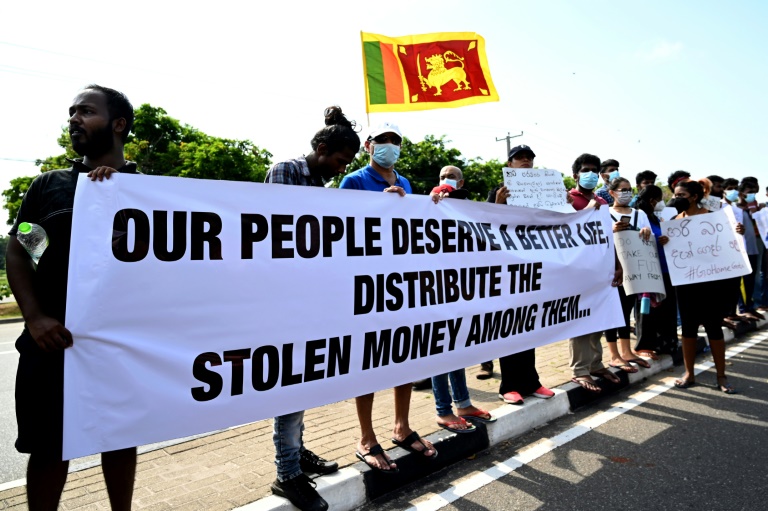
Sri Lanka’s embattled president offered to share power with the opposition on Monday as protests demanding his resignation grew over the worsening shortages of food, fuel and medicines.

President Gotabaya Rajapaksa’s invitation to legislators came as heavily armed security forces looked to quell more demonstrations over what the government itself has acknowledged as the worst shortages of essentials since independence from Britain in 1948.

“The president invites all political parties in parliament to accept cabinet posts and join the effort to seek solutions to the national crisis,” Rajapaksa’s office said in a statement.

It stressed that solutions to the deepening crisis should be found “within a democratic framework”, as thousands joined spontaneous demonstrations in cities, towns and villages.

The invitation came after 26 cabinet members — every minister except Rajapaksa and his elder brother Prime Minister Mahinda Rajapaksa — submitted letters of resignation at a late-night meeting on Sunday.

The country’s central bank governor Ajith Cabraal — who has long opposed an International Monetary Fund bailout for the country — also stepped down on Monday.

The departures cleared the way for the country’s ruling political clan to seek to shore up its weakening position.

The first nominations to the new cabinet saw the president re-appoint four of the outgoing ministers, three of them to their old jobs, while he replaced his brother Basil as finance minister with the previous justice chief.

Other cabinet vacancies will be filled after talks with the opposition, the president said.

But there was no immediate response from the opposition, which would not join any Rajapaksa-led government, according to comments Sunday by its main leader Sajith Premadasa.

Political analysts said the offer of a unity government did not go far enough to address the economic crisis or restore confidence in the Rajapaksa administration.

“This is like re-arranging the deck chairs on the Titanic,” Bhavani Fonseka, political analyst and human rights lawyer, told AFP. “This is a joke.”

Political columnist Victor Ivan added that a cabinet reshuffle in the guise of a national government would not be acceptable to people demanding the Rajapaksas’ departure.

“What is needed is a serious reform programme, not just to revive the economy but address issues of governance,” Ivan told AFP. 

– Power base protest –

The South Asian island nation is in the grip of unprecedented food and fuel shortages along with record inflation and crippling power cuts, with no sign of an end to the economic woes.

Trading was halted on the country’s stock exchange seconds after it opened Monday as shares fell by more than the five percent threshold needed to trigger an automatic stop.

The government has announced it will seek a bailout from the International Monetary Fund, but talks are yet to begin.

Troops and police were placed on high alert as a 36-hour curfew ended at dawn despite intelligence reports warning of more unrest, a top security official told AFP.

Thousands took to the streets in the Rajapaksa bastion of Tangalle in the island’s deep south demanding the resignation of the family, police said.

Anti-Rajapaksa rallies would have been unthinkable in the region in recent years.

– ‘Go home Gota’ –

“Go lunatic, Gota lunatic,” crowds chanted on Monday in Kiribathgoda, referring to the president, who had imposed a state of emergency a day after a crowd attempted to storm his residence.

Throughout Sunday evening, hundreds of people had staged noisy but peaceful demonstrations in towns across the island of 22 million, denouncing Rajapaksa’s handling of the crisis.

But Sunday’s full-day curfew prevented larger protests that had been organised through social media platforms such as Facebook, Twitter and WhatsApp, all of which were blocked by the government.

The platforms were unblocked and the partial internet censorship ended after 15 hours, as the Human Rights Commission of Sri Lanka ruled the ban illegal.

A junior coalition partner announced it would quit the administration this week, a move that would weaken Rajapaksa’s majority in the legislature.

Many economists say Sri Lanka’s crisis has been exacerbated by government mismanagement, years of accumulated borrowing and ill-advised tax cuts.

Close Bitnami banner
Bitnami