World

Pakistan's top court meets as constitutional crisis rages

Pakistan’s Supreme Court was hearing arguments Monday around Prime Minister Imran Khan’s shock decision to call an early election, sidestepping a no-confidence vote that would have seen him booted from office.

The opposition had expected to take power on Sunday after mustering enough votes to oust the cricketer-turned-politician, but the national assembly deputy speaker refused to allow the motion to proceed because of “foreign interference”.

Simultaneously, Khan asked the presidency — a largely ceremonial office held by a loyalist — to dissolve the assembly, meaning an election must be held within 90 days.

On paper, and pending any court decision, Khan will remain in charge until an interim government is formed to oversee elections.

A notice Monday from President Arif Alvi to Khan and opposition leader Shehbaz Sharif said they should agree on a new interim prime minister, but Sharif declined to cooperate.

“How can we respond to a letter written by a person who has abrogated the constitution?” he told a press conference Monday.

According to the constitution, the prime minister cannot ask for the assembly to be dissolved while he is facing a no-confidence vote.

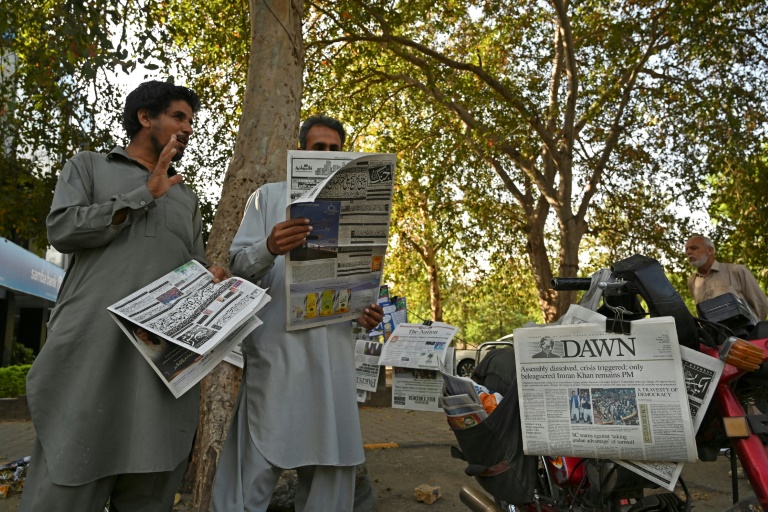
“Khan’s ‘surprise’ triggers constitutional crisis,” thundered The Nation newspaper Monday, while its rival Dawn called it “A travesty of democracy” above a front-page editorial.

An alliance of usually feuding dynastic parties had plotted for weeks to unravel the tenuous coalition that made Khan premier in 2018, but he claimed they went too far by colluding with the United States for “regime change”.

– Washington denial –

Khan insists he has evidence — which he has declined to disclose publicly — of Washington’s involvement, although local media have reported it was merely a letter from Pakistan’s ambassador following a briefing with a senior US official.

Western powers want him removed because he won’t stand with them on global issues against Russia and China, Khan said.

Washington has denied involvement.

Pakistan’s Supreme Court has now received a slew of suits and petitions from the government and opposition regarding the crisis, but has also taken up the case “suo moto” — on its own merit.

“This is an urgent matter,” chief justice Umar Atta Bandial said late Sunday.

The current court is ostensibly independent, but rights activists say previous benches have been used by civilian and military administrations to do their bidding throughout Pakistan’s history.

It is unclear when the court may rule on the issue — or if Khan would even accept its decision — but there is precedent.

In 1988 Muhammad Khan Junejo appealed to the Supreme Court after the assembly was dissolved by President General Zia-ul-Haq, who had taken power in a military coup years earlier.

The court agreed his government had been dissolved unconstitutionally, but ruled that since elections had been announced anyway it was best to move on.

Khan was elected after promising to sweep away decades of entrenched corruption and cronyism, but has struggled to maintain support with inflation skyrocketing, a feeble rupee and crippling debt.

Some analysts said Khan had also lost the crucial support of the military, but it is unlikely he would have pulled off Sunday’s manoeuvres without its knowledge — if not blessing.

There have been four military coups — and at least as many unsuccessful ones — since independence in 1947, and the country has spent more than three decades under army rule.

“The best option in this situation are fresh elections to enable the new government to handle economic, political and external problems faced by the country,” said Talat Masood, a general-turned-political analyst.

As the opposition scrambled to react, Khan taunted them on Twitter.

“Astonished by the reaction,” he tweeted, adding the opposition had been “crying hoarse” about the government failing and losing the support of the people.

“So why the fear of elections now?”
Hong Kong leader Carrie Lam to leave office

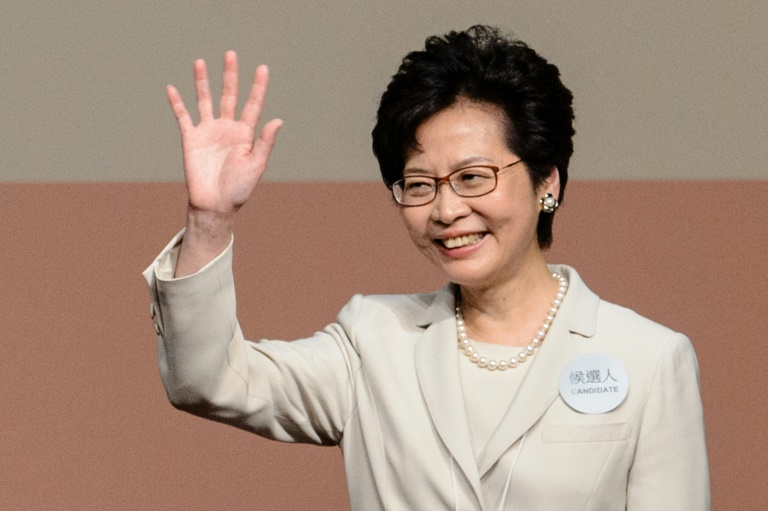
Hong Kong’s leader Carrie Lam announced Monday that she will step down in June, ending a divisive term that saw democracy protests squashed and strict pandemic curbs plunge the business hub into international isolation.

Ending months of speculation, Lam confirmed she would not seek a second term when a committee made up of the city’s political elite chooses a new leader next month. 

“I will complete my five-year term as chief executive on June 30, and officially conclude my 42-year career in government,” Lam told reporters.

Lam said China’s leaders “understood and respected” her choice not to seek another term and that she wanted to spend more time with her family. 

The 64-year-old had dodged questions for months over her future and during Monday’s announcement she revealed that she had informed Beijing of her plans to quit more than a year ago.  

A career bureaucrat, Lam became Hong Kong’s first woman leader in 2017 but she is on track to leave office with record-low approval ratings. 

Kenneth Chan, a political scientist at Baptist University, said Hong Kong leaders have always suffered from a “chronic legitimacy crisis” because they are not popularly elected.

But Lam had lost support across the political spectrum. 

“Not merely among the pro-democracy citizens but also increasingly among the pro-Beijing camp as she has done such a terrible job with the pandemic,” he told AFP.

– Security tsar next leader? –

Hong Kongers and businesses based in the finance hub currently have little clarity on who will be the next leader at a time when Beijing is increasingly calling the shots directly.

The chief executive position is not popularly elected, something that years of democracy protests failed to change.

Instead, the position is selected by a 1,500-strong pro-Beijing committee, the equivalent of 0.02 percent of the city’s 7.4 million population. 

The next chief executive will be chosen on May 8 but so far no one with a realistic prospect has publicly thrown their hat into the ring. 

Hong Kong’s number-two official, John Lee, who has a background in the security services, has been tipped by local press as the most likely contender.

Another potential front runner is finance chief Paul Chan.

Lam’s successor will take office on July 1, the 25th anniversary of Hong Kong’s handover by Britain to China.

Supporters saw Lam as a staunch Beijing loyalist who steered the city through huge democracy protests and a debilitating pandemic. 

Starry Lee, who leads Hong Kong’s largest pro-Beijing party the DAB, described Lam on Monday as a “hard-working” official.

“Her merit… should be left to history to judge,” she said.

Critics, including many Western powers, viewed Lam as someone who oversaw the collapse of Hong Kong’s political freedoms and its reputation as a stable regional business hub.

– Protests and pandemic –

After huge and sometimes violent protests swept Hong Kong in 2019 Beijing responded with a crackdown that has remoulded the once-outspoken city into a mirror of the authoritarian mainland. 

Lam became the first Hong Kong leader to be sanctioned by the United States, because of her support for the crackdown, which has seen most of the city’s prominent democracy supporters arrested, jailed or flee overseas.

Her administration also hewed to China’s zero-Covid model, implementing some of the world’s toughest anti-coronavirus measures and exasperating international businesses.

The largely closed borders and strict quarantine rules kept infections at bay for some two years at the expense of Hong Kong being cut off internationally.

But the strategy collapsed when the highly transmissible Omicron variant broke through earlier this year leaving Hong Kong with one of the developed world’s highest fatality rates. 

Hong Kongers have been leaving the city over the last two years at a rate not seen since the period before the handover.

Thousands of foreign residents have also departed, especially in the first quarter of this year when the Omicron outbreak raged and it became clear the city would remain cut off.

Hong Kong’s stock exchange was trading up two percent following Lam’s announcement.

While the return of protests are unlikely in the current draconian political climate, Lam’s successor will need to reboot business confidence and tackle perennial Hong Kong problems such as a dismal shortage of housing.   

But Lam predicted on Monday that whoever replaces her will have an easier ride. 

“Compared to this term of government, the next government will be seeing a more stable political environment,” she told reporters. 

Turkish inflation hits fresh record at 61.1 percent

Turkey’s inflation has soared to a new record, official data showed Monday, as analysts see an impact from Russia’s invasion of Ukraine and President Recep Tayyip Erdogan’s unorthodox interest rate policy.

Exacerbating a cost of living crisis, consumer prices accelerated to 61.14 percent at an annual rate, up from 54.4 percent in February, according to the statistics agency.

The weakening lira and runaway inflation have become major sources of public discontent in Turkey as President Recep Tayyip Erdogan faces an election next year.

Turkey has recorded double digit inflation since early 2017 but the latest figure is the highest since the ruling Justice and Development Party (AKP) came to power in 2002.

The currency was stable following the latest inflation data, trading at 14.7 lira against the dollar and 16.2 lira against euro.

The war in Turkey’s Black Sea neighbourhood has had a major impact on the country as Russia is a key supplier of energy while Ukraine ships wheat. Turkish tourism industry also mainly relies on Russian tourists. 

On Friday, S&P global rating agency kept a negative outlook on Turkey and cut its credit rating. 

“The fallout of the Russia-Ukraine military conflict, including rising food and energy prices, will further weaken Turkey’s already tenuous balance of payments and exacerbate inflation,” it said.

The biggest price increases in March were in transportation and food prices, according to the statistics agency.

-‘Be patient’-

While countries around the world are facing rising inflation as energy prices have soared while economies emerge Covid restrictions, Turkey’s problems have also been affected by Erdogan’s unorthodox economic approach. 

The Turkish leader rejects the idea that inflation should be fought by hiking the main interest rate, which he believes causes prices to grow even higher — the exact opposite of conventional economic thinking.

Turkish central bank “policies are just not working in countering inflation,” said Timothy Ash, emerging markets strategist at BlueBay Asset Management. 

“Indeed, I think the overwhelming consensus is that the unorthodox policy settings of the CBRT (central bank) are a major cause of inflation,” he said in a note to clients.

“The war in Ukraine is just making things that much worse.”

On Saturday, Erdogan said increase in food and energy prices triggered by the war in Ukraine “is affecting us too.”

“We are fighting against those who are charging unreasonably high prices,” he said. 

“There are problems we need to address … I ask you to be patient and trust us,” in reference to people squeezed by the biting inflation. 

In January, Erdogan changed the head of the state statistics agency.

Turkish media reported that he was unhappy with the inflation figures it published while the opposition believes that the official figures grossly underestimate the reality.

Jason Tuvey, senior emerging markets economist at the London-based Capital Economics, said inflation was likely to rise further over the coming months and stay close to the current high rates for much of this year.

“But there is still little sign that the central bank and, crucially, President Erdogan are about to shift tack and hike interest rates,” he said. 

War in Ukraine: Latest developments

Here are the latest developments in the war in Ukraine:

– Outrage over civilian killings –

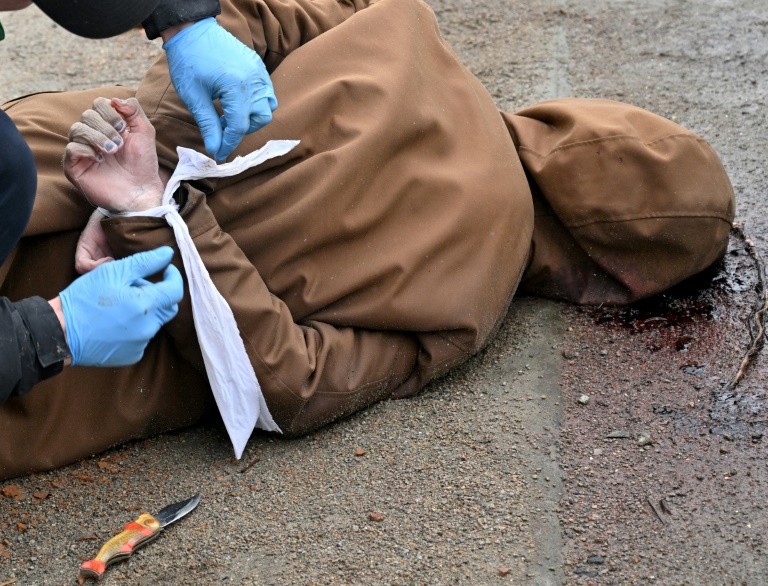
Global outrage grows over the discovery of dozens of bodies in the Ukrainian town of Bucha, some with their hands bound, after the withdrawal of Russian forces from the area west of Kyiv.

Britain, France, Germany, the United States, NATO and the United Nations voice horror after the reports of civilians being murdered and AFP pictures showing a street littered with corpses.

French President Emmanuel Macron says there are “very clear indications of war crimes” and backs calls by fellow EU leaders, including German Chancellor Olaf Scholz, for further sanctions on Moscow.

President Volodymyr Zelensky calls Russian troops “murderers, torturers, rapists, looters” who “deserve only death after what they did”. 

Polish Prime Minister Mateusz Morawiecki calls for an international investigation into what he termed a “genocide” carried out by Russian troops.

– Hundreds of bodies –

Ukrainian prosecutor general Iryna Venediktova says 410 civilian bodies were recovered from areas around Kyiv recently retaken from Russian forces.

AFP sees at least 20 bodies, all in civilian clothing, strewn across a single street in Bucha.

Bucha’s mayor Anatoly Fedoruk says 280 bodies were buried in mass graves.

– Russian denials –

Russia’s defence ministry says “not a single local resident” in Bucha suffered violence, accusing Ukraine of bombarding its own suburbs and falsifying images of corpses in “another production” for Western media.

Moscow calls for a special UN Security Council meeting to discuss what it calls the actions of “Ukrainian radicals”.

A senior Washington official says the move is designed to “feign outrage”.

– Zelensky addresses Grammys –

Zelensky makes a surprise appearance at the Grammy music awards, appearing in a pre-taped video urging support for his country.

“Our musicians wear body armour instead of tuxedos,” he says. “They sing to the wounded in hospitals — even to those who can’t hear them. But the music will break through anyway.”

– Full isolation ‘impossible’ –

Kremlin spokesman Dmitry Peskov says it is not possible to isolate Russia entirely, telling Russian state television that the world is “much larger than Europe”.

– Strikes in east, south –

Russia steps up its attacks in eastern Ukraine, killing seven people and wounding 34 in strikes on a residential area of the country’s second largest city Kharkiv, according to local authorities.  

Russian forces also shell the nearby town of Dergachi, leaving at least three civilians dead and wounding seven, its mayor says.

Six people are reportedly killed in the eastern Donetsk region by strikes and one in the east Ukrainian town of Rubizhne, where Russian forces are accused of targeting a local hospital.

Russia also maintains its offensive in southern Ukraine. 

One person is killed and 14 injured after a Russian strike on the city of Mykolaiv, according to the local governor, and the strategic Black Sea port of Odessa is also targeted in air strikes.

– Too soon for peace summit –

Russia’s chief negotiator Vladimir Medinsky says it is too early for a top-level meeting between Zelensky and Putin on ending the conflict.

He says Kyiv has become “more realistic” in its approach to issues related to the neutral and non-nuclear status of Ukraine but a draft agreement for submission to a summit meeting is not ready.

Zelensky calls Russian troops murderers, outrage grows over 'war crimes'

Ukraine’s President Volodymyr Zelensky called Russian troops “murderers, torturers, rapists, looters” on Monday after dozens of bodies were found near Kyiv, triggering global outrage and vows of tough new sanctions on Moscow.

Local authorities said they had been forced to dig communal graves to bury the dead accumulating in the streets, including some found with their hands bound behind their backs, in scenes that sent shockwaves through international capitals more than a month into Russia’s invasion.

Despite Russian denials of responsibility, condemnation was swift, with Western leaders, NATO and the UN all voicing horror at reports of civilian murders in Bucha, northwest of Kyiv, and elsewhere.

Zelensky was unsparing in his nightly video message, warning “concentrated evil has come to our land”.

He described Russian troops as “murderers, torturers, rapists, looters, who call themselves the army and who deserve only death after what they did”, speaking in Ukrainian.

Switching to Russian, he continued: “I want every mother of every Russian soldier to see the bodies of the killed people in Bucha, in Irpin, in Hostomel.”

“I want all the leaders of the Russian Federation to see how their orders are being fulfilled.”

Zelensky said he had created a special body to investigate killings in areas from which Russian troops have withdrawn around the capital, as Moscow refocuses its energies on southeastern Ukraine.

The scale of the killings is still being pieced together, but Ukrainian prosecutor general Iryna Venediktova said 410 civilian bodies had been recovered so far.

And Bucha’s mayor Anatoly Fedoruk told AFP that 280 bodies were placed in mass graves because it was impossible to bury them in cemeteries within firing range.

Satellite imagery firm Maxar released pictures it said showed a mass grave located in the grounds of a church in the town.

Municipal worker Serhii Kaplychnyi told AFP that Russian troops initially refused to allow residents to bury the dead in Bucha.

“They said while it was cold to let them lie there.”

Eventually, they were able to retrieve the bodies, he said. “We dug a mass grave with a tractor and buried everyone.”

AFP reporters in the town saw at least 20 bodies, all in civilian clothing, strewn across a single street. 

The UN said it was “highly concerned” by images emerging from the region, though it said it could not rule out that some of the dead were fighters or had died of natural causes.

– ‘Clear indications of war crimes’ –

Ukraine’s Foreign Minister Dmytro Kuleba accused Russia of a “deliberate massacre”, while Zelensky’s spokesman, Sergiy Nikiforov, said the killings in Bucha “looks exactly like war crimes”.

Russia’s defence ministry pushed back, saying “not a single local resident” in Bucha suffered violence. 

It accused Kyiv of falsifying images of corpses in “another production” for Western media.

Moscow’s deputy ambassador to the UN said Russia had requested a UN Security Council meeting on Monday “in light of heinous provocation of Ukrainian radicals in Bucha” — but a senior Washington official said the move was designed to “feign outrage”.  

The deaths have heightened calls for new measures against Russia.

On Monday, French President Emmanuel Macron said he was in favour of fresh sanctions.

“There are very clear indications of war crimes. It was the Russian army that was in Bucha,” Macron told the France Inter broadcaster. 

He said new measures could target the oil and coal industries.

German Chancellor Olaf Scholz said new sanctions would be decided “in the coming days”, with his defence minister raising the possibility of an end to gas imports. 

“(Russian) President (Vladimir) Putin and his supporters will feel the consequences,” Scholz said.

Other European officials, including Irish Foreign Minister Simon Coveney, said the EU “must respond strongly with tougher sanctions”, while Zelensky said “there will definitely be a new package of sanctions against Russia”.

Polish Prime Minister Mateusz Morawiecki on Monday called for an international investigation into what he termed a “genocide”.

And Prime Minister Pedro Sanchez said Spain “will do everything… to deal with these alleged cases of (crimes against) humanity, war crimes and why not say it too, genocide”. 

– ‘Something terrible is coming’ –

The Ukrainian leader warned that the worst could be yet to come as Moscow refocuses its attention on the south and east of the country, in a bid to create a land link between occupied Crimea and the Russian-backed separatist statelets of Donetsk and Lugansk.

“Russian troops still control the occupied areas of other regions, and after the expulsion of the occupiers, even worse things could be found there, even more deaths and tortures,” he said.

He also appeared in a taped message at the Grammys, urging people to “tell the truth about this war… support us in any way you can, any, but not silence”.

Europe’s worst conflict in decades, sparked by Russia’s invasion on February 24, has already killed 20,000 people, according to Ukrainian estimates.

Nearly 4.2 million Ukrainians have fled the country, with almost 40,000 pouring into neighbouring countries in the last 24 hours alone, the UN refugee agency said.

In the eastern city of Kramatorsk, women, children and elderly people were boarding trains to flee the Donbas region.

“The rumour is that something terrible is coming,” said Svetlana, a volunteer organising the crowd on the station platform.

Russia has redoubled its efforts in Ukraine’s south and east, including carrying out several strikes Sunday on the strategic Black Sea port of Odessa, which Moscow said targeted an oil refinery and fuel depots.

“We were woken up by the first explosion, then we saw a flash in the sky, then another, then another. I lost count,” resident Mykola, 22, told AFP.

Britain’s defence ministry said recent Russian air activity had been focused on southeastern Ukraine, adding that heavy fighting was continuing in the devastated and besieged southern city of Mariupol.

“The city continues to be subject to intense, indiscriminate strikes,” the ministry said in an update on Twitter.

The UN’s top humanitarian envoy Martin Griffiths is expected in Kyiv soon after arriving in Moscow on Sunday in an attempt to halt the fighting.

And peace talks are scheduled to resume by video on Monday, though Russia’s chief negotiator Vladimir Medinsky said it was too early for a top-level meeting between Zelensky and Putin.

He said Kyiv had become “more realistic” in its approach to issues related to the neutral and non-nuclear status of Ukraine, but a draft agreement for submission to a summit meeting was not ready.

Ukraine has proposed abandoning its aspirations to join NATO and declaring official neutrality, if it obtains security guarantees from Western countries. 

It has proposed temporarily shelving the question of Crimea, annexed by Russia in 2014, and two breakaway territories in the Donbas that Russia has recognised as independent.

Medinsky said Russia’s position on Crimea and the Donbas “remains unchanged”.

burs-sah/reb/ssy

Markets mostly up on US jobs data but rate worries linger

Asian markets mostly rose Monday as another strong jobs report provided some reassurance that the recovery in the US economy remained on track, though it also solidified expectations for more aggressive Federal Reserve interest rate hikes.

The gains were helped by another recent drop in oil prices after the 31-nation International Energy Agency agreed to tap its vast reserves to offset the removal of Russian exports, while the start of a ceasefire in Yemen eased concerns over supplies from the region.

Officials said Friday that the world’s top economy added 431,000 positions in March while the unemployment rate fell to just slightly above pre-pandemic levels. 

The figures showed that while inflation has surged to a 40-year high and the Ukraine war has fanned uncertainty, the recovery continues.

The economy’s resilience will be taken as further evidence that it could withstand a sharper rise in interest rates to bring prices under control, with many observers now predicting a half-point hike in May.

However, expectations that rates will continue to go up have seen Treasury yields surge, with commentators saying there were warning signs that growth will slow as the year progresses.

“It would not be surprising to see yields rise further from here and it is very hard to know where they will land,” Angela Ashton, of Evergreen Consultants, noted.

“Markets are volatile and there is every chance they will overshoot.”

A positive close on Wall Street was followed by a broadly upbeat start to the week in Asia.

Hong Kong led gains, jumping more than two percent thanks to a rally in tech firms after Beijing removed a rule preventing US authorities from inspecting the audits of Chinese companies listed in New York.

The announcement came after a drawn-out row between the two countries with Washington saying Chinese firms could be delisted by 2024 if they do not comply with audit requirements. 

The demand put at risk more than 200 companies, including e-commerce titans Alibaba and JD.com and Tencent.

Tokyo, Singapore, Sydney, Mumbai, Seoul, Manila, Jakarta and Bangkok also rose, though Wellington struggled.

London rose at the open, though Paris and Frankfurt dipped.

Shanghai and Taipei were closed for a holiday.

Crude bounced after Friday’s losses, responding to the IEA pledge to dip into stockpiles to shore up tight supplies caused by Russia’s invasion of Ukraine.

The grouping made the promise at an emergency ministerial meeting, having already announced last week a plan to release more than 60 million barrels.

That came a day after US President Joe Biden said he would release a record 180 million barrels onto the market over six months.

Meanwhile, there was also some cheer from news of a 60-day ceasefire in Yemen’s six-year civil war, which has seen several attacks on Saudi facilities that have hit output from the world’s biggest producer.

Still, analysts said that while markets equity and crude markets have shown some stability after the wild swings seen at the start of the Ukraine war, uncertainty continued to act as a drag and traders remained nervous.

“Risk sentiment over the past week has been inconsistent,” said SPI Asset Management’s Stephen Innes.

“Market signals could be characterised by a repetitive cat-and-mouse game whereby headlines initially emerge around the progress in ceasefire talks before being typically walked down by Russian officials who deny the odds of any close peace deal.”

– Key figures around 0810 GMT –

Tokyo – Nikkei 225: UP 0.3 percent at 27,736.47 (close)

Hong Kong – Hang Seng Index: UP 2.1 percent at 22,502.31 (close)

Shanghai – Composite: Closed for a holiday

London – FTSE 100: UP 0.3 percent at 7,557.60

Brent North Sea crude: UP 1.1 percent at $105.51 per barrel

West Texas Intermediate: UP 1.1 percent at $100.33 per barrel

Euro/dollar: DOWN at $1.1028 from $1.1049 late Friday

Pound/dollar: UP at $1.3125 from $1.3118

Euro/pound: DOWN at 84.02 pence from 84.24 pence 

Dollar/yen: UP at 122.58 yen from 122.49 yen

New York – Dow: UP 0.4 percent at 34,818.27 (close)

Markets mostly up on US jobs data but rate worries linger

Asian markets mostly rose Monday as another strong jobs report provided some reassurance that the recovery in the US economy remained on track, though it also solidified expectations for more aggressive Federal Reserve interest rate hikes.

The gains were helped by another recent drop in oil prices after the 31-nation International Energy Agency agreed to tap its vast reserves to offset the removal of Russian exports, while the start of a ceasefire in Yemen eased concerns over supplies from the region.

Officials said Friday that the world’s top economy added 431,000 positions in March while the unemployment rate fell to just slightly above pre-pandemic levels. 

The figures showed that while inflation has surged to a 40-year high and the Ukraine war has fanned uncertainty, the recovery continues.

The economy’s resilience will be taken as further evidence that it could withstand a sharper rise in interest rates to bring prices under control, with many observers now predicting a half-point hike in May.

However, expectations that rates will continue to go up have seen Treasury yields surge with commentators saying there were warning signs that growth will slow as the year progresses.

“It would not be surprising to see yields rise further from here and it is very hard to know where they will land,” Angela Ashton, of Evergreen Consultants, noted.

“Markets are volatile and there is every chance they will overshoot.”

A positive close on Wall Street was followed by a broadly upbeat start to the week in Asia.

Hong Kong led gains thanks to a rally in tech firms after Beijing removed a rule preventing US authorities from inspecting the audits of Chinese companies listed in New York.

The announcement came after a drawn-out row between the two countries with Washington saying Chinese firms could be delisted by 2024 if they do not comply with audit requirements. 

The demand put at risk more than 200 companies, including e-commerce titans Alibaba and JD.com and Tencent.

Tokyo, Singapore, Sydney, Mumbai, Seoul, Manila, Jakarta and Bangkok also rose, though Wellington struggled.

London, Paris and Frankfurt all rose at the open.

Shanghai and Taipei were closed for a holiday.

Crude bounced after Friday’s losses, responding to the IEA pledge to dip into stockpiles to shore up tight supplies caused by Russia’s invasion of Ukraine.

The grouping made the promise at an emergency ministerial meeting, having already announced last week a plan to release more than 60 million barrels.

That came a day after US President Joe Biden said he would release a record 180 million barrels onto the market over six months.

Meanwhile, there was also some cheer from news of a 60-day ceasefire in Yemen’s six-year civil war, which has seen several attacks on Saudi facilities that have hit output from the world’s biggest producer.

Still, analysts said that while markets equity and crude markets have shown some stability after the wild swings seen at the start of the Ukraine war, uncertainty continued to act as a drag and traders remained nervous.

“Risk sentiment over the past week has been inconsistent,” said SPI Asset Management’s Stephen Innes.

“Market signals could be characterised by a repetitive cat-and-mouse game whereby headlines initially emerge around the progress in ceasefire talks before being typically walked down by Russian officials who deny the odds of any close peace deal.

– Key figures around 0720 GMT –

Tokyo – Nikkei 225: UP 0.3 percent at 27,736.47 (close)

Hong Kong – Hang Seng Index: UP 1.8 percent at 22,443.36

Shanghai – Composite: Closed for a holiday

London – FTSE 100: UP 0.4 percent at 7,566.36

Brent North Sea crude: UP 0.9 percent at $105.37 per barrel

West Texas Intermediate: UP 0.9 percent at $100.20 per barrel

Euro/dollar: DOWN at $1.1039 from $1.1049 late Friday

Pound/dollar: UP at $1.3129 from $1.3118

Euro/pound: DOWN at 84.08 pence from 84.24 pence 

Dollar/yen: UP at 122.67 yen from 122.49 yen

New York – Dow: UP 0.4 percent at 34,818.27 (close)

Viruses that could save millions of lives

It may seem strange after a pandemic that has killed millions and turned the world upside down, but viruses could save just as many lives.

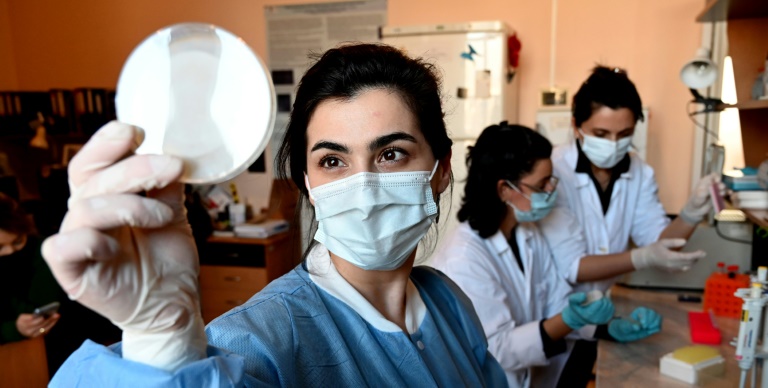
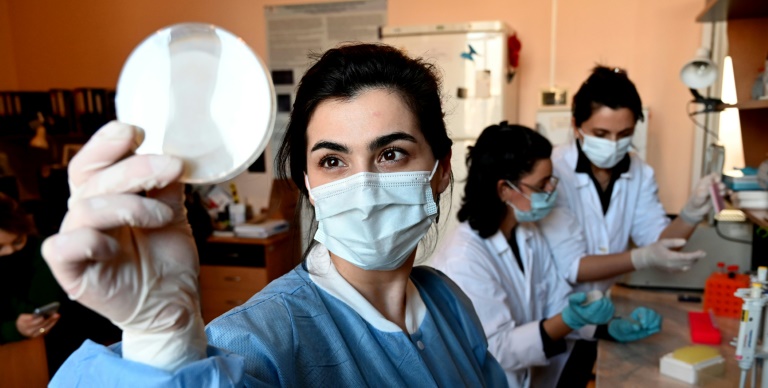
In a petri dish in a laboratory in the Georgian capital Tbilisi, a battle is going on between antibiotic resistant bacteria and “friendly” viruses.

This small nation in the Caucasus has pioneered research on a groundbreaking way to tackle the looming nightmare of bacteria becoming resistant to the antibiotics on which the world depends.

Long overlooked in the West, bacteriophages or bacteria-eating viruses are now being used on some of the most difficult medical cases, including a Belgian woman who developed a life-threatening infection after being injured in the 2016 Brussels airport bombing.

After two years of unsuccessful antibiotic treatment, bacteriophages sent from Tbilisi cured her infection in three months.

“We use those phages that kill harmful bacteria” to cure patients when antibiotics fail, Mzia Kutateladze of the Eliava Institute of Bacteriophages told AFP. 

Even a banal infection can “kill a patient because the pathogen has developed resistance to antibiotics,” Kutateladze said.

In such cases, phagotherapy “is one of the best alternatives”, she added.

Phages have been known about for a century, but were largely forgotten and dismissed after antibiotics revolutionised medicine in the 1930s.

– Stalin’s henchman –

It didn’t help that the man who did most to develop them, Georgian scientist Giorgi Eliava, was executed in 1937 on the orders of another Georgian, Lavrentiy Beria, Stalin’s most notorious henchman and the head of his secret police.

Eliava had worked in the Pasteur Institute in Paris with French-Canadian microbiologist Felix d’Herelle, one of the two men credited with discovering phages, and persuaded Stalin to invite him to Tbilisi in 1934. 

But their collaboration was cut short when Beria had Eliava killed, although his motive still remains a mystery. 

With the World Health Organization now declaring antimicrobial resistance a global health crisis, phages are making a comeback, especially as they can target bacteria while leaving human cells intact.

A recent study warned that superbugs could kill as many as 10 million people a year when antimicrobial resistance due to overuse of antibiotics reaches a tipping point. That could come within three decades.

– ‘Training’ viruses –

While phages-based medicines cannot completely replace antibiotics, researchers say they have major pluses in being cheap, not having side-effects nor damaging organs or gut flora.

“We produce six standard phages that are of wide spectrum and can heal multiple infectious diseases,” said Eliava Institute physician Lia Nadareishvili.

In some 10 to 15 percent of patients, however, standard phages don’t work and “we have to find ones capable of killing the particular bacterial strain,” she added.

Tailored phages to target rare infections can be selected from the institute’s massive collection — the world’s richest — or be found in sewage or polluted water or soil, Kutateladze said.

The institute can even “train” phages so that “they can kill more and more different harmful bacteria.”

“It is a cheap and easily accessible therapy,” she added.

– Last-resort treatment –

A 34-year-old American mechanical engineer suffering from a chronic bacterial disease for six years told AFP he “already felt improvement” after two weeks at the Tbilisi institute.

“I’ve tried every possible treatment in the United States,” said Andrew, who would only give his first name.

He is one of the hundreds of patients from around the globe who arrive in Georgia every year for last-resort treatment, said Nadareishvili.

With the traditional antimicrobial armoury depleting rapidly, more clinical studies are needed so that phagotherapy can be more widely approved, Kutateladze argued.

In 2019, the United States Food and Drug Administration (FDA) authorised a clinical study on the use of bacteriophages to cure secondary infections in Covid patients.

Beyond medicine, phages are already being used to stop food going off, and they “can be used in agriculture to protect crops and animals from harmful bacteria,” Kutateladze said. 

The institute has already conducted research on bacteria targeting cotton and rice.

Bacteriophages also have potential to counter biological weapons and combat bioterrorism, with Canadian researchers publishing a 2017 study on using them to counter an anthrax attack on crowded public places.

Viruses that could save millions of lives

It may seem strange after a pandemic that has killed millions and turned the world upside down, but viruses could save just as many lives.

In a petri dish in a laboratory in the Georgian capital Tbilisi, a battle is going on between antibiotic resistant bacteria and “friendly” viruses.

This small nation in the Caucasus has pioneered research on a groundbreaking way to tackle the looming nightmare of bacteria becoming resistant to the antibiotics on which the world depends.

Long overlooked in the West, bacteriophages or bacteria-eating viruses are now being used on some of the most difficult medical cases, including a Belgian woman who developed a life-threatening infection after being injured in the 2016 Brussels airport bombing.

After two years of unsuccessful antibiotic treatment, bacteriophages sent from Tbilisi cured her infection in three months.

“We use those phages that kill harmful bacteria” to cure patients when antibiotics fail, Mzia Kutateladze of the Eliava Institute of Bacteriophages told AFP. 

Even a banal infection can “kill a patient because the pathogen has developed resistance to antibiotics,” Kutateladze said.

In such cases, phagotherapy “is one of the best alternatives”, she added.

Phages have been known about for a century, but were largely forgotten and dismissed after antibiotics revolutionised medicine in the 1930s.

– Stalin’s henchman –

It didn’t help that the man who did most to develop them, Georgian scientist Giorgi Eliava, was executed in 1937 on the orders of another Georgian, Lavrentiy Beria, Stalin’s most notorious henchman and the head of his secret police.

Eliava had worked in the Pasteur Institute in Paris with French-Canadian microbiologist Felix d’Herelle, one of the two men credited with discovering phages, and persuaded Stalin to invite him to Tbilisi in 1934. 

But their collaboration was cut short when Beria had Eliava killed, although his motive still remains a mystery. 

With the World Health Organization now declaring antimicrobial resistance a global health crisis, phages are making a comeback, especially as they can target bacteria while leaving human cells intact.

A recent study warned that superbugs could kill as many as 10 million people a year when antimicrobial resistance due to overuse of antibiotics reaches a tipping point. That could come within three decades.

– ‘Training’ viruses –

While phages-based medicines cannot completely replace antibiotics, researchers say they have major pluses in being cheap, not having side-effects nor damaging organs or gut flora.

“We produce six standard phages that are of wide spectrum and can heal multiple infectious diseases,” said Eliava Institute physician Lia Nadareishvili.

In some 10 to 15 percent of patients, however, standard phages don’t work and “we have to find ones capable of killing the particular bacterial strain,” she added.

Tailored phages to target rare infections can be selected from the institute’s massive collection — the world’s richest — or be found in sewage or polluted water or soil, Kutateladze said.

The institute can even “train” phages so that “they can kill more and more different harmful bacteria.”

“It is a cheap and easily accessible therapy,” she added.

– Last-resort treatment –

A 34-year-old American mechanical engineer suffering from a chronic bacterial disease for six years told AFP he “already felt improvement” after two weeks at the Tbilisi institute.

“I’ve tried every possible treatment in the United States,” said Andrew, who would only give his first name.

He is one of the hundreds of patients from around the globe who arrive in Georgia every year for last-resort treatment, said Nadareishvili.

With the traditional antimicrobial armoury depleting rapidly, more clinical studies are needed so that phagotherapy can be more widely approved, Kutateladze argued.

In 2019, the United States Food and Drug Administration (FDA) authorised a clinical study on the use of bacteriophages to cure secondary infections in Covid patients.

Beyond medicine, phages are already being used to stop food going off, and they “can be used in agriculture to protect crops and animals from harmful bacteria,” Kutateladze said. 

The institute has already conducted research on bacteria targeting cotton and rice.

Bacteriophages also have potential to counter biological weapons and combat bioterrorism, with Canadian researchers publishing a 2017 study on using them to counter an anthrax attack on crowded public places.

UN to release handbook of climate change solutions

UN climate experts are set to release what is expected to be the definitive guide to halting global warming on Monday, in a report that lays out how societies and economies must transform to ensure a “liveable” future.

With war in Ukraine spurring an urgent energy rethink in the West, analysts say the latest report from the UN’s Intergovernmental Panel on Climate Change will also be an important resource for nations seeking a rapid transition away from Russian oil and gas.

In recent months the IPCC has published the first two instalments in a trilogy of mammoth scientific assessments covering how greenhouse gas pollution is heating the planet and what that means for life on Earth.

This third report will outline what to do about it.

But that answer has sweeping political ramifications as climate solutions touch on virtually all aspects of modern life — and require significant investment. 

Two weeks of gruelling negotiations have seen nearly 200 nations struggling to thrash out line-by-line a high-level “summary for policymakers” that distils the hundreds of pages of underlying assessment. 

That meeting was supposed to wrap up on Friday, but dragged on through the weekend. The IPCC assessment was originally due to be published publicly on Monday at 0900 GMT, but will now be released at 1500GMT. 

“Everybody has something to lose and everybody has something to gain,” said one person close to the process.

Easy answers are unlikely, with the IPCC expected to detail the need for transformational changes to energy generation and industry, as well as to cities, transportation and food systems. 

To save the world from the worst ravages of climate change, the report is also expected to warn that slashing carbon dioxide pollution is no longer enough. 

And technologies that are not yet operating to scale will need to be ramped up enormously to suck CO2 out of the atmosphere.

A 1.5C cap on global warming — the aspirational goal of the 2015 Paris climate accord — has been embraced as a target by most of the world’s nations.

Barely 1.1C of warming so far has ushered in a devastating surge of deadly extreme weather across the globe.

– Fossil fuels –

UN chief Antonio Guterres warned last month that major economies are allowing carbon pollution to increase when drastic cuts are needed.

“We are sleepwalking to climate catastrophe,” he said.

In February, the IPCC report on past, present and future climate change impacts and vulnerabilities detailed what Guterres called an “atlas of human suffering”. 

The report concluded that further delays in cutting carbon pollution and preparing for impacts already in the pipeline “will miss a brief and rapidly closing window of opportunity to secure a liveable and sustainable future for all”.

Current national carbon-cutting commitments still put the world on a catastrophic path toward 2.7C of warming by 2100.

“How much more destruction must we witness, and how many more scientific reports will it take, before governments finally acknowledge fossil fuels as the real culprits behind the human suffering being felt across the globe?”, said Namrata Chowdhary of 350.org. 

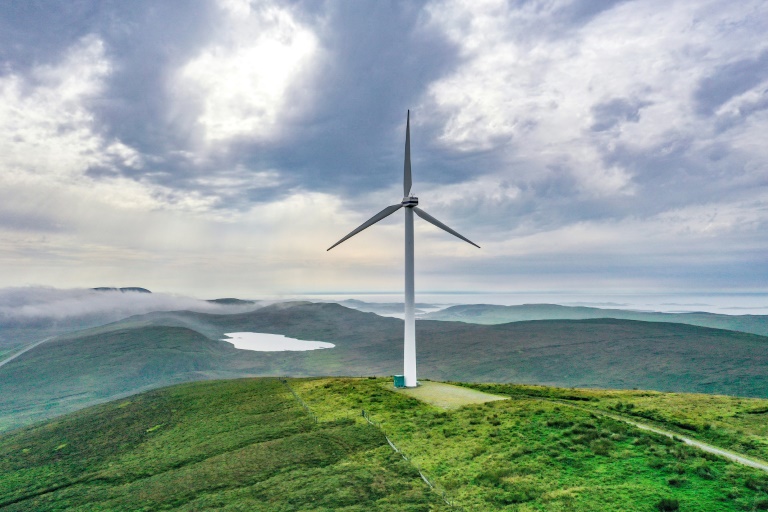
The main focus of the report is on weaning the global economy off fossil fuels and moving to low- or zero-carbon sources of energy, from solar and wind to nuclear, hydro and hydrogen.

Helping that transition is the fact that renewable energy is now cheaper than energy generated by fossil fuels in most markets.

The IPCC also details ways to reduce demand for oil, gas and coal, whether by making buildings more energy-efficient or encouraging shifts in lifestyle, such as eating less beef and not flying half-way around the world for a holiday or business meeting.

With intense political wrangling over the high-level policy summary, some fear the message will have been watered down.  

“The climate crisis is accelerating and fossil fuels are the overwhelming cause. Any report on mitigation that fails to emphasise that fact is denying the very science to which the IPCC is committed,” said Nikki Reisch of the Center for International Environmental Law. 

The report’s finding will feed into UN political negotiations, which resume in November in Egypt at COP 27.   

Close Bitnami banner
Bitnami