World

Hungary PM Orban wins fourth term with comfortable victory

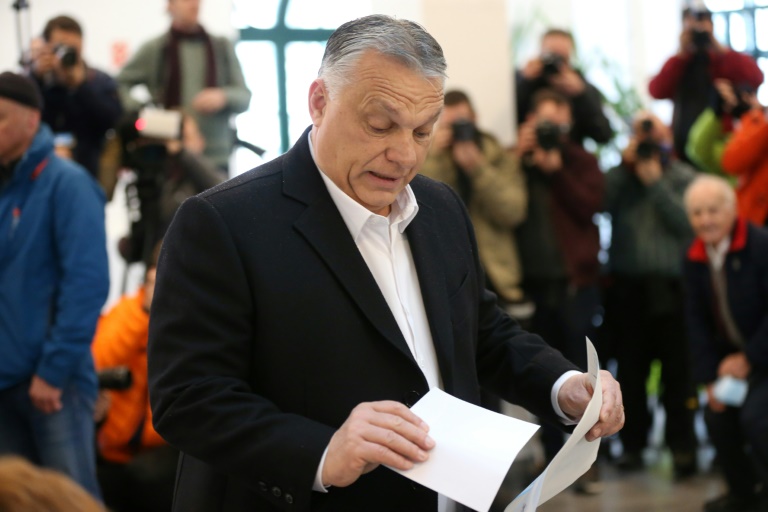
Official results from Hungary’s general election on Sunday showed nationalist Hungarian Prime Minister Viktor Orban’s Fidesz party had won a fourth term in office by a much greater margin than pre-election polls had suggested, after a campaign overshadowed by the war in neighbouring Ukraine.

Addressing a jubilant crowd chanting his name, many of them wearing Fidesz’s orange party colour, Orban said: “We have won a great victory — a victory so great you can perhaps see it from the moon and certainly from Brussels”.

Orban’s administration has presided over repeated confrontations with the European Union, including over the neutering of the press and judiciary, and measures targeting the LGBTQ community — also the subject of a vote on Sunday.

The 58-year-old, already the longest-serving head of government in the EU, was challenged by six united opposition parties seeking to roll back the “illiberal” revolution Orban’s Fidesz party has pursued during 12 consecutive years in office.

But with 94 percent of votes counted, Fidesz was on 53 percent compared to 35 percent for the opposition coalition, according to results from the national election office — a result which means the party will retain its two-thirds majority in parliament.

Peter Marki-Zay, 49, the conservative leading the opposition list, addressed supporters and conceded defeat late on Sunday evening.

“I will not hide my sadness and my disappointment,” he told them, combatively accusing Fidesz of running a campaign of “hate and lies”.

He added that the opposition had done “everything humanly possible” but that the campaign had been “an unequal fight” given the way in which he and other anti-Fidesz politicians had been all but banished from state media.

MEP Marton Gyongyosi from the right-wing Jobbik party which is part of the opposition coalition, told AFP that “abuses” had taken place on Sunday and added: “This will have to be considered when talking about how the results of the elections can be respected”.

Orban has dismissed such complaints and insisted the vote was fair.

For the first time more than 200 international observers monitored the election in Hungary, an EU member, along with thousands of domestic volunteers from both camps.

Turnout reached 68.69 percent, almost matching the record participation seen at the last national elections in 2018.

The far-right Mi Hazank party also surpassed expectations and will make its debut in parliament after crossing the five-percent minimum threshold.

– ‘Ruined the country’ –

Budapest resident Agnes Kunyik, 56, told AFP she had backed the opposition.

“They have ruined our country, destroyed it,” she said of Fidesz, becoming visibly emotional.

But one of those who had turned out for Orban’s victory celebration, 55-year-old Ildiko Horvath, said that under Fidesz “Hungary is really going forwards,” adding: “On the really important questions like the (Ukraine) war and migrants he always decides in line with what the majority wants.”

Russia’s February 24 invasion of Ukraine cast a long shadow over the campaign.

Diplomatically, Orban fell into line with EU support for Kyiv despite his long-standing closeness to Russian President Vladimir Putin.

But at home, Orban has struck a neutral and even anti-Ukrainian tone at times, refusing to let weapons for Ukraine cross Hungarian territory.

He cast himself as the protector of stability and accused the opposition of “warmongering”.

In his victory speech Orban said: “We never had so many opponents,” reeling off a list that comprised “Brussels bureaucrats… the international mainstream media, and finally the Ukrainian president”.

Ukrainian President Volodymyr Zelensky has singled Orban out for criticism over his reticence to take a tougher stance against Russia.

French and Italian far-right leaders Marine Le Pen and Matteo Salvini were quick to offer their congratulations on Sunday.

Le Pen, herself gathering momentum in polls before the first round of presidential elections in France next week, posted a picture of herself shaking hands with Orban and the caption: “When the people vote, the people win!”

As well as electing MPs, Hungarians were voting in a referendum designed to elicit support for what Fidesz calls a “child protection” law banning the portrayal of LGBTQ people to under-18s.

Budapest resident Regina, 25 — who refused to give her surname — told AFP she had spoiled her ballot in the “twisted” referendum which she said had portrayed LGBTQ Hungarians as an “enemy”. 

Partial results showed the referendum had failed as not enough valid votes had been cast. 
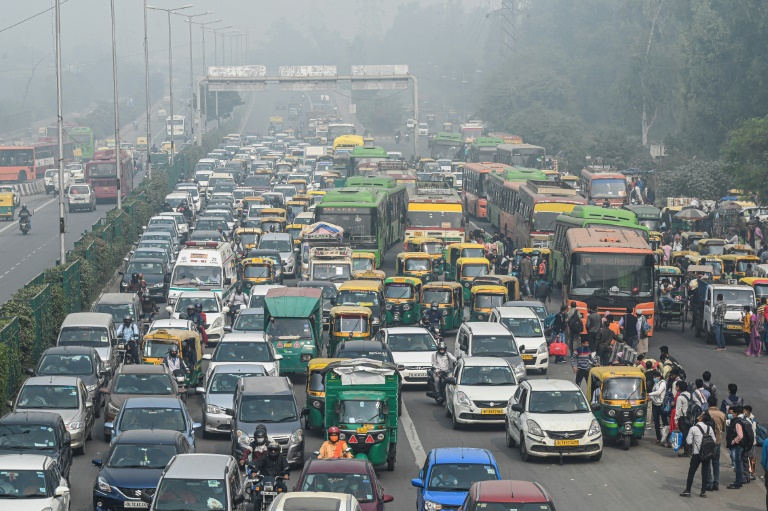
UN talks on climate solutions wrap up two days into overtime

Negotiations to finalise a key UN report on how to stave off climate catastrophe wrapped up on Sunday more than two days late following a tussle over how to describe financial needs, participants told AFP.

Two-weeks of virtual talks were contentious from the start, as nearly 200 nations grapple with hard choices about how to rapidly purge carbon pollution from their economies and become carbon neutral by mid-century.

The latest report from the UN’s Intergovernmental Panel on Climate Change (IPCC), due to be published on Monday, will detail how societies and industries must be reimagined to cut greenhouse gas emissions and avoid the worst impacts of a heating planet. 

But with sweeping changes needed — and huge investments on the line — the political stakes are high. 

“Everybody has something to lose and everybody has something to gain,” another participant monitoring the process said.

Nations were tasked with thrashing out line-by-line a high-level “summary for policymakers” that distils the thousands of pages of the IPCC’s underlying assessment.

As talks resumed Sunday, only 50 percent of the text had been approved, and by late evening all the sticking points had been cleared. 

“A final reading and checkup will take place Monday morning,” tweeted Belgian scientist Jean-Pascal van Ypersele, a delegate from Belgium.

A source close to the talks told AFP earlier that delays were down to the references to finance.

The United States baulked at data showing how much developing countries require to slash greenhouse gas emissions to meet the temperature goals of the Paris Agreement, whereas China wants the figures prominently included, he said.

While these detailed estimates will likely remain in the main IPCC report, the US and other wealthy nations wanted it dropped from the all-important summary for policymakers.  

Some studies have said that developing nations need to spend trillions per year, many times more than current levels of investment.

“These figures are very policy relevant. The report says it is possible to limit warming to 1.5C and cut emissions in half by 2030,” the source said. 

“But you can’t say that without saying how much money you need to implement those solutions.” 

The closed-door negotiations on how to cast the IPCC’s findings stumbled over how, and how quickly, the fossil fuels that drive global warming must be drawn down.

They also stalled over how big a role should be given to technologies that capture CO2 as it is emitted or extract it from the air.

Nikki Reisch, of the Center for International Environmental Law, said “political pressure” was trying to “mask the undeniable reality” that warming will reach catastrophic levels if the shift away from fossil fuels is not accelerated immediately.

Bucha mourns at mass graves in wreck of Russian retreat

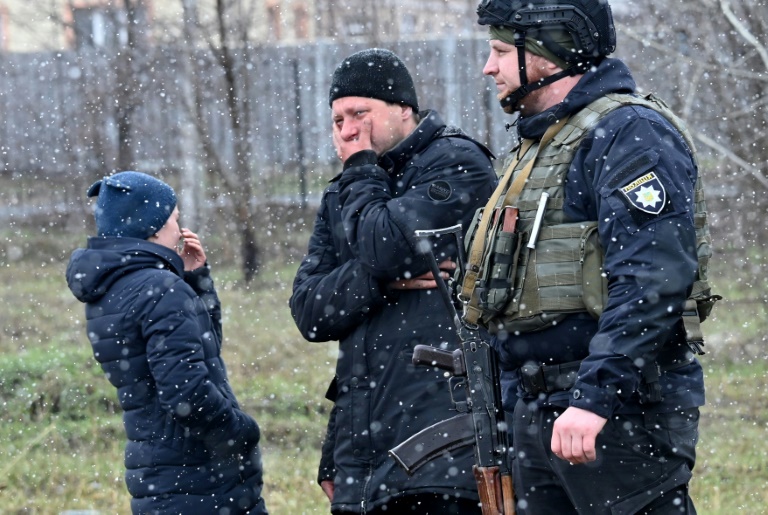
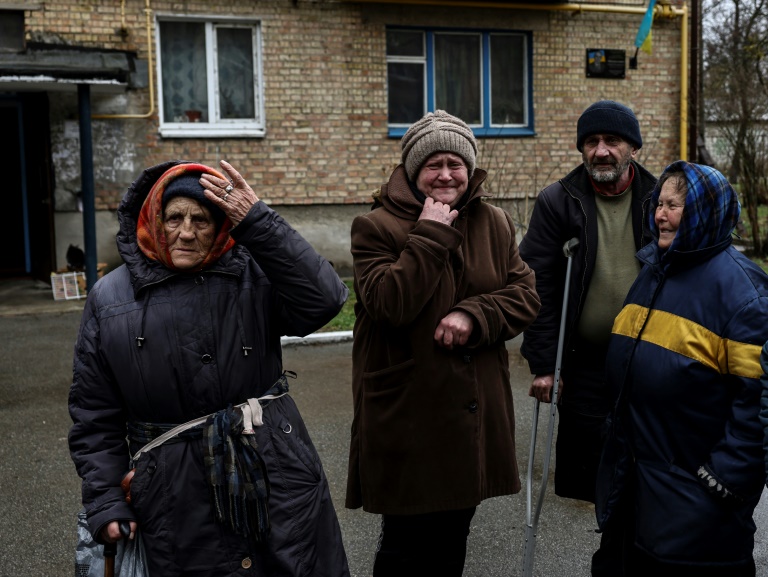
The grieving of Bucha begins today, for those who can bear to face it.

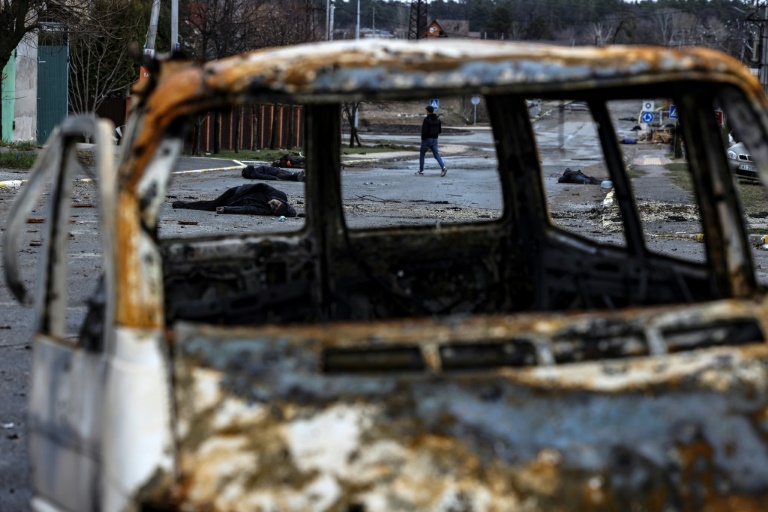
There are bodies in mass graves yet to be claimed, bodies in the street waiting to be collected, bodies everywhere in the ruined Kyiv suburb left by Russian forces which retreated earlier this week.

Liuba, 62, leads her neighbour to the lip of a trench in the sodden clay behind a gold-domed church. But he cannot bring himself to peer inside the grave and search for his missing brother rumoured to lie inside.

57 people are here at this mass burial site, a city worker told AFP. But only a fraction of those are visible.

Some are heaped in black zipped body bags. Others in civilian clothing are only partly buried — a pale hand, a booted foot or the cusp of a forehead exposed to snow falling on the harrowed commuter town.

One body is bundled in a red and white bedsheet near a single pink women’s sandal.

Hands and feet reach out from the earth in improbable poses, suggesting a tangle of remains beneath the surface.

Liuba’s neighbour retreats to a fallen tree and collapses. Though he is held in comfort by a female companion, his anguish prevents him from coming closer.

“This wound will never heal,” says Liuba. “I would not wish it even on my worst enemy.”

– A necessary task – 

Nearby, along a thin grey road framed by shattered homes, four men pilot a white van from corpse to corpse.

AFP counted 20 along this single stretch. Some lie with legs tangled in bikes, others near a ruined car blemished with countless bullet marks.

All are in civilian clothing and one has his hands bound behind his back with a strip of white fabric, his hooded head in a crimson puddle.

Vitalii Shreka, 27, tries to cut the cloth but his pen knife fails. He unknots it instead and hauls the cadaver into a body bag the team zips tight.

One by one, the men inspect the dead for ID cards then stack them in the cargo bay. Shreka holds them steady with blue surgical gloves smeared in days-old blood.

One corpse is wearing a blue and yellow armband, a signal of solidarity with Ukraine. 

A worker throws a bike at two lumbering dogs stalking too close.

The team drive up the road but are forced to reverse. They have missed one more person: a black hooded figure, totally still, lost in the devastated scenery.

It is added to the growing pile in the van.

“It needs to be done,” says 44-year-old Vladyslav Minchenko, standing over a body next to a scattering of potatoes wrinkled by rain — relics from a final shopping trip.

“I did not understand this myself before, when I didn’t have to, but it’s necessary.”

Minchenko and his three colleagues estimate there are “more than 10” dead bodies already inside the van.

But still there is more work to do.

– ‘Let them lie there’ – 

Municipal worker Serhii Kaplychnyi says his team struggled to bury the dead during Russia’s short-lived occupation of Bucha, the focus of growing war crimes allegations against President Vladimir Putin.

“There are many people who died from their bullets and shrapnel,” he told AFP. “They would not allow us to bury them.”

“They said while it was cold to let them lie there.”

Eventually, he says, the Russians allowed his team to collect the bodies from the morgue. “We dug a mass grave with a tractor and buried everyone,” he recalls.

Outside the Bucha mayor’s office Kaplychnyi now coordinates a recovery effort in the town. 

There is a thin sheen of triumph. Military men give each other hard-gripping hugs, miniature Ukrainian flags are being handed out, aid convoys are creeping in.

But Kaplychnyi’s mind travels to the trauma of the past weeks. On one day his team recovered 10 people shot in the head: “Apparently a sniper was ‘having fun’.” 

Civilians also made efforts to bury their neighbours as best they could, in gardens and factories, too fearful to risk a proper funeral.

“There is an old disused sewer pit and they put them there too — covered them up so they’re still lying there,” he said.

“Now we will go and collect them.”

UN talks on climate change solutions hung up on finance

Negotiations to finalise a key UN report on how to stave off climate catastrophe, already two days into overtime, remained stymied Sunday on the issue of financial needs, participants told AFP.

The two-week virtual talks have been contentious from the start, as nearly 200 nations grapple with hard choices about how to rapidly purge carbon pollution from their economies and become carbon neutral by mid-century.

The latest report from the UN’s Intergovernmental Panel on Climate Change (IPCC), due to be published on Monday, will detail how societies and industries must be reimagined to cut greenhouse gas emissions and avoid the worst impacts of a heating planet. 

But with sweeping changes needed — and huge investments on the line — the political stakes are high. 

“Everybody has something to lose and everybody has something to gain,” another participant monitoring the process said.

Nations are tasked with thrashing out line-by-line a high-level “summary for policymakers” that distils the thousands of pages of the IPCC’s underlying assessment.

“We’re at 90 percent of approving the Summary,” which is about 40 pages long, one person tracking the talks said. “What is holding things up is the finance.”

The United States is balking at data showing how much developing countries require to slash greenhouse gas emissions to meet the temperature goals of the Paris Agreement, whereas China wants the figures prominently included, one source said.

While these detailed estimates would remain in the main IPCC report, the US and other wealthy nations want it dropped from the all-important summary for policymakers. 

Some studies have said that developing nations need to spend trillions per year, many times more than current levels of investment.

“These figures are very policy relevant. The report says it is possible to limit warming to 1.5C and cut emissions in half by 2030,” the source said. 

“But you can’t say that without saying how much money you need to implement those solutions.” 

Negotiations on how to cast the IPCC’s findings have stumbled over how, and how quickly, the fossil fuels that drive global warming must be drawn down.

Talks have also stalled over how big a role should be given to technologies that capture CO2 as it is emitted or extract it from the air.

Nikki Reisch, of the Center for International Environmental Law, said “political pressure” was trying to “mask the undeniable reality” that warming will reach “catastrophic levels” if the shift away from fossil fuels is not accelerated immediately.

Costa Ricans vote in poll dominated by poverty, unemployment

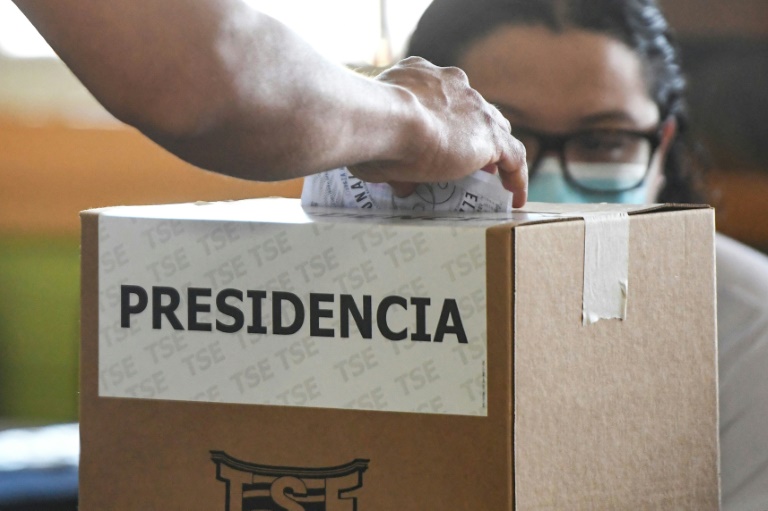
Costa Ricans voted on Sunday to choose between two scandal-tainted presidential candidates in a country grappling with sky-high poverty and unemployment.

Former president Jose Maria Figueres was once investigated for corruption while ex-finance minister Rodrigo Chaves — who was slightly ahead in opinion polls — was previously demoted for sexual harassment.

But with 23 percent of the population living in poverty and unemployment soaring to 14 percent alongside a series of corruption scandals, Costa Ricans seem more focused on the economy as they elect a successor to President Carlos Alvarado.

Polls opened at 6.00 am (1200 GMT) and will close at 6.00 pm (0000 GMT), with the first results expected just over two hours later.

Long lines formed early Sunday at voting centers in the capital San Jose. The commission overseeing the elections said all centers around the country had opened without incident.

“I am going to elect the person I like and who has good principles to govern Costa Rica. The first concern is that there is work, economy and security,” said 58-year-old Angela Marin, first to vote at the Liceo de San Antonio de Coronado.

“The two candidates left are people for whom there is not much confidence. But we have to choose between one of the two and hopefully there will be something good,” she added.

Casting his vote at a school on the outskirts of San Jose, Figueres said, “Let us all vote with joy, respecting people’s preferences but strengthening our democratic system.”

“I say to people vote, vote, vote. Exercise your right … I promise you a fair, honest and transparent government,” siad Chaves, who voted in mid-morning at a city center school in the capital.

Costa Rica has been described as the “happiest” country in Latin America and praised for its environmental policies and eco-tourism, but the vital tourism industry was hard hit by the coronavirus pandemic.

Alongside Peru, it suffered the largest fall in employment figures in the region between 2019 and 2020.

– ‘We’re very poor’ –

“The next president has to change everything because we’re very poor. There is no work here, there is nothing,” said Ana Briceno, 64, a travel agent in San Jose.

“In the last years with Carlos Alvarado the situation has been very difficult … so I think the future president must focus on the economy,” said Cristina Aguilar, 32.

Given their previous troubles, the two candidates have sought to keep the debate swirling around the economy.

“The urgent themes to address are the ones causing discomfort and suffering to the people,” said Chaves, 60, a surprise qualifier for Sunday’s run-off, having polled fourth ahead of February’s first round.

“The first is the lack of jobs. Secondly, the cost of living.”

Chaves, from the newly formed right-wing Social Democratic Progress Party, led the most recent opinion polls, with more than 41 percent support, compared to 38 percent for Figueres.

Figueres, 67, who was president from 1994 to 1998, is equally focused on the economy.

“In the economic agenda, unemployment is the most important, the creation of employment opportunities is the priority,” he said.

Figueres, whose father Jose abolished the army in 1948 when he was president, topped the first round of voting among a crowded field of 25 contenders with 27.3 percent, ahead of Chaves who had 16.8 percent.

But they were a long way from the 40 percent needed to win outright.

– ‘Misinterpreted’ jokes – 

Both men have reached this final stage of the election despite the specter of past scandals.

Chaves, who spent six months as finance minister in the outgoing government, was investigated over sexual harassment complaints brought by multiple women while he was a senior official at the World Bank, where he worked for 30 years.

He was demoted, though not fired, and has dismissed his behavior as jokes that were “misinterpreted due to cultural differences.”

Figueres, who represents the centrist National Liberation Party (PLN), was investigated for allegedly taking $900,000 from French engineering firm Alcatel, which has admitted to bribing officials.

The ex-president, who worked abroad at the time as executive director of the World Economic Forum (WEF), refused to give evidence in the case in 2004 and returned to Costa Rica only in 2011 when the investigation expired.

“Right now, I don’t know who I will vote for … because Chaves contradicts himself in everything and given what Figueres did last time, it leaves us undecided,” said Jairo Montero, 37.

In the unlikely event the election ends in a draw, Costa Rican law says the elder candidate would win, in this case Figueres. 

The winner will begin a four-year term on May 8.

Serbians vote in polls overshadowed by war in Ukraine

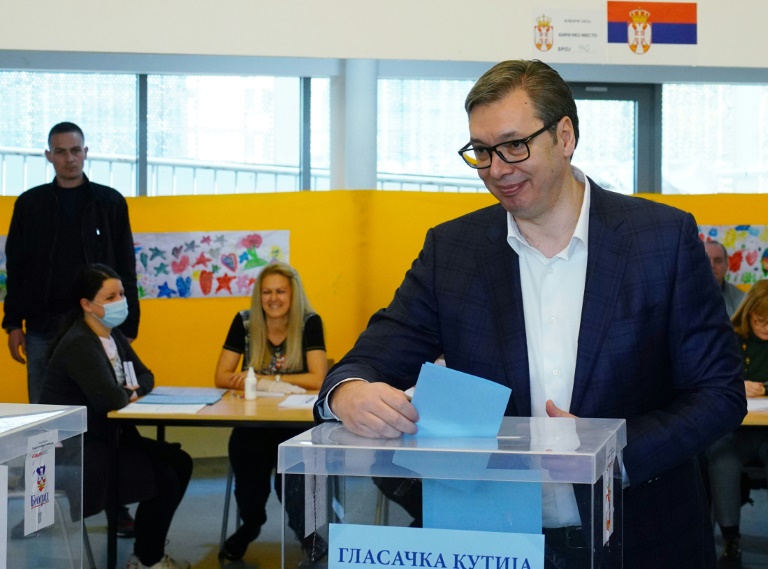
Serbians flocked to the polls on Sunday in elections that will likely see populist President Aleksandar Vucic extend his rule in the Balkan country, as he vows to provide stability amid war raging in Ukraine.

The country of around seven million will elect the president and members of the 250-seat parliament and cast votes in several municipal contests.

The polls officially closed at 8:00 pm (1800 GMT) local time, with unofficial results due later in the evening.

The latest surveys see Vucic’s centre-right Serbian Progressive Party (SNS) maintaining its control over the parliament, while the president is poised to win a second term.

“Personally, I see stable progress and I voted in accordance with this opinion,” Milovan Krstic, a 52-year-old government employee, told AFP after casting his vote in Belgrade.

Russia’s invasion of Ukraine has cast a long shadow over a contest that observers had earlier predicted would focus on environmental issues, corruption and rights.

Vucic has deftly used the return of war in Europe along with the coronavirus pandemic to his advantage, promising voters continued stability amid uncertain headwinds.   

“We expect a huge victory. That’s what we worked for in the past four or five years, and we believe we will continue with the great efforts and the development of this country,” the president said after casting his ballot early Sunday.

Serbia’s leading opposition candidate Zdravko Ponos said he hoped the contest would offer a path to institute “serious change” in the country. 

“I hope for a bright future. Elections are the right way to change the situation. I hope the citizens of Serbia will take the chance today,” said Ponos.

In the capital Belgrade, the elections were briefly marred by scuffles between parliamentary candidate Pavle Grbovic and supporters of Vucic’s SNS, along with scattered reports of small skirmishes and voter intimidation.

The country’s election commission predicted voter turnout would likely hover around 60 percent, nearly a 10-point jump from the last general elections in 2020.

Serbs from the former breakaway province of Kosovo also participated in the contest and boarded around 40 buses headed north to vote, after authorities in Pristina refused to allow polling centres on its soil.

– Decade in power –

Only a few months ago, the opposition seemed to have gained momentum. 

In January, Vucic axed a controversial lithium mine project following mass protests that saw tens of thousands take to the streets. 

The move was a rare defeat for Vucic, who has rotated through a range of positions, including prime minister, president and deputy premier along with a stint as the defence chief during a decade in power. 

The polls predict he will win again on Sunday even as the opposition hopes a high turnout could force a run-off. 

Analysts, however, say the opposition has little chance of dethroning Vucic or eating away at his parliamentary coalition, which holds a lion’s share of the seats.

The president has also carefully managed the country’s response to the war in Ukraine by officially condemning Russia at the United Nations but stopping short of sanctioning Moscow at home, where many Serbs hold a favourable view of the Kremlin. 

The opposition in turn has largely refrained from attacking Vucic’s position on the conflict, fearing any call for harsher measures against Russia would backfire at the ballot box. 

Vucic also headed into elections with a plethora of other advantages. 

Following a decade at the helm, he has increasingly tightened his grip over the various levers of power, including de facto control over much of the media and government services.

In the months leading up to the campaign, the president rolled out a range of financial aid offers to select groups, prompting critics to say he was trying to “buy” votes before the contest. 

Outrage at Russian 'war crimes' after civilians killed in Ukraine

Global outrage at accusations of Russian war crimes in Ukraine mounted on Sunday as the discovery of mass graves and “executed” civilians near Kyiv prompted vows of action at the International Criminal Court.

Britain, France, Germany, the United States, NATO and the United Nations all voiced horror at the reports of civilians being murdered in Bucha, northwest of Kyiv.

Ukrainian prosecutor general Iryna Venediktova said 410 civilian bodies were recovered from areas around Kyiv recently retaken from Russian forces.

Ukrainian officials on Saturday said nearly 300 bodies had been buried in mass graves in Bucha. AFP saw at least 20 bodies, all in civilian clothing, strewn across a single street.

Russia denied the accusations and said Ukraine staged footage of the corpses.

Bucha’s mayor Anatoly Fedoruk told AFP that 280 bodies were buried in mass graves. One rescue official said 57 people were found in one hastily dug trench behind a church. 

About 10 were either unburied or only partially covered by earth.

Ukraine’s Foreign Minister Dmytro Kuleba called it a “deliberate massacre” while President Volodymyr Zelensky said Russian forces were committing “genocide”.

His spokesman, Sergiy Nikiforov, said earlier the Bucha killing “looks exactly like war crimes”.

“We found people with their hands and with their legs tied up… and with shots, bullet holes, in the back of their head,” he told the BBC. 

“They were clearly civilians and they were executed.”

US Secretary of State Antony Blinken called the killings “a punch to the gut” while NATO chief Jens Stoltenberg said the violence, unseen in Europe for decades, was “horrific” and “absolutely unacceptable”.

Britain, France, Germany, Italy and the European Union all called for those responsible to be brought to book at the international tribunal in The Hague.

UK Prime Minister Boris Johnson said Russia’s “despicable attacks” against civilians in Irpin and Bucha were “evidence that Putin and his army are committing war crimes in Ukraine”.

Chancellor Olaf Scholz said Germany would draw up new sanctions with allies over the alleged war crimes.

UN chief Antonio Guterres said he was “deeply shocked” by images of mass graves in Bucha and called for an independent investigation.

But Russia’s defence ministry on Sunday said “not a single local resident” in Bucha suffered violence, accusing Ukraine of bombarding its southern suburbs and falsifying images of corpses in “another production” for Western media.

Despite Western action targeting oligarchs and businesses — and calls to go further — the Kremlin said it was not possible to isolate Russia entirely.

The world is “much larger than Europe”, Kremlin spokesman Dmitry Peskov told Russian state television, adding: “Sooner or later we will have to build a dialogue, whether some overseas want it or not.”

– ‘Tormented Ukraine’ – 

Europe’s worst conflict in decades, sparked by Russia’s invasion on February 24, has already left some 20,000 people dead, according to Ukrainian estimates.

Nearly 4.2 million Ukrainians have fled the country, with almost 40,000 pouring into neighbouring countries in the last 24 hours alone, the UN refugee agency said, although Ukraine’s interior ministry on Sunday said more than 500,000 Ukrainians have returned.

Nearly 6.48 million were estimated to be displaced inside Ukraine, the International Organization for Migration has assessed.

AFP journalists saw women, children and elderly people boarding a train at the station to flee the eastern city of Kramatorsk in the Donbas region as Moscow refocuses its offensive on southern and eastern Ukraine.

“The rumour is that something terrible is coming,” said Svetlana, a volunteer organising the crowd on the station platform.

Pope Francis, on a visit to Malta on Sunday, made a plea for refugees fleeing the “sacrilegious war” in “tormented Ukraine” to be welcomed.

Several Western leaders, including US President Joe Biden, have already accused Russia’s Vladimir Putin of being a “war criminal”.

Human Rights Watch said Russian troops may have committed possible war crimes against civilians in occupied areas of Chernigiv, Kharkiv and Kyiv, including rape and summary execution.

Zelensky has also alleged Russian soldiers planted mines and other booby traps as they withdraw from northern Ukraine, warning returning residents to be wary of tripwires and other dangers.

– Odessa hit – 

The war crimes claims came as the strategic Black Sea port city of Odessa, which has largely been spared in the conflict, was hit by air strikes apparently targeting key infrastructure.

Plumes of thick black smoke billowed over the strategic port city, after a series of blasts shook residents awake at about 6:00 am (0300 GMT).

“We were woken up by the first explosion then we saw a flash in the sky, then another, then another. I lost count,” one local man, Mykola, 22, told AFP.

Russia’s defence ministry said it had targeted an oil refinery and three fuel storage facilities with “high-precision sea and air-based missiles”.

The depots were supplying fuel to Ukrainian troops, it added.

Ukraine said its defences shot down some of the missiles.

The strikes came as top UN humanitarian envoy Martin Griffiths arrived in Moscow on Sunday before an expected visit to Kyiv to seek a halt to the fighting. 

– Peace talks – 

On peace talks, Russia’s chief negotiator Vladimir Medinsky said it was too early for a top-level meeting between Zelensky and Putin on ending the conflict.

He said Kyiv had become “more realistic” in its approach to issues related to the neutral and non-nuclear status of Ukraine but a draft agreement for submission to a summit meeting was not yet ready.

Ukraine has proposed abandoning its aspirations to join NATO and declaring official neutrality, if it obtains security guarantees from Western countries. It would also pledge not to host any foreign military bases.

It has proposed to temporarily put aside the question of Crimea, annexed by Russia in 2014, and two breakaway territories in the eastern Donbas region that Russia has recognised as independent.

Medinsky said Russia’s position on Crimea and the Donbas “remains unchanged” and that talks would resume by video conference on Monday.

– ‘Liberated’ –

As Russian forces withdraw from some northern areas, Moscow appears to be focusing on eastern and southern Ukraine, where it already holds swathes of territory.

UK Defence Intelligence said early Sunday that Russian air activity in the last week had been concentrating on southeastern Ukraine, “likely as a result of Russia focusing its military operations in this area”.

But it said Russia was struggling to find and destroy air systems, which has “significantly affected their ability to support the advance of their ground forces”.

Ukraine on Saturday claimed progress against Russian forces, saying Irpin, Bucha, Gostomel and the whole Kyiv region had been “liberated”.

NATO’s Stoltenberg, however, cautioned that Russia’s claim to be pulling troops away from Kyiv was “not a withdrawal” but Russia repositioning its troops.

– Evacuation bid –

Russia’s efforts to consolidate its hold on southern and eastern areas of Ukraine have been hampered by the resistance of Mariupol despite devastating attacks lasting weeks.

At least 5,000 residents have been killed in the besieged southern port city, according to officials, while the estimated 160,000 who remain face shortages of food, water and electricity.

burs-phz/imm/jar

S.Sudan rivals seal security pact in peace 'milestone'

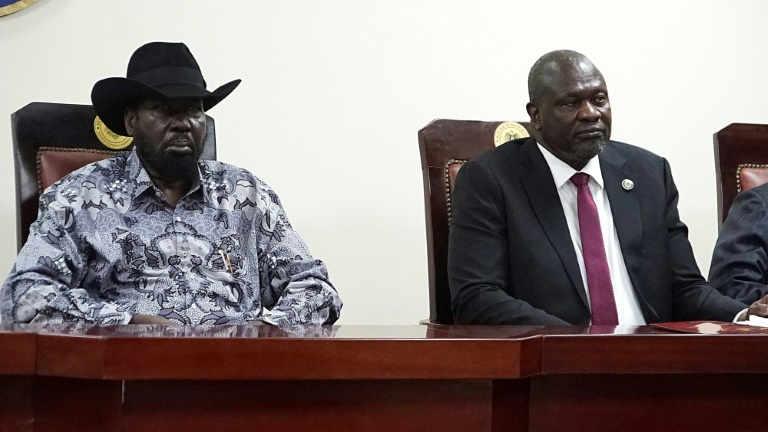
In what has been hailed as a major breakthrough, South Sudan’s rival leaders sealed an agreement Sunday on a key military provision in a stuttering peace deal and vowed to silence their guns.

President Salva Kiir and his rival, Vice President Riek Machar, agreed on the creation of a unified armed forces command, one of several deadlocked issues holding up implementation of the 2018 pact to end the country’s bloody five-year civil war.

Feuding between forces loyal to Kiir and former rebel leader Machar spiralled recently, triggering fears of a return to full-blown conflict in the world’s youngest nation.

“Peace is about security and today we have (achieved) a milestone,” said Martin Abucha, who signed the agreement on behalf of Machar’s opposition SPLM/A-IO. “The guns must go down.”

Minister of presidential affairs Barnaba Marial Benjamin hailed the deal — hammered out following mediation by neighbouring Sudan — as a “necessary step… that opens a route for the stable government of the Republic of South Sudan”.

The rivals also agreed to a cessation of hostilities, a halt to “propaganda” that stokes tensions, and called for the two sides to stop trying to encourage defections from the other party, according to Machar’s spokesman Puok Both Baluang.

Nevertheless, the people of the troubled country will be watching warily to see if the deals are implemented, since other agreements have collapsed in the past, often leading to violence. 

Both Kiir and Machar were at the ceremony in the capital Juba for the signing of the accord, which stipulates a 60-40 distribution in favour of the president’s side of leadership posts in the army, police and national security forces.

Under the deal, the appointments should be made in a week, with the graduation of the unified forces within two months. 

Mohamed Hamdan Daglo, the number two in Sudan’s post-coup ruling council, arrived in Juba on Friday in a bid to break the stalemate over the security arrangements.

Sudan, a guarantor of the 2018 deal, drew up the proposal after Kiir on March 25 issued a presidential decree on the formation of the military command structure, an act rejected by Machar as “unilateral”.

– Chronic instability –

Landlocked South Sudan, one of the poorest countries on the planet despite large oil reserves, has suffered chronic instability since independence from Sudan in 2011, spending almost half of its life as a nation at war. 

It has struggled to draw a line under the 2013-2018 conflict that erupted after Kiir accused Machar of an attempted coup. Almost 400,000 people lost their lives and millions more were displaced by the fighting.

Although the two men formed a unity government more than two years ago, South Sudan has continued to lurch from crisis to crisis, battling flooding, hunger, interethnic violence and political bickering.

The fragile peace process was put under further pressure last month when Machar’s Sudan People’s Liberation Movement in Opposition (SPLM/A-IO) pulled out of a monitoring body to protest at “unprovoked” attacks on its bases. 

Machar’s spokesman told AFP the party had now agreed to return to the mechanism.

– Peacekeeping mission renewed –

Last month, the UN Security Council voted to prolong its peacekeeping mission in South Sudan another year. The operation, with up to 17,000 soldiers and 2,100 police officers, is one of the UN’s most expensive, with an annual budget topping $1 billion.

In a briefing to the Security Council, the UN envoy for South Sudan, Nicholas Haysom, issued a stark warning to the country’s leaders to do more to prepare for elections due to be held in less than a year.

“Elections have the potential to be a nation-building moment, or a catastrophe,” he said.

Although he highlighted progress in some areas including the operation of key government institutions and parliament, other issues are stalled, including the process of drafting a new constitution.    

The UN has repeatedly criticised South Sudan’s leadership for its role in stoking violence, cracking down on political freedoms and plundering public coffers and has accused the government of rights violations amounting to war crimes over deadly attacks in the southwest last year.

South Sudan also faces grave humanitarian woes caused by conflict as well as climate-related disasters such as flooding and drought, prompting the UN on Thursday to launch a $1.6 billion aid plan. 

It said the funding will be used for urgent life-saving assistance and protection in a country where it is estimated more than two-thirds of the population, nearly nine million people, require aid relief. 

Pope laments 'tormented Ukraine', defends migrants on Malta trip

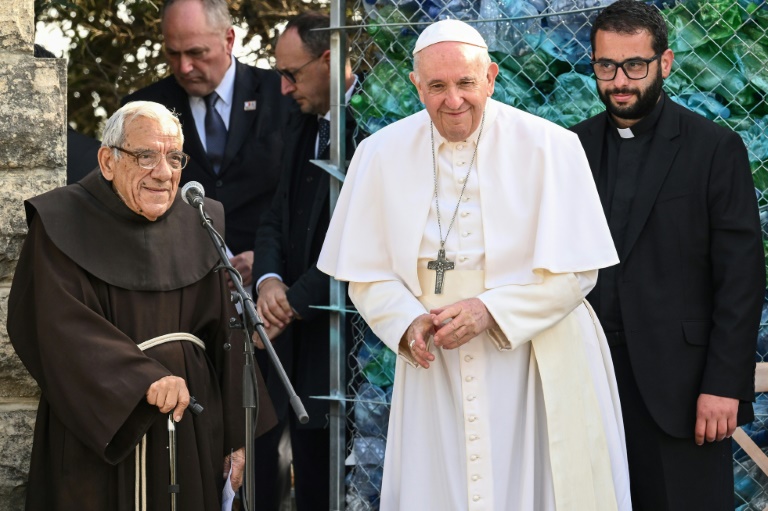
Pope Francis decried the “sacrilegious war” in Ukraine on Sunday as he wrapped up a two-day trip to Malta that bore a pointed pro-migrant message and drew his sharpest rebuke yet of Russia’s invasion.

His condemnation came amid international outrage over the killing of civilians near the Ukrainian capital Kyiv, after officials in Bucha said nearly 300 bodies were found in mass graves following the withdrawal of Russian forces.

“Let us pray for peace, thinking of the humanitarian tragedy of tormented Ukraine, still under the bombardments of this sacrilegious war,” Francis said after an open-air mass to an estimated 12,000-strong crowd in Floriana, near Valletta.

The 85-year-old has condemned the violence in increasingly emotive terms without ever directly blaming Russia or its president, Vladimir Putin.

But on Saturday, in the Maltese capital Valletta, he came the closest yet, warning that “some potentate, sadly caught up in anachronistic claims of nationalist interests, is provoking and fomenting conflicts”.

– You are not numbers –

The war has overshadowed Francis’s first trip to Malta but also added urgency to a key theme of his nine-year papacy — the need to welcome those fleeing war, poverty or the effects of climate change.

Russia’s invasion of Ukraine has triggered Europe’s worst refugee crisis since World War II, a continent already struggling to form a coherent response to thousands of people arriving by sea each year from North Africa.

Catholic-majority Malta, a tiny archipelago located off the coast of Sicily, is on the frontline of that influx but has been accused by charities of turning a blind eye to those in distress in its waters.

In an emotional visit before flying out Sunday, Francis visited a Catholic-run migrant centre where he heard testimonies from young men who arrived on Malta’s shores, and embraced them.

He said the world must imagine “that those same people we see on crowded boats or adrift in the sea, on our televisions or in the newspapers, could be any one of us, or our son or daughter.” 

Before an audience of around a dozen African migrants, clergy and volunteers gathered at the John XXIII Peace Lab, he noted that just on Saturday, news arrived of more than 90 people drowned in the Mediterranean, with just four survivors.

He drew applause from the crowd when, in a veiled reference to Libya, he said many migrants’ rights were violated on their long journeys, often “with the complicity of the competent authorities”.

“You are not numbers,” the pope told them.

He had previously urged Malta to do more to welcome desperate people who arrive on the archipelago, living up to its status as a “safe harbour” that in the first century AD welcomed the Apostle Paul who shipwrecked here.

One of 55 undocumented Africans living at the centre told AFP he has been waiting for two years for his identity papers, and until they arrived, he could do nothing but wait.

“I haven’t seen my parents for five years. That’s huge,” said Debosque, a 24-year-old from Cameroon who did not want to give his last name. 

The migrant centre is readying to receive some refugees fleeing the war in Ukraine, and outside, members of Malta’s Ukrainian community urged the pope to keep speaking out.

“We would like him to bless our country,” said Olga Attard, 36, standing with her daughter in a crowd filled with yellow and blue Ukrainian flags.

“People of his level and power, they can make a difference in such a situation,” she added.

The pope, who last summer underwent colon surgery and cancelled an event in February due to acute knee pain, walked with difficulty throughout the trip, limping and taking the arm of a helper at his side.

Anna Balzan, 67, draped in a Vatican flag purchased during John Paul II’s 1990 visit, expressed concern for Francis’ health, saying he looked “very tired yesterday”.

But he has been given a warm welcome. 

“He’s a sign of hope in a time when nobody seems to believe anything any more,” said Isabella Dorgu, 38, an Italian living in Malta, as she strained for a view of the pope at the mass.

Russia accused of war crimes after civilians killed in Ukraine

Ukraine and Western nations on Sunday accused Russian troops of war crimes after the discovery of mass graves and “executed” civilians near Kyiv, prompting vows of action at the International Criminal Court.

Britain, France, Germany, the US and NATO all voiced horror after Ukrainian officials said Saturday that nearly 300 bodies had been buried in mass graves. AFP saw at least 20 bodies, all in civilian clothing, strewn across a single street.

City mayor Anatoly Fedoruk told AFP that 280 bodies were buried in mass graves. One rescue official said 57 people were found in one hastily dug trench behind a church. 

About 10 were either unburied or only partially covered by earth.

Ukraine’s Foreign Minister Dmytro Kuleba called it a “deliberate massacre” while President Volodymyr Zelensky said Russian forces were committing “genocide”.

His spokesman, Sergiy Nikiforov, said earlier the Bucha killing “looks exactly like war crimes”.

“We found mass graves. We found people with their hands and with their legs tied up… and with shots, bullet holes, in the back of their head,” he told the BBC. 

“They were clearly civilians and they were executed.”

US Secretary of State Antony Blinken called the killings “a punch to the gut” while NATO chief Jens Stoltenberg said the violence, unseen in Europe for decades, was “horrific” and “absolutely unacceptable”.

Britain, France, Germany, Italy and the European Union all called for those responsible to be brought to book at the international tribunal in The Hague.

Ukraine’s Kuleba called for G7 nations to impose immediate “devastating” sanctions against Russia as a result. 

But despite Western action targeting oligarchs and businesses — and calls to go further — the Kremlin said it was not possible to isolate Russia entirely.

“There can be no complete vacuum or isolation of Russia. It is technologically impossible in the modern world,” Kremlin spokesman Dmitry Peskov told Russian state television.

The world is “much larger than Europe”, he said, adding: “Sooner or later we will have to build a dialogue, whether some overseas want it or not.”

– ‘Tormented Ukraine’ – 

Europe’s worst conflict in decades, sparked by Russia’s invasion on February 24, has already left some 20,000 people dead, according to Ukrainian estimates.

Nearly 4.2 million Ukrainians have fled the country, with almost 40,000 pouring into neighbouring countries in the last 24 hours alone, the UN refugee agency said.

Nearly 6.48 million were estimated to be displaced inside Ukraine, the International Organization for Migration has assessed. 

Pope Francis, on a visit to Malta on Sunday, made a plea for refugees fleeing the “sacrilegious war” in “tormented Ukraine” to be welcomed.

Several Western leaders, including US President Joe Biden, have already accused Russia’s Vladimir Putin of being a “war criminal”.

Human Rights Watch said Russian troops may have committed possible war crimes against civilians in occupied areas of Chernigiv, Kharkiv and Kyiv, including rape and summary execution.

Ukraine’s President Volodymyr Zelensky has also alleged Russian soldiers planted mines and other booby traps as they withdraw from northern Ukraine, warning returning residents to be wary of tripwires and other dangers.

– Odessa hit – 

The war crimes claims came as the Black Sea port city of Odessa, which has largely been spared in the conflict, was hit by air strikes apparently targeting key infrastructure.

Plumes of thick black smoke billowed over the strategic port city, after a series of blasts shook residents awake at about 6:00 am (0300 GMT).

“We were woken up by the first explosion then we saw a flash in the sky, then another, then another. I lost count,” one local man, Mykola, 22, told AFP.

Russia’s defence ministry said it had targeted an oil refinery and three fuel storage facilities with “high-precision sea and air-based missiles”.

The depots were supplying fuel to Ukrainian troops, it added.

Anton Herashchenko, an adviser to Ukraine’s interior minister, said: “Some of the missiles were shot down by air defence.”

The strikes came as top UN humanitarian envoy Martin Griffiths was expected in Moscow then Kyiv to seek a halt to the fighting. 

– Peace talks – 

On peace talks, Russia’s chief negotiator Vladimir Medinsky said it was too early for a top-level meeting between Zelensky and Putin on ending the conflict.

He said Kyiv had become “more realistic” in its approach to issues related to the neutral and non-nuclear status of Ukraine but a draft agreement for submission to a summit meeting was not yet ready.

And he said he did not share the “optimism” of Ukraine’s negotiators on the possibility of talks between the two countries’ leaders in Turkey.

His Ukrainian counterpart, David Arakhamia, had said on Saturday that Moscow had “verbally” agreed to key Ukrainian proposals, raising hopes that talks to end fighting were moving forward.

Ukraine has proposed abandoning its aspirations to join NATO and declaring official neutrality, if it obtains security guarantees from Western countries. It would also pledge not to host any foreign military bases.

It has proposed to temporarily put aside the question of Crimea, annexed by Russia in 2014, and two breakaway territories in the eastern Donbas region that Russia has recognised as independent.

Medinsky said Russia’s position on Crimea and the Donbas “remains unchanged” and that talks would resume by video conference on Monday.

– ‘Liberated’ –

As Russian forces withdraw from some northern areas, Moscow appears to be focusing on eastern and southern Ukraine, where it already holds swathes of territory.

UK Defence Intelligence said early Sunday that Russian air activity in the last week had been concentrating on southeastern Ukraine, “likely as a result of Russia focusing its military operations in this area”.

But it said Russia was struggling to find and destroy air systems, which has “significantly affected their ability to support the advance of their ground forces”.

In his latest video message, Zelensky said Russian troops wanted to seize the disputed Donbas region and southern Ukraine, promising “to defend our freedom, our land and our people”.

Ukraine on Saturday claimed progress against Russian forces, saying Irpin, Bucha, Gostomel and the whole Kyiv region had been “liberated”.

NATO’s Stoltenberg, however, cautioned that Russia’s claim to be pulling troops away from Kyiv was “not a withdrawal” but Russia repositioning its troops.

– Evacuation bid –

Russia’s efforts to consolidate its hold on southern and eastern areas of Ukraine have been hampered by the resistance of Mariupol despite devastating attacks lasting weeks.

At least 5,000 residents have been killed in the besieged southern port city, according to officials, while the estimated 160,000 who remain face shortages of food, water and electricity.

The International Committee of the Red Cross (ICRC) said its team left for Mariupol on Saturday to make another attempt at conducting an evacuation, after being forced to turn back the day before.

A Lithuanian filmmaker, Mantas Kvedaravicius, 45, was killed as he tried to flee, the Ukrainian military said.

burs-phz/imm/jm

Close Bitnami banner
Bitnami