World

Sarkozy's name jeered at French election rally

The name of former French president Nicolas Sarkozy was jeered at an election rally of his right-wing Republicans party on Sunday, reflecting anger at his decision not to join campaigning ahead of next weekend’s vote.

The 67-year-old former head of state has declined to endorse the Republicans struggling candidate Valerie Pecresse, who served as his budget minister.

“I absolutely didn’t expect that reaction at all,” Pecresse advisor Yann Wehrling said from the stage at a rally in Paris on Sunday after whistles and boos rang out at the mention of Sarkozy’s name. 

“On the contrary, you should applaud him,” Wehrling added, referring to the 2007-2012 leader. 

Sarkozy’s refusal to back Pecresse as well as his closeness with President Emmanuel Macron have caused frustration among many Republicans rank-and-file members.

He has always been a popular figure among right-wing French voters, but his standing nation-wide has fallen in recent years following two convictions for corruption and illegal campaign financing.

Pecresse is running in fourth or fifth position ahead of next weekend’s vote, polls suggest, with the 2022 election appearing on track to be a re-run of the 2017 contest that pitched Macron against far-right veteran Marine Le Pen.

Surveys suggest that Macron’s lead over Le Pen is narrowing sharply as next Sunday’s first round approaches, with a second round-run off scheduled for April 24.

A poll for the Journal du Dimanche newspaper on Sunday by the Ifop group showed Macron winning the first round with 27 percent, down 2.5 points in a fortnight, while Le Pen had gained 3.5 points to 22 percent. 

In a duel between the two of them, Macron was seen on 53 percent while Le Pen was on 47 percent — in line with several other polls at the end of the last week.

Voter sentiment appears to be highly volatile, and many French people have not made up their minds yet, making the outcome difficult to forecast, experts say.

– Consultancy scandal –

Macron held his first rally on Saturday at a stadium west of Paris where he drew around 30,000 people.

Calling for a “general mobilisation” from his supporters, he warned about the danger posed by Le Pen and fellow far-right candidate Eric Zemmour.

“Look at what happened with Brexit, and so many other elections: what looked improbable actually happened,” Macron warned, referring to Britain’s shock decision to leave the EU in 2016 that most pollsters failed to foresee. 

The head of Macron’s parliamentary party Christophe Castaner said that “of course” the president could lose to Le Pen next Sunday.

He told RMC radio that it be an error to “let anyone believe that the election is won in advance.” 

The centrist president’s opponents continue to target him over his governments’ use of expensive management consultancies during his term in office following a highly critical report from the Senate last month.

A Senate investigation found that spending on outside consulting firms such as McKinsey had more than doubled from 2018-2021, reaching more than a billion euros ($1.1 billion) last year, a record.

Rising hard-left candidate Jean-Luc Melenchon criticised Macron for “inviting the private sector into the state. Who can believe that a private company would give advice in the public interest?”

The head of Le Pen’s National Rally party, Jordan Bardella, said that “Emmanuel Macron has become the front for private interests”.

Macron and his aides have sought to stress that France uses consultants less than some other large EU members and that outside help had been required for technical missions such as IT or cybersecurity, as well as during the Covid-19 pandemic. 

burs-adp/jm
Costa Ricans vote in poll dominated by poverty, unemployment

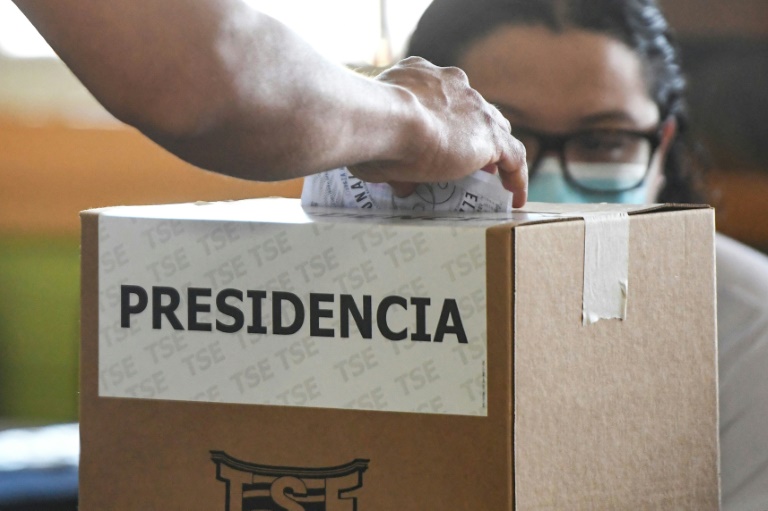
Costa Ricans voted on Sunday to choose between two scandal-tainted presidential candidates in a country grappling with sky-high poverty and unemployment.

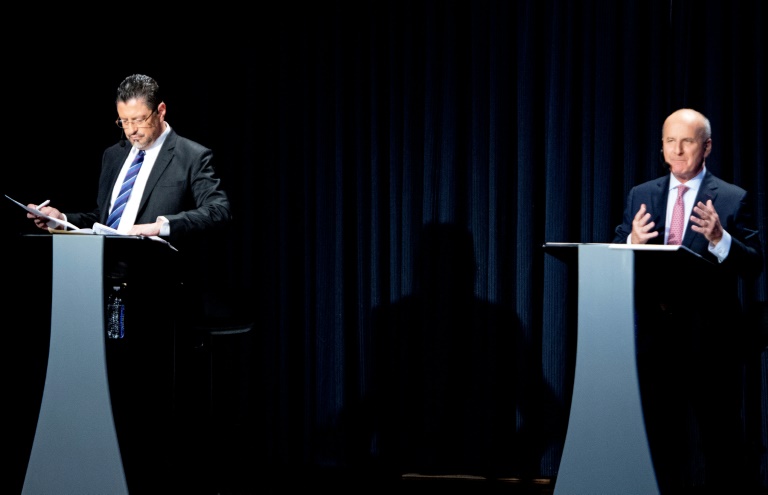
Former president Jose Maria Figueres was once investigated for corruption while ex-finance minister Rodrigo Chaves — who was slightly ahead in opinion polls — was previously demoted for sexual harassment.

But with 23 percent of the population living in poverty and unemployment soaring to 14 percent alongside a series of corruption scandals, Costa Ricans seem more focused on the economy as they elect a successor to Carlos Alvarado.

Polls opened at 6.00 am (1200 GMT) and will close at 6.00 pm (0000 GMT), with the first results expected just over two hours later.

Long lines formed early Sunday at voting centers in the capital San Jose. The commission overseeing the elections said all centers around the country had opened without incident.

“I am going to elect the person I like and who has good principles to govern Costa Rica. The first concern is that there is work, economy and security,” said 58-year-old Angela Marin, first to vote at the Liceo de San Antonio de Coronado.

“The two candidates left are people for whom there is not much confidence. But we have to choose between one of the two and hopefully there will be something good,” she added.

Casting his vote at a school on the outskirts of San Jose, Figueres said, “Let us all vote with joy, respecting people’s preferences but strengthening our democratic system.”

Costa Rica has been described as the “happiest” country in Latin America and praised for its environmental policies and eco-tourism, but the vital tourism industry was hard hit by the coronavirus pandemic.

Alongside Peru, it suffered the largest fall in employment figures in the region between 2019 and 2020.

– ‘We’re very poor’ –

“The next president has to change everything because we’re very poor. There is no work here, there is nothing,” said Ana Briceno, 64, a travel agent in San Jose.

“In the last years with Carlos Alvarado the situation has been very difficult … so I think the future president must focus on the economy,” said Cristina Aguilar, 32.

Given their previous troubles, the two candidates have sought to keep the debate swirling around the economy.

“The urgent themes to address are the ones causing discomfort and suffering to the people,” said Chaves, 60, a surprise qualifier for Sunday’s run-off, having polled fourth ahead of February’s first round.

“The first is the lack of jobs. Secondly, the cost of living.”

Chaves, from the newly formed right-wing Social Democratic Progress Party, led the most recent opinion polls, with more than 41 percent support, compared to 38 percent for Figueres.

Figueres, 67, who was president from 1994 to 1998, is equally focused on the economy.

“In the economic agenda, unemployment is the most important, the creation of employment opportunities is the priority,” he said.

Figueres, whose father Jose abolished the army in 1948 when he was president, topped the first round of voting among a crowded field of 25 contenders with 27.3 percent, ahead of Chaves who had 16.8 percent.

But they were a long way from the 40 percent needed to win outright.

– ‘Misinterpreted’ jokes – 

Both men have reached this final stage of the election despite the specter of past scandals.

Chaves, who spent six months as finance minister in the outgoing government, was investigated over sexual harassment complaints brought by multiple women while he was a senior official at the World Bank, where he worked for 30 years.

He was demoted, though not fired, and has dismissed his behavior as jokes that were “misinterpreted due to cultural differences.”

Figueres, who represents the centrist National Liberation Party (PLN), was investigated for allegedly taking $900,000 from French engineering firm Alcatel, which has admitted to bribing officials.

The ex-president, who worked abroad at the time as executive director of the World Economic Forum (WEF), refused to give evidence in the case in 2004 and returned to Costa Rica only in 2011 when the investigation expired.

“Right now, I don’t know who I will vote for … because Chaves contradicts himself in everything and given what Figueres did last time, it leaves us undecided,” said Jairo Montero, 37.

In the unlikely event the election ends in a draw, Costa Rican law says the elder candidate would win, in this case Figueres. 

The winner will begin a four-year term on May 8.

Serbians vote in polls overshadowed by war in Ukraine

Serbians went to the polls on Sunday in elections that will likely see populist President Aleksandar Vucic extend his rule in the Balkan country, as he vows to provide stability amid war raging in Ukraine.

The country of around seven million will elect the president, deputies for the 250-seat parliament and cast votes in several municipal contests. 

The latest opinion polls see Vucic’s centre-right Serbian Progressive Party (SNS) maintaining its control over the parliament, while the president is poised to win a second term.

“Personally, I see stable progress and I voted in accordance with this opinion,” Milovan Krstic, a 52-year-old government employee, told AFP after casting his vote in Belgrade.

Russia’s invasion of Ukraine has cast a long shadow over a contest that observers had earlier predicted would focus on environmental issues, corruption and rights.

Vucic has deftly used the return of war in Europe along with the coronavirus pandemic to his advantage, promising voters continued stability amid uncertain headwinds.   

“We expect a huge victory. That’s what we worked for in the past four or five years, and we believe that we will continue with the great efforts and the development of this country,” the president said after casting his ballot early Sunday.

Serbia’s leading opposition candidate Zdravko Ponos said he hoped the contest would offer a path to institute “serious change” in the country. 

“I hope for a bright future. Elections are the right way to change the situation. I hope the citizens of Serbia will take the chance today,” said Ponos.

In the capital Belgrade, the relatively quiet elections were briefly marred by scuffles between parliamentary candidate Pavle Grbovic and supporters of Vucic’s SNS, along with scattered reports of small skirmishes elsewhere.

As of 5 pm local time (1500 GMT), voter turnout hovered around 45 percent, according to the election monitor CRTA.

Serbs from the former breakaway province of Kosovo also participated in the contest and boarded around 40 buses headed north to vote, after authorities in Pristina refused to allow polling centres on its soil.

– Decade in power –

Only a few months ago, the opposition seemed to have gained momentum. 

In January, Vucic axed a controversial lithium mine project following mass protests that saw tens of thousands take to the streets. 

The move was a rare defeat for Vucic who has rotated through a range of positions, including prime minister, president and deputy premier along with a stint as the defence chief during a decade in power. 

The polls predict that he will win again on Sunday even as the opposition hopes a high turnout could force a run-off. 

Analysts, however, say the opposition has little chance of dethroning Vucic or eating away at his coalition in the parliament, which holds a lion’s share of the seats.

The president has also carefully managed the country’s response to the war in Ukraine by officially condemning Russia at the United Nations, but stopping short of sanctioning Moscow at home, where many Serbs hold a favourable view of the Kremlin. 

The opposition in turn has largely refrained from attacking Vucic’s position on the conflict, fearing any call for harsher measures against Russia would backfire at the ballot box. 

Vucic also headed into elections with a plethora of other advantages. 

Following a decade at the helm, he has increasingly tightened his grip over the various levers of power, including de facto control over much of the media and government services.

In the months leading up to the campaign, the president rolled out a range of financial aid offers to select groups, prompting critics to say he was trying to “buy” votes before the contest. 

Polling stations opened from 0500 GMT and close at 1800 GMT, with unofficial results due later in the evening.

S.Sudan rivals seal security pact in peace 'milestone'

In what has been hailed as a major breakthrough, South Sudan’s rival leaders sealed an agreement Sunday on a key military provision of their stuttering peace deal.

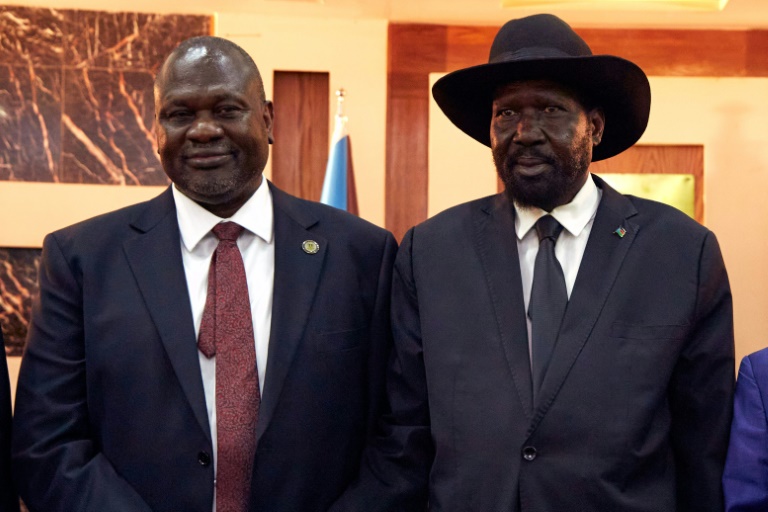
President Salva Kiir and his rival, Vice President Riek Machar, agreed on the creation of a unified armed forces command, one of several crucial unresolved issues holding up implementation of the 2018 deal to end the country’s bloody five-year civil war.

“Peace is about security and today we have (achieved) a milestone,” said Martin Abucha, who signed the agreement on behalf of Machar’s opposition SPLM/A-IO. 

Minister of presidential affairs Barnaba Marial Benjamin hailed the deal — signed following mediation by neighbouring Sudan — as a “necessary step… that opens a route for the stable government of the Republic of South Sudan”.

Tensions between forces loyal to Kiir and former rebel leader Machar have spiralled recently, triggering fears in the international community of a return to full-blown conflict in the world’s youngest nation.

Both men were at the ceremony in the capital Juba for the signing of the accord, which stipulates a 60-40 distribution in favour of Kiir’s side of key leadership posts in the army, police and national security forces.

Mohamed Hamdan Daglo, the number two in Sudan’s post-coup ruling council, had arrived in Juba on Friday in a bid to break the deadlock over the security arrangements.

Sudan, one of the guarantors of the 2018 deal, drew up the proposal after Kiir on March 25 issued a presidential decree on the formation of the military command structure, a move that had been swiftly rejected by Machar as a “unilateral” action.

Landlocked South Sudan, one of the poorest countries on the planet despite large oil reserves, has suffered from chronic instability since it declared independence from Sudan in 2011, spending almost half of its life as a nation at war. 

It has struggled to draw a line under the 2013-2018 conflict that erupted after Kiir accused Machar of an attempted coup. Almost 400,000 people lost their lives and millions more were displaced by the fighting.

– UN warning of potential ‘catastrophe’ –

Although the two men formed a power-sharing unity government more than two years ago, South Sudan has continued to lurch from crisis to crisis, battling flooding, hunger, violence and political bickering that threatened to undo even the limited progress in the faltering peace process.

The fragile peacemaking was put under further pressure last month when Machar’s Sudan People’s Liberation Movement in Opposition (SPLM/A-IO) pulled out of a body monitoring the process to protest at continued “unprovoked” attacks of its bases by its “peace partner”.

The United States last week expressed concern over the growing tensions, deploring reported clashes in Upper Nile State and warning that the opposition move undermined the peace agreement.

Last month, the UN Security Council voted to prolong its peacekeeping mission in South Sudan for one more year, although Russia and China abstained.

The operation, with up to 17,000 soldiers and 2,100 police officers, is one of the most expensive for the UN, with an annual budget surpassing $1 billion.

In a presentation to the Security Council, the UN envoy for South Sudan, Nicholas Haysam, issued a stark warning to the country’s leaders to do more to prepare for elections due to be held in less than a year.

“Elections have the potential to be a nation-building moment, or a catastrophe,” he said.

Although he highlighted progress in some areas including the operation of key government institutions and parliament, other issues are stalled, including the process of drafting a new constitution.    

The UN has repeatedly criticised South Sudan’s leadership for its role in stoking violence, cracking down on political freedoms and plundering public coffers.

South Sudan also faces humanitarian woes caused by conflict as well as climate-related disasters such as flooding and drought, prompting the UN on Thursday to launch a $1.6 billion aid plan. 

It said the funding will be used to provide urgent life-saving assistance and protection in a country where it is estimated more than two thirds of the population, nearly nine million people, require aid relief. 

Pakistan to go to the polls after PM Khan foils sacking attempt

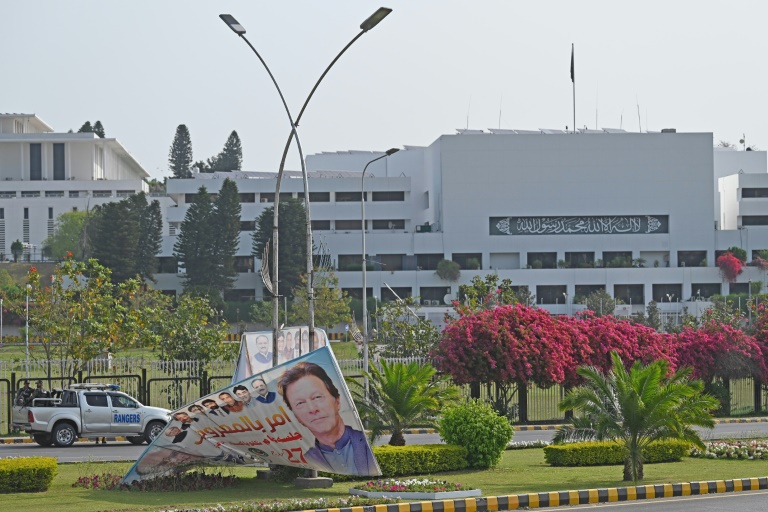
Pakistan Prime Minister Imran Khan foiled an attempt to boot him from office Sunday by getting the president to dissolve the national assembly, meaning fresh elections must be held within three months.

On a day of high drama, the assembly deputy speaker refused to accept a motion of no confidence in the government, as Khan simultaneously appeared on TV to say there had been “foreign interference” in Pakistan’s democratic institutions.

“I have sent advice to the president to dissolve the assemblies. We will go to the public and hold elections, and let the nation decide,” he said.

The presidency — a largely ceremonial office — acceded hours later.

No Pakistan prime minister has ever completed a full term, and Khan was facing the biggest challenge to his rule since being elected in 2018, with opponents accusing him of economic mismanagement and bungling foreign policy.

On Sunday parliament was due to debate a no-confidence motion that looked certain to succeed, but the deputy speaker — a Khan loyalist — refused to accept it on the grounds it had a “clear nexus” with a foreign state to bring about a change of government.

It caused uproar in the chamber, but there was calm on the streets on the first day of the fasting month of Ramadan, with a huge security presence in the capital. 

Khan, an ex-international cricket star who in 1992 captained Pakistan to their only World Cup win, had hinted Saturday he still had a card to play — and Sunday’s move appeared to blindside the opposition.

“Astonished by the reaction,” he tweeted later, adding the opposition had been “crying hoarse” about the government failing and losing the support of the people.

“So why the fear of elections now?”

– ‘Black day’ for Pakistan –

“This day will be remembered as a black day in Pakistan’s constitutional history,” said Shehbaz Sharif, tipped to replace Khan if the no-confidence motion had succeeded.

The opposition and government immediately filed a slew of petitions and briefs against and for the developments, with the supreme court saying arguments would be heard on Monday.

“It is of utmost importance that political parties and state functionaries act accordance to law and refrain from taking unconstitutional steps,” said Chief Justice Umar Ata Bandial.

Khan’s Pakistan Tehreek-e-Insaf party (PTI) effectively lost its majority in the 342-member assembly last week when a coalition partner said its seven lawmakers would vote with the opposition.

More than a dozen PTI members had also indicated they would cross the floor.

In days leading up to the vote, Khan accused the opposition of conspiring with “foreign powers” to remove him because he would not take the West’s side on global issues against Russia and China.

On Thursday he accused the United States of meddling in Pakistan’s affairs. 

Local media had reported that Khan received a briefing letter from Islamabad’s ambassador to Washington recording a senior US official saying they felt relations would be better if Khan left office.

In Washington last week State Department spokesman Ned Price told reporters there was “no truth” to the allegations, but Khan insisted Sunday it was “regime change” and accused the opposition of betraying the country.

“This betrayal was taking place in front of the entire nation… traitors were sitting and planning this conspiracy,” he added.

– Opposition gathers –

The opposition is headed by the Pakistan Muslim League-N (PML-N) and the Pakistan Peoples Party (PPP) — two usually feuding dynastic groups that dominated national politics for decades until Khan forged a coalition against them.

Khan was elected after promising to sweep away decades of entrenched corruption and cronyism, but has struggled to maintain support with inflation skyrocketing, a feeble rupee and crippling debt.

Some analysts said Khan had also lost the crucial support of the military — claims both sides deny — but it is unlikely he would have pulled off Sunday’s manoeuvre without its knowledge, if not blessing.

There have been four military coups — and at least as many unsuccessful ones — since independence in 1947, and the country has spent more than three decades under army rule.

“The best option in this situation are fresh elections to enable the new government to handle economic, political and external problems faced by the country,” said Talat Masood, a general turned political analyst.

Somaliland capital counts cost of devastating blaze

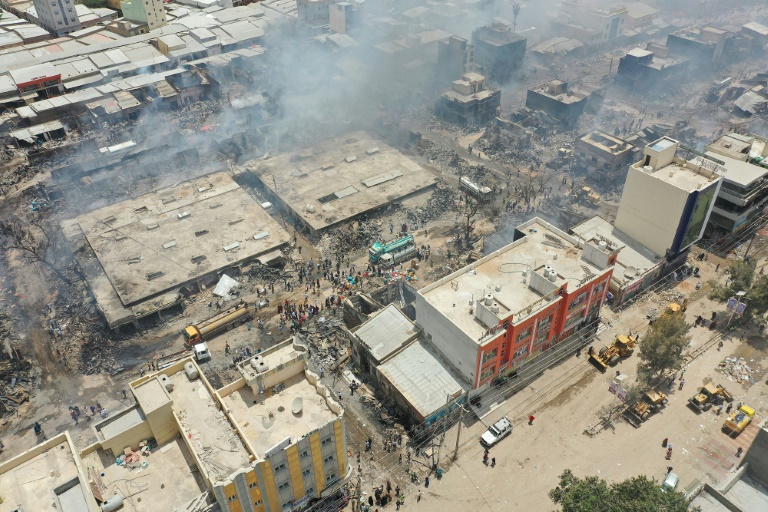
Stunned residents of the northern Somali city of Hargeisa were struggling to pick up the pieces Sunday after a massive inferno destroyed the central market, and with it the livelihoods of thousands.

The mayor of Hargeisa, capital of the breakaway region of Somaliland, estimated the blaze that engulfed the Waheen market had caused losses of up to $2 billion.

Officials have issued urgent appeals for help to rebuild the open-air market, which was the bustling economic heart of Hargeisa with an estimated 2,000 shops and stalls.

The fire broke out late Friday and the flames rapidly swept through the market, consuming everything in their path before they were largely brought under control on Saturday.

No-one was killed in the disaster that struck at the start of the holy Muslim month of Ramadan, but 28 people were injured and hundreds of businesses destroyed, officials said. The cause is not yet known.

“According to preliminary information about the damage the fire caused, there is an estimated loss of property ranging between $1.5 billion to $2 billion,” Hargeisa mayor Abdikarim Mohamed Moge told reporters late Saturday.

“The town has never witnessed such a massive calamity.”

He said the clean-up operation would begin in earnest on Tuesday after allowing local residents and traders to try to retrieve any property that survived the blaze.

A five-member committee has been set up by Somaliland’s president Muse Bihi Abdi to lead the rescue operation and efforts to assist those whose livelihoods have been ruined by the disaster.

Information minister Saleban Yusuf Ali Kore told reporters the flames destroyed an area of about 99,000 square metres (about 24 acres).

– Problems of congestion –

Images from the scene showed huge flames and clouds of smoke billowing into the sky over Hargeisa as the fire took hold, with many buildings destroyed or turned into charred wrecks, their windows blown out.

Somaliland’s fire and rescue chief Ahmed Mohamed Hassan said at least 24 vehicles were used in the firefighting operation but were hampered by poor access in the sprawling market and the difficulty of breaking into shops locked up with iron bars.

“We have been complaining about the overcrowding here for some time and sent our concerns to the business owners, but they have ignored our calls to clear the clogged pathways,” he said. 

“I hope they will learn from this.”

Several countries including Britain, which once ruled Somaliland as a protectorate, and neighbouring Ethiopia and Djibouti have offered support and sympathy over the disaster.

“Your city will rise again and the UK will do what we can to support Somaliland’s rebuilding effort,” British Prime Minister Boris Johnson tweeted on Saturday, without giving details.

Somaliland declared independence from Somalia in 1991, an act not recognised by the international community that has left the region of 4.5 million people poor and isolated.

Somaliland has however remained a comparative beacon of stability while Somalia has been wracked by decades of political violence.

Taliban chief orders ban on poppy cultivation in Afghanistan

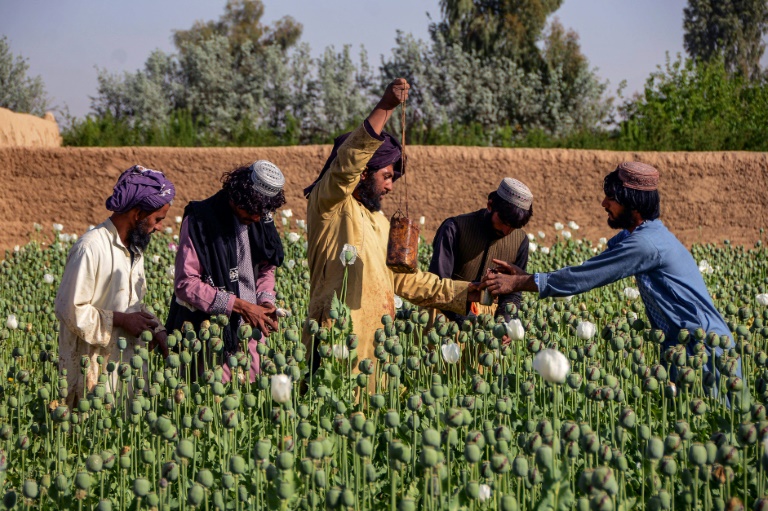
The Taliban’s supreme leader on Sunday ordered a ban on poppy cultivation in Afghanistan, warning that the hardline Islamist government would crack down on farmers planting the crop.

Afghanistan is the world’s biggest producer of poppies, the source of sap that is refined into heroin, and in recent years production and exports have only boomed.

“All Afghans are informed that from now on cultivation of poppy has been strictly prohibited across the country,” said a decree issued by Supreme Leader Hibatullah Akhundzada.

The order was read out by government spokesman Zabihullah Mujahid at a gathering of reporters, foreign diplomats and Taliban officials.

“If anyone violates the decree the crop will be destroyed immediately and the violator will be treated according to the sharia law,” it added.

It is not the first time the fundamentalist group has vowed to outlaw the trade. Production was banned in 2000, just before the group was overthrown by US-led forces in the wake of the September 11 attacks.

During their 20-year insurgency against foreign forces, the Taliban heavily taxed farmers cultivating the crop in areas under their control, experts have said.

It became a key resource for the group to generate funds.

Poppy farmer Abdul Rahman told AFP that Sunday’s ban was a blow to his livelihood. 

“We have taken loans to cultivate this… If these crops are destroyed our income will be gone,” said Rahman, who is from the southern province of Kandahar — the Taliban’s de facto power centre.

“We too are not fond of cultivating this crop and are fed up with it. We know our future generations will be addicted to it but we are compelled to cultivate.”

– Tough to enforce ban –

The United States and NATO forces tried to curb poppy cultivation during their two decades in Afghanistan by paying farmers to grow alternative crops such as wheat or saffron.

But their attempts were thwarted by the Taliban, who controlled the main poppy-growing regions and derived hundreds of millions of dollars from the trade, experts have said.

Author David Mansfield, who has written a book on Afghanistan’s opium trade, said the Taliban would find it difficult to enforce the latest ban, as farmers had invested considerable resources in a crop that was ready to harvest.

“It’s not just opium (farmers) smell, it’s cash & what it buys after a cold winter of rising food prices & economic crisis,” Mansfield tweeted.

Afghanistan’s economic and humanitarian crisis has deepened since foreign donors cut off aid to the country in the aftermath of the Taliban’s takeover of the country in August last year.

Mansfield said the ban was an attempt by the Taliban to divert the political debate in the country away from issues such as “girls education & human rights”.

Last month the Taliban shut all secondary schools for girls, just hours after reopening them for the first time since seizing power, triggering international outrage. 

Afghan media reports, meanwhile, have said poppy production has increased in two southern provinces, Kandahar and Helmand, since the Taliban returned to power, but did not provide data.

Afghanistan has a near-monopoly on opium and heroin, accounting for 80 to 90 percent of global output, according to the United Nations Office on Drugs and Crime.

The amount of land used for planting poppies hit a record high in 2017 and has averaged around 250,000 hectares in recent years, roughly four times the level of the mid-1990s, UN figures show.

According to a UN survey in 2020, poppies were grown in 22 of Afghanistan’s 34 provinces.

Brazil storm death toll rises to 16

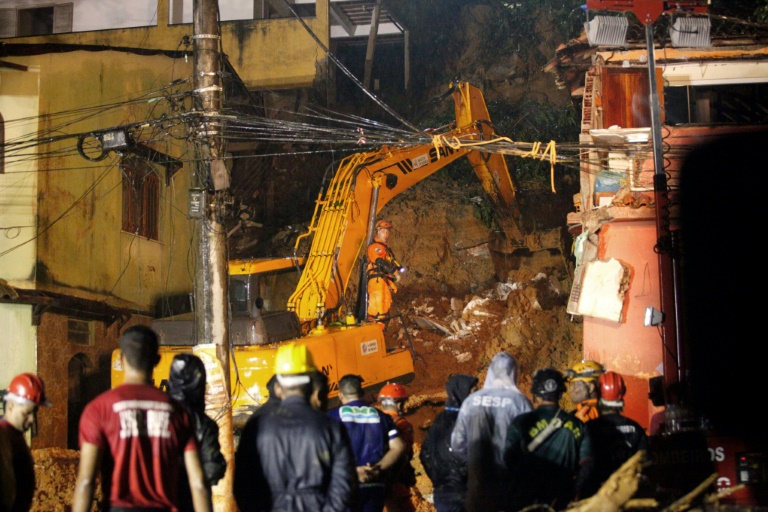
The death toll from torrential downpours that triggered flash floods and landslides in Brazil’s Rio de Janeiro state rose to 16 Sunday, with three people still missing, authorities said.

Three days of heavy rain have battered a broad swathe of the southeastern state’s Atlantic coast, the latest in a series of deadly storms in Brazil that experts say are being made worse by climate change. 

Emergency workers pulled two more bodies early Sunday from the mud and wreckage left by a landslide in the Monsuaba neighborhood of Angra dos Reis, a seaside town 160 kilometers (100 miles) southwest of Rio de Janeiro city, officials said.

In all, four children and four adults were killed there, the city government said. Emergency workers are still searching for three people reported missing in Monsuaba.

Another landslide in the picturesque colonial town of Paraty killed a mother and six of her children, aged two to 17.

A seventh child was rescued alive and taken to the hospital, where he was in stable condition, the mayor’s office said.

In the Rio suburb of Mesquita, a 38-year-old man was electrocuted trying to help another person escape the flooding, officials and media reports said.

President Jair Bolsonaro said on Facebook the federal government had sent military aircraft to help the rescue effort and dispatched national disaster response secretary Alexandre Lucas to the state of 17.5 million people.

The new storms come six weeks after flash floods and landslides killed 233 people in the scenic city of Petropolis, the Brazilian empire’s 19th-century summer capital, also in Rio state.

Pakistan to go to the polls after PM Khan foils sacking attempt

Pakistan Prime Minister Imran Khan foiled an attempt to boot him from office Sunday by getting the president to dissolve the national assembly, meaning fresh elections must be held within three months.

On a day of high drama, the assembly deputy speaker refused to accept a motion of no confidence in the government, as Khan simultaneously appeared on TV to say there had been “foreign interference” in Pakistan’s democratic institutions.

“I have sent advice to the president to dissolve the assemblies. We will go to the public and hold elections, and let the nation decide,” he said.

The presidency — a largely ceremonial office — acceded hours later.

No Pakistan prime minister has ever completed a full term, and Khan was facing the biggest challenge to his rule since being elected in 2018, with opponents accusing him of economic mismanagement and bungling foreign policy.

On Sunday parliament was due to debate a no-confidence motion that looked certain to succeed, but the deputy speaker — a Khan loyalist — refused to accept it on the grounds it had a “clear nexus” with a foreign state to bring about a change of government.

It caused uproar in the chamber, but there was calm on the streets on the first day of the fasting month of Ramadan, with a huge security presence in the capital. 

Khan, an ex-international cricket star who in 1992 captained Pakistan to their only World Cup win, had hinted Saturday he still had a card to play — and Sunday’s move appeared to blindside the opposition.

– ‘Black day’ for Pakistan –

“This day will be remembered as a black day in Pakistan’s constitutional history,” said Shehbaz Sharif, tipped to replace Khan if the no-confidence motion had succeeded.

The opposition and government immediately filed a slew of petitions and briefs against and for the developments, with the supreme court saying arguments would be heard on Monday.

“It is of utmost importance that political parties and state functionaries act accordance to law and refrain from taking unconstitutional steps,” said Chief Justice Umar Ata Bandial.

Khan’s Pakistan Tehreek-e-Insaf party (PTI) effectively lost its majority in the 342-member assembly last week when a coalition partner said its seven lawmakers would vote with the opposition.

More than a dozen PTI members had also indicated they would cross the floor.

In days leading up to the vote, Khan accused the opposition of conspiring with “foreign powers” to remove him because he would not take the West’s side on global issues against Russia and China.

On Thursday he accused the United States of meddling in Pakistan’s affairs. 

Local media had reported that Khan received a briefing letter from Islamabad’s ambassador to Washington recording a senior US official saying they felt relations would be better if Khan left office.

In Washington last week State Department spokesman Ned Price told reporters there was “no truth” to the allegations, but Khan insisted Sunday it was “regime change” and accused the opposition of betraying the country.

“This betrayal was taking place in front of the entire nation… traitors were sitting and planning this conspiracy,” he added.

– Opposition gathers –

The opposition is headed by the Pakistan Muslim League-N (PML-N) and the Pakistan Peoples Party (PPP) — two usually feuding dynastic groups that dominated national politics for decades until Khan forged a coalition against them.

Khan was elected after promising to sweep away decades of entrenched corruption and cronyism, but has struggled to maintain support with inflation skyrocketing, a feeble rupee and crippling debt.

Some analysts said Khan had also lost the crucial support of the military — claims both sides deny — but it is unlikely he would have pulled off Sunday’s manoeuvre without its knowledge, if not blessing.

There have been four military coups — and at least as many unsuccessful ones — since independence in 1947, and the country has spent more than three decades under army rule.

“The best option in this situation are fresh elections to enable the new government to handle economic, political and external problems faced by the country,” said Talat Masood, a general turned political analyst.

Costa Ricans vote in poll dominated by poverty, unemployment

Costa Ricans began voting on Sunday to elect one of two scandal-tainted presidential candidates in a country grappling with sky-high poverty and unemployment.

Former president Jose Maria Figueres was once investigated for corruption while ex-finance minister Rodrigo Chaves — who was slightly ahead in opinion polls — was previously demoted for sexual harassment.

But with 23 percent of the population living in poverty and unemployment soaring to 14 percent alongside a series of corruption scandals, Costa Ricans seem more focused on the economy as they elect a successor to Carlos Alvarado.

Polls opened at 6.00 am (1200 GMT) and will close at 6.00 pm (0000 GMT), with the first results expected later Sunday.

Long lines formed early Sunday at voting centers in the capital San Jose.

“I am going to elect the person I like and who has good principles to govern Costa Rica. The first concern is that there is work, economy and security,” said 58-year-old Angela Marin, first to vote at the Liceo de San Antonio de Coronado.

“The two candidates left are people for whom there is not much confidence. But we have to choose between one of the two and hopefully there will be something good,” she added.

Costa Rica has been described as the “happiest” country in Latin America and praised for its environmental policies and eco-tourism, but the vital tourism industry was hard hit by the coronavirus pandemic.

Alongside Peru, it suffered the largest fall in employment figures in the region between 2019 and 2020.

– ‘We’re very poor’ –

“The next president has to change everything because we’re very poor. There is no work here, there is nothing,” said Ana Briceno, 64, a travel agent in the capital San Jose.

“In the last years with Carlos Alvarado the situation has been very difficult … so I think the future president must focus on the economy,” said Cristina Aguilar, 32.

Given their previous troubles, the two candidates have sought to keep the debate swirling around the economy.

“The urgent themes to address are the ones causing discomfort and suffering to the people,” said Chaves, 60, a surprise qualifier for Sunday’s run-off, having polled fourth ahead of February’s first round.

“The first is the lack of jobs. Secondly, the cost of living.”

Chaves, from the newly formed right-wing Social Democratic Progress Party, led the most recent opinion polls, with more than 41 percent support, compared to 38 percent for Figueres.

Figueres, 67, who was president from 1994 to 1998, is equally focused on the economy.

“In the economic agenda, unemployment is the most important, the creation of employment opportunities is the priority,” he said.

Figueres, whose father Jose abolished the army in 1948 when he was president, topped the first round of voting among a crowded field of 25 contenders with 27.3 percent, ahead of Chaves who had 16.8 percent.

But they were a long way from the 40 percent needed to win outright.

– ‘Misinterpreted’ jokes – 

Both men have reached this final stage of the election despite the specter of past scandals.

Chaves, who spent six months as finance minister in the outgoing government, was investigated over sexual harassment complaints brought by multiple women while he was a senior official at the World Bank, where he worked for 30 years.

He was demoted, though not fired, and has dismissed his behavior as jokes that were “misinterpreted due to cultural differences.”

Figueres, who represents the centrist National Liberation Party (PLN), was investigated for allegedly taking $900,000 from French engineering firm Alcatel, which has admitted to bribing officials.

The ex-president, who worked abroad at the time as executive director of the World Economic Forum (WEF), refused to give evidence in the case in 2004 and returned to Costa Rica only in 2011 when the investigation expired.

“Right now, I don’t know who I will vote for … because Chaves contradicts himself in everything and given what Figueres did last time, it leaves us undecided,” said Jairo Montero, 37.

In the unlikely event the election ends in a draw, Costa Rican law says the elder candidate would win, in this case Figueres. 

The first results are expected at around 8.30 pm. 

The winner will begin a four-year term on May 8.

Close Bitnami banner
Bitnami