World

Russia targets Ukraine's Odessa as UN seeks ceasefire

Explosions rocked the strategic Ukrainian port city of Odessa on Sunday, as a top UN official headed to Moscow to try to secure a “humanitarian ceasefire” and after evidence emerged of possible civilian killings around Kyiv.

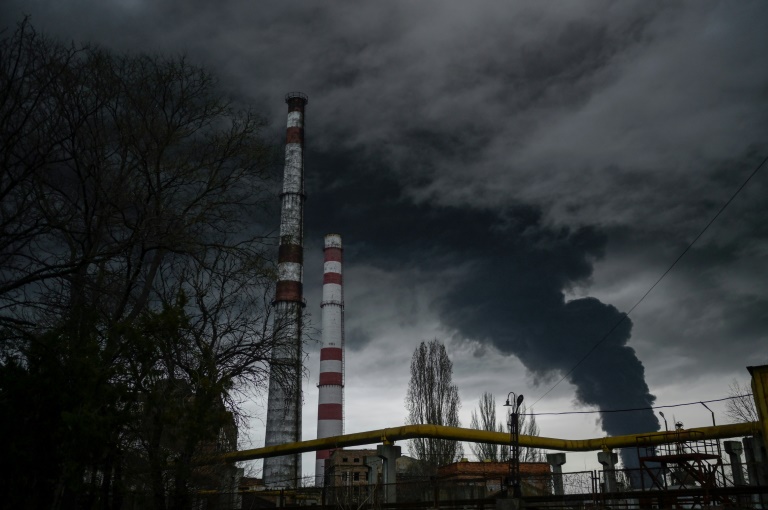
Thick plumes of black smoke rose from several areas on the historic Black Sea port, after air strikes shook the city at about 6:00 am (0300 GMT) but the Ukrainian army said no one was killed.

Russia’s defence ministry confirmed the attack, saying “high-precision sea and air-based missiles destroyed an oil refinery and three storage facilities for fuel and lubricants”.

The ministry claimed the targets were supplying fuel to Ukrainian troops.

Anton Herashchenko, an adviser to the Ukrainian interior minister, said: “Fires were reported in some areas. Some of the missiles were shot down by air defence.”

The strikes came with Greece’s Foreign Minister Nikos Dendias expected in the city to deliver humanitarian aid to the municipal authorities.

UN chief Antonio Guterres’ humanitarian envoy Martin Griffiths was meanwhile seeking a halt in the fighting, which Ukraine estimates has left 20,000 people dead, and forced more than 10 million to flee for their lives.

He will fly on to Kyiv from Moscow. Both Russia and Ukraine have agreed to meet him, Guterres said on Saturday.

– Mass graves –

In the ravaged city of Bucha, just outside the Ukrainian capital, the bodies of nearly 300 civilians were found in mass graves after Russian troops withdrew.

AFP reporters saw at least 20 bodies, all in civilian clothing, strewn across a single street. One had his hands tied behind his back with a white cloth, and his Ukrainian passport left open beside his body.

“All these people were shot,” Bucha’s mayor Anatoly Fedoruk said, adding that 280 other bodies had been buried in mass graves in the town. “These are the consequences of Russian occupation.”

UK Foreign Secretary Liz Truss said she was “appalled by atrocities in Bucha and other towns in Ukraine” and promised the perpetrators would be held to account before an international war crimes tribunal.

The International Criminal Court has already opened a probe into possible war crimes committed in Ukraine, and several Western leaders, including US President Joe Biden, have accused Russia’s Vladimir Putin of being a “war criminal”.

Ukraine’s President Volodymyr Zelensky has also alleged that Russian soldiers  planted mines and other booby traps as they withdraw from northern Ukraine.

In a video address Saturday, he warned returning residents of tripwires and other dangers.

“We are moving forward. Moving carefully and everyone who returns to this area must also be very careful,” he said.

Meanwhile, in an attempt to raise economic pressure on Russia, the Baltic states of Latvia, Estonia and Lithuania announced Saturday that they had stopped all imports of Russian natural gas.

– ‘Verbal agreement’ –

Pope Francis, on a visit to the Mediterranean island of Malta, issued a thinly veiled attack on Putin for ordering troops into Ukraine, and on Sunday made a plea for refugees fleeing the conflict to be welcomed.

The pontiff has not ruled out a visit to Kyiv.

On talks to end the fighting, Ukrainian negotiator David Arakhamia told local television channels that Russia had “verbally” accepted most of Kyiv’s proposals — except on the issue of Crimea, which Moscow annexed in 2014.

Among the agreed-upon points was that a referendum on Ukraine’s neutral status “will be the only way out of this situation”, Arakhamia said.

He said any meeting between Zelensky and Putin would “with a high probability” take place in Turkey, which has sought to mediate the conflict.

As Russian forces withdraw from some northern areas, Moscow appears to be focusing on eastern and southern Ukraine, where it already holds vast swathes of territory.

UK Defence Intelligence said early Sunday that Russian air activity in the last week had been concentrating on southeastern Ukraine, “likely as a result of Russia focusing its military operations in this area”.

But it said Russia was struggling to find and destroy air systems, which has “signficantly affected their ability to support the advance of their ground forces”.

In his latest video message, Zelensky said Russian troops wanted to seize the disputed Donbas region and the south of Ukraine, promising “to defend our freedom, our land and our people”.

But Ukrainian presidential adviser Mykhaylo Podolyak warned on social media that “without heavy weapons we won’t be able to drive (Russia) out”.

Ukraine authorities nevertheless offered citizens elements of good news Saturday in claiming progress against the Russians, more than five weeks after the start of Europe’s worst conflict in decades.

“Irpin, Bucha, Gostomel and the whole Kyiv region were liberated from the invader,” deputy defence minister Ganna Maliar said on Facebook, referring to towns that have been heavily damaged or destroyed by fighting.

– Resistance –

Russia’s efforts to consolidate its hold on southern and eastern areas of Ukraine have been hampered by the resistance of Mariupol despite devastating attacks lasting weeks.

At least 5,000 residents have been killed in the besieged southern port city, according to officials, while the estimated 160,000 who remain face shortages of food, water and electricity.

The International Committee of the Red Cross (ICRC) said its team left for Mariupol on Saturday to make another attempt at conducting an evacuation, after being forced to turn back the day before.

In another southern city, Enerhodar, which is under Russian control, a Ukrainian official said Russian forces opened fire on peaceful demonstrators, injuring four.

Zelensky has thanked the residents of Enerhodar, the site of Europe’s largest nuclear power plant, which had been seized by Russian troops in early March, for their bravery.

“When people protest, and the more they protest, the harder it is for the occupiers to destroy us, to destroy our freedom,” Zelensky said.

In Russia, hundreds of people gathered across the country Saturday to protest against the war in Ukraine. Police detained 211 people in several cities, according to OVD-Info, a group that monitors arrests.

burs-phz/bp
Sri Lanka protesters defy curfew after social media shutdown

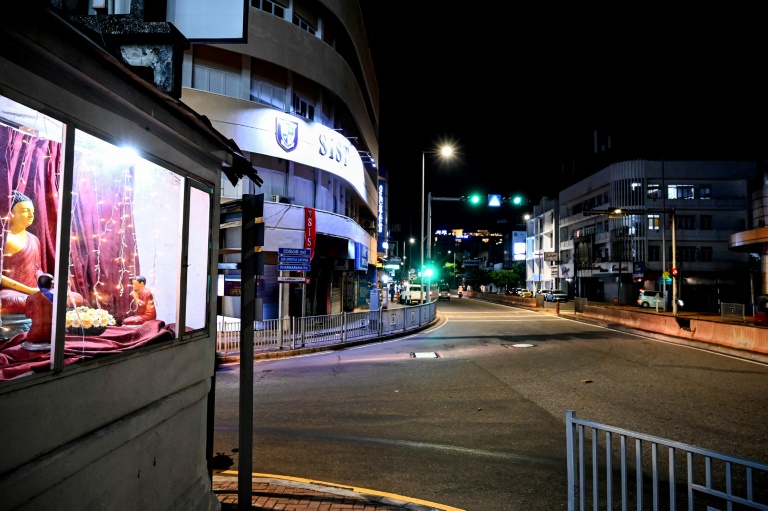
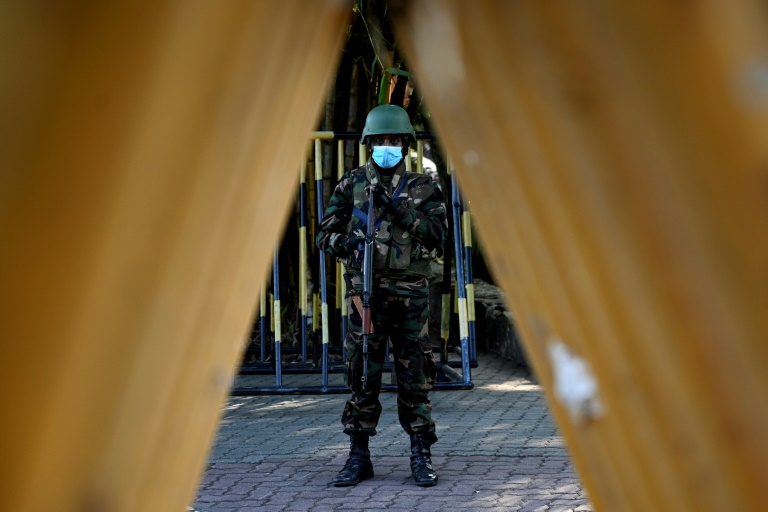
Armed troops in Sri Lanka blocked a Sunday opposition march that defied a weekend curfew to protest the island nation’s worsening economic crisis, after authorities imposed a social media blackout to contain public dissent.

The South Asian nation is facing severe shortages of food, fuel and other essentials, along with record inflation and crippling power cuts, in its most painful downturn since independence from Britain in 1948.

President Gotabaya Rajapaksa imposed a state of emergency on Friday, the day after a crowd attempted to storm his home in the capital Colombo, and a nationwide curfew is in effect until Monday morning.

The Samagi Jana Balawegaya (SJB), Sri Lanka’s main opposition alliance, denounced a social media blackout aimed at quelling intensifying public demonstrations, and said it was time for the government to resign.

Troops armed with automatic assault rifles moved to stop a protest by opposition lawmakers and hundreds of their supporters attempting to march to the capital’s Independence Square.

The road was barricaded a few hundred metres from the home of opposition leader Sajith Premadasa and the crowd engaged in a tense stand-off with security forces for nearly two hours before dispersing peacefully. 

“President Rajapaksa better realise that the tide has already turned on his autocratic rule,” SJB lawmaker Harsha de Silva told AFP at the rally.

Fellow SJB legislator Eran Wickramaratne condemned the state of emergency declaration and the presence of troops on city streets.

“We can’t allow a military takeover,” he said. “They should know we are still a democracy.”

Facebook, YouTube, Twitter, Instagram and WhatsApp were among the platforms shut down Sunday on the orders of defence authorities, internet service providers told their subscribers.

Private media outlets reported that the chief of Sri Lanka’s internet regulator resigned after the order went into effect. 

The streets of the capital stayed largely empty on Sunday, apart from the opposition protest and long lines of vehicles queued for fuel at service stations. 

Mass protests had been called on social media before the ban went into effect, and organisers have since postponed the rallies until after the curfew is lifted on Monday.

Small crowds defied the curfew on Saturday night to hold peaceful demonstrations in various neighbourhoods around Colombo which broke up without incident. 

– ‘Completely useless’ –

Cracks in the government have emerged, with the president’s nephew Namal Rajapaksa announcing he had urged the government to reconsider the partial internet blackout. 

“I will never condone the blocking of social media,” said Namal, also the country’s sports minister. 

“The availability of VPN, just like I’m using now, makes such bans completely useless.”

The anti-government hashtags “#GoHomeRajapaksas” and “#GotaGoHome” have been trending locally for days on Twitter and Facebook. 

A social media activist was arrested Friday for posting material that could allegedly cause public unrest. He has since been bailed.

Hundreds of lawyers have volunteered to represent anti-government protesters arrested by the authorities. Sri Lanka’s influential Bar Association has also urged the government to rescind the state of emergency.

Western diplomats in Colombo expressed concern over the use of emergency laws to stifle democratic dissent and said they were closely monitoring developments.

Solidarity protests were staged elsewhere in the world over the weekend including in the Australian city of Melbourne, home to a large Sri Lankan diaspora.

A critical lack of foreign currency has left Sri Lanka struggling to service its ballooning $51 billion foreign debt, with the pandemic torpedoing vital revenue from tourism and remittances.

The crisis has also left the import-dependent country unable to pay even for essentials.

Diesel shortages have sparked outrage across Sri Lanka in recent days, causing protests at empty pumps, and electricity utilities have imposed 13-hour blackouts to conserve fuel.

Many economists also say the crisis has been exacerbated by government mismanagement, years of accumulated borrowing, and ill-advised tax cuts.

Sri Lanka is negotiating with the International Monetary Fund for a bailout.

Serbians vote in polls overshadowed by war in Ukraine

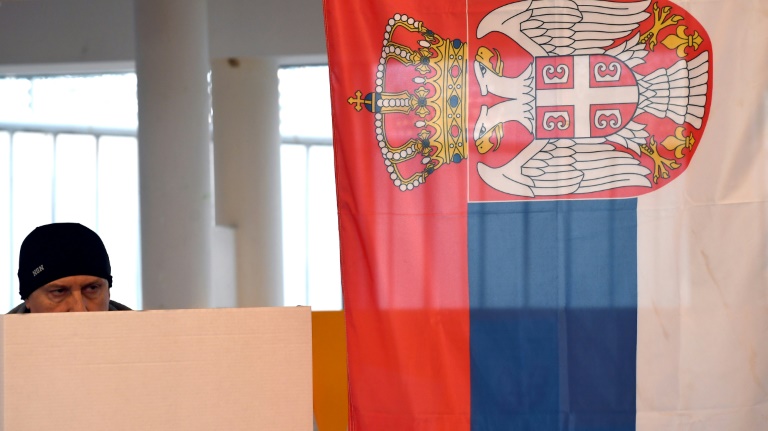
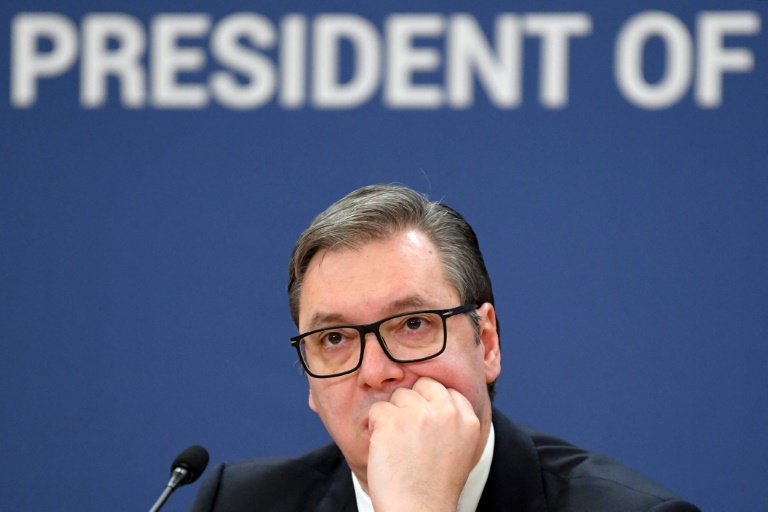
Serbians went to the polls on Sunday in elections that will likely see populist President Aleksandar Vucic extend his rule in the Balkan country, as he vows to provide stability amid war raging in Ukraine.

The country of around seven million will elect the president, deputies for the 250-seat parliament and cast votes in several municipal contests. 

The latest opinion polls see Vucic’s centre-right Serbian Progressive Party maintaining its control over the parliament, while the president is poised to win a second term.

“Personally, I see a stable progress and I voted in accordance with this opinion,” Milovan Krstic, a 52-year-old government employee, told AFP after casting his vote in Belgrade.

Russia’s invasion of Ukraine has cast a long shadow over a contest that observers had earlier predicted would focus on environmental issues, corruption and rights.

Vucic has deftly used the return of war in Europe along with the coronavirus pandemic to his advantage, promising voters continued stability amid uncertain headwinds.   

“We expect a huge victory. That’s what we worked for in the past four or five years, and we believe that we will continue with the great efforts and the development of this country,” the president said after casting his ballot early Sunday.

Only a few months ago, the opposition seemed to have gained momentum. 

In January, Vucic axed a controversial lithium mine project following mass protests that saw tens of thousands take to the streets. 

The move was a rare defeat for Vucic who has rotated through a range of positions, including prime minister, president and deputy premier along with a stint as the defence chief during a decade in power. 

The polls predict that he will win again on Sunday even as the opposition hopes a high turnout could force a run-off. 

Analysts, however, say the opposition has little chance of dethroning Vucic or eating away at his coalition in the parliament, which holds a lion’s share of the seats.

The president has also carefully managed the country’s response to the war in Ukraine by officially condemning Russia at the United Nations, but stopping short of sanctioning Moscow at home, where many Serbs hold a favourable view of the Kremlin. 

The opposition in turn has largely refrained from attacking Vucic’s position on the conflict, fearing any call for harsher measures against Russia would backfire at the ballot box. 

Vucic also headed into elections with a plethora of other advantages. 

Following a decade at the helm, he has increasingly tightened his grip over the various levers of power, including de facto control over much of the press and government services.

In the months leading up to the campaign, the president rolled out a range of financial aid offers to select groups, prompting critics to say he was trying to “buy” votes before the contest. 

Polling stations opened from 0500 GMT and close at 1800 GMT, with unofficial results due later in the evening.

Pope evokes Malta's welcome of St Paul in migrant appeal

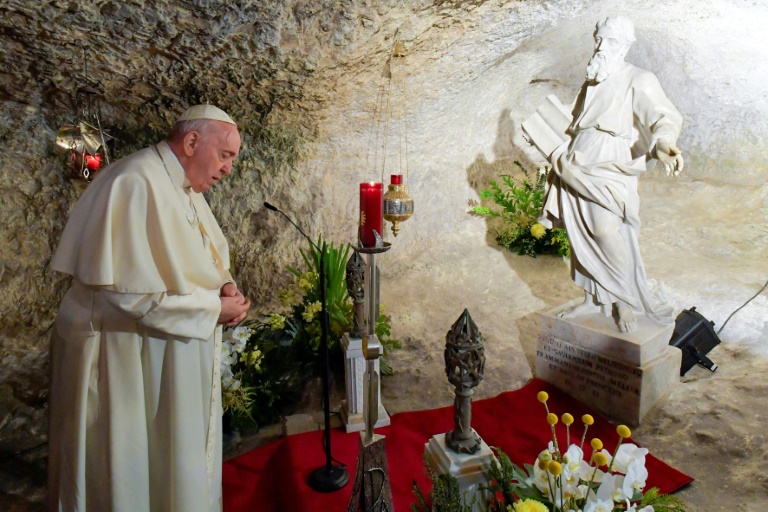
Pope Francis visited the grotto Sunday where St. Paul lived after washing up on Malta, recalling the welcome the Apostle received and urging better treatment of modern day arrivals on the Mediterranean island.

On the final day of his weekend trip to Malta, the 85-year-old pontiff will also hold open-air mass before visiting a migrant centre that will soon host refugees from the Ukraine war.

According to Christian tradition, Paul was shipwrecked on Malta in 60 AD while en route to Rome, and performed several miracles in his three months there.

Following in the footsteps of former popes John Paul II and Benedict XVI, Francis visited the holy grotto in Rabat, lighting a candle and saying a prayer.

He recalled how Paul and his fellow travellers were welcomed, even though “no one knew their names, their place of birth or their social status”.

He called on God to “help us to recognise from afar those in need, struggling amidst the waves of the sea, dashed against the reefs of unknown shores” and grant that “our compassion be more than empty words”.

The pope, who last summer underwent colon surgery and cancelled an event in February due to acute knee pain, appeared to have trouble walking during the visit, where he also met the sick and disabled at the connected Basilica of St. Paul.

– Safe harbour –

Russia’s invasion of Ukraine has overshadowed the pope’s first trip to Catholic-majority Malta, a voyage delayed two years by coronavirus.

Addressing politicians and diplomats on Saturday, he warned that “some potentate, sadly caught up in anachronistic claims of nationalist interests, is provoking and fomenting conflicts” in a thinly veiled accusation against Russian President Vladimir Putin.

Asked by a reporter about a possible trip to Kyiv, he said a visit to Ukraine’s capital was “on the table”.

The war has caused the worst refugee crisis in Europe since World War II, which feeds into a key theme of Francis’ nine-year papacy — the need to welcome those fleeing war, poverty or the effects of climate change.

Malta is on the frontline of the route from North Africa into Europe and thousands of people who risked the crossing in overcrowded boats have ended up here.

But charity groups have accused Malta of turning a blind eye to desperate people in its waters, and the pope on Saturday reminded the archipelago of its status as a “safe harbour”, while adding that other countries must also step in. 

“The growing migration emergency — here we can think of the refugees from war-torn Ukraine — calls for a broad-based and shared response,” he said.

– ‘Very tired’ –

After visiting the grotto, the pope headed to Floriana, near the capital Valletta, where he was set to conduct mass for a 10,000-strong crowd of followers. 

Awaiting him among the crowd was 67-year-old Anna Balzan from the nearby city of Qormi and her extended family. Over her shoulders was draped a Vatican flag she purchased during John Paul II’s visit in 1990.

“I’ve seen Benedict and John Paul when they came to Malta,” she said, expressing concern for the current pope’s health. 

“I saw him as very tired yesterday… I think he is suffering.”

Later Sunday, Francis will return to the theme of migrants by visiting the John XXIII Peace Lab, a centre inspired by the pope of that name, which is preparing for the arrival of Ukrainian refugees.

Run for the past five decades by a Franciscan friar, now 91, it already hosts around 55 young men from different parts of Africa who arrived on Malta without any legal papers.

Hungary vote goes to wire as PM Orban seeks fourth term

Nationalist Hungarian Prime Minister Viktor Orban faces a tough challenge with a united opposition in an unpredictable general election Sunday, after a campaign dominated by Russia’s invasion of neighbouring Ukraine.

The six main opposition parties are for the first time fielding a joint list, determined to roll back the “illiberal” revolution Orban’s Fidesz party has pursued during its 12 consecutive years in office.

That has involved repeated confrontations with EU institutions, including over the neutering of the press and judiciary, and measures targeting the LGBT community.

On Saturday, opposition supporters braved rain and chilly temperatures in Budapest to hear the opposition alliance’s candidate for prime minister, Peter Marki-Zay.

While admitting the election was “an uphill battle” given what he called “12 years of brainwashing” under Fidesz, he insisted the opposition alliance stood “at the gates of victory”.

Polls opened at 6:00 am local time (0400 GMT) and will close at 7:00 pm.

However, government spokesman Zoltan Kovacs says a definitive picture of results will likely only emerge between 11:00 pm and midnight.

Turnout is expected to be high, surpassing 70 percent.

– ‘Anything can happen’ –

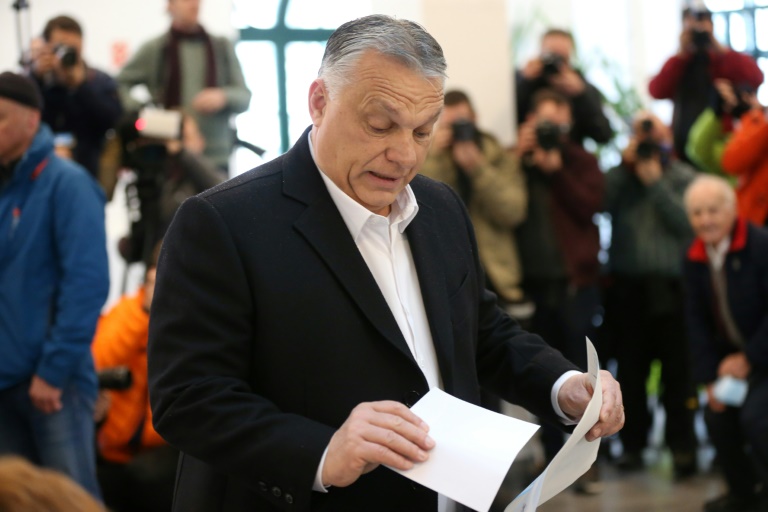
Orban himself voted on Sunday morning at a school in a Budapest suburb and told reporters on the way out he was expecting a “great victory”.

“It’s a fair election,” he said, dismissing complaints that the process had been weighted towards Fidesz.

More than 200 international observers will be monitoring the vote for the first time.

The capital is favourable territory for the opposition and 75-year-old retiree Maria Rapcsak said that she had “voted for the alliance for change”, adding: “I hope today we will put an end to Orban’s corrupt pro-Putin politics”.

However, the election will be decided in around 30 less-urban swing seats out of the 106 directly elected constituencies. 

Marki-Zay has been criss-crossing these areas in recent weeks to reach voters directly and try to break through government “propaganda”.

At his rally on Saturday, he cut an approachable figure, wading into the crowd to take selfies with supporters.

By contrast, Orban has been “hidden”, with no open events apart from a final rally on Friday, says Andras Pulai of the opposition-leaning Publicus polling institute.

Instead, Orban preferred “closed events where he talked to his most loyal supporters”.

Publicus’ last pre-election poll, published on Saturday, put Fidesz and the opposition neck-and-neck, while other pollsters have given Fidesz a narrow lead.

However, given the advantage Fidesz enjoys under the electoral system, “the opposition needs to have a three-to-four-point lead to win a majority” in the 199-seat chamber, Pulai points out.

He cautions that the votes of Hungarians abroad constitute another unknown factor making the vote “too close to call”.

“Anything can happen,” he says.

– ‘War changed everything’ –

As Orban told his supporters on Friday, “the war (in Ukraine) changed everything” for the campaign.

In the wake of the Russian invasion, Orban went along with EU support for Kyiv despite his long-standing closeness to Russian President Vladimir Putin.

However, domestically Orban has struck a neutral and even at times anti-Ukrainian tone, and has refused to let weapons for Ukraine cross Hungarian territory.

He has presented himself as the protector of peace and stability as opposed to a “warmongering” opposition who he alleges would immediately boycott vital Russian energy imports and drag Hungary into the conflict.

For his part, Marki-Zay has tried to frame the vote as “a clear choice: Putin or Europe?”

In a sign of the attention the vote is receiving abroad, former US president Donald Trump felt moved to endorse Orban earlier this year, while Trump’s 2016 opponent Hillary Clinton has urged Hungarians to vote to “fight autocracy”.

– ‘Vicious’ referendum  –

As well electing their MPs on Sunday, Hungarians will vote in a referendum posing four questions designed to elicit support for a law banning the portrayal of LGBT people to under-18s.

“Our children must be left alone, our families must be protected,” Orban said at the rally on Friday, where he also railed against “gender madness” in the West.

Human rights activists have called on voters to put a cross in both the “yes” and “no” boxes in order to reduce the number of valid ballots and thereby invalidate the referendum. 

The Hatter Society, an LGBT rights organisation, branded the referendum “vicious” and an attempt to exploit “hatred of a vulnerable minority”.

Serbians vote in 'stability' polls overshadowed by war in Ukraine

Serbians headed to the polls on Sunday in elections that will likely see populist President Aleksandar Vucic extend his rule in the Balkan country, as he vows to provide stability amid war raging in Ukraine.

The country of around seven million will elect the president, deputies for the 250-seat parliament and cast votes in several municipal contests. 

The latest opinion polls say Vucic’s centre-right Serbian Progressive Party should maintain its control over the parliament, while the president is in pole position for a second term.

“Personally, I see a stable progress and I voted in accordance with this opinion,” Milovan Krstic, a 52-year-old government employee, told AFP after casting his vote in Belgrade.

Russia’s invasion of Ukraine has cast a long shadow over a contest that observers had earlier predicted would focus on environmental issues, corruption and rights.

Vucic has deftly used the return of war in Europe along with the coronavirus pandemic to his advantage, promising voters continued stability amid uncertain headwinds.   

“These crises have shaken much stronger economies than ours, but we are completely stable. We are successfully facing the challenges,” the president wrote recently in a widely published op-ed, vowing to raise wages and pensions if elected again.

Only a few months ago, the opposition seemed to have momentum. 

In January, Vucic axed a controversial lithium mine project following mass protests that saw tens of thousands take to the streets in protest. 

The move was a rare defeat for Vucic who has rotated through a range of positions including prime minister, president and deputy premier along with a stint as the defence chief during a decade in power. 

The polls predict that he will win again on Sunday even as the opposition hopes a high turnout could force a run-off. 

Analysts, however, say the opposition has little chance of dethroning Vucic or eating away at his coalition in the parliament, which possesses a lion’s share of the seats.

The president has also carefully managed the country’s response to the war in Ukraine by officially condemning Russia at the United Nations but stopping short of sanctioning Moscow at home, where many Serbs hold a favourable view of the Kremlin. 

The opposition in turn has largely refrained from attacking Vucic’s position on the conflict, fearing any call for harsher measures against Russia would backfire at the ballot box. 

Vucic also headed into elections with a plethora of other advantages. 

Following a decade at the helm, he has increasingly tightened his grip over the various levers of power, including de facto control over much of the press and government services.

In the months leading up to the campaign, the president rolled out a range of financial aid offers to select groups, prompting critics to say he was trying to “buy” votes before the contest. 

Polling stations opened from 0500 GMT and close at 1800 GMT, with unofficial results due later in the evening.

Sri Lanka protesters defy curfew after social media shutdown

Armed troops in Sri Lanka blocked a Sunday opposition protest march staged in defiance of an emergency curfew to protest the island nation’s worsening economic crisis, after authorities imposed a social media blackout to contain public dissent.

The South Asian island nation is facing severe shortages of food, fuel and other essentials, along with sharp price rises and crippling power cuts, in its most painful downturn since independence from Britain in 1948.

President Gotabaya Rajapaksa imposed a state of emergency on Friday, the day after a crowd attempted to storm his home in the capital Colombo, and a nationwide curfew is in effect until Monday morning.

The Samagi Jana Balawegaya (SJB), Sri Lanka’s main opposition alliance, denounced a social media blockade imposed Sunday to quell intensifying public demonstrations, and said it was time for the government to tender its resignation.

Armed troops moved to stop a protest by more than one hundred opposition lawmakers and supporters attempting to march to the capital’s Independence Square from the home of opposition leader Sajith Premadasa.

“President Rajapaksa better realise that the tide has already turned on his autocratic rule,” SJB lawmaker Harsha de Silva told AFP.

Fellow SJB legislator Eran Wickramaratne said the spiralling situation raised the prospects of martial law. 

“We can’t allow a military takeover,” he said. “They should know we are still a democracy.”

Anonymous activists had called for mass protests Sunday on social media before the ban order went into effect. 

There was a heavy presence of troops elsewhere in the capital as the curfew was strictly enforced. 

News photographers were denied access to Independence Square, a popular venue for demonstrations in Colombo.

Overnight, however, hundreds defied the curfew and staged small demonstrations in various Colombo neighbourhoods and dispersed peacefully, police and residents said.

Facebook, YouTube, Twitter, Instagram and WhatsApp were among the platforms shut down Sunday on the orders of defence authorities, internet service providers told their subscribers.

Private media outlets reported that the chief of Sri Lanka’s internet regulator resigned after the order went into effect. 

-Demonstrations trending-

Cracks in the government have emerged, with the president’s nephew Namal Rajapaksa publicly announcing he had urged the government to reconsider the partial internet blackout. 

“I will never condone the blocking of social media,” said Namal, also the country’s sports minister. 

“The availability of VPN, just like I’m using now, makes such bans completely useless.”

The anti-government hashtags “#GoHomeRajapaksas” and “#GotaGoHome” have been trending locally for days on Twitter and Facebook.

A social media activist was arrested Friday for allegedly posting material that could cause public unrest. He has since been bailed.

Hundreds of lawyers have volunteered to represent any anti-government protesters arrested by the authorities. Sri Lanka’s influential Bar Association has also urged the government to rescind the state of emergency.

Western diplomats in Colombo expressed concern over the use of emergency laws to stifle democratic dissent and said they were closely monitoring developments.

A critical lack of foreign currency has left Sri Lanka struggling to service its ballooning $51 billion public debt, with the pandemic torpedoing vital revenue from tourism and remittances.

The crisis has also left the import-dependent country unable to pay for sorely needed goods.

Diesel shortages have sparked outrage across Sri Lanka in recent days, causing protests at empty pumps, and electricity utilities have imposed 13-hour blackouts to conserve fuel.

Many economists also say the crisis has been exacerbated by government mismanagement, years of accumulated borrowing, and ill-advised tax cuts.

Sri Lanka is negotiating with the International Monetary Fund for a bailout.

Costa Rica presidential candidates vow to tackle unemployment

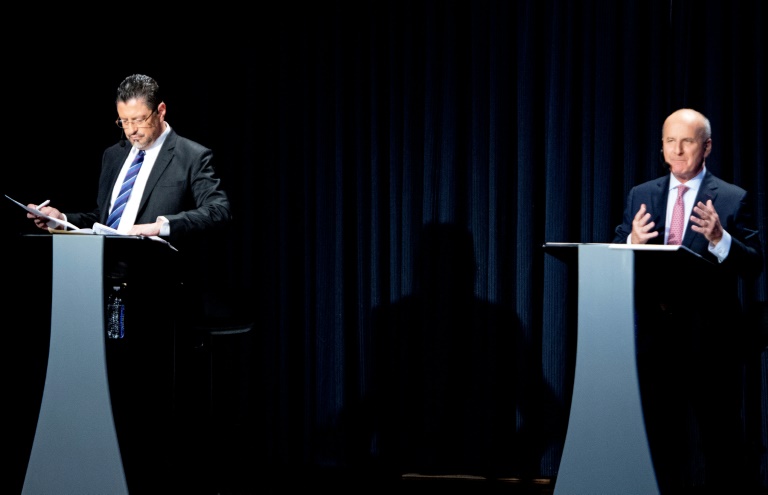
Costa Ricans head to the polls on Sunday to elect one of two scandal-tainted presidential candidates in a country grappling with sky-high poverty and unemployment.

Former president Jose Maria Figueres was once investigated for corruption while ex-finance minister Rodrigo Chaves was previously demoted for sexual harassment.

But with 23 percent of the population living in poverty and unemployment soaring to 14 percent alongside a series of corruption scandals, Costa Ricans seem more focused on the economy as they elect a successor to Carlos Alvarado.

Costa Rica has been described as the “happiest” country in Latin America and praised for its environmental policies and eco-tourism, but the vital tourism industry was hard hit by the coronavirus pandemic.

Alongside Peru, it suffered the largest fall in employment figures in the region between 2019 and 2020.

– ‘We’re very poor’ –

“The next president has to change everything because we’re very poor. There is no work here, there is nothing,” said Ana Briceno, 64, a travel agent in the capital San Jose.

“In the last years with Carlos Alvarado the situation has been very difficult … so I think the future president must focus on the economy,” said Cristina Aguilar, 32.

Given their previous troubles, the two candidates have sought to keep the debate swirling around the economy.

“The urgent themes to address are the ones causing discomfort and suffering to the people,” said Chaves, 60, a surprise qualifier for Sunday’s run-off, having polled fourth ahead of February’s first round.

“The first is the lack of jobs. Secondly, the cost of living.”

Chaves, from the newly formed right-wing Social Democratic Progress Party, led the most recent opinion polls, with more than 41 percent support, compared to 38 percent for Figueres.

Figueres, 67, who was president from 1994-98, is equally focused on the economy.

“In the economic agenda, unemployment is the most important, the creation of employment opportunities is the priority,” he said.

Figueres, whose father Jose abolished the army in 1948 when he was president, topped the first round of voting among a crowded field of 25 contenders with 27.3 percent ahead of Chaves who had 16.8 percent.

But they were a long way from the 40 percent needed to win outright.

– ‘Misinterpreted jokes’ – 

Both men have reached this final stage of the election despite the specter of past scandals.

Chaves, who spent six months as finance minister in the outgoing government, was investigated over sexual harassment complaints brought by multiple women while he was a senior official at the World Bank, where he worked for 30 years.

He was demoted, though not fired, and has dismissed his behavior as jokes that were “misinterpreted due to cultural differences.”

Figueres, who represents the centrist National Liberation Party (PLN), was investigated for allegedly taking some $900,000 from French engineering firm Alcatel, which has admitted to bribing officials.

The ex-president, who worked abroad at the time as executive director of the World Economic Forum (WEF), refused to give evidence in the case in 2004 and returned to Costa Rica only in 2011 when the investigation expired.

Polls will open at 6:00 am (1200 GMT) and close 12 hours later.

“Right now, I don’t know who I will vote for … because Chaves contradicts himself in everything and given what Figueres did last time, it leaves us undecided,” said Jairo Montero, 37.

In the unlikely event the election ends in a draw, Costa Rican law says the elder candidate would win, in this case Figueres. 

The first results are expected at around 8:30 pm. 

The winner will begin a four-year term on May 8.

China reports 13,000 Covid cases, most since end of Wuhan's first wave

China reported 13,000 Covid cases on Sunday, the most since the peak of the first pandemic wave over two years ago, as health officials said they have found a suspected new subtype of the Omicron variant in the Shanghai area.

China’s “zero-Covid” strategy is under extreme pressure as the virus whips across the country. 

Until March, China had successfully kept the daily caseload down to double or triple digits, with hard, localised lockdowns, mass testing and travel restrictions.

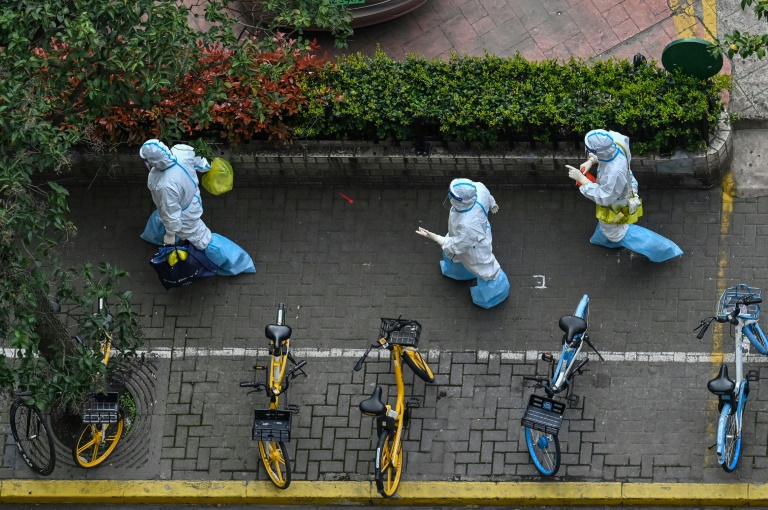
But cases have surged over recent weeks to thousands each day, especially in the outbreak epicentre of Shanghai, where streets were eerily empty on Sunday as 25 million people stayed in under lockdown orders.

Officials in Suzhou, a city 30 minutes west of Shanghai, have detected a mutation of the Omicron variant not found in local or international databases, state media reported on Sunday.

“This means a new variant of Omicron has been discovered locally,” Xinhua said, citing health official  Zhang Jun, deputy director of the Suzhou Center for Disease Control and Prevention. 

The current outbreak is also testing the patience of the Chinese towards tough restrictions, at a time when much of the world has re-opened.

On Sunday, the 1.5 million residents of Baicheng in northeast China joined the ranks of tens of millions of other Chinese who have endured some form of lockdown over the last month, disrupting work and damaging the economy. 

China recorded 13,146 cases on Sunday, the National Health Commission said in a statement, with “no new deaths” reported.

It is the country’s highest daily infection tally since mid-February 2020.

Nearly 70 percent of the national caseload was found in Shanghai, the commission said, after mass testing the metropolis’ 25 million residents.

City authorities have conceded they are struggling to contain the outbreak, with thousands now in state quarantine and reports circulating of health workers being stretched. 

Vice Premier Sun Chunlan urged “resolute and swift moves” to snuff out the outbreak after a visit to Shanghai, Xinhua reported Sunday. 

Anger is rising among residents over lockdowns that were initially planned to last just for four days, but now appear likely to drag on for several more as fresh rounds of mass testing are carried out.

Parents have expressed fears of separation from their children in the event of a positive test, while residents have griped about a lack of fresh food and the ability to walk dogs outside.

China, the country where the coronavirus was first detected in the central city of Wuhan in late 2019, is among the last remaining places following a zero-Covid approach to the pandemic.

The outbreak has taken on an increasingly serious economic dimension, trimming analysts’ growth projections as factories close and millions of consumers are ordered indoors.

Shanghai’s restrictions threaten to snarl supply chains, with shipping giant Maersk saying some depots in the city remained closed and trucking services would likely be hit further due to the lockdown.

The World Health Organization’s emergencies director Michael Ryan last week said it was important for all countries, including China, to have a plan to wind down pandemic restrictions.

But he said China’s vast population provides a unique challenge to its health system and authorities will have to “define a strategy that allows them to exit (the pandemic) safely”.

'About time': Law set to end child marriage in England and Wales

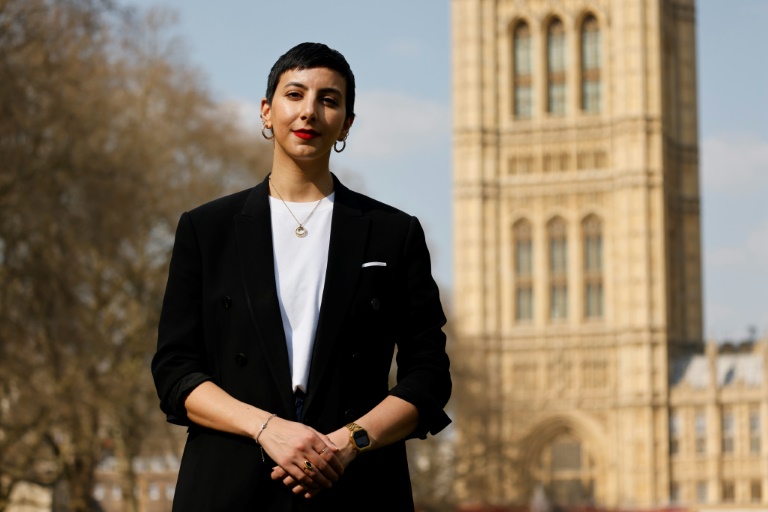
At 16, Payzee Mahmod was coerced by her Iraqi-Kurdish family in London into marrying a man around twice her age.

Two years later her elder sister Banaz, who had left a marriage she was forced into aged 17, was murdered by members of her family in a so-called honour killing.

Laws in England and Wales, which allow 16- and 17-year-olds to get married as long as they have parental consent, offered the teenage girls little redress at the time. 

But nearly two decades on, a renewed legislative bid to change the minimum age for marriage to 18, and criminalise those organising underage unions, looks set to succeed.

“I’m absolutely ecstatic that this is happening — it’s about time,” Mahmod told AFP outside the UK parliament in London, where the bill is poised to pass in the coming weeks.

“This is something that could have really protected me and my sister and all the children that have been going through this harmful practice.”

– ‘Global issue’ –

Campaigners hope it could help spur changes in other countries where under-18s are still allowed to marry — from Scotland, which has a separate legal system to England and Wales, to the majority of US states.

“This is a global issue,” said Mahmod, who has been publicly advocating for reform for several years.

Britain has committed to the United Nations’ sustainable development goals, which include outlawing child marriage by 2030.

“I’m hoping it will have a bit of a domino effect,” said Conservative lawmaker Pauline Latham, who is behind the bill.

Latham launched the proposal after learning the UK was asking countries receiving aid to stop child marriage, even though it had not done so itself.

“It had never really occurred to me before that we did have child marriage,” she said. “But we do… and once this bill goes through it’ll stop.”

– ‘Life chances’ –

The UK outlawed forced marriage in 2014 but that is seen as insufficient to protect teenagers because it requires victims to testify against the perpetrators — who are typically their parents.

The number of coerced 16- and 17-year-olds is hard to ascertain, because whether they had agreed can be hard to determine. Some unions are often not registered legally.

In 2018, officials recorded 147 legal marriages of under-18s in England and Wales — involving 28 boys and 119 girls — while there were 183 the prior year.

“But it’s the ones that are never registered that we don’t know about,” Latham said, adding her bill would also prevent minors being taken abroad for marriage.

“It’s fantastic legislation and it will transform the life chances of so many young people because they’ll be able to finish their education.” 

It is currently progressing through parliament unopposed.

The government has cautioned that once it becomes law, enforcement may not start before the summer school holidays, when underage marriages abroad often spike.

– ‘Harms’ –

Banaz Mahmod’s 2006 murder drew international attention and saw her father, uncle and a third killer receive lengthy jail sentences.

But it prompted no change to the law.

Now 34, Payzee Mahmod said she still struggles with the legacy of her own forced union, which lasted less than two years after she filed for divorce on turning 18.

“I experienced financial abuse, I experienced mental and physical abuse, and this is the reality of child marriage,” she said.

Mahmod said opportunities for support were missed by those in positions to help, from healthcare workers to staff at the college she attended.

“I wasn’t only let down by the people around me, but I was also let down by every professional that I came into contact with.

“Nobody ever gave me any support or saw that this was wrong and that I was a child and I should’ve been protected.”

– Little opposition –

Sara Browne, of women’s rights organisation IKWRO, said criminalising the organising of child marriages and increasing oversight are also key.

“We need safeguarding professionals — teachers, the police, healthcare workers — to know that if a child marriage is happening that is wrong, and that that child needs… protecting,” she told AFP.

“(It) can happen at a very young age… preparations for child marriage can happen at birth.”

The campaigners said they had encountered little opposition to the change.

“One or two people said to me: ‘What happens if the girl gets pregnant, and they’re in love?'” Latham recalled.  

“It’s not about that. I’m not trying to stop love. I’m trying to stop children being allowed to marry.”

Close Bitnami banner
Bitnami