World

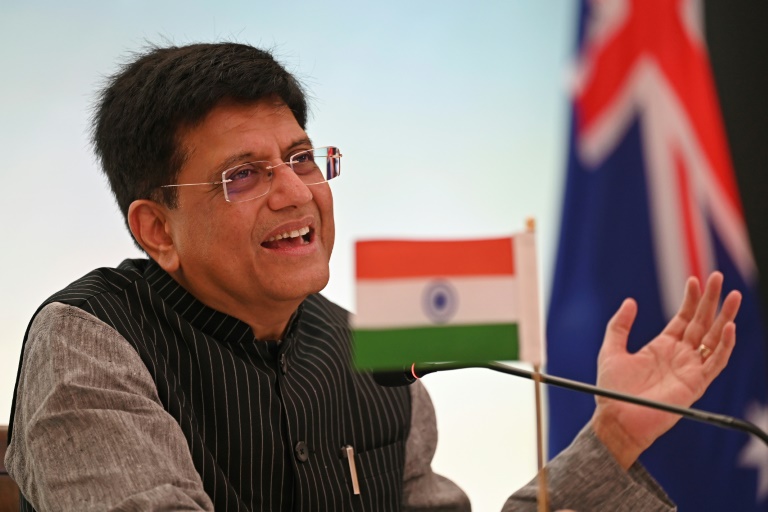
India, Australia ink interim trade deal

India and Australia signed an interim free trade deal on Saturday that cuts tariffs on billions of dollars of commerce as the two Quad partners bolster their economic ties.

Both signatories are members of the Quad alliance with the United States and Japan, which is seen as a counterweight to an increasingly assertive China.

But while they both border the Indian Ocean, India was only Australia’s seventh-largest trading partner in 2020, and accounted for just over four percent of exports last year. 

The Economic Cooperation and Trade Agreement was signed simultaneously in New Delhi and Canberra by India’s commerce minister Piyush Goyal and his Australian counterpart Dan Tehan in a joint ceremony.

India and Australia are “natural partners, connected by shared values of democracy, rule of law and transparency”, Goyal said. 

“Our relationship rests on the pillars of trust and reliability aptly reflected in our deepening geo-strategic engagement through the QUAD and the supply chain resilience initiative.”

Two-way trade reached around $17 billion last year, with resource-rich Australia exporting sheep meat, coal and other commodities, and India largely supplying services.

At the same time Canberra’s relations with its biggest trading partner China are at their lowest point in a generation, with many Australian goods hit with punitive sanctions and ministerial relations frozen.

Beijing has been angered at Australia’s willingness to legislate against overseas influence operations, to bar Huawei from 5G contracts and to call for an independent investigation into the origins of the coronavirus pandemic.

India and China have also seen a sharp deterioration in ties after a high-altitude clash in 2020 left 20 Indian soldiers and at least four Chinese soldiers dead.

The agreement “delivers a clear message that democracies are working together and ensuring the security and resilience of our supply chains”, Australian Prime Minister Scott Morrison said at Saturday’s signing.

India’s Prime Minister Narendra Modi added it would “contribute to increasing supply chain resilience and to the stability of the Indo-Pacific region”.

Negotiations on a comprehensive deal between India and Australia were launched more than a decade ago but stalled in 2015.

A full trade pact is now being negotiated and Morrison, who called Modi a “dear and trusted friend”, said he hoped it would be signed by the end of the year.

Saturday’s agreement cuts tariffs on more than 85 percent of Australian exports to India. 

In an accompanying statement, Morrison highlighted several products hit hard by the Chinese trade dispute — like coal, wine and rock lobsters — which will benefit under the Indian deal, calling it “a big door into the world’s fastest-growing major economy”.

His conservative government is trailing in the polls ahead of an election in May, and the tensions with China are a key issue.

War in Ukraine: Latest developments

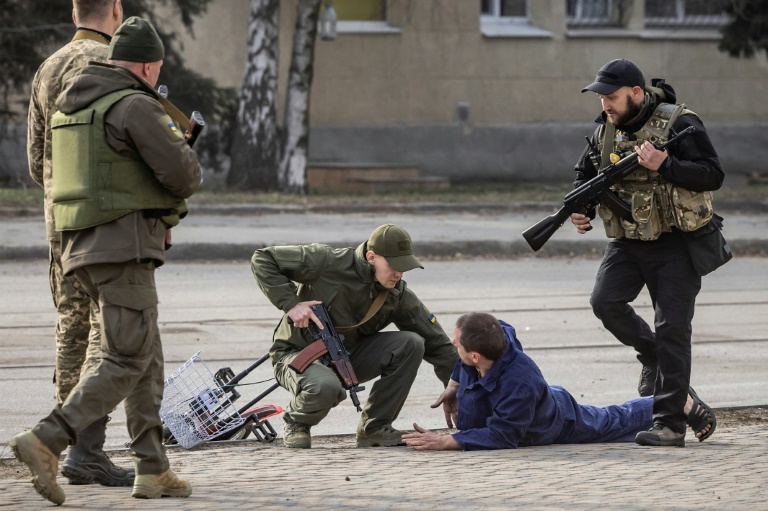
Here are the latest developments in the war in Ukraine:

– Mariupol evacuation –

Residents fleeing the besieged region around southern port Mariupol take a convoy of buses and private cars to reach Ukrainian-controlled Zaporizhzhia.

The fleet’s arrival comes as Ukrainian President Volodymyr Zelensky says over 3,000 people have been rescued from Mariupol, though it is not immediately clear if he is referring to the bus passengers.

The Red Cross says its own Mariupol rescue effort was forced to turn back after “arrangements and conditions made it impossible to proceed”, but adds its team will try again Saturday. 

– US commits $300 mn in ‘assistance’ –

The US Defence Department announces it is allotting $300 million in “security assistance” for Ukraine to bolster its defence capabilities, adding to the $1.6 billion Washington has already committed since Russia’s invasion. 

The package includes laser-guided rocket systems, drones, ammunition, night-vision devices, tactical secure communications systems, medical supplies and armoured vehicles.

– Ukraine accused of Russia attack –

Ukrainian helicopters have carried out a strike on a fuel storage facility in Russia’s western town of Belgorod, around 40 kilometres (25 miles) from the border, according to the local governor. 

Vyacheslav Gladkov says on Telegram the air strike was “carried out by two Ukrainian army helicopters, which entered Russian territory at a low altitude”. 

Kyiv would not be drawn on whether it was behind the attack, with Foreign Minister Dmytro Kuleba saying he did “not possess all the military information”.

– Peace talks resume –

Peace talks between Ukrainian and Russian officials resume via video conference, but Moscow warns that the helicopter attack will hamper negotiations.

Moscow’s chief negotiator Vladimir Medinsky says on Telegram: “Our positions on Crimea and Donbas have not changed”.

– UN official to visit Moscow, Kyiv –

A top UN official is set to fly to Moscow Sunday, and then on to Kyiv to try and secure a “humanitarian ceasefire” in Ukraine, says the body’s chief Antonio Guterres. 

Both Russia and Ukraine have agreed to meet Martin Griffiths, Under-Secretary-General for Humanitarian Affairs, Guterres said.

– ‘Russia preparing powerful strikes’ –

Zelensky says Russia is preparing “powerful strikes” in the country’s east and south, including Mariupol.

Moscow said in peace talks earlier this week it would scale back attacks on the capital Kyiv and the northern city of Chernigiv.

– Ukrainian troops regaining control – 

Ukraine’s troops begin to regain control including around the capital Kyiv and in the southern region of Kherson — the only significant city that Russia had managed to occupy.

Russian troops “are continuing their partial retreat” from the north of Kyiv towards the Belarusian border, Ukraine’s defence ministry says.

– New gas war front –

Russian President Vladimir Putin says “unfriendly” countries, including all EU members, must set up ruble accounts to pay for gas deliveries from April, or “existing contracts would be stopped”. 

– 30 countries tap oil reserves –

The 31-country International Energy Agency (IEA) agrees to tap national emergency oil reserves again in a bid to calm crude prices that have soared following Russia’s invasion of Ukraine.

On Thursday, US President Joe Biden announced a record release of US oil onto the market.

– China warned –

The EU’s top officials have warned China’s leaders at a summit not to help Russia wage war on Ukraine or sidestep Western sanctions, European Commission head Ursula von der Leyen says. 

“It would lead to a major reputational damage for China here in Europe,” Von der Leyen says after video talks with Chinese President Xi Jinping.

– Chernobyl radiation –

Russian soldiers were likely exposed to radiation while they were occupying the area around the Chernobyl nuclear power station over the past four weeks, Ukraine’s nuclear agency Energoatom says.

The power station, the site of the world’s worst nuclear disaster in 1986, was taken back under the control of Ukrainian forces on Thursday.

– Lavrov lauds India –

Russia’s foreign minister Sergei Lavrov praises India’s refusal to condemn the Ukraine invasion, stressing their “friendship” and saying Moscow and New Delhi will find ways to circumvent “illegal” Western sanctions and continue to trade.

– Landmarks damaged –

The UN’s cultural agency UNESCO says it has confirmed that at least 53 Ukrainian historical sites, religious buildings and museums have sustained damage during Russia’s invasion of the country.

– 4.1 million refugees –

The number of Ukrainian refugees fleeing Russia’s war in their country has crossed 4.1 million, the United Nations says.

After crisis, Spain's right-wing PP appoints new leader

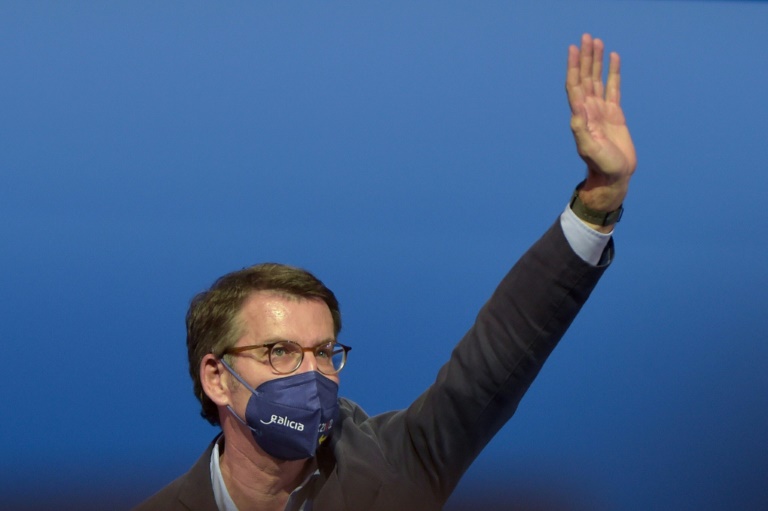
Spain’s opposition Popular Party (PP) on Saturday appoints Alberto Nunez Feijoo as leader in the hope the calm, experienced moderate with a pragmatic outlook will return the right-wing faction to power.

After 13 years governing Galicia in northwestern Spain with an impressive track record of four absolute majorities, the party is hoping the 60-year-old will be able to translate his regional success to a national level.

“I have come here to win and to govern,” he told delegates on Friday at a two-day party conference in the southern city of Seville to appoint him. 

The Galician leader is the only candidate running to take over from Pablo Casado, who was edged out following a bitter internal dispute with one of the party’s rising stars. 

When he took over as PP chief in July 2018, Casado was a young hardliner who promised to breathe new life into a party snarled in corruption and bleeding votes.

But barely four years later, the 41-year-old was left fighting for his political life after a very public confrontation with Isabel Diaz Ayuso, whose success as Madrid regional leader threw his own lacklustre leadership into sharp relief.

Casado told the gathering on Friday that he was giving up his seat in parliament and quitting all “positions of responsibility” in the PP.

“It is best if I step aside,” he said.

Two former PP prime ministers also spoke at the two-day gathering: Jose María Aznar, who was premier between 1996-2004, and Rajoy, who served between 2011-2018. 

Both urged party members to rally around Feijoo.

“I ask everyone for the greatest unity and the clearest support for this new stage of our party,” said Aznar speaking by video link because he has Covid-19. 

– Feijoo v. Vox and the Socialists –

Feijoo is the only one of Spain’s regional leaders to govern with an absolute majority in a region where the Socialists pose no threat and the far-right party Vox has made no headway despite its growing popularity across Spain.

But at a national level, the scene is the opposite, and Feijoo will have to contend with a Socialist-led government, its hard-left partner Podemos and Vox in the ascendency. 

During his long political career, Feijoo has steered clear of scandal, despite the emergence of photos from the mid-90s showing his friendship with a cigarette smuggler later jailed for drug trafficking. 

While admitting they were friends at the time, Feijoo said he had no idea about the illegal activities. 

During a national tour to present his candidacy, Feijoo made a few slips, including a reference to the government as “autistic” for which he later apologised to those with the condition. 

General elections are due by the end of 2023 but Pedro Sanchez’s left-wing coalition is already worn out by the pandemic, soaring inflation and social unrest over spiralling prices as well as the global uncertainty caused by the war in Ukraine. 

The far-right has also been a headache for the PP, which has watched how Vox has, within eight years, managed to obtain 52 of the 350 seats in Spain’s parliament as its own showing has fallen from 186 to 88.

Feijoo’s job is now “to attract the centrist voters” that brought the PP’s Aznar and Rajoy to power, said Ernesto Pascual, a political scientist at Barcelona’s Autonomous University.

Even if the PP does succeed in next year’s election, recent polls suggest it could need the support of Vox to govern. 

Alarm bells sounded last month when the PP made a coalition deal with Vox, letting the far-right faction into a regional government for the first time, raising fears it could be a blueprint for future power-sharing, both regionally and nationally. 

Macron holds first rally as France election race tightens

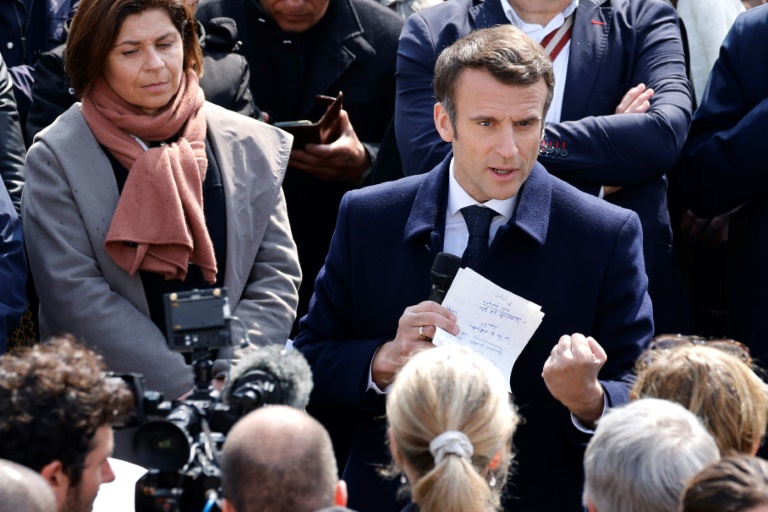
President Emmanuel Macron on Saturday holds his first rally of the French election campaign, with far-right rival Marine Le Pen eating into what once seemed his unassailable lead barely a week ahead of the ballot.

The centrist Macron threw his hat into the election ring at the last moment and has been distracted by the war in Ukraine, conducting diplomacy from the Elysee while Le Pen paces the country to discuss basic issues, including purchasing power. 

With the first round of elections on April 10 — followed by a run-off on April 24 — polls have shown Le Pen comfortably in second place in the initial stage and narrowing the gap on Macron for round two.

Macron’s 1230 GMT rally at the indoor La Defense Arena stadium — a vast venue that usually hosts top-level rugby and rock concerts — represents a pivotal chance for the president to regain momentum.

“Of course Marine Le Pen can win,” Macron’s former prime minister Edouard Philippe warned in an interview with the Le Parisien daily posted online Thursday.

Philippe, who is backing Macron, added that “if she wins, believe me, things will be seriously different for the country… Her programme is dangerous.”

– ‘Possible to defeat Macron’ –

The latest Elabe poll published Wednesday showed Le Pen winning 47.5 percent of the vote in a second-round run-off against Macron, who was projected to garner 52.5 percent, a smaller margin than in the same poll last week.

Le Pen, who lost to Macron in the 2017 polls run-off, has sought to moderate her image in the last half decade in a process helped by the emergence of Eric Zemmour as a fellow candidate in the far-right.

While Zemmour risks taking votes from Le Pen in the first round, his more radical stances in immigration and Islam have helped her project a more mainstream image.

“We feel it on the ground, there is a great dynamic, a hope that is emerging as the campaign nears it end,” she said on a visit to eastern France Friday.

“What people said was the automatic re-election of Emmanuel Macron turned out to be fake news. It is perfectly possible to defeat Emmanuel Macron and radically change the politics of this country,” she added.

– Sarkozy snub? –

But the first round risks being a disaster for The Republicans — the traditional right-wing party that was the political home of ex-presidents such as Nicolas Sarkozy and Jacques Chirac.

Their candidate Valerie Pecresse is projected by most polls to be vying with Zemmour for fourth place after failing to find momentum in the campaign.

Her big chance to ignite her bid will be at a rally Sunday in southern Paris. But the Le Parisien daily reported that Sarkozy — whose support is still coveted by the right despite criminal convictions — would be staying away in a major snub to her campaign.

The Socialist candidate, Paris mayor Anne Hidalgo, is struggling to reach beyond low single figures while the Greens hopeful Yannick Jadot has failed to put the environment at the centre stage of the campaign.

The left’s main hope is the far-left candidate Jean-Luc Melenchon who most polls project coming in third place but believes he has a chance of making a run-off.

Melenchon, one of the most explosive orators in French politics, will address an open air meeting in Place de Capitole in centre of the southern French city of Toulouse on Sunday.

Crisis-hit Sri Lanka deploys troops to quell protests

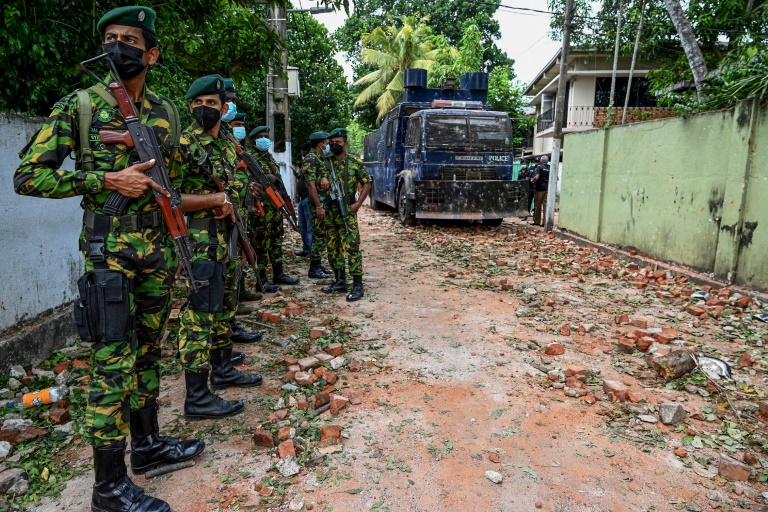
Troops armed with sweeping powers to detain suspects were deployed in Sri Lanka Saturday, hours after the president declared a state of emergency as protests against him escalated.

Gotabaya Rajapaksa invoked the emergency on Friday night, a day after hundreds tried to storm his house in anger over unprecedented shortages of food, fuel and medicine.

The emergency was for the “protection of public order and the maintenance of supplies and services essential to the life of the community”, Rajapaksa said in a proclamation.

Soldiers armed with automatic assault rifles were already deployed for crowd control at fuel stations and elsewhere when the emergency was invoked. More were seen on Saturday.

“Before the emergency, the military could not act on its own and had to play a supportive role to the police, but since Friday they are on their own and they have more powers,” a police official said.

The emergency laws came ahead of planned anti-government protests on Sunday, when activists on social media have been urging people to demonstrate outside their homes.

The South Asian nation of 22 million is facing severe shortages of essentials, sharp price rises and crippling power cuts in its most painful downturn since independence from Britain in 1948.

The coronavirus pandemic torpedoed tourism and remittances, both vital to the economy, and authorities imposed a broad import ban in an attempt to save foreign currency.

Many economists also say the crisis has been exacerbated by government mismanagement, years of accumulated borrowing, and ill-advised tax cuts.

A curfew reimposed for a second night Friday was relaxed at dawn Saturday.

Thursday night’s unrest outside the president’s private home saw hundreds of people demand he step down. 

People chanted “lunatic, lunatic, go home”, before police fired tear gas and used water cannon.

The crowd turned violent, setting ablaze two military buses, a police jeep and other vehicles, and threw bricks at officers.

Police arrested 53 protesters and 21 of them were released on bail on Friday night, court officials said. Others were still being detained but had yet to be charged.

Rajapaksa’s office said Friday that the protesters wanted to create an “Arab Spring” — a reference to anti-government protests in response to corruption and economic stagnation that gripped the Middle East more than a decade ago.

Thousands flee Mariupol as Red Cross prepares fresh rescue effort

More than 3,000 people have escaped the besieged region of Mariupol in a convoy of buses and private cars, Ukrainian President Volodymyr Zelensky said Saturday as the Red Cross prepared a fresh evacuation effort for the devastated southern port.

The city has faced weeks of ferocious Russian shelling, with at least 5,000 residents killed, according to local authorities, and the estimated 160,000 who remain face shortages of food, water and electricity.

“We have managed to rescue 6,266 people, including 3,071 people from Mariupol,” Zelensky said in a video address early Saturday.

Giving details of Friday’s evacuation efforts along humanitarian corridors, Deputy Prime Minister Iryna Vereshchuk said 42 buses carrying Mariupol residents had departed from the city of Berdiansk, 70 kilometres (44 miles) southwest, while another 12 had left Melitopol with local residents on board.

“That’s more than 2,500 people. More than 300 private cars follow the buses. All of them are now heading to the city of Zaporizhzhia,” she said on Telegram, adding more evacuations of Mariupol were planned for Saturday.

Dozens of buses carrying Mariupol residents who had escaped the devastated city arrived Friday in Zaporizhzhia, about 200 kilometres to the northwest, according to an AFP reporter on the scene.

The buses carried people who had been able to flee Mariupol to Russian-occupied Berdiansk.

“We were crying when we reached this area. We were crying when we saw soldiers at the checkpoint with Ukrainian crests on their arms,” said Olena, who carried her young daughter in her arms. 

“My house was destroyed. I saw it in photos. Our city doesn’t exist anymore.”

The International Committee of the Red Cross said its team headed to Mariupol to conduct an evacuation effort was forced to turn back Friday after “arrangements and conditions made it impossible to proceed”. It said it would try again Saturday.

– New US aid –

Peace talks between Kyiv and Moscow resumed via video, but the Kremlin warned that what it described as a helicopter attack on a fuel depot would hamper negotiations.

“This is not something that can be perceived as creating comfortable conditions for the continuation of negotiations,” Kremlin spokesman Dmitry Peskov told reporters.

The air strike hit energy giant Rosneft’s fuel storage facility in Belgorod, around 40 kilometres from the border with Ukraine.

But Kyiv would not be drawn on whether it was behind the attack, with Zelensky telling US network Fox News: “I’m sorry, I do not discuss any of my orders as commander in chief”.

Britain’s defence ministry said the destruction of oil tanks in Belgorod and reports of explosions at an ammunition depot near the city would add to Russia’s resupply problems.

“The probable loss of fuel and ammunition supplies from these depots will likely add additional short-term strain to Russia’s already stretched logistic chains,” it said in its latest intelligence update on Twitter late Friday.

After five weeks of a military campaign that has reduced parts of Ukraine to rubble, Moscow said this week it would scale back attacks on the capital Kyiv and the city of Chernigiv.

But Zelensky said Russia was consolidating and preparing “powerful strikes” in the east and south, joining Western assessments that Moscow’s troops were regrouping, not withdrawing.

Zelensky repeated his plea for the West to provide greater military support.

“Just give us missiles. Give us airplanes,” he said on Fox. “You cannot give us F-18 or F-19 or whatever you have? Give us the old Soviet planes. That’s all… Give me something to defend my country with.”

The Pentagon later said it was allotting $300 million in “security assistance” to bolster Ukraine’s defence capabilities, adding to the $1.6 billion Washington has committed since Russia invaded in late February.

The announcement comes after President Joe Biden and Zelensky on Wednesday discussed “additional capabilities” to help the Ukrainian military.

The package includes laser-guided rocket systems, drones, ammunition, night-vision devices, tactical secure communications systems, medical supplies and spare parts.

– ‘Partial retreat’ –

Russia launched its invasion on February 24, expecting to quickly take Kyiv. 

A ferocious Ukrainian fightback and Russia’s logistics and tactical problems scuppered such plans.

Russia on Friday launched its annual military draft but vowed that conscripts would not be sent to fight in Ukraine.

Referring to the draft, Zelensky urged Russian families not to send their children to war.

“Don’t let them join the army. It’s not their war. We don’t need any more deaths,” he said.

On the ground, Ukraine’s troops were beginning to reassert control including around Kyiv and in the southern region of Kherson — the only significant city that Russia had managed to occupy.

Ukraine’s defence ministry said Russian troops were continuing their “partial retreat” from the north of Kyiv towards the Belarusian border. 

Ukraine also warned that Russian forces who left the Chernobyl nuclear plant — site of the world’s worst nuclear accident, in 1986 — after weeks of occupation may have been exposed to radiation.

“Russia behaved irresponsibly in Chernobyl” by digging trenches in contaminated areas and keeping plant personnel from performing their duties, said Foreign Minister Dmytro Kuleba. 

– ‘Common grave’ –

Civilians have trickled out of devastated areas after arduous and daring escapes.

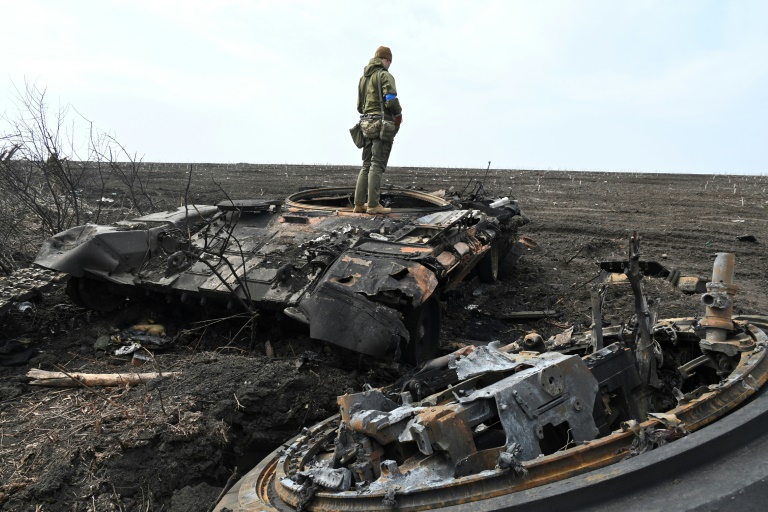
Three-year-old Karolina Tkachenko and her family walked an hour through a field strewn with burnt-out Russian armoured vehicles to flee their village outside Kyiv.

“The shops are closed, there’s no delivery of supplies. The bridge is also blown up, we can’t go for groceries through there,” said Karolina’s mother Karina Tkachenko. 

In Mariupol, Viktoria Dubovytskaya, who had sheltered in the theatre where 300 people are feared to have been killed in Russian bombardments, said she only grasped the extent of the destruction as she fled.

Bodies lay in the rubble and small wooden crosses were planted in the ground, she told AFP.

“When people find their loved ones, they just bury them wherever they can. Sometimes where roses used to bloom,” she said. “The city is now a common grave.”

burs-hmn/mlm/mtp/lb

Buses carrying Mariupol residents arrive in Zaporizhzhia

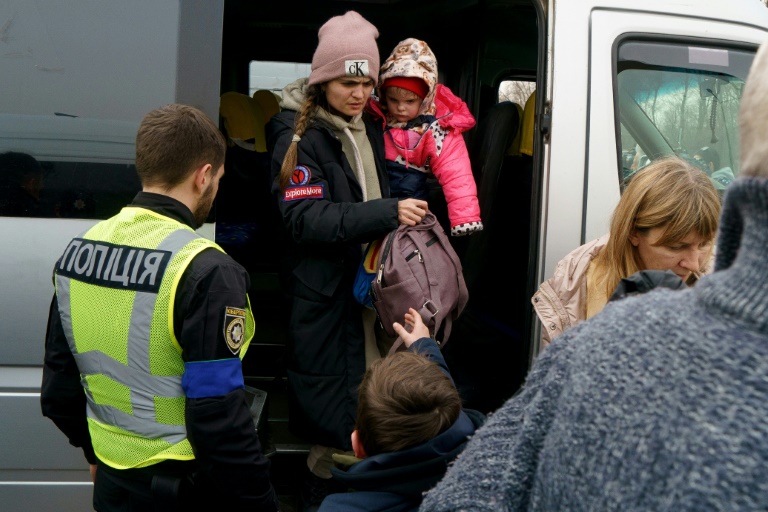
Dozens of buses tightly packed with exhausted evacuees from Mariupol and other Russian-occupied cities in southeast Ukraine arrived in Zaporizhzhia Friday to the relief of waiting relatives, according to an AFP reporter on the scene.

The passengers included people who managed to flee besieged Mariupol, as well as residents of Berdiansk and nearby Melitopol.

As the coaches pulled into a shopping centre on the outskirts of Zaporizhzhia more than 200 kilometres (120 miles) northwest, some evacuees wept with relief to be back in Ukrainian-controlled territory.

“We were crying when we reached this area. We were crying when we saw soldiers at the checkpoint with Ukrainian crests on their arms,” said Olena, who carried her young daughter in her arms. 

“My house was destroyed. I saw it in photos. Our city doesn’t exist anymore.”

Mariupol has suffered near-total destruction since Russia’s invasion of Ukraine, leaving residents without food, water and heat as they endured heavy bombardment.

On Friday, the International Committee of the Red Cross said its rescue convoy had been forced to turn back after it became “impossible to proceed”. It said it would try another evacuation attempt Saturday.

An estimated 160,000 people are believed to still be trapped in the southeastern port city after several evacuation attempts collapsed, though some have made the dangerous dash to freedom alone.

In a video address posted on Telegram, Deputy Prime Minister Iryna Vereshchuk confirmed Friday that 42 buses from Berdiansk had successfully brought people to safety, including Mariupol residents. Another 771 Mariupol residents had found their own transportation to Zaporizhzhia, she added.

“Know and believe: we are with you,” Vereshchuk said.

Later, President Volodymyr Zelensky said they had “managed to rescue 6,266 people, including 3,071 people from Mariupol”, though it was not immediately clear if he was talking about the people on the buses.

– Tears of joy –

Several evacuees from Mariupol told AFP they had to walk 15 kilometres or more to escape the city, before locating private vehicles to continue their journey.

Once they reached Russian-occupied Berdiansk, some were stranded for a further two weeks after several unsuccessful attempts to leave.

Their journey ended with a 12-hour bus ride that snaked its way through a series of checkpoints before arriving in Zaporizhzhia, a trip that would have taken just three hours before the war.

With no bathrooms onboard, some people had wet themselves, while other passengers were in desperate need of medication, such as insulin.

After the convoy arrived, an elderly woman from Mariupol grasped at the sky as she was transferred to a stretcher and rushed to hospital. Doctors said she had suffered a stroke.

Waiting outside during the post-curfew blackout, Ludmilla wept tears of joy when she spotted her mother’s face through the window of one of the first buses to arrive.

“Three days ago my mother walked out of Mariupol and then found a car to take her to Berdiansk. I can’t tell you how I feel to see her here,” said Ludmilla, who left Mariupol on March 12 with husband Nikita.

Olga also anxiously waited to find family members on the buses.

“I just saw my granddaughter,” she said. 

“There are no words for how happy I am to see she is safe.”

“Her mother’s family are still in Mariupol and we don’t know if they are alive,” she added.

Families of Cuban protesters left devastated by harsh sentences

Luis Frometa Compte, 59, had been back in the land of his birth for just 40 days when unprecedented anti-government protests broke out all over the country in July 2021.

The forestry technician had been living for 37 years in Germany when he decided to visit his homeland, staying with his sister Virgen Frometa.

He had gone out to buy rum when he joined a protest and started filming it on his mobile phone.

Less than a week later, plain clothed police officers arrested him at his sister’s house, and he has since been sentenced to 25 years in prison for “sedition.”

“I am asking for my brother’s immediate release,” said 56-year-old homemaker Virgen Frometa. “And for all the prisoners” arrested following the protests.

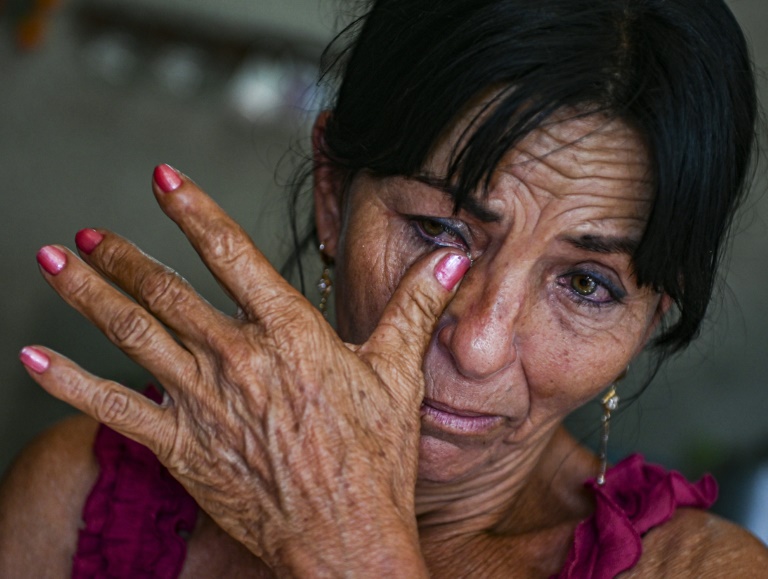
“There is a revolutionary suffering inside of me,” she told AFP, wiping back the tears in her eyes.

The government response to the protests left one person dead, dozens injured and almost 1,400 detained.

According to the Miami-based Cubalex NGO, more than 700 of them remain in detention.

“No-one starts a revolution without weapons by talking, nor by protesting, nor by saying four things that no-one liked, nor by filming,” said Frometa, raising her voice.

– ‘They didn’t kill anyone’ –

Five doors down in the poor neighborhood of Guinera, on the outskirts of Havana, laborer Emilio Roman, 51, is also suffering.

His three children have been convicted of sedition.

Yosney Emilio, 25 and his sister Mackyani Yosney, 23, have been sentenced to 12 years each while Emy Yoslan, 18, was given seven years.

On July 12, 2021, the Roman family was celebrating a birthday.

Mackyani went out to buy cigarettes and on the corner came across the throngs of protesters.

“She was enthralled,” as were her brothers, said Roman.

During the two weeks of their trials in January, Roman stayed at the door of the court.

“I didn’t have the strength to go in to watch the injustice being committed against all these youngsters,” he said from his modest cement house where the bedroom, kitchen and bathroom share the same single space.

The verdict was pronounced on March 16. Cuba’s Supreme Court handed down sentences of six to 30 years to 128 protesters accused of sedition and theft.

Those sentenced had taken part in protests in Guinera and the Diez de Octubre municipality, where some of the most violent demonstrations happened.

The heavy sentences shocked many on the island nation, including singer-songwriter Silvio Rodriguez, a fervent defender of the Cuban revolution.

“Sentencing people to 15, 20 and 30 years for public disorder? That does not seem fair to me,” Rodriguez said on the Cubadebate website.

“If they committed the acts of violence they have been accused of, then I agree they should be judged and the appropriate punishments applied. But as far as I know, they didn’t kill anyone.”

Around 90 homes in Guinera have seen at least one family member arrested.

– ‘Disproportionate sentences’ –

Disillusioned, Roman wants his children to leave Cuba, as thousands of others have done in recent months.

“I don’t want them to spend one more day in this disgraceful country,” he said.

During his daughter’s sentencing she was accused of participating “in the grouping of people leading the disturbances using weapons capable of killing, injuring and damaging with force, such as rocks, poles and bottles, including in the form of explosive devices.”

In videos, Mackyani can only be seen “with a bottle in her hand,” insists her father.

As for her brothers, they were accused of “throwing rocks and bottles at interior ministry agents.”

In response to criticisms, prosecutors claim to have acted transparently and with respect for the rule of law, something disputed by many Cubans.

They accuse protesters of being politically motivated.

“We were able to prove” that there were people who wanted to provoke “a military intervention in Cuba by the United States,” prosecutor Yohandris Lopez, told state media outlets.

On Wednesday, the European Union expressed its “great concern” over the “disproportionate” sentences.

Both the EU and US have urged Cuba’s authorities to release “political prisoners and those detained while exercising their right to meet and express themselves.”

Bolsonaro, Lula already in campaign mode in Brazil

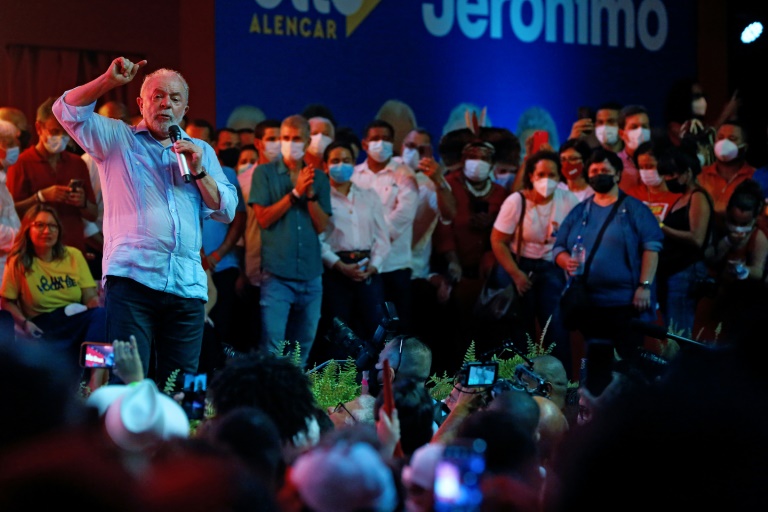
There are more than four months to go until the campaign officially starts for Brazil’s October elections, but far-right incumbent Jair Bolsonaro and leftist ex-president Luiz Inacio Lula da Silva are already in candidate mode.

Neither of the two front-runners has officially declared a candidacy, and both are trying not to cross the line into actual campaigning — barred by Brazilian electoral law until August.

That means no election rallies, and no asking people to vote for them or against the adversary. 

But it leaves a wide-open gray area of activities that look a lot like campaigning, with Latin America’s biggest country already deeply polarized six months out from the vote.

“Officially, the campaign starts on August 16, but until then these activities (by Bolsonaro and Lula) will only increase,” said political scientist Andre Cesar of consulting firm Hold.

“We’re going to see a ‘non-campaign’ campaign,” he told AFP.

The two heavyweights have been holding a steady stream of non-rallies officially called political-party events, ribbon-cutting ceremonies, high-profile meetings with political elites and celebrities, and a frenetic agenda of interviews in the media.

Bolsonaro even set a date to officially announce his candidacy — but then downgraded the March 27 event to a “membership drive” for his Liberal Party, whose lawyers reportedly feared he would breach electoral law if he declared.

– ‘Good versus evil’ –

But the 67-year-old incumbent looked well on his way to polishing his stump speech.

Brazil is facing “a struggle of good versus evil,” he told supporters at the event.

Lula, the 76-year-old ex-steelworker who led Brazil from 2003 to 2010, was for his part in Rio de Janeiro Wednesday to meet with leading figures of the Latin American left, who clamored for his return.

“This is the regional leader Latin America needs,” gushed Argentine President Alberto Fernandez.

Lula, who was hugely popular as president but then jailed on bribe-taking charges in 2018, has been the front-runner since Brazil’s Supreme Court annulled his convictions on procedural grounds last year, clearing the way for him to run for office again.

He currently has 43 percent of the vote heading into the October 2 election to 26 percent for Bolsonaro, in the latest poll from the Datafolha institute, released on March 24.

Cesar puts the likelihood of a Bolsonaro-Lula runoff on October 30 at 95 percent.

Despite a push from the political center for a “third-way” candidate, none is currently polling in the double digits. And one of the best-known names, former anti-corruption judge Sergio Moro, announced Thursday he was stepping aside.

At this point, “Lula has more to lose than Bolsonaro,” said Cesar.

“He’s leading in the polls, but doesn’t hold power or the executive pen. The one with the federal government’s machinery at his fingertips is President Bolsonaro.”

Bolsonaro has been on a spree of public-works inaugurations, including in traditional Lula bastions, and recently launched a big new welfare program that critics call a thinly veiled electoral ploy.

– Awkwardness spillover –

Some experts say Brazilian electoral law is too soft on campaigning ahead of the campaign.

“The main limit set by the law is that they’re not allowed to ask for votes. It’s a very formalistic requirement that’s very easy to dodge,” said law professor Michael Mohallem.

But the authorities are watching carefully, said Cesar.

“One abrupt move, one overly explicit act, could cause them serious problems,” he said.

The awkwardness of the non-campaign is spilling over into other parts of Brazilian life.

Last weekend, at Bolsonaro’s party’s request, a judge on the Superior Electoral Tribunal banned political statements by musicians at the Lollapalooza festival in Sao Paulo, after a singer brandished a Lula banner and other artists criticized Bolsonaro.

The injunction drew outcry from the cultural world. Some of the top names in Brazilian music, including living legend Caetano Veloso and pop superstar Anitta, condemned it as “censorship.”

Bolsonaro’s party later withdrew its complaint, leading the judge to revoke his ruling.

NASA begins critical final test on mega Moon rocket

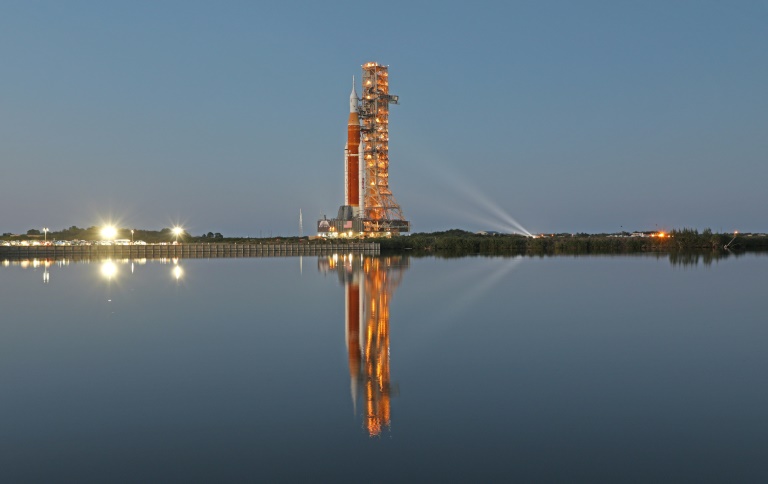
NASA on Friday began a critical two-day-long test of its giant Space Launch System (SLS) rocket complete with a simulated countdown, as the agency gears up to return humans to the Moon.

Known as the “wet dress rehearsal,” it is the final major test before the Artemis-1 mission this summer: an uncrewed lunar flight that will eventually be followed by boots on the ground, likely no sooner than 2026.

“The countdown is now underway,” NASA said in its Artemis blog at 5:00 pm Eastern Time (2100 GMT), confirming members of the launch control team had been issued their “call to stations.”

Data from the test, which ends Sunday mid-afternoon, will be used to finalize a launch date for Artemis 1. NASA had said May could be the first window, but later now seems likely.

It is called a “wet” dress rehearsal because supercooled liquid hydrogen and liquid oxygen will be loaded into SLS from ground systems, just as they would be in a real launch.

The 322-foot (98-meter) rocket — expected to be the most powerful in history at the time it is operational — was rolled out to Launch Complex 39B at the Kennedy Space Center in Florida around two weeks ago.

Teams are now filling up a sound suppression system with water that is used to dampen acoustic energy during lift-off. They will continue to practice every operation that would be carried out in a real launch. 

Come Sunday morning, with the SLS rocket and Orion crew capsule fixed atop both powered on, they will load up 700,000 gallons (2.6 million liters) of propellant.

They won’t actually ignite the rocket’s RS-25 engines, which were tested previously. Instead they will halt the countdown about 10 seconds before liftoff, in order to simulate a “scrub,” when launch is aborted due to technical or weather related issues.

The fuel will be drained, and a few days later SLS and Orion will be rolled back to the vehicle assembly building to carry out checks on how everything went.

Test milestones will be posted on NASA’s blog for the Artemis mission, and the public might be able to glimpse the rocket venting vapor on the launch pad on April 3, during tanking operations, on the agency’s YouTube channel. 

On Monday, agency officials plan to hold a press conference to give further information.

NASA won’t however let the public listen to live internal audio.

Senior NASA official Tom Whitmeyer explained this was because certain key information, including timing sequences, could assist other countries looking to develop long range missiles, and fall foul of export control regulations called International Traffic in Arms Regulations (ITAR). 

“We’re really, really super sensitive to cryogenic launch vehicles that are of this size and capability, (and) are very analogous to ballistic type capabilities that other countries are very interested in,” he said, but added that the agency could re-evaluate the position in future.

The decision has caused some confusion, as commercial launch companies routinely make their countdown audio available, while most intercontinental ballistic missiles run on solid fuel, not liquid propellants.

Close Bitnami banner
Bitnami