World

US lifting pandemic border expulsion policy in May

The United States announced Friday it was lifting a public health order imposed because of the Covid-19 pandemic that required the immediate expulsion of migrants arriving at the southern border.

Homeland Security Secretary Alejandro Mayorkas said the Centers for Disease Control and Prevention’s so-called Title 42 public health order would be lifted next month.

Republican lawmakers condemned the move, arguing that it will lead to a surge in arrivals, but it was welcomed by migrant advocates.

“Title 42 remains in place until May 23 and, until then, DHS will continue to expel single adults and families encountered at the Southwest border,” Mayorkas said in a statement. 

Title 42, which was put in place in March 2020 by former president Donald Trump, required the expulsion of unauthorized single adults and family units arriving at US land borders — not letting them apply for asylum — to protect against the spread of Covid-19.

“After considering current public health conditions and an increased availability of tools to fight Covid-19… the CDC Director has determined that an Order suspending the right to introduce migrants into the United States is no longer necessary,” the CDC said.

Mayorkas said more border agents were being deployed to “process new arrivals, evaluate asylum requests, and quickly remove those who do not qualify for protection.”

“We will increase personnel and resources as needed and have already redeployed more than 600 law enforcement officers to the border,” he said.

Migrant advocates had argued that Title 42 was becoming outdated as the pandemic eased and an affront to international conventions allowing people to claim asylum.

With the lifting of Title 42, “DHS will process individuals encountered at the border pursuant to Title 8, which is the standard procedure we use to place individuals in removal proceedings,” Mayorkas said. 

“Nonetheless, we know that smugglers will spread misinformation to take advantage of vulnerable migrants,” he said.

“Let me be clear: those unable to establish a legal basis to remain in the United States will be removed.”

Crossings from Mexico have been surging in recent weeks and Republican lawmakers have warned of a “humanitarian disaster.”

– ‘Frightening decision’ –

“The border crisis is about to get a whole lot worse,” House Republicans tweeted after the announcement of the termination of Title 42.

“Worst domestic news today: the Biden Administration will admit double or more the number of ‘undocumented’ immigrants at the border,” said Republican Senator Mitt Romney.

“Best GOP political news today: the same as above. (Arizona, Nevada, and more Dem senators will lose their elections).”

Border guards expelled illegal migrants 1.7 million times in the last fiscal year — the highest number ever recorded and four times the number of expulsions posted in Trump’s last year in the White House, when numbers were down in part because of the pandemic.

President Joe Biden’s own Democratic Party has been divided over plans to loosen restrictions at the border.

Democratic Senator Joe Manchin of West Virginia called the move a “frightening decision.”

“Title 42 has been an essential tool in combatting the spread of Covid-19 and controlling the influx of migrants at our southern border,” Manchin said.

The lifting of Title 42 was welcomed by the American Civil Liberties Union (ACLU).

“The new order is a huge step forward in the fight to ensure that people fleeing violence and persecution will once again be able to seek safety in this country, as our laws require,” said Jonathan Blazer, director of border strategies at the ACLU.

“Title 42 has been misused for over two years to illegally shut down asylum at the southern border and send thousands of people directly back into harm’s way,” Blazer said. 

According to advocacy organization Human Rights First, Title 42 expulsions had led to nearly 10,000 reports of kidnap, torture, rape and other violent attacks against people blocked in or sent back to Mexico.
Will Biden's plan to tap US oil reserves reduce gasoline prices?

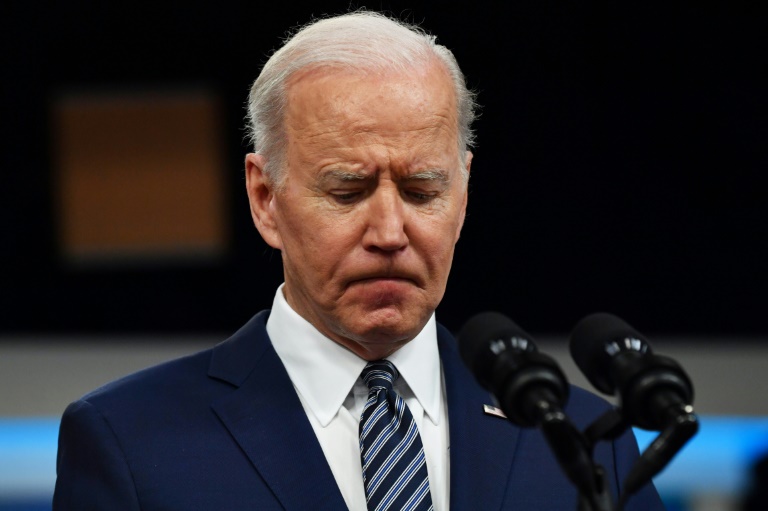
Citing the need to counteract the “Putin price hike” following Russia’s invasion of Ukraine, President Biden has announced a sweeping plan to make unprecedented use of US emergency oil stockpiles.

Under Biden’s plan, the United States will release up to a million barrels a day every day for six months from its Strategic Petroleum Reserve (SPR). 

On Friday, the International Energy Agency announced that a group of 30 other countries will also release crude onto the market from strategic holdings following an emergency meeting in Paris.

Biden’s announcement Thursday prompted an immediate slump in oil prices, but the crude market was choppy on Friday, suggesting investor skepticism that the emergency releases will change the picture.

Below are some of the main questions about the SPR and the likely impact of the policy.

– What is the Strategic Petroleum Reserve ? –

Set up in 1975 following the 1973 Arab oil embargo, the SPR is maintained in immense salt caverns along the Gulf of Mexico. The IEA requires members to hold 90 days of import protection, a requirement the United States has traditionally met with SPR and industry stocks.

At its peak, the SPR contained 727 million barrels in December 2009. The level stood at 568 million barrels as of last week, according to government data.

If the United States goes forward with Biden’s plan, it would reduce the SPR to levels not seen since the mid-1980s.

– How does Biden’s plan compare with past uses?

The White House’s plan dwarfs previous SPR releases, which included President George H.W. Bush ordering about 17 million barrels released during the first Gulf War in 1991 and a 2011 release by President Barack Obama of 30.6 million barrels due to the disruption of Libyan production.

The announcement marks Biden’s third move to tap the SPR. 

In November, the United States announced it was putting out 50 million barrels of oil in response to soaring inflation amid pandemic-exacerbated supply chain snarls. Early last month, Washington also joined a 60 million emergency release announced by the IEA to address disruption from the Russian invasion.

Given the scale of the release, some analysts have said Energy Department officials may have trouble finding buyers for crude, or face infrastructure bottlenecks. A note from JPMorgan Chase predicted the release would add 850,000 barrels per day, rather than one million,

Bill O’Grady, chief market strategist at Confluence Investment Management, said that the move comes as the long-term need for so much stockpiling looks less acute because of decarbonization efforts to address climate change and as the US shale boom has lessened the need for imports.

“I don’t think that oil will ever be replaced,” O’Grady said.

– Will it bring down prices? –

Oil prices ended about three percent lower on Thursday following the official announcement after falling even more on the initial reports about the plan.

“The market reacted immediately after the announcement was made,” said Andy Lipow of Lipow Oil Associates in Houston, who thinks gasoline prices will fall 10 to 15 cents a gallon due to the SPR release.

The move comes as the US president faces long odds in the November midterm elections, as runaway consumer prices weigh threaten to overshadow a strong labor market.

Biden described the policy as meant to “ease the pain” of lofty gas prices, which now stand above $4.20 a gallon, up almost 50 percent from last year.

But now that the announcement has been priced in, “the market will look to the next headline for direction,” Lipow said.

“It’s like a quick fix,” said Jim Krane, a fellow at Rice University’s Baker Institute for Public Policy.

The quantity of oil is more than twice the increased output just offered by the OPEC+ group of exporters, and will “give us some relief,” said Krane.

But the extended nature of the SPR plan could blunt some of the longer-term impact if US shale producers defer investments in new drilling, or OPEC opts against shifting from its current austerity posture.

Biden has almost no other levers for lowering oil prices, said Krane, who notes “the US does not have a national oil company that takes orders from the government.”

Oil prices were already elevated prior to the Ukraine invasion, but Russia’s attack prompted crude prices to spike to almost $140 a barrel in early March after the United States banned Russian energy imports — not far from their all-time high.

While other oil importing countries have not followed the US lead, some analysts have estimated that as much as three million barrels a day may be sidelined by crude buyers “self sanctioning,” adding to uncertainty in a period when inventories lag historic levels.

NASA begins critical final test on mega Moon rocket

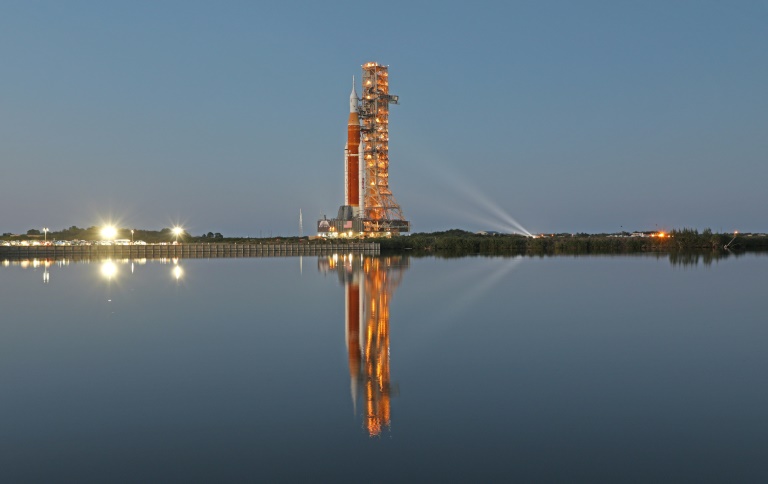
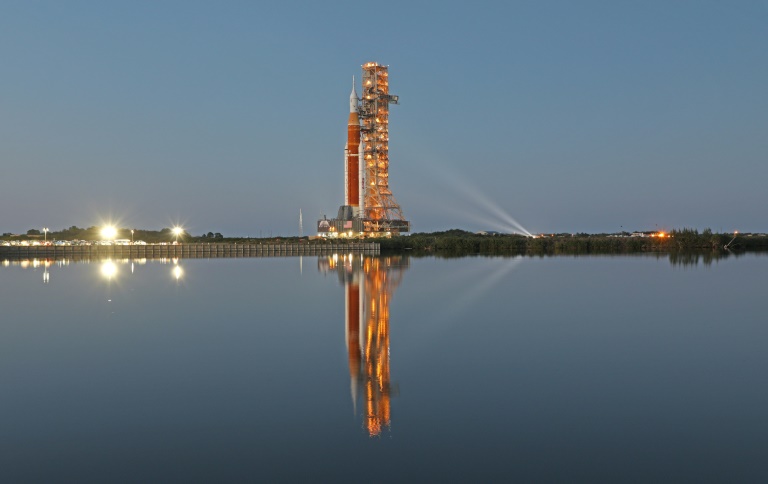
NASA on Friday begins a critical two-day-long test of its giant Space Launch System (SLS) rocket complete with a mock countdown, as the agency gears up to return humans to the Moon.

Known as the “wet dress rehearsal,” it is the final major test before the Artemis-1 mission this summer: an uncrewed lunar flight that will eventually be followed by boots on the ground, likely no sooner than 2026. 

“It is our last design verification prior to our launch,” senior NASA official Tom Whitmeyer said in a call with reporters this week.

Data collected from the test will be used to finalize a date for Artemis-1 — NASA had said May could be the first window, but later now seems likely.

It is called a “wet” dress rehearsal because super-cooled liquid hydrogen and liquid oxygen will be loaded into SLS from ground systems, just as they would be in a real launch.

The 322 feet (98 meters) tall rocket — expected to be the most powerful in history at the time it is operational — was rolled out to Launch Complex 39B at the Kennedy Space Center in Florida around two weeks ago.

The test begins at 5:00 pm Eastern Time (2100 GMT) with a “call to stations,” as members of the launch control team arrive at their firing rooms and start a countdown of more than 45 hours.

With the SLS rocket and Orion crew capsule fixed on top powered on, teams will proceed to load 700,000 gallons (3.2 million liters) of propellant, and practice procedures such as pauses in countdown and other checks.

They won’t actually ignite the rocket’s RS-25 engines, which were tested previously. Instead they will halt the countdown about 10 seconds before liftoff, in order to simulate a “scrub,” when launch is aborted due to technical or weather related issues.

The fuel will be drained, and a few days later SLS and Orion will be rolled back to the vehicle assembly building to carry out checks on how everything went.

Test milestones will be posted on NASA’s blog for the Artemis mission, but the agency won’t let the public listen to live internal audio, as it did in the past for Space Shuttle missions. 

Whitmeyer explained this was because certain key information, including timing sequences, could assist other countries looking to develop long range missiles. 

“We’re really, really super sensitive to cryogenic launch vehicles that are of this size and capability, (and) are very analogous to ballistic type capabilities that our countries are very interested in,” he said, but added that the agency could re-evaluate the position in future.

NASA begins critical final test on mega Moon rocket

NASA on Friday begins a critical two-day-long test of its giant Space Launch System (SLS) rocket complete with a mock countdown, as the agency gears up to return humans to the Moon.

Known as the “wet dress rehearsal,” it is the final major test before the Artemis-1 mission this summer: an uncrewed lunar flight that will eventually be followed by boots on the ground, likely no sooner than 2026. 

“It is our last design verification prior to our launch,” senior NASA official Tom Whitmeyer said in a call with reporters this week.

Data collected from the test will be used to finalize a date for Artemis-1 — NASA had said May could be the first window, but later now seems likely.

It is called a “wet” dress rehearsal because super-cooled liquid hydrogen and liquid oxygen will be loaded into SLS from ground systems, just as they would be in a real launch.

The 322 feet (98 meters) tall rocket — expected to be the most powerful in history at the time it is operational — was rolled out to Launch Complex 39B at the Kennedy Space Center in Florida around two weeks ago.

The test begins at 5:00 pm Eastern Time (2100 GMT) with a “call to stations,” as members of the launch control team arrive at their firing rooms and start a countdown of more than 45 hours.

With the SLS rocket and Orion crew capsule fixed on top powered on, teams will proceed to load 700,000 gallons (3.2 million liters) of propellant, and practice procedures such as pauses in countdown and other checks.

They won’t actually ignite the rocket’s RS-25 engines, which were tested previously. Instead they will halt the countdown about 10 seconds before liftoff, in order to simulate a “scrub,” when launch is aborted due to technical or weather related issues.

The fuel will be drained, and a few days later SLS and Orion will be rolled back to the vehicle assembly building to carry out checks on how everything went.

Test milestones will be posted on NASA’s blog for the Artemis mission, but the agency won’t let the public listen to live internal audio, as it did in the past for Space Shuttle missions. 

Whitmeyer explained this was because certain key information, including timing sequences, could assist other countries looking to develop long range missiles. 

“We’re really, really super sensitive to cryogenic launch vehicles that are of this size and capability, (and) are very analogous to ballistic type capabilities that our countries are very interested in,” he said, but added that the agency could re-evaluate the position in future.

Stocks wobble as solid US jobs data points to rate hike

Stock markets wavered on Friday as a solid US jobs report raised expectations of an aggressive US interest rate hike to tame runaway inflation.

Oil prices, meanwhile, fell slightly, with the US benchmark WTI contract dipping under $100 as US allies agreed to tap their emergency stockpiles again in a bid to calm the market.

While Russia’s war in Ukraine remains at the forefront of investor concerns, they were also tracking the latest US jobs picture as it serves as a barometer of the health of the world’s biggest economy.

The United States added 431,000 jobs in March and the unemployment rate fell to 3.6 percent, bringing the labour market closer to where it was before the Covid-19 pandemic began, according to official data.

The figures also fed into expectations of the next move by the US Federal Reserve, which has begun to raise interest rates in a bid to rein in a surge in inflation that has threatened to derail the economic recovery from the pandemic.

Higher rates, however, can also put the brakes on economic growth.

Analysts said they now expect the Fed to enact a half-point rate hike in May, higher than the quarter-point increase decided at its last meeting.

“The employment report showed strong jobs growth, a lower unemployment rate, and sustained wage inflation — a recipe for the Fed to issue a 50-basis-point hike next month,” market analysis firm Briefing.com said in a note.

Wall Street fell in midday trading after opening on a high note, but European equities finished the day in positive territory while Asian markets were mixed to end the week.

“This continues to be a very headline-driven market and they’re coming thick and fast,” said Craig Erlam, senior market analyst at OANDA foreign exchange platform.

“Talks between Ukraine and Russia are progressing well, it seems, but things can change rapidly, for better or worse. Until we see a deal, the situation will continue to feel precariously balanced and investors will remain on edge as a result,” he said.

Fallout from the war sent consumer prices in the eurozone surging by a record 7.5 percent, EU statistics agency Eurostat said heading into the weekend.

– IEA emergency meeting –

In a bid to ease oil prices, the 31-nation International Energy Agency agreed to tap emergency oil reserves again at an emergency ministerial meeting following a pledge to release over 60 million barrels.

The IEA, whose members include the United States, European countries, Japan and other nations allied to Washington, said it would make the new amount public early next week.

US President Joe Biden said that the countries had agreed to release “tens of millions of additional barrels of oil onto the market”.

“The IEA Ministers reiterated their concerns about the energy security impacts of the egregious actions by Russia and voiced support for sanctions imposed by the international community in response,” the group said in a statement.

The announcement came a day after Biden announced a record release of oil onto the market — one million barrels of US government oil every day for six months in a bid to ease prices.

Biden described the move as a “wartime” measure that will defuse Russia’s leverage as an energy power.

Washington has pressed the OPEC+ group of oil producing countries, led by Saudi Arabia and Russia, to boost its output but the group on Thursday agreed on another modest increase instead.

The war has driven oil prices to near record heights over concerns about supplies as Russia is the world’s second biggest exporter of crude after Saudi Arabia.

– Key figures around 1630 GMT –

New York – Dow: DOWN 0.2 percent at 34,609.91 points

London – FTSE 100: UP 0.3 percent at 7,537.90 (close)

Frankfurt – DAX: UP 0.2 percent at 14,446.48 (close)

Paris – CAC 40: UP 0.4 percent at 6,684.31 (close)

EURO STOXX 50: UP 0.6 percent at 3,927.44

Tokyo – Nikkei 225: DOWN 0.6 percent at 27,665.98 (close)

Hong Kong – Hang Seng Index: UP 0.2 percent at 22,039.55 (close)

Shanghai – Composite: UP 0.9 percent at 3,282.72 (close)

Brent North Sea crude: DOWN 0.5 percent at $104.20 per barrel

West Texas Intermediate: DOWN 1.0 percent at $99.26 per barrel

Euro/dollar: DOWN at $1.1046 from $1.1067 late Thursday

Pound/dollar: DOWN at $1.3111 from $1.3143

Euro/pound: UP at 84.25 pence from 84.20 pence

Dollar/yen: UP at 122.60 yen from 121.69 yen

New era for Zara empire as Ortega heiress takes helm

Marta Ortega on Friday took the reins of Zara-owner Inditex, the group founded by her father, and faces an immediate challenge after the fashion giant closed shops in Russia, its second biggest market.

With neither fanfare nor ceremony, the 38-year-old daughter of multibillionaire Amancio Ortega took over the world’s biggest fashion retailer and its 6,500 shops. 

“I begin this stage…with a deep sense of responsibility,” Ortega wrote in a letter to the 174,000 employees of the group, which has eight brands including Massimo Dutti, Bershka and Stradivarius. 

“I ask for your support and patience while I continue to learn from everyone every day,” she added.

The youngest of Ortega’s three children, she was in charge of design and product launches across all of Inditex’s brands before becoming chairwoman on Friday, taking over from Pablo Isla who had run the group since her father retired in 2011. 

As her father’s right hand, Isla oversaw Inditex’s massive international expansion over the past decade. 

Marta Ortega’s promotion has been on the cards for several years but was only announced at the end of November as part of a reorganisation engineered by her father, now 86.

“We’ve been preparing for this transition for a while,” said Isla at the time. “Marta has been working in the company for 15 years … she knows it very well”.

– ‘Very well prepared’ – 

Described as discreet and reserved, Marta Ortega was born on January 10, 1984 to the billionaire and his second wife Flora Perez, growing up in La Coruna in northwestern Spain with her half-sister Sandra and half-brother Marcos.

After attending a Swiss boarding school and graduating in 2007 from the European Business School in London, she briefly worked on the shop floor at a Zara store in the British capital to understand how things operate.

Although she never said she was the Inditex owner’s daughter, her colleagues told El Pais newspaper they quickly figured it out after noticing her Rolex watch.

“The first week, I thought I was not going to survive. But then you get kind of addicted to the store” she told The Wall Street Journal in a rare interview in August 2021. 

When her appointment was initially announced in November, it caused concern in the business community, triggering a fall in the company’s share price but such fears appear to have evaporated. 

Although she has never held an executive role at Inditex, she is “well prepared” and will be “surrounded by good people” said Alfred Vernis, professor at Spain’s ESADE business school and a former Inditex executive.

Working with her is Oscar Garcia Maceiras, who recently took over as chief executive of Inditex barely a year after joining the group from Spanish banking giant Santander.

“He will be the one who takes executive decisions,” said Vernis. 

– A difficult moment –

The change at the top comes at a pivotal time for the Galicia-based company which has chalked up record profits in recent years but is now facing one of its most difficult moments. 

Worth some 62 billion euros, Inditex nearly tripled its profits last year to 3.2 billion euros, but its outlook for 2022 has been overshadowed by Russia’s invasion of Ukraine. 

At the start of March, the retail giant suspended all retail activity in Russia, its biggest market after Spain, shutting its 502 shops and suspending all online transactions. 

The move is likely to have a significant impact on its results, with the Russian market accounting for nearly 10 percent of sales. 

“The current financial year promises to be very complex, due to Inditex’s exposure in Russia and the rest of Europe” and “rising production costs” caused by record inflation, Credit Suisse said in a note.

Founded in 1985 by Amancio Ortega, Inditex must also strengthen its online offering in the face of stiff competition from other retailers. 

Above all it must step up its “green transition” in order to reduce its environmental impact, which is huge. 

“Pablo Isla was doing it but not enough,” said Vernis, indicating such an essential step “would cost” the company. 

Shares in Inditex closed up 1.67 percent at 20.11 euros.

Street protests grip Sri Lanka as economic crisis escalates

Street protests gripped Sri Lanka Friday as demonstrators blocked main roads across the country, a day after hundreds tried to storm the president’s home in anger over an unprecedented economic crisis.

The South Asian nation is facing severe shortages of essentials, sharp price rises and crippling power cuts in its most painful downturn since independence from Britain in 1948.

Towns and cities across the country faced a fresh wave of protests Friday, according to police and local officials.

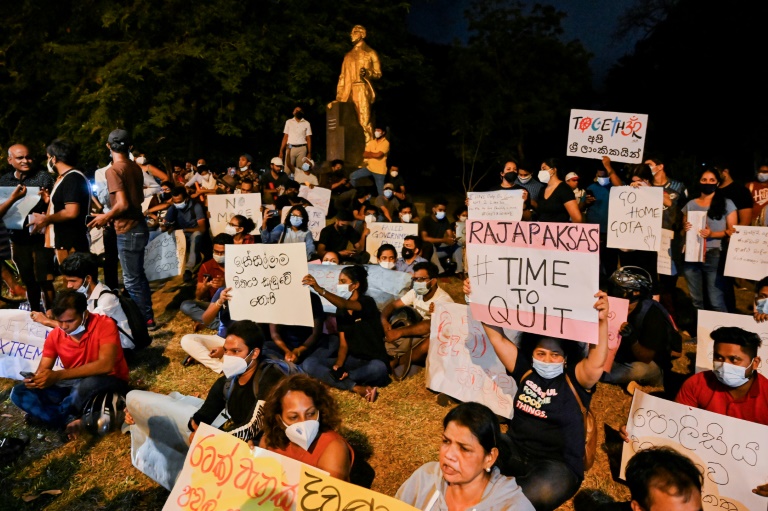
In the capital Colombo, dozens of rights activists carried handwritten placards and oil lamps while demonstrating at a busy intersection on Friday evening.

“Time to quit Rajapaksas,” said one placard. “No more corruption, go home Gota,” said another — referring to President Gotabaya Rajapaksa.

In the highland town of Nuwara Eliya, activists blocked the opening of a flower exhibition by Prime Minister Mahinda Rajapaksa’s wife, Shiranthi, police said.

The southern towns of Galle, Matara and Moratuwa also saw anti-government protests, and similar demonstrations were reported in the northern and central regions. All held up traffic on main roads.

– ‘Lunatic, go home’-

Thursday night’s unrest outside the president’s private home saw hundreds of people demand he step down.

People chanted “lunatic, lunatic, go home”, before police fired tear gas and used water cannon.

The crowd turned violent, setting ablaze two military buses, a police jeep, two patrol motorcycles and a three-wheeler. They also threw bricks at officers.

At least two protesters were wounded in police firing but it was not clear whether officers used live ammunition or rubber bullets. Four people were injured when a security vehicle ran over them.

Police said 53 protesters were arrested, but local media organisations said five news photographers were also detained and tortured at a local police station, a charge the government said it will investigate.

An overnight curfew was lifted early Friday morning, but the police and military presence was beefed up across the country as social media posts urged residents to demonstrate peacefully outside their homes.

– ‘Terrorists’ –

Two government ministers said a major intelligence failure had placed the lives of the president and his wife in danger on Thursday.

“Both the president and his wife were at their home when the protests were going on,” Health Minister Keheliya Rambukwella told reporters in Colombo, discounting earlier claims that they were away at the time.

“We had information of a demonstration, but nothing suggesting that it could turn violent. This is a major intelligence failure.”

Transport Minister Dilum Amunugama said “terrorists” were behind the unrest.

Rajapaksa’s office said Friday that the protesters wanted to create an “Arab Spring” — a reference to anti-government protests in response to corruption and economic stagnation that gripped the Middle East over a decade ago.

A common theme of demonstrations was a demand for all members of the powerful Rajapaksa family to quit.

One of the president’s brothers, Mahinda, serves as prime minister while the youngest, Basil, is finance minister. His eldest brother and nephew also hold cabinet positions.

Sri Lanka’s predicament has been compounded by the Covid-19 pandemic, which torpedoed tourism and remittances.

Many economists also say the crisis has been exacerbated by government mismanagement and years of accumulated borrowing.

– Record inflation –

The latest official data released Friday showed inflation in Colombo hit 18.7 percent in March, the sixth consecutive monthly record. Food prices soared a record 30.1 percent.

Colombo imposed a broad ban on imports in March 2020 in a bid to save foreign currency needed to repay nearly $7.0 billion this year to service its $51 billion debt.

Diesel shortages have sparked outrage across Sri Lanka in recent days, causing protests at empty pumps.

Since Thursday, diesel has been unavailable at stations across the island, according to officials and media reports. 

The state electricity monopoly said it was enforcing a daily 13-hour power cut from Thursday — the longest ever — because it did not have diesel for generators.

Several state-run hospitals, facing shortages of life-saving medicines, have stopped routine surgeries.

The government has said it is seeking a bailout from the International Monetary Fund while asking for more loans from India and China.

IMF spokesman Gerry Rice told reporters in Washington on Thursday that talks should begin “in the coming days”, with the president’s youngest brother, finance minister Basil Rajapaksa, expected in the US capital.

Pope apologises to Canada's Indigenous for abuse at church-run schools

Pope Francis apologised Friday to indigenous people for abuse committed at church-run residential schools in Canada, and said he hoped to visit the country in July.

“I ask for God’s forgiveness for the deplorable conduct of these members of the Catholic Church,” he said, telling Indigenous delegations at the Vatican it caused him “pain and shame”.

Numerous investigations into the former residential schools are underway across Canada after the discovery of mass unmarked graves, with more than 4,000 children believed to be missing, according to authorities.

Francis said he heard “stories of suffering, deprivation, discriminatory treatment and various forms of abuse” during meetings this week with survivors from the First Nations, Metis and Inuit groups.

“I join the Canadian bishops in asking you for forgiveness,” he said.

The 85-year old pontiff added; “I hope” to travel to Canada for the country’s St Anne’s Feast Day on July 26.

– ‘Historic and meaningful’ – 

The president of the Metis National Council, Cassidy Caron, told journalists after the meeting that the pope’s words were appreciated.

“His apology is absolutely historic and so meaningful to so many people. This opens the doors for us to continue on our healing journey and continue to fight for action,” she said, adding that survivors “deserve justice.”

“I now look forward to his coming to Canada where he can deliver this heartfelt apology directly to our survivors and their families,” she said.

Gerald Antoine, regional chief of First Nations, said Friday was “the day we had been waiting for”.

“We accept this apology as a gesture of good faith,” he said.

Francis heard first-hand this week of centuries of abuse committed at the schools, and the delegations had pressed him for an apology for a scandal that rocked the Catholic Church.

Some 150,000 First Nations, Metis and Inuit children were enrolled from the late 1800s to the 1990s in 139 residential schools across Canada, as part of a government policy of forced assimilation.

They spent months or years isolated from their families, language and culture, and many were physically and sexually abused by headmasters and teachers.

Pope Francis on Friday slammed the “ideological colonisation” of which “so many children have been victims”.

“Your identity and culture have been wounded, many families have been separated,” he said.

He described as “chilling” the “unresolved traumas that have become intergenerational traumas”.

Thousands are believed to have died of disease, malnutrition or neglect. More than 1,300 unmarked graves have been discovered since May 2021 at the schools.

A truth and reconciliation commission concluded in 2015 the failed government policy amounted to “cultural genocide”.

In January, Canada announced a $31.5 billion agreement to reform its discriminatory child welfare system and compensate Indigenous families who suffered because of it.

Survivors of Mariupol theatre strike recall 'horror' of strike

Two women that survived the Russian airstrike on a theatre sheltering civilians in Ukraine’s besieged city of Mariupol earlier this month told AFP about the “horror” they endured. 

Viktoria Dubovytskaya was inside the Mariupol drama theatre when it was hit on March 16. Maria Kutnyakova — who left the theatre to get water the day of the shelling — witnessed the strike from outside, while her mother and sister were still in the building.

The two residents of the besieged port city are now refugees on the other side of Ukraine, in the western city of Lviv, where they spoke to AFP about the minutes before and after the bombing, which Kyiv blames on Russia. 

Mariupol has suffered near total destruction since Moscow’s invasion of Ukraine. 

An estimated 160,000 people remain trapped in the southeastern city, with many left without food in the cold. 

– Theatre refuge –

Looking to escape the shelling and bombing, hunger and cold, Viktoria Dubovytskaya had taken refuge in the theatre on March 5 with her two young children. 

She thought she could then find an evacuation convoy to join with her two-year-old daughter Anastasia and six-year-old son Artyom.

The day the drama theatre was shelled began calmly.

The two children were playing near their mother when the bomb crashed into the building.

Dubovytskaya was thrown against the wall and injured her face. She immediately heard her son scream, but not her daughter.    

“It was the most frightening moment, when you think that she’s not there anymore,” the 24-year-old recalled, two weeks on, as she held her daughter in a shelter in Lviv.

“You hope that maybe she is without arms or legs, but at least alive.”

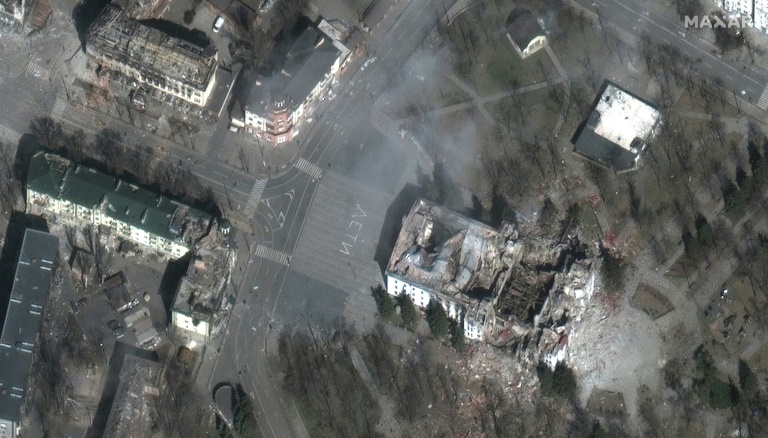
According to satellite images of the theatre and witness testimony collected by AFP, the word “deti” (“children” in Russian) had been painted in large white letters in front and behind the theatre.

Authorities said 1,000 people were inside the theatre at the time of the strike, mostly women and children.

It is still unknown how many people were killed in the strike. 

Mariupol city hall put the figure at 300, citing witnesses. 

“Everyone knew that there were children in the theatre, even my husband whom I could not contact because there was no reception,” said Dubovytskaya.

Her husband was working in neighbouring Poland when Moscow launched its invasion of Ukraine. He came to pick them up in Mariupol after the strike.

“I was going there and I did not know if they were alive or not, but I had hope,” Viktoria’s husband Dmitry told AFP.  

– ‘Miraculously’ survived – 

Like Dubovytskaya, Maria Kutnyakova, a communications manager at a start-up in Mariupol, also hoped to join a humanitarian convoy at the drama theatre with her mother and sister. 

The family had run out of food and water after a strike on March 10 took out most of their apartment’s kitchen and bathroom, as well as killing a neighbour. 

The theatre was meant to be a starting point for evacuations via an official humanitarian convoy. 

It also became a rallying point for individuals hoping to try their luck in their own convoys, according to the two Mariupol residents. 

Russia alleges that the theatre had housed soldiers from the nationalist Azov battalion. 

But the two witnesses told AFP that no soldier was in the theatre at the time of the airstrike. 

“The soldiers came once a day to announce if there would be a humanitarian convoy and then left immediately,” said Viktoria Dubovytskaya. 

She specified that only once, four Ukrainian soldiers spent the night there, after a nearby bombing. 

On March 16, Maria, her sister and her mother moved to the third floor of the theatre, due to a lack of space on the lower floors and in the basement.

When she went to get water from her uncle in the next building, she heard a plane flying and then the bomb being dropped. 

“When I came closer, I saw that the theatre did not have a roof anymore. The debris and wounded were there,” she said, still in shock, now speaking from a theatre in Lviv where she is taking refuge after a three-day journey out of Mariupol. 

When she went inside the bombed theatre, she heard desperate calls of first names in the rubble, of people looking for their loved ones. 

To find her mother and sister, the 30-year-old screamed out their last name.

They had “miraculously” survived.

– ‘Common grave’ –

Both the women got stuck in the theatre after the strike. 

“Outside, the Russians continued to shoot and inside, the building was burning,” said Kutnyakova. 

She then ran to another improvised shelter and the local philharmonic nearby. It was also bombed the same evening.

Homeless and without shelter, the family decided to embark on a risky journey “to finally be in a place where the ceiling won’t fall on our heads.”

It was on the way out of Mariupol that Dubovitskaya saw the extent of the city’s destruction. 

She said bodies lay in the rubble, sometimes small wooden crosses planted in the ground. 

“When people find their loved ones, they just bury them wherever then can. Sometimes where roses used to bloom,” she said. “The city is now a common grave for everyone.”

Russian director in Germany after travel ban lifted

Russian director Kirill Serebrennikov was permitted to leave the country and has travelled to Berlin, his team told AFP on Friday. 

The 52-year-old is known for his daring films and plays that have earned him the ire of conservatives. 

He was convicted in 2020 of embezzling funds at Moscow’s Gogol Centre theatre and barred from leaving the country, which his supporters say was revenge for his critiques of authoritarianism and homophobia.

But he was recently informed that, having served half his sentence, he would be permitted to travel. 

“I left Russia since I’ve got an opportunity to do it legally. In Europe I have few important meetings concerning my future projects,” Serebrennikov said in a statement to AFP by email. 

His team did not say whether he planned to return to Russia. 

Serebrennikov is due to soon begin rehearsals for a German opera, “Der Freischutz”, in Amsterdam. 

He is also due to open the Avignon Festival in France this summer with a new play based on “The Black Monk”, a short story by Anton Chekhov. 

The travel ban meant Serebrennikov was unable to attend the Cannes Film Festival last year where his film “Petrov’s Flu” was competing for Palme d’Or. 

Close Bitnami banner
Bitnami