World

War in Ukraine: Latest developments

Here are the latest developments in the war in Ukraine:

– Ukrainian strike in Russia: local governor –

Ukrainian helicopters have carried out a strike on a fuel storage facility in Russia’s western town of Belgorod, some 40 kilometres (25 miles) from the border, according to the local governor. 

“There was a fire at the petrol depot because of an air strike carried out by two Ukrainian army helicopters, who entered Russian territory at a low altitude,” Vyacheslav Gladkov wrote on his Telegram channel.

On Wednesday, explosions could be heard from an arms depot in Belgorod but the authorities did not provide any explanation for the blasts.

– EU to urge China rethink on Russia –

The EU is set to hold a virtual summit with China against a backdrop of increasing alarm over Beijing’s growing proximity with Moscow and its reluctance to condemn its invasion of Ukraine.

French European affairs minister Clement Beaune says the meeting will notably include “the role we are urging China to play.” 

– US warns India on Moscow links –

The US has warned India over its close Moscow links after Delhi abstained from UN resolutions censuring Russia over Ukraine.

India continues to buy Russian oil from its “longstanding and time-tested friend” but Daleep Singh, Washington’s chief sanctions strategist, has been quoted as saying on an India visit that Delhi cannot rely on Russia when it comes to relations with China.

“Russia is going to be the junior partner in this relationship with China. And the more leverage that China gains over Russia, the less favourable that is for India,” Indian media quoted Singh as saying.

– Russia preparing ‘powerful strikes’: Kyiv –

Ukraine’s President Volodymyr Zelensky is warning that Russia is consolidating and preparing “powerful strikes” in the country’s east and south, including besieged Mariupol, where a new attempt was due to be made Friday to evacuate civilians from the devastated city.

NATO also says it is not seeing a pull-back of Russian forces in Ukraine and expects “additional offensive actions”, alliance chief Jens Stoltenberg warns.

– EU parliament leader visiting Kyiv –

European Parliament President Roberta Metsola says she is on her way to Ukraine, making her the first EU leader to visit the war-torn country.

– Russia leaving Chernobyl with hostages –

Russian forces have begun to pull out of the defunct Chernobyl nuclear power site and move towards Belarus, but took an unspecified number of captive Ukrainian servicemen with them, officials in Kyiv say.  

– Putin may be ‘isolated’: Biden –

US President Joe Biden says that Russian counterpart Vladimir Putin may be “isolated” and could have placed some of his advisors under “house arrest”.

In his first public remarks on Western assessments of Kremlin tensions over the war in Ukraine, Biden also says he is “sceptical” about Moscow’s claim to be scaling back its onslaught in parts of the country.

– New gas war front –

Putin says “unfriendly” countries, including all EU members, must set up ruble accounts to pay for gas deliveries from April, or “existing contracts would be stopped”. 

German Chancellor Olaf Scholz insists payments continue in euros or dollars, while France says Paris and Berlin are preparing for a cut in Russian gas deliveries.

– Buses en route to Mariupol – 

Ukraine’s government is sending 45 buses to evacuate civilians from the besieged city of Mariupol, where Russia has declared a local ceasefire following a global outcry over the suffering of civilians trapped by a month of relentless shelling.

– ‘Longer’ conflict possible: US –

Russia’s refocusing of its military efforts on the Donbas could herald a “longer, more prolonged conflict” as Ukrainian forces put up fierce resistance there, a senior US defence official says.

“It’s been fought over now for eight years,” the official says of the heavily contested region.

– Putin ratings up –

Putin’s ratings have received a boost since the start of military actions in Ukraine, Russia’s independent Levada Centre polling institute says, with more than 80 percent of Russians saying they support his actions.

The first poll the centre has conducted since the conflict began shows 83 percent of Russians back their leader, up from 71 percent in early February.

– Biden taps oil reserves –

Biden announces an unprecedented release of crude from US strategic oil reserves, saying it will “ease the pain” of rising fuel prices for Americans.

– New US sanctions –

The United States hits a series of Russian tech firms with sanctions, including the nation’s largest chip maker Mikron.

– Russia bans EU leaders – 

Russia says it will expand the list of EU figures banned from entering the country following Western sanctions.

burs/cdw/kjm

Markets mixed at start of new quarter, while oil extends losses

Equities were mixed Friday after their worst quarter since the early days of the pandemic as traders assess the impact of the war in Ukraine and the Federal Reserve’s plans to fight surging inflation by ramping up interest rates.

And oil extended a sell-off following Thursday’s plunge in response to news that the United States would release a million barrels a day from its reserves as it looks to rein in a price rally fuelled by Russia’s conflict.

Investors suffered a torrid first three months, with markets across the planet first plunged into turmoil over central bank moves to tighten policy and reel in their Covid-era financial support measures, and then by Russian President Vladimir Putin’s invasion of Ukraine.

Inflation had already rocketed to multi-decade highs in several countries before the war in eastern Europe exacerbated the problem as crucial crude supplies from Russia were slashed and sent its price to six-year highs above $100.

The developments came as profit-takers cashed out after a near two-year rally fuelled by central bank and government largesse.

Despite a pick-up in recent weeks, most indexes finished the quarter in the red.

Traders are struggling to ascertain the outlook for the next three months, with the war showing no signs of ending and the Federal Reserve just getting started on its campaign of sharp rate hikes.

The second quarter of 2022 “is going to start as messily as the first quarter has finished, with markets buffeted by a multitude of strong winds from various directions, with the outcome no clearer for the future than ever,” said OANDA’s Jeffrey Halley.

And Anwiti Bahuguna, at Columbia Threadneedle Investments, told Bloomberg Television that a lowering of growth forecasts for the United States, Europe and China are “something to watch very carefully”.

The upcoming earnings season will be closely watched to see what impact higher inflation and the war has had on firms’ bottom line and their forecasts for the year ahead.

The release of US jobs data later in the day will be closely followed for an idea about the state of the world’s top economy.

All three main indexes on Wall Street finished more than one percent down but Asia ended mixed after a poor start.

Tokyo, Sydney, Seoul, Taipei, Manila, and Wellington were all down but Hong Kong finished higher thanks to a late rally while Shanghai, Mumbai, Singapore, Jakarta and Bangkok were also up.

London, Paris and Frankfurt also rose in morning trade.

Oil prices shed more than one percent, extending a selloff on Thursday that saw WTI lose seven percent after Joe Biden announced he would release up to 180 million barrels over six months.

The US benchmark was trading below $99.

The president described the move as a “wartime” measure that will defuse Russia’s leverage as an energy power.

However, while the move to ease a global supply crisis was welcomed, commentators warned it would only be a stopgap and could not be a long-term solution.

“It is worth keeping in mind that 180 million barrels is approximately nine days of US demand,” said SPI Asset Management’s Stephen Innes. “And while one million barrels per day is better than nothing and can help balance the four million a day lost from Russia for about six months, what happens after?”

He added: “Markets are still tight, but six months could be a meaningful lifeline and reduce the chances of (more than) $150 oil.”

– Key figures around 0810 GMT –

Tokyo – Nikkei 225: DOWN 0.6 percent at 27,665.98 (close)

Hong Kong – Hang Seng Index: UP 0.2 percent at 22,039.55 (close)

Shanghai – Composite: UP 0.9 percent at 3,282.72 (close)

London – FTSE 100: UP 0.3 percent at 7,535.23

Brent North Sea crude: DOWN 1.2 percent at $103.47 per barrel

West Texas Intermediate: DOWN 1.5 percent at $98.78 per barrel

Euro/dollar: DOWN at $1.1059 from $1.1067 late Wednesday

Pound/dollar: DOWN at $1.3122 from $1.3143

Euro/pound: UP at 84.28 pence from 84.20 pence

Dollar/yen: UP at 122.67 yen from 121.69 yen

New York – Dow: DOWN 1.6 percent at 34,678.35 (close)

'Dying with dignity': Dutch mark 20 years of euthanasia

Golden butterflies adorn the walls of the Netherland’s only euthanasia expertise centre, put up in remembrance of thousands of patients who have chosen to die with dignity over the past two decades.

Situated in a leafy upmarket suburb of The Hague, the Euthanasia Expertise Centre is the only one of its kind, giving information, assisting medical doctors and providing euthanasia as end-of-life care, which was legalised in a world first in the Netherlands on April 1, 2002. 

Belgium soon followed later that year and Spain last year became the sixth country to adopt euthanasia — the act of intentionally ending a life to relieve a person’s suffering, for instance through a lethal injection given by a doctor.

The number of people seeking euthanasia is growing in the Netherlands, with some 7,666 last year, up by more than 10 percent from the year before, according to official figures.

The vast majority are aged 60 or over, suffering from cancer or other terminal illnesses.

“Twenty years ago, when the law was passed it was known, but certainly not used as often as today,” said Sonja Kersten, director of the Euthanasia Expertise Centre.

The reasons are many: an ageing Dutch population; the fact that euthanasia is no longer a taboo subject and society has opened up to the issue.

“Dying with dignity is a debate that’s growing within Dutch society, which is quite open to the subject,” Kersten said.

– ‘Existential question’ –

Euthanasia is only authorised in a few countries around the world. 

In Belgium, which will mark two decades of euthanasia in May, some 40 French citizens also benefitted from the practice last year.

The decision to ask for euthanasia as end-of-life care remains a “difficult and existential question”, Kersten said.

“It’s neither a patient’s right, nor a doctor’s duty,” to have euthanasia, she added.

In the Netherlands, euthanasia can only be carried out under strict conditions set down in Dutch law.

Children aged up to 16 need the permission of their parents and guardians, while parents must be involved in the process for children aged 16 and 17. From 18, any Dutch citizen may ask for assisted death. 

In all cases, the patient must have “unbearable suffering with no prospect of improvement” and must have requested to die in a way that is “voluntary, well considered and with full conviction”. 

Other criteria apply as well, like the absence of a reasonable alternative to the patient’s situation.

Doctors, too, cannot be forced to perform euthanasia.

– ‘Die at home’ –

The Euthanasia Expertise Centre helps doctors through the process by sharing knowledge and providing guidance. At the same time, the centre helps patients whose doctors refuse to help them.

The centre, established in 2012, is a foundation but patient care is reimbursed by health insurers.

It first positioned itself as the “Levenseindekliniek”, Dutch for “End-of-life clinic”, offering on-site euthanasia.

But even before the start, it became apparent that most patients preferred to die at home, Kersten said.

Today, the centre can call upon a network of about 140 doctors and nurses around the country, employed by the Euthanasia Expertise Centre.

Most euthanasia requests, however, are handled by the patient’s own physician, with whom they already have a relationship of trust. Last year, this was the case for 80 percent of euthanasias performed in the country.

“There are however still doctors in the Netherlands who are opposed to euthanasia,” said Kersten, adding “they have every right”.

The centre’s medical team itself provided euthanasia to nearly 900 people in 2020, out of nearly 3,000 requests, with figures on the rise.

About 20 percent had dementia or psychiatric disorders.

The Netherlands’ highest court ruled in 2020 that doctors can euthanise patients with severe dementia without the fear of prosecution. 

It concerns patients with advanced dementia who are no longer mentally competent, but who previously had a clear request for euthanasia.

The decision followed a landmark case, not related to the Expertise centre, in which a doctor was acquitted of providing euthanasia on a woman in 2016 with severe Alzheimer’s disease, who earlier requested the procedure.

Sri Lanka's all-powerful Rajapaksas under fire

Anger is boiling over in Sri Lanka at the country’s worst economic crisis since independence in 1948, much of it directed at the island nation’s all-powerful Rajapaksa family.

Late Thursday hundreds of people tried to storm the home of Gotabaya Rajapaksa, the current president and one of four politically active brothers. In a night of violence one person was injured and 45 were arrested.

AFP profiles the clan, which has held sway over the nation’s politics for decades and which returned to power after a brief hiatus in 2019 when Gotabaya was elected president.

– ‘The Chief’ –

Mahinda Rajapaksa, 76, is the charismatic head of the group and the current prime minister. He previously held the post in 2004, and was then president from 2005 to 2015.

Gotabaya appointed him to the prime ministership a second time three years ago.

Mahinda is adored by the Sinhala-Buddhist majority for crushing separatist Tamil rebels in May 2009 following a brutal military offensive that ended a decades-long civil war.

The bloody final weeks of the civil war ended with — according to UN estimates — the deaths of around 40,000 civilians, who were herded into so-called no-fire zones that were then bombed by the Sri Lankan armed forces.

Rajapaksa denied the toll and refused an international probe into alleged atrocities. A series of local enquiries have failed to yield either a proper war crimes investigation or prosecutions. 

During his rule Sri Lanka also moved closer to China, borrowing almost $7 billion for infrastructure projects — many of which turned into white elephants mired in corruption.

Critics say he also did little to bridge the divide with Sri Lanka’s Tamils after the war. The community is barred from commemorating their war dead and remain largely marginalised.

– ‘The Terminator’ –

President Gotabaya Rajapaksa, 72, was Mahinda’s main lieutenant during his time as head of state, holding the influential post of secretary to the defence ministry with day-to-day control of the armed forces and police.

He denies accusations that he was behind death squads that abducted and “disappeared” dozens of opponents in notorious white vans.

Dubbed “The Terminator” by his own family, he is feared by foes for his short temper.

As president he has presided over Sri Lanka’s spiralling economic crisis.

A dire shortage of foreign currency — needed to pay down Sri Lanka’s debt — forced the government to ban swathes of imports, causing severe shortages of essentials.

Sri Lanka’s heavily tourism-dependent economy was first hit by the Easter Sunday Islamist attacks of 2019 and then torpedoed by Covid.

But many experts say that economic mismanagement by the Rajapaksas is also to blame including years of chronic budget deficits and ill-advised tax cuts.

– ‘Mr. Ten Percent’ –

Basil Rajapaksa, 70, is a political strategist who managed the economy under Mahinda and is now finance minister.

He was called “Mr. Ten Percent” in a BBC interview in reference to commissions he allegedly took from government contracts.

Subsequent administrations failed to prove any charges he syphoned off millions of dollars from state coffers. All cases against him have been dropped since Gotabaya became president.

– ‘The Bodyguard’ –

Chamal Rajapaksa, 79, was speaker of parliament when Mahinda was president and is also a former minister of shipping and aviation. He currently holds the irrigation portfolio and is number two in the defence department under Gotabaya, who is also defence minister. 

Formerly a police officer, he once served as a personal bodyguard to Sirimavo Bandaranaike, the world’s first woman prime minister.

– The Scion –

Namal Rajapaksa, 35, a lawyer, is the scion of the family dynasty and the eldest son of Mahinda, who is thought to be grooming him to be president one day.

He entered parliament in 2010 aged just 24, and is now minister for sports and youth.

During his father’s decade in power, Namal was highly influential although he did not hold any portfolio.

A rival former administration accused him of money laundering and other corruption charges, which he denies.

Singapore reopens borders after two-year Covid closure

Singapore fully reopened its borders to all vaccinated visitors Friday after a two-year coronavirus closure, with arrivals saying it felt “wonderful” to travel again without onerous restrictions.

The aviation hub, a key gateway for people arriving in Asia, joins other countries in the region that have recently dropped travel curbs as they shift to living with Covid-19. 

Previously, only travellers from a handful of places could enter Singapore without quarantining but from Friday all vaccinated arrivals just need a negative Covid test.

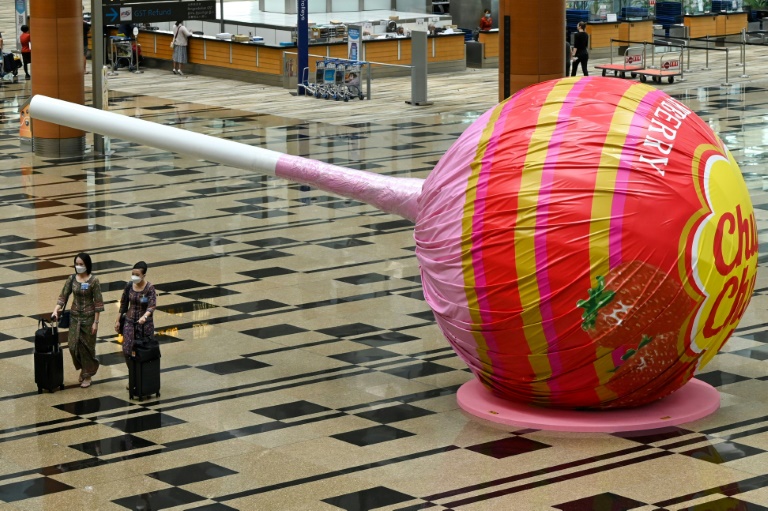
The city-state’s Changi Airport buzzed with activity as passengers streamed out of the arrival area, while hundreds were lining up in the departure zone to make trips outside Singapore.

“It’s wonderful,” Aldo Pizzini, a 63-year-old Italian businessman who had flown in from Milan, told AFP. 

“I took the first opportunity to fly today, (now) that much of the restrictions are lifted… We are coming back to normality.”

Diana Mathias, who is from French Guiana and lives in Abu Dhabi, was visiting Singapore for a holiday with her mother. 

“I feel really happy because it’s a long time since I flew,” she said. 

The 38-year-old said she was a “bit stressed” at the prospect of doing a lot of paperwork to travel again but in the end found the process “really easy”.

Borders also reopened fully in neighbouring Malaysia on Friday, and thousands of cars and motorcycles flooded across a one-kilometre (0.6 mile) causeway that separates it from Singapore. 

The causeway, one of the world’s busiest land borders, had already partially reopened last year although some curbs were still in place.  

The main airport serving Kuala Lumpur was busy as foreign tourists arrived. 

Previously tourists were barred from entering Malaysia, a popular destination due to its white-sand beaches and lush rainforests, but vaccinated travellers can now do so with only a negative Covid test. 

Bo Lingam — group CEO of leading regional carrier AirAsia, which is based in Malaysia — predicted a “surge” in people flying. 

The reopening of borders is “a joy for me and our AirAsia staff who had to face a lot of hardship during the pandemic”, he told AFP. 

“From today, it is all about flying the blue skies and an end to our planes sitting on the tarmac.”

Asian markets fall further and oil extends steep losses

Equities mostly fell Friday after their worst quarter since the early days of the pandemic as traders assess the impact of the war in Ukraine and the Federal Reserve’s plans to fight surging inflation by ramping up interest rates.

And oil extended a sell-off following Thursday’s plunge in response to news that the United States would release a million barrels a day from its reserves as it looks to rein in a price rally fuelled by Russia’s conflict.

Investors suffered a torrid first three months, with markets across the planet first plunged into turmoil over central bank moves to tighten policy and reel in their Covid-era financial support measures, and then by Russian President Vladimir Putin’s invasion of Ukraine.

Inflation had already rocketed to multi-decade highs in several countries before the war in eastern Europe exacerbated the problem as crucial crude supplies from Russia were slashed and sent its price to six-year highs above $100.

The developments came as profit-takers cashed out after a near two-year rally fuelled by central bank and government largesse.

Despite a pick-up in recent weeks, most indexes finished the quarter in the red.

Traders are struggling to ascertain the outlook for the next three months, with the war showing no signs of ending and the Federal Reserve just getting started on its campaign of sharp rate hikes.

The second quarter of 2022 “is going to start as messily as the first quarter has finished, with markets buffeted by a multitude of strong winds from various directions, with the outcome no clearer for the future than ever,” said OANDA’s Jeffrey Halley.

And Anwiti Bahuguna, at Columbia Threadneedle Investments, told Bloomberg Television that a lowering of growth forecasts for the United States, Europe and China are “something to watch very carefully”.

The upcoming earnings season will be closely watched to see what impact higher inflation and the war has had on firms’ bottom line and their forecasts for the year ahead.

The release of US jobs data later in the day will be closely followed for an idea about the state of the world’s top economy.

All three main indexes on Wall Street finished more than one percent down and Asia was also mostly lower.

Tokyo, Hong Kong, Sydney, Seoul, Taipei, Manila, Jakarta, Bangkok and Wellington were all down. 

London, Paris and Frankfurt rose at the open.

However, Shanghai rose as traders kept an eye on the second phase of a Covid lockdown in China’s biggest city that will see restrictions imposed on the western side. Mumbai and Singapore were also up.

Oil prices shed at least one percent, extending a selloff on Thursday that saw WTI lose seven percent after Joe Biden announced he would release up to 180 million barrels over six months.

The US benchmark struggled to break back above $100.

The president described the move as a “wartime” measure that will defuse Russia’s leverage as an energy power.

However, while the move to ease a global supply crisis was welcomed, commentators warned it would only be a stopgap and could not be a long-term solution.

“It is worth keeping in mind that 180 million barrels is approximately nine days of US demand,” said SPI Asset Management’s Stephen Innes. “And while one million barrels per day is better than nothing and can help balance the four million a day lost from Russia for about six months, what happens after?”

He added: “Markets are still tight, but six months could be a meaningful lifeline and reduce the chances of (more than) $150 oil.”

– Key figures around 0720 GMT –

Tokyo – Nikkei 225: DOWN 0.6 percent at 27,665.98 (close)

Hong Kong – Hang Seng Index: DOWN 0.2 percent at 21,957.38

Shanghai – Composite: UP 0.9 percent at 3,282.72 (close)

London – FTSE 100: UP 0.1 percent at 7,526.08

Brent North Sea crude: DOWN 1.0 percent at $103.69 per barrel

West Texas Intermediate: DOWN 1.1 percent at $99.17 per barrel

Euro/dollar: UP at $1.1069 from $1.1067 late Wednesday

Pound/dollar: DOWN at $1.3125 from $1.3143

Euro/pound: UP at 84.33 pence from 84.20 pence

Dollar/yen: UP at 122.47 yen from 121.69 yen

New York – Dow: DOWN 1.6 percent at 34,678.35 (close)

Shanghai residents frustrated by food shortages, prolonged lockdowns

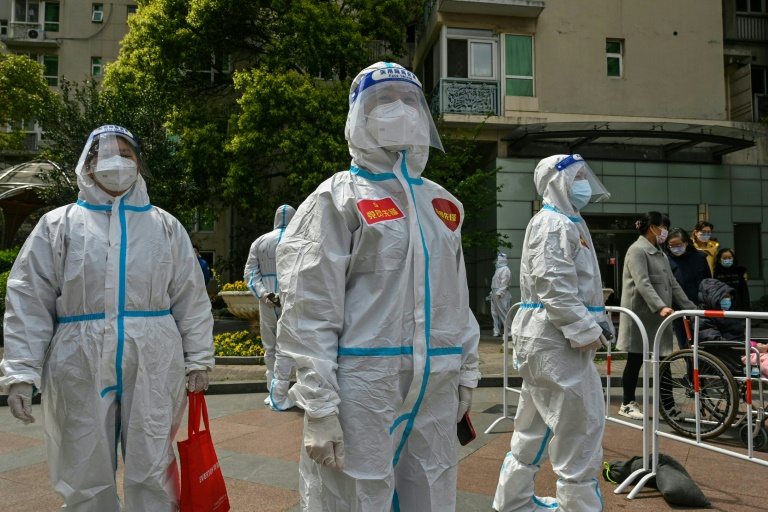
Shanghai residents voiced growing frustration on Friday at confusion over a week of snap Covid lockdowns, taking to social media to complain about food shortages and bewildering stay-at-home orders.

After initially vowing they would avoid a city-wide lockdown, officials changed tack this week and announced a phased shutdown which divided China’s financial centre in two so authorities can test its 25 million residents.

A four-day lockdown of the Pudong area began on Monday, followed by stay-at-home orders for the densely populated Puxi zone which was meant to start on Friday.

But many Puxi neighbourhoods were suddenly ordered inside early on Thursday, while much of Pudong was still closed on Friday, angering residents on both sides.

“This is de facto city-wide lockdown,” one Weibo user said. “Many Pudong streets and compounds are still in lockdown, few are lifted.”

Authorities late Thursday published a bewildering “grid management” plan for reopening, which would keep all residential compounds where a positive test is found closed, as well as the “cells” next to them. 

The restrictions have led to panic buying at shops as well as a dire shortage of delivery drivers to get food to the millions now trapped at home.

“Is this continuing lockdown aiming to starve us?” another poster on Weibo said, calling government promises so far “window dressing”. 

Residents of some compounds have skirted restrictions by taking deliveries attached to ropes lowered to the ground, according to AFP reporters.

As patience starts to fray in Shanghai among a public who have broadly acquiesced with virus controls for two years, leading city official Ma Chunlei on Thursday made a rare admission of failure, saying the city was “insufficiently prepared” for the outbreak.

With an infection level of several thousand cases a day, Shanghai has become the heart of China’s worst Covid-19 outbreak since the virus was first detected in Wuhan in 2019. 

The country reported 7,386 virus cases nationwide on Friday.

While tiny compared with many countries, the case numbers are alarming to China’s leadership, who have tethered the country to a “zero-Covid” approach to contain the pandemic. 

burs-apj/reb

Young Sami return to reindeer herding despite climate fears

In the snowy Arctic darkness Suvi Kustula throws bundles of lichen to her excitable herd of reindeer, their antlers lit up by her van’s headlights.

“I was just a few months old when I fed my first reindeer,” the 24-year-old laughed, saying she “pretty much always knew” she would follow her father and grandfather into herding.

“I managed one and a half weeks living in a city before I switched to reindeer herding college,” Kustula told AFP. 

“It’s a way of life. Reindeer before everything.”

Twenty years ago the ancient tradition of herding reindeer for meat and fur appeared to be in decline in Lapland, the vast area of forest and tundra which spans northern Finland, Sweden, Norway and Russia’s Kola Peninsula.

Young people felt they had to move south “to make a good life”, said Anne Ollila, head of Finland’s Reindeer Herders’ Association. 

But nowadays nearly a quarter of Finland’s 4,000 herders are under 25, as more young people choose to stay or return home to Lapland. 

The number of women entering the traditionally male-dominated profession is also at its highest ever.

“People have learned to better appreciate freedom and nature and tradition,” Ollila said. “Even if you can’t make big money.”

Instead herders get to live an outdoor life, dictated by the seasons and the weather in the often stunningly beautiful Arctic wilderness. 

But the new generation faces an array of emerging challenges, including a warming climate and pressure from industries keen to exploit Lapland’s resource-rich landscape.

– Indigenous culture revival –

A herder needs intimate knowledge of the landscape and how their animals behave to keep tabs on their reindeer, which roam freely across the plains and forests.

And asking how many animals a herder has is a big no-no.

“It’s a bit like if I asked you how much you have in your bank account,” Kustula laughed.

Most young herders are either born in or have married into a reindeer herding family, Ollila said.

Many belong to the indigenous Sami community, who have herded reindeer across northern Lapland for centuries. 

Oppressed for years by Nordic governments, many Sami have in recent decades begun reclaiming their traditional culture and language.

“Some earlier generations were ashamed of being Sami,” Ollila says. “But I think the young people choosing reindeer herding are very proud of it.”

– Long periods away –

Herding has been passed down through generations of the Lansman family, who live on Finland’s northern border with Norway.

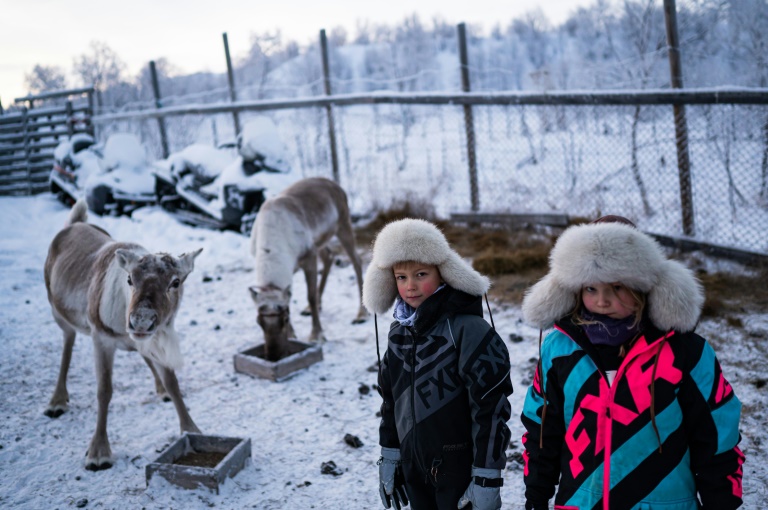
In late November, with the sun setting at 1 pm — not to rise again for seven weeks — Anna Nakkalajarvi-Lansman and her two children climbed onto their snowmobile and drove to the enclosure where their children’s two reindeer live.

“The lighter one’s mine, called Golden Horn,” said six-year-old Antti Iisko, as he and his sister scatter lichen for the animals to eat.

He wants to be a herder when he grows up, while Anni-Sivia, eight, would like to be a vet.

“I’ll be able to give the reindeer their vaccinations,” Anni-Sivia told AFP.

“Our daily routine depends on the season and whether we’re helping out with the herding,” explained their mother Anna Nakkalajarvi-Lansman, a Sami musician.

pad

Two hours’ drive away, father Asko Lansman had just spent a fortnight at a meat-packaging plant. 

Demand is soaring, Lansman told AFP, standing in front of piles of boxes of vacuum-packed reindeer meat ready to be delivered across Finland.

“It’s my greatest hope that the kids continue the work, just like it was my father’s hope when I was young,” he said.

– New challenges –

The job has changed a lot, Lansman said, with quad bikes, helicopters and now drones making gathering the reindeer much easier.

But with temperatures in the Arctic warming three times faster than the rest of the planet, climate change is bringing new challenges.

The shorter winters can turn snow into ice “and cause the reindeers’ drinking holes to freeze over”, Lansman said, as well as making their food inaccessible.

Numerous proposed mining and energy projects across Lapland also threaten the animals’ pasture lands, herders warn.

“The more the land use changes, the less space we’ll have for reindeer,” Kustula said.

“I am hopeful about the future, she insisted, “but the government should listen to us more.”

Russia regrouping for 'powerful strikes', Zelensky warns

Ukraine’s President Volodymyr Zelensky warned Russia is consolidating and preparing “powerful strikes” in the country’s east and south, including besieged Mariupol, where a new attempt will be made Friday to evacuate civilians from the devastated city.

Russia meanwhile threatened to turn off its gas taps to Europe if payments are not made in rubles, as US President Joe Biden ordered a record release of strategic oil reserves to ease soaring US prices.

In peace talks this week, Russia said it would scale back attacks on the capital Kyiv and the city of Chernigiv, but Ukrainian and Western officials have dismissed the pledge, saying Moscow’s troops were merely regrouping.

“This is part of their tactics,” said Zelensky in a late-night address.

“We know that they are moving away from the areas where we are beating them to focus on others that are very important… where it can be difficult for us,” he said.

In particular, he warned, the situation in the country’s south and east was “very difficult”.

“In Donbas and Mariupol, in the Kharkiv direction, the Russian army is accumulating the potential for attacks, powerful attacks,” he said.

Washington echoed that assessment, with a senior US defence official saying Russia’s focus on Donbas could herald a “longer, more prolonged conflict”.

Military experts believe that Moscow is ditching efforts to advance simultaneously along multiple axes in the north, east and south, after struggling to overcome stronger-than-expected Ukrainian resistance.

Instead it wants to establish a long-sought land link between Crimea, which Moscow occupied in 2014, and the two Russian-backed Donbas statelets of Donetsk and Lugansk.

– ‘Civilians desperately wanting to flee’ –

Mariupol is the main remaining obstacle to that ambition, and Russian forces have encircled and relentlessly bombarded the city to try to capture it.

Instead, it has been reduced to rubble, with tens of thousands of civilians trapped inside with little food, water or medicine.

Previous attempts to evacuate residents have collapsed, though some have made the dangerous dash to freedom alone, but on Friday Russia says it will allow a humanitarian corridor organised by the International Committee of the Red Cross (ICRC).

The ICRC’s Ukraine delegation said on Twitter it was in nearby Zaporizhzhia, where buses from the encircled city are meant to arrive.

“We hope to be able to facilitate safe passage for civilians desperately wanting to flee Mariupol. We are also here with two trucks of assistance, hoping that we can also get assistance in,” the organisation’s Lucile Marbeau said in a video.

“In these trucks there is food, medicine, relief items, for those civilians who decide to stay,” she added.

Russia has moved about 20 percent of its troops from around Kyiv but its strikes have continued and troops are likely “going to be repositioned, probably into Belarus, to be refitted and resupplied and used elsewhere in Ukraine,” said Pentagon spokesman John Kirby.

Russian troops have also pulled back from the Chernobyl nuclear plant after weeks of occupation, but have taken a number of captive Ukrainian servicemen with them, according to officials in Kyiv.

And in a sign that the war could be expanding in scope, a Russian official said Friday that Ukrainian helicopters had carried out a strike on a fuel depot in the Russian town of Belgorod, some 30 kilometres (19 miles) from the border with Ukraine.

Western intelligence has claimed Putin’s advisors may be “afraid to tell him the truth” and Biden suggested some advisors may even have been placed under house arrest, though he cautioned “there’s a lot of speculation.”

– ‘I hope all this will end soon’ –

Kremlin spokesman Dmitry Peskov hit back, saying Western officials “don’t understand President Putin, they don’t understand the mechanism for taking decisions and they don’t understand the style of our work”.

With his economy crippled by unprecedented international sanctions, Putin has sought to leverage Russia’s status as an energy power, and warned Thursday that EU members will need to set up ruble accounts from Friday to pay for his country’s gas.

“If such payments are not made, we will consider this a breach of obligations on the part of our buyers” and existing contracts would be stopped, Putin said.

The EU has joined the United States in imposing sanctions, and European Parliament President Roberta Metsola is expected in Kyiv soon in a show of support.

But the bloc has not imposed an energy embargo, and Germany, which imported 55 percent of its gas supplies from Russia before the war, insisted it will pay in euros or dollars as stipulated in contracts.

Berlin and Paris were also “preparing” for Russian gas to simply stop flowing, France’s economy minister said.

Biden meanwhile moved to mitigate rising domestic fuel prices by announcing a release from strategic US reserves of a million barrels daily for six months.

The record release amounts to augmenting global supplies by about one percent.

Peace talks between Ukrainian and Russian officials were expected to resume via video on Friday, with Kyiv negotiator David Arakhamia saying Turkey and Germany had offered to serve as security guarantors in any eventual agreement.

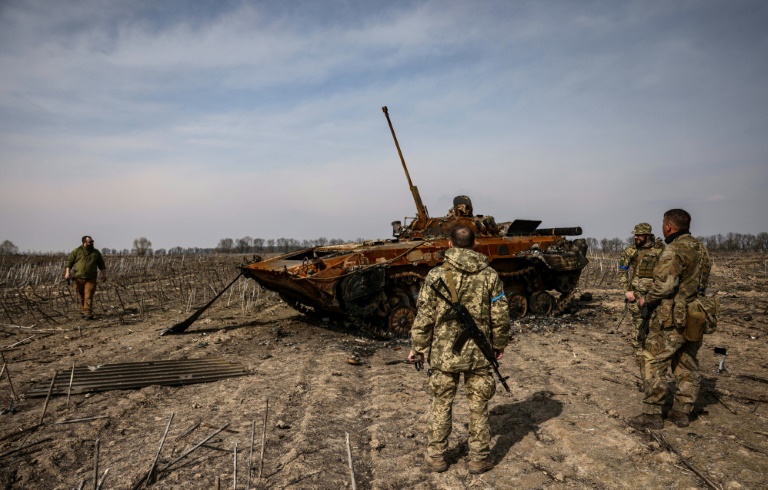
On the ground around Kyiv, Ukrainian forces have continued to push back Russian troops, capturing territory on the outskirts of the capital as Moscow’s advance stalls.

Zelensky praised the advances, but said he was stripping two generals of their ranks for unspecified offences.

“Right now I don’t have time to deal with all the traitors, but gradually all of them will be punished,” he said.

Civilians have been trickling out of devastated areas, including three-year-old Karolina Tkachenko, who was helped over a pipeline east of Kyiv by Ukrainian troops as she and her family escaped.

“The shops are closed, there’s no delivery of supplies. The bridge is also blown up, we can’t go for the groceries through there,” said her mother Karina, holding her daughter in a pink bobble hat in her arms.

“I hope all this will end soon, and I will go back to my work.”

burs-sah/oho

Kenya jail goes green to fix sewage woes and protect sea

Heading north from Mombasa, the unmistakable whiff of a foul stench in the air was as reliable as any mile marker for motorists taking the highway along the Kenyan coast.

“You would always know you were near Shimo la Tewa Prison,” said Stephen Mwangi, a government scientist who has lived for decades in the coastal region where thousands of inmates are incarcerated in a maximum security jail.  

The smell wasn’t coming from the prison itself but its septic system, which had collapsed from overuse.

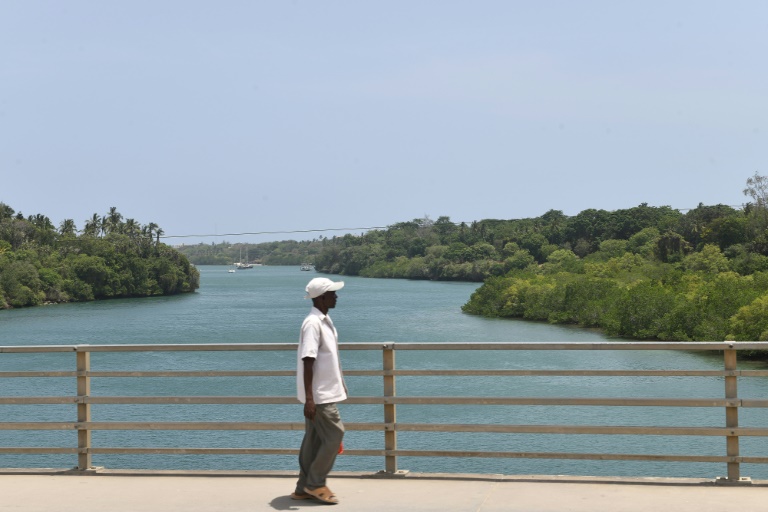
Every day, a small river of sewage flowed downhill into Mtwapa Creek, which empties into the Indian Ocean.

The contamination threatened fishing grounds, waterside hotels and restaurants, and the tropical reefs of Mombasa’s protected marine park, a jewel of the tourism industry just offshore.

Motorists pinched their noses as they passed over the creek but on the prison grounds, the stench was inescapable.

Government lodgings used by prison wardens and hospital staff were deemed uninhabitable, and abandoned over public health concerns.

“Those who were living in the quarters were really affected by the smell,” said Erick Ochieng, deputy officer in charge of Shimo la Tewa Prison.

“It was not good.”

– Harnessing nature – 

In an effort to solve the perennial menace, a low-cost “green tech” approach is being adopted to treat the wastewater.

An artificial wetland is being constructed on the prison grounds — a simple yet efficient system that mimics the way nature cleans pollutants from water using vegetation, soil and microbes.

Once fully operational — expected by end-April — sewage will first pass through an improved septic tank where solids are separated.

From there, the semi-treated water percolates through underground beds of sand and gravel, filtering out pathogens and other impurities.

The end result should be safe not only for the creek, but irrigating farms or fish ponds around the prison, said Mwangi, a scientist with the Kenya Marine and Fisheries Research Institute, which is involved in the project.

Reeds planted on the surface of the wetland help with filtration and absorb nutrients from below, attracting birds and other wildlife, and beautifying a space few dared linger in the past.

“There will be no smell. We will actually have a very good environment,” said Mwangi.

– Climate friendly – 

The UN Environment Programme (UNEP), which sponsors the project, said artificial wetlands offered an affordable and versatile solution for sanitation, while storing carbon and helping cool the planet.

Champions of the technology say big cost savings are possible thanks to relatively inexpensive materials that filter the waste through simple gravity.

Traditional sewage systems require huge volumes of concrete to create retention ponds for the waste, and pumps and other electricity-gobbling machinery to treat it. 

GreenWater, the Kenya-based company building the Shimo la Tewa system, has constructed sustainable wetland systems for schools, homes, businesses and farms.

The prison complex houses as many as 6,000 people — convicts but also jail wardens, hospital staff and courthouse officials — and the project serves as a model for other built-up areas on waterways and beaches.

Home to 40 percent of the world’s population, coastal areas are among the most densely populated parts of the planet, UNEP says.

Creeks and inlets along the Kenyan coast self-clean by flushing out water with the ebbing and flowing of tides, said ecologist David Obura.

“The problem is now with just so many people, and so much pressure… that cleaning function has been overwhelmed,” said Obura, director of CORDIO East Africa, a Kenya-based oceans research institute.

“It’s not working anymore. And you can see it on the Kenyan coast.”

Sewage dumped into creeks around Mombasa — Kenya’s oldest and second-largest city — drifts north on the winds and currents, turning beaches brown and harming coral reefs, seagrass and fisheries.

Obura said it was too late for a major overhaul of sewage systems in crowded cities like Mombasa, but artificial wetlands were a “key tool” for policymakers trying to address the pollution crisis.

“We need to have locally-driven treatment using natural systems, and then I think we can really start to resolve some of these challenges.”

Close Bitnami banner
Bitnami