World

Disaster tourism: blackouts, shortages hit Sri Lanka recovery hopes

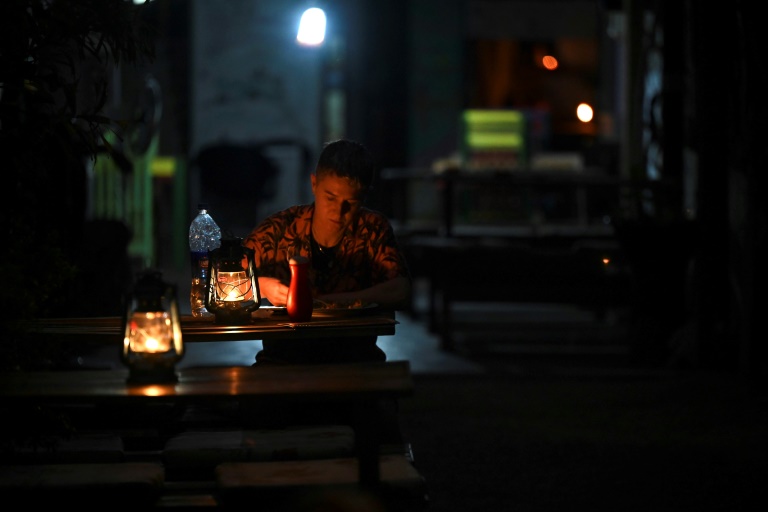
In a Sri Lankan beach guesthouse blacked out by a power cut, the owner’s son illuminates a printed Wifi password with his phone for two European backpackers. A moment later the trio grasp the gesture’s futility.

Electricity stoppages, petrol queues and escalating protests are threatening hopes that a tourism revival could help arrest the island nation’s intensifying financial crisis.

After being ravaged by civil war for decades the country’s coconut palm-lined beaches and exotic wildlife more recently made it a popular stomping ground for both high-end globetrotters and budget travellers.

Tourism became crucial to the economy — its pandemic-enforced closure underlies the foreign exchange shortage that is the root cause of the current situation.

But now the effects of the crisis are putting in jeopardy the industry that is a key element of any possible solution, with many smaller operators expecting to hit the wall soon.

“Because of the power cuts, we can’t serve our customers,” the darkened hostel’s owner Dilip Sandaruwan told AFP. “They’re not satisfied and they’re asking for lower prices.”

His guesthouse a short walk from the beach in the languid coastal town of Mirissa has few reservations, and his family are struggling to pay the interest on borrowings taken to weather the Covid years — let alone the principal.

“We are always tense,” Sandaruwan said. “We don’t know how to pay back our loans, but the banks are putting a lot of pressure on us.” 

Similar tales of woe echo among business owners up and down Mirissa’s back lanes. 

Guests gripe about sweating through tropical nights without air conditioning, hoteliers cannot access online booking platforms, and restaurants fret over how to cater to western tastes when they struggle to source imported coffee.

Worsening fuel shortages are making it harder to move around the country, with long lines of motorbike taxis snarled outside service stations waiting for scarce petrol. 

“I never let the foreigners know that there is a problem with the fuel,” said motorboat tour company owner Pradeep Chandana De Silva. 

He sends staff out before dawn each day to hunt for diesel to ferry tourists across the mangrove lagoons of Balapitiya, pointing out cormorants and baby crocodiles along the way. 

“At the moment the situation is okay, but if there’s longer queues and less fuel, it will be terrible for the entire industry,” he said.

– ‘Pretty crazy’ –

Shortages are making daily life miserable for many in Sri Lanka and resentment is flaring, with security forces deployed around Colombo Friday after protesters attempted to storm the president’s home overnight.

But bewildered foreign adventurers often arrive without knowledge of the crisis, or a grasp of its scale.

“Everyone here is telling you, ‘Hey, we have a lot of problems with gas, fuel, electricity and stuff like that’,” said Nick Reiter, a German tourist waiting to fill up his rented scooter at a petrol station.

“But right now, this is pretty crazy.”

Indian tourist Ayesha Khan said she was unaware of the situation until after booking her flights, and considered cancelling.

“We didn’t know a lot until we actually came here,” she said, breaking off a romantic sunset walk along Mirissa beach with her husband. 

Both knew their driver had waited for hours in petrol lines and said the electricity in their accommodation had regularly cut out without warning, but neither regretted their trip.

“It’s been nothing but a good experience for us,” said Afnan Syed, Khan’s partner. 

“I wouldn’t mind coming here again.”

– ‘Not sufficient at all’ –

Sri Lankan tourism has been plagued by setbacks before, even after the civil war. Islamist attacks on Easter Sunday three years ago targeted hotels and churches, killing 279 people and leading to a wave of cancellations.

A post-pandemic recovery began late last year, with nearly 100,000 coming in February, around 40 percent of previous peaks.

But late that month Russia invaded Ukraine, halting nearly all visits from the number one and three sources of foreign arrivals.

And now even a fully thriving tourism industry would not be enough on its own for Sri Lanka to claw itself out from under its escalating loan repayments, experts say.

“While tourism has picked up since Covid… it’s not sufficient at all,” said Suramya Ameresekera, an economist at the JB Securities advisory firm in Colombo.

“The amount that comes due every month is not covered by the size of the tourism receipts,” she added. “Even in Sri Lanka’s history when tourism was at its peak… we were still running a current account deficit.”

The government is scrambling to insulate holidaymakers from the hardships facing much of the nation’s 22 million people. Accredited tour guides are allowed to skip petrol queues — to the occasional chagrin of other drivers waiting in line.

“We found some problems because they are out of petrol,” said Spanish tourist Nazareth Marina in Galle’s centuries-old Dutch Fort.

But the Sri Lankan people, she added, “treat us really well, so it was really nice to come here now”.
Disaster tourism: blackouts, shortages hit Sri Lanka recovery hopes

In a Sri Lankan beach guesthouse blacked out by a power cut, the owner’s son illuminates a printed Wifi password with his phone for two European backpackers. A moment later the trio grasp the gesture’s futility.

Electricity stoppages, petrol queues and escalating protests are threatening hopes that a tourism revival could help arrest the island nation’s intensifying financial crisis.

After being ravaged by civil war for decades the country’s coconut palm-lined beaches and exotic wildlife more recently made it a popular stomping ground for both high-end globetrotters and budget travellers.

Tourism became crucial to the economy — its pandemic-enforced closure underlies the foreign exchange shortage that is the root cause of the current situation.

But now the effects of the crisis are putting in jeopardy the industry that is a key element of any possible solution, with many smaller operators expecting to hit the wall soon.

“Because of the power cuts, we can’t serve our customers,” the darkened hostel’s owner Dilip Sandaruwan told AFP. “They’re not satisfied and they’re asking for lower prices.”

His guesthouse a short walk from the beach in the languid coastal town of Mirissa has few reservations, and his family are struggling to pay the interest on borrowings taken to weather the Covid years — let alone the principal.

“We are always tense,” Sandaruwan said. “We don’t know how to pay back our loans, but the banks are putting a lot of pressure on us.” 

Similar tales of woe echo among business owners up and down Mirissa’s back lanes. 

Guests gripe about sweating through tropical nights without air conditioning, hoteliers cannot access online booking platforms, and restaurants fret over how to cater to western tastes when they struggle to source imported coffee.

Worsening fuel shortages are making it harder to move around the country, with long lines of motorbike taxis snarled outside service stations waiting for scarce petrol. 

“I never let the foreigners know that there is a problem with the fuel,” said motorboat tour company owner Pradeep Chandana De Silva. 

He sends staff out before dawn each day to hunt for diesel to ferry tourists across the mangrove lagoons of Balapitiya, pointing out cormorants and baby crocodiles along the way. 

“At the moment the situation is okay, but if there’s longer queues and less fuel, it will be terrible for the entire industry,” he said.

– ‘Pretty crazy’ –

Shortages are making daily life miserable for many in Sri Lanka and resentment is flaring, with security forces deployed around Colombo Friday after protesters attempted to storm the president’s home overnight.

But bewildered foreign adventurers often arrive without knowledge of the crisis, or a grasp of its scale.

“Everyone here is telling you, ‘Hey, we have a lot of problems with gas, fuel, electricity and stuff like that’,” said Nick Reiter, a German tourist waiting to fill up his rented scooter at a petrol station.

“But right now, this is pretty crazy.”

Indian tourist Ayesha Khan said she was unaware of the situation until after booking her flights, and considered cancelling.

“We didn’t know a lot until we actually came here,” she said, breaking off a romantic sunset walk along Mirissa beach with her husband. 

Both knew their driver had waited for hours in petrol lines and said the electricity in their accommodation had regularly cut out without warning, but neither regretted their trip.

“It’s been nothing but a good experience for us,” said Afnan Syed, Khan’s partner. 

“I wouldn’t mind coming here again.”

– ‘Not sufficient at all’ –

Sri Lankan tourism has been plagued by setbacks before, even after the civil war. Islamist attacks on Easter Sunday three years ago targeted hotels and churches, killing 279 people and leading to a wave of cancellations.

A post-pandemic recovery began late last year, with nearly 100,000 coming in February, around 40 percent of previous peaks.

But late that month Russia invaded Ukraine, halting nearly all visits from the number one and three sources of foreign arrivals.

And now even a fully thriving tourism industry would not be enough on its own for Sri Lanka to claw itself out from under its escalating loan repayments, experts say.

“While tourism has picked up since Covid… it’s not sufficient at all,” said Suramya Ameresekera, an economist at the JB Securities advisory firm in Colombo.

“The amount that comes due every month is not covered by the size of the tourism receipts,” she added. “Even in Sri Lanka’s history when tourism was at its peak… we were still running a current account deficit.”

The government is scrambling to insulate holidaymakers from the hardships facing much of the nation’s 22 million people. Accredited tour guides are allowed to skip petrol queues — to the occasional chagrin of other drivers waiting in line.

“We found some problems because they are out of petrol,” said Spanish tourist Nazareth Marina in Galle’s centuries-old Dutch Fort.

But the Sri Lankan people, she added, “treat us really well, so it was really nice to come here now”.
Sri Lanka steps up security as anger over crisis boils over

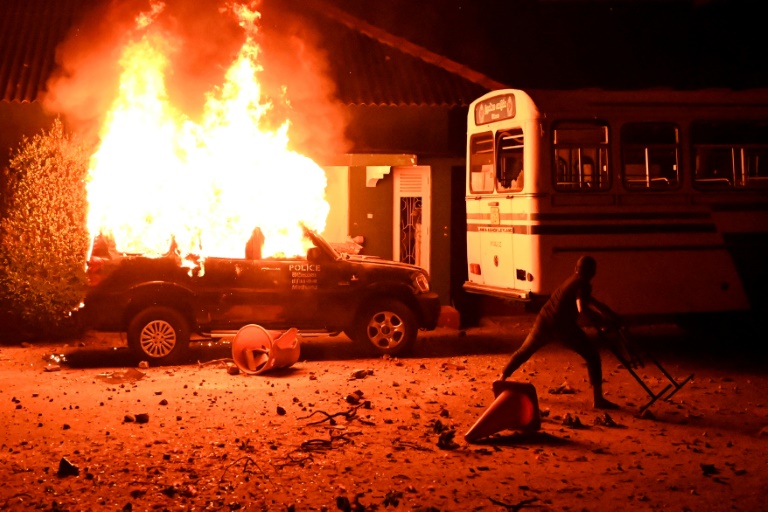
Sri Lanka’s capital was under heavy security on Friday after hundreds of protesters tried to storm the president’s home in a night of violence and anger at a dire economic crisis.

The South Asian nation is seeing severe shortages of essentials, sharp price rises and crippling power cuts in its most painful downturn since independence in 1948. Many fear it will default on its debts.

Thursday night’s unrest saw hundreds of people, rallied by unidentified social media activists, march on President Gotabaya’s home demanding his resignation.

They set two military buses and a police jeep ablaze, threw bricks to attack officers and barricaded a main road into Colombo with burning tyres.

One person was critically injured and police said five officers were hurt in running battles. Forty-five people were arrested.

Security forces fired into the crowd and used tear gas and water cannon to disperse the demonstrators. It was not immediately clear if they used live rounds or rubber bullets.

An overnight curfew was lifted early Friday morning, but police and military presence was beefed up around the city, where a burnt-out wreckage of a bus was still blocking the road to Rajapaksa’s house.

Rajapaksa’s office said Friday that the protesters wanted to create an “Arab Spring” — a reference to anti-government protests in response to corruption and economic stagnation that gripped the Middle East over a decade ago.

“The Thursday night protest was led by extremist forces calling for an Arab Spring to create instability in our country,” the president’s office said in a brief statement. 

Rajapaksa was not at home during the protest, according to official sources.

A live broadcast by a private television network abruptly stopped after what journalists said was pressure from the government.

But videos shared on social media verified as genuine by AFP showed men and women shouting “lunatic, lunatic go home” and demanding that all members of the powerful Rajapaksa family step down.

The president’s elder brother Mahinda serves as prime minister while the youngest Basil is finance minister. His eldest brother and nephew also hold cabinet positions.

Sri Lanka’s predicament has been compounded by the Covid-19 pandemic, which torpedoed tourism and remittances.

Many economists also say it has been exacerbated by government mismanagement and years of accumulated borrowing.

– Record inflation –

Latest official data released Friday showed that inflation in Colombo hit 18.7 percent in March, the sixth consecutive monthly record. Food prices also soared a record 30.1 percent.

Colombo imposed a broad import ban in March 2020 in a bid to save foreign currency needed to repay nearly $7.0 billion this year to service its $51 billion in debts.

Diesel shortages had sparked outrage across Sri Lanka in recent days, but the protests had been in various towns and not aimed at any top leader. 

But on Thursday diesel was unavailable at stations across the island, according to officials and media reports. 

The state electricity monopoly said it enforced a 13-hour power cuts from Thursday — the longest ever — because it did not have diesel for generators.

Several state-run hospitals have stopped conducting surgeries as they have run out of essential life-saving medicines.

The government has said it is seeking a bailout from the International Monetary Fund while asking for more loans from India and China.

IMF spokesman Gerry Rice told reporters in Washington on Thursday that such talks should begin “in the coming days”, with Sri Lanka’s finance minister expected in the US capital.

War in Ukraine: Latest developments

Here are the latest developments in the war in Ukraine:

– EU to urge China rethink on Russia –

EU is set to hold a virtual summit with China against a backdrop of increasing alarm over Beijing’s growing proximity with Moscow and its reluctance to condemn its invasion of Ukraine.

“The meeting will focus on the role we are urging China to play, to be on the side of the principles of international law without ambiguity and exert all the necessary influence and pressure on Russia,” says French European affairs minister Clement Beaune.

– Russia regrouping: Zelensky –

Ukraine’s President Volodymyr Zelensky warns Russia is consolidating and preparing “powerful strikes” in the country’s south, including besieged Mariupol.

“We know that they are moving away from the areas where we are beating them to focus on others that are very important… where it can be difficult for us,” he says.

NATO also says it is not seeing a pull-back of Russian forces in Ukraine and expects “additional offensive actions”, alliance chief Jens Stoltenberg warns.

– EU parliament leader visiting Kyiv –

European Parliament President Roberta Metsola says she is on her way to Ukraine, making her the first EU leader to visit the war-torn country.

The Maltese MEP, who was elected in January, tweets “On my way to Kyiv” alongside a Ukrainian flag, but gives no further details.

– Russia leaving Chernobyl with hostages –

Russian forces have begun to pull out of the defunct Chernobyl nuclear power site and move towards Belarus, but took an unspecified number of captive Ukrainian servicemen with them, officials in Kyiv say.  

Troops seized control of the Chernobyl site — where radioactive waste is still stored — on February 24, the first day of the invasion.

– Putin may be ‘isolated’: Biden –

US President Joe Biden says that Russian counterpart Vladimir Putin may be “isolated” and could have placed some of his advisors under “house arrest”.

In his first public remarks on Western assessments of Kremlin tensions over the war in Ukraine, Biden also says he is “sceptical” about Moscow’s claim to be scaling back its onslaught in parts of the country.

– New gas war front –

Putin says “unfriendly” countries, including all EU members, must set up ruble accounts to pay for gas deliveries from April, or “existing contracts would be stopped”. 

German Chancellor Olaf Scholz insists payments continue in euros or dollars, while France says Paris and Berlin are preparing for a cut in Russian gas deliveries.

– Buses en route to Mariupol – 

Ukraine’s government sends 45 buses to evacuate civilians from the besieged city of Mariupol, where Russia has declared a local ceasefire following a global outcry over the suffering of civilians trapped by a month of relentless shelling.

The first convoy arrives in the Russian-occupied port of Berdyansk, a hub in the operation to evacuate civilians to the Ukrainian-controlled town of Zaporizhzhia.

– ‘Longer’ conflict possible: US –

Russia’s refocusing of its military efforts on the Donbas could herald a “longer, more prolonged conflict” as Ukrainian forces put up fierce resistance there, a senior US defence official says.

“It’s been fought over now for eight years,” the official says of the heavily contested region.

– Putin ratings up –

Putin’s ratings have received a boost since the start of military actions in Ukraine, Russia’s independent Levada Centre polling institute says, with more than 80 percent of Russians saying they support his actions.

The first poll the centre has conducted since the conflict began shows 83 percent of Russians back their leader, up from 71 percent in early February.

– Biden taps oil reserves –

Biden announces an unprecedented release of crude from US strategic oil reserves, saying it will “ease the pain” of rising fuel prices for Americans.

– Foreign ministers meeting mooted –

Turkey says the foreign ministers of Russia and Ukraine could meet “within about a week or two” to step up negotiations on ending the five-week-old conflict.

– New US sanctions –

The United States hits a series of Russian tech firms with sanctions, including the nation’s largest chip maker Mikron.

– Russia bans EU leaders – 

Russia says it will expand the list of EU figures banned from entering the country following Western sanctions.

burs-cb-cdw-jmy-oho/je

Amazon locked in tight unionization votes in two US states

Amazon narrowly led in an effort to prevent unionization in Alabama, according to preliminary results Thursday, but the e-commerce behemoth trailed in a partial tally in a parallel election in New York. 

The results were not final in either case. At stake is Amazon’s ability to remain union-free in its home market, a status it has guarded fiercely since the company was founded in the 1990s.

“We already made history. We defeated a lot of odds to get here,” said Christian Smalls, a leader of the New York campaign who said he was not surprised by the union’s early lead of more than 360 votes.

In the Alabama election, a re-vote after federal officials threw out results of a 2021 referendum, 993 workers voted against the labor group, compared with 875 employees in favor.

But there were 416 “challenged” ballots, a “determinative” amount, according to the National Labor Relations Board, meaning the number of ballots still to be settled is big enough to potentially decide the final result.

The fate of the challenged ballots will be settled following an NLRB hearing that is not expected for at least a couple of weeks.

Stuart Appelbaum, president of the Retail, Wholesale and Department Store Union (RWDSU), said workers “will have to wait just a little bit longer,” on Twitter.

“Every vote must be counted, and every objection heard,” he said.

– ‘Ignited a movement’ –

In New York, union backers had reason for hope as ballots were counted from the Staten Island JFK8 warehouse, where more of the facility’s 5,000 workers turned out compared with Bessemer, which has 6,000 employees.

When the New York count wrapped up for the day early Thursday evening, there were 1,518 workers voting in favor of the union, compared with 1,154 employees voting no.

“It’s very clear that we’ll finish tomorrow,” an NLRB official said shortly before the counting stopped for the day.

At a news conference Thursday, Applebaum noted that their initial campaign last year — which received lots of media coverage and even an official endorsement by President Joe Biden — helped spur similar moves around the country.

“We ignited a movement with this campaign,” said the RWDSU president.

He added that he was “honored” the Alabama campaign was cited by leaders of a successful Starbucks union drive last December in New York — the first for the large coffee chain.

Since then, employees in over 150 Starbucks have requested union votes.

While the outcome of the latest votes remain uncertain, labor advocates hope they represent an inflection point as the overall rate of US private-sector unionization edges lower and unions remain on the outs in several states, especially in the South and West.

EU to seek China rethink over Russia ties

The EU holds a virtual summit with China on Friday amid increasing alarm over Beijing’s growing proximity with Moscow and its reluctance to condemn Russia’s invasion of Ukraine.

Chinese President Xi Jinping will hold the videoconference with EU leaders Charles Michel and Ursula von der Leyen, carrying through on an annual exercise that was skipped last year as tensions simmered.

“The meeting will focus on the role we are urging China to play, to be on the side of the principles of international law without ambiguity and exert all the necessary influence and pressure on Russia,” said French European affairs minister Clement Beaune, whose country holds the EU’s rotating presidency.

“This was not the initial purpose of the summit but it necessarily became one,” Beaune said, though he insisted other topics such as climate and trade “would not disappear”.

The EU-China summit is usually an effort to deepen trade ties. But last year’s exchange of tit-for-tat sanctions over the plight of China’s Uyghur minority, followed by Beijing’s trade coercion of EU-member Lithuania over Taiwan, soured preparations for the meeting.

The downgrade in relations came surprisingly quickly after the EU and China secured an investment deal in late 2020 long sought by Germany.

Human rights concerns, and US pressure on the EU, sapped momentum, sowing distrust and sinking diplomatic ties.

Relations have suffered further as Beijing abstains from condemning Moscow’s assault on Ukraine. Some in the EU see the emergence of a Chinese-Russian bloc against the US, EU and their more liberal-minded allies.

In a meeting with Russian counterpart Sergei Lavrov, Chinese Foreign Minister Wang Yi on Wednesday said that “China-Russia cooperation has no limits”, repeating a line used by Presidents Vladimir Putin and Xi.

The friendship between Russia and China “is clearly directed towards creating a new world order in which authoritarian great power politics would dominate over the international rule of law,” said German MEP Reinhard Buetikofer, a frequent critic of Beijing.

But given China’s close commercial ties to Europe, “China’s ways of dealing with Russia’s aggression is a convoluted effort to be on Russia’s side without paying too much of a price for that,” added Buetikofer, one of several MEPs sanctioned by China.

– ‘Pipe dream’ –

An EU official involved in preparing the summit, which includes a session with Chinese Prime Minister Li Keqiang, stressed the importance of China’s stance on Russia over all else.

“It has very concrete significance whether China uses or does not use its influence to have ceasefire established, humanitarian corridors established, that it doesn’t help or helps to circumvent sanctions.”

But Sylvie Bermann, a former French ambassador to both Moscow and Beijing, cautioned: “The idea of detaching China from Russia is a pipe dream.”

While Ukraine is at the top of the agenda for European leaders, the same cannot be said for Beijing. 

Asked Wednesday what the Communist leadership expects from the summit, a Chinese foreign affairs spokesman did not once mention Ukraine by name. 

“The international situation is unstable and volatile, and uncertainty is increasing,” the spokesman, Wang Wenbin, said, adding: “China and the EU are two major powers for world peace.”

But a senior EU official insisted that China “has to realise that, while it thinks that (the Russian invasion of Ukraine) has nothing to do with EU-China relations, actually it does”.

Ding Chun, a professor at the Institute of Global Economics at Fudan University in Shanghai, still expected Ukraine to make it into the conversation, even if no developments were expected.

“The two parties will simply share their respective positions,” he told AFP.

Russia forces regrouping to attack south, Ukraine president warns

Ukraine’s President Volodymyr Zelensky warned Russia is consolidating and preparing “powerful strikes” in the country’s south, including besieged Mariupol, where a new attempt will be made Friday to evacuate civilians from the devastated city.

Russia meanwhile threatened to turn off its gas taps to Europe if payments are not made in rubles, as US President Joe Biden ordered a record release of strategic oil reserves to ease soaring US prices.

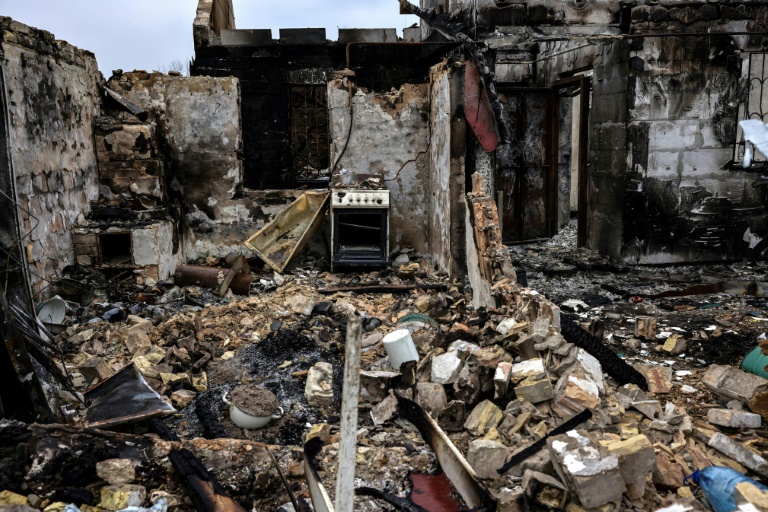
Over a month into Russia’s invasion of its neighbour, Vladimir Putin’s troops have devastated cities like Mariupol with shelling, killing at least 5,000 people in the port city alone. 

In peace talks this week, Russia said it would scale back attacks on the capital Kyiv and the city of Chernigiv, but Ukrainian and Western officials have dismissed the pledge, saying Moscow’s troops were merely regrouping.

“This is part of their tactics,” said Zelensky in a late-night address.

“We know that they are moving away from the areas where we are beating them to focus on others that are very important… where it can be difficult for us,” he said.

In particular, he warned, the situation in the country’s south was “very difficult”.

“In Donbas and Mariupol, in the Kharkiv direction, the Russian army is accumulating the potential for attacks, powerful attacks,” he said.

Washington echoed that assessment, with a senior US defence official saying Russia’s focus on Donbas could herald a “longer, more prolonged conflict”.

Military experts believe that Moscow is ditching efforts to advance simultaneously along multiple axes in the north, east and south, after struggling to overcome stronger-than-expected Ukrainian resistance.

Instead it wants to establish a long-sought land link between Crimea, which Moscow occupied in 2014, and the two Russian-backed Donbas statelets of Donetsk and Lugansk.

– ‘Civilians desperately wanting to flee’ –

Mariupol is the main remaining obstacle to that ambition, and Russian forces have encircled and relentlessly bombarded the city to try to capture it.

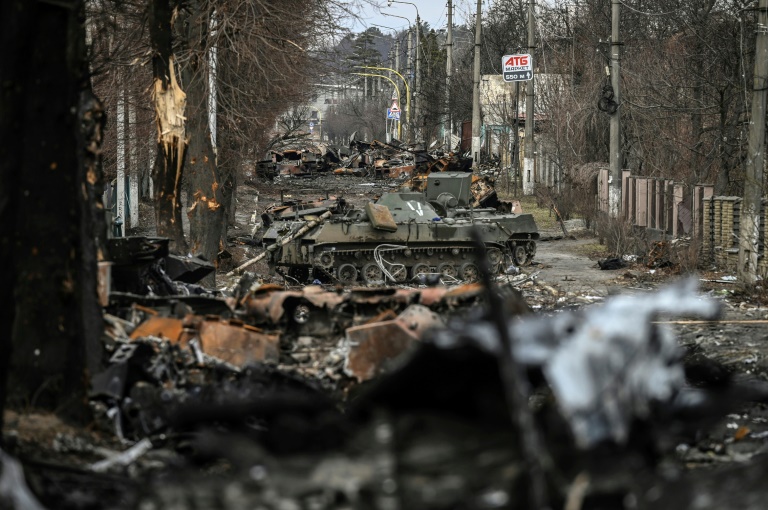
Instead, it has been reduced to rubble, with tens of thousands of civilians trapped inside with little food, water or medicine.

Previous attempts to evacuate residents have collapsed, though some have made the dangerous dash to freedom alone, but on Friday Russia says it will allow a humanitarian corridor organised by the International Committee of the Red Cross (ICRC).

The ICRC’s Ukraine delegation said on Twitter it was in nearby Zaporizhzhia, where buses from the encircled city are meant to arrive.

“We hope to be able to facilitate safe passage for civilians desperately wanting to flee Mariupol. We are also here with two trucks of assistance, hoping that we can also get assistance in,” the organisation’s Lucile Marbeau said in a video.

“In these trucks there is food, medicine, relief items, for those civilians who decide to stay,” she added.

Ukrainian officials on Thursday sent dozens of buses towards Mariupol, and the local government said on Telegram that civilians would be able to start boarding Friday morning in neighbouring Berdiansk.

Russia has moved about 20 percent of its troops from around Kyiv after failing to capture the city, according to US officials.

But its strikes have continued on Kyiv and Pentagon spokesman John Kirby said is seemed likely troops are “going to be repositioned, probably into Belarus, to be refitted and resupplied and used elsewhere in Ukraine.”

Russian troops have also pulled back from the Chernobyl nuclear plant after weeks of occupation, but have taken a number of captive Ukrainian servicemen with them, according to officials in Kyiv.

Western intelligence has warned that Putin’s advisors may be “afraid to tell him the truth” about battlefield losses or the damage that sanctions have wrought on the country’s economy.

And Biden suggested Putin may have placed some advisors under house arrest, though he cautioned “there’s a lot of speculation.”

– ‘I hope all this will end soon’ –

The Kremlin has rejected the claims, with spokesman Dmitry Peskov saying Western officials “don’t understand President Putin, they don’t understand the mechanism for taking decisions and they don’t understand the style of our work”.

With his economy crippled by unprecedented international sanctions, Putin has sought to leverage Russia’s status as an energy power, and warned Thursday that EU members will need to set up ruble accounts from Friday to pay for Russian gas.

“If such payments are not made, we will consider this a breach of obligations on the part of our buyers” and existing contracts would be stopped, Putin said.

The EU has joined the United States in imposing sanctions, and European Parliament President Roberta Metsola is expected in Kyiv soon in a show of support.

But the bloc has not imposed an energy embargo, and Germany, which imported 55 percent of its gas supplies from Russia before the war, insisted it will pay in euros or dollars as stipulated in contracts.

Berlin and Paris were also “preparing” for Russian gas to simply stop flowing, France’s economy minister said.

Biden meanwhile moved to mitigate rising domestic fuel prices by announcing a release from strategic US reserves of a million barrels daily for six months.

The record release amounts to augmenting global supplies by about one percent.

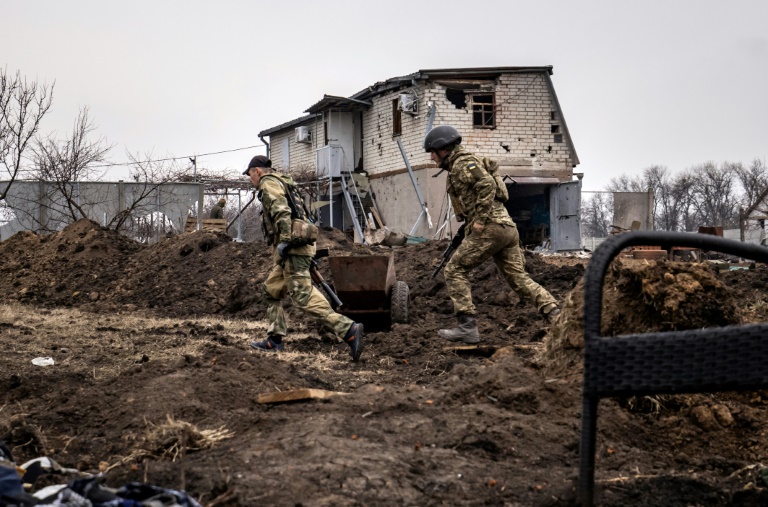
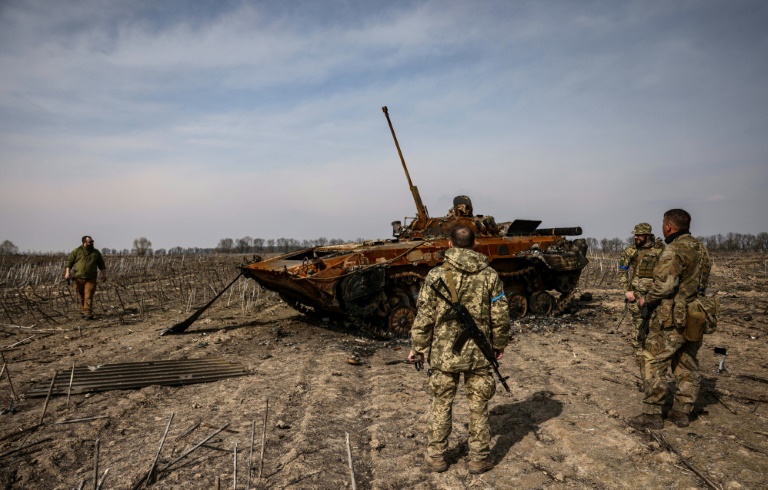
On the ground around Kyiv, Ukrainian forces have continued to push back Russian troops, capturing territory on the outskirts of the capital as Moscow’s advance stalls.

Zelensky praised the advances, but said he was stripping two generals of their ranks for unspecified offences.

“Right now I don’t have time to deal with all the traitors, but gradually all of them will be punished,” he said.

Civilians have been trickling out of devastated areas, including three-year-old Karolina Tkachenko, who was helped over a pipeline east of Kyiv by Ukrainian troops as she and her family escaped.

“The shops are closed, there’s no delivery of supplies. The bridge is also blown up, we can’t go for the groceries through there,” said her mother Karina, holding her daughter in a pink bobble hat in her arms.

“I hope all this will end soon, and I will go back to my work.”

burs-sah/je

Former soldier reveals Argentine torture in Falklands war

Some soldiers were buried up to their necks in snow, others tied to posts by their limbs.

Badly trained and poorly equipped, Argentine soldiers suffered shocking conditions and even torture during the 1982 Falklands War — but it was inflicted by their own officers.

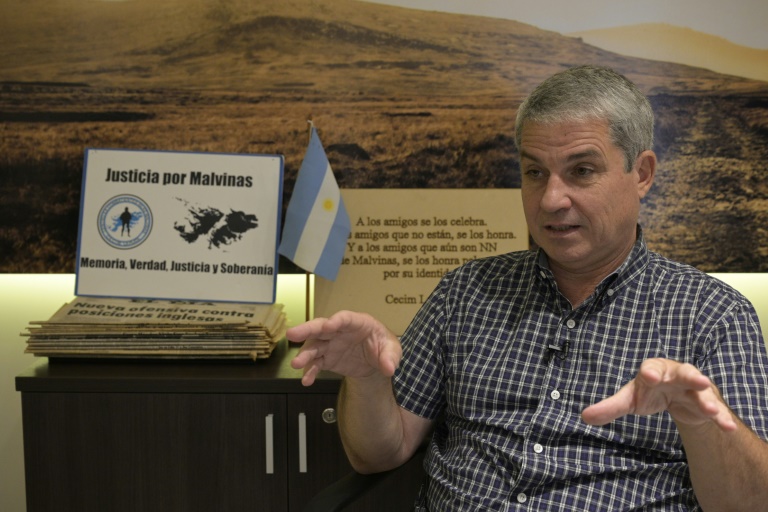
“The dictatorship’s methods were transported to the Falklands,” said former fighter Ernesto Alonso, who has launched a case against Argentina’s military command for torturing soldiers during the war.

“In many cases the Falklands situation was being stuck between two enemies,” Alonso told AFP, ahead of the 40th anniversary of Argentina’s disastrous invasion of the British-held South Atlantic archipelago.

On one side, the British were “killing our comrades in battle,” and on the other, Argentine officers were torturing their own men.

The Center for ex-fighters in La Plata, Alonso’s home town, has collected statements from dozens of former soldiers and in 2007 opened a court case against Argentina’s military leaders for torture during the war.

“It was systematic, there was no precedent for what we went through in the Falklands where the state terrorism was exported,” said Alonso.

“Over there the life of a sheep was worth more than a soldier… There were soldiers that died of hunger,” added Alonso, who spoke of a “very traumatic experience.”

“I was witness to the death of a soldier who was punished by sleeping outside of his position and one morning we found him between the rocks, covered by a poncho, almost frozen with convulsions. He did not survive the cold.”

Alonso said he also saw “three soldiers tied to stakes in front of” barracks on Mount Longdon, near the eastern coast of the region.

Many Argentine soldiers came from warm climates and had never before experienced the biting cold of the Falklands’ wind.

– ‘Your whole body froze’ –

The court case involves 180 incidents, with around 100 members of the military implicated, although only four are to be prosecuted.

The trial has been delayed while the Supreme Court of Argentina decides whether or not such torture constitutes a crime against humanity.

But the former fighters’ testimonies in the case have exposed the brutality of their tormentors.

“They lay us on our backs, made us spread our arms into a T figure and tied our legs apart with rope. With the snow and the cold, your whole body froze,” said one ex-soldier.

“I was ordered to be buried alongside three other soldiers up to our necks in a pit with no coat, no helmet, for more than 10 hours in extreme temperatures and without food,” said another.

Temperatures in the Falklands can drop to minus six degrees Celsius (21 degrees Fahrenheit), with snow and frost common in addition to the freezing winds.

Some soldiers said they were forced to eat feces, given electric shocks and were left without helmets during British bombardments.

Argentina’s public prosecutor’s office said on Thursday it was incorporating new complaints to the file, including “immersion in icy water as a method of torture and cases of sexual abuse in an anti-Semitic context against 24 victims,” following analysis of newly declassified military documents.

– ‘Worst oppressive apparatus’ –

Alonso was just 19 and enrolled in obligatory military service when dictator Leopoldo Galtieri sent an invasion force to the islands on April 2, 1982.

Argentina claims sovereignty over the Falklands, which Britain asserted control over in 1833 following earlier competing claims by the French and Spanish as well as the British.

Alonso arrived on the islands — some 2,000 kilometers from his home in La Plata, in Argentina’s northeast — 10 days after the start of the invasion.

His company spent 64 days stationed on Mount Longdon, the site of a fierce battle just days before Argentina’s surrender on June 14.

It was where 33 of the 649 Argentines who lost their lives during the war died.

Upon his return home he received no recognition nor psychological support.

“We were received by the worst oppressive apparatus of the dictatorship, and they imposed silence on us. That caused terrible damage,” said Alonso.

But “talking was reparatory, we were able to transform our pain into a struggle.”

Since the war, some 600 ex-fighters have died.

Alonso has been back to the islands five times since 2005. He has spearheaded a campaign to identify the bodies in around 100 unmarked graves in the Argentine cemetery at Darwin on the Falklands.

Successive Argentine governments have refused to repatriate the bodies, insisting they are already buried in Argentine territory.

Alonso is proud of the young men who fought with minimal training and inadequate weapons or clothing against the far more professional British armed forces.

But he does not want to “remain anchored” to the conflict.

Despite the horrors of war, Alonso still supports the state claim on the Falklands, as does 80 percent of the Argentinian population, according to surveys.

“The Falklands are much more than a war,” said Alonso “The Falklands is in the DNA of all Argentines and clearly the dictatorship knew how to strike a chord in that DNA.” 

Stocks sink, gas and oil prices soar over Ukraine fears

Global stock markets fell across the board Friday and energy prices soared after Russia attacked a major Ukrainian nuclear power plant, the largest in Europe, exacerbated worries about the hit to the continent and its economy.

Europe’s main stock markets closed sharply lower, with Paris down five percent and Frankfurt losing 4.4 percent.

Asian indices had earlier retreated and Wall Street also lost ground to conclude a losing week on a downcast note.

The euro sank close to a two-year low under $1.10 as the Ukraine conflict clouds the eurozone’s economic recovery from the coronavirus pandemic.

The greenback benefited from its status as a haven investment.

“Investors have piled out of European stocks this week, accelerating a decline that began at the end of last month, and has accelerated over the last two days,” said analyst Michael Hewson at CMC Markets.

“This morning’s reckless shelling of a Ukrainian nuclear power plant by Russian forces shows that (President Vladimir) Putin is becoming increasingly desperate to obtain a victory in the face of numerous setbacks,” he said.

“These actions are a significant escalation and raise the question as to whether Putin could adopt a scorched earth policy in his attempts to crush Ukrainian resistance,” Hewson added.

European and British gas prices surged to record peaks on supply disruption fears as a result of key supplier Russia’s ongoing attack on Ukraine.

Oil prices also continued to push higher, with Brent futures ending at $118.11 a barrel, the highest level since 2008.

– ‘Markets ill prepared’ –

Ukrainian President Volodymyr Zelensky has meanwhile demanded still tougher sanctions against his Moscow foes after Russian forces attacked and seized the Zaporizhzhia nuclear power plant, but Kyiv said no radiation leak was detected.

Western countries have hit Russia’s economy hard including by closing airspace, freezing assets and excluding seven banks from the SWIFT interbank messaging network.

The impact is already impeding Moscow’s ability to shore up the beleaguered ruble and purchase imports.

On Friday, White House spokeswoman Jen Psaki said US officials were “looking at ways to reduce the import of Russian oil while also making sure that we are maintaining the global supply needs out there.”

US employers added 678,000 workers to their payrolls in February, government data showed Friday, driving the unemployment rate down to 3.8 percent in a monthly report that was better than expected.

“The market is trying to balance the lousy geopolitical situation with the February employment report, which was pretty strong,” said Briefing.com analyst Patrick O’Hare.

“What’s principally driving the market is this foreboding sense that things are going to get worse before they get better in Ukraine.”

– Key figures around 2100 GMT –  

New York – Dow: DOWN 0.5 percent at 33,614.80 (close)

New York – S&P 500: DOWN 0.8 percent at 4,328.87 (close)

New York – Nasdaq: DOWN 1.7 percent at 13,313.44 (close)

London – FTSE 100: DOWN 3.5 percent at 6,987.14 (close)

Frankfurt – DAX: DOWN 4.4 percent at 13,094.54 (close)  

Paris – CAC 40: DOWN 5.0 percent at 6,061.66 (close)

EURO STOXX 50: DOWN 5.0 percent at 3,556.01 (close)

Tokyo – Nikkei 225: DOWN 2.2 percent at 25,985.47 (close)

Hong Kong – Hang Seng Index: DOWN 2.5 percent at 21,905.29 (close)

Shanghai – Composite: DOWN 1.0 percent at 3,447.65 (close)

Euro/dollar: DOWN at $1.0916 from $1.1066 late Thursday

Pound/dollar: DOWN at $1.3248 from $1.3348

Euro/pound: DOWN 82.60 pence from 82.91 pence

Dollar/yen: DOWN at 114.78 yen from 115.46 yen

Brent North Sea crude: UP 6.9 percent at $118.11 per barrel

West Texas Intermediate: UP 7.4 percent at $115.68 per barrel

burs-jmb/sst

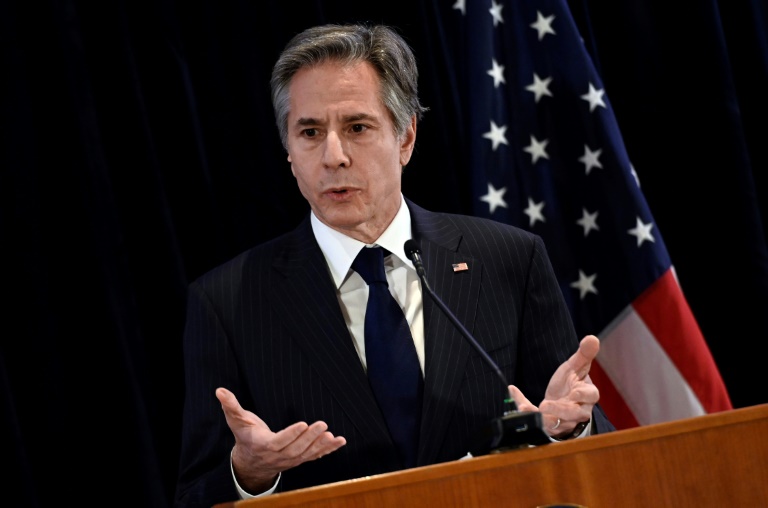
Blinken defends sanctions tactic, warns of more Ukraine suffering

US Secretary of State Antony Blinken said Friday that the suffering of Ukrainians will likely worsen but defended the West’s focus on sanctions and limited military support as an effective way to stop Russia’s invasion.

Amid rising pressure for US and European allies, and especially NATO, to help Kyiv more on the battlefield, Blinken said that their actions so far against Moscow were only just beginning to have a punishing impact.

But he also said that more military support and more sanctions, as well as increased humanitarian aid for Ukrainians, were the focus of a day of talks at the NATO and European Union headquarters in Brussels.

“The terrible expectation is that the suffering we’ve already seen is likely to get worse before it gets better,” Blinken told reporters.

Earlier Friday NATO rejected mounting calls to implement a “no-fly zone” over Ukraine that could force Russia to stop its jet fighters, bombers and helicopters from attacking Ukraine.

And while the United States and Western European countries are actively supplying Ukraine’s forces with anti-armour rockets and portable Stinger missiles that can take down helicopters and slower-moving aircraft, they are refusing to send Ukraine’s air force more fighter jets to better counter-attack the Russians.

But Blinken, who has taken a lead role in organizing global retaliation against Russia, said a no-fly zone would be impossible to enforce without expanding the conflict.

“The only way to actually implement something like a no-fly zone is to send NATO planes into Ukrainian airspace and to shoot down Russian planes. That could lead to a full-fledged war,” he said.

But even as the Russian invading force pushes ahead and increasingly hits urban civilian targets, Blinken said coordinated Western actions are having an impact.

With what he said was a continuing supply of weaponry, the Ukrainian military has been able to stall some of the Russia advance.

“We are going to tremendous lengths with allies and partners to provide Ukrainians with the means to  effectively defend themselves,” he said.

“One of the things that we talked about at length today in our various meetings of NATO and the EU was, what more we can do and how to do it effectively,” he said.

Ukrainian Foreign Minister Dmytro Kuleba attended those meetings virtually, he said, and gave his counterparts a list of what the country’s army needs.

“We’re working on all of that, every every single day,” Blinken said.

He also cited the impact economic of sanctions on the Russian economy, debasing the currency, forcing up interest rates, and cutting it off from crucial supplies and income.

But he admitted that the impact can’t provide immediate relief to millions of Ukrainians.

“Unfortunately, this is not like flipping a light switch,” Blinken said.

“It takes time and when you have, in the case of…  President Putin’s Russia, a country that is prepared to go to excessive means to achieve its results, it’s a real challenge.    

Nevertheless, he said, “the impact is there. It’s powerful. It’s real and it is building. So let’s see how Russia responds to that as this really takes hold”, he said.

Close Bitnami banner
Bitnami