World

Near Ukraine border, Western arms arrive quickly and discreetly

On a runway near the Ukrainian border, 14 wide-body aircraft arrive on average each day — a carefully calibrated operation mounted at top speed to deliver tons of Western military assistance to Kyiv.

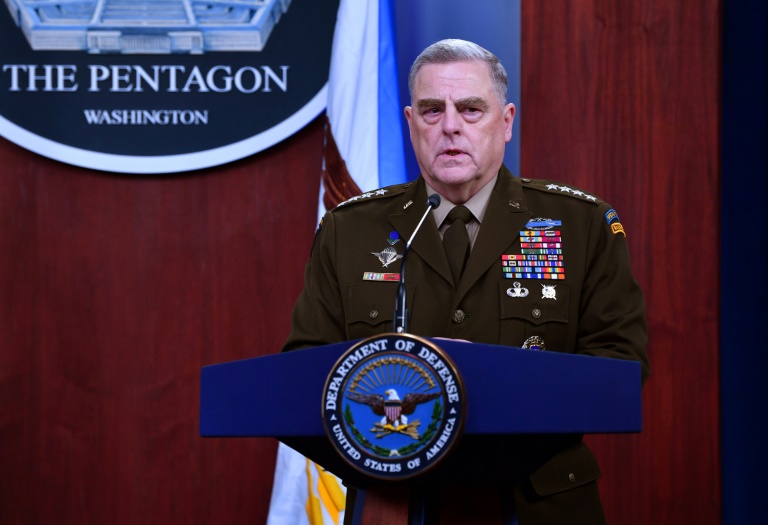
General Mark Milley, the chairman of the US Joint Chiefs of Staff, inspected the site on Friday — its location is being kept secret for security reasons — where the Pentagon is coordinating the activities of 22 donor countries.

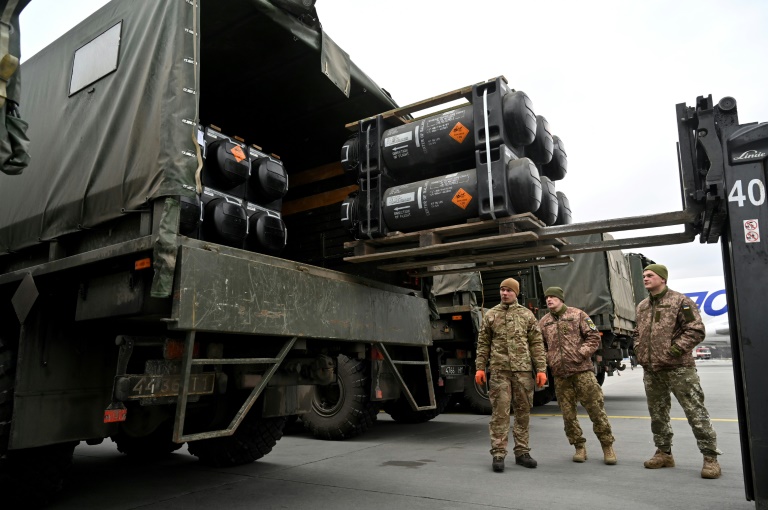
A handful of journalists accompanying Milley were allowed to observe as personnel prepared about 100 Javelin anti-tank missiles for delivery to the border. Pictures were forbidden.

Men in civilian clothes used forklifts to move the missiles, which were stacked on pallets and only covered in plastic.

On the runway, the cargo hold of a US Air Force C-17 transport plane has just been shut — the delivery was complete. At the same moment, another C-17 was landing.

The missiles did not stay in one place for long: they were quickly taken by land to their final destination, military officials said. 

As many as 18 deliveries have taken place in a single day at the site. Only about four or five a day are American.

The operation is coordinated by a mix of soldiers and civilians, mainly from NATO member countries, who have come to support Ukraine in its battle against a Russian invading force that is bigger and better equipped.

Beyond assistance from Washington, which has unblocked more than $1 billion in military aid to Ukraine over the past year, several European nations are providing Kyiv with an array of materiel — anti-tank missile launchers, Stinger surface-to-air missiles, armoured vehicles, fuel, munitions, assault rifles and even rations for their troops.

The United States has already delivered two-thirds of the arms it promised in late February to Ukraine, which says it has been able to effectively slow the Russian advance, a Pentagon official said Friday.

And with NATO’s eastern European members deeply worried about Russia’s intentions, Washington has sent thousands of extra troops to reassure them.

– NATO ‘more unified’ than ever –

Those US soldiers are notably deployed in Poland, where Milley visited members of the 82nd Airborne Division stationed at the massive Nowa Deba training ground in the southeast of the country.

To reinforce the ability of US and Polish troops to work together, soldiers from the two countries have intensified their joint exercises over the last two weeks. One such drill was conducted Friday in the presence of Milley.

US tanks simulated an attack while Polish soldiers manning Leopard battle tanks — emerging from a wooded area, flanked by other US tanks — fought back.

Milley said the US soldiers were there to “reinforce the idea that the US is a full-fledged member (of NATO) and we intend to fulfil our NATO Article 5 obligations as a member state,” referring to the alliance’s collective defence pledge.

The commander of US forces in Europe, General Chris Cavoli — who is supervising this deployment — hailed the unprecedented mobilisation of NATO forces over the past two weeks.

“NATO is more unified than I have ever seen NATO unified before,” he said. “I have never seen the resolve and the practical expression of combat readiness that I see in the alliance’s ground forces right now.”

Milley later visited a welcome centre set up shortly before the Russian invasion began for Americans fleeing the fighting.

The centre, located in a conference centre in the southern Polish city of Rzeszow, can house up to 2,500 people. So far, it has not been used, but it could eventually be repurposed for Ukrainian refugees if the flow of migrants grows.

The G2 Arena centre — run by General Chris Donahue, who was the last US soldier to leave Kabul airport last August — is also the temporary home of the 82nd Airborne Division in Poland, and a multinational operations hub.

From their provisional headquarters, soldiers from the 82nd Airborne monitor the number of people arriving at the Polish border from Ukraine.

They also analyse the fighting in Ukraine, to ensure that Western arms shipments arrive safely with Ukrainian forces.
Russia's war in Ukraine: Latest developments

Here are the latest developments in Russia’s war in Ukraine:

– Nuclear plant shelled then taken –

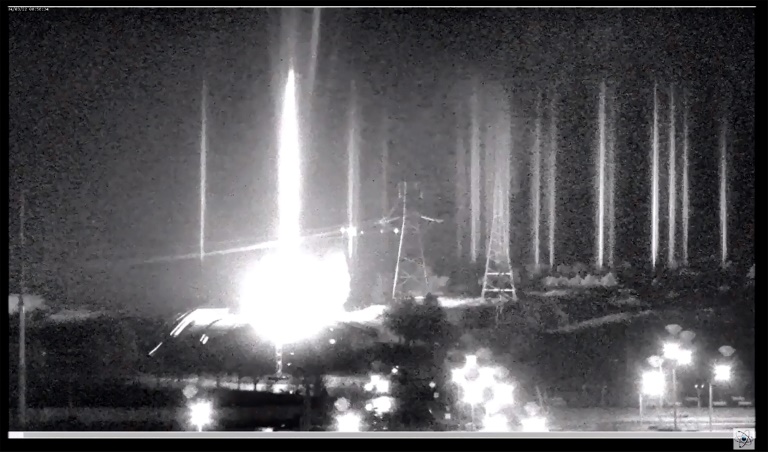
A fire at Europe’s biggest nuclear power station at Zaporizhzhia is put out, with Ukraine accusing Russia of “nuclear terror” in shelling the plant.

Russian troops later take over the site of the reactors, which generate a fifth of Ukraine’s electricity, after firefighters say they were prevented from reaching the blaze for hours.

– West slams ‘recklessness’ –

At a United Nations Security Council meeting, the US ambassador Linda Thomas-Greenfield says Russia’s “reckless” overnight attack “represents a dire threat to all of Europe and the world”.

Moscow’s UN ambassador Vassily Nebenzia denies that Russian forces had shelled the plant, saying the statements “are simply untrue”.

Rafael Grossi, director general of the International Atomic Energy Agency (IAEA), offers to travel to Ukraine to negotiate with Ukraine and Russia on ensuring the safety of nuclear sites.

– Putin ready for dialogue –

Russian President Vladimir Putin in a phone call with German Chancellor Olaf Scholz says Moscow is ready for dialogue over Ukraine if all its demands are met.

– New talks? –

Ukraine plans to hold a third round of talks this weekend with Russian officials to try to end the fighting, one of Kyiv’s negotiators says.

– ‘Not over soon’ –

US Secretary of State Antony Blinken warns that the war in Ukraine “may not be over soon” and that the US and European allies must sustain tough pressure on Russia until it ends.

– G7 threatens further sanctions –

G7 foreign ministers warn that Russia will face further “severe sanctions” for its invasion, and call on Moscow to stop its attacks near nuclear power plants.

– NATO rejects no-fly zone –

NATO chief Jens Stoltenberg says the alliance will not impose a no-fly zone over Ukraine after Kyiv calls for one to help stop Russia’s bombing of its cities.

– Moscow media blackout –

Russia blocks social media staple Facebook in the country, part of an unprecedented government crackdown on independent media and activists since the start of the invasion.

– Jail terms for ‘fake news’ –

Putin signs a law imposing 15-year jail sentences for fake news about the Russian armed forces which many fear could severely curtail reporting.

– BBC, Novaya Gazeta react –

The BBC says it is halting its coverage in Russia, as the new legislation “appears to criminalise independent journalism”.

And Russian newspaper Novaya Gazeta says it is deleting content over the new law.

– Russia isolated –

Russia is more isolated than ever after a historic vote at the UN Human Rights Council for a probe into violations committed during the war on Ukraine, with only Eritrea siding with Moscow.

– Russia’s Black Sea push –

Russian forces take the Black Sea port of Kherson as it appears Moscow is trying to cut Ukraine’s entire access to the sea, with the besieged port of Mariupol in the east without water or power.

– 47 killed in northern city –

Forty-seven people have been killed following a Russian air strike in the northern Ukrainian city of Chernihiv, regional authorities say. 

– ‘Numerous rapes’: Kyiv –

Ukraine’s foreign minister claims there have been “numerous cases” of Russian troops raping Ukrainian women and calls for an international tribunal on war crimes.

– More than 1.2 million flee –

More than 1.2 million people have fled Ukraine into neighbouring countries since Russia invaded last week, the UN says.

– Stocks sink, gas, oil soar – 

Global stock markets fall, gas prices reach a record high, and oil prices soar as investors fear the risk of an escalation after Russia attacked the nuclear power plant.

– Hunger threat –

The United Nations’ World Food Programme warns about a looming food crisis in Ukraine in conflict areas, while disruptions in production and exports could lead to food insecurity globally. 

burs-arb-fg-jmy/imm

US calls attack on Ukraine nuclear plant a possible 'war crime'

The United States on Friday called an attack attributed to Russian forces against a nuclear power plant in Ukraine a possible war crime.

“It is a war crime to attack a nuclear power plant,” tweeted the US embassy in Ukraine — which was moved out of the capital Kyiv because of the Russian invasion — after the overnight attack at the nuclear plant in Zaporizhzhia.

Asked by AFP whether Washington was openly accusing Moscow of having perpetrated a war crime prohibited by the Geneva Convention, the US State Department was more cautious.

“The intentional targeting of civilians or civilian objects, including nuclear power plants, is a war crime, and we are assessing the circumstances of this operation,” a State Department spokesman said.

“But regardless of the legality, this action was the height of irresponsibility, and the Kremlin must cease operations around nuclear infrastructure,” the official said.

Washington has in recent days accused Russia of hitting civilian infrastructure and killing civilians in Ukraine, but has been careful not to explicitly say that the Russian military was intentionally targeting them, or to openly discuss war crimes. 

British Prime Minister Boris Johnson on Wednesday called Russian President Vladimir Putin a war criminal.

“What we have seen already from Vladimir Putin’s regime, in the use of the munitions that they have already been dropping on innocent civilians, in my view already fully qualifies as a war crime,” Johnson said.

Facebook blocked as Russia backs jail time for 'fake news'

Russia on Friday blocked Facebook and moved to impose harsh jail terms for publishing “fake news” about the army as part of efforts to muffle dissent over Moscow’s invasion of Ukraine.

Social media staple Facebook was blocked over several instances of “discrimination” of Russian state media, media regulator Roskomnadzor said. 

Earlier in the day, Russian lawmakers backed legislation that would impose harsh jail terms and fines for publishing “fake news”. 

Russia’s lower house said in a statement that if fake news stories “led to serious consequences, (the legislation) threatens imprisonment of up to 15 years”.

Amendments were also passed to fine or jail people calling for sanctions against Russia.

The BBC, which has a large bureau in Moscow and runs a Russian-language news website, reacted by announcing a halt of its operations in Russia.

“This legislation appears to criminalise the process of independent journalism,” BBC Director-General Tim Davie said in a statement.

He warned that journalists could face “the risk of criminal prosecution simply for doing their jobs”.

Two Russian outlets, Nobel Prize-winning newspaper Novaya Gazeta and business news website The Bell, said Friday they will stop reporting on Russia’s invasion of Ukraine to protect their journalists.  

The past year has seen an unprecedented crackdown on independent and critical voices in Russia that has intensified since the invasion.

Russia’s media watchdog said Friday it had restricted access to the BBC and other independent media websites, further tightening controls over the internet.

– Foreign media restricted –

The independent news website Meduza, German broadcaster Deutsche Welle, and the Russian-language website of the US-funded Radio Free Europe/Radio Liberty, Svoboda, were “limited,” said Roskomnadzor, following a request from prosecutors.

Valery Fadeyev, the head of the Kremlin’s human rights council accused Western media of being behind “a huge flow of false information that comes from Ukraine” and said the council had set up a project to stop it.

In another attack on critical voices, Russian police on Friday were carrying out searches at the office of the country’s most prominent rights group, Memorial, which was ordered to close late last year, sparking international outcry.

Russia’s invasion has already claimed hundreds of lives, displaced more than a million people and spurred allegations of war crimes.

Western-led sanctions levelled against Russia in retaliation have sent the ruble into free-fall forcing the central bank to impose a 30-percent tax on sales of hard currency after a run on lenders.

– State-media narratives –

Moscow has few economic tools with which to respond but the Duma, or lower house, on Friday adopted a bill that would freeze any assets inside Russia of foreigners “violating rights of Russians”.

Russian media have been instructed to publish only information provided by official sources, which describe the invasion as a military operation. 

For the moment, it appears the invasion has marked the beginning of the end for what remains of Russia’s independent media.

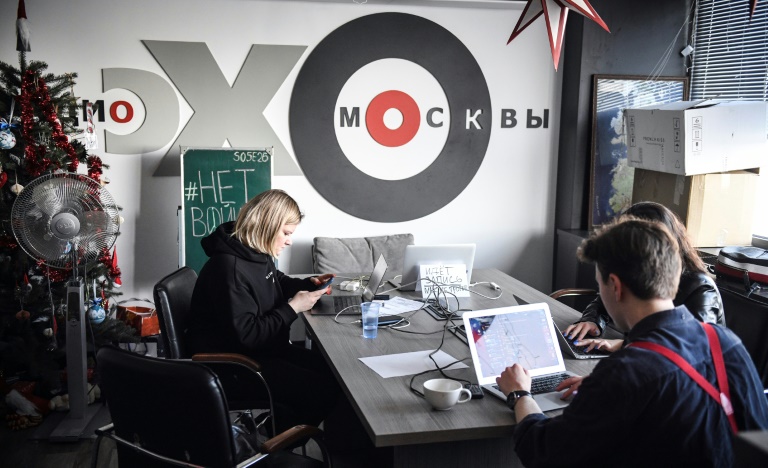
Ekho Mosvky — a liberal-leaning radio station majority-owned by Russia’s energy giant Gazprom — said Thursday it would shut down after being taken off air over its Ukraine war coverage.

Authorities had on Tuesday blocked the Ekho Moskvy website and took the station off air as punishment for spreading “deliberately false information” about the conflict.

Its editor-in-chef Alexei Venediktov said on Telegram Friday that the station will be deleting its website and social media accounts. 

Another independent outlet, Znak, said Friday it was ceasing work “due to the large number of restrictions that have recently appeared for the work of the media in Russia”.

The BBC said this week that the audience of its Russian language news website had “more than tripled… with a record reach of 10.7 million people in the last week”.

A BBC spokesperson said the company would “continue our efforts to make BBC News available in Russia, and across the rest of the world” despite the restrictions. 

burs/gw

Ukraine crisis deepens as Russians attack nuclear plant

Ukraine accused the Kremlin of “nuclear terror” and the West expressed fury on Friday after Europe’s largest atomic power plant was attacked and seized by invading Russian forces, which continued to shell major cities.

Fighting and a fire at the Zaporizhzhia plant triggered an emergency UN Security Council meeting, after which President Vladimir Putin said Moscow was ready for talks — if all Russia’s demands were first met.

The six reactors at Zaporizhzhia, which can power four million homes, were apparently undamaged by the fire in a training facility. Monitors reported no spike in radiation. 

But the attack killed three Ukrainian soldiers, according to Kyiv’s nuclear operator Energoatom, and was furiously condemned by Western capitals, NATO and environmental groups as utterly irresponsible.

“We survived a night that could have stopped the story, the history of Ukraine, the history of Europe,” Ukrainian President Volodymr Zelensky said.

An explosion at Zaporizhzhia would have equalled “six Chernobyls”, he said, referring to the plant in Ukraine that was the site of the world’s worst nuclear disaster in 1986.

“Russian tank commanders knew what they were firing at,” Zelensky alleged, adding: “The terrorist state now resorted to nuclear terror.”

– ‘Reckless actions’ –

Russian defence ministry spokesman Igor Konashenkov claimed the attack on Zaporizhzhia was staged by “Ukrainian sabotage groups, with the participation of foreign mercenaries”.

“This shows the Kyiv regime’s criminal plan,” he alleged, adding that the plant had been secured by Russian troops and was functioning normally.

After phoning Zelensky during the night, British Prime Minister Boris Johnson accused Putin of “reckless actions” that could “threaten the safety of all of Europe”. 

At the urging of Johnson and Western allies, the UN Security Council was convening after the attack, although Russia’s veto on the world body would limit any concerted condemnation.

“We are faced together with what is President Putin’s war of choice, unprovoked, unjustified, and a war that is having horrific, horrific consequences,” US Secretary of State Antony Blinken said in Brussels. 

“We’re committed to doing everything we can to make it stop.”

But Putin has been unmoved as Russia has become an economic, sporting and cultural pariah.

The Kremlin said that Putin, in a call with Belarusian President Alexander Lukashenko Friday, restated that “the tasks set for the (Ukraine) operations are going according to plan and will be fulfilled in their entirety”.

Kremlin spokesman Dmitry Peskov called on Russians “to unite around our president”, after thousands braved mass arrests at anti-war demonstrations this week.

Authorities have imposed a news blackout and two liberal media groups have halted operations. On Friday, Facebook and multiple media websites, including the BBC, were partially inaccessible in Russia.

The BBC also said it was temporarily suspending the work of its journalists in Russia after Russian lawmakers approved legislation to impose fines and jail terms of up to 15 years for anyone publishing “fake news” about the army.

Independent Russian newspaper Novaya Gazeta said Friday it would be removing Ukraine content on Friday in the wake of the new law.

Western social media companies “carry hatred and lies” against Russia, parliament chairman Vyacheslav Volodin said.

– ‘Like Aleppo’ –

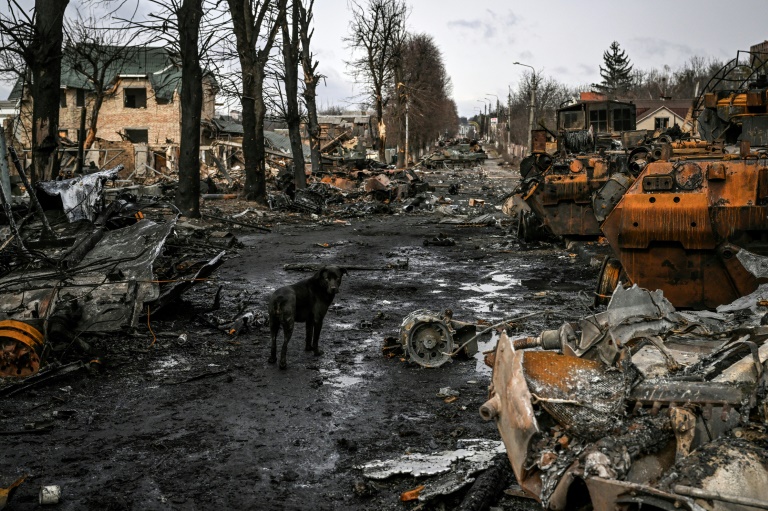
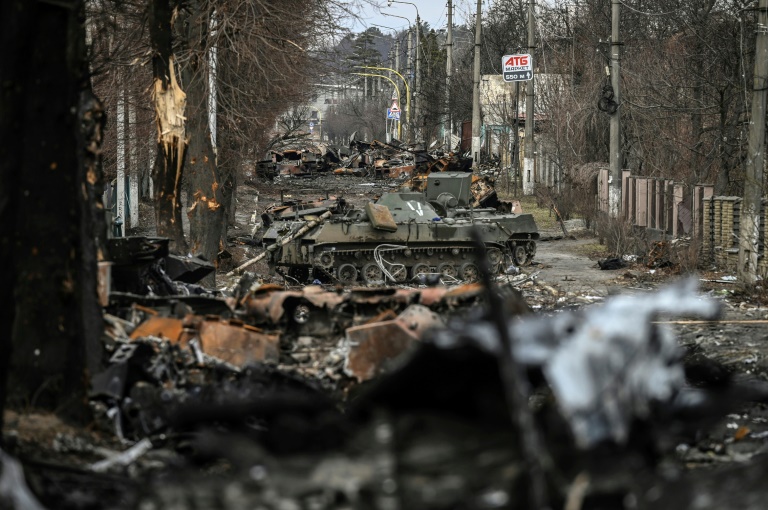
Russia has intensified strikes across Ukraine with fresh reports of civilian casualties and devastating damage, particularly in southern areas near Kherson, the first city to fall to Moscow’s troops.

In a second round of talks held Thursday, Moscow agreed to a Ukrainian request for humanitarian corridors to allow terrified residents to flee.

But there was no clarity on how the corridors would work, and no sign of any move towards a ceasefire.

Ahead of a third round of talks this weekend, Zelensky urged the West to step up military assistance and to “give me planes”. He also called for direct talks with Putin. 

NATO, fearful of provoking its own war with nuclear-armed Russia, again ruled out enforcing a no-fly zone over Ukraine. And the Kremlin rejected direct talks, insisting any contact should come via negotiators.

Ukrainian leaders warn that Russia — given signs its offensive on the capital Kyiv has stalled — is bent on reprising the horrific tactics it used to level the Syrian city of Aleppo in 2016. 

The port city of Mariupol, east of Kherson, is cut off without water or electricity in the depths of winter, but Putin has denied bombing Ukrainian cities. 

Mariupol’s deputy mayor Sergei Orlov told BBC radio that its humanitarian situation was “terrible” after 40 hours of continuous shelling of sites including schools and hospitals.

“Today Putin style of war is like Aleppo. So Mariupol goes to Aleppo,” Orlov said in English. 

“I believe that he wants to destroy Ukraine as a nation, and Mariupol is on this way.” 

In the northern city of Chernihiv, 47 people died Thursday when Russian forces bombed residential areas, including schools and a high-rise apartment block, according to a new toll given by local officials.

According to the UN, at least 331 civilians have died since Russia invaded in the night of February 24, purportedly to erase a Western-leaning, “Nazi” threat on its borders.

Ukraine says it has killed thousands of Russian troops. Moscow on Wednesday said it had lost 498 soldiers.

– ‘Whole world against you’ –

Ukraine authorities say residential parts of the eastern city of Kharkiv have also come under indiscriminate shelling, which UN prosecutors at The Hague are investigating as a possible war crime.

Ukraine’s Foreign Minister Dmytro Kuleba demanded a special tribunal, alleging there were “numerous cases of, unfortunately, when Russian soldiers rape women in the Ukrainian cities”.

In Geneva, the UN Human Rights Council overwhelmingly voted to create a top-level investigation into violations committed in the invasion.

“The message to Putin has been clear: you’re isolated on a global level and the whole world is against you,” Ukrainian ambassador Yevheniia Filipenko said after the vote.

The UN says more than 1.2 million refugees have flooded into neighbouring countries from Ukraine.

Both the EU and Washington said they would approve temporary protection for all refugees fleeing the war, while Brussels’ Commission Vice-President Maros Sefcovic said he wanted Ukraine to join the bloc “as soon as possible”.

The conflict is also driving some Russians to flee their country, fearful it is their last chance to escape the economic pain from ever-tougher Western sanctions, or the Kremlin crackdown on domestic dissent.

On one of the few remaining routes from Russia to the EU, trains from Saint Petersburg to Finland, have been packed with Russians.

Nor is it just people fleeing.

Six lions and six tigers evacuated from a shelter near Kyiv arrived at a zoo in Poland, following a two-day journey through combat zones.

burs-jit-gw/har

Majority of US weapons promised to Ukraine in February delivered: official

The United States has already delivered more than two thirds of the arms it promised in late February to Ukraine, whose forces are “effectively” using them to push back the Russians, a Pentagon official said Friday.

On February 26, Washington authorized $350 million of military equipment — the largest such package in US history — to bolster Kyiv against the Russian invasion, which began last week.

An official with the US State Department’s Bureau of Political-Military Affairs told Congress this week that the package aimed to “provide urgently needed ammunition, Javelin anti-tank missiles and the Stinger man portable air defense systems to Ukraine.”

Her testimony officially confirmed for the first time America’s delivery of the high-tech Stingers, which can be used to shoot down low-flying aircraft.

The Pentagon official told reporters that out of the $350 million, “we have already delivered to the Ukrainians $240 million-worth of that package, including some of the most needed capabilities like anti-armour capabilities.”

“You can see how fast we are moving to get those capabilities to the field,” she added, noting there was “no evidence of any Russian interference” to hinder arms deliveries.

Washington had previously authorized $60 million in military assistance to Ukraine last fall, followed by another $200 million in December for weapons and ammunition.

Most of that aid has been distributed to Ukrainian forces, the senior official told reporters Friday.

She added that US authorities “have been tremendously impressed by how effectively the Ukrainian armed forces have been using the equipment that we’ve provided them.”

“They are able to distribute the equipment very quickly” on the battlefield and have “slowed the Russian advance” she added.

Ukrainian forces have received US training, according to the official, including in December and early January, as Russia’s threats against its neighbor became more acute.

“The vast majority of what we have been providing they are already familiar with,” the official said.

She added that 14 other countries had also delivered weapons to Ukraine since Russia’s invasion began on February 24, and that US President Joe Biden had requested a new package from Congress to provide even more US assistance.

Stocks sink, gas and oil prices soar over Ukraine escalation fears

Global stock markets fell across the board Friday and energy prices soared as investors feared the risk of an escalation after Russia attacked the largest nuclear power plant in Ukraine.

Europe’s main stock markets closed sharply lower, with Paris down 4.97 percent, its lowest since the first coronavirus lockdown in 2020.

Asian indices had earlier closed sharply lower and Wall Street saw drops of around one percent in mid-day trading — tempered by a solid jobs report. 

The euro sank close to a two-year low under $1.10 as the Ukraine conflict clouds the eurozone’s economic recovery from the coronavirus pandemic.

The greenback benefited also from its status as a haven investment.

“Investors have piled out of European stocks this week, accelerating a decline that began at the end of last month, and has accelerated over the last two days,” said analyst Michael Hewson at CMC Markets.

“This morning’s reckless shelling of a Ukrainian nuclear power plant by Russian forces shows that (President Vladimir) Putin is becoming increasingly desperate to obtain a victory in the face of numerous setbacks,” he said.

“These actions are a significant escalation and raise the question as to whether Putin could adopt a scorched earth policy in his attempts to crush Ukrainian resistance,” Hewson added.

European and UK gas prices surged to record peaks Friday on supply disruption fears as a result of key supplier Russia’s ongoing attack on Ukraine.

Europe’s reference Dutch TTF gas price struck 213.895 euros per megawatt hour in afternoon deals, while UK gas prices hit 508.80 pence per therm.

Oil prices shot up again around 3.5 percent on fears of supply disruptions to Russian crude but were well below the almost $120 per barrel reached Thursday.

– ‘Markets ill prepared’ –

Hopes for an Iran nuclear deal that would allow Tehran to restart crude exports to the world market capped crude’s gains, analysts said. 

Ukrainian President Volodymyr Zelensky has meanwhile demanded still tougher sanctions against his Moscow foes after Russian forces attacked and seized the Zaporizhzhia nuclear power plant, but Kyiv said no radiation leak was detected.

Western countries have hit Russia’s economy hard including by closing airspace, freezing assets and excluding seven banks from the SWIFT interbank messaging network.

The impact is already impeding Moscow’s ability to shore up the beleaguered ruble and purchase imports.

Russia’s invasion of its neighbour Ukraine has sent global stock markets slumping over the week, during which time commodities including wheat, metals and particularly oil have soared.

That has fuelled concerns that the global economic recovery from Covid-19 will be derailed, especially with surging prices adding to worries about decades-high inflation.

To combat rocketing costs, Federal Reserve boss Jerome Powell this week said he intends to raise US interest rates this month, though he tempered expectations of a half-point rise.

“Markets are ill-prepared for a conflict with all its unknowable consequences,” said Chris Beauchamp, chief market analyst at IG. 

He said this is especially the case “when combined with surging oil prices and rising inflation, mixed in with central banks who are not displaying any of the dovishness needed to rescue sentiment.” 

In New York, the Dow, S&P and the Nasdaq all fell in mid-day trading as worries about the worsening picture of the Russia-Ukraine conflict overshadowed a strong US jobs report.

US employers added 678,000 workers to their payrolls in February, driving the unemployment rate down to 3.8 percent in a monthly report that was better than expected.

– Key figures around 1650 GMT –  

London – FTSE 100: DOWN 3.2 percent at 7,006.99 points (close)

Frankfurt – DAX: DOWN 4.4 percent at 13,094.54 (close)  

Paris – CAC 40: DOWN 4.97 percent at 6,061.66 (close)

EURO STOXX 50: DOWN 4.96 percent at 3,556.01 

New York – Dow: DOWN 1.2 percent at 33,382.42

Tokyo – Nikkei 225: DOWN 2.2 percent at 25,985.47 (close)

Hong Kong – Hang Seng Index: DOWN 2.5 percent at 21,905.29 (close)

Shanghai – Composite: DOWN 1.0 percent at 3,447.65 (close)

Euro/dollar: DOWN at $1.0917 from $1.1069 late Thursday

Pound/dollar: DOWN at $1.3126 from $1.3350

Euro/pound: DOWN 82.60 pence from 82.89 pence

Dollar/yen: DOWN at 114.69 yen from 115.45 yen

Brent North Sea crude: UP 3.4 percent at $114.24 per barrel

West Texas Intermediate: UP 3.6 percent at $111.57 per barrel

burs-lc/kjm

Battleground Ukraine: Day nine of Russia's invasion

On the ninth day of Russia’s invasion of Ukraine Friday, Russian forces pressed an advance into the country but are still facing resistance in their bid to seize major cities.

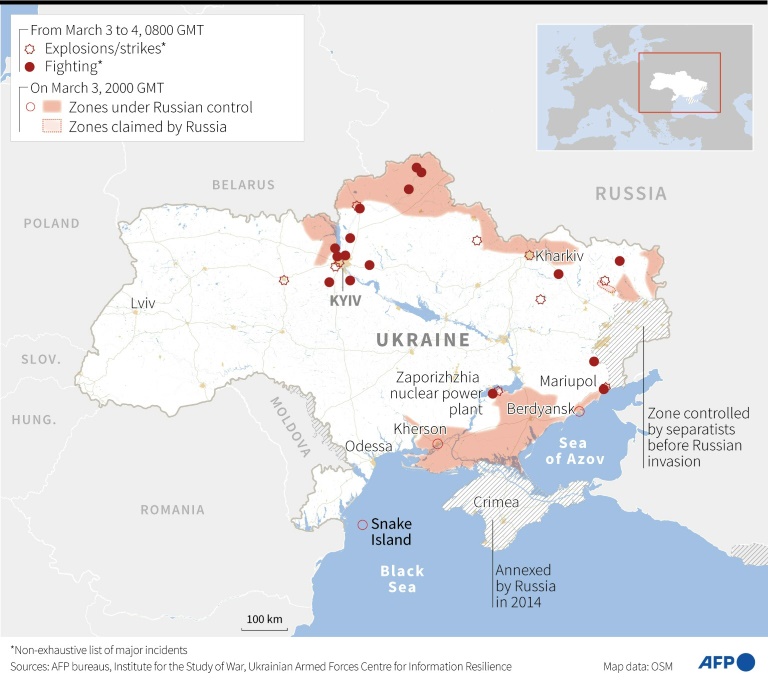
The capital Kyiv remains under Ukrainian control as does Kharkiv in the east despite heavy Russian bombardment. Russian forces have seized Kherson in the south and have encircled urban centres in the region.

Here is a summary of the situation on the ground, based on statements from the sides, Western defence and intelligence sources and international organisations.

– The east

Kharkiv remains in Ukrainian hands despite intense bombardments, according to Western sources.

Russian forces are also pressing an offensive through the Russian-backed separatist Donetsk and Lugansk regions although how far they have penetrated remains unclear.

– Kyiv and the north

Kyiv remains under Ukrainian control, despite heavy bombardments, although Western observers have pointed to a major Russian column of hundreds of vehicle outside the city stationed around the Hostomel airfield. 

There has been heavy fighting in the vicinity of Hostomel but the column has made little progress in recent days.

Regional authorities said 47 people were killed in a Russian air strike in the northern city of Chernigiv.

Zhytomyr west of Kyiv has also come under heavy fire.

– The south

Ukraine this week acknowledged that Russia had taken control of the southern city of Kherson, the first urban centre that Moscow has captured.

A major fight is ongoing for the city of Mariupol, still under Ukrainian control, while Mykolayiv just west of Kherson is surrounded.

In Zaporizhzhia, Europe’s largest atomic power plant was attacked and seized by invading Russian forces in a move that sparked international outrage.

Odessa remains in Ukrainian control and for now spared of fighting although there are fears of a possible amphibious assault on the city with Russian warships lurking off the Black Sea coast.

– The west

The west of Ukrainian remains largely spared from the fighting. The main western city of Lviv has become a hub for foreign diplomatic missions, journalists and Ukrainians seeking safety or seeking to leave the country.

– Casualties

Russia said Wednesday that 498 Russian troops had been killed in Ukraine, its first announced death toll.

Ukraine and Western sources claim that the real toll is far higher. Ukraine says over 9,000 Russian soldiers have been killed.

The UN said Wednesday that it had recorded nearly 230 civilian deaths in Ukraine, including 15 children, warning that the true toll was likely far higher.

– Refugees

Over 1.2 million refugees have fled Ukraine in the week since Russia’s invasion, around half of them into Poland, according to the UN refugee agency.

Russia isolated as UN council votes to probe rights abuses in Ukraine

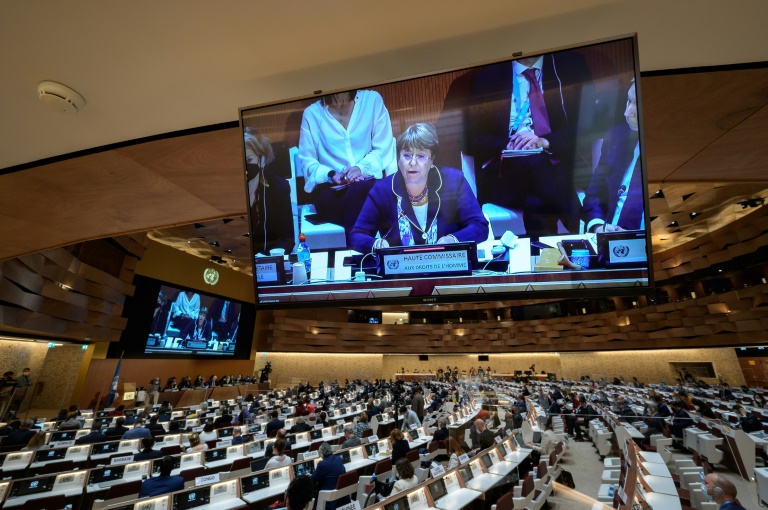
Russia appeared more isolated than ever following a historic vote at the UN Human Rights Council on Friday to trigger an investigation into violations committed in Moscow’s Ukraine war.

“The message to (Russian President Vladimir) Putin has been clear: You’re isolated on a global level and the whole world is against you,” Ukrainian ambassador Yevheniia Filipenko told reporters after the overwhelming vote.

Thirty-two of the council’s 47 members voted to establish the highest-level probe possible, in a bid to hold perpetrators responsible.

Only Russia itself and Eritrea voted against, while 13 countries abstained, including Moscow’s traditional backers China, Venezuela and Cuba.

The heavy blow to Russia came after the UN General Assembly in New York on Wednesday issued its own powerful rebuke, with a 141-5 vote to deplore Moscow’s invasion and demand an immediate withdrawal.

The council in Geneva also condemned “in the strongest possible terms” the violations “resulting from the Russian Federation’s aggression against Ukraine”.

The text, presented by Kyiv, called for the “swift and verifiable withdrawal of Russian Federation troops and Russian-backed armed groups from the entire territory of Ukraine”.

Most importantly, Friday’s vote opens the way to create an independent international commission of inquiry “to investigate all alleged violations and abuses… in the context of the Russian Federation’s aggression against Ukraine.”

– ‘Russia stands alone’ –

It calls for the appointment of three investigators to “establish the facts, circumstances, and root causes of any such violations and abuses,” and to gather evidence “with a view to ensuring that those responsible are held accountable”.

The International Criminal Court in The Hague has already begun investigating possible war crimes in Ukraine.

“I thank all those who voted for the right cause,” Filipenko said, calling for the investigation to start “as soon as possible, given the urgency of the situation”.

“This will be an important body to complement the work of the ICC,” she said.

Flanked by many of her counterparts from across the globe, Filipenko celebrated that “the whole world is standing by Ukraine”.

Some of Kyiv’s backers echoed her sentiment.

“The vote was a powerful condemnation of Russia’s actions,” US ambassador Sheba Crocker said.

“Members of the international community stand with Ukraine, and it is clear that Russia stands alone.”

Her British colleague Simon Manley hailed the “unprecedented show of unity of the international community.”

– Hold perpetrators accountable –

Russian ambassador Gennady Gatilov however said he did not believe Friday’s council vote reflected “all the nuances” of the positions of countries who voted in favour or abstained.

“I wouldn’t say we are isolated,” he told reporters in Geneva.

“A number of countries were heavily pressed by the US and their Western allies.”

Eritrea, Moscow’s sole overt backer, decried those trying to create a “unipolar world order” through the “encirclement and containment of Russia”.

“Ukraine is sadly a victim and has been scapegoated in their overarching scheme of tightening the noose on Russia,” the foreign ministry in Asmara said in a statement.

Filipenko however hailed Friday’s “historic” resolution, stressing that “those from Russia directing and committing violations against my people should be paying attention”.

“The evidence is going to be collected. You’re going to be identified and you’re going to be held to account.”

Friday’s decision was considered an extremely strong one by the rights council, which has never before passed a resolution directly targeting Russia. 

Nonetheless, rights groups suggested the text should have gone further, and called for the investigation to extend to widespread abuses inside Russia itself. 

A number also called for the text to include a request for the General Assembly to consider revoking Russia’s membership of the Human Rights Council, with some countries seeming to back the idea.

Asked about it, Filipenko stressed to reporters that “nothing is off the table”.

Former Argentine bishop sentenced for sex abuse

A retired Argentine bishop seen as close to the Pope was on Friday sentenced to four and a half years in prison for sexual abuse.

A court in the northwestern town of Oran, where Gustavo Oscar Zanchetta, 57, was bishop from 2013 to 2017, ordered his immediate detention.

Zanchetta was convicted of “simple, continued and aggravated sexual abuse,” with his offense aggravated by his role as a religious minster.

The trial in the town some 1,700 kilometers north of Buenos Aires began two weeks ago.

Zanchetta, who also worked as an advisor for the management of Vatican property, had denied the charges.

He was appointed to the Oran diocese by Pope Francis.

Once he has served his sentence, Zanchetta must sign a sex offenders register.

The charges were brought in 2018 by at least two seminary students.

The court heard evidence from two complainants, one of whom claimed the bishop had made approaches towards him and asked for “massages.”

The Vatican has said that at the time of Zanchetta’s resignation in 2017, there were no sex abuse claims against him.

The Catholic Church, which forbids priests from marrying, has been repeatedly rocked by child sex abuse scandals around the world over the last three decades.

Close Bitnami banner
Bitnami