World

Lions, tigers evacuated from Ukraine to Poland

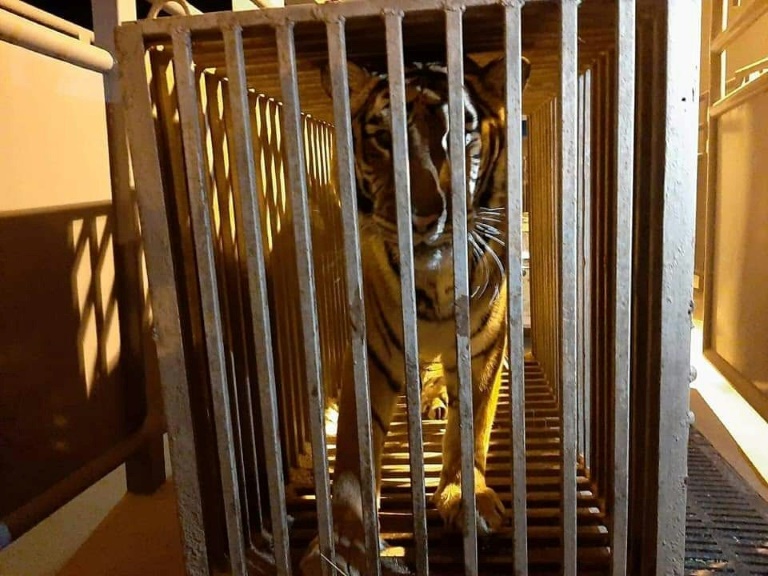
Six lions and six tigers evacuated from near Kyiv arrived at a zoo in Poland on Thursday following a two-day odyssey skirting battle frontlines and coming face to face with Russian tanks, a zoo spokesman said.

A Ukrainian truck drove the animals, along with two wild cats and a wild dog, nearly 1,000 kilometres (600 miles) to the Polish border while avoiding the Zhytomyr region, which the invading Russian forces have bombarded, spokeswoman Malgorzata Chodyla told AFP.

At one point, the truck had to stop overnight opposite Russian tanks. 

The driver rested under his vehicle while the owner of the Ukrainian shelter fed the animals because the transport crew did not know how to, the spokeswoman said.

At the border, the animals were transferred to a Polish truck while the Ukrainian driver returned home to his children.

For now, the animals will be cared for at the Poznan zoo.

Zoo director Ewa Zgrabczynska, who helped arrange the evacuation, said she is already in contact with several western organisations that want to take in the animals.

She also launched a fundraising drive as the city of Poznan, which runs the zoo, lacks a budget for the evacuated animals. 

US should diplomatically recognise 'free' Taiwan: Pompeo

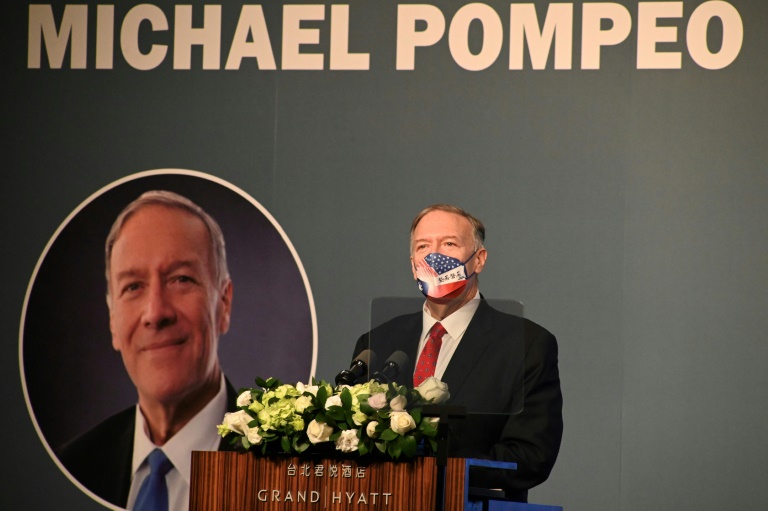
The United States should diplomatically recognise Taiwan as “a free and sovereign country,” former US Secretary of State Mike Pompeo said in a speech while visiting the island. 

Pompeo, one of former president Donald Trump’s most hawkish advisors on China, arrived on Wednesday for a visit at a time of rising tensions between Washington and Beijing over the self-ruled island as well as the crisis sparked by Russia’s invasion of Ukraine. 

While Washington should continue to engage with Beijing as a sovereign government, offering Taipei diplomatic recognition “can no longer be ignored, avoided or treated as secondary,” Pompeo said in a speech hosted by a local think-tank.

“It is my view that the United States government should immediately take necessary and long-overdue steps to do the right and obvious thing, that is to offer the Republic of China (Taiwan) America’s diplomatic recognition as a free and sovereign country.”

The Republic of China is Taiwan’s official name. 

Washington has remained Taipei’s most important ally and leading arms supplier despite switching diplomatic recognition to Beijing in 1979. 

But Pompeo said the move “isn’t about Taiwan’s future independence, it’s about recognition of an unmistakable, already existing reality”. 

China claims self-ruled democratic Taiwan as part of its territory to be retaken one day, by force if necessary. 

Beijing considers a formal declaration of independence as something that would cross its self-declared “red line” and has warned that such a step could trigger war. 

Taiwan’s current leader Tsai Ing-wen, who has won elections twice, hails from a party that historically favours independence.

But her stance is deliberately nuanced. 

She says there is no need to declare independence because Taiwan is already a sovereign nation called the Republic of China (Taiwan).

Pompeo’s speech advocated the same position.

“As many of your past and present leaders have made clear, there’s no need for Taiwan to declare independence because it’s already an independent nation. Its name is the Republic of China (Taiwan),” he said. 

“The people and government of the United States should simply accept this fundamentally decent, morally right thing. This is easy. The Taiwanese people deserve the world’s respect for continuing down this free, democratic and sovereign path.”  

President Tsai met Pompeo on Thursday, conferring on him an honorary medal and praising him for facilitating “multiple breakthroughs” in Taiwan-US relations.

On his way out of office, Pompeo announced that Washington was ending restrictions on official contacts with Taipei in a move that angered Beijing. 

President Joe Biden has continued most of the Trump era’s policies towards Taiwan. 

China has ramped up pressure on Taiwan since the 2016 election of Tsai

China’s sabre-rattling has increased considerably over the past year, with warplanes breaching Taiwan’s air defence zone on a near-daily basis.

Beijing Paralympics to open in storm of controversy over Ukraine invasion

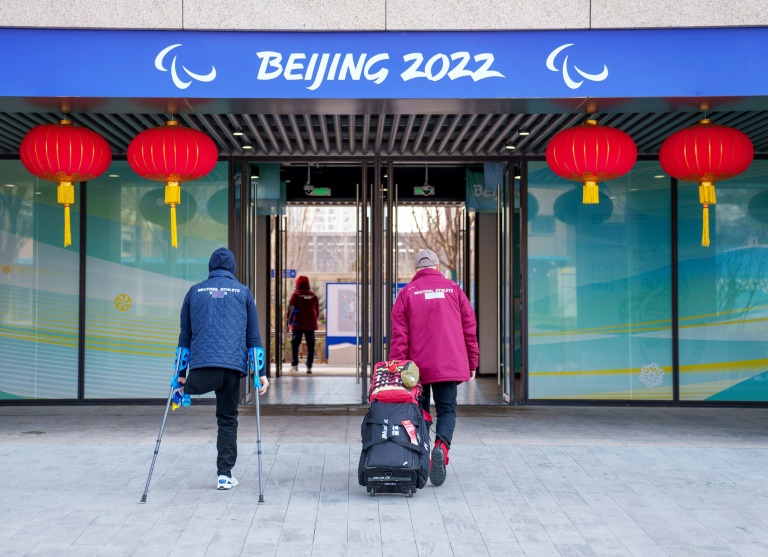
Tensions in the athlete villages, threats of competition boycotts and an eleventh-hour reversal to ban Russian athletes have marred the lead-up to Friday’s opening of the Beijing Winter Paralympics.

Moscow’s invasion of Ukraine sent shockwaves through the Paralympic movement, with bitter wrangling over whether its athletes and those from ally Belarus — which hosted troops and military equipment — should be allowed to participate.

The International Olympic Committee (IOC) has urged sporting federations across the world to exclude athletes from the two countries.

On Wednesday, Paralympic organisers said the “harshest punishment” they could dish out was to allow athletes from those countries to compete as neutrals.

The decision was reversed less than 24 hours later, with organisers citing safety concerns and a volatile mood in the athletes village.

Multiple teams and athletes had threatened not to compete if the Russian and Belarusian athletes were present, which was “jeopardising the viability” of the Games, organisers said.

International Paralympic Committee president Andrew Parsons apologised to the athletes facing the ban, saying: “You are victims of your governments’ actions.”

Kremlin spokesman Dmitry Peskov swiftly condemned the ban as “monstrous”.

But countries including Britain, Ireland and Germany welcomed the ban and said athletes could now focus on competition.

“Given the horror of what is happening in Ukraine, we believe (the IPC) have made the correct decision for these Games,” Team Great Britain said.

A million Ukrainians have fled to neighbouring countries over the past week, and Russia has become a global pariah across the worlds of finance, diplomacy and sports. 

And Friday saw that isolation set to deepen with Moscow’s shelling of a major nuclear power plant.

The Ukraine delegation was overwhelmed with solidarity after arriving safely in Beijing on Wednesday after narrowly escaping bombings to make it to the ski slopes.

“I can say that this is a miracle that we managed to be here at the Paralympic Games,” Ukraine Paralympic committee president Valeriy Sushkevych told reporters.

“For us, it is a matter of principle to be here, it’s a symbol to show that Ukraine is alive.”

After an embarrassing policy U-turn, Games organisers will likely sigh with relief when the spotlight moves to the Bird’s Nest for the opening ceremony in the evening.

Coming just six months after the pandemic-delayed Paralympic Games closed in Tokyo, Beijing has become the first city to host the Winter and Summer Olympic series in a pared-down sport event held in a tightly closed bubble.

The opening ceremony, like all sporting events, will be held in controlled conditions with no tickets sold to the general public due to Covid fears. 

Sporting action kicks off Saturday with preliminary ice hockey matches, wheelchair curling round robins and alpine skiing and biathlon races.

While Olympic athletes last month faced treacherous blizzards and some competitions were forced to postpone, temperatures on the slopes at Zhangjiakou and Yanqing have warmed up in recent days, causing snow to melt.

Russian forces attack Ukrainian nuclear plant, blaze extinguished

Russian troops attacked Europe’s largest nuclear power plant on Friday, setting part of the Ukrainian facility ablaze in an assault the country’s leader branded “nuclear terror” and said could endanger the continent.

After hours of uncertainty throughout the night, local authorities reported the fire was extinguished at dawn. They had earlier reported that no immediate radiation rise was detected and “essential” equipment was unaffected.

But it remained unclear what the invading forces planned next.

President Volodymr Zelensky spoke with world leaders, including US President Joe Biden and British Prime Minister Boris Johnson, who called for a halt to fighting at the Zaporizhzhia nuclear plant.

Johnson accused Russian President Vladimir Putin of “reckless actions” that he said “could now directly threaten the safety of all of Europe”.

The British leader will seek an emergency UN Security Council meeting in the coming hours, according to a statement from his office.

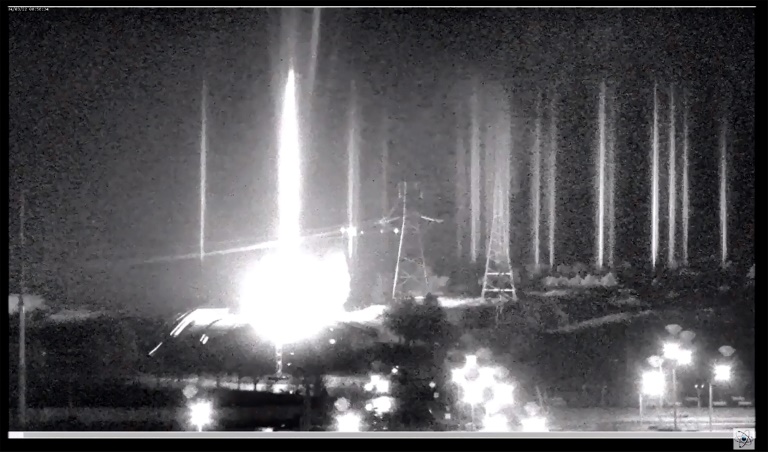
Images on a live feed from the Zaporizhzhia nuclear plant site earlier showed blasts lighting up the night sky and sending up plumes of smoke.

Zelensky angrily denounced the attack, in a video message saying: “No country other than Russia has ever fired on nuclear power units.”

“This is the first time in our history. In the history of mankind. The terrorist state now resorted to nuclear terror,” he added, calling for global help.

“If there is an explosion, it is the end of everything. The end of Europe. This is the evacuation of Europe. Only immediate European action can stop Russian troops.” 

Despite the fears, after several hours of uncertainty, Ukrainian authorities said the site had been secured.

“The director of the plant said that the nuclear safety is now guaranteed,” Oleksandr Starukh, head of the military administration of the Zaporizhzhia region, said on Facebook.

“According to those responsible for the plant, a training building and a laboratory were affected by the fire,” he added.

And the IAEA said it had been told by Ukraine’s regulator that “there has been no change reported in radiation levels” at the site.

“Ukraine tells IAEA that fire at site of Zaporizhzhia Nuclear Power Plant has not affected ‘essential’ equipment, plant personnel taking mitigatory actions,” the watchdog added in a tweet.

US Energy Secretary Jennifer Granholm also tweeted that “the plant’s reactors are protected by robust containment structures and reactors are being safely shut down”.

– ‘Give me planes’ –

Russia has intensified strikes across the country during the nine days of conflict, with fresh reports of civilian casualties and devastating damage, particularly in southern areas near the first city to fall to Moscow’s troops.

In a second round of talks held Thursday, Moscow agreed to a Ukrainian request for humanitarian corridors to allow terrified residents to flee, but there was no immediate clarity on how they would work, and no sign of any move towards a ceasefire.

Zelensky called for direct talks with Putin, saying they were “the only way to stop this war”. But he also urged the West to step up military assistance and “give me planes.”

Much of the international community has rallied behind Ukraine since Putin invaded, making Russia a global outcast in the worlds of finance, diplomacy, sport and culture.

But the offensive has continued despite punishing international sanctions, and Putin said Thursday that his invasion was going “strictly according to schedule, according to plan.”

He said Russia was rooting out “neo-Nazis”, adding in televised comments that he “will never give up on (his) conviction that Russians and Ukrainians are one people”. 

French President Emmanuel Macron, who spoke to Putin Thursday, believes “the worst is to come,” an aide said.

While a long military column appears stalled north of Ukraine’s capital Kyiv, Russian troops have already seized Kherson, a Black Sea city of 290,000 people, after a three-day siege that left it short of food and medicine.

Russian troops are also pressuring the port city of Mariupol east of Kherson, which is without water or electricity in the depths of winter.

“They are trying to create a blockade here, just like in Leningrad,” Mariupol mayor Vadym Boichenko said, referring to the brutal Nazi siege of Russia’s second city, now re-named Saint Petersburg.

In the northern city of Chernihiv, 33 people died Thursday when Russian forces hit residential areas, including schools and a high-rise apartment block.

And Ukrainian authorities said residential areas in the eastern city of Kharkiv had been “pounded all night” by indiscriminate shelling, which UN prosecutors are investigating as a possible war crime.

Many Ukrainians were digging in, with volunteers in industrial hub Dnipro making sandbags and collecting bottles for Molotov cocktails.

In Lviv, others organised food and supplies to send to cities under attack and produced home-made anti-tank obstacles after watching YouTube tutorials.

– ‘Maybe it’s hell’ –

But for some, the worst had already arrived. 

Oleg Rubak’s wife Katia, 29, was crushed in their family home in Zhytomyr, west of Kyiv, by a Russian missile strike.

“One minute I saw her going into the bedroom. A minute later there was nothing,” Rubak, 32, told AFP amid the ruins in the bitter winter chill.

“I hope she’s in heaven and all is perfect for her,” he said, in tears.

Gesturing at the pile of rubble, he said what remained was “not even a room, it’s… maybe it’s hell.”

The conflict has already produced more than one million refugees who have streamed into neighbouring countries to be welcomed by volunteers handing them water, food and giving them medical treatment.

Both the EU and the United States said they would approve temporary protection for all refugees fleeing the war.

The fear of igniting all-out war with nuclear-armed Russia has put some limits on Western support for Ukraine, though a steady supply of weaponry and intelligence continues.

The main lever used to pressure Russia globally has been sanctions, which have sent the ruble into free-fall and forced the central bank to impose a 30-percent tax on sales of hard currency after a run on lenders.

Putin’s invasion has pushed some eastern European countries to lean even harder West, with both Georgia and Moldova applying for EU membership on Thursday.

In Russia, authorities have imposed a media blackout on the fighting and two liberal media groups said they were halting operations, in another death-knell for independent reporting in the country.

On Friday, Facebook and multiple media websites were partially inaccessible in Russia, as authorities crack down voices criticising the war.

burs-sah/kma/oho

Beijing Paralympics to open in storm of controversy over Ukraine invasion

Tensions in the athlete villages, threats of competition boycotts and an eleventh-hour reversal to ban Russian athletes have marred the lead-up to Friday’s opening of the Beijing Winter Paralympics.

Moscow’s invasion of Ukraine sent shockwaves through the Paralympic movement, with bitter wrangling over whether its athletes and those from ally Belarus — which hosted troops and military equipment — should be allowed to participate.

The International Olympic Committee (IOC) has urged sporting federations across the world to exclude athletes from the two countries.

On Wednesday, Paralympic organisers said the “harshest punishment” they could dish out was to allow athletes from those countries to compete as neutrals.

The decision was reversed less than 24 hours later, with organisers citing safety concerns and a volatile mood in the athletes village.

Multiple teams and athletes had threatened not to compete if the Russian and Belarusian athletes were present, which was “jeopardising the viability” of the Games, organisers said.

International Paralympic Committee president Andrew Parsons apologised to the athletes facing the ban, saying: “You are victims of your governments’ actions.”

Kremlin spokesman Dmitry Peskov swiftly condemned the ban as “monstrous”.

But countries including Britain, Ireland and Germany welcomed the ban and said athletes could now focus on competition.

“Given the horror of what is happening in Ukraine, we believe (the IPC) have made the correct decision for these Games,” Team Great Britain said.

A million Ukrainians have fled to neighbouring countries over the past week, and Russia has become a global pariah across the worlds of finance, diplomacy and sports. 

And Friday saw that isolation set to deepen with Moscow’s shelling of a major nuclear power plant.

The Ukraine delegation was overwhelmed with solidarity after arriving safely in Beijing on Wednesday after narrowly escaping bombings to make it to the ski slopes.

“I can say that this is a miracle that we managed to be here at the Paralympic Games,” Ukraine Paralympic committee president Valeriy Sushkevych told reporters.

“For us, it is a matter of principle to be here, it’s a symbol to show that Ukraine is alive.”

After an embarrassing policy U-turn, Games organisers will likely sigh with relief when the spotlight moves to the Bird’s Nest for the opening ceremony in the evening.

Coming just six months after the pandemic-delayed Paralympic Games closed in Tokyo, Beijing has become the first city to host the Winter and Summer Olympic series in a pared-down sport event held in a tightly closed bubble.

The opening ceremony, like all sporting events, will be held in controlled conditions with no tickets sold to the general public due to Covid fears. 

Sporting action kicks off Saturday with preliminary ice hockey matches, wheelchair curling round robins and alpine skiing and biathlon races.

While Olympic athletes last month faced treacherous blizzards and some competitions were forced to postpone, temperatures on the slopes at Zhangjiakou and Yanqing have warmed up in recent days, causing snow to melt.

Fire at Ukrainian nuclear plant after Russian forces attack

Russian troops attacked Europe’s largest nuclear power plant on Friday, setting part of the Ukrainian facility ablaze in an assault the country’s leader branded “nuclear terror” and said could endanger the continent.

Local authorities said no immediate radiation rise was detected and “essential” equipment was unaffected by the fire, but it remained unclear what the invading forces planned next.

President Volodymr Zelensky spoke with world leaders, including US President Joe Biden and British Prime Minister Boris Johnson, who called for a halt to fighting at the Zaporizhzhia nuclear plant.

Johnson accused Russian President Vladimir Putin of “reckless actions” that he said “could now directly threaten the safety of all of Europe”.

The British leader will seek an emergency UN Security Council meeting in the coming hours, according to a statement from his office.

Images on a live feed from the Zaporizhzhia nuclear plant site earlier showed blasts lighting up the night sky and sending up plumes of smoke.

Zelensky angrily denounced the attack, in a video message saying: “No country other than Russia has ever fired on nuclear power units.”

“This is the first time in our history. In the history of mankind. The terrorist state now resorted to nuclear terror,” he added, calling for global help.

“If there is an explosion, it is the end of everything. The end of Europe. This is the evacuation of Europe. Only immediate European action can stop Russian troops.” 

Despite the fears, after several hours of uncertainty, Ukrainian authorities said the site had been secured.

“The director of the plant said that the nuclear safety is now guaranteed,” Oleksandr Starukh, head of the military administration of the Zaporizhzhia region, said on Facebook.

“According to those responsible for the plant, a training building and a laboratory were affected by the fire,” he added.

And the IAEA said it had been told by Ukraine’s regulator that “there has been no change reported in radiation levels” at the site.

“Ukraine tells IAEA that fire at site of Zaporizhzhia Nuclear Power Plant has not affected ‘essential’ equipment, plant personnel taking mitigatory actions,” the watchdog added in a tweet.

US Energy Secretary Jennifer Granholm also tweeted that “the plant’s reactors are protected by robust containment structures and reactors are being safely shut down”.

– ‘Give me planes’ –

Russia has intensified strikes across the country during the nine days of conflict, with fresh reports of civilian casualties and devastating damage, particularly in southern areas near the first city to fall to Moscow’s troops.

In a second round of talks held Thursday, Moscow agreed to a Ukrainian request for humanitarian corridors to allow terrified residents to flee, but there was no immediate clarity on how they would work, and no sign of any move towards a ceasefire.

Zelensky called for direct talks with Putin, saying they were “the only way to stop this war”. But he also urged the West to step up military assistance and “give me planes.”

Much of the international community has rallied behind Ukraine since Putin invaded, making Russia a global outcast in the worlds of finance, diplomacy, sport and culture.

But the offensive has continued despite punishing international sanctions, and Putin said Thursday that his invasion was going “strictly according to schedule, according to plan.”

He said Russia was rooting out “neo-Nazis”, adding in televised comments that he “will never give up on (his) conviction that Russians and Ukrainians are one people”. 

French President Emmanuel Macron, who spoke to Putin Thursday, believes “the worst is to come,” an aide said.

While a long military column appears stalled north of Ukraine’s capital Kyiv, Russian troops have already seized Kherson, a Black Sea city of 290,000 people, after a three-day siege that left it short of food and medicine.

Russian troops are also pressuring the port city of Mariupol east of Kherson, which is without water or electricity in the depths of winter.

“They are trying to create a blockade here, just like in Leningrad,” Mariupol mayor Vadym Boichenko said, referring to the brutal Nazi siege of Russia’s second city, now re-named Saint Petersburg.

In the northern city of Chernihiv, 33 people died Thursday when Russian forces hit residential areas, including schools and a high-rise apartment block.

And Ukrainian authorities said residential areas in the eastern city of Kharkiv had been “pounded all night” by indiscriminate shelling, which UN prosecutors are investigating as a possible war crime.

Many Ukrainians were digging in, with volunteers in industrial hub Dnipro making sandbags and collecting bottles for Molotov cocktails.

In Lviv, others organised food and supplies to send to cities under attack and produced home-made anti-tank obstacles after watching YouTube tutorials.

– ‘Maybe it’s hell’ –

But for some, the worst had already arrived. 

Oleg Rubak’s wife Katia, 29, was crushed in their family home in Zhytomyr, west of Kyiv, by a Russian missile strike.

“One minute I saw her going into the bedroom. A minute later there was nothing,” Rubak, 32, told AFP amid the ruins in the bitter winter chill.

“I hope she’s in heaven and all is perfect for her,” he said, in tears.

Gesturing at the pile of rubble, he said what remained was “not even a room, it’s… maybe it’s hell.”

The conflict has already produced more than one million refugees who have streamed into neighbouring countries to be welcomed by volunteers handing them water, food and giving them medical treatment.

Both the EU and the United States said they would approve temporary protection for all refugees fleeing the war.

The fear of igniting all-out war with nuclear-armed Russia has put some limits on Western support for Ukraine, though a steady supply of weaponry and intelligence continues.

The main lever used to pressure Russia globally has been sanctions, which have sent the ruble into free-fall and forced the central bank to impose a 30-percent tax on sales of hard currency after a run on lenders.

Putin’s invasion has pushed some eastern European countries to lean even harder West, with both Georgia and Moldova applying for EU membership on Thursday.

In Russia, authorities have imposed a media blackout on the fighting and two liberal media groups said they were halting operations, in another death-knell for independent reporting in the country.

On Friday, Facebook and multiple media websites were partially inaccessible in Russia, as authorities crack down voices criticising the war.

burs-sah/kma

Long road ahead for Iraq pledge to phase out gas flares

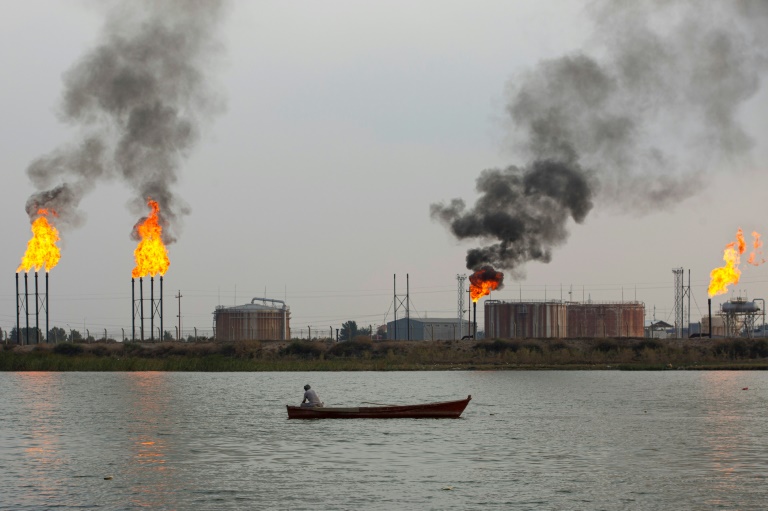
In the oilfields of southern Iraq, billions of cubic feet of gas literally go up in smoke, burnt off on flare stacks for want of the infrastructure to capture and process it.

The flares produce vast amounts of carbon dioxide and other greenhouse gases, contributing to global warming without any economic or social benefit.

Analysts say the waste is particularly egregious, as Iraq is a significant importer of natural gas, meeting a third of its needs through expensive and not always reliable supplies from neighbouring Iran.

The government has pledged to phase out the practice by 2030 but the road to a greener, less wasteful energy sector is proving a long one.

For the oil companies exploiting the mega fields around Basra, it is actually cheaper to flare off the associated gas than to capture, process and market it, despite the obvious environmental costs.

Currently, only half of the three million cubic feet of gas that comes out of Iraqi oil wells each day is captured and processed.

The rest is burnt off in flares creating the plumes of acrid black smoke that blight the skies.

“Flared gas, if captured and processed, could provide electricity to three million homes,” said Yesar al-Maleki, Gulf analyst at Middle East Economic Survey.

“This could definitely help the country end its acute power shortages that go up all the way to a supply and demand gap of nine gigawatts in summer.”

– ‘Up in smoke’ –

In December, Iraq’s oil minister Ihsan Ismail pledged to cut flare gas by 90 percent by 2024.

But despite contracts with foreign oil majors, including France’s TotalEnergies, the target is likely to face bureaucratic obstacles in a sector which provides 90 percent of government revenues.

Over the past two years, the government has cut flare gas by just five percent.

The captured gas is fuel that Iraq desperately needs for its power stations.

Under an exemption from US sanctions on Iran, Iraq imports 750 million cubic feet per day from its eastern neighbour.

Any disruption to that supply can lead to widespread power cuts, particularly in summer when the demand for air conditioning and refrigeration peaks.

Maleki said the failure to address the issue bore multiple costs for Iraq.

“It loses financially by burning money in the air; it loses more money by importing gas from neighbouring countries at a premium; it loses more money resolving resultant issues in its power sector when it switches its gas turbines to costly and pollutive liquid fuels; and it definitely loses environmentally.”

Basra province is home to Iraq’s five largest oilfields and accounts for 65 percent of its flared gas, according to World Bank figures.

The Basrah Gas Company, a consortium of Iraq’s state-owned South Gas Company, Shell and Mitsubishi, captures one billion cubic feet of gas from the three fields in which it operates.

It plans to raise that figure to 1.4 billion cubic feet by the end of 2023 but doing so requires heavy investment, in processing as well as capture.

Managing director Malcolm Mayes said the consortium was investing around $1.5 billion in a giant new processing facility in Artawi, outside Basra.

“In Artawi, we are building two processing trains,” Mayes said. 

“The first will be on stream in May 2023 and the second will come on stream in November 2023, and at that point we will have the capacity to process 1.4 billion cubic feet — approaching 90 percent from our lease area.”

– ‘Cleaner electricity’ –

Iraq has also signed a mega-contract with TotalEnergies that includes building a processing facility for the associated gas from three southern oilfeilds.

“The plant’s launch is scheduled for 2026,” the French firm said.

Iraq says the plant will process 300 million cubic feet a day of gas that is currently flared off, rising to 600 million in a second phase.

Teams from TotalEnergies are already on the ground carrying out preliminary studies, but the process is dragging on.

Last month, Baghdad said some clauses of the contract “require time and cannot be implemented or solved in a short period”.

A similar project awarded to Chinese firms in neighbouring Maysan province is only half finished.

In the meantime, Basra’s residents continue to live with the environmental consequences.

“Everything is polluted by these flares — the water, the animals, they’re all dead,” said Salem, an 18-year-old shepherd in the village of Nahr Bin Omar, site of a major oilfield just north of Basra.

The agent and the comic: Putin, Zelensky in fight for Ukraine

One is a former comic actor who became president in 2019 as a political novice. The other a one-time KGB agent now in power for over two decades.

Ukrainian President Volodymyr Zelensky and Russian President Vladimir Putin were both born in the Soviet Union and share the same first names. But the similarities end there.

The bitterly personal confrontation between the two men is at the heart of Russia’s invasion of Ukraine, with their personal and political futures at stake along with the fate of the country.

Zelensky, 44, hunkers down in central Kyiv amid the Russian bombardment at intimate quarters with his protection squad and closest aides.

Putin, 69, meanwhile sits in the Kremlin receiving visitors according to the strictest protocols, with the distance he sits even from close ministers at giant tables mocked on social media.

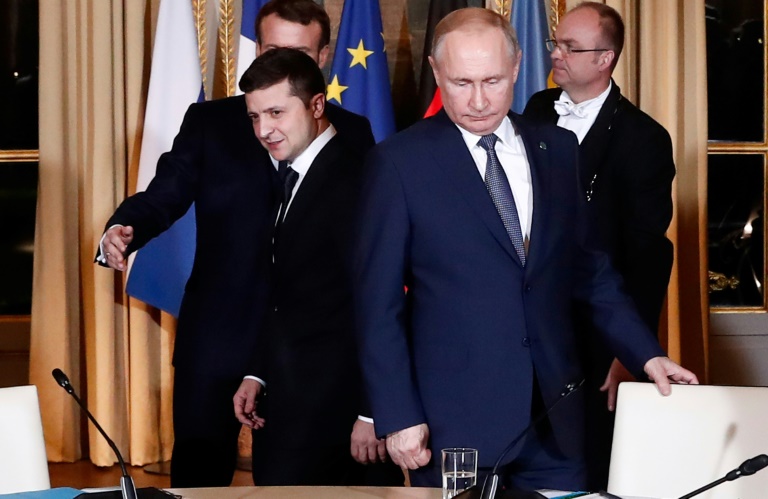
The two men have met face-to-face only once — when French President Emmanuel Macron hosted them along with then-German Chancellor Angela Merkel for talks in Paris on Ukraine in December 2019. 

Since then, Zelensky has become such an implacable enemy of Putin that the Russian president never refers to him by name, just like his main domestic opponent Alexei Navalny.

Putin instead refers to the Jewish president, who was elected in 2019 polls and widely admired by the international community, as the head of the “Kyiv regime” or the leader of a “gang of drug addicts and neo-Nazis.”

Macron, in an address to the nation late Wednesday, drew a stark contrast between the two men saying Putin “chose war” while Zelensky is “the face of honour, freedom and courage”.

– ‘Servant of the people’ –

While Putin was consolidating his control over Russia in the first years of the new millennium, Zelensky was establishing his production company Kvartal 95 and a reputation as one of Ukraine’s most prominent showbiz personalities.

Just over a year after Putin annexed the Ukrainian peninsula of Crimea and backed separatists in the country’s east, Zelensky in 2015 began starring in the show that propelled him to stardom.

The comedy drama was called “Servant of the People” and tells the story of Vasyl Holoborodko — played by Zelensky — a history teacher who becomes president after a rant about corruption goes viral.

In one episode, the Holoborodko receives a call from German chancellor Angela Merkel congratulating Ukraine on joining the European Union and skips with joy — only to be told she has called the wrong number and meant to call Montenegro.

This week Zelensky — the real president that is — signed the application for Ukraine to join the EU.

In 2019, with the country’s politics in turmoil, Zelensky entered the fray and won the presidential elections in a landslide, calling his party “Servant of the People”.

His election was greeted coolly by the Kremlin and Putin, who never showed much interest in engaging with Zelensky, even after the 2019 Paris summit.

In an address to the nation hours ahead of the Russian invasion, Zelensky said the Kremlin had not responded to a request for telephone talks in a grim indication that war was near.

Zelensky’s years in power even before the war had by no means been untroubled, with accusations from critics at home that he lacked experience, employed his former business partners as top aides and had built up offshore wealth.

But as a wartime leader he has excelled, giving almost daily video addresses dressed in a T-shirt and with growing stubble to show he has remained in Kyiv despite the bombardments.

– ‘Go home’ –

While Zelensky has taken cheery selfies with his ebullient defence minster, Putin has cut an increasingly isolated figure with even his Defence Minister Sergei Shoigu — a close friend and holiday companion — kept at a distance at the other end of the notoriously long Kremlin table.

Stewart Patrick, senior fellow in global governance at the Washington-based Council on Foreign Relations, said Putin had succeeded in turning Zelensky into “an international hero”.

“There is nothing more threatening to a despot, it seems, than a functioning (if imperfect) democracy next door.”

Time magazine even put Zelensky’s comments from an address in Ukrainian to the EU parliament this week on its front cover — “Zhittya permozhe smert – a svit temryavu” (Life Will Win Over Death – Light Will Win Over Darkness).

French foreign minister Jean-Yves Le Drian said Thursday that Putin wished for the “negation of Ukraine” to avoid having “democratic models on his doorstep”.

Zelensky has said he fears he is the number one target of the Russian invasion but on Thursday also called for talks with Putin as the only way to end the conflict.

“If anyone thinks… Ukraine will surrender he knows nothing about Ukraine and has nothing to do in Ukraine,” Zelensky said in his latest video address in an apparent message to Putin.

“Go home. To your home,” he said.

Google Maps and Tripadvisor nix war news in reviews

Google on Thursday said it has stopped allowing reviews to be added to its online Maps service in Belarus, Russia and Ukraine to prevent them from being used for war news.

Travel platform Tripadvisor, meanwhile, was blocking reviews for restaurants, hotels, or other venues if the commentary focuses on Russia’s invasion of Ukraine rather than an experience with a business.

Both services face a campaign by activists to use online reviews of businesses such as restaurants to get news of the war to Russians being fed information from the government.

“Due to a recent increase in contributed content on Google Maps related to the war in Ukraine, we’ve put additional protections in place to monitor and prevent content that violates our policies for Maps,” a spokesperson told AFP.

Safeguards included temporarily blocking new reviews, photos, or videos from being added to Maps for locations in Belarus, Russia, and Ukraine, according to the spokesperson.

Twitter account @YourAnonNews, which claims to be a voice for hacker group Anonymous, broadcast the suggestion early this week, saying the idea was from a tweet out of Poland.

“Go to Google Maps. Go to Russia. Find a restaurant or business and write a review,” the YourAnonNews tweet read.

“When you write the review explain what is happening in Ukraine.”

The point is to “push information to the Russian civilian population being lied to” by its leader, a series of tweets contended.

Such reviews are removed for violating Tripadvisor requirements that they focus on first-person encounters with businesses, but talk of what is happening in the Ukraine is not fettered in forums at the service.

“We have created threads within our forums for people located in Ukraine to share information about what is happening in the country in real-time,” Tripadvisor chief executive Steve Kaufer said in a letter published Thursday.

“We intend to utilize our existing Ukraine forums to enable users to share information through our platform over the coming days.”

Online platforms have become one of the fronts in the internationally condemned attack. They are home to sometimes false narratives but also real-time monitoring of a conflict that marks Europe’s biggest geopolitical crisis in decades.

Top carmakers suspend operations at Russian plants

Toyota and Volkswagen, the world’s two biggest auto manufacturers, said Thursday they would suspend operations at their production facilities in Russia, following the invasion of Ukraine.

Toyota said it would halt work at its only factory in Russia and stop shipping vehicles to the country, citing “supply chain disruptions” linked to Moscow’s assault on Ukraine and Western sanctions.

The world’s top-selling carmaker said its plant in Saint Petersburg produced around 80,000 vehicles last year, mainly for the Russian market — representing just a fraction of the 10.5 million vehicles made worldwide by the Japanese group.

Toyota’s Saint Petersburg plant employs around 2,600 people, a spokeswoman told AFP, confirming the supply disruption was linked to the conflict.

Toyota has no factories in Ukraine but said sales operations in the country had been suspended since February 24, when Moscow launched its assault.

German group Volkswagen also said in a statement it was suspending production at its two plants in Russia “until further notice”, as a result of the invasion.

Volkswagen, which had already announced a stop to deliveries to Russia, employs around 4,000 people between its two plants in Kaluga and Nizhny Novgorod.

Fellow German car manufacturers Mercedes-Benz and BMW have also idled production in Russia, as well as halting vehicle exports to the country.

Western governments, sporting organisations and big companies have cut Russia off or dealt it punishing sanctions over the internationally condemned attack.

Other Japanese firms also announced Thursday that they were halting or altering business as a result of the situation.

Honda said it had suspended all exports to Russia “until further notice”, though the firm only exports around 3,000 cars and motorbikes a year to the country.

Mazda, which sold around 29,000 vehicles in Russia last year, said it had stopped reserving containers for shipments to the country and would continue operating its joint venture factory in Vladivostok until parts run out.

Others were more cautious, with Nissan and Mitsubishi Motors saying they were reviewing the situation.

Japanese airlines are also being forced to adapt to tit-for-tat airspace closures, with Japan Airlines and All Nippon Airways cancelling some routes and rerouting others to avoid Russia, adding hours to some flights.

kaf-etb-sah-sea/mfp/spm

Close Bitnami banner
Bitnami