World

Saudi Crown prince says Israel 'potential ally'

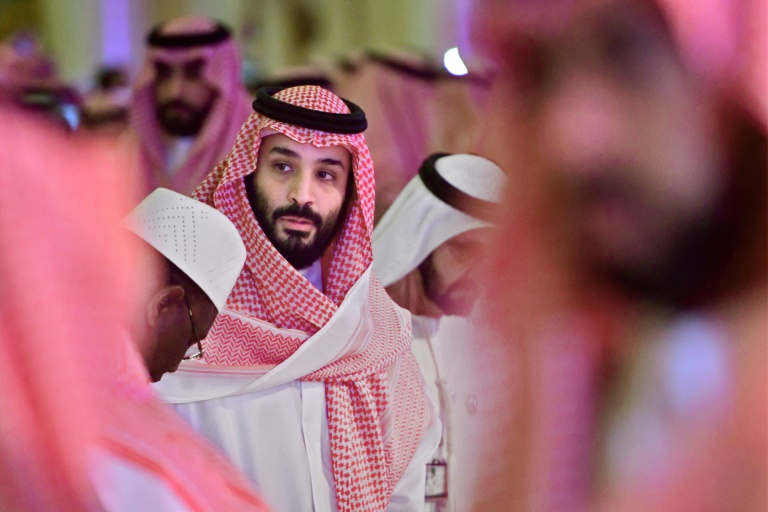
Saudi Crown Prince Mohammed bin Salman called Israel a “potential ally” and said in a wide-ranging interview published on Thursday that he wants to “work it out” with Iran 

The de facto leader, 36, also called the killing of journalist Jamal Khashoggi “a huge mistake” for which he was unfairly blamed, and revealed a penchant for hit TV series “Game of Thrones”.

“For us, we hope that the conflict between the Israelis and Palestinians is solved,” the prince told The Atlantic, according to a transcript issued by the official Saudi Press Agency.

“We don’t look at Israel as an enemy, we look to them as a potential ally, with many interests that we can pursue together… But we have to solve some issues before we get to that.”

Saudi Arabia does not have diplomatic relations with Israel, but in 2020 Gulf allies Bahrain and the United Arab Emirates normalised ties with the Jewish state.

The normalisation deals under the US-brokered Abraham Accords angered the Palestinians, who condemned them as a “stab in the back”.

Saudi relations with Israel’s arch-foe Iran, blamed by Gulf states for creating chaos in the region, have at the same time showed signs of improvement with several rounds of talks hosted by Iraq. 

“They are neighbours. Neighbours forever. We cannot get rid of them, and they can’t get rid of us,” the prince said of Iran.

“So it’s better for both of us to work it out and to look for ways in which we can coexist,” the transcript said he told the US monthly publication. 

“Hopefully, we can reach a position that’s good for both countries and is going to create a brighter future for this country and Iran,” he added.

Saudi Arabia has repeatedly said it would stick to the decades-old Arab League position of not establishing official ties with Israel until the conflict with the Palestinians is resolved. 

Prince Mohammed has, however, seemed more open than his father, King Salman, towards Israel, allowing its commercial aircraft to pass through Saudi air space.

– House of Cards –

The ultra-conservative kingdom has undergone marked social change under Prince Mohammed, with women allowed to drive for the first time in 2018.

However, Khashoggi’s murder that year by a hit squad in the Saudi consulate in Istanbul led to global revulsion and pointed questions for the young prince.

“Why would I do it?” he asked, saying that accusations that he ordered the killing “hurt me a lot”.

“What happened was painful… that was a huge failure in the system,” he said.

“In any case, if that’s the way we did things, Khashoggi would not even be among the top 1,000 people on the list,” added the prince.

He also defended a purge launched in 2017 that saw hundreds of Saudi royals and business elite imprisoned in Riyadh’s palatial Ritz-Carlton hotel.

“That was a strong signal,” said Prince Mohammed.

“I believe (by) 2019 to 2020, they understood even if you steal $100, you’re going to pay for it. And a lot of people made that mistake,” he added.

Asked whether criticism could land his interviewer in the Ritz-Carlton, the crown prince replied: “Well, at least it’s a five-star hotel.”

In the rare interview with foreign media, the crown prince also gave an insight into his personal leisure habits, including his preferred TV: sci-fi series “Foundation” and HBO’s “Game of Thrones”.

“When I watch movies or series I try to see something outside my world. For example, ‘House of Cards’ is not good for me,” he said.

“‘Foundation’, it’s a new series. It’s unbelievable. Amazing. ‘Game of Thrones’, for example. It’s great,” added the prince.

Iran/dm/th/it
New US sanctions target Russia's pro-Putin oligarchs

The United States imposed sanctions on the ultra-wealthy Russian oligarchs at the heart of President Vladimir Putin’s regime Thursday in the latest ratcheting up of pressure on the Kremlin to halt its invasion of Ukraine.

They and their family members “will be cut off from the US financial system, their assets in the United States will be frozen and their property will be blocked from use,” the White House said in a statement.

“The United States and governments all over the world will work to identify and freeze the assets Russian elites and their family members hold in our respective jurisdictions — their yachts, luxury apartments, money, and other ill-gotten gains.”

The sanctions match earlier EU measures against Russia’s wealthiest figures, but also include a ban on travel to the United States and preventing these targeted people from hiding their assets through transfer to family members.

“We’re adding dozens of names … , including one of Russia’s wealthiest billionaires, and I’m banning travel to America by more than 50 Russian oligarchs, their families and their closest associates,” US President Joe Biden told reporters.

Biden accused oligarchs of “lining their pockets with the Russian people’s money while the Ukrainian people are hiding in subways from missiles” and he vowed to maintain “the strongest, unified economic impact campaign in all history” against Moscow.

Britain — a favorite destination for oligarchs — announced a similar full asset freeze and travel ban on billionaire businessman Alisher Usmanov and former deputy prime minister Igor Shuvalov. The pair, worth an estimated $19 billion, have “close links to the Kremlin,” the Foreign Office said.

That brings the number of oligarchs hit by British sanctions to 15.

The oligarchs — government officials and business owners who have amassed vast wealth in an economy where only Putin loyalists can get ahead — are seen as vulnerable because much of their wealth is tied to Western interests.

They own prestigious property in New York, sports clubs across the West, enormous yachts in the Mediterranean and send their children to the most expensive US universities, while traveling in luxury around the world.

Much of that lifestyle is now set to come to a halt.

– ‘Squeeze’ on Putin –

“One of the big factors is of course the proximity to President Putin,” White House Press Secretary Jen Psaki told reporters, explaining how the ultimate goal of the sanctions.

“We want him to feel the squeeze. We want the people around him to feel the squeeze. I don’t believe this is going to be the last set of oligarchs. Making them a priority and a focus of our individual sanctions is something the president has been focused on.”

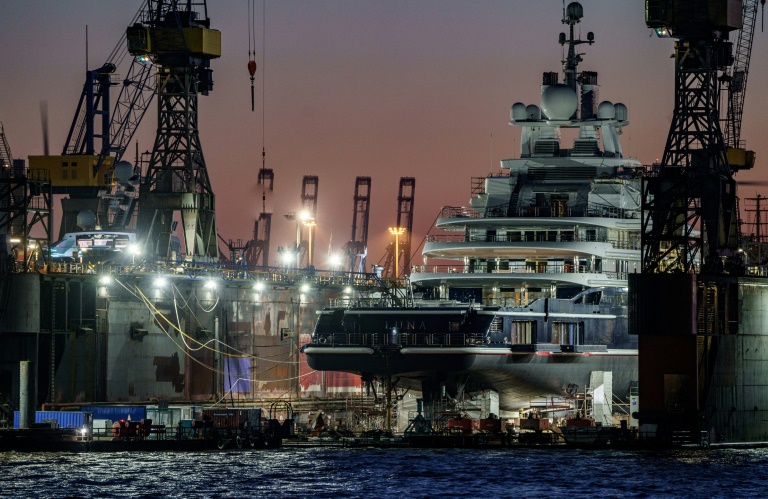
The White House singled out several, including Usmanov, whose “property will be blocked from use in the United States and by US persons — including his superyacht… and his private jet.”

Usmanov’s yacht, the “Dilbar,” is currently at a shipyard in Hamburg for repair work.

Authorities there denied the yacht has been seized, but it is unlikely to leave Hamburg soon since all goods transported to Russia from the port now require individual customs permits.

The Biden administration listed Putin’s wealthy, longtime spokesman Dmitry Peskov, a “top purveyor” of the Russian leader’s “propaganda.”

Also targeted were Nikolay Tokarev, boss of pipeline mammoth Transneft; brothers Boris and Arkady Rotenberg, who both play ice hockey with Putin and made their money from state construction contracts. Another on the list was Rostec head Sergei Chemezov.

The United States and its Western allies have already imposed sweeping sanctions aimed at hobbling Russia’s economy and the ability of the central bank to defend the ruble.

However, the focus on oligarchs makes the financial offensive far more personal, going after people who for years have been not just untouchable but courted by Western governments eager to benefit from the Russians’ spending sprees.

In many cases their children go to top European and US schools and universities and some have obtained residency through so-called golden visa schemes. Throughout, the oligarchs have maintained steely loyalty to Putin — with those not toeing the line were sidelined or in the case of Mikhail Khodorkovsky imprisoned for years in what was seen as setting an example to the others.

burs-sms/dw

United States returns pillaged skull, golden objects to France

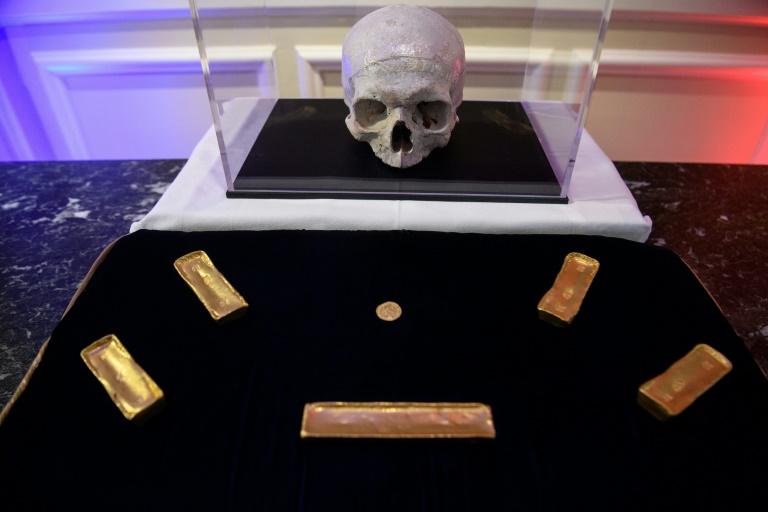
The United States has returned a set of illegally obtained artifacts, including a skull from the Parisian catacombs and golden ingots from an Atlantic shipwreck, to their rightful owner — the French state.

The prized objects, which also included an ancient Roman coin, were handed over on Wednesday during an official “restitution” ceremony at the French ambassador’s residence in Washington.

Steve Francis, a high-ranking official in the US Department of Homeland Security, along with French Ambassador Philippe Etienne, unveiled the pieces and detailed how American authorities had worked with their French counterparts to get them back into French hands.

“It is unacceptable that cultural property can be stolen and trafficked, and this is one of the mutual priorities between the United States and France,” the ambassador told AFP.

– Treasure hunt –

The five golden ingots had originally been looted from the Prince de Conty, a ship that wrecked in December 1746 off the French island of Belle-Ile-en-Mer, near mainland France, according to a handout provided by the French embassy.

The vessel, which was on a return trip from China, had long been forgotten, until a teacher in 1975 came across archival documents mentioning its location. He received authorization to excavate the site, but it was quickly looted, with many of the ingots disappearing before arrests were made.

However, in December 2017, five ingots matching the description of the Prince de Conty gold appeared on a list of items up for auction in California.

A French agency dedicated to underwater archeology notified American authorities, who stepped in to seize the objects.

“The evidence that was provided by the French government was overwhelming,” said David Keller, a US agent who focuses on cultural property and antiquities.

“These marks on them identify the people that actually made the ingots in the Qing dynasty,” Keller told AFP, “so there’s a lot of history just wrapped up in it.”

The golden coin is much older — dating back to the third century AD.

It is part of a larger treasure trove of ancient Roman objects, known as the Treasure of Lava, which was found in 1985 on the French island of Corsica, and was sold without official permission.

According to the French Embassy, specialists in currency “consider it one of the most important monetary treasures in the world.” 

The skull originated in the Parisian catacombs, extensive caverns created in the late 18th century to house relocated remains from local cemeteries.

The site, known as an ossuary, is the largest in the world, containing the bones of more than six million Parisians.

The skull was recovered from an antiquities dealer in Houston, Texas in 2015.

How commercial satellites are shaping the Ukraine conflict

From a huge Russian military convoy snaking its way to Kyiv to missile strikes and refugee crossings, commercial satellite imagery of the Ukraine conflict is helping lift the fog of war, illuminating for the public what was previously the domain of spy agencies.

Technologies that can pierce cloud cover and work at night are also coming to the fore, as a growing army of open-source intelligence analysts offer near real time assessments of battleground developments.

“Governments are no longer the only place to go for high precision satellite data,” Craig Nazareth, a former US intelligence officer turned scholar at the University of Arizona, told AFP.

Thanks to the explosive growth of the private satellite industry, the volume of imagery is greater and turnaround time faster compared to prior conflicts, such as Russia’s 2014 annexation of Crimea.

While most Western governments have their own sophisticated satellite assets, their classified nature means the images can’t be shared.

And with public trust in the US and British governments shaken after the 2003 Iraq war, third-party imagery has helped plug credibility gaps.

“They’re saying ‘Look, it’s not us, this is actually happening, we’re not making this up,” Nazareth said.

Beyond helping shape narratives, the images are directly aiding Ukrainian forces in their war efforts. 

“Capella Space is working directly with the US and Ukrainian governments as well as other commercial entities to provide timely data and assistance around the ongoing conflict,” Payam Banazadeh, the company’s CEO confirmed in a statement to AFP.

– Radar imagery –

It was images taken by the San Francisco startup that led a group of independent researchers to realize the invasion was underway, before Vladimir Putin announced his “special military operations” in the early morning of February 24.

Hours before that speech, Jeffrey Lewis of the Middlebury Institute in California tweeted that Google Maps showed a “traffic jam” on the road from Belgorod, Russia to the Ukrainian border.

It was the precise spot Capella Space previously saw a convoy of military vehicles, and the congestion likely reflected Russian civilians getting stuck at roadblocks while military vehicles passed.

“Someone’s on the move,” he correctly hypothesized.

While most satellite imaging requires daylight and clear skies to capture images, Capella Space works with synthetic aperture radar (SAR) — in which sensors shoot down energy, then record the amount that reflects back to them.

SAR “penetrates clouds and smoke, even in very large storm events or fires, so we can reliably capture clear and precise images of the Earth under almost any conditions,” said Dan Getman, the company’s vice president of product.

Another company whose pictures have been used heavily by news media is BlackSky, which released what it believes was among the first engagements of the war — an attack on the Luhansk Thermal Power Station a little after 4:00 pm local time on February 23.

“We have a constellation of small satellites that can see dawn to dusk, not just at certain times of the day” the company’s CEO Brian O’Toole told AFP. 

In traditional polar orbits, which fly north-south, a satellite could take only two snaps of a particular spot per day — but BlackSky flies its hardware counter-clockwise to the planet’s rotation, allowing them to revisit areas more often.

Clients receive the images within 90 minutes, and are helped in interpreting them by AI-enabled software.

– Future ethical concerns? –

Perhaps the most grabbing image of the conflict so far has been a picture of the 40 mile (64 km) long Russian convoy, captured by Maxar, “the granddaddy of the industry,” according to Chris Quilty, of Quilty Analytics.

He explained that unlike traditional satellites that only point downwards, Maxar’s satellites have gyroscopes that allow them to swivel and target with more precision.

The US government, through the National Reconnaissance Office, is one of Maxar’s main clients, dictating “shutter time,” which helps explain why the company and others are spending so much time over Ukraine right now.

But the selective release of what the satellites are seeing could eventually lead to ethical concerns.

Maxar and others “are inevitably capturing imagery of Ukrainian troop movements and defensive positions and that information is not being released to the public,” said Quilty.

Looking ahead to future conflicts, “There is absolutely an ability to color the narrative depending upon what imagery is made available,” he said.

Step aside football: gaming new rage in Brazil favelas

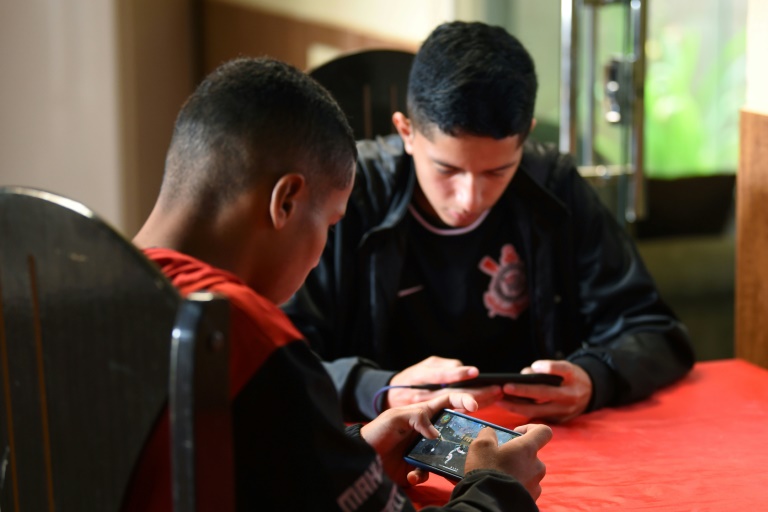
Ask Brazilian teen Yan Araujo who his idols are, and he doesn’t hesitate. Not Neymar. Not Vinicius Junior. “Nobru and Cerol,” he says — superstars of the booming gamer scene in Brazil’s favelas.

Like his heroes, 15-year-old Araujo is a die-hard player of Free Fire, an online multi-player game designed for cell phones — perfect for Brazil’s poor slums, where expensive gaming consoles are rare but phones are relatively easy to come by.

Football was once the undisputed king of favela kids’ dreams in Brazil, the country that has won the World Cup more times than any other — five.

But growing numbers now aspire to make it as professional gamers, inspired by Nobru, Cerol and other eSports phenoms who have gotten rich and famous playing video games.

With the dexterity of a virtuoso guitarist, Araujo slides his long, thin fingers across his screen in a favela on the outskirts of the capital, Brasilia, playing what he sees as much more than a game.

“I have a dream of making it as a Free Fire player, becoming famous and helping people,” he says, wearing a red tracksuit jacket and swaying his head in time with the game.

Araujo and five teammates from the P. Sul favela won the Brasilia Free Fire championships last year, organized by favela community organization CUFA.

Free Fire is what is known as a “battle royale” game: up to 50 players parachute onto an island, then look for weapons to hunt down and kill each other.

The last one standing wins.

Developed by a Vietnamese company, the game was launched in 2017, and has been a huge hit in Brazil.

– Paid to play –

“The kids are all crazy about” Free Fire, says Carlos Campos, CUFA coordinator in Brasilia.

Last year’s national championships drew 80,000 players from the favelas.

A full 96 percent of favela children aged 15 and younger want to grow up to be professional gamers, and 29 percent call it their biggest dream in life, according to a 2021 survey by the Data Favela Institute.

“A lot of kids have that dream, because they’ve seen it’s a profession, that people from their world are becoming champions, that it can be a way to earn money,” Campos told AFP.

The 2021 national championships awarded 100,000 reais ($20,000) to the winning team.

The biggest names in gaming have even become influencers and turned pro, like Bruno “Nobru” Goes, who streams his games online and has 13 million followers on Instagram.

The 21-year-old reportedly earns around $500,000 a month from webcasts, earning him the nickname the “Neymar of Free Fire.”

“He really is basically the Neymar of gaming. He comes from a poor community, he worked hard, spent a lot of long hours playing, and look where he is today,” says Araujo.

Paris Saint-Germain superstar Neymar has even gotten in on the eSports craze himself: in December, the gaming fanatic signed a deal to webcast his own games on Facebook Gaming.

Major Brazilian football clubs including Flamengo and Corinthians have meanwhile launched their own eSports teams.

– Convincing Mom –

Football coaches scouting talent in the favelas, which have produced stars such as Real Madrid’s Vinicius Junior and Manchester City’s Gabriel Jesus, say there is less interest in football than there used to be.

“Some players don’t show up to practice because they’re playing Free Fire,” says Joao de Oliveira, coach at Brasilia favela football academy Toque de Bola.

“It’s a bit early to say the majority is choosing Free Fire over football, but gaming is gaining ground by the day.”

Araujo’s teammate Matheus da Silva says he is training to become the next “Bak” — Free Fire star Gabriel Lessa, the seven-time Brazilian champion.

“He’s like (Lionel) Messi — seven Ballons d’Or, seven national championships,” says Da Silva.

The teen’s mother, Claudia Gomes da Silva, says at first she disapproved of him spending so much time playing on the cell phone.

But when his team won the Brasilia championships, she started to change her mind.

“It’s more than a game,” she says.

“He just might become a great player and make a living from it.”

Two men carrying firearms near US Ukrainian Embassy say trying to join war

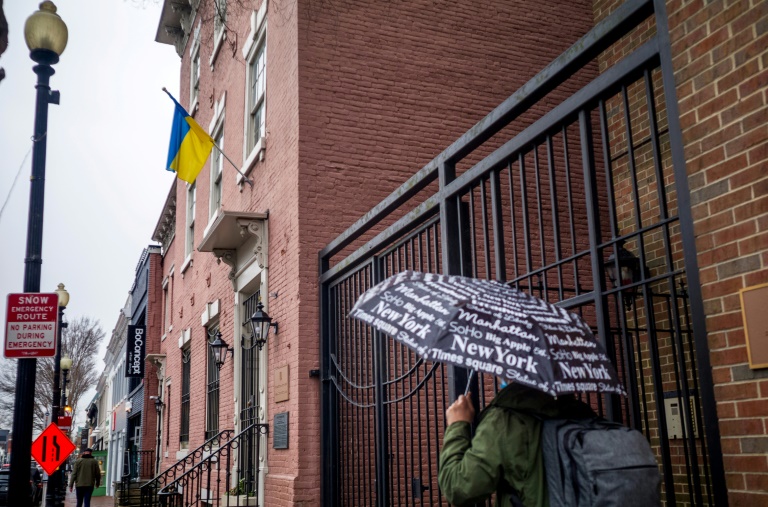
Two men who were arrested near Ukraine’s embassy in Washington Thursday for carrying firearms reportedly told police they wanted to help fight off Russia’s invasion of its pro-Western neighbor. 

The pair, who according to US media told officers they had driven from the Midwest state of Indiana, were charged with multiple weapons-related violations.

The Secret Service told AFP its officers “observed two individuals acting suspiciously near a vehicle,” approximately three blocks from the embassy just after 9:00 am (1400 GMT).

The Secret Service was unable to give their names and provided no further details.

However, The Washington Post reported that officers seized a long gun and two handguns, and that one of the men was wearing military fatigues.

Ukrainian President Volodymyr Zelensky has urged any foreigners to come to Ukraine “and fight side by side with the Ukrainians against Russian war criminals,” the country’s general staff said.

A Ukrainian statement additionally called on volunteers to visit Ukrainian embassies in their respective countries.

Russia invaded Ukraine eight days ago and has faced fierce resistance by Ukrainians, in addition to deepening international isolation.

Macron: an abrasive reformer in turbulent times

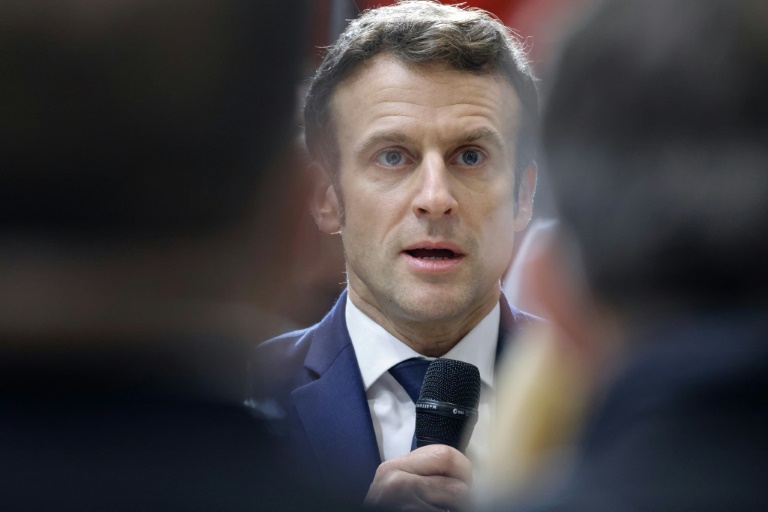
A short time after becoming France’s youngest ever president in 2017, Emmanuel Macron made a boast about his temperament that made clear he was expecting trouble while in office

“I’m not made to lead in calm weather,” he told author Emmanuel Carriere during a tour of the hurricane-hit French Caribbean island of Saint Martin in 2017. “My predecessor was, but I’m made for storms.” 

The comment, made as he observed devastated homes, proved prophetic.

Over his five years, some storms were expected, some were of his own making, while others barrelled over the horizon unannounced. 

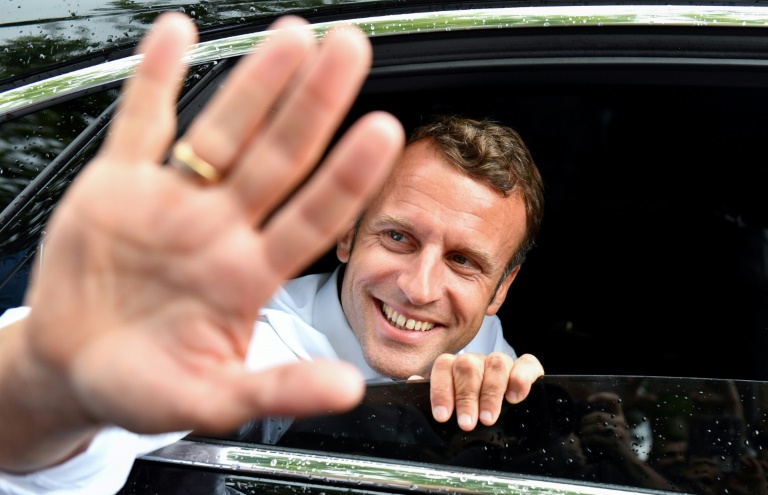
On Thursday, Macron threw his hat in the ring for what could be another stormy term as president. The first round of the presidential vote will take place on April 10.

After Macron’s first year in office, marked by major tax and labour market reforms, he faced some of the most violent anti-government demonstrations since the 1960s when protesters in florescent yellow safety jackets began a nationwide revolt against his policies. 

From the beginning of 2020, he battled a once-in-a-century global pandemic as Covid-19 spread from China, rendering almost all other government business irrelevant and putting paid to his last reform plans.

“We are at a time in the history of humanity when we have rarely seen such an accumulation of short-term crises,” he told the Groupe d’Etudes Geopolitique, a think-tank, in late 2020.

Now, having weathered Donald Trump’s norm-shredding American presidency, he faces war in Europe as Russian President Vladimir Putin’s troops invade Ukraine, overshadowing France’s election next month.

Throughout all these crises, the man dubbed “The Chameleon President” by Le Monde newspaper, who had never been elected to any position before winning the presidency, was refining a governing style that has often confounded the French.

Still only 44, he is seen widely as energetic and bold, but also abrasive and sometimes authoritarian.

“I think I arrived in power with a sort of vitality, which I hope I still have, with a desire to shake things up,” he told TF1 television in an interview in December.

– ‘President of the rich’? – 

That desire, he now concedes, has sometimes been the source of his errors, particularly off-the-cuff comments made to members of the public that have forged his reputation for arrogance and insensitivity.

He once told an unemployed gardener that he could “cross the road and get you a job” and accused opponents of his labour market reforms of being “slackers”.

“I think that with some of my comments I hurt people,” Macron continued during his interview with TF1. “And I think you can get things done without hurting people.” 

Nicolas Domenach, co-author of a recent book titled “Macron: Why so much hatred?”, said these remarks, coupled with Macron’s decision to make tax cuts for the wealthy one of his first priorities, were the fuel for the “Yellow Vest” protests in 2018.

“Not only did we have a ‘president of the rich’, but a president of contempt and arrogance. Everyone we spoke to mentioned it,” said the veteran journalist and commentator. “It cut through. It was like he was branded with it, with hot iron.”

The old instinct returned in early January when Macron told a group of voters that he really wanted to “piss off” people who were refusing vaccinations against Covid-19, sparking another round of outrage.

– Reforms – 

Despite stirring such strong feelings in opponents, Macron has always retained a loyal core support, mainly from urban professionals.

They admire his pro-business policies to encourage entrepreneurship, as well as what is widely seen as an uncommon intellect and grasp of policy detail.

Partly thanks to his pro-business labour market reforms and vast government spending to protect the economy from the effects of the global pandemic, unemployment is at its lowest level in nearly 10 years. 

“People are also proud when they see him overseas. He represents France well,” explained Domenach. 

Macron, a former investment banker, believes in “diplomacy of audacity” and he has thrown himself into the search for solutions to crises ranging from Iran’s disputed nuclear programme, Libya’s civil war, to latterly the Russian-Ukraine conflict. 

However his repeated mediation efforts have rarely borne fruit — including his most recent attempts to convince Putin not to invade — but the Ukraine crisis has proved a boon for his dream of a stronger, more united European Union.

“What’s happened, in this acceleration of history in just a few hours, is a revolution.. a European power revolution” French Europe Minister Clement Beaune, a close aide of the president, exalted on February 28.

– Private life –

Macron’s unusual personal life remains a source of fascination in France, though his marriage is no longer a subject of open speculation, as it was before the 2017 election which forced him to make a public denial that he was gay.  

He is married to former teacher Brigitte, whom he met while a pupil at a private school in their hometown of Amiens in northeast France. 

In her forties and with three children, Brigitte divorced her husband and began a relationship with Macron while he was in his late teens.

Known to have reluctantly embraced her husband’s political ambitions, she once said she wanted to avoid being like “a vase of flowers” in the background at official functions but has kept a relatively low profile as first lady.

“I’ve learned not to speak openly to anyone, anywhere and anyhow which is a colossal effort for me because I’m very talkative,” she told the Figaro newspaper recently. 

If Macron fails with his bid for a second term — or succeeds and serves a second term until 2027, when he will be only aged 49 — his mother has an idea of what his future might hold.

“I’m convinced he’ll launch himself as a writer, that he’ll take another path. He’s the not the sort of person to do the international conference circuit,” she told the writer Gael Tchakaloff for her book about the Macron couple.

Macron confirms bid for second term

French President Emmanuel Macron announced Thursday that he will seek a second term in office at elections next month, with Russia’s war in Ukraine likely to eclipse the campaign but boost his chances.

Macron formally announced his attempt to become the first French president to be re-elected in 20 years in a letter to the French people published online by numerous news sites.

There was little suspense about the 44-year-old’s intentions, but the announcement has been repeatedly delayed because of the crisis in eastern Europe that has seen Macron take a prominent role in diplomatic talks.

“I’m a candidate to invent, with you, and faced with the challenges of this century, a singular French and European response,” he said. 

“I am a candidate to defend our values that are threatened by the disruptions of the world,” he added.

Macron acknowledged that the election would not be a normal one due to Russia’s war on Ukraine.

“Of course, I will not be able to campaign as I would have liked because of the context,” he said, while vowing to “explain our project with clarity and commitment”.

Ahead of Friday’s deadline for candidates to stand, polls widely show him as the frontrunner in the two-round election on April 10 and 24, with the war focusing  attention on foreign policy rather than the domestic issues favoured by his opponents.

“In a crisis, citizens always get behind the flag and line up behind the head of state,” said Antoine Bristielle, a public opinion expert at the Jean-Jaures Foundation, a Paris think-tank.

“The other candidates are inaudible. In every media, all anyone is talking about is the invasion,” he told AFP. 

One ruling party MP told AFP this week the Ukraine crisis meant that Macron’s rivals were “boxing on their own”, while several polls have shown his personal ratings rising.

The former investment banker admitted in a national address on Wednesday night that the crisis had “hit our democratic life and the election campaign” but promised “an important democratic debate for the country” would take place. 

Voter surveys currently tip the centrist to win the first round of the election with 26 percent and then triumph in the April 24 run-off irrespective of his opponent. 

– Rivals –

After five tumultuous years in office, Macron’s biggest challenge comes from opponents on his right who accuse him of being lax on immigration, soft on crime and slow to defend French culture. 

These include the conservative Valerie Pecresse from the Republicans party, far-right candidate Marine Le Pen and anti-Islam media pundit Eric Zemmour.

On the left, four mainstream candidates are competing, which is expected to split the vote and lead to all of them being eliminated in the first round. 

Socialist Party candidate Anne Hidalgo said the announcement was “not a surprise.” 

“The democratic debate, of one programme versus another that I have been calling for for months, can finally take place,” she said in a statement. 

Macron’s camp have been looking for the right moment to launch his candidacy since early February, but the Ukraine crisis has seen his agenda filled with either foreign trips or talks with other leaders.

He spoke for the third time in a week to Russian President Vladimir Putin on Thursday and again with Ukrainian counterpart President Volodymyr Zelensky.

Striking a note of humility, Macron added in his letter that “we have not got everything right”.

“There are choices that after the experience I gained with you I would have no doubt made differently,” he said.

A recent poll by the Elabe group, published March 1, showed that confidence in Macron’s “ability to tackle the main problems of the country” was up a massive five points in a month.

Another by the Harris Interactive group showed 58 percent of French people held a favourable view of his handling of the Ukraine crisis 

Allies of the president are quietly confident, but analysts warn many voters remain undecided and that sentiment can swing sharply in the final weeks of campaigning.

jri-leb-adp-sjw/har

UN nuclear watchdog chief to travel to Iran on Saturday

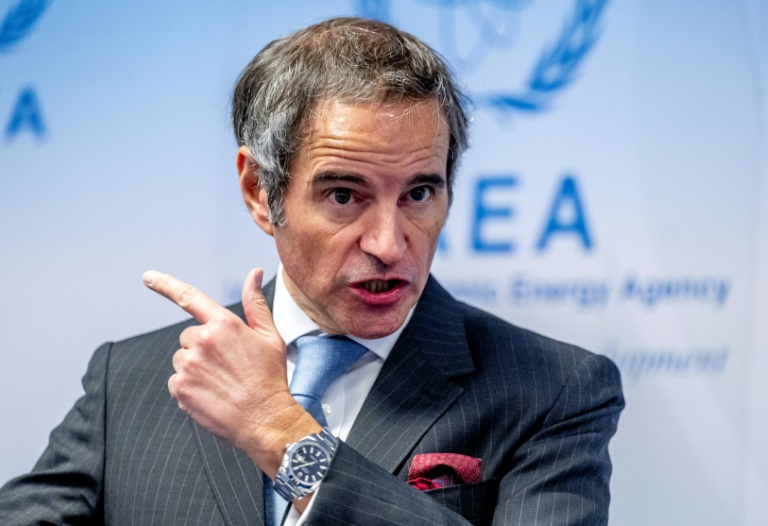
The head of the Vienna-based International Atomic Energy Agency, the UN nuclear watchdog, will travel to Iran on Saturday “for meetings with senior Iranian officials”, the IAEA said Thursday.

Director General Rafael Grossi will then hold a press conference on his return to Vienna, an agency spokesman said.

The announcement comes a day after Grossi vowed that the IAEA would “never abandon” its attempts to get Iran to clarify the previous presence of nuclear material at several undeclared sites there.

Iran has said the closure of the probe is necessary in order to clinch a deal to revive the 2015 deal with world powers on its nuclear programme.

The talks on the deal taking place in Vienna are widely seen as being at a crunch point, with the next few days key to their success or failure.

The 2015 deal began unravelling when former US president Donald Trump withdrew from it in 2018 and re-imposed sanctions, prompting Iran to start disregarding the limits on its nuclear activity laid down in the agreement. 

Diplomats from Britain, China, France, Germany, Iran and Russia restarted the talks in late November to revive the accord, also known as the JCPOA or Joint Comprehensive Plan of Action.

The US has been taking part indirectly.

– Growing stockpile –

The IAEA has been pressing Tehran for several years for explanations regarding indications that nuclear material was previously present at four different locations in Iran.

While much of the activity concerned is thought to date back to the early 2000s, sources say that one of the sites, in the Turquzabad district of Tehran, may have been used for storing uranium as late as the end of 2018.

Israel fears Iran is seeking to obtain nuclear weapons, a charge Tehran denies.

On Thursday, Israeli Prime Minister Naftali Bennett spoke with Grossi to state his country’s stance on the Vienna talks, “as well as on the open cases in the IAEA that deal with the Iranian weapons programme.”

Bennett stressed “Israel’s expectation that the IAEA will act as a professional and impartial supervisory body,” a statement from his office read.

On Wednesday, Bennett said that an agreement enabling Iran to “install centrifuges on a broad scale within a few years” would be “unacceptable” to Israel, stressing the Jewish state would “know how to defend itself and ensure both its security and its future.”

Also on Thursday the IAEA issued a report in which it estimated that Iran’s stockpile of enriched uranium stood at 3,197.1 kilograms (7,033.62 pounds), up from 2,489.7 kgs in November.

One of the stipulations of the 2015 deal was that Iran was not allowed to enrich uranium above 3.67 percent, but this is one of the limits Iran has exceeded.

Thursday’s IAEA report estimated the stockpile of uranium enriched to 20 percent at 182.1 kgs (up from 113.8 kgs in November) and that of uranium enriched up to 60 percent at 33.2 kgs (up from 17.7 kgs).

Military-grade levels are around 90 percent.

Biden, Asia-Pacific allies discuss Ukraine but no joint condemnation

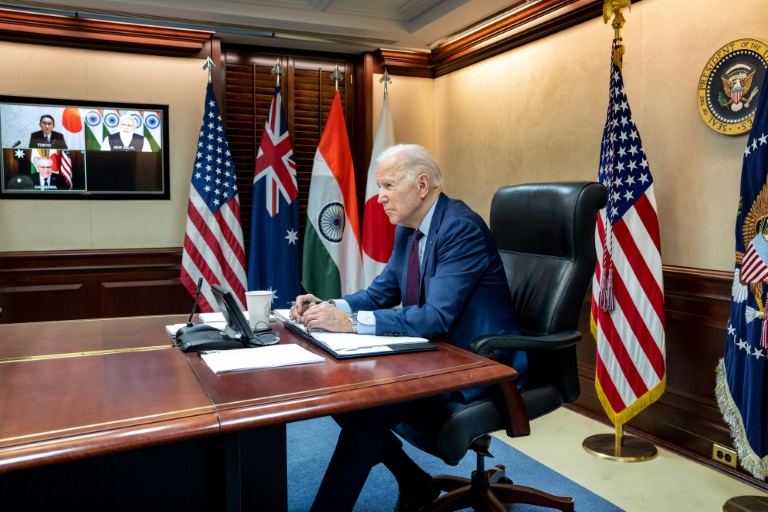
US President Joe Biden on Thursday met virtually with the leaders of Japan, Australia and India over Ukraine, but the “Quad” group failed to agree on condemning Russia’s invasion, with New Delhi hesitant to censure Moscow.

The impromptu meeting was held shortly after it was announced by Delhi.

Washington has called on India to use its “leverage” with Moscow.

But at the conclusion of the talks, a joint statement said simply that the leaders had “discussed the ongoing conflict and humanitarian crisis in Ukraine and assessed its broader implications” — without any condemnation of Moscow’s military assault.

A separate readout from Indian Prime Minister Narendra Modi’s office said the premier had “emphasised the need to return to a path of dialogue and diplomacy”.

India has repeatedly urged Russia and Ukraine to cease hostilities but has stopped short of condemning the deadly invasion.

Modi “underlined that the Quad must remain focused on its core objective of promoting peace, stability and prosperity in the Indo-Pacific region,” his office said.

The leaders jointly reaffirmed their “commitment to a free and open Indo-Pacific, in which the sovereignty and territorial integrity of all states is respected and countries are free from military, economic, and political coercion” — a statement that could be interpreted as a new warning to China over its regional ambitions.

The Quad grouping is seen as a bulwark against China, and there have been concerns in India and elsewhere that the Ukraine crisis could distract Washington from the region.

On Wednesday, India, which leaned towards the Soviet Union in the Cold War and maintains strong ties with Moscow, again abstained in a UN resolution deploring Russia’s actions.

Also on Wednesday, Modi spoke to Russian President Vladimir Putin for the second time since Moscow’s invasion of Ukraine last week.

The Quad leaders agreed to meet in person in Tokyo in the coming months, according to the joint readout.

The office of Japanese Prime Minister Fumio Kishida said in a tweet that the meeting would be held “this spring”.

The Quad was first launched in 2007, but only took root a decade later after China aggressively projected its military power into the South China Sea, and following violent border clashes with India.

Close Bitnami banner
Bitnami