World

France seizes Russian oil supremo's yacht as EU sanctions bite

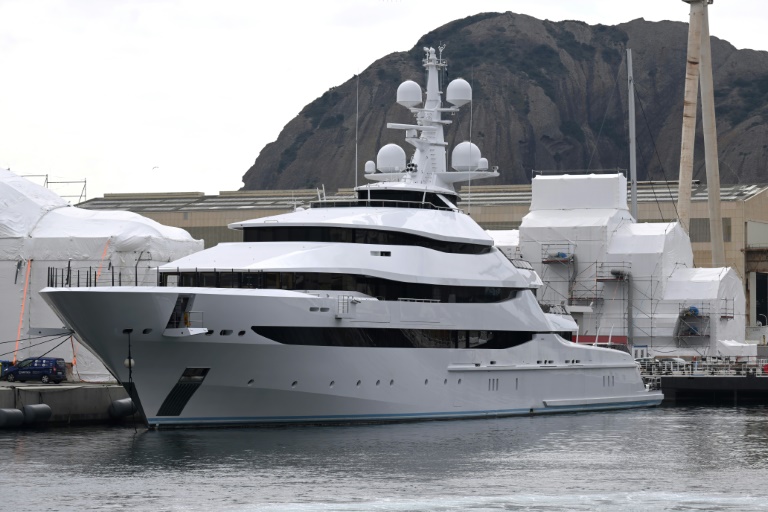
France said Thursday it had seized a superyacht owned by Russia’s oil czar Igor Sechin, following through on threats to target sanctioned oligarchs close to Russian leader Vladimir Putin.

The estimated $120-million vessel “Amore Vero” was seized while undergoing maintenance work at a shipyard at La Ciotat on the French Riviera, a popular summer playground for the super-rich. 

“French customs carried out the seizure of the yacht Amore Vero in La Ciotat as part of the implementation of sanctions by the European Union against Russia,” a statement for the French finance ministry said. 

The 85.6-metre (280 ft) vessel was owned by a company “in which Sechin is the main shareholder”, the statement added.

Authorities moved after it “was preparing to cast off in a hurry, without the work on it having been finished,” junior budget minister Olivier Dussopt said. 

Sechin, seen as part of Putin’s tightest inner circle and a former deputy prime minister, is chief executive of Russian oil giant Rosneft.

Another superyacht moored in Mediterranean port of Monaco, the “Quantum Blue”, owned by Russian billionaire Sergei Galitsky, was also being checked by customs on Thursday, a source in the principality told AFP.

German authorities denied a report in Forbes magazine that they had seized the “Dilbar” yacht, belonging to billionaire businessman Alisher Usmanov, in the port of Hamburg.

Part of the challenge for European authorities is determining the ownership of vessels, which are usually registered in low-tax jurisdictions and sometimes owned by trusts or front companies.

– Exodus? –

Rory Jackson, business editor at the Superyacht Group, said that the boats being targeted were likely in Europe because they were undergoing maintenance.

“At this point in the year, it’s the end of the Caribbean season and the Mediterranean season will start in May,” he told AFP. “The yachts that are in Europe in this period, they’re probably having refit work done.”

He said there was evidence that Russian owners were keeping their vessels in the Caribbean or moving them to places out of reach of European or American authorities such as the Seychelles.

Authorities in the Maldives have told AFP that the “Clio” superyacht of billionaire Oleg Deripaska has anchored off its capital, along with the “Titan” vessel owned by steel magnate Alexander Abramov.

The megayacht Solaris owned by Roman Abramovich is currently shown as located in Barcelona in Spain, according to specialist ship tracking websites, and is thought to be undergoing maintenance.

Abramovich has not been sanctioned, but announced Wednesday that he was divesting from Chelsea football club in a possibly pre-emptive move.

Putin himself has been repeatedly linked to the 80-metre boat “Graceful”, which was moved from the German port of Hamburg to the Russian enclave of Kalingrad on the Baltic Sea in early February, ship-tracking website Marinetraffic.com shows.

– Sanctions –

Around 500 Russian individuals have been targeted by sanctions from the European Union, with the the United States and Britain also announcing their own measures. 

“Those who enable the invasion of Ukraine will pay a price for their action,” EU foreign policy chief Josep Borrell said on Monday as he announced new sanctions after Russia’s invasion of Ukraine last Thursday. 

These included asset freezes for Sechin, pipeline boss Nikolay Tokarev, bankers Mikhail Fridman and Petr Aven and others.

Paris has said it is drawing up a list of assets in France owned by oligarchs including yachts and luxury cars. 

“If I were an oligarch, in Russia or France, I’d be worried,” French Foreign Minister Minister Jean-Yves Le Drian said on Monday.

US President Joe Biden has also tasked the Department of Justice with assembling a task force to “to find and seize their yachts, their luxury apartments their private jets.”

The “Amore Vero” vessel seized by France on Thursday was made by Netherlands-based yacht builder Oceanco and includes a swimming pool that turns into a helipad.

– Weak spot? –

Russians have long been major buyers of superyachts — pleasure vessels classed as being more than 30 metres long.

The London-based Superyacht Group estimates they make up about 10 percent of the global market.

“It’s not a majority, but its a significant portion,” Jackson said.

The EU sanctions are expected to badly hit the businesses of European superyacht builders concentrated in the Netherlands, Germany, Spain and Britain, as well as people who serve as crew.

But campaigners have long argued that Putin depends on the loyalty of the tight group of businessman around him, and that targeting their wealth is a way of destabilising his regime.

“So far, the lists are quite short of which oligarchs are going to be sanctioned. They need to be much longer,” campaigner Bill Browder told AFP this week. 
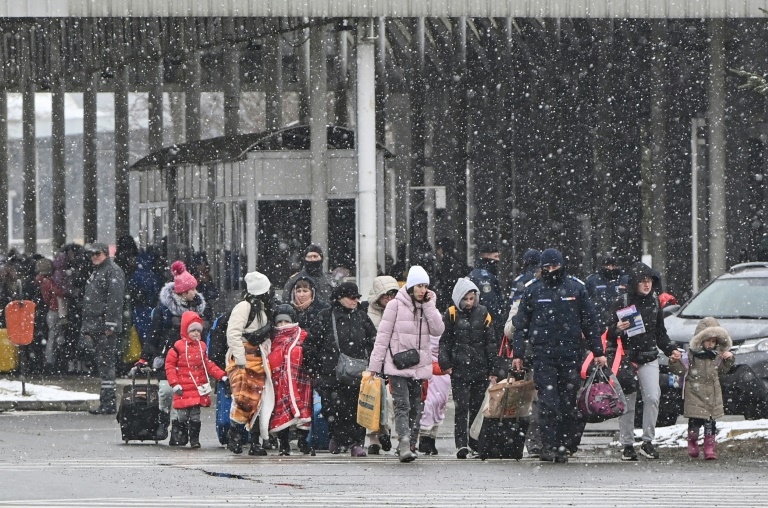
One million refugees flee Ukraine in first week of war

One million refugees have fled Ukraine in the week since Russia’s invasion, the United Nations said Thursday, warning that unless the onslaught ended immediately, millions more were likely to flee.

UN leaders also pleaded for everyone fleeing to be treated equally, voicing alarm at reports of African and Asian nationals facing discrimination at the border.

“In just seven days we have witnessed the exodus of one million refugees from Ukraine to neighbouring countries,” UN refugee chief Filippo Grandi tweeted.

“Unless there is an immediate end to the conflict, millions more are likely to be forced to flee Ukraine,” he warned.

According to data from Grandi’s UNHCR agency, 1,045,459 people have now fled Ukraine since Russian President Vladimir Putin launched the full-scale invasion on February 24.

Grandi said that in almost 40 years working in refugee emergencies, “rarely have I seen an exodus as rapid as this one”.

More than half of those who have fled Ukraine — nearly 548,000 people — have crossed west into Poland, UNHCR said.

Poland’s border guards said more than 600,000 people in total had crossed the frontier — many will have since moved on elsewhere in Europe — with 56,400 people alone crossing on Thursday, by 1400 GMT.

– Half a million children –

Hungary, Moldova, Slovakia and Romania have also welcomed tens of thousands of refugees. Countless people have also been displaced inside Ukraine.

Grandi hailed the “remarkable” response of governments and local communities in surrounding countries who have accomodated the million refugees.

The UN children’s agency UNICEF said that half of those who had left Ukraine were youngsters.

“Half a million children have already fled Ukraine to neighbouring countries, with the number of refugees continuing to grow,” it said in a statement.

UNICEF said it was setting up “safe spaces” for children and mothers to access services along transit routes.

The UN’s aid chief Martin Griffiths said the number of refugees was “going to keep mounting very quickly, by the hour”.

With Russian forces closing in on major cities, people’s risk calculation may shift from staying to leaving and “we will see more displacement”, he told AFP.

He warned the parties to the conflict that they were responsible for protecting civilians within Ukraine and also their “safe outflow, if they so desire”.

– Discrimination concerns –

UN human rights chief Michelle Bachelet said the million refugees had often spent days travelling by bicycle or on foot in freezing conditions.

But she raised concerns for fleeing non-Ukrainians who, after heading for the borders, faced discrimination.

“I commend the welcome that Ukrainians leaving the country have received. This welcome must be extended to all those fleeing conflict, regardless of their citizenship, ethnicity, migration or other status,” she told the UN Human Rights Council. 

“There have been disturbing indications of discrimination against African and Asian nationals while fleeing.”

The International Organization for Migration’s leader Antonio Vitorino also voiced strong concerns, saying fleeing foreign workers and students were facing “heightened risk and suffering”.

“I am alarmed about verified, credible reports of discrimination, violence and xenophobia against third-country nationals attempting to flee the conflict in Ukraine,” the IOM chief said in a statement.

“Discrimination on the basis of race, ethnicity, nationality or migration status is unacceptable. I deplore any such acts and call on states to investigate this issue and address it immediately.”

The Human Rights Council’s African nations were also disturbed by reports of Africans “being denied the right to cross the border to safety”.

“Everyone has the right to cross international borders during a conflict,” Ivory Coast’s representative said, on behalf of the group. 

“Show the same empathy and support for all people fleeing war, regardless of their racial identity,” he urged. 

Mine warfare on Kyiv's eastern front

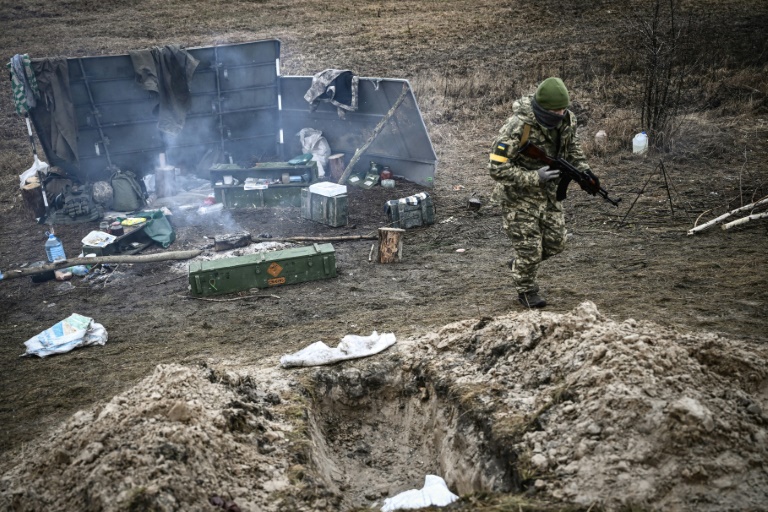
The Ukrainian army battalion commander is not sure who laid the mines scattered across fields on Kyiv’s eastern front that his men hit while seeking intelligence on Russian forces.

Maksym Kyrychuk is just grateful that only one of his men was injured and none died –- this time around.

“Someone laid them,” he reasoned, standing at the edge of one of the minefields on farmland 130 kilometres (80 miles) northeast of the Ukrainian capital.

“It wasn’t the Ukrainian armed forces, that I can tell you for sure,” he said with a resolute shake of the head.

“It could have been Ukrainian territorial defence units,” he added, referring to mostly untrained volunteer forces.

“The Russians? I am sure they also do it. But that our intelligence team went out and hit one yesterday, that is a fact.”

Russia’s week-long assault on Kyiv appears to have, at least temporarily, stalled after reaching a web of villages on the city’s northwest edge.

But more and more Russian forces are now approaching the historic city from the northeast, on the eastern side of the Dnipro river.

There they will confront various Ukrainian defence units that are trying to protect what remains Kyiv’s more exposed flank.

Regular units are interspersed with the eager volunteer forces who often man checkpoints with little more than hunting rifles and knives.

Kyrychuk suspected that one of these volunteer units scattered a cache of anti-tank mines across the fields encircling the town of Nizhyn before his own units moved in this week.

“Or it could have been the Russians,” he added. “Maybe they are trying to make people think that we’re engaging in mine warfare.”

– ‘I worry about them’ –

A UN treaty agreed in Ottawa in 1997 and which went into force two years later banned anti-personnel mines. Ukraine signed the deal, but Russia and the United States did not.

Mines like those in Nizhyn are aimed at destroying tanks and are often frowned upon but permitted under internationally accepted warfare rules.

Locals appear to have a love-hate relationship with the anti-tank mines lurking in the fields where they once grew wheat and corn.

“I worry about them. The entire war worries me,” said 40-year-old bricklayer Artem Kurylenko. 

“But I think the soldiers know better whether this is the right thing to do or not,” Kurylenko added.

Local mayor Oleksandr Kodola is upfront about his support for mine-laying.

Kodola said he would do anything to stop the Russians from assaulting his working-class town of about 80,000.

“Everyone is coming out to defend our city and our country,” the mayor said.

“So among other things, we are conducting certain mining operations around the approaches to the city. We ask residents to stay at home and to avoid the fields.”

– ‘Welcome to hell’ –

A local checkpoint commander who goes by the nom de guerre Serpent appeared to have more pressing worries than the mines that might be lurking around his roadside camp.

A Russian war plane that had made several circles over Serpent’s command post was making another run.

It had already delivered an air strike that left a two-metre (seven-foot) crater in the ground at another checkpoint.

It then scared a group of locals walking down the edge of the road, forcing them to scramble into a foxhole for safety while it buzzed ominously overhead.

Serpent said the mines might slow down the Russians, but not make the ones already here go away.

“The front is everywhere,” he said with a wave of the hand. “The saboteurs are already shooting at us from the woods and from the fields.”

Yet the Ukrainians are not sitting idle.

Some of the armoured vehicles at Kyrychuk’s outpost fly a red-and-white flag that once represented Ukrainian resistance that fought both the Soviets and the Nazis during World War II.

“When we pick up the Russians’ equipment, we plant that flag on it to make sure that our own guys don’t shoot at us,” he said.

That resolve is spelt out in black spray paint on a bedsheet hanging off one of the bridges on the road from Nizhyn to Kyiv.

“Russians -– welcome to hell,” the makeshift banner declares.

European equities slide, as oil drops off peaks

European stocks lost early gains while oil fell back Thursday after briefly flirting with $120 per barrel while natural gas touched another record peak as war raged on in Ukraine.

The euro sank to the lowest level against the pound since mid-2016, as the start of a second week in fighting triggered concerns over the eurozone’s economic recovery from the coronavirus pandemic.

In commodities trading, Brent North Sea crude reached $119.84 per barrel, the highest level since early 2012, while WTI touched $116.57, last seen in 2008 — but both gave up ground mid-session as their rally faded.

Europe’s reference Dutch TTF gas price earlier surged to a record 199.99 euros per megawatt hour, before heading back under 170 euros in mid-afternoon trade.

Russia is a major oil and gas producer.

“Stock markets are back in the red again on Thursday, as we await further talks between delegations from Ukraine and Russia,” said OANDA analyst Craig Erlam.

“Any rebounds we’re seeing in risk appetite appear more driven by hope than reality and as we’re seeing today, they’re not lasting,” added Erlam. With more sanctions on Russia in the offing, “I struggle to see market sentiment dramatically improving for the foreseeable future.”

ActivTrades senior analyst Ricardo Evangelista noted supply side pressures could “soon extend to gas and oil exports and exacerbate the tightness felt in global markets.”

Surging oil prices are playing a major role in sending global inflation to the highest levels in decades, forcing central banks to hike interest rates but the added fear of where the conflict in Ukraine is headed is futher battering sentiment.

Amid the volatility, “the focus remains firmly fixated on the situation in Ukraine and nothing else matters, it seems, for the markets,” said Fawad Razaqzada, market analyst with ThinkMarkets.

Federal Reserve chief Jerome Powell on Wednesday said he was in favour of a moderate pace of rate increases, with a 25-basis-point lift this month as “near-term effects on the US economy of the invasion of Ukraine, the ongoing war, the sanctions, and of events to come, remain highly uncertain”.

The comments soothed concerns that officials could announce an aggressive 50-basis-point lift. 

The issue of Fed tightening has cast a pall over stock markets for months, bringing a near two-year rally to an abrupt end, with Ukraine compounding matters.

Analysts warned of market volatility for some time as fighting in Ukraine sent other commodities produced by Russia, including aluminium, to record highs.

Bloomberg’s gauge of raw materials is closing in on the biggest weekly gain since at least 1960, the financial data provider said Thursday. 

Widespread international sanctions against Russia threaten to put its economy on its knees, while Moody’s and Fitch have slashed the country’s credit rating to junk.

It comes as Russian companies are removed from international stock markets.

Elsewhere, the European single currency on Thursday slid at one point to 82.76 pence per euro, the lowest level since Britain voted in favour of Brexit.

The eurozone remains vulnerable to energy markets volatility because of its dependency on Russian oil and gas supplies.

– Key figures around 1650 GMT –  

Brent North Sea crude: DOWN 0.5 percent at $112.42 per barrel

West Texas Intermediate: DOWN 0.8 percent at $109.76 per barrel

New York – Dow: DOWN 0.6 percent at 33,685.02 points

London – FTSE 100: DOWN 2.6 percent at 7,238.85 (close)

Frankfurt – DAX: DOWN 2.2 percent at 13,698.40 (close)

Paris – CAC 40: DOWN 1.8 percent at 6,378.37 (close)

EURO STOXX 50: DOWN 1.8 percent at 3,739.53

Tokyo – Nikkei 225: UP 0.7 percent at 26,577.27 (close)

Hong Kong – Hang Seng Index: UP 0.6 percent at 22,467.34 (close)

Shanghai – Composite: DOWN 0.1 percent at 3,481.11 (close)

Euro/dollar: DOWN at $1.1046 from $1.1126 late Wednesday

Pound/dollar: DOWN at $1.3337 from $1.3405

Euro/pound: DOWN at 82.82 pence from 82.95 pence

Dollar/yen: UP at 115.60 yen from 115.51 yen

burs-bcp/rfj/cdw/lc

Sri Lanka ends widely condemned Muslim burial policy

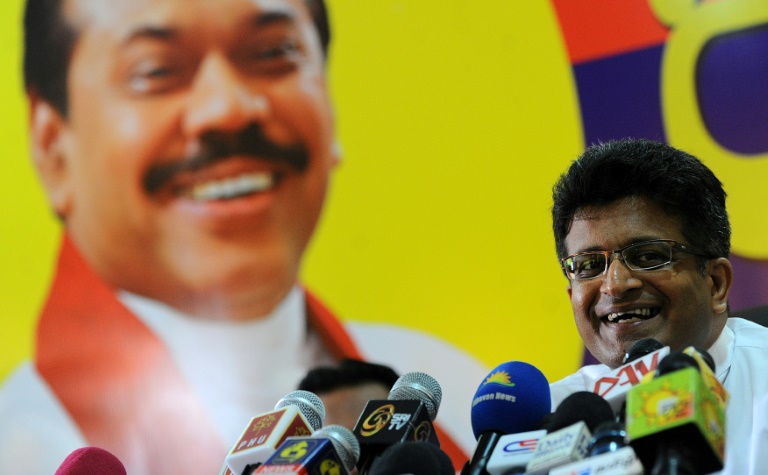
Sri Lanka on Thursday ended a heavily criticised policy that required Muslim Covid-19 victims to be buried at a remote government-designated site in the absence of their families or final religious rites.

Only a year ago, Colombo reversed an initial policy of enforced cremations — prohibited by Islam — under intense international pressure, while still refusing to allow traditional burials at cemeteries.

In Thursday’s new directive, the country’s top health official said the bodies of virus victims could now be handed over to relatives for burial at any cemetery of their choosing.

“The method of disposal, burial or cremation, at any cemetery or burial ground is at the discretion of relatives,” Health Director-General Asela Gunawardena said.

The shift came as a UN Human Rights Council meeting in Geneva was set to discuss Sri Lanka’s treatment of religious minorities as well as Colombo’s overall rights record.

The forced cremations were halted a year ago after Pakistani Prime Minister Imran Khan visited Colombo and urged President Gotabaya Rajapaksa, a Buddhist, to respect Muslims’ funeral rites.

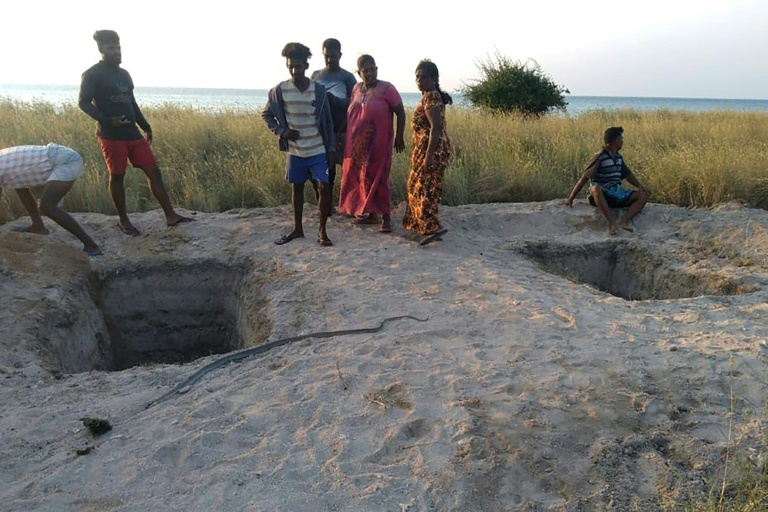
The government then allowed burials at the remote Oddamavadi area in the island’s east under military supervision, but without the bereaved family.

Sri Lanka’s Buddhist majority, strong backers of the current government, are typically cremated, as are Hindus. Muslims must be buried without a coffin and facing Mecca according to their religious beliefs.

Hardliners within the Buddhist community had argued that burials of virus victims could spread the virus through groundwater, an argument debunked by experts.

In December 2020, authorities ordered the cremation of at least 19 Muslim Covid-19 victims after their families refused to claim the bodies from a hospital morgue in protest against the forced cremations policy.

Muslim community leaders said many of their elders were reluctant to seek medical help for Covid-19 because they feared that they would be cremated if they were identified as having the virus.

Putin vows 'uncompromising fight' as Ukraine war enters second week

Russian President Vladimir Putin vowed no let-up in his invasion of Ukraine on Thursday, even as the warring sides met for ceasefire talks and Kyiv demanded safe passage for besieged civilians.

After the fall of a first major Ukrainian city to Russian forces, Putin appeared in no mood to heed a global clamour for hostilities to end as the war entered its second week.

“Russia intends to continue the uncompromising fight against militants of nationalist armed groups,” Putin said, according to a Kremlin account of a call with French President Emmanuel Macron.

Russian armoured columns from Crimea pushed deep into the southern Ukrainian region of Kherson on the first day of their invasion Thursday, triggering fighting that left at least 13 civilians dead.

Nine Ukrainian soldiers were also killed, the Kherson regional administration said, as the Russian force seized crossing points from Crimea to the mainland and a crossing over the Dnipro river.

But Ukraine insisted on the need for humanitarian corridors, to get urgent supplies into cities and trapped civilians out, as negotiators met at an undisclosed location on the Belarus-Poland border.

They shook hands across a table at the meeting’s start, the Ukrainian delegates in military khaki clothing and the Russians in more formal business suits

A first round of talks on Monday yielded no breakthrough, and Kyiv says it will not accept any Russian “ultimatums”.

Putin, however, said any attempts to slow the talks process would “only lead to additional demands on Kyiv in our negotiating position”.

Macron said he feared that “worse is to come” in the conflict and condemned Putin’s “lies”, according to an aide.

The invasion, now in its eighth day, has created a refugee exodus and turned Russia into a global pariah in the worlds of finance, diplomacy and sports. 

The UN has opened a probe into alleged war crimes, as the Russian military bombards cities in Ukraine with shells and missiles, forcing civilians to cower in basements.

“We will restore every house, every street, every city and we say to Russia: learn the word ‘reparations’,” Ukrainian President Volodymyr Zelensky said in a video statement. 

“You will reimburse us for everything you did against our state, against every Ukrainian, in full,” he said. 

– ‘Just like Leningrad’ –

Zelensky claims thousands of Russian soldiers have been killed since Putin shocked the world by invading Ukraine, purportedly to demilitarise and “de-Nazify” a Western-leaning threat on his borders.

Moscow said Wednesday that it has lost 498 troops, and Kremlin spokesman Dmitry Peskov said Putin praised their sacrifice.

“Their exploits will enter into the history books, their exploits in the struggle against the Nazis,” Peskov told reporters.

The Kremlin has been condemned for likening the government of Zelensky, who is Jewish, to that of Germany in World War II. 

But Russian Foreign Minister Sergei Lavrov kept up the verbal barrage, accusing Western politicians of fixating on “nuclear war” after Putin placed his strategic forces on high alert.

While a long military column appears stalled north of Ukraine’s capital Kyiv, Russian troops seized Kherson, a Black Sea city of 290,000 people, after a three-day siege that left it short of food and medicine.

Russian troops are also besieging the port city of Mariupol east of Kherson, which is without water or electricity in the depths of winter.

“They are trying to create a blockade here, just like in Leningrad,” Mariupol mayor Vadym Boichenko said, referring to the brutal Nazi siege of Russia’s second city, now re-named Saint Petersburg.

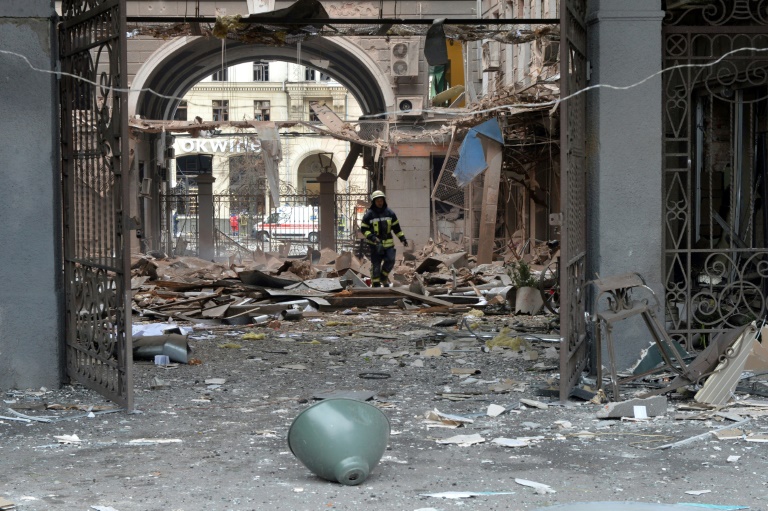
Ukrainian authorities said residential and other areas in the eastern city of Kharkiv had been “pounded all night” by indiscriminate shelling, which UN prosecutors are investigating as a possible war crime.

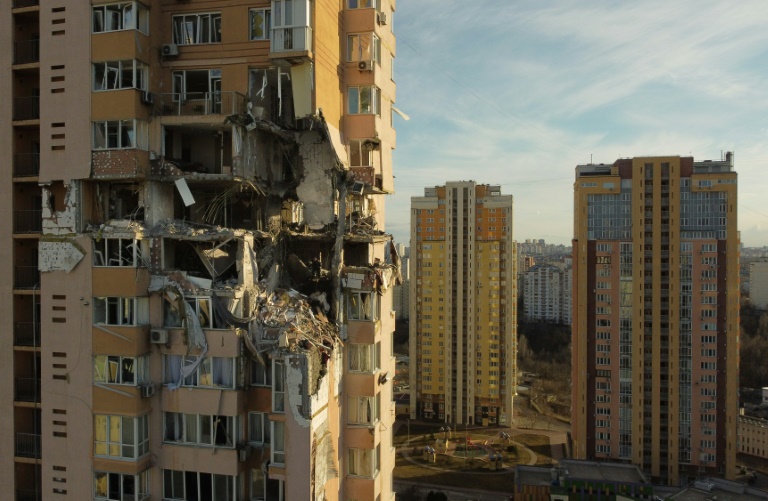
Oleg Rubak’s wife Katia, 29, was crushed in the rubble of their family home in Zhytomyr, west of Kyiv, by a Russian missile strike.

“One minute I saw her going into the bedroom. A minute later there was nothing,” Rubak, 32, told AFP amid the ruins in the bitter winter chill.

“I hope she’s in heaven and all is perfect for her,” he said, adding through tears, “I want the whole world to hear my story.”

– Junk status –

The war has displaced more than one million people, according to the United Nations. 

“Protect civilians, for God’s sake, in Ukraine; let us do our job”, UN emergency relief coordinator Martin Griffiths told AFP in Geneva.

The UN’s International Atomic Energy Agency urged Russia to “cease all actions” at Ukraine’s nuclear facilities, including the site of the 1986 Chernobyl disaster.

Putin now finds himself an international outcast, his country the subject of swingeing sanctions that sent the ruble into further freefall on currency markets on Thursday.

Russia’s central bank — whose foreign reserves have been frozen in the West — imposed a 30-percent tax on all sales of hard currency, following a run on lenders by ordinary Russians.

The unfolding financial costs were underlined as ratings agencies Fitch and Moody’s slashed Russia’s sovereign debt to “junk” status. 

Turmoil deepened on markets more broadly. European stocks slid and oil prices approached $120 per barrel. 

Swedish furniture giant Ikea became the latest to halt operations in Russia, as well as Belarus.

Russia’s sporting isolation worsened as it lost the right to host Formula One races. The International Paralympic Committee, in a U-turn, banned Russians and Belarusians from the Beijing Winter Games.

The UN General Assembly voted 141-5 to demand that Russia “immediately” withdraw from Ukraine. Only four countries supported Russia, and China abstained.

Europe stepped up practical support as well as diplomatic. The German government is planning to deliver another 2,700 anti-aircraft missiles to Ukraine, a source said. 

– Leaving everything behind –

Many Ukrainians have now fled into nearby countries, according to the UN refugee agency’s rapidly rising tally.

“We left everything there as they came and ruined our lives,” refugee Svitlana Mostepanenko told AFP in Prague. 

Nathalia Lypka, a professor of German from the eastern Ukrainian city of Zaporizhzhia, arrived in Berlin with her 21-year-old daughter.

“My husband and son stayed… My husband already served in the army, and he had to return to duty,” she said, before boarding a train for Stuttgart where friends were waiting.

Putin’s invasion has appeared hamstrung by poor logistics, tactical blunders and resistance from Ukraine’s outgunned military — as well as its ever-swelling ranks of volunteer fighters.

Russian authorities have imposed a media blackout on what the Kremlin euphemistically calls a “special military operation”.

Two liberal media groups — Ekho Moskvy radio and TV network Dozhd — said they were halting operations, in another death-knell for independent reporting in Putin’s Russia.

But Russians have still turned out for large anti-war protests across the country, braving mass arrests in a direct challenge to the president’s 20-year rule.

burs-jit/phz/pvh

European equities fall, as oil flirts with $120

European stocks mostly slid, oil briefly flirted with $120 per barrel before pulling lower and natural gas fired its way to another record peak Thursday as war raged in Ukraine.

The euro sank to the lowest level against the pound since mid-2016, as the bloody unrest triggers concerns over the eurozone’s economic recovery from the coronavirus pandemic.

In commodities trading, Brent North Sea crude reached $119.84 per barrel, the highest level since early 2012, while WTI touched $116.57, last seen in 2008 — though both gave up ground mid-session as their rally faded.

Europe’s reference Dutch TTF gas price earlier surged to a record 199.99 euros per megawatt hour, before heading back under 170 euros in mid-afternoon trade.

Russia is a major oil and gas producer.

“Supply side pressures remain high, as the conflict in Ukraine triggers new sanctions on Russia, which could soon extend to gas and oil exports and exacerbate the tightness felt in global markets,” noted ActivTrades senior analyst Ricardo Evangelista.

“US inventories continue to decline and the OPEC+ cartel is sticking to its pre-established output levels, despite the growing demand.”

Surging oil prices are playing a major role in sending global inflation to the highest levels in decades, forcing central banks to hike interest rates.

Amid the volatility, “the focus remains firmly fixated on the situation in Ukraine and nothing else matters, it seems, for the markets,” said Fawad Razaqzada, market analyst with ThinkMarkets.

“Uncertainty is weighing on risk appetite,” he added.

Federal Reserve chief Jerome Powell on Wednesday said he was in favour of a moderate pace of rate increases, with a 25-basis-point lift this month.

He warned that the “near-term effects on the US economy of the invasion of Ukraine, the ongoing war, the sanctions, and of events to come, remain highly uncertain”.

The comments soothed concerns that officials could announce an aggressive 50-basis-point lift. 

The issue of Fed tightening has cast a pall over stock markets for months, bringing a near two-year rally to an abrupt end, and that has now been compounded by the Ukraine crisis.

Analysts warned of market volatility for some time as fighting in Ukraine weighed further on the ruble and is sending other commodities produced by Russia, including aluminium, to record highs.

Bloomberg’s gauge of raw materials is closing in on the biggest weekly gain since at least 1960, the financial data provider said Thursday. 

Widespread international sanctions against Russia threaten to put its economy on its knees, while Moody’s and Fitch have slashed the country’s credit rating to junk.

It comes as Russian companies are removed from international stock markets.

Elsewhere, the European single currency on Thursday slid at one point to 82.76 pence per euro, the lowest level since Britain voted in favour of Brexit.

The eurozone remains vulnerable to energy markets volatility because of its dependency on Russian oil and gas supplies.

“The euro area is very exposed to the events in Ukraine, particularly on the energy side given how reliant it is on Russia,” Craig Erlam, analyst at OANDA trading group, told AFP.

– Key figures around 1500 GMT –  

Brent North Sea crude: DOWN 0.9 percent at $111.95 per barrel

West Texas Intermediate: DOWN 1.5 percent at $108.94 per barrel

New York – Dow: UP 0.6 percent at 34,080.82 points

London – FTSE 100: DOWN 1.0 percent at 7,348.71

Frankfurt – DAX: DOWN 0.5 percent at 13,936.15

Paris – CAC 40: DOWN 0.2 percent at 6,486.49

EURO STOXX 50: DOWN 0.2 percent at 3,813.18

Tokyo – Nikkei 225: UP 0.7 percent at 26,577.27 (close)

Hong Kong – Hang Seng Index: UP 0.6 percent at 22,467.34 (close)

Shanghai – Composite: DOWN 0.1 percent at 3,481.11 (close)

Euro/dollar: DOWN at $1.1084 from $1.1126 late Wednesday

Pound/dollar: DOWN at $1.3366 from $1.3405

Euro/pound: DOWN at 82.92 pence from 82.95 pence

Dollar/yen: UP at 115.66 yen from 115.51 yen

burs-bcp/rfj/cdw/ach 

Sri Lanka sacks energy minister as economic crisis deepens

Sri Lanka’s president sacked his energy minister on Thursday as fuel shortages left the near-bankrupt island facing its worst blackouts in 26 years and the nation’s buses largely sidelined.

Udaya Gammanpila was booted from the cabinet a day after publicly criticising the government’s monetary policy, saying it had worsened the dollar shortage that has slammed oil imports.

Another cabinet member who had accused Finance Minister Basil Rajapaksa, a younger brother of President Gotabaya Rajapaksa, of mismanagement was also sacked.

“The president used his executive powers to remove Industries Minister Wimal Weerawansa and Energy Minister Udaya Gammanpila with effect from today,” presidential spokesman Kingsly Rathnayaka said.

No reason was given for the summary dismissals, but official sources said the president was livid over their scathing attacks on the government’s handling of the worsening economic crisis.

Earlier in the day, the International Monetary Fund had warned the country’s foreign debt was “unsustainable”, and called for devaluation and higher taxes to revive the economy.

Since Wednesday, Sri Lankans have been subject to nationwide power cuts of seven-and-a-half hours a day, the worst since 1996, after thermal power stations ran out of fuel.

Public transport has also been crippled, with many fuel retailers out of diesel and some bus drivers reporting queueing for up to seven hours to top up.

Sri Lanka is in the grip of a severe foreign exchange shortage, with the country’s external reserves falling to $2.3 billion in January, down 25 percent from the previous month.

A wide-ranging import ban imposed in March 2020 to save foreign exchange has led to shortages of essentials, including food, medicines and industrial raw materials.

International rating agencies have downgraded Sri Lanka, saying there were doubts if the South Asian nation can service its $51 billion foreign debt. Colombo has insisted it will honour its obligations.

Algeria journalist's jail sentence suspended on appeal

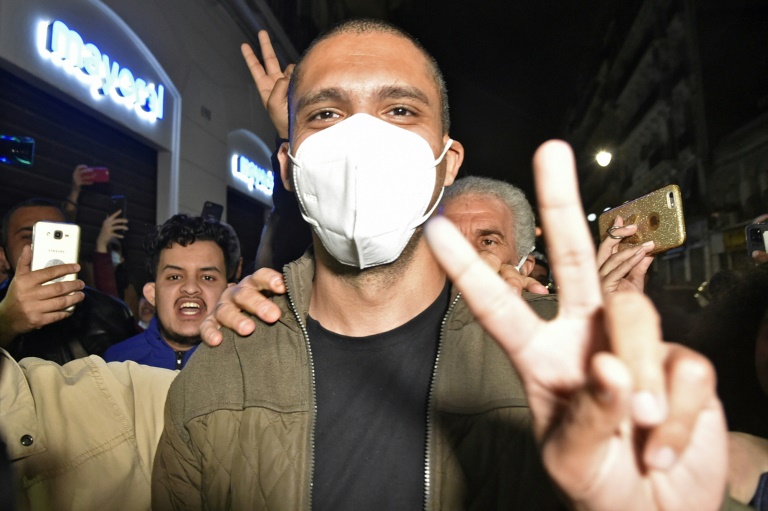
Algerian journalist and press freedom activist Khaled Drareni had a two-year jail term reduced on appeal to a six-month suspended sentence on Thursday, a detainees’ rights group said. 

The 41-year-old — who became a symbol of the country’s struggle for media freedom — used to work for French channel TV5 Monde and press freedom group Reporters without Borders (RSF).

He was sentenced in September 2020 for “inciting” demonstrations and “attacking national unity”.

The National Committee for the Liberation of Detainees announced the reduction in his sentence.

Charges related to his coverage of demonstrations held by the Hirak opposition movement in 2020, a year after the mass protests toppled longtime president Abdelaziz Bouteflika.

In February 2021, President Abdelmajid Tebboune pardoned Drareni after 11 months behind bars, but the following month the high court ruled his case could be re-examined.

The prosecution had requested a heavier sentence against him.

On Wednesday Drareni had tweeted: “Thank you everyone for your ongoing support. Whatever the verdict… I will continue my work fully independently.”

RSF had called the two-year sentence “absurd and arbitrary”.

Algerian rights group LADDH says several journalists remain behind bars in the country, which ranks 146th out of 180 countries on RSF’s World Press Freedom index.

Marilyn Manson accuses Evan Rachel Wood of conspiracy after rape claim

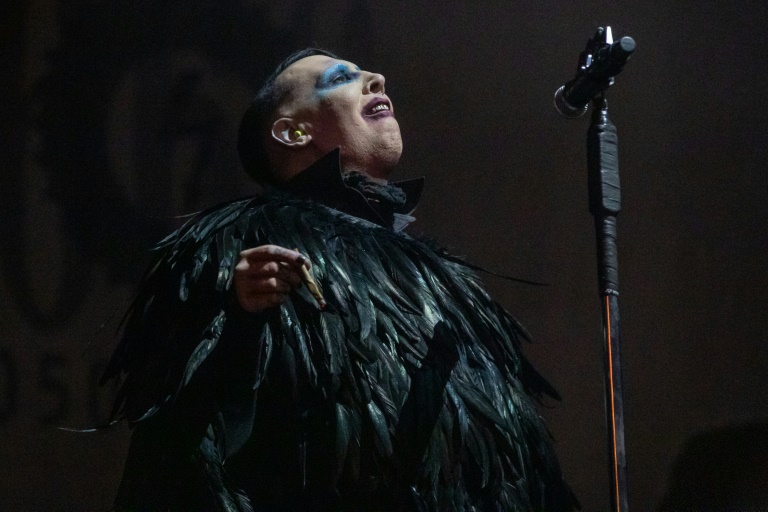
Goth rocker Marilyn Manson on Wednesday filed court proceedings against ex-fiancee Evan Rachel Wood for conspiracy, fraud and defamation after the US actress accused him of raping her.

The complaint accuses Wood and her “romantic partner” actor Illma Gore of fabricating malicious claims against Manson, including fraudulently impersonating an FBI agent to pressure “prospective accusers to emerge simultaneously with allegations of rape and abuse.”

Wood’s accusation became public in January, when she said Manson raped her on camera during the filming of a music video for his 2007 hit single “Heart-Shaped Glasses.” 

The allegations — denied by Manson — were made in the HBO documentary “Phoenix Rising,” due to be released later this month.

“We had discussed a simulated sex scene. But once the cameras were rolling, he started penetrating me for real,” she said.

“I had never agreed to that.”

The former child actress began dating Manson — whose real name is Brian Warner — in 2006 when she was 18 and he was 37.

Manson’s complaint, filed before the Los Angeles Superior Court, says Wood and Gore provided accusers with “checklists and scripts” and made “false statements to prospective accusers” as part of a scheme that “could benefit them both.”

Manson has asked for a jury trial to stop the allegations and to assess and award damages incurred by the singer. 

Terming the actions “invasive, harassing, defamatory, and otherwise injurious,” Manson’s lawyers said in the complaint that Gore “hacked” his computers, phone, email and social media accounts. 

Known for his controversial image and stage name evoking killer Charles Manson, the rocker has been accused by multiple women of sexual assault, including “Game of Thrones” actress Esme Bianco.

Los Angeles police last year confirmed they were investigating domestic violence allegations against the singer. 

Manson posted the court documents on Twitter, saying: “There will come a time when I can share more about the events of the past year. Until then, I’m going to let the facts speak for themselves.” 

“Phoenix Rising” documents efforts by Wood and other sexual assault survivors to extend the statute of limitations for sex crimes, allowing women more time to seek justice following abuse.

Close Bitnami banner
Bitnami