
World
Ukraine pounded as Russia seizes key city ahead of talks
Ukraine demanded Thursday that Russia provide humanitarian corridors to allow in much-needed supplies to cities wracked by war, as Moscow’s invasion entered a second week.
After the fall of the first major Ukrainian city to Russian forces, the warring sides were meeting for more talks, after an earlier encounter failed to agree a ceasefire.
But Kyiv insisted that corridors for medical and other supplies were the bare minimum it expected, as negotiators arrived for the talks at an undisclosed location on the Belarus-Poland border.
A first round of talks on Monday yielded no breakthrough, and Ukraine says it will not accept any Russian “ultimatums”.
The invasion, now on its eighth day, has driven one million Ukrainians from their homes and turned Russia into a global pariah in the worlds of finance, diplomacy and sports.
The UN has opened a probe into alleged war crimes, as the Russian military bombards cities in Ukraine with shells and missiles, forcing civilians to cower in basements.
“We will restore every house, every street, every city and we say to Russia: learn the word ‘reparations’,” Ukrainian President Volodymyr Zelensky said in a video statement.
“You will reimburse us for everything you did against our state, against every Ukrainian, in full,” he said.
– ‘Just like Leningrad’ –
Zelensky claims thousands of Russian soldiers have been killed since Russian President Vladimir Putin shocked the world by invading Ukraine, purportedly to demilitarise and “de-Nazify” a Western-leaning threat on his borders.
Moscow says it has lost 498 troops and Kremlin spokesman Dmitry Peskov said Putin would praise their sacrifice at a meeting with his security chiefs later Thursday.
“It’s a huge tragedy,” Peskov told reporters in Moscow.
“But we also admire the heroism of our soldiers. Their exploits will enter into the history books, their exploits in the struggle against the Nazis.”
The Kremlin has been condemned for likening the government of Zelensky, who is Jewish, to Germany’s in World War II.
Russian Foreign Minister Sergei Lavrov kept up a verbal barrage, accusing Western politicians of fixating on “nuclear war” after Putin placed his strategic forces on high alert.
While a long military column appears stalled north of Ukraine’s capital Kyiv, Russian troops seized Kherson, a Black Sea city of 290,000 people, after a three-day siege that left it short of food and medicine.
Russian troops have been advancing elsewhere on the southern front and are besieging the port city of Mariupol east of Kherson, which is without water or electricity in the depths of winter.
“They are trying to create a blockade here, just like in Leningrad,” Mariupol mayor Vadym Boichenko said, referring to the siege of Russia’s second largest city, since re-named Saint Petersburg, by Nazi Germany’s invading army in World War II.
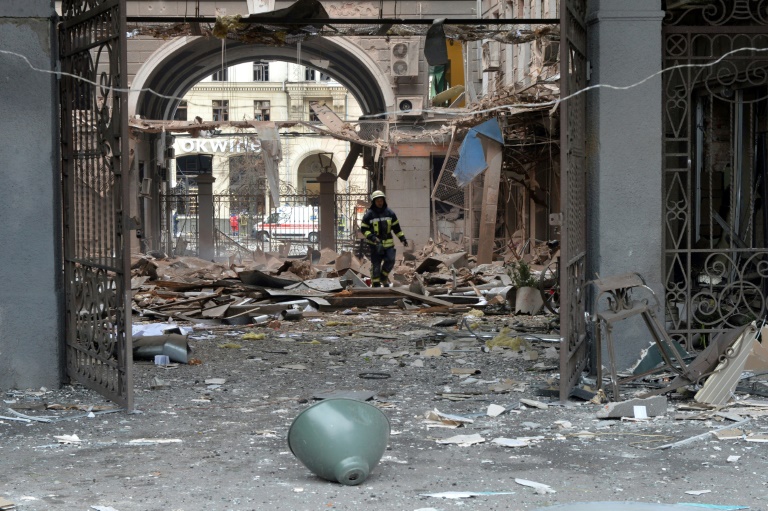
Ukrainian military authorities said residential and other areas in the eastern city of Kharkiv had been “pounded all night” by indiscriminate shelling, which UN prosecutors are investigating as a possible war crime.
Oleg Rubak’s wife Katia, 29, was crushed in the rubble of their family home in Zhytomyr, 150 kilometres (93 miles) west of Kyiv, by a Russian missile strike.
“One minute I saw her going into the bedroom, a minute later there was nothing,” Rubak, 32, told AFP, standing stunned and angry amid the ruins in the bitter winter chill.
“I hope she’s in heaven and all is perfect for her.”
He sobbed, apologised, and continued: “I want the whole world to hear my story.”
– Junk status –
The UN says the war has displaced more than one million people. “Protect civilians, for God’s sake, in Ukraine; let us do our job”, emergency relief coordinator Martin Griffiths told AFP in Geneva.
The UN’s International Atomic Energy Agency urged Russia to “cease all actions” at Ukraine’s nuclear facilities, including the site of the 1986 Chernobyl disaster.
Putin now finds himself an international outcast, his country the subject of swingeing sanctions that sent the ruble into further freefall on currency markets Thursday.
Russia’s central bank — whose foreign reserves have been frozen in the West — imposed a 30-percent tax on all sales of hard currency, following a run on lenders by ordinary Russians.
The unfolding financial costs were underlined as ratings agencies Fitch and Moody’s slashed Russia’s sovereign debt to “junk” status.
Turmoil deepened on markets more broadly. European stocks slid, oil prices approached $120 per barrel, and the euro sank to the lowest level against the pound since mid-2016.
Swedish furniture giant Ikea became the latest to halt operations in Russia, as well as Belarus, saying nearly 15,000 employees would be affected.
Russia’s sporting isolation worsened as it lost the right to host Formula One races and the International Paralympic Committee, in a U-turn, banned Russians and Belarusians from the Beijing Winter Games.
The UN General Assembly voted 141-5 to demand that Russia “immediately” withdraw from Ukraine. Only four countries supported Russia — Belarus, Eritrea, North Korea and Syria. China abstained.
Europe stepped up practical support as well as diplomatic. The German government is planning to deliver another 2,700 anti-aircraft missiles to Ukraine, a source said.
– Leaving everything behind –
Many Ukrainians have now fled into nearby countries, according to the UN refugee agency’s rapidly rising tally.
“We left everything there as they came and ruined our lives,” refugee Svitlana Mostepanenko told AFP in Prague.
Nathalia Lypka, a professor of German from the eastern Ukrainian city of Zaporizhzhia, arrived in Berlin with her 21-year-old daughter.
“My husband and son stayed… My husband already served in the army, and he had to return to duty,” she said, before boarding a train for Stuttgart where friends were waiting.
Putin’s invasion has appeared hamstrung by poor logistics, tactical blunders and fierce resistance from Ukraine’s outgunned military — as well as ever-swelling ranks of volunteer fighters.
Scores of images have emerged of burned-out Russian tanks, the charred remains of transporters and of unarmed Ukrainians confronting bewildered occupation forces.
US officials say the massive column of Russian military vehicles amassed north of Kyiv has “stalled” due to fuel and food shortages.
Russian authorities have imposed a media blackout on what the Kremlin euphemistically calls a “special military operation”.
The Ekho Moskvy radio station — a symbol of new-found media freedom in post-Soviet Russia — said it would shut down after being taken off air over its invasion coverage.
But Russians have still turned out for large anti-war protests across the country, in a direct challenge to Putin’s 20-year rule.
Thousands of anti-war demonstrators have been detained.
“I couldn’t stay at home. This war has to be stopped,” student Anton Kislov, 21, told AFP.
burs-jit/dc/jm
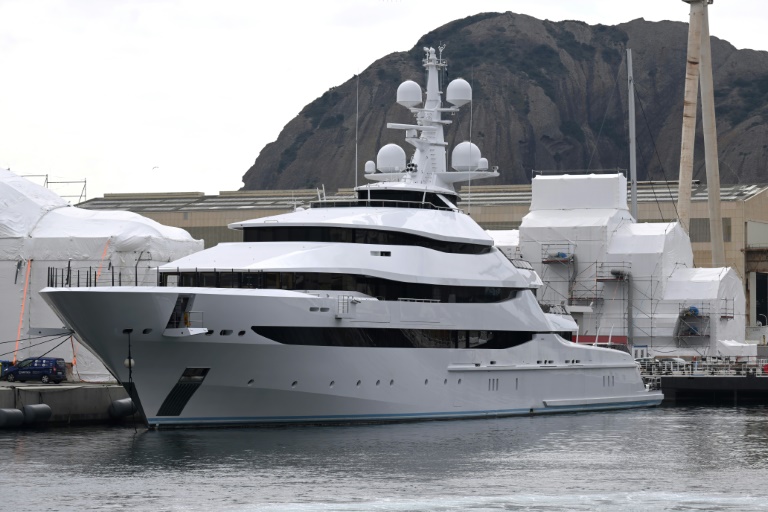
France seizes Russian oil supremo's yacht as EU sanctions bite
France said Thursday it had seized a superyacht owned by Russia’s oil czar Igor Sechin, following through on threats to target sanctioned oligarchs close to Russian leader Vladimir Putin.
The vessel, “Amore Vero”, was seized at a shipyard at La Ciotat on the French Riviera, a popular summer playground for the super-rich where many tycoons moor their vessels for pleasure or maintenance.
“French customs carried out the seizure of the yacht Amore Vero in La Ciotat as part of the implementation of sanctions by the European Union against Russia,” a statement for the French finance ministry said.
The 85.6-metre (280 ft) vessel was owned by a company “in which Sechin is the main shareholder”, the statement added.
Sechin, seen as part of Putin’s tightest inner circle and a former deputy prime minister, is chief executive of Russian oil giant Rosneft.
Forbes magazine reported that German authorities have also seized the superyacht “Dilbar” belonging to billionaire businessman Alisher Usmanov.
Rory Jackson, business editor at the Superyacht Group, said that the boats being targeted were likely in Europe because they were undergoing maintenance.
“At this point in the year, it’s the end of the Caribbean season and the Mediterranean season will start in May,” he told AFP. “The yachts that are in Europe in this period, they’re probably having refit work done.”
He said there was evidence that Russian owners were keeping their vessels in the Caribbean or moving them to places such as the Seychelles.
Authorities in the Maldives have told AFP that the “Clio” superyacht belonging to sanctioned billionaire Oleg Deripaska has anchored off its capital, along with the “Titan” vessel owned by steel magnate Alexander Abramov.
The megayacht Solaris owned by Roman Abramovich is currently shown as located in Barcelona in Spain, according to specialist ship tracking websites, and is thought to be undergoing maintenance.
Abramovich has not been sanctioned, but announced Wednesday that he was divesting from Chelsea football club in a possibly pre-emptive move.
Putin himself has been repeatedly linked to the 80-metre superyacht “Graceful”, which was moved from the German port of Hamburg to the Russian enclave of Kalingrad on the Baltic Sea in early February, Marinetraffic.com data shows.
– Sanctions –
The European Union, the United States and Britain have all announced sanctions against Russian tycoons that are closely connected to Putin.
“Those who enable the invasion of Ukraine will pay a price for their action,” EU foreign policy chief Josep Borrell said on Monday as he announced new measures following Russia’s invasion of Ukraine last Thursday.
These included sanctions against Sechin, pipeline boss Nikolay Tokarev, bankers Mikhail Fridman and Petr Aven and others.
Paris has said it is drawing up a list of assets in France owned by oligarchs including yachts and luxury cars, with the southern Rivera coastline long being a magnet for the rich and famous.
“If I were an oligarch, in Russia or France, I’d be worried,” French Foreign Minister Minister Jean-Yves Le Drian said on Monday.
US President Joe Biden has also tasked the Department of Justice with assembling a task force to “to find and seize their yachts, their luxury apartments their private jets.”
The 85.6-metre (280 ft) “Amore Vero” vessel seized by France on Thursday was made by Netherlands-based yacht builder Oceanco and includes a swimming pool that turns into a helipad.
Sechin is seen as one of Russia’s most powerful men and worked with Putin since the 1990s when they both worked in the Saint Petersburg mayor’s office.
– Weak spot? –
Russians have long been major buyers of superyachts — pleasure vessels classed as being more than 30 metres long — which are usually owned by companies registered in low-tax jurisdictions such as the Cayman Islands.
The London-based Superyacht Group estimates they make up about 10 percent of the global market.
“It’s not a majority, but its a significant portion,” Jackson said.
The EU sanctions are expected to badly hit the businesses of European superyacht builders concentrated in the Netherlands, Germany, Spain and Britain, as well as people who serve as crew.
But campaigners have long argued that Putin depends on the loyalty of the tight group of businessman around him, and that targeting their wealth is a way of destabilising his regime.
“So far, the lists are quite short of which oligarchs are going to be sanctioned. They need to be much longer,” campaigner Bill Browder told AFP this week.
“Many oligarchs hide their money in names of family members, and so we need to go after the family members,” he added.
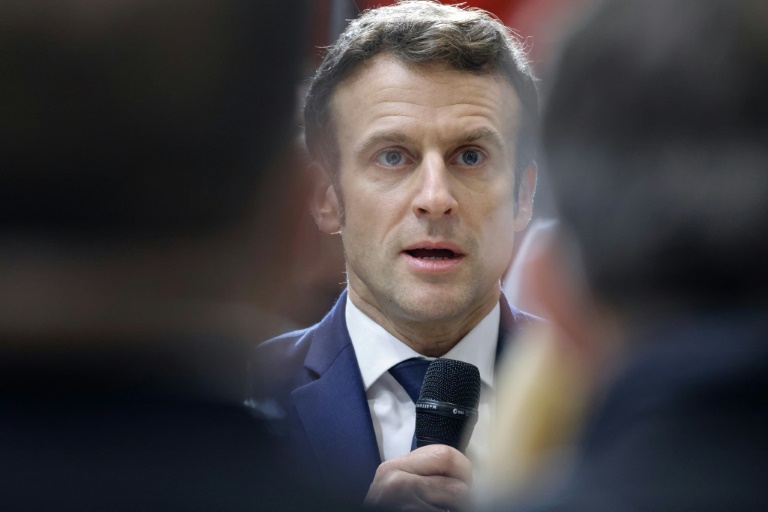
Macron to unveil bid for second term
French President Emmanuel Macron will announce later Thursday that he will seek a second term in office at elections next month, aides said, with Russia’s war in Ukraine likely to eclipse the campaign but boost his chances.
Macron will formally announce his attempt to become the first French president to be re-elected in 20 years in a “letter to the French” that will be published online, the sources told AFP.
There was little suspense about the 44-year-old’s intentions, but the announcement has been repeatedly delayed because of the crisis in eastern Europe that has seen Macron take a prominent role in diplomatic talks.
Ahead of Friday’s deadline for candidates to stand, polls widely show him as the frontrunner in the two-round election on April 10 and 24, with the war focusing attention on foreign policy rather than the domestic issues favoured by his opponents.
“In a crisis, citizens always get behind the flag and line up behind the head of state,” said Antoine Bristielle, a public opinion expert at the Jean-Jaures Foundation, a Paris think-tank.
“The other candidates are inaudible. In every media, all anyone is talking about is the invasion,” he told AFP.
One ruling party MP told AFP this week the Ukraine crisis meant that Macron’s rivals were “boxing on their own”, while several polls have shown his personal ratings rising.
The former investment banker admitted in a national address on Wednesday night that the crisis had “hit our democratic life and the election campaign” but promised “an important democratic debate for the country” would take place.
Voter surveys currently tip the centrist to win the first round of the election with 26 percent and then triumph in the April 24 run-off irrespective of his opponent.
– Rivals –
After five tumultuous years in office, Macron’s biggest challenge comes from opponents on his right who accuse him of being lax on immigration, soft on crime and slow to defend French culture.
These include the conservative Valerie Pecresse from the Republicans party, far-right candidate Marine Le Pen and anti-Islam media pundit Eric Zemmour.
On the left, four mainstream candidates are competing, which is expected to split the vote and lead to all of them being eliminated in the first round.
Macron’s camp have been looking for the right moment to launch his candidacy since early February, but the Ukraine crisis has seen his agenda filled with either foreign trips or talks with other leaders.
He spoke for the third time in a week to Russian President Vladimir Putin on Thursday and again with Ukrainian counterpart President Volodymyr Zelensky.
A recent poll by the Elabe group, published March 1, showed that confidence in Macron’s “ability to tackle the main problems of the country” was up a massive five points in a month.
Another by the Harris Interactive group showed 58 percent of French people held a favourable view of his handling of the Ukraine crisis
Allies of the president are quietly confident, but analysts warn many voters remain undecided and that sentiment can swing sharply in the final weeks of campaigning.
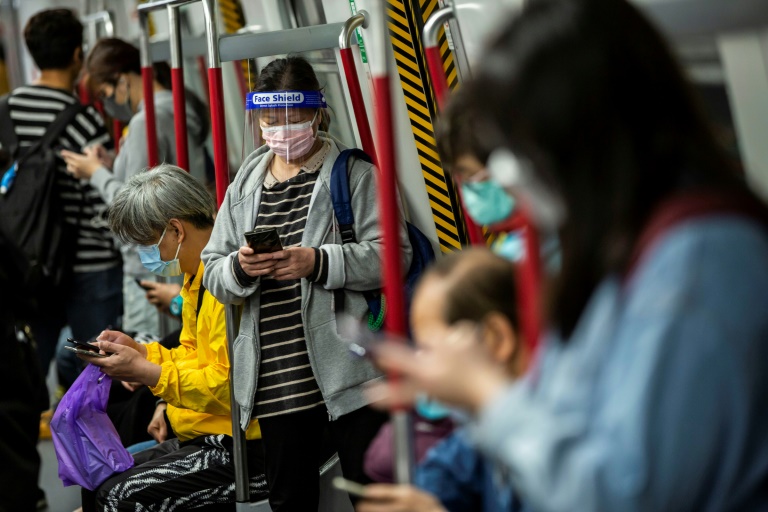
Top Hong Kong Covid expert says mass-testing plan 'unhelpful'
One of Hong Kong’s top coronavirus experts on Thursday joined a growing chorus of criticism over plans to test the entire city, saying doing so during its worst-ever outbreak would have little impact.
The Asian financial hub is registering tens of thousands of new cases each day, overwhelming hospitals and shattering the city’s zero-Covid strategy.
China has ordered local officials to stamp out the current wave even as studies estimate as many as a quarter of the city’s residents may have already been infected.
Authorities plan to test all 7.4 million residents later this month and are scrambling to build a network of isolation camps and temporary hospitals, with China’s help, to house the infected.
The criticism from Yuen Kwok-yung, a veteran microbiologist who led the city’s fight against SARS in 2003, follows multiple other local health experts taking issue with the strategy this week.
Yuen, a key government pandemic adviser, said mass testing can help break transmission chains when there are “only a few dozen or a few hundred cases a day” and has been deployed successfully in mainland China when outbreaks first emerge.
“If we are recording over 50,000 new cases every day, I don’t think (mass testing) will be very helpful,” he told reporters.
“If we do not have sufficient isolation facilities, the effectiveness of compulsory testing will be very low.”
Yuen’s comments add to a growing gulf between Hong Kong experts and their mainland counterparts, who are increasingly directing the city’s fight via a joint task force set up in neighbouring Shenzhen.
China is the only major economy still hewing to a zero-Covid strategy.
– Record-breaking caseload –
Hong Kong authorities have said they still plan to try and isolate infected residents in camps.
About 70,000 units are expected to come online in the coming weeks, in requisitioned hotels and public housing as well as camps.
But that is a fraction of what would be needed.
On Thursday alone, Hong Kong reported a record 56,827 new infections, bringing the total to nearly 338,000 since the highly transmissible Omicron variant broke through.
More than 1,100 have died, the vast majority unvaccinated elderly people.
The real infection numbers are likely far higher, in part because residents worried about being sent to camps are afraid to tell authorities they have tested positive.
The isolation and mass-testing plans have compounded uncertainty in Hong Kong this week.
Panic buying has stripped some supermarket shelves bare, while the United States warned against travel to the city citing, in part, the risk of children being separated from parents.
Hong Kong’s subway operator, bus and ferry companies as well as a major supermarket chain have all announced reduced operations.
The city’s poorest and most vulnerable communities, meanwhile, have been hit hardest.
On Thursday, local charity the Justice Center warned there was “a humanitarian crisis in the making” as the city’s 14,000 refugees were struggling to buy food as costs spiral.
Refugees and asylum seekers cannot work in Hong Kong and have to live on a small allowance from the government.
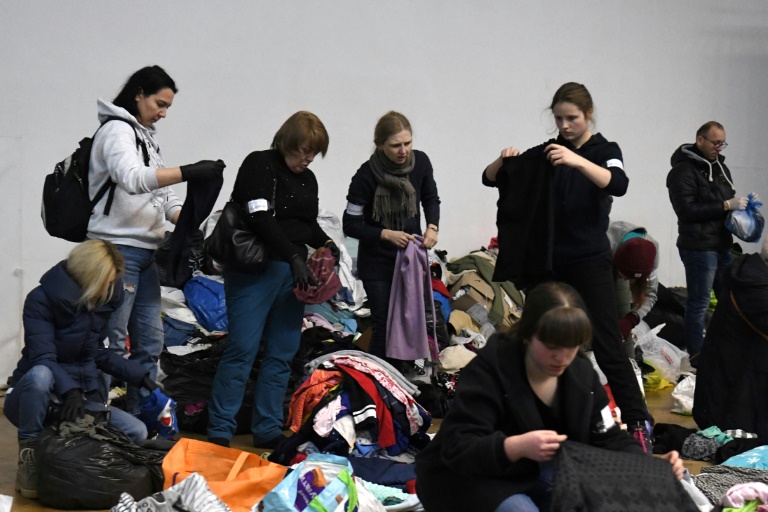
Lviv's Art Palace turns Aid HQ for Ukrainians under the bombs
Lviv’s imposing Art Palace buzzes from dawn to curfew with volunteers sorting through donations from Europe that are flooding into this west Ukrainian city.
A 36-tonne red lorry pulls into the car park, navigating the mounds of boxes and occasional electricity generator.
In the space of a few minutes, a human chain has formed to unload bags of garments from the truck: men’s trousers, women’s jackets, baby clothes.
Where is this mountain of goodwill going to?
“All over the place!” says Art Palace director Yuri Vyzniak.
The army and self-defence brigades manning the region’s checkpoints will, of course, get a good proportion of the food.
But many ordinary Ukrainians also urgently need aid, including the tens of thousands who have flocked to this city near the border with Poland, some hoping to cross into the European Union.
“For example yesterday we sent out about 50 busloads of aid. We also sent out 40 tonnes of essential supplies to Odessa and, I think, about 10 tonnes to Kherson and Kyiv,” says Vyniak, who remains dapper and dynamic despite fatigue.
The Aid HQ, as he calls it, was his idea. He set it up on the morning of February 24 — “ie, two or three hours after the Russian occupation forces started bombing”.
He sounds tired rather than proud.
– ‘Independence first’ –
The vast hall of the 9,000-square-metre (97,000-square-foot) building hums with volunteers bustling back and forth, occasionally refuelling en route from the vats of “vareniki” — Ukranian ravioli — doing the rounds among the workers.
Anyone who stops for a breather is instantly chastised.
Vyzniak commandeers Iryna Dudko to show us round.
In her past life — before February 24 — she was a shop assistant.
Now she has her hair scraped back in a ponytail and a bit of paper with “Volunteer” scrawled on it taped hastily to her chest.
“My job is the last thing on my mind at the moment. What we need most is our health. And our independence,” she says.
Aid HQ — a palatial faux Art Nouveau exhibition and cultural centre — runs like clockwork.
Basement: medicines. Ground floor: food and a stand where displaced people can register their needs. First floor concert hall: children’s clothes and toys. Second floor: supplies for newborn babies.
In the newborn section, a dozen women and a handful of men carefully fill black bin bags with packets of nappies, sorted by size. Behind them is a wall of nappies, two metres (6.5 feet) high.
Work slows when the curfew kicks in at 10 pm but it doesn’t stop.
“People who have the right passes carry on through the night,” Vyzniak says.
– Churches and hipsters –
Similar initiatives are popping up all over Lviv, a gutsy city which sees itself as the country’s cultural capital.
Instead of drum and bass gigs and modern art displays, one arts venue in the city centre now houses a refugee reception centre. Some of the displaced sleep in the hipster barber’s shop down the road.
“We’ve got 11 people her just now but we’re expecting more from Kharkiv today,” says coordinator Stepok. He returned to Lviv in 2020 after seven years in Vietnam and didn’t expect then to be manning an emergency shelter for fellow Ukranians.
Help isn’t just on hand for people fleeing the bombs. An elderly lady makes her way down the street on her way to the chemist’s. A teenager stops her. “We’ve ordered your pills. They’re there,” she tells her.
In the Greek-Catholic church of the Holy Apostles Peter and Paul, military chaplain Roman Mentukh is also fielding gifts of aid.
“It’s very moving, especially when elderly people come in and you realise they’re bringing us the only things they have left,” the young man says.
Donations brought to the historic garrison church are destined for the country’s soldiers and Mentukh accepts “everything but weapons”.
A corner of the nave under the 17th-century oil paintings is piled with camouflage uniforms ready to dispatch to the front.
Mentukh’s chokes up when he recounts how he celebrated mass with weeping parishioners on the morning of February 24 and says how proud of them he feels.
“Of course people panicked at first but now they’re getting organised… They understand that we all need to be in this together to win this war.”
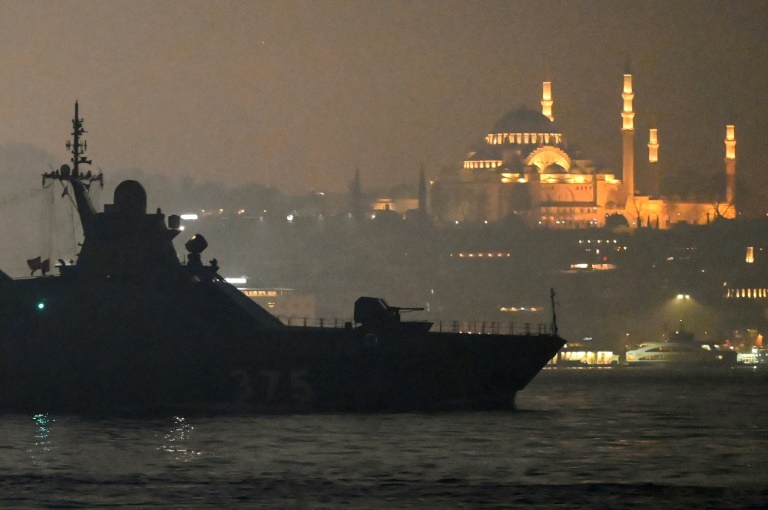
Turkey walks a diplomatic tightrope in Russia-Ukraine war
The signs of Russian presence have long been visible in Turkey, from rows of tourists on Antalya beaches to the Russian battleships ploughing their way through the Bosphorus.
President Recep Tayyip Erdogan has worked hard to forge close ties with his counterpart Vladimir Putin, despite being on opposing sides of several conflicts, including in Syria and Libya.
Ankara has bought Russian missile defence systems against the wishes of its NATO partners and is dependent on Moscow for energy and trade.
They even managed to leave behind a crisis sparked by the downing of Russian military jet by Turkey in 2015.
But now he finds himself in a delicate balancing act.
Ukraine is Turkey’s closest post-Soviet ally in the region and Ankara wants to show solidarity without triggering the full-blown ire of Moscow.
Erdogan visited Kyiv only last month to ink a deal on expanding drone production in Ukraine.
The use of Turkish Bayraktar TB2 drones in the war has been a clear source of tension with Russia.
For some analysts, Turkey’s position is clearer than it might seem.
“Turkey is actually not balancing between Russia and Ukraine. Turkey is actively supporting Ukraine and pivoting away from Russia,” Ozgur Unluhisarcikli of the German Marshall Fund told AFP.
“Turkey is treading carefully so as not to attract Russian retribution,” he said.
– ‘Skilful diplomacy’-
Turkey depends on Russia for energy supplies, importing 44 percent of its gas from Russia last year.
Russians also made up 19 percent (4.7 million) of its foreign visitors last year.
Such factors have led Erdogan to insist he will “not abandon either Russia or Ukraine”.
Turkey has offered to host talks between their leaders and has refused to join sanctions against Moscow, abstaining during a vote at the Council of Europe.
But it also blocked warships from using the key Bosphorus and Dardanelles waterways that Russia needs to access the Black Sea from the Mediterranean.
Foreign Minister Mevlut Cavusoglu said Tuesday that Ankara denied access to three Russian warships through the straits on February 27-28, because they were not registered to Black Sea bases.
This was not a major blow to Russia, said Turkey analyst Anthony Skinner, since Russia’s Black Sea Fleet was already deployed in the campaign.
“The fact that Turkey has not closed its airspace to, or imposed sanctions on, Russia shows how concerned Ankara has been not to trigger a costly breach in relations with Moscow,” he said.
Sinan Ulgen of the Istanbul-based EDAM think tank praised Ankara’s “skilful diplomacy” and said limiting access to its waterways was “not a sanction against Russia” but a “very firm position” in applying an international treaty.
Turkey is bound to block access to battleships in time of war under the 1936 Montreux Convention.
– ‘Vulnerabilities’ –
And despite its desire to help Ukraine, Turkey is vulnerable in other areas.
“Turkey and Russia have unresolved issues in Syria, Libya and Nagorno-Karabakh which means that if Turkey goes too far with this policy, Russia can exploit Turkey’s vulnerabilities,” said Unluhisarcikli.
This is a particular problem for Erdogan as he fixates on the presidential elections in 2023, Skinner added.
But it could also be an opportunity.
“While Erdogan will not throw all his eggs in one basket, this crisis could offer an opening to at least partially mend some of the many fences that have been damaged with the West,” Skinner said.
“The big question is what Washington and other Western capitals have to offer. What is on the table for Turkey?”
Erdogan has already called on the EU to treat his country with the same concern as it does Ukraine, without waiting for it to be “hit by a war”.
“It required a catastrophe for that… Turkey won’t wait for a catastrophe.”
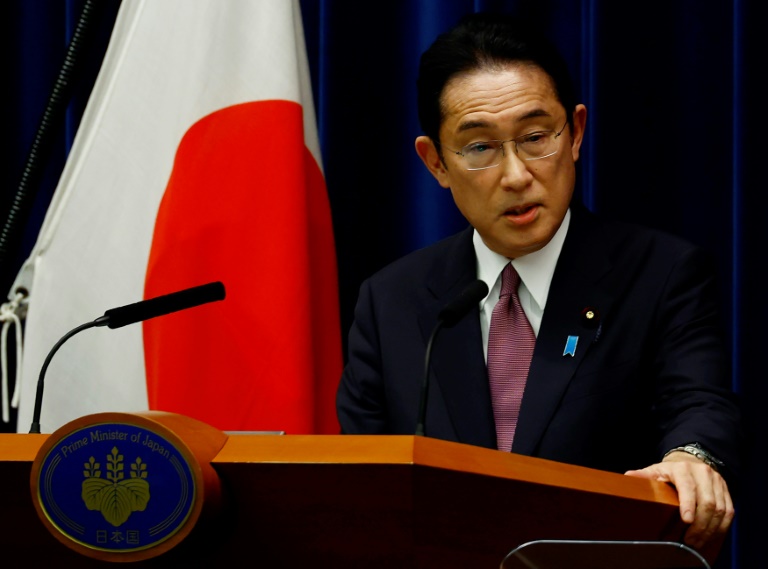
Japan plans $3 bn domestic relief package as oil prices surge
Japan plans to help residents and businesses facing difficulty due to a surge in oil prices fuelled by the Ukraine crisis with $3 billion in relief funds, Prime Minister Fumio Kishida said Thursday.
The price of crude oil has jumped to multi-year highs in recent days as investors fret over key producer Russia’s invasion of its neighbour.
Kishida said the Japanese government would use 360 billion yen ($3.1 billion) in emergency funds to “minimise the negative impact on people’s lives and corporate activity” caused by higher energy prices.
Details of the package will be announced on Friday, he told reporters.
They will likely include subsidies to mitigate the impact of “drastic changes in fuel prices” as the assault on Ukraine intensifies, Kishida said.
Japan has acted with its G7 partners to pressure Moscow over the invasion, and on Thursday Kishida said his country would freeze the assets of four Russian banks on top of three already sanctioned.
He also said virus measures imposed in parts of Japan, which mainly request venues to curb evening opening hours, would be extended for two weeks from Sunday in several areas including Tokyo.
Kishida will join a virtual summit later on Thursday with leaders of the United States, India and Australia, who are together known as the Quad.

