World

Australia orders 200,000 to flee floods, city of Sydney spared

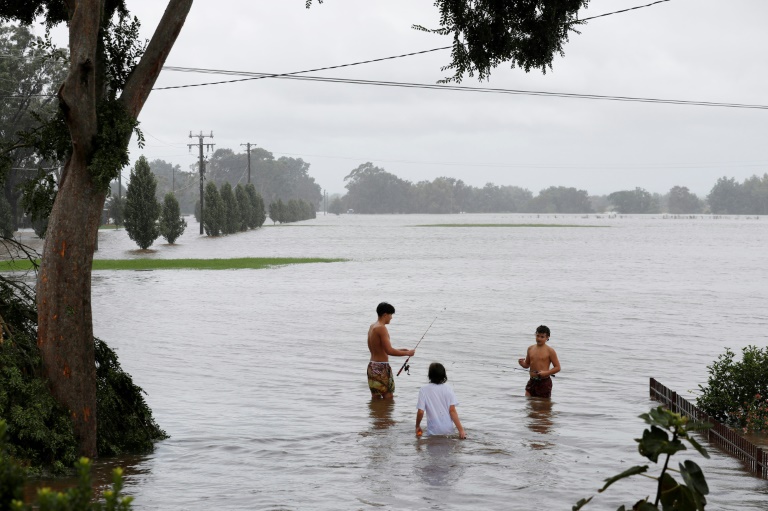
Australia’s emergency services Thursday ordered 200,000 people to flee from the path of a wild storm that has killed 13 people in a week of record-setting east coast floods, but the city of Sydney escaped the worst of the deluge.

Authorities issued severe rain and wind warnings for a 400-kilometre (250-mile) stretch of the coast as water levels rose rapidly — including in suburbs around Sydney, Australia’s largest city and home to five million people.

The unpredictable storm front has crawled southwards along the east coast from Queensland to New South Wales, creating havoc as rivers and reservoirs broke their banks with water swamping homes up to their roofs.

A low-pressure system sat off the coast hundreds of kilometres north of Sydney, dumping the heaviest rain in that area and sparing the city from a feared downpour, said meteorologist Ben Domensino of Weatherzone.

“Sydney escaped the heaviest falls today,” he told AFP, predicting that the storm would weaken by Friday.

The Warragamba Dam in southwestern Sydney, which supplies 80 percent of the city’s water, has been spilling over since the early hours of Wednesday.

The forecast of peak overflow at the dam was downgraded by nearly half on Thursday because rainfall in the dam’s catchment areas was less than had been predicted.

– ‘Unpredictable’ –

Major floods are still under way in some areas west of Sydney along the Hawkesbury and Nepean rivers — which snakes across the city’s suburbs — said a spokeswoman for the New South Wales bureau of meteorology.

“That’s a system that is very big and it will take a while for it to ease off,” she warned.

In the historic town of Windsor — where many of Australia’s oldest surviving European buildings are — Paul Caleo joined other locals watching the Hawkesbury River rise above the local bridge, cutting off access to homes and farms. 

Across the submerged bridge, an almost 120-year-old home stood alone on high ground surrounded by floodwaters.

“The river by its very nature is unpredictable,” Caleo said. 

Along Sydney’s historic harbour, Taronga Zoo prepared for an influx of injured wildlife from torrential rainfall and flooding.

The first fear was for young wildlife, small animals –- including echidnas and bandicoots -– and birds unable to escape surging floodwaters. 

Heavy downpours can make birds’ feathers so waterlogged they are unable to fly, a spokeswoman told AFP. 

As the floodwaters recede, concern will turn to the animals living in fresh water, including platypuses.

New South Wales’ emergency services said more than 70 evacuation orders were still in force across the state. 

“Many people are waking up today to see much of our state underwater,” New South Wales Premier Dominic Perrottet said earlier in the day.

“If you are subject to one of those evacuation orders, please get out,” he told a news conference, explaining that the evacuation orders affected 200,000 people.

– ‘We will be with you’ –

Scientists say climate change is making Australia’s floods, bushfires, cyclones and droughts more frequent and more intense.

“Australia is at the forefront of severe climate change,” said environmental expert Hilary Bambrick of the Queensland University of Technology.

“Temperatures are rising faster in Australia than the global average, and higher temperatures mean the atmosphere holds more moisture, meaning rainfall events are becoming more extreme.”

Across New South Wales, flood levels have climbed to the highest level in decades during the flooding disaster.

In towns such as Lismore in the state’s northeast, which is now cleaning up as flood waters retreat, people had clambered onto their rooftops, sometimes waiting many hours to be rescued from rising waters.

New South Wales said it was sending an extra 400 personnel to that region to help people on the “very, very long road” to cleaning up and recovering.

“Many people today in the Northern Rivers and over the last 24 hours have returned home, and they have returned home to devastating scenes,” state premier Perrottet said. “My message is we will be with you.”
Equities rise as Powell soothes rate fears, oil presses higher

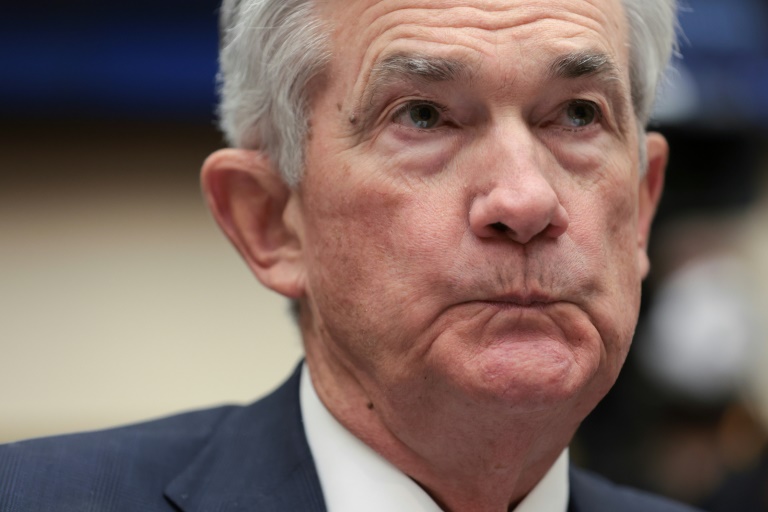
Asian stocks rose Thursday after Federal Reserve chief Jerome Powell said the bank would hike interest rates gradually to fight inflation, though oil marched higher as the Ukraine conflict continues to roil energy markets.

With the Russian invasion of its neighbour hammering all assets across the board as uncertainty reigns supreme, traders were given a much-needed shaft of light on Wednesday when the Fed boss eased concerns over its plans for tightening policy.

Powell told lawmakers he was in favour of a moderate pace of rate increases, with a 25-basis-point lift this month, as he tries to nurture the economic recovery while keeping a lid on prices, which are rising at their fastest pace in 40 years.

He warned that the “near-term effects on the US economy of the invasion of Ukraine, the ongoing war, the sanctions, and of events to come, remain highly uncertain”.

The comments soothed concerns that officials could announce an aggressive 50-basis-point lift. The issue of Fed tightening has cast a pall over markets for months, bringing a near two-year rally to an abrupt end, and that has now been compounded by the Ukraine crisis.

Powell did, however, say the bank would remain “nimble” to events and would act more aggressively if needed down the line.

Meanwhile, St. Louis Fed chief James Bullard said he was for a “rapid withdrawal of policy accommodation”, as Chicago president Charles Evans added that policy was currently “wrong-footed” and should be tightened.

Still, Powell’s comments were able to “appease risk-markets by ruling out a 50 basis-points hike in March, while simultaneously promising inflation vigilance at following meetings”, said Citigroup strategists William O’Donnell and Edward Acton.

Wall Street ended sharply higher with all three main indexes more than one percent up.

And Asia followed suit with Tokyo, Hong Kong, Sydney, Seoul, Taipei and Singapore leading healthy gains, though Shanghai and Mumbai edged slightly lower.

The gains were also helped by news that Ukraine and Russian officials will hold second round talks to end the war. 

But analysts warned of further volatility for some time as fighting continues to rage in Ukraine.

Widespread sanctions across the world against Russia threaten to put its economy on its knees, while Moody’s and Fitch have slashed its rating to junk.

Meanwhile, the country’s equities are to be removed from closely followed indexes by MSCI and FTSE Russell, further isolating Moscow from the global economy.

“It is clear the perpetual mega-bulls of the past two years are continuing to fight a rear-guard action, using their previously successful buy-the-dip playbook, refusing to accept that the central bank cookie jar is near empty and that Ukraine-Russia has changed everything,” said OANDA’s Jeffrey Halley.

While the war is making finance chiefs re-think their plans, central banks appear intent to keep on the tightening track for now, with the Bank of Canada on Wednesday announcing a rate rise.

The major source of angst for policy-setters is the spike in oil prices, which has been a key driver of inflation this year owing to narrow supplies and soaring demand and is now being amplified by the conflict in Europe.

On Thursday Brent continued to storm higher, at one point hitting $118.22 a barrel for the first time since early 2013. WTI touched $114.78 for the first time since 2011.

While world governments have not included Russian oil in their wide-ranging sanctions on Moscow owing to concerns about the impact on prices and consumers, trade has become increasingly tough as banks pull financing and shipping costs rise.

OPEC and other major producers, including Russia, refused Wednesday to lift output by more than their previously agreed amount, dealing a blow to hopes of an easing in supply pressures.

An agreement by the United States and 29 other countries to release 60 million barrels from their reserves has had little impact on the relentless rise in prices.

Other commodities are also elevated with European natural gas benchmarks and aluminium at records.

– Key figures around 0710 GMT –  

Brent North Sea crude: UP 3.4 percent at $116.76 per barrel

West Texas Intermediate: UP 3.5 percent at $114.45 per barrel

Tokyo – Nikkei 225: UP 0.7 percent at 26,577.27 (close)

Hong Kong – Hang Seng Index: UP 0.5 percent at 22,447.03

Shanghai – Composite: DOWN 0.1 percent at 3,481.11 (close)

Euro/dollar: DOWN at $1.1100 from $1.1126 late Wednesday

Pound/dollar: DOWN at $1.3404 from $1.3405

Euro/pound: DOWN at 82.81 pence from 82.95 pence

Dollar/yen: UP at 115.68 yen from 115.51 yen

New York – Dow: UP 1.8 percent at 33,891.35 (close)

London – FTSE 100: UP 1.4 percent at 7,429.56 (close)

US experts: militarily, the Russian invasion is a disaster so far

The Russian military’s initial invasion of Ukraine has been a surprising strategic and tactical blunder marked by food and fuel shortages, abandoned armored vehicles, aircraft losses and troop deaths, US experts say.

But the failures of the first days, including vastly underestimating the Ukrainians’ willingness to fight back, could lead to a frustrated Moscow deciding to unleash all its power and indiscriminately destroying large swathes of Ukraine, they said.

US specialists who study the Russian military say they have been astonished by the mismanagement of the campaign, which has seen invading columns stalled, apparently hundreds of Russian armored vehicles lost, and the Ukrainians preventing the Kremlin’s air force from controlling the skies.

“If you were going to screw it up two or three weeks in, I might understand it,” said Scott Boston, a senior defense analyst at the Rand Corp. think tank. 

“But if you, like, tripped over the doorframe on the way into the house, you have another issue,” he said.

– ‘Disaster, through and through’ –

The Pentagon and private sector experts expected Russian President Vladimir Putin’s army to quickly destroy Ukraine’s ability to fight back, undermining its command and control of the 200,000-strong Ukraine military, wrecking its missile defenses and destroying Kyiv’s air force. 

None of that has happened in the first six days. And, although there are no reliable estimates of the dead, injured and captured Russian troops, the numbers appear to be much higher than what would have been expected in a well-managed invasion.

“This is a colossal intelligence failure that vastly underestimated Ukrainian resistance, and military execution has been terrible,” Michael Vickers, former US Under Secretary of Defense for Intelligence, said this week at the Center for Strategic and International Studies.

“His main attack has been underweighted. It’s been piecemeal. His reconnaissance elements have been captured, columns have been destroyed,” he said.

“It’s just a disaster, through and through.”

– Aircraft losses –

An assessment by military experts of the Atlantic Council’s Scowcroft Center pointed to the crucial failure of the Russians to quickly seize and hold an airport just outside Kyiv.

The fight over the airport left it likely too damaged to use as planned to invade Kyiv, they said.

Moreover, they said, “Russian aircraft and helicopter losses have been surprisingly high and unsustainable,” because they did not destroy the Ukrainians’ air defenses.

Also surprising was the limited or ineffective deployment of electronic warfare weapons, which most analysts expected would have a significant role in attacking the Ukrainians’ ability to communicate.

“Were the Russians able to cut off Ukrainian military leaders from those they are commanding … Ukrainian air and air-defense forces would have been forced to fight in an uncoordinated fashion, making them less lethal and more susceptible to attack,” the Scowcroft Center report said.

Boston pointed out that the Ukrainians have continued to use their Turkish-made Bayraktar drones to destroy Russian armor.

“If they got hit with the Turkish drones once or twice, okay,” he said.

“If they got hit more than once or twice, something’s wrong on the Russian side.”

– Food shortages –

Pentagon spokesman John Kirby said that the Russians appeared to not coordinate well their sizable and diverse capabilities, or manage the logistics for the invasion.

“We’re seeing indications here early on that though they have sophisticated combined arms capabilities, that they’re not being necessarily fully integrated,” he said.

Equally surprising was their logistics shortcomings.

“We’re seeing vehicles abandoned. We’re seeing sustainment problems not just in fuel but in food,” he said Wednesday. 

Boston, who has taken part in high-level war games focused on the Russian force, said there are signs they much of the force is young, undertrained for this kind of conflict, and probably unaware they were even going to war.

He said it appeared, too, that the troops on the ground had no sense of what they were trying to do in invading Ukraine, with its longstanding ties to Russia.

“If you don’t know what’s going on … you can’t adapt,” he said.

None of the experts count the Russians out. The Russian force’s advance has stalled, but that could allow it to resolve its logistical problems, noted Kirby.

And to the contrary, they expect Putin’s frustration over the first days could lead to his unleashing the full force of his artillery, missiles and air power on the Ukrainian population with devastating effect.

“Russia still holds the overwhelming combat power advantages that will eventually grind down Ukrainian forces as the war continues,” said the Scowcroft Center analysis.

Germany begins slow move away from Russian gas after Ukraine invasion

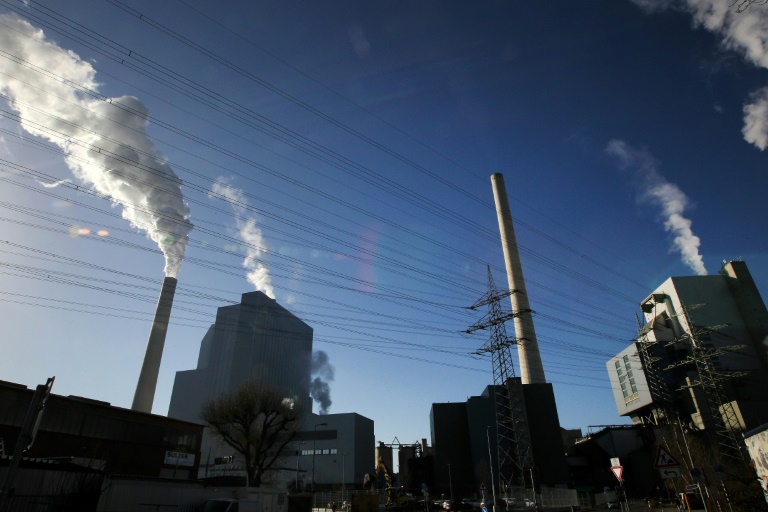
The invasion of Ukraine has thrown Germany’s problematic dependence on Russian gas into stark relief, forcing Europe’s largest economy to urgently reshape its energy mix.

In a previously unthinkable step for Chancellor Olaf Scholz’s young government, the crisis even has politicians considering delaying Germany’s planned exit from nuclear energy and coal to keep the lights on.

“We will change course to overcome our import dependence,” Scholz said Sunday at an extraordinary session of the Bundestag, or lower house of parliament, on the Ukraine crisis.

The decision represents a massive and expensive reversal for the government which has banked on Russia to secure its energy needs over the past two decades. 

With Russia increasingly isolated internationally as a result of economic sanctions over Ukraine, Berlin can no longer rely on Moscow to keep supplying over half of the country’s gas.

While energy supplies have largely been exempted from the West’s response, policymakers still needed to “prepare for a scenario” where Russia “stops gas deliveries”, Finance Minister Christian Lindner said on Tuesday.

– Liquefied gas –

Initially, Germany hopes to substitute Russian supplies with larger deliveries of liquefied natural gas (LNG), a super-chilled form of the fuel, which can be imported by sea from producers such as the United States or Qatar.

The German government made a splash in the LNG market on Wednesday by announcing it was earmarking 1.5 billion euros ($1.7 billion) for the fuel. 

But Germany lacks the infrastructure to absorb huge new supplies, with no LNG terminals along its coast where tankers can dock.

Their absence means it will have to import supplies through one of the European Union’s 21 other terminals, a costly solution at a time when energy prices are soaring.

“Germany must build its own LNG terminals with the necessary connections and infrastructure,” the economy ministry concluded last week.

A number of projects, which had stalled because of a lack of political and financial backing, could also receive “public support”, the ministry said.

In the northern town of Stade, on the Elbe, the construction process for one project is about to get under way.

“The technical assessments are complete,” Hanseatic Energy Hub, the company behind the project, told AFP.

Meanwhile, in Wilmershaven, on the North Sea coast, the Belgian group TES is also planning to build a facility.

The terminals could, however, take some time to come online. “The approval process takes minimum three years, and two for construction,” Karen Pittel, energy expert at the Ifo institute think-tank, told AFP.

– Climate objectives –

The narrow room for manoeuvre has cast doubt over Germany’s ambitious timetable for its transition towards renewable energy.

Germany’s governing coalition of the Social Democrats, the Greens and the liberal FDP, in office since December, had promised an earlier exit from coal in 2030 and maintained Angela Merkel’s decision to exit nuclear by the end of 2022.

Paradoxically, natural gas was to play a crucial bridging role in the planned green shift, providing a ready energy supply when the wind is still or the sun does not shine — at least until the technology to store the energy produced by renewables catches up.

“There are no more taboos,” Economy and Climate Minister Robert Habeck declared recently. “In the short term, we may need to hold coal power plants in reserve out of caution,” he said.

The Green party minister likewise did not rule out pushing back the closure of the country’s last three operational nuclear power plants.

The government would, however, face significant challenges were it to pursue the nuclear option. “You cannot just extend a nuclear plant you have decided to close like that,” energy expert Pittel said.

There were “extremely high hurdles, on a technical and administrative level” to keep the plants going, the plant operator RWE told German daily Handelsblatt.

Texas court temporarily halts investigation of transgender minor

A court in Texas ordered the suspension Wednesday of a probe into the parents of a transgender 16-year-old girl under a legal opinion that deemed transitioning procedures as tantamount to child abuse.

Last week, Governor Greg Abbott instructed the Texas Department of Family and Protective Services (DFPS) to investigate instances of minors receiving “sex change procedures,” which he argued “constitute child abuse under existing Texas law.”

In his order, he cited such gender transitioning procedures as “reassignment surgeries that can cause sterilization, mastectomies, removals of otherwise healthy body parts, and administration of puberty-blocking drugs.” 

Such care to transgender minors, much like participation by transgender athletes in sports competitions, is the subject of extensive debate in the United States, where many conservative states have moved to adopt restrictive regulations.

Shortly after Abbott’s directive, the mother in Wednesday’s court case was suspended by her employer, the DFPS, and visited by a state investigator who sought to learn whether her child was “currently transitioning from male to female,” court documents said.

The American Civil Liberties Union (ACLU) and Lambda Legal, an LGBTQ rights organization, filed a lawsuit on behalf of the mother. On Wednesday a district court judge in Texas issued a restraining order preventing the state from investigating the parents.

According to a press release from those two organizations, the court’s ruling stops the state from acting until at least March 11, when the court will hear arguments seeking a larger block of the governor’s order.

“We appreciate the relief granted to our clients, but this should never have happened and is unfathomably cruel,” said Brian Klosterboer, an attorney with ACLU’s Texas branch, in a statement. 

“Families should not have to fear being separated because they are providing the best possible health care for their children.”

US President Joe Biden, while not addressing the specific lawsuit, issued a statement Wednesday evening condemning Texas’s Republican governor for a “cynical and dangerous campaign targeting transgender children and their parents.”

Biden called the move by Abbott, who is in the middle of a reelection campaign, “government overreach at its worst.”

“Like so many anti-transgender attacks proliferating in states across the country, the Governor’s actions callously threaten to harm children and their families just to score political points.”

Russia seizes key southern Ukraine city after week of war

Russian troops have seized Kherson, the first major Ukrainian city to fall in a devastating week-old war that has already created one million refugees.

The capture of the Black Sea city of 290,000 people, which just last year hosted NATO-supported war games, appeared a significant boost for Moscow as it readied for potential ceasefire talks on Thursday.

Russian “occupiers” were in “all parts” of Kherson, Ukrainian regional official Gennady Lakhuta conceded late on Wednesday.

After a three-day siege that left Kherson short of food and medicine, and struggling to collect and bury its dead, the town’s mayor also announced he was in talks with “armed guests.”

He had “made no promises” to the invading forces, but agreed to a night curfew and restrictions on car traffic. 

“So far so good. The flag flying above us is Ukrainian. And for it to stay that way, these requirements must be met,” he said in a Facebook post.

Stalled elsewhere, Russia continues to make significant advances on the southern front, with troops breaking through in Kherson — opening the path west and north — and besieging the larger strategically vital port city of Mariupol.

There, mayor Vadym Boychenko reported hours of punishing bombardments that trapped civilians in a city now without light, water or heating as temperatures hover around freezing.

“Today was the hardest, cruellest of the seven days of this war,” he said. “Today they just wanted to destroy us all.”

Moscow’s victory in Kherson comes one week after Russian President Vladimir Putin’s army marched into Ukraine from the north, east and south, training a vast arsenal of weaponry at Ukrainian cities.

Russian forces have sporadically bombarded civilian targets across the country, including the capital Kyiv and the majority Russian-speaking second city of Kharkiv, which is now coming under more intense attack.

Ukrainian President Volodymyr Zelensky has called the barrage of missiles, shells and rockets a “war crime” and the International Criminal Court has confirmed an investigation is underway.

Amid violence that has kindled memories of Europe’s blood-soaked past, one million Ukrainians have now fled across the border into neighbouring Poland, Slovakia, Hungary, Romania and Moldova, according to the UN refugee agency’s rapidly rising tally.

“We left everything there as they came and ruined our lives,” refugee Svitlana Mostepanenko told AFP in Prague. 

“They’re bombing even civilian houses where there are kids, small kids, children, they die now.”

– War machine –

Putin’s long-telegraphed invasion has frequently appeared hamstrung by poor logistics, tactical blunders and fierce resistance from Ukraine’s underpowered and outgunned military — and from ever-swelling ranks of volunteer fighters.

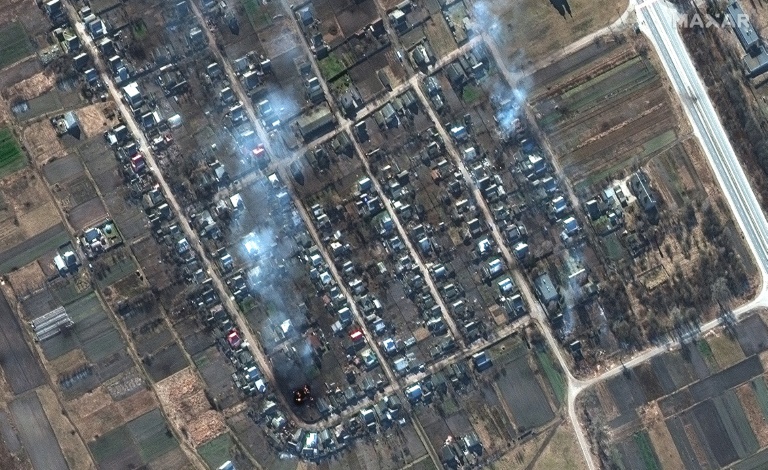
Scores of images have emerged of burned-out Russian tanks, the charred remains of transporters and of unarmed Ukrainians confronting bewildered occupying forces.

A senior US defence official said the massive column of Russian military vehicles amassed north of Kyiv had “stalled” due to fuel and food shortages.

Russian authorities had been silent on the toll of the invasion, and have a domestic media blackout on what the Kremlin euphemistically calls a “special military operation”.

But the Ministry of Defence on Wednesday acknowledged for the first time that 498 soldiers had “died in the line of duty”. 

Ukrainian forces put the Russian toll at 10 times that number. The true figure is not known.

Despite risks and restrictions, Russians have turned out for large anti-war protests across the country, in a direct challenge to Putin’s 20-year rule.

Thousands of anti-war demonstrators have been detained, including several dozen in rallies in Moscow and Saint Petersburg on Wednesday.

“I couldn’t stay at home. This war has to be stopped,” student Anton Kislov, 21, told AFP.

– Diplomatic rebuke –

At the United Nations, the General Assembly issued another powerful rebuke, overwhelmingly backing a resolution demanding Russia “immediately” withdraw from Ukraine.

Moscow lost the vote 141-5 winning the support of only four other nations — Belarus, North Korea, Eritrea and Syria. Its allies China and Cuba abstained.

In Washington, top US diplomat Antony Blinken warned the human costs were already “staggering,” accusing Russia of attacking places that “aren’t military targets.”

“Hundreds if not thousands of civilians have been killed or wounded,” said the secretary of state, who will travel to eastern Europe next week to shore up support for Ukraine — and for efforts to secure a ceasefire.

Kyiv is sending a delegation to the Thursday ceasefire talks, at an undisclosed location on the Belarus-Poland border, but has warned it would not accept “ultimatums”.

Western countries have already imposed heavy sanctions on Russia’s economy and there have been international bans and boycotts against Russia in everything from finance to tech, from sports to the arts.

EU and NATO members have already sent arms and ammunition to Ukraine, although they have made clear that they will not send troops and the EU has dampened Zelensky’s hopes of membership of the bloc.

burs-arb/kma

Heritage of Iraq's last few Jews at risk

In a busy district of the Iraqi capital Baghdad, there is little to distinguish the faded brick building, except for a Hebrew inscription above the entrance.

Iraq’s Jewish community was once one of the largest in the Middle East but its members have dwindled to a handful, outside of the autonomous Kurdistan region.

“Our heritage is in a pitiful condition” and authorities take no notice, said a member of the congregation who requested anonymity, fearing reprisals.

Their precious history, including the synagogue, is threatened in a country torn apart by decades of war, corruption and armed groups.

While historical treasures ruined by jihadists are being restored in Iraq, rare international efforts at saving the Jewish heritage have not been enough.

Baghdad’s Meir Tweig Synagogue, built in 1942, seems to have been frozen in time.

Behind its padlocked doors, the benches are covered in white cloth to shield them from the sun. The walls of the sky-blue two-storey columned interior are crumbling.

The steps leading to a wooden cabinet holding the sacred Sefer Torah scrolls are coming apart.

Flanked by marble plaques engraved with seven-branched candelabra and psalms, the cabinet shelters the scrolls written in hand calligraphy on gazelle leather.

“We used to pray here,” the member said. “We celebrated our festivals, and in summer we studied religious courses in Hebrew.”

One synagogue in Iraq’s south has been illegally occupied and turned into a warehouse, the woman added.

“Save this heritage,” she said, asking for the United Nations’ help.

– Deep roots –

Jewish roots in Iraq go back about 2,600 years, on the land where the patriarch Abraham was born and where they wrote the Babylonian Talmud.

More than 2,500 years later, in Ottoman-ruled Baghdad, Jews made up 40 percent of city inhabitants.

By the time of Israel’s creation in 1948 they numbered 150,000, but three years later, 96 percent of the community had left.

A report published in 2020 listed Jewish heritage sites in Iraq and Syria, some dating back to the first millennium BC.

The study identified 118 synagogues, 48 schools, nine sanctuaries and three cemeteries among the Iraqi Jewish heritage sites. Most are now gone.

“In Iraq, only 30 of the 297 documented sites are confirmed to still exist,” according to the report published by the London-based Foundation for Jewish Heritage and ASOR, the non-profit American Society of Overseas Research.

“Of these 30 sites, 21 are in poor or very bad condition,” it added.

The few remaining Jews in Iraq “worked very hard to protect and preserve their heritage, but the scale of the work was beyond their abilities,” said Darren Ashby, who worked on the study.

“Over time, much of this heritage was lost to seizure, sale or slow decay and collapse,” said Ashby, from the University of Pennsylvania’s Iraq Heritage Stabilization Program.

– Glimmers of hope –

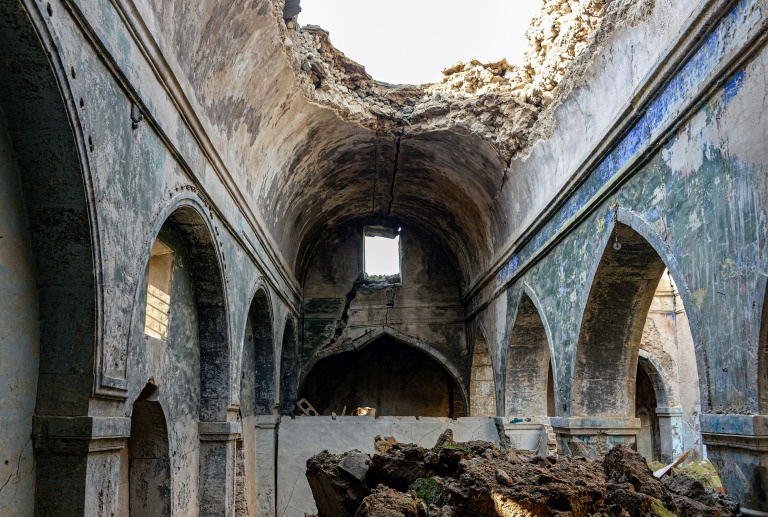
In Mosul, Iraq’s second city and a melting pot of diverse ethnic and religious communities, colourful paintings signal the ruins of the Sasson synagogue at a bend in an alley. 

The synagogue’s collapsed ceiling vault exposes arches and stone columns. But all around is rubble, scrap metal and dumped rubbish.

A local official in charge of antiquities, Mossaab Mohammed Jassem, said the 17th-century building had “served as a residence for a long time.”

He said it belongs to a local family which holds the ownership title, and asked the local authorities to either buy it from them or restore it.

Aliph, the Swiss-based International Alliance for the Protection of Heritage in Conflict Areas, has expressed its willingness to support a potential renovation project of the Sasson synagogue.

There have been other glimmers of hope.

In January, the United States consulate in Arbil, capital of the Kurdish region which did not experience the same level of internecine violence, announced $500,000 in funding to restore the small Ezekiel synagogue near Akre.

Even though some had converted to Islam, other families of Jewish descent live in the Kurdish zone.

US funds also helped restore the tomb of Nahum, one of Judaism’s minor prophets, along with financial support from Kurdistan and private donors.

Surrounded by church steeples in the village of Al-Qosh, the stone sanctuary now looks almost new. Built under its actual form in the 18th century, it could date back to the 10th century, according to local officials.

Joseph Elias Yalda, an official from Al-Qosh heritage museum, remembers stories told by local elders, who said Jewish pilgrims would pour in for a week each June to pray.

“They came from all the provinces and even from neighbouring countries,” said Yalda, who is in his sixties.

“After the religious commemoration, there was a celebration in the old town, with drinking and dancing.”

Cairo's newspaper vendors go silent as sales collapse

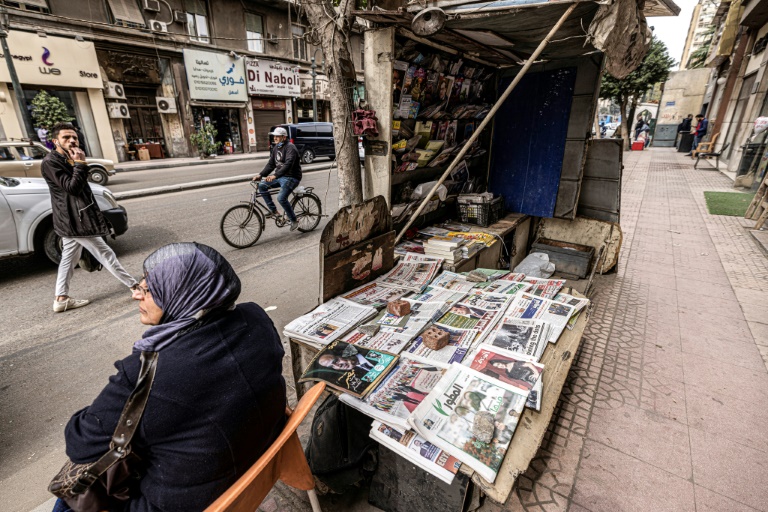
Newspaper sellers were once a dime a dozen on Cairo’s bustling streets, but now the vendors hawking hot-off-the-press editions have fallen almost silent. 

As elsewhere in the world, Egypt’s print media has been in sharp decline as news has moved mostly online and readers tend to stay up-to-date via their smartphones. 

In Egypt, a country of 103 million people, the trend has been especially stark since the government, which publishes most newspapers, has also raised their prices.

“No one buys newspapers anymore, especially since they got more expensive,” said a vendor in her 50s known as Umm Mohammed, wearing a woollen shawl against the winter chill. 

Critics also bemoan the homogeneity of the press in a country tightly ruled by army-marshall-turned-President Abdel Fattah al-Sisi, where censorship and self-censorship are common.

The stacks of newspapers and magazines before Umm Mohammed have hardly shrunk all morning, she said, sitting at her kiosk in Cairo’s western Dokki district.

Between 6 am and 3 pm, she said she had earned just 15 Egyptian pounds, or about $1.

The government three years ago raised prices of dailies from two to three pounds, and of weeklies from three to four pounds, citing costlier raw materials and dwindling subscriptions.

This dampened print circulation in the Arab world’s largest country, where the average family income is around 6,000 EGP, or $380, per month.

Sales collapsed further last July when the government scrapped evening newspaper print editions. 

“People used to come by to get the evening paper and then pick up a couple of other issues on the way,” said Umm Mohammed. “Now we don’t even have that.”

“It’s mobile phones everywhere. People passing my kiosk often ask: ‘Oh, people are still selling these, even with everything online?’

“That really upsets me. This is our livelihood. What are we supposed to do?” 

– ‘Need to innovate’ –

Microbus driver Tareq Mahmud, 44, stopping near the kiosk, said he hadn’t bought a newspaper in 11 years.

“I stopped when I realised that the journalists I was reading in the paper every morning were the same ones I had watched on television” the previous evening, he told AFP.

“And I think there are many like me who stopped around then.”

According to official statistics, Mahmud is right: Egypt in 2019 published 67 titles — public, private or linked to political parties — down from 142 in 2010. 

Circulation roughly halved from more than one million copies to 539,000 over the decade.

Ahmad al-Taheri, editor-in-chief of the Rose al-Youssef weekly, a staple of Egyptian journalism for almost a century, said media need to innovate, including in their distribution.

“We need to find new outlets,” he told AFP, suggesting new pandemic-era sales points: “Why not pharmacies?”

– Media in ‘sorry state’ –

This is hardly a solution for Umm Mohamed, who after 18 years in the business is planning for her retirement. 

In the absence of a trade union or other support system, she, like other vendors, recently signed up to a modest pension scheme with state-run publisher the Ahram Foundation.

But even this pension is not guaranteed.  

Abdul Sadiq el-Shorbagy, head of the National Press Authority, told parliament in January that the state press is indebted, owing over $573 million in taxes and insurance payments.

Press outlets are bleeding cash as going online has yet to turn a profit for them, with most content offered for free and advertising revenue proving insufficient.

Imad Eddine Hussein, editor-in-chief of the private daily Al-Shorouk, bemoaned the “sorry state” of the press in Egypt.

All front pages tend to look almost identical, reporting on the same presidential speeches or ministerial announcements.

“It’s all the same, across every newspaper, so readers are turning away from them,” said Hussein. “If it continues like this, it’s not just the state press that’s going to disappear, private newspapers will too.”

Heritage of Iraq's last few Jews at risk

In a busy district of the Iraqi capital Baghdad, there is little to distinguish the faded brick building, except for a Hebrew inscription above the entrance.

Iraq’s Jewish community was once one of the largest in the Middle East but its members have dwindled to a handful, outside of the autonomous Kurdistan region.

“Our heritage is in a pitiful condition” and authorities take no notice, said a member of the congregation who requested anonymity, fearing reprisals.

Their precious history, including the synagogue, is threatened in a country torn apart by decades of war, corruption and armed groups.

While historical treasures ruined by jihadists are being restored in Iraq, rare international efforts at saving the Jewish heritage have not been enough.

Baghdad’s Meir Tweig Synagogue, built in 1942, seems to have been frozen in time.

Behind its padlocked doors, the benches are covered in white cloth to shield them from the sun. The walls of the sky-blue two-storey columned interior are crumbling.

The steps leading to a wooden cabinet holding the sacred Sefer Torah scrolls are coming apart.

Flanked by marble plaques engraved with seven-branched candelabra and psalms, the cabinet shelters the scrolls written in hand calligraphy on gazelle leather.

“We used to pray here,” the member said. “We celebrated our festivals, and in summer we studied religious courses in Hebrew.”

One synagogue in Iraq’s south has been illegally occupied and turned into a warehouse, the woman added.

“Save this heritage,” she said, asking for the United Nations’ help.

– Deep roots –

Jewish roots in Iraq go back about 2,600 years, on the land where the patriarch Abraham was born and where they wrote the Babylonian Talmud.

More than 2,500 years later, in Ottoman-ruled Baghdad, Jews made up 40 percent of city inhabitants.

By the time of Israel’s creation in 1948 they numbered 150,000, but three years later, 96 percent of the community had left.

A report published in 2020 listed Jewish heritage sites in Iraq and Syria, some dating back to the first millennium BC.

The study identified 118 synagogues, 48 schools, nine sanctuaries and three cemeteries among the Iraqi Jewish heritage sites. Most are now gone.

“In Iraq, only 30 of the 297 documented sites are confirmed to still exist,” according to the report published by the London-based Foundation for Jewish Heritage and ASOR, the non-profit American Society of Overseas Research.

“Of these 30 sites, 21 are in poor or very bad condition,” it added.

The few remaining Jews in Iraq “worked very hard to protect and preserve their heritage, but the scale of the work was beyond their abilities,” said Darren Ashby, who worked on the study.

“Over time, much of this heritage was lost to seizure, sale or slow decay and collapse,” said Ashby, from the University of Pennsylvania’s Iraq Heritage Stabilization Program.

– Glimmers of hope –

In Mosul, Iraq’s second city and a melting pot of diverse ethnic and religious communities, colourful paintings signal the ruins of the Sasson synagogue at a bend in an alley. 

The synagogue’s collapsed ceiling vault exposes arches and stone columns. But all around is rubble, scrap metal and dumped rubbish.

A local official in charge of antiquities, Mossaab Mohammed Jassem, said the 17th-century building had “served as a residence for a long time.”

He said it belongs to a local family which holds the ownership title, and asked the local authorities to either buy it from them or restore it.

Aliph, the Swiss-based International Alliance for the Protection of Heritage in Conflict Areas, has expressed its willingness to support a potential renovation project of the Sasson synagogue.

There have been other glimmers of hope.

In January, the United States consulate in Arbil, capital of the Kurdish region which did not experience the same level of internecine violence, announced $500,000 in funding to restore the small Ezekiel synagogue near Akre.

Even though some had converted to Islam, other families of Jewish descent live in the Kurdish zone.

US funds also helped restore the tomb of Nahum, one of Judaism’s minor prophets, along with financial support from Kurdistan and private donors.

Surrounded by church steeples in the village of Al-Qosh, the stone sanctuary now looks almost new. Built under its actual form in the 18th century, it could date back to the 10th century, according to local officials.

Joseph Elias Yalda, an official from Al-Qosh heritage museum, remembers stories told by local elders, who said Jewish pilgrims would pour in for a week each June to pray.

“They came from all the provinces and even from neighbouring countries,” said Yalda, who is in his sixties.

“After the religious commemoration, there was a celebration in the old town, with drinking and dancing.”

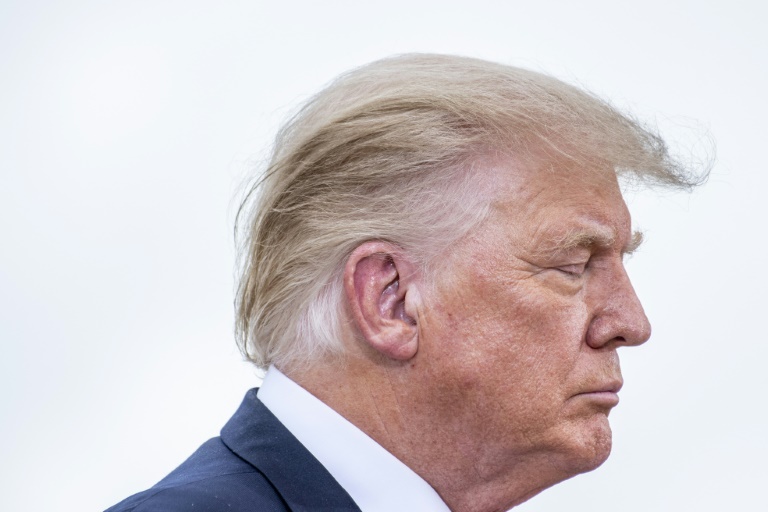
Committee investigating Capitol assault believes Trump broke law

The legislative panel probing the assault on the US Capitol by a mob of then-president Donald Trump’s supporters alleged in a court filing Wednesday that he and his allies took part in a criminal conspiracy to overturn the 2020 election.

The filing by the House of Representatives Select Committee seeks access to documents from rightwing lawyer John Eastman, who has refused to testify, citing attorney-client privilege.

“The Select Committee…has a good-faith basis for concluding that the President and members of his Campaign engaged in a criminal conspiracy to defraud the United States,” the panel wrote in their brief.

The committee’s comments are not its final conclusion, as the probe continues. But they were seen as its most extensive and damning statement yet about Trump’s behavior as he fought to cling to power after losing to Joe Biden.

It was Trump ally Eastman who wrote a now-famous memo in which he outlined how Vice President Mike Pence could prevent lawmakers from certifying Biden’s election win over Trump during what would normally have been a routine session of Congress on January 6, 2021. In the end, Pence declined to do so.

In the filing released Wednesday night, the committee said  Eastman’s claims of attorney-client privilege do not apply because he and others, including Trump, “may have engaged in criminal and/or fraudulent acts” in their attempts to overturn the election.

Lawmakers said their evidence provides “a good-faith basis for concluding that President Trump has violated section 18 U.S.C. § 1512(c)(2).”

That’s a law that makes it a crime to “conspire either to commit any offense against the United States, or to defraud the United States, or any agency thereof in any manner or for any purpose,” according to the Justice Department.

In the chilling events of January 6, after a fiery speech near the White House in which Trump repeated his false claim of election fraud and urged the assembled crowd to “fight like hell,” the mob marched to the Capitol and overran it in stunning scenes of violence and mayhem.

Trump was impeached for a historic second time after the Capitol riot — he was charged with inciting an insurrection — but was acquitted by the Senate.

The former president still dominates the Republican Party and regularly makes comments flirting with the idea of seeking a second term.

Close Bitnami banner
Bitnami