World

China's Congress to focus on boosting slowing economy

A property downturn, slowing economy and war in Ukraine loom large over this week’s annual convening of China’s legislature, with policymakers expected to focus on shoring up faltering growth.

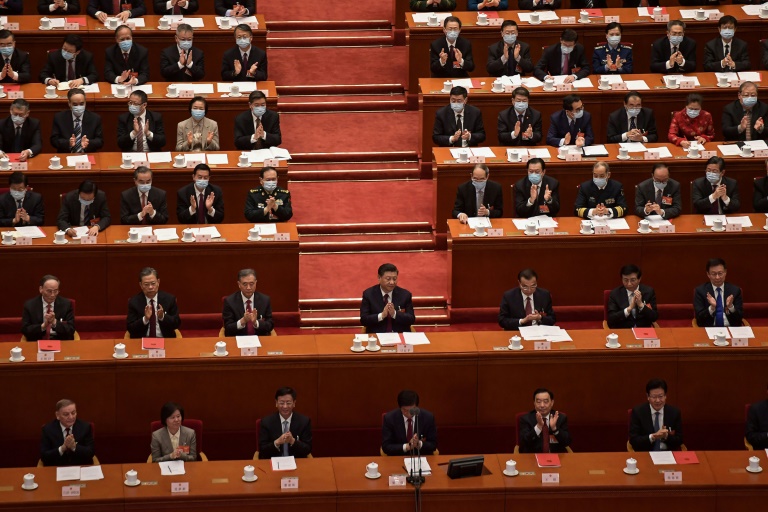
The rubber-stamp parliament starting Saturday in Beijing gathers some 3,000 members of the National People’s Congress (NPC) for highly choreographed meetings over bills, budgets and personnel changes.

The ruling Communist Party uses the opportunity to tout its achievements while also setting the country’s economic blueprint and GDP target for the year ahead.

Much of the NPC’s agenda is unknown until during — or even after — the multi-day meeting, with many sessions taking place behind closed doors.

But this year, concerns are bound to centre on the country’s sluggish economic growth, partly down to a crunch in the crucial property sector — which makes up as much as a quarter of national output.

Stringent “zero-Covid” measures including harsh lockdowns and closed borders have also been a major blow to manufacturing hubs, tourist centres and port cities.

Meanwhile, the Russian invasion of Ukraine has raised the prospect of spiking food and oil prices, with fears over supplies of crucial commodities from the region being affected.

Commerce Minister Wang Wentao admitted to journalists this week that China’s economy faces “huge” pressure this year.

– GDP and stability – 

Beijing traditionally announces its new economic growth target at Premier Li Keqiang’s annual “state of the nation” speech at the NPC, followed by his rare — but heavily stage-managed — press conference.

China’s GDP growth slowed sharply in the final months of 2021 despite an earlier pandemic bounceback, as it grappled with tepid domestic demand and a property downturn.

The country’s communist leaders have long based their legitimacy on the argument that their model of government represents economic growth and continuity for China’s massive population.

But as much of the rest of the world now reopens, China is increasingly out of step, as continued Covid-19 restrictions weigh on consumer confidence.

Maintaining stability will be crucial as the Communist Party gears up for a pivotal meeting this fall — the 20th party congress — that is expected to easily secure President Xi Jinping a third term.

In 2020, there was no GDP target set at all, and last year Li announced a modest goal of “above six percent”.

Amid the unpredictability, analysts expect Beijing to announce a similarly open and attainable target this year.

“We expect the growth target to be set at ‘above five percent’,” UOB economist Ho Woei Chen said in a recent report, adding that pace would match the past two years’ average of 5.1 percent.

Iris Pang, ING’s chief economist for Greater China, expected the range could be higher after the country easily exceeded last year’s target.

And infrastructure would probably form a key part of the government’s support for the economy, predicted ANZ Research senior China strategist Zhaopeng Xing.

He expected “double-digit growth in infrastructure investment” in the first quarter, on top of tax cuts and the central bank’s earlier interest rate cuts.

Australia orders 200,000 to flee floods moving towards Sydney

Australia’s emergency services ordered 200,000 people to flee from the path of a wild storm that lurched towards Sydney Thursday after killing 13 people in more than a week of record-setting floods along the east coast.

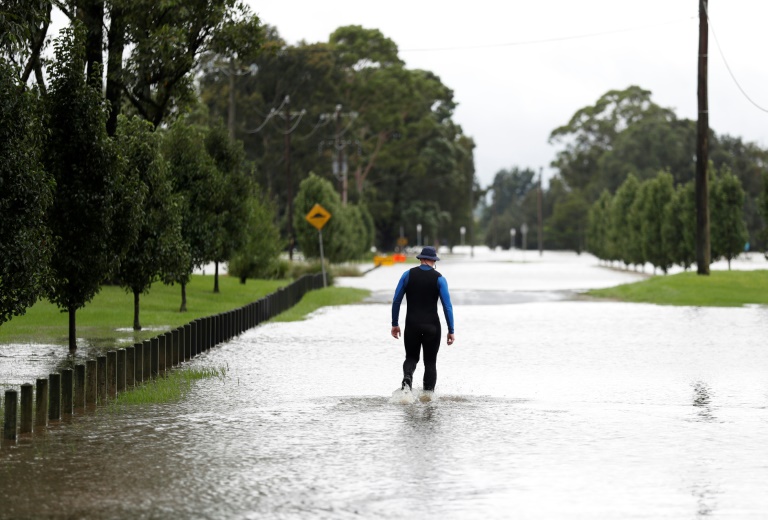
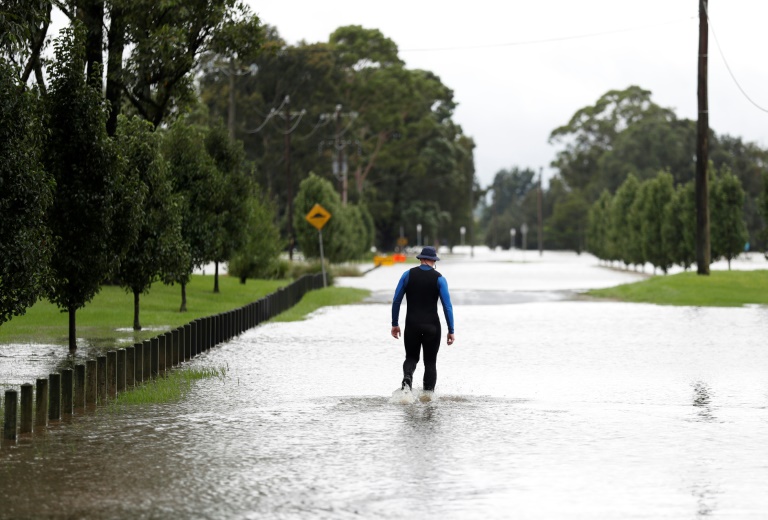
Authorities issued severe rain and wind warnings for a 400-kilometre (250-mile) stretch of coast as water levels rose rapidly — including in suburbs around Sydney, Australia’s largest city and home to five million people.

The unpredictable storm front has crawled southwards along the east coast from Queensland to New South Wales, creating havoc as rivers and reservoirs broke their banks with water swamping homes up to their roofs.

“Many people are waking up today to see much of our state underwater,” New South Wales Premier Dominic Perrottet said.

“If you are subject to one of those evacuation orders, please get out,” he told a news conference. “Things will get worse before they get better.”

Authorities have ordered 200,000 people to evacuate their homes, and warned another 300,000 may soon have to join them.

The Warragamba Dam in southwestern Sydney, which supplies 80 percent of the city’s water, has been spilling over since the early hours of Wednesday, accelerating the flooding in some areas.

-‘Devastating scenes’ –

New South Wales meteorologist Dean Narramore predicted the storm would dump 50-150 millimetres of rain during the day in areas including in and around Sydney, possibly more in areas struck by thunderstorms.

“That could lead to dangerous and life-threatening flash flooding,” he warned.

Meteorologist Ben Domensino of Weatherzone said the storm was being fuelled by an “atmospheric river” — a long stream of airborne moisture.

Scientists say climate change is making Australia’s floods, bushfires, cyclones and droughts more frequent and more intense.

“Australia is at the forefront of severe climate change,” said environmental expert Hilary Bambrick of the Queensland University of Technology.

“Temperatures are rising faster in Australia than the global average, and higher temperatures mean the atmosphere holds more moisture, meaning rainfall events are becoming more extreme.”

In New South Wales, emergency services chief Carlene York said the storm was “difficult to predict” as she warned of a tough day across Sydney and other parts of the state.

– ‘Drought, fires, floods’ –

Taronga Zoo, located along Sydney Harbour, prepared for an influx of injured wildlife from torrential rainfall and flooding.

The first fear was for young wildlife, small animals –- including echidnas and bandicoots -– and birds unable to escape surging floodwaters. 

Heavy downpours can make birds’ feathers so waterlogged they are unable to fly, a spokeswoman told AFP. 

As the floodwaters recede, concern will turn to the animals living in fresh water, including platypuses.

Across New South Wales, flood levels have climbed to the highest level in decades.

In towns such as Lismore in the state’s northeast, which is now cleaning up as floods recede, people had clambered onto their rooftops, sometimes waiting many hours to be rescued from rising waters.

New South Wales said it was sending an extra 400 personnel to that region to help people on the “very, very long road” to cleaning up and recovering.

“Many people today in the Northern Rivers and over the last 24 hours have returned home, and they have returned home to devastating scenes,” state premier Perrottet said. “My message is we will be with you.”

He added that the state of more than eight million residents have been through a difficult three years of “drought, fires, floods, floods again on top of the pandemic”.  

“But our people have stood tall,” Perrottet said. 

Australia orders 200,000 to flee floods moving towards Sydney

Australia’s emergency services ordered 200,000 people to flee from the path of a wild storm that lurched towards Sydney Thursday after killing 13 people in more than a week of record-setting floods along the east coast.

Authorities issued severe rain and wind warnings for a 400-kilometre (250-mile) stretch of coast as water levels rose rapidly — including in suburbs around Sydney, Australia’s largest city and home to five million people.

The unpredictable storm front has crawled southwards along the east coast from Queensland to New South Wales, creating havoc as rivers and reservoirs broke their banks with water swamping homes up to their roofs.

“Many people are waking up today to see much of our state underwater,” New South Wales Premier Dominic Perrottet said.

“If you are subject to one of those evacuation orders, please get out,” he told a news conference. “Things will get worse before they get better.”

Authorities have ordered 200,000 people to evacuate their homes, and warned another 300,000 may soon have to join them.

The Warragamba Dam in southwestern Sydney, which supplies 80 percent of the city’s water, has been spilling over since the early hours of Wednesday, accelerating the flooding in some areas.

-‘Devastating scenes’ –

New South Wales meteorologist Dean Narramore predicted the storm would dump 50-150 millimetres of rain during the day in areas including in and around Sydney, possibly more in areas struck by thunderstorms.

“That could lead to dangerous and life-threatening flash flooding,” he warned.

Meteorologist Ben Domensino of Weatherzone said the storm was being fuelled by an “atmospheric river” — a long stream of airborne moisture.

Scientists say climate change is making Australia’s floods, bushfires, cyclones and droughts more frequent and more intense.

“Australia is at the forefront of severe climate change,” said environmental expert Hilary Bambrick of the Queensland University of Technology.

“Temperatures are rising faster in Australia than the global average, and higher temperatures mean the atmosphere holds more moisture, meaning rainfall events are becoming more extreme.”

In New South Wales, emergency services chief Carlene York said the storm was “difficult to predict” as she warned of a tough day across Sydney and other parts of the state.

– ‘Drought, fires, floods’ –

Taronga Zoo, located along Sydney Harbour, prepared for an influx of injured wildlife from torrential rainfall and flooding.

The first fear was for young wildlife, small animals –- including echidnas and bandicoots -– and birds unable to escape surging floodwaters. 

Heavy downpours can make birds’ feathers so waterlogged they are unable to fly, a spokeswoman told AFP. 

As the floodwaters recede, concern will turn to the animals living in fresh water, including platypuses.

Across New South Wales, flood levels have climbed to the highest level in decades.

In towns such as Lismore in the state’s northeast, which is now cleaning up as floods recede, people had clambered onto their rooftops, sometimes waiting many hours to be rescued from rising waters.

New South Wales said it was sending an extra 400 personnel to that region to help people on the “very, very long road” to cleaning up and recovering.

“Many people today in the Northern Rivers and over the last 24 hours have returned home, and they have returned home to devastating scenes,” state premier Perrottet said. “My message is we will be with you.”

He added that the state of more than eight million residents have been through a difficult three years of “drought, fires, floods, floods again on top of the pandemic”.  

“But our people have stood tall,” Perrottet said. 

Equities rise as Powell soothes rate fears, oil presses higher

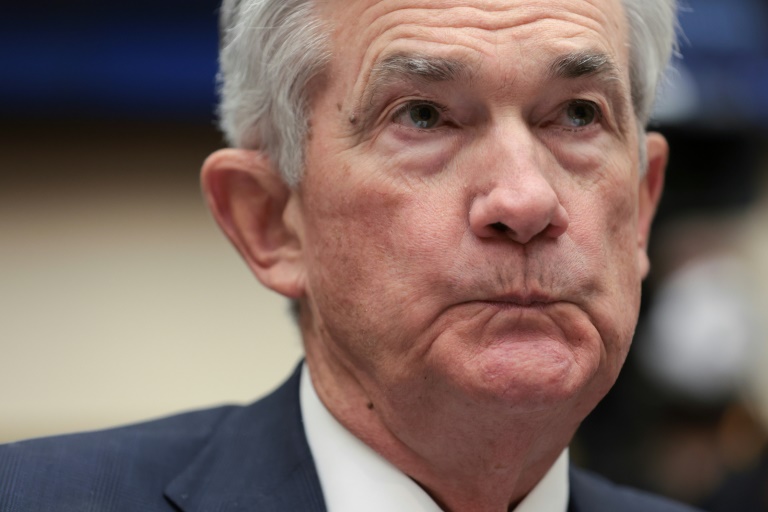
Asian stocks rose Thursday after Federal Reserve chief Jerome Powell said the bank would hike interest rates gradually to fight inflation, though oil marched higher as the Ukraine conflict continues to roil energy markets.

With the Russian invasion of its neighbour hammering all assets across the board as uncertainty reigns supreme, traders were given a much-needed shaft of light on Wednesday when the Fed boss eased concerns over its plans for tightening policy.

Powell told lawmakers he was in favour of a moderate pace of rate increases, with a 25-basis-point lift this month, as he tries to nurture the economic recovery while keeping a lid on prices, which are rising at their fastest pace in 40 years.

He warned that the “near-term effects on the US economy of the invasion of Ukraine, the ongoing war, the sanctions, and of events to come, remain highly uncertain”.

The comments soothed concerns that officials could announce an aggressive 50-basis-point lift. The issue of Fed tightening has cast a pall over markets for months, bringing a near two-year rally to an abrupt end, and that has now been compounded by the Ukraine crisis.

Powell did, however, say the bank would remain “nimble” to events and would act more aggressively if needed down the line.

Meanwhile, St. Louis Fed chief James Bullard said he was for a “rapid withdrawal of policy accommodation”, as Chicago president Charles Evans added that policy was currently “wrong-footed” and should be tightened.

Still, Powell’s comments were able to “appease risk-markets by ruling out a 50 basis-points hike in March, while simultaneously promising inflation vigilance at following meetings”, said Citigroup strategists William O’Donnell and Edward Acton.

Wall Street ended sharply higher with all three main indexes more than one percent up.

And Asia followed suit with Tokyo, Hong Kong, Shanghai, Sydney, Seoul and Singapore leading healthy gains.

But analysts warned of further volatility for some time as the war continues to rage in Ukraine.

While the war is making finance chiefs re-think their plans, central banks appear intent to keep on the tightening track for now, with the Bank of Canada on Wednesday announcing a rate rise.

The major source of angst for policy-setters is the spike in oil prices, which has been a key driver of inflation this year owing to narrow supplies and soaring demand and is now being amplified by the conflict in Europe.

On Thursday Brent continued to storm higher, hitting $118 a barrel for the first time since early 2013.

While world governments have not included Russian oil in their wide-ranging sanctions on Moscow owing to concerns about the impact on prices and consumers, trade has become increasingly tough as banks pull financing and shipping costs rise.

OPEC and other major producers, including Russia, refused Wednesday to lift output by more than their previously agreed amount, dealing a blow to hopes of an easing in supply pressures.

An agreement by the United States and 29 other countries to release 60 million barrels from their reserves has had little impact on the relentless rise in prices.

Other commodities are also elevated with European natural gas benchmarks and aluminium at records.

– Key figures around 0230 GMT –  

Brent North Sea crude: UP 2.7 percent at $115.95 per barrel

West Texas Intermediate: UP 2.2 percent at $112.97 per barrel

Tokyo – Nikkei 225: UP 0.8 percent at 26,608.21 (break)

Hong Kong – Hang Seng Index: UP 0.7 percent at 22,493.03

Shanghai – Composite: UP 0.2 percent at 3491.82

Euro/dollar: DOWN at $1.1108 from $1.1126 late Wednesday

Pound/dollar: DOWN at $1.3394 from $1.3405

Euro/pound: DOWN at 82.91 pence from 82.95 pence

Dollar/yen: UP at 115.62 yen from 115.51 yen

New York – Dow: UP 1.8 percent at 33,891.35 (close)

London – FTSE 100: UP 1.4 percent at 7,429.56 (close)

Six-month suspended sentence for Ghosn aide Kelly in Nissan trial

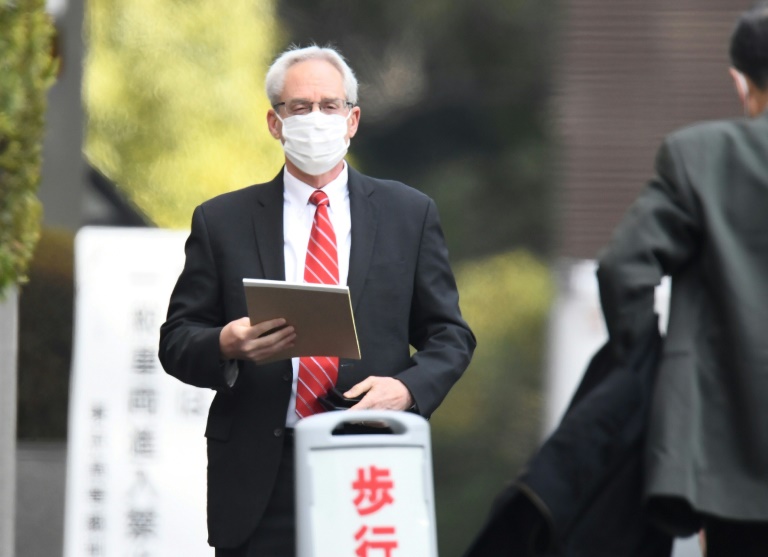
Former Nissan executive Greg Kelly was handed a six-month suspended sentence on Thursday by a Tokyo court over allegations he helped disgraced auto tycoon Carlos Ghosn attempt to conceal income.

The 65-year-old American was detained at the same time as Ghosn in November 2018, but the former Nissan chief jumped bail and fled to Lebanon the following year, leaving Kelly alone to face charges.

Prosecutors had sought two years in prison for Kelly, accusing him of helping Ghosn under-report his income to the tune of 9.1 billion yen ($79 million) between 2010 and 2018.

But the court found him not guilty on the charges for the financial years 2010 to 2016, and guilty for the financial year 2017, handing down a six-month prison sentence suspended for three years.

The soft-spoken American has always denied the claims, and the trial has been closely watched in Japan and abroad, with the US ambassador to Tokyo saying the case was a top priority.

Kelly’s team argued the proposed post-retirement payments were never agreed and there were merely exploratory discussions about a “legal way” to keep Ghosn in the fold after his tenure and prevent him from joining a competitor.

But judge Kenji Shimizu ruled that by fiscal year 2017 Kelly “was aware that there was an unpaid remuneration and the court recognises that there was a conspiracy (between Kelly) with Ghosn and (Nissan executive Toshiaki) Ohnuma.”

Some have viewed Kelly as little more than a scapegoat in a case that centred around Ghosn, whose audacious escape hidden in an audio-equipment box in December 2019 left Japanese prosecutors red-faced.

“Kelly was arrested with the expectation that he could be ‘turned’ to testify against Ghosn,” said Stephen Givens, a business lawyer in Tokyo who has followed the case.

“When Ghosn escaped to Beirut, the prosecutors were left with a weak, free-standing case against Kelly,” he told AFP.

– ‘A long three years’ –

Nissan had pleaded guilty in a separate case, and was ordered Thursday to pay a fine of 200 million yen ($1.7 million).

Kelly’s lawyers previously said they would appeal any guilty verdict, even if the sentence was suspended.

Kelly has been in Japan since his detention in 2018 and has been joined in Tokyo by his wife, who had to enrol in Japanese lessons to secure a visa to stay in the country.

The verdict does mean he should now be able to leave Japan for the first time in three years, which was welcomed by US ambassador to Tokyo Rahm Emanuel.

“We are relieved that the legal process has concluded, and Mr and Mrs Kelly can return home,” he said in a statement.

“While this has been a long three years for the Kelly family, this chapter has come to an end,” he added, offering no comment on the guilty verdict itself.

Japanese prosecutors have a close to 99 percent conviction rate in cases that go to trial, though experts said the outcome in Kelly’s case was hard to predict because it was the first of its kind in the country.

For his part, Ghosn, who faced several additional financial misconduct charges, has always insisted he and Kelly are innocent and that Japanese prosecutors worked to help Nissan push him out in a “palace coup”.

“If he’s guilty, many Japanese should also be in prison,” he said from Beirut during an online press conference in December.

There has been other fallout from the case, with two Americans who helped Ghosn flee the country extradited from the US to Japan and sentenced last year to between 20 months and two years in prison.

Mutilated bodies, gang wars shock once-peaceful Ecuador

A headless body discarded in the street. Two corpses dangling from a bridge. An intensifying drug war has shocked once-peaceful Ecuador with scenes of horrific violence.

Experts say the two crimes committed within a single week last month evoked the savage methods of Mexican narco gangs which, according to the government in Quito, has infiltrated the South American country of 17.7 million people.

“The cruelty is something new,” Daniel Ponton, dean of the security and defense school at Ecuador’s IAEN university told AFP. He blamed “emulation” by local criminals of the well-documented atrocities committed by drug lords in Mexico or Colombia.

The local gangs soon learn, he added, that “violence has a value in itself” as a tool “to intimidate rival criminal gangs (and) diminish the will of the State… and the general population” to fight crime. 

Wedged between Colombia and Peru — the world’s largest cocaine producers — Ecuador long managed to escape drug violence even as the illegal but lucrative trade started showing benefits for its economy and domestic consumption grew.

The country used to be a drug transit and storage point favored by foreign traffickers for its porous borders, dollarized economy and major Pacific seaports for export.

But the ports — especially at Guayaquil — have since become battlegrounds themselves as the presence of local gangs has exploded, and murder figures with it.

– ‘Super-violent messages’ –

In January and February this year, 468 people were killed in Ecuador — 277 more than in the same two months of last year.

More than 320 of this year’s victims have been inmates — many dismembered and burnt in grisly wars between rival prison gangs allied to drug cartels beyond Ecuador’s borders.

In 2021, the country recorded a rate of 14 murders per 100,000 inhabitants — nearly double the 2020 figure, though still not among the highest in the world.

Especially hard hit is Guayaquil, a city of 2.8 million people home to Ecuador’s main commercial port, and the violence is increasingly filtering through to the streets.

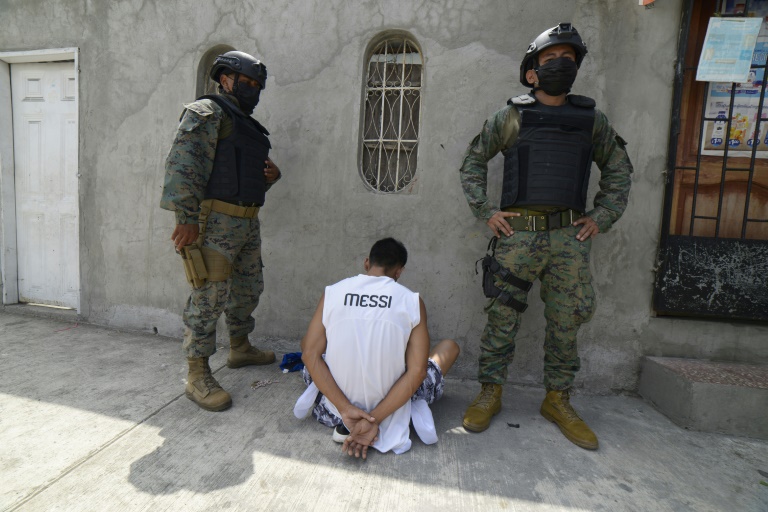
On February 20, residents of Guayaquil were shocked when the body of a 21-year-old man was thrown from a moving vehicle in a city street, followed by his severed head.

Six days earlier, in the nearby town of Duran, the bodies of two men were found handcuffed and hanging from a pedestrian bridge.

Since late last year, five decapitated bodies have been found in Duran and Guayaquil, authorities say, and last month a head was found stuffed in a backpack at the port of Puerto Bolivar to the south.

There have also been neighborhood shootouts, a previously alien phenomenon.

“Drug trafficking has gained ground in Ecuadorian society,” President Guillermo Lasso said last month after the latest bodies were so publicly displayed. 

He blamed previous governments for allowing “microtrafficking” to find a foothold in the country, only to be swiftly followed by gangs and their territorial disputes.

For Renato Rivera, a researcher at the Latin American Network for Analysis of Security and Organized Crime, the mutilated corpses were meant as “super-violent messages” of warning.

The victims are often killed as punishment for being short on a drug delivery — possibly after police seizures — while at the same time serving as “a message of intimidation for rivals,” he added.

– ‘Weakened’ state –

Faced with the expanding violence, Lasso’s government recently ordered troops to Guayaquil to retake control of the city and “prevent the entry of drugs from the north (Colombia) or weapons from the south (Peru).”

The president also replaced the commander of the police, an entity widely seen as unwilling or unable to address the growing crime wave.

So far this year, the authorities have seized 37 tons of drugs. The number was 210 tons for the whole of 2021.

For Ponton, the escalating violence was “a kind of cumulative and growing time bomb,” for Ecuador.

“The problem of Ecuador is that the state’s response capacity is totally weakened in key areas: intelligence, criminal investigation, arms control,” partly due to corruption.

According to a Transparency International report on corruption perception, Ecuador scored 36 in 2021 on a scale on which 100 represents clean government. This was lower than the average score of 43 for the Americas.

“Organized crime cannot live without corruption,” said Rivera.

UN General Assembly demands Russia withdraw from Ukraine

The UN General Assembly on Wednesday overwhelmingly adopted a resolution that “demands” Russia “immediately” withdraw from Ukraine, in a powerful rebuke of Moscow’s invasion by a vast majority of the world’s nations.

After more than two days of extraordinary debate, which saw the Ukrainian ambassador accuse Russia of genocide, 141 out of 193 United Nations member states voted for the non-binding resolution. 

“The world is rejecting Russia’s lies,” US President Joe Biden said in a statement later Wednesday. “Russia is responsible for the devastating abuses of human rights and the international humanitarian crisis that we are watching unfold in Ukraine in real time.”

China was among the 35 countries which abstained, while just five — Eritrea, North Korea, Syria, Belarus and of course Russia — voted against it.

The resolution “deplores” the invasion of Ukraine “in the strongest terms” and condemns President Vladimir Putin’s decision to put his nuclear forces on alert.

The vote had been touted by diplomats as a bellwether of democracy in a world where autocracy is on the rise, and came as Putin’s forces bear down on Kyiv while terrified Ukrainians flee.

“They have come to deprive Ukraine of the very right to exist,” Ukraine’s ambassador Sergiy Kyslytsya told the Assembly ahead of the vote.

“It’s already clear that the goal of Russia is not an occupation only. It is genocide.”

Putin launched the full-scale invasion of Ukraine on February 24. Moscow has pleaded “self-defense” under Article 51 of the UN Charter.

But that has been roundly rejected by Western countries who accuse Moscow of violating Article 2 of the Charter, requiring UN members to refrain from the threat or use of force to resolve a crisis.

The European Union’s ambassador to the UN Olof Skoog said the vote was “not just about Ukraine.”

“It is about defending an international order based on rules we all have signed up to,” he said in a statement.

UN Secretary-General Antonio Guterres said the General Assembly’s message was “loud and clear.”

“End hostilities in Ukraine — now. Silence the guns — now,” he said in a statement. 

“As bad as the situation is for the people in Ukraine right now, it threatens to get much, much worse. The ticking clock is a time bomb.”

Some delegations chose to place stuffed animals on their tables during the session — a stark visual reminder of the conflict’s devastating impact on children.


– ‘Who will be next?’ –

The text of the resolution — led by European countries in coordination with Ukraine — has undergone numerous changes in recent days.

It no longer “condemns” the invasion as initially expected, but instead “deplores in the strongest terms the Russian Federation’s aggression against Ukraine.”

Nearly every General Assembly speaker unreservedly condemned the war.

“If the United Nations has any purpose, it is to prevent war,” the US ambassador, Linda Thomas-Greenfield, said during her speech on Wednesday.

She accused Russia of “preparing to increase the brutality of its campaign.”

“We’ve seen videos of Russian forces moving exceptionally lethal weaponry into Ukraine, which has no place on the battlefield. That includes cluster munitions and vacuum bombs, which are banned under the Geneva Convention,” Thomas-Greenfield said.

Russia’s ally Belarus offered a staunch defense of the invasion, however.

Ambassador Valentin Rybakov blasted sanctions imposed by the West on Russia as “the worst example of economic and financial terrorism.”

And he followed other Russian allies such as Syria in condemning the “double standards” of Western nations who have invaded countries including Libya, Iraq and Afghanistan in recent decades.

Other speakers cited fears of a domino effect should Ukraine fall to Russia. Colombia railed against any return to “empire,” while Albania wondered: “Who will be next?”

From the Arab world it was Kuwait, itself the victim of an invasion by Iraq in 1990, whose denunciation of Moscow was the most explicit.

– China, India abstain –

Japan and New Zealand led condemnation from Asia, but the continent’s giants — China, India and Pakistan — all abstained. During the debate Beijing had stressed the world had “nothing to gain” from a new Cold War.

On the meeting’s sidelines, Washington has taken aim at Russians working at the United Nations, leveling accusations of espionage and demanding expulsions.

ICC to start 'active' probe into war crimes in Ukraine

The International Criminal Court’s chief prosecutor said Wednesday an active probe into possible war crimes in Ukraine “will immediately proceed” after his office received the backing of 39 countries.

The countries include all EU member states, as well as Australia, Britain, Canada, New Zealand, Switzerland and several Latin American countries.

“I have notified the ICC Presidency a few moments ago of my decision to immediately proceed with active investigations in the Situation” in Ukraine, Karim Khan wrote in a statement.

“Our work in the collection of evidence has now commenced,” he added.

Khan announced Monday he was opening a probe into alleged war crimes committed after Russia’s invasion of Ukraine last week.

Khan said he believed there was a “reasonable basis” to believe that crimes within the court’s jurisdiction had been committed.

But he needed the Hague-based court’s judges to approve his decision before going ahead.

However, the ICC countries’ referral now means that Khan’s probe can continue without the judges’ approval, speeding up the process.

“These referrals enable my office to proceed with opening an investigation into the situation in Ukraine from 21 November 2013 onwards,” Khan said.

That would include “any past and present allegations of war crimes, crimes against humanity or genocide committed on any part of the territory of Ukraine by any person,” Khan said.

UK Prime Minister Boris Johnson told parliament on Wednesday that Russian President Vladimir Putin was “guilty of a war crime” after civilians were bombed in Ukraine, echoing an earlier accusation by Ukrainian President Volodymyr Zelensky.

Khan, who was recently appointed as prosecutor, said his probe will be conducted “objectively and independently” and focus on “ensuring accountability for crimes falling within ICC jurisdiction”.

The Hague-based ICC was established in 2002 as an independent court to try individuals accused of genocide, war crimes and crimes against humanity.

The ICC, however, can only prosecute crimes committed on the territory of its 123 member states.

Ukraine is not a member, but in 2014 accepted the jurisdiction of the Court. 

Moscow withdrew from the ICC, so the court will only be able to reach Russians if they are arrested on the territory of a state that respects the jurisdiction of the court.

The ICC is also hampered by the fact that it has no police force and relies on state parties to detain suspects — with varying success in the past.

Alarm at civilian toll on Russian assault's 'cruellest day'

The United States raised the alarm Wednesday over the “staggering” human cost of Moscow’s invasion of Ukraine, as the apparent deployment of cluster bombs and other treaty-violating weapons raised fears of a brutal escalation in the week-old conflict.

The American warnings came as Russia revealed 498 of its troops had been killed in the assault on ex-Soviet Ukraine — the first official death toll it has given and one Kyiv says is by far an undercount.

And they came on the eve of the resumption of ceasefire talks after a first round Monday failed to produce a breakthrough.

On the ground in Ukraine, Russia appeared despite determined resistance to be intensifying the offensive ordered seven days earlier by President Vladimir Putin — in defiance of almost the entire international community.

“Today was the hardest, cruellest of the seven days of this war,” said Vadym Boychenko, the mayor of the key southeastern port of Mariupol who said Russian forces pummelled the city for hours and were attempting to block civilians from leaving.

“Today they just wanted to destroy us all,” he said in a video on Telegram, accusing Russian forces of shooting at residential buildings.

Boychenko said more of the city’s vital infrastructure was damaged in the assault, leaving people without light, water or heating.

In Washington, top US diplomat Antony Blinken warned the human costs were already “staggering,” accusing Russia of attacking places that “aren’t military targets.”

“Hundreds if not thousands of civilians have been killed or wounded,” said the secretary of state, who will travel to eastern Europe next week to shore up support for Ukraine — and for efforts to secure a ceasefire.

Kyiv is sending a delegation to the Thursday ceasefire talks, at an undisclosed location on the Belarus-Poland border, but has warned it would not accept “ultimatums.”

– UN rebuke –

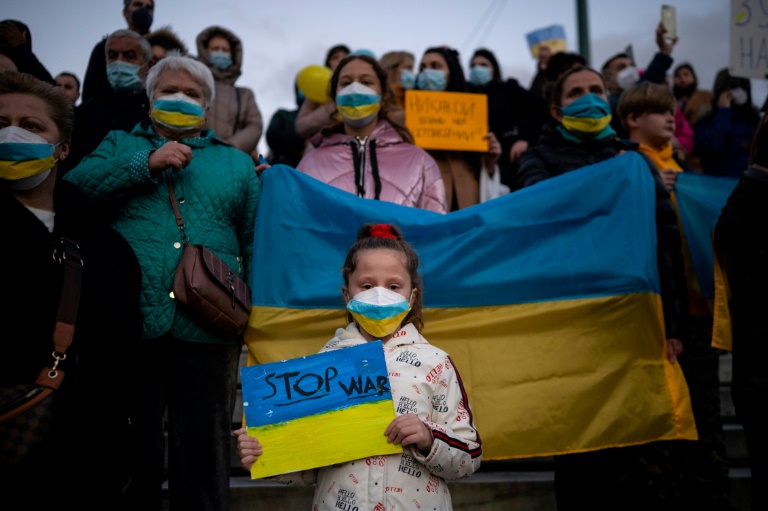
At the United Nations, the General Assembly overwhelmingly adopted a resolution Wednesday that “demands” Russia “immediately” withdraw from Ukraine, in a powerful rebuke of Moscow by a vast majority of the world’s nations.

After more than two days of extraordinary debate, which saw the Ukrainian envoy accuse Russia of genocide, 141 out of 193 member states backed the non-binding resolution — with only Eritrea, North Korea, Syria and Belarus joining Russia against.

At least 350 civilians including 14 children have so far been killed, Ukrainian authorities say, and hundreds of thousands have fled the country since the invasion began, triggering punishing Western sanctions intended to cripple Russia’s economy.

The UN rights office, OHCHR, said it had registered 752 civilian casualties including 227 deaths — but believes the reality is “considerably higher.”

“The humanitarian consequences will only grow in the days ahead,” Blinken warned.

At the UN, the US ambassador echoed Blinken’s alarm about mounting civilian deaths — accusing Moscow of moving cluster munitions and other arms banned under international conventions into its neighbour.

“It appears Russia is preparing to increase the brutality of its campaign against Ukraine,” Linda Thomas-Greenfield told the General Assembly.

Russia said Wednesday it had captured the Black Sea port of Kherson, population 290,000, though the claim was not confirmed by mayor Igor Nikolayev who appealed online for permission to transport the dead and wounded out of the city and for food and medicine to be allowed in.

“Without all this, the city will die,” he wrote.

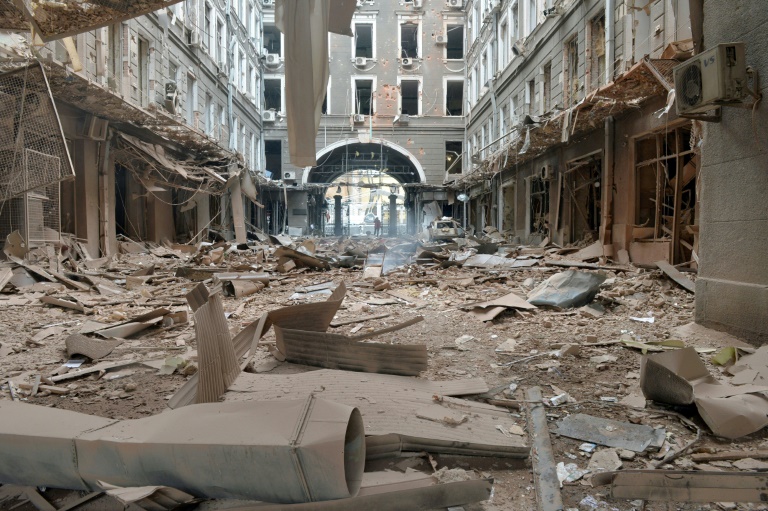
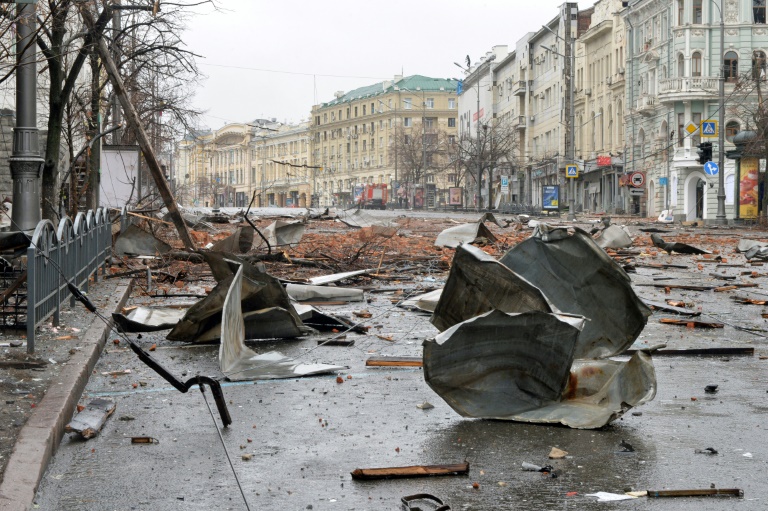
AFP witnessed the aftermath of apparent Russian bombing on a market and a residential area in Zhytomyr in central Ukraine, and in Kharkiv, Ukraine’s second biggest city.

“There is nowhere in Kharkiv where shells have not yet struck,” said Anton Gerashchenko, an adviser to Ukraine’s interior minister, after Russian airborne troops landed in the city before dawn.

Shelling in the northeastern city of 1.4 million a day earlier drew comparisons to the massacres of civilians in Sarajevo in the 1990s.

– ‘Erase us all’ –

As Russian artillery massed outside Kyiv, the former champion boxer turned city mayor Vitali Klitschko vowed to stand strong.

“The enemy is drawing up forces closer to the capital,” he said. “Kyiv is holding and will hold. We are going to fight.” 

Residents have been hunkered down in Kyiv for a week and dozens of families were sheltering Wednesday in the Dorohozhychi metro station.

In a video address, Ukraine’s President Volodymyr Zelensky said Russian forces wanted to “erase our country, erase us all”.

Five people were killed in an attack a day earlier on the Kyiv television tower at Babi Yar, the site of a Nazi massacre in which over 33,000 people were killed — most of them Jews.

The 44-year-old Zelensky, who is himself Jewish, urged Jewish people around the world to speak up.

“Nazism is born in silence. So, shout about killings of civilians. Shout about the murders of Ukrainians,” he said.

– New US sanctions –

With the civilian toll mounting, opposition to the conflict is also growing within Russia.

Dozens of anti-war demonstrators were detained in Moscow and Saint Petersburg after jailed Kremlin critic Alexei Navalny called Russians to the streets, dismissing Putin as “an insane little tsar”.

Internationally, meanwhile, the United States announced a new set of sanctions, this time targeting Russian ally Belarus and Russia’s defense industry.

Authoritarian Belarus and Russia are closely linked and Belarus has been used as a key staging ground for the invasion of neighboring Ukraine.

Western countries have already imposed heavy sanctions on Russia’s economy and there have been international bans and boycotts against Russia in everything from finance to tech, from sports to the arts.

In France, President Emmanuel Macron said in an address to the nation Europe had entered a “new era,” and would need to both invest in its defences and wean itself off reliance on Russian gas.

EU and NATO members have already sent arms and ammunition to Ukraine, although they have made clear that they will not send troops and the EU has dampened Zelensky’s hopes of membership of the bloc.

– Chelsea for sale –

In its latest move to isolate Russia, the European Union banned broadcasts of Russian state media RT and Sputnik and excluded seven Russian banks from the global SWIFT bank messaging system.

In London, meanwhile, Chelsea’s Russian owner Roman Abramovich said he had made the “incredibly difficult” decision to sell the Premier League club, pledging proceeds would go to Ukraine war victims.

Abramovich, alleged to have close links to Putin, has not been named on a British sanctions list targeting Russian banks, businesses and pro-Kremlin tycoons.

But the Chelsea owner’s concern about potential seizing of assets is understood to have sparked his move.

burs-ft/ec

Georgia to apply 'immediately' for EU membership

Georgia will “immediately” apply for EU membership, the Black Sea nation’s ruling party said Wednesday, a day after the European Parliament backed war-torn Ukraine’s bid to apply for EU membership.

The ruling Georgian Dream party chairman, Irakli Kobakhidze, announced the party’s “decision today to immediately apply for the EU membership”.

Georgia calls on the EU “to review our application in an urgent manner and to make the decision to grant Georgia the status of an EU membership candidate”, he told journalists.

The decision was made “based on the overall political context and the new reality”, he added.

Georgia’s EU integration would put the country “on a path which will lead our country to a qualitative increase in our population’s wellbeing, security, and to de-occupation,” he added.

Georgia’s decision followed a similar move by Ukraine’s President Volodymyr Zelensky, who won backing from MEPs in a non-binding resolution recommending EU bodies grant Ukraine the status of candidate country.

Russian President Vladimir Putin last week ordered a full-scale invasion of Ukraine.

Georgia’s ruling party has faced strong pressure from opposition parties to follow Kyiv’s suit. The MEP’s vote on Ukraine was largely seen in Georgia as a window of opportunity to advance its own EU aspirations — a goal enshrined in the country’s constitution.

Last year, the Georgian government announced its intention to apply for EU membership in 2024.

Georgia’s government has faced mounting international criticism over perceived backsliding on democracy, seriously damaging Tbilisi’s relations with Brussels.

– Long road ahead –

The war in Ukraine strengthened the West’s focus on Georgia and Moldova, another ex-Soviet republic seeking EU membership. Some observers view these countries as possible targets for the Kremlin after Ukraine.

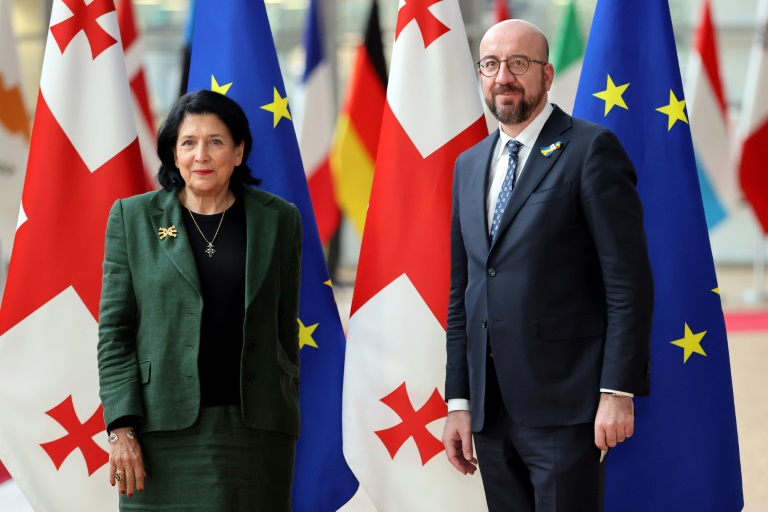
Last week, Georgian President Salome Zurabishvili was in Paris and Brussels to argue for Europe’s commitments to Ukraine being extended to Georgia.

Even if granted candidate status however, Georgia and Ukraine will face a protracted and complex accession process. They would have to implement sweeping reforms to comply with the 27-nation bloc’s political and economic standards.

Georgia’s and Ukraine’s efforts to have closer ties with the West have long angered Russia.

Tensions with Moscow culminated in Russia’s invasion of Georgia in 2008.

Both Georgia and Ukraine have both signed association agreements with the EU designed to bring them closer together economically and politically.

The agreements also include free trade deals between the countries and the EU as well as visa-free travel for its nationals for a short stay in the Schengen area.

But they give no guarantee of eventual membership.

Close Bitnami banner
Bitnami