World

Lawyers for ex-Irish soldier hit out at Facebook in IS terror case

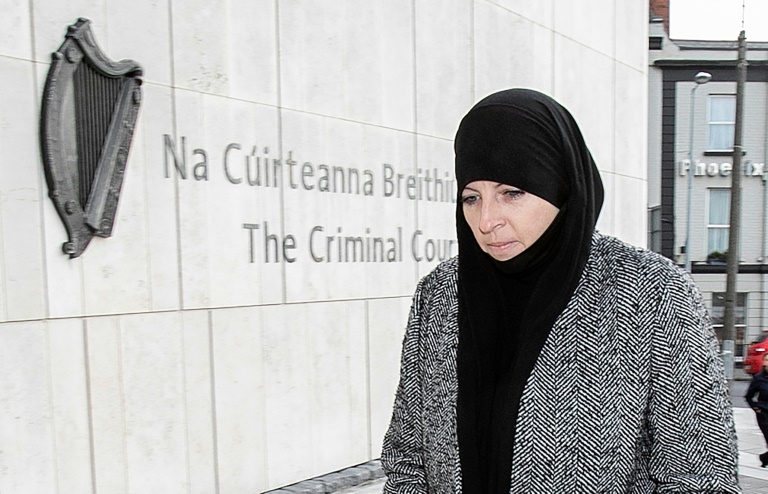
Lawyers for a former Irish soldier accused of being a member of the so-called Islamic State jihadist group on Wednesday criticised Facebook for breaching users’ privacy.

Lisa Smith, 40, from Dundalk, on Ireland’s east coast, has pleaded not guilty to membership of an unlawful terrorist group between October 28, 2015 and December 1, 2019.

She has also denied funding terrorism by sending 800 euros ($900) to aid medical treatment for a Syrian man in Turkey.

At the Special Criminal Court in Dublin, her lawyer, Michael O’Higgins, objected to the use of Facebook messages that the prosecution is relying on.

And he told a panel of three judges hearing the case that the social networking giant was involved in a “wholesale breach” of privacy rights.

The prosecution has sought to submit as evidence messages Smith sent using Facebook to known Islamist terrorists in Australia dating back to 2012.

“The idea that private conversations can be produced 10 years later and decanted into a court case is a very, very significant incursion on people’s right to communicate with each other,” O’Higgins said. 

“My client has the constitutional right to discuss her political and religious beliefs without someone storing every utterance and storing it so it might be used years later.” 

The prosecution has told the court that Smith was a member of the Irish Defence Forces from 2001 to 2011 but left after converting to Islam.

Lawyers allege she joined IS and moved to territory it controlled in October 2015, living in Raqqa, the capital of the militants’ self-styled caliphate, and married a UK national involved with the group’s armed patrols.

She returned to the Irish capital in 2019 after the fall of the extremists’ last remaining stronghold and was arrested on arrival with her young daughter at Dublin airport on December 1.

The court has been told the Irish authorities initially received some of the Facebook messages from the United States, following investigations into John Georgelas, a US Muslim convert who is presumed to have died while fighting in Syria.

O’Higgins argued that the US court that first allowed FBI access to Facebook’s records had not considered Smith’s rights, adding that the subsequent handover of private, sensitive data from the FBI to Irish police is not allowed under Ireland’s Data Protection Act.

Ford unveils new structure as it speeds electric car push

Ford announced Wednesday it is creating separate businesses for its conventional and electric-auto operations, as it accelerates its build-out of emission-free vehicles.

Under the plan, which sent Ford shares sharply higher, the conventional internal combustion operations will be known as “Ford Blue,” while the electric vehicle (EV) products will be run through “Ford Model e.” 

The reorganization, while significant, keeps both operations under the same corporate roof and avoids a potential spin-off that had generated speculation on Wall Street.

“Our legacy organization has been holding us back,” said Chief Executive Jim Farley. “We had to change.”

Ford said the intention is to give the EV venture “the focus and speed of a start-up,” while the conventional business will try to excel at the challenges of a mature business, “relentlessly attacking costs, simplifying operations and improving quality.”

The two ventures will each have distinct executive leadership and report their own financial results. Both companies will continue to be headquartered in the midwestern state of Michigan.

The move is the latest announcement by a conventional automaker as the industry pivots hard to pursue EVs following the success of Elon Musk’s Tesla.

– No IPO –

Farley, in remarks last month, had described operating the EV and internal combustion units as “fundamentally different” in terms of supply chain, product development, even business “rhythm.”

Those comments generated speculation of a possible spin-off. But Ford opted against an initial public offering in part because the company already has enough access to capital and did not need extra funds from an IPO, Farley said.

“No we are not spinning off Model e,” Farley said. “That’s because the structures we set up actually make it stronger than a spin-off.”

Executives said the EV company would benefit from access to industrial know-how, while the conventional business would prosper from newer technologies. 

A third division, Ford Pro, will serve commercial customers.

Amid the shift to EVs, Mercedes has divested its truck division, while Volkswagen announced plans to list its Porsche business on stock markets to finance its electrification strategy.

Renault has said it will present in the fall a new structure, with its EV division in France, apart from its division overseeing internal combustion, which will be located in another country.

Ford’s big US rival, General Motors, has also announced massive new investments in EV models, but has so far not unveiled a similar revamp of its corporate structure.

“This move represents the dual nature of every traditional automaker as they transition from internal combustion drivetrains to electric vehicles,” said Karl Brauer, analyst at iSeeCars.com.

The company’s vision is to garner the benefits of both units, but “knowing when to combine these divisions and when to keep them separate will be key,” Brauer said. “And with separate profit and loss statements, we’ll all be watching.”

– Spending more –

Executives signaled more aggressive spending on EVs, projecting spending $50 billion between 2022 and 2026, compared with a prior plan to invest $30 billion between 2021 and 2025.

Ford also raised some of its operating and financial targets. The company now expects to produce two million EVs by 2026, about one third of global volumes, rising to half by 2030.

In February, Ford said EVs would account for at least 40 percent of its product mix by 2030.

Shares of Ford jumped 8.3 percent to $18.09 in afternoon trading.

UN General Assembly demands Russia withdraw from Ukraine

The UN General Assembly on Wednesday overwhelmingly adopted a resolution that “demands” Russia “immediately” withdraw from Ukraine, in a powerful rebuke of Moscow’s invasion by a vast majority of the world’s nations.

After more than two days of extraordinary debate, which saw the Ukrainian ambassador accuse Russia of genocide, 141 out of 193 United Nations member states voted for the non-binding resolution. 

China was among the 35 countries which abstained, while just five — Eritrea, North Korea, Syria, Belarus and of course Russia — voted against it.

The resolution “deplores” the invasion of Ukraine “in the strongest terms” and condemns President Vladimir Putin’s decision to put his nuclear forces on alert.

The vote had been touted by diplomats as a bellwether of democracy in a world where autocracy is on the rise, and came as Putin’s forces bear down on Kyiv while terrified Ukrainians flee.

“They have come to deprive Ukraine of the very right to exist,” Ukraine’s ambassador Sergiy Kyslytsya told the Assembly ahead of the vote.

“It’s already clear that the goal of Russia is not an occupation only. It is genocide.”

Putin launched the full-scale invasion of Ukraine on February 24. Moscow has pleaded “self-defense” under Article 51 of the UN Charter.

But that has been roundly rejected by Western countries who accuse Moscow of violating Article 2 of the Charter, requiring UN members to refrain from the threat or use of force to resolve a crisis.

The European Union’s ambassador to the UN Olof Skoog said the vote was “not just about Ukraine.”

“It is about defending an international order based on rules we all have signed up to,” he said in a statement.

UN Secretary-General Antonio Guterres said the General Assembly’s message was “loud and clear.”

“End hostilities in Ukraine — now. Silence the guns — now,” he said in a statement. 

“As bad as the situation is for the people in Ukraine right now, it threatens to get much, much worse. The ticking clock is a time bomb.”


– ‘Who will be next?’ –

The text of the resolution — led by European countries in coordination with Ukraine — has undergone numerous changes in recent days.

It no longer “condemns” the invasion as initially expected, but instead “deplores in the strongest terms the Russian Federation’s aggression against Ukraine.”

Nearly every General Assembly speaker unreservedly condemned the war.

“If the United Nations has any purpose, it is to prevent war,” the US ambassador, Linda Thomas-Greenfield, said during her speech on Wednesday.

She accused Russia of “preparing to increase the brutality of its campaign.”

“We’ve seen videos of Russian forces moving exceptionally lethal weaponry into Ukraine, which has no place on the battlefield. That includes cluster munitions and vacuum bombs, which are banned under the Geneva Convention,” Thomas-Greenfield said.

Russia’s ally Belarus offered a staunch defense of the invasion, however.

Ambassador Valentin Rybakov blasted sanctions imposed by the West on Russia as “the worst example of economic and financial terrorism.”

And he followed other Russian allies such as Syria in condemning the “double standards” of Western nations who have invaded countries including Libya, Iraq and Afghanistan in recent decades.

Other speakers cited fears of a domino effect should Ukraine fall to Russia. Colombia railed against any return to “empire,” while Albania wondered: “Who will be next?”

From the Arab world it was Kuwait, itself the victim of an invasion by Iraq in 1990, whose denunciation of Moscow was the most explicit.

– China, India abstain –

Japan and New Zealand led condemnation from Asia, but the continent’s giants — China, India and Pakistan — all abstained. During the debate Beijing had stressed the world had “nothing to gain” from a new Cold War.

On the meeting’s sidelines, Washington has taken aim at Russians working at the United Nations, leveling accusations of espionage and demanding expulsions.

US President Joe Biden asserted Tuesday in his State of the Union address that Putin had underestimated the response to the invasion.

“He rejected efforts at diplomacy… And, he thought he could divide us here at home,” Biden said.

“Putin was wrong. We were ready.”

In Israel, Germany's Scholz says Iran deal 'cannot be postponed'

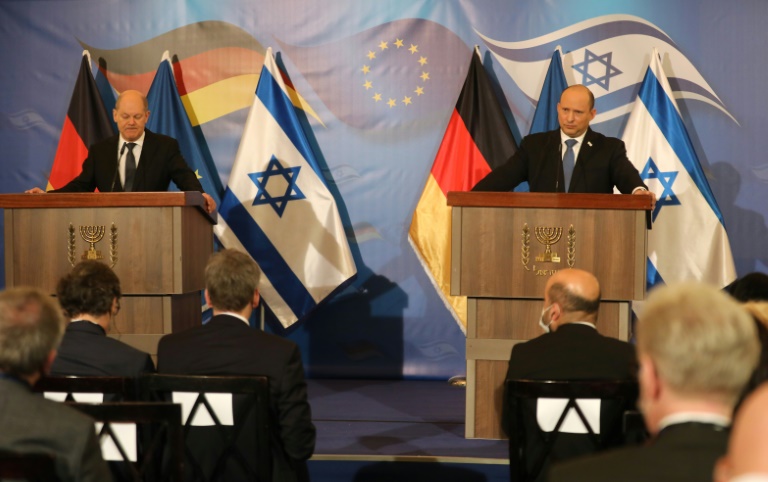
Germany’s Olaf Scholz said Wednesday that a new Iran nuclear agreement “cannot be postponed any longer”, during his first visit as chancellor to Israel which staunchly opposes efforts to forge a deal with Tehran.

Scholz’s visit, which included a ceremony at Jerusalem’s Holocaust memorial Yad Vashem accompanied by Israeli Prime Minister Naftali Bennett, comes amid the geopolitical turmoil sparked by Russia’s invasion of Ukraine.

The two heads of government — both relatively new in office following many years when their countries were ruled by veterans Angela Merkel and Benjamin Netanyahu — met as rapidly moving world events test their leadership.

Policy differences on Iran, long Israel’s arch foe, surfaced at a Jerusalem joint press conference, where Scholz said Berlin “would like to see an agreement reached in Vienna”.

The latest round of negotiations to salvage Iran’s 2015 nuclear deal with Germany and other world powers started in late November in the Austrian capital. Talks are expected to reach a crunch point in the coming days.

The so-called Joint Comprehensive Plan of Action secured sanctions relief for Iran in return for strict curbs on its nuclear programme to prevent it acquiring an atomic weapon, a goal Iran has always denied pursuing.

“Now is the time to make a decision,” Scholz said. “This must not be postponed any longer and cannot be postponed any longer. Now is the time to finally say yes to something that represents a good and reasonable solution.” 

The original 2015 agreement unravelled when former US president Donald Trump withdrew from it, with Israeli encouragement. 

Israel’s Bennett has said he is “deeply troubled” by the outlines of a new deal taking shape, fearing it does too little to stop Iran from getting a nuclear bomb.

Bennett stressed that Israel is “following the talks in Vienna with concern” and warned that “Israel will know how to defend itself and ensure its security and future”.  

– ‘Permanent responsibility’ –

At the earlier visit to Yad Vashem, Scholz left a message in the guest book stressing Germany’s historical responsibility toward the Jewish state. 

“The mass murder of the Jews was instigated by Germany,” he wrote. “Every German government bears permanent responsibility for the security of the state of Israel and the protection of Jewish life.”

Bennett said the Holocaust “is the wound that forms the basis of ties between Germany and Israel. From this wound we have built significant and steadfast relations.”

The two leaders, however, have diverged on their responses to Russia’s war in Ukraine. 

Since the invasion started last week, Scholz’s coalition government has reversed a ban on sending weapons into conflict zones and halted the Nord Stream 2 gas pipeline project between Russia and Germany.

He also pledged 100 billion euros ($113 billion) this year to modernise Germany’s army and committed to spending more than two percent of Germany’s gross domestic product on defence annually, surpassing even NATO’s target.

Bennett has resisted Kyiv’s request for weapons, according to Israeli media, and this week sent Ukraine 100 tonnes of non-military assistance, including blankets, water purification kits and medical supplies. 

“We have a very measured and responsible policy whose goal is both to help the Ukrainian people and to do what we can to help alleviate some of the pressures and the consequences of this horrific situation,” Bennett said, standing beside Scholz. 

A short while later, Bennett and Ukrainian President Volodymyr Zelensky held a phone call, their second since the Russian invasion.

Zelensky said in a tweet they spoke about “Russian aggression,” while Bennett’s office noted that “they agreed to maintain continuous communication”.

Bennett later called Russian President Vladimir Putin, and was briefed on the Russian military operation, a Kremlin summary said, noting the Israeli leader’s “recent contacts with a number of foreign leaders.”

Bennett’s office would not comment on the call, which came after the two leaders also spoke by phone on Sunday.

During their Friday conversation, Zelensky had asked Bennett to help mediate with Russia, given Israel’s good ties with both sides.

Israel has sought to preserve its delicate security cooperation with Moscow, given the large Russian military presence in Syria, where Israel conducts regular air strikes on what it calls Iran-linked targets.

On Wednesday, Israel voted in favour of the UN General Assembly resolution demanding Russia withdraw from Ukraine.

Scholz also met Foreign Minister Yair Lapid and visited the Knesset, or Israeli parliament, before leaving the country. 

He postponed a scheduled meeting with Palestinian president Mahmud Abbas in Ramallah in the Israeli-occupied West Bank due to the events in Ukraine, the German Foreign Office in Ramallah told AFP. 

Record sale for Magritte at London auction: Sotheby's

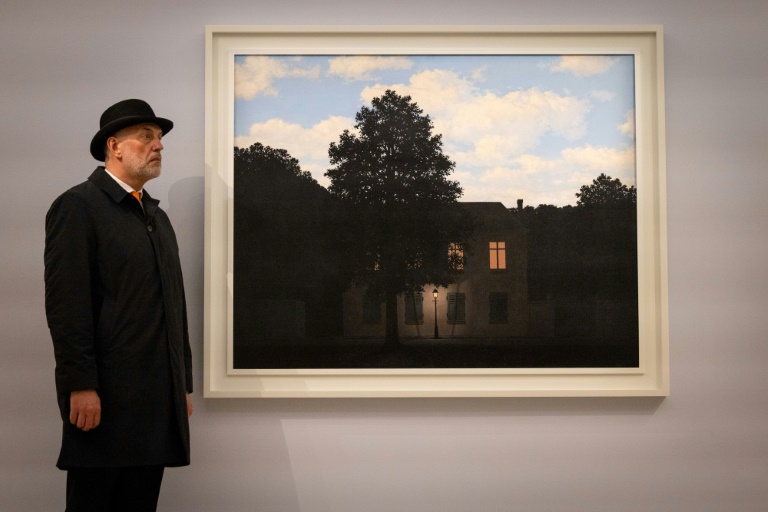
“L’Empire des lumieres” was sold for £59.4 million ($79.4 million, 71.4 million euros) in London on Wednesday, shattering the record for a work by Belgian artist Rene Magritte.

The Surrealist work, described by London auction house Sotheby’s as “a masterpiece of 20th century art”, had a guide price in excess of $60 million.

The previous record for a Magritte was held by “Le principe du plaisir”, which sold for $26.8 million at Sotheby’s in New York in November 2018.

“L’Empire des lumieres” — the empire or dominion of lights in English — is one of the most defining images of the Surrealist movement.

The trees of its foreground are in shadow, as if at night, but the residential house of its mid-ground is reflected in the light of dawn or dusk, while the background is the daylight of a cloudy blue sky.

Sotheby’s said the “uncanny combination… is typical of Magritte’s unsettling Surrealist imagery, in which two seemingly incompatible things are brought together to create a ‘false reality'”. 

The tableau had been in the family of Anne-Marie Gillion Crowet since it was painted for her in 1961. She appeared in a number of Magritte’s greatest works.

It has been exhibited worldwide in Rome, Paris, Vienna, Milan, Seoul, Edinburgh and San Francisco, and was on loan to the Magritte Museum in Brussels from 2009 to 2020. 

Sotheby’s also called the painting “arguably the most cinematic of all of Magritte’s oeuvre”.

“Testament to its arresting power, the work even provided inspiration for a scene in the 1973 Golden Globe-winning classic ‘The Exorcist’,” it added in a statement.

Dozens detained at anti-war rallies in Russia

Dozens of anti-war demonstrators were detained in Moscow and Saint Petersburg Wednesday after jailed Kremlin critic Alexei Navalny called on Russians to protest President Vladimir Putin’s invasion of Ukraine.

Police in Putin’s hometown of Saint Petersburg violently dispersed protesters and detained around 100 people, an AFP journalist at the scene said.

In Moscow, law enforcement closed off Red Square near the Kremlin and detained at least seven people who gathered while loudspeakers warned people from convening.

The demonstrations Wednesday came hours after Navalny called for daily rallies against the military assault, saying Russia should not be a “nation of frightened cowards” and calling Putin “an insane little tsar”.

In Moscow, one woman in a red coat shouted “No war!” before being hauled off by police to a van, according to an AFP journalist.

“It pains me to see what is happening and to do nothing,” a man in his fifties told AFP, before being arrested with his son, 17.

“I couldn’t stay at home. This war has to be stopped,” student Anton Kislov, 21, told AFP in Saint Petersburg.

Independent monitoring group OVD-Info said that more than 7,000 people in total in Russia had been detained at demonstrations over Moscow’s invasion of Ukraine that began last Thursday.

Navalny, 45, led the biggest protests in Russia against Putin in recent years and was targeted in a poisoning attack he blames on the Kremlin in 2020. 

He is now serving a prison sentence on old fraud charges outside Moscow.

Army of cyber hackers rise up to back Ukraine

An army of volunteer hackers is rising up in cyberspace to defend Ukraine, though internet specialists are calling on geeks and other “hacktivists” to stay out of a potentially very dangerous computer war. 

According to Livia Tibirna, an analyst at cyber security firm Sekoia, nearly 260,000 people have joined the “IT Army” of volunteer hackers, which was set up at the initiative of Ukraine’s digital minister Mykhailo Fedorov.

The group, which can be accessed via the encrypted messaging service Telegram, has a list of potential targets in Russia, companies and institutions, for the hackers to target.

It’s difficult to judge the effect the cyber-army is having.

The actions reported so far seem to be limited to “denial of service” (DOS) attacks, where multiple requests are sent to a website in a coordinated manner to saturate it and bring it down. Defacement actions, in which the targeted site displays a hacked page, have also been briefly observed on Russian sites.

The “cyber-army” could also ask hackers to try to identify vulnerabilities of certain Russian sites, and send that info to more seasoned specialists capable of carrying out more sophisticated intrusive actions, such as data theft or destruction, explains Clement Domingo, co-founder of the “Hackers Without Borders” group.

But he and other specialists consulted by AFP warned the hackers against participating in the activities of the “IT Army”, or other cyber mavericks like Anonymous.

– ‘Too much risk’ – 

“I strongly advise against joining these actions,” says Damien Bancal, who is well-versed in the opaque world of cybercrime. “There are plenty of other ways to help Ukrainians who are suffering”, if only by relaying the testimonies that are flourishing on social networks, he adds.

For SwitHak, a cybersecurity researcher, the maverick hackers are taking “too much risk”. 

“There are legal risks, for example,”  he said, Attempting to attack a website or penetrate a server or network is “computer crime”.

For Domingo there is also a real risk of “hack back,” a destructive counterattack by Russian operatives, 

He is particularly appalled to see that a number of candidate hackers have obviously not taken the trouble to create a special Telegram account to participate in the IT Army, at the risk of being identified by the Russian side. 

In cyberspace, and in particular on forums and other discussion groups on Telegram or Discord, “you don’t know who’s who”, insists Felix Aime, another researcher at Sekoia. 

Inexperienced hackers can find themselves caught up with infiltrators from the opposite camp, and end up working for the very opponent they wanted to fight, he warns.

Between the experienced hackers, who carry out ransomware attacks, the fight is on.

The Conti ransomware group, which declared its support for Russia, saw one of its pro-Ukrainian members publish more than a year’s worth of its internal communications in retaliation, offering a treasure trove of information to the world’s cyber security researchers, police and spy specialists. 

The forums where cybercriminals meet “try to stay away from any debate” on the Russian-Ukrainian war to avoid attracting the attention of state services, says Sekoia analyst Tibirna.

Army of cyber hackers rise up to back Ukraine

An army of volunteer hackers is rising up in cyberspace to defend Ukraine, though internet specialists are calling on geeks and other “hacktivists” to stay out of a potentially very dangerous computer war. 

According to Livia Tibirna, an analyst at cyber security firm Sekoia, nearly 260,000 people have joined the “IT Army” of volunteer hackers, which was set up at the initiative of Ukraine’s digital minister Mykhailo Fedorov.

The group, which can be accessed via the encrypted messaging service Telegram, has a list of potential targets in Russia, companies and institutions, for the hackers to target.

It’s difficult to judge the effect the cyber-army is having.

The actions reported so far seem to be limited to “denial of service” (DOS) attacks, where multiple requests are sent to a website in a coordinated manner to saturate it and bring it down. Defacement actions, in which the targeted site displays a hacked page, have also been briefly observed on Russian sites.

The “cyber-army” could also ask hackers to try to identify vulnerabilities of certain Russian sites, and send that info to more seasoned specialists capable of carrying out more sophisticated intrusive actions, such as data theft or destruction, explains Clement Domingo, co-founder of the “Hackers Without Borders” group.

But he and other specialists consulted by AFP warned the hackers against participating in the activities of the “IT Army”, or other cyber mavericks like Anonymous.

– ‘Too much risk’ – 

“I strongly advise against joining these actions,” says Damien Bancal, who is well-versed in the opaque world of cybercrime. “There are plenty of other ways to help Ukrainians who are suffering”, if only by relaying the testimonies that are flourishing on social networks, he adds.

For SwitHak, a cybersecurity researcher, the maverick hackers are taking “too much risk”. 

“There are legal risks, for example,”  he said, Attempting to attack a website or penetrate a server or network is “computer crime”.

For Domingo there is also a real risk of “hack back,” a destructive counterattack by Russian operatives, 

He is particularly appalled to see that a number of candidate hackers have obviously not taken the trouble to create a special Telegram account to participate in the IT Army, at the risk of being identified by the Russian side. 

In cyberspace, and in particular on forums and other discussion groups on Telegram or Discord, “you don’t know who’s who”, insists Felix Aime, another researcher at Sekoia. 

Inexperienced hackers can find themselves caught up with infiltrators from the opposite camp, and end up working for the very opponent they wanted to fight, he warns.

Between the experienced hackers, who carry out ransomware attacks, the fight is on.

The Conti ransomware group, which declared its support for Russia, saw one of its pro-Ukrainian members publish more than a year’s worth of its internal communications in retaliation, offering a treasure trove of information to the world’s cyber security researchers, police and spy specialists. 

The forums where cybercriminals meet “try to stay away from any debate” on the Russian-Ukrainian war to avoid attracting the attention of state services, says Sekoia analyst Tibirna.

Ceasefire talks mooted after Russia shells Ukrainian cities

Russia on Wednesday mooted the possibility of ceasefire talks with Ukraine after Russian forces shelled several Ukrainian cities and troops battled in the streets of Kharkiv.

Ukraine said a delegation was “on its way” for the talks at an undisclosed location on the Belarus-Poland border but Foreign Minister Dmytro Kuleba said Kyiv would not accept “ultimatums”.

Speaking seven days since President Vladimir Putin ordered Moscow’s troops to attack Ukraine, Russian negotiator Vladimir Medinsky said the Ukrainian officials were expected at the location on Thursday.

Hundreds of civilians have been killed and hundreds of thousands of Ukrainians have fled their country since the invasion began, while the West has imposed sanctions to cripple Russia’s economy.

Russia revealed on Wednesday that 498 of its troops had been killed in Ukraine — the first official death toll Moscow has given during its assault.

– Kyiv ‘will hold’ –

Russian troops have defied the world and advanced into pro-Western Ukraine but have encountered determined resistance from a much smaller army.

Several civilians were also reported killed in the latest shelling on Wednesday, adding to a civilian death toll of at least 350 people, including 14 children, according to Ukrainian authorities.

Russia also said it had captured the Black Sea port of Kherson on the seventh day of Moscow’s invasion, while Russian artillery massed outside the capital Kyiv — raising fears of an imminent assault.

AFP saw the aftermath of apparent Russian bombing on a market and a residential area in Zhytomyr, around 150 kilometres (93 miles) from Kyiv, and in Kharkiv, Ukraine’s second biggest city.

“There is nowhere in Kharkiv where shells have not yet struck,” said Anton Gerashchenko, an adviser to Ukraine’s interior minister, after Russian airborne troops landed in the city before dawn.

In Kyiv, mayor Vitali Klitschko said that “the enemy is drawing up forces closer to the capital”.

“Kyiv is holding and will hold. We are going to fight,” the former champion boxer added.

Many residents have been hunkered down for a week and dozens of families could be seen sheltering on Wednesday in the Dorohozhychi metro station.

“What happens to us down here when the food runs out? Do we try to get out and run?” said Volodymyr Dovgan, a 40-year-old IT engineer.

– ‘Erase us all’ –

In a video address on Wednesday, Ukraine’s President Volodymyr Zelensky said Russian forces wanted to “erase our country, erase us all”.

The leader said Tuesday’s strike on a television mast in the capital Kyiv demonstrated Russia’s threat to Ukrainian identity.

Five people were killed in the attack on the tower at Babi Yar, the site of a Nazi massacre in which over 33,000 people were killed — most of them Jews.

The 44-year-old Zelensky, who is himself Jewish, urged Jewish people around the world to speak up.

“Nazism is born in silence. So, shout about killings of civilians. Shout about the murders of Ukrainians,” he said.

In New York, Ukraine’s ambassador to the United Nations, Sergiy Kyslytsya, said that “the goal of Russia is not an occupation only. It is genocide.”

The UN said nearly 875,000 people have fled since the conflict began, including thousands of students and migrant workers from Africa and the Middle East who had been living in Ukraine.

“We left everything there as they came and ruined our lives,” said Svitlana Mostepanenko, a refugee registering in Prague.

– ‘The city will die’ –

While Ukrainian forces have held Russian forces back from the country’s main cities, the Russian army said it was now in “full control” of Kherson, a city with a population of 290,000 people.

The claim was not confirmed by Kherson mayor Igor Nikolayev who appealed on Facebook for permission to transport the dead and wounded out of the city and for food and medicine to be allowed in.

“Without all this, the city will die,” he wrote.

Ukraine’s army also said there was a fierce battle under way in Kharkiv, in northeast Ukraine near the Russian border with a population of 1.4 million.

“There is an ongoing fight between the invaders and the Ukrainians,” the army said on the messaging app Telegram.

Shelling in Kharkiv on Tuesday drew comparisons to the massacres of civilians in Sarajevo in the 1990s and condemnation for what Zelensky called a “war crime”.

The city of Mariupol on the Azov Sea was also reportedly encircled by Russian forces.

In an important strategic victory, Russian troops attacking from the Crimean peninsula said they had linked up along the Azov Sea coast with pro-Moscow separatists in eastern Ukraine.

The separatists have been fighting Ukrainian government forces since 2014 in a conflict that has killed more than 14,000 people.

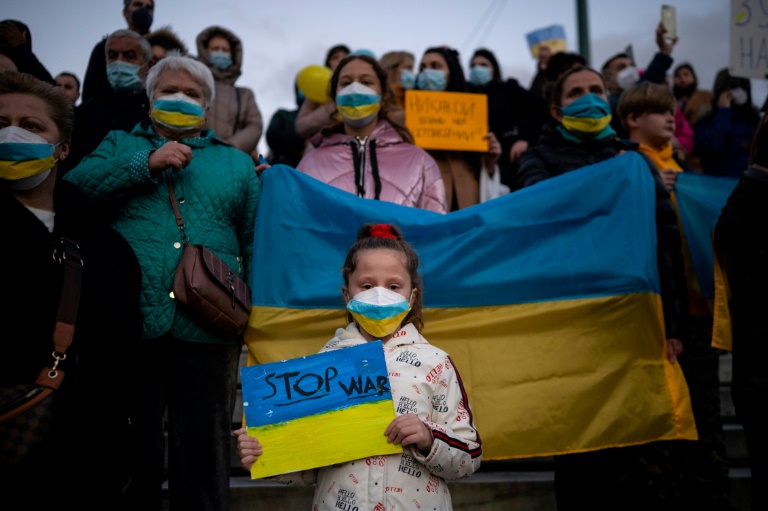
As the civilian death toll mounts, there is growing opposition to the conflict within Russia, with thousands detained for taking part in anti-war protests.

“I am urging everyone to take to the streets and fight for peace,” jailed Kremlin critic Alexei Navalny said in a statement posted on Facebook.

He called on Russians not to be afraid of going to prison.

“Everything has a price and now, in the spring of 2022, we should pay that price.”

– ‘Russia will be a pariah’ –

Western countries have imposed heavy sanctions on Russia’s economy and there have been international bans and boycotts against Russia in everything from finance to tech, from sports to the arts.

In his first State of the Union address on Tuesday, US President Joe Biden had called Russian President Vladimir Putin a “dictator” and warned of more sanctions to cripple Russia’s economy.

In the latest move, the EU banned broadcasts of Russian state media RT and Sputnik and excluded seven Russian banks from the global SWIFT bank messaging system.

The list did not name two major Russian banks, Sberbank and Gazprombank, which were left connected to SWIFT to allow EU countries to pay for Russian gas and oil deliveries.

EU and NATO members have also sent arms and ammunition to Ukraine, although they have made clear that they will not send troops and the EU has dampened Zelensky’s hopes of membership of the bloc.

Western companies meanwhile have pulled out of projects in Russia, deepening the economic toll on Moscow that saw the ruble collapse this week.

German logistics giant DHL was one of the latest to announce a ban, saying it would stop deliveries to Russia and neighbouring Belarus, which has allowed the passage of Russian troops to attack Ukraine.

“Going forward, Russia will be a pariah, and it’s hard to see how they can restore anything resembling normal interactions in the international system,” said Sarah Kreps, professor at Cornell University.

The invasion has roiled global markets, with crude surging past $110 a barrel at one point on Wednesday and equities sinking.

Aluminium and gas prices hit record highs on supply fears and the Moscow Stock Exchange failed to open for a third day running.

burs-dt/jbr/lc

Russia's war on Ukraine: Day seven situation on the ground

On the seventh day of fighting in Ukraine Wednesday, Russia claims control of the southern port city of Kherson, street battles rage in Ukraine’s second-biggest city Kharkiv, and Kyiv braces for a feared Russian assault. 

Here is a summary of the situation on the ground, based on statements from the sides, Western defence and intelligence sources and international organisations.

The military situation

– Russia says it has taken “full control” of Kherson, a port city on the Black Sea.

– Kherson’s mayor says “We are still Ukraine. Still firm”.

– Ukraine says Russian paratroopers also landed in Kharkiv, Ukraine’s second city.

– There is fighting in the streets of Kharkiv, Ukraine’s army says.

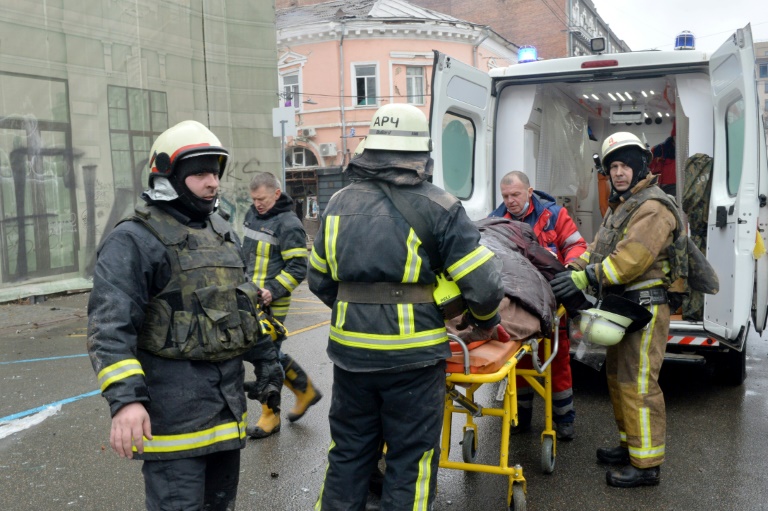
– Emergency services report four dead, nine wounded in Kharkiv shelling.

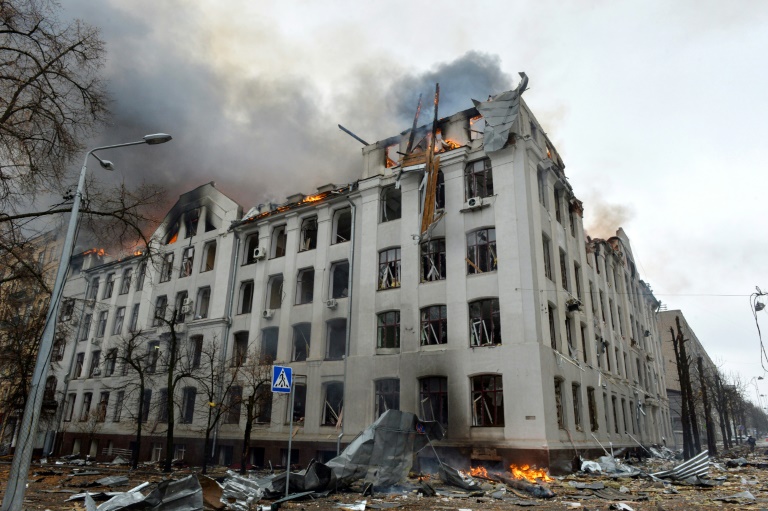
– AFP witnesses see rocket damage to security, police and university buildings in Kharkiv.

– Russia steps up bombing of Ukraine’s cities, including west and south of Kyiv.

– With Western observers noticing a Russian military column outside Kyiv, the capital remains braced for a possible assault.

– Mariupol on the Azov Sea is reportedly surrounded by Russian forces

– Spain is the latest country to announce supply of “military hardware” to Ukraine.

The military toll

– Ukraine claims 5,840 Russian soldiers have lost their lives in the conflict so far, a claim which cannot be verified.

– Russia says 498 of its soldiers have died in Ukraine. This toll, the first given by Moscow since the invasion began, cannot be verified.

– According to the Russian defence ministry, its forces have destroyed over 1,500 Ukrainian military elements including 58 planes, 46 drones and 472 tanks.

– Ukraine denies suffering military losses on this scale.

The humanitarian toll

– Tuesday’s Russian attack on a Kyiv TV tower killed five, Ukraine says.

– More than 350 civilians have died in the conflict so far, including 14 children, Ukraine says.

– UN says nearly 875,000 people have fled conflict including nearly 200,000 in 24 hours.

burs-jh/sjw/har

Close Bitnami banner
Bitnami