World

Honduras bans open-pit mining

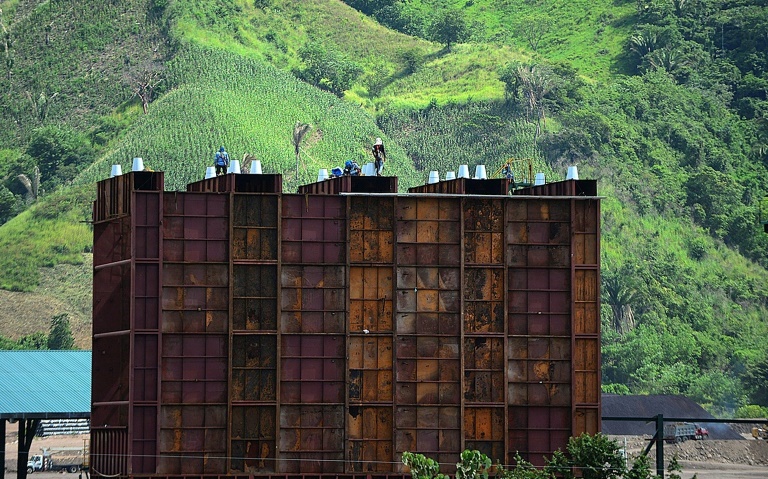
The government of newly elected Honduran President Xiomara Castro has banned open-pit mining, declaring it harmful to the environment and to people, and said it would scrap permits for such operations.

The move, announced Monday by the leftist leader, was met with joy by rights defenders and environmentalists but brought uncertainty to the industry.

“All Honduran territory is declared free of open-pit mining,” a statement from the Ministry for Mining and the Environment said.

“The approval of extractive exploitation permits is canceled because they… threaten natural resources and public health and limit access to water as a human right,” it added.

The statement did not specify whether this applied to new as well as existing permits for open-pit, or surface mining.

Taking office on January 27, Castro announced that banning open-pit mining was one of her priorities, along with fighting crime, poverty and corruption that she said was rife under her predecessor Juan Orlando Hernandez.

The ministry also vowed to intervene “immediately” to conserve areas of “high ecological value” and secure their benefit to the population.

The office of the UN High Commissioner for Human Rights in Honduras welcomed the ban in line with “the principle of climate justice and the protection of natural resources, public health and access to water as a human right.” 

But Santos Gabino Carvajal of the National Association of Miners described the announcement as “ambiguous” and potentially in violation of mining legislation.

It “prohibits even the extraction of stone and sand for construction,” he said, adding the move would “kill the possibility of development.”

The association will seek talks with the government.

– ‘An encouragement’ –

According to the Central Bank, Honduran mining exports amounted to $293 million in 2021.

Carvajal said that, if artisanal miners are included in the count, some 80,000 people would lose their jobs under the new measure.

Multinational Aura Minerals extracts gold at an open-pit mine in San Andres in the northwest of Honduras.

Last year, it was forced to suspend mining after saying its operations were “illegally interrupted” by individuals who, according to rights groups, were protesting damage to an indigenous cemetery.

Environmentalists have also been fighting against an iron oxide mine in Tocoa in the northeast which they accuse of damaging a forest reserve.

Eight people jailed in 2018 for protesting that project were released only this year.

Tocoa environmental committee member Juan Lopez told AFP the government’s announcement was “an encouragement” to communities that have been “pitted against the state and large companies because the government of Juan Orlando Hernandez was placed at the service of big companies.”

Hernandez is wanted on drug trafficking charges in the United States, which has requested his extradition.

Environmental lawyer Victor Fernandez said it was hoped the mining companies “will be brought to justice, that they will pay reparations to victims.”

The Fosdeh NGO in a recent report said mineral and hydrocarbon extraction and energy generation were “changing the geography” of Honduras.

It said that with pending mining concessions, the area earmarked for extraction could increase by 330 percent to cover more than 1,383,500 acres (560,000 hectares) or five percent of the national territory.

Elsewhere in Central America, El Salvador was the first country in the world to ban metal mining, in 2018, while Costa Rica banned open-pit mining in 2010.
Honduras bans open-pit mining

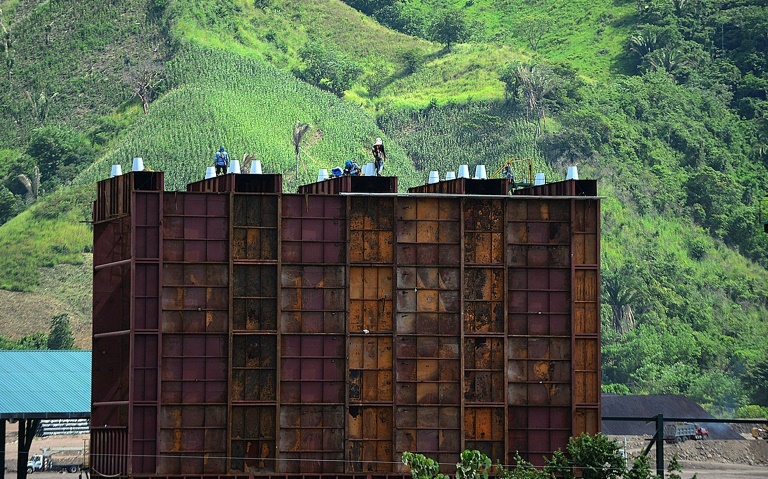
The government of newly elected Honduran President Xiomara Castro has banned open-pit mining, declaring it harmful to the environment and to people, and said it would scrap permits for such operations.

The move, announced Monday by the leftist leader, was met with joy by rights defenders and environmentalists but brought uncertainty to the industry.

“All Honduran territory is declared free of open-pit mining,” a statement from the Ministry for Mining and the Environment said.

“The approval of extractive exploitation permits is canceled because they… threaten natural resources and public health and limit access to water as a human right,” it added.

The statement did not specify whether this applied to new as well as existing permits for open-pit, or surface mining.

Taking office on January 27, Castro announced that banning open-pit mining was one of her priorities, along with fighting crime, poverty and corruption that she said was rife under her predecessor Juan Orlando Hernandez.

The ministry also vowed to intervene “immediately” to conserve areas of “high ecological value” and secure their benefit to the population.

The office of the UN High Commissioner for Human Rights in Honduras welcomed the ban in line with “the principle of climate justice and the protection of natural resources, public health and access to water as a human right.” 

But Santos Gabino Carvajal of the National Association of Miners described the announcement as “ambiguous” and potentially in violation of mining legislation.

It “prohibits even the extraction of stone and sand for construction,” he said, adding the move would “kill the possibility of development.”

The association will seek talks with the government.

– ‘An encouragement’ –

According to the Central Bank, Honduran mining exports amounted to $293 million in 2021.

Carvajal said that, if artisanal miners are included in the count, some 80,000 people would lose their jobs under the new measure.

Multinational Aura Minerals extracts gold at an open-pit mine in San Andres in the northwest of Honduras.

Last year, it was forced to suspend mining after saying its operations were “illegally interrupted” by individuals who, according to rights groups, were protesting damage to an indigenous cemetery.

Environmentalists have also been fighting against an iron oxide mine in Tocoa in the northeast which they accuse of damaging a forest reserve.

Eight people jailed in 2018 for protesting that project were released only this year.

Tocoa environmental committee member Juan Lopez told AFP the government’s announcement was “an encouragement” to communities that have been “pitted against the state and large companies because the government of Juan Orlando Hernandez was placed at the service of big companies.”

Hernandez is wanted on drug trafficking charges in the United States, which has requested his extradition.

Environmental lawyer Victor Fernandez said it was hoped the mining companies “will be brought to justice, that they will pay reparations to victims.”

The Fosdeh NGO in a recent report said mineral and hydrocarbon extraction and energy generation were “changing the geography” of Honduras.

It said that with pending mining concessions, the area earmarked for extraction could increase by 330 percent to cover more than 1,383,500 acres (560,000 hectares) or five percent of the national territory.

Elsewhere in Central America, El Salvador was the first country in the world to ban metal mining, in 2018, while Costa Rica banned open-pit mining in 2010.
Ukraine war brings Sweden, Finland even closer to NATO

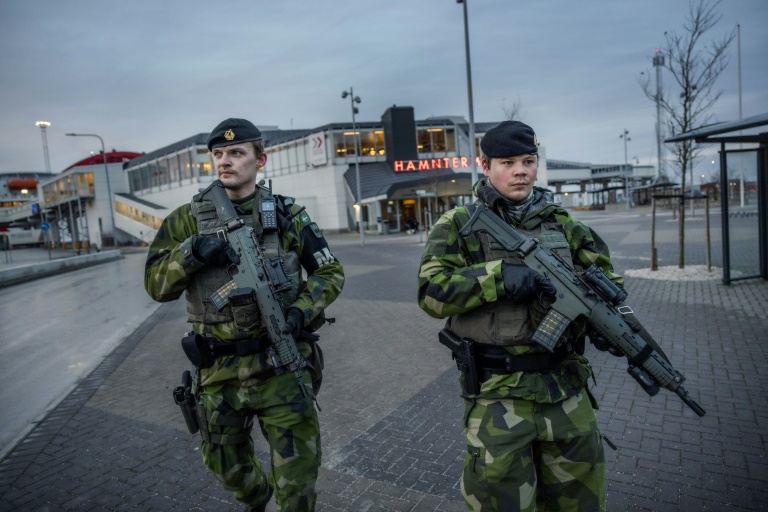
The Russian invasion of Ukraine has upended the status quo in traditionally non-aligned Finland and Sweden, ushering in an “historic” surge in support for NATO, “exceptional” arms exports and defiance to Moscow’s demands.

Stockholm and Helsinki have ruled out applying to join the NATO military alliance for the time being but the two countries have never been so close to taking the plunge, analysts say.

“Anything is possible at the moment and the signal from NATO countries is that a membership application can be processed in a very short time-span,” said Zebulon Carlander, defence analyst with the Society and Defence organisation in Sweden.

“So I think it’s very much a political decision that rests in the capitals — Stockholm and Helsinki,” he told AFP. 

The two countries are officially non-aligned, although they have been NATO partners since the mid-1990s and ended their neutral stance at the end of the Cold War.

Finland’s Prime Minister, Sanna Marin, said Tuesday that the mindset of citizens and politicians towards joining the alliance “is changing” following Russia’s assault on Ukraine.

The NATO debate “is in full swing and will certainly intensify,” Marin said, after party leaders met to consider how to respond to a public petition calling for a referendum on NATO membership.

But Marin cautioned against drawing conclusions at this stage.

The petition garnered the 50,000 signatures needed to refer the matter to the parliament in less than a week, and will be considered as part of a wider debate on the Ukraine crisis.

For the first time, a majority (53 percent) of Finns are in favour of joining NATO, according to a poll published Monday by public broadcaster Yle.

That is almost double the number a month ago, when Helsingin Sanomat newspaper put support at just 28 percent.

“(This is) a completely historic and exceptional result,” Charly Salonius-Pasternak of the Finnish Institute of International Affairs told AFP. 

Support for joining NATO is historically high in Sweden, too — at 41 percent according to a poll by public broadcaster SVT last Friday.

– Russian warnings –

In another radical change, the two countries have broken with tradition by exporting weapons to a country in active conflict.

Sweden is sending 5,000 anti-tank weapons to Ukraine alongside helmets and body armour, while Finland is sending 2,500 assault rifles, ammunition and 1,500 single-use anti-tank weapons.

For Sweden, this is unprecedented since the Winter War of 1939, when it sent assistance to Finland to counter an invasion by none other than the Soviet Union.

“This is probably just the beginning of reassessments in Swedish defence security policy,” Carlander said.

Both countries are also seeing a surge in applications to their army reserves. 

Experts expect the two countries to act in concert on whether to join NATO. 

If they did, it would further heighten tensions between Russia and the West, since the eastward expansion of the alliance is the prime security grievance of the Kremlin.

Last Friday, Russia’s foreign ministry warned that if the Nordic countries were to join NATO it would “have serious military and political repercussions”.

Helsinki shrugged this off as a warning it had heard before. 

burs/jll/gil/er

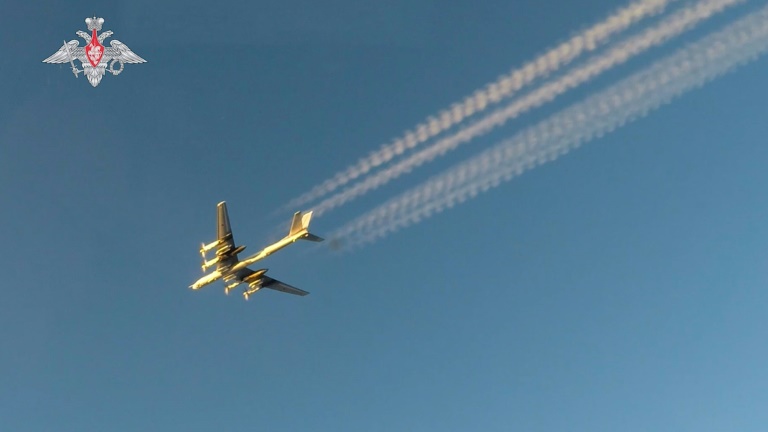
Low-profile Russian air force puzzles Western experts

Russia’s air force still does not enjoy total superiority in the skies above Ukraine despite its overwhelming numerical advantage, part of the reason for the army’s slow progress on the ground, experts say.

According to strategic intelligence research service Janes, Russia’s air force comprises 132 bombers versus none for Ukraine, 832 fighter jets against 86 for Ukraine, and 358 transport planes against 63 for Kyiv.

Other aerial weapons show a similarly crushing asymmetry, except for drones of which Ukraine has 66 and Russia 25.

Even though Russia has not engaged its entire air force in the conflict, its forces would still have been expected to rule the Ukrainian air space by now, experts say.

“While Russia has the advantage that comes with greater numbers, it has not yet gained control of the skies over Ukraine to the extent that it has been able to prevent the Ukrainian Air Force from operating and inflicting damage on the Russian war effort,” said Gareth Jennings at Janes.

“They are still engaged in trying to neutralise Ukrainian ground- and air-based air defences,” he told AFP.

– Border control  –

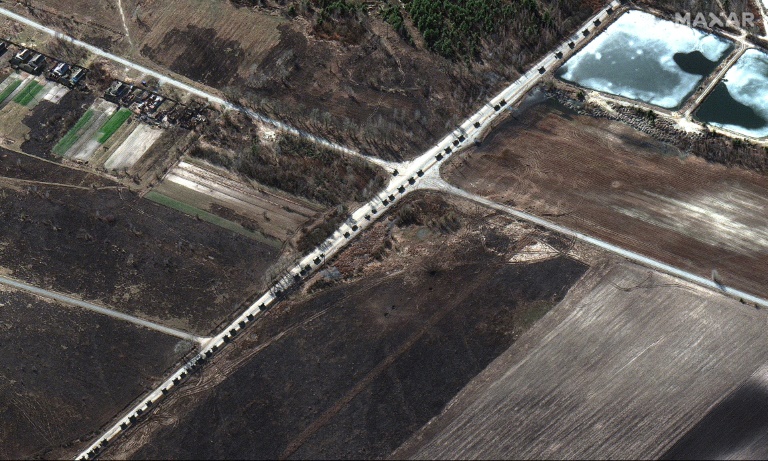
The Russian air force is, nevertheless, in a position to protect the advancing army where it counts, such as a convoy — dozens of kilometres (miles) long of trucks, armoured vehicles and artillery — advancing on Kyiv from the north, as seen on satellite images Tuesday.

“The Russians certainly have air superiority along a 200-kilometre (125-mile) stretch close to the border, and around priority objectives,” said Pierre Razoux, head of research at the FMES strategic research foundation.

Whatever air power the Ukrainians may still possess, “they will not risk it against this kind of position because they would be all but certain to be destroyed”, he said.

But even after accounting for the convoy’s need for air cover, experts remain puzzled as to why the two-day Russian bombing campaign against Ukrainian airfields and control towers at the start of the campaign was not quickly followed up with a grab for all of the country’s air space.

“The lacking efficacy of the Russian air force is one of the surprising elements of this conflict,” said former French army colonel Michel Goya.

Despite the experience from its intervention in Syria in 2015, the Russian air force is still a far cry from “the precision, the flexibility and the inter-operability of Western air forces”, he said on Twitter.

– Maybe soon –

Air defences deployed in Kyiv and in other cities are in good shape meanwhile, leaving the Russians with the hard choice of launching high-altitude attacks and risk carnage among the civilian population, or coming in low at the risk of being shot down.

“You get the feeling that Putin is pursuing contradictory objectives,” said Razoux. “On the one hand he’s showing off his power, but on the other hand he hasn’t yet crossed some lines, such as taking a city whatever the cost may be.”

Justin Bronk, aviation expert at the British RUSI think tank, said he suspected a possible lack of precision guided munitions (PGMs) available to Russian pilots may also be a factor in the attack delay.

Russian air strikes in Syria often relied on unguided missiles, he said. 

“This not only indicates a very limited familiarity with PGMs among most Russian fighter crews, but also reinforces the widely accepted theory that the Russian air-delivered PGM stockpile is very limited,” he wrote on Monday.

Other factors for the air force’s hesitancy could be the fear of friendly-fire incidents, and the Russian pilots’ limited total flying hours on their jets, he suggested.

But just because the expected onslaught of the 300 Russian fighter planes deployed near combat zones has not yet happened does not mean that it won’t happen, perhaps soon.

Whatever may have gone wrong so far, Russian fighter fleets “remain a potentially highly destructive force, and one that could be unleashed against aerial and fixed ground targets at short notice over the coming days”, Bronk said.

Ukraine says civilians killed in fresh Russian shelling

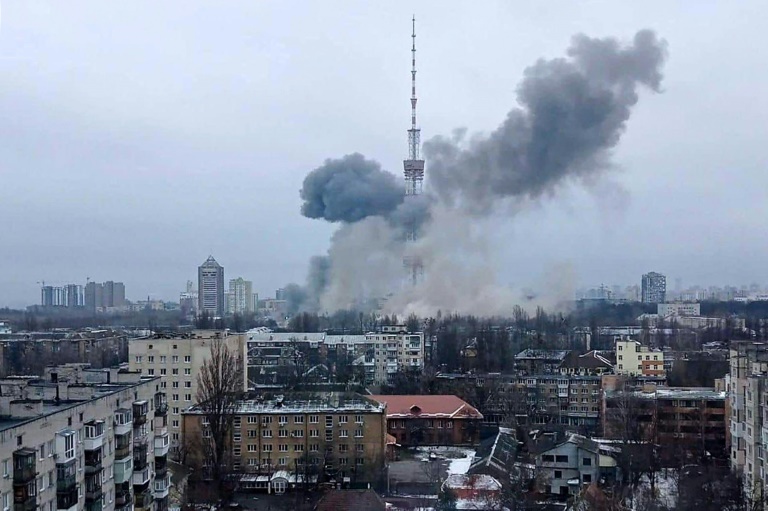
Russian air strikes hit a residential block in Kharkiv and the main TV tower in the capital Kyiv, Ukraine said on Tuesday, as Moscow stepped up attacks despite sanctions and warnings of a humanitarian crisis.

Eight people were reported killed in the strike in Kharkiv, Ukraine’s second biggest city, on day six of Russia’s invasion of its pro-Western neighbour.

Kharkiv officials said 10 more people had been killed by Russian shelling on a local government building, and 10 more were found alive under the rubble.

Ukrainian officials said the strike on the TV tower in Kyiv killed five people, knocked out some state broadcasting but left the structure intact.

It came after Russia warned Kyiv residents living near security infrastructure to leave their homes.

“This is state terrorism on the part of Russia,” said Ukrainian President Volodymyr Zelensky, accusing Moscow of committing a “war crime”.

After a call with US President Joe Biden later Tuesday he said on Twitter: “We must stop the aggressor as soon as possible.” 

Russia has denied targeting civilian infrastructure.

Visiting Estonia on Tuesday, British Prime Minister Boris Johnson called the bombardment of Kharkiv “absolutely sickening” and reminiscent of massacres of civilians in Sarajevo in the 1990s.

– Strategic win along Azov Sea –

The International Criminal Court has already opened a war crimes investigation against Russia since Moscow began its invasion on Thursday.

Ukraine says more than 350 civilians, including 14 children, have been killed in the conflict so far.

There was no breakthrough in initial talks between Russia and Ukraine Monday and Russian forces have pressed further into the country.

In southern Ukraine, the city of Mariupol on the Azov Sea was left without electricity after bombardment, while Kherson on the Black Sea reported Russian checkpoints encircling the city.

In a key victory for Moscow, Russia’s defence ministry said its troops had linked up with the forces of pro-Moscow rebels from eastern Ukraine in a region along the Azov Sea coast.

But Ukrainian forces say that despite incursions by “sabotage groups” into the cities, Russian forces have yet to capture a major settlement.

– ‘Shattered peace in Europe’ –

During a visit to an airbase in Poland, NATO chief Jens Stoltenberg said Russian President Vladimir Putin had “shattered peace in Europe”.

Zelensky meanwhile reiterated an urgent appeal for his pro-Western country to be admitted to the European Union.

“Prove you are not abandoning us and you are really Europeans,” he told MEPs in a video address to the European Parliament. 

More than 660,000 people have already fled abroad, the UN refugee agency said, estimating that a million people are displaced within ex-Soviet Ukraine, which has a population of 44 million.

The UN estimates that up to four million refugees may need help in the coming months and 12 million more will need assistance within the country.

It has asked for $1.7 billion in urgent aid, while the EU pledged 500 million euros.

Russia has defied international bans, boycotts and sanctions to press ahead with an offensive it says is aimed at defending Ukraine’s Russian speakers and toppling the leadership.

Defence Minister Sergei Shoigu said Russia would continue “until set goals are achieved”.

He vowed to “demilitarise and de-Nazify” Ukraine and protect Russia from a “military threat created by Western countries”.

Western powers are planning more sanctions in response, with French Finance Minister Bruno Le Maire saying they would “bring about the collapse of the Russian economy”.

Russia’s former president Dmitry Medvedev, the deputy head of Russia’s Security Council, hit back, warning that “economic wars quite often turned into real ones” in the past.

– ‘Bombing kept us up all night’ –

Fears are growing of an all-out assault to capture Kyiv — a city of 2.8 million people.

Satellite images provided by US firm Mazar showed a 65-kilometre (40-mile) long build-up of armoured vehicles and artillery north of the city.

Zelensky said defending the city was now “the key priority for the state”.

Inside Kyiv, makeshift barricades dotted the streets and residents formed long queues outside the few shops that remained open to buy basic essentials.

In the village of Shaika near Kyiv, Natasha, 51, opened a canteen in the local church to feed soldiers and volunteers.

“The shelling and the bombing kept us up all night,” she said.

– Sanctions hit Russians –

Western nations have moved to further isolate Russia, responding with an intensifying diplomatic, economic, cultural and sporting backlash.

US Secretary of State Antony Blinken on Tuesday suggested Russia should be stripped of UN rights council membership.

Germany has already promised arms for Ukraine, while the EU also said it will buy and supply arms to Ukraine, the first such move in its history.

Turkey said it would implement an international treaty to limit ships passing through the Dardanelles and Bosphorus straits, a move requested by Ukraine to block the transit of Russian warships.

And global shipping magnates Maersk, MSC and CMA CGM all said Tuesday they were suspending non-essential deliveries to Russia in the latest economic punishment. 

Within Russia, sanctions imposed by the West have begun to bite.

Putin announced emergency measures intended to prop up the Russian ruble, including banning Russians from transferring money abroad, after the currency crashed to a record low.

Many ordinary Russians have raced to withdraw cash.

– Russian conductor sacked –

The response from the world of sports also gathered steam.

Russia was expelled from the World Cup and the country’s clubs and national teams suspended from all international football competitions, while the International Tennis Federation banned Russian and Belarusian teams from competitions. 

The International Olympic Committee on Monday urged sports federations and organisers to exclude Russian and Belarusian athletes and officials from international events.

Russian ally Belarus hosted some troops used in Moscow’s invasion.  

In the arts, the Munich Philharmonic said it was parting ways with star Russian conductor Valery Gergiev “with immediate effect” after he failed to respond to a request to denounce the invasion.

And Russian soprano Anna Netrebko said she was stepping back from performing amid controversy over her pro-Kremlin stance, despite her condemnation of the invasion. 

The Cannes Film Festival meanwhile banned Russian delegations from this year’s event.

burs-jv/gw

Taliban row back comments saying Afghans barred from leaving

The Taliban’s chief spokesman on Tuesday rowed back comments he made suggesting Afghans would be barred from leaving the country, saying he had been misunderstood.

Zabihullah Mujahid sparked alarm at the weekend when he told a press conference that Afghans would need “an excuse” to travel abroad, and confirmed Afghanistan’s new rulers had put a stop to any more evacuation flights.

After seizing power in August, the Taliban promised Afghan citizens would be allowed to come and go as they pleased — as long as they had passports and visas for their destinations.

But on Sunday, he told a press conference: “I have to say clearly that persons who leave the country along with their families and have no excuse… we are preventing them.”

On Tuesday, he tweeted that his “meaning” was: “Our compatriots who have legal documents and invitations can travel outside the country and can return to the country confidently.”

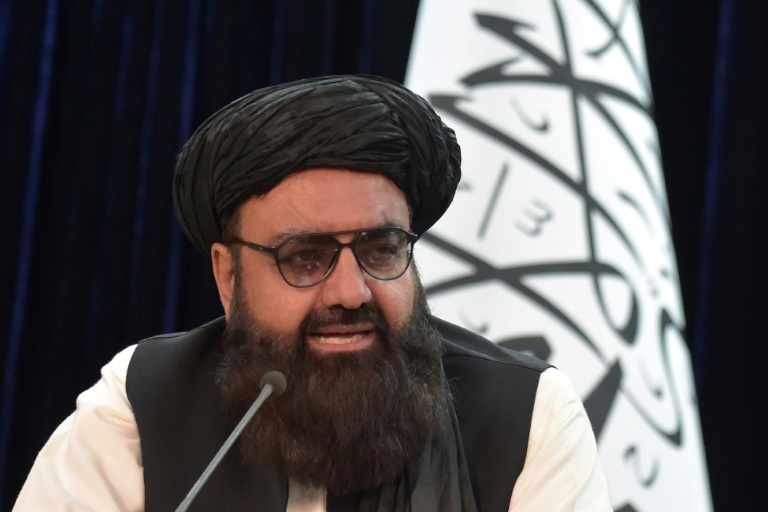
The Taliban’s deputy minister for refugees and repatriations, however, said Tuesday it was “not appropriate” for Western nations to invite Afghans abroad, or facilitate their departure.

“To a larger extent, the international community is interfering in Afghanistan’s affairs and are inviting people promising asylum,” Mohammad Arsala Kharutai told a press conference.

“This is interference and against international law and we condemn it.”

Mujahid’s Sunday announcement alarmed many Afghans who have been promised asylum abroad after working with US-led foreign forces or other Western organisations during the Taliban’s 20-year insurgency.

More than 120,000 Afghans and dual nationals were evacuated up to August 31 when the last US-led troops withdrew, two weeks after the hardline Islamists seized Kabul.

Thousands with similar links are still in Afghanistan, however, desperate to leave and fearful they may be targeted by the Taliban as “collaborators”.

The last official evacuation by air was on December 1, although organised road convoys to Pakistan have taken place as recently as last week.

Hugo Shorter, Britain’s top envoy to Afghanistan, but based outside the country, said barring Afghans from leaving amounted to “unacceptable restrictions on freedom of movement”.

“I call on the Taliban to clarify their remarks urgently,” he tweeted.

“The world is still watching the Taliban’s behaviour.”

In Washington, the State Department said the Taliban had a commitment to allowing free passage, and that the United States continues to try to facilitate the exit of US citizens and eligible Afghan allies who want to leave.

“We will continue to engage diplomatically to resolve any issues and to hold the Taliban to their public pledge to let all foreign nationals and any Afghan citizen with travel authorisation from other countries to freely depart Afghanistan,” a department spokesperson said.

“Our ability to facilitate relocation for our Afghan allies depends on the Taliban living up to its commitment of free passage. We have repeatedly reiterated this point to them.”

Ukraine refugees begin arriving in Budapest

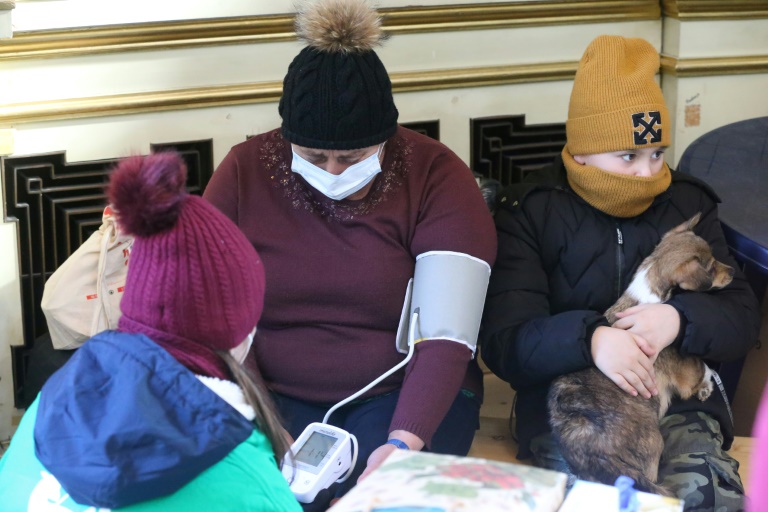
Thousands of refugees fleeing Russia’s invasion of Ukraine have arrived in Budapest after abandoning their homes fearing for their lives as they seek safety elsewhere.

An AFP photographer saw dozens of refugees disembarking from trains arriving every 30 minutes in the Hungarian capital from the Ukrainian border on Tuesday. 

“We were really scared. We left Kyiv last Friday. It took us so long to get here,” Laura Kusnirova, 54, told AFP after getting off a train.

Carrying a little dog in a shoulder bag, she said tearfully “how could I leave her behind,” before rushing off. 

Like Kusnirova, who is planning to head to Brussels to stay with friends, relief organisations say most of the refugees plan to travel onwards rather than stay in Hungary.

Around 4,000 refugees, including more than 300 children, arrived by train in Budapest on Monday, according to police, and hundreds were provided with emergency accommodation in the city.

Relief groups have set up stalls with food, water and other aid supplies in train stations in Budapest, said Marton Juhasz, head of the Hungarian Reformed Church’s charity.

“Some just need baggage storage or onward travel information, but others are in urgent need of food, water and shelter, even psychological help as many have left family behind,” Juhasz told AFP while waiting for the next train to arrive.

Svetlana Hogert, a volunteer translator originally from western Ukraine where a large ethnic-Hungarian minority lives, said many people in her home country were frightened. 

“I came here to help in any way I can,” the 46-year-old, who has lived in Hungary for years, told AFP.

Since Russia invaded Ukraine last week, volunteers have rushed to the aid of refugees entering Hungary, which in past years has restricted asylum seekers’ access under nationalist Prime Minister Viktor Orban.

More than 660,000 people have already left Ukraine and an estimated one million are displaced within the country, the UN refugee agency says.

The United Nations estimated on Monday that some 90,000 people from Ukraine had arrived in EU member Hungary since last week.

US says Russian advance on Kyiv stalled

The Russian military advance on Kyiv has momentarily stalled, hampered by Ukrainian resistance as well as fuel and food shortages, a senior US defense official said Tuesday.

“We generally sense that the Russian military movement… the overarching movement on Kyiv, is stalled at this point,” the official told reporters.

“We do think that some of it has to do with their own sustainment and logistics,” the official said.

“And we also think that just in general… the Russians themselves are regrouping and rethinking and trying to adjust to the challenges that they’ve had.”

Six days after Moscow invaded its ex-Soviet neighbor, the official said a massive Russian convoy north of Kyiv is barely moving, but that the US believes they still intend to surround and capture the Ukraine capital, by siege tactics if necessary.

The US official said the Ukraine military continues to challenge the invasion force, and that the Russians have not gained control of the skies above the country.

Nor have the Russians succeeded in taking their first major target, the Ukraine’s second largest city of Kharkiv in the northeast, where the heaviest fighting has taken place.

But in the south, the Russians have connected their forces along the coast from Crimea to the Russian border in the east, and have surrounded the city of Mariupol.

The Pentagon believes that the advance of the 150,000-strong combat force Russia has committed to invading Ukraine — around 80 percent of which has so far entered the country — has moved much more slowly than planned, and now faces supply shortages.

“In many cases, what we’re seeing are columns that are literally out of gas,” the defense official said. “Now they’re starting to run out of food for their troops.”

The official also said, but offered no evidence, that there were signs of morale problems in the Russian force, which makes use of a large number of conscript soldiers.

“Not all of them were apparently fully trained and prepared, or even aware that they were going to be sent into a combat operation,” the official said.

“We have picked up independently on our own indications that  morale is flagging in some of these units,” the official said.

Five killed in Russian strike on Kyiv TV tower

An apparent Russian airstrike aimed at Kyiv’s main television tower killed five people on Tuesday, officials said, knocking out some broadcasts but leaving the structure intact.

After a blast sounded around the city and smoke was seen rising in the Babi Yar district, the emergencies service said five people were also injured in the attack.

Ukrainian officials released footage of charred bodies and cars damaged by the strike, which came during a surge of Russian attacks on Ukraine’s second city of Kharkiv.

“To the world: what is the point of saying ‘never again’ for 80 years, if the world stays silent when a bomb drops on the same site of Babi Yar,” Ukrainian leader Volodymyr Zelensky asked in a tweet.

“Once again, these barbarians are murdering the victims of Holocaust!”

The tower is based near the Babi Yar ravine where more than 30,000 were slaughtered by the Nazis during World War II.

The tragedy is commemorated by a memorial statue and is a site of pilgrimage for many Jews.

Ukrainian officials accused Moscow of threatening the memorial. 

Kyiv mayor Vitali Klitschko said the attack damaged the tower’s transformer substation, which provides it with electricity, as well as some of its hardware.

The interior ministry said that back-up systems would be put into operation to restore programming.

Most Ukrainian channels appeared to be functioning normally about an hour after the strike.

Earlier, the Russian defence ministry spokesman had said that Moscow’s forces would hit technological infrastructure in Kyiv “to suppress information attacks on Russia”.

But the targets he cited — the SBU security service and the army psychological operations unit — did not include the civilian-run television tower in the capital.  

Tired and emotional, Ukrainians arrive by train in Berlin

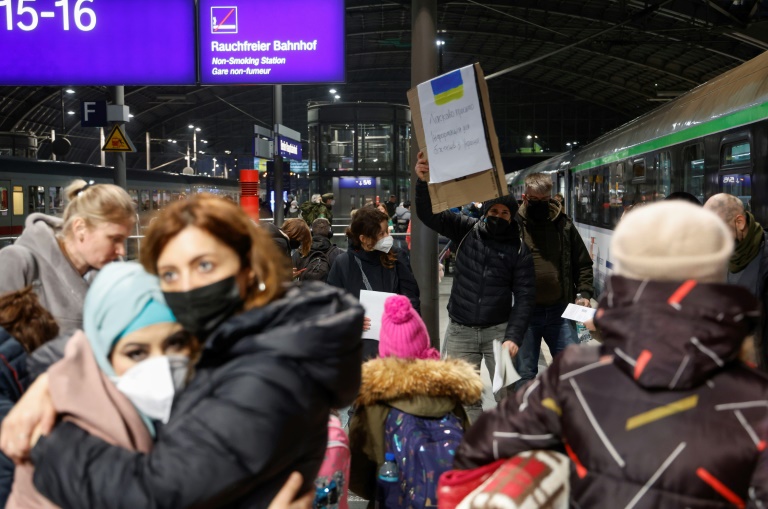
At Berlin central station, commuters rush past a mother and her four children as they stand bewildered on the platform, weighed down by heavy luggage. 

Two of them, still toddlers, are wearing hats and jackets in blue and yellow, the colours of the flag of Ukraine, the country they have fled to come here.

Germany has opened its doors to refugees from Ukraine since Russia’s invasion of the country began last week, displacing more than half a million people already.

National rail operator Deutsche Bahn has laid on free travel for refugees and is also preparing to charter additional trains from the Polish border.

“We are going to Dresden (in eastern Germany). We have a good friend there who said he could find us a place to stay,” 17-year-old Ukrainian student Maxym Floria tells AFP.

Floria set off four days ago with his mother and younger brother from Izmail, in the Odessa region, and has travelled through Moldova, Romania, Hungary, Slovakia and Poland to get here.

“If Odessa fell we didn’t stand a chance, so we decided to leave with my family,” he said.

Only a relatively small number have made it to Germany so far: around 3,000, according to the latest figures from the interior ministry.

– Men left behind –

Over 677,000 people have so far left Ukraine to seek refuge in neighbouring countries, according to the UNHCR, with many of them ending up in Poland.

Gerd Landsberg, head of the German Association of Towns and Municipalities, told the Handelsblatt daily he expects more than 100,000 to arrive in Germany.

Floria’s father, like all men aged between 18 and 60, has not been allowed to leave Ukraine as he has been called up to fight.

The family are not intending to stay in Germany permanently.

“I firmly believe that we will be able to go home safely and that everyone will fight for our country,” Floria said, visibly emotional and exhausted.

Berlin is expecting to see a sharp increase in the number of women and children arriving from Ukraine in the coming days. 

The German capital and the surrounding state of Brandenburg have already reactivated some of the systems deployed in 2015 to cope with an influx of refugees from the Middle East, mainly Iraq and Syria.

Ukraine is at least 700 kilometres (430 miles) from Berlin, but Interior Minister Nancy Faeser has repeatedly stressed that Germany’s borders are open to those fleeing the conflict.

– Night train from Warsaw –

The Russian invasion has provoked an outpouring of support in Germany, with more than 100,000 people joining a demonstration in Berlin on Sunday to show solidarity with Ukraine.

Some have also taken to social media to organise initiatives to transport food and clothes to the Polish-Ukrainian border and to offer accommodation in Berlin.

The European Union is planning to grant Ukrainians fleeing the war the right to stay and work in the 27-nation bloc for up to three years.

At Berlin Hauptbahnhof, one of the largest stations in Europe, the situation is a far cry from 2015, when Germans welcomed cohorts of refugees from Afghanistan, Iraq and Syria by serving them soup and handing out toothbrushes.

On platform 14, police officers and volunteers draped in Ukrainian flags are there to welcome a handful of refugee families who have just arrived on the night train from Warsaw.

Berlin has already prepared 1,300 emergency beds for refugees and is planning to add 1,200 more in the coming days. 

In Brandenburg, which borders Poland, accommodation is being readied for 10,000 people, regional interior minister Michael Stuebgen told the RBB broadcaster.

The authorities are also counting on support from the 330,000 Ukrainians or people of Ukrainian origin already living in Germany, many of whom still have family and friends back home. 

Close Bitnami banner
Bitnami