World

Australia tells tens of thousands to flee floods

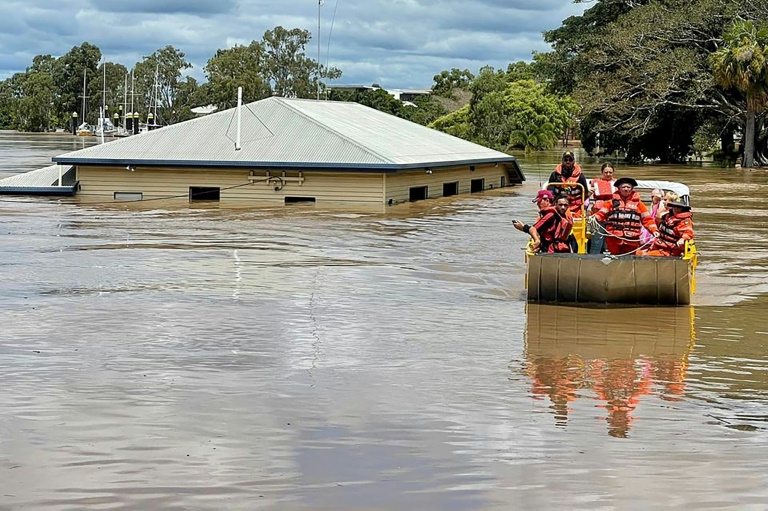
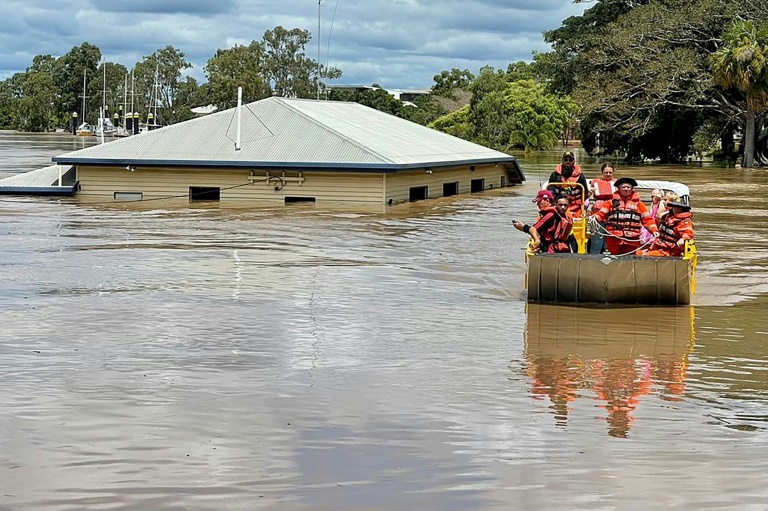
Deadly floods swept Australia’s east coast Tuesday, stranding people on bridges and rooftops and forcing tens of thousands to flee their homes.

Dozens of emergency warnings are in effect across the states of Queensland and New South Wales, where a week-long “rain bomb” has dumped a metre (3.2 feet) of water on some areas.

Several waterways have burst their banks or broken through levees, inundating towns and forcing residents to evacuate or seek safety on higher ground.

Nine people have died and more than a thousand people have been rescued. Authorities have warned that more fatalities are likely.

The latest victim was a woman in her 80s whose body was found by police inside a home in the country town of Lismore. 

“She is yet to be formally identified,” said New South Wales Police. 

In the usually laid back surf town of Byron Bay, Hannah Leser had enjoyed the weekend celebrating her wedding with 150 guests.

But the new bride and groom are now rescuing friends stranded in the nearby towns of Ballina and Mullumbimby in a borrowed four-wheel-drive.

About 30 people are camped at a house where the couple were to spend their honeymoon.

“It’s chaos but all of our friends and family are safe,” she told AFP. “This is not quite the honeymoon I expected but it is what it is.”

Australia’s military has deployed two MRH-90 Taipan helicopters to aid the rescue effort.

In one daring aerial rescue, the crew plucked two people to safety as muddy waters lapped at the corrugated metal roofing of their home.

Live television images on public broadcaster ABC showed a rescuer sitting on the roof with the pair, preparing to strap them to the chopper’s winch.

“We’ve seen people stranded on roofs for hours, we’ve seen children being rescued, we’re seeing people stranded on bridges,” said New South Wales Premier Dominic Perrottet.

– Sailing past roofs –

Emergency services were overwhelmed by calls for help and flotillas of makeshift rescue boats fanned out across towns as people tried to ferry their neighbours to safety.

In Lismore, local member of parliament Janelle Saffin had to swim to safety after she was stranded in the floodwaters.

“We went to the verandah, hanging on to the rafters,” she told Nine Newspapers.

Local resident Danika Hardiman was rescued Monday after she woke up to find floodwaters had reached the balcony of her second-floor apartment in the town’s main street.

She and her partner managed to climb up to the roof and were eventually rescued by “two guys in a boat, two locals”, she told AFP, describing the scenes in Lismore as “horrific”.

“Imagine you’re in a boat sailing past people’s roofs,” she said.

Makeshift evacuation centres have been set up in primary schools, recreation centres and retired service members’ clubs.

Travis Lavdaras headed for Ballina Airport, where the departure lounge was filled with families, holidaymakers and the elderly trying to escape.

“There were big lakes’ worth of water on either side of the highway” on the way to the terminal, he said, with many flights cancelled and an evacuation ordered for the area nearby.

Near the town of Grafton, the scale of the disaster was thrown into stark relief by the sight of buildings submerged almost to roof level, roads washed away and cattle roaming abandoned.

Further south in Sydney, residents endured another day of torrential downpours and were warned to brace for “major flooding”.

Australia has been on the sharp end of climate change, with droughts, deadly bushfires, bleaching events on the Great Barrier Reef and floods becoming more common and intense as global climate patterns change.
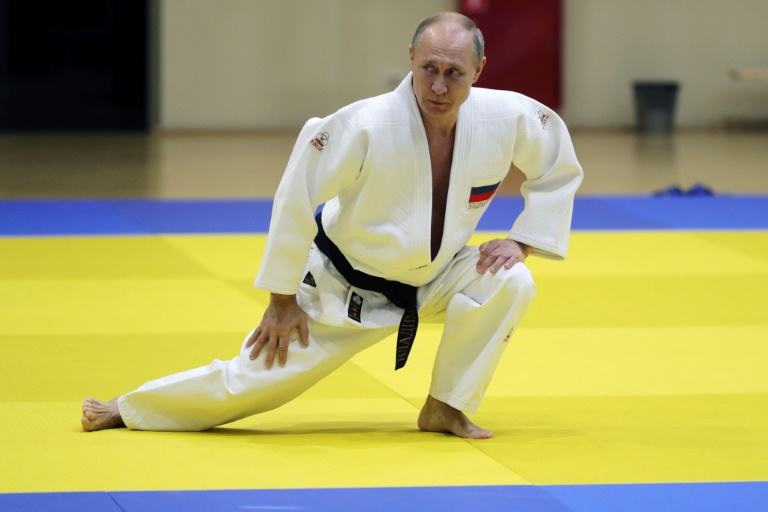
World Taekwondo revokes Putin's honorary black belt over Ukraine

Russian President Vladimir Putin had his honorary black belt in taekwondo revoked by the sport’s international governing body on Tuesday, over his country’s invasion of Ukraine.

As Russian troops amass outside Kyiv, and hundreds of thousands of Ukrainian refugees flee into neighbouring countries, world leaders have heaped punishing economic sanctions on Putin and his closest allies, as well as Russian-linked businesses.

The sporting world has had a similar reaction: Russia was booted out of qualifying for this year’s football World Cup, and the International Olympic Committee (IOC) has urged federations to exclude athletes from Russia, as well as from its ally Belarus. 

World Taekwondo, which governs international federations for the sport, was the latest to condemn Putin, saying Tuesday that Moscow’s actions went against the sport’s vision: “Peace is more precious than triumph.”

“In this regard, World Taekwondo has decided to withdraw the honorary 9th dan black belt conferred to Mr Vladimir Putin in November 2013,” the Seoul-based body said in an official statement. 

It added that official taekwondo events would not be organised in Russia or Belarus.

In line with the IOC’s urging, the flags and anthems of both countries will also not be displayed or played at taekwondo events around the world.

“World Taekwondo’s thoughts are with the people of Ukraine and we hope for a peaceful and immediate end to this war,” it said. 

Putin does not actually do taekwondo, but is instead accomplished in judo, another martial art, and has long served as an honorary president to the International Judo Federation.

On Sunday the IJF suspended his status as honorary president and ambassador to the sport. 

Australia tells tens of thousands to flee floods

Deadly floods swept Australia’s east coast Tuesday, stranding residents on bridges and rooftops and forcing tens of thousands to flee their homes.

Flood warnings were in effect for dozens of areas across the states of Queensland and New South Wales, where a week-long “rain bomb” has dumped a metre (3.2 feet) of water on some areas in a week.

Several waterways have already burst their banks or broken through levees, inundating towns and forcing residents to flee or seek safety on higher ground.

Nine people have died and more than a thousand people have been rescued. Authorities have warned that more fatalities are likely.

The latest victim was a woman in her 80s, whose body was found by police inside a home in the country town of Lismore. 

“She is yet to be formally identified,” said New South Wales Police. 

In the usually laid back surf town of Byron Bay, Hannah Leser spent the weekend celebrating her wedding with 150 guests.

But the new bride and groom are now spending their honeymoon rescuing friends stranded in the nearby towns of Ballina and Mullumbimby in a borrowed four-wheel-drive.

Some 30 people are camped at the house where they were to spend their honeymoon.

“It’s chaos but all of our friends and family are safe,” she told AFP. “This is not quite the honeymoon I expected but it is what it is.”

Elsewhere, a military helicopter performed a daring aerial rescue, plucking two people to safety as muddy waters lapped at the corrugated metal roofing of their home.

Live television images on public broadcaster ABC showed a rescuer sitting on the roof with the pair, preparing to strap them to the chopper’s winch.

“We’ve seen people stranded on roofs for hours, we’ve seen children being rescued, we’re seeing people stranded on bridges,” said New South Wales Premier Dominic Perrottet.

– Sailing past roofs –

Emergency services were overwhelmed by calls for help and flotillas of makeshift rescue boats fanned out across the town as people tried to ferry their neighbours to safety.

In the town of Lismore, local member of parliament Janelle Saffin had to swim to safety after she was stranded in the floodwaters.

“We went to the verandah, hanging on to the rafters,” she told Nine Newspapers.

Local resident Danika Hardiman was rescued Monday after she woke up to find floodwaters had reached the balcony of her second-floor apartment in the town’s main street.

She and her partner managed to climb up to the roof and were eventually rescued by “two guys in a boat, two locals”, she told AFP, describing the scenes in Lismore as “horrific”.

“Imagine you’re in a boat sailing past people’s roofs,” she said.

Makeshift evacuation centres have been set up in primary schools, recreation centres and retired service members’ clubs.

Near the town of Grafton, buildings were submerged almost to roof level, roads were washed away and cattle roamed abandoned.

Further south in Sydney, residents endured another day of torrential downpours, and were warned to brace for “major flooding”.

Australia has been on the sharp end of climate change, with droughts, deadly bushfires, bleaching events on the Great Barrier Reef and floods becoming more common and more intense as global climate patterns change.
Australia tells tens of thousands to flee floods

Deadly floods swept Australia’s east coast Tuesday, stranding residents on bridges and rooftops and forcing tens of thousands to flee their homes.

Flood warnings were in effect for dozens of areas across the states of Queensland and New South Wales, where a week-long “rain bomb” has dumped a metre (3.2 feet) of water on some areas in a week.

Several waterways have already burst their banks or broken through levees, inundating towns and forcing residents to flee or seek safety on higher ground.

Nine people have died and more than a thousand people have been rescued. Authorities have warned that more fatalities are likely.

The latest victim was a woman in her 80s, whose body was found by police inside a home in the country town of Lismore. 

“She is yet to be formally identified,” said New South Wales Police. 

In the usually laid back surf town of Byron Bay, Hannah Leser spent the weekend celebrating her wedding with 150 guests.

But the new bride and groom are now spending their honeymoon rescuing friends stranded in the nearby towns of Ballina and Mullumbimby in a borrowed four-wheel-drive.

Some 30 people are camped at the house where they were to spend their honeymoon.

“It’s chaos but all of our friends and family are safe,” she told AFP. “This is not quite the honeymoon I expected but it is what it is.”

Elsewhere, a military helicopter performed a daring aerial rescue, plucking two people to safety as muddy waters lapped at the corrugated metal roofing of their home.

Live television images on public broadcaster ABC showed a rescuer sitting on the roof with the pair, preparing to strap them to the chopper’s winch.

“We’ve seen people stranded on roofs for hours, we’ve seen children being rescued, we’re seeing people stranded on bridges,” said New South Wales Premier Dominic Perrottet.

– Sailing past roofs –

Emergency services were overwhelmed by calls for help and flotillas of makeshift rescue boats fanned out across the town as people tried to ferry their neighbours to safety.

In the town of Lismore, local member of parliament Janelle Saffin had to swim to safety after she was stranded in the floodwaters.

“We went to the verandah, hanging on to the rafters,” she told Nine Newspapers.

Local resident Danika Hardiman was rescued Monday after she woke up to find floodwaters had reached the balcony of her second-floor apartment in the town’s main street.

She and her partner managed to climb up to the roof and were eventually rescued by “two guys in a boat, two locals”, she told AFP, describing the scenes in Lismore as “horrific”.

“Imagine you’re in a boat sailing past people’s roofs,” she said.

Makeshift evacuation centres have been set up in primary schools, recreation centres and retired service members’ clubs.

Near the town of Grafton, buildings were submerged almost to roof level, roads were washed away and cattle roamed abandoned.

Further south in Sydney, residents endured another day of torrential downpours, and were warned to brace for “major flooding”.

Australia has been on the sharp end of climate change, with droughts, deadly bushfires, bleaching events on the Great Barrier Reef and floods becoming more common and more intense as global climate patterns change.
Lockdown fears spark panic buying in Hong Kong

Hong Kongers stripped shop shelves bare Tuesday as panic buying set in following mixed messaging from the government over whether it plans a China-style hard lockdown this month.

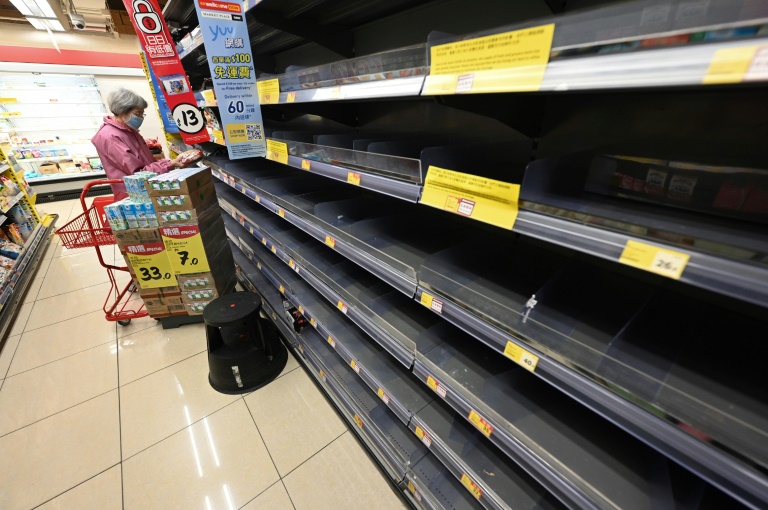
Uncertainty over Covid rules has sent the city’s residents flocking to supermarkets, chemists and vegetable stores to stock up, leaving shelves empty across the city.

Photos circulating on social media showed people had trouble finding a variety of items including meat, vegetables, frozen foods, noodles, paracetamol and testing kits. 

“We are like ants going home, grabbing a bit at one spot at a time,” a woman, who gave her surname Wu, told AFP on Tuesday in a supermarket where most vegetables and meat had been snapped up.

The financial hub is in the grips of its worst coronavirus outbreak, registering tens of thousands of new cases each day, overwhelming hospitals and shattering the city’s zero-Covid strategy.

Authorities plan to test all 7.4 million residents this month and isolate all infections either at home or in a series of camps that are still being constructed with the help of mainland China.

City leader Carrie Lam had initially ruled out a mainland style lockdown where people are confined to their homes during the testing period.

But on Monday, health chief Sophia Chan confirmed it was still on the table, a day after a senior Chinese health official described it as the best option.

On Tuesday multiple Hong Kong media including HK01, Singtao and South China Morning Post also said authorities were planning a variety of lockdown options for the test period, citing sources.

SCMP’s said the current favoured option was a nine-day “large-scale lockdown” where most residents would only be allowed out to by food.

One of the most densely populated cities on Earth, Hong Kong’s supermarkets have limited backroom storage space and saw waves of panic buying at the start of the pandemic two years ago.

City apartments are also some of the smallest in the world leaving little space to stock up. 

– ‘Rules change every day’ –

The vast majority of HongKong’s food is imported from mainland China and the current supply crunch has been worsened by cross border truckers getting infected by the high transmissible Omicron variant.

More than 190,000 infections have been recorded in the last two months compared to just 12,000 for the rest of the pandemic.

The government released a statement late Monday saying food supplies remained constant and that there was no need for panic buying. 

“You don’t need to worry about food and other necessities, Hong Kong has sufficient goods and material reserve,” the city’s number two official John Lee told reporters as he presided over the opening of a 3,900 bed isolation facility where mild infections will be treated.

But analysts said uncertainty and distrust were fuelling consumer habits.

“We have so many questions but all answers are ‘to be confirmed’,” Chan Ka-lok, an international politics scholar at Baptist University, wrote on social media.

“Rush to buy and stock up, let the people decide how to live their life.”

Tom Grundy, editor of the Hong Kong Free Press news website, described the latest panic buying as “a massive failure of gov’t communications”.

“Rules changing every few days, u-turns, botched stats, poor data disclosure,” he wrote on Twitter.

Faith in government assurances is low in Hong Kong, where authorities have carried out a two-year crackdown on dissent after huge democracy protests and have a history of backpeddling on promises.

The decision to mass test residents was itself a policy U-turn — Lam had previously ruled out such a step before backing it last month.

It is not yet clear when testing will take place and what the government will do with all the cases it finds. 

Some 70,000 isolation units for mild cases are due to come online in the coming weeks, in requisitioned hotels, public housing units and camps being built with Chinese help.

That will cover roughly two days of infections at Hong Kong’s current official caseload. 

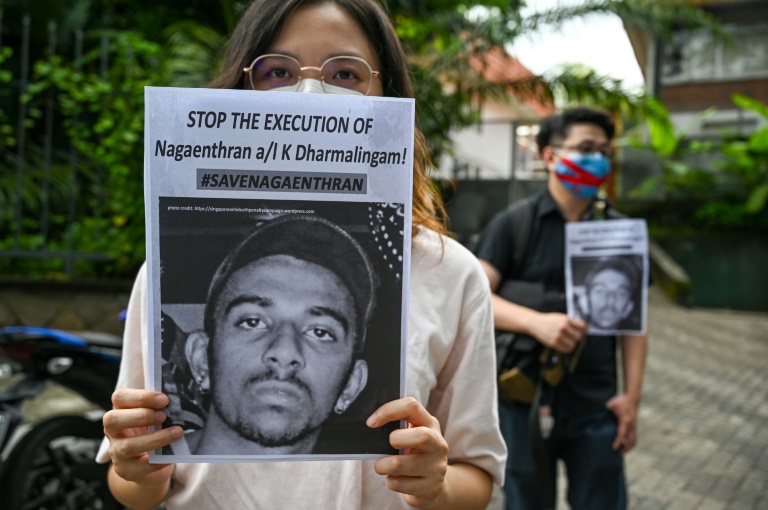
Singapore court urged to show 'mercy' to disabled man on death row

Singapore’s top court was Tuesday urged to show “mercy” as it heard the last-ditch appeal of a Malaysian man facing execution despite criticism from supporters who say he is mentally disabled.

Nagaenthran K. Dharmalingam was arrested in 2009 for trafficking a small amount of heroin into the city-state, which has some of the world’s toughest drugs laws, and handed a then mandatory death sentence the following year.

He was finally scheduled to be hanged in November but the plan sparked criticism due to concerns he has intellectual disabilities, with the European Union and British billionaire Richard Branson among those condemning it.

The 34-year-old lodged a final appeal and, after several delays, Singapore’s Court of Appeal on Tuesday heard the challenge.

His lawyer Violet Netto urged the judges to show “mercy” by allowing Nagaenthran to undergo an independent psychiatric assessment.

She asked that the defence team be given “adequate time” to locate psychiatrists for the examination, adding it was against international law to execute mentally disabled people.

But prosecutor Wong Woon Kwong opposed the move and said the defence was seeking to delay proceedings, accusing them of “abusing the process of this court”.

Tuesday’s proceedings ended without a verdict being issued, and a ruling will be handed down at a later date, which is still to be decided.

Nagaenthran was in court for the hearing, which took place with social distancing measures in place to cut the risk of coronavirus infections, and with heavy security.

The appeal was supposed to take place months ago but was delayed after Nagaenthran contracted Covid-19.

Campaigners fear chances of success are slim. If Nagaenthran is hanged, it would be the first execution in Singapore since 2019.

Concerns are also growing that his hanging will be the first in a series in the coming months, with activists warning that authorities gearing up to execute three other drug traffickers. 

– ‘Spare him’ –

Ahead of Tuesday’s hearing, Nagaenthran’s sister Sarmila Dharmalingam told AFP the family was “stressed and frightened thinking of my brother’s current situation”.

Speaking from the family home in Malaysia, she urged the Singapore government to “spare him from the gallows, give him a second chance”.

Rights groups have been ratcheting up pressure, with Amnesty International urging Singapore to spare Nagaenthran and “prevent a travesty of justice”.

“Executing someone whose mental disabilities may impede an effective defence runs counter to international law, and so does the use of this punishment for drug-related offences and its mandatory imposition,” the group said.

Nagaenthran was arrested at the age of 21 after a bundle of heroin weighing around 43 grams (one and a half ounces) — equivalent to about three tablespoons — was found strapped to his thigh as he sought to enter Singapore.

Supporters say he has an IQ of 69 — a level recognised as a disability — and was coerced into committing the crime.

But authorities have defended the decision to press ahead with the hanging, saying that legal rulings had found he “knew what he was doing” at the time of the offence.

The city-state maintains the death penalty for several offences, including drug trafficking and murder, and insists it has helped to keep Singapore one of Asia’s safest places.

Russia invasion convoy masses near Ukraine capital

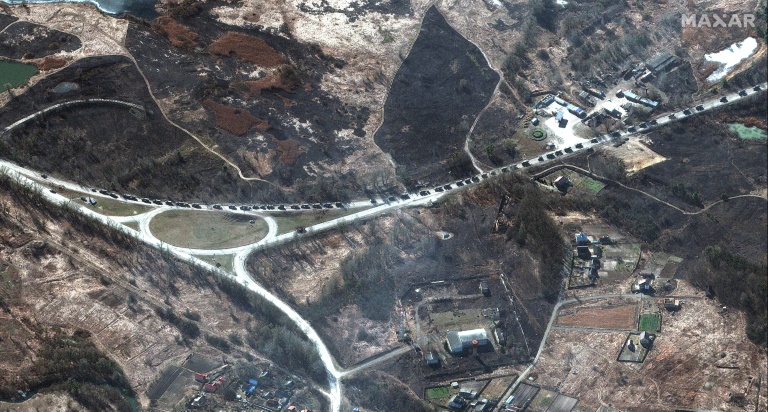
A huge Russian military convoy was massing on the outskirts of Ukraine’s capital Tuesday as fears grew the invading forces were set to launch devastating assaults aimed at taking control of Kyiv and other major cities.

Satellite images showed a long build-up of armoured vehicles and artillery starting 29 kilometres (18 miles) north of the city, as Moscow defied mounting global pressure and a wave of international sanctions that have smashed Russia’s economy.

Initial ceasefire talks between Moscow and Kyiv on Monday failed to secure a breakthrough, with Russia shelling residential areas in Ukraine’s second city Kharkiv and other areas of the country after the negotiations.

The Russian army has been regrouping and massing its forces over the past 24 hours “primarily to encircle and take control of Kyiv and other major cities,” the general staff of Ukraine’s armed forces wrote on Facebook.

The column is more than 65 kilometres long and covers the entire road from near Antonov airport outside Kyiv to the town of Prybirsk, US satellite imaging company Maxar said.

“Some vehicles are spaced fairly far apart while in other sections military equipment and units are traveling two or three vehicles abreast on the road,” Maxar said.

The images also showed “additional ground forces deployments and ground attack helicopter units” in southern Belarus near the Ukraine border.

Eastern city Kharkiv’s mayor Igor Terekhov, quoted by Ukrainian media, warned that Moscow’s armoured vehicles and tanks are “everywhere around the city”.

Russian forces killed several civilians including children late Monday, he said.

– ‘Flowers for the grave’ –

The mayor of Kherson, Igor Kolykhayev, also wrote on Facebook that the Russian army had set up checkpoints at all of the city’s entrances, but said it “remains Ukrainian” and “will be able to resist”.

Explosions were also reported in and around Brovary, a city on the outskirts of the capital.

In Kyiv, many were preparing for a fresh assault with makeshift barricades dotting the streets.

“We will greet them with Molotov cocktails and bullets to the head,” bank employee Viktor Rudnichenko told AFP. “The only flowers they might get from us will be for their grave.”

More than 350 civilians, including 14 children, have been killed since the invasion last Thursday, Ukraine says, while more than half a million people have fled the country.

Moscow claimed Monday it had “gained air superiority over the entire territory of Ukraine”.

Ukrainian President Volodymyr Zelensky called for a global ban on Russian planes and ships entering the world’s airports and seaports in a bid to stem Moscow’s assault. 

– War crimes probe –

Russian President Vladimir Putin announced his demands to bring the war to an end in a phone call with his French counterpart Emmanuel Macron on Monday.

They included recognition of Russian sovereignty over Crimea and Ukraine’s demilitarisation.

Instead, Western nations have moved to increasingly isolate Russia, responding with an intensifying diplomatic, economic, cultural and sporting backlash.

The weekend featured a momentous series of announcements from Europe, with Germany unveiling a historic change to its defence policies.

The EU also said it would buy and supply arms to Ukraine, the first such move in its history.

Moscow came under fire on Monday at the UN General Assembly and the International Criminal Court (ICC), which opened a war crimes investigation.

“I am satisfied that there is a reasonable basis to believe that both alleged war crimes and crimes against humanity have been committed in Ukraine” since 2014, ICC prosecutor Karim Khan said in a statement.

Russia also faced urgent calls at an extraordinary UN General Assembly debate to end its “unprovoked” and “unjustified” assault.

Inside the General Assembly hall Monday, UN Secretary-General Antonio Guterres pleaded: “The fighting in Ukraine must stop. Enough is enough.”

The United States expelled 12 members of Moscow’s UN mission from America on Monday for being “intelligence operatives”.

Canada announced a ban on Russian oil imports Monday.

The European Union and its allies were also preparing more sanctions against Russia in the coming days to “raise the cost” of war in Ukraine, an aide to Macron told reporters.

And Turkey said it would implement an international treaty to limit ships passing through the Dardanelles and Bosphorus straits, a move requested by Ukraine to block the transit of Russian warships.

The Russian ruble crashed to a record low as sanctions imposed by the West over the weekend had an immediate impact in Moscow, forcing the central bank to more than double its key interest rate to 20 percent.

Putin also announced emergency measures intended to prop up the ruble, including banning residents from transferring money abroad.

Many Russians raced to withdraw cash.

Retired soldier Edward Sysoyev, 51, fidgeted impatiently while in line at a bank in Moscow.

“Ninety percent of Russians are going to rush to withdraw their rubles and change them into dollars, property or even gold… it’ll be ordinary people who pay for this military bun-fight,” he said.

– Sporting isolation –

The response from the world of sports also gathered steam, as Russia was expelled from the World Cup and the country’s clubs and national teams were suspended from all international football competitions “until further notice”, FIFA and UEFA said.

The International Olympic Committee on Monday urged sports federations and organisers to exclude Russian and Belarusian athletes and officials from international events.

Authorities in badminton, rugby, ice hockey, basketball and Formula One have all moved to act against Russia, either banning Russian national teams and clubs, or suspending events in Russia.

The growing sporting isolation comes as hundreds of thousands flee their homes west into Europe after the Russian invasion.

More than half a million people have already fled abroad, the UN refugee agency said Monday, with neighbouring Poland alone having taken in nearly 300,000 people. 

Many more are expected to follow.

Iryna Plakhuta, a pregnant 43-year-old executive, had to leave her family behind in the capital because of fears over her safety.

“Our husbands stayed in Kyiv,” she said. “They are protecting Ukraine. It’s so hard.”

China could eventually 'co-exist' with Covid: top scientist

China could move away from its zero-Covid strategy “in the near future” and co-exist with the virus, a top Chinese scientist said in a possible sign that the country’s leadership is rethinking its strict approach.

The country where the coronavirus was first detected in 2019 is now one of the last places still hewing to a zero-tolerance approach, responding to small outbreaks with snap lockdowns and cutting off most international travel.

But fatigue over disruptions to everyday life as well as semi-autonomous Hong Kong’s struggle to contain a mass Omicron outbreak have raised questions about the sustainability of China’s approach.

China’s strategy against Covid-19 cannot “remain unchanged forever” and “it is the long-term goal of humanity to co-exist with the virus” at tolerable death and illness rates, Zeng Guang wrote in a social media post Monday.

Zeng is the former chief scientist of China’s Center for Disease Control and Prevention and one of the experts behind the country’s initial Covid response. 

Zeng said that while China’s approach had prevented the early chaos of widespread infection experienced by many Western countries, the country’s low infection rate was now a “soft spot” as far fewer people had built up natural immunity.

He said Western countries were now showing “commendable courage” in exploring how to live with the virus and that China should “observe and learn” even though there was still “no need to open the country’s doors  at the peak of the global pandemic”.

“In the near future, at the right time, the roadmap for Chinese-style co-existence with the virus should be presented,” Zeng wrote on the Weibo platform.

Zeng’s comment are unusual for an official in China’s government, which has touted its low infection rates to the Chinese public as a sign of the superiority of its approach.  

Experts who previously questioned “zero Covid” have faced a backlash, including prominent scientist Zhang Wenhong who was attacked by online trolls and probed for plagiarism after a similar Weibo post in July.

Zeng’s post did not appear to make as much of a splash online, attracting only a few thousand comments on a platform where trending topics normally engage millions of users.

Lockdown fears spark panic buying in Hong Kong

Hong Kongers stripped supermarket shelves bare Tuesday as panic buying set in following mixed messaging from the government over whether it plans a lockdown this month.

Uncertainty over Covid rules has sent the city’s residents flocking to supermarkets, chemists and vegetable stores to stock up, leaving shelves empty across the city.

Photos circulating on social media showed people had trouble finding a variety of items including meat, vegetables, frozen foods, noodles, paracetamol and testing kits. 

The financial hub is currently in the grips of its worst coronavirus outbreak, registering tens of thousands of new cases each day, overwhelming hospitals and shattering the city’s zero-Covid strategy.

Authorities plan to test all 7.4 million residents this month and isolate all infections either at home or in a series of camps that are still being constructed with the help of mainland China. 

City leader Carrie Lam had initially ruled out a mainland style lockdown where people are confined to their homes during the testing period.

But on Monday, health chief Sophia Chan confirmed it was still on the table, a day after a senior Chinese health official described it as the best option.

On Tuesday multiple pro-government Hong Kong media citing official sources also said authorities were looking at a variety of lockdown options for the test period.

One of the most densely populated cities on earth, Hong Kong’s supermarkets have limited backroom storage space and saw waves of panic buying at the start of the pandemic two years ago.

The vast majority of its food is imported from mainland China and the current supply crunch has been worsened by cross border truckers getting infected by the high transmissible Omicron variant.

More than 190,000 infections have been recorded in the last two months compared to just 12,000 for the rest of the pandemic.

The government released a statement late Monday saying food supplies remained constant and that there was no need for panic buying. 

But analysts said uncertainty and distrust were fuelling consumer habits.

“We have so many questions but all answers are ‘to be confirmed’,” Chan Ka-lok, an international politics scholar at Baptist University, wrote on social media.

“Rush to buy and stock up, let the people decide how to live their life.”

Tom Grundy, editor of the Hong Kong Free Press news website, described the latest panic buying as “a massive failure of gov’t communications”

“Rules changing every few days, u-turns, botched stats, poor data disclosure,” he wrote on Twitter.

Faith in government assurances is low in Hong Kong, where authorities have carried out a two year crackdown on dissent after huge democracy protests.

The decision to mass test residents was also itself a policy u-turn — Lam had previously ruled out such a step before backing it last month.

Virus wave deepens grim conditions for Hong Kong domestic workers

Janice Obiang stifled sobs as she packed goods to send to the Philippines, gifts for loved ones she hasn’t seen in years as life for domestic workers in virus-hit Hong Kong goes from bad to worse.

Few have suffered more during Hong Kong’s pandemic restrictions than the hundreds of thousands of women from the Philippines and Indonesia who work as domestic helpers.

And as the city reels under its most severe coronavirus wave to date, many are now at breaking point. 

“I really want to move, I really want to have vacation,” Obiang said, as a police officer with a megaphone gave regular reminders for people not to gather in groups.

“But I don’t have a choice, we need to stay,” the 36-year-old told AFP, adding it had been four years since she went home. “We really miss our family.”

There are about 340,000 foreign domestic helpers in Hong Kong, down from 400,000 when the pandemic began.

Paid a minimum of HK$4,630 ($590) a month, they work six days a week and must live with their employers, in a city that offers some of the world’s smallest apartments.

While the work is tough, it pays more than the women can earn in the Philippines, allowing them to support families as key breadwinners.

But the pandemic has made a hard job even harder.

For two years Hong Kong kept the coronavirus at bay with a strict zero-Covid policy and long quarantines, meaning most foreigners have not seen family for long periods.

The highly transmissible Omicron variant broke through at the start of the year but authorities have been ordered by China to return to zero-Covid despite the exponential caseload.

As a result, the government has taken to advising Hong Kongers to keep domestic workers inside during their one day off. 

Police have also stepped up fines –- the equivalent of one to two months’ salary for a domestic worker –- for breaching the current ban on any more than two people gathering in public. 

– Sacked for falling sick –

Avril Rodrigues said her phone has not stopped ringing with stories of intensifying suffering and dismay. 

“Imagine thinking ‘I am not allowed to fall sick’ out of fear of losing your job,” Rodrigues, who works at the charity Help for Domestic Workers, told AFP.

But that is exactly what is happening to some.

She recalled one woman calling from outside one of Hong Kong’s hospitals as they buckle under thousands of new infections each day. 

“(Her employer) made her do a rapid test because she had a slight cold and when she went to the hospital, the employer told the agency to inform her ‘Don’t come back,'” Rodrigues said. 

Multiple stories like this have emerged in local media or through press conferences arranged by increasingly infuriated charities and unions in the last fortnight. 

Some had to sleep rough during an unusually cold winter snap, including one domestic helper with a young baby.

Last week Hong Kong’s government issued a statement reminding employers they could not sack a domestic helper purely because they were sick, and could face fines.

– ‘We need to feel like we are free’ –

Lita, 34, who asked to use a pseudonym, said staying at her employer’s home during her day off just meant working seven days a week given the coffin-like size of her room, which is not uncommon in Hong Kong apartments. 

“You go in like a dead person, only to sleep,” she said.

Jec Sernande, from the Federation of Asian Domestic Workers Unions, said many domestic helpers do not even have their own rooms.

“Sitting for the whole day in the kitchen or in the living room — that is not a rest,” she said.

Unionists like Sernande have long campaigned for better working conditions and are angered by the lack of compassion shown by authorities and some employers during the pandemic. 

“They need to get more recognition, because they contribute a lot to the society and the economy,” she added. 

Charity services have been overwhelmed by requests for help partly because few plans were in place to deal with soaring cases when the disease eventually broke through. 

Last week Philippine consul-general Raly Tejada said staff had helped dozens of nationals and that they were exploring possible legal options against those who fired helpers. 

Domestic helper Bebeth, 54, described living in Hong Kong right now as “difficult and traumatic”.

But she was adamant about one thing –- she will take her one day off outside. 

“We need to go out, we need to feel like we are free outside, we want to inhale and exhale fresh air,” she said. 

Close Bitnami banner
Bitnami