World

Ukraine crisis stretches Indian 'neutrality' to the limit

Russia’s invasion of Ukraine has left India’s traditional balancing act between Moscow and the West looking wobblier than ever, with experts saying New Delhi has few good diplomatic options.

Last week India abstained on a UN Security Council resolution deploring Russia’s “aggression” against Ukraine, winning praise from Moscow for its “independent and balanced position”.

But while New Delhi hoped this would be seen as neutrality, in many capitals its failure to condemn the invasion was taken as de facto backing of Moscow that gave President Vladimir Putin useful diplomatic cover.

And India is also reportedly looking to bolster its rupee-rouble trade pact with Moscow, potentially undermining Western efforts to isolate Russia from the global financial system.

The crisis has left India facing a dilemma: it leant towards the Soviet Union during the Cold War — while Pakistan was in the Western camp — and their close relations outlived the fall of the Iron Curtain, with Moscow still by far its biggest arms supplier.

At the same time it needs Western support to contend with Xi Jinping’s increasingly assertive China: Beijing is extending its reach into the Indian Ocean, and the two countries had a deadly border clash in 2020.

Together with the US, Japan and Australia, India is also a member of the “Quad alliance” that is seen as a bulwark against China.

Its decision to abstain at the Friday Security Council vote left it alongside only Beijing and the United Arab Emirates, while Russia vetoed the resolution.

“There are not many choices that India has,” said Nandan Unnikrishnan of the Observer Research Foundation.

It “has as much investment in a relationship with Russia as it has in maintaining a relationship with the United States”, he told AFP.

“India’s challenges in the maritime is where it needs the United States and India’s challenges on the continental shelf is where it requires Russia.”

– Hug the bear –

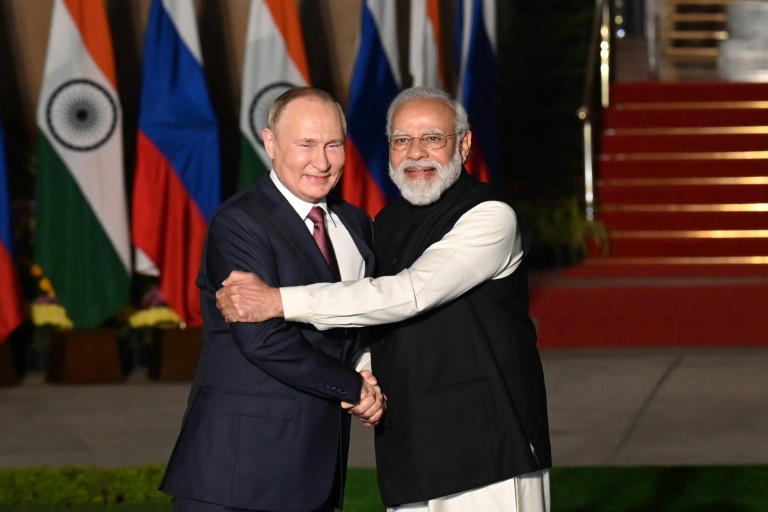
Putin visited India last year, in a rare foreign trip for the Russian president, bear-hugging Prime Minister Narendra Modi as the two men bolstered military and energy ties.

New Delhi is the world’s second largest importer of arms after Saudi Arabia and according to the Business Standard, between 2016-2020, 49.4 percent of its purchases were from Russia.

Late last year it began taking delivery from Russia of the S-400 missile defence system that it agreed to buy for over $5 billion in 2018, despite the threat of US sanctions.

And while New Delhi is looking to develop its own capacity and diversify its suppliers, US imports accounted for just 11 percent.

The Asian giant of 1.4 billion people is also a major consumer of Russian oil. Total annual bilateral trade runs at around $9 billion, with much smaller quantities of pharmaceuticals, tea and coffee going the other way.

Russia has also repeatedly vetoed UN resolutions condemning Delhi over its behaviour in Indian-administered Kashmir where a violent insurgency has raged for decades.

According to Happymon Jacob from Jawaharlal Nehru University, Russia is perhaps India’s “only partner of consequence” in the territory to its north.

– ‘East-West conflict’ –

While New Delhi aspires to a permanent seat on the UN Security Council, a role that would bring greater responsibility on the world stage, it has been careful to avoid explicitly condemning Russia.

So far it has not referred to Moscow’s operation as an invasion and instead emphasised narrow domestic aspects of the crisis, primarily the evacuation of Indian students from Ukraine.

Officially, Washington has kept its annoyance quiet, saying India and Russia “have a relationship… that we don’t have” and calling on Delhi to use its “leverage” with Moscow.

But ex-officials have been more vocal, with former US diplomat Richard Haass calling India’s “careful, avoid angering Putin at all costs response” a sign that it “remains unprepared to step up to major power responsibilities or be a dependable partner.”

But commentator Sanjaya Baru said Western countries should be more indulgent of India’s ties to Russia — precisely because of its role in confronting China.

“Only a vibrant India can take the edge off an aggressive China,” he wrote in the Times of India.

There is “no reason why India should be taking sides in what is essentially an East-West conflict, centred in Europe and a continuation of the Cold War”, he added.
China backpedals on climate promises as economy slows

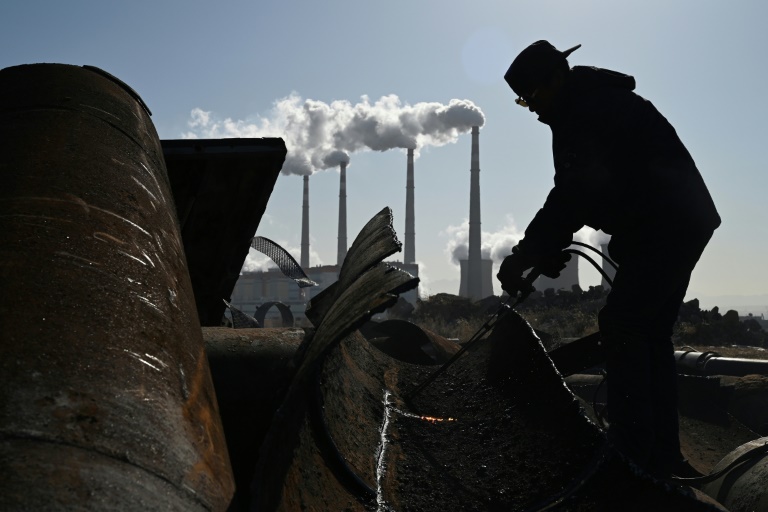
When China’s President Xi Jinping issued his traditional Lunar New Year wishes from the country’s coal heartland in January, the subtext was clear: Beijing is not ready to kick its coal addiction, despite promises to slash emissions.

The ink had barely dried on the hard-fought deal struck at last year’s United Nations climate conference in Glasgow when Beijing’s backslide on pledges began. 

The country’s central economic planner has watered down a roadmap to slash emissions, greenlighted giant coal-fired power plants, and told mines to produce “as much coal as possible” after power shortages paralysed swathes of the economy last year. 

Environmentalists are concerned this would mean China would continue to pollute beyond the 2030 deadline by which it has promised to have reached peak emissions.

Xi’s trip to mining towns in Shanxi –- China’s biggest coal producing province — saw him making crispy noodle snacks with families “recently lifted out of poverty”.

“We are not pursuing carbon neutrality because others are forcing us, it’s something we must do. But it can’t be rushed,” he said later, while inspecting a thermal power plant.

“We can’t delay action, but we must find the right rhythm.”

Days earlier, Xi told Communist Party officials in Beijing that low-carbon goals should not come at the expense of “normal life” — a major change in rhetoric from his 2020 announcement at a UN assembly that China would be carbon neutral by 2060.

– Dependent on coal –

The Glasgow pact encourages countries to slash their emissions targets, with the aim of limiting warming to well below 2 degrees Celsius (36 degrees Fahrenheit) ideally to 1.5 degrees.

Experts have warned that global emissions must be halved within a decade to have a chance of achieving that goal.  

A report issued by the UN’s climate science advisors on Monday said that warming beyond 1.5C would wreak permanent damage to the planet and that nearly half the world’s population is already “highly vulnerable” to the accelerating impacts of climate change.

“The world’s biggest polluters are guilty of arson of our only home,” UN chief Antonio Guterres said in response to this most compelling scientific overview of climate change impacts to date.

China generates an estimated 29 percent of the world’s greenhouse gas emissions — double the US share and three times that of the European Union. 

Environmentalists had hoped that post-Glasgow, Beijing might announce a maximum carbon cap for the whole country but Li Shuo, a campaigner for Greenpeace China, told AFP that is now “off the table”. 

Policymakers in Beijing have long walked a tightrope balancing climate objectives with domestic growth. 

Beijing has pledged to curb coal consumption after 2025 — but last year, half of China’s economy was fuelled by it. 

Now as growth slows, authorities are resorting to an old formula of propping up smokestack industries to juice the economy. 

In late 2021 China began construction on 33 gigawatts of coal-fired power plants — the most since 2016 — that will emit as much carbon dioxide annually as Florida, according to data from Global Energy Monitor.

Even more new plants are being built in the first few months of 2022 as well, all of which can operate for 40 years on average.  

– ‘Ambition in jeopardy’ –

During the Glasgow talks the Chinese delegation — like many others — promised a detailed roadmap to peak emissions for different industries and regions over the next decade.  

Existing guidelines issued just before the talks only include vague targets for increasing energy efficiency and say renewables will supply a quarter of China’s electricity by 2030. 

They have not yet been updated.

This “suggests that the politics are tough, ambition is in jeopardy, and the regulators are reserving as much wiggle room (to pollute) as possible for the next few years,” Greenpeace’s Li said. 

Earlier last month, Beijing pushed back the deadline for slashing emissions from the steel sector — China’s biggest carbon emitter — five years to 2030. 

“Steel and cement need to peak earlier than the country as a whole to ensure China’s targets are on track,” said Lauri Myllyvirta, lead analyst at the Centre for Research on Energy and Clean Air.

Meanwhile, China’s investments in overseas oil and gas projects tripled to $10.9 billion last year, according to a Fudan University report in January. 

– Renewable bottlenecks –

Another of China’s key pledges — to increase wind and solar capacity to three times the current level over the next decade — has been blown off-course as well by supply chain disruptions and soaring raw material costs.

The price of polysilicon, used to make solar panels, jumped 174 percent in December from the previous year.

Analysts fear more fossil fuels will be burnt to meet China’s growing energy needs as the rollout of renewables slows.

“The political signals are much more cautious (than before), saying the transition will be slow, and coal would remain a mainstay of China’s energy supply for a long time,” said Myllyvirta.

China backpedals on climate promises as economy slows

When China’s President Xi Jinping issued his traditional Lunar New Year wishes from the country’s coal heartland in January, the subtext was clear: Beijing is not ready to kick its coal addiction, despite promises to slash emissions.

The ink had barely dried on the hard-fought deal struck at last year’s United Nations climate conference in Glasgow when Beijing’s backslide on pledges began. 

The country’s central economic planner has watered down a roadmap to slash emissions, greenlighted giant coal-fired power plants, and told mines to produce “as much coal as possible” after power shortages paralysed swathes of the economy last year. 

Environmentalists are concerned this would mean China would continue to pollute beyond the 2030 deadline by which it has promised to have reached peak emissions.

Xi’s trip to mining towns in Shanxi –- China’s biggest coal producing province — saw him making crispy noodle snacks with families “recently lifted out of poverty”.

“We are not pursuing carbon neutrality because others are forcing us, it’s something we must do. But it can’t be rushed,” he said later, while inspecting a thermal power plant.

“We can’t delay action, but we must find the right rhythm.”

Days earlier, Xi told Communist Party officials in Beijing that low-carbon goals should not come at the expense of “normal life” — a major change in rhetoric from his 2020 announcement at a UN assembly that China would be carbon neutral by 2060.

– Dependent on coal –

The Glasgow pact encourages countries to slash their emissions targets, with the aim of limiting warming to well below 2 degrees Celsius (36 degrees Fahrenheit) ideally to 1.5 degrees.

Experts have warned that global emissions must be halved within a decade to have a chance of achieving that goal.  

A report issued by the UN’s climate science advisors on Monday said that warming beyond 1.5C would wreak permanent damage to the planet and that nearly half the world’s population is already “highly vulnerable” to the accelerating impacts of climate change.

“The world’s biggest polluters are guilty of arson of our only home,” UN chief Antonio Guterres said in response to this most compelling scientific overview of climate change impacts to date.

China generates an estimated 29 percent of the world’s greenhouse gas emissions — double the US share and three times that of the European Union. 

Environmentalists had hoped that post-Glasgow, Beijing might announce a maximum carbon cap for the whole country but Li Shuo, a campaigner for Greenpeace China, told AFP that is now “off the table”. 

Policymakers in Beijing have long walked a tightrope balancing climate objectives with domestic growth. 

Beijing has pledged to curb coal consumption after 2025 — but last year, half of China’s economy was fuelled by it. 

Now as growth slows, authorities are resorting to an old formula of propping up smokestack industries to juice the economy. 

In late 2021 China began construction on 33 gigawatts of coal-fired power plants — the most since 2016 — that will emit as much carbon dioxide annually as Florida, according to data from Global Energy Monitor.

Even more new plants are being built in the first few months of 2022 as well, all of which can operate for 40 years on average.  

– ‘Ambition in jeopardy’ –

During the Glasgow talks the Chinese delegation — like many others — promised a detailed roadmap to peak emissions for different industries and regions over the next decade.  

Existing guidelines issued just before the talks only include vague targets for increasing energy efficiency and say renewables will supply a quarter of China’s electricity by 2030. 

They have not yet been updated.

This “suggests that the politics are tough, ambition is in jeopardy, and the regulators are reserving as much wiggle room (to pollute) as possible for the next few years,” Greenpeace’s Li said. 

Earlier last month, Beijing pushed back the deadline for slashing emissions from the steel sector — China’s biggest carbon emitter — five years to 2030. 

“Steel and cement need to peak earlier than the country as a whole to ensure China’s targets are on track,” said Lauri Myllyvirta, lead analyst at the Centre for Research on Energy and Clean Air.

Meanwhile, China’s investments in overseas oil and gas projects tripled to $10.9 billion last year, according to a Fudan University report in January. 

– Renewable bottlenecks –

Another of China’s key pledges — to increase wind and solar capacity to three times the current level over the next decade — has been blown off-course as well by supply chain disruptions and soaring raw material costs.

The price of polysilicon, used to make solar panels, jumped 174 percent in December from the previous year.

Analysts fear more fossil fuels will be burnt to meet China’s growing energy needs as the rollout of renewables slows.

“The political signals are much more cautious (than before), saying the transition will be slow, and coal would remain a mainstay of China’s energy supply for a long time,” said Myllyvirta.

Australia tells tens of thousands to flee floods

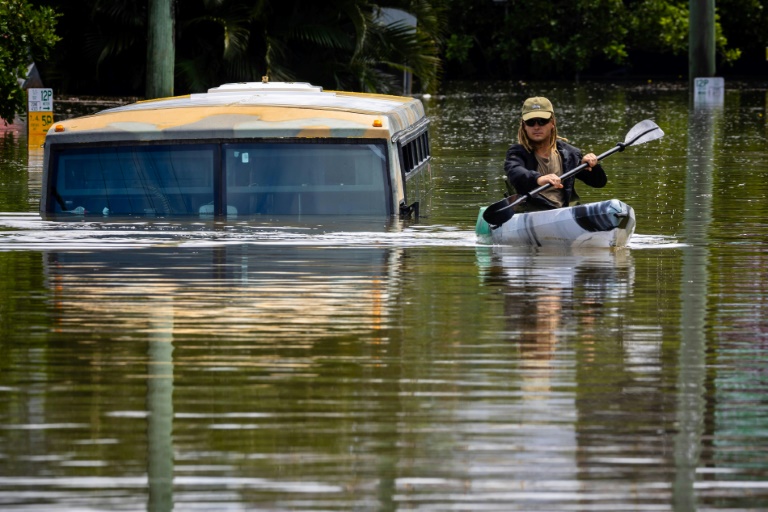
Deadly floods spread down Australia’s east coast Tuesday, stranding residents on rooftops and bridges and prompting authorities to order tens of thousands of people to flee their homes.

Flood warnings were in effect for dozens of rivers across the states of Queensland and New South Wales, where a days-long “rain bomb” has dumped a metre (3.2 feet) of rain on some areas in a week.

Several waterways have already burst their banks or broken through levees, inundating towns and forcing residents to flee or seek safety on higher ground.

“We’ve seen people stranded on roofs for hours, we’ve seen children being rescued, we’re seeing people stranded on bridges,” said New South Wales premier Dominic Perrottet.

Eight people have died and more than a thousand people have been rescued. Authorities have warned that more fatalities are likely.

In one spectacular rescue, a helicopter crew flew in to pluck two people to safety as muddy waters lapped at the corrugated metal roof of their home.

Live television images on national broadcaster ABC showed a rescuer sitting on the roof with the pair, preparing to strap them to the chopper’s winch.

In the town of Lismore, nine people were missing amid the worst floods on record.

The local member of parliament for Lismore, Janelle Saffin, had to swim to safety after she was stranded in the floodwaters.

“We went to the verandah, hanging on to the rafters,” she told the Nine Newspapers.

– Sailing past roofs –

Emergency services were overwhelmed by calls for help and flotillas of makeshift rescue boats fanned out across the town as people tried to ferry their neighbours to safety.

Lismore resident Danika Hardiman was rescued Monday after she woke up to find floodwaters had reached the balcony of her second-floor apartment in the town’s main street.

She and her partner managed to climb up to the roof and were eventually rescued by “two guys in a boat, two locals”, she told AFP Monday, describing the scenes in Lismore as “horrific”.

“Imagine you’re in a boat sailing past people’s roofs,” she said.

In total, more than 150,000 people are subject to evacuation orders, according to an AFP tally.

Makeshift evacuation centres have been set up in primary schools, recreation centres and retired service members’ clubs.

Near the town of Grafton, buildings were submerged almost to roof level, roads were washed away and cattle roamed abandoned.

Further south in Sydney, residents endured another day of torrential downpours, and were warned to brace for “major flooding”.

Australia has been on the sharp end of climate change, with droughts, deadly bushfires, bleaching events on the Great Barrier Reef and floods becoming more common and more intense as global climate patterns change.

Australia tells tens of thousands to flee floods

Deadly floods spread down Australia’s east coast Tuesday, stranding residents on rooftops and bridges and prompting authorities to order tens of thousands of people to flee their homes.

Flood warnings were in effect for dozens of rivers across the states of Queensland and New South Wales, where a days-long “rain bomb” has dumped a metre (3.2 feet) of rain on some areas in a week.

Several waterways have already burst their banks or broken through levees, inundating towns and forcing residents to flee or seek safety on higher ground.

“We’ve seen people stranded on roofs for hours, we’ve seen children being rescued, we’re seeing people stranded on bridges,” said New South Wales premier Dominic Perrottet.

Eight people have died and more than a thousand people have been rescued. Authorities have warned that more fatalities are likely.

In one spectacular rescue, a helicopter crew flew in to pluck two people to safety as muddy waters lapped at the corrugated metal roof of their home.

Live television images on national broadcaster ABC showed a rescuer sitting on the roof with the pair, preparing to strap them to the chopper’s winch.

In the town of Lismore, nine people were missing amid the worst floods on record.

The local member of parliament for Lismore, Janelle Saffin, had to swim to safety after she was stranded in the floodwaters.

“We went to the verandah, hanging on to the rafters,” she told the Nine Newspapers.

– Sailing past roofs –

Emergency services were overwhelmed by calls for help and flotillas of makeshift rescue boats fanned out across the town as people tried to ferry their neighbours to safety.

Lismore resident Danika Hardiman was rescued Monday after she woke up to find floodwaters had reached the balcony of her second-floor apartment in the town’s main street.

She and her partner managed to climb up to the roof and were eventually rescued by “two guys in a boat, two locals”, she told AFP Monday, describing the scenes in Lismore as “horrific”.

“Imagine you’re in a boat sailing past people’s roofs,” she said.

In total, more than 150,000 people are subject to evacuation orders, according to an AFP tally.

Makeshift evacuation centres have been set up in primary schools, recreation centres and retired service members’ clubs.

Near the town of Grafton, buildings were submerged almost to roof level, roads were washed away and cattle roamed abandoned.

Further south in Sydney, residents endured another day of torrential downpours, and were warned to brace for “major flooding”.

Australia has been on the sharp end of climate change, with droughts, deadly bushfires, bleaching events on the Great Barrier Reef and floods becoming more common and more intense as global climate patterns change.

Russia shells Ukraine's Kharkiv as pressure on Moscow bites

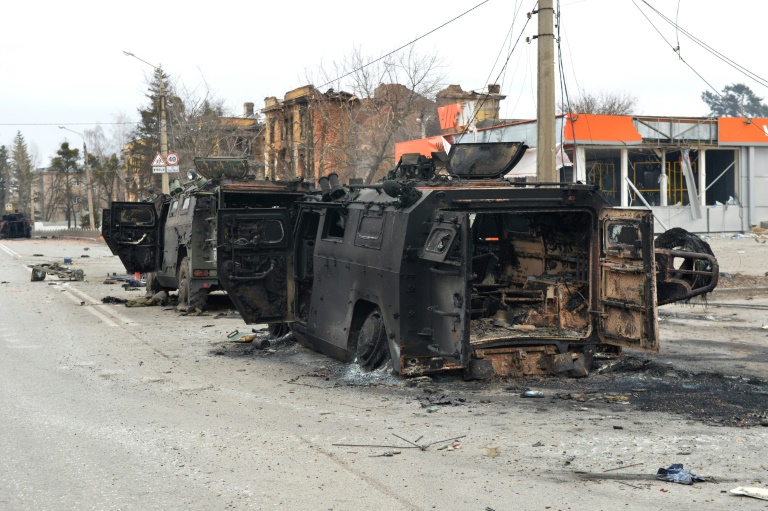
Russia shelled the Ukrainian city of Kharkiv as it pressed on with its invasion Tuesday, defying mounting global pressure that saw a war crimes probe opened against Moscow, sanctions smash its economy and FIFA ban it from the World Cup.

After their first talks since the war started failed to secure a breakthrough Monday, Russia continued to target residential areas and Ukrainian President Volodymyr Zelensky called for a global ban on Russian planes and ships.

“We must close entry for this state in all ports, all canals and all the world’s airports,” he said on Facebook.

Russian President Vladimir Putin had earlier outlined Moscow’s demands for ending the invasion, including recognition of Russian sovereignty over Crimea and Ukraine’s demilitarisation.

He issued his demands in a phone call with French leader Emmanuel Macron shortly before the Russian-Ukranian talks.

Instead, the world has responded with an intensifying diplomatic, economic, cultural and sporting backlash, with Moscow coming under fire at the UN General Assembly and the International Criminal Court (ICC) opening a war crimes investigation.

“I am satisfied that there is a reasonable basis to believe that both alleged war crimes and crimes against humanity have been committed in Ukraine” since 2014, ICC prosecutor Karim Khan said in a statement.

Russia also faced urgent calls at an extraordinary UN General Assembly debate to end its “unprovoked” and “unjustified” assault, which has provoked a massive diplomatic, economic, cultural and sporting backlash.

Inside the General Assembly hall Monday, UN Secretary-General Antonio Guterres pleaded: “The fighting in Ukraine must stop. Enough is enough.”

It followed Putin’s phone call with Macron where the Russian leader “stressed that a settlement is possible only if Russia’s legitimate security interests are unconditionally taken into account”, said the Kremlin. 

Fighting continued during the dialogue, with at least 11 people killed by Russian attacks in Kharkiv and Russian missile fire on several residential buildings.

Explosions were also reported in and around Brovary, a city on the outskirts of the capital, Kyiv.

Russian fire killed several civilians, including children, in Kharkiv and Russian armoured vehicles and tanks are “everywhere” around the city, said mayor Igor Terekhov, quoted by Ukrainian media. 

More than 350 civilians, including 14 children, have been killed during the invasion, Ukraine says, while more than half a million people have fled the country.

In Kyiv, many were preparing for a fresh assault with makeshift barricades dotting the streets.

The Russian army urged Ukrainians to leave Kyiv “freely” on one highway out ahead of what is an expected Russian offensive to capture the capital.

The International Atomic Energy Agency said it was “gravely concerned” as Russian forces advanced towards Ukraine’s largest nuclear plant, strongly warning against any military action that could threaten the Zaporizhzhia facility.

– Ruble plummets –

Western nations have moved to increasingly isolate Russia, with the United States expelling 12 members of Moscow’s UN mission from America for being “intelligence operatives”.

Canada announced a ban on Russian oil imports Monday.

The European Union and its allies were also preparing more sanctions against Russia in the coming days to “raise the cost” of war in Ukraine, an aide to Macron told reporters.

And Turkey said it would implement an international treaty to limit ships passing through the Dardanelles and Bosphorus straits, a move requested by Ukraine to block the transit of Russian warships.

The Russian ruble crashed to a record low as sanctions imposed by the West over the weekend had an immediate impact in Moscow, forcing the central bank to more than double its key interest rate to 20 percent.

Putin also announced emergency measures intended to prop up the ruble, including banning residents from transferring money abroad.

– Long queues –

Long queues for groceries snaked through the streets of Kyiv on Monday after a strict 36-hour military curfew was lifted and volunteer militias learned how to make home-made explosives. 

“We will greet them with Molotov cocktails and bullets to the head,” bank employee Viktor Rudnichenko told AFP. “The only flowers they might get from us will be for their grave.”

Many Russians raced to withdraw cash.

Retired soldier Edward Sysoyev, 51, fidgeted impatiently while in line at a bank in Moscow.

“Ninety percent of Russians are going to rush to withdraw their rubles and change them into dollars, property or even gold… it’ll be ordinary people who pay for this military bun-fight,” he said.

– ‘Unprovoked armed aggression’ –

In Russia, there were more signs of rare dissent among the usually ultra-loyal oligarchs who surround the Russian leader — in addition to anti-war demonstrations that saw an estimated 2,100 people arrested on Sunday.

Russian tycoon Oleg Deripaska said “we need real crisis managers and not fantasists”, while billionaire banker Oleg Tinkov said “innocent people are dying every day, this is unthinkable and unacceptable!”

Western defence officials and the Kyiv government say Ukrainian troops have so far kept the country’s major cities out of Russian hands despite incursions in the capital and Kharkiv over the weekend. 

However the small southern city of Berdyansk has been occupied, Ukraine said.

Moscow claimed it had “gained air superiority over the entire territory of Ukraine”, while accusing Ukrainian troops of using civilians as human shields.

However Olivier Kempf, a security analyst at the Foundation for Strategic Research think tank, said that Russian forces were “not bogged down”.

“This is war, so there are difficulties. They may have logistics issues. But regardless of what we’re told, they are making progress,” he told AFP. “Only in video games do you conquer a country in two days.”

– Kicked out of World Cup –

The weekend featured a momentous series of announcements from Europe, with Germany unveiling a historic change to its defence policies, and the EU saying it would buy and supply arms to Ukraine, the first such move in its history.

On Monday the European Union said it would add Russian oligarchs and the Kremlin’s spokesman to its sanctions blacklist while traditionally neutral Switzerland said it would adopt the bloc’s sanctions. 

However the EU poured cold water on Zelensky’s request for “immediate” membership to the bloc, saying the process to join takes years.

The response from the world of sports also gathered steam, as Russia was expelled from the World Cup and the country’s clubs and national teams were suspended from all international football competitions “until further notice”, FIFA and UEFA said.

Poland has taken in more than half of the 500,000 people who have fled Ukraine, according to the UN.

Katerina Zaporojets, a laboratory worker from the central city of Cherkassy, said it took her 24 hours to arrive at the western Shegyni border post — and she will likely wait another 48 hours before crossing.

“The trip was really hard,” the 31-year-old told AFP. “It’s calmer here, but the drive was really scary.”

burs-dl/ach/jfx/oho/kma

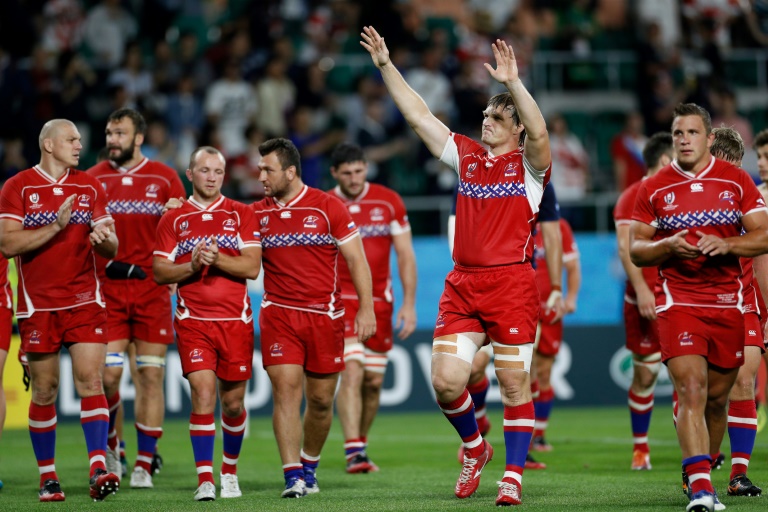
Russia, Belarus suspended by World Rugby 'until further notice'

Russia and Belarus were suspended from all international rugby “until further notice” on Tuesday, the world governing body said, as it announced “full and immediate” sanctions following the invasion of Ukraine.

Russia’s membership of World Rugby was also suspended indefinitely, meaning the country’s slim hopes of qualifying for next year’s World Cup in France are over.

“World Rugby reiterates its condemnation of Russia’s aggressive invasion of Ukraine and the facilitation of this action by Belarus,” said a strongly worded statement.

“The World Rugby executive committee has today decided to take immediate additional steps to protect the rugby family and take a strong stance against the conflict in line with recommendations by the International Olympic Committee:

“The full and immediate suspension of Russia and Belarus from all international rugby and cross-border club rugby activities until further notice.

“The full and immediate suspension of the Rugby Union of Russia from World Rugby membership until further notice.”

Russia had still been involved in final European qualifying for the 2023 Rugby World Cup, but were fifth in the standings with three games to play with only the top two progressing automatically.

Their qualifying match against table-topping Georgia, due to have taken place two days ago, had already been postponed, and will now not be played, along with Russia’s final two matches against the Netherlands and Portugal later this month.

World Rugby did not say what would happen to the qualifying process.

Russia qualified for the World Cup in 2011 and 2019, but failed to win a match in either tournament.

“The decision has been taken with the interests of rugby’s values of solidarity, integrity and respect at heart,” said World Rugby, who added that it pledged “full support to the rugby community” in Ukraine.

NASA exploring ways to keep ISS afloat without Russian help: official

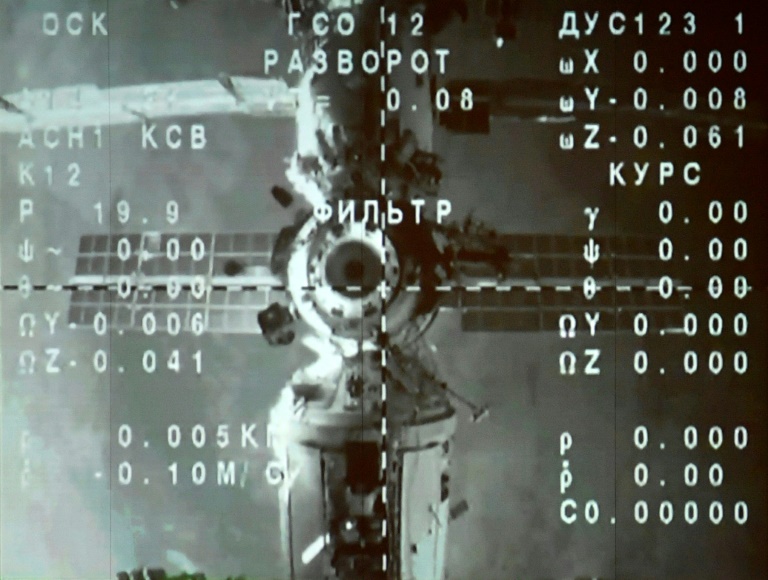
NASA is exploring ways to keep the International Space Station in orbit without Russian help, but doesn’t see any immediate signs Moscow is withdrawing from the collaboration following the invasion of Ukraine, a senior official said Monday.

Kathy Lueders, who heads the agency’s human spaceflight program, told reporters on a call that operations on the research platform were proceeding “nominally” and “we’re not getting any indications at a working level that our counterparts are not committed.”

“That said, we always look for how do we get more operational flexibility and our cargo providers are looking at how do we add different capabilities,” she continued.

While the US side of the ISS supplies power and life support, Russia is responsible for propulsion and keeping the station afloat: it does this by using docked Progress spacecraft to periodically give the station a boost to maintain its altitude, approximately 250 miles (400 kilometers) high. 

Last week, though, Russia’s space chief Dmitry Rogozin raised the prospect of pulling out of the partnership in response to US sanctions, allowing the 400 ton structure to come crashing down to Earth while most likely avoiding his country, since its orbit doesn’t fly much over it.

Lueders said: “Northrop Grumman has been offering up a reboost capability, and you know, our SpaceX folks are looking at can we have additional capability.”

The last Northrop Grumman Cygnus cargo vessel that arrived at the ISS on February 21 was the first to boast a capacity to “reboost” the outpost without Russian help.

On Friday, SpaceX boss Elon Musk tweeted his company’s logo in response to Rogozin’s rhetorical question about who would save the ISS from an uncontrolled de-orbit.

But Lueders stressed that such plans were a contingency measure only. 

“It would be very difficult for us to be operating on our own — ISS is an international partnership that was created…with joint dependencies,” she said.

“As a team, we are looking at where we may have operational flexibilities, but… it would be a sad day for international operations if we can’t continue to peacefully operate in space,” she concluded.

A symbol of post Cold War detente, the ISS has been continuously habited for more than 21 years and has weathered past geopolitical storms, notably Russia’s invasion of Crimea in 2014. But some observers believe the invasion of Ukraine could hasten the demise of US-Russian space cooperation.

US expels 12 Russian UN staff for 'espionage activities'

The United States said Monday that it was expelling 12 members of Russia’s UN mission from America for being “intelligence operatives,” prompting a furious response from Moscow, which denounced what it called a “hostile move.”

A spokeswoman for the US mission to the UN said those ordered to leave had “abused their privileges of residency in the United States by engaging in espionage activities that are adverse to our national security.”

“We are taking this action in accordance with the UN Headquarters Agreement. This action has been in development for several months,” said the spokeswoman, Olivia Dalton.

Richard Mills, the US’s deputy ambassador to the UN, told a Security Council meeting on the humanitarian situation in Ukraine that the dozen had engaged in non-diplomatic activities.

“Those diplomats that have been asked to leave the United States were engaged in activities that were not in accordance with their responsibilities and obligations as diplomats,” he said, without elaborating further.

“This is a hostile move against our country,” Anatoly Antonov, Russia’s ambassador to Washington, said on Facebook, adding that Moscow was “deeply disappointed” and “totally rejected” the US claims.

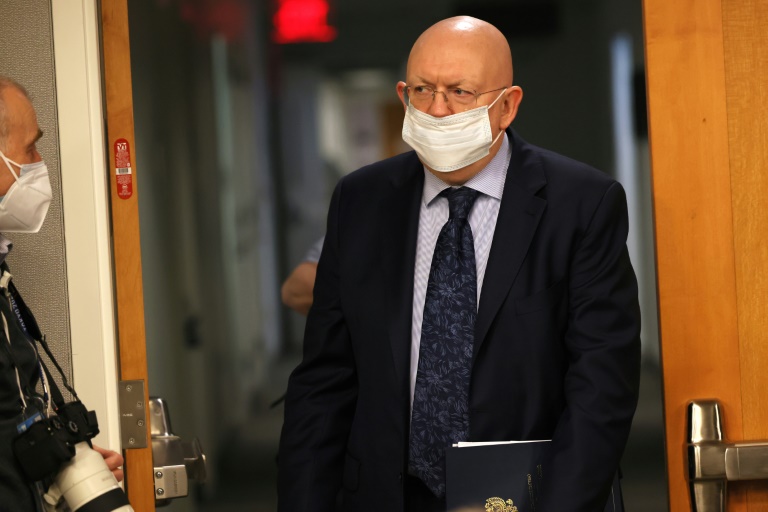
Russia’s ambassador to the UN Vassily Nebenzia — who has not been targeted for himself for expulsion — informed reporters of the decision first in a highly unusual way.

While giving a press conference ahead of the UN meeting, Nebenzia asked reporters for a minute to answer a telephone message. He then revealed that he had just learned of the expulsion order issued by the United States. 

A Russian diplomatic source later told AFP that the expulsion decision did not target either the ambassador or his two senior deputies, Dmitry Polyanskiy and Anna Evstigneeva. 

“It’s bad news,” said Nebenzia, adding that the staff in question were to leave the country by March 7.

The Russian mission to the UN has around 100 staff, according to a Russian diplomatic source. 

The announcement of the expulsion came on the last day of Russia’s rotating presidency of the UN Security Council, which changes every month. Russia is to cede the presidential seat to the United Arab Emirates on Tuesday. 

The Russian diplomatic mission planned a reception later Monday to mark the end of its presidency, which has been marked, unprecedentedly, by its launch of a war against a neighboring country. 

“It is not clear that there will be many guests,” one ambassador told AFP on condition of anonymity about this event which, unusually, no journalists were invited to attend.

How US 'wokeness' became a right-wing cudgel around the world

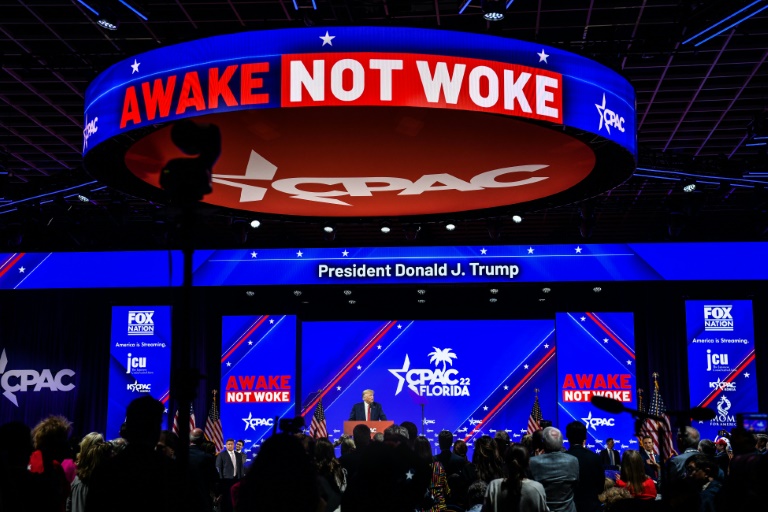
With Covid-19 beginning to fade into the rear view mirror, the largest annual conservative gathering in the United States sounded the alarm this weekend over what they deem to be another fast-spreading virus: “wokeness.”

Once a rallying cry for Americans to be alert to racism, “wokeness” has become the political term of the hour, co-opted by culture warriors to denigrate “political correctness” and leftist orthodoxy.

“The radical left is trying to replace American democracy with woke tyranny,” former US president Donald Trump told the Conservative Political Action Conference in Orlando, Florida during his keynote speech Saturday.

Speaker after speaker at CPAC invoked rightwing betes noires from “cancel culture” to the policing of pronouns. Florida Governor Ron DeSantis, a potential 2024 presidential hopeful, joined in the barrage of accusations, telling the crowd that “the woke is the new religion of the left.”

The concept has metastasized from its US origins to penetrate the global body politic, from the English-speaking world to newsrooms, university boards and parliaments in Europe, Asia and South America. 

“Among conservatives, wokeness is an all-pervasive ideology of extreme identity politics on behalf of minorities and women which is oppressive towards traditional cultural views,” said Democratic political analyst Ed Kilgore.

The word “woke” as a means of describing enlightened skepticism over systemic injustice has its origins in African-American vernacular dating back before World War II.

American linguist John McWhorter points to the music of US blues-folk musician Lead Belly, who can be heard imploring his fans to “stay woke” on the 1938 protest song “Scottsboro Boys.”

It appears to have crept into mainstream parlance in the early-to-mid 2010s, as the killings of Trayvon Martin, Michael Brown and other African-Americans ignited a firestorm of protest from Black Lives Matter activists who beseeched followers to “stay woke” to racially-motivated police brutality.

– Free speech –

Its appropriation by liberal whites as a watchword for heightened cultural awareness followed soon after.

From there conservatives turned it into a slur, an accusation of superficial, over-the-top sociopolitical sensitivity or authoritarian, performative political correctness.

In its new pejorative guise, the term spread quickly to Europe, particularly France, where “le wokisme” is seen by supporters of Eric Zemmour, a far-right election rival to President Emmanuel Macron, as a toxic, divisive US import.

In Britain, too, rightwing politicians have been pushing back against social-justice and LGBT activism, framing it as a threat to free speech and marker of progressiveness gone awry.

In the United States, “anti-woke” campaigners deplore politicians, CEOs and public figures who worry about cultural appropriation when they should be concerned with immigration, spiraling food prices and education.

A quick foray into Texas Senator Ted Cruz’s Twitter pronouncements reveals he has used the word “woke” to call out the military, the news media, universities, Hollywood, the CIA, cartoons, Starbucks and even the sport of baseball.  

At the four-day CPAC, marketed this time around under the slogan “Awake Not Woke,” Cruz joked about House Speaker Nancy Pelosi flying on a broomstick and mocked leftists badgering people to get vaccinated.

Meanwhile serious conservative priorities such as low taxation, free trade and a hawkish foreign policy took a back seat to scorched-earth rhetoric about an America suffering under the jack boot of Marxist political elites.

– ‘Woke, government-run everything’ –

The Ukraine crisis came up here and there, but mostly just to be cast as a salutary warning about the excesses of political correctness.

“Woke weakness leads to things like we’re seeing in the White House and what you’re seeing around the world,” former Wisconsin governor Scott Walker told attendees, while Senator Rick Scott warned of “woke, government-run everything.”

Former White House advisor Steve Bannon lauded Russian leader Vladimir Putin for being “anti-woke,” echoing the warm words of praise Trump and his chief diplomat Mike Pompeo had offered the former KGB spy. 

The issue is not exclusively party political. One is as likely to hear Democratic strategist James Carville or comedian Bill Maher rail against “woke” ideology, for example, as leading Republicans.

And many critics of “wokeness” raise good faith concerns about over-medicalization of teen gender identity, zealous policing of language and the tendency to prioritize social justice over free speech. 

This interpretation seems to chime with Middle America.

In November, ultra-conservative Glenn Youngkin defeated the Democratic frontrunner in Virginia’s election for governor, in perhaps the biggest rejection yet of post-Trump political correctness.

During his campaign, the Republican Youngkin weaponized what he saw as performative outrage over America’s racial history to cast himself as the man who would save the school curriculum from “critical race theory.”

He won handily. 

Close Bitnami banner
Bitnami