World

US Supreme Court hears climate case as UN issues stark warning

A divided US Supreme Court heard arguments on Monday in an environmental regulation case with potentially far-reaching implications for the Biden administration’s fight against climate change.

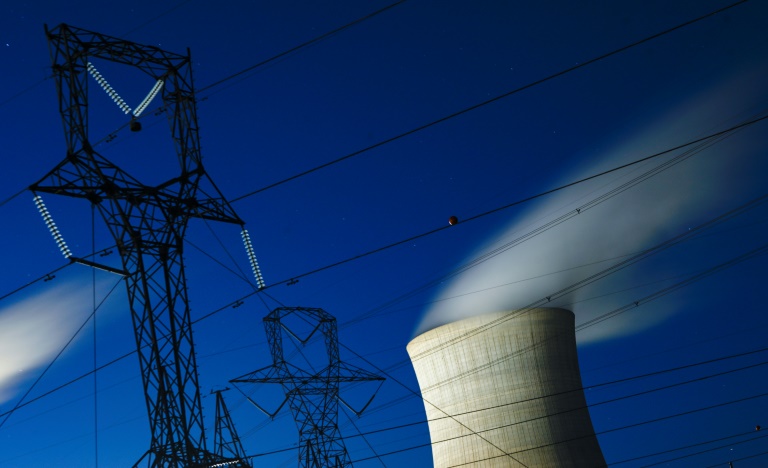
The high-stakes case concerns the authority of the Environmental Protection Agency (EPA) to regulate greenhouse gas emissions from coal-fired power plants, which produce nearly 20 percent of the electricity in the United States.

As the Supreme Court was hearing arguments, the United Nations issued a landmark report containing dire warnings over climate change.

While the three liberal justices on the nine-member Supreme Court appeared largely to support arguments that the EPA was operating within its brief, several of the conservative justices appeared skeptical.

“This agency is doing greenhouse gas regulation,” said Justice Sonia Sotomayor, one of the liberal members of the court. “This is in, you know, exactly in its wheelhouse.”

Jacob Roth, arguing for The North America Coal Corp., said the EPA is going beyond its remit.

“The agency is asking questions like: Should we phase out the coal industry? Should we build more solar farms in this country? Should we restrict how consumers use electricity in order to bring down emissions?

“Those are not the types of questions we expect the agency to be answering,” Roth said.

In 2007, the Supreme Court, by a narrow majority, ruled that the EPA has the power to regulate carbon dioxide emissions from power plants under the Clean Air Act of 1970.

In 2015, Democratic president Barack Obama unveiled his Clean Power Plan, which was intended to combat global warming by reducing carbon dioxide emissions from coal- and gas-burning plants and shifting energy production to clean sources such as solar and wind power.

The Clean Power Plan was blocked in the Supreme Court in 2016 and repealed by former Republican president Donald Trump, who replaced it with his own industry-friendly Affordable Clean Energy (ACE) rule.

Trump, a climate change skeptic hostile to government regulation of industry, also nominated three justices to the Supreme Court, giving conservatives a 6-3 majority.

– ‘Constrain EPA authority’ –

The US Court of Appeals for the District of Columbia threw out Trump’s ACE rule on the last day of his presidency, setting the stage for the case currently before the Supreme Court: West Virginia vs EPA.

West Virginia and several other coal-producing states asked the Supreme Court to intervene and define the powers of the EPA. The case has also been embraced by opponents of strong government regulatory authority.

Solicitor General Elizabeth Prelogar, arguing before the court for the administration of President Joe Biden, said the justices should just wait until the EPA publishes its new rules, expected before the end of the year.

“The DC Circuit’s judgment leaves no EPA rule in effect,” Prelogar said. “No federal regulation will occur until EPA completes its upcoming rulemaking.

“Petitioners aren’t harmed by the status quo,” she said. “Instead, what they seek from this court is a decision to constrain EPA authority in the upcoming rulemaking.”

In its brief to the court, West Virginia accused the EPA of acting like “the country’s central energy planning authority.”

Justice Samuel Alito, one of the more conservative members of the court, questioned how far the EPA could go in regulating emissions.

“Is there any reason EPA couldn’t force the adoption of a system for single family homes that is similar to what it has done, what it is claiming it can do, with respect to existing power plants?” Alito asked.

Prelogar, the solicitor general, replied that the EPA “has never listed homes as a source category and couldn’t do so because they are far too diverse and differentiated.”

Robert Percival, director of the Environmental Law Program at the University of Maryland, said the conservative majority on the court “seems determined to put a stake in the heart of a regulation that has been dead for years in order to rein in EPA in the future.”

UN experts, in the report issued Monday on the global impacts of climate change, said humanity is perilously close to missing its chance to secure a “liveable” future.

“The cumulative scientific evidence is unequivocal: Climate change is a threat to human wellbeing and planetary health,” the Intergovernmental Panel on Climate Change (IPCC) said.

Any further delay in global action to cut carbon pollution “will miss a brief and rapidly closing window of opportunity to secure a liveable and sustainable future for all,” the 195-nation IPCC warned.

Before the Supreme Court hearing, Harvard University environmental law professor Richard Lazarus said there was “good reason for concern” the conservative-leaning court would argue that Congress does not have the power to delegate its regulatory powers to the agency. 

Given the stalemate in Congress, he said “such a ruling would seriously threaten the national government’s ability to address some of the nation’s most pressing problems.” 

The Supreme Court is expected to issue its decision in West Virginia vs EPA before June.
Isolated Russia defends Ukraine war at UN General Assembly

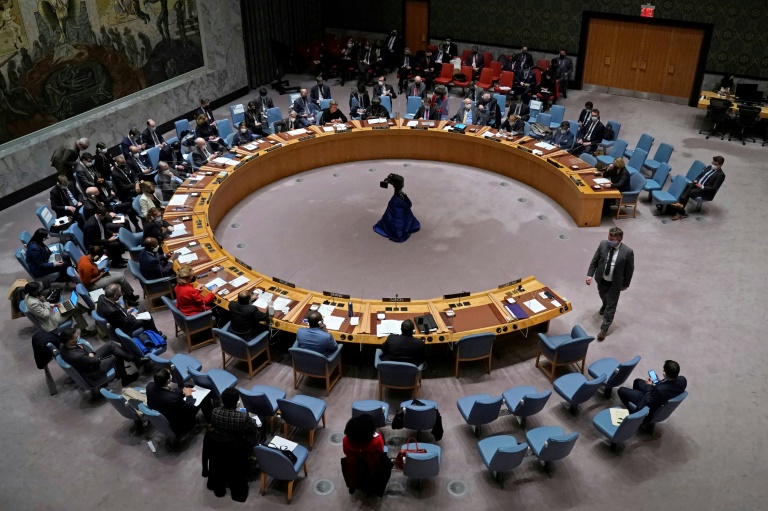
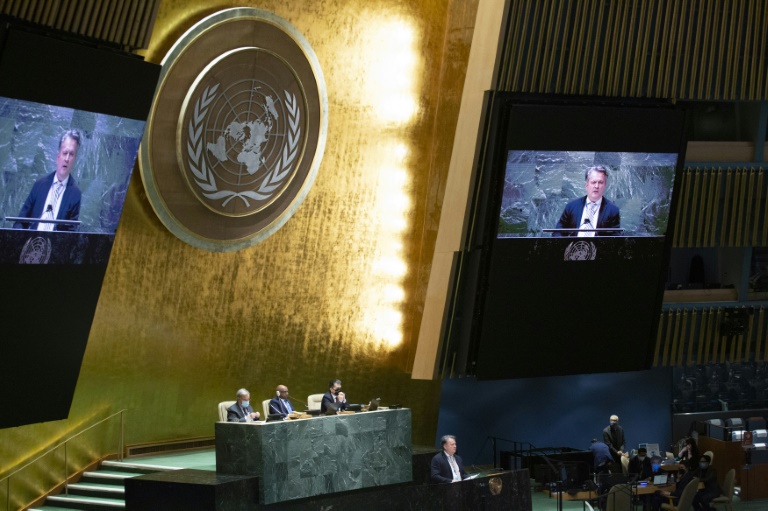
Encountering deepening global isolation, Russia faced urgent calls Monday to end its “unprovoked” and “unjustified” assault on Ukraine as the UN General Assembly’s 193 members held an extraordinary debate on the invasion of the ex-Soviet state.

During the rare emergency special session, just the 11th the Assembly has held in its history, Russia defended its decision to invade its neighbor as nation after nation urged peace from the podium.

On the sidelines, the United States said it was expelling from the country 12 “intelligence operatives” at Russia’s United Nations mission for “engaging in espionage activities that are adverse to our national security.”

Inside the General Assembly hall, UN Secretary-General Antonio Guterres, pleaded: “The fighting in Ukraine must stop. Enough is enough.”

Representatives of more than 100 countries are expected to speak over three days as the global body decides if it will support a resolution that demands Russia immediately withdraws its troops from Ukraine.

A vote is expected Wednesday, and it must reach a two-thirds threshold to pass. The resolution is non-binding but will serve as a marker of how isolated Russia is.

Its authors hope they may exceed 100 votes in favor — though countries including Syria, China, Cuba and India are expected to either support Russia or abstain.

“We do not feel isolated,” Russia’s UN ambassador Vassily Nebenzia told reporters.

He reiterated Moscow’s stance, flatly rejected by Kyiv and its Western allies, that its military operation was launched to protect residents of breakaway regions in eastern Ukraine.

“The hostilities were unleashed by Ukraine against its own residents,” he said during his address.

The vote is also being seen as a barometer of democracy in a world where autocratic sentiment has been on the rise, diplomats said, pointing to such regimes in Myanmar, Sudan, Mali, Burkina Faso, Venezuela, Nicaragua — and of course Russia.

“If Ukraine does not survive, the United Nations will not survive. Have no illusions,” said Ukraine’s ambassador to the UN, Sergiy Kyslytsya.

– ‘I’m afraid’ –

During an emotional speech, Kyslytsya held up images of what he said were the final text messages from a Russian soldier to his mother before he was killed.

“Mama, I’m in Ukraine. I’m afraid,” Kyslytsya said, reading the messages. “They call us fascists. Mama, this is so hard.”

Russian President Vladimir Putin launched the full-scale invasion of Ukraine on February 24. Moscow has pleaded “self-defense” under Article 51 of the UN Charter. 

But that has been roundly rejected by Western countries and the United Nations itself. They accuse Moscow of violating Article 2 of the Charter, requiring members to refrain from the threat or use of force to resolve a crisis.

Addressing the General Assembly, British ambassador Barbara Woodward said the war was “unprovoked, unjustified.”

The resolution would be “a message to the world: that the rules we built together must be defended,” she added. “Because otherwise, who might be next?”

China’s UN envoy Zhang Jun warned that “nothing can be gained from starting off a new Cold War,” but did not indicate how Beijing would vote.

The move to hold the emergency session was sparked by Russia using its veto Friday to block a similarly-worded Security Council resolution.

Council members can turn to the General Assembly if the five permanent members — Britain, China, France, Russia and the United States — fail to agree to act together to maintain peace.

– ‘Hostile act’ –

There is no veto right at the General Assembly, which held a similar vote in 2014 condemning Russia’s seizure of Crimea and obtained 100 votes in support.

The Security Council held a separate emergency meeting Monday on the humanitarian situation in Ukraine.

UN High Commissioner for Refugees Filippo Grandi warned that the fighting was expected to displace four million people.

Nebenzia broke the news of the 12 expelled diplomats during a press conference, saying he had just heard the dozen had been told to leave the United States by March 7.

A US spokeswoman said the move had been “in development for several months,” implying it was not directly related to the war.

In response, Moscow called the expulsions a “hostile act.”

By car and foot, Ukraine refugees start flowing into Hungary

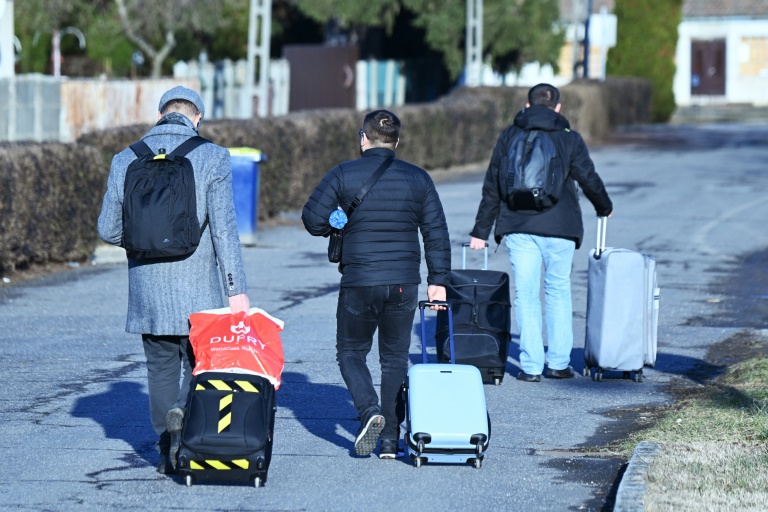
The queue of cars lining up to get into Hungary from Ukraine was long. Hundreds of others came on foot.

They were escaping empty cash machines, bare supermarket shelves and long waits at petrol stations on a day of fierce fighting in Ukraine after Russia’s shock invasion. 

“Anyone who can is fleeing,” said Krisztian Szavla, one of the first refugees who arrived in Hungary Thursday from Ukraine’s western region of Transcarpathia, where a large Hungarian minority lives.

“We don’t want to go through what those over the mountains in the east are experiencing, waking up to sirens and the Russians bombing your city,” the 28-year-old told AFP at a petrol station at Zahony, on the Hungarian side of the border. 

Ukraine’s Transcarpathia region is cut off from the rest of the country by the Carpathian mountain range, and is home to a patchwork of ethnic groups with the 130,000-strong Hungarian community the largest.

“On the other side there are hour-long queues for petrol, the bank ATMs have emptied, and the shop shelves are clearing due to the throngs of people,” said Szavla, a marketing professional who plans to stay temporarily with friends in eastern Hungary.

“I have a wife and young child, and I don’t want her to grow up without a father,” he said, admitting that he doesn’t want to be drafted into the army.

Through Thursday Hungarian police reported long queues of cars waiting to enter Hungary at five crossings along its 140-kilometre (85-mile) long (85-mile) border with Ukraine.

According to the Hungarian MTI news agency “at least 400 or 500 people” also crossed the border on foot into Hungary Thursday.

“The situation in Ukraine is horrible, my friends and family are leaving Kyiv and other cities for the border,” said Bogdan Khmenitsky, a 33-year-old Ukrainian doctor, wheeling a suitcase in the other direction back to Ukraine.  

“Today we decided to cut short a trip to a medical conference in Budapest, to help out in Ukraine,” he told AFP alongside two colleagues, adding that they hope to hitchhike back to Kyiv.

– ‘Collateral effect’ –

Hungarian Prime Minister Viktor Orban said earlier his country was braced for an uptick in arrivals after Russia’s invasion.  

“We have to count on a growing number of Ukrainian citizens arriving in Hungary and presumably applying for refugee status,” he said in a video message Thursday.

“We are prepared to provide for them, we will be able to quickly and efficiently step up to this challenge.” 

A map shown on Orban’s Facebook page yesterday indicated that Budapest believes some 600,000 refugees from Ukraine could arrive in Hungary.

In neighbouring Romania, police said Thursday that some 5,300 people entered from Ukraine along its 615-kilometre (300-mile) long shared border, up from 2,400 the day before.

Several hundred, including women accompanied by children, crossed the frontier at Sighetul Marmatiei, according to television images.

“Most of them are asking about how to get to Poland or the Czech Republic,” said the city’s mayor, Vasile Moldovan.

According to Defence Minister Vasile Dancu, Romania plans to accommodate potential refugees in six or seven regions along the border. 

“We are prepared to deal with this collateral effect” of the invasion of Ukraine, he said.

Ukraine flags fly in Europe against Putin's 'surreal war'

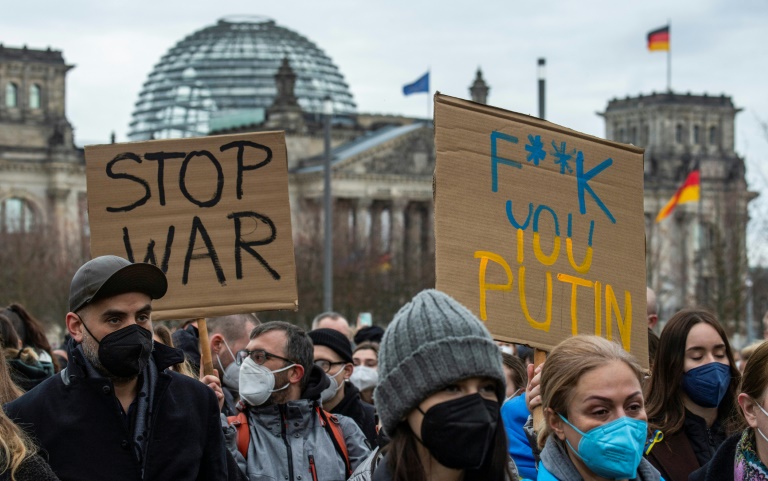
Protesters turned out in cities around the world on Thursday to show solidarity with Ukraine against Russian President Vladimir Putin’s “surreal war” on the former Soviet country, as hundreds of demonstrators who marched in Russia itself were arrested.

Police made nearly 1,400 arrests in 51 cities across Russia, an independent monitor said, cracking down on dissent after authorities warned citizens against marching. 

In Berlin, several hundred people rallied at the Brandenburg Gate, lit up in the blue and yellow colours of the Ukraine flag for the second evening.

Anton Kushch, 35, a Ukrainian software engineer, said he woke up to “a push notification on my phone about war” and had been sent “messages on my phone with all these burning tanks on the roads”.

“It’s hard to believe, it’s surreal,” he said. “This is just catastrophic for the whole world… But we have what we have, a tyrant sitting there in the Kremlin.”

Student Sofia Avdeeva, 22, from the disputed Donetsk region, described Putin as a “war criminal” and said she hoped “the same thing he is putting people through happens to him and his family”.

Russians also joined the protests, with some holding placards outside the Russian embassy.

“We want to show that we are against the war,” said Ekaterina Studnitzky, 40, a teacher from Moscow, holding a cardboard Ukraine flag.

– ‘Brothers and sisters’ –

“Ukraine was always a very friendly and close country to us. We have a lot of relatives there, a lot of friends. Nobody wants this war,” she said.

“This is just terrible. Ukrainian and Russian people are brothers and sisters,” said Olga Krupacina, 32, a student from Kaliningrad. 

Thousands rallied on Prague’s Wenceslas Square then marched toward the Russian embassy, with demonstrators carrying a large poster featuring Hitler and Putin and the tagline 1938-2022, referring to the year of Nazi Germany’s occupation of Czechoslovakia.

Protesters shouted “Pack up your bags!” and “Glory to Ukraine, glory to the heroes!”

In Paris, several hundred people gathered outside the Russian embassy.

Protesters chanted “Stop Putin, stop the war” and carried placards with slogans declaring “No war” and “Putin Ukraine 2022, Hitler Poland 1939”.

“We are here to support the people of Ukraine, those who are still there,” said French-Ukrainian protester Teresa Voytanovska, 42. 

Around 150 demonstrated in Stockholm outside the Russian embassy, waving Ukrainian flags and holding signs reading “Ukraine, solidarity!”, “Stop Russian aggression” and “Stop the bloody maniac”. 

“We feel destroyed… It’s a very bad feeling when your mum calls you at six o’clock in the morning and says that the war has started,” said Yevhenii Osypchuk, a 27-year-old car mechanic.

“So we just decided to leave our jobs and to come to say ‘no’ in front of the Russian embassy.”

In the Netherlands, about 100 pro-Ukrainian protesters gathered in front of the Russian embassy in The Hague and a similar number demonstrated on Amsterdam’s Dam Square, Dutch public broadcaster NOS reported.

Images showed many people draped in Ukrainian flags, carrying placards saying “No war” and chanting “Putin is a killer”.

– ‘We just want peace’ –

In Dublin on Thursday morning, a small group of protesters gathered outside the Russian embassy where red paint was splattered on the mission’s emblem by a gated entrance.

Later in the day, dozens of protesters gathered outside the national parliament building in the centre of the Irish capital carrying Ukrainian flags and placards emblazoned with “stand with Ukraine” and “Putin get out of Ukraine”.

There were also demonstrations in other cities including Athens, Barcelona, Bern, Istanbul, London, Lisbon, Madrid, Sofia, Tokyo and Warsaw.

In Georgia, thousands rallied in the capital Tbilisi’s main thoroughfare, waving Ukrainian and Georgian flags and holding banners that read “Putin get out of Ukraine”.

The war has invited a sense of deja vu in Georgia, which faced a devastating Russian invasion in 2008.

burs-fec-dlc/jv

'The foxes are guarding the hen house': Russia's war highlights UN impotence

It was arguably the ultimate illustration of UN powerlessness: an emergency Security Council meeting designed to avoid war rendered redundant by Russia’s invasion of Ukraine just minutes after the late-night session began.

As UN chief Antonio Guterres and member state after member state on the 15-country council urged Vladimir Putin to step back from the brink, the Russian leader was already sending his troops across the border.

The ambassadors of the United States, Britain, France and others reading pre-prepared speeches calling for Putin to pursue diplomacy seemed unaware of what journalists watching the proceedings already knew: Russia’s president was on state television announcing that his military operation had begun.

As news filtered through to the chamber at the UN’s headquarters in New York, the mood turned to one of anger, despair and hopelessness.

Adding an air of surrealism was the identity of the country chairing the meeting: Russia, in its role as temporary president of the council.

“I call on every one of you to do everything possible to stop the war,” pleaded an emotional Ukrainian ambassador Sergiy Kyslytsya.

But as with the 2003 invasion of Iraq by the United States and Britain, the United Nations again proved incapable of preventing conflict.

With Putin intent on launching his invasion and Russia a permanent council member with the power to veto resolutions, what if anything could the body have done?

“The Security Council was never going to solve this crisis,” Richard Gowan, a UN expert at the International Crisis Group think tank, told AFP.

“That is because of Russia’s veto power, plus the simple fact that President Putin clearly doesn’t give a damn about international opinion or diplomacy.”

Since its creation in 1945, the UN has been unable to stop any conflict started by one of its five permanent members: Britain, China, France, Russia and the United States.

The same five powers that emerged victorious from World War II wield all the power today, relegating the organization to a role focused primarily on providing humanitarian aid in natural disasters and wars, in some cases succeeding in limiting the expansion of conflicts.

The format of the Security Council has not changed in 77 years, with other countries rotating through the body’s 10 non-permanent member spots, which do not have veto power.

– Deadlocked reform –

Experts and governments have long argued for reform to take into account an international order that is now multipolar, with countries like India, Japan and Germany arguing that they should have a permanent, veto-wielding seat.

But reform efforts have been deadlocked for years, however, hampering the credibility of the council, which has all too often been riven by division and infighting, leading to inaction.

“Essentially the foxes are guarding the hen house. Thus, the Security Council is back to its Cold War paralysis,” Pamela Chasek, chair of the political science department at Manhattan College in New York, told AFP.

Russia has not hesitated to wield its veto, doing so more than 15 times with regards to the Syria conflict.

Moscow will exercise its right again on Friday, to block a resolution proposed by Western powers that would “condemn in the strongest terms the Russian invasion of Ukraine,” according to a senior UN official.

A similar text will then be sent to the General Assembly, which brings together all 193 members of the UN. Experts will closely watch the vote to see how isolated Russia is, but ultimately it is non-binding.

A similar scenario occurred in 2014 when Russia annexed Crimea. Eight years later, Russia is still in control of that region.

– ‘Saddest day’ –

At Wednesday night’s session, as ambassadors learned of Russia’s invasion via their mobile phones, many made second speeches, directing much of their anger at Moscow’s envoy Vassily Nebenzia.

“There is no purgatory for war criminals. They go straight to hell, ambassador,” Kyslytsya, the Ukrainian representative, told him.

US ambassador Linda Thomas-Greenfield was seen consoling Kyslytsya and afterwards, a dejected Guterres said Russia’s military assault marked “the saddest day” of his tenure as UN chief.

For some UN watchers, the invasion is not only a personal failure for Guterres but also further evidence of the declining stature of the world body.

“The mediation efforts by the Secretary-General would have been taken seriously 20 years ago,” Trita Parsi of the Quincy Institute think tank told AFP.

“Today, no one even notices his absence because no one has even an expectation that the UN or the Secretary-General will play such a role.”

So what can we expect the Security Council to achieve in the Ukraine crisis?

“For now, the UNSC is a theater where the West and Russia can shout at each other,” said Gowan.

“It won’t do much to bring this war to a close.”

prh-ft-mlm-pdh/sst

'Pariah' Putin mocks global isolation: analysts

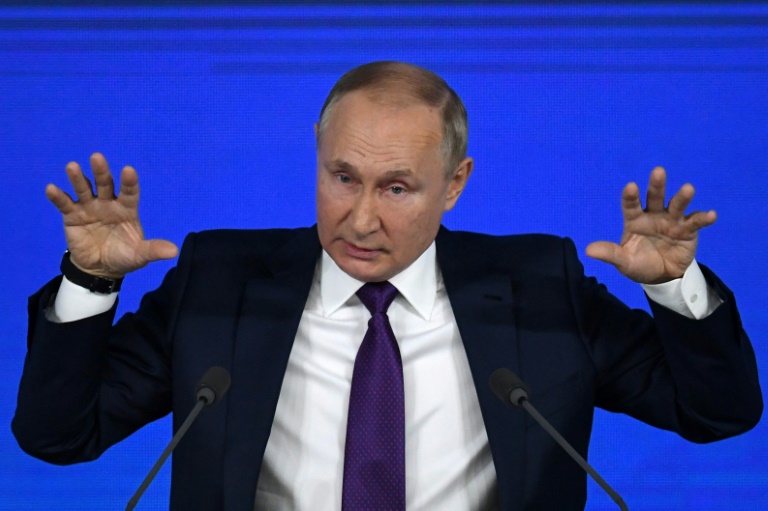
Russia’s invasion of Ukraine risks making President Vladimir Putin an international pariah, but he does not fear such isolation — quite the contrary, experts say. 

The attack on Thursday led the United States and its allies to agree on a “devastating” sanctions package against Russia, after NATO, EU and G7 leaders condemned the invasion and vowed to hold Moscow accountable.

“Putin is now recognised as THE most imminent threat to our system of Western liberal market democracy,” said Timothy Ash, an emerging markets strategist at BlueBay Asset Management.

Western leaders “feel totally let down and threatened by Putin”, who has marked himself out as “the number one pariah” of the West, he added in a note to clients.

The result, said Comfort Ero, president and CEO of the International Crisis Group think-tank, is that Russia “is likely to find itself in unprecedented political and economic isolation for a long time”.

Russia was already targeted with rounds of sanctions after Moscow’s 2014 annexation of Ukraine’s Crimean peninsula and after the poisoning of Kremlin critic Alexei Navalny in 2020.

But no measure seemed to have any effect on the Russian president, other than increasing his intransigence.

“For a year and a half the Kremlin has actively prepared for the fact that the West will impose the most severe sanctions possible,” Tatiana Stanovaya, founder of the R.Politik analysis firm, told AFP. 

For Putin, “sanctions don’t have the aim of preventing Russian aggression but of curbing Russia’s development,” she said, adding that Moscow expects a long confrontation with the West.

Among possible further measures, Washington and Brussels could cut Russia off from SWIFT, the global financial messaging system used to move money around the world, although US President Joe Biden noted on Thursday that is not a step much of Europe yet “wishes to take”.

Russia has prepared itself, particularly by growing its foreign exchange reserves, which total about $640 billion.

“Abundant currency reserves, the soaring price of oil and a low debt-to-GDP ratio will help Russia weather the immediate hit of the sanctions,” said Oleg Ignatov, a Russia expert with the International Crisis Group.

“But in the longer-term, they will compound the country’s economic stagnation.” 

– ‘Necessary measures’ –

Russia is one of the world’s leading producers of crude, which soared to levels not seen since 2014 after the invasion began.

Massive sanctions would make Russia “a global market pariah and uninvestable”, said Ash, pointing to the free-fall experienced by Russia’s stock market on Thursday. 

The Kremlin says it has foreseen such developments. “In order that this emotional period be as temporary as possible, all necessary measures have been taken,” Kremlin spokesman Dmitry Peskov told reporters.

He also downplayed the diplomatic impact.

“Of course we could have problems with a number of states. But we were having problems with these states even before,” Peskov said.

In fact, Putin’s Russia seems determined to shake the foundations of international security.

“This is not just a European security crisis,” said Ero. “The repercussions of this war for global security, too, will be severe and lasting.”

Alexander Baunov, a senior fellow at the Carnegie Moscow Center, said Russia will obviously become “for a time, a pariah”, and the longer its Ukraine operation lasts “the more economic links and engagements between Russia and other countries will unravel”.

Isolated diplomatically and economically from the West, Putin could turn elsewhere, such as China or Iran. Both of those countries have so far seemed hesitant to condemn Russia.

Pakistan’s Prime Minister Imran Khan was visiting Moscow on Thursday.

Beijing said it understands Moscow’s “reasonable concerns on security issues” over Ukraine, while Tehran said “the Ukraine crisis is rooted in NATO’s provocations.”

Dogs show signs of mourning after loss of canine companions

Dogs are deeply affected by the deaths of canine companions, eating and playing less and seeking attention more following a loss, a large scientific study said Thursday.

Signs of grief have previously been reported across many species, including great apes, whales, dolphins, elephants and birds. 

Among the canid family, there were some prior indications: some wild wolves have been reported burying the carcasses of two-week-old pups, and a dingo mother had been observed transporting its deceased pup to different locations in the days following its death.

But the evidence was overall sparse, and, when it came to domestic dogs, confined to anecdotal reports from owners, which run the risk of anthropomorphism and over-stating the case.

The new study, published in the Nature journal Scientific Reports, involved a survey completed by 426 Italian adults who owned at least two dogs, one of whom had died while the other was alive.

Negative changes were reported by 86 percent of owners, with a quarter saying these lasted longer than six months.

These behaviors included more attention seeking (67 percent), reduced playfulness (57 percent), and reduced overall activity (46 percent).

Surviving dogs also slept more, became more fearful, ate less, and whined or barked more.

The researchers found that the length of time the two dogs had lived together was not an important factor in determining grief — rather it was the quality of the relationship the pair had shared that mattered.

How much the owner felt the loss also played a significant role, suggesting that the surviving dog was also responding to the human’s emotional cues.

“This is potentially a major welfare issue that has been overlooked,” with better understanding of behavior patterns key to meeting the animals’ emotional needs, concluded the authors.

Russian soldiers drop from sky at edge of Kyiv

The Russian forces came in shooting as they dropped from the open doors of helicopters to gain control of a strategic airport on the edge of Kyiv.

Their advance was the closest Russian forces had managed to get to the capital on the first day of Kremlin chief Vladimir Putin’s shock invasion of Ukraine.

They now represent an ominous presence at Kyiv’s doorstep as Western-backed Ukrainian leader Volodymyr Zelensky tries to hold on to power in the face of the Russian onslaught.

Zelensky vowed that the Russian forces would be encircled and “destroyed”. 

But witnesses told AFP that the Russian paratroopers had managed to establish control of the airstrip after swooping in with helicopters and jets from the direction of Belarus.

“There were people sitting in the helicopters with their doors open, flying right over our houses,” resident Sergiy Storozhuk said.

“The helicopters came in and then the battles started. They were firing machine guns, grenade launchers,” he said.

“First the choppers were bombing, then maybe an hour ago, to Sukhoi jets flew by and dropped bombs.”

– ‘They were shooting at me’ –

The Gostomel airfield could provide a strategic base for Russian forces to ferry in troops who could then launch an assault on government buildings and the presidential administration in the heart of Kyiv.

Black plumes of smoke loomed over the airstrip on Thursday afternoon.

The main road leading from the base to Kyiv was deserted and almost completely void of any Ukrainian military presence.

Long queues formed outside petrol stations. A few members of a civil defence protection unit walked down the side of the road with guns and shovels.

A tank flying a Ukrainian flag rolled past one of the main intersections and some soldiers manned a checkpoint leading into the city.

But witnesses said the airstrip itself had been filled by what one witness estimated were at least a few hundred Russian soldiers.

“They were shooting at me. I don’t know, perhaps they were trying to scare me. Two helicopters were flying behind me and shooting at the side of the road,” said taxi driver Mykola Shymko.

“Then I came back and see around 100 people. And I see that their uniforms are not ours.”

Witnesses told AFP that the paratroopers wore white wristbands and orange-and-black ribbons — the nationalist Russian colours of Saint George worn by some servicemen.

One witness said a three-hour battle ensued after the first offensive. Then more jets swooped in — including Ukrainian ones.

The chaotic battle left many locals in tears.

– Shock and anguish –

Lyudmila Klimova wavered between shock and anguish while recalling how her little town on the edge of the airstrip had been teeming with life just a day ago.

“The base is smoking over there, it was bombed, our houses are nearby. We don’t know where to run, my parents are here, my sister,” she said as she walked away from the smouldering fields with a few lifelong friends.

“Russian troops are there, a friend of mine lives there, and the Russians have already approached his mother with a machine gun,” the 58-year-old said.

Ukrainian border guards had earlier confirmed that Russian ground forces had also crossed south over the Belarus-Ukraine border into the Kyiv administrative region.

More battles were raging across Ukraine’s eastern front with Russian-backed insurgents that first rebelled against Kyiv’s rule in 2014.

But Klimova’s thoughts mostly focused on her friends and the battles raging around her home.

“Our little town is there, smouldering,” she said. “It was bombed. Our home is next to it. 

“We do not know where to run.”

Russia invades Ukraine, dozens killed

Russian President Vladimir Putin launched a full-scale invasion of Ukraine on Thursday, unleashing air strikes and sending troops deep into the country in unrest that Ukrainian authorities said left dozens dead.

The attack triggered Western warnings of unprecedented economic action against Russia as NATO and the EU condemned the invasion, while the G7 agreed on “devastating packages of sanctions”.

Weeks of intense diplomacy failed to deter Putin, who massed over 150,000 troops on Ukraine’s borders in what the West said was the biggest military build-up in Europe since World War II.

“I have decided to proceed with a special military operation,” Putin said in a televised address before dawn on Thursday.

Shortly afterwards, the first bombardments were heard in Ukraine’s capital, Kyiv, and several other cities, according to AFP correspondents. 

Following a day of intense violence, the site of the Chernobyl nuclear disaster fell to Russia.

Russian airstrikes hit military installations across the country as ground forces moved in from the north, south and east, forcing many Ukrainians to flee their homes to the sounds of bombing. 

The country’s defence ministry said Moscow’s forces had “successfully completed” their objectives for the day.

Olena Kurilo was among 20 wounded after a blast sent shards of glass from her windows in the eastern Ukrainian town of Chuguiv.

“Never, under any conditions will I submit to Putin. It is better to die,” the 52-year-old teacher said, her face swathed in bandages.

Ukrainian President Volodymyr Zelensky said there was now a “new iron curtain” between Russia and the rest of the world, like in the Cold War.

US President Joe Biden said that the G7 group of wealthy nations had agreed to impose “devastating” economic sanctions on Russia over the invasion. 

“We agreed to move forward on devastating packages of sanctions and other economic measures to hold Russia to account. We stand with the brave people of Ukraine,” Biden tweeted.

Biden was expected to give a speech at 1830 GMT.

– Fall of Chernobyl –

Across Ukraine, at least 68 people were killed, including both soldiers and civilians, according to an AFP tally from Ukrainian official sources.

Air raid sirens sounded over Kyiv at the break of dawn after the city’s main airport was hit in the first bombing of the city since World War II.

The city declared an overnight curfew but said underground stations would remain open throughout to serve as bomb shelters.

Ukraine said that Russian forces had managed to capture an airfield near Kyiv and that Chernobyl in northern Ukraine — site of the world’s worst nuclear disaster — had fallen to Moscow’s forces.

Zelensky called the attack on Chernobyl — a vast area that has been abandoned since the disaster because of continued high levels of radioactivity — “a declaration of war on all of Europe”.

In the deadliest single strike reported by Ukrainian authorities, 18 people were killed at a military base near the Black Sea port of Odessa.

Ukraine’s emergency services also said a military plane with 14 people on board crashed south of Kyiv and that they were determining how many people died.

Ukrainian forces said they had killed “around 50 Russian occupiers” while repulsing an attack on a town on the frontline with Moscow-backed rebels, a toll that could not immediately be confirmed by AFP.

– ‘Significant economic risk’ –

In the Ukrainian village of Starognativka near the frontline where separatists have faced off against Kyiv’s forces, official Vladimir Vesyelkin said missiles had rained down since the morning and power was out.

“They are trying to wipe the village off the face of the earth,” he said. 

Russia’s defence ministry said it had destroyed over 70 military targets, including 11 airfields.

Ukraine said Russian tanks and heavy armour crossed the border in several northern regions, in the east as well as from the Kremlin-annexed peninsula of Crimea in the south.

The fighting spooked global financial markets, with stocks plunging and oil prices soaring past $100.

IMF chief Kristalina Georgieva said the unrest carried “significant economic risk” for the world, but Putin insisted he did not seek to undermine the global economic system.

– ‘Crime against humanity’ –

In his televised address, Putin justified the assault as a defence of the self-proclaimed Donetsk and Lugansk republics in eastern Ukraine.

The Kremlin earlier said the leaders of the two separatist territories had asked Moscow for military help against Kyiv after Putin recognised their independence on Monday.

A conflict between the separatists and government forces has dragged on since 2014, killing more than 14,000 people on both sides.

The OSCE’s acting chairman, Polish Foreign Minister Zbigniew Rau, said the invasion was a “crime against humanity”, and later the organisation said it was pulling its foreign staff from Ukraine. 

NATO said it had activated “defence plans” for allied countries but alliance chief Jens Stoltenberg said there were no intentions to send NATO forces into Ukraine.

Russia has long demanded that Ukraine be forbidden from ever joining NATO and that US troops pull out from Eastern Europe.

In the Baltics, Lithuania declared a national emergency and Latvia banned three Russian TV channels that were broadcasting in the country, saying they posted a “threat to national security”.

Demonstrators took to the streets of European capitals to condemn Russia but a small anti-war protest in Moscow was quickly shut down by police and monitors said over 700 people were detained.

burs-gw/jv

UK imposes unprecedented sanctions on Russia's 'dictator' regime

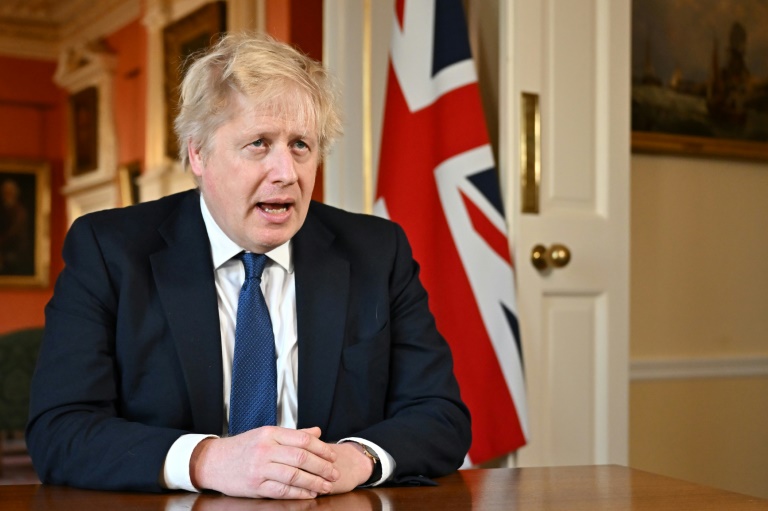
Britain on Thursday imposed a biting package of sanctions on Russia that Prime Minister Boris Johnson said would degrade its economy “for years to come”, as he slammed President Vladimir Putin in unusually personal terms.

After Putin ordered his forces to invade Ukraine, Johnson called him a “dictator” who “will never be able to cleanse the blood of Ukraine from his hands”. 

Downing Street will fly Ukraine’s flag and be lit up in the national colours of yellow and blue on Thursday evening, the prime minister’s spokesman said.

Protesters waving Ukrainian flags and brandishing placards of support gathered outside Downing Street.

The UK sanctions include freezing the assets of Russian bank VTB and arms manufacturer Rostec, sanctions on five more oligarchs close to Putin including his former son-in-law Kirill Shamalov, and banning Aeroflot from British airspace.

Britain will legislate to prevent the Russian state and entities from raising money in London, and ban the export of “dual-use” equipment that can have military applications.

It will also legislate to limit how much money Russians can hold in UK bank accounts, although the ceiling has yet to be determined.

Long accused of turning a blind eye to Kremlin-backed money flowing through London, the government will accelerate an “Economic Crime Bill”, notably to prise open the real ownership of Russian-held assets.

Johnson told parliament the measures were “the largest and most severe package of economic sanctions that Russia has ever seen”.

– ‘Blood-stained aggressor’ –

Putin would “stand condemned in the eyes of the world and of history”, he added.

“Putin was always determined to attack his neighbour, no matter what we did,” he said, calling the Kremlin chief “a blood-stained aggressor who believes in imperial conquest”.

Britain had this week already imposed sanctions on five Russian banks and three billionaire businessmen, but was accused of not going far enough.

The new trade sanctions, Johnson said, “will constrain Russia’s military industrial and technological capabilities for years to come”.

“We cannot and will not just look away,” he had said in a televised address to the nation, after phoning Ukraine’s President Volodymyr Zelensky just after four am (0400 GMT) as Russian forces moved in.

Johnson summoned his security chiefs for an early meeting in response to the  invasion and was due to hold a further crisis session and full cabinet meeting on Thursday evening.

Foreign Secretary Liz Truss said the government had deployed teams to five countries in eastern Europe to support Britons leaving Ukraine. 

Transport Secretary Grant Shapps said he had instructed the UK Civil Aviation Authority to ensure airlines avoid Ukraine airspace “to keep passengers and crew safe”.

The other Russians sanctioned Thursday by the UK were Pyotr Fradkov, Denis Bortnikov, Yuri Slyusar and Elena Georgieva. 

The oligarchs are “people who have international lifestyles”, a British diplomatic source said.

“They come to Harrods to shop, they stay in our best hotels when they like, they send their children to our best public (private) schools, and that is what’s being stopped. 

“So these people are essentially persona non grata in every major Western European capital in the world. That really bites.”

Johnson said sanctions would also be extended to Belarus for helping in the invasion, but did not go into detail.

Russia meanwhile is due to hold the final of European football’s Champions League final in Saint Petersburg on May 28, which governing body UEFA is reviewing.

“I cannot for the life of me see how that can currently go ahead,” Johnson told parliament.

Close Bitnami banner
Bitnami