World

'Multi-pronged' Russian assault aims to encircle Ukraine forces

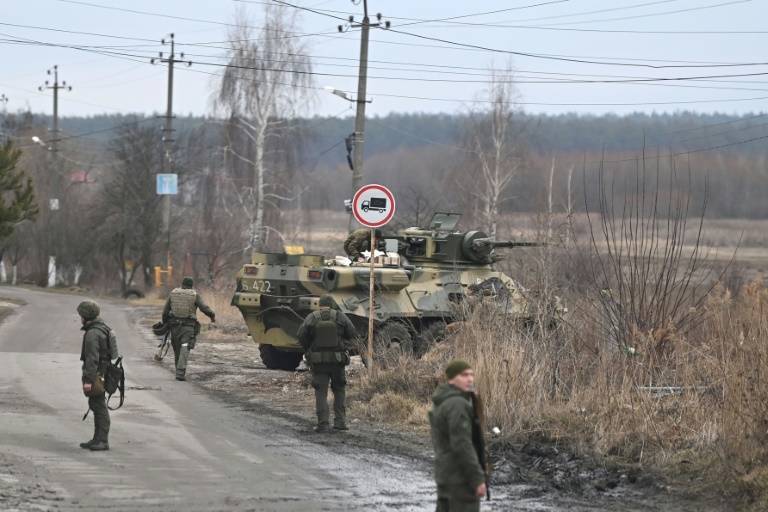
Russia’s military strike against its neighbour Ukraine is designed to claim air superiority before ground troops that have massed on the country’s borders encircle Ukrainian forces from the north and south, experts told AFP.

The assault, after more than 150,000 Russian troops massed on Ukraine’s borders in recent weeks, has been accompanied by a massive wave of air and missile strikes, while ground troops push on several fronts including towards the capital Kyiv.

The picture is of “a rapid Russian military campaign that seeks to rapidly dislocate, encircle and destroy Ukrainian forces in a multi-pronged assault”, said Franz-Stefan Gady, a research fellow at the International Institute of Strategic Studies (IISS).

“Russia… will try to see a rapid conclusion of this conflict,” he added.

A series of explosions were heard in the capital, with Ukraine saying Russian forces had captured an airbase on Kyiv’s outskirts while helicopters were seen flying in from the north.

Attackers “look like they’re on the way” towards Kyiv from Belarus, including via pontoon bridges built to the north of the exclusion zone around the former Chernobyl nuclear power plant, said Francois Heisbourg of the Paris-based Foundation for Strategic Research (FRS).

The Russian armed forces — vastly superior in numbers of armoured vehicles and especially air power — said they had destroyed 74 Ukrainian military installations including 11 airbases and anti-aircraft systems.

Russian strikes also hit Kramatorsk, site of the Ukrainian military headquarters for the region, Kharkiv, the country’s second-largest city near the frontier, Black Sea port Odessa and Mariupol, the city closest to the initial frontline.

– Air superiority –

Thursday’s “Russian textbook” attack began with “a phase of preparing the battlefield… known as ‘shaping'”, a senior French military officer said on condition of anonymity.

By “neutralising all anti-air defences and airbases, eliminating electronic warfare equipment… they’re in the process of seizing air superiority before ground manoeuvres,” the officer added.

“With Russia in total control of the skies, the Ukrainians are in an impossible military situation,” added Heisbourg.

Along with air superiority, Moscow could be trying to paralyse its neighbour’s digital communications, with multiple websites of banks and ministries taken offline by so-called distributed denial of service (DDOS) attacks from Wednesday afternoon.

Kyiv has blamed Russian operatives for the cyberattacks, which Moscow has denied.

The senior French officer said that once air superiority was assured, “in the coming hours we’ll see bridgeheads being taken, especially with airborne troops, and large-scale manoeuvres coming from Belarus, Crimea and the east.”

Russia is “on course to occupy all of Ukraine”, he predicted.

And with such a large share of his forces committed, President Vladimir Putin’s “calculus is that NATO is not going to intervene”, Gady said.

“If he had really feared an attack on Russian territory by NATO or by any other Western country, he would not have done this.”

– Encirclement –

Sunny weather and firm, dry ground present the perfect conditions for both Russian aircraft and armoured vehicles to operate.

Multiple ground offensives, including from Belarus to the north and Crimea to the south, will likely aim to encircle the bulk of Ukrainian forces, which had been concentrated along the existing “line of contact” with two breakaway pro-Russian republics in the Donbas region.

“It’s like a 21st-century version of the major European wars of the 20th century,” especially World War II, Heisbourg said.

Russian troops “will attack the Ukrainian troops in their trenches from the rear, who will have no other option but to give up after selling their lives dearly”, Heisbourg added.

But the attacking forces will be leery of engaging in street battles in Ukraine’s cities.

“These types of military operations are extremely costly, they’re man-intensive and also can be bloody,” said Gady.

“If they do want to force the Ukrainian government into submission, I think they might actually lay siege to some of the cities… to force a political solution,” he added.

As for the Ukrainians, they could drag out the conflict “if they are able to re-establish interior defensive lines and if they maintain their fighting morale,” Gady said.

“Having said that, the chances for this to happen… at this moment are fairly small.”

dab-vl-burs/tgb/sjw/imm
Biden meets with G7, addresses US on response to Russia

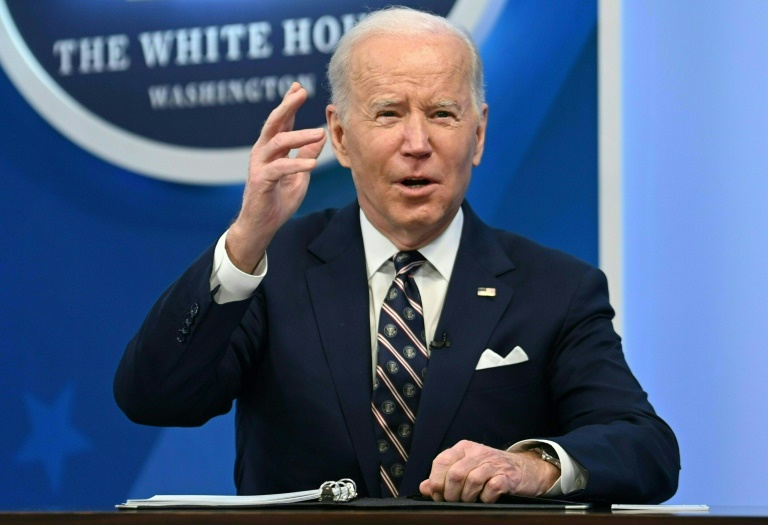
US President Joe Biden met with G7 allies Thursday to hammer out a raft of new sanctions against Russia after it invaded Ukraine, and was shortly to speak to the American people on a crisis that he warns will cause “catastrophic loss of life.”

After a virtual, closed-door meeting which lasted an hour and 10 minutes, the group of rich Western democracies — Britain, Canada, France, Germany, Italy, Japan and the United States — said in a joint statement that Russia posed “a serious threat to the rules-based international order.” 

It said the seven industrial powers were “ready to act” to minimize disruptions to world energy markets as a result of Moscow’s assault on Ukraine and with sanctions already targeting a major pipeline from heavyweight energy producer Russia.

Before the G7 gathering, Biden first huddled with his National Security Council in the Situation Room, the White House said. His speech to the nation was scheduled for 12:30 pm (1730 GMT).

For weeks, as Russia built up tens of thousands of troops and heavy weapons on Ukraine’s border, Biden has led NATO and other European allies in trying to craft a package of what Washington says are “unprecedented” sanctions as a deterrent.

Now that the deterrent has failed, the goal is to “hold Russia accountable,” Biden said in his first comments late Wednesday in Washington, after Russian missiles began to rain down. Biden said US allies would “respond in a united and decisive way.”

Biden also held a phone call with his Ukrainian counterpart Volodymyr Zelensky, saying afterwards that he had promised to “provide support and assistance to Ukraine and the Ukrainian people.”

A first round of Western sanctions was unleashed on Tuesday, after Putin announced he would send troops as “peacekeepers” to two small areas already controlled by Moscow-backed separatists. 

The US government joined European allies in imposing sanctions on two Russian banks, Moscow’s sovereign debt, several oligarchs and other measures.

On Wednesday, as the Russian invasion force became clearly primed to attack, Biden announced he was imposing sanctions on the Nord Stream 2 natural gas pipeline from Russia to Germany — one of Moscow’s highest-profile geopolitical projects.

Germany had earlier announced it would block the pipeline from opening for deliveries.

Now, US officials are teeing up tougher new sanctions that could include targeting bigger banks, more oligarchs close to Putin and, crucially, a ban on exports to Russia of high-tech equipment and components. 

It was not clear how many of these measures would be announced Thursday.

– ‘Cut off’ Russian economy –

Germany’s vice chancellor, Robert Habeck, signalled Thursday there would be a “strong sanctions package” that will “cut off the Russian economy from industrial progress, will attack and freeze assets and financial holdings, and will dramatically limit access to the European and American markets.”

“No Russian financial institution is safe,” State Department spokesman Ned Price said Wednesday, hours before the invasion was launched.

Some measures also risk serious economic fallout for Western countries and could imperil the global economy recovery after the Covid pandemic. Already stock markets are tumbling and oil prices are soaring over $100 a barrel.

Among the more controversial sanctions would be directly targeting Putin, who is widely reported to have amassed a vast, secret fortune during his two decades running Russia.

Arguably the highest stakes sanction would be cutting Moscow off from the SWIFT international banking network. This would at least for some time disconnect Russia from basic commerce, hugely disrupting the economy, but it would also carry considerable potential aftershocks to the wider, US-led financial system.

Zelensky, speaking as Russian troops broadened their attack on his country, appealed directly for Moscow to be yanked from SWIFT.

Ukraine flags fly in Europe and beyond against Putin's 'surreal war'

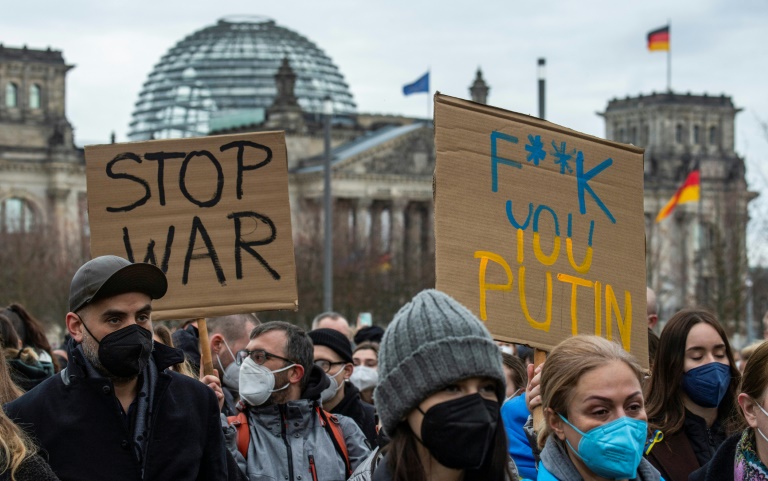
Protesters turned out in cities around the world on Thursday to show solidarity with Ukraine against Russian President Vladimir Putin’s “surreal war” on the former Soviet country. 

In Berlin, several hundred people rallied at the Brandenburg Gate, which had been lit up in the blue and yellow colours of the Ukraine flag the previous evening.

Anton Kushch, 35, a Ukrainian software engineer, said he woke up to “a push notification on my phone about war” and had been sent “messages on my phone with all these burning tanks on the roads”.

“It’s hard to believe, it’s surreal,” he said. “This is just catastrophic for the whole world… But we have what we have, a tyrant sitting there in the Kremlin.”

Student Sofia Avdeeva, 22, from the disputed Donetsk region, described Putin as a “war criminal” and said she hoped “the same thing he is putting people through happens to him and his family”.

Russians also joined the protests, with some holding placards outside the Russian embassy.

“We want to show that we are against the war,” said Ekaterina Studnitzky, 40, a teacher from Moscow, holding a cardboard Ukraine flag.

– ‘Brothers and sisters’ –

“Ukraine was always a very friendly and close country to us. We have a lot of relatives there, a lot of friends. Nobody wants this war,” she said.

“This is just terrible. Ukrainian and Russian people are brothers and sisters,” said Olga Krupacina, 32, a student from Kaliningrad. 

In Paris, several hundred people gathered outside the Russian embassy.

Protesters chanted “Stop Putin, stop the war” and carried placards with slogans declaring “No war” and “Putin Ukraine 2022, Hitler Poland 1939”.

“We are here to support the people of Ukraine, those who are still there,” said French-Ukrainian protester Teresa Voytanovska, 42. 

Around 150 demonstrated in Stockholm outside the Russian embassy, waving Ukrainian flags and holding signs reading “Ukraine, solidarity!”, “Stop Russian aggression” and “Stop the bloody maniac”. 

“We feel destroyed… It’s a very bad feeling when your mum calls you at six o’clock in the morning and says that the war has started. So we just decided to leave our jobs and to come to say ‘no’ in front of the Russian embassy,” said Yevhenii Osypchuk, a 27-year-old car mechanic.

In the Netherlands, about 100 pro-Ukrainian protesters gathered in front of the Russian embassy in The Hague and a similar number demonstrated on Amsterdam’s Dam square, Dutch public broadcaster NOS reported.

Images showed many people draped in Ukrainian flags, carrying placards saying “No war” and chanting “Putin is a killer”.

– ‘We just want peace’ –

In Dublin on Thursday morning, a small group of protesters gathered outside the Russian embassy where red paint was splattered on the mission’s emblem by a gated entrance.

Later in the day, dozens of protesters gathered outside the national parliament building in the centre of the Irish capital carrying Ukrainian flags and placards emblazoned with “stand with Ukraine” and “Putin get out of Ukraine”.

There were also demonstrations in other cities including Beirut, Bern, Istanbul, London, Lisbon, Sofia, Tokyo and Warsaw.

In Tokyo, a female protester who wanted to remain anonymous said she had been unable to contact her mother in Ukraine for three hours on Thursday morning, as the invasion began.

“I was really worried. I don’t know if she will evacuate, but I could talk to her and I know she is fine, at least for now,” she said.

In Beirut, protesters outside the Russian embassy waved flags and chanted “Russia go home”.

“We do not want World War III to happen,” said Suzan Jaramani, 27, a Ukrainian-Lebanese university teacher. “We just want peace. So leave us be and Putin, take your people and just go back to where you belong.”

burs-fec/sea/bp

Battle underway for airbase on Kyiv outskirts

Russian and Ukrainian forces were on Thursday battling for an airbase on the northern outskirts of Kyiv after dozens of attack helicopters swooped south from Belarus towards the capital.

Russian airborne troops seized control of the Gostomel airfield, but Ukraine’s leader President Volodymyr Zelensky vowed that they would be encircled and crushed. 

“The enemy paratroopers in Gostomel have been blocked, and troops have received an order to destroy them,” Zelensky said, in a video address. 

Earlier AFP reporters had seen helicopters flying low over the city from the north and Ukraine’s commander-in-chief of the armed forces, Valeriy Zaluzhny, had confirmed: “Fighting is underway for Gostomel airfield.” 

The Gostomel airfield, which is alongside the Antonov airport, is immediately on the northern edge of Kiev, and the fighting there is the closest that Russian forces had got to the Ukrainian capital on the first day of their invasion.

Lyudmila Klimova, a 58-year-old who lives nearby, said: “The base is smoking over there, it was bombed, our houses are nearby. We don’t know where to run, my parents are here, my sister.

“Russian troops are there, a friend of mine lives there, and the Russians have already approached his mother with a machine gun.”

Alexander Kovtonenko, a 30-year-old civilian also living nearby, said that two fighter jets had fired missiles at Ukrainian ground units as the assault got underway.

“Then there was shooting, it lasted three hours,” he told AFP. “Then three more jets flew in and they started shooting again.”

Smoke was rising from the scene and social media images appeared to show an assault by helicopter-borne troops. CNN showed footage of Russian troops at the airport and a reporter said he had spoken to them.

Earlier, Ukrainian border guards had confirmed that Russian ground forces equipped with tanks had also crossed south over the Belarus-Ukraine border into the Kyiv administrative region, headed towards the capital.

The main Russian advance on the first day of the operation also came from the occupied region of Crimea, from where armoured columns pressed quickly towards the southern city of Kherson.

The Kherson regional government said 13 civilians had been killed, including two children, and nine Ukrainian soldiers have died during the fighting in the area.

Bangui hails Russian 'saviours' of battered C. Africa

Russia has been branded a pariah for invading Ukraine, but in the remote Central African Republic, the country has fans — supporters who say its paramilitaries “saved” their war-torn country.  

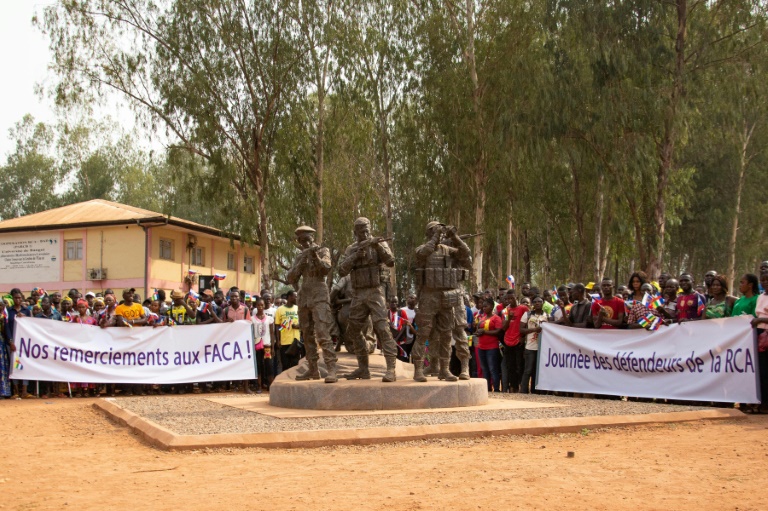
Beneath a statue of Russian fighters protecting a woman and her children, civilians joined a military tribute in Bangui on Wednesday to thank Russians who 14 months ago helped prevent a takeover by armed rebels.

The “Russian monument,” as the people of the capital call it, stands in a square of reddish clay earth near the university.

About a hundred people of all ages waved Russian and CAR flags before troops from an elite unit and figures close to the government.

Some held up banners and signs proclaiming “Central Africans with Russia” and even “Russia will save the Donbass from war” — a reference to the Ukrainian territory that President Vladimir Putin cited as justification for Thursday’s attack.

In December 2020, as elections loomed, a coalition of armed groups advanced on Bangui, prompting President Faustin Archange Touadera to appeal to the Kremlin for help under bilateral accords.

Russia sent hundreds of paramilitaries to the deeply poor and landlocked country, where they joined others who had been present for three years. Rwanda also sent a military contingent.

In a few months, with Russian backing, the CAR’s ill-equipped and poorly-trained army drove back rebels who had occupied two-thirds of the CAR’s territory.

Today, government forces have regained control over the major cities — the immediate crisis is over, although the threat of violence remains. 

The rebels have scattered into the countryside, where they launch attacks on the security forces and civilians.

– ‘Wagner’ controversy –

Russia describes its personnel as “unarmed instructors,” but the UN and France — CAR’s colonial power and traditional ally — say they are from Wagner, a private and unaccountable security firm.

The help has come at a cost, for the operatives have been accused of extrajudicial killings and other abuses.

Last year, a group of UN experts denounced abuses committed against civilians by the CAR armed forces and their Russian allies.

And on Tuesday, France and the United States alleged at the UN Security Council on Tuesday that Wagner “mercenaries” killed dozens of civilians last month.

In July 2018, three Russian journalists investigating Wagner’s activities in the CAR were ambushed and killed.

– ‘Real peace’ – 

Inaugurated by Touadera with great fanfare in December as a “tribute to the Russian armed forces and fighters,” the statue bears no inscription.

“The Russians have always been there on our side,” claimed Yefi Kezza, a member of Touadera’s United Hearts Movement (MCU) and also of the National Galaxy Platform, which organised the tribute and vilifies France and the UN.

“The Russians came and did a remarkable job to liberate the Central African people,” added Blaise-Didacien Kossimatchi, another member of the National Galaxy Platform.

Several demonstrators sported T-shirts stamped “I am Wagner,” identifying with the controversial security firm which supports the Kremlin’s interests — with deniability.

Soldiers of the 6th Territorial Infantry Battalion, an elite unit of the Central African Armed Forces (FACA), snapped to attention for the CAR national anthem.

Their commander laid a wreath at the foot of the statue in hommage to the “Defenders of the Fatherland.”

None of the Russian paramilitaries or diplomats who usually attend such events was to be seen, however.

“The peace that the FACA and the Russians have brought us is truly the peace of God,” announced one speaker at the microphone, rousing cheers from the crowd.

“What interests us is to have real peace,” said Nelson Ezechiel Yangelema, a first-year student in the faculty of science. 

“The Russians must still give the CAR a helping hand.”

Fear, disbelief on Ukraine border as Russia invades

An elderly woman keeping night watch at a hotel in the city of Taganrog sounds incredulous as guests trickling down to the lobby at dawn tell her Russia had invaded Ukraine.

“Maybe it’s a lie?” says the employee of Ida, a small hotel in the historic centre of the southern port city near the border with Ukraine.

Then the woman in her 60s turns on the TV and her eyes widen.

On the screen, she sees a surprise address from President Vladimir Putin, who announces the start of an air and ground assault on Ukraine in the small hours of Thursday.

The road to the Ukrainian border — and towards the port city of Mariupol — hugs the coastline. Early Thursday, there is little traffic, but the road, recently battered by rain, is shrouded in a thick fog. 

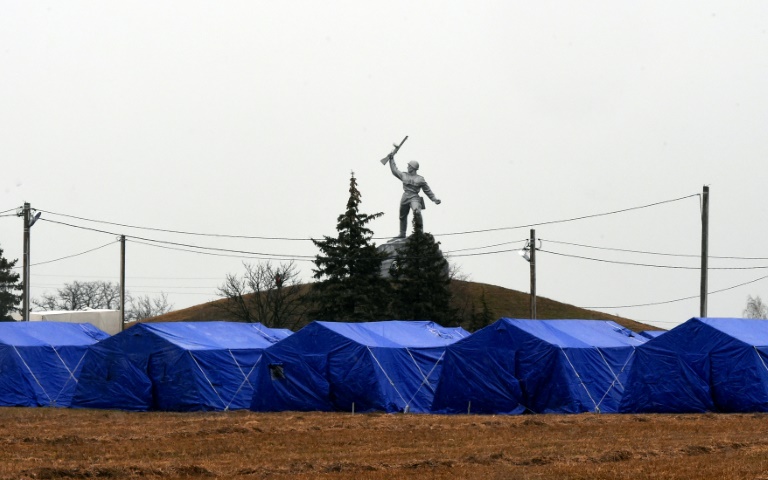
At the Russian-Ukrainian border post, a strange calm reigns. Several policemen go about their business, and tents of the Russian emergencies ministry have been erected.

Not a soldier is in sight, not a detonation is heard. Three police vehicles parked at the checkpoint allow sporadic civilian cars to cross the border despite the offensive. 

Dozens of kilometres away is the village of Pokrovskoye. One day earlier, it had been packed with Russian soldiers. 

Now it is deserted, the soldiers likely having departed north towards the Ukrainian region of Donetsk. The fresh tank tracks could be seen in the mud.

– ‘War has started’ –

Anastasia Yashonkova comes out of a store where she bought toys and lemonade for her four-year-old son. Holding her child by the hand, Yashonkova says all she wants is peace.

“This is really scary,” said the 30-year-old. “I feel sorry for the people who live there, I feel sorry for all the soldiers. I feel sorry for everyone.”

Ambulances could be seen racing down the roads, without sirens.

In the border village of Avilo-Uspenka, a tent camp has been set up by the emergencies ministry. 

Volunteers from a pro-Putin movement, the Popular Front, welcome people fleeing the separatist territory of Donetsk, whose independence Putin recognised this week.

“300 to 400 people have arrived since this morning,” said Kirill, one of the volunteers.

“We have prepared wheelchairs for the elderly, we are offering medical aid,” said the student, who is in his 20s.

Back in Pokrovskoye, where wet dogs run through mud puddles, Yulia, a 20-year-old student, says she cannot believe the news.

“I woke up and my father told me that the war had started. I don’t feel good about this,” said the young woman, declining to give her last name.

She said she was worried about civilians both in Russia and Ukraine.

“I want everyone to be alive and well,” she said.

Insurance agent Anton Shakhovalov brushed aside concerns.

Even though some of his relatives lived in Ukraine, he defended Putin.

“I think this will all be over very quickly,” said the 40-year-old.

“The president has made the right decision. As they rightly say, these are defensive and not offensive actions.”

Russia invades Ukraine, dozens killed

Russian President Vladimir Putin launched a full-scale invasion of Ukraine on Thursday, unleashing air strikes and ordering ground troops across the border in fighting that Ukrainian authorities said left dozens of people dead.

The attack triggered Western warnings of unprecedented sanctions against Russia as NATO, EU and G7 leaders condemned the invasion and vowed to hold Moscow accountable.

Weeks of intense diplomacy failed to deter Putin, who massed over 150,000 troops on Ukraine’s borders in what the West said was the biggest military build-up in Europe since World War II.

“I have decided to proceed with a special military operation,” Putin said in a televised address before dawn on Thursday.

Shortly afterwards, the first bombardments were heard in Ukraine’s capital, Kyiv, and several other cities, according to AFP correspondents.

Russian air strikes hit military installations across the country as ground forces moved in from the north, south and east, forcing many Ukrainians to flee their homes to the sounds of bombing.

– Battle for airbase –

Across the country, at least 68 people were killed, including both soldiers and civilians, according to an AFP tally from Ukrainian official sources.

Air raid sirens sounded over Kyiv at the break of dawn after the city’s main airport was hit in the first bombing of the city since World War II.

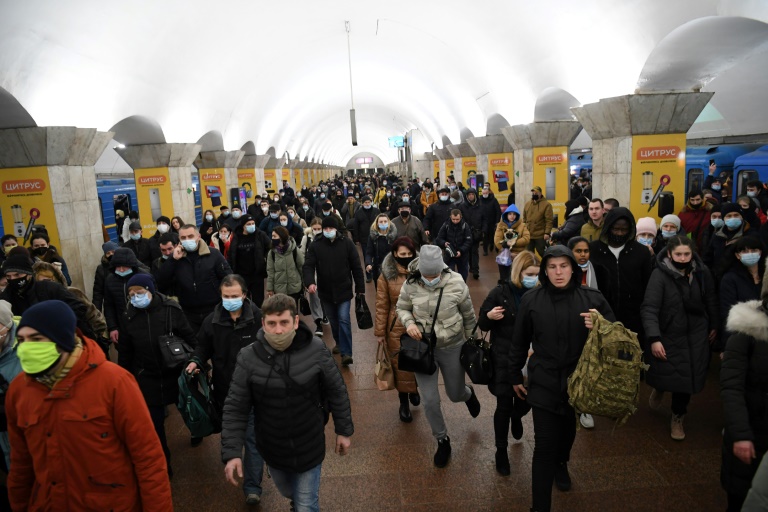
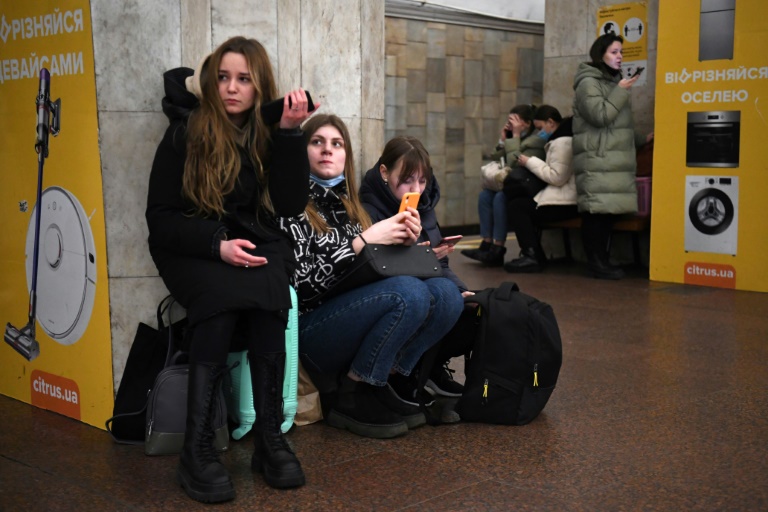
“I woke up because of the sounds of bombing. I packed a bag and tried to escape,” Maria Kashkoska told AFP, as she sheltered inside a metro station.

Ukraine said that Russian forces had managed to reach the region around Kyiv and a battle was under way for an airbase near the city.

An AFP reporter in the northern part of the city saw several low-flying helicopters overhead.

In the deadliest single strike reported by authorities, 18 people were killed at a military base near Ukraine’s Black Sea port city of Odessa.

Ukraine’s emergency services also said a military plane with 14 people on board crashed south of Kyiv and that it was determining how many people died.

Ukrainian President Volodymyr Zelensky declared martial law and accused Russia of acting like “Nazi Germany” but asked people not to panic and promised victory.

Ukrainian forces said they had killed “around 50 Russian occupiers” while repulsing an attack on a town on the frontline with Moscow-backed rebels, a toll that could not be immediately confirmed by AFP.

– ‘Feel sorry for everyone’ –

In the eastern Ukrainian town of Chuguiv, a son wept over the body of his father among the wreckage of a missile strike in a residential district.

“I told him to leave,” the man sobbed repeatedly, next to the twisted ruins of a car.

Elena Kurilo, a 52-year-old teacher was among 20 wounded recovering in hospital after a blast sent shards of glass from her windows into her face.

“Never, under any conditions will I submit Putin. It is better to die,” she said.

On the Russian side of the border, in Pokrovskoye, there was a strange calm and no sign of the soldiers who had filled the village on Wednesday.

Anastasia Yashonkova came out of a store where she bought small toys and a lemonade for her four-year-old son. Holding her child by the hand, Yashonkova said all she wanted was peace.

“This is really scary,” said the 30-year-old. “I feel sorry for everyone.”

– Panic on the markets –

Russia’s defence ministry said it had destroyed over 70 military targets, including 11 airfields.

Ukraine said Russian tanks and heavy equipment crossed the border in several northern regions, in the east as well as from the Kremlin-annexed peninsula of Crimea in the south.

Kremlin spokesman Dmitry Peskov said the operation would last as long as necessary, saying there were “goals that need to be achieved”.

“Ideally, Ukraine needs to be liberated and cleansed of Nazis,” he told reporters, repeating unfounded claims made by the Kremlin about Ukraine’s government.

The fighting roiled global financial markets, with stocks plunging and oil prices soaring past $100.

European wheat prices also hit a record high on expectations of lower supplies as Ukraine and Russia are two of the world’s biggest producers.

– ‘Harshest sanctions’ –

In his televised address, Putin justified the assault as a defence of the self-proclaimed Donetsk and Lugansk republics in eastern Ukraine.

The Kremlin earlier said the leaders of the two separatist territories had asked Moscow for military help against Kyiv after Putin recognised their independence on Monday.

A conflict between the separatists and government forces has dragged on since 2014, killing more than 14,000 people on both sides.

“Putin’s aim is to end the existence of Ukraine as it was yesterday,” said Tatyana Stanovaya, founder of the political consultancy R.Politik Center and a non-resident scholar at the Carnegie Moscow Center. 

“I cannot see anything that would stop Russia now”.

US President Joe Biden spoke with Zelensky after the Russian assault began to vow US support.

He condemned the “unprovoked and unjustified attack,” and vowed Russia would be held accountable.

Biden joined a virtual meeting of G7 leaders — Britain, Canada, France, Germany, Italy, Japan and the United States — on Thursday, likely to result in more sanctions against Russia.

In Brussels, EU foreign policy chief Josep Borrell said Russia would be hit with the “harshest sanctions” the European Union has ever imposed.

French President Emmanuel Macron said the events were a “turning point in the history of Europe”.

NATO said it would hold a virtual summit and activate “defence plans” for allied countries.

But NATO chief Jens Stoltenberg said: “We don’t have any plans to send NATO troops into Ukraine”.

Russia has long demanded that Ukraine be forbidden from ever joining NATO and that US troops pull out from Eastern Europe. 

Putin this week set out a number of stringent conditions if the West wanted to de-escalate the crisis, saying Ukraine should drop its NATO ambition and become neutral.

The Russian invasion rattled eastern NATO members once dominated by Moscow, with several calling for a strong response from the military alliance.

Poland also said it would open nine reception centres along its border with Ukraine in anticipation of an influx of refugees.

In the Baltics, Lithuania declared a national and Latvia banned three Russian TV channels that were broadcasting in the country, saying they posted a “threat to national security”.

burs-dt/jbr/jm

Pakistani-American sentenced to death for beheading girlfriend

A Pakistan court sentenced the scion of a wealthy industrialist family to death Thursday, for raping and beheading his girlfriend in a murder that sparked an outcry over the brutalising of women in the deeply patriarchal nation.

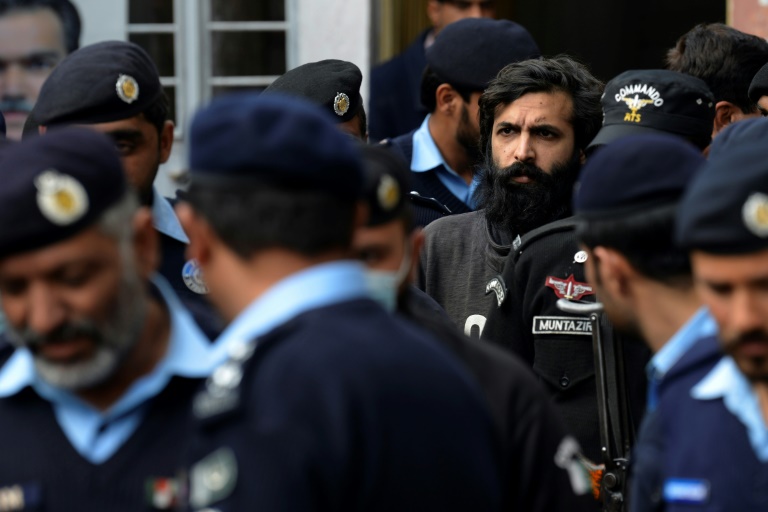
Pakistani-American Zahir Jaffer, 30, attacked Noor Mukadam at his Islamabad home in July last year after she refused his marriage proposal — torturing her with a knuckleduster and using a “sharp-edged weapon” to behead her.

Mukadam, the 27-year-old daughter of a former ambassador, had made repeated attempts to escape the sprawling mansion but was blocked by two members Jaffer’s staff.

“The main accused has been awarded the death sentence,” said judge Atta Rabbani at the Islamabad district court.

Jaffer’s parents, Zakir Jaffer and Asmat Adamjee, were found not guilty of attempting to cover up the crime.

The two staff members were sentenced to 10 years in prison for abetting murder.

“I am happy that justice has been served,” said Shuakat Mukadam, Noor’s father, while pledging to challenge the acquittal of Jaffer’s parents.

The case prompted an explosive reaction from women’s rights campaigners reckoning with the pervasion of violence against women.

– Privileged elite –

The shocking nature of the murder, involving a couple from the privileged elite of Pakistani society, led to pressure for the trial to conclude swiftly in a country where the justice system is notoriously sluggish and cases typically drag on for years.

According to the Asma Jahangir Legal Aid Cell, a group providing legal assistance to vulnerable women, the conviction rate for cases of violence against them is lower than three percent.

Targets of sexual and domestic abuse are often too afraid to speak out, and criminal complaints frequently not investigated seriously.

“Convictions have been dismally low for victims… making today’s guilty verdict all the more significant,” said Amnesty International South Asia campaigner Rimmel Mohydin.

The court verdict dictates Jaffer be “hanged by his neck till he is dead”, however he was also given a concurrent sentence of 25 years in prison for abduction and rape.

He will also be able to challenge Thursday’s verdict.

Executions have rarely been carried out in Pakistan in recent years — and usually only involving terrorism cases — in part due to pressure from the European Union.

The last was in December 2019, according to the Justice Project Pakistan, making it likely Jaffer will only serve jail time, with remissions for religious holidays and good behaviour.

Jaffer was thrown out of court several times during the trial for unruly behaviour.

He was frequently carried into proceedings by stretcher or wheelchair, and his lawyers argued he should be found not “mentally sound” — a manoeuvre prosecutors said was designed to have the trial suspended.

At one hearing he claimed someone else had killed Mukadam during a “drug party” at his house.

When questioning Mukadam’s father — a former ambassador to South Korea and Kazakhstan — Jaffer’s lawyer implied she was killed by her own family for conducting a relationship outside of marriage.

Prosecutions for violence and sexual assault frequently see the female victim’s personal history picked over according to Pakistan’s patriarchal mores — another reason why justice is rare for women.

Bloodshed, tears in eastern Ukraine as Russia attacks

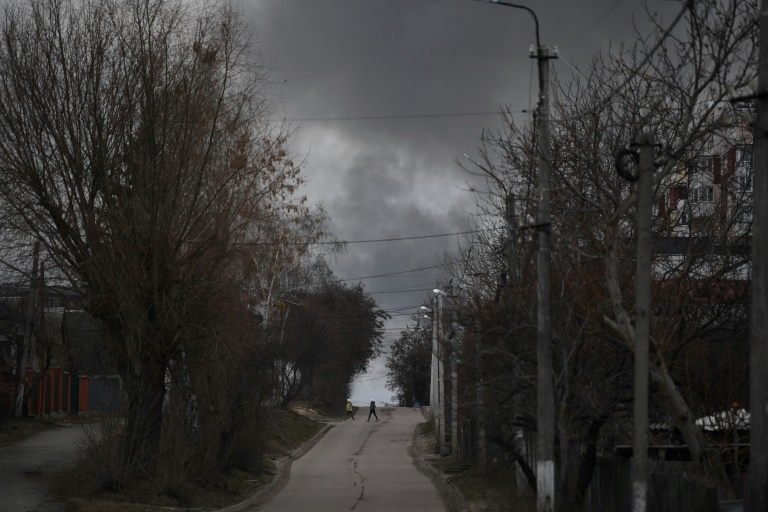
A son wept over the body of his father among the wreckage of a missile strike in a residential district in the eastern Ukrainian town of Chuguiv as the country reeled Thursday from Russia’s invasion.

“I told him to leave,” the man in his 30s sobbed, next to the twisted ruins of a car.

Nearby a woman screamed curses into the wintry sky. 

A missile crater, some four to five metres wide, was scoured into the earth between two devastated five-storey apartment buildings. Firefighters battled to extinguish the remains of a blaze. 

Several other buildings on the street were seriously damaged, their windows shattered and doorframes hanging in the frigid morning air. 

It was among the first reported damage after Russia launched an invasion of Ukraine early Thursday, with explosions heard in several locations across the country in the early morning hours.

Residents said a 13-year-old was among those killed in the town, but there was no definitive death toll from the authorities.  

Sergiy, 67, tried to use the leg of an Ikea table to block up his smashed window. He had received a few bruises but said he was fine. 

“I’m going to stay here, my daughter is in Kyiv and it’s the same there,” he told AFP.

Sergiy thought the target had been the nearby military airfield, close to Ukraine’s second city Kharkiv and just 40 kilometres (25 miles) from the Russian border. 

“It was one of the targets that Putin had cited, I’m not even surprised,” he said, refusing to give his surname.  

“We will hang in there.”

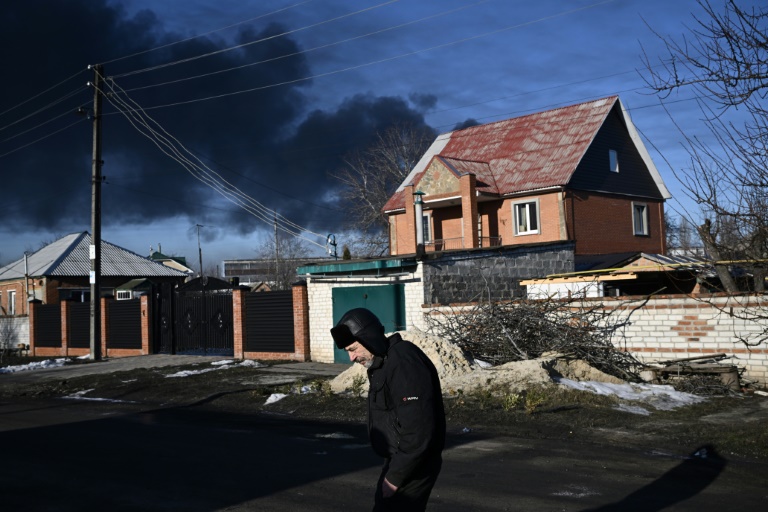
Thick black smoke could be seen billowing from the direction of the airfield — one of a raft of strategic locations across the country pounded by Moscow’s firepower in an opening barrage.

Teenager Anastasia clutched her grey cat as she watched her grandfather in a wheelchair being loaded onto a minibus waiting to rush them to a nearby village.

– ‘Hope the war will spare us’ –

“We could never have expected this. We’re going to the village, we hope the war will spare us there,” she said.

A few hours later teacher Olena Kurilo, 52, emerged from the town’s hospital with her faced swathed in bandages. A missile had blasted shards of glass from her windows into her face.

Doctors said 20 wounded people remained in hospital for treatment.  

“I only managed to think in that second ‘My God, I’m not ready to die’,” Kurilo said. 

“I was in shock, I felt no pain.”

She said she “never thought” that such an attack would come, but now it has she was in no mood to surrender. 

“I will do everything for Ukraine, as much as I can,” she said.

“Never, under any conditions will I submit to (Russian President Vladimir) Putin. It is better to die.”

Ukrainian military personnel and trucks swarmed around the town as the government in Kyiv insisted its forces would do all they could to protect Ukraine.

Across Ukraine’s vulnerable eastern front civilians and soldiers scrambled to react as one of the world’s most powerful militaries began what authorities warned was a “full-scale invasion”.  

Some 250 kilometres to the south — along the frontline where Russia-backed separatists have been fighting Ukraine — authorities were rushing to evacuate civilians as fighting raged. 

Local administrations reported heavy missile bombardments as Russian forces sought to advance — cutting gas and electricity, and making evacuations impossible in some areas.

Official Vladimir Vesyelkin said missiles had rained down on his village of Starognativka since the morning and power was out.

“They are trying to wipe the village off the face of the earth,” he said. 

Yevgeny Kaplin, head of the humanitarian organisation Proliska, said attacks were going on across the entire frontline that had divided Ukrainian forces from an enclave held by Russian-backed rebels. 

But poor communications were hampering information coming about victims. 

“The offensive is underway along the entire demarcation line in the Lugansk and Donetsk regions,” he said. 

“Fighting is happening everywhere. We cannot yet receive information about victims, because there is no communication in this area.”

'Unprovoked and unjustified:' world reacts to attack on Ukraine

World leaders on Thursday  condemned the Russian invasion of Ukraine, with Western capitals vowing to escalate sanctions against Moscow while the head of the United Nations demanded the conflict end immediately.

Key reactions:

– US President Joe Biden – 

“The prayers of the entire world are with the people of Ukraine tonight as they suffer an unprovoked and unjustified attack by Russian military forces,” Biden said shortly after the operation began.

He warned “Russia alone is responsible for the death and destruction this attack will bring.”

“The world will hold Russia accountable,” he declared.

– Ukrainian President Volodymyr Zelensky –

Zelensky compared Russia’s invasion of his country to Nazi Germany’s military campaigns during World War II.

“Russia has attacked Ukraine in a cowardly and suicidal way, like Nazi Germany did during World War II,” Zelensky said in an online briefing.

– China –

Foreign Minister Wang Yi told his Russian counterpart Sergei Lavrov in a phone call that China understands “Russia’s reasonable concerns on security issues”, China’s foreign ministry said.

The foreign ministry repeatedly declined to call the attack an “invasion” at a press briefing on Thursday.

– UN chief Antonio Guterres – 

Guterres made a direct and personal plea to Russian President Vladimir Putin after an emergency Security Council session, urging him to stop the attack “in the name of humanity.”

“Do not allow to start in Europe what could be the worst war since the beginning of the century,” he said.

“The conflict must stop now,” added the UN chief, who said it was the “saddest day” of his tenure.

– NATO head Jens Stoltenberg – 

The Atlantic alliance’s secretary general said Russia had “chosen the path of aggression against a sovereign and independent country.”

The attack “puts at risk countless civilian lives,” Stoltenberg said in a statement, describing it as a “grave breach of international law, and a serious threat to Euro-Atlantic security.”

NATO ambassadors were to hold an emergency meeting to discuss the attack.

– British Prime Minister Boris Johnson – 

“I am appalled by the horrific events in Ukraine and I have spoken to President Zelensky to discuss next steps,” the British leader tweeted.

In an address to the nation, Johnson later called Putin a “dictator” facing “massive” sanctions for his “attack on democracy and freedom in east Europe and around the world.”

– EU chiefs – 

“In these dark hours, our thoughts are with Ukraine and the innocent women, men and children as they face this unprovoked attack and fear for their lives,” European Union chiefs Ursula von der Leyen and Charles Michel said on Twitter. 

“We will hold the Kremlin accountable,” they added.

Foreign policy chief Josep Borrell said Russia faced “unprecedented isolation” and would face the “harshest sanctions” the EU has ever imposed.

“This is not a question of blocs. This is not a question of diplomatic power games. It’s a matter of life and death,” he said.

– German Chancellor Olaf Scholz – 

The German leader lashed out at an “unscrupulous act” and spoke to Zelensky to express his country’s “full solidarity.”

Putin is “endangering the lives of countless innocent people in Ukraine… (and) jeopardising peace in our continent,” Scholz said.

– French President Emmanuel Macron – 

Macron said Russia’s “act of war” was a “turning point in the history of Europe” with “deep and lasting consequences for our lives” in an address to the nation.

He said the G7, NATO and the European Union would be “without weakness” when they meet to agree sanctions later on Thursday, after Moscow inflicted “the most significant damage on peace and stability in Europe for decades.”

– Canadian Prime Minister Justin Trudeau – 

Trudeau condemned Russia’s “egregious” and “unprovoked” attack on Ukraine as “a clear further violation of Ukraine’s sovereignty and territorial integrity” and of Russia’s obligations under international law.

“These reckless and dangerous acts will not go unpunished,” he said in a statement.

– OSCE – 

The Organization for Security and Co-operation in Europe, of which Russia is a member, denounced the move in a statement. 

It said the attack “puts the lives of millions of people at grave risk and is a gross breach of international law and Russia’s commitments.”

– Japanese Prime Minister Fumio Kishida – 

“The latest Russian invasion shakes the foundation of the international order, which does not permit unilateral attempts to change the status quo,” Japan’s leader said after a meeting of his national security council.

– Italian Prime Minister Mario Draghi –

The leader of G7 member Italy’s government called Russia’s invasion “unjustified and unjustifiable.”

“Italy is close to the Ukrainian people and institutions in this dramatic moment,” Draghi said in a statement.

– Turkey –

Turkey, a NATO member with friendly ties with Ukraine and Russia, said the invasion was “unjust and unlawful” in a foreign ministry statement.

President Recep Tayyip Erdogan denounced Moscow’s move as a “heavy blow” to regional peace and stability.

burs-sah/imm/yad

Close Bitnami banner
Bitnami