World

Russia launches Ukraine invasion

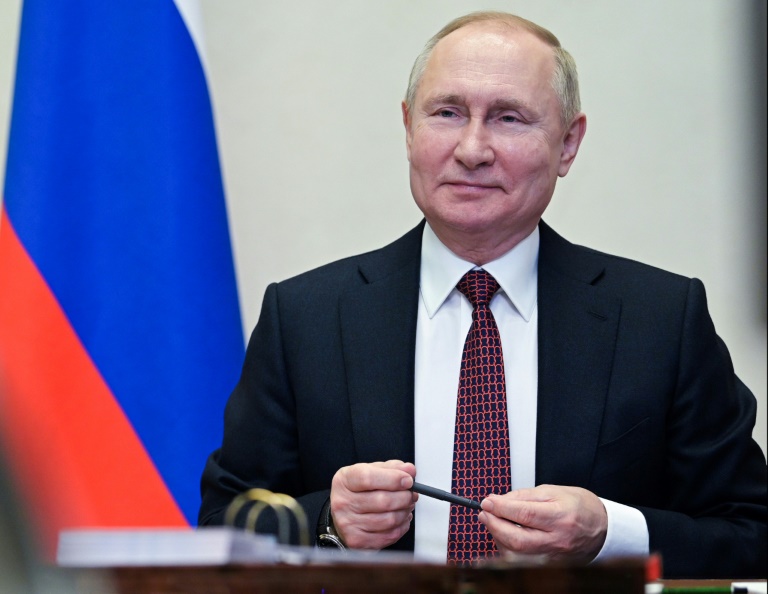
Russian President Vladimir Putin launched a full-scale invasion of Ukraine on Thursday, forcing residents to flee for their lives and leaving at least 40 Ukrainian soldiers and 10 civilians dead.

Russian air strikes hit military facilities across the country and ground forces moved in from the north, south and east, triggering condemnation from Western leaders and warnings of massive sanctions.

Weeks of intense diplomacy to avert war failed to deter Putin, who had massed more than 150,000 troops along the borders of Ukraine.

“I have decided to proceed with a special military operation,” Putin said in a television announcement in the early hours of Thursday.

Shortly afterwards, the first bombardments were heard in Ukraine’s capital, Kyiv, and several other cities, according to AFP correspondents.

“Putin has just launched a full-scale invasion of Ukraine. Peaceful Ukrainian cities are under strikes,” Ukrainian Foreign Minister Dmytro Kuleba tweeted.

President Volodymyr Zelensky declared martial law and said Russia was attacking his country’s “military infrastructure” but urged citizens not to panic and vowed victory.

The military said it had received orders from Zelensky to “inflict maximum losses against the aggressor”.

It said its forces had killed “around 50 Russian occupiers” while repulsing an attack on a town on the frontline with Moscow-backed rebels, a toll that could not be immediately confirmed by AFP.

– ‘Sounds of bombing’ –

Kyiv’s main international airport was hit in the first bombing of the city since World War II and air raid sirens sounded over the capital at the break of dawn.

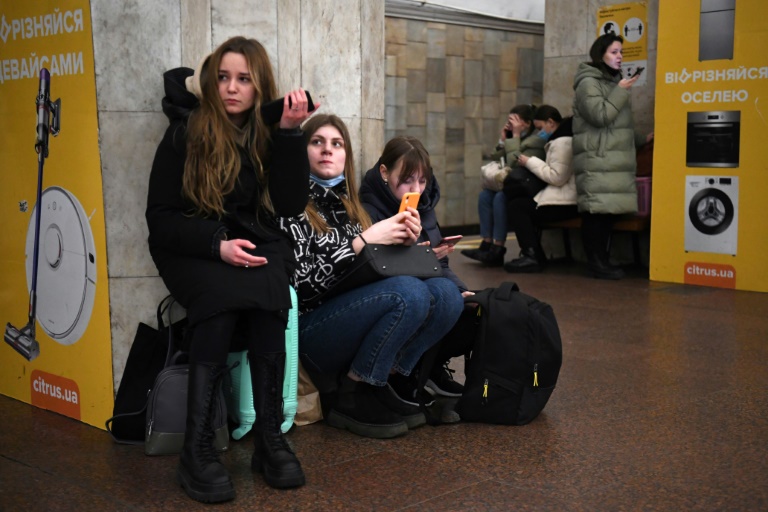
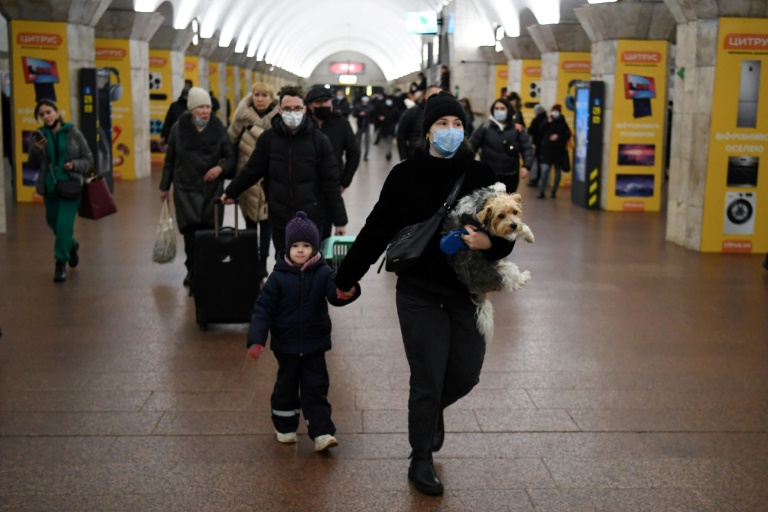
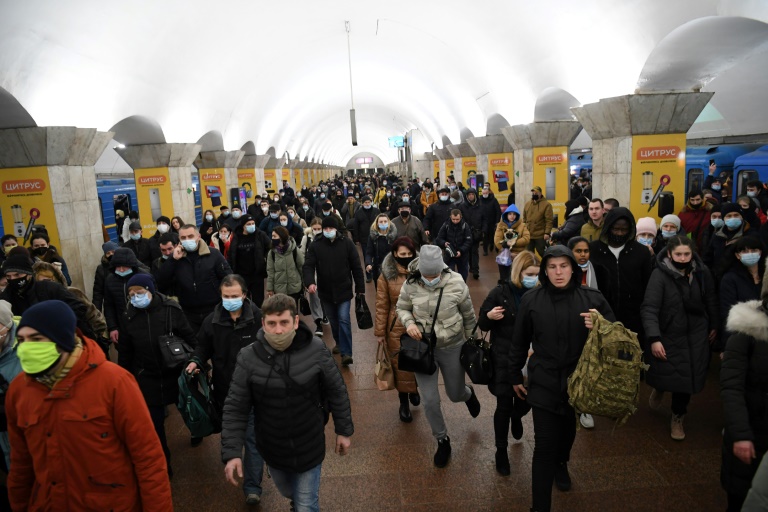
“I woke up because of the sounds of bombing. I packed a bag and tried to escape,” said Maria Kashkoska, as she sheltered inside the Kyiv metro station.

In the eastern Ukrainian town of Chuguiv, a son wept over the body of his father among the wreckage of a missile strike in a residential district.

“I told him to leave,” the man sobbed repeatedly, next to the twisted ruins of a car.

Kuleba said the worst-case scenario was playing out.

“This is a war of aggression. Ukraine will defend itself and will win. The world can and must stop Putin. The time to act is now,” he said.

Within a few hours of Putin’s speech, Russia’s defence ministry said it had neutralised Ukrainian military airbases and its air defence systems.

Ukraine said Russian tanks and heavy equipment crossed the border in several northern regions, in the east as well as from the Kremlin-annexed peninsula of Crimea in the south.

The Russian army said Moscow-backed separatists in the east had advanced by up to three kilometres (1.8 miles) into territory previously under government control.

The fighting roiled the global financial markets, with stocks plunging and oil prices soaring past $100.

The Russian ruble fell nine percent against the dollar after the attack and the Moscow Stock Exchange was down more than 25 percent.

– ‘Unprovoked and unjustified’ –

In his televised address, Putin justified the operation by claiming the government was overseeing a “genocide” in the east of the country.

The Kremlin had earlier said the leaders of two separatist territories in eastern Ukraine had asked Moscow for military help against Kyiv.

Putin recognised the independence of the self-proclaimed Donetsk and Lugansk republics on Monday.

US President Joe Biden spoke with Zelensky after the Russian operation began to vow US “support” and “assistance”.

Biden condemned the “unprovoked and unjustified attack by Russian military forces,” and vowed Russia would be held accountable.

“President Putin has chosen a premeditated war that will bring a catastrophic loss of life and human suffering,” he said in a statement.

Biden was due to join a virtual, closed-door meeting of G7 leaders — Britain, Canada, France, Germany, Italy, Japan and the United States — on Thursday, likely to result in more sanctions against Russia.

In Brussels, EU foreign policy chief Josep Borrell said Russia faced “unprecedented isolation” and would be hit with the “harshest sanctions” the EU has ever imposed.

The Russian invasion also rattled other countries in eastern Europe once dominated by Moscow.

NATO member Poland said it was invoking Article 4 of the NATO Treaty, calling for urgent consultations among leaders of the Western military alliance.

Lithuania joined Poland’s call and said it would impose a national state of emergency.

– Drop NATO ambitions –

Ukraine has around 200,000 military personnel, and could boost that with up to 250,000 reservists. 

Moscow’s total forces are much larger — around a million active-duty personnel — and have been modernised and re-armed in recent years.

But Ukraine has received advanced anti-tank weapons and some drones from NATO members. More have been promised as the allies try to deter a Russian attack or at least make it costly.

Russia has long demanded that Ukraine be forbidden from ever joining the NATO alliance and that US troops pull out from Eastern Europe. 

Putin this week set out a number of stringent conditions if the West wanted to de-escalate the crisis, saying Ukraine should drop its NATO ambition and become neutral.

“Putin’s aim is to end the existence of Ukraine,” said Tatyana Stanovaya, founder of the political consultancy R.Politik Center and a non-resident scholar at the Carnegie Moscow Center.

“It is possible that the east of Ukraine will come under Russian control,” she said, adding: “I cannot see anything that would stop Russia now”.

burs-dt/jbr/jv
Malawi polio immunisation starts next month after outbreak

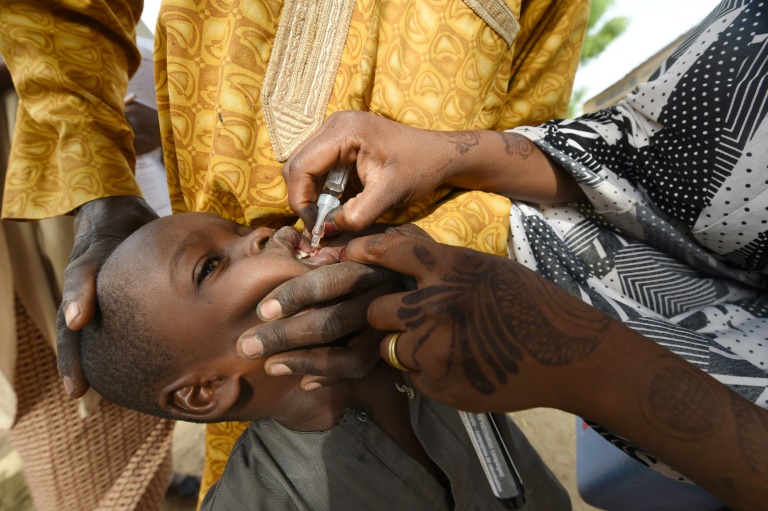
Malawi said Thursday it will launch a nationwide polio vaccination campaign next month following the detection of its first case in 30 years and Africa’s first in five years.

The southern African country announced the discovery of a wild poliovirus case a week ago in a four-year girl.

The child had not been fully immunised, according to the World Health Organization’s representative in Malawi, Janet Kayita.

Authorities are now rushing to inoculate nearly three million children aged under five years.

“The upcoming polio vaccination campaign in four weeks’ time… will target around 2.9 million children across the country,” Malawi’s health ministry director, Queen Dube, told AFP.

Malawi has placed an order of around 14 million doses of vaccines.

The vaccination is expected to extend beyond Malawi’s borders, targeting selected districts in neighbouring countries, she said.

Dube said an emergency meeting of international health regulators was due on Monday and may recommend mandatory vaccination for travellers to Malawi to help curb the spread of the virus.

UNICEF’s representative in Malawi, Rudolf Schwenk, on Tuesday described the outbreak “a very serious situation”.

“We have to collectively take quick action because it’s a national emergency,” he said at a news conference. 

President Lazarus Chakwera has declared a national health emergency.

Laboratory analysis showed that the detected strain is linked to one that has been circulating in Sindh Province in Pakistan. 

Dube said it was “difficult” to establish how the Malawian child became infected.

Polio, an acutely contagious virus which attacks the spinal cord and causes irreversible paralysis in children, remains endemic in Pakistan and its neighbour Afghanistan.

The disease can be prevented with a highly effective and very cheap vaccine.

Africa was declared free of indigenous wild polio in August 2020 after an exhaustive immunisation campaign.

No polio cases had occurred on the continent for the previous four years — the threshold for eradication.

Ukrainians in 'Moscow on the Med' look on in horror

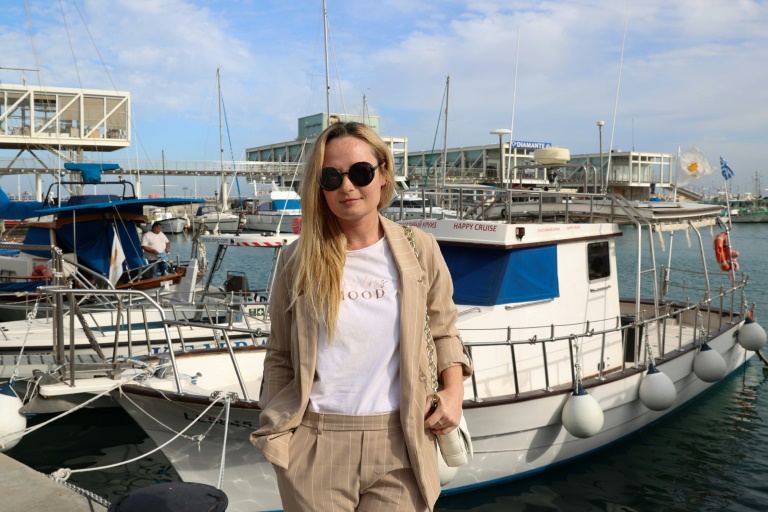
Ukrainians living alongside fellow expats from “brother” Russia in the Mediterranean seaside town of Limassol in Cyprus looked on in horror Thursday at the Russian assault on their homeland.

“This is the worst-case scenario we could have imagined. They are bombing all regions of Ukraine, attacking all our airports and bases,” said Evgeny Staroselskiy, a director of Russian Radio Cyprus based in Limassol.

He said nationals from both countries had awoken in shock to hear of the full-blown conflict unfolding between Ukraine and its giant neighbour.

“A lot of people have family on both sides of the border,” said the 60-year-old native of Kharkiv, a mainly Russian-speaking city in eastern Ukraine considered in the “red zone” because of its proximity to the border with Russia.

But Staroselskiy stressed the influence of Russian media on the attitude of citizens from their side, even in sunny Limassol, also known as “Limassolgrad” or “Moscow on the Med” as being home to tens of thousands of people from ex-Soviet republics as well as a favourite holiday destination.

“We are all brothers but we are now receiving telephone calls from some Russians who actually support this crazy (Russian President Vladimir) Putin. We are very surprised.”

A group of Russian bikers, clad in leather waistcoats with Moscow and Saint Petersburg emblazoned on the back, gathered at Limassol’s gleaming marina tried to play things down.

“This is all bullshit; it’s all politics,” said Grigori, declining to give a surname. “We are family.”

Ksenia Bordianou, a 36-year-old Ukrainian yacht stewardess whose mother’s family hails from Siberia, said she used to celebrate the Soviet Union’s February 23 “Defender of the Fatherland Day” holiday until Russia’s 2008 war in Georgia, a harbinger of its 2014 annexation of Crimea, seized from Ukraine.

“Talking to Russians, Crimea is the one issue we’ve never been able to agree on,” she said of the peninsula located some 1,000 kilometres (600 miles) due north of Cyprus.

For many ordinary Ukrainians, said Oksana, a mother from Kherson, a Russian-speaking city close to the Crimean Peninsula, “the biggest immediate concern” was rising food and utility prices as well as access to the banking system.

– Fallout fears –

As for Cyprus, whose economy is heavily dependent on tourism revenues, to which Russia and Ukraine are both major contributors, it fears the fallout from the crisis and the mounting sanctions being slapped on Moscow.

More than 780,000 Russian tourists visited Cyprus in 2019 before Covid struck, out of a total of some 3.9 million, making it the holiday island’s second largest market after Britain. Over 95,000 Ukrainian arrivals were registered in the same year.

Cyprus, an EU but non-NATO member, has since counted on tourists from both Russia and Ukraine for a revival.

Ethnically divided, Cyprus is a close friend of Russia, but Nicosia has defended Ukraine’s independence as the only EU country with occupation troops on its soil.

In response to Russia’s attack on Ukraine, Cypriot President Nicos Anastasiades, himself a native of Limassol, on Thursday condemned “any actions which violate the sovereignty and territorial integrity of an independent country”.

The eastern Mediterranean island has been split since 1974 when Turkish forces occupied its northern third in response to a military coup sponsored by the junta in power in Greece at the time.

Russian Radio’s CEO, Stanislav Andonov, a 58-year-old from Moscow, said relations on the island between Ukrainians and Russians had at least until Thursday been unaffected by the drums of war.

“I have not felt any friction and doubt there will be any,” he said.

Andonov said the “Defender of the Fatherland Day”, as previously celebrated across the Soviet Union to mark the 1918 foundation of the Red Army, was treated by Russian-speaking expats simply as a “men’s day”, equivalent to the March 8 International Women’s Day.

Staroselskiy’s wife, Yuliya, a DJ at Russian Radio, pointed out that many of the Russians living in Cyprus were “not supporters of Putin in any case”, lowering a source of tension with their Ukrainian fellow expats.

Vladimir Putin's long obsession with Ukraine

Russian President Vladimir Putin, who launched an invasion of Ukraine on Thursday, has long been obsessed with returning the country to Moscow’s fold, in the name of Russia’s greatness.

For many Russians of his generation, who were raised on Soviet propaganda, the USSR disintegrating and its spheres of influences vanishing remains an open wound.

For Putin, a KGB officer based in East Germany at the time the Soviet Union was gradually collapsing — between 1989 and 1991 — this was a personal defeat.

The Russian leader has said many times that he suffered the same misery as his compatriots when the Soviet empire crumbled, recently claiming he was forced to drive a taxi to make ends meet when he returned to his homeland.

For many Russians, the years after the Soviet collapse were marked by humiliation and poverty — a stark contrast to the West’s triumphalism and prosperity at the time.

Putin has claimed that the end of the Soviet Union was the “greatest geopolitical catastrophe of the 20th century” — despite Russia living through two world wars.

Putin’s rhetoric became more extreme in recent weeks, as between 150,000 and 200,000 Russian troops massed along the borders of Ukraine, prompting a broad diplomatic effort aimed at preventing an invasion.

In a speech on February 21, Putin baselessly accused Ukraine of seeking a nuclear weapon and called its government a “neo-Nazi” regime that bore responsibility for any further bloodshed.

– ‘Crossed over to the dark side’ – 

He recognised the independence of two separatist regions and authorised sending “peacekeepers” into the rebel provinces.

Tatiana Stanovaya, who runs the R.Politik analytical centre, predicted grim times ahead, saying that Putin had “crossed over to the dark side of history.”

On Thursday, Putin declared “I have made the decision of a military operation” in Ukraine, during a television address, and explosions were soon heard across the country, triggering swift international condemnation.

He justified the operation by accusing the Kyiv government of overseeing a “genocide” in the east of the country.

Observers say Putin’s sense for revenge over Ukraine deepened when NATO and the EU expanded into countries once dominated by Moscow.

For the long-time Russian leader, any attempts towards bringing Ukraine into Western alliances have represented a red line.

Putin has made it his historical mission to stop this advance in what he believes should be Russia’s region of influence.

In his vision, “if the authorities do not solve this security problem now, then Ukraine will be in NATO in 10-15 years”, according to analyst Alexei Makarkin.

When a pro-Western revolution took place in Kyiv in 2014, Moscow annexed Ukraine’s Crimean peninsula and pro-Russian separatists took up arms in the east of the country, in a conflict that cost more than 14,000 lives.

– Some ‘only understand force’ –


For the Kremlin chief, Russia must respond by being strong, menacing even. Giving in is not in the nature of the former KGB agent and judoka.

Born into a working-class Saint Petersburg family, Putin said in 2015 that “if a fight is inevitable, you must strike first.”

One of his teachers, Vera Gurevich, has said that when a 14-year-old Putin broke one of his classmate’s leg, the future president said that some “only understand force.”

He has repeatedly called into question the idea of distinct Ukrainian identity and statehood.

Putin claims that two Ukrainian revolutions — in 2005 and 2014 — that drove out pro-Russia elites were the result of a Western plot.

As far back as 2008, according to Russian and US media, Putin told his then US counterpart George W. Bush that “Ukraine is not even a country.”

During his end-of-year press conference in December, Putin again raised eyebrows by saying Ukraine was “created” by Vladimir Lenin, the founder of the Soviet Union.

Months earlier, in a long article called “On the historical unity of Russians and Ukrainians,” he said that Kyiv’s decisions are driven by a Western “anti-Russia” plot.

Analyst Stanovaya said that Putin has always believed that the Ukrainian people are themselves pro-Russians that have been “the subject of manipulation”.

She said that in the Kremlin’s “understanding, war would not be an attack on Ukraine, but a liberation of the Ukrainian people from a foreign occupier.”

The Kremlin has for years repeated its line that the West has taken advantage of Russia’s post-Soviet weakness to camp close by, betraying vague promises made in the twilight of the USSR.

What drives Putin, said Makarkin, “is the desire to stop time.”

Bloodshed and tears as eastern Ukraine faces Russian attack

A son wept over the body of his father among the wreckage of a missile strike in a residential district in the eastern Ukrainian town of Chuguiv as the country woke up Thursday to a Russian invasion.

“I told him to leave,” the man in his 30s sobbed, next to the twisted ruins of a car.

Nearby a woman screamed curses into the wintry sky. 

A missile crater, some four to five metres wide, was scoured into the earth between two devastated five-storey apartment buildings. Firefighters battled to extinguish the remains of a blaze. 

Several other buildings on the street were seriously damaged, their windows shattered and doorframe hanging in the frigid morning air. 

It was among the first reported damage after Russia launched an invasion of Ukraine early Thursday, with explosions heard in several locations across the country in the early morning hours. 

Sergiy, 67, tried to use the leg of an Ikea table to block up his smashed window. The leg stuck out into the air.  

He had received a few bruises but said he was fine. 

“I’m going to stay here, my daughter is in Kyiv and it’s the same there,” he told AFP. 

In Sergiy’s opinion, the missile has targeted the nearby military airfield, close to Ukraine’s second city Kharkiv and just some 40 kilometres (25 miles) from the Russian border. 

“It was one of the targets that Putin had cited, I’m not even surprised,” he said, refusing to give his surname.  

“We will hang in there.”

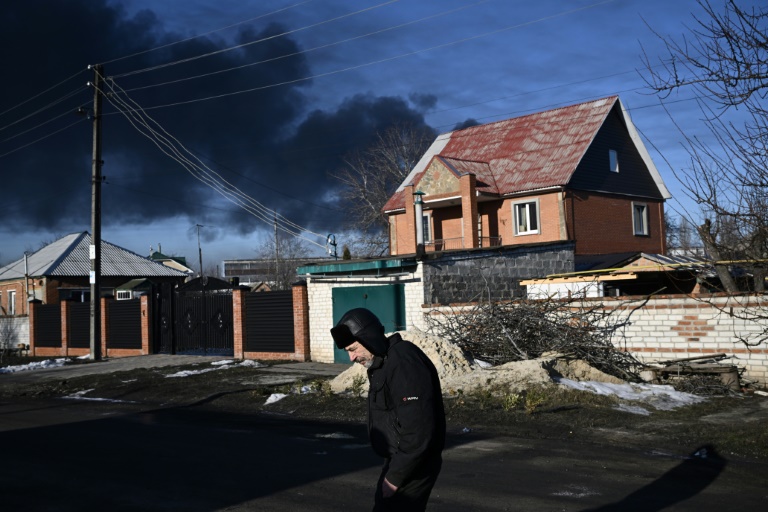
Thick black smoke could be seen billowing from the direction of the airfield — one of a raft of strategic locations across the country pounded by Moscow’s firepower in an opening barrage.

A policeman said the toll from the bombardment was still being “evaluated” without giving more details. 

Teenager Anastasia clutched her grey cat as she watched her grandfather in a wheelchair being loaded onto a minibus waiting to rush them to a nearby village. 

– ‘Hope the war will spare us’ –

“We could never have expected this. We’re going to the village, we hope the war will spare us there,” she said. 

Ukrainian military personnel and trucks swarmed around the town as the government in Kyiv insisted its forces would do all they could to protect Ukraine.

Across Ukraine’s vulnerable eastern front civilians and soldiers scrambled to react as one of the world’s most powerful militaries began what authorities warned was a “full-scale invasion”.  

Some 300 kilometres to the south in key port city of Mariupol — close to the frontline where Russia-backed separatists have been fighting Ukraine — authorities were rushing to evacuate civilians as fighting raged. 

Local official Alexiy Babchenko said they were starting to move people out of two areas to the nearest railway station — but the violence was too heavy to begin in another location.  

“It is under heavy artillery,” he told AFP. 

Yevgeny Kaplin, head of the humanitarian organisation Proliska, said attacks were going on across the entire frontline that had divided Ukrainian forces from an enclave held by Russian-backed rebels. 

But poor communications were hampering information coming about victims. 

“The offensive is underway along the entire demarcation line in the Lugansk and Donetsk regions,” he said. 

“Fighting is happening everywhere. We cannot yet receive information about victims, because there is no communication in this area.”

'Unprovoked and unjustified:' world reacts to attack on Ukraine

World leaders on Thursday swiftly condemned Russia’s military attack on Ukraine, with Western capitals vowing to escalate sanctions against Moscow while the head of the United Nations demanded the conflict end immediately.

Key reactions:

– US President Joe Biden – 

“The prayers of the entire world are with the people of Ukraine tonight as they suffer an unprovoked and unjustified attack by Russian military forces,” the US president said shortly after the operation began.

He warned “Russia alone is responsible for the death and destruction this attack will bring.”

“The world will hold Russia accountable,” he declared.

– UN chief Antonio Guterres – 

Guterres made a direct and personal plea to Russian President Vladimir Putin after an emergency Security Council session, urging him to stop the attack “in the name of humanity.”

“In the name of humanity, do not allow to start in Europe what could be the worst war since the beginning of the century,” he said.

“The conflict must stop now,” added the UN chief, who said it was the “saddest day” of his tenure.

– NATO head Jens Stoltenberg – 

The Atlantic alliance’s secretary general said Russia had “chosen the path of aggression against a sovereign and independent country.”

The attack “puts at risk countless civilian lives,” Stoltenberg said in a statement, describing it as a “grave breach of international law, and a serious threat to Euro-Atlantic security.”

NATO ambassadors were to hold an emergency meeting to discuss the attack.

– British Prime Minister Boris Johnson – 

“I am appalled by the horrific events in Ukraine and I have spoken to President (Volodymyr) Zelensky to discuss next steps,” the British leader tweeted.

“President Putin has chosen a path of bloodshed and destruction by launching this unprovoked attack on Ukraine. The UK and our allies will respond decisively.”

– EU chiefs – 

“In these dark hours, our thoughts are with Ukraine and the innocent women, men and children as they face this unprovoked attack and fear for their lives,” European Union chiefs Ursula von der Leyen and Charles Michel said on Twitter. “We will hold the Kremlin accountable.”

Foreign policy chief Josep Borrell said Russia faced “unprecedented isolation” and would be hit with the “harshest sanctions” the EU has ever imposed.

“This is not a question of blocs. This is not a question of diplomatic power games. It’s a matter of life and death. It is about the future of our global community,” he said.

– German Chancellor Olaf Scholz – 

The German leader lashed out at an “unscrupulous act” by Putin and spoke to Zelensky to express his country’s “full solidarity.”

Foreign Minister Annalena Baerbock warned the world “will not forget this day of shame.”

“This attack will have severe political and economic consequences for Russia,” Economy and Climate Minister Robert Habeck said.

– French President Emmanuel Macron – 

“Russia must immediately put an end to its military operations,” Macron wrote on Twitter, saying Russia had made the decision to “wage war” on Ukraine.

“France stands in solidarity with Ukraine. It stands by Ukrainians and is working with its partners and allies to end the war,” he added.

– Canadian Prime Minister Justin Trudeau – 

“These unprovoked actions are a clear further violation of Ukraine’s sovereignty and territorial integrity, and of Russia’s obligations under international law and the Charter of the UN,” Trudeau said in a statement.

He said he would meet with partners from the Group of Seven to shape a collective response, “including by imposing sanctions additional to those announced earlier this week.”

“These reckless and dangerous acts will not go unpunished.”

– OSCE – 

The Organization for Security and Co-operation in Europe (OSCE), of which Russia is a member, said “this attack on Ukraine puts the lives of millions of people at grave risk and is a gross breach of international law and Russia’s commitments.”

The statement was issued by the OSCE’s current chairman, Polish Foreign Minister Zbigniew Rau, and the organisation’s secretary general, Helga Maria Schmid.

– Ukraine’s UN ambassador – 

During the charged UN emergency meeting, the Ukraine’s ambassador Sergiy Kyslytsya implored the council, chaired by Russia to “do everything possible to stop the war”.

He demanded that Russia’s ambassador relinquish his duties as chair.

“There is no purgatory for war criminals. They go straight to hell, ambassador,” the visibly emotional Kyslytsya said.

– China –

The world’s second-biggest economy, which shares a long border with Russia, said it was monitoring the crisis and urged restraint.

“China is closely watching the latest situation, and we call on all parties to maintain restraint and prevent the situation from getting out of control,” foreign ministry spokeswoman Hua Chunying said at a regular press briefing.

– Japanese Prime Minister Fumio Kishida – 

“The latest Russian invasion shakes the foundation of the international order, which does not permit unilateral attempts to change the status quo,” Japan’s leader said after a meeting of his national security council.

burs-sah/ri

Ukrainians wake up to sounds of bombings as war hits home

Frightened Ukrainians took to subway stations on Thursday as air raid sirens rang out across the country’s main cities following Russia’s launch of its feared military attack.

Ksenya Michenka looked deeply shaken as she took cover with her teenage son — their cat peeking out of a bag — in a metro station off Kyiv’s historic Maidan Square.

The expansive square was the focal point off two pro-Western revolutions that Russian President Vladimir Putin tried to reverse in 2004 and 2014.

But the former Soviet republic continued pulling away from Russia and building ties with the West.

Putin responded on Thursday by doing what many thought unimaginable — launching an all-out air and ground assault on Ukraine.

Michenka said she ran to the subway station for cover “because Russia has started a war against Ukraine.”

“We need to save our lives,” she said in a tense voice. “We hope the metro can save us because it is underground.”

Many in the city of three million people woke up to a series of terrifying booms echoing somewhere in the distance in the deep of night.

“I woke up because of the sounds of bombing,” said 29-year-old Maria Kashkoska as she sat on the subway station’s floor.

Ukrainian defence officials later said that Kyiv’s main international airport had come under a Russian bombing attack.

“I packed a bag and tried to escape. We are sitting here, waiting,” she said after packing her charger and a few essentials.

The booms were followed a few hours later by air raid sirens that sounded over Kyiv at the break of dawn.

A police car drove down Kyiv’s main Khreshchyatyk Avenue urging everyone to remain calm and take shelter.

Queues formed outside currency exchanges as well as petrol stations.

AFP reporters saw people carrying suitcases to bus and train stations in an effort to get out of Kyiv and move further west.

– ‘Remain calm’ –

But nowhere seemed completely safe.

Air raids sounded over the western city of Lviv — the new diplomatic home of US and European officials who fled Kyiv — and the sounds of exploding bombs echoed across the northern city of Kharkiv.

Kharkiv rests just 35 kilometres (20 miles) south of the Russian border and once served as the capital of Ukraine when its was still part of the Soviet state.

Russian-backed insurgents tried but failed to seize the city of 1.4 million people when they launched their deadly insurgency in 2014.

“I once again call on the people of Kharkiv to stay at home and to remain as calm as possible,” mayor Igor Terekhov said.

But the most frightening explosions and heaviest fighting was ringing out across the scattering of impoverished towns that hug Ukraine’s frontline with Russian-backed rebels in the east.

An AFP team in the eastern town of Chuguiv saw a man crying over a body stretched out on the ground.

Firefighters tried to extinguishes the flames of a house burning after an apparent attack.

“If they continue to bomb us, I will find weapons and defend my homeland,” said 62-year-old Vladimir Levichov.

Israeli strikes kill six near Damascus: monitor

At least six pro-government fighters, including Syrian troops, were killed in Israeli air strikes Thursday targeting positions held by Iran-backed groups near the capital Damascus, a war monitor reported.

It is the fourth time this month that Israeli strikes have been reported inside Syria, keeping up a campaign against pro-Iranian forces supporting the Damascus government in the more than decade-old civil war.

“Israeli strikes killed six people, including two Syrian troops and four Iran-backed militia fighters whose nationalities remain unknown,” the Syrian Observatory for Human Rights said.

The Britain-based monitor, which has an extensive network of sources across the country, said the raids “targeted positions and arm depots” operated by Iran-backed groups near Damascus airport, destroying several weapon caches. 

The strikes also targeted air defences south of Damascus, said the Observatory, which did not elaborate on any damage. 

Syrian state media said the attack came at around 1:10 am (2310 GMT Wednesday). 

The official SANA news agency said air defences intercepted most of the missiles but three soldiers were killed.

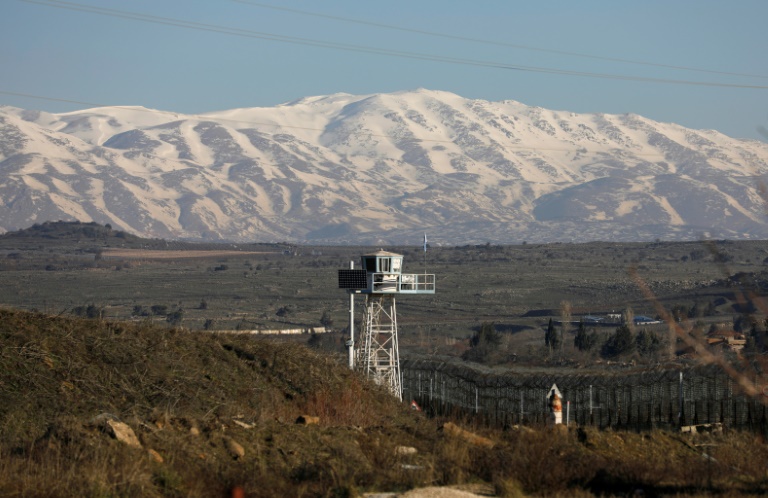
The latest raids follow Israel’s bombardment this week of a Syrian town near the armistice line on the Golan Heights, and strikes on a Syrian military post on February 17, and on anti-aircraft batteries at the start of the month.

The Observatory said Israel has carried out raids in Syria at least six times since the start of the year. 

Asked about the latest strikes, an Israeli army spokesman said: “We don’t comment on reports in foreign media”.

– Shadow war –

Since civil war broke out in Syria in 2011, Israel has carried out hundreds of air strikes inside the country, targeting government positions as well as allied Iran-backed forces and fighters of the Shiite militant movement Hezbollah.

While Israel rarely comments on individual strikes in Syria, it has acknowledged mounting hundreds since 2011.

According to the Israeli military, it hit around 50 targets inside Syria in 2020.

Last year, Israel hit Syria roughly 30 times, killing 130 people — five civilians and 125 loyalist fighters, according to Observatory figures.

In December, it carried out a strike targeting an Iranian arms shipment in Latakia — in the heartland of President Bashar al-Assad’s minority Alawite community — its first on the port since the start of the civil war.

The Israeli military has defended the strikes as a necessary measure to prevent its arch-foe Iran from gaining a foothold on its doorstep.

Israel’s head of military intelligence, Major General Aharon Haliva, has accused Iran of “continuing to promote subversion and terror” in the Middle East.

In a shadow war, Israel has targeted suspected Iranian military facilities in Syria and mounted a sabotage campaign against Iran’s nuclear programme.

Iran has been a key supporter of the Syrian government in the decade-old conflict.

It finances, arms and commands a number of Syrian and foreign militia groups fighting alongside the regular armed forces, chief among them Hezbollah.

The conflict in Syria has killed nearly 500,000 people since it started in 2011 with the brutal repression of peaceful demonstrations.

'Unprovoked and unjustified:' world reacts to attack on Ukraine

World leaders on Thursday swiftly condemned Russia’s military attack on Ukraine, with Western capitals vowing to escalate sanctions against Moscow while the head of the United Nations demanded the conflict end immediately.

Key reactions:

– US President Joe Biden – 

“The prayers of the entire world are with the people of Ukraine tonight as they suffer an unprovoked and unjustified attack by Russian military forces,” the US president said shortly after the operation began.

He warned “Russia alone is responsible for the death and destruction this attack will bring.”

“The world will hold Russia accountable,” he declared.

– UN chief Antonio Guterres – 

Guterres made a direct and personal plea to Russian President Vladimir Putin after an emergency Security Council session, urging him to stop the attack “in the name of humanity.”

“In the name of humanity, do not allow to start in Europe what could be the worst war since the beginning of the century,” he said.

“The conflict must stop now,” added the UN chief, who said it was the “saddest day” of his tenure.

– NATO head Jens Stoltenberg – 

The Atlantic alliance’s secretary general said Russia had “chosen the path of aggression against a sovereign and independent country.”

The attack “puts at risk countless civilian lives,” Stoltenberg said in a statement, describing it as a “grave breach of international law, and a serious threat to Euro-Atlantic security.”

NATO ambassadors are to hold an emergency meeting on Thursday morning European time to discuss the attack.

– British Prime Minister Boris Johnson – 

“I am appalled by the horrific events in Ukraine and I have spoken to President (Volodymyr) Zelensky to discuss next steps,” the British leader tweeted.

“President Putin has chosen a path of bloodshed and destruction by launching this unprovoked attack on Ukraine. The UK and our allies will respond decisively.”

– EU chiefs – 

“In these dark hours, our thoughts are with Ukraine and the innocent women, men and children as they face this unprovoked attack and fear for their lives,” EU chiefs Ursula von der Leyen and Charles Michel said on Twitter.

“We will hold the Kremlin accountable.”

– German Chancellor Olaf Scholz – 

The German leader lashed out at an “unscrupulous act” by Putin and spoke to Zelensky to express his country’s “full solidarity.”

Foreign Minister Annalena Baerbock warned the world “will not forget this day of shame.”

“This attack will have severe political and economic consequences for Russia,” Economy and Climate Minister Robert Habeck said.

– French President Emmanuel Macron – 

“Russia must immediately put an end to its military operations,” Macron wrote on Twitter, saying Russia had made the decision to “wage war” on Ukraine.

“France stands in solidarity with Ukraine. It stands by Ukrainians and is working with its partners and allies to end the war,” he added.

– Canadian Prime Minister Justin Trudeau – 

“These unprovoked actions are a clear further violation of Ukraine’s sovereignty and territorial integrity, and of Russia’s obligations under international law and the Charter of the UN,” Trudeau said in a statement.

He said he would meet with partners from the Group of Seven to shape a collective response, “including by imposing sanctions additional to those announced earlier this week.”

“These reckless and dangerous acts will not go unpunished.”

– Japanese Prime Minister Fumio Kishida – 

“The latest Russian invasion shakes the foundation of the international order, which does not permit unilateral attempts to change the status quo,” Japan’s leader said after a meeting of his national security council.

– OSCE – 

The Organization for Security and Co-operation in Europe (OSCE), of which Russia is a member, said “this attack on Ukraine puts the lives of millions of people at grave risk and is a gross breach of international law and Russia’s commitments.”

The statement was issued by the OSCE’s current chairman, Polish Foreign Minister Zbigniew Rau, and the organisation’s secretary general, Helga Maria Schmid.

– Ukraine’s UN ambassador – 

During the charged UN emergency meeting, the Ukraine’s ambassador Sergiy Kyslytsya implored the council, chaired by Russia to “do everything possible to stop the war”.

He demanded that Russia’s ambassador relinquish his duties as chair.

“There is no purgatory for war criminals. They go straight to hell, ambassador,” the visibly emotional Kyslytsya said.

burs-sah/ri

Russia's Putin launches 'military operation' in Ukraine

Russian President Vladimir Putin launched a military operation in Ukraine on Thursday with explosions heard across the country and its foreign minister warning a “full-scale invasion” was underway.

Weeks of intense diplomacy and the imposition of Western sanctions on Russia failed to deter Putin, who had massed between 150,000 and 200,000 troops along the borders of Ukraine.

“I have made the decision of a military operation,” Putin said in a surprise television announcement that triggered immediate condemnation from US President Joe Biden and other Western leaders, and sent global financial markets into turmoil.

Shortly after the announcement, explosions were heard in Ukraine’s capital, Kyiv, and several other cities, according to AFP correspondents.

Ukrainian border guards reported being under attack along the Russian and Belarusian frontiers.

Ukraine’s President Volodymyr Zelensky declared martial law and said Russia was attacking his country’s “military infrastructure”, but urged citizens not to panic and vowed victory.

His foreign minister said the worst-case scenario was playing out.

“Putin has just launched a full-scale invasion of Ukraine. Peaceful Ukrainian cities are under strikes,” Dmytro Kuleba tweeted.

“This is a war of aggression. Ukraine will defend itself and will win. The world can and must stop Putin. The time to act is now.”

Within a few hours of Putin’s speech, Russia’s defence ministry said it had neutralised Ukrainian military airbases and its air defence systems.

In his televised address, Putin justified the operation by claiming the government was overseeing a “genocide” in the east of the country.

The Kremlin had earlier said rebel leaders in eastern Ukraine had asked Moscow for military help against Kyiv. 

Biden, who had for weeks sought to lead a Western alliance to deter Putin from invading Ukraine, spoke with Zelensky after the Russian operation began to vow US “support” and “assistance”.

Biden condemned the “unprovoked and unjustified attack by Russian military forces,” and urged world leaders to speak out against Putin’s “flagrant aggression”.

He also vowed Russia would be held accountable.

“President Putin has chosen a premeditated war that will bring a catastrophic loss of life and human suffering,” he said in a statement.

“Russia alone is responsible for the death and destruction this attack will bring, and the United States and its allies and partners will respond in a united and decisive way.

Biden was due to join a virtual, closed-door meeting of G7 leaders — Britain, Canada, France, Germany, Italy, Japan and the United States — on Thursday. 

The G7 meeting is likely to result in more sanctions against Russia, which had long claimed it would not invade Ukraine, despite massing troops on the country’s borders.

– ‘Aggression’ –

An excuse for the military operation was given on Wednesday when the Kremlin said the separatist leaders of Donetsk and Lugansk had sent separate letters to Putin, asking him to “help them repel Ukraine’s aggression”. 

Their reported appeals came after Putin recognised their independence and signed friendship treaties with them that include defence deals.

The United Nations Security Council had met late Wednesday for its second emergency session in three days over the crisis, with a personal plea there by UN Secretary-General Antonio Guterres coinciding with Putin’s announcement.

“President Putin, in the name of humanity, bring your troops back to Russia,” Guterres said.

“In the name of humanity, do not allow to start in Europe what could be the worst war since the beginning of the century.”

The US ambassador to the United Nations, Linda Thomas-Greenfield, warned that an all-out Russian invasion could displace five million people, triggering a new European refugee crisis.

– Living in fear –

Western nations said ahead of Thursday’s operation Russia had amassed 150,000 troops in combat formations on Ukraine’s borders with Russia, Belarus and Russian-occupied Crimea and on warships in the Black Sea.

Ukraine has around 200,000 military personnel, and could boost that with up to 250,000 reservists. 

Moscow’s total forces are much larger — around a million active-duty personnel — and have been modernised and re-armed in recent years.

But Ukraine has received advanced anti-tank weapons and some drones from NATO members. More have been promised as the allies try to deter a Russian attack or at least make it costly.

Shelling had intensified in recent days between Ukrainian forces and Russia-backed separatists — a Ukrainian soldier was killed on Wednesday, the sixth in four days — and civilians living near the front were fearful.

Dmitry Maksimenko, a 27-year-old coal miner from government-held Krasnogorivka, told AFP that he was shocked when his wife came to tell him that Putin had recognised the two Russian-backed separatist enclaves.

“She said: ‘Have you heard the news?’. How could I have known? There’s no electricity, never mind internet. I don’t know what is going to happen next, but to be honest, I’m afraid,” he said.

Russia has long demanded that Ukraine be forbidden from ever joining the NATO alliance and that US troops pull out from Eastern Europe. 

Speaking to journalists, Putin on Tuesday set out a number of stringent conditions if the West wanted to de-escalate the crisis, saying Ukraine should drop its NATO ambition and become neutral.

Washington Wednesday announced sanctions on the Nord Stream 2 gas pipeline, which Germany had earlier effectively suspended by halting certification.

burs-kma/jfx

Close Bitnami banner
Bitnami