World

No bull: New Zealand bovine rides raging floodwaters

A New Zealand bull has been hailed a “legend” after it was swept along a flooded river and survived going over a waterfall before being dumped 80 kilometres (50 miles) downstream.

South Island farmer Tony Peacock said the 18-month-old bull was one of three washed away earlier this month when the West Coast region experienced its worst flooding in almost 80 years.

“We had a massive dump of water that we weren’t expecting and just got caught out by not having stock on higher ground,” he told AFP.

“It was daylight by the time I realised how bad it was and by that stage they were gone. I never thought I’d see any of them again.”

But a week later, Peacock received a call saying one of his bulls had been found on the riverbank at Westport, about 80 kilometres away.

“It was a big surprise, as you can imagine,” he said, noting the bull survived a 10-metre drop at the Maruia Falls during its watery adventure.

He said the Hereford breed bull, which was identified by an ear tag, is being transported back to the farm and would be retired after returning home.

“We’ll be keeping him, he’s become a local legend now,” he said.

“He’s more famous than anything else we’ve produced.”

Peacock said the local school is now holding a competition to find a suitable name for the celebrity heavyweight.

No bull: New Zealand bovine rides raging floodwaters

A New Zealand bull has been hailed a “legend” after it was swept along a flooded river and survived going over a waterfall before being dumped 80 kilometres (50 miles) downstream.

South Island farmer Tony Peacock said the 18-month-old bull was one of three washed away earlier this month when the West Coast region experienced its worst flooding in almost 80 years.

“We had a massive dump of water that we weren’t expecting and just got caught out by not having stock on higher ground,” he told AFP.

“It was daylight by the time I realised how bad it was and by that stage they were gone. I never thought I’d see any of them again.”

But a week later, Peacock received a call saying one of his bulls had been found on the riverbank at Westport, about 80 kilometres away.

“It was a big surprise, as you can imagine,” he said, noting the bull survived a 10-metre drop at the Maruia Falls during its watery adventure.

He said the Hereford breed bull, which was identified by an ear tag, is being transported back to the farm and would be retired after returning home.

“We’ll be keeping him, he’s become a local legend now,” he said.

“He’s more famous than anything else we’ve produced.”

Peacock said the local school is now holding a competition to find a suitable name for the celebrity heavyweight.

Israel's president heads to Greece to calm ally ahead of Turkey visit

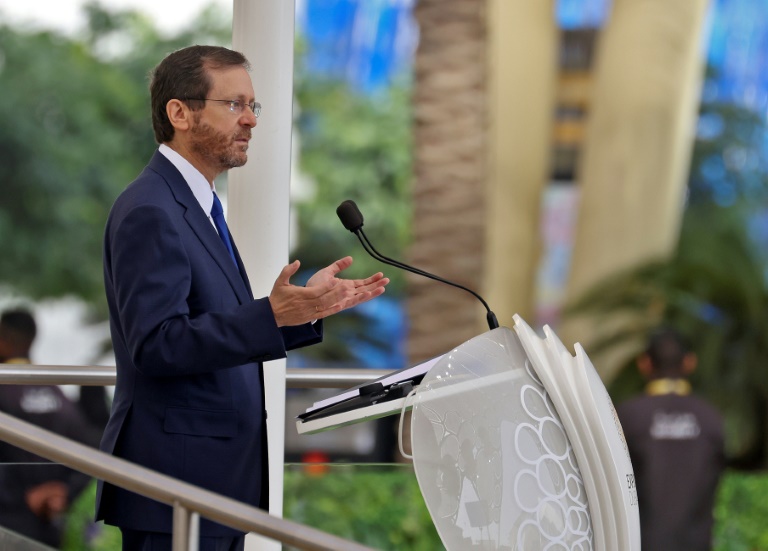
Israel’s President Isaac Herzog headed to Greece Thursday for a trip experts said marked a chance to reassure an ally as Israel moves closer to Turkey, with tensions fraught between Athens and Ankara.

Herzog holds a largely ceremonial post but has assumed a high-profile diplomatic role under the Israeli government that took office last year. 

He is expected to make a rare visit to Turkey next month for talks with President Recep Tayyip Erdogan, a prominent critic of Israel’s policies towards the Palestinians. 

But experts said that any Israeli rapprochement with Turkey cannot undermine the Jewish state’s ironclad ties with its Mediterranean neighbours, Greece and Cyprus, two states with long-standing acrimony towards Erdogan’s Turkey. 

On his one-day trip, the Israeli president is due to meet his counterpart Katerina Sakellaropoulou, Prime Minister Kyriakos Mitsotakis, as well as opposition leader and ex-premier Alexis Tsipras. 

Oded Eran, a senior researcher at the Tel Aviv university’s Institute for National Security Studies, told AFP that while in Athens Herzog must stress that “the attempt to improve relations with Turkey will absolutely not come at the expense of ties with Greece.”

Herzog should underscore that Israel wants to “enhance the eastern Mediterranean cooperation,” with Cyprus and Greece, added Eran, Israel’s former ambassador to the European Union. The president is also due to visit Cyprus next week. 

Relations between majority-Muslim Turkey and the Jewish state froze over after the death of 10 civilians in an Israeli raid on a Turkish flotilla carrying aid for the Gaza strip in 2010. 

Relations between Israel and Greece have meanwhile deepened over the past decade. 

In 2019, Cyprus, Greece, Egypt, Israel, Jordan, Italy and the Palestinian territories agreed to create the “East Mediterranean Gas Forum” — without Turkey.

And in 2020, Israel, Greece and Cyprus signed the EastMed deal for a huge pipeline to ship gas from the eastern Mediterranean to Europe, triggering objections from Ankara.

Eran also noted that Israeli jets that used to conduct drills over Turkey up to 2010 were training in Greek airspace.

An Israeli official who requested anonymity told AFP that “the improvement in the ties with Turkey is not coming at the expense of the very important relations with Greece and Cyprus.”

Biden says 'world will hold Russia accountable' over Ukraine attack

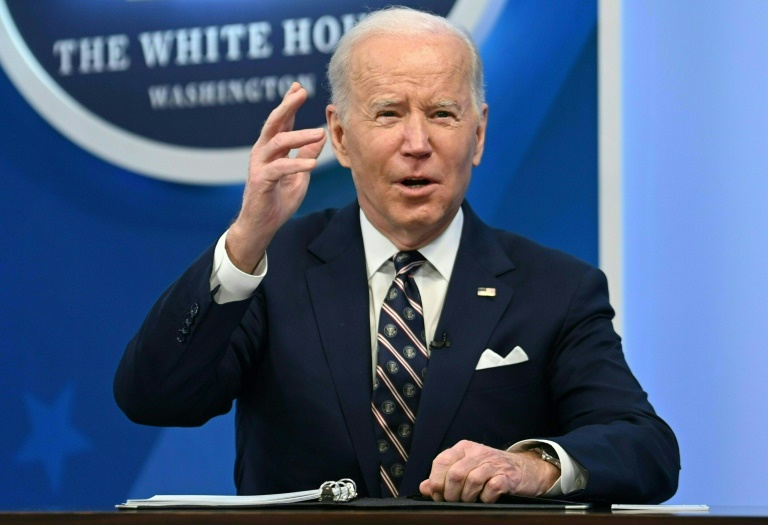
US President Joe Biden on Wednesday said the “world will hold Russia accountable” over a military onslaught against Ukraine that he warned will cause “catastrophic loss of life.”

In a statement issued shortly after Russian President Vladimir Putin announced the start of military operations in Ukraine, Biden said he would address the US public Thursday to outline the “consequences” for Russia, calling the attack “unprovoked and unjustified.”

Biden also held a phone call with his Ukrainian counterpart Volodymyr Zelensky soon after explosions were heard in multiple parts of the country, which is sandwiched between Russia and NATO member Poland.

“We will continue to provide support and assistance to Ukraine and the Ukrainian people,” Biden said in a statement after the call, adding that Zelensky had requested him to “call on the leaders of the world to speak out clearly” against Putin’s “flagrant aggression.”

The US Secretaries of State and Defense also spoke with NATO chief Jens Stoltenberg to condemn the “unprovoked, and unjustified attack on Ukraine,” the State Department said.

President Biden was due to join a virtual, closed-door meeting of G7 leaders — Britain, Canada, France, Germany, Italy, Japan and the United States — at 9:00 am (1400 GMT) Thursday. The White House said his remarks to the nation would come in the early afternoon in Washington.

The G7 meeting is likely to result in more sanctions against Russia, which has long claimed it would not invade Ukraine, despite putting a huge force of tens of thousands of soldiers and heavy weaponry on the country’s borders, while insisting that the Ukrainian government abandon its pro-Western ambitions.

Putin’s speech delivered in the early hours of Thursday announced a “special military operation.” Shortly after, explosions were reported across Ukraine, including in the capital Kyiv.

On Tuesday, the US government joined European allies in imposing sanctions on two Russian banks, Moscow’s sovereign debt, several oligarchs and other measures.

And on Wednesday, Biden announced he was imposing sanctions on the Nord Stream 2 natural gas pipeline from Russia to Germany — one of energy-rich Moscow’s highest-profile energy and geopolitical projects. Germany had earlier announced it would block the pipeline from opening for deliveries.

US officials have repeatedly warned that any escalation by Russia in Ukraine — which has now occurred — will be met with even tougher sanctions, targeting bigger banks, more oligarchs and a halt to exports of high-tech equipment. 

A White House spokesman said “President Biden will deliver remarks announcing the further consequences the United States and our allies and partners will impose on Russia.”

– ‘Death and destruction’ –

In reactions soon after the Russian attacks began, US senators from both parties indicated support for a tough response.

“Tonight, the entire post-World War international order sits on a knife edge. If Putin does not pay a devastating price for this transgression, then our own security will soon be at risk,” Democratic Senator Chris Murphy said.

Another Democrat, Senator Mark Warner, said “President Biden has already imposed an initial tranche of sanctions, and it is now time for us to up the pain level for the Russian government.”

Russians “will pay a steep cost for Putin’s reckless ambition, in blood and in economic harm,” he said.

Republican Senator Mitt Romney warned against “the peril of again looking away from Putin’s tyranny” and urging “the harshest economic penalties” and “expelling them from global institutions.”

In his statement, Biden said “the prayers of the entire world are with the people of Ukraine tonight as they suffer an unprovoked and unjustified attack by Russian military forces. President Putin has chosen a premeditated war that will bring a catastrophic loss of life and human suffering.”

“Russia alone is responsible for the death and destruction this attack will bring, and the United States and its allies and partners will respond in a united and decisive way. The world will hold Russia accountable,” Biden said.

Scrounging for food in 'hunger hotspot' Colombia

While the Colombian government fumes over being listed as a “hunger hotspot” by UN agencies, Heidy Garzon — a single mother of nine — worries where her family’s next meal will come from.

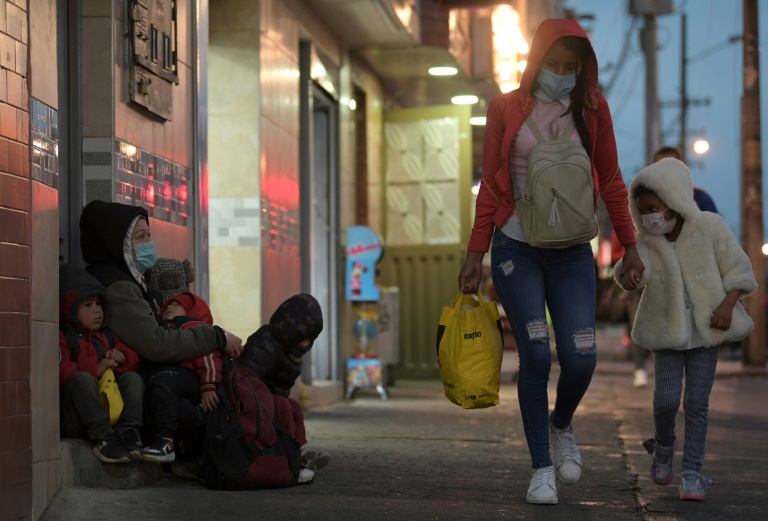
“We don’t know what we’re going to eat tonight,” Garzon told AFP in a shantytown neighborhood of Ciudad Bolivar in the south of Bogota, two toddlers in diapers clinging to her legs.

Garzon, 38, and her kids live in a ramshackle shanty with six beds to a single clay-floored room in the poorest, most violent part of Ciudad Bolivar.

Most days, they are lucky to eat two meals a day.

On the day AFP visited, the family of 10 breakfasted on a few eggs, some chocolate and corn patties called arepas. They also shared a mango given to them by a shopkeeper.

“Hunger is terrible,” Garzon said, adding it is “terrible to feel hungry and not be able to do anything” about it.

Last month, a report by the UN’s Food and Agriculture Organization and the World Food Programme stated that “7.3 million Colombians are food insecure and in need of food assistance in 2022.”

The list of 20 “hunger hotspots” also included Afghanistan, Ethiopia, Haiti, Somalia, South Sudan and Yemen.

In Colombia, the UN agencies blamed “a combination of political instability, economic challenges and the ongoing impact of the regional migratory crisis amplified by internal displacement.”

Colombia took umbrage at its inclusion on the list, for which it said there was a lack of “factual support, methodological definition and clarity.” The government in Bogota demanded that the “hunger hotspot” designation be removed.

– Begging, the last resort –

Garzon, who said she was not aware of the diplomatic debacle, claimed not to have received any government help since coronavirus handouts stopped a few months ago.

She lives off odd jobs as a cleaner of homes or at construction sites, earning about 20,000 pesos (five dollars ) a day, from which she has to subtract her transportation fees.

None of her children go to school. There is not enough money for that.

Oftentimes, begging is the family’s only hope.

“Sometimes we are given something, sometimes not… so we return home hungry.

“It is hard to get up every day and say: ‘Well, what are we going to eat today?’ (…) Sometimes I feel powerless, not having anything and hearing the children saying they are hungry,” said Garzon, fighting back tears.

According to the Colombian Association of Food Banks (ABACO), about 21 million of Colombia’s 50 million inhabitants live in poverty, with a monthly income of less than 331,000 pesos (about $84).

This is not enough to buy even half a basic basket of food essentials.

Some 16 million people eat only two meals a day, and about five million — including half a million children — suffer chronic malnutrition.

– ‘Whole country is affected’ –

The government of President Ivan Duque points to social programs that benefited 10.3 million households during the peak of the pandemic, as well as plans to boost food production and basic incomes.

It insists it has “done everything (possible) to ensure that no one suffers from hunger in Colombia.”

For Garzon and others, it is not enough.

Despite economic growth of more than 10 percent last year, the peso lost 16 percent of its value against the US dollar in 2021, and food inflation is biting hard.

In one year, the price of chicken and fruit increased by more than 25 percent, that of potatoes more than doubled and oil costs almost 50 percent more.

“The reality is that for many people today, eating three times a day is a luxury,” said Daniel Saldarriaga Molina, who heads the Bogota food bank agency.

“The whole country is affected. It is not just a problem of areas that are remote, isolated or impacted by violence… It is close to us, in the big cities, here in Bogota,” he said.

Battle over future of spytech firm NSO: Israel court papers

A court fight within Israeli spytech firm NSO Group has shed new light on the crisis engulfing the company, including tensions over whether to keep selling malware to autocrats to stay afloat.

NSO was already mired in debt before an investigation revealed last year that its Pegasus phone-hacking software had been used to spy on hundreds of journalists, dissidents and activists worldwide.

Now the surveillance tech giant is teetering, especially after being banned by the United States.

AFP has reviewed hundreds of pages of court documents from a dispute involving NSO, its creditors and the Berkeley Research Group (BRG), majority shareholders of NSO’s parent company.  

The documents suggest creditors have sought to push NSO, based in the Tel Aviv suburb of Herzliya, to continue selling Pegasus to “elevated risk” countries with questionable human rights records, in order to maintain revenues.

But Berkeley Research has demanded a halt to suspect sales without more internal reviews, citing an “absolute need for [NSO] to address the underlying issues” that saw it blacklisted.

The tensions surfaced in a Tel Aviv court case where BRG is seeking to force the spinoff of three subsidiaries, including a maker of anti-drone equipment, arguing the smaller companies risk being brought down by the Pegasus scandal.

The legal battle lines unveil a broader fight over the company’s future, with implications for the global cyber-surveillance industry. 

“NSO is a flagship company. They are sort of the case study right now,” Danna Ingleton, deputy director of Amnesty Tech, told AFP.

What happens to NSO, she said, could signal a “seismic shift in the regulation of this industry”.

– ‘Shut down’? –

Pegasus can remotely switch on a mobile phone’s camera and microphone and suck up data. 

The company says the software has helped security forces in many countries thwart crime and stop attacks. 

NSO has not identified its customers, but reporting has revealed Pegasus was used by several states with poor democratic credentials and histories of suppressing dissent. 

In a letter released with court documents, lawyers for NSO’s creditors charge that BRG’s approach “foreclosed the Company from accepting any new customers”. 

A source familiar with NSO said BRG wanted the company “to shut down, or to stop some of the activities that we have with customers”.

“We said we have legal obligations that we cannot do it unless they misuse the system,” the source told AFP, requesting anonymity. 

BRG’s lawyers countered that “since the Pegasus Project disclosures the only new potential customer bookings” for Pegasus are from “elevated risk customers”.

A source from BRG’s legal team told AFP it opposed those sales. 

“If they want to sell the system to democratic countries, I don’t think somebody will block them,” the source said also requesting anonymity.  


– Staggering debt –

NSO was reportedly valued at $1 billion in 2019, when co-founders Shalev Hulio and Omri Lavie announced they acquired the firm from California-based Francisco Partners, with backing from London-based Novalpina Capital. 

To fund the acquisition, Novalpina borrowed $500 million and placed the debt in a holding company above NSO.

It stood out among tech companies who usually rely on investment banks or investors, said Israeli tech attorney Dan Or-Hof, of the Privacy Protection Council advising the justice ministry. 

“Taking $500 million worth of loans, I would say, would be an irregular event for a tech company here in Israel,” he said.

The debt was staggering, but so were NSO’s revenues, estimated at $250 million in 2018. However, fortunes turned fast. 

Since the Pegasus Project revelations emerged in July, the US banned NSO, saying it enabled foreign governments to “maliciously target” people. 

Ratings agency Moody’s downgraded NSO, citing low revenues and a risk that new sales “can become increasingly difficult given the actions taken against NSO”.

Apple sued the company for targeting its users, following a similar suit by Meta’s WhatsApp.

Novalpina’s investors, who hold 70 percent of the shares of NSO’s parent company, appointed BRG Asset Management to take over as investment managers. 

Throughout, NSO has stressed its foreign sales are licensed by Israel’s defence ministry and that it does not control how its customers use Pegasus. 

Israel’s defence establishment has said it is reviewing its export approval process.

– Trickle of cash –

The company’s debt has increased the pressure to maintain revenues. 

In a December letter, lawyers for the creditors said they understood “the need for caution given the global attention” but that BRG’s “blunt-instrument approach … has deepened the Company’s current liquidity crisis”. 

BRG’s lawyers countered the lenders were “demanding that our clients blindly sanction the sale” of Pegasus to “elevated risk” customers without appropriate internal reviews. 

NSO has also been criticised in Israel after reports claimed police used Pegasus against dozens of citizens, including senior government officials and activists, though a government investigation has so far undercut the allegations. 

NSO said in a statement to AFP that it “is considering the best way for its natural growth in terms of new markets and products”.

In January, Delaware-based Integrity Labs sent a letter of interest to NSO’s chief executive Hulio, proposing to inject $300 million, take control of the company and trim its customers to the US, Britain, Canada, Australia and New Zealand. 

It is one of “a few options on the table,” the NSO source told AFP.

Russia's Putin launches 'military operation' in Ukraine

Russian President Vladimir Putin announced a military operation in Ukraine on Thursday with explosions heard soon after across the country and its foreign minister warning a “full-scale invasion” was underway.

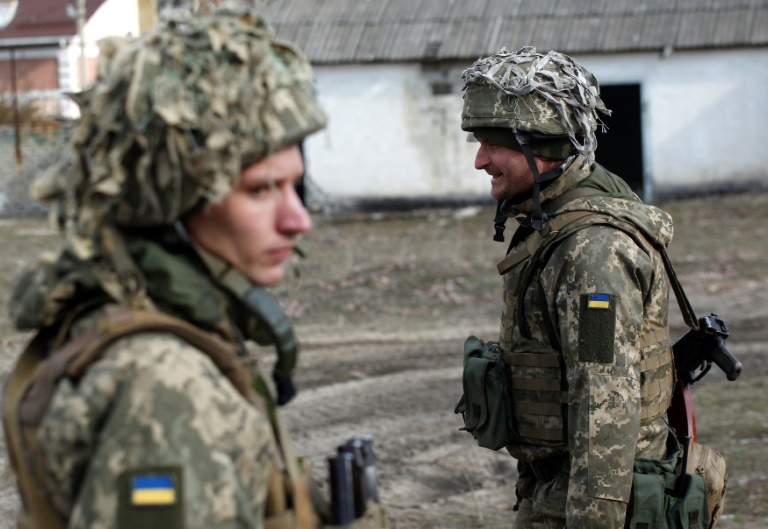
Weeks of intense diplomacy and the imposition of Western sanctions on Russia failed to deter Putin, who had massed between 150,000 and 200,000 troops along the borders of Ukraine.

“I have made the decision of a military operation,” Putin said in a surprise television announcement that triggered immediate condemnation from US President Joe Biden and sent global financial markets into turmoil.

Shorly after the announcement, explosions were heard in Ukraine’s capital, Kyiv, and several other cities, according to AFP correspondents.

Putin called on Ukrainian soldiers to lay down their arms, and justified the operation by claiming the government was overseeing a “genocide” in the east of the country.

The Kremlin had earlier said rebel leaders in eastern Ukraine had asked Moscow for military help against Kyiv. 

The extent of Thursday’s attacks was not immediately clear, but Ukraine Foreign Minister Dmytro Kuleba said the worst-case scenario was playing out.

“Putin has just launched a full-scale invasion of Ukraine. Peaceful Ukrainian cities are under strikes,” Kuleba tweeted.

“This is a war of aggression. Ukraine will defend itself and will win. The world can and must stop Putin. The time to act is now.”

Biden immediately warned of “consequences” for Russia and that there would be a “catastrophic loss of life and human suffering”.

NATO’s chief condemned Russia’s “reckless and unprovoked attack” on Ukraine.

Putin’s move came after Ukraine’s President Volodymyr Zelensky made an emotional appeal late on Wednesday night to Russians not to support a “major war in Europe”.

Speaking Russian, Zelensky said that the people of Russia were being lied to about Ukraine.

Zelensky said he had tried to call Putin but there was “no answer, only silence”, adding that Moscow now had around 200,000 soldiers near Ukraine’s borders.

Earlier on Wednesday the separatist leaders of Donetsk and Lugansk sent separate letters to Putin, asking him to “help them repel Ukraine’s aggression”, Putin’s spokesman Dmitry Peskov said. 

The two letters were published by Russian state media and were both dated February 22. 

Their appeals came after Putin recognised their independence and signed friendship treaties with them that include defence deals.

– ‘Moment of peril’ –

Putin had for weeks defied a barrage of international criticism over the crisis, with some Western leaders saying he was no longer rational. 

His announcement of the military operation came ahead of a last-ditch summit involving European Union leaders in Brussels planned for Thursday.  

The 27-nation bloc had also imposed sanctions on Russia’s defence minister Sergei Shoigu and high-ranking figures including the commanders of Russia’s army, navy and air force, another part of the wave of Western punishment after Putin sought to rewrite Ukraine’s borders.

The United Nations Security Council met late Wednesday for its second emergency session in three days over the crisis, with a personal plea there by UN Secretary-General Antonio Guterres to Putin going unheeded.

“President Putin, stop your troops from attacking Ukraine, give peace a chance, too many people have already died,” Guterres said.

The US ambassador to the United Nations, Linda Thomas-Greenfield, warned that an all-out Russian invasion could displace five million people, triggering a new European refugee crisis. 

Before Putin’s announcement, Ukraine had urged its approximately three million citizens living in Russia to leave.

“We are united in believing that the future of European security is being decided right now, here in our home, in Ukraine,” President Zelensky said during a joint media appearance with the visiting leaders of Poland and Lithuania.

Western capitals said Russia had amassed 150,000 troops in combat formations on Ukraine’s borders with Russia, Belarus and Russian-occupied Crimea and on warships in the Black Sea.

Ukraine has around 200,000 military personnel, and could call up to 250,000 reservists. 

Moscow’s total forces are much larger — around a million active-duty personnel — and have been modernised and re-armed in recent years.

– High cost of war –

But Ukraine has received advanced anti-tank weapons and some drones from NATO members. More have been promised as the allies try to deter a Russian attack or at least make it costly.

Shelling had intensified in recent days between Ukrainian forces and Russia-backed separatists — a Ukrainian soldier was killed on Wednesday, the sixth in four days — and civilians living near the front were fearful.

Dmitry Maksimenko, a 27-year-old coal miner from government-held Krasnogorivka, told AFP that he was shocked when his wife came to tell him that Putin had recognised the two Russian-backed separatist enclaves.

“She said: ‘Have you heard the news?’. How could I have known? There’s no electricity, never mind internet. I don’t know what is going to happen next, but to be honest, I’m afraid,” he said.

In a Russian village around 50 kilometres (30 miles) from the border, AFP reporters saw military equipment including rocket launchers, howitzers and fuel tanks mounted on trains stretching for hundreds of metres.

Russia has long demanded that Ukraine be forbidden from ever joining the NATO alliance and that US troops pull out from Eastern Europe. 

Speaking to journalists, Putin on Tuesday set out a number of stringent conditions if the West wanted to de-escalate the crisis, saying Ukraine should drop its NATO ambition and become neutral.

Washington Wednesday announced sanctions on the Nord Stream 2 gas pipeline, which Germany had earlier effectively suspended by halting certification.

Australia, Britain, Japan and the European Union have all also announced sanctions. 

burs-kma/

Biden says 'world will hold Russia accountable' over Ukraine attack

US President Joe Biden on Wednesday said the “world will hold Russia accountable” over a military onslaught against Ukraine that he warned will cause “catastrophic loss of life.”

In a statement issued shortly after Russian President Vladimir Putin announced the start of military operations in Ukraine, Biden said he would address the US public Thursday to outline the “consequences” for Russia, calling the attack “unprovoked and unjustified.”

The US president was due to join a virtual, closed-door meeting of G7 leaders — Britain, Canada, France, Germany, Italy, Japan and the United States — at 9:00 am (1400 GMT) Thursday. The White House said his remarks to the nation would come in the early afternoon in Washington.

The G7 meeting is likely to result in more sanctions against Russia, which has long claimed it would not invade Ukraine, despite putting a huge force of tens of thousands of soldiers and heavy weaponry on the country’s borders, while insisting that the Ukrainian government abandon its pro-Western ambitions.

Putin’s speech delivered in the early hours of Thursday announced a “special military operation.” Shortly after, explosions were reported across Ukraine, including in the capital Kyiv.

On Tuesday, the US government joined European allies in imposing sanctions on two Russian banks, Moscow’s sovereign debt, several oligarchs and other measures.

And on Wednesday, Biden announced he was imposing sanctions on the Nord Stream 2 natural gas pipeline from Russia to Germany — one of energy-rich Moscow’s highest-profile energy and geopolitical projects. Germany had earlier announced it would block the pipeline from opening for deliveries.

US officials have repeatedly warned that any escalation by Russia in Ukraine — which has now occurred — will be met with even tougher sanctions, targeting bigger banks, more oligarchs and a halt to exports of high-tech equipment. 

A White House spokesman said “President Biden will deliver remarks announcing the further consequences the United States and our allies and partners will impose on Russia.”

– ‘Death and destruction’ –

In reactions soon after the Russian attacks began, US senators from both parties indicated support for a tough response.

“Tonight, the entire post-World War international order sits on a knife edge. If Putin does not pay a devastating price for this transgression, then our own security will soon be at risk,” Democratic Senator Chris Murphy said.

Another Democrat, Senator Mark Warner, said “President Biden has already imposed an initial tranche of sanctions, and it is now time for us to up the pain level for the Russian government.”

Russians “will pay a steep cost for Putin’s reckless ambition, in blood and in economic harm,” he said.

Republican Senator Mitt Romney warned against “the peril of again looking away from Putin’s tyranny” and urging “the harshest economic penalties” and “expelling them from global institutions.”

In his statement, Biden said “the prayers of the entire world are with the people of Ukraine tonight as they suffer an unprovoked and unjustified attack by Russian military forces. President Putin has chosen a premeditated war that will bring a catastrophic loss of life and human suffering.”

“Russia alone is responsible for the death and destruction this attack will bring, and the United States and its allies and partners will respond in a united and decisive way. The world will hold Russia accountable,” Biden said.

Virus-hit Hong Kong invokes emergency powers to allow in China medics

Hong Kong’s government invoked emergency powers on Thursday to allow doctors, nurses and other personnel from the Chinese mainland to help combat a spiralling coronavirus outbreak.

The densely populated metropolis is in the throes of its worst-ever Covid wave, registering thousands of cases every day, overwhelming hospitals and government efforts to isolate all infected people in dedicated units.

Hong Kong authorities have followed a zero-Covid strategy similar to mainland China that kept infections mostly at bay throughout the pandemic. 

But they were caught flat-footed when the highly infectious Omicron variant broke through those defences, and have since increasingly called on the Chinese mainland for help.

“Hong Kong is now facing a very dire epidemic situation which continues to deteriorate rapidly,” the government said in its statement announcing the use of emergency powers.

Chinese mainland medics are not currently allowed to operate in Hong Kong without passing local exams and meeting licensing regulations.

The emergency powers “exempt certain persons or projects from all relevant statutory requirements… so as to increase Hong Kong’s epidemic control capacity for containing the fifth wave within a short period of time,” the statement said.

The move came after Chinese President Xi Jinping last week ordered Hong Kong to take “all necessary measures” to bring the outbreak under control, signalling Hong Kong would not be allowed to move towards living with the virus like much of the rest of the world. 

Allowing mainland medics to work in Hong Kong has been a source of debate for years.

Even before the pandemic, supporters argued it could alleviate shortages in the city’s stretched healthcare system.

Local medical practitioners in the past have objected, citing issues such as language and cultural barriers -– though critics have dismissed such talk as protectionism.

Hong Kong was supposed to operate as a semi-autonomous region from China, after the territory returned from British colonial rule in 1997. 

But that autonomy was eroded in recent years as China crushed a democracy movement. 

– Manpower ‘exhausted’ –

Hong Kong has recorded more than 62,000 Covid cases in the current wave, compared with just 12,000 during the two years before.

Health experts fear the real number is far higher because of a testing backlog and people avoiding testing for fear of being forced into isolation units if they are positive.

Over the last fortnight, stories have emerged of parents being separated from children and babies who test positive, as well as elderly patients lying on gurneys outside hospitals.

Around 1,200 healthcare workers have been infected as of Wednesday, according to the Hospital Authority. 

The authority’s chairman Henry Fan told state media Monday he hoped the mainland government would send over doctors and nurses, because local manpower had been “exhausted”.

Hong Kong has ordered all 7.4 million residents to go through three rounds of mandatory coronavirus testing next month.

China is helping to build a series of isolation units and temporary hospital wards but it is unclear whether enough can be constructed in time.

Local modelling predicts the city might see as many as 180,000 infections and 100 deaths daily by mid-March.

Local authorities have increasingly resorted to emergency orders in recent years.

During the 2019 protests, authorities used such powers to ban mask-wearing. 

The following year, emergency orders were used to make mask-wearing mandatory during the pandemic.

The city’s disease prevention law has also been invoked to forbid public gatherings and a host of strict social distancing measures and business closure orders that have been in place on and off for two years.

City leader Carrie Lam has defended her approach, citing the intensity of the virus crisis.

“In an environment as urgent as this, we cannot let existing laws stop us from doing what we should do,” she said Tuesday.

“This is not the mentality for fighting a war.”

Three Syrian soldiers killed in Israeli strike near Damascus: state media

Three Syrian soldiers were killed Thursday in an Israeli air strike near the capital Damascus, according to Syria’s state media.

It was the fourth reported time this month Israel has launched strikes inside Syria, keeping up a campaign against pro-Iranian forces supporting the Damascus government in the more than decade-old civil war.

“The Israeli enemy carried out an air assault with several missiles,” state news agency SANA reported, adding three soldiers were killed.

It said Syrian air defences intercepted most of the missiles in the attack, which occurred at around 1:10 am (2310 GMT Wednesday).

The Syrian Observatory for Human Rights (SOHR), which has an extensive network of sources across the country, reported that explosions were heard in Damascus and its suburbs “after the interception of Israeli missiles by the Syrian regime’s anti-aircraft defence”.

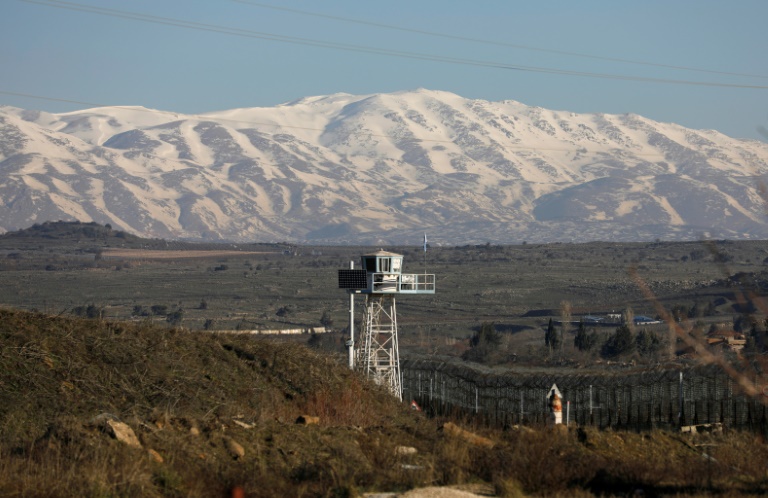
It follows strikes in recent days on a town near the Golan Heights, a Syrian military post on February 17, and an assault against anti-aircraft batteries at the start of the month.

Since civil war broke out in Syria in 2011, Israel has carried out hundreds of air strikes inside the country, targeting government positions as well as allied Iran-backed forces and fighters of the Shiite militant movement Hezbollah.

– Shadow war –

While Israel rarely comments on individual strikes in Syria, it has acknowledged mounting hundreds since 2011.

According to a report by the Israeli army, it hit around 50 targets inside its northern neighbour’s territory in 2020.

Last year, Israel targeted Syria roughly 30 times, killing 130 people including five civilians and 125 loyalist fighters, according to SOHR figures.

In December 2021, it carried out a strike targeting an Iranian arms shipment in Latakia — in the heartland of President Bashar al-Assad’s minority Alawite community — its first on the port since the start of the civil war.

The Israeli military has defended the strikes as a necessary measure to prevent its arch-foe Iran from gaining a foothold on its doorstep.

Israel’s head of military intelligence, Major General Aharon Haliva, has accused Iran of “continuing to promote subversion and terror” in the Middle East.

In a shadow war, Israel has targeted suspected Iranian military facilities in Syria and mounted a sabotage campaign against Iran’s nuclear programme.

Iran has been a key supporter of the Syrian government in the decade-old conflict.

It finances, arms and commands a number of Syrian and foreign militia groups fighting alongside the regular armed forces, chief among them Hezbollah.

The conflict in Syria has killed nearly 500,000 people since it started in 2011 with the brutal repression of peaceful demonstrations.

Close Bitnami banner
Bitnami