World

Lebanese turn to public libraries to check out of financial crunch

In many countries, public libraries are considered a dying relic amid the shift to digital, but in Lebanon they are getting a new lease of life as its economy flatlines.

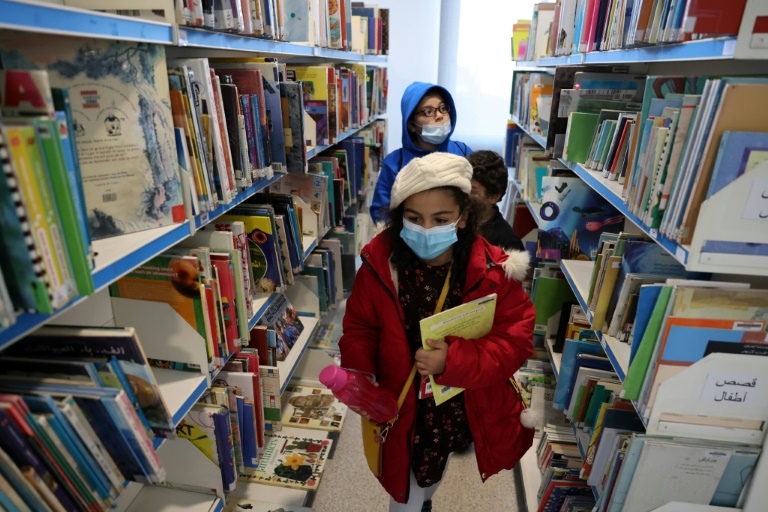
Every Friday afternoon, Munira Khalifa takes her son Elia to a public library in Beirut for a weekly storytelling event — one of the last affordable pleasures as a crashing local currency has rendered books something of a luxury.

“We had reached a point where we couldn’t find anywhere to take Elia because of the coronavirus pandemic and our difficult financial situation,” Khalifa said.

She is just one of hundreds of parents who are hitting the shelves at three public libraries in Beirut in the heat of the unprecedented financial crisis.

The libraries are managed by the Assabil non-governmental group, which was founded in 1997 to promote free access to books and culture.

At one of them in the neighbourhood of Bachoura, the mother and son were the first to arrive ahead of a reading.

The library offered them some relief, Khalifa said, adding: “It is safe, comfortable and close to home.”

“Financially, it helps us cut on costs for transportation and new books, which have become more expensive,” she told AFP.

Throughout the reading, laughter abounded as a storyteller acted out a book using puppets.

Librarian Samar Choucair said the number of visitors at the facility had increased in the past year, largely since people cannot afford to buy new books.

This is especially the case for children’s books, which are mostly produced abroad and tend to be more expensive, she said.

“We keep hearing from parents that this is the spot they choose to take their children… in light of the economic crisis.”

– ‘Need to read’ –

Sluggish internet speeds and the absence of credit cards have also hindered the take-up of digital books in Lebanon, where banks have locked people out of their accounts.

Lebanon is facing a financial crisis that the World Bank says is of a scale usually associated with wars, with more than 80 percent of the population living in poverty.

The local currency has shed more than 90 percent of its value against the dollar on the black market, causing skyrocketing inflation.

As a result, the cost of printing and buying books has soared, while the monthly minimum wage remains unchanged at 675,000 pounds, the equivalent nowadays of just $32.

While this may have translated into more footfall at libraries, it has eaten into booksellers’ profits.

Lana Halabi, who runs a family-owned bookshop in Beirut’s Tariq al-Jadideh neighbourhood, said all new books were priced in dollars and therefore hit by the fluctuating exchange rate.

“Book purchases are not a priority” for many Lebanese, the 33-year-old told AFP.

“This has reflected negatively on us and other publishing houses,” she added, pointing to a drop in orders at the Halabi bookshop.

But in a public library in Beirut’s Geitawi neighbourhood, demand is on the rise, prompting management to add 300 new covers to their collection in the past two months, said librarian Josiane Badra.

“Books have become very expensive and people can’t afford them… especially novels that are in great demand in the region, whether in French or in Arabic,” she said.

For literature student Aline Daou, the Geitawi public library is an indispensible lifeline.

“As a literature student, I always need to read,” the 21-year-old said.

“I prefer to borrow novels from here,” she added, explaining that it helps her set aside money to buy books not carried by public libraries.

– ‘Breathing room’ –

Ali Sabbagh of the Assabil organisation said public libraries offered people “breathing room”, but they were beset by challenges.

“We run these libraries in partnership with the Beirut municipality which used to front around 80 percent of operating costs in Lebanese pounds,” he said.

The currency devaluation, according to Sabbagh, has meant the value of municipal funding has plummeted.

“We are trying as much as possible to reach out to donors that can provide us with the necessary support to continue,” Sabbagh told AFP.

“Relying solely on public funds during this time has become very difficult.”

International donors, meanwhile, tend to focus on humanitarian projects as opposed to cultural spaces, said Sabbagh.

At the Geitawi library, fine arts student Valentina Habis said funding should not overlook culture.

“In the midst of economic collapse, we need cultural spaces… places that develop thought and culture, because culture is the basis of society,” she said.
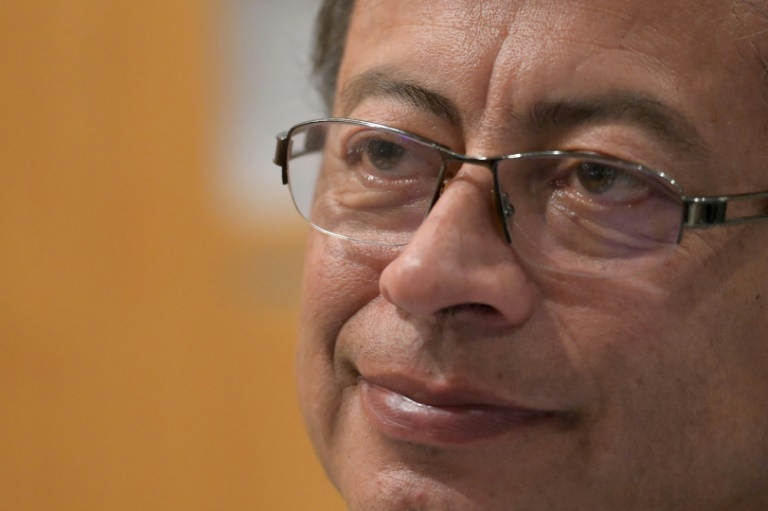
Ex-guerrilla Petro hopes to be Colombia's first leftist president

Gustavo Petro is a former Colombian guerrilla who became mayor of Bogota and a senator — now, he wants to be the first leftist president in the South American nation’s history.

Polls suggest he stands a chance, with stated support of about 42 percent — head and shoulders above any other contender in a country traditionally distrustful of the left.

The 61-year-old Petro, who is active on social media, hopes to win outright in the first round on May 29, for which he would need 50 percent of the vote.

 If not, there will be a runoff on June 19.

He is an inspiring orator and crowds chant his name at political rallies where he rails against the ruling political “oligarchy” and promises to tackle poverty and social inequality.

Petro moves around with an entourage of bodyguards and snipers in armored cars in a country with a long history of violence and a toll of five assassinated presidential candidates.

In 2018, Petro lost the presidential race to right-wing Ivan Duque, who now has record disapproval rates.

Petro told AFP recently he would pursue a different leftist model than those of controversial leaders such as Nicaragua’s Daniel Ortega and Venezuela’s Nicolas Maduro.

He would instead align himself to a “progressivism” he associates with Chile’s president-elect Gabriel Boric and Brazil’s ex-president Luiz Inacio Lula da Silva.

Here are some main points from an interview with AFP:

Q: What kind of a leftist agenda would you pursue?

A: “There is appearing in Latin America a new type of progressivism that… does not base the economy on the extraction of non-renewable raw materials (but rather) on knowledge and production.

“I think it would mark a different way of Latin American social struggle than (those of) Daniel Ortega and Maduro, which basically continue a rhetorical leftist idea based on oil extraction, based on having a banana republic that imprisons any kind of opponent.”

Petro says he would, however, resume diplomatic relations with Caracas, frozen since 2019, and restore order in the border region where armed groups fight over trafficking routes and resources.

Q: What would your first presidential decisions be? 

A: “The signing of (oil) exploration contracts in Colombia would cease… because we want to start the transition to (clean energy)… and the process of decarbonization of the economy.  

“I think it is appropriate to establish a program to fight against immediate, urgent hunger… and to (restore) the country’s great agricultural and food-producing potential.”

Q: How would you approach the United States? 

A: “There are common subjects. One of those… is the climate crisis… 

“We have to see how, in a united way with America, we make the leap towards a decarbonized, oil-free, carbon-free economy.”

Q: In a country with a history of political assassinations, do you fear for your life?

“A: “It doesn’t stop appearing like a flash, when I get mixed up in the crowd, when I am on a stage and there is a full square (where from) anywhere someone could shoot…  but I try to avoid thinking about that. 

“Both the specter of fraud and the specter of death undoubtedly accompany us in some way in this presidential campaign.”

Q: What will you do about drug trafficking?  

A: “(The use of) Glyphosate (a herbicide used to eradicate coca plants) has been a major failure in Colombia. 

“In addition to poisoning our land and waters, the cost of spraying one hectare with glyphosate is higher than the cost of giving the farmer fertile land.”

He would instead pursue “a peaceful policy of dismantling drug trafficking” that could include lighter penalties for those who agree to abandon the trade.

Ukraine crisis exposes Putin's 'isolated, paranoid' world

The conduct of President Vladimir Putin in the crisis over Ukraine has opened a window onto the world of a leader who appears to be increasingly paranoid and politically isolated, Western officials and analysts say.

Some Western leaders, including French President Emmanuel Macron, have in the past sought to treat Putin as a credible, if tough, negotiating partner.

But all notions of reliability have been shattered after Putin on Monday recognised two Ukrainian breakaway regions and gave a lacerating speech doubting Ukraine’s right to statehood — apparently just hours after making commitments to pursue diplomacy in telephone talks with Macron, according to the French presidency.

A French presidential official, who asked not to be named, said that Putin’s speech on Ukraine mixed “rigid and paranoid ideas” which recalled the impression Macron had got in his five-hour closed door talks with Putin at the Kremlin earlier this month.

“The Putin that he (Macron) met at the Kremlin was not the same that he had seen in December 2019,” the official said.

“What he found at the Kremlin was a Putin who was more rigid and isolated.”

Macron had last met Putin at a Paris summit on Ukraine in December 2019. 

Earlier that year, he had also hosted Putin for talks at his Mediterranean summer residence to launch a policy of engagement with Russia, where the smiling Russian leader arrived gallantly bearing a bouquet of flowers for the French president’s wife Brigitte.

But these images were a far cry from the chilling speech by Putin on Monday, in which he baselessly accused Ukraine of seeking a nuclear weapon and warned the “Kyiv regime” bore responsibility for any further bloodshed.

“There was an extremely violent analysis, somewhat delusional and paranoid… with many historical lies,” said France’s Europe Minister Clement Beaune.

In unguarded comments reported by the Press Association, British Defence Minister Ben Wallace said Putin had gone “full tonto” and he was a man with “no friends, no alliances”.

– ‘Speak clearly!’ –

When Putin seized Crimea from Ukraine in 2014, to the shock of Western leaders, former German Chancellor Angela Merkel was quoted by American media as telling US President Barack Obama that Putin was living in “another world”.

Now, with Western powers still guessing over what Putin’s final plan is for Ukraine — which US intelligence has suggested could even involve an attempt to seize the capital Kyiv — scrutiny of Putin’s conduct has intensified.

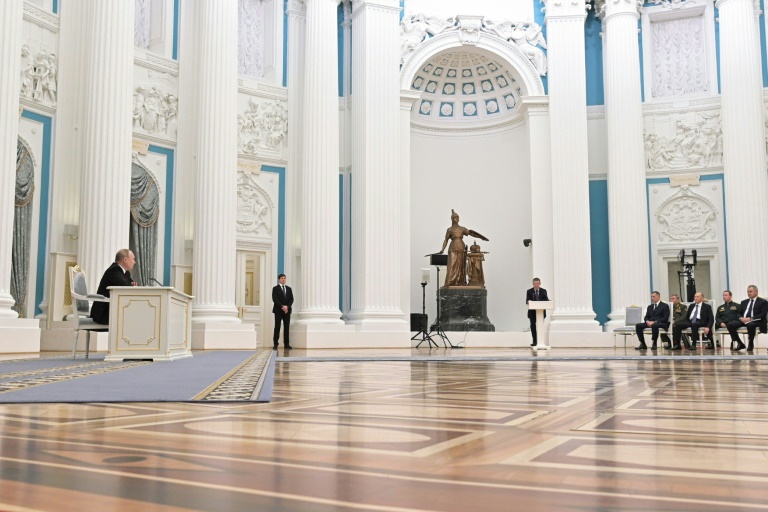
His historic Monday evening address was broadcast after a highly-choreographed meeting of Russia’s security council attended by two dozen officials — all male with the exception of upper house speaker Valentina Matviyenko. 

The officials sat in stiff chairs at tennis court distance from Putin, who watched from behind a desk as they gave their assent to the recognition of the breakaway regions.

In one bizarre moment yet to be properly explained, Putin subjected the powerful head of the SVR foreign intelligence service Sergei Naryshkin to humiliation as he stumbled in his comments.

“Speak clearly! Sergei! Yes or no?”, spat Putin, impatiently drumming his hands on the table.

Naryshkin appeared overcome and then mistakenly said that the two regions should become part of Russia, an idea that was not on Putin’s radar.

“We are not talking about this or discussing this!” Putin laughed contemptuously. “We are discussing recognising the independence or not!”

In another jarring detail, bloggers noticed that the watches of Defence Minister Sergei Shoigu and Foreign Minister Sergei Lavrov showed a different time to the actual time during the supposedly live TV relay.

“Naked propaganda is no longer enough for the old fogies and thieves. They want blood,” commented opposition figure Alexei Navalny, currently jailed in a prison camp, calling Putin the “head of the (Soviet-era) politburo of the 21st century.”

In any case, Naryshkin’s ordeal remained in the final cut.

– ‘Sacrifice pragmatism?’ –

French writer Michel Eltchaninoff, author of the book “In the Head of Vladimir Putin”, said while Putin had expressed such ideas before, there had been troubling changes in the style of presentation.

“This somewhat sadistic, humiliating staging had an amazing effect”, with Putin determined to “show that he decides alone” in what appeared almost a reference to the representation of power “in the Stalin era”.

“There is a kind of detachment from reality on the part of Putin in the name of his ideology which can be described as paranoid,” he told AFP.

“We have always said that he was a pragmatic leader, a good tactician. Will he sacrifice his pragmatism in the name of his ideology? It’s possible. In any case, he seems ready to go to war,” he said.

The respected Russian analyst Tatyana Stanovaya, founder of the political consultancy R.Politik Center and a nonresident scholar at the Carnegie Moscow Center, predicted grim times ahead after the speech.

“Today is the day Vladimir Putin crossed over to the dark side of history,” she wrote on her Telegram channel. “This is the beginning of the end of his regime, which can only rely on bayonets now.”

US truckers launch 'The People's Convoy' in pandemic protest

Hundreds of truckers and their supporters set off from southern California on Wednesday on a convoy headed across the United States towards the capital Washington to protest against pandemic restrictions.

Inspired by the demonstrations that crippled Canada’s cities for weeks, organizers of “The People’s Convoy” want an end to mask mandates, vaccination requirements and business shutdowns that are intended to slow the march of Covid-19.

“Let’s get back to normal,” said Bryan Brase, whose rig was near the front of the caravan that had gathered in the small town of Adelanto, northeast of Los Angeles.

“I think everybody’s here for different reasons, but it all boils down to the same thing: Freedom and liberty,” said Shane Class, who had travelled from Idaho to join the rally.

“It’s time for our government to start understanding that people want that freedom in the Constitution back.”

The caravan, which began Wednesday as a few dozen vehicles, was expected to take 11 days to get to the Washington, DC area, arriving on March 5, though organizers say they do not intend to enter the city itself.

That assurance has not prevented the mobilisation of 700 National Guard to provide added security around the nation’s capital, as authorities fret over a possible repeat of the January 6, 2021, invasion of Congress by supporters of former president Donald Trump.

Pentagon spokesman John Kirby said Guardsmen would not be armed and would not be empowered to arrest people, but would be reporting wrongdoing to local police.

A number of large vehicles, including snow-ploughs and garbage trucks have been deployed on the streets of the capital to prevent access to sensitive sites.

– Debunked theories –

Convoy organizers stress on their website that it is a non-partisan movement that includes both Republicans and Democrats, though there were plenty of flags signifying support for Trump among participants in Adelanto and along the route.

Paul Alexander, a health adviser under Trump who suggested letting the coronavirus spread unchecked in the population to prompt “herd immunity,” was among those who revved up the crowd, claiming that vaccines do not work.

Scientists say the extensively tested shots are safe and effective, and represent the single best protection against death or serious illness from Covid-19.

Vaccine adoption is uneven across the United States, with some on the political right distrustful of the science and holding to debunked conspiracy theories pushed on the internet.

Crowds gathered on bridges along the route to cheer the convoy on, with some holding banners calling for the arrest of government health experts.

– Donations –

Many of those AFP spoke to in the flag-waving crowd voiced arguments common on the right.

“I can no longer work at my facility, a major health organization, without submitting a religious exemption,” said one Los Angeles-based nurse, who did not wish to give her name.

“So in order for me to earn a living for my family, I have to call on the holy and righteous name of Jesus.”

The movement has attracted more than $450,000 of donations, according to thepeoplesconvoy.org, which organizers say will be used to reimburse fuel and other costs borne by participating truckers.

The convoy starting from Adelanto is just one of a number of planned truckers’ events beginning in various parts of the country.

Others are due to depart from Texas, North Dakota, Washington state and Ohio over the coming days, according to greatamericanpatriotproject.org.

Benfica's Yaremchuk shows shirt of support for Ukraine in Champions League

Benfica’s Ukrainian striker Roman Yaremchuk celebrated a Champions League goal on Wednesday by revealing a shirt bearing his country’s coat of arms as fears of a Russian invasion of his homeland grew.

The 26-year-old scored the goal that gave his team a 2-2 draw against Ajax and then displayed a black shirt displaying the blue and gold Tryzub symbol.

“I wanted to support my country. I thought a lot about it and I’m afraid of the situation,” he told CNN Portugal.

“The club supports me, they spoke to me and wanted to do everything to help me. I thanked them, although for the moment everything is fine.”

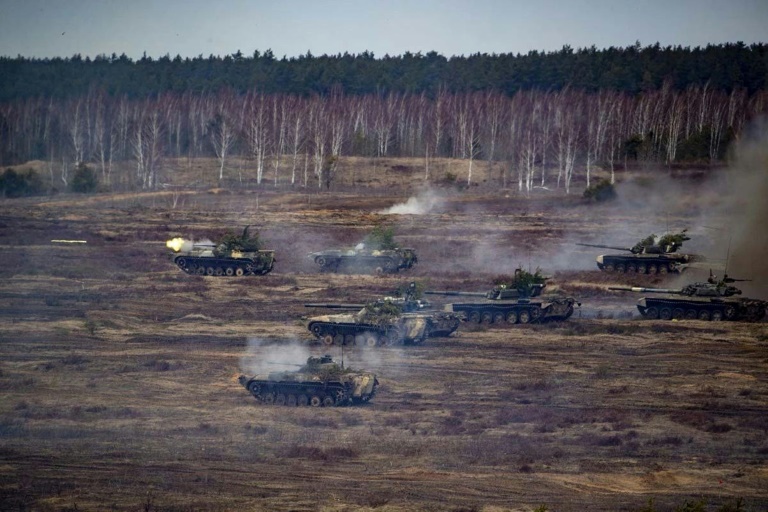
His action comes as tens of thousands of Russian troops are stationed near Ukraine’s borders, with the West saying they could be used for an attack at any moment and Kyiv imposing a national state of emergency.

Twitter mistakenly pulled accounts monitoring Russian troops

Twitter acknowledged Wednesday it suspended in error some accounts relaying information about Russian military movements as the threat builds for an attack on Ukraine.

The social network has begun restoring access to the users, which were taken down due to “our work to proactively address manipulated media,” tweeted the platform’s head of site integrity Yoel Roth.

A company spokesperson said earlier claims that the accounts were taken offline by a coordinated campaign or mass complaints were untrue.

“We took enforcement action on a number of accounts in error,” the spokesperson added. “We’re expeditiously reviewing these actions and have already proactively reinstated access to a number of affected accounts.” 

Like Facebook and YouTube, the platform is regularly accused of not doing enough to fight misinformation. 

But Twitter has fewer human and financial resources than its Silicon Valley neighbors to curb the harmful phenomenon. 

Tens of thousands of Russian troops are massed near Ukraine’s borders, with the West saying they could attack at any moment.

Rebel leaders in eastern Ukraine have asked Moscow for military help against Kyiv, the Kremlin said, in a move that opens the door for Russian troops to move in.

Washington and Britain say Russia’s force is poised to strike Ukraine and trigger the most serious war in Europe for decades, but Russian President Vladimir Putin says he is open to negotiation — within limits.

9,000-year-old ritual complex found in Jordan desert

Archaeologists deep in the Jordanian desert have discovered a 9,000-year-old ritualistic complex near what is thought to be the earliest known large human-built structure worldwide.

The Stone Age shrine site, excavated last year, was used by gazelle hunters and features carved stone figures, an altar and a miniature model of a large-scale hunting trap.

The giant game traps the model represents — so-called “desert kites” — were made of long walls that converge to corral running gazelles into enclosures or holes for slaughter.

Similar structures of two or more stone walls, some several kilometres (miles) long, have been found in deserts across Saudi Arabia, Syria, Turkey and Kazakhstan.

The Neolithic-era ritual site was discovered inside a larger campsite last October by a joint French-Jordanian team called the South Eastern Badia Archaeological Project.

The nearby desert kites in Jibal al-Khashabiyeh are “the earliest large-scale human built structures worldwide known to date,” said a statement by the SEBA Project.

It hailed the “spectacular and unprecedented discovery” of the ritualistic site, believed to date to about 7000 BC.

It featured two steles with anthropomorphic features, the taller one 1.12 metres high, other artefacts including animal figurines, flints, and some 150 arranged marine fossils.

The wider, decade-old research project aims to study “the first pastoral nomadic societies, as well as the evolution of specialised subsistence strategies”. 

The desert kites suggest “extremely sophisticated mass hunting strategies, unexpected in such an early timeframe,” said the project’s statement.

The sacral symbolism was most likely meant “to invoke the supranatural forces for successful hunts and abundance of prey to capture,” it said. 

The teams of researchers have also found campsites with circular dwellings and large numbers of gazelle bones.

The project is a collaboration of Jordan’s Al Hussein Bin Talal University and the French Institute of the Near East.

French ambassador Veronique Vouland-Aneini hailed the “outcome for both the scientific world and Jordan”, saying “it provides us with a priceless testimony of the historical life in the Middle East, its traditions and rituals”.

More than $1.5 bn bid so far in US offshore wind auction

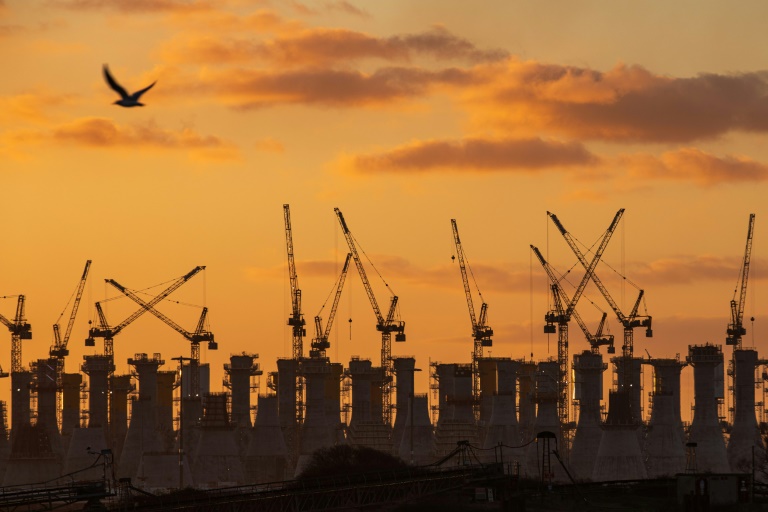
Energy companies interested in developing offshore wind sites bid more than $1.5 billion Wednesday in by far the biggest US auction for the renewable power.

After launching the auction Wednesday morning, US officials released updates throughout the day as the bids gradually rose on six available tracts involving nearly 500,000 acres off the coasts of New York and New Jersey.

After 21 rounds of bidding conducted Wednesday, the Bureau of Ocean Energy Management was set to resume the process on Thursday morning.

US President Joe Biden has embraced offshore wind as a component of an energy transition needed to combat climate change.

Development of all six tracts could generate as much as seven gigawatts of wind energy, enough to power some two million homes, the agency said.

Nearly 25 firms were authorized to participate in the auction, including European companies Avangrid Renewables, Equinor ASA and EDF Renewables Development, as well as US groups Invenergy and Arevia Power.

“People are excited because this is the first lease sale that has been held by the federal government since 2018,” said Lesley Jantarasami, an energy specialist at the Bipartisan Policy Center, a US think tank.

Jantarasami noted that the Biden administration has set a goal of producing 30 gigawatts of offshore wind energy by 2030.

“For a long time, everybody has been saying it’s poised to take off,” she said, alluding to the interest of European companies in the US offshore market. 

“But we had not seen the federal government take concrete action to make this a reality,” she said.

– Legal challenges possible –

Currently there are just two producing offshore wind sites in the United States generating a modest 42 megawatts.

But the Biden administration last year cleared construction of two larger offshore wind projects: Vineyard Wind in Massachusetts and South Ford Wind offshore Rhode Island.

The administration also envisions reviewing at least 16 plans to construct and operate commercial offshore wind energy facilities through 2025 and plans seven auctions through that year. Projects are expected near the coasts of North Carolina and California.

In 2018, an auction on three tracts across 390,000 acres near Massachusetts raised $405 million following 32 rounds of bidding.

Wednesday’s bidding easily overtook that level, said Timothy Fox, an analyst at Clearview Energy Partners.

While the White House’s principle legislative package, “Build Back Better,” remains stuck in Congress, Biden’s administration “may rely on the results of the auction to reinforce is green energy bona fides,” Fox said.

But the auction represents just the first step in a lengthy process before wind energy will be produced. Key permits will need to be granted and “legal challenges represent continued risk,” Fox said.

Fox said lawsuits on environmental grounds are possible after a permit to a specific site is granted. Of particular concern are US laws protecting endangered species, he said.

But Jantarasami expressed confidence in the projects, given the support of governors in New York and New Jersey, who see the ventures as beneficial on both environmental and energy grounds.

Additionally, the emerging industry could be a source of new jobs.

“We are turning the corner,” Jantarasami said. “This administration in particular and the governors want the projects to happen. They are going to work pretty closely to make the projects happen.”

Amsterdam hostage taker dies of injuries in hospital: prosecutors

A 27-year-old man who held several people hostage at an Apple store on a busy Amsterdam square has died in hospital from his injuries, Dutch prosecutors said late Wednesday.

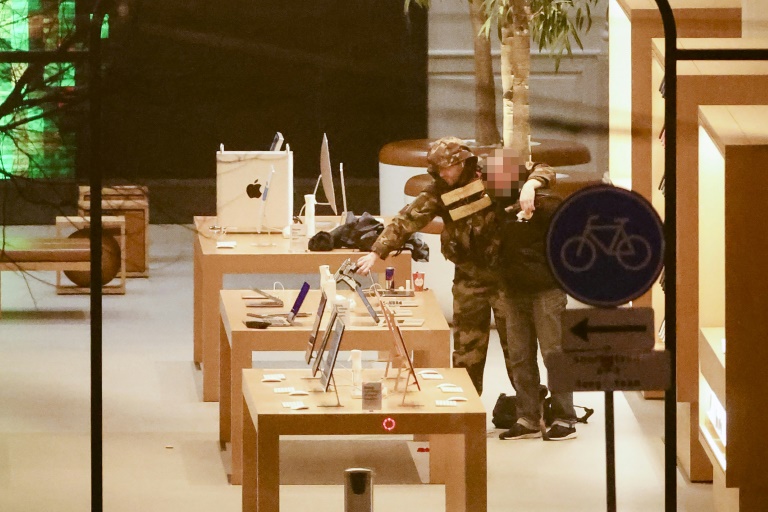
The man, said to be a resident of the Dutch capital, entered the Apple store on Leidseplein armed with two guns, sparking a tense five-hour-long ordeal on Tuesday.

The stand-off ended when the suspect was hit by a police car as he chased his last hostage who made a desperate break for freedom and ran out of the store.

“I can confirm that the man has died in hospital this evening,” public prosecution service spokesman Franklin Wattimena said.

“More than that, we cannot say, but the investigation continues,” he told AFP.

Police later hailed the hostage who helped to end the tense ordeal that gripped the city centre as a hero.

Dozens of police officers rushed to the building at 5:30 pm on Tuesday after the camouflage-wearing suspect entered the store in the popular Leidseplein neighbourhood, prompting a chaotic exodus from the building.

The suspect took a Bulgarian man hostage and demanded 200 million euros ($230 million) in cryptocurrency, as well as a free passage out of the city.   

Around 70 people fled the building and four people hid in a closet, apparently unknown to the suspect.

– ‘Hero role’ –

Five hours later, the suspect asked for water.  

Footage showed the hostage bending down as the water was delivered, before running out of the building followed closely by the suspect. 

The suspect was then sent sprawling by a police vehicle before a robot checked him for explosives as he lay on the road, lit up with laser sights from police snipers. 

“A car from the special forces reacted very adequately and alertly,” police chief Frank Paauw said in an overnight press conference, hailing the hostage’s bravery. 

“The hostage has played a hero role. In a few split seconds he escaped this hostage situation, otherwise it would have been an even longer night — and nasty night.”

Police later confirmed that the suspect was wearing an explosive device, but “that it was not primed” during the incident.

He was taken to hospital “seriously injured”, police said, adding that a “wide-ranging” investigation had been launched. 

“All options are open over a possible motive,” they added, saying at least two homes around the Dutch capital had been searched.

Amsterdam-based daily newspaper Het Parool identified the man as Abdel Rahman A., a grocery delivery worker that has had previous brushes with the law.

However, his motive for besieging the Apple store remained unclear, Dutch media reports said.

– ‘Prevented worse –


The suspect aimed an automatic weapon at officers, Paauw said, as special police units arrived at the scene Tuesday and cordoned off the area around the shop. 

All Apple stores across the Netherlands were closed Wednesday, and the site of Tuesday’s hostage taking will remain closed Thursday, the company said.

Leidseplein is popular with tourists and known for its lively bars and cafes. The area was quickly closed and the restaurants, bars and theatres were shut after the hostage taking.

The incident happened close to where well-known Dutch crime reporter Peter R. de Vries was gunned down in broad daylight last year.

“Just when the city was about to reopen and return to normal life, violence is again emerging in the heart of Amsterdam,” deputy mayor Rutger Groot Wassink said late on Tuesday.

Dutch Justice Minister Dilan Yesilgoz-Zegerius praised the quick action by the police.

“Their controlled and decisive action deserves nothing but compliments,” she said in a tweet.

“It prevented worse,” the minister added.

Dog kennel hit by meteorite sells at auction

A Christie’s auction of rare meteorites Wednesday sold a rock from space that narrowly missed a German Shepherd when it smashed into his kennel in Costa Rica.

But the offer of the third-largest piece of Mars on Earth failed to make an impact at the auction house’s annual sale of unusual meteorites.

The buyer paid $21,420 for the three-by-1.5 inch (eight-by-four centimeter) carbonaceous chondrite stone that landed in the garden of dog Roky’s owner’s home in Aguas Zarcas in April 2019.

The wood and tin doghouse itself, complete with a seven-inch hole marking where the meteorite punctured the roof, sold separately for $44,100, Christie’s said.

That was much less than the pre-sale estimate of between $200,000 and $300,000.

A bidder paid $189,000 for a chunk of lunar rock that was discovered in Morocco in 2007, below pre-sale estimates of up to $300,000.

Another slice of the Moon — found in the Sahara desert in Mauritania — fetched $69,300 during the two-week online sale that ended Wednesday.

It was a disappointing auction for Mars, though. The 20-pound (9.1 kg) Martian rock had been priced at between $500,000 and $800,000 but failed to find a buyer.

Close Bitnami banner
Bitnami