World

Prominent anti-China activist arrested in Mongolia

A prominent anti-China activist has been arrested in Mongolia, part of what campaigners have said is a wider effort to “clean up” Beijing’s critics in the country.

Landlocked Mongolia is dependent on mineral exports to its giant neighbours, Russia and China, but there have also been protests in the capital Ulaanbaatar over Beijing’s language policy in Inner Mongolia.

Critics of the policy in the Chinese border region — home to an estimated 4.5 million ethnic Mongolians — say it mirrors moves in other areas such as Xinjiang and Tibet to assimilate local minorities into the dominant Han culture and eradicate minority languages.

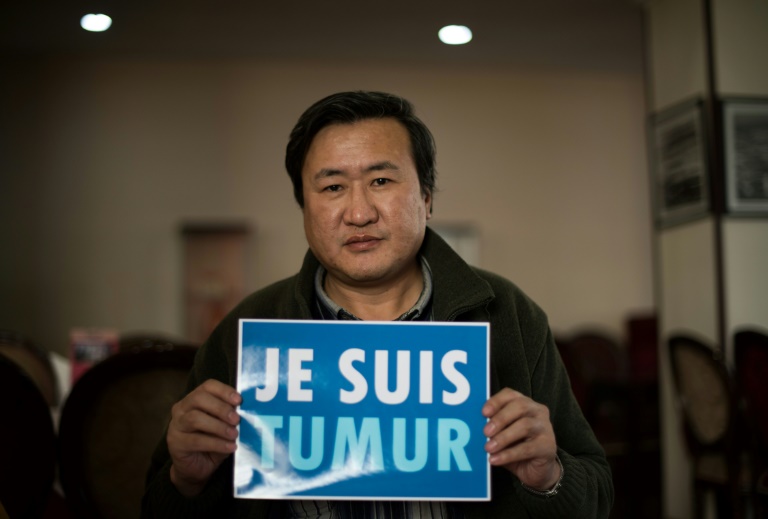
Munkhbayar Chuluundorj was arrested Friday in Ulaanbaatar on suspicion of “receiving instructions and funds from a foreign intelligence group”, the country’s spy agency said.

The General Intelligence Agency (GIA) said he had “engaged in illegal cooperation activities” but gave no more details.

Campaigners said they suspected Munkhbayar’s comments on China had brought him under official scrutiny.

In Facebook posts, he recently called for the Mongolian prime minister to resign over his close relationship with Beijing, saying “our nation’s independence will be lost and all citizens of Mongolia will become slaves of China”.

Footage of the arrest published by Mongolian outlet Eguur News showed a man being led away by armed police down a shop-lined road. 

Visits from relatives are being denied and a closed-door trial is being held, the Southern Mongolian Human Rights Information Centre, an overseas NGO that advocates for ethnic Mongols, quoted his brother Munkh-erdene as saying.

The NGO said Munkhbayar is “one of the most vocal critics of the Mongolian government’s cosy relationship with China”.

Munkhbayar has “defended Inner Mongolian human rights, culture, history and land rights”, according to Baljinima Bai, a language rights advocate originally from Inner Mongolia.

“Mongolia has started to ‘clean up’ these people… who oppose China,” he told AFP.

Bai said he had also been summoned for questioning by the GIA in relation to Munkhbayar’s case.

Inner Mongolian activists in Mongolia say they have faced threats and intimidation from authorities after a widespread protest movement against Chinese-language curriculum reforms across the border was met with a harsh police crackdown.

Activists also say China has pressured Mongolia to deport Inner Mongolian political refugees back to the country.

Ukraine urges 'tough sanctions' after Putin orders troops into rebel regions

Ukraine on Tuesday urged its Western allies to hit Russia with “tough sanctions” after President Vladimir Putin recognised two breakaway regions as independent and ordered in his troops.

Putin’s move — which came with tens of thousands of Russian soldiers on Ukraine’s borders and fears of an all-out invasion — was quickly and widely condemned by Kyiv’s allies in the West.

The United States, Britain and the European Union all moved to announce new economic sanctions within hours, as European and Russian stocks tumbled and oil prices surged over news of the recognition.

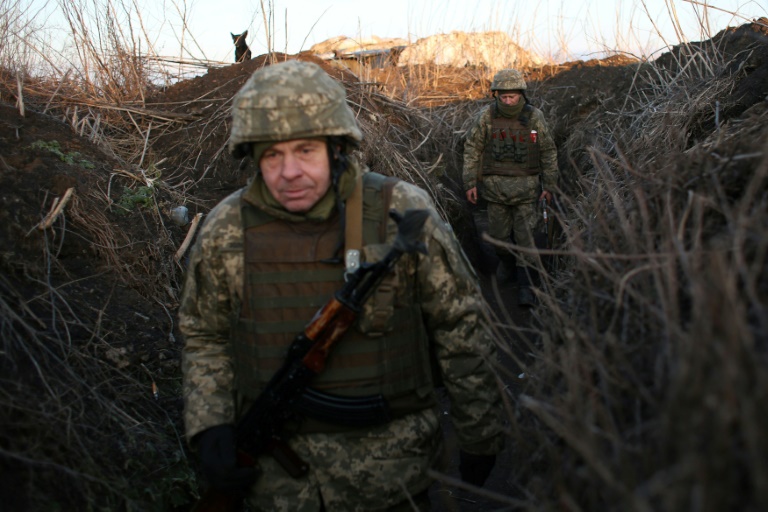
Russian troops were meanwhile believed to be deploying into Donetsk and Lugansk in eastern Ukraine, after Putin issued decrees ordering his army to assume “peacekeeping” functions in the separatist territories.

Western officials were not yet describing Putin’s moves as an invasion, but the situation remained deeply strained after weeks of tensions and days of intense shellfire on the frontline dividing the separatists from Kyiv’s forces.

In a statement issued during a visit to Washington, Ukrainian Foreign Minister Dmytro Kuleba said he was working with Kyiv’s Western friends “to impose tough sanctions against the Russian Federation”.

“Russia is trying to provoke Ukraine. Instead, Ukraine is showing wisdom and endurance to prevent an armed confrontation,” he said.

EU foreign policy chief Josep Borrell said the bloc would be adopting measures from Tuesday afternoon.

“Our response will be in the form of sanctions, whose extent the ministers will decide,” Borrell told reporters in Paris.

The UK was also set to unveil a “first barrage” of sanctions against Russia Tuesday, Prime Minister Boris Johnson vowed. 

“They will hit Russia very hard and there is a lot more that we are going to do in the event of an invasion,” he told reporters.

– ‘Outrageous, false claims’ –

Washington took its first measures in the early hours of Tuesday, banning US persons from any financial dealings with the breakaway territories, and said more sanctions would be announced Tuesday.

But it was unclear how far the West would go, after warning repeatedly of sanctions that would do severe damage to the Russian economy in the event of an invasion.

Russian troops were already known to be inside the two rebel regions and ordering more to deploy is unlikely to be enough for the West to trigger its worst-case response.

Putin announced he was recognising the territories, which broke away from Kyiv’s control in 2014, in a day of political theatre in Moscow.

After a dramatic televised meeting with his top government, military and security officials, Putin spoke to the Russian people in a 65-minute address from his Kremlin office.

In the often angry speech, Putin railed against Ukraine as a failed state and “puppet” of the West, accusing Kyiv of preparing a “blitzkrieg” to retake the separatist regions.

The move to recognise them, Putin said, was “a long overdue decision”.

He was then shown signing “friendship” agreements with rebel leaders that allowed for the official deployment of Russian forces to “maintain peace” and the sharing of military bases and border protection.

Within hours the UN Security Council held an emergency meeting, where US ambassador Linda Thomas-Greenfield described as “nonsense” Putin’s reference to the troops as “peacekeepers”.

“We know what they really are,” Thomas-Greenfield said, saying Putin’s address amounted to a “series of outrageous, false claims” that were aimed at “creating a pretext for war.”

Russia’s ambassador to the UN Vasily Nebenzya told the meeting that Moscow was still open to a diplomatic solution.

“Allowing a new bloodbath in the Donbas is something we do not intend to do,” he added, referring to the region encompassing Donetsk and Lugansk.

– Russia ‘ready’ for talks –

Moscow said Russian Foreign Minister Sergei Lavrov was still ready for talks with US Secretary of State Antony Blinken as planned for Thursday in Geneva.

“Even during the most difficult moments… we say: we are ready for negotiations,” foreign ministry spokeswoman Maria Zakharova said. “We are always in favour of diplomacy.” 

Ukraine’s President Volodymyr Zelensky held telephone calls with several world leaders after the recognition announcement, in a bid to shore up support.

“We expect clear support steps and effective support steps from our partners,” he declared in a late-night televised address, vowing that Kyiv was not afraid of anyone.

“It is very important to see now who is our true friend and partner, and who will continue to scare the Russian Federation with words,” he said. 

As news of the late-night recognition hit the streets of Kyiv, many were in disbelief but said they were ready to defend their country if called on.

“I am very shocked,” Artem Ivaschenko, a 22-year-old cook originally from Donetsk, told AFP in the capital, calling the recognition the “scariest news” he had heard since he fled the region eight years ago.

“I live here, I already lost a part of my homeland, it was taken away, so I will protect it.”

Russia had massed more than 150,000 troops on the borders of Ukraine, prompting warnings from the West that Russia would invade — claims Moscow repeatedly denied.

Tensions then spiked this week after an outbreak of heavy shellfire in eastern Ukraine, where Kyiv’s forces have been battling separatists since 2014 in a conflict that has left more than 14,000 dead.

Fighting appeared to have eased overnight Tuesday, with the Ukrainian military saying there had been only three violations of the ceasefire between midnight and 7:00 am. On Monday there had been 84 violations, with two soldiers killed and 18 wounded.

Tonga back online as undersea cable repaired

Internet connection was restored in Tonga on Tuesday, five weeks after a massive volcanic eruption shredded the undersea cable that connects the Pacific nation with the rest of the world.

Telecom providers Digicel and TCC said data connectivity had been restored to two main islands, after breaks in an 80-kilometre (50-mile) stretch of the cable were finally fixed.

Residents reported services were quickly coming back online, email seemed blazingly fast after 38 days in the internet doldrums and a slew of calls from family overseas were coming in — their voices now heard loud and clear.

“YES! TCC is restoring fibre cable internet services,” the company said in a message to customers.

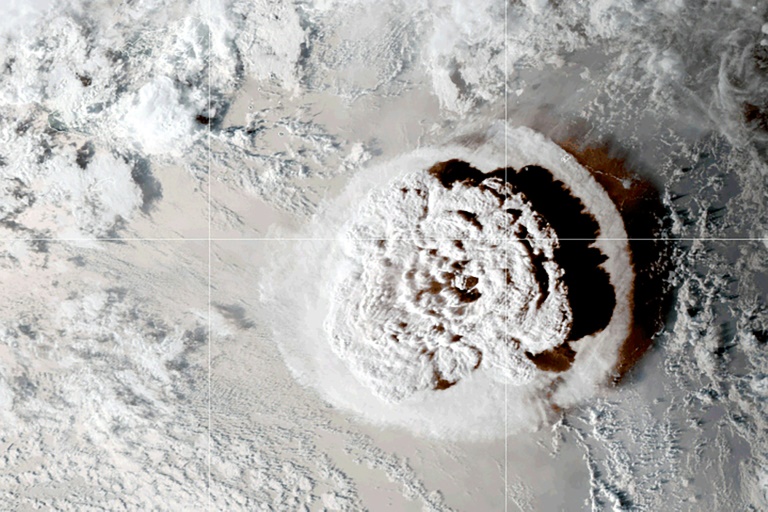
The January 15 eruption was so powerful it was heard as far away as Alaska and caused a tsunami that flooded coastlines around the Pacific.

It covered Tonga with ash and mangled an 80-kilometre stretch of the undersea cable that proved more difficult than expected to fix.

Immediately after the disaster, contact with Tonga was only possible via a handful of satellite links. Although some connectivity was later restored, connections were limited.

Digicel said “data connectivity had been restored” to two islands, after “multiple faults and breaks” were repaired.

“We are delighted to see that our customers are connected to the outside world again,” said Digicel Tonga chief executive Anthony Seuseu.

Earlier this month Tonga Cable Limited chief executive James Panuve said a repair ship had located the severed ends of the 840 kilometre-long cable linking Tonga to Fiji that was cut in the blast.

– ‘Major havoc’ –

But rather than a clean break, Panuve said the ship found the eruption tore an 80 kilometre section of cable into numerous pieces as it pummelled the seabed with the explosive force of a nuclear bomb.

“It is obvious that the eruption, shockwaves, (and) tsunami caused major havoc underwater,” he said.

Panuve said that after contending with poor weather, the cable repair ship “Reliance” had to retrieve sections of cable in waters up to 2.5 kilometres deep.

He said one section had been moved five kilometres by the undersea blast and another was buried under 30 centimetres (a foot) of silt.

The eruption of the Hunga Tonga-Hunga Ha’apai volcano, which lies about 65 kilometres north of the capital Nuku’alofa, killed three people.

According to UN agencies, the dual disaster also damaged 293 houses and displaced 1,525 people.

About 85 percent of the total population were affected by the disaster, with fresh water difficult to come by and arable land covered with six centimetres (two inches) of ash in some places.

Despite Tonga receiving aid under strict “no-contact” protocols, the international relief effort prompted a Covid-19 outbreak in the previously virus free nation.

China moves closer to Russia, but wary on Ukraine

China and Russia set off alarms in the West this month with the most robust declaration of their friendship in decades but Beijing has signalled it would not back Vladimir Putin if he sent troops in to invade Ukraine.

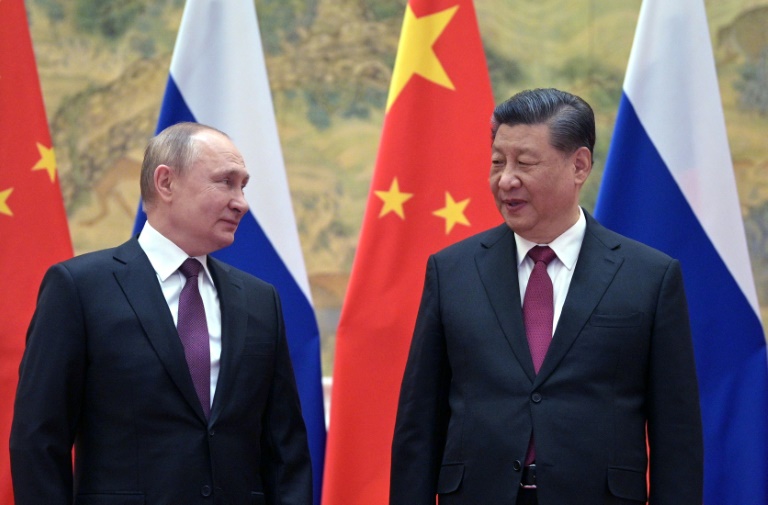
The February 4 joint statement by the neighbours included unprecedented support from Beijing for Moscow’s opposition to the expansion of NATO, and came as Washington and its allies were warning of full-scale Russian military action against Kyiv.

It was “quite a quantum shift from what has been a steady intensification, elevation of the content of Russia-China declarations over the last 20 years”, former Australian prime minister Kevin Rudd said during an online discussion co-hosted by the Atlantic Council think tank and the Asia Society.

“It is China becoming a global security actor in a way that I personally have not seen before.”

China’s unusually direct position on NATO and support for Moscow’s “reasonable” security concerns have, however, placed it on a diplomatic tightrope, forcing it to balance its close Russia ties with major economic interests in Europe.

With more than 150,000 troops massed on the border with Ukraine, Russia has demanded guarantees that Kyiv will never be allowed to join NATO — a position in stark contrast to China’s long-standing stated foreign policy red line: no interference in other countries’ internal affairs.

When asked if there was a contradiction, Chinese Foreign Minister Wang Yi told the Munich Security Conference via video link Saturday that the sovereignty of all nations should be respected.

“Ukraine is no exception,” he said.

That position was tested in just two days.

Russian President Putin on Monday recognised two “republics” in Ukraine held by pro-Moscow separatist rebels, and ordered the deployment of troops there.

The United States and its allies blasted Russia for violating the sovereignty of Ukraine at an emergency UN Security Council meeting, but China was circumspect, urging restraint by “all sides”.

Putin has “denied the territorial independence and sovereignty — indeed, the very existence — of Ukraine”, Ivo Daalder, former US ambassador to NATO, wrote on Twitter.

“Both were core… (tenets) of China’s approach to the crisis. Putin has blown both to bits.”

– Delicate balance –

This is not the first time China has had to strike a delicate balance between its interests and a major international escalation by its strategic partner Russia.

When Moscow annexed Crimea in 2014, China did not join Russia’s veto of a UN Security Council resolution on the issue, instead abstaining and mainly offering economic support.

Eight years later, experts say there are again limits to what Beijing can — or wants to — do for Moscow.

Among the key factors are trade and financial links with Europe. Overt backing of any Russian belligerence could also threaten the major investment deal Beijing is trying to seal with the bloc.

Further, some analysts say China may not want to escalate already high tensions with the United States.

“The Ukraine crisis… carries significant risk of the bottom falling out of (China’s) relationships with the EU and the US,” wrote Bill Bishop in the Sinocism China Newsletter.

“I do not believe that Xi and his team want to see Russia invade Ukraine, as they understand the risks from the expected reaction to any invasion.”

Others said that, with its support for Moscow’s concerns about NATO, Beijing may be looking to its own future security interests.

By implicitly siding with Moscow, Beijing gains “considerable diplomatic leverage” and “presumes that Russia will act likewise when China finds itself in a critical security situation”, Richard Ghiasy, an expert at the Hague Centre for Strategic Studies, told AFP.

– Act of defiance –

Despite Beijing’s guarded language on Ukraine, observers say the China-Russia joint announcement is still a stark challenge to the United States and its allies beyond the current crisis.

The statement contained challenges to the definitions of democracy and human rights, which Moscow and Beijing have been accused of violating by the West for years.

This prompted scathing criticism in Europe, with some accusing two authoritarian regimes of trying to redefine universal concepts to suit their agenda.

“It’s an act of defiance,” EU foreign policy chief Josep Borrell said at the Munich Security Conference on Sunday.

“It’s a clear revisionist manifesto.” 

UN experts slam online attacks on Indian journalist

UN rights experts have called for an end to “misogynistic and sectarian” online attacks against a Muslim Indian woman journalist, asking the authorities to investigate the harassment.

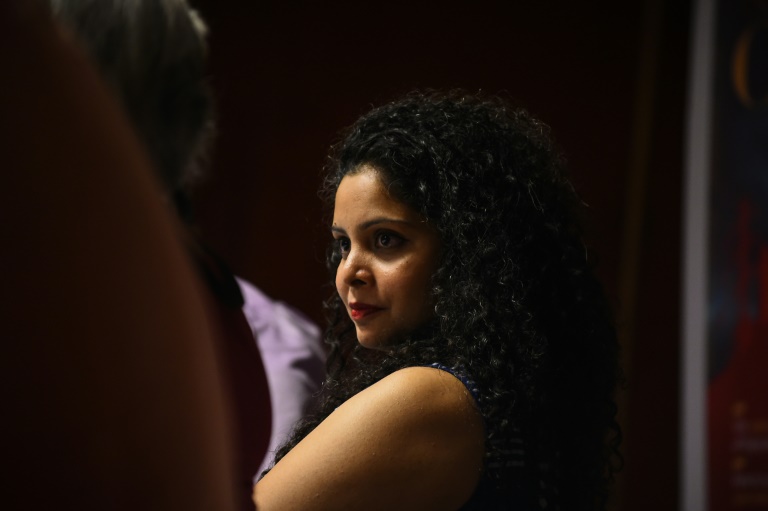
Rana Ayyub, a fierce critic of Prime Minister Narendra Modi and the Hindu nationalist ideology of his Bharatiya Janata Party (BJP), has been the target of a relentless campaign of online abuse — including death and rape threats.

She is the “victim of intensifying attacks and threats online by far-right Hindu nationalist groups”, the independent rapporteurs, who do not speak for the United Nations but are mandated to report to it, said in a statement Monday.

They said these attacks were in response to Ayyub’s reporting on issues affecting India’s minority Muslims, her criticism of the government’s handling of the Covid-19 pandemic, and her commentary on the recent hijab ban at schools and colleges in the southern state of Karnataka.

The rapporteurs added that the Indian government had failed to condemn or investigate the attacks.

She “has been subjected to legal harassment by the Indian authorities in relation to her reporting”, they said, including the freezing of her bank account and other assets.

Ayyub, 37, began as an investigative journalist and wrote a book accusing Prime Minister Narendra Modi of being complicit in deadly sectarian violence in Gujarat in 2002, when he was state premier.

Investigators cleared Modi of involvement.

She has since become a commentator for The Washington Post and other media.

This week, the Post put out a full-page advert saying Ayyub faces threats almost daily and that the free press is “under attack” in India.

The Indian mission at the UN in Geneva tweeted in response to the rapporteurs’ statement that allegations of “so-called judicial harassment are baseless & unwarranted”, and that advancing “a misleading narrative only tarnishes” the UN’s reputation.

Other journalists have also complained of increased harassment under Modi, whose government has been accused of trying to silence critical reporting.

Media rights group Reporters Without Borders places India at a lowly 142 in its World Press Freedom Index, saying that under Modi, “pressure has increased on the media to toe the Hindu nationalist government’s line”.

“The coordinated hate campaigns waged on social networks against journalists who dare to speak or write about subjects that annoy Hindutva (hardline Hindu ideology) followers are terrifying and include calls for the journalists concerned to be murdered,” according to RSF.

“The campaigns are particularly violent when the targets are women.”

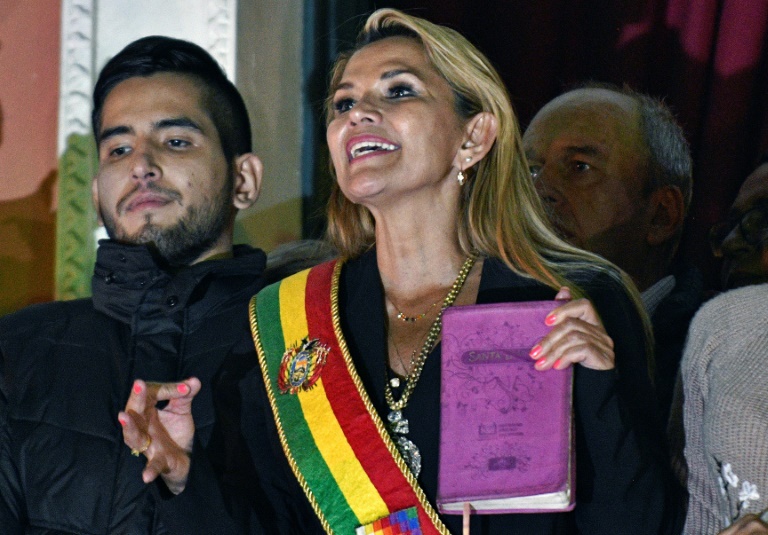
Ex-Bolivia interim president Anez gets 3 more months' prison

Former Bolivian interim president Jeanine Anez, imprisoned since March 2021 for her alleged role in a coup d’etat, will remain in detention for at least three more months, a court ruled Monday.

Hailed as a “political prisoner” by her supporters, Anez has been on a hunger strike since February 9, the eve of her trial over the ouster of former leftist president Evo Morales.

“The request for an extension of (provisional) detention can be granted for a period of three months,” Judge Armando Zeballos told an online hearing, noting it was a “complex” case with an ongoing investigation.

Her defense has appealed the decision.

“They continue to punish me at the whim of my executioners. The terrorism case does not exist. They have not proven anything since they kidnapped me. I am innocent,” the conservative ex-president, in power between 2019 and 2020, tweeted after the ruling. 

Accusations of terrorism still under investigation stem from complaints made by the families of victims of a police crackdown against protesters.

Anez, 54, is accused of unconstitutionally assuming the presidency on November 12, 2019 following the resignation of Morales, who fled into exile following 14 years in power.

A month earlier, Morales had faced a wave of protests after contesting for a fourth term, despite the constitution limiting the president to two successive terms. He fled into exile after being abandoned by the army and police.

After a year as acting president, Anez recognized the victory of Luis Arce, a candidate from Morales’s Movement for Socialism (MOS) party, in the October 2020 presidential election and handed him power.

Bolivia’s government, public prosecutor and MOS-dominated congress are the plaintiffs in the case against her.

Earlier this month, a group of 21 former Latin American presidents asked the United Nations to visit Anez and investigate potential “abuses of power” in her treatment.

Her trial could last at least three years.

Breeding ban for bulldogs and cavaliers in Norway

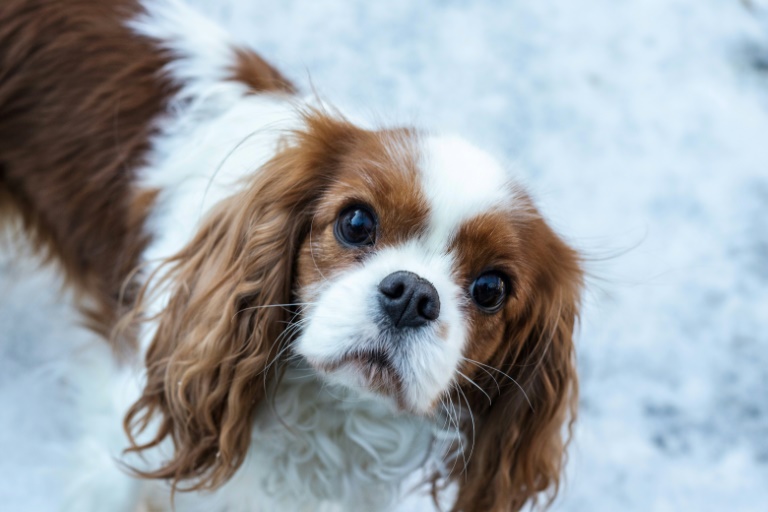
Cavalier King Charles Spaniels are known for their tiny heads, English bulldogs for their smushed wrinkled muzzles — traits their owners love.

But in an unprecedented move, Norway has banned the breeding of these dogs because being cute is causing them suffering.

In a recent ruling, the Oslo district court banned the breeding of the two purebreds on the grounds that it inflicts harm on them, in violation of Norwegian animal protection laws.

Hailed by animal rights activists and criticised by breeders, the verdict comes amid a growing debate: is the quest for cute pets going to extremes at the expense of the animals’ well-being?

“A lot of our breeds are highly inbred and have a massive burden of disease,” Ashild Roaldset, the head of the Norwegian Animal Welfare Society, told AFP.

Her organisation brought the legal case against dogbreeding companies and individuals.

“We need to change the way we breed dogs,” she said. “The way we breed dogs was maybe acceptable 50 years ago but is not acceptable anymore.”

Inbreeding has caused the two breeds to develop a “disease guarantee”, a long list of hereditary illnesses that affect most individuals, if not all.

Fierce-looking but gentle — and since World War II a symbol of British tenacity — the English bulldog has developed respiratory difficulties due to its flattened muzzle, as well as dermatological, reproductive and orthopaedic problems.

More than half of all bulldogs born in Norway over the past 10 years had to be delivered by Caesarian section.

“The race’s genetic inability to give birth naturally is reason alone for bulldogs not to be used for breeding,” the district court judges wrote in their ruling.

As for cavaliers — which have won the hearts of many over the years, from Queen Victoria to Ronald Reagan and Sylvester Stallone — they often suffer headaches because their skull is too small. They also have heart and eye problems.

Roaldset said these diseases cannot be bred away with other purebreds from abroad due to an overall lack of genetic diversity.

The two breeds will eventually be led to extinction, she said. 

“And it’s going to be painful for them because they’re just going to get more and more diseases,” she said.

– ‘Puppy factories’ –

The January 31 court ruling has been appealed and has therefore not come into force yet.

But it delivered a shock to professional breeders.

“In the judgement it was said that the dogs are born with headaches, I cannot understand that,” says Lise Gran-Henriksen, who has been a breeder for 25 years, as she watches five of her Cavalier King Charles Spaniels frolic on the ice outside her Oslo home.

“If so, they would not be so happy. They are happy dogs that run around and look very healthy, and that’s what I think they are,” she insists.

Professional breeders readily admit that the two breeds do pose “challenges”, but say these can be overcome by selective breeding of individuals that meet certain requirements.

In addition, they note that the court ruling does not ban the ownership, sale or import of bulldogs or cavaliers — only their breeding.

Walking her English bulldog Oscar in an Oslo park, Anne Grethe Holen fears a rise in “undocumented dogs” from “puppy factories” abroad.

“Demand will not decline. And the dogs that are sold will be more sick,” she says.

“They won’t be subjected to any veterinary requirements and you won’t know anything about their pedigree,” she adds.

Meanwhile, the Animal Welfare Society says the future of the two breeds lies in crossbreeding them with other types of dogs to get rid of their genetic flaws.

“If the cavalier gets a slightly larger skull to fit their brain, it’s still… going to be the cutest dog in the world,” says Roaldset.

“And if the bulldog gets a little bit less wrinkly, a little bit longer snout and a better skeleton, it’s not going to be a horrible dog.

“It’s going to look a little bit different, but you can still call it a bulldog.”

Behind Cape Town's heavenly beaches, the hell of dog fighting

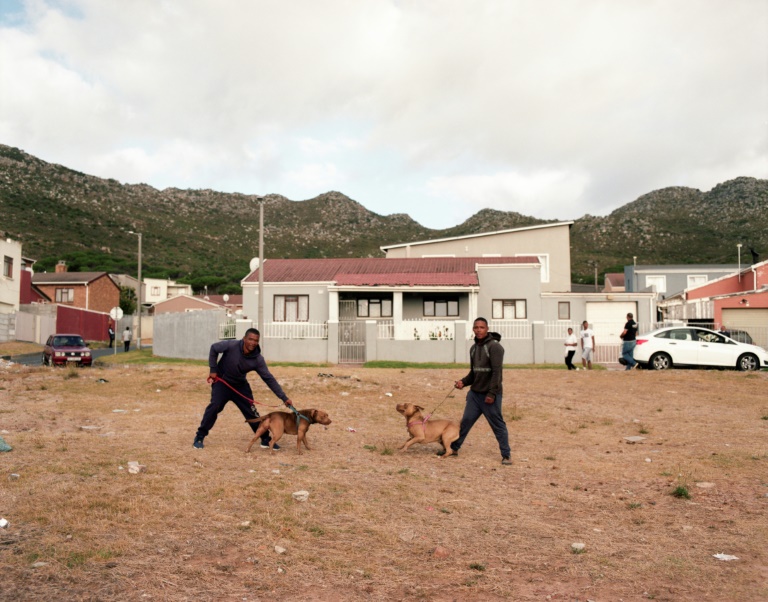
Ocean View is a contender for one of the world’s most ironic place names.

Stuck between mountains and exquisite white-sand beaches, this distant suburb of Cape Town has, in fact, no sea vista.

It was created in 1968 by South Africa’s apartheid regime as a “township” for so-called coloured people, who themselves had been forced out of areas that looked out on the Atlantic.

Houses made of stone and brick lie among vacant, grassless lots, signalling a middle-class life by South African standards — one without extreme wealth or poverty, but still touched by the country’s rampant problems of unemployment, substance abuse and crime.

Breeding or owning a fierce dog is part of the local culture — to protect one’s home from burglars, for instance. 

But some turn to dog fighting, a brutal and illegal activity, for fun and money, pitting pitbulls and other hounds bred and trained to kill against each other.

“These fights can get the owner between 5,000 and 20,000 rand ($330-1,300 / 300- 1,200 euros) if his dog wins,” said one dog owner, who said he had given up the business.

Combat takes place in a ring, which is set up either in an apartment or “in the bush”, out in the countryside, where the noise of barking or distressed dogs cannot be heard by passers-by.

Owners set the date for the fight around eight months in advance, giving them enough time to raise and maltreat a dog so that it is ready to fight with mindless ferocity.

Combat continues until one dog dies. “It can last between 40 minutes to three hours,” the source said, speaking on condition of anonymity.

Police try to crack down on the illegal activity, often using informers to bust a network, said an insider.

But dogs are not just bred for fighting.

Having a fierce dog provides social status as a sign of virility, and also provides protection.

“Nobody will jump over my fence because my dog is a bad one,” said one owner proudly.

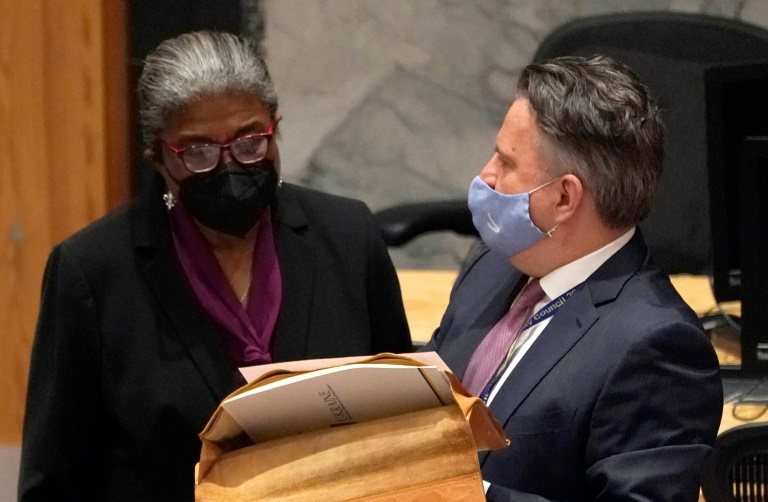
US, allies lambast Russia over Ukraine at UN Security Council

The United States and its allies rounded on Russia during an emergency Security Council session Monday, denouncing Vladimir Putin’s recognition of rebel-held areas in Ukraine and his ordered deployment of troops as a gross violation of international law and “pretext for war.”

Addressing the council, US Ambassador Linda Thomas-Greenfield heaped scorn on Putin’s assertion that the Russian troops would take on a peacekeeping role in the Donetsk and Lugansk areas.

“He calls them peacekeepers. This is nonsense. We know what they really are,” Thomas-Greenfield said.

Ukraine’s ambassador Sergiy Kyslytsya insisted that his country’s borders remain “unchangeable” despite Russia’s actions.

Meanwhile, Russia’s ambassador to the UN, Vasily Nebenzya, said Moscow is still “open to diplomacy for a diplomatic solution” — but warned against what he dubbed Ukrainian aggression.

“Allowing a new bloodbath in the Donbass is something we do not intend to do,” he added, referring to the region encompassing Donetsk and Lugansk.

Putin’s order has been widely seen as paving the way for an operation to deploy part of the potential invasion force he has massed on Ukraine’s borders.

In a lengthy televised national address announcing his recognition of the rebel-held areas, Putin railed against Ukraine as a failed state and “puppet” of the West, repeatedly suggesting it was essentially part of Russia.

Thomas-Greenfield said the speech amounted to a “series of outrageous, false claims” that were aimed at “creating a pretext for war.”

Her remarks came just before a White House spokesperson told AFP that Washington on Tuesday would impose sanctions on Moscow following Putin’s order.

– ‘Critical’ moment –

Russia — which currently holds the rotating presidency of the Council — had wanted the session to be closed, but the United States insisted it be public.

Multiple countries had requested Monday’s emergency meeting based on a letter from Ukraine that demanded its representative be able to attend.

Speaking before the UN late Monday, Kyslytsya challenged the Security Council to defy Russian intimidation, saying: “The United Nations is sick.”

“It’s been hit by the virus spread by the Kremlin. Will it succumb to this virus?” he said.

“It is in the hands of the membership.”

The Under-Secretary-General for Political and Peacebuilding Affairs, Rosemary DiCarlo, voiced “regret” that Russian troops were ordered to eastern Ukraine.

“The next hours and days will be critical,” DiCarlo said. “The risk of major conflict is real and needs to be prevented at all costs.”

Putin’s recognition of the separatist republics effectively buries a fragile 2015 peace plan for the conflict, and opens the door for direct Russian military involvement.

Moscow provided no details or date for any deployment of the “peacekeeping” forces, only saying that it “comes into force from the day it was signed.”

British envoy Barbara Woodward said the council must be united in urging Russia to “de-escalate” and “respect its obligations.”

“Russia has brought us to the brink. We urge Russia to step back,” Woodward said, as China called for restraint by “all sides.”

Geraldine Byrne Nason, Ireland’s ambassador to the UN, called Russia’s actions “a flagrant violation of international law,” saying the “unilateral step” had “cast into doubt all the diplomatic efforts of past weeks.”

Martin Kimani of Kenya pointed out that many countries were “birthed by the ending of empire” and urged against “dangerous nostalgia” for past borders, saying Russia’s move “breaches the territorial integrity of Ukraine.”

“Multilateralism lies on its deathbed tonight. It has been assaulted today, as it has been by other powerful states in the recent past,” Kimani said.

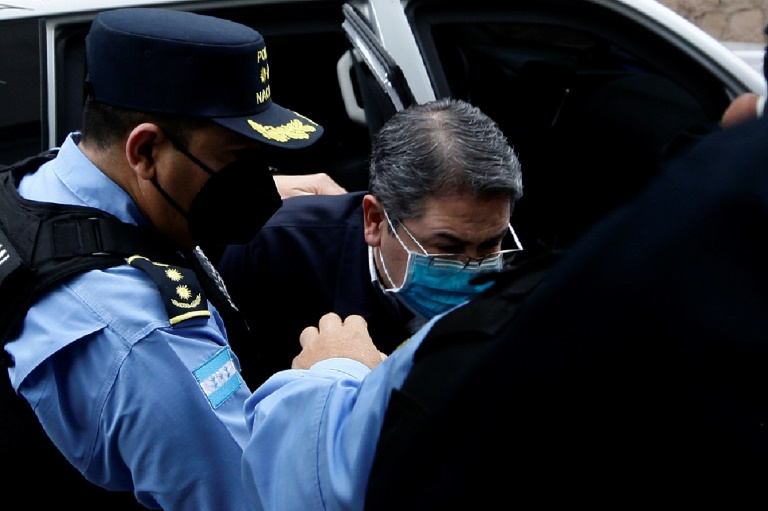
Honduran ex-president requests house arrest as US seeks extradition

Lawyers for Honduran ex-president Juan Orlando Hernandez, wanted on drug trafficking charges in the United States, asked Monday that he be granted house arrest while the extradition case against him proceeds, a spokesperson said.

The 53-year-old is accused of having facilitated the smuggling of some 500 tons of drugs — mainly from Colombia and Venezuela — to the United States via Honduras since 2004.

In turn, he allegedly received “millions of dollars in bribes… from multiple narcotrafficking organizations in Honduras, Mexico and other places,” according to a document from the US embassy in Tegucigalpa.

Washington requested on February 14 he be extradited to the United States to face charges.

He was arrested and placed in a prison at the Special Forces headquarters, in the east of the capital Tegucigalpa.

A judge ruled Hernandez would stay there in preventative detention until a second hearing next month.

But on Monday, Hernandez’s defense team requested “the change of detention measure… to his home, under house arrest,” Supreme Court spokesman Melvin Duarte said.

The court had said on Twitter the judge had agreed to hear an appeal from the defense team to revoke Hernandez’s preventative detention.

The appeal has to be approved by all 15 justices of the Supreme Court.

In power for eight years until January 27, when leftist Xiomara Castro was sworn in as Honduras’s first woman president, Hernandez was taken from his home in Tegucigalpa by Honduran police acting in coordination with US agencies, including the Drug Enforcement Administration.

While the rightwing politician had portrayed himself as an ally of the US war on drugs during his tenure, traffickers caught in the United States claimed to have paid bribes to the president’s inner circle.

Hernandez’s brother, former Honduran congressman Tony Hernandez, was given a life sentence in the United States in March 2021 for drug trafficking.

US Secretary of State Antony Blinken said on February 7 that “according to multiple, credible media reports,” Hernandez “has engaged in significant corruption by committing or facilitating acts of corruption and narco-trafficking and using the proceeds of illicit activity to facilitate political campaigns.”

Hernandez denies the claims, which he said were part of a revenge plot by traffickers that his government had captured or extradited to the United States.

His wife, Ana Garcia, appeared Monday before the National Commission on Human Rights to protest against the way her husband was arrested.

“You transmitted all the images of the humiliating and degrading way in which my husband was treated,” she told reporters. “The authorities who allowed the use of shackles and chains… exhibited him publicly as a trophy.”

But deputy security minister Julissa Villanueva said she had checked Hernandez’s prison conditions Monday and did not find “any violation of human rights, cruel or degrading treatment.”

Close Bitnami banner
Bitnami