World

Chile museum to return Easter Island 'head'

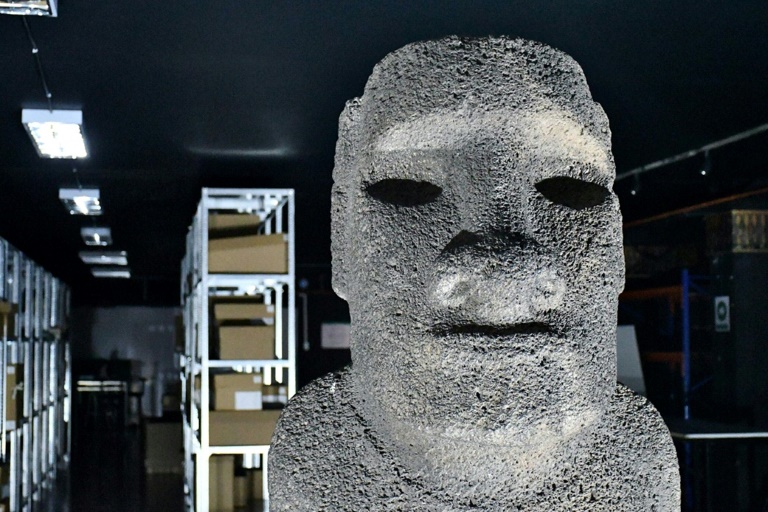
Chile’s National Museum of Natural History said Monday it will return to Easter Island an enormous stone statue taken from the Rapa Nui people and brought to the mainland 150 years ago.

The monolith is one of hundreds, called Moai, carved by the Rapa Nui in honor of their ancestors and sometimes referred to as the Easter Island heads. 

The statues are today the island’s greatest tourist attraction, sculpted from basalt more than 1,000 years ago. 

The one being returned, dubbed Moai Tau, is a 715-kilogram (1,500-pound) giant brought by the Chilean navy some 3,700 kilometers (2,300 miles) across the Pacific in 1870.

Eight years later, it was moved to the natural history museum to be displayed.

The Rapa Nui, for whom the Moai represent the spirits of their ancestors, have been asking for the statue’s return for years — as well as other cultural treasures taken from their island. 

“For the Rapa Nui, their ancestors, funerary objects and ceremonial materials may be as alive as members of their communities themselves,” said a museum statement.

The return of the monolith “is profoundly significant as a gesture towards our indigenous peoples,” said museum curator Cristian Becker.

With delays due to the coronavirus epidemic, the statue will finally depart from the port of Valparaiso next Monday on a trip of about five days to Easter Island, said the museum, “after a complex technical and diagnostic process” to guarantee its structural integrity.

A traditional ceremony was held at the museum Monday to send the statue safely on its way.

“It is essential that the Moai return to my homeland. For them (the community) and for me, this day is very much awaited,” said Veronica Tuqui, a Rapa Nui representative.

Back on Easter Island, the Moai will be exhibited at the Father Sebastian Englert Anthropological Museum.  

The Rapa Nui community has also asked the British Museum in London to return another Moai, dubbed Hoa Hakananai’a, that was taken in 1868 from Orongo, a ceremonial village on Easter Island. 

The Rapa Nui in 2017 gained self-administration over their ancestral lands on Easter Island, a special territory of Chile.

Bags packed, Ukrainians at frontline brace for Russian invasion

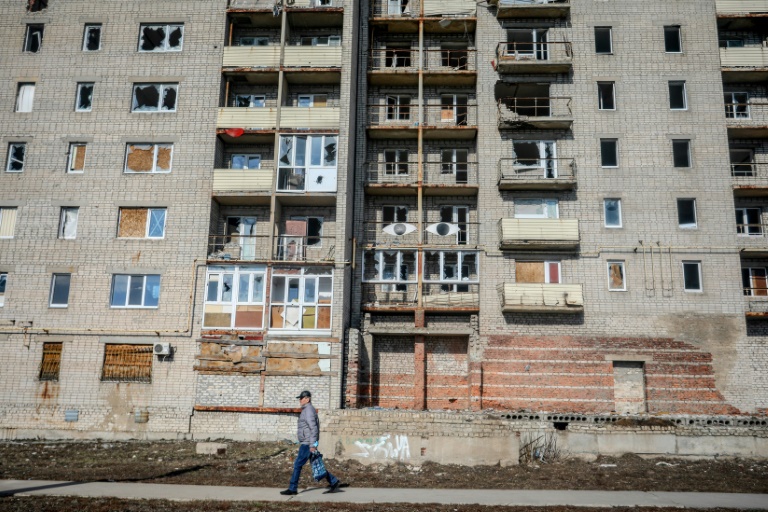
Only a fraction of the apartments in Anna Velichko’s shell-scarred high-rise are fit for habitation after years of a war in Ukraine that could turn yet more brutal should Russia invade.

The 39-year-old lives in one of them up on the ninth floor.

From her rickety perch overlooking the frontline of eastern Europe’s festering conflict, Velichko has a clear view of Donetsk and the Russian-backed rebels who take regular shots at the residents of her town of Avdiivka.

“Right now, they are shooting as hard as they did back in 2015,” Velichko says, referring to the second year of Ukraine’s eastern separatist conflict, when dozens were dying every day.

The official toll now, while disputed, is still small, with one civilian and two Ukrainian soldiers confirmed by Kyiv to have been killed in the past week.

But Velichko’s fury at both Russian President Vladimir Putin and Ukraine’s Western-backed leader Volodymyr Zelensky is huge.

“I want to slap Putin and Zelensky,” she says as fears of an all-out war between Russia and Ukraine rise by the day, if not the hour.

“I want them to finally sit down and agree to end this war,” she says.

– Ready to run –

Defying the threat of Western sanctions, Putin on Monday recognised the independence of Ukraine’s two separatist regions of Donetsk and Lugansk.

What remains unclear is what this recognition will entail.

The big fear in government-held territory along Ukraine’s front is that it will lead to the arrival of Russian troops, who would be formally asked to protect the pro-Moscow leadership and their territory.

The key unanswered question is whether Putin’s recognition extends only to rebel-held areas, or the broader pre-war administrative regions of Donetsk and Lugansk, which include Kyiv-controlled lands.

The separatists control only the eastern parts of Donetsk and Lugansk, where they created their own “people’s republics” in 2014.

Initial indications from Moscow officials was that this is the area that Putin was referring to in his recognition.

But a Kremlin recognition of the entire region could set the stage for a direct clash between Russian and Ukrainian troops along the current frontline, which includes towns such as Avdiivka.

Local residents are bracing for the worst.

– Emergency bags –

Pensioner Tetyana Polishchuk has held on to her flat through some of the fiercest months of war. But now she is packing her emergency evacuation bag, ready to run.

“They’ve started firing a lot more,” the 67-year-old says. “Because of the possible Russian invasion, I even packed my bags. I put them by there by the door, to be ready.”

Still, others said Putin’s formal recognition on Monday simply confirmed the realities on the ground.

Russia has already tried unilaterally to  redraw Ukraine’s border, annexing the Crimea peninsula in 2014 in a step that was never recognised by the West.

Yevgen Vasylenko, 30, said he was more worried about the fighting than who was in formal control of areas that had slipped out from under the government’s control eight years ago.

“I would rather not relive what happened in 2014, 2015 and 2016,” said Vasylenko. “Those were not pleasant times.”

Yevgen Tsyganok also was more worried about his personal safety.

“Sometimes, a very large shell or something like that shoots by and you feel it with your whole body,” says the 27-year-old.

“But we can’t run from here because my parents are there on the other side, in Donetsk,” he said. “They can’t go anywhere and I feel like I can’t either. This is our land.”

Brazil storm toll rises to 176, search continues

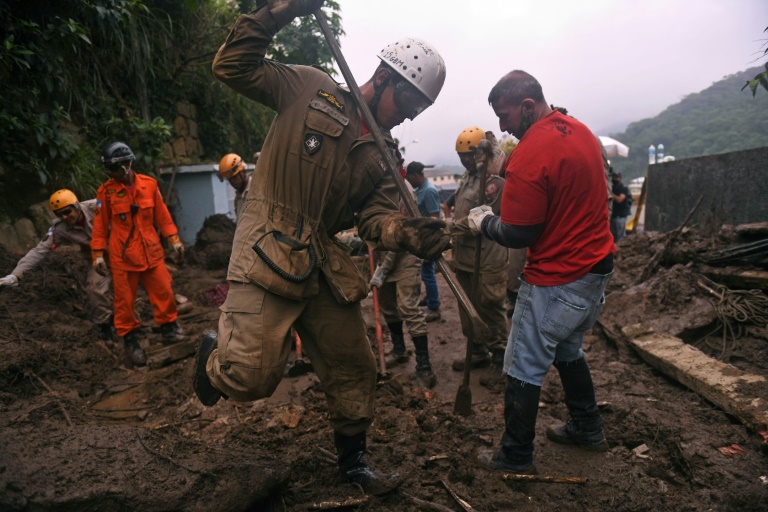
The death toll from violent floods and landslides that hit the scenic Brazilian city of Petropolis last week rose to 176 Monday, including 29 children, officials said.

Another 112 people remain missing, police said, raising fears the toll could rise further still as rescue workers continue digging through the mud and wreckage left by last Tuesday’s torrential rains.

The new toll means the storm is now the deadliest in the history of the southeastern city, a picturesque tourist town that was the 19th-century summer capital of the Brazilian empire.

It surpassed another violent storm in 1988 that claimed 171 lives.

Nearly a week after the tragedy, 143 of the 176 bodies recovered so far have been identified, officials said.

Twenty-four people were rescued alive in the early hours after the storm, but there is little chance now of finding more survivors beneath the wreckage, authorities say.

President Jair Bolsonaro flew over the disaster zone Friday, saying it looked like something “out of a war.”

Pope Francis sent his condolences following his weekly Angelus prayers Sunday, and Queen Elizabeth II added hers Monday.

“I am deeply saddened to hear of the tragic loss of life and destruction caused by the terrible floods in Brazil,” she said.

“My thoughts and prayers are with all those who have lost their lives, loved ones and homes, as well as the emergency services and all those working to support the recovery efforts.”

Officials say at least 847 people are being housed in shelters after losing their homes or being forced to evacuate.

Meanwhile, more violent rains Sunday in the southeastern state of Espirito Santo killed two people, emergency officials said.

In the past three months, at least 230 people have died in severe storms in Brazil.

Experts say the violent rains are being made worse by climate change.

Russia to recognise Ukraine rebel regions as Putin defies West

The Kremlin said Monday that Russian President Vladimir Putin was planning to recognise two rebel regions of Ukraine as independent, a move that could set off a potentially catastrophic conflict with Kyiv’s Western-backed government.

In a statement after Putin spoke to the French and German leaders, the Kremlin said Putin had informed them of requests from authorities in the breakaway regions and from Russian lawmakers for Moscow to grant recognition.

“In the near future, the president plans to sign the order,” the statement said, adding that France’s Emmanuel Macron and Germany’s Olaf Scholz “expressed disappointment” over the decision in the phone calls.

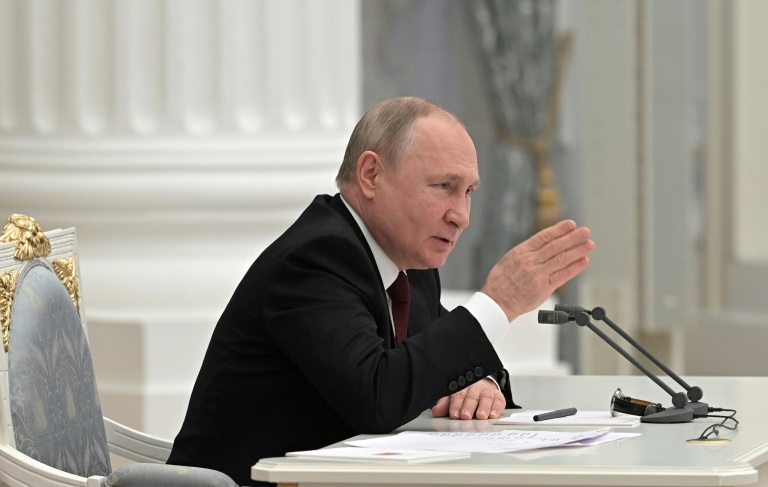
Putin had hours earlier presided over a long and carefully stage-managed meeting of his powerful Security Council, listening to senior officials say it was time for Russia to recognise the Donetsk People’s Republic and the Lugansk People’s Republic as independent.

“I have heard your opinions. The decision will be taken today,” he said after the meeting, which aired on state television for more than 90 minutes. 

State media have announced a televised statement by Putin later on Monday.

The recognition will effectively put an end to an already shaky peace plan in the separatist conflict, which has rumbled on since 2014, after Moscow annexed Crimea from Ukraine, and has left more than 14,000 dead.

Russia could now move in troops to protect hundreds of thousands of residents in the regions who have been granted Russian passports, justifying an intervention as a defence of its citizens.

Ukraine would then either have to accept the loss of a huge chunk of territory, or face an armed conflict with its vastly more powerful neighbour.

Ukrainian leader President Volodymyr Zelensky said he had convened his own National Security and Defence Council after Putin spoke, and also held calls with Macron and Scholz.

The sudden and decisive move by Moscow overshadowed last-ditch diplomatic attempts to ease weeks of tensions over fears Russia has been planning an all-out invasion of its pro-Western neighbour.

European leaders have been urging Putin to hold a summit with his US counterpart Joe Biden, and Russian Foreign Minister Sergei Lavrov told Putin in the security council meeting that he would meet his US counterpart on Thursday in Geneva.

– ‘Very big threat’ to Russia –

But Putin made clear there was no room for further talks on the separatists, telling the security council there were “no prospects” for the 2015 Minsk peace accords aimed at resolving the Ukraine conflict. 

He made clear the stakes were bigger than ex-Soviet Ukraine, whose efforts to join NATO and the European Union have deeply angered Moscow.

“The use of Ukraine as an instrument of confrontation with our country poses a serious, very big threat to us,” Putin said.

The dramatic meeting — with Putin sitting alone at a desk as his government, military and security chiefs took turns addressing him from a podium — came after weeks of tensions between Moscow and the West over Ukraine.

Western leaders are warning that Russia is planning to invade its pro-Western neighbour after massing more than 150,000 troops on its borders, a claim Moscow has repeatedly denied.

Ukraine on Monday requested an urgent meeting of the UN Security Council to address the threat, citing security assurances it received in return for giving up its nuclear arsenal in 1994.

Announcing the request on Twitter, Foreign Minister Dmytro Kuleba cited article six of the Budapest memorandum, the landmark 1994 deal also signed by Russia, the United States and Britain.

The tensions have spiked in recent days after an outbreak of heavy shellfire on Ukraine’s eastern frontline with the separatists and a series of reported incidents on the border with Russia. 

In one of the most potentially dangerous, Moscow claimed — to furious Kyiv denials — that its forces had intercepted and killed five Ukrainian saboteurs who infiltrated Russian territory, and accused Ukraine of shelling a border post.

– ‘Crush them, harm them’ –

Kyiv, concerned that Russia is building a narrative to justify an invasion, immediately denied all the allegations, which are being widely broadcast on Russian state media, and Kuleba took to Twitter. 

“No, Ukraine did NOT: attack Donetsk or Lugansk, send saboteurs or APCs (armoured personnel carriers) over the Russian border, shell Russian territory, shell Russian border crossing, conduct acts of sabotage,” he said.

“Ukraine also does NOT plan any such actions. Russia, stop your fake-producing factory now,” he wrote.

Also on Monday, local officials said shelling on the government-held village of Novoluganske, 35 kilometres (25 miles) north of the eastern rebel stronghold Donetsk, had killed a civilian there.

US National Security Advisor Jake Sullivan told NBC news that a Russian invasion of its neighbour would be an “extremely violent” operation followed by a brutal occupation.

“It will be a war waged by Russia on the Ukrainian people to repress them, to crush them, to harm them,” the White House official said.

Ukrainian Defence Minister Oleksiy Reznikov said there was no sign of Russian forces withdrawing from the border and Moscow-backed rebels continued to shell Ukrainian positions.

In recent weeks, according to US intelligence, Moscow has massed an invasion force of troops, tanks, missile batteries and warships around Ukraine’s borders in Belarus, Russia, Crimea and the Black Sea.

Biden has said that US intelligence believes that Putin has made a decision to invade Ukraine and that commanders are readying units to attack within days.

Western powers have threatened a crippling sanctions package if Russia invades and shortly before Putin’s announcement, EU foreign policy chief Josep Borrell said sanctions would also be “on the table” if Russia recognised the separatists.

burs-mm/dc/pvh

Global health champion Paul Farmer dies at 62

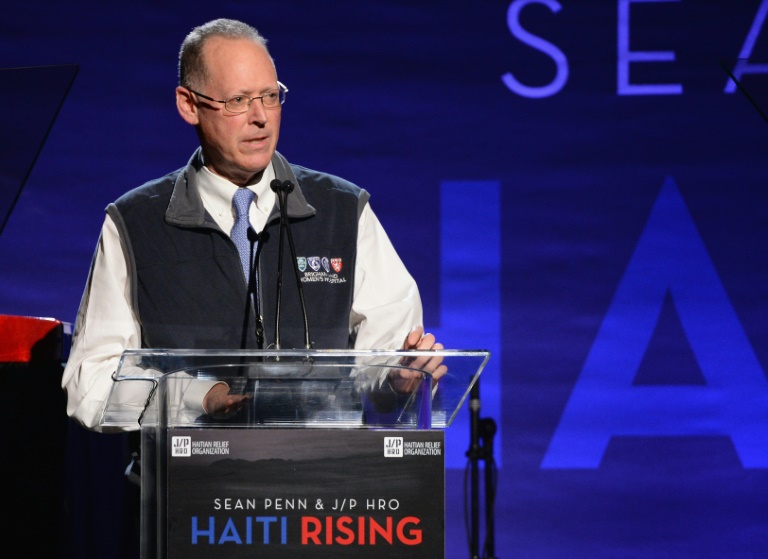
Paul Farmer, an American physician and medical anthropologist renowned for his innovative work in providing health care to poorer countries, died Monday at age 62, his Partners in Health group said.

The Boston-based organization said he “unexpectedly passed away today in his sleep while in Rwanda.”

Farmer’s work on providing healthcare solutions to poorer countries brought him wide acclaim. A 2003 book profiling him, “Mountains Beyond Mountains,” called him “the man who would cure the world.”

Samantha Power, the former US ambassador to the United Nations, tweeted that Farmer was “a giant” in his field.

“Devastating news,” she posted. “Paul Farmer gave everything — everything — to others. He saw the worst, and yet did all he could to bring out the best in everyone he encountered.”

Pulmonologist and medical analyst Dr Vin Gupta tweeted: “It is hard to overstate the impact Dr Paul Farmer had on the medical profession.”

And actor Edward Norton, a social and environmental activist, called Farmer “one of the most loving, funny, generous & inspiring people to grace humanity with his soul in our lifetimes.”

Working in Haiti in 1987, Farmer co-founded Partners in Health to help devise and deliver better healthcare in poor and badly underserved countries.

A co-founder and close longtime associate was Jim Yong Kim, who went on to lead the World Bank from 2012 to 2019.

In 2009, Farmer succeeded Kim as chair of the Department of Global Health and Social Medicine at Harvard Medical School.

The same year he was named a UN deputy special envoy to Haiti, working with Bill Clinton.

Farmer held that position at the time of the island’s devastating 2010 earthquake, and soon was headed to Haiti on an airplane full of physicians.

Farmer, a lifelong advocate for the poor Caribbean nation, co-founded the Institute for Justice and Democracy in Haiti.

He was editor in chief of the journal Health and Human Rights, and wrote extensively on the juncture of those two fields.

Farmer was also chief of the division of Global Health Equity at Brigham and Women’s Hospital, in Boston, Massachusetts.

He, Kim and another Partners in Health co-founder, Ophelia Dahl — daughter of British writer Roald Dahl and American actress Patricia Neal — are featured in a 2017 documentary, “Bending the Arc.”

In addition to Rwanda and Haiti, Partners in Health works in Kazakhstan, Lesotho, Liberia, Malawi, Mexico, Peru, Russia and Sierra Leone, as well as in Navajo communities in the United States.

Farmer was married to Didi Bertrand Farmer, a Haitian medical anthropologist.

Iran hails nuclear talk 'progress' but Raisi insists US sanctions end

Iran Monday signalled “significant progress” in talks on reviving a stalled accord on its nuclear programme but President Ebrahim Raisi, on his first visit to a Gulf state, again insisted that Washington must lift its crippling sanctions.

Iran’s ultraconservative president, a personal target of the US sanctions, spoke out ahead of a summit of natural gas exporting nations in Qatar. The summit will take place against the backdrop of mounting tensions in Ukraine and reported progress in efforts to restore the 2015 deal limiting Iran’s nuclear programme.

The United States withdrew from the nuclear accord in 2018 under former president Donald Trump, saying it was not tough enough in curtailing Iran’s weapons ambitions. Tehran has always denied seeking an atomic bomb.

But months of negotiations in Vienna have brought the two sides closer to a revived deal.

Iran’s foreign ministry said Monday that “significant progress” has been made and the number of outstanding obstacles had been “considerably reduced”.

“But the problems that remain are most difficult, the most difficult and most serious to be resolved,” it added.

Talks on reviving the Joint Comprehensive Plan of Action (JCPOA) resumed in the Austrian capital in November, after originally getting underway in April before stalling for months after Raisi won the presidency in June.

The dialogue involves Britain, China, France, Germany and Russia directly and the United States indirectly.

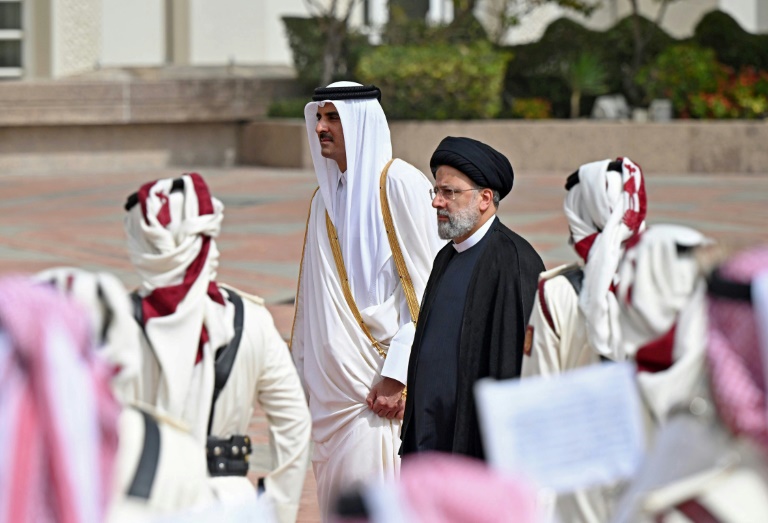
After arriving in Doha and meeting Qatar’s emir, Sheikh Tamim bin Hamad al-Thani — a close US ally who has encouraged the two sides to narrow their differences — Raisi again took aim at the US sanctions that have ravaged his country’s economy.

– ‘Lift the main sanctions’ –

“The United States must show their desire to lift the main sanctions,” he said.

“To reach an accord, it is necessary to guarantee the interests of the Iranian people, in particular the lifting of sanctions, (give) a strong guarantee and end dossiers of a political character.”

Raisi was named in US Treasury sanctions in 2019. The trip to Qatar is only his fourth abroad since he took office in August.

Qatar has added the Iran nuclear dispute to its list of diplomatic hotspots where it has taken a behind-the-scenes mediation role and the emir called for more dialogue to settle the showdown.

Qatar’s Foreign Minister Sheikh Mohammed bin Abdulrahman al-Thani went on an unannounced visit to Tehran shortly before the emir met US President Joe Biden this month in Washington.

Sanctions have badly hit Iran’s oil and gas revenues and the Tehran government is anxious to get new investment and customers.

The gas exporters’ summit has been dominated by Ukraine tensions that have raised prices and European fears that its supplies of Russian gas may be cut. 

The United States has asked Qatar to help Europe by preparing emergency supplies if the Ukraine crisis worsens.

But producing nations say they will not be able to provide substantial amounts of replacement gas if sanctions against Russia do affect Western Europe.

Raisi and the Qatari emir will be joined at Tuesday’s summit by Algeria’s President Abdelmadjid Tebboune and Trinidad and Tobago’s Prime Minister Keith Rowley. Energy ministers from the other seven forum members, who include Russia, will also take part.

Ministers from the 11-member group met on Monday to approve a summit statement that industry analysts predicted would touch on the lack of spare supplies that could help Europe, where consumers are already paying record prices for gas.

Qatar and other countries have insisted that massive investment is needed in gas infrastructure, and that they need the certainty of long-term contracts to be able to guarantee supplies to Europe. 

The European Union has long resisted the 10, 15 and 20-year contracts signed by other major customers for Qatar’s gas, which include China, Japan and South Korea.

Bags packed, Ukrainians at frontline brace for Russian invasion

Only a fraction of the apartments in Anna Velichko’s shell-scarred high-rise are fit for habitation after years of a war in Ukraine that could yet turn more brutal still should Russia invade.

The 39-year-old lives in one of them up on the ninth floor.

From her rickety perch overlooking the frontline of eastern Europe’s festering conflict, Velichko has a clear view of Donetsk and the Russian-backed rebels who take regular shots at the residents of her town of Avdiivka.

“Right now, they are shooting as hard as they did back in 2015,” Velichko says, referring to the second year of Ukraine’s eastern separatist conflict, when dozens were dying a day.

The official toll now, while disputed, is still small, with one civilian and two Ukrainian soldiers confirmed to have been killed by Kyiv in the past week.

But Velichko’s fury at both Russian President Vladimir Putin and Ukraine’s Western-backed leader Volodymyr Zelensky is huge.

“I want to slap Putin and Zelensky,” she says as fears of an all-out war between Russia and Ukraine rise by the day, if not the hour.

“I want them to finally sit down and agree to end this war,” she says.

– Ready to run –

Putin told an emergency meeting of his security council that he would decide later Monday whether to recognise the independence of Ukraine’s two separatist regions of Donetsk and Lugansk.

Few doubt he will. What remains unclear is what this recognition will entail.

The big fear in government-held territory along Ukraine’s front is that it will lead to the arrival of Russian troops, who would be formally asked to protect the pro-Moscow leadership and their territory.

The key unanswered question is whether Putin is willing to only recognise the rebel-held areas as independent, or the broader pre-war administrative regions of Donetsk and Lugansk, which include Kyiv-held lands.

The separatists control only the eastern parts of Donetsk and Lugansk.

A Kremlin recognition of the entire region could set the stage for a direct clash between Russian and Ukrainian troops along the current frontline, which includes towns such as Avdiivka.

Local residents are bracing for the worst.

– Emergency bags –

Pensioner Tetyana Polishchuk has held on to her flat through some of the fiercest months of war. But now she is packing her emergency evacuation bag, ready to run.

“They’ve started firing a lot more,” the 67-year-old says. “Because of the possible Russian invasion, I even packed my bags. I put them by there by the door, to be ready.”

But Yevgeniy Tsyganok says he has nowhere left to go after moving his family to Avdiivka in the weeks after the rebels’ seizure of his home city of Donetsk in 2014.

“Sometimes, a very large shell or something like that shoots by and you feel it with your whole body,” the 27-year-old says.

“But we can’t run from here because my parents are there on the other side, in Donetsk,” he said. “They can’t go anywhere, and I feel like I can’t either. This is our land.”

Putin to decide 'today' on recognising Ukraine rebel regions

Russian President Vladimir Putin said Monday he would decide by the end of the day whether to recognise two rebel regions of Ukraine as independent, a move that could set off a potentially catastrophic conflict with Kyiv’s Western-backed government.

Presiding over a long and carefully stage-managed meeting of his powerful Security Council, Putin listened to senior officials say it was time for Russia to recognise the breakaway regions of Donetsk and Lugansk as independent.

“I have heard your opinions. The decision will be taken today,” the Russian leader said after the meeting, which aired on state television for more than 90 minutes.

Such recognition would put an end to an already shaky peace plan in the separatist conflict, which has rumbled on since 2014 after Moscow annexed Crimea from Ukraine and has left more than 14,000 dead.

Russia could then move in troops to protect hundreds of thousands of residents in the regions who have been granted Russian passports, justifying an intervention as a defence of its citizens.

Ukraine would either have to accept the loss of a huge chunk of territory, or face an armed conflict with its vastly more powerful neighbour.

Putin told the security council there were “no prospects” for the 2015 Minsk peace accords aimed at resolving the conflict and made clear that the stakes were bigger than ex-Soviet Ukraine, whose efforts to join NATO and the European Union have deeply angered Moscow.

– ‘Very big threat’ to Russia –

“The use of Ukraine as an instrument of confrontation with our country poses a serious, very big threat to us,” Putin said.

The dramatic meeting — with Putin sitting alone at a desk as his government, military and security chiefs took turns addressing him from a podium — came after weeks of tensions between Moscow and the West over Ukraine.

Western leaders are warning that Russia is planning to invade its pro-Western neighbour after massing more than 150,000 troops on its borders, a claim Moscow has repeatedly denied.

Ukraine on Monday requested an urgent meeting of the UN Security Council to address the threat, citing security assurances it received in return for giving up its nuclear arsenal in 1994.

“On President (Volodymyr) Zelensky’s initiative, I officially requested UNSC member states to immediately hold consultations under article six of the Budapest memorandum,” Foreign Minister Dmytro Kuleba tweeted, citing the landmark 1994 deal, also signed by Russia, the United States and Britain.

The tensions have spiked in recent days after an outbreak of heavy shellfire on Ukraine’s eastern frontline with the separatists and a series of reported incidents on the border with Russia. 

In one of the most potentially dangerous, Moscow claimed — to furious Kyiv denials — that its forces had intercepted and killed five Ukrainian saboteurs who infiltrated Russian territory, and accused Ukraine of shelling a border post.

– ‘Crush them, harm them’ –

Kyiv, concerned that Russia is building a narrative to justify an invasion, immediately denied all the allegations, which are being widely broadcast on Russian state media, and Foreign Minister Dmytro Kuleba took to Twitter. 

“No, Ukraine did NOT: attack Donetsk or Lugansk, send saboteurs or APCs (armoured personnel carriers) over the Russian border, shell Russian territory, shell Russian border crossing, conduct acts of sabotage,” he said.

“Ukraine also does NOT plan any such actions. Russia, stop your fake-producing factory now,” he wrote.

European leaders are attempting to broker a diplomatic resolution, urging Putin to hold a summit with his US counterpart Joe Biden, and Russian Foreign Minister Sergei Lavrov said he would meet his US counterpart on Thursday in Geneva.

But any hope for diplomacy was faltering, especially in Washington and Kyiv.

US National Security Advisor Jake Sullivan told NBC news that a Russian invasion of its neighbour would be an “extremely violent” operation followed by a brutal occupation.

“It will be a war waged by Russia on the Ukrainian people to repress them, to crush them, to harm them,” the White House official said.

Visiting Brussels, Kuleba gave a cautious welcome to a French effort to arrange a summit of top leaders on the crisis. 

“We believe that every effort aimed at a diplomatic solution is worth trying,” he said.

But Defence Minister Oleksiy Reznikov said there was no sign of Russian forces withdrawing from the border and that Moscow-backed rebels continue to shell Ukrainian positions.

In recent weeks, according to US intelligence, Moscow has massed an invasion force of troops, tanks, missile batteries and warships around Ukraine’s borders in Belarus, Russia, Crimea and the Black Sea.

Biden has said that US intelligence believes that Putin has made a decision to invade Ukraine and that commanders are readying units to attack within days.

Western powers have threatened a crippling sanctions package if Russia invades. 

burs-mm/dc/jv

Thousands rally in Sudan against military coup

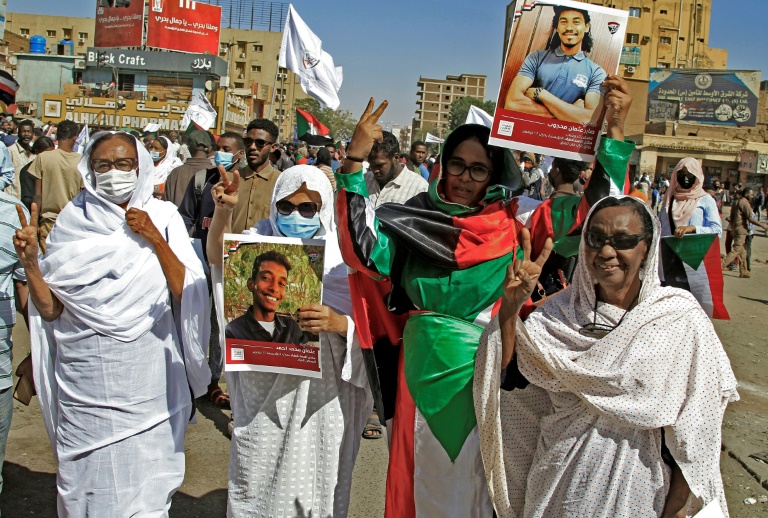
Thousands of Sudanese protesters on Monday marched against the October military coup which has led to scores of arrests, as authorities released some of those held, witnesses and lawyers said.

Regular protests calling for civilian rule have occurred throughout the impoverished northeast African country despite a deadly crackdown since the power grab led by army chief Abdel Fattah al-Burhan.

The coup, Sudan’s latest, sparked wide international condemnation and cuts in aid. 

At least 82 people have been killed, many of them shot dead, and hundreds wounded by security forces, according to medics. The latest fatality came on Sunday.

“The number of people detained has exceeded 200,” according to a statement by a group of anti-coup lawyers, which confirmed that some had been ordered released. 

Multiple political figures and pro-democracy activists are among those who have been detained.

Pro-democracy lawyer Enaam Attik said authorities have ordered that more than 40 people arrested in the crackdown on anti-coup protests be freed. 

During Monday’s demonstrations, protesters called on the military “to go back to the barracks” in the city of Wad Madani, south of Khartoum, witnesses said.

In the eastern state of Gedaref they chanted, “Civilian rule is the people’s choice,” according to witness Amal Hussein.

Demonstrators also marched to rally outside a government building in the Red Sea city of Port Sudan but security forces blocked their route with tear gas, witnesses said. 

In the eastern border state of Kassala, young protesters chanted, “No, no to military rule” as they headed toward a military base in the city, witness Hussein Idris said. 

Security forces in the capital Khartoum fired tear gas at hundreds of protesters who tried to rally outside the presidential palace, where the ruling Sovereign Council is based along the Nile River, an AFP correspondent said. 

The latest demonstrations came one day after United Nations human rights expert Adama Dieng arrived on his first official visit to Sudan. 

Dieng is scheduled to meet with senior Sudanese government officials, diplomats, rights defenders and others. 

The military takeover derailed a transition to full civilian rule negotiated between military and civilian leaders following the 2019 ouster of strongman president Omar al-Bashir.

Shelter for traumatised apes in DR Congo's strife-torn east

Beyond the reach of bloody conflicts in eastern Democratic Republic of Congo, rescued apes swing from one branch to another under the leafy canopy at a wildlife sanctuary.

On the edge of a national park that is home to endangered gorillas, the Lwiro Ape Rehabilitation Centre (CRPL) has for two decades nursed wounded and traumatised animals to recovery and taken in orphans.

The centre houses scores of chimpanzees, gorillas and bonobos among its wards, often saved from poachers in a region where illegal activities go largely unchallenged in the insecurity caused by many armed groups.

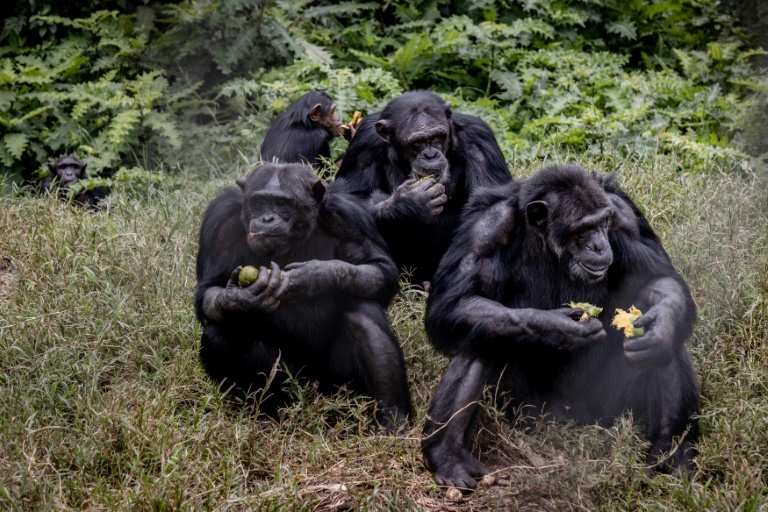
During a recent visit, half a dozen apes gathered behind a fence to choose the best banana to peel and eat after a fresh food delivery.

Female chimpanzees walked around, carrying their babies on their backs.

Each of the 110 chimpanzees at the sanctuary in South Kivu province eats six kilogrames (13.2 pounds) of fruit, cereals and vegetables a day, its staff say. The infants are bottle-fed.

“These orphaned baby chimps are coming to us because of insecurity and war,” centre manager Sylvestre Libaku said, urging the government to secure the region to “let the animals live peacefully in their natural habitat”.

– ‘Unhealed wounds’ –

Weeks or even months of effort are needed to stabilise an animal in its new home. Tarzan, a chimpanzee collected last June in Bunia in the troubled Ituri province to the north, still lives in quarantine.

The ape has unhealed wounds on his skull, but “is doing better. The hair is starting to grow [but] he is still kept in his cage, waiting for him to be able to mix with the others”, Libaku said.

However, Byaombe, another injured chimpanzee picked up more than a year ago, is a source of worry. The animal receives care every day but “without success — its future is not reassuring”, he said.

In his laboratory, Damien Muhugura handles samples taken from sick animals.

“We do parasitological analyses to search for intestinal worms, for example,” among other bacteriological and biochemical risks, he explained.

The facility extends over four hectares (almost 10 acres) inside the Kahuzi-Biega National Park, named after two extinct volcanoes and listed as a UN World Heritage Site.

Animals brought in from large forests where they roamed freely “feel trapped” on the small territory, said Assumani Martin, a veterinarian for the CRPL.

In November 2020, 39 grey parrots were released into the Kahuzi-Biega forest, after a stay for adaptation at the Lwiro facility, founded in 2002 by the Congolese Institute for the Conservation of Nature and the Centre for Research in Natural Sciences.

Since then, no animals have been introduced to the reserve because of the insecurity in and around the protected domain, Libaku says.

Covering 600,000 hectares, the national park lies between the extinct Kahuzi and Biega volcanoes. It provides a sanctuary to a remarkable diversity of wildlife, including some 250 eastern lowland gorillas, the last of their kind.

UNESCO describes the park as “one of the ecologically richest regions of Africa and worldwide”, but it is also one of 52 sites on the World Heritage endangered list for the planet.

Close Bitnami banner
Bitnami