World

Curtain set to fall on Beijing Olympics after tears, doping and Gu

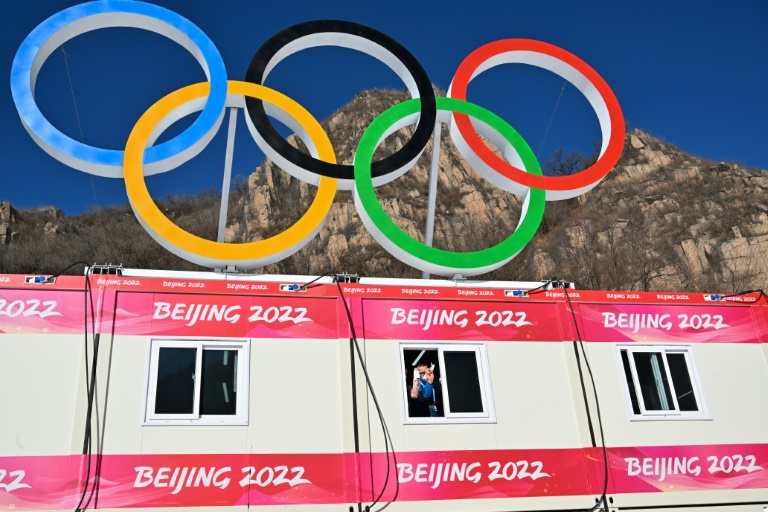
A Beijing Winter Olympics beset by concerns about rights and Covid in the build-up and tarnished by a Russian doping scandal once under way were set to close on Sunday.

The curtain will come down on a Games which will be remembered for sporting excellence and the doping controversy which engulfed 15-year-old figure skater Kamila Valieva, but also because they took place inside a vast Covid-secure “bubble”.

The impressive “Bird’s Nest” stadium — which also took centre stage when Beijing hosted the 2008 Summer Games — will be the scene for the closing ceremony, as it was for the opening on February 4.

In the more than two weeks since, a new global star was born in the form of 18-year-old freestyle skier Eileen Gu, who was born in California but switched to China in 2019 and became the unofficial face of the Games.

There was a new men’s figure skating champion in 22-year-old Nathan Chen of the United States, who dethroned Japan’s two-time Olympic champion Yuzuru Hanyu, in what could be his final appearance at a Games. 

Another legendary figure of winter sports, the American snowboarder Shaun White, will definitely not be returning to competition of any sort after calling it quits.

The 35-year-old’s last competition ended agonisingly out of the medals and he was in tears as he bid farewell to snowboarding — “the love of my life”.

There was bitter disappointment for his fellow American, the ski star Mikaela Shiffrin, one of the biggest names at the Games, who went home without a medal.

There were tears from the teenager Valieva after it emerged that she had failed a drugs test prior to the Games, catapulting her to the forefront of yet another Russian doping controversy to mar an Olympics.

In what will go down as a notorious episode in the history of the Winter Olympics, the pre-tournament favourite for women’s singles gold fell several times on the ice in the finals, to audible gasps from the socially distanced crowd of hand-picked spectators.

Her doping case looks certain to drag on in the coming months, long after the Games have ended. She was allowed to skate but has not been cleared of doping.

In a Games first, the skating team medals were not awarded after Valieva played a starring role in propelling the Russians to gold, ahead of the United States and Japan.

The American skaters made an 11th-hour court bid on Saturday to get their hands on their medals before they went home, but the Court of Arbitration for Sport rejected them.

– Shiffrin’s ‘favourite memory’ –

China and its ruling Communist Party will look back on a job well done — fears about a mass Covid outbreak in the “closed loop” bubble sealing the nearly 3,000 athletes and about 65,000 others never materialised.

Some athletes did though catch the illness and saw their Olympic hopes obliterated, among them American figure skater Vincent Zhou. 

“I’ve already lost count of the number of times I’ve cried today,” the 21-year-old said in an emotional video from isolation.

The United States led a diplomatic boycott of its closest allies over China’s rights record, especially the fate of the Muslim Uyghur minority in Xinjiang. Their athletes did however compete.

China had warned in the fraught build-up that foreign athletes criticising the authorities could face consequences, but in the end, any protests against the hosts were extremely muted.

There were milestones — among them American bobsleigher Elana Meyers Taylor becoming the most decorated Black athlete in the history of the Winter Olympics.

Snowboarder Zoi Sadowski Synnott made history for New Zealand, winning her country’s first Winter Games gold; with Gu winning two golds, the hosts enjoyed a significant medal bump and finished third in the medals table with nine golds.

That was easily their best performance in the Winter Games, a place ahead of chief geopolitical rival the United States, on eight golds.

For the second Games in a row, Norway topped the medals table, with 16 golds. Germany were second on 12.

Earlier Sunday, on the last day of action, Shiffrin said her United States team-mates got her through the Games even as she went home without a medal around her neck.

The mixed team parallel was her last opportunity to salvage something from the wreckage of these Olympics, after she inexplicably misfired in the individual events, skiing out of three races and finishing out of the medals in two others.

Her US team were beaten to bronze by Norway, but Shiffrin said: “I am not disappointed.

“I have had a lot of disappointing moments at these Games, today is not one of them. Today is my favourite memory.”

The closing ceremony starts at 8:00pm (1200 GMT) with Beijing handing over to 2026 hosts Milano Cortina.
Russian forces to stay in Belarus as Ukraine braced for war

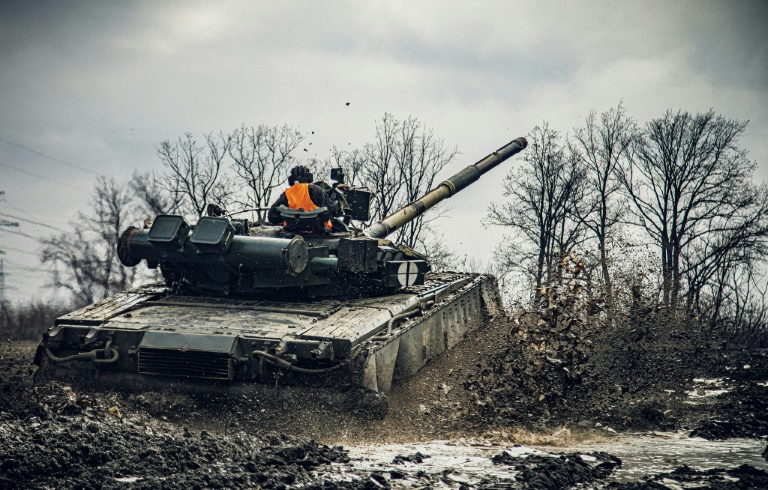
Russian military exercises in Belarus will continue, Minsk announced Sunday, leaving Moscow with a large force near the northern Ukraine border as Western powers warn of an imminent invasion.

The announcement came as French President Emmanuel Macron called Russia’s Vladimir Putin for talks the Elysee described as “the last possible and necessary efforts to avoid a major conflict in Ukraine”.

Moscow had previously said the 30,000 troops it has in Belarus were simply carrying out readiness drills with its ally, which would be finished by February 20, allowing the Russians to head back to their bases.

But, as the day arrived for the operation to end, the Belarus defence ministry said Putin and Belarusian leader Alexander Lukashenko had decided to “continue inspections”, citing increased military activity on their shared borders and an alleged “escalation” in east Ukraine. 

The move will be seen as a further tightening of the screws on Ukraine, already facing increased shelling from Russian-backed separatist rebels and a force of what Western capitals says is more than 150,000 Russian personnel on its borders.  

It will also be seen as a rebuff to efforts by leaders like Macron and Germany’s Chancellor Olaf Scholz to urge their Russian counterpart to pull back from the brink of war.

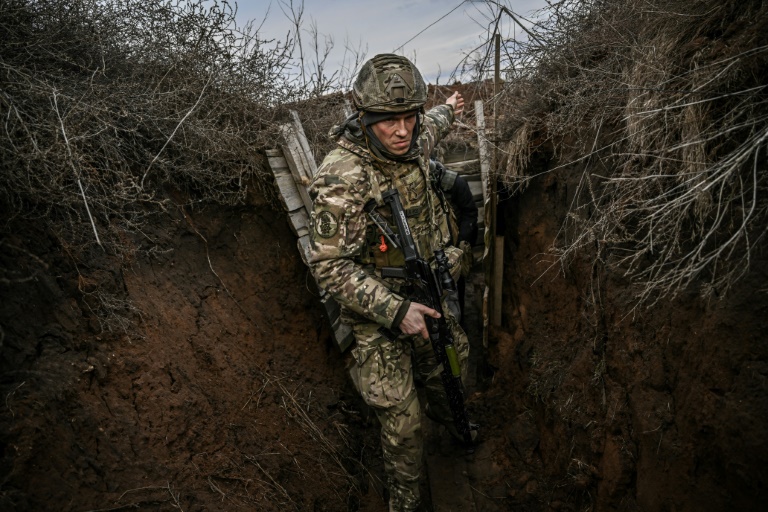
More bombardments were heard by AFP reporters overnight close to the frontline between government forces and the Moscow-backed rebels who hold parts of the districts of Lugansk and Donetsk.

– Occupied enclave –

“Every indication indicates that Russia is planning a full-fledged attack against Ukraine,” NATO chief Jens Stoltenberg said, echoing US President Joe Biden, who believes the invasion is imminent.

The Moscow-backed separatists have accused Ukraine of planning an offensive into their enclave, despite the huge Russian military build-up on the frontier.

Kyiv and Western capitals ridicule this idea, and accuse Moscow of attempting to provoke Ukraine and of plotting to fabricate incidents to provide a pretext for a Russian intervention.

“Russian military personnel and special services are planning to commit acts of terror in temporarily-occupied Donetsk and Lugansk, killing civilians,” alleged Ukraine’s top general Valeriy Zaluzhniy.

“Our enemy wants to use this as an excuse to blame Ukraine and move in regular soldiers of the Russian armed forces, under the guise of ‘peacekeepers’,” the military chief of staff said.

The rebel regions have made similar claims about Ukraine’s forces and have ordered a general mobilisation, while staging an evacuation of civilians into neighbouring Russian territory.

Officials with the Lugansk rebels claimed Sunday they had repulsed an attack by Ukrainian forces that had left two civilians dead, but the Ukrainian interior ministry immediately denounced the claim as an “absolute fake”.

Russian investigators said they had opened a probe into the alleged incident.

Russia, according to Western leaders, has more than 150,000 troops along with missile batteries and warships massed around Ukraine, poised to strike.

Ukrainian President Volodymyr Zelensky told Macron on Saturday he would not respond to Russia’s provocations, according to the Elysee.

But in his speech to the Munich Security Conference, he also condemned “a policy of appeasement” towards Moscow.

“For eight years, Ukraine has been holding back one of the greatest armies in the world,” he said.

He called for “clear, feasible timeframes” for Ukraine to join the US-led NATO military alliance — something Moscow has said it would never accept, as it tries to roll back Western influence.

Western officials in Munich warned of enormous sanctions if Russia attacks, with US Vice President Kamala Harris saying this would only see NATO reinforce its “eastern flank”.

– Nuclear drills –

On Saturday, from the Kremlin situation room, Putin and Lukashenko watched the launch of Russia’s latest hypersonic, cruise and nuclear-capable ballistic missiles.

Putin has also stepped up his rhetoric, reiterating demands for written guarantees that NATO roll back deployments in eastern Europe to positions from decades ago.

“The big question remains: does the Kremlin want dialogue?” European Council President Charles Michel asked at the Munich Security Conference. “We cannot forever offer an olive branch while Russia conducts missile tests and continues to amass troops.”

The volatile front line between Ukraine’s army and Russian-backed separatists has seen a “dramatic increase” in ceasefire violations, monitors from the OSCE European security body have said.

Hundreds of artillery and mortar attacks were reported in recent days, in a conflict that has rumbled on for eight years and claimed more than 14,000 lives.

The OSCE said there had been 1,500 ceasefire violations in Donetsk and Lugansk on Friday alone, and AFP reporters in the area have heard heavy shelling since.

On Saturday, a dozen mortar shells fell within a few hundred metres (yards) of Ukraine’s Interior Minister Denys Monastyrskiy as he inspected a frontline position with journalists in tow.

burs-dc/mm/bp

Passenger found alive on ferry ablaze off Greece

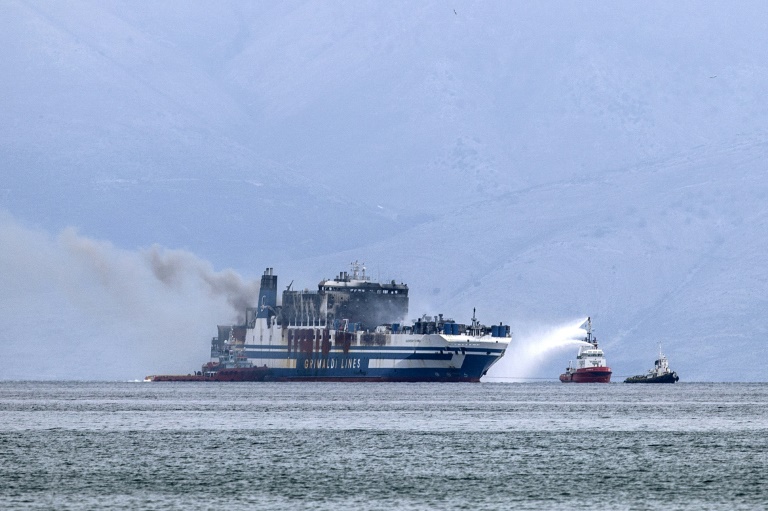
A passenger was on Sunday found alive aboard a ferry that has been ablaze off Greece for three days, coastguards said, with reports suggesting several more missing people have survived.

Eleven truck drivers remained unaccounted for on Sunday before Skai television reported that an operation was underway “to rescue 4-5 more passengers who are alive”.

Rescuers had first spotted a 21-year-old man on the stern of the stricken vessel as it was being towed to port.

The ferry was 1.5 miles (about two kilometres) off the northern part of Corfu, the coastguard said.

The smiling Belarussian was taken to Corfu on a coastguard boat wearing flip flops and put in an ambulance heading to hospital, television footage showed.

“I’m fine”, he told journalists.

“Tell me I’m alive,” the truck driver, had told rescuers, according to the Proto Thema news website.

Clad in tan shorts and a black t-shirt, he climbed down a ladder into a rescue boat, according to images from the iefimerida news website.

“I was in my cabin. I went to the lower deck. I heard voices. I did not see others,” the survivor told rescuers.

The news of the man’s “miraculous” survival, according to Greek media, had raised hopes further lives might be saved. 

“There is optimism. Given the fact this man managed to get to the upper deck in these conditions,” coastguard spokesman Nikos Alexiou told Ert television. 

According to the fire brigade, 40 firemen were deployed in the area on Sunday morning to help with rescue efforts.

“The thermal load and the toxicity on the vessel remain high. In some areas, fire is still burning. The operation is really delicate”, Shipping deputy minister, Costas Katsafados told Skai. 

The blaze broke out on the Italian-flagged Euroferry Olympia late  Thursday as it sailed from Igoumenitsa in Greece to Brindisi in Italy, with nearly 300 people aboard.

– ‘Corrosive goods’ –

Criticism has mounted over conditions aboard the vessel, which was reported to be carrying fuel and “corrosive, dangerous goods”.

Rescuers had managed to save 280 passengerson Friday, evacuating them to Corfu, but 12 lorry drivers remained missing.

The man rescued on Sunday was one of those drivers, the coastguard said.

Authorities initially gave the missing as seven from Bulgaria, three from Greece, one from Turkey and one from Lithuania.

On Sunday, they said there was an error and the missing Lithuanian was actually the man saved, who was from Belarus. 

The drivers are believed to have been asleep inside their lorries when the blaze broke out.

Olympia was carrying an estimated 800 cubic metres of fuel and 23 tons of “corrosive dangerous goods”, according to Italy’s environment ministry which said on Saturday that a “possible spill” was detected after a fly-over by an Italian coastguard aircraft.

— ‘Miserable’ conditions —

The vessel was officially carrying 239 passengers and 51 crew, as well as 153 trucks and trailers and 32 passenger vehicles, the Grimaldi company has said.  

But the coastguard has said two of the 281 people rescued were Afghans not on the manifest, sparking fears that more undocumented passengers could also be missing. 

The missing truckers reportedly slept in their vehicles because cabins on the vessel were overcrowded.

Ilias Gerontidakis, the son of a missing Greek trucker, told the Proto Thema online newspaper the Olympia was “miserable from every point of view”.  

“It had bed bugs, it was dirty, it had no security systems,” he said as he waited at the port for news.

“It had 150 lorries inside. Normally it should have 70 to 75 cabins, but it only has 50. They force us to sleep four people in a cabin”, he said. 

“My father, from what I was told, slept in the truck.”

The news of the rescue of the Belarussian rippled through relatives of those still missing who are waiting for news of loved ones in the port of Corfu in agony. 

Ert showed emotional scenes of a woman being carried away after fainting. 

The last shipboard fire in the Adriatic occurred in December 2014 on the Italian ferry Norman Atlantic. Thirteen people died in that blaze.

Last-ditch push to head off Russian attack on Ukraine

Last-ditch diplomatic efforts were underway on Sunday to prevent what Western powers warn could be the imminent Russian invasion of Ukraine and a catastrophic European war.

French President Emmanuel Macron was to call his Russian counterpart Vladimir Putin as ceasefire monitors and Ukrainian commanders reported intense shelling in eastern Ukraine.

Macron met Putin on February 7 and has since, along with fellow Western leaders like Germany’s Chancellor Olaf Scholz, been urging his Russian counterpart to pull back from the brink of war.

Sunday’s call, Macron’s office said, represented “the last possible and necessary effort to avoid a major conflict in Ukraine”. 

More bombardments were heard overnight close to the frontline between government forces and the Moscow-backed rebels who hold parts of the districts of Lugansk and Donetsk.

– Occupied enclave –

“Every indication indicates that Russia is planning a full-fledged attack against Ukraine,” NATO chief Jens Stoltenberg said, echoing US President Joe Biden, who believes the invasion is imminent.

The Moscow-backed separatists have accused Ukraine of planning an offensive into their enclave, despite the huge Russian military build-up on the frontier.

Kyiv and Western capitals ridicule this idea, and accuse Moscow of attempting to provoke Ukraine and of plotting to fabricate incidents to provide a pretext for a Russian intervention.

“Russian military personnel and special services are planning to commit acts of terror in temporarily-occupied Donetsk and Lugansk, killing civilians,” alleged Ukraine’s top general Valeriy Zaluzhniy.

“Our enemy wants to use this as an excuse to blame Ukraine and moving in regular soldiers of the Russian armed forces, under the guise of ‘peacekeepers’,” the military chief of staff said.

The rebel regions have made similar claims about Ukraine’s forces and have ordered a general mobilisation, while staging an evacuation of civilians into neighbouring Russian territory.

Officials with the Lugansk rebels claimed Sunday they had repulsed an attack by Ukrainian forces that had left two civilians dead, but the Ukrainian interior ministry immediately denounced the claim as an “absolute fake”.

Russian investigators said they had opened a probe into the alleged incident.

Russia, according to Western leaders, has more than 150,000 troops along with missile batteries and warships massed around Ukraine, poised to strike.

Some 30,000 of these troops are in Belarus, ostensibly for an exercise alongside Putin ally Alexander Lukashenko’s forces, but also close to the Ukraine frontier and the road to the capital Kyiv.

All eyes were on this force Sunday, the day when the exercises are scheduled to end. If Putin fails to withdraw them to Russia as promised, this will be seen as a further escalation of the threat.

Ukrainian President Volodymyr Zelensky told Macron on Saturday he would not respond to Russia’s provocations, according to the Elysee.

But in his speech to the Munich Security Conference, he also condemned “a policy of appeasement” towards Moscow.

“For eight years, Ukraine has been holding back one of the greatest armies in the world,” he said.

He called for “clear, feasible timeframes” for Ukraine to join the US-led NATO military alliance — something Moscow has said it would never accept, as it tries to roll back Western influence.

Western officials in Munich warned of enormous sanctions if Russia attacks, with US Vice President Kamala Harris saying this would only see NATO reinforce its “eastern flank”.

– Nuclear drills –

On Saturday, from the Kremlin situation room, Putin and Lukashenko watched the launch of Russia’s latest hypersonic, cruise and nuclear-capable ballistic missiles.

Putin has also stepped up his rhetoric, reiterating demands for written guarantees that NATO roll back deployments in eastern Europe to positions from decades ago.

“The big question remains: does the Kremlin want dialogue?” European Council President Charles Michel asked at the Munich Security Conference. “We cannot forever offer an olive branch while Russia conducts missile tests and continues to amass troops.”

The volatile front line between Ukraine’s army and Russian-backed separatists has seen a “dramatic increase” in ceasefire violations,  monitors from the OSCE European security body have said.

Hundreds of artillery and mortar attacks were reported in recent days, in a conflict that has rumbled on for eight years and claimed more than 14,000 lives.

The OSCE said there had been 1,500 ceasefire violations in Donetsk and Lugansk on Friday alone, and AFP reporters in the area have heard heavy shelling since.

On Saturday, a dozen mortar shells fell within a few hundred metres (yards) of Ukraine’s Interior Minister Denys Monastyrskiy as he inspected a frontline position with journalists in tow.

burs-dc/mm/bp

China celebrates record Winter Olympics haul — and beating US

China celebrated a record gold medal haul as the Beijing Winter Olympics concluded Sunday, narrowly beating out chief geopolitical rival the United States to rank third in the medal count. 

Traditionally much stronger in the Summer Games, China earned an unprecedented nine gold medals during its home-hosted winter edition after the state ploughed resources into training. 

By Sunday afternoon, at least four trending hashtags related to China’s best haul had received almost 200 million views on the Twitter-like platform Weibo.

Much of that commentary was as pleased about beating the United States by one place as it was China’s best winter finish.

“Last year the US surpassed China by one gold medal in the Summer Olympics, this year China surpassed the US by one medal,” read one comment liked more than 2,800 times.

The Chinese team won 15 medals in total — nine golds, four silvers and two bronzes.

Figure skating duo Han Cong and Sui Wenjing secured the country’s last Olympic gold — and broke a previous world record — in an emotional pairs event on Saturday evening. 

Winter powerhouse Norway was in first place with 16 gold medals and a total of 37. Runner-up Germany received 12 golds and 27 medals in total.

Beijing sees the Winter Games as a propaganda showpiece with which to burnish its international image and project soft power abroad.

But the event has been clouded by political controversies.

The United States led a diplomatic boycott of the Games over China’s human rights record, which was joined by multiple Western countries.

The Games also saw a doping scandal involving a teenage Russian athlete and growing fears of a Russian invasion of Ukraine. 

However, Chinese medal-winners have been lionised as national heroes by state media, while Chinese social media has been flooded with patriotic comments.

“I am so proud of the Chinese team’s achievements,” 32-year-old tech worker Min Rui told AFP on Sunday as she shopped with two girlfriends near an Olympic countdown clock in one of Beijing’s central districts. 

“The winter sports industry is still in its infancy and many athletes were chosen from other sporting disciplines. So coming third in the medal tally, ahead of countries like the US and Canada, is a real achievement.” 

Beijing’s investment in developing winter sports has nurtured a new generation of breakout stars.

Among them are teenage snowboarding champion Su Yiming and Chinese-American skier Eileen Gu, who is the most decorated Chinese athlete with two golds and one silver medal. 

Gu switched to compete for China over the United States in 2019. 

China won one gold and a total of nine medals at the 2018 Pyeongchang Winter Olympics. 

It had never won more than three gold medals in Winter Games history. 

China helps virus-ravaged Hong Kong build isolation units

Construction crews from mainland China were helping Hong Kong build two temporary isolation facilities to house thousands of coronavirus patients on Sunday as a senior official declared the city “in full combat mode”.

The crowded Chinese financial hub is in the throes of its worst-ever coronavirus outbreak, registering thousands of confirmed cases a day as hospitals reach breaking point.

A strict zero-Covid policy like China uses kept infections at bay for two years but left the city cut off internationally.

And when the highly transmissible Omicron variant broke through, authorities were caught flat-footed with a dangerously under-vaccinated elderly population and few plans in place to deal with a mass outbreak.

Late Saturday city leader Carrie Lam announced that China State Construction International Holdings, the largest state-owned constructor in Hong Kong, would start work on two temporary isolation facilities to provide 9,500 extra beds.

The units will be located at Penny’s Bay, which already hosts a quarantine camp, and in Kai Tak where the city’s old airport once stood.

Lam also announced that three hotels would be used to create an additional 20,000 beds.

Chief Secretary John Lee, Hong Kong’s number two official, wrote on his official blog on Sunday that the city’s government was in “full combat mode”. 

“With our motherland’s strong support, we will definitely win the battle,” Lee wrote.

The sudden flurry of activity came after Chinese President Xi Jinping ordered Hong Kong to make tackling the outbreak its “overriding mission” in comments that were seen as something of a rebuke to the city’s leadership. 

It is not yet clear when the new facilities will be ready and whether they will be enough given Hong Kong’s spiralling caseload.

Under China’s direction, Hong Kong is sticking to a policy of trying to isolate everyone who tests positive for the coronavirus and has rejected calls to shift to a strategy of living with Covid.

Over the last few days officials have announced around 6,000 confirmed cases daily with a similar number of “preliminary positives” that still need to be certified.

About 22,000 cases have been recorded since the current outbreak hit last month compared to just 12,000 in the two years before that.

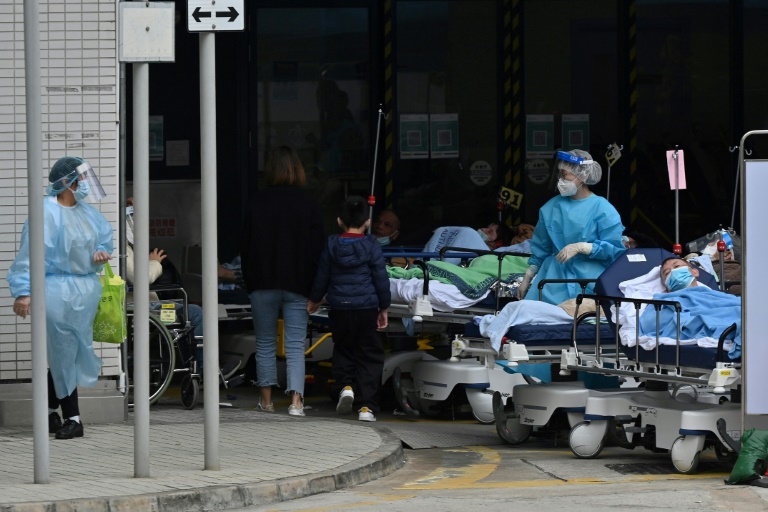
Some hospitals have had to house patients on gurneys outdoors in grim winter conditions while thousands are still waiting at home in the city’s notoriously small apartments with positive test results.

Ben Cowling, a coronavirus expert at the University of Hong Kong, said isolation facilities would be useful but increasing hospital beds must be a priority.

“New cases needing admission will continue to accumulate faster than beds are freed up, and delays to admission will get longer and longer,” Cowling wrote on Twitter.

“Construction of isolation facilities for mild/asymptomatic cases will be useful for people that can’t isolate at home… but increasing hospital beds and ICU beds must be a priority.” 

Lam announced plans on Friday to test Hong Kong’s entire 7.5 million population by some point in March, when modellers predict the daily caseload could reach 28,000.

She has ruled out the kind of hard lockdown that China has used to stamp out smaller outbreaks.

Macron and Putin to talk as Ukraine front line grows more volatile

French President Emmanuel Macron will call Russia’s Vladimir Putin on Sunday to try to avert what Western powers predict will be an imminent invasion of Ukraine.

Over the weekend, civilians were evacuated from increasingly barraged front line regions where Kyiv said Saturday two of its soldiers had died in an attack — the first fatalities in the conflict in more than a month.

The Kremlin insists it has no incursion plans, but its test-firing of nuclear-capable missiles Saturday did little to alleviate tensions.

“Every indication indicates that Russia is planning a full-fledged attack against Ukraine,” NATO chief Jens Stoltenberg said.

US President Joe Biden, who earlier said he was “convinced” Russia would invade in the coming days, is convening a rare Sunday National Security Council meeting over the crisis.

US and EU officials have said they believe Moscow is attempting to fabricate a pretext for its offensive by having proxy outlets put out false information about violence in rebel-held enclaves in eastern Ukraine.

“Locals in Donetsk reported calm despite Russian claims of a car bomb,” said US State Department spokesman Ned Price.

Speaking to Macron on Saturday, Ukrainian President Volodymyr Zelensky said he would not respond to Russia’s provocations, according to the Elysee.

But in his speech to the Munich Security Conference, he also condemned “a policy of appeasement” towards Moscow.

“For eight years, Ukraine has been holding back one of the greatest armies in the world,” he said.

He called for “clear, feasible timeframes” for Ukraine to join the US-led NATO military alliance — something Moscow has said is a red line for its security.

– Strategic missile tests –

Western officials in Munich warned of enormous sanctions if Russia attacks, with US Vice President Kamala Harris saying this would only see NATO reinforce its “eastern flank”.

The United States insists that, with around 150,000 Russian troops on Ukraine’s borders — as many as 190,000, when including the Russian-backed separatist forces in the east — Moscow has already made up its mind to invade.

Russia has in recent days announced a series of withdrawals of its forces from near Ukraine, saying they were taking part in regular military exercises. 

Around 30,000 Russian troops are in Belarus for an exercise due to end on Sunday. 

Afterwards, Moscow says these forces will return to barracks, but US intelligence is concerned they could take part in an invasion of Ukraine.

From the Kremlin situation room, Putin and visiting Belarus President Alexander Lukashenko watched the launch of Russia’s latest hypersonic, cruise and nuclear-capable ballistic missiles on Saturday.

Putin has also stepped up his rhetoric, reiterating demands for written guarantees that Ukraine will never be allowed to join NATO and for the alliance to roll back deployments in eastern Europe to positions from decades ago.

– ‘Dramatic increase’ in clashes –

The volatile front line between Ukraine’s army and Russian-backed separatists has seen a “dramatic increase” in ceasefire violations, international monitors from the OSCE European security body have said.

Hundreds of artillery and mortar attacks were reported in recent days, in a conflict that has rumbled on for eight years and claimed more than 14,000 lives.

The OSCE said Saturday there had been 1,500 ceasefire violations in Donetsk and Lugansk in just one day.

A dozen mortar shells fell within a few hundred metres (yards) of Ukraine’s Interior Minister Denys Monastyrskiy Saturday as he met journalists.

The pro-Russian rebels declared general mobilisations in the two regions, calling up men to fight even as they announced the mass evacuations of women and children.

Moscow and the rebels have accused Kyiv of planning an assault to retake the regions, claims fiercely denied by Ukraine and dismissed by the West.

Ukrainian Foreign Minister Dmytro Kuleba denounced reports of Ukrainian shells falling on Russian territory as “fake”.

Germany and France on Saturday urged their citizens to leave Ukraine. NATO said it was relocating staff from Kyiv to Lviv in the west of the country and Brussels.

German airlines Lufthansa and Austrian Airlines said they would stop flights to Kyiv and Odessa from Monday until the end of February, but would maintain flights to western Ukraine.

Lebanon's 'zombie banks' downsize to weather crisis

Once the economy’s crown jewel, Lebanon’s banks are shutting branches and laying off employees in droves, resizing to the bleak reality of a crisis they are widely blamed for.

Before the onset in 2019 of a financial collapse deemed one of the world’s worst since the 1850s by the World Bank, the small Mediterranean country had an oversized but prosperous banking sector.

The capital Beirut was a booming regional financial hub, attracting savers keen to profit from high interest rates and banking secrecy laws.

But more than two years into the crisis, the reputation of Lebanese lenders has been shredded. 

A dizzying currency collapse, coupled with banks imposing strict withdrawal limits and prohibiting transfers abroad, has left ordinary depositors watching on helplessly as their savings evaporate.

And yet bankers stand accused of bypassing those exact same capital controls — stoking the crisis by helping the political elite squirrel billions of dollars overseas. 

Their trust destroyed, citizens now keep new income well away from the banks, which in turn are deprived of money they could lend.

“The whole banking system today is made up of zombie banks,” said economic analyst Patrick Mardini.

“They don’t work as banks anymore — they don’t give loans, they don’t take new deposits.”

– ‘Abandoned country’ –

As a result, the industry has been forced to scale back its operations. 

In 2019, Lebanon ranked second in the region for bank branches per 100,000 people, according to the World Bank, and held a total of around $150 billion in deposits. 

Deposits by Arab investors and Lebanese expatriates propelled the banking sector to peak at three times the value of national economic output. 

But more than 160 branches have closed since the end of 2018, leaving a total of 919 branches operating across the country, according to the Association of Banks in Lebanon (ABL).

The number of employees has dropped by around 5,900, reducing the sector’s workforce to roughly 20,000 late last year.

“Lebanon is an abandoned country,” ABL chief Salim Sfeir told AFP, referring to negligence by the nation’s authorities. 

The association claims the sector has been “forced to adapt to the contraction of the economy,” even as others blame the banks for overall economic activity plunging by more than half since 2019.

The Lebanese pound, officially pegged at 1,507 to the greenback since 1997, has lost more than 90 percent of its value on the black market.

The slide has prompted banks to adopt a plethora of exchange rates for transactions even though the official rate remains unchanged. 

Those who hold dollar accounts have mostly had to withdraw cash in Lebanese pounds and at a fraction of the black market rate.

“If we apply international accounting standards, almost all Lebanese banks are insolvent,” investment banker Jean Riachi said. 

– ‘Exit the market’ –

Lebanon’s government defaulted on its foreign debt in 2020, stymying the country’s hopes of quickly securing new international credit or donor money to stem the crisis. 

The ruling elite, beset by internal rifts that have repeatedly left the country without a government, has yet to agree on an economic recovery plan with international creditors.

Disagreements between the government, the central bank and commercial banks over the scale of financial sector losses have dogged talks with the International Monetary Fund that first started nearly two years ago.

In December, the government of Prime Minister Najib Mikati set financial sector losses at around $69 billion in a crucial step towards advancing IMF talks.  

But while the global lender said early this month that efforts to agree on a rescue package have progressed, it made clear more work was needed, especially in terms of “restructuring of the financial sector”.

The analyst Mardini said bank restructuring proposals have been discussed by several governments.

Central bank chief Riad Salameh has said banks that are unable to lend must “exit the market”.

But meaningful progress on restructuring has been impeded by a political elite who maintain large shares in some of the main banks, according to Mardini. 

For out-of-pocket depositors, the details of any restructuring arrangements are a secondary concern.

“I just want to recover my savings,” said Hicham, a businessman who asked to use his first name only over privacy concerns.

“All the parties concerned must assume their responsibilities.”

Show of force in Ottawa as police clear main protest hub

Police in riot gear cleared the main protest hub in downtown Ottawa Saturday, using batons and pepper spray and making dozens of arrests, as they worked to flush out a hard core of demonstrators occupying the Canadian capital.

In a day-long show of force, hundreds of officers pushed into the city center — facing off in tense scenes with determined protesters who hurled gas canisters and smoke grenades at advancing police, linking arms and chanting “freedom.”

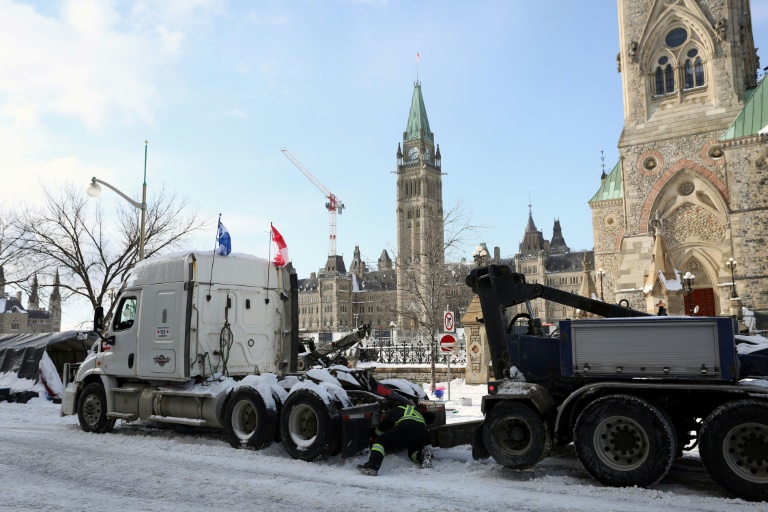
By the afternoon, police backed by tactical vehicles and overwatched by snipers had cleared Wellington Street in front of the Canadian parliament — the epicenter of the trucker-led demonstrations that began almost a month ago over Covid-19 health rules.

Trucks were towed and tents, food stands and other structures set up by the demonstrators were torn down. 

Ottawa interim police chief Steve Bell told a news conference “very important progress” had been made on day two of the operation to clear the protesters, though he cautioned it was “not over.”

On side streets around the parliament, a police message boomed by loudspeaker urged die-hard demonstrators, “You must leave, (or) you will be arrested.”

A few hundred ignored the order, braving bone-chilling cold into the night while waving Canadian flags, setting off fireworks at a barricade and singing the 1980s rock anthem, “We’re Not Gonna Take It.”

Bell said 170 people had been arrested since the start of the operation, 47 of them on Saturday.

He also called out parents for putting their children “at risk” by bringing them “to the front of our police operation.”

As tensions ratcheted up, police used what they called a “chemical irritant” — apparently pepper spray — against protesters, who they said were being “assaultive and aggressive,” launching gas canisters at officers.

Organizers of the so-called “Freedom Convoy” meanwhile accused police of beating and trampling demonstrators, telling supporters to leave “to avoid further brutality.”

– Largest ever operation –

Some truckers had chosen to depart on their own as the police closed in, driving their 18-wheelers away after weeks of demonstrations that at their peak drew 15,000 to the capital. 

Others were defiant. “I’m not leaving,” said Johnny Rowe at the start of the day.

“There’s nothing to go back to,” he told AFP. “Everybody here, myself included, has had their lives destroyed by what’s happened in the past two years.”

“I’m freezing my ass off, but I’m staying,” echoed a protester who gave his name only as Brian.

An AFP journalist also observed a steady flow of protesters leaving the area.

“We’re taking it somewhere else,” said musician Nicole Craig, her husband Alex adding: “Even if the truckers have left town, the protest will continue. This fight is not over.”

Within minutes of deploying Saturday morning, police had claimed a section of road in front of the prime minister’s office.

Officers pointed guns as they smashed truck windows and ordered occupants out, with smoke filling the air.

As the operation unfolded outside parliament, inside the complex, lawmakers resumed debating Prime Minister Justin Trudeau’s controversial use of emergency powers — for the first time in 50 years — to subdue the protests.

The Ottawa police operation was the largest ever seen in the capital, drawing hundreds of officers from across the nation.

Bell said police had opened several criminal investigations “that relate to the seizure of weapons.” 

And he warned participants in the protest that authorities — who’ve already frozen Can$32 million in donations and bank accounts — “will actively look to identify you and follow up with financial sanctions and criminal charges.”

– Debating emergency powers –

The Canadian trucker convoy, which inspired copycats in other countries, began as a protest against mandatory Covid-19 vaccines to cross the US border. 

Its demands grew, however, to include an end to all pandemic rules and, for many, a wider anti-establishment agenda.

At its peak, the movement also included blockades of US-Canada border crossings, including a key trade route across a bridge between Ontario and Detroit, Michigan — all of which have since been lifted after costing the economy billions of dollars, according to the government.

Criticized for failing to act decisively on the protests, Trudeau this week invoked the Emergencies Act, which gives the government sweeping powers to deal with a major crisis. 

But lawmakers split over their use.

Trudeau has said the act was not being used to call in the military against the protesters and denied restricting freedom of expression.

The objective was simply to “deal with the current threat and to get the situation fully under control,” he said. “Illegal blockades and occupations are not peaceful protests.”

Toll mounts as Brazil storm rescuers retrieve more bodies

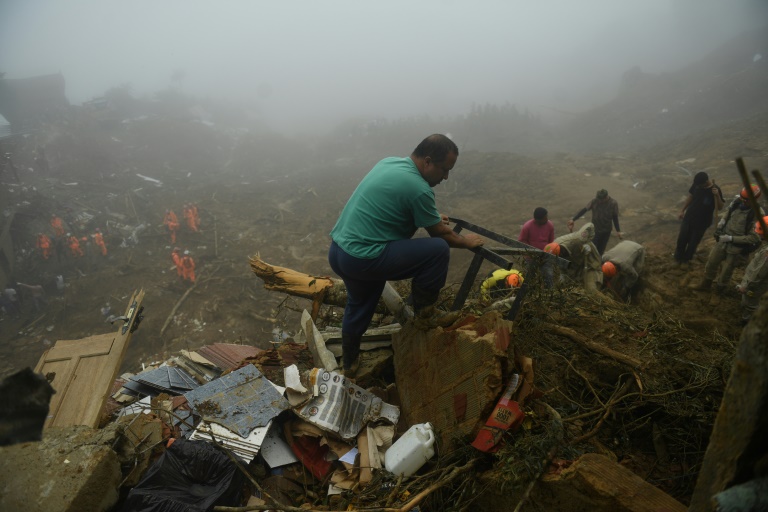
Rescue workers pulled more bodies Saturday from the muddy wreckage left by devastating floods and landslides in the Brazilian city of Petropolis, where the death toll rose to 146, including 26 children.

In a dense fog, workers dug with spades and shovels through the rubble and muck as the search churned through its fifth day with little hope of finding more survivors.

An AFP photographer saw rescuers carrying out two recovered corpses in body bags in the hard-hit neighborhood of Alto da Serra, as relatives sobbed in the street.

In the heart of the disaster zone, rescue workers occasionally blew loud whistles to call for silence and listen for signs of life.

But authorities say there is little hope at this point of finding survivors from Tuesday’s torrential rains.

The downpour turned streets to gushing rivers in the picturesque city in the southeastern mountains, and triggered landslides in poor hillside neighborhoods that wiped out virtually everything in their path.

Officials say 24 people have been rescued alive, but that came mostly in the early hours after the tragedy.

Rio de Janeiro state police said 218 people remained missing as of late Friday.

Meanwhile, 91 of the 146 bodies recovered so far have been identified, according to the police.

Many of the missing may be among the unidentified bodies. But the numbers have been hazy, and it is difficult to know how high the death toll could go.

President Jair Bolsonaro, who flew over the disaster zone Friday by helicopter, said the city was suffering from “enormous destruction, like scenes of war.”

Tuesday’s was the latest in a series of deadly storms to hit Brazil, which experts say are made worse by climate change.

In the past three months, at least 198 people have died in severe rains, mainly in the southeastern state of Sao Paulo and the northeastern state of Bahia, as well as Petropolis.

– ‘Little by little’ –

Normal life has been slow to return to central Petropolis, a charming tourist town that was the 19th-century summer capital of the Brazilian empire.

Staff were busy cleaning out shops in the city center, where little was open besides essential businesses such as supermarkets and pharmacies.

One bookstore owner had to dump her entire stock of water-logged books in the street.

“They were stocked in the basement. It filled with water all the way up to the ceiling,” said Sandra Correa Neto, 52, her thousands of books waiting for the city’s overloaded sanitation workers to collect them.

“We’re so sad to lose all these books. We can’t even donate them, they’re too damaged. It pains me,” she told AFP.

Elsewhere in the city center, family members cried as rescue workers dug through the ruins of a collapsed house, looking for the mother of a family of four.

The father and two children’s bodies had already been recovered.

In the Alto da Serra neighborhood, atop the worst landslide, rescue workers in bright orange uniforms kept up a slow, dogged search alongside exhausted residents looking for their missing loved ones.

Authorities say the mountain of mud and rubble is unstable, so the search is being carried out with hand tools and chainsaws at the hardest-to-reach spots.

It would be too dangerous to bring in the excavators being used in less difficult zones near the bottom of the hillside, said Roberto Amaral, coordinator of the local fire department’s special rescue group.

“It’s impossible to bring in heavy machinery up here, so we basically have to work like ants, going little by little,” he told AFP.

A sobering series of funerals, meanwhile, continued at the city’s main cemetery, where 90 victims have been buried so far — 44 on Saturday alone.

Close Bitnami banner
Bitnami