World

US resumes avocado imports from Mexico

Avocado imports from the western Mexican state of Michoacan have resumed following a week-long suspension after steps were taken to ensure the safety of American inspectors, the US government said Friday.

Shipments were halted after a US inspector received a threatening phone call a week ago, prompting fears among lovers of guacamole and avocado toast that prices could spike.

But the US Animal and Plant Health Inspection Service (APHIS) said security and industry organizations “have enacted additional measures that enhance safety for APHIS’ inspectors working in the field.”

As a result, the avocado inspection program “has restarted and avocado exports to the United States have resumed,” APHIS said in a statement.

Michoacan is the world’s largest avocado producer, with 85 percent of its crop exported to the United States, but it is also one of the Mexican states hardest hit by violence linked to organized crime.

Last year a group of avocado producers formed a self-defense group they said was needed to prevent kidnapping, extortion and theft by criminal groups.

Mexican President Andres Manuel Lopez Obrador said Monday that “economic and political interests” afraid of competition also played a part in the US decision to pause exports.

In the statement Friday, the US Department of Agriculture (USDA) said employee safety “is of paramount importance” and noted the “positive, collaborative relationship” between the neighboring nations to resolve the issue. 

In 2021, 92 percent of the $3 billion in avocados imported into the United States came from Mexico, and Michoacan is the only Mexican state with approval to export to the US market, which it has done for some 25 years, according to APHIS.

Many anti-abortion Americans would still help friends and family seeking one

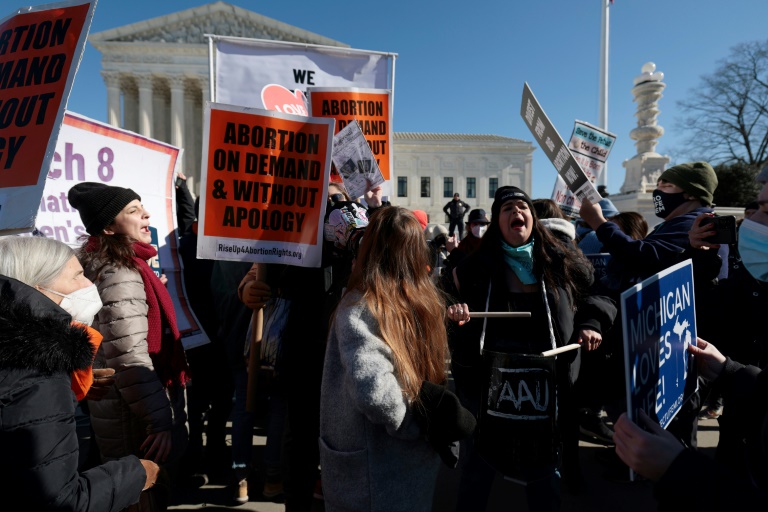
Almost half of Americans morally opposed to abortion would help a friend or family member with arrangements to get one, and a majority would offer emotional support, a new study said Friday.

The authors of the paper, which appeared in the journal Science Advances, wrote the finding showed that people are willing to cross ideological and partisan lines to help others in their personal networks, something they referred to as “discordant benevolence.”

“At first blush, these people may appear as hypocrites. They are not,” said Sarah Cowan, a sociologist at New York University and the lead author of the article, in a statement.

“They are at a moral crossroads, pulled by their opposition to abortion and by their inclination to support people they care about.” 

The study was drawn from surveys and interviews conducted in 2018 and 2019 respectively, and comes after Texas passed a law allowing residents of the state to sue others who “aided or abetted” abortions performed after six weeks of pregnancy.

The Supreme Court could soon roll back decades of precedent by ruling abortion is not a constitutional right. The issue is deeply contentious and divides the public along political lines between Democrats and Republicans.

The new study was based on survey responses from more than 1,574 people, and separately 74 in-depth interviews.

Of those morally opposed, 76 percent said they would offer emotional support —- compared to 96 percent of those who are not morally opposed, or whose view depended on circumstances. 

But the type of support varied greatly, reflecting the social meaning of money and the view that spending money is a means to enact one’s values, the authors said.

Just six percent of those morally opposed would directly help a friend or relative pay for the procedure, compared to the 45 percent who said they would help with ancillary costs.

Among those not morally opposed, 54 percent would help pay for the procedure, which typically costs $500 in the first trimester.

– Moral conflict –

Social scientists have long been interested in what explains helpful behavior.

Factors are thought to range from the act of kindness causing a person to feel good about themselves, to a sense of duty to their kinship networks and expectation of reciprocity in future.

But the authors said scenarios where rendering help placed the helper in a moral conflict were less studied.

Based on their in-depth interviews, they found people who were willing to help despite their inner opposition relied on three main rationalizations.

The first was “commiseration,” or reasoning that people are worthy of care despite their imperfections in an imperfect world. 

The second was “exemption” — carving out an exception for their loved ones in particular, while the third was “discretion,” — the idea that what is right or wrong is inherently personal, not universal.

“If it were my sister…I would want to talk to her to make sure she’s thinking about every possible thing,” said Ryan, a person interviewed in the survey.

“But if, ultimately, she’s like ‘No, (Ryan), I can handle this,’ then, ‘Ok, do what you gotta do,’ you know? But it’s just because you love someone.”

Mali asks France to pull out troops 'without delay'

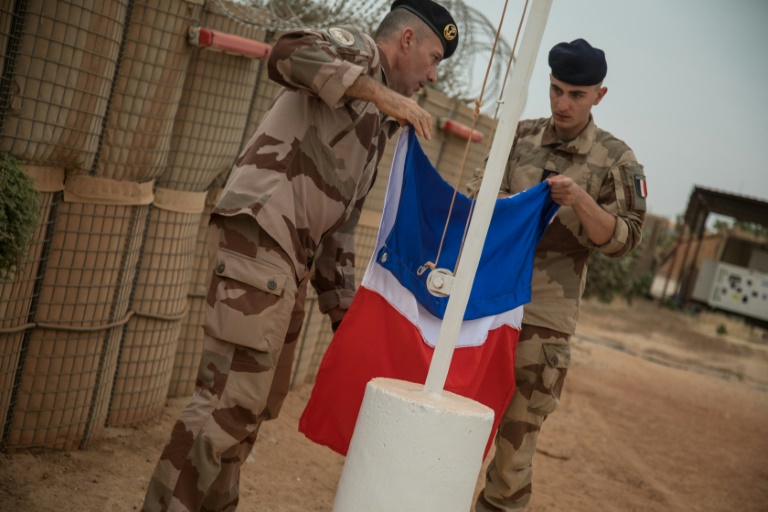
Mali’s army-led government on Friday asked France to withdraw its forces from the Sahel state “without delay”, calling into question Paris’ plans to pull out over several months. 

A Malian government spokesman added in a statement announced on public television that the results of France’s nine-year military engagement in the conflict-torn country were “not satisfactory”. 

On Thursday, French President Emmanuel Macron announced that he was withdrawing troops from Mali after a breakdown in relations with the nation’s ruling military junta.

France first intervened in Mali in 2013 to combat a jihadist insurgency that emerged one year prior. It currently has around 4,600 troops stationed across the Sahel, 2,400 of them in Mali.

But relations between the two countries deteriorated sharply after Mali’s army seized power in a coup in 2020, and later defied calls to restore civilian rule swiftly.

The French pull-out after nearly a decade is also set to see the smaller European Takuba group of special forces, created in 2020, leave Mali. 

Macron said the withdrawal would take place over four to six months. 

Spokesman Colonel Abdoulaye Maiga called the prolonged French withdrawal a “flagrant violation” of accords between the two countries. 

“In view of these repeated breaches of defence agreements, the government invites the French authorities to withdraw, without delay,” he said.

Mali has also asked the smaller Takuba force to depart quickly.

Macron responded with a statement saying he would not compromise the safety of French soldiers and the withdrawal will take place “in orderly fashion”.

The planned withdrawal of France and its allies has raised questions about the possibility of a security vacuum in impoverished Mali, a vast and ethnically diverse nation of 21 million people. 

– Dire relations –

Mali’s call for a swift French military withdrawal caps months of escalating tensions with its former colonial master. 

Relations first began to fray after Malian army officers led by Colonel Assimi Goita deposed elected president Ibrahim Boubacar Keita in August 2020. 

The army then deposed the civilian leaders of a transitional government last year, in a second coup. 

Mali’s international partners — including France and the Economic Community of West African States (ECOWAS) — insisted that the junta stick to a pledge to stage elections in February 2022 and restore civilian rule.

But the junta then floated plans to stay in power for up to five years. 

The proposal prompted the 15-nation ECOWAS bloc to impose a trade embargo and shut its borders with Mali in January.

France followed by announcing a pull-out on Thursday. But Paris had already begun to scale back its deployment before relations nosedived. 

It closed three bases in northern Mali this year, where the bulk of its anti-jihadist Barkhane force had been stationed.

Macron said the closure of three bases in Gao, Menaka and Gossi would take between four to six months.

– 40 civilians killed –

As well as concerns over civilian rule in Mali, Paris has protested the junta’s alleged use of Russia’s Wagner private security firm. 

The US and others say that hundreds of fighters from the controversial paramilitary group are in the country, though the junta denies the claim. AFP has been unable to independently verify the information. 

Mali remains the epicentre of the Sahel-wide jihadist conflict, which has killed thousands of soldiers and civilians and displaced some two million people.

The conflict spread deeper into Mali, despite the presence of French troops, which has fed popular resentment of France’s military intervention. 

France and its allies have vowed to remain engaged in fighting terror in the Sahel despite leaving Mali.

Rival jihadists groups linked to al-Qaeda and the Islamic State group not only carry out regular attacks on national and foreign troops, but are also fighting each other for territory.

Earlier this week, the Islamic State in the Greater Sahara (EIGS) killed around 40 civilians who it claimed were complicit with their al-Qaeda-aligned rivals GSIM, local sources told AFP on Friday.

A civilian official in the northern Tessit area said it was a common scenario.

“When a (jihadist) group passes through a village, the one that comes later accuses the residents of being accomplices,” said the official, whose name was withheld for security reasons.

The residents, who are “unable to kill a fly”, thus become caught up in the rivalry.

Israeli police scatter Palestinian protesters in Jerusalem

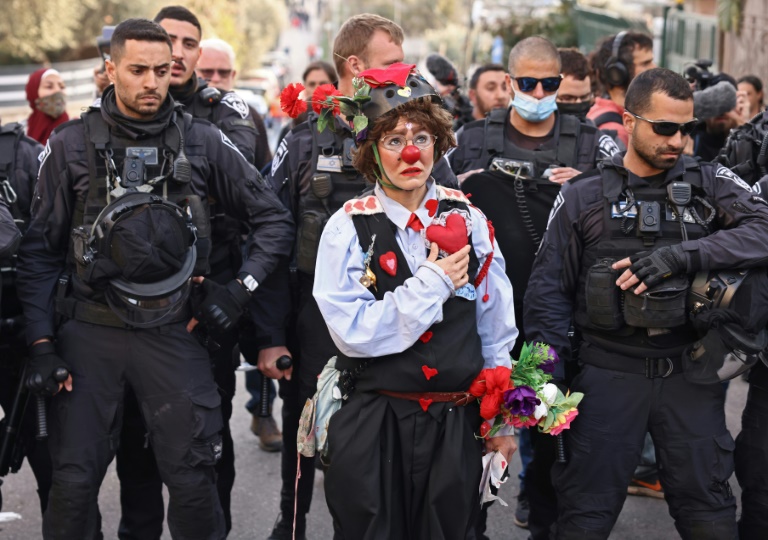
Israeli police on horseback scattered protesters Friday in the flashpoint east Jerusalem neighbourhood of Sheikh Jarrah, where demonstrators poured in to support Palestinians facing eviction by Jewish settlers. 

The scuffles there came alongside protests elsewhere in the occupied West Bank.

Tensions that erupted in Sheikh Jarrah last year — as several Palestinian families faced eviction by settler groups — in part sparked the May war between Israel and armed groups in the Gaza Strip.

In Jerusalem, Palestinian men had lain prayer rugs on the asphalt of a local street and carried out Islamic prayers. Later, hundreds of activists joined them to protest the looming evictions.

AFP reporters observed Israeli border police charging the protesters with horses after the activists refused to clear a road. Police described the incident as a “riot” and said “demonstrators did not listen to instructions of police”. 

An AFP photographer saw two people being detained. However, police said no arrests were reported.

Sheikh Jarrah has emerged as a symbol of Palestinian resistance against Israeli control of east Jerusalem. 

Israel captured east Jerusalem from Jordan in the 1967 Six-Day War and later annexed it, in a move not recognised by most of the international community. More than 200,000 Jewish Israelis live in east Jerusalem, which Palestinians claim as the capital of their future state.

Abdallah Grifat, 30, said he travelled from Nazareth in northern Israel to show his support. 

“It’s my duty as a Palestinian to stand here, with every other Palestinian who’s struggling for their land,” he told AFP. “We’re standing for justice.” 

– The Salem family –

Palestinians also confronted Israeli forces in Hebron — in the southern West Bank — and in the northern West Bank’s Beita.

In Beita, residents opposed to an Israeli outpost erected on village land used slingshots to hurl rocks at security forces who responded with what the army called “riot dispersal means.”

The army said no troops were injured. Palestinians’ official news agency Wafa said 23 Palestinians were hurt. An AFP photographer was wounded by a rubber bullet fired by Israeli forces. 

The confrontations in Sheikh Jarrah come amid growing focus on one family, named Salem, who face imminent eviction. 

Earlier in the week, clashes broke out when far-right Israeli lawmaker Itamar Ben Gvir opened a tent “office” near the family’s house after an alleged Palestinian arson of a settler’s home nearby. 

The United Nations said its personnel visited the Salem family on Friday, adding that it “has repeatedly called for a halt to forced evictions and demolitions in the occupied West Bank, including East Jerusalem.”

Palestinian presidency spokesman Nabil Abu Rudeina said via Wafa that “Israeli assaults” in Sheikh Jarrah “will not deter our people from achieving their goal of establishing their independent Palestinian state with East Jerusalem as its capital.”

Hamas, the Islamist rulers of the Gaza Strip, warned on Thursday that “violation of the red lines in Sheikh Jarrah” could “prepare the atmosphere for the next explosion.”

'Violent' attack by protesters at Canadian pipeline worksite

Canadian police said Friday they were investigating a “violent confrontation” at a gas pipeline construction site in the western province of British Columbia.

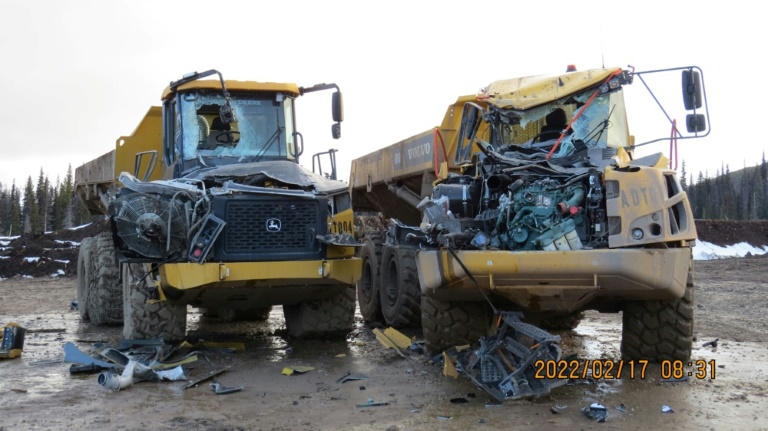
Shortly after midnight Thursday, police attempted to inspect the Coastal GasLink (CGL) construction site near Houston, where they say “approximately 20 people, some armed with axes” had been reported to be “attacking security guards and smashing their vehicle windows,” according to a statement released by the Royal Canadian Mounted Police.

On the road to the site, police discovered “downed trees, tar covered stumps, wire, boards with spikes in them, and fires” blocking the way.

“As police worked their way through the debris and traps, several people threw smoke bombs and fire lit sticks at the police, injuring one officer,” the statement added.

When the police finally arrived at the worksite, they discovered “a multimillion dollar path of destruction.”

Photos accompanying the statement showed heavy machinery overturned or their windows and engines smashed, and a trailer with a wall ripped off.

“This coordinated and criminal attack from multiple directions threatened the lives of several workers,” said CGL in a statement.

“In one of the most concerning acts, an attempt was made to set a vehicle on fire while workers were inside,” the company, headquartered in neighboring Alberta province, added.

The CGL pipeline aims to bring natural gas from eastern British Columbia to be liquified in a facility on the Pacific coast, before being exported.

The project has stirred controversy in Canada for years.

At the beginning of 2020, protesters against the pipeline mobilized across multiple Canadian provinces with some blocking rail traffic for weeks.

At the moment, the CGL pipeline is 60 percent completed, the company said.

'Scenes of war' amid search for victims of Brazil floods

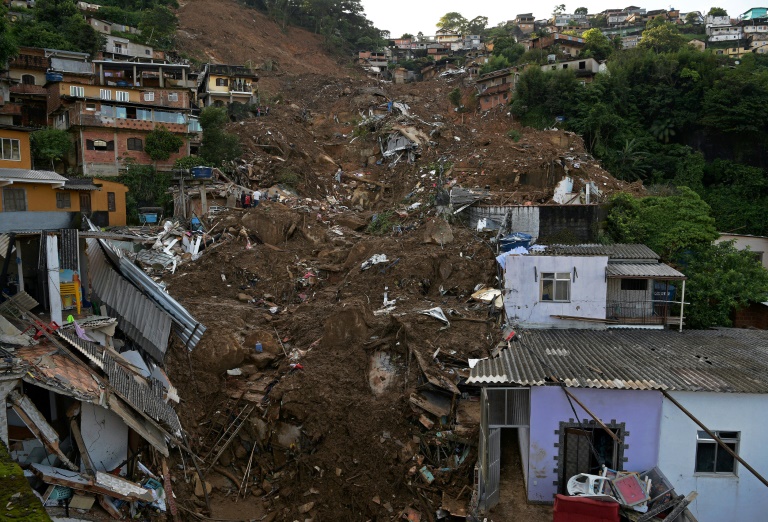
An increasingly desperate search was under way Friday for people buried by a deluge of mud that swept through the Brazilian city of Petropolis leaving what resembled “scenes of war” according to President Jair Bolsonaro. 

A total of 122 bodies have been retrieved to date, according to civil defense officials, in the scenic tourist town some 60 kilometers (37 miles) north of Rio de Janeiro.   

On Tuesday, the streets of the city were turned into torrential rivers of mud that swept away homes, cars and trees following the heaviest rains to hit the region since 1932, according to Rio governor Claudio Castro. 

“We saw enormous destruction, like scenes of war,” Bolsonaro told reporters after his helicopter flyover Friday. 

He had headed straight for Petropolis on his return to Brazil after an official visit to Russia and Hungary.   

Officials say 116 people are still missing. Some of them are likely to be among the 65 unidentified bodies found so far.  

On Friday morning, the alarm bells rang once again in areas at high risk of landslides in the city of 300,000 people.   

“There is a risk of landslides… be careful, move to a safe place,” came the message over loudhailers amid renewed heavy rain in the early morning, which later subsided.   

“Everyone is very frightened and jumps at the slightest noise,” said Atenor Alves de Alcantara, a 67-year-old retiree whose home was in the path of the water.  

“It is good that the President is visiting us, but it won’t change anything,” he added.   

– Sense of abandonment –

More than 500 firefighters with helicopters, excavation machinery and sniffer dogs continued the search even as hope dwindled of finding anyone alive.  

Hundreds of volunteers are giving give a hand to residents digging through the mud themselves in a frantic search for missing loved ones.  

In the Alta de Serra neighborhood, 80 houses were engulfed, and the bodies of 98 people have been recovered since Tuesday.  

“There could still be 50 people under there,” said Roberto Amaral, coordinator of the fire brigade’s special rescue group.

“We would like to finish the search as soon as possible, but we will work until the last body is removed,” he added.    

Many inhabitants said they felt abandoned. 

Bolsonaro said people had the right to criticize, but “we cannot predict everything that will happen in 8.5 million square kilometers” (3.3 million square miles) that is the surface area of Brazil.  

“This is not the first time a tragedy has happened here,” said the president, adding that “We will do our part.”  

Petropolis and the surrounding region were previously hit by severe storms in January 2011, when more than 900 people died in flooding and landslides.  

Tuesday’s was the latest in a series of deadly storms — which experts say are made worse by climate change — to hit Brazil in the past three months.  

Last month, torrential downpours triggered floods and landslides that killed at least 28 people in southeastern Brazil, mainly in Sao Paulo state. 

There have also been heavy rains in the northeastern state of Bahia, where 24 people died in December.  

Pope Francis sent a message of condolences Friday, and assured the community in a statement from the Vatican of his “participation in the grief of all those who are bereaved or who have been deprived of their possessions.”    

Seven dead as Storm Eunice batters Europe

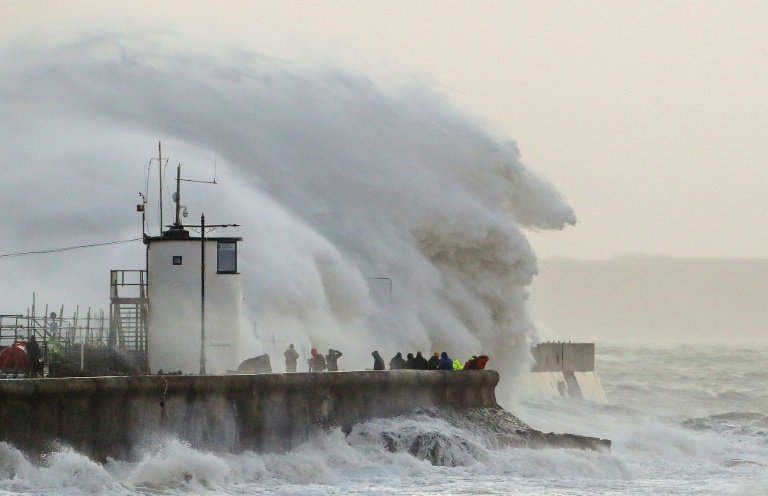
Storm Eunice killed at least seven people in Europe on Friday, pummelling Britain with record-breaking winds and forcing millions to take shelter as it disrupted flights, trains and ferries across Western Europe.

London was eerily empty after the British capital was placed under its first ever “red” weather warning, meaning there is “danger to life”. By nightfall, police there said a woman in her 30s had died after a tree fell on a car she was a passenger in.

Meanwhile a man in his 50s was also killed in northwest England after debris struck the windscreen of a vehicle he was travelling in, according to Merseyside Police.

Beyond Britain, falling trees killed three people in the Netherlands and a man in his 60s in southeast Ireland, while a Canadian man aged 79 died in Belgium, according to officials in each country.

As well as in London, the highest weather alert level was declared across southern England, South Wales and the Netherlands, with many schools closed and rail travel paralysed, as towering waves breached sea walls along the coasts.

Meanwhile Eunice’s winds knocked out power to more than 140,000 homes in England, mostly in the southwest, and 80,000 properties in Ireland, utility companies said.

Around the UK capital, three people were taken to hospital after suffering injuries in the storm, and a large section of the roof on the capital’s Millennium Dome was shredded by the gales.

One wind gust of 122 miles (196 kilometres) per hour was measured on the Isle of Wight off southern England, “provisionally the highest gust ever recorded in England”, the Met Office said.

At the Tan Hill Inn, Britain’s highest pub in Yorkshire, staff were busy preparing even if the winds remained merely blustery in the region of northern England.

“But with the snow coming in now, the wind’s increasing, we’re battening down the hatches, getting ready for a bad day and worse night,” pub maintenance worker Angus Leslie told AFP.

– ‘Sting jet’ –

Scientists said the Atlantic storm’s tail could pack a “sting jet”, a rarely seen meteorological phenomenon that brought havoc to Britain and northern France in the “Great Storm” of 1987. 

Eunice caused high waves to batter the Brittany coast in northwest France, while Belgium, Denmark and Sweden all issued weather warnings. Long-distance and regional trains were halted in northern Germany. 

Ferries across the Channel, the world’s busiest shipping lane, were suspended, before the English port of Dover reopened in the late afternoon. 

Hundreds of flights were cancelled or delayed at London’s Heathrow and Gatwick airports and Schiphol in Amsterdam. One easyJet flight from Bordeaux endured two aborted landings at Gatwick — which saw wind gusts peak at 78 miles per hour — before being forced to return to the French city.

Prime Minister Boris Johnson, who has placed the British army on standby, tweeted: “We should all follow the advice and take precautions to keep safe.”

Environment Agency official Roy Stokes warned weather watchers and amateur photographers against heading to Britain’s southern coastline in search of dramatic footage, calling it “probably the most stupid thing you can do”.

– Climate impact? –

London’s rush-hour streets, where activity has been slowly returning to pre-pandemic levels, were virtually deserted as many heeded government advice to stay home.

Trains into the capital were already running limited services during the morning commute, with speed limits in place, before seven rail operators in England suspended all operations.

The London Fire Brigade declared a “major incident” after taking 550 emergency calls in just over two hours — although it complained that several were “unhelpful”, including one from a resident complaining about a neighbour’s garden trampoline blowing around.

The RAC breakdown service said it was receiving unusually low numbers of callouts on Britain’s main roads, indicating that motorists are “taking the weather warnings seriously and not setting out”.

The storm forced Prince Charles, the heir to the throne, to postpone a trip to South Wales on Friday “in the interests of public safety”, his office said Thursday.

Another storm, Dudley, had caused transport disruption and power outages when it hit Britain on Wednesday, although damage was not widespread.

Experts said the frequency and intensity of the storms could not be linked necessarily to climate change. 

But Richard Allan, professor of climate science at the University of Reading, said a heating planet was leading to more intense rainfall and higher sea levels.

Therefore, he said, “flooding from coastal storm surges and prolonged deluges will worsen still further when these rare, explosive storms hit us in a warmer world”.


Israeli police scatter Palestinian protesters in Jerusalem

Israeli police on horseback scattered protesters Friday in the flashpoint east Jerusalem neighbourhood of Sheikh Jarrah, where demonstrators poured in to support Palestinians facing eviction by Jewish settlers. 

The scuffles there came alongside protests elsewhere in the occupied West Bank.

Tensions that erupted in Sheikh Jarrah last year — as several Palestinian families faced eviction by settler groups — in part sparked the May war between Israel and armed groups in the Gaza Strip.

In Jerusalem, Palestinian men had lain prayer rugs on the asphalt of a local street and carried out Islamic prayers. Later, activists who ended up numbering in the hundreds joined them to protest the looming evictions.

AFP reporters observed Israeli border police charging the protesters with horses after the activists refused to clear a road. Police described the incident as a “riot” and said “demonstrators did not listen to instructions of police”. 

An AFP photographer observed two people being detained. However, police said no arrests were reported.

Sheikh Jarrah has emerged as a symbol of Palestinian resistance against Israeli control of east Jerusalem. 

Israel captured east Jerusalem from Jordan in the 1967 Six-Day War and later annexed it, in a move not recognised by most of the international community. More than 200,000 Jewish Israelis live in east Jerusalem, which Palestinians claim as the capital of their future state.

Abdallah Grifat, 30, said he travelled from Nazareth in northern Israel to show his support. 

“It’s my duty as a Palestinian to stand here, with every other Palestinian who’s struggling for their land,” he told AFP. “We’re standing for justice.” 

Palestinians also confronted Israeli forces in Hebron — in the southern West Bank — and in the northern West Bank’s Beita.

In Beita, residents opposed to an Israeli outpost erected on village land used slingshots to hurl rocks at security forces who responded with what the army called “riot dispersal means.”

The army said no troops were injured. Palestinians’ official news agency Wafa said 23 Palestinians were hurt. An AFP photographer was wounded by a rubber bullet fired by Israeli forces. 

Hamas, the Islamist rulers of the Gaza Strip, warned on Thursday that “violation of the red lines in Sheikh Jarrah” could “prepare the atmosphere for the next explosion.”

Police move in to clear trucker-led protests in Canada capital

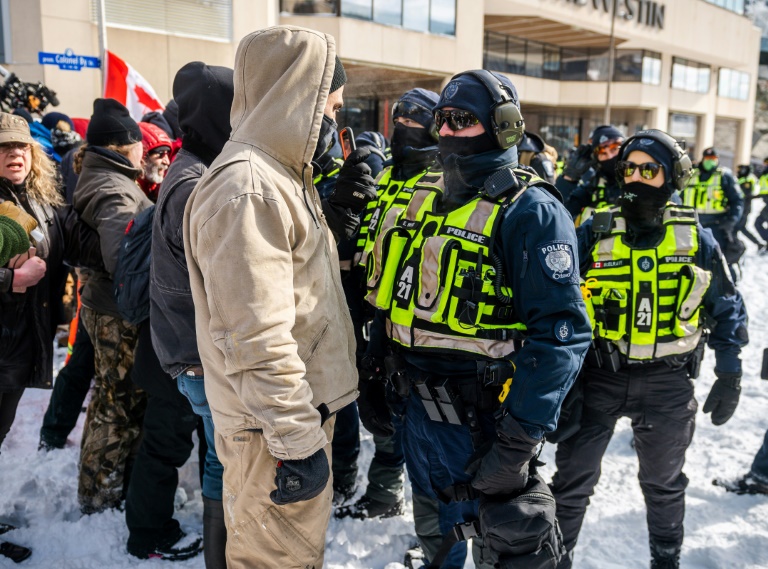
Canadian police on Friday began a massive operation in Ottawa to clear trucker-led protests against Covid rules, with demonstrators arrested and vehicles towed away after a three- week blockade.

Hundreds of heavily armed officers — including on horseback — lined up against protesters who locked arms in the capital’s downtown at the start of a gradual clearance process that could take days.

Police advanced slowly and methodically, pushing back the protesters.

An AFP journalist saw several demonstrators led away in handcuffs as police and tow trucks moved in.

A few demonstrators were wrestled to the ground, and at least one who refused to exit his truck had his windows smashed and was dragged out by police.

“Some protesters are surrendering and are being arrested,” Ottawa police tweeted.

“You must leave,” they warned the crowds, telling them “you will face severe penalties if you do not cease further unlawful activity and remove your vehicle.”

Demonstrators appeared to dig in after heavy snowfall, playing cheerful music and waving Canadian flags on hockey sticks. A bouncy castle was set up and and a pig roast held in the street.

The so-called “Freedom Convoy” started with truckers protesting against mandatory Covid vaccines to cross the US border, but its demands have grown to include an end to all pandemic rules and, for many, a wider anti-establishment agenda.

At its peak, the movement also included blockades of US-Canada border crossings including a key trade route across a bridge between Ontario and Detroit, Michigan — all of which have been lifted after costing the economy billions of dollars, according to the government.

– Leaders arrested –

Overnight two protest leaders were arrested and charged with mischief and counselling others to break the law. 

One of them, Tamara Lich, 49, was heard telling truckers as she was being led away by police to “hold the line.”

On Friday, a third protest leader was stopped in his car as he was live-streaming on social media.

Convoy organizers tweeted for supporters to “drop whatever you are doing, and make your voice heard” by coming to the capital.

Earlier, lawmakers took the extraordinary move to cancel a parliamentary session. Speaker of the House Anthony Rota cited an “ever-changing” situation in the streets outside the seat of Canada’s democracy.

Government workers and MPs were asked to stay away, while anyone already in the parliamentary precinct were urged to shelter indoors.

– Final warning –

Police on Thursday had given protesters a final warning to leave, as barricades went up to restrict access to the downtown protest zone and surrounding neighborhoods — encompassing more than 500 acres (200 hectares).

Criticized for failing to act decisively to end the protests, Prime Minister Justin Trudeau this week invoked the Emergencies Act, which gives the government sweeping powers to deal with a major crisis.

It’s only the second time such powers have been invoked in peacetime.

Lawmakers, split over the move with only a small leftist party backing Trudeau’s minority Liberal government, were debating its use when parliament was hastily shuttered.

New Democratic Party leader Jagmeet Singh told the Commons on Thursday that the protesters were “brazenly” trying to overthrow the government.

Conservative MPs accused the government of using a “sledgehammer to crack down on dissent.”

Trudeau has said the act was not being used to call in the military against the protesters, and denied restricting freedom of expression.

The objective was simply to “deal with the current threat and to get the situation fully under control,” he said. “Illegal blockades and occupations are not peaceful protests.”

Police this week arrested dozens of protesters at border crossings, including four people charged with conspiracy to murder police officers at a checkpoint between Coutts, Alberta and Sweet Grass, Montana.

They also seized dozens of vehicles, as well as a cache of weapons that included rifles, handguns, body armor and ammunition.

Authorities also froze the bank accounts of protesters and chocked off crowdfunding and cryptocurrency transactions supporting the truckers.

US military aims to reassure rattled eastern NATO allies

At the Powidz base in Poland, US soldiers said they hoped the growing US presence in a key NATO ally bordering Ukraine would reassure the region as a whole amid security tensions with Russia.

The base is a key logistics hub for the US deployment in Poland, which has more than doubled in recent days to around 9,000 troops in response to Moscow’s military build-up around Ukraine.

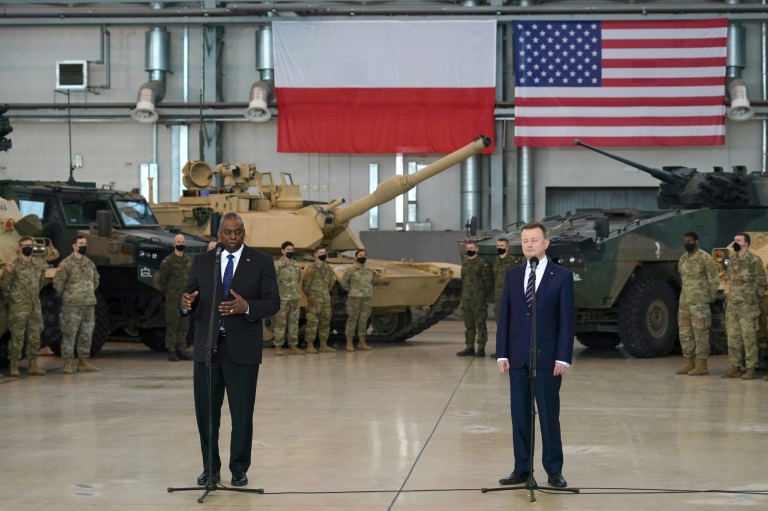
“What we are focused on is assuring our allies and partners in the region that the US is here,” Lieutenant General John Kolasheski said on the sidelines of a visit to the base by the US and Polish defence ministers on Friday.

Kolasheski said US troops were training “to build the collective readiness of our units as well as their units and also demonstrating that we’re able to be interoperative” with Polish forces.

At the base, which hosts around 1,000 US soldiers, armoured vehicles were on display inside a giant hangar for US Defense Secretary Lloyd Austin and Polish Defence Minister Mariusz Blaszczak.

On the airstrip, there were three Ospreys — a type of military aircraft with vertical take-off and landing often used by US special forces.

Poland normally hosts around 4,000 US troops on a rotational basis, including as part of a US-led NATO battle group sent to the region following Russia’s annexation of Crimea in 2014.

US President Joe Biden has dispatched 4,700 more troops in response to the current situation.

Russia has criticised this additional US military presence and has called for NATO’s “enhanced forward presence” in Poland and the Baltic states — all once ruled by Moscow — to be rolled back.

– ‘Growing sense of insecurity’ –

At a news conference earlier on Friday in Warsaw, Blaszczak thanked Austin for sending extra troops.

“The support of the United States at this difficult time is a sign of responsibility and iron-clad commitment to the security of Poland and Europe,” he said, warning against the “imperialistic policy of the Russian Federation”.

Austin said the troops were “prepared to respond to a range of contingency”, including for the evacuation of US citizens from Ukraine if needed.

“Poland knows first hand the steep cost paid by victims of aggression from larger neighbours,” Austin said.

Greg Lewicki, an international relations expert from the Jagiellonian Club, a think-tank, said the additional US troops were a “very welcome” response to “a growing sense of insecurity” in Central and Eastern Europe in recent years.

“This growing sense of insecurity has been downplayed and even ridiculed by some western European countries,” he said.

He pointed in particular to politicians in France and Germany who he said were “depicting Central and Eastern Europe as Russophobe”, adding that the current situations “shows we were right all along”.

In Powidz, which among other things helps supply food and fuel for US troops in Poland, the recent reinforcements have meant some extra work but soldiers are taking it in their stride.

“Our troops are committed. They love the mission  here,” said Sergeant Major Raymond Harris.

“They really enjoy working with our NATO partners and allies, building those relationships.”

Close Bitnami banner
Bitnami