World

11 missing after Greece ferry fire

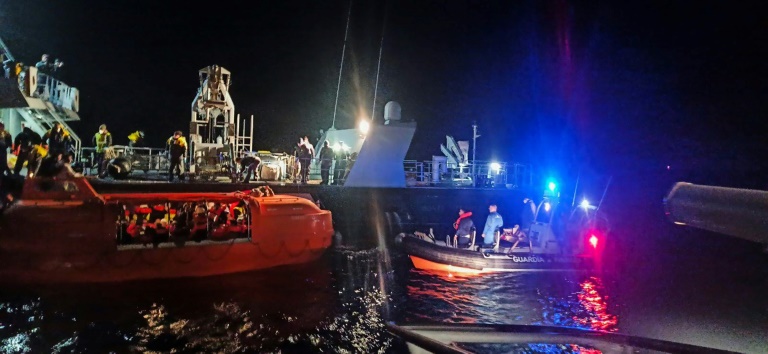
Eleven people were missing and two remained trapped after an Italian-flagged ferry caught fire overnight on the Ionian Sea, Greek officials said as emergency crews raced against the clock to put out the blaze and locate survivors before dark.

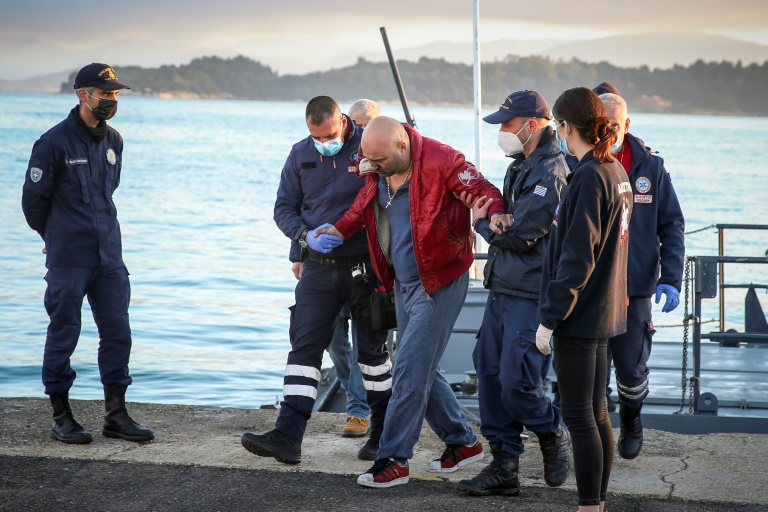
Divers were being brought in to widen the search for those missing, the Greek coastguard said, after 278 people had been rescued and taken to the island of Corfu following the blaze on the Euroferry Olympia en route from Greece to Italy. 

The fire was still burning on Friday afternoon hours after it first broke out off the island of Ereikousa between Greece and Albania.

Officials said the cause remained unknown. 

Among the rescued, 10 were taken to hospital with breathing difficulties and minor injuries, public television ERT said.

But several were still unaccounted for on Friday afternoon. 

“An operation to locate 11 missing passengers is in progress,” the Greek coastguard said in a statement.

Nine of those missing are from Bulgaria.

A specialised Greek rescue team was able to board the vessel over 12 hours after the fire broke out. 

According to ferry owners Grimaldi Lines, five missing passengers had been “traced on board” and evacuation efforts were underway.

But the Greek coastguard said it was aware of only two passengers on board, identified by a Bulgarian freight company as a Bulgarian and a Turkish truck driver who were trying to make their way to the deck. 

Grimaldi Lines said the vessel was officially carrying 239 passengers and 51 crew as well as 153 trucks and trailers and 32 passenger vehicles.

A migrant stowaway was rescued in addition to those on the ship’s list, raising fears that more undocumented passengers could be on board.

Grimaldi Lines said they were alerted at 4:12 am (0212 GMT) to the fire on the ship, which was heading to Italy from the Greek port city of Igoumenitsa opposite Corfu.

Television images showed the ship enveloped in flames which sent plumes of black smoke into the sky.

– ‘Burning from end to end’ –

“The ship is burning from end to end,” Corfu rescuer Yiorgos Glikofridis told ERT on Friday afternoon from a vessel near the ferry.

“There is a tremendous amount of smoke and visibility is poor. We see no movement on the deck, only flames,” he said.

Three tugboats equipped with fire hoses were engaged in extinguishing the fire, and a ferry was dispatched with two fire engines on board, the coastguard said.

A Greek coastguard spokeswoman told AFP it would take several hours to put the fire out.

The Bulgarian foreign ministry said there were 127 of its nationals on the passenger list, including 37 truck drivers. 

Another 24 are from Turkey, the country’s NTV station said. ERT said there were 21 Greeks among the passengers.

No fuel spill has been detected at sea, and the ship’s stability does not appear to be compromised, the company said.

“Tugboats have been hired and are heading towards the Euroferry Olympia to give prompt support and manage the emergency,” it said.

The 27-year-old ship’s latest safety check was at Igoumenitsa on February 16, the company said.

“We heard that the fire started in the hold, but it’s not certain,” a Greek man who identified himself as a passenger told Skai TV.

“It took just 15 minutes for the fire to reach the deck,” he said, adding that the mostly Italian crew’s response had been “simply perfect”.

“They were very organised. The crew saved us,” he said.

Passengers rescued by an Italian law enforcement patrol boat that also rushed to the scene later told Italian news agency Ansa that the flames were “gigantic” and that panic had ensued.

“The evacuation was not a simple matter,” the patrol boat’s commander told Ansa.

Costas Zorbas, a senior regional official for the Ionian island group, told ERT that passengers had been moved to hotels.

“Health personnel are present at the hotels, and medication has been provided to those in need,” he said.

There is heavy maritime traffic between the western Greek ports of Igoumenitsa and Patras and the Italian ports of Brindisi and Ancona.

The last shipboard fire in the Adriatic occurred in December 2014 on the Italian ferry Norman Atlantic. Thirteen people died in the blaze.

burs-hec-jph/har
Three dead as Storm Eunice batters Europe

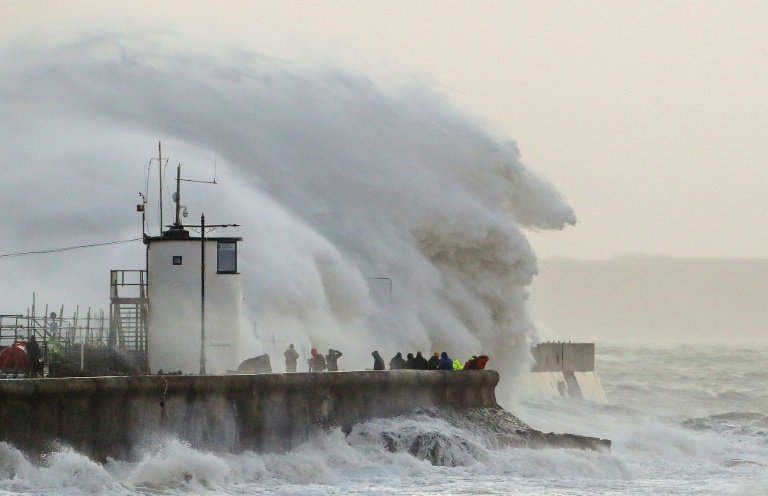
Storm Eunice killed three people in Europe on Friday, pummelling Britain with record-breaking winds and forcing millions to take shelter as it disrupted flights, trains and ferries across Western Europe.

London was eerily empty after the British capital was placed under its first ever “red” weather warning, meaning there is “danger to life”.

The same rare level of alert was in place across southern England, South Wales and the Netherlands, with many schools closed and rail travel paralysed, as towering waves breached sea walls along the coasts.

Eunice knocked out power to more than 140,000 homes in England, mostly in the southwest, and 80,000 properties in Ireland, utility companies said.

Two people were killed by falling trees in the Netherlands, Dutch emergency services said. A man in his 60s was killed by a tree in the Ballythomas area of southeast Ireland, police said. 

Around London, three people were hospitalised after suffering injuries in the storm, and a large section of the roof on the capital’s Millennium Dome was shredded by the high winds.

One wind gust of 122 miles (196 kilometres) per hour was measured on the Isle of Wight off southern England, “provisionally the highest gust ever recorded in England”, the Met Office said.

At the Tan Hill Inn, Britain’s highest pub in Yorkshire, staff were busy preparing even if the winds remained merely blustery in the region of northern England.

“But with the snow coming in now, the wind’s increasing, we’re battening down the hatches, getting ready for a bad day and worse night,” pub maintenance worker Angus Leslie told AFP.

– ‘Sting jet’ –

Scientists said the Atlantic storm’s tail could pack a “sting jet”, a rarely seen meteorological phenomenon that brought havoc to Britain and northern France in the “Great Storm” of 1987. 

Eunice caused high waves to batter the Brittany coast in northwest France, while Belgium, Denmark and Sweden all issued weather warnings. Long-distance and regional trains were halted in northern Germany. 

Ferries across the Channel, the world’s busiest shipping lane, were suspended, before the English port of Dover reopened in the late afternoon. 

Hundreds of flights were cancelled or delayed at Heathrow and Gatwick in London, and Schiphol in Amsterdam. One easyJet flight from Bordeaux endured two aborted landings at Gatwick before being forced to return to the French city.

Prime Minister Boris Johnson, who has placed the British army on standby, tweeted: “We should all follow the advice and take precautions to keep safe.”

Environment Agency official Roy Stokes warned weather watchers and amateur photographers against heading to Britain’s southern coastline in search of dramatic footage, calling it “probably the most stupid thing you can do”.

– Climate impact? –

London’s rush-hour streets, where activity has been slowly returning to pre-pandemic levels, were virtually deserted as many heeded government advice to stay home.

Trains into the capital were already running limited services during the morning commute, with speed limits in place, before seven rail operators in England suspended all operations.

The London Fire Brigade declared a “major incident” after taking 550 emergency calls in just over two hours — although it complained that several were “unhelpful”, including one from a resident complaining about a neighbour’s garden trampoline blowing around.

Widespread delays and cancellations were reported on bus and ferry services, with high bridges closed to traffic.

The RAC breakdown service said it was receiving unusually low numbers of callouts on Britain’s main roads, indicating that motorists are “taking the weather warnings seriously and not setting out”.

The storm forced Prince Charles, the heir to the throne, to postpone a trip to South Wales on Friday “in the interests of public safety”, his office said Thursday.

Another storm, Dudley, caused transport disruption and power outages when it hit Britain on Wednesday, although damage was not widespread.

Experts said the frequency and intensity of the storms could not be linked necessarily to climate change. 

But Richard Allan, professor of climate science at the University of Reading, said a heating planet was leading to more intense rainfall and higher sea levels.

Therefore, he said, “flooding from coastal storm surges and prolonged deluges will worsen still further when these rare, explosive storms hit us in a warmer world”.

Police move in to clear trucker-led protests in Canada capital

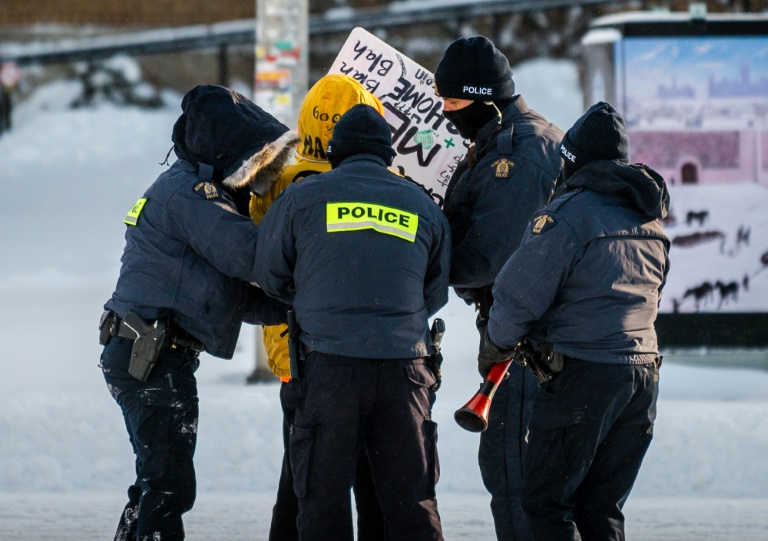
Canadian police on Friday began a massive operation to clear the trucker-led protests against Covid health rules clogging the capital for three weeks, with several arrests made and trucks towed away.

Hundreds of heavily armed officers gathered in the early morning on the edges of downtown Ottawa for the start of a gradual clearance process that could take days.

Overnight two protest leaders were arrested and charged with mischief and counselling others to break the law, while Friday morning an AFP journalist saw several demonstrators led away in handcuffs as police and tow trucks moved in.

“Some protesters are surrendering and are being arrested,” Ottawa police tweeted.

“You must leave,” they warned the protesters, telling them “you will face severe penalties if you do not cease further unlawful activity and remove your vehicle and/or property immediately.”

Media were asked to “stay out of police operations for your safety.” A police news conference was scheduled later in the day to provide an update.

Demonstrators appeared to dig in after a heavy snowfall, playing cheerful music and waving Canadian flags at the ends of hockey sticks. 

The so-called “Freedom Convoy” started with truckers protesting against mandatory Covid vaccines to cross the US border, but its demands have grown to include an end to all pandemic health rules and, for many, a wider anti-establishment agenda.

At its peak, the movement also included blockades of a half-dozen US-Canada border crossings including a key trade route across the Ambassador Bridge between Windsor, Ontario and Detroit, Michigan — all of which have been lifted after costing the economy billions of dollars, according to the government.

One of the arrested protest organizers, Tamara Lich, 49, was heard telling truckers as she was being led away by police late Thursday to “hold the line.”

– Parliament closed –

On Friday, lawmakers took the extraordinary move to cancel a parliamentary session. Speaker of the House Anthony Rota cited “exceptional circumstances” and an “ever-changing” situation in the streets outside the seat of Canada’s democracy.

Government workers and MPs were asked to stay away, while anyone already in the parliamentary precinct were urged to shelter indoors.

Police had given protesters on Thursday a final warning to leave, as barricades went up to restrict access to the downtown protest zone and surrounding neighborhoods — encompassing more than 500 acres (200 hectares).

Criticized for failing to act decisively to end the protests and facing pressure from Washington, Prime Minister Justin Trudeau this week invoked the Emergencies Act, which gives the government sweeping powers to deal with a major crisis.

It’s only the second time such powers have been invoked in peacetime.

Lawmakers, split over the move with only a small leftist party backing Trudeau’s minority Liberal government, were debating its use when parliament was hastily shut down.

New Democratic Party leader Jagmeet Singh told the Commons on Thursday that the protesters were “brazenly” trying to overthrow the government, while accusing the main opposition Tories of “endorsing” the trucker convoy.

Conservative MPs shot back that the government was using a “sledgehammer to crack down on dissent.”

Trudeau has said the act was not being used to call in the military against the protesters, and denied restricting freedom of expression.

The objective was simply to “deal with the current threat and to get the situation fully under control,” he said Thursday. “Illegal blockades and occupations are not peaceful protests… They have to stop.”

Police this week arrested dozens of protesters at border crossings, including four people charged with conspiracy to murder police officers at a checkpoint between Coutts, Alberta and Sweet Grass, Montana.

They also seized dozens of vehicles, as well as a cache of weapons that included rifles, handguns, body armor and ammunition.

Authorities also froze the bank accounts of protesters and chocked off crowdfunding and cryptocurrency transactions supporting the truckers.

Russian court orders Navalny brother jailed in absentia

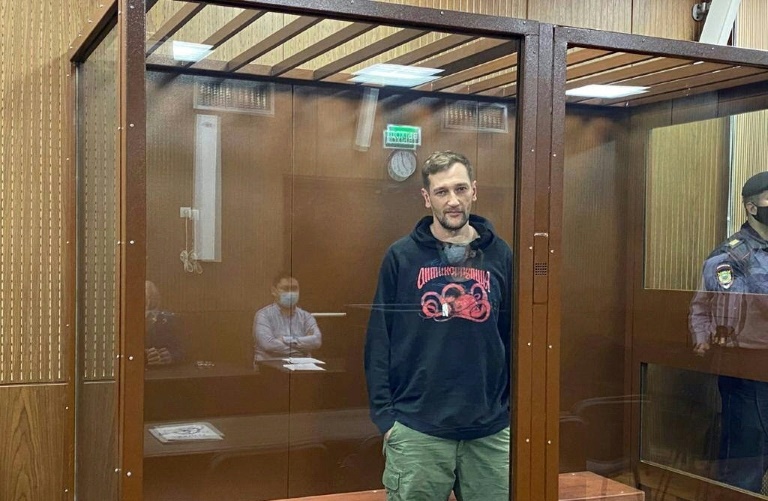
Russia on Friday sentenced in absentia the brother of imprisoned Kremlin critic Alexei Navalny to one year in prison for violating terms of a suspended sentence, expanding a protracted opposition crackdown.

The ruling against Oleg Navalny comes one year after his brother was thrown in jail for two-and-a-half years on old fraud charges, the first of several controversial rulings that abruptly halted opposition politics in the country.

Alexei Navalny’s political and anti-corruption organisations were declared extremist and shuttered. Most of his allies fled the country and those remaining face persecution. 

On Friday, a district court in Moscow “replaced Oleg Navalny’s suspended sentence… with jail time,” his lawyer Nikos Paraskevov wrote on Twitter.

The 38-year-old was given the suspended sentence in August last year for violating coronavirus-restrictions.

He was accused of calling on Russians to attend an unsanctioned rally in January 2021 in support of his detained brother.

Alexei Navalny, 45, was swept up by police last January in a Moscow airport on his return to Russia from Germany where he had been recovering from a near-fatal poisoning attack.

Oleg Navalny was not present at the trial Friday.

According to court documents cited by news agencies, he travelled to Cyprus in September last year and did not return to Russia.

In January, Russia’s prison authorities lodged a request to convert his sentence to jail time after he did not report for police inspections. Authorities issued an arrest warrant.

– Yves Rocher fraud trial –

The judge Friday granted the request and cited “aggravating circumstances”, the state-run RIA Novosti news agency reported, in a reference to Navalny’s previous convictions.

In 2014, both Alexei and Oleg Navalny were convicted in a fraud trial, that their supporters said was politically motivated, related to their work for French cosmetics company Yves Rocher.

Oleg served three-and-a-half years in prison, while Alexei received a three-and-a-half-year suspended sentence.

Oleg Navalny served his term in a penal colony 300 kilometres (186 miles) from Moscow.

During his time in prison, he designed drawings for tattoos in support of political prisoners.

After returning to Russia last year, Alexei Navalny had his suspended sentence converted to jail time, which he is serving in a penal colony outside Moscow.

Last week, a makeshift court in Navalny’s penal colony started hearings in a new trial against Vladimir Putin’s main critic that could see his jail time extended by more than a decade. 

Alexei Navalny is accused of stealing for personal use more than $4.7 million in donations that were given to his political organisations. The charges carry a maximum penalty of 10 years in prison.

In separate charges, Navalny also faces up to six months in prison if convicted of contempt of court.

Mali asks France to pull out troops 'without delay'

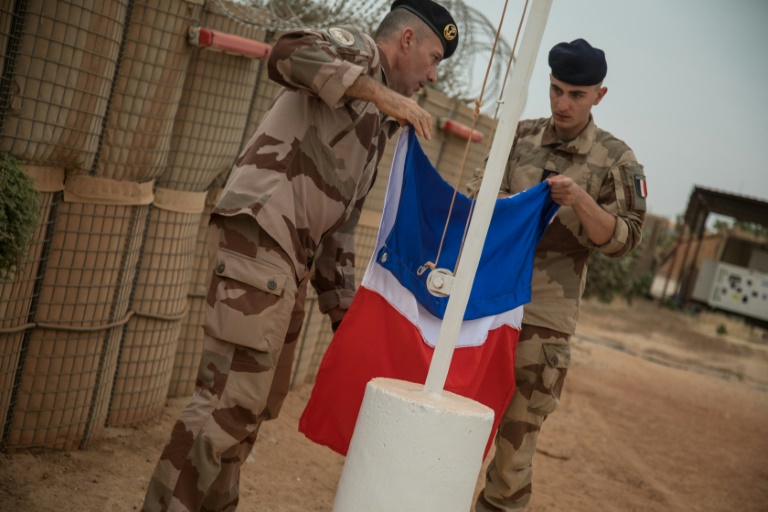
Mali’s army-led government on Friday asked France to withdraw its forces from the Sahel state “without delay”, calling into question Paris’ plans to pull out over several months. 

A government spokesman added in a statement announced on public television that the results of France’s nine-year military engagement in conflict-torn Mali were “not satisfactory”. 

On Thursday, French President Emmanuel Macron announced that he was withdrawing troops from Mali after a breakdown in relations with the nation’s ruling military junta.

France first intervened in Mali in 2013 to combat a jihadist insurgency that emerged one year prior. It currently has thousands of troops stationed across the Sahel, with the majority in Mali.

However, relations between the two countries deteriorated sharply after Mali’s army seized power in a coup in 2020, and later defied calls to restore civilian rule swiftly.

The French pullout after nearly a decade is also set to see the smaller European Takuba group of special forces, created in 2020, leave Mali. 

Macron said the withdrawal would take place over four to six months. 

Spokesman Colonel Abdoulaye Maiga called the prolonged French withdrawal a “flagrant violation” of accords between the two countries. 

“In view of these repeated breaches of defence agreements, the government invites the French authorities to withdraw, without delay,” he said.

Mali has also asked the smaller Takuba force to depart quickly.

Macron responded with a statement saying he would not compromise the safety of French soldiers and the withdrawal will take place take place “in orderly fashion”.

The planned withdrawal of France and its allies has raised questions about the possibility of a security vacuum in impoverished Mali, a vast and ethnically diverse nation of 21 million people. 

– Dire relations –

Mali’s call for a swift French military withdrawal caps months of escalating tensions with its former colonial master. 

Relations first began to fray after Malian army officers led by Colonel Assimi Goita deposed elected president Ibrahim Boubacar Keita in August 2020. 

The army then deposed the civilian leaders of a transitional government last year, in a second coup. 

Mali’s international partners — including France and the Economic Community of West African States (ECOWAS) — insisted that the junta stick to a pledge to stage elections in February 2022 and restore civilian rule.

But the junta floated plans to stay in power for up to five years. 

The proposal prompted the 15-nation ECOWAS bloc to impose a trade embargo and shut its borders with Mali in January.

France followed by announcing a pullout on Thursday. However, Paris had already begun to scale back its deployment before relations nosedived. 

It closed three bases in northern Mali this year, where the bulk of its anti-jihadist Barkhane force had been stationed. 

– Wagner group –

As well as concerns over civilian rule in Mali, Paris has protested the junta’s alleged use of Russia’s Wagner private security firm. 

The US and others say that hundreds of fighters from the controversial paramilitary group are in the country. However, the junta flatly denies the claim. AFP has been unable to independently verify the information. 

Mali remains the epicentre of the Sahel-wide jihadist conflict, which has killed thousands of soldiers and civilians and displaced some two million people.

The conflict spread deeper into Mali, despite the presence of French troops, which has fed popular resentment of France’s military intervention. 

France and its allies have vowed to remain engaged in fighting terror in the Sahel despite leaving Mali.

Iran nuclear talks nearing 'decision point'

Several world powers have indicated that a deal — at least in principle — to revive the Iran nuclear accord may be just days away, but experts warn that failure still cannot be ruled out.

The 2015 accord had offered Tehran sanctions relief in exchange for curbs on its nuclear programme, but the US unilaterally withdrew in 2018 under then-president Donald Trump and reimposed heavy economic sanctions, prompting Iran to start ramping up its nuclear activities.

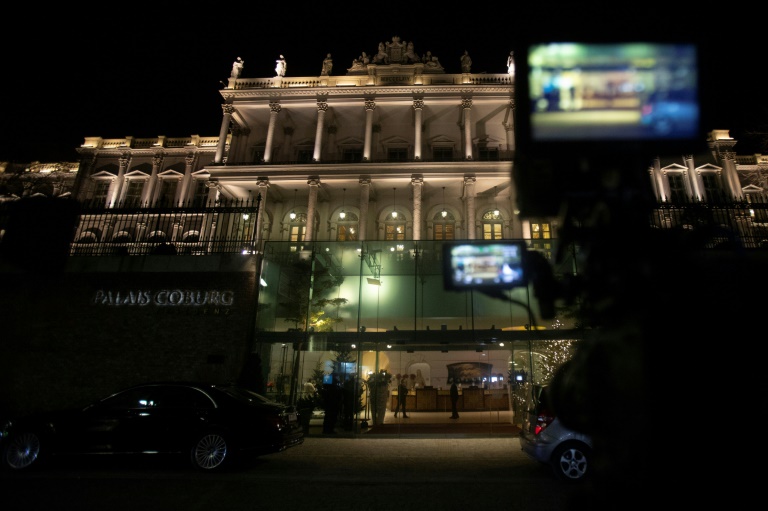
The outline of a new deal appears to be on the table in talks which have been held in Vienna since late November between signatories Britain, China, France, Germany, Russia — and the United States indirectly.

“The West, Russia, and China appear to be more aligned than at any prior point,” said Henry Rome, analyst with the Eurasia Group.

The strategy of the world powers appears to be “pressuring Iran to bring the talks to a conclusion,” the analyst said, adding that the negotiations appeared to nearing a “decision point”.

A diplomatic source in Vienna confirmed this week that there had been “advances” in the talks.

The US State Department said on Thursday that “substantial progress” had been made, and that an agreement was possible within days if Iran “shows seriousness”.

The day before French Foreign Minister Jean-Yves Le Drian had said a deal was “within grasp” but that “a serious crisis” was still possible if Iran refused to accept the proposals of the other parties.

Experts believe Iran is only a few weeks away from having enough fissile material to build a nuclear weapon — even if it would take several more complicated steps to create an actual bomb.

Iran has always denied it wanted to acquire atomic weapons, and on Thursday supreme leader Ayatollah Ali Khamenei called such claims “absurd”.

– Points of contention –

The stumbling blocks in the way of a new deal have long been clear.

The points of contention “have been on the table from the very beginning,” said Ali Vaez, Iran specialist at the International Crisis Group.

They include which sanctions will be lifted and whether Washington can offer Tehran any guarantees against the possibility of a future US president repeating Trump’s move.

Tehran also wants to know that companies and banks venturing back into Iran will not be penalised by potential future American sanctions.

“I think both sides believed that the other would blink and give more concessions on these issues at the last minute,” Vaez said.

Iranian Foreign Minister Hossein Amir-Abdollahian said this week that his country wanted “political statements” from the parliaments of the other signatories — including the US Congress — underlining their commitment to the deal.

“Iran’s commitments are as clear as a mathematical formula,” he said.

Vaez said that “on the question of scope of sanctions relief, I think there is more room for manoeuvre on the West’s side.”

“But the reality is that on the question of guarantees, there’s really nothing that the US can do and offer,” he added, given the difficulty of binding the hands of a future administration.

– Best and worst case scenarios –

Echoing Amir-Abdollahian, Iran’s top negotiator Ali Bagheri called on the other parties to “avoid intransigence”.

“We are closer than ever to an agreement; nothing is agreed until everything is agreed, though,” he tweeted earlier this week.

Two scenarios are possible in the current conditions, according to Vaez.

“If, in the next few days, the Iranians don’t back off from some of their demands, then I think what you’re likely to see is a Western walkout,” he said.

That could lead to a resolution criticising Iran being put forward at the next Board of Governors meeting of the UN nuclear watchdog the International Atomic Energy Agency, due to begin on March 7.

Vaez said this could be the first step in a “cycle of escalation”.

However, faced with multiple security crises in other parts of the world, Vaez said “the last thing the Biden administration wants” is a nuclear proliferation headache in Iran.

The more optimistic scenario would entail “a breakthrough in… the next four or five days” opening the door for a deal being “announced towards the end of this month or early March”.

According to analyst Rome, even the “soft deadline” of March 7 may slip by, “especially if Iran continues talking, given significant reluctance in the West to pivot to an alternative strategy”.

Boy trapped for three days in Afghan well dies after rescue

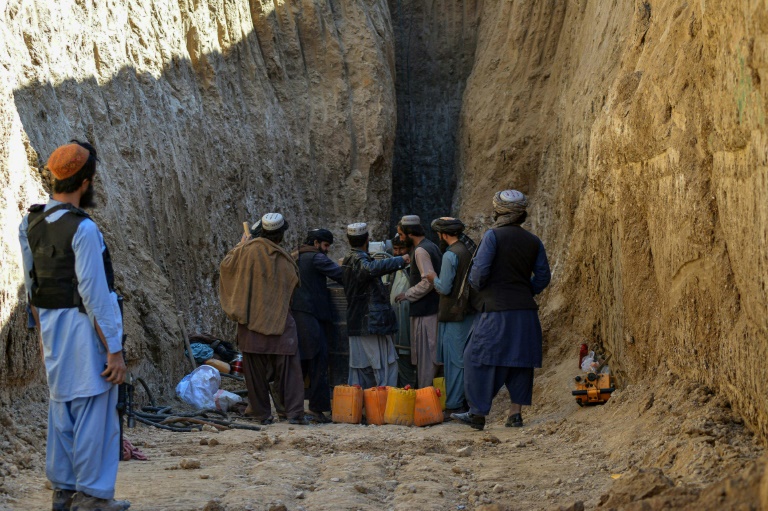
A five-year-old boy trapped for three days down a remote Afghan village well died minutes after being pulled out on Friday, following a rescue effort the country’s new Taliban rulers said showed they would spare nothing for their citizens.

The child, named Haidar, on Tuesday slipped and fell to the bottom of a well being dug in Shokak, a parched village in Zabul province, about 400 kilometres (250 miles) southwest of the capital Kabul.

“With great sorrow, young Haidar is separated from us forever,” said Taliban interior ministry senior adviser Anas Haqqani, in a tweet echoed by several of his colleagues.

“This is another day of mourning and grief for our country.”

Haidar was buried later in the day, his small grave covered by a mound of gravel and marked by a ribbon of white cloth.

Zabul police spokesman Zabiullah Jawhar told AFP Haidar was clinging to life when rescuers reached him.

“In the first minutes after the rescue operation was completed, he was breathing, and the medical team gave him oxygen,” he said.

“When the medical team tried to carry him to the helicopter, he lost his life.”

The operation comes around two weeks after a similar attempt to rescue a boy from a Moroccan well gripped the world — but ended with the child found dead.

Haidar’s grandfather, 50-year-old Haji Abdul Hadi, told AFP the boy fell down the well when he was trying to “help” adults dig a borehole in the drought-ravaged village.

Officials said he fell to the bottom of the narrow 25-metre (80-foot) shaft, then was pulled by rope to within about 10 metres of the surface before becoming stuck.

Senior officials from the Taliban’s newly installed government oversaw the rescue operation in Shokak, which was watched by hundreds of villagersmany related to the child.

– ‘Prayers not enough’ –

They despatched bulldozers and other earth-moving equipment to the site, as well as one of the country’s few airworthy helicopters in case he required medical evacuation to hospital.

Some Taliban officials posted videos of the tricky operation, saying it showed how the new regime — widely criticised for rights abuses — would spare nothing to care for its citizens.

“Our prayers weren’t enough, but it brought everyone together, and we showed to everyone that all Afghan lives are precious,” tweeted one Taliban official.

Video shared Thursday on social media showed the boy wedged in the well but able to move his arms and upper body.

“Are you OK my son?” his father can be heard saying. “Talk with me and don’t cry, we are working to get you out.”

“OK, I’ll keep talking,” the boy replies in a plaintive voice.

The video was obtained by rescuers who lowered a light and camera down the narrow well by rope.

Engineers using bulldozers dug an open slit trench from an angle at the surface to reach the point where Haidar was trapped.

A large rock blocked the final few metres, which workers used pickaxes to break through on Friday morning.

The operation employed similar engineering to the rescue attempt in Morocco earlier this month, when a boy fell down a 32-metre well and was pulled out dead five days later.

The ordeal of “little Rayan” gained global attention and sparked an outpouring of sympathy online, with the Arabic Twitter hashtag #SaveRayan trending.

Shellfire as Putin turns up heat on Ukraine and West

Shellfire rang out in eastern Ukraine on Friday as Kyiv and Washington accused Russia of seeking to provoke an incident to falsely justify an invasion and Moscow-backed rebels said they were evacuating civilians from their breakaway enclave. 

An AFP reporter near the frontline between government forces and rebel-held territory in the Lugansk region heard the thud of explosions and saw damaged civilian buildings

All eyes were on Russian President Vladimir Putin’s next move as Moscow announced he will oversee a weekend drill of “strategic forces” — ballistic and cruise missiles.

“Right now we are seeing a deterioration of the situation,” Putin said at a press conference with his Belarus counterpart Alexander Lukashenko in Moscow.

Russia has demanded that the United States withdraw all forces from NATO members in central and eastern Europe and is turning up the pressure on Ukraine.

US Secretary of State Antony Blinken told the Munich Security Conference that what has happened “in the last 24-48 hours is part of a scenario that is already in place of creating false provocations, of then having to respond to those provocations and then ultimately committing new aggression against Ukraine.”

Russia has denied it has any such plan and claims to have begun withdrawing some of the 149,000 troops that Ukraine says are on its borders.

But Putin has done nothing to dial down tensions, ordering the missile drills even as there are reports of an increase in shelling from Russian-backed rebels in eastern Ukraine.

The separatist leader of eastern Ukraine’s self-proclaimed Donetsk People’s Republic said rebel authorities will begin evacuating civilians to Russia on Friday.

“Women, children and the elderly are subject to be evacuated first,” Denis Pushilin said. 

Visiting Poland, US Defense Secretary Lloyd Austin said Washington was seeing “more” Russian forces moving into the Ukraine border region despite Moscow’s announcements.

US President Joe Biden is to hold video talks with Western allies, including the leaders of Britain, Canada, France, Germany and NATO, later on Friday to discuss the crisis.

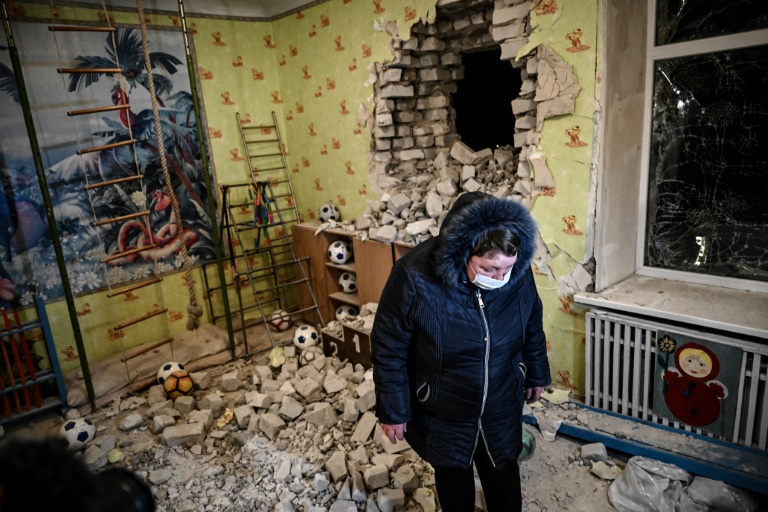
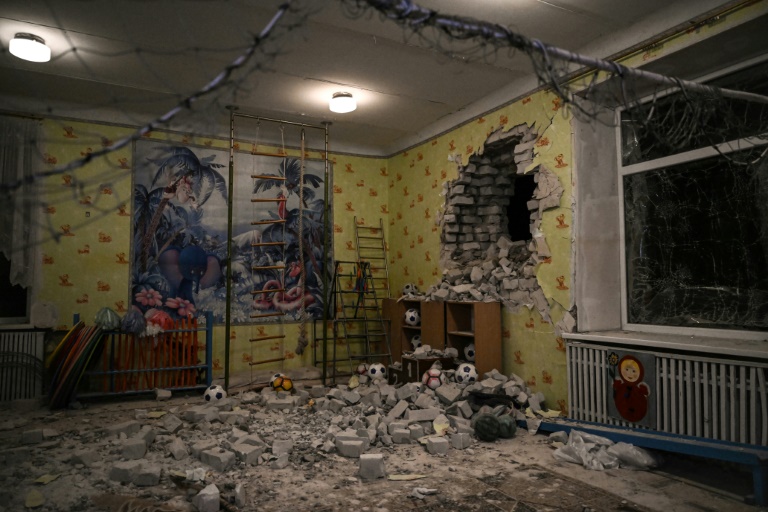
On Thursday, a shell punched a hole in the wall of a kindergarten in government-held territory near the frontline in the Ukrainian village of Stanytsia Luganska.

– Invasion pretext –

The 20 children and 18 adults inside escaped serious injury but the attack sparked international howls of protest.

“The children were eating breakfast when it hit,” school laundry worker Natalia Slesareva told AFP at the scene.

“It hit the gym. After breakfast, the children had gym class. So, another 15 minutes, and everything could have been much, much worse.”

On Friday, part of the village remained without electricity. Konstantin Reutsky, director of the Vostok SOS aid agency, told AFP that houses and a shop had been damaged. 

The Ukrainian joint command centre said the rebels had violated the ceasefire 45 times between midnight and 2:00 pm Friday, while the Donetsk and Lugansk separatist groups said the army had fired 27 times in the morning.

“There are no losses among the military personnel of the joint forces as a result of enemy actions,” the Ukrainian command centre said, accusing the rebels of firing artillery from civilian population areas.

“Ukrainian defenders returned fire to stop enemy activity only in case of a threat to the lives of servicemen.”

The conflict in Ukraine’s east has rumbled on for eight years, claiming the lives of more than 14,000 people and forcing more than 1.5 million from their homes.

But now, after Russia surrounded its neighbour with armoured battle groups, missile batteries and warships, there are fears that Ukraine will be drawn into a clash that Russia could use as a pretext for invasion.

Speaking in parliament, Ukraine’s defence minister Oleksiy Reznikov insisted government forces would keep their cool.  

“Ukraine is stepping up its defences. But we have no intention of conducting military operations” against the separatists or Russian-annexed Crimea, he said.

– ‘Keep a cool head’ –

“Our mission is not to do any of the things the Russians are trying to provoke us into doing,” Reznikov added. “We have to push back but keep a cool head.”

The Russian defence ministry further upped the ante by announcing that Putin would on Saturday oversee an “exercise of strategic deterrence forces… during which ballistic and cruise missiles will be launched.”

The air force, units of the southern military district, as well as the Northern and Black Sea fleets would be involved.

Russia’s aggressive stance has sent diplomatic shockwaves through the West, scrambling to counter an unpredictable foe during what has been described as the worst threat to European security since the Cold War.

Leaders of the Group of Seven wealthy nations will hold a virtual conference next Thursday with the Ukraine crisis high on the agenda, Germany, which holds the group’s rotating presidency, said Friday.

Opening the Munich Security Conference German Foreign Minister Annalena Baerbock said Russia is making an “absolutely unacceptable threat” with its troop build up.

“This crisis is therefore not a Ukraine crisis. It is a Russia crisis. We urge Russia to withdraw its troops immediately,” she said.

“Initial signals to this effect were a glimmer of hope, but we need to see action now. Because the Russian threat remains real.”

UN chief Antonio Guterres told the opening ceremony that if the crisis escalates into a war “it would be catastrophic.”

“With a concentration of Russian troops around Ukraine, I am deeply concerned about heightened tensions and increased speculation about a military conflict in Europe,” he said.

burs-dc/mm/pvh

Sleepless night under falling shells at Ukraine front

The ripped power lines hanging from wooden poles betray a sleepless night without electricity for the residents of this frontline Ukrainian town, where renewed shelling attacks have put it under a global spotlight.

More heavy thuds rang out on Friday around the snow-covered town of Stanytsia Luganska, as world powers braced for signs of an escalation in fighting that Russia might use as a pretext to launch an invasion of Ukraine.

Many of the rural town’s original 12,000 residents fled at the onset of fighting eight years ago in regions hugging Ukraine’s southeastern border with Russia. The conflict has killed thousands.

But those who remained in the government-held town spent the night worrying about a resurgence of clashes similar to those that claimed dozens of lives daily in the early months of Ukraine’s simmering war.

“Right now, the locals’ biggest need is housing,” Vostok SOS relief agency head Kostyantyn Reutskiy told AFP as he inspected the latest damage.

“Three houses and a store were damaged in the village itself,” he said.

His agency counted 20 houses damaged by the latest exchanges of fire between Ukrainian forces and Russian-backed separatists along this stretch of the front.

“One family spent the night in one of these houses without a roof over their heads,” said Reutskiy. “They have nowhere to go.”

– ‘Children are frightened’ –

Stanytsia Luganska gained unwanted international attention after a shell blew a hole in the wall of one of its kindergartens during a sudden surge in attacks on Thursday afternoon.

All 20 children and 18 staff escaped relatively unharmed after rushing to the opposite side of the building and cowering against the walls.

But the shell smashed through the wall of a gym room the children were supposed to play in 15 minutes later.

Kindergarten director Natalia Butenko said her family had to run into their own bomb shelter twice last night because of shelling attacks nearby.

“Of course, all of this is wrong,” the 38-year-old told AFP. “The children are frightened. The staff are also worried. It’s not even safe at home. You end up having to hide.”

Butenko braved the thuds echoing on the horizon and returned to the kindergarten to clean up some of the debris on Friday.

The gym room’s floor was scattered with a thick pile of bricks.  Three soccer balls lay atop debris dust in a corner decorated with posters and a few remaining Christmas ornaments.

“If the shooting intensifies, we will run into the bomb shelter in the neighbouring house,” Butenko said.

– Banned weapons –

Ukrainian soldiers stationed some 100 kilometres (60 miles) to the southwest in the frontline town of Novoluganske reported heavier fighting in recent days.

“It has been quiet for a few hours,” an infantry soldier, who agreed to be named only as Andriy for military security reasons, told AFP.

“But in the morning, at about 7:00 am, first on the right, then on the left, they were firing at us with banned weapons.”

Monitors from the OSCE European security body are also reporting more attacks by armaments that were supposed to have been removed under the terms of two largely-ignored peace plans signed in 2014 and 2015.

“Before, they would fire with small-calibre weapons, regular grenades, grenade launchers. But now, they are using more serious weapons: artillery and guided anti-tank missiles,” the soldier said.

Ukrainian Defence Minister Oleksiy Reznikov told parliament on Friday that his forces were being extremely careful not to do anything that might provoke Russia into launching its feared offensive.

Andriy said his infantry unit was following that guidance.

“We are not responding to the fire,” he said. “If they launch a direct offensive, we will have to hold them back. But otherwise, we are not responding to provocations,” he said.

Two trapped, several feared missing in ferry fire off Greece

Two people were trapped Friday on a burning Italian-flagged ferry sailing through the Ionian Sea and nearly a dozen sustained minor injuries as hundreds were rescued, Greek officials said amid fears of unaccounted-for passengers on board.

A Bulgarian and a Turkish truck driver were trapped on the Euroferry Olympia, with a Super Puma helicopter sent to pick them up, the Greek coastguard said.

A coastguard source said 278 people had been rescued and taken to the island of Corfu. Ten of them were taken to hospital with breathing difficulties and minor injuries, public television ERT said.

A dozen people remained unaccounted for, according to owners Grimaldi Lines, on the vessel, which was officially carrying 239 passengers and 51 crew as well as 153 trucks and trailers and 32 passenger vehicles.

A migrant stowaway was rescued in addition to those on the ship’s list, raising fears that more undocumented passengers could be on board.

Migrant stowaways frequently sneak onto ferries between Greece and Italy.

Grimaldi Lines said they were alerted at 4:12 am (0212 GMT) to the fire on the Euroferry Olympia, which was heading to Italy from the Greek port city of Igoumenitsa opposite Corfu.

Television images showed the ship enveloped in flames which sent plumes of black smoke into the sky.

“The ship is burning from end to end,” Corfu rescuer Yiorgos Glikofridis told ERT from a vessel near the ferry.

“There is a tremendous amount of smoke and visibility is poor. We see no movement on the deck, only flames,” he said.

A Greek coastguard spokeswoman said it would take several hours to extinguish the fire.

The Bulgarian foreign ministry said there were 127 of its nationals on the passenger list, including 37 truck drivers. Another 24 are from Turkey, Turkey’s NTV station said.

– Stowaway fears –

No fuel spill has been detected at sea, and the ship’s stability does not appear to be compromised, the company said.

“Tugboats have been hired and are heading towards the Euroferry Olympia to give prompt support and manage the emergency,” it said.

“We heard that the fire started in the hold, but it’s not certain,” a Greek man who identified himself as a passenger told Skai TV.

“It took just 15 minutes for the fire to reach the deck,” he said, adding that the mostly Italian crew’s response had been “simply perfect”.

“They were very organised. The crew saved us,” he said.

The cause of the fire off the island of Ereikousa between Greece and Albania, is still unknown.

Greek coastguard patrol and tow boats were rushed to the site and a frigate and two helicopters took part in the rescue operations.

An Italian patrol boat also assisted, and some rescued passengers later told Italian news agency Ansa that the flames were “gigantic” and that panic had ensued.

“The evacuation was not a simple matter,” the patrol boat’s commander told Ansa.

Nikos Bardis, a local fisherman, had earlier told ERT that several fishing boats were also circling the stricken vessel, looking for people in the water.

“We can hear explosions, it must be freight trucks blowing up,” he said.

There is heavy maritime traffic between the western Greek ports of Igoumenitsa and Patras and the Italian ports of Brindisi and Ancona.

The last shipboard fire in the Adriatic occurred in December 2014 on the Italian ferry Norman Atlantic. Thirteen people died in the blaze.

str-burs-hec-jph/cdw

Close Bitnami banner
Bitnami