World

US bares intel on Russia in risky strategy to prevent Ukraine invasion

The US government normally keeps battlefield intelligence close to its chest, but by revealing the secret details of Russian military plans, it hopes to prevent an invasion of Ukraine.

Since Russia moved tens of thousands of troops to Ukraine’s border in recent months, Washington’s unconventional strategy has been to let Moscow and the world know what it knows about the Russian invasion plans, rather than keep it secret.

“At long last, Washington is catching up to its rivals — including Russia and WikiLeaks — in the use of information to shape events,” former CIA official Douglas London wrote recently in Foreign Affairs magazine.

With tensions rising, at the beginning of February US officials said Moscow was planning to create a graphic film of a fake Ukrainian attack on Russia, or on Russians inside Ukraine, using footage of damaged locations, “corpses” of people ostensibly killed in the attack, and actors playing mourners. 

Pentagon Spokesman John Kirby is one of several officials who readily detailed the alleged plan.

“We’ve seen these kinds of activity by the Russians in the past and we believe it’s important when we see it like this and we can to call it out,” he said.

Officials would not say how they knew, and so far the ruse has not happened. 

But for US diplomats and military and intelligence officials, that could demonstrate that their approach is working, making Russian President Vladimir Putin think twice about what he allegedly planned to do.

Days later, US officials provided reporters details of the more than 100,000 troops around Ukraine’s borders, describing the likely Russian approach to an invasion and the expected casualties, and revealing a very specific map of the planned invasion routes.

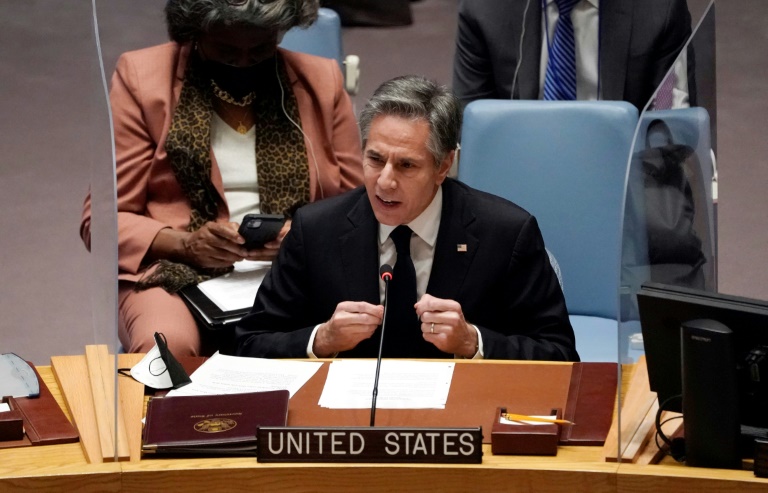
And on Thursday Secretary of State Antony Blinken laid out the most recent picture of an invasion that officials say could come “within days.”

“First, Russia plans to manufacture a pretext for its attack,” Blinken told the UN Security Council.

This could be a violent event that Russia will blame on Ukraine,” he said. 

“It could be a fabricated so-called terrorist bombing inside Russia, the invented discovery of the mass grave, a staged drone strike against civilians or a fake, or even a real attack using chemical weapons. Russia may describe this event as ethnic cleansing or a genocide,” he said, referring to a claim made by Putin on Tuesday.

For the second step, he said, “the highest levels of the Russian government may theatrically convene emergency meetings to address the so-called crisis. The government will issue proclamations declaring that Russia must respond to defend Russian citizens or ethnic Russians in Ukraine.”

“Next, the attack is planned to begin,” he said.

– Catching up –

Making such intelligence public is not how Washington normally works. 

But officials say they hope it pulls the rug out from under Moscow’s own deft, effective disinformation efforts and possibly deter an attack. 

“The more Washington exposes Russian actions and intentions, the fewer face-saving off-ramps Putin has,” London said.

He said revealing intelligence comes with big risks, like exposing valued sources and channels, or losing credibility if the information is wrong.

The US image suffered deeply in 2003 when secretary of state Colin Powell told the United Nations that the United States had “proof” of weapons of mass destruction in Iraq, a claim that “justified” the US invasion but later proved false.

On the other hand, intelligence was made public to good effect when US officials leaked to media intimate details that linked Saudi Crown Prince Mohammed bin Salman to the 2018 murder of journalist Jamal Khashoggi, he said.

“In this case, the US government decided the price was worth it.”

US officials say their claims on Russia and Ukraine might be proven wrong, and admit people might criticize them.

But in fact, it is their hope: that baring Putin’s plans will deter him from following through.

“That’s the best outcome possible. We will have saved thousands of lives,” a senior US official said of that scenario.
Rescued condors spread wings in Chilean Andes

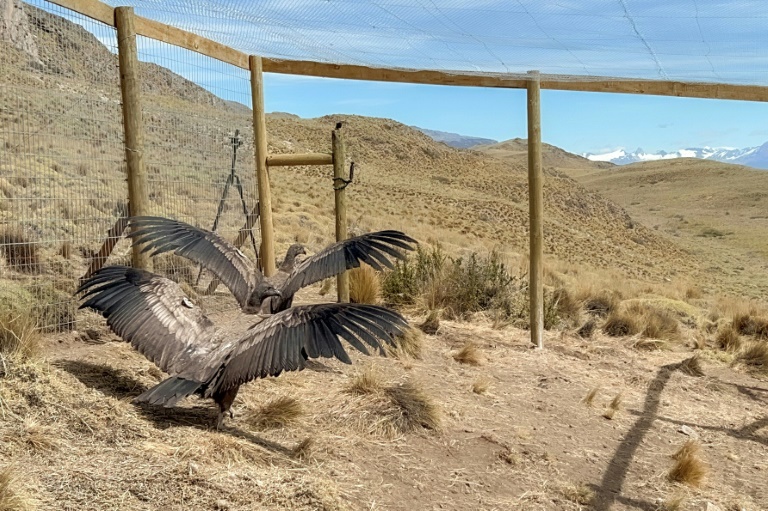
Pumalin and Liquine, two juvenile condors rescued from certain death, have been released back into the wild in a much-needed boost for a dwindling species emblematic of the Chilean Andes.

After 14 months of rehabilitation, the pair of scavengers were freed last week in the Patagonian National Park in Chile’s extreme south, where every individual counts for a species listed by the International Union for Conservation of Nature (IUCN) as “vulnerable” to extinction.

From a vast cage perched on the edge of a cliff overlooking the Patagonian valley, the pair spread their massive wings, waddled to the ledge, and took the leap of freedom, soaring away graciously.

“Today we have witnessed a milestone,” Christian Saucedo of the Rewilding Chile Foundation told AFP.

“It is a very complex process… but it means returning individuals who would otherwise be condemned to live in captivity,” he said.

According to the IUCN, the Andean condor — a type of scavenging vulture — is a declining species, with fewer than 7,000 left in the wild.

– Human ‘persecution’ –

The main threat is “direct and indirect persecution by humans,” it states.

Dominic Duran, the executive director of the Manku Project for condor conservation, told AFP “the biggest threat is toxic baits set by humans to poison… pumas or wild dogs eating their livestock.”

When the condors feed on these carcasses, up to 30 at a time, they get poisoned in turn.

The first to eat, he added, are usually the breeding males and females, and “when condors are killed by toxic bait, all the reproductive individuals at the top of the chain die.”

Other threats are hunting by humans, intoxication from poorly-managed landfills and dwindling numbers of the wild animals that make up their diet.

The foundation that rescued Pumalin and Liquine is a legacy of US philanthropist Douglas Tompkins, who in 1990 donated 8,000 square kilometers (3,088 square miles) of land to Chile and Argentina for conservation.

The Patagonia National Park now housed there holds an estimated 70 percent of Chile’s Andean condors — the largest population in South America.

Pumalin, a male, was found over a year ago unable to fly after getting caught in a heavy storm, and Liquine, a female, was rescued struggling to make it in the wild after an earlier attempt to rehabilitate her.

They will now go back to “learning the codes of condor society,” said Saucedo.

The pair’s progress will be monitored with radio transmitters implanted in their wings.

US judge orders Trump to testify in New York fraud probe

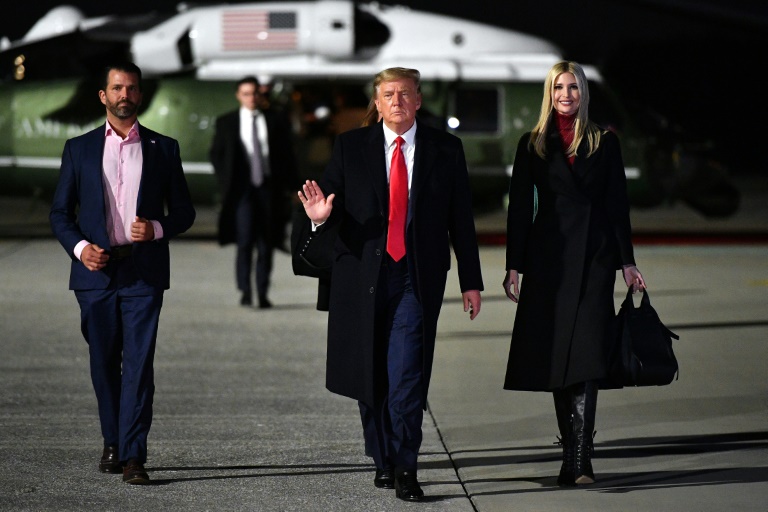
A US judge ruled Thursday that former president Donald Trump and his eldest children must testify under oath in New York’s civil probe into alleged fraud at his family business.

The ruling is the latest legal blow to the 75-year-old as he fights numerous cases that threaten to complicate any bid for another run at the White House in 2024.

The Trumps have repeatedly tried to shut down the investigation by New York Attorney General Letitia James, who last month said she had uncovered “significant evidence” of fraudulent or misleading practices at the Trump Organization.

Following more than two hours of oral arguments, state judge Arthur Engoron rejected a plea by Trump, Donald Jr and Ivanka to quash subpoenas issued by James in December.

He ordered the trio to sit for depositions with James’s office within 21 days. The Trumps are expected to appeal.

Their lawyers argued that the subpoenas in the civil case were an attempt by James to grab evidence for a parallel criminal investigation into the Trump Organization that she is involved with.

They argued that James was trying to bypass a New York state law that grants immunity to witnesses that appear before a grand jury in criminal cases.

Engoron said their argument “completely misses the mark,” noting that neither the Manhattan district attorney, which is running the criminal investigation, nor James’s office have ordered the Trumps to appear before a grand jury.

In his ruling, Engoron added that the Trumps could invoke their Fifth Amendment right not to incriminate themselves during questioning in the civil case.

He noted that Trump’s son Eric had pleaded the fifth “more than 500 times” during a deposition for James’s investigation in October 2020.

Engoron also rejected Trump’s claim that the inquiry by James, a Democrat, is politically motivated.

Following the ruling, Trump’s lawyer slammed James’s investigation as “yet another politically motivated witch-hunt,” one of the ex-leader’s favorite refrains.

“The court clearly had its mind made up and had no interest in engaging in impartial discourse on this critically important issue,” attorney Alina Habba said in a statement.

– ‘Dereliction of duty’ –

He ruled that the motive for the case was not “personal animus” but “sworn congressional testimony by (former Trump lawyer) Michael Cohen that the respondents were ‘cooking the books.'”

He said that for James not to have investigated the allegations or subpoenaed the Trumps would have been “a blatant dereliction of duty.”

James hailed the ruling, tweeting: “No one is above the law.”

She said in January that her civil inquiry had found that the Trump Organization fraudulently overvalued multiple assets to secure loans and then undervalued them to minimize taxes.

If James finds evidence of financial misconduct, she can sue the Trump Organization for damages but cannot file criminal charges.

The Manhattan district attorney’s probe into possible financial crimes and insurance fraud is very similar, however.

In that case, the Trump Organization and its long-serving finance chief, Allen Weisselberg, pleaded not guilty in a New York court to 15 felony fraud and tax evasion charges in July last year.

His trial is due to begin in the middle of this year.

At the heart of the twin investigations are a decade’s worth of financial statements that Trump’s longtime accountants Mazar’s said last week were unreliable.

Mazar’s announced it was ending its relationship with Trump in part because of James’s findings.

Trump has so far kept Americans guessing about whether he intends to seek the Republican nomination again.

In Washington, he has been trying to prevent a congressional probe into the January 6 attack by his supporters on the US Capitol from accessing White House records related to that day.

In further bad news for the ex-president Thursday, a congressional committee asked a government agency to terminate the lease for one of his hotels in Washington before the Trump Organization can sell it.

US says nuclear deal possible within days if Iran 'shows seriousness'

The United States said Thursday that “substantial progress” during negotiations in Vienna to save the Iran nuclear deal had been made, deeming an agreement possible within days if Iran “shows seriousness” on the matter.

The Vienna talks, which involve Iran as well as Britain, China, France, Germany and Russia directly, and the United States indirectly, resumed in late November with the aim of restoring the 2015 deal. 

That accord had offered Tehran sanctions relief in exchange for curbs on its nuclear program, but the United States unilaterally withdrew in 2018 under former president Donald Trump and reimposed heavy economic sanctions, prompting Iran to begin rolling back on its commitments. 

Stating that “substantial progress has been made in the last week,” a State Department spokesperson told AFP that “if Iran shows seriousness, we can and should reach an understanding on mutual return to full implementation of the JCPOA within days,” using an acronym for the 2015 deal.

But “anything much beyond that would put the possibility of return to the deal at grave risk,” the spokesperson added.

Experts believe Iran is only a few weeks away from having enough fissile material to build a nuclear weapon — even if it would take several more complicated steps to create an actual bomb.

President Joe Biden said he is willing to return to the deal and ease some of the US sanctions, provided Tehran resumes its commitments under the agreement.

France had warned Iran Wednesday that time was running out to accept a new deal. Foreign Minister Jean-Yves Le Drian said it was “a question of days,” adding that a major crisis would be unleashed if there is no agreement.

But earlier in the day, Iran’s top negotiator Ali Bagheri said they “are closer than ever to an agreement.”

He called on the other parties to be “realistic” and make “serious decisions.”

Tehran also called on the US Congress to say Washington would commit if an agreement is reached in Vienna.

Iranian authorities had said in 2018 they wanted a “guarantee” that an agreement would be implemented, as the potential of US political turnover had once more brought that into question.

Rescued condors spread wings in Chilean Andes

Pumalin and Liquine, two juvenile condors rescued from certain death, have been released back into the wild in a much-needed boost for a dwindling species emblematic of the Chilean Andes.

After 14 months of rehabilitation, the pair of scavengers were freed last week in the Patagonian National Park in Chile’s extreme south, where every individual counts for a species listed by the International Union for Conservation of Nature (IUCN) as “vulnerable” to extinction.

From a vast cage perched on the edge of a cliff overlooking the Patagonian valley, the pair spread their massive wings, waddled to the ledge, and took the leap of freedom, soaring away graciously.

“Today we have witnessed a milestone,” Christian Saucedo of the Rewilding Chile Foundation told AFP.

“It is a very complex process… but it means returning individuals who would otherwise be condemned to live in captivity,” he said.

According to the IUCN, the Andean condor — a type of scavenging vulture — is a declining species, with fewer than 7,000 left in the wild.

– Human ‘persecution’ –

The main threat is “direct and indirect persecution by humans,” it states.

Dominic Duran, the executive director of the Manku Project for condor conservation, told AFP “the biggest threat is toxic baits set by humans to poison… pumas or wild dogs eating their livestock.”

When the condors feed on these carcasses, up to 30 at a time, they get poisoned in turn.

The first to eat, he added, are usually the breeding males and females, and “when condors are killed by toxic bait, all the reproductive individuals at the top of the chain die.”

Other threats are hunting by humans, intoxication from poorly-managed landfills and dwindling numbers of the wild animals that make up their diet.

The foundation that rescued Pumalin and Liquine is a legacy of US philanthropist Douglas Tompkins, who in 1990 donated 8,000 square kilometers (3,088 square miles) of land to Chile and Argentina for conservation.

The Patagonia National Park now housed there holds an estimated 70 percent of Chile’s Andean condors — the largest population in South America.

Pumalin, a male, was found over a year ago unable to fly after getting caught in a heavy storm, and Liquine, a female, was rescued struggling to make it in the wild after an earlier attempt to rehabilitate her.

They will now go back to “learning the codes of condor society,” said Saucedo.

The pair’s progress will be monitored with radio transmitters implanted in their wings.

US challenges Russia to step back from Ukraine attack

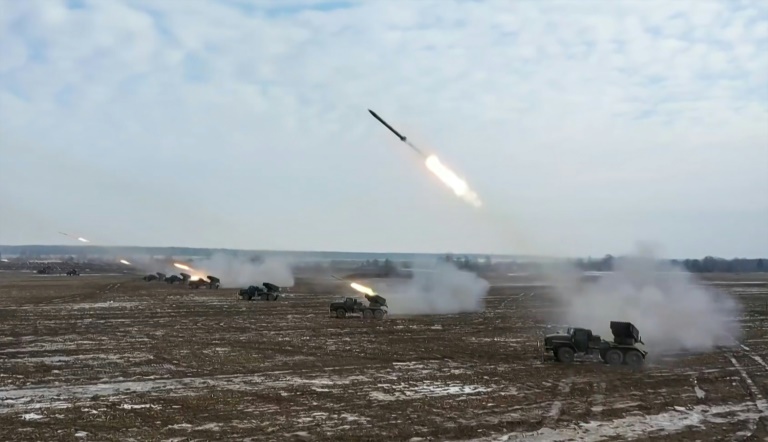
The United States said Thursday that Russia is on the verge of unleashing a massive military attack against Ukraine, dismissing Moscow’s claim to be pulling forces back, as artillery fire hit a Ukrainian kindergarten.

In a dramatic, previously unscheduled speech to the United Nations in New York, US Secretary of State Antony Blinken said intelligence showed Moscow could order an assault on its neighbor in the “coming days.”

With US and other Western governments saying they see no evidence to support Russia’s claim to be withdrawing, Blinken challenged the Kremlin to “announce today with no qualification, equivocation or deflection that Russia will not invade Ukraine. State it clearly. State it plainly to the world.”

“Demonstrate it by sending your troops, your tanks, your planes, back to their barracks and hangers, and sending your diplomats to the negotiating table,” he said.

Russia denies any invasion plans but warned of “military-technical measures” if its far-reaching demands for a US and NATO pullback from eastern Europe aren’t satisfied.

President Joe Biden, at the White House, accused Moscow of preparing a “false flag operation” as a pretext for an attack and said this could happen “in the next several days.”

“They have not moved any of their troops out. They’ve moved more troops in,” Biden said. “Every indication we have is that they’re prepared to go into Ukraine.”

He added, however, that diplomacy is not dead. “There is a path. There is a way through this,” he said.

– ‘Forced to respond’ –

Russia has massed enormous air, land and sea forces around Ukraine. President Vladimir Putin and officials say they do not plan to invade Ukraine and that the troops are only conducting practice exercises.

However, Putin has made clear that the price for removing any threat would be Ukraine agreeing never to join NATO and for the Western alliance to pull back from a swath of eastern Europe, effectively splitting the continent into Cold War-style spheres of influence. Ukraine is far from being ready to join NATO but has set this as part of a broader goal to integrate with the democracies of western Europe, making a historic break from Russia’s orbit.

The United States said Thursday that it had received Putin’s response to its offers of a diplomatic solution to the crisis, but did not give any reaction to the contents.

The Russian foreign ministry indicated that there was little to discuss.

“In the absence of will on the American side to negotiate firm and legally binding guarantees on our security from the United States and its allies, Russia will be forced to respond, including with military-technical measures,” the foreign ministry said.

“We insist on the withdrawal of all US armed forces in Central Europe, Eastern Europe and the Baltics,” it added.

Russia also expelled the number two US diplomat in Moscow, the US State Department said, condemning the “unprovoked” action.

– Artillery fire on kindergarten –

Russia took over Ukraine’s Crimea region and began backing heavily armed separatists in the eastern Donetsk and Lugansk regions in 2014, sparking a war that has already cost thousands of lives.

Sporadic fighting remains common in the east and the Ukrainian army accused the pro-Russian separatists of 34 ceasefire breaches on Thursday, 28 of them using heavy weapons.

The potentially most serious incident — an example of the kind of spark that many fear could ignite far more intense fighting — was the shelling of a kindergarten in the village of Stanytsia-Luganska. Children were inside but none were hit.

Ukrainian President Volodymyr Zelensky tweeted that the attack “by pro-Russian forces is a big provocation.”

Russian news agencies meanwhile quoted authorities in the separatist Lugansk region saying they blamed Kyiv after the situation on the frontline “escalated significantly.”

US Defense Secretary Lloyd Austin described Thursday’s reports as “troubling.”

“We’ve said for some time that the Russians might do something like this in order to justify a military conflict. So we’ll be watching this very closely,” Austin told journalists after a meeting with NATO counterparts. 

Western capitals say they are also concerned by the Russian parliament’s request that Putin grant unilateral recognition of independence for the separatists in eastern Ukraine, probably ending chances of reuniting the country.

“If this request were accepted, it would… demonstrate a Russian decision to choose a path of confrontation over dialogue,” British Foreign Secretary Liz Truss said. 

Putin earlier this week claimed with no evidence that Ukraine is committing “genocide” in the eastern region.

– Disputed pull-out –

Moscow has made several announcements of troop withdrawals this week and on Thursday said that units of the southern and western military districts, including tank units, had begun returning to their bases from near Ukraine.

Defense ministry spokesman Igor Konashenkov said some troops had returned to their garrisons in several areas far from the border, including Chechnya and Dagestan in the North Caucasus, and near Nizhny Novgorod, some 300 kilometers (185 miles) east of Moscow.

The United States, NATO and Ukraine all said they had seen no evidence of a pullback, with Washington saying Russia had in fact moved 7,000 more troops near the border.

According to US officials, there are now about 150,000 Russian troops arrayed in offensive groupings on the southern, eastern and northern borders of Ukraine.

burs-sms/bfm

France announces Mali withdrawal after decade-long jihadist fight

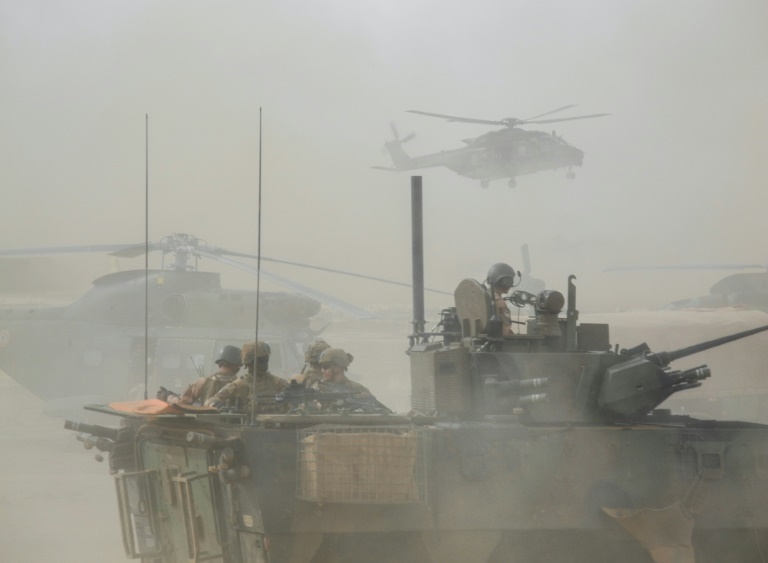
France announced Thursday that it was withdrawing its troops from Mali after a breakdown in relations with the country’s ruling junta, ending a near 10-year deployment against jihadist groups that pose a growing threat in West Africa.

France sent soldiers to its former colony in 2013 to beat back advancing Islamic extremists, but its initial battlefield success was followed by a grinding anti-insurgency operation and rising hostility from Malians. 

Anger in Paris about the alleged arrival of Russian mercenaries from the Wagner group, as well as deepening ties between the Malian regime and Moscow, also hastened the French departure.

“We cannot remain militarily engaged alongside de facto authorities whose strategy and hidden aims we do not share,” President Emmanuel Macron told a news conference.

The French decision will see the departure of 2,400 troops from Mali, but fellow EU nations also announced that they would withdraw several hundred soldiers in the smaller European Takuba force that was created in 2020.

Macron “completely” rejected the idea that France had failed in its mission in Mali that has cost the lives of 48 soldiers, with another five dead across the wider Sahel region. 

“What would have happened in 2013 if France had not chosen to intervene? You would for sure have had the collapse of the Malian state,” he said, adding that French troops had also killed the leaders of local al-Qaeda and Islamic State-affiliated groups.

Ex-president Francois Hollande, who was in power when France first sent the troops to Mali, agreed, telling AFP on Thursday: “If I had to do it again, I would.”

But he also said he would have pulled out the troops sooner than his successor.

France’s bases in Gossi, Menaka and Gao in Mali would be closed within the next four to six months in an “orderly” withdrawal, Macron said.

The announcement comes at a critical time for the 44-year-old French leader, who is expected to announce soon that he will stand for a second term at elections in April.

Macron’s priority will now be to ensure that the withdrawal does not invite comparisons with the chaotic US departure from Afghanistan last year.

“The big question is how we leave, and what we put in place to enable our forces to leave in the best possible security conditions,” Macron’s far-right opponent Marine Le Pen said. 

– Spreading threat –

France and its European allies vowed to remain engaged in fighting terror in the Sahel, a vast and arid region below the Sahara desert that Macron has long argued is crucial for European security. 

The French leader warned that Al-Qaeda and the Islamic State group had made this part of Africa “a priority for their strategy of expansion,” and said the European Takuba forces in Mali would be shifted to neighbouring Niger.

Mali meanwhile proposed that European Takuba members continue cooperating bilaterally.

“All partners who wish to work with Mali in securing the country… are welcome,” Foreign Minister Abdoulaye Diop was quoted as saying in a statement released by the army. 

Since the 2013 French deployment, rebels based in the inhospitable north of Mali have regrouped and moved into the centre, while also launching raids on neighbouring Burkina Faso and Niger.

New fears have emerged of a jihadist push toward the Gulf of Guinea, threatening Ghana, Ivory Coast, Togo and Benin.

Speaking alongside the French leader, Senegalese President Macky Sall said fighting “terrorism in the Sahel cannot be the business of African countries alone.”

Richard Moncrieff, an expert on the Sahel region for the International Crisis Group, a think-tank, said that France’s decision to leave Mali was “far from a surprise” given the tensions between France and Mali.

French daily Le Monde called the withdrawal “an inglorious end to an armed intervention that began in euphoria.” 

Relations between France and Mali plunged after a coup in 2020 and current strongman Assimi Goita refused to stick to a calendar to return the country to civilian rule.

The West also accuses Mali of turning to the shadowy Wagner group to shore up its position amid growing Russian influence in the region.

– Wider impact –

Around 25,000 foreign troops are currently deployed in the Sahel.

They include around 4,600 French soldiers in a regional mission known as Barkhane that France was already planning to wind down. 

In Mali, the UN peacekeeping mission MINUSMA and EUTM Mali, an EU military training mission, operate alongside Malian forces, but French soldiers backed by air power have long been seen as the most effective fighting force.

Macron said France would still provide air and medical support for MINUSMA in the coming months before transferring these responsibilities.

Olivier Salgado, the spokesman for MINUSMA, told AFP that France’s pullout was “bound to impact” the mission and the UN would “take the necessary steps to adapt.”

In Berlin, German Defence Minister Christine Lambrecht said she was “very sceptical” that the country’s mission in the EUTM could continue in the light of the French decision.

Five dead as storms pummel Europe

At least five people were killed as severe storms lashed Europe on Thursday, with winds of up to 181 kilometres per hour (112 miles per hour) causing widespread travel disruption.

In Poland, gusts of up to 125 kilometres per hour  seriously damaged more than 500 homes, felled hundreds of trees and left 324,000 households across the country without power overnight.

Police said two people died and two were injured after storms toppled a large crane at a construction site in Krakow.

Another person was killed by a tree that fell on his car in the west of the country.

In neighbouring Germany, falling trees killed two drivers, a 37-year-old near the northern town of Bad Bevensen and a 55-year-old in the central village of Schwenda.

The Czech Republic was also hit, with more than 300,000 households left without power and extensive traffic disruptions as fallen trees blocked roads and railways.

The strongest winds with gusts of 181 kph were recorded on Snezka, the highest Czech mountain, in the north.

Three children were taken to hospital with injuries after a car accident in the southwest of the country. Wind lifted the bonnet of a car, causing the driver to swerve and crash into another car head-on.

Gales also damaged or destroyed roofs across the country.

In the Netherlands, the high winds injured three people including a police officer.

The officer was injured by roofing that had blown off a commercial building in Duiven, near Arnhem, public broadcaster NOS said.

– Flights grounded –

Firefighters also had to cut two people from a car after a tree fell on it in the southern town of Maasluis. They were later taken to hospital.

Amsterdam’s Schiphol Airport reported flight delays of up to 45 minutes, while some rail services were cancelled.

Britain’s army was placed on standby after the meteorological service issued a rare “red weather” alert for Thursday and Friday, warning of “danger to life” from severe gusts in southwestern England and south Wales.

Ireland also warned of “severe and damaging winds” and the possibility of coastal flooding.

In Germany, dramatic images of a wave smashing through the windows of a ferry on the Elbe River circulated widely on social media.

The operator said no-one was injured. 

Schools were closed in several states and police warned residents to stay at home and avoid parks or forests.

The strongest winds were felt on Brocken, the highest point in the Harz highlands in central Germany, with speeds of up to 152 kph.

Long-distance trains were halted throughout northern Germany, including in Hamburg, Berlin and Bremen, national rail operator Deutsche Bahn said.

Airline Lufthansa cancelled 20 flights destined for Hamburg, Berlin and Munich, departing from Frankfurt, the country’s largest airport.

The storms are expected to persist through Friday and into Saturday, with hurricane-force gales expected in many areas.

Belgium said it was placing its coastal regions on orange-level alert, the second highest level after red.

The north and northwest of France were also placed on orange alert. 

burs-dt-amj/rl

Angry and desperate, residents search for Brazil storm missing

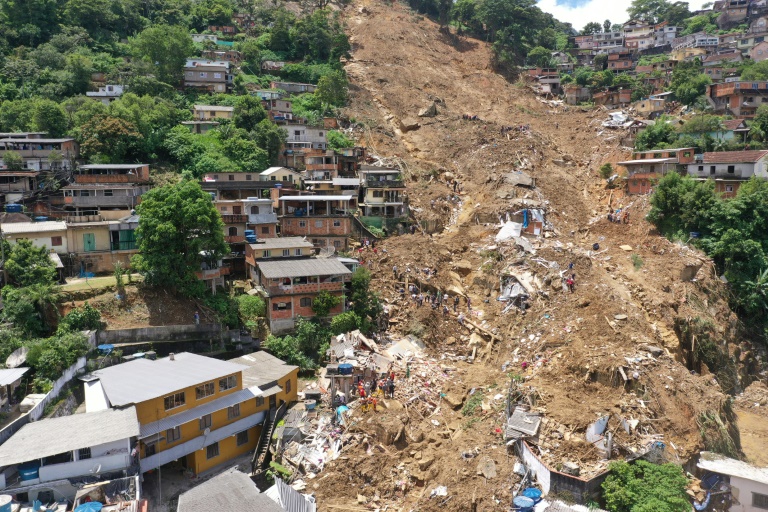
Standing on the heap of mud and rubble that used to be his sister’s house, Anderson Mota Barreiros joins the small army of volunteers shoveling through the muck for their missing loved ones after deadly landslides hit the scenic Brazilian city of Petropolis.

“My sister and her family are still missing. This is where her house was,” says Barreiros, 37, standing in the poor hillside neighborhood of Alto da Serra.

Like him, many civilians jumped into the flood waters and mud as the disaster unfolded Tuesday night, and have been searching for their family, friends and neighbors ever since.

There is bitter anger for many in Alto da Serra over the tragedy and the time it is taking for official rescue operations to find the missing.

Barreiros searched all day Wednesday, in the first hours after torrential rains triggered flash floods and landslides that killed more than 100 people — a death toll that has been steadily rising.

After an agonizing night, he returned at 5:00 am Thursday to pick up where he left off, helped by friends.

“There’s nobody here” to help, Barreiros told AFP.

“I haven’t seen any firefighters, any rescue workers to help me. But we’re not going to give up. With or without help, we’re going to continue.”

As the search geared up again Thursday morning, frustrated residents compared notes on which homes and businesses vanished and whether there was news of the people they knew inside.

Often, there was not.

The number of people still missing is hazy. Many may be among the scores of bodies that have yet to be identified, authorities say.

Twenty-four people were rescued from the mud and rubble, mostly in the first hours after the disaster.

Hope of finding any more alive is growing slim.

– ‘Nothing but mud’ –

Covered in mud, holding a shovel in one hand and a spade in the other, market vendor 26-year-old Luciano Goncalves has been working as a volunteer rescuer.

He helped save a man inside a car that was being swept away in the flood waters early on, but he does not think any more survivors will be found at this point.

“Unfortunately, it looks practically impossible,” he says, a pained look on his face.

Goncalves, who grew up in Alto da Serra, says he lost many friends in the tragedy.

The remains of the buildings where he and his fellow volunteers are now digging are “filled with nothing but mud,” leaving little chance of air pockets where survivors could be alive, he says.

“But we’re going to keep searching, to at least be able to give the bodies to the families so they can bury them and have that comfort.”

Hundreds of soldiers and rescue workers have now arrived on the scene.

But residents of this community built on the hillside — like so many poor neighborhoods in Brazil — say they had no one to help them but each other when the flank of the hill gave way, wiping out everything in its path.

Yasmim Kennia Narciso, a 26-year-old teacher, recalls the noises of that night: the roar of the hillside collapsing, then the screams of neighbors calling for help.

“My father rushed to help them, but more and more earth just kept coming down,” she says, sitting on a mattress on the floor at the nearby church where she and her family of 12 have sought shelter.

“He didn’t manage to help the two elderly ladies who lived near us. One was 82 and the other was 89. Everything was buried there.”

The women’s bodies were recovered, she says.

“But another lady who lived by us is still up there, buried in the mud.”

US ships 5 mln Covid vaccine doses to Egypt, Nigeria

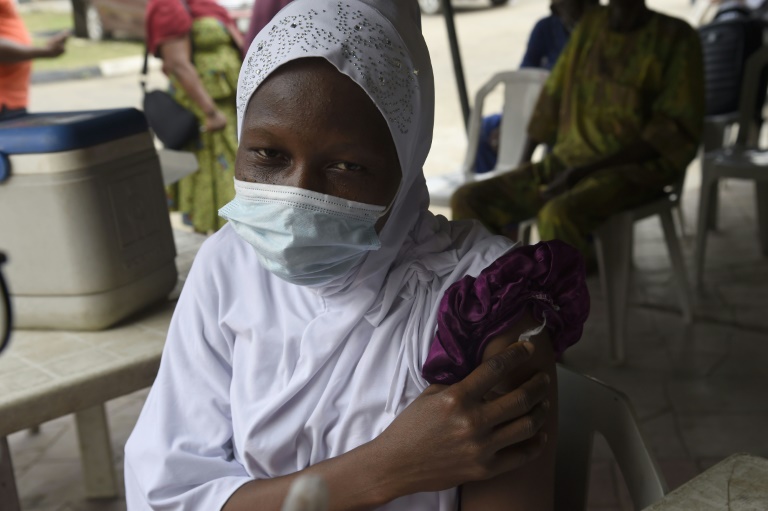
The United States on Thursday shipped nearly 5.2 million doses of the Pfizer Covid-19 vaccine to Egypt and Nigeria, a White House official told AFP.

The shipments were the latest in a global campaign of donations from the United States. More than 400 million shots have already been dispatched from a target of 1.1 billion.

The official, who asked not to be named, said that 2,999,880 Pfizer doses were heading to Nigeria and 2,158,650 doses to Egypt. The shipments, which left Thursday and were due to arrive by Monday, went through Covax, the global distribution initiative co-led with public-private partnership Gavi.

The United States and other countries producing vaccines against the pandemic have been criticized for not doing enough to blunt the virus’ global spread, while trying to get their own populations fully vaccinated and boosted.

However, the official said President Joe Biden’s “administration understands that putting an end to this pandemic requires eliminating it around the world.”

Washington is “leading the world in a global vaccine strategy because it’s the right thing to do. It’s the right thing morally, the right thing from a global public health perspective, and right for our collective security and well-being.”

According to Johns Hopkins University, just under 29 percent of Egypt’s population is fully vaccinated. The coronavirus has killed an estimated 23,519 people there.

In Nigeria, no more than 2.7 percent of the population is fully vaccinated, according to JHU. Only 3,141 deaths have been reported.

In December, Nigerian authorities destroyed more than a million donated doses of the AstaZeneca vaccine after they expired. The government said the doses had been delivered shortly before the end of their shelf life, which is relatively short for AstraZeneca.

The White House official said that for the Pfizer donations, “scientific teams and legal and regulatory authorities from both countries have worked together to ensure the prompt delivery of safe and effective vaccine lots to Egypt and Nigeria.”

Close Bitnami banner
Bitnami