World

Yellen acknowledges 'some global fallout' from any Russia sanctions

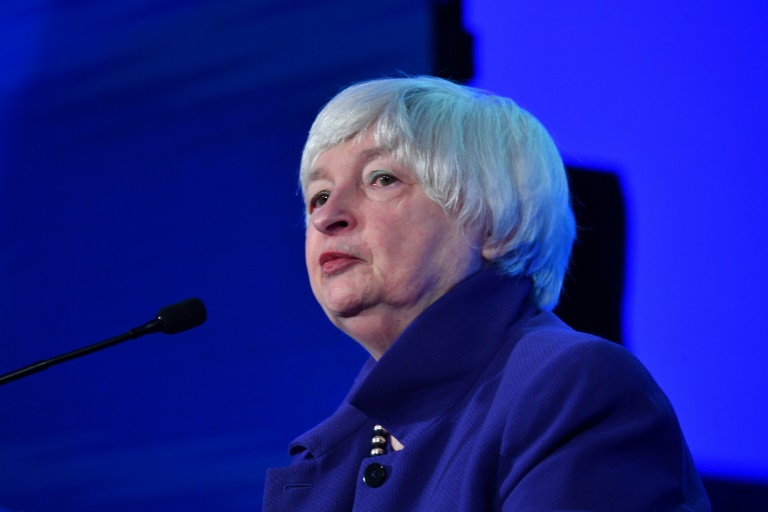
US Treasury Secretary Janet Yellen says “some global fallout” would result if the West moves ahead with the punishing, coordinated sanctions threatened against Russia, should it attack Ukraine.

If the penalties are imposed, “of course, we want the largest cost to fall on Russia,” Yellen said in an interview.

“But we recognize that there will be some global fallout from sanctions,” she told AFP.

Her comments echoed President Joe Biden’s warning on Tuesday that an escalation of the conflict would not be “painless” for Americans.

With Russian troops massed on the border with Ukraine, Biden continues to work with US allies on a diplomatic solution to the crisis, but has repeatedly warned Moscow of the dire consequences it will face if it moves against its neighbor.

Biden and German Chancellor Olaf Scholz on Wednesday urged Moscow to take real steps to defuse tensions. 

The president “has made clear that we intend to impose very significant costs on Russia, if they invade Ukraine,” Yellen said.

Treasury is crafting a set of financial sanctions together with European allies that could target Russian “individuals or companies” and “certainly could involve export controls,” she said.

Yellen described them as a “very substantial package of sanctions that will have severe consequences for the Russian economy.”

But she acknowledged worries about the “potential impacts on energy markets, given the importance of Russia’s role as a supplier of oil to the world market and of natural gas to Europe.”

Washington is “working with our European allies to try to, as best as possible, shield them from undue impact,” by ensuring that “supplies that are available, that come from other parts of the world” and to “try to make sure that oil and natural gas continue to flow to Europe.”

European Union officials said Wednesday they have secured alternate sources of natural gas and could survive a supply squeeze by Russia.

Amid the prospects of armed conflict, and threats Russia could cut off energy supplies, oil prices have risen sharply in recent weeks, hitting $96 a barrel on Wednesday, the highest level since 2014. 

Natural gas prices have been more volatile, but also increased in the past week after dipping earlier in the month.

Anger in UK over Prince Andrew's '£12 mn' settlement

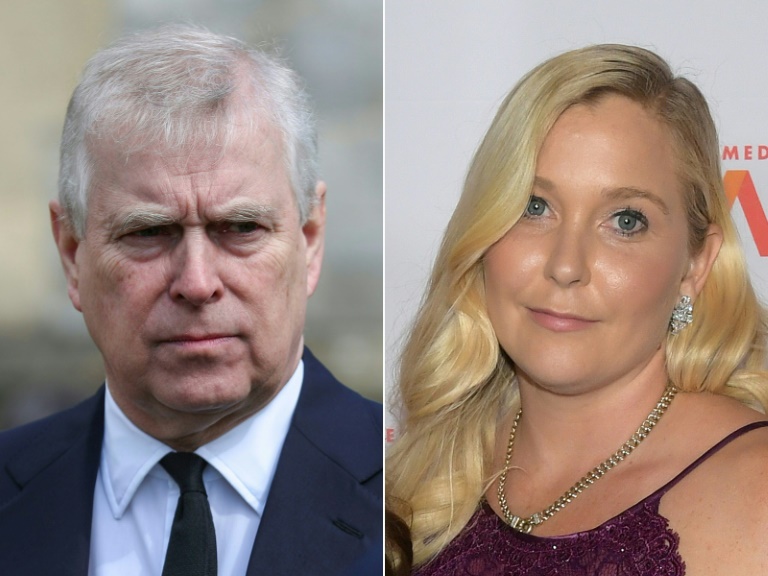
Disgraced British royal Prince Andrew was urged Wednesday to disappear forever from public life after settling a sexual assault lawsuit at vast cost, as Queen Elizabeth II suffered further indignity in her Platinum Jubilee year.

The 95-year-old monarch, who is reportedly helping to foot the bill for the cash-strapped Andrew’s settlement, also saw her elder son and heir Prince Charles embroiled in fresh controversy over a “cash for honours” scandal.

Police in London said they were investigating claims that an aide to Charles offered UK honours and even citizenship to a Saudi tycoon, in return for donations to Charles’s charitable foundation. 

The office of the Prince of Wales reiterated that he “had no knowledge of the alleged offer” by Michael Fawcett, who for decades was one of Charles’s closest confidants.

The revelation came a day after Charles’s younger brother Andrew settled the lawsuit brought by US accuser Virginia Giuffre, sparing him the public humiliation of a trial. 

Details of the deal were not made public, and Andrew’s representatives told AFP they would not comment on the contents.

The Daily Telegraph put the settlement at a whopping £12 million ($16.3 million, 14.3 million euros) — £10 million for Giuffre and £2 million to a charity for victims of sex trafficking.

The newspaper said the money would come from one of the private estates belonging to Queen Elizabeth. Commentators demanded transparency on the source, in case the British taxpayer ends up on the hook.

– ‘Swept under the carpet’ –

“I just think it’s awful that it’s all been swept under the carpet, as if it never even happened,” Yasmine Ollive, a 34-year-old account manager, said in London.

After other controversies over Prince Harry and his wife Meghan Markle, she said that if the royals “keep on carrying on with the things that they’re doing, then it could be the end of them”.

Giuffre, 38, has said she had sex with Andrew when she was 17 and a minor under US law, after meeting him through US financier Jeffrey Epstein. He took his own life in prison while awaiting trial for sex crimes.

The prince, 61, has not been criminally charged and has denied the allegations.

Mark Stephens, a media specialist at law firm Howard Kennedy, told AFP that Andrew had “preserved some measure of dignity for the wider royal family” by agreeing to settle.

But, Stephens added, “he’s not going to see the light of day in public service ever again”.

The scandal hanging over Andrew has threatened to overshadow the queen’s Platinum Jubilee this year, marking her 70 years on the throne. Any jury trial could have coincided with nationwide jubilee celebrations due to take place in the summer.

The queen on Wednesday resumed in-person meetings, having isolated for a week after Charles and his wife both tested positive for Covid-19, suggesting she has avoided the disease.

– ‘No way back’ –

British media called on Andrew to withdraw entirely from public life, after he was already stripped of his honorary military ranks and the title of “His Royal Highness”.

“Andrew is finished — undone by his insufferable arrogance, entitlement and staggering naivety,” popular tabloid The Sun said in its editorial.

“He must retreat entirely from public life and live out his retirement in ignominy.”

Opposition Labour MP Rachael Maskell demanded that Andrew also lose his Duke of York title to show “respect” for the people of the northern English city, which she represents.

The staunchly royalist Daily Mail said in its front-page headline that there was “no way back” for Andrew, who withdrew from royal duties in 2019 after a widely panned BBC interview.

Inside, the paper slammed Andrew for a “vile smear campaign” against Giuffre.

British commentators and social media users also mocked Andrew for claiming he had never met Giuffre, querying why he had agreed in that case to settle for such an apparently large amount.

Many pointed to a photograph of the pair together when she was 17. His lawyers had questioned the authenticity of the photo, which also showed socialite and Epstein friend Ghislaine Maxwell.

In December, Maxwell was convicted of recruiting and grooming young girls to be sexually abused by Epstein.

How world's most precise clock could transform fundamental physics

Einstein’s theory of general relativity holds that a massive body like Earth curves space-time, causing time to slow as you approach the object — so a person on top of a mountain ages a tiny bit faster than someone at sea level.

US scientists have now confirmed the theory at the smallest scale ever, demonstrating that clocks tick at different rates when separated by fractions of a millimeter.

Jun Ye, of the National Institute of Standards and Technology (NIST) and the University of Colorado Boulder, told AFP their new clock was “by far” the most precise ever built — and could pave the way for new discoveries in quantum mechanics, the rulebook for the subatomic world.

Ye and colleagues published their findings Wednesday in the prestigious journal Nature, describing the engineering advances that enabled them to build a device 50 times more precise than today’s best atomic clocks.

It wasn’t until the invention of atomic clocks — which keep time by detecting the transition between two energy states inside an atom exposed to a particular frequency — that scientists could prove Albert Einstein’s 1915 theory.

Early experiments included the Gravity Probe A of 1976, which involved a spacecraft 6,000 miles (10,000 kilometers) above Earth’s surface and showed that an onboard clock was faster than an equivalent on Earth by one second every 73 years.

Since then, clocks have become more and more precise, and thus better able to detect the effects of relativity.

In 2010, NIST scientists observed time moving at different rates when their clock was moved 33 centimeters (just over a foot) higher.

– Theory of everything –

Ye’s key breakthrough was working with webs of light, known as optical lattices, to trap atoms in orderly arrangements. This is to stop the atoms from falling due to gravity or otherwise moving, resulting in a loss of accuracy.

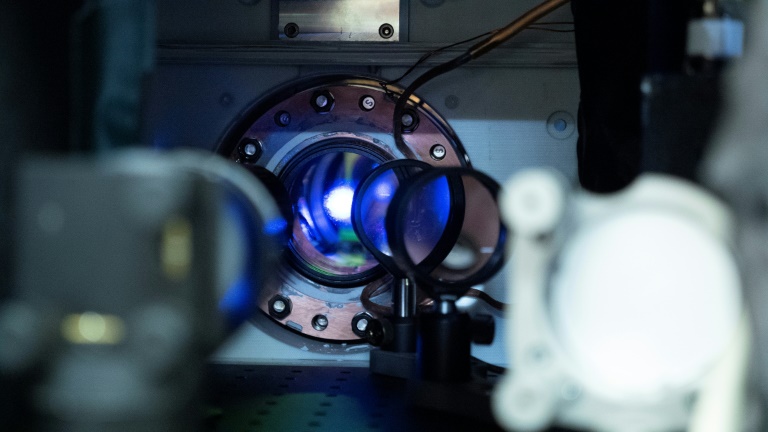
Inside Ye’s new clock are 100,000 strontium atoms, layered on top of each other like a stack of pancakes, in total about a millimeter high.

The clock is so precise that when the scientists divided the stack into two, they could detect differences in time in the top and bottom halves.

At this level of accuracy, clocks essentially act as sensors.

“Space and time are connected,” said Ye. “And with time measurement so precise, you can actually see how space is changing in real time — Earth is a lively, living body.”

Such clocks spread out over a volcanically-active region could tell geologists the difference between solid rock and lava, helping predict eruptions. 

Or, for example, study how global warming is causing glaciers to melt and oceans to rise.

What excites Ye most, however, is how future clocks could usher in a completely new realm of physics. 

The current clock can detect time differences across 200 microns — but if that was brought down to 20 microns, it could start to probe the quantum world, helping bridge disparities in theory.

While relativity beautifully explains how large objects like planets and galaxies behave, it is famously incompatible with quantum mechanics, which deals with the very small.

According to quantum theory, every particle is also a wave — and can occupy multiple places at the same time, something known as superposition. But it’s not clear how an object in two places at once would distort space-time, per Einstein’s theory.

The intersection of the two fields therefore would bring physics a step closer to a unifying “theory of everything” that explains all physical phenomena of the cosmos.

Police issue ultimatum to protesters to leave Canada capital

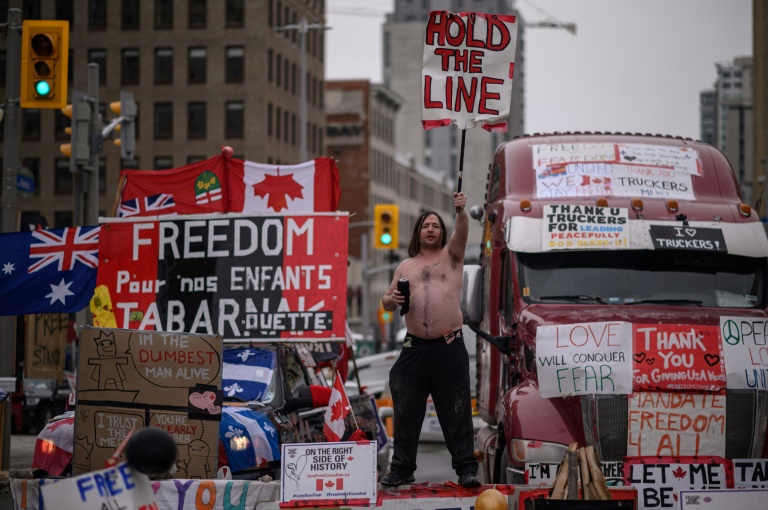
Canadian police issued an ultimatum Wednesday to protesters who’ve been choking Ottawa streets for 20 days to leave the capital, as provincial and US state leaders called for an end to the cross-border vaccine requirement that sparked the trucker-led movement.

Officials, meanwhile, announced a negotiated peaceful end to the last of several recent blockades by protesters of border crossings between Canada and the United States.

“You must leave the area now,” Ottawa police said in a notice distributed to truckers outside parliament. 

Anyone blocking streets or assisting others in doing so will be arrested and face charges, as well as fines and seizures of their trucks, the statement said.

Police also warned that anyone charged or convicted for taking part in the illegal demonstration may, in addition to criminal penalties, be barred from traveling to the United States.

As the notices were handed out, AFP journalists saw hundreds of trucks continuing to occupy streets in the parliamentary precinct, blaring horns — despite an extension Wednesday of a court order against the deafening noises, obtained by an area resident fed up with the disruptions.

“We’re still a lot of trucks holding the line,” trucker David Shaw, 65, told AFP. If arrested, he added: “I’ll keep coming back.”

Fellow protester Jan Grouin, 42, decried Prime Minister Justin Trudeau’s decision earlier this week to impose a state of emergency, calling it “a little overreacting maybe to think that we are terrorists.”

In a statement, Ottawa interim police Chief Steve Bell said “a methodical and well-resourced plan” would be carried out over the coming days “to take back the entirety of the downtown core and every occupied space.”

“Some of the techniques we are lawfully able and prepared to use are not what we are used to seeing in Ottawa,” he said. “But we are prepared to use them… to restore order.”

Montana Governor Greg Gianforte, meanwhile, asked Canadian and US leaders in a letter signed by 16 US governors — all members of the Republican party — to exempt truckers from vaccine and quarantine requirements when crossing the Canada-US border.

They were joined by Alberta Premier Jason Kenney and Saskatchewan Premier Scott Moe, who has endorsed the truckers’ convoy.

“The timing of your decision to terminate the vaccine and quarantine exemptions could not have been worse, as North America already faces grave supply chain constraints,” said the letter addressed to US President Joe Biden and Trudeau.

“These constraints, combined with increasing inflation, place significant burdens on the residents of Canada and the United States.”

– ‘Time for this to end’ –

Unable to dislodge the protesters, Trudeau this week invoked the Emergencies Act, which gives the government wide new powers to end the demonstrations over Covid restrictions. The move marked only the second time in Canadian history such emergency powers have been invoked in peacetime.

Trudeau told reporters Wednesday that with police now getting help from various other law enforcement units, they should “be able to begin their actions.”

“It’s time for this to end,” he said, adding that it was up to “police to decide when and how.”

The so-called “Freedom Convoy” started with truckers protesting against mandatory Covid vaccines to cross the US border, but its demands have since grown to include an end to all pandemic health rules and, for many, a wider anti-establishment agenda.

At its peak, the movement also included blockades of a half-dozen border crossings — including a key trade route across the Ambassador Bridge between Windsor, Ontario and Detroit, Michigan.

Forty-six protesters were arrested and 37 vehicles seized during police operations at the Ontario-Michigan border, and in Coutts, Alberta, four people were charged with conspiracy to murder police officers. They were among 13 arrested with a cache of weapons that included rifles, handguns, body armor and ammunition.

On Wednesday, Public Safety Minister Marco Mendicino said the last blocked crossing — between Manitoba and the US state of North Dakota — had been reopened.

As protest organizers at a news conference continued to encourage supporters to come to the capital, Mendicino said: “Don’t. At best, residents of the city have made it clear that this is not the time and at worst, you may be tying yourself to dangerous criminal activity.”

The demonstrations, he said, “are not about vaccines mandates.”

Rather, he described the core protesters as “a small number of individuals with a steely resolve, driven by an extreme ideology that would seek to overthrow the existing government.”

US accuses Russia of deploying thousands more troops to Ukraine border

The United States on Wednesday dismissed reports that Russia was withdrawing troops from Ukraine’s border, instead accusing Moscow of sending more soldiers as fears of an invasion grow.

Russia has increased its presence on the border with Ukraine by “as many as 7,000 troops,” some of whom arrived Wednesday, said a senior White House official, slamming Moscow’s announcement of a withdrawal as “false.”

“We continue to receive indications they could launch a false pretext at any moment to justify an invasion.” 

The official, who requested anonymity, added that while Moscow has said it wants to reach a diplomatic solution, its actions “indicate otherwise.”

Earlier Wednesday, the United States and NATO joined Ukraine in saying there was no sign of Russian troops withdrawing after military movements in occupied Crimea fueled reports that the crisis could be abating.

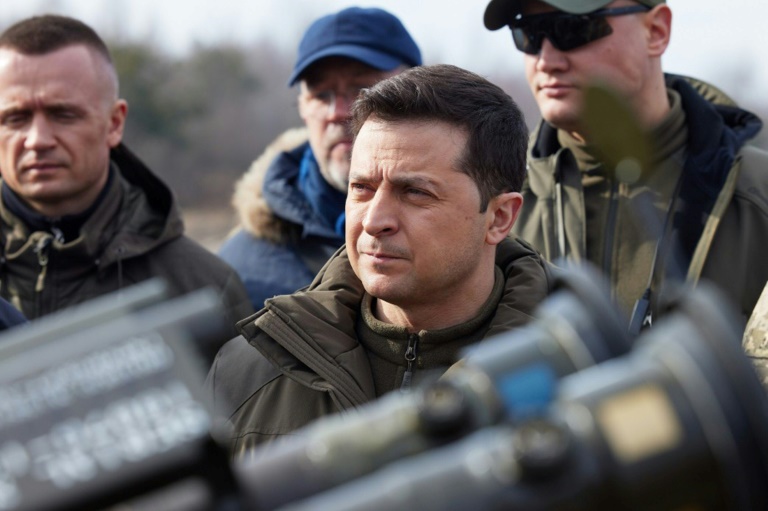
Ukraine’s President Volodymyr Zelensky marked what he had declared “Day of Unity” by watching Ukrainian soldiers train with new Western-supplied anti-tank weapons near Rivne, west of the capital Kyiv.

He also visited the frontline city of Mariupol, wearing a military-style olive green coat.

“We are not afraid of anyone, of any enemies,” Zelensky said on a day that Western intelligence had warned Moscow could choose to invade. “We will defend ourselves.”

Despite images on Russian state media that were said to show Moscow’s forces winding up a major exercise in Crimea, Zelensky said there was no evidence of Russians pulling back.

“We are seeing small rotations. I would not call these rotations the withdrawal of forces by Russia,” he said in televised comments. “We see no change.”

In Rivne, missiles pounded practice targets, while in Kyiv hundreds of civilians marched in a stadium with an enormous national banner.

Russia’s huge build-up of troops, missiles and warships around Ukraine has been billed as Europe’s worst security risk since the Cold War.

NATO chief Jens Stoltenberg, who hosted a meeting of alliance defense ministers in Brussels, also dismissed suggestions that the threat on Ukraine’s border had diminished.

“Moscow has made it clear that it is prepared to contest the fundamental principles that have underpinned our security for decades and to do so by using force,” he said.

“I regret to say that this is the new normal in Europe.”

– ‘Invasion force ready’ –

On the reported Russian troop movements, he said: “So far we do not see any sign of de-escalation on the ground.

“Russia maintains a massive invasion force ready to attack with high-end capabilities from Crimea to Belarus.”

German Chancellor Olaf Scholz echoed Wednesday that “the risk of a further military aggression by Russia” remains “high,” according to a statement issued following a phone call with US President Joe Biden.

Russian President Vladimir Putin has demanded Ukraine be forbidden from pursuing its ambition to join NATO and wants to redraw the security map of eastern Europe, rolling back Western influence.

But, backed by a threat of crippling US and EU economic sanctions, Western leaders are pushing for a negotiated settlement, and Moscow has signaled it will start to pull forces back.

In the latest such move, the Russian defense ministry said on Wednesday that military drills in Crimea — a Ukrainian region that Moscow annexed in 2014 — had ended and that troops were returning to their garrisons.

While Washington has demanded verifiable evidence of de-escalation, Biden has nevertheless vowed to push for a diplomatic solution.

Kremlin spokesman Dmitry Peskov welcomed this, telling reporters: “It is positive that the US president is also noting his readiness to start serious negotiations.”

– US slams invasion ‘pretext’ –

Meanwhile, the Pentagon said that three US Navy aircraft were intercepted by Russian planes in an “unprofessional” manner over the Mediterranean Sea last weekend.

The US State Department had said earlier that Russia was attempting to create a pretext for invading with unsupported claims of “genocide” and mass graves in Ukraine’s eastern Donbas region, which is controlled by Moscow-backed separatists.

“Over the past several weeks, we’ve also seen Russian officials and Russian media plant numerous stories in the press, any one of which could be elevated to serve as a pretext for an invasion,” State Department Spokesman Ned Price said.

EU leaders, already gathered in Brussels for a summit with their African counterparts, are now to hold impromptu crisis talks Thursday on Russia and Ukraine.

A UN Security Council meeting is also set Thursday to discuss the crisis.

And US Vice President Kamala Harris will meet with Zelensky on the sidelines of the annual Munich Security Conference this weekend, a senior White House official said Wednesday.

Ukraine had said Tuesday the websites of the country’s defense ministry and armed forces, as well as private banks, had been hit by a cyberattack of the kind that US intelligence fears would precede a Russian attack.

“It cannot be excluded that the aggressor is resorting to dirty tricks,” Ukraine’s communications watchdog said, referring to Russia.

Kremlin spokesman Peskov denied that Moscow had any role in the cyber assault and accused Ukraine of “blaming Russia for everything.”

burs-dc/to/lb

'I'll kill you!': Mexico's nature defenders put lives on line

In the fir forests of Mexico, one of the world’s most dangerous countries for environmentalists, the legacy of butterfly defender Homero Gomez lives on two years after his suspected murder.

Despite the dangers of standing up to illegal loggers, fellow conservationists continue Gomez’s work guarding the El Rosario monarch butterfly sanctuary in Mexico’s central highlands.

The agricultural engineer dedicated much of his life to protecting the habitat of the iconic orange and black insects, which migrate several thousand kilometers (miles) each year to Mexico, fleeing the Canadian winter.

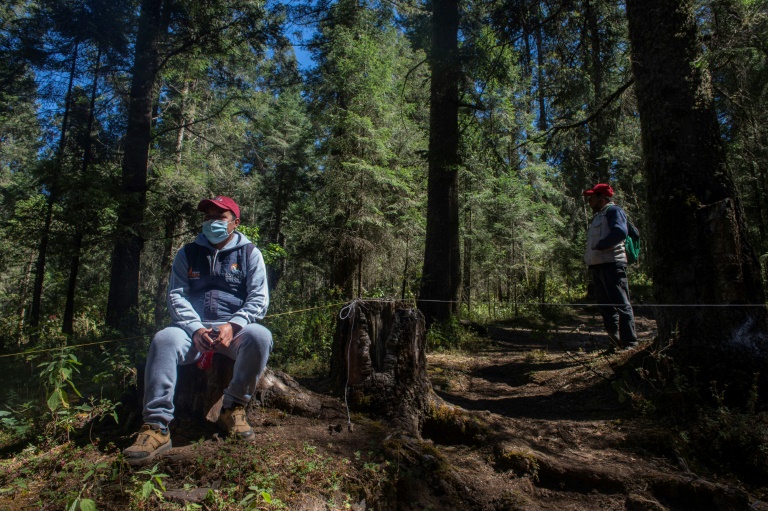
His legacy “is in all of us,” Olegario Sanchez told AFP during a patrol through the mountains of the El Rosario sanctuary, where swarms of butterflies delight visitors with majestic aerial dances.

The body of Gomez, who had gained international recognition for his activism and management of the sanctuary, was found at the bottom of a well in January 2020 in the state of Michoacan, where monarch butterflies spend the winter. 

Days later, the dead body of another butterfly conservationist, Raul Hernandez, was found bearing signs of violence in Michoacan, which is home to several criminal gangs.

The prosecution’s ongoing investigation suggests that Gomez, 50, was murdered.

He was one of 30 environmentalists killed in Mexico in 2020, according to rights group Global Witness.

The death toll soared 67 percent from 2019, making Mexico the second-deadliest country for environmentalists behind Colombia.

Almost a third of the attacks in Mexico were linked to logging, and half targeted Indigenous communities, Global Witness said.

Impunity was “shockingly high,” with up to 95 percent of murders going unprosecuted, it added.

– ‘It was murder’ –

The Michoacan prosecutor’s office, which did not respond to AFP’s request for an interview, said that Gomez died due to “mechanical suffocation due to submersion… with traumatic brain injury.” 

His family have no doubt that he was killed by criminals pillaging the forest that he loved.

“It wasn’t an accident. It was murder,” Gomez’s widow Rebeca Valencia told AFP, voicing fears of a cover-up given the lack of progress in the investigation. 

In the El Rosario sanctuary, near one of the many clusters of resting butterflies that hang from oyamel fir trees, Gomez’s companions smiled wistfully at his memory.

“He was a person with a lot of spirit,” said Sanchez, adding that the activist’s strength would live on through his fellow conservationists.

“There are 260 of us (community guards) and we keep going along the same path” of surveillance and reforestation, Sanchez said.

The wildlife defenders, some armed with machetes, walk up to 20 kilometers each shift, day and night, in groups of 10 to protect fir and pine trees from loggers as well as hungry livestock and fires.

When they detect suspicious activity, they report it to the authorities.

Police also stand guard on tourist trails in the sanctuary, which covers around 2,500 hectares (6,000 acres).

Together with other overwintering sites, it forms Mexico’s Monarch Butterfly Biosphere Reserve — a UNESCO World Heritage site visited by millions of the insects each year.

– ‘Immensely sad’ –

In Mexico’s central state of Hidalgo, Filiberta Nevado also refuses to abandon her work protecting the Zacacuautla forest despite the risks of confronting criminals lured in particular by its pine trees to use for carpentry.

In October 2020, a logger approached her to say: “If anything happens to me, I’ll kill you!”

Nevado, 66, showed apparent evidence of illegal activities during a tour of the area, pointing to dozens of tree trunks scattered on a dirt road.

Men wielding chainsaws were seen leaving when they saw visiting journalists.

In front of dozens of stumps of felled trees, Nevado lamented that her efforts to denounce loggers, helped by tip-offs from neighbors, were usually in vain.

“It makes me immensely sad, and not for my generation… but for the generations to come,” she said.

France warns Iran only days left to agree nuclear deal

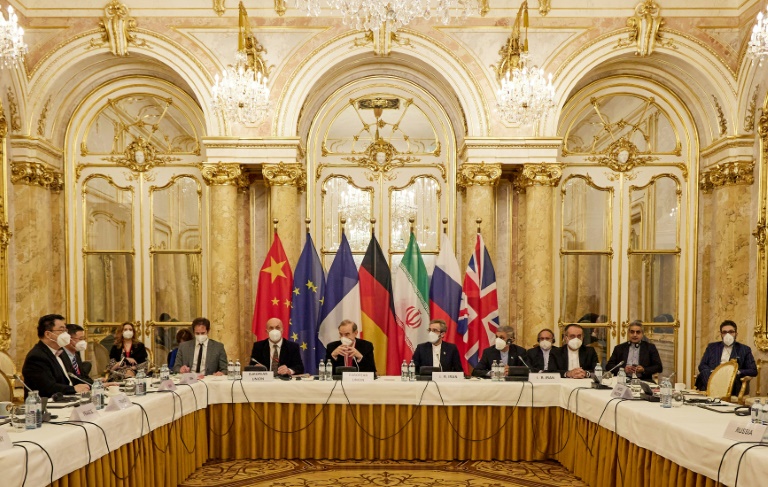
Iran has just days left to accept a deal on its nuclear programme at talks in Vienna, France warned on Wednesday, while Tehran’s chief negotiator promised that an agreement was closer than ever.

“It is not a question of weeks, it is a question of days,” French Foreign Minister Jean-Yves Le Drian told the Senate, adding that a major crisis would be unleashed if there is no agreement.

The Vienna talks, which involve Iran as well as Britain, China, France, Germany and Russia directly, and the United States indirectly, resumed in late November with the aim of restoring the 2015 deal. 

That accord had offered Tehran sanctions relief in exchange for curbs on its nuclear programme, but the United States unilaterally withdrew in 2018 and reimposed heavy economic sanctions, prompting Iran to begin rolling back on its commitments.

“We are closer than ever to an agreement,” Iran’s top negotiator Ali Bagheri wrote on Twitter on Wednesday. “Our negotiating partners need to be realistic, avoid intransigence and heed lessons of past 4yrs. Time for their serious decisions.”

Earlier in the day, Tehran had called on the US Congress to say Washington would commit if an agreement is reached in Vienna.

“As a matter of principle, public opinion in Iran cannot accept as a guarantee the words of a head of state, let alone the United States, due to the withdrawal of Americans” in 2018, Iran’s Foreign Minister Hossein Amir-Abdollahian told the Financial Times in an interview published on his ministry’s website.

He stressed that he had asked Iranian negotiators to propose to the Western parties that “at least their parliaments or parliament speakers, including the US Congress, can declare in the form of a political statement their commitment to the agreement.”

– ‘Within grasp’ –

In 2018, then-president Donald Trump reimposed sanctions against Iran, battering the country’s economy. In response, Tehran ramped up its nuclear work, violating the terms of the 2015 deal, called the Joint Comprehensive Plan of Action (JCPOA).

Negotiations in Vienna are seeking to return Washington to the nuclear deal, including through the lifting of sanctions on Iran, and to ensure Tehran’s full compliance with its commitments.

“We need political decisions from the Iranians. They have a very clear choice,” France’s Le Drian said.

“Either they unleash a serious crisis in the next days… or they accept an agreement that respects the interests of all the parties, especially those of Iran,” he said.

He described a deal as being “within grasp” and noted there was now agreement on an accord between the European powers as well as China, Russia and the United States.

But he said that time was running out because Iran was continuing to intensify its nuclear activities.

“The more this goes on, the more Iran is accelerating its nuclear procedures,” he said.

Thousands affected as quake hits Guatemala

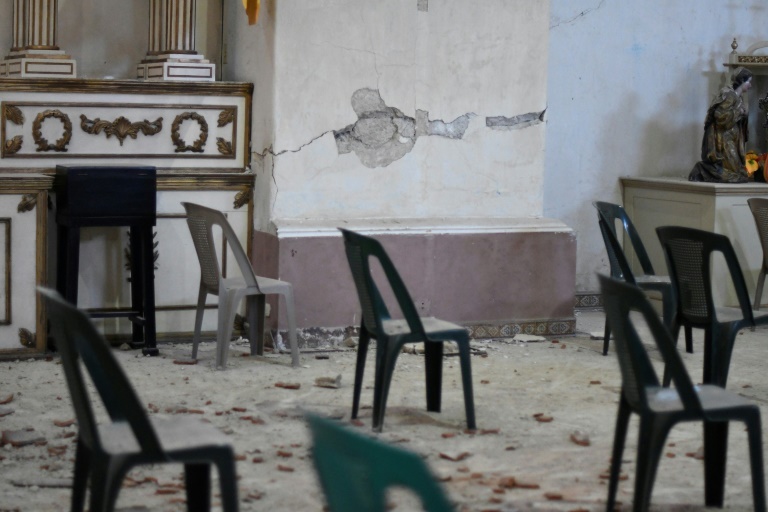
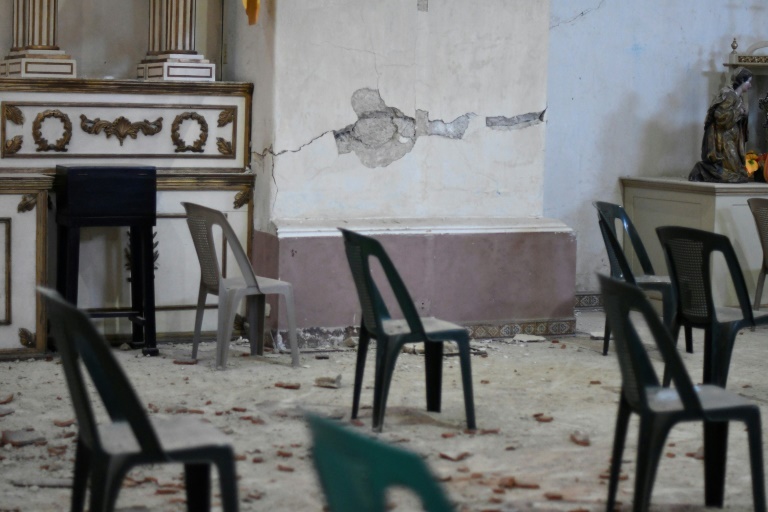
A 6.2-magnitude earthquake that struck western Guatemala early Wednesday caused damage affecting nearly 25,000 people, and caused three people to suffer fatal heart attacks, authorities said.

The epicenter of the quake, which struck at a depth of 84 kilometers (52 miles), was in the coastal district of Escuintla, less than 100 kilometers southwest of the capital, Guatemala City.

The United States Geological Survey said it measured as a 6.2-magnitude quake, though Guatemalan authorities estimated it was stronger, at 6.8, followed by an aftershock of 4.8.

The quake caused landslides on roads, damage to houses and power outages affecting some 31,300 people, according to rescue services.

Three women died of heart attacks, which officials linked to the quake without specifying how they were related.

One woman, 50, died in the village of Mixco, west of the capital. The other two women, whose ages authorities did not give, were in the northern department of Baja Verapaz and the western city of Quetzaltenango.

The tremor was felt as far away as El Salvador, to the southeast of Guatemala, and in southern Mexico.

Firefighters also reported a landslide on the road from the capital to Antigua, Guatemala’s main tourist city.

The Central American country, located at the meeting point of three tectonic plates, sits in a risk zone for earthquakes.

Last year, more than 125 earthquakes were recorded in Guatemala, without any deaths or significant damage.

Thousands affected as quake hits Guatemala

A 6.2-magnitude earthquake that struck western Guatemala early Wednesday caused damage affecting nearly 25,000 people, and caused three people to suffer fatal heart attacks, authorities said.

The epicenter of the quake, which struck at a depth of 84 kilometers (52 miles), was in the coastal district of Escuintla, less than 100 kilometers southwest of the capital, Guatemala City.

The United States Geological Survey said it measured as a 6.2-magnitude quake, though Guatemalan authorities estimated it was stronger, at 6.8, followed by an aftershock of 4.8.

The quake caused landslides on roads, damage to houses and power outages affecting some 31,300 people, according to rescue services.

Three women died of heart attacks, which officials linked to the quake without specifying how they were related.

One woman, 50, died in the village of Mixco, west of the capital. The other two women, whose ages authorities did not give, were in the northern department of Baja Verapaz and the western city of Quetzaltenango.

The tremor was felt as far away as El Salvador, to the southeast of Guatemala, and in southern Mexico.

Firefighters also reported a landslide on the road from the capital to Antigua, Guatemala’s main tourist city.

The Central American country, located at the meeting point of three tectonic plates, sits in a risk zone for earthquakes.

Last year, more than 125 earthquakes were recorded in Guatemala, without any deaths or significant damage.

Despair, solidarity for Brazil storm victims

Holding the few possessions they are able to carry, families stream down the slopes of the hillside neighborhood of Alto da Serra, many in tears, fleeing the devastation left by deadly landslides in the Brazilian city of Petropolis.

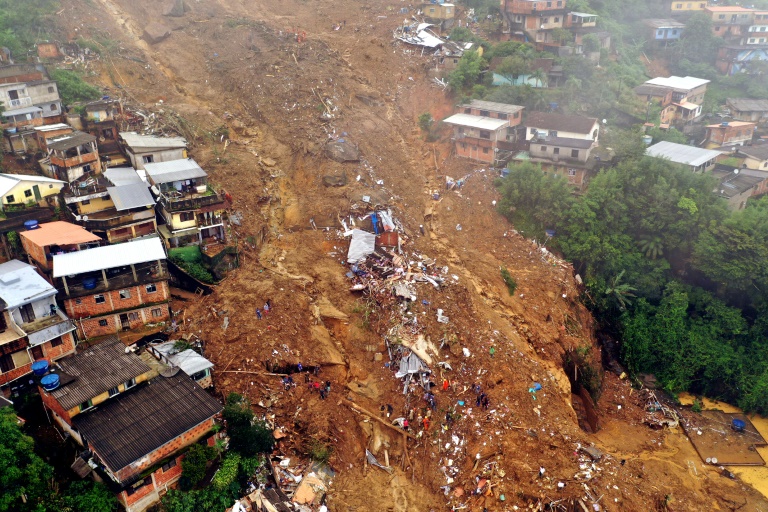
Their modest neighborhood was one of the hardest hit by Tuesday’s storms, which dumped a month’s worth of rain on this scenic tourist town in a matter of hours, triggering flash floods and torrents of mud that gushed violently through the city.

“It’s devastating. We never could have imagined something like this,” says one fleeing resident, Elisabeth Lourenco, clutching two bags in which she stuffed some clothing when emergency officials ordered everyone in the neighborhood to evacuate.

“When the rain was falling hardest, a huge amount of mud came pouring down the hillside, and some tree branches fell on my house,” says the 32-year-old manicurist, on the verge of tears.

Nearby is a scene of total chaos. A giant swathe of hillside is covered in mud and strewn with the remains of shattered houses.

Authorities say the disaster killed at least 78 people across the city. There are fears the death toll, which rose steadily through the day, could climb further still as rescue workers continue digging through the mud and ruins.

Watching the rescue operation in disbelief, residents shudder with each deafening pass of the helicopters hovering overhead.

“I was eating dinner when the storm started. My brother came in and said, ‘We need to get out of here, the hillside is collapsing,'” says Jeronimo Leonardo, 47, whose home sits at the edge of the area wiped out by the landslide.

– ‘Up to our waists’ –

Residents of Alto da Serra have been evacuated to a church that sits atop another hill nearby.

From the square outside the small blue building, they can see the disaster zone through the mist.

Dozens of families swarm the church, carting their belongings in bags.

Outside, volunteers unload a truck of bottled water, as others sort through donated clothing.

“Can I have some shoes?” asks a little boy standing barefoot, his clothes stained with mud.

Inside, mattresses line the floor.

“We started taking people in as soon as the tragedy started Tuesday evening. We’re hosting around 150 to 200 people, including a lot of children,” says Father Celestino, a parish priest.

Yasmin Kennia Narciso, a 26-year-old teacher’s assistant, is sitting on a mattress nursing her nine-month-old baby.

“I didn’t sleep all night,” she says.

She tells the story of how she fled with her two daughters around 11:00 pm.

“We tried to leave earlier, but there were boulders strewn across the path and everything was flooded. We were in water up to our waists. We had no choice but to wait until it went down,” she says.

She adds that she is still waiting for news on several neighbors.

“An older lady and her three grandchildren who lived just above us were buried in the mud.”

Survivors know they likely face a long wait to learn if and when they can return home — for those who still have homes left.

Close Bitnami banner
Bitnami