World

Covid-pass protest convoy heads for banned Brussels rally

Hundreds of cars, campervans and trucks taking part in a Canada-style protest convoy against Covid regulations were preparing to enter Brussels Monday where Belgian officials have already banned a demonstration following a weekend attempt in Paris.

Around 1,300 vehicles from across France had arrived near the French border town of Lille by late Sunday, according to police.

The protest is one of several worldwide inspired by the truckers’ standoff with authorities in Canada.

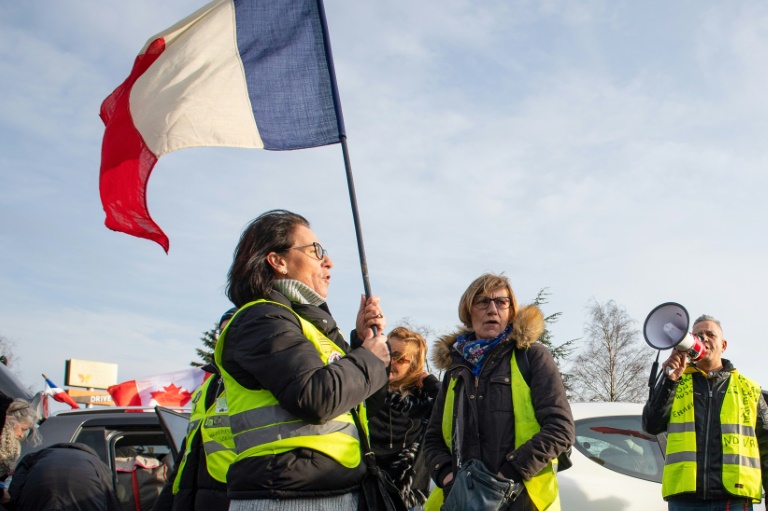
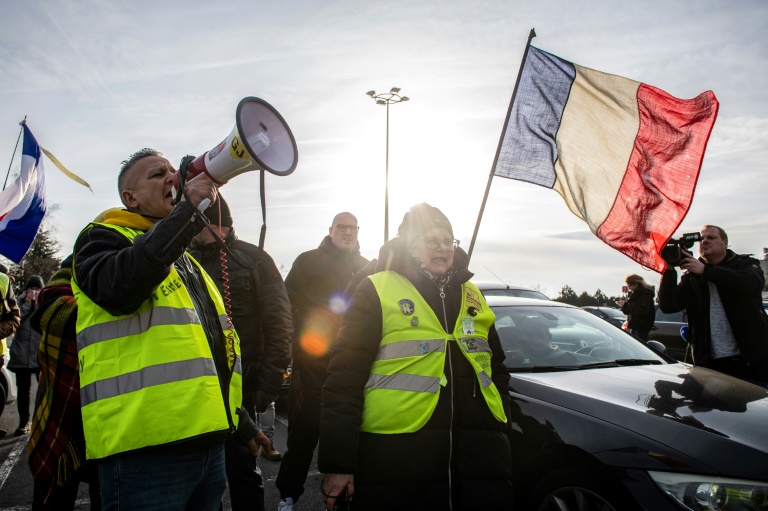
Camped at a parking lot near Lille, protesters brandished French flags and chanted “We won’t give up” and “Freedom, freedom.”

“We’ll go to Brussels to try to block it, to fight against this policy of permanent control,” said Jean-Pierre Schmit, an unemployed 58-year-old who came from Toulouse.

For Sandrine, 45, who came from Lyon, the government’s response to the Covid crisis had revealed that “we’re losing our freedoms bit by bit, in an insidious way.”

The latest self-proclaimed “freedom convoy” comes after 97 people were arrested at the weekend in Paris where thousands of demonstrators defied a ban on attempting to blockade the French capital.

In France, the demonstrators took aim at the “vaccine pass” required to enter restaurants, cafes and many other public venues implemented as part of President Emmanuel Macron’s inoculation drive.

– Border checks –

Belgian authorities have banned all demonstrations in the capital with “motorised vehicles” and said they had taken measures to prevent the blocking of the Brussels region.

Brussels police have posted on social media warning that vehicle protests are banned and advising against travelling to the capital by car, channelling convoys to a parking lot on the outskirts of the city as the only place where a static protest will be tolerated.

Some participants in a similar demonstration organised in The Hague have also announced their intention to go to Belgium.

Belgian Prime Minister Alexander De Croo had however advised the demonstrators to abandon their plans to come to Brussels.

“I say to those who come from abroad: look at the rules in Belgium. We never had rules that were too hard and we don’t have so many anymore. So complain at home,” he said Friday.

Checks are planned at the border and vehicles coming to the capital despite the ban will be diverted, Belgian authorities warned.

Brussels airport also advised travellers to take precautions on Monday and come by train for fear of blocking access routes.

The self-proclaimed “freedom convoy” is one of several worldwide inspired by a truckers’ standoff with authorities in Canada over vaccine mandates.

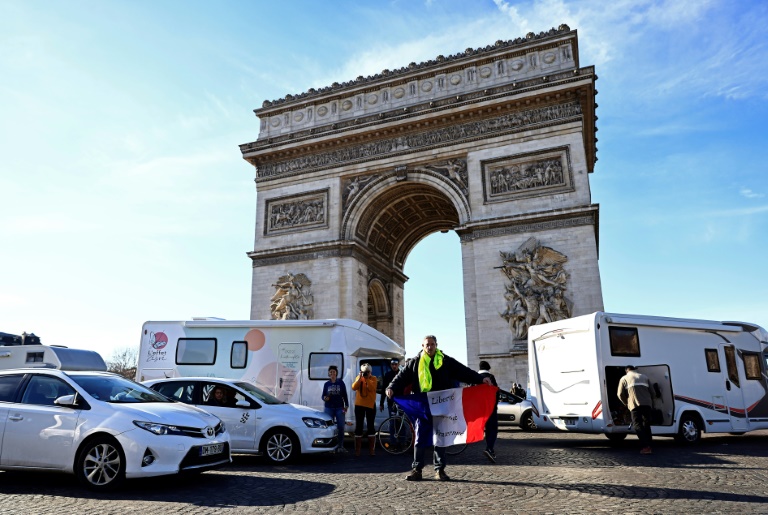
While French police counted 3,000 vehicles outside Paris on Friday evening, only around a hundred made it to the Champs-Elysees avenue in the heart of the capital on Saturday before being forced out after officers deployed tear gas to disperse the protesters.

In Canada, police on Sunday cleared demonstrators who had occupied a key US border bridge for a week but thousands of protesters remained in the capital Ottawa, where they have paralysed the city centre.

The French protest movement brings together those opposed to the Covid vaccine pass required to access many public venues but also some angry at rising energy and food prices, issues which ignited the “yellow vest” protests that shook France in late 2018 and early 2019.

The French government has said it plans to relax face mask mandates by February 28, and is hoping to end the vaccine pass requirement by late March or early April.

burs-ob/roc/mtp/jfx
Germany leader heads to Kyiv to calm 'critical' Russia war threat

German Chancellor Olaf Scholz lands in Kyiv on Monday before visiting Moscow to try to head off a “very critical” threat of a Russian invasion that could spark the worst crisis since the Cold War.

The German leader visits the two capitals in reverse order from that taken last week by French President Emmanuel Macron in his bid to quiet the drumbeats of war echoing across eastern Europe.

Russian President Vladimir Putin has surrounded Ukraine from nearly all sides with more than 100,000 soldiers in a high-stakes standoff with the West over NATO’s post-Soviet expansion into countries once under the Kremlin’s domain.

The West has remained united and defiant in the face of Putin’s demands for binding security guarantees that would see NATO roll back its forces and rule out Ukraine’s potential membership of the alliance.

But US intelligence officials worry that weeks of crisis talks have given Russia the time to prepare a major offensive — should Putin make the ultimate decision to attack Ukraine.

Washington reaffirmed its warning Sunday that Russia was now ready to strike at “any moment” with an assault that would likely start with “a significant barrage of missiles and bomb attacks”.

US President Joe Biden briefed Ukrainian leader Volodymyr Zelensky on Sunday about his hour-long phone call with Putin the previous day. Biden’s talks with Putin broke no new ground, the White House said.

– Invitation to Biden –

US officials said Biden and Zelensky had “agreed on the importance of continuing to pursue diplomacy and deterrence” in their call.

The Ukrainian presidency said Zelensky had also urged Biden to visit Kyiv “in the coming days” in a show of moral support.

The White House made no mention of the invitation in its readout of the 50-minute call.

But Germany’s Scholtz sounded firm in his resolve to support Ukraine and hit Russia “immediately” with punishing sanctions if it went to war.

“In the event of a military aggression against Ukraine that threatens its territorial integrity and sovereignty, that will lead to tough sanctions that we have carefully prepared and which we can immediately put into force,” Scholz said on the eve of his departure.

“We assess the situation as very critical, very dangerous,” a German government source added.

– Tough trip –

Germany and France both play a central role in mediation efforts around the gruelling conflict in Ukraine’s Russian-backed separatist east that has claimed more than 14,000 lives.

But Germany’s close business relations with Moscow and heavy reliance on Russian natural gas imports have been a source of lingering concern for Kyiv’s pro-Western leaders as well as Biden’s team.

Scholz has warned Russia it should “not underestimate our unity and determination” but also hedged against unequivocally backing Biden’s pledge to “bring an end” to Russia’s new Nord Stream 2 gas link to Germany.

Kyiv is also upset with Berlin for not having joined some of its NATO allies in beginning to supply weapons to Ukraine.

Scholz’s visit to Moscow on Tuesday will be clouded by a spat involving the tit-for-tat closures of the German-language channel of Russia’s RT network and the Moscow bureau of Germany’s Deutsche Welle.

British Prime Minister Boris Johnson will also “travel to Europe” to address the crisis towards end of the week as part of the European push for peace, his office said Sunday.

– Air travel worries –

The diplomatic push comes as Western countries withdraw staff from their Kyiv embassies, with many of them urging their citizens to leave immediately.

But departures may be complicated by the looming threat of the skies over Ukraine closing due to rising risks for airlines.

The Dutch carrier KLM became the first major airline over the weekend to indefinitely suspend flights to Kyiv.

Ukraine’s budget airline SkyUp said its flight from Portugal to Kyiv was forced to land in Moldova Sunday after the plane’s Irish leasing company revoked permission for it to cross into Ukraine.

SkyUp added that European leasing companies were demanding that Ukrainian airlines return their planes to EU airspace within 48 hours.

Industry analysts believe other international airlines may soon also ban flights into Ukraine because of the growing cost to insurers.

The travel industry is still haunted by the memory of Malaysia Airlines flight MH17, shot down while flying near eastern Ukraine’s conflict zone in July 2014.

All 298 passengers and crew on board the Amsterdam-Kuala Lumpur flight were killed.

The diplomatic drawdown has also touched the staff of the Organization for Security and Co-operation (OSCE) monitoring mission in Ukraine.

The mission said “certain participating states” had asked their staff to leave Ukraine “within the next days”.

But it stressed that its mission continued in 10 cities throughout the country.

Kiwi cops blast use of Barry Manilow songs to clear protesters

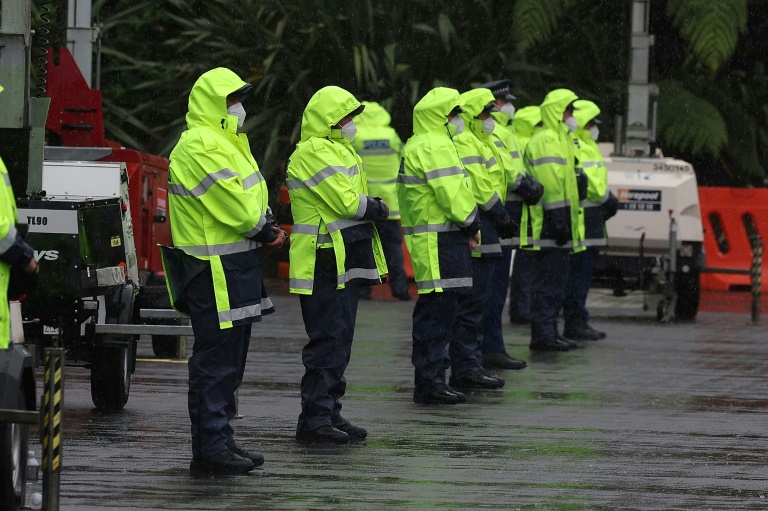
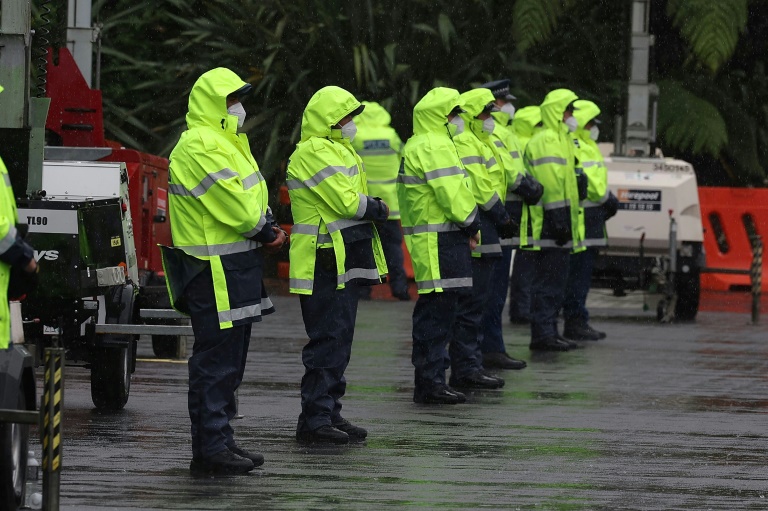
Efforts to clear New Zealand anti-vaccine protesters by blasting Barry Manilow songs on a loop have drawn criticism from police officers caught in the crossfire.

Hundreds of demonstrators — inspired by the “Freedom Convoy” of truckers in Canada — have been camped on the lawns of parliament for a week, ignoring appeals from Prime Minister Jacinda Ardern on Monday to “go home, and take your children”.

Attempts to move the protesters over the weekend included dousing them with sprinklers and pummelling them with sickly sweet pop tracks such as “Baby Shark”, “Macarena” and Manilow’s “Mandy”.

Wellington police chief Superintendent Corrie Parnell was unamused at the tongue-in-cheek tactics deployed by parliament officials, which appear to have steeled demonstrators’ determination not to move.

“It certainly wouldn’t be tactics or methodologies that we would endorse, and it’s something we would have preferred did not occur,” Parnell told Radio New Zealand.

“But it did occur, so we have to deal with what we’ve got in front of us.”

Parnell urged protesters who arrived as part of a convoy last week to move vehicles that were still blocking streets.

He also defended the hands-off approach adopted by police since Thursday, when officers tried to forcibly clear the lawns, resulting in violent clashes and more than 120 arrests.

“This is not a matter of… arresting your way out of it,” he said, calling on protest organisers to negotiate in good faith.

While the original convoy was promoted as a demonstration against vaccine mandates, Ardern said it was clearly now being dominated by anti-vaccination activists.

“What we’ve seen out there seems to be much more anti-vaccination than anything else,” she told TV3.

“It’s included yelling abuse at people who are walking around with masks on… there are signs calling for the execution of politicians… we’ve seen some horrific behaviour down there.”

Ardern declined to comment on the musical anti-protest stunt, but opposition figures criticised parliamentary speaker Trevor Mallard for approving the action.

“Mallard’s actions are unedifying, embarrassing and ineffective,” National party lawmaker Chris Bishop tweeted.

Opposition ACT Party leader David Seymour accused Mallard of “acting like a kid” and fuelling a siege mentality among the protesters.

“Not only are Mallard’s antics immature, not only are they ineffective, they have made a serious situation much worse,” he said. 

“His petty behaviour has only encouraged the protesters further.”

Kiwi cops blast use of Barry Manilow songs to clear protesters

Efforts to clear New Zealand anti-vaccine protesters by blasting Barry Manilow songs on a loop have drawn criticism from police officers caught in the crossfire.

Hundreds of demonstrators — inspired by the “Freedom Convoy” of truckers in Canada — have been camped on the lawns of parliament for a week, ignoring appeals from Prime Minister Jacinda Ardern on Monday to “go home, and take your children”.

Attempts to move the protesters over the weekend included dousing them with sprinklers and pummelling them with sickly sweet pop tracks such as “Baby Shark”, “Macarena” and Manilow’s “Mandy”.

Wellington police chief Superintendent Corrie Parnell was unamused at the tongue-in-cheek tactics deployed by parliament officials, which appear to have steeled demonstrators’ determination not to move.

“It certainly wouldn’t be tactics or methodologies that we would endorse, and it’s something we would have preferred did not occur,” Parnell told Radio New Zealand.

“But it did occur, so we have to deal with what we’ve got in front of us.”

Parnell urged protesters who arrived as part of a convoy last week to move vehicles that were still blocking streets.

He also defended the hands-off approach adopted by police since Thursday, when officers tried to forcibly clear the lawns, resulting in violent clashes and more than 120 arrests.

“This is not a matter of… arresting your way out of it,” he said, calling on protest organisers to negotiate in good faith.

While the original convoy was promoted as a demonstration against vaccine mandates, Ardern said it was clearly now being dominated by anti-vaccination activists.

“What we’ve seen out there seems to be much more anti-vaccination than anything else,” she told TV3.

“It’s included yelling abuse at people who are walking around with masks on… there are signs calling for the execution of politicians… we’ve seen some horrific behaviour down there.”

Ardern declined to comment on the musical anti-protest stunt, but opposition figures criticised parliamentary speaker Trevor Mallard for approving the action.

“Mallard’s actions are unedifying, embarrassing and ineffective,” National party lawmaker Chris Bishop tweeted.

Opposition ACT Party leader David Seymour accused Mallard of “acting like a kid” and fuelling a siege mentality among the protesters.

“Not only are Mallard’s antics immature, not only are they ineffective, they have made a serious situation much worse,” he said. 

“His petty behaviour has only encouraged the protesters further.”

Germany to Putin: 'untie the noose' around Ukraine

Germany’s president on Sunday said “responsibility” for the risk of “war” in Ukraine lay with Russia, bringing greater clarity to Berlin’s position on the crisis which has been criticised as too lenient towards Moscow.

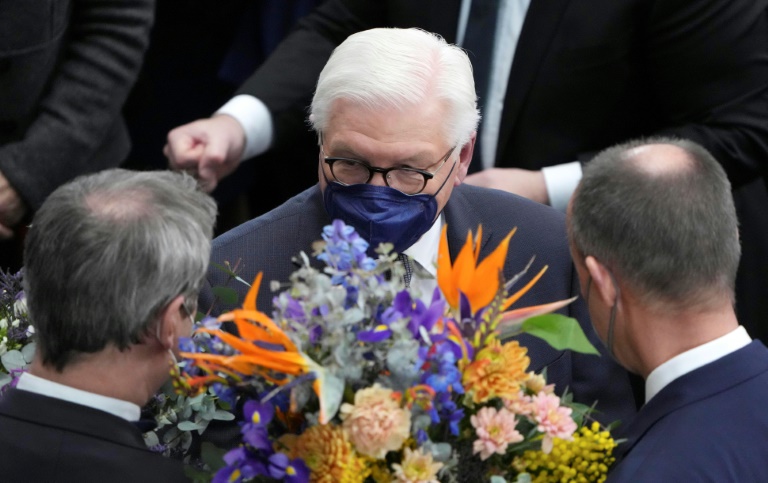
Speaking after his re-election for a second five year term, Frank-Walter Steinmeier called directly on Russian President Vladimir Putin to “untie the noose around Ukraine’s neck”.

On the eve of Chancellor Olaf Scholz’s trip to Kyiv and Moscow, the continent was confronted with the “danger of a military conflict, of war in eastern Europe — and Russia carries the responsibility for that,” Social Democrat Steinmeier said.

“Peace cannot be taken for granted. It must be worked on in dialogue and when necessary, with clear words, deterrence and determination,” the former foreign minister said.

Speaking shortly afterwards, the chancellor echoed his party colleague Steinmeier, saying there was a “serious threat to peace in Europe” and warning of retaliation.

“In the event of a military aggression against Ukraine that threatens its territorial integrity and sovereignty, that will lead to tough sanctions that we have carefully prepared and which we can immediately put into force, together with our allies in NATO and Europe,” Scholz said.

Scholz travels to Kyiv on Monday, where he will meet with the Ukranian President Volodymyr Zelensky. He will then move on to Moscow on Tuesday for talks with Russian President Putin, in the latest diplomatic push to avoid a conflict.

Scholz’s trip comes after weeks of rising tensions that have seen Russia nearly surround its western neighbour with more than 100,000 troops.

The crisis entered a new phase after Washington warned that an all-out invasion could begin “any day”.

– ‘Critical’ moment – 

Tensions between Russia and Ukraine have reached a “critical” point, a German government source said earlier on Sunday. 

“Our concerns have grown… we asses the situation as very critical, very dangerous”, the source told journalists in Berlin, including AFP.

While Germany continued to rule out delivering “lethal” arms to Ukraine, it was considering extending more financial support to Ukraine, the source indicated.

Berlin, which has already delivered 2 billion euros ($2.3 billion) in aid to Ukraine since the annexation of Crimea by Russia in 2014, was examining “whether there are still bilateral possibilities to contribute to economic support”, the source said. 

Germany has been criticised in recent weeks by Kyiv and some European allies for not taking a hard enough line against Russia during the crisis.

Earlier on Sunday, Ukraine’s ambassador to Berlin used an interview with public radio to call for Germany to “remove the Russian glasses from its Ukraine policy, because they are blurring its vision”.

– Diplomatic credentials –

The presidential election, normally held in the Bundestag building, took place at Paul Loebe Haus, a post-modern office complex opposite the Chancellery in central Berlin, in order to meet pandemic distancing requirements.

Steinmeier, 66, who has gained a reputation as a tireless defender of democratic values during his first term in office, secured an overwhelming majority in the first round of voting among delegates to the Federal Convention.

In all, the incumbent received 1,045 votes from the 1,472 delegates in the one-off assembly, made up of MPs and an equal number of state delegates.

Steinmeier served twice as foreign minister in Merkel’s cabinet, stepping back from his duties as Germany’s top diplomat to take on the ceremonial role as head of state in 2017.

The president’s role in Germany is mostly symbolic, with the office holder acting as a constitutional counterpart to the chancellor.

Canada police arrest protesters, mayor says border bridge crisis over

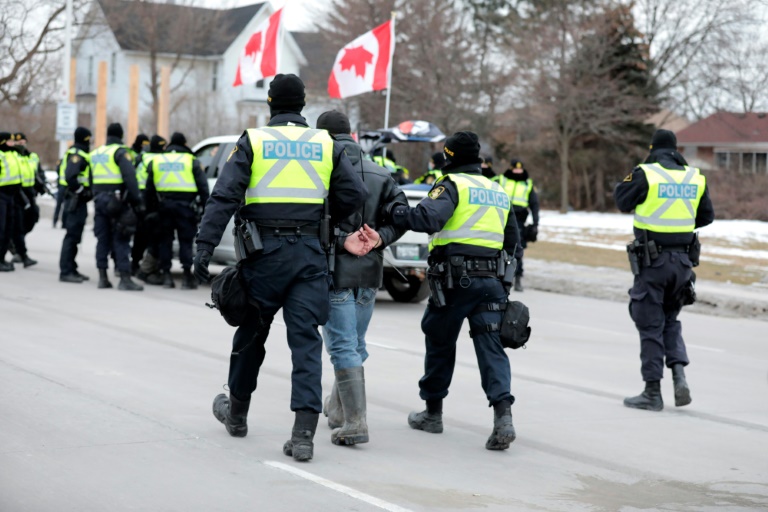
A Canadian mayor Sunday declared the standoff on a key US border bridge over after police moved in and arrested protesters, but the trucker-led movement against Covid-19 restrictions remained defiantly mobilized in the capital Ottawa and elsewhere.

A heavy contingent of officers backed by armored vehicles made their way to the demonstration near Windsor, Ontario, to clear the Ambassador Bridge, a major border crossing to the US city of Detroit, Michigan. 

Authorities began their operation Saturday but several demonstrators had remained, extending the protracted standoff and preventing traffic from flowing.

Police took more forceful action Sunday, placing bridge protesters in handcuffs, towing vehicles and reclaiming clogged lanes, saying on Twitter that “there will be zero tolerance for illegal activity.”

The road to the bridge was cleared, but cross-border traffic had yet to be restored by midday.

“Today, our national economic crisis at the Ambassador Bridge came to an end,” Windsor Mayor Drew Dilkens said in a statement, referring to the heavy toll on trade and other business by a blockade that had been in place since Monday.

“Border crossings will reopen when it is safe to do so and I defer to police and border agencies to make that determination,” the mayor added.

The demonstrations have inspired copycat protests around the globe, including in France, the Netherlands, Switzerland and Australia, and with some US truckers discussing a protest for March.

In Ontario, where authorities have declared a state of emergency, the provincial supreme court had ordered truckers late in the week to end their blockade of the Ambassador Bridge. 

The protest has forced major automakers in both countries to halt or scale back production.

Canada’s Prime Minister Justin Trudeau, who blasted the blockades as “illegal,” promised that “this conflict must end,” but he has faced mounting criticism for failing to act more decisively.

Initially, no arrests were made at the bridge; but drivers were warned that they potentially faced major fines, jail time and loss of their driver’s licenses if they continued blocking traffic.

Mayor Dilkens, apparently mindful of the division caused by the protests, urged tolerance and respect moving forward.

“I strongly urge all provincial and federal leaders to refrain from any divisive political rhetoric and redouble efforts to help all Canadians heal, as we emerge from almost two years of pandemic lockdowns and restrictions,” he said.

– 4,000 protesters –

The Ambassador Bridge is vital to the US and Canadian auto industries, carrying more than 25 percent of merchandise exported by both countries.

Truckers originally converged on Ottawa to press their demand for an end to a vaccination requirement affecting truckers crossing the international border.

But the movement has spread, as the protesters now seek an end to all vaccine mandates, whether imposed by the federal or provincial governments.

Ottawa has been the epicenter of protests. Police on Saturday estimated that some 4,000 demonstrators were still occupying the center city, in the third weekend of the movement.

The atmosphere among protesters has been festive, with music, dancing and constant sounding of air horns — but the noise, obstruction and sometimes rude and aggressive behavior of demonstrators has harmed area businesses and infuriated many locals.

The truckers’ message, however, has resonated more widely than authorities expected. 

One opinion survey found that a third of Canadians support the protest movement.

The truckers have also found support among conservatives and vaccine mandate opponents in other countries, even as Covid measures are being rolled back in many places.

In Paris on Saturday, police fired tear gas and arrested nearly 100 people in an effort to break up convoys of vehicles coming from across France. 

By Sunday hundreds of them drove their self-proclaimed “freedom convoy” of cars and trucks northward to Lille, en route to Brussels, where Belgian officials have already banned a demonstration called for Monday.

A vehicle convoy in the Netherlands brought The Hague’s city center to a standstill in another Canada-style protest.

In Switzerland, hundreds of protesters marched in Zurich to protest Covid-19 restrictions, while several thousand others rallied against them, Swiss media reported. Police used tear gas, water cannons and rubber bullets to disperse the crowds. 

An estimated 10,000 Australian protesters marched through the capital Canberra to decry vaccine mandates. 

Relief, concern at Kyiv airport as West calls citizens home

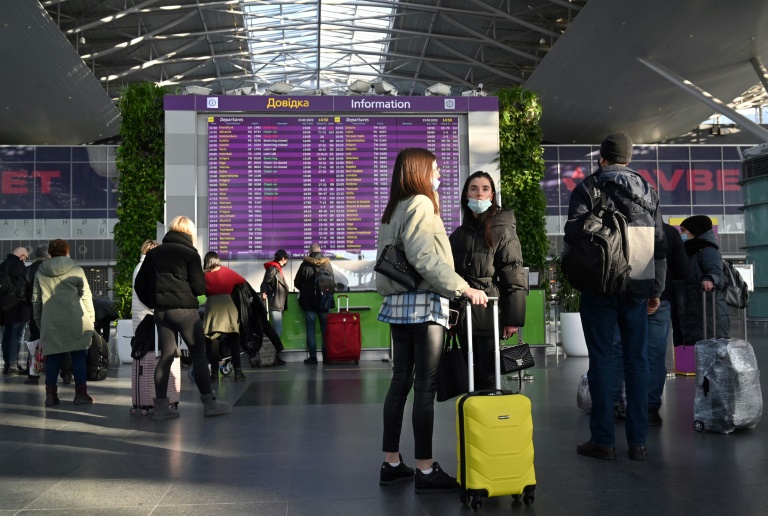
Moroccan entrepreneur Aimrane Bouziane sighs with relief after seeing the “boarding” sign for his flight light up at Kyiv’s main airport despite fears that airspace may soon close over Ukraine.

“I think the soundest choice to make is to leave Ukraine now,” the 23-year-old said before heading off to passport control.

“I am leaving because of the situation, because I value my life.”

The ex-Soviet state’s air links with the world appeared in danger after KLM suspended flights citing risks from more than 100,000 Russian soldiers conducting drills across long stretches of Ukraine’s frontier.

Washington warns that an invasion could start “any day” and analysts predict that other international carriers may also soon stop flying to Kyiv because of the soaring insurance costs.

The febrile atmosphere was stoked further when a low-cost Ukrainian carrier had to divert a flight from Portugal and land its 175 passengers in Moldova because the plane’s Irish leasing company refused it permission to cross into Ukraine.

The Ukrainian foreign ministry was trying to arrange buses for the stranded passengers. A growing number of Western governments were urging their citizens to get out while they can.

American sports coach Denis Lucins said he was hoping for the best after landing in Kyiv — in defiance of US travel guidance — to visit his wife and seven-year-old son.

“I personally don’t think anything is going to happen,” Lucins said in reference to US warnings of a looming war.

“But unfortunately, nobody can read Vladimir Putin’s mind.”

– ‘Not helping’ –

The mood at Boryspil Airport was as relaxed as it has been across Kyiv and most other Ukrainian cities throughout the weeks-long crisis.

Travellers were calmly drinking coffee and eating cake as rays of sun streamed into the terminal on a cold winter day.

Ukrainian leaders have been increasingly angry at Washington for releasing almost daily intelligence briefings pointing to the imminent threat of war.

“All this information is only provoking panic and not helping us,” Ukrainian President Volodymyr Zelensky said over the weekend.

Lucins said he was worried about his safety “at some level”.

But he said he has been living in Ukraine since its 2014 pro-EU revolution was followed by Russia’s annexation of Crimea and support for a separatist insurgency in the east that has claimed more than 14,000 lives.

“I guess we just wait and see what happens,” he said.

Armenia native Armen Vartanyan looked up at the schedule board before flying to Istanbul and saw one flight cancelled to Canada.

“They are more careful about this stuff even if there is a 0.1 percent chance, they always take precaution,” the 36-year-old said.

But he scoffed at the idea of Russian troops marching into Ukraine in a bid to reverse its gradual drift toward the West.

“Russian troops coming to Kyiv? No, I don’t think that’s going happen. That would be World War III — too much.”

“The Donbass — yes,” he added in reference to the eastern separatist region under the rebels’ control.

“It’s already separate, they are using the ruble,” he said. “Putin might take that.”

Clashes as controversial Israeli lawmaker visits Jerusalem flashpoint

Israeli police clashed with Palestinians in the flashpoint east Jerusalem neighbourhood of Sheikh Jarrah on Sunday, during a visit by a controversial far-right Jewish lawmaker that inflamed tensions.

Police said they arrested eight people during the day for suspected involvement in “public riots and violence,” in the area of annexed east Jerusalem that has emerged as a symbol of Palestinian resistance against Israeli control of the city.

Scuffles broke out as Itamar Ben Gvir of the far-right Religious Zionism alliance opened a parliamentary office in Sheikh Jarrah, in what he described as an effort to show support for its Jewish residents.

Tensions that erupted in Sheikh Jarrah last year — as several Palestinian families faced eviction by settler groups — in part sparked the May war between Israel and armed groups in the Gaza Strip.

More than 200,000 Jewish settlers live in east Jerusalem, in communities widely regarded as illegal under international law.

Efforts by settler groups to expand the Jewish presence in east Jerusalem, which Palestinians claim as their future capital, have further fuelled hostilities.

Ben Gvir, a Jewish nationalist with a long history of incendiary comments about Palestinians, accused police of failing to react to alleged arson attacks on a settler home in Sheikh Jarrah.

“Jewish lives have become worthless,” Ben Gvir charged in a tweet before his visit.

He told reporters in Sheikh Jarrah, where he set up his “make-shift office” under a tent, that he would remain there until police “looked after the security of the (Jewish) residents”. 

– ‘Irresponsible provocations’ –

In a move that risked sparking fresh hostilities, Ben Gvir urged supporters to gather in the area. 

Palestinians were also called on to mobilise, while a group of Jewish Israelis that oppose Ben Gvir circulated a petition online urging people to head to Sheikh Jarrah as a show of support for its Arab residents.  

Voicing concern over Sunday’s “violent clashes,” the European Union in a tweet said “irresponsible provocations and other escalatory acts in this sensitive area only fuel further tensions & must cease.”  

The Palestinian Authority, based in the Israeli-occupied West Bank, condemned Ben Gvir’s visit as a “provocative and escalating move that threatens to ignite… violence that will be difficult to control.”

Seven Palestinian facing eviction by settler groups have taken their cases to Israel’s supreme court. 

Hamas, the Islamists who control Gaza, warned there would be “consequences” over Israel’s repeated “attacks” on Sheikh Jarrah. 

Palestinians across east Jerusalem accuse Israeli police of using heavy-handed tactics to quell protests.

Six people were arrested during unrest in the neighbourhood late Saturday.

Israel captured east Jerusalem in the 1967 Six Day War and later annexed it, a move not recognised by most of the international community.  

French anti-vaccine convoy heads toward Brussels

Around three hundred vehicles taking part in a Canada-style protest convoy against Covid regulations arrived in Lille, northern France, on Sunday en route to Brussels, where officials have already banned a demonstration called for Monday.

The flag-bearing trek north came after 97 people were arrested in Paris on Saturday as thousands of demonstrators defied a ban on trying to block traffic, with 81 still in custody early Sunday.

The convoy, while smaller than the nearly 3,000 vehicles that converged on the capital from cities across France, stopped Sunday at the parking lot of a shopping mall outside Lille, just south of the Belgian border.

“We’ll go to Brussels to try to block it, to fight against this policy of permanent control,” said Jean-Pierre Schmit, an unemployed 58-year-old who came from Toulouse.

For Sandrine, 45, who came from Lyon, the government’s response to the Covid crisis had revealed that “we’re losing our freedoms bit by bit, in an insidious way.”

The self-proclaimed “freedom convoy” of cars, trucks and campervans is one of several worldwide inspired by a truckers’ standoff with authorities in Canada.

In France, the demonstrators took aim in particular at the “vaccine pass” required to enter restaurants, cafes and many other public venues implemented as part of President Emmanuel Macron’s inoculation drive.

But participants have also cited rising fuel and energy costs, an echo of the “yellow vest” grievances that forced Macron to announce a series of tax cuts and other concessions.

More than 100 vehicles managed to converge on the Champs-Elysees avenue in Paris despite a heavy police deployment to keep them out of the city, with security forces using teargas to disperse protesters in scenes reminiscent of the “yellow vest” clashes of 2018 and 2019.

Prosecutors said Jerome Rodrigues, a leader of the “yellow vest” protest movement, was one of the people detained in the Saturday protests, though his lawyer denied any organisational role and called him a “political prisoner.”

The Paris police department also said an internal inquiry had been opened after a video emerged on social media showing an officer pointing his gun at a driver.

– ‘Fatigue’ and anger –

The demonstrations, with convoys setting out from cities across France, come two months before presidential elections in which Macron is expected to seek re-election.

On Friday, Macron said he understood the “fatigue” after two years of the pandemic.

“This fatigue also leads to anger. I understand it… But I call for the utmost calm,” he told the Ouest-France newspaper.

The government has said it plans to relax face mask mandates by February 28, and is hoping to end the vaccine pass requirement by late March or early April.

Some 24,000 more people demonstrated in other parts of the country Saturday, the authorities said, including in the southern city of Montpellier, where radical fringe activists broke the glass facades of two banks.

Paris police hold 81 over banned anti-vaccine convoy

Paris police said they arrested 97 people who defied a ban on a Canada-style protest convoy over coronavirus regulations to try block traffic in the capital, with 81 still in custody Sunday.

Thousands of demonstrators from across France attempted to block traffic in the capital Saturday in a self-proclaimed “freedom convoy” of cars, trucks and campervans. Hundreds of them continued on to Brussels on Sunday.

In Paris, more than 100 vehicles managed to converge on the Champs-Elysees avenue, where police used teargas to disperse protesters in scenes reminiscent of the “yellow vest” riots of 2018-2019.

Dozens of people remained on the famous avenue and in the nearby Bois de Boulogne forest park until early Sunday.

Prosecutors said one of those being held was Jerome Rodrigues, a leader of the “yellow vest” protest movement, which engaged in running battles with the police every weekend for several months in late 2018 and early 2019.

The Paris police department also said an internal inquiry has been opened after a video emerged on social media showing an officer pointing his gun at a driver near the Arc de Triomphe monument at the top of the Champs-Elysees.

The protest is one of several worldwide inspired by the truckers’ standoff with authorities in Canada.

In France, the demonstrators took aim at the “vaccine pass” required to enter restaurants, cafes and many other public venues implemented as part of President Emmanuel Macron’s inoculation drive.

“This Covid pass is just the latest in a series of anti-freedom measures in our country — we have freedom of movement in Europe, yet we’re being stopped by the police, we don’t have the right to be here and carry a flag,” Daniel Bravo, 61, told AFP.

Over 400 vehicles camped out at several sites around Paris overnight, and organisers have called for people to head for Brussels for a major demonstration on Monday, a police source said.

However not all are expected to make the trip, the source said.

Belgium has banned the protest, and its Prime Minister Alexander de Croo has urged would-be attendees to “go and protest in your own country”.

– ‘Fatigue’ and anger –

The demonstrations, with convoys setting out from cities across France, come two months before presidential elections in which Macron is expected to seek re-election.

On Friday, Macron said he understood the “fatigue” after two years of the pandemic.

“This fatigue also leads to anger. I understand it… But I call for the utmost calm,” he told the Ouest-France newspaper.

The government has said it plans to relax face mask mandates by February 28, and is hoping to end the vaccine pass requirement by late March or early April.

Some 24,000 more people demonstrated in other parts of the country Saturday, the authorities said, including in the southern city of Montpellier, where radical fringe activists broke the glass facades of two banks.

Close Bitnami banner
Bitnami