World

Swiss vote on banning tobacco advertising, animal testing

The Swiss head to the polls Sunday to decide whether to ban almost all advertising of tobacco products and separately on a blanket ban on all animal testing.

In-person voting on those and other topics will begin at 10:00 am (0900 GMT) as part of Switzerland’s direct democracy system, although most people vote in advance by post.

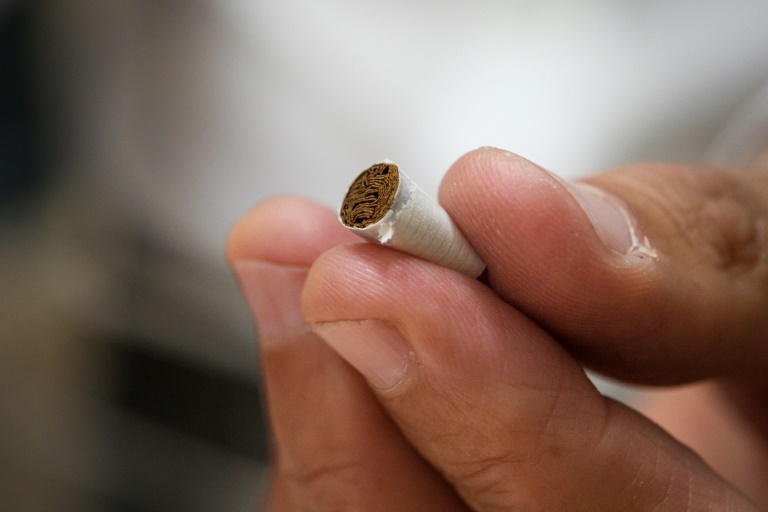
Recent polls indicate that the initiative to tighten Switzerland’s notoriously lax tobacco laws by banning all advertising of the health-hazardous products wherever minors might see it — effectively all settings — is the most likely to pass.

Switzerland lags far behind most wealthy nations in restricting tobacco advertising — a situation widely blamed on hefty lobbying by some of the world’s biggest tobacco companies headquartered in the country.

Currently, most tobacco advertising remains legal at a national level, except on television and radio, or ads that specifically target minors.

Some Swiss cantons have introduced stricter regional legislation and a new national law is pending, but campaigners gathered enough signatures to spur a vote towards a significantly tighter country-wide law.

– ‘Extreme’ –

Opponents of the initiative, which include the Swiss government and parliament, say it goes too far.

Philip Morris International (PMI), the world’s largest tobacco company, which, like British American Tobacco and Japan Tobacco, is headquartered in Switzerland and which has helped fund the “No” campaign, described the initiative as “extreme”.

“This is a slippery slope as far as individual freedom is concerned,” a spokesman for PMI’s Swiss section told AFP, warning that it “paves the way for further advertising bans on products such as alcohol or sugar”.

Jean-Paul Humair, who heads a Geneva addiction prevention centre and serves as a spokesman for the “Yes” campaign, flatly rejected that comparison.

“There is no other consumer product that kills half of all users,” he told AFP.  

Campaigners claim lax advertising laws have stymied efforts to bring down smoking rates in the Alpine nation of 8.6 million people, where more than a quarter of adults consume tobacco products. There are around 9,500 tobacco-linked deaths each year.

The latest gfs.bern poll hinted that 63 percent of voters favoured the tobacco advertising ban, but it will also need backing from a majority of Switzerland’s 26 cantons to pass.

– Animal testing –

There is meanwhile little chance that a bid to ban all animal and human testing will go through, with only a quarter of those questioned in the latest survey backing the move.

All political parties, parliament and the government oppose it, warning it goes too far and would have dire consequences for medical research.

Switzerland has since 1985 rejected three similar initiatives by large margins.

Researchers insist medical progress is impossible without experimentation, and even the Swiss Animal Protection group has warned against the initiative’s “radical” demands.

Swiss authorities insist the country already has among the world’s strictest laws regulating animal testing.

As the laws have tightened, the number of animals used has fallen sharply in recent decades, from nearly two million per year in the early 1980s to around 560,000 today.

In another animal-themed vote, inhabitants in the northern Basel-Stadt canton will on Sunday decide whether non-human primates should be granted some of the same basic fundamental rights as their human cousins.

Among the other issues on Sunday’s slate, there will also be a national referendum on a new law aimed at providing additional state funding to media companies, which have seen their advertising revenues evaporate in recent years.

The government argues the extra funding could secure the survival of many small, regional papers in peril, and also assist with their costly digital transition.

But the latest poll indicates a win for the “No” campaign, backed by rightwing parties, who charge the subsidy would mainly benefit large media groups and would be a waste of public funds.
Chile govt pledges new safety measures after trucker protest

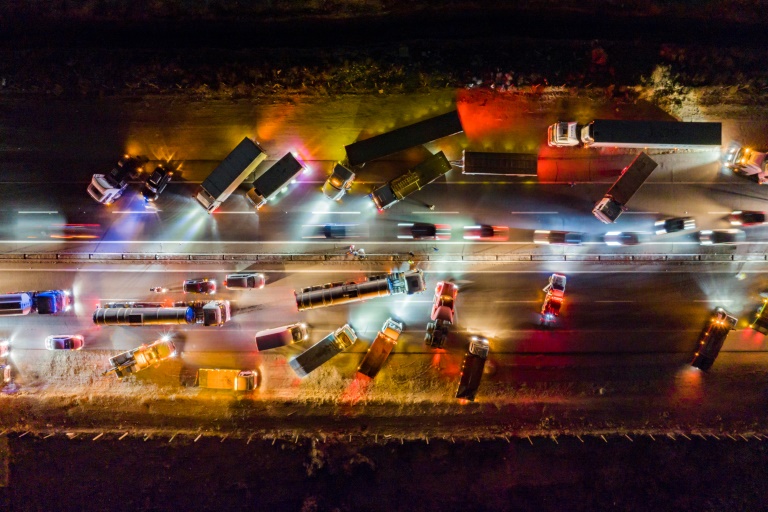
Chilean truck drivers lifted road blockades they had imposed to protest the killing of a colleague, after the government pledged new safety measures on Saturday.

Truck drivers had been blocking roads and setting up barricades since a clash Thursday in which a colleague died near the northern city of Antofagasta.

During the protest, big rigs clogged roads in northern and central Chile, as well as on the outskirts of the capital Santiago. 

In the port city of Iquique, trucks sealed off the road to the airport, forcing the cancellation of all incoming and outgoing flights.

Police said the trucker died when three Venezuelans threw rocks at his rig because he refused to give them a ride. The three alleged assailants have been arrested.

To appease the protesting drivers, the government Saturday announced new crime-fighting measures in the north of the country allowing soldiers to assist police and stepped-up monitoring of roads from the ground and with aircraft.

Interior Minister Rodrigo Delgado announced the measures after a five-hour meeting with a truck drivers’ union. He said they will go into force Monday.

Immigration has become a sensitive subject in Chile because of the deep economic woes of Venezuela, from where millions have fled seeking better lives, spreading out across Latin America.

In towns and along roads in northern Chile it is common to see migrant Venezuelan families camping out in public places and asking for money as they try to find work and start a new life.

The death of the truck driver prompted calls for more anti-migrant protests of the kind that have unfolded in Iquique and elsewhere in Chile’s north over the past three weeks.

A new immigration law went into effect Saturday that the Chilean government says gives authorities greater powers to expel foreigners who have false papers or have dodged immigration controls.

Cyclone, Barry Manilow fail to dislodge New Zealand anti-vaccine protesters

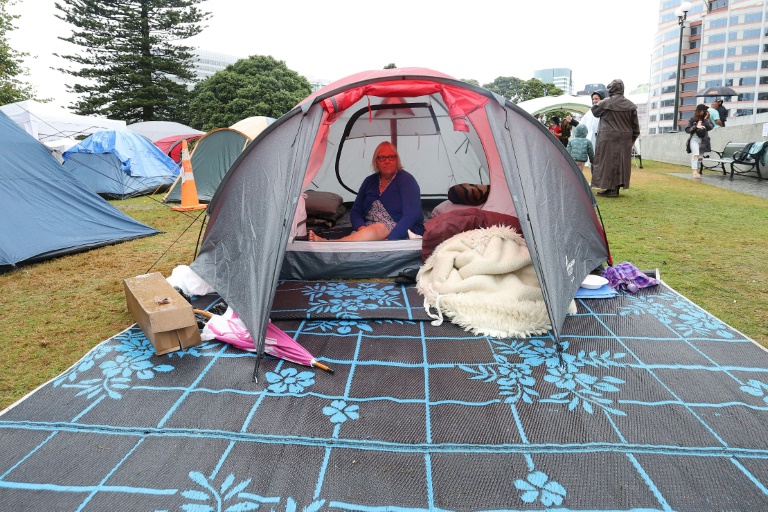
Cyclone Dovi caused power outages, mudslides and evacuations across New Zealand on Sunday, but neither the storm nor the music of Barry Manilow could dislodge anti-vaccine protesters camped outside parliament. 

Instead, hundreds of protesters — inspired by the “Freedom Convoy” of truckers in Canada — danced in the mud to the tunes meant to force their dispersal.

Not even a tongue-in-cheek offer of help from singer James Blunt could end the stand-off in the capital Wellington, which entered a sixth day with no sign of ending.

Deputy Prime Minister Grant Robertson told Television New Zealand there was a “sad element” to the protest.

“Every New Zealander has a right to peaceful protest, the problem is they have gone well beyond that,” he said.

“I do find the rhetoric of these protests highly disturbing … there is a sad element to it, there is a conspiracy theory element that people have been sucked in by.”

Like the Canadian truckers in Ottawa, the New Zealand protesters object to the strict Covid-19 restrictions imposed on the country and are demanding an end to vaccine mandates.

Their resolve hardened after police moved in Thursday and arrested 122 people in an attempt to end the sit-in.

Police have since backed off making arrests, and authorities have attempted to drench the makeshift settlement into submission by turning on water sprinklers.

This only saw the manicured lawns in front of the parliamentary buildings churned into a muddy morass even before Cyclone Dovi hit.

Superintendent Scott Fraser said police were continuing “to explore options to resolve the disruption”, while parliamentary Speaker Trevor Mallard had the music of Barry Manilow, the 1990s pop song “Macarena”, and government Covid-19 messages blasted at the protesters. 

British singer James Blunt weighed in on the strategy on Twitter, telling NZ Police “give me a shout if this doesn’t work”.

By Sunday afternoon, Blunt’s “You’re Beautiful” had been added to the playlist.

But the protesters drowned out the government music with their own favourites, which included heavy metal band Twisted Sister’s “We’re Not Gonna Take It”. 

Meanwhile, as winds of up to 130 kilometres per hour (80 mph) buffetted Wellington and other parts of New Zealand, police urged people to avoid all non-essential travel, with many roads blocked by mudslides or floodwaters.

Several houses just north of Wellington have also been evacuated because of mudslides.

Power was out in many areas across the country, and the fire service responded to multiple incidents of trees falling on houses and power lines, as well as roofs lifted and houses flooded.

Nicaragua dissident jailed under Ortega dies in prison: family

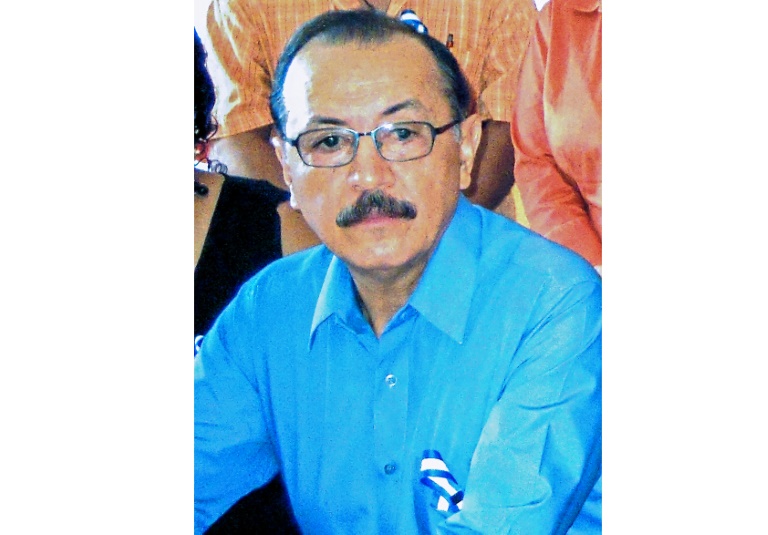
Former guerrilla Hugo Torres Jimenez, one of 46 opposition figures jailed since last year by the Nicaraguan government of President Daniel Ortega, died on Saturday, his family said in a statement.

He was 73.

The statement offered few details on Torres’ death but expressed his children’s “deep pain over the death of our beloved father.” It was released by the opposition coalition Blue and White National Unity (UNAB), of which Torres was a member. 

A former Sandinista dissident, Torres had been held since June 13, 2021, in El Chipote prison, before being transferred in December to a hospital for treatment, sources said.

Torres had been vice president of the opposition Democratic Renovation Union (Unamos), formerly the Sandinista Renovation Movement, established in 1995 by militants unhappy with Ortega’s leadership.

A retired army general, Torres in 1974 undertook a risky operation to free a group of jailed politicians — including Ortega — being held under the Somoza dictatorship.

But Ortega, who himself has grown increasingly dictatorial as president and as head of the Sandinista National Liberation Front, has accused dozens of opposition figures of conspiring against his government with US backing.

Torres was hailed on Saturday as a “hero” by ex-guerrilla and exiled Sandinista dissident Monica Baltodano. 

She told news website 100% Noticias that Torres was “a true hero of the struggles against the dictatorships that have dominated Nicaragua — the dictatorship of Somoza and now the dictatorship of Ortega, which is a brutal and criminal dictatorship.”

Unamos in January had reported that Torres’ health was deteriorating and demanded details from the government. It offered none.

The Washington-based Organization of American States said it “considers the fact of keeping political prisoners, with terminal illnesses and without necessary medical assistance, an abominable act.”

The UN High Commissioner for Human Rights said that for months Torres was “denied freedom in inhumane conditions and subjected to a legal process with no guarantees.”

Torres was one of 46 opposition figures detained last year, most of them before November elections in which Ortega was re-elected for a fourth consecutive term. Among the 46 were seven who had planned to run against Ortega.

All have been accused of undermining national integrity and promoting foreign interference in Nicaragua.

Eighteen have been found guilty in the past two weeks, and seven have been sentenced to prison terms ranging from eight to 13 years.

Popular incumbent Steinmeier eyes new term as German president

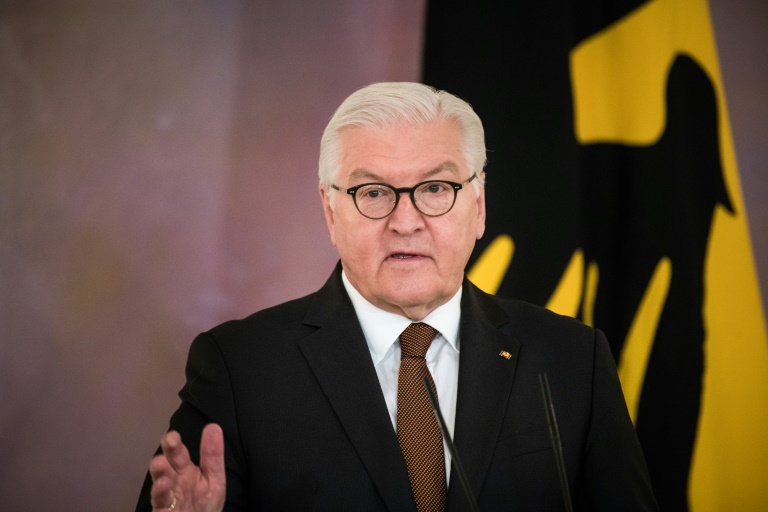
German President Frank-Walter Steinmeier is poised to be re-elected on Sunday for a second straight term, after gaining a reputation as a tireless defender of democratic values at a time when resurging far-right extremism and the coronavirus pandemic were putting them to the test.

The Social Democrat, 66, served twice as foreign minister in Angela Merkel’s cabinet, stepping back from his duties as Germany’s top diplomat to take on the ceremonial role as head of state in 2017.

With his snowy white hair, round glasses and dimpled smile, the trained lawyer has become one of Germany’s most popular and trusted politicians.

The presidential role was an “honour” and an “enormous challenge” Steinmeier said in May last year when announcing his desire to stay in office until 2027.

The former foreign minister has cast himself as the conscience of the nation, occasionally stepping into political debates and speaking at memorials. 

He has repeatedly warned against the rising threat of right-wing extremism in Germany and criticised scenes at Kabul airport after the city’s fall as “shameful for the political West”.

Steinmeier’s time in office has been marked by the outbreak of the coronavirus pandemic in Germany at the start of 2020, with the president sometimes playing the role of a moral arbiter in public debates on health issues.

Earlier this year, Steinmeier held a public debate between health experts and coronavirus vaccine sceptics, a vocal minority in the country that has increasingly taken to the streets to protest against coronavirus rules.

– Second term –

The presidential election, normally held in the Bundestag building, will instead take place at Paul Loebe Haus, a post-modern office complex opposite the Chancellery in central Berlin, in order to meet pandemic distancing requirements. 

The president is voted for by the Federal Convention, a one-off assembly made up of MPs and an equal number of state delegates, taking the total number close to 1,500.

Among the delegates are a number of public figures, including the Bayern Munich and German national team midfielder Leon Goretzka, selected by the Bavarian SPD. 

With the backing of all the parties in the current coalition government, including Steinmeier’s own Social Democrats, the Greens and the liberal FDP, as well as the support of the opposition conservatives (CDU-CSU), the incumbent is expected to win the vote comfortably.

Three other candidates have been nominated for the role by the far-right AfD, the far-left Linke party and the Freie Waehler, part of the ruling coalition in Bavaria.

Presidents can run for a maximum of two terms in Germany, though Steinmeier, who is expected to secure re-election, would be only the fourth person to do so.

The president’s role in Germany is mostly symbolic, with the office holder acting as a constitutional counterpart to the head of government, currently Chancellor Olaf Scholz, a Social Democrat comrade.

Canadian protesters out in force again, key bridge still blocked

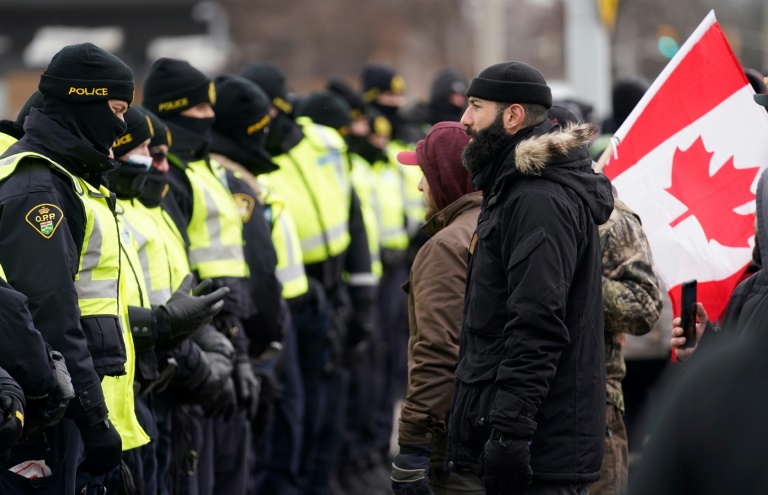
Canadian demonstrators led by truckers angry over Covid-19 restrictions defied police and kept occupying a key bridge Saturday, while thousands more rallied in the capital as a two-week-old protest showed no signs of abating.

The demonstrations have inspired copycat protests that are now spreading around the globe, including to France, the Netherlands, Switzerland and Australia.

In Ontario, where authorities have declared a state of emergency, the provincial supreme court had ordered truckers to end their blockade of the strategic Ambassador Bridge, which links the city of Windsor in Canada to Detroit, Michigan in the United States. 

The protest has forced major automakers in both countries to halt or scale back production and Washington on Friday urged Ottawa to use its federal powers to end the blockade.

Canada’s Prime Minister Justin Trudeau promised “an increasingly robust police intervention,” adding that borders cannot remain closed and “this conflict must end.”

Canadian police, backed by armored vehicles, began clearing the bridge, taking down tents erected in traffic lanes and persuading some drivers to move their trucks. 

But by Saturday evening, after hours of facing off against the demonstrators, the police had not completely cleared the span. Most of the cars and trucks blocking it were removed but hundreds of people refused to budge.

Windsor police spokesman Jason Bellaire said the aim was to clear the bridge peacefully, but he could not say if it would be cleared by the end of the day. There were no immediate reports of arrests Saturday. 

The Ambassador Bridge is vital to the US and Canadian auto industries, carrying more than 25 percent of merchandise exported by both countries. 

Two other US-Canada border crossings, one in Manitoba province and one in Alberta, remain blocked by protests.

– ‘I’m not dead’ –

In Ottawa, crowds of thousands packed the streets of the city center, the epicenter of the movement, blaring horns, playing music, dancing and drinking hot coffee against the bitter cold. Very few police were on hand.

“I’ve been supporting the cause from the beginning,” said 38-year-old Marc-Andre Mallette. 

“I’m not vaccinated and I’m not dead,” added Mallette, a sewer worker from the town of St.-Armand, near the US border.

Truckers originally converged on Ottawa to press their demand for an end to a vaccination requirement affecting truckers crossing the international border.

But the movement has spread, as the protesters — mostly insisting they want to protect their freedoms, but some displaying swastikas or Confederate flags — now seek an end to all vaccine mandates, whether imposed by the federal or provincial governments. 

Anti-Trudeau signs and chants have become common along the clogged Ottawa streets.

Political opponents say the prime minister has been far too slow to bring the protests to an end.

Trudeau has repeatedly insisted the protesters represent a small — if noisy — fraction of a population that has largely followed vaccination requirements and guidance.

But anti-Covid measures in some provinces have been more restrictive than in much of the world, and the truckers’ message has resonated more widely than authorities expected. 

One opinion survey found that a third of Canadians support the protest movement, while 44 percent say they at least understand the truckers’ frustrations.

– Protest in Paris –

Since the movement began, some central Canadian provinces have announced plans to end mask and vaccine requirements in coming weeks, with the numbers of Covid-19 cases falling. But the two most populous provinces — Ontario and Quebec — have yet to follow suit.

The truckers have found support among conservatives and vaccine mandate opponents across the globe, even as Covid measures are being rolled back in many places.

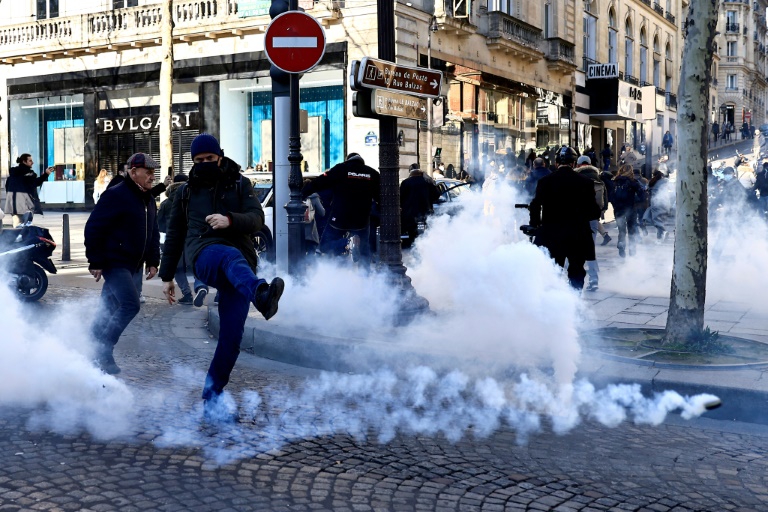
In Paris on Saturday, police fired tear gas and issued hundreds of fines in an effort to break up convoys of vehicles coming from across France in a protest over Covid restrictions and rising living costs. 

While some protesters made it to the glitzy Champs-Elysees, they were unable to block the city’s streets. 

In the Netherlands, a vehicle convoy brought The Hague’s city center to a standstill in another Canada-style protest.

In Switzerland, hundreds of protesters marched in Zurich to protest Covid-19 restrictions, while several thousand others rallied against them, Swiss media reported. Both rallies were illegal, and police used tear gas, water cannons and rubber bullets to disperse the crowds. 

In Australia, an estimated 10,000 protesters marched through capital the Canberra to the parliament building to decry vaccine mandates. 

And in New Zealand, anti-mandate activists have been camped on the lawns of parliament in Wellington for days in a protest inspired by the Canadian convoy.

Germany loses patience with ex-chancellor's Russia lobbying

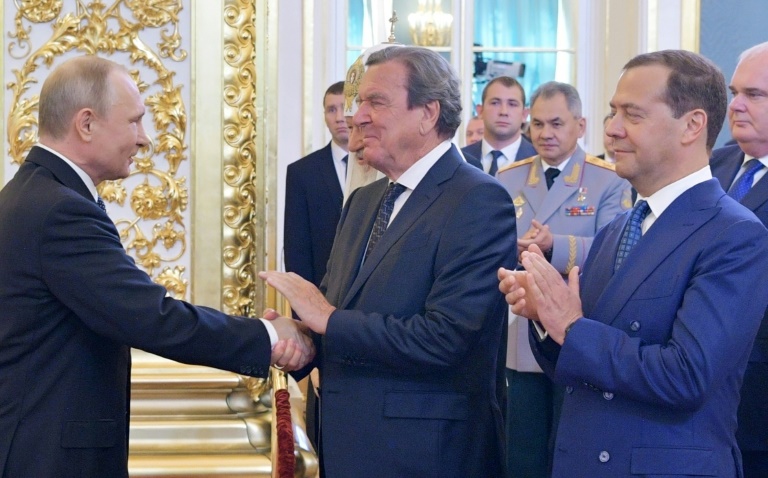
Former German chancellor Gerhard Schroeder’s close friendship with President Vladimir Putin and lucrative business dealings with Russia have for years been reluctantly tolerated at home.

But as war clouds gather over Ukraine and allies question Germany’s resolve, Schroeder is increasingly seen as potential liability to new chancellor and fellow Social Democrat Olaf Scholz, fuelling calls for a clean break with the pro-Kremlin lobbyist.

“Schroeder is a burden to Germany’s foreign policy and to his old party,” Der Spiegel weekly wrote. “He has clear goals. Not for his country, but for himself.”

Schroeder’s recent warning to Ukraine to stop its “sabre rattling” was met with widespread disbelief in Germany, even among longtime friends within the centre-left SPD party.

Last week’s announcement that the 77-year-old is set to serve on the board of Russian state energy giant Gazprom did little to calm tempers, as did the revelation that Schroeder held talks about Russia with an SPD interior ministry official last month.

The controversy comes at an awkward time for Scholz, who faces a major test next week when he travels to Moscow for his first in-person talks with Putin since taking office.

Scholz has been accused of being slow to step into the diplomatic fray in the Ukraine crisis, and of muddying Germany’s message of being united with allies against the Russian threat.

– Nord Stream 2 –

After much prodding from the United States and other allies, Scholz recently toughened his stance on possible sanctions should Russia invade Ukraine, including halting the Gazprom-owned Nord Stream 2 gas pipeline.

It was Schroeder, chancellor from 1998-2005, who signed off on the first Nord Stream pipeline between Russia and Germany in his final weeks in office, and he currently heads the Nord Stream company’s shareholders’ committee.

He is also chairman of the board of directors of Russian oil giant Rosneft.

In a TV interview, Scholz denied being influenced by Schroeder ahead of the Moscow trip.

“I haven’t asked him for advice, he hasn’t given me any either,” he said. “There’s only one chancellor, and that’s me.”

– ‘A distraction’ –

Putin and Schroeder appear to have built “a genuine friendship, based on trust” back when Schroeder was in power, political scientist Ursula Muench told AFP. 

But “it’s problematic when a former chancellor uses his past political activities and contacts to make money,” she said.

Germany’s SPD has historically championed close ties with Russia, born out of the “Ostpolitik” policy of rapprochement and dialogue with the then Soviet Union, devised by former SPD chancellor Willy Brandt in the 1970s.

Successive chancellors continued the policy to varying degrees, including Scholz’s centre-right predecessor Angela Merkel who focussed on the economic benefits of dealing with Russia — a strategy known as “Wandel durch Handel” in German, or “change through trade”.

But even among German politicians sympathetic to Russia and its longstanding grievance over NATO’s expansion, patience with Schroeder — who famously celebrated his 70th birthday with Putin in Saint Petersburg — is running out.

SPD veteran Rudolf Dressler told Spiegel that Schroeder’s behaviour was “embarrassing”, and urged the party leadership to ask Schroeder to refrain from commenting on political matters in public.

Opposition politicians and those from the SPD’s junior coalition party, the liberal FDP, have called for Schroeder to lose his privileges as ex-chancellor — including an office with staff and a driver.

German taxpayers should no longer “finance Russian lobbying”, MP Volker Ullrich from the conservative CSU party told Bild newspaper, suggesting Gazprom pay for Schroeder’s upkeep.

Sudha David-Wilp, deputy director of the German Marshall Fund think tank in Berlin, said the latest Schroeder saga was “a distraction” in the Ukraine crisis, but nothing new.

“Everybody knows where Schroeder stands, everybody knows where he is getting his source of income from,” she told AFP. 

More interesting is how Scholz and the SPD choose to navigate relations with Russia in the future, she said. 

“Is there now an understanding that ‘Ostpolitik’ or ‘Wandel durch Handel’ is a thing of the past? Or will they keep using the same formula?” she asked.

Peru's president ditches iconic hat and seeks image rebrand

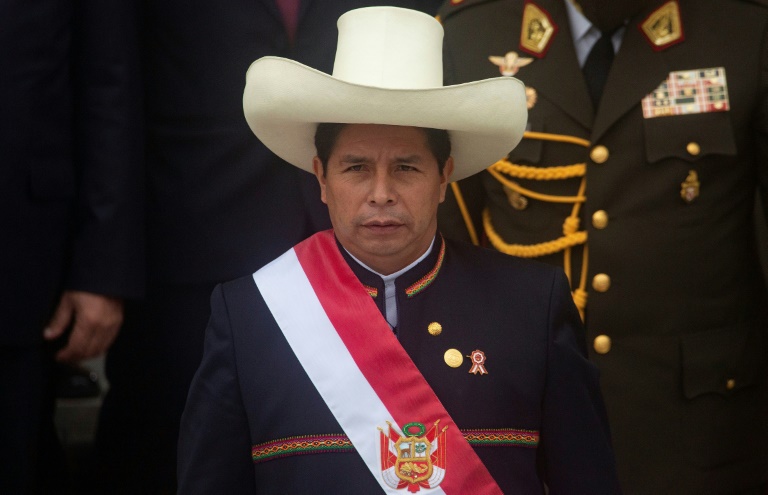
Peruvian President Pedro Castillo has adopted a unique measure in a bid to lift his falling popularity and resolve a series of political crises: he has ditched his iconic white cowboy hat.

The hat has been an important feature of Castillo’s humble rural-school teacher image that helped propel him to the presidency.

But for three days running this week, Castillo has appeared in public without his “sombrero.”

Having been forced into a fourth cabinet reshuffle in just six months as president and with his disapproval rating hitting 60 percent, Castillo allegedly sought the advice of Saul Alanya, a leadership and self-improvement coach.

“I suspect that the image ‘coach’ advised him that he had to change and should start with the hat,” political analyst Augusto Alvarez Rodrich told AFP.

“The problem is that he has taken off the hat but not the ideas that were beneath it.”

Castillo has come under fire during his short presidency with critics blaming his political inexperience and lack of management skills for the instability of his successive cabinets.

The 52-year-old says he is the victim of a campaign by political opponents and some media actors to try to force him from power, hitting out at “anti-democratic attitudes of certain sectors that just want to destabilize the country.”

In December, he survived an attempt at impeachment, but earlier this month a far-right party announced it would file a new motion to remove him.

Prosecutors are also investigating him and his associates in three separate graft cases.

Amidst the political turmoil, Castillo appears to have decided that the iconic headwear that contributed to his humble man-of-the-people image has got to go.

– ‘Kidnapped’ –

The hat was a prominent feature on the campaign trail, although it turned Castillo into the butt of jokes by his opponents and some sections of the press.

He was said to only ever remove it when entering church, and was even pictured wearing it at breakfast on election day last June, alongside his likewise sombrero-clad parents.

He wore it in cabinet meetings, in talks with foreign dignitaries and even at the United Nations General Assembly in New York.

Peruvians saw their new president without his sombrero for the first time on Tuesday when swearing in his new cabinet, before subsequent hatless appearances on Wednesday and Thursday.

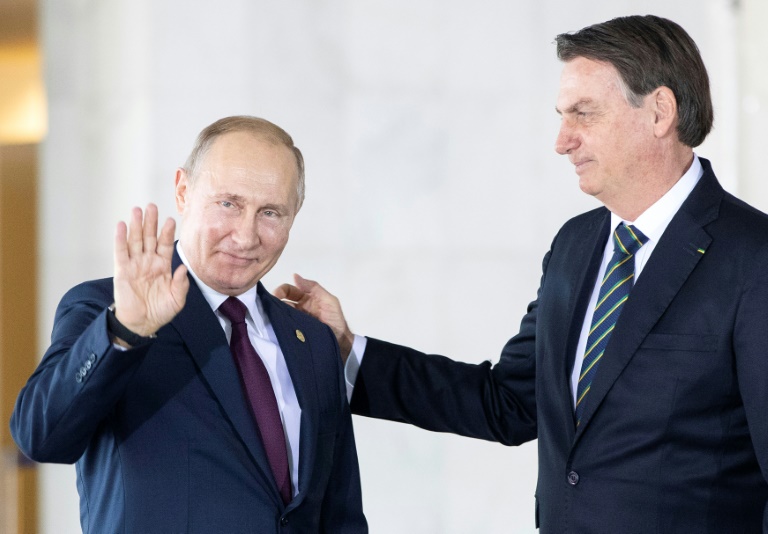
He had briefly been deprived of it last week when meeting Brazil’s far-right president, Jair Bolsonaro, who stole it off his head while laughing and posing for pictures.

“Help me, Bolsonaro’s kidnapped me,” joked Castillo.

However, Castillo has not always been so attached to his sombrero.

He did not wear it when he first came to national prominence in 2017 as the leader of a striking teachers union.

Guido Bellido, a politician from Castillo’s ruling Peru Libre (Free Peru) party, claimed last year that he was the one to suggest the hat would make a good political identity.

On the campaign trail, Castillo traveled to every corner of Peru wearing his hat and even sometimes riding on horseback.

He took part in election debates clad in his white hat, and so the legend was born.

– Luxury item –

Castillo’s tall wide-brimmed straw hat is typical of those worn by peasants in his home region of Cajamarca, in northern Peru.

Worn by both men and women — although it is less popular amongst younger generations — it is known as a “bambamarquino” or “chotano” after the rural area of Chota in Cajamarca.

Each hat is handmade and it takes between three weeks and two months to complete.

Although intrinsically linked to humble peasants, the chotanos have recently become a luxury item, selling for as much as 4,000 soles ($1,000).

'Terrible timing': Brazil's Bolsonaro to visit Russia

Ignoring US concerns, Brazilian President Jair Bolsonaro is due to arrive in Russia Tuesday for an official visit with highly awkward diplomatic timing, amid the tense standoff between Moscow and the West over Ukraine.

Brushing off pressure from traditional ally the United States and within his own cabinet, Bolsonaro decided to go ahead with meeting Russian counterpart Vladimir Putin, a visit he says is about building trade relations.

The far-right leader known as the “Tropical Trump” has dismissed fears that Putin could try to use the trip to claim support on Ukraine from Latin America’s biggest country, a non-permanent member of the UN Security Council.

But their meeting, scheduled for Wednesday, could become a diplomatic minefield for Bolsonaro if the subject veers away from bilateral ties.

“The timing is terrible,” said Guilherme Casaroes, a political analyst at the Getulio Vargas Foundation in Brazil.

“We don’t know what’s going happen. Things are going to be more and more intense at the (Russia-Ukraine) border,” he told AFP.

Russia made the invitation in late November, when tension over Ukraine was already building.

Bolsonaro accepted, deciding to combine it with a visit to fellow far-right leader Viktor Orban in Hungary, where he will travel Thursday.

Since then, the Ukraine standoff has only grown worse, with the risk of war in Europe looking all too real.

“The US exerted a lot of pressure on Brasilia to call off” the trip, said Felipe Loureiro, professor of international relations at the University of Sao Paulo.

But canceling now would send the signal that “Brazil is a puppet of the US,” and Putin “would get really pissed off,” he said.

Bolsonaro insisted again in a radio interview Saturday that he would go ahead with the visit, despite the prospect of war breaking out soon.

“We ask God that peace reign in the world, for the good of all of us,” Bolsonaro said.

– Domestic spotlight, world stage –

Bolsonaro’s main reasons for making the trip appear to be domestic, said Casaroes.

The Brazilian leader’s approval rating is at an all-time low as he gears up to seek re-election in October, trailing badly in the polls to leftist ex-president Luiz Inacio Lula da Silva.

“Bolsonaro has practically nothing to show after three years (in office). Going to Russia right now is a sign of grandeur,” said Casaroes.

“He has antagonized the US, China, Europe. The only foreign power he could visit was Russia.”

The trip plays to Bolsonaro’s hardline base on the far right and Brazil’s powerful agribusiness lobby, he added.

Analysts say Bolsonaro may also be keen to cultivate ties with Putin for his own imminent battle, October’s elections.

Bolsonaro has hinted he will not leave the presidency without a fight, saying his reelection bid can only have three outcomes: “prison, death or victory.”

The trip “is completely related to Bolsonaro’s desire to disrupt the Brazilian election. We know Russia is very keen on cyber-attacks and disinformation,” said Loureiro.

Officially, the talks will focus on Russian investments in hydrocarbons and infrastructure in Brazil, as well as trade.

Though both countries are in the BRICS group of emerging powers (Brazil, Russia, India, China and South Africa), their trade ties are relatively tiny.

Brazil imports mainly fertilizer from Russia, and sells it beef, poultry, soy and coffee — though exports to the country represent just 0.74 percent of the Brazilian total.

– US watching –

Bolsonaro cultivated close ties with the United States under former president Donald Trump, his political role model.

The US even declared Brazil a “major non-NATO ally” in 2019.

But relations have grown chillier under Joe Biden, who has taken Bolsonaro to task over surging deforestation in the Amazon rainforest.

Meanwhile, Bolsonaro has expressed admiration for “strong man” Putin.

Communication channels between the Bolsonaro and Biden administrations are at a standstill, said Casaroes.

But Bolsonaro could pay a price if he antagonizes Brazil’s traditional allies during the trip.

“Bolsonaro is unpredictable. If he says something that somehow supports Russia, it would create a lot of problems for Brazil with Europe and especially the US,” said Loureiro.

The US urged Bolsonaro to tread carefully in Moscow.

“As democratic countries… we have a responsibility to stand up for democratic principles and for the rules-based order,” said US State Department spokesman Ned Price.

He added Washington was “confident that there will be discussions, both before and after the trip, with our Brazilian partners.”

Police fire tear gas, fine Paris protest convoy

Paris police fired tear gas and issued hundreds of fines on Saturday to break up a convoy of vehicles that attempted to block traffic in a protest over coronavirus restrictions and rising living costs.

Inspired by truckers who shut down the Canadian capital Ottawa, thousands of demonstrators from across France made their way to Paris in a self-proclaimed “freedom convoy” of cars, trucks and vans.

The police, who had banned the protest, moved quickly to try to clear cars at entry points to the city, handing out fines for participation in an unauthorised protest.

But more than 100 vehicles managed to converge on the Champs-Elysees, where police used teargas to disperse protesters in scenes reminiscent of the “yellow vest” anti-government riots of 2018-2019.

Among those arrested in Paris, said a police source, was Jerome Rodrigues, one of the leading figures in the “yellow vest” protests and a supporter of the convoy. 

Interior Minister Gerard Darmanin tweeted that officers had arrested 54 protesters in Paris and handed out 337 fines.

The demonstrators oppose the Covid vaccine pass required to access many public venues but some also took aim at rising energy and food prices, issues which ignited the “yellow vest” protests that shook France in late 2018 and early 2019.

Aurelie M., a 42-year-old administrative assistant from Paris, said the pass requirement meant she could no longer take a long-distance TGV train even if she tested negative for Covid in a home test.

“There’s so much inconsistency and unfairness,” she told AFP, noting that commuters could still cram onto crowded Paris metros without proof of vaccination.

– ‘Fatigue leads to anger’ –

Sixty-five-year-old factory worker Jean-Paul Lavigne said he had travelled in from the southwestern town of Albi to protest not just the pressure to get vaccinated, but also fuel, food and electricity price hikes.

Across the capital, more than 7,600 other people protested against the vaccination pass, the interior ministry said.

Nearly 7,200 officers equipped with armoured vehicles and water cannon were deployed around Paris.

The demonstrations come two months before presidential elections in which President Emmanuel Macron is expected to seek re-election.

On Friday, Macron, a figure of hate for the far left, said he understood the “fatigue” linked to the pandemic.

“This fatigue also leads to anger. I understand it… But I call for the utmost calm,” he told the Ouest-France newspaper.

The convoys set out from Nice in the south, Lille and Vimy in the north, Strasbourg in the east and Chateaubourg in the west.

They want an end to the government’s vaccine pass and more help with their energy bills.

“People need to see us, and to listen to the people who just want to live a normal and free life,” said Lisa, a 62-year-old retired health worker travelling in from Chateaubourg, who did not want to give her surname.

– ‘Betrayal’ –

Paris police had banned the gathering, saying it posed a threat to public order, a decision upheld by the country’s highest administrative court on Saturday.

“It’s a betrayal. The basis of the order is not respectful of the law, of the freedom to demonstrate,” anti-vaccine and “yellow vest” activist Sophie Tissier told AFP.

Prime Minister Jean Castex defended the clampdown.

“The right to demonstrate and to have an opinion are a constitutionally guaranteed right… in our democracy,” he said.

“The right to block others or to prevent coming and going is not.”

The government has said it plans to relax the mask mandates by February 28, and end the vaccine pass requirement by late March or early April.

Some 24,000 more people demonstrated in other parts of the country, the authorities said, including in the southern city of Montpellier, where radical fringe activists broke the glass facades of two banks.

From Paris, some of the protesters plan to travel on to Brussels for a “European convergence” of protesters planned there for Monday. 

Belgium has banned that event too, and its Prime Minister Alexander de Croo has urged would-be attendees to “go and protest in your own country”.

burs-ao/jj/dw

Close Bitnami banner
Bitnami