World

Biden warns Putin that Ukraine attack will bring 'swift and severe costs'

Efforts to defuse the crisis in Ukraine via a frenzy of telephone diplomacy failed to ease tensions Saturday, with the White House insisting that Russia faces “swift and severe costs” if its troops carry out an invasion.

Russian President Vladimir Putin slammed Western claims that such a move might be on the horizon, calling the idea “provocative speculation” that could lead to a conflict in the ex-Soviet country, according to a Russian readout of a call with French President Emmanuel Macron.

Weeks of tensions that have seen Russia nearly surround its western neighbour with more than 100,000 troops intensified after Washington warned that an all-out invasion could begin “any day” and Russia launched its biggest naval drills in years across the Black Sea.

“If Russia undertakes a further invasion of Ukraine, the United States together with our Allies and partners will respond decisively and impose swift and severe costs on Russia,” US President Joe Biden told Putin, according to the White House.

While the United States was prepared to engage in diplomacy, “we are equally prepared for other scenarios”, Biden said, as the two nations stare down one of the gravest crises in East-West relations since the Cold War.

While the Biden-Putin talks were “professional and substantive”, lasting just over an hour, they produced “no fundamental change” in dynamics, a senior US official told reporters.

Russia’s defence ministry added to the febrile atmosphere by announcing that it had chased off a US submarine that it alleged had crossed into its territorial waters near the Kuril Islands in the northern Pacific. 

The ministry said it had summoned the US defence attache in Moscow over the incident, while the Pentagon said only that it was aware of press reports.

Putin began his afternoon by holding talks with Macron that the French presidency said lasted one hour and 40 minutes.

Macron’s office said “both expressed a desire to continue dialogue” but, like Washington, reported no clear progress.

– ‘Possible provocations’ –

Russia on Saturday added to the ominous tone by pulling some of its diplomatic staff out of Ukraine.

The foreign ministry in Moscow said its decision was prompted by fears of “possible provocations from the Kyiv regime”.

But Washington and a host of European countries along with Israel cited the growing threat of a Russian invasion as they called on their citizens to leave Ukraine as soon possible.

Britain and the United States also pulled out most of their remaining military advisors while the US embassy ordered “most” of its Kyiv staff to leave. 

Dutch carrier KLM announced that it was suspending commercial flights to Ukraine until further notice. 

The prospect of fleeing Westerners prompted Kyiv to issue an appeal to its citizens to “remain calm”.

“Right now, the people’s biggest enemy is panic,” Ukrainian President Volodymyr Zelensky said on a visit to troops stationed near the Russian-annexed peninsula of Crimea.

Several thousand Ukrainians braved the winter cold to march through Kyiv in a show of unity amid the growing fears of war.

“Panic is useless,” said student Maria Shcherbenko as the crowd waved Ukraine’s blue-and-yellow flags and sang the national anthem. “We must unite and fight for independence.” 

– ‘Any day now’ –

Washington on Friday issued its most dire warning yet that Russia had assembled enough forces to launch a serious assault.

“Our view that military action could occur any day now, and could occur before the end of the Olympics, is only growing in terms of its robustness,” US National Security Advisor Jake Sullivan warned.

US military assessments had earlier said the Kremlin may want to wait for the Beijing Winter Olympic Games to end on February 20 before launching an offensive so as not to offend Russia’s ally China.

Ukrainian leaders have been trying to talk down the prospects of an all-out war because of the damaging effect such fears were having on the country’s teetering economy and public morale.

But the mood across the country remained tense.

The mayor’s office of Kyiv announced that it had prepared an emergency evacuation plan for the capital’s three million residents as a precaution.

Sullivan stopped short on Friday of saying that the United States has concluded that Putin has made the decision to attack. 

But some US and German media cited intelligence sources and officials as saying that a war could begin at some point after Putin concludes talks with German Chancellor Olaf Scholz in Moscow on Tuesday.

The German leader is due to travel to Kyiv on Monday and then visit Putin as Europe strives to keep lines of communication open with Moscow.

Russia is seeking binding security guarantees from the West that include a pledge to roll NATO forces out of eastern Europe and to never expand into Ukraine.

Washington has flatly rejected the demands while offering to discuss a new European disarmament agreement with Moscow.

Sullivan also repeated warnings that Russia risked severe Western sanctions and said that NATO is now “more cohesive, more purposeful, more dynamic than any time in recent memory”.

Germany’s Scholz has added his voice to European pledges to punish Russia with severe economic sanctions targeting its financial and energy sector if it attacks.

burs-zak/as/jm/bfm/bbk
Police fire tear gas, fine Paris protest convoy

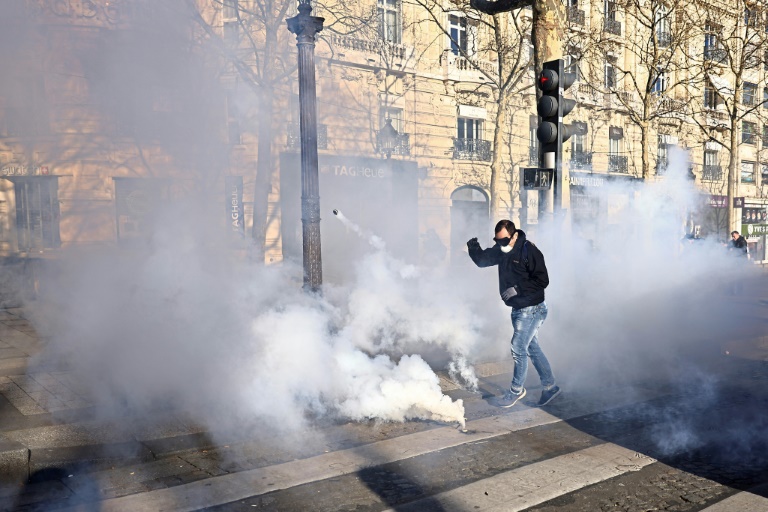
Paris police fired tear gas and issued hundreds of fines on Saturday to break up a convoy of vehicles that attempted to block traffic in a protest over coronavirus restrictions and rising living costs.

Inspired by truckers who shut down the Canadian capital Ottawa, thousands of demonstrators from across France made their way to Paris in a self-proclaimed “freedom convoy” of cars, trucks and vans.

The police, who had banned the protest, moved quickly to try to clear cars at entry points to the city, handing out 283 fines for participation in an unauthorised protest.

But more than 100 vehicles managed to converge on the famous Champs-Elysees avenue, where police used teargas to disperse protesters in scenes reminiscent of the “yellow vest” anti-government riots of 2018-2019.

The demonstrators oppose the Covid vaccine pass required to access many public venues but some also took aim at rising energy and food prices, issues which ignited the “yellow vest” protests that shook France in late 2018 and early 2019.

Aurelie M., a 42-year-old administrative assistant from Paris, complained that the health pass meant she could no longer take a long-distance TGV train even if she tested negative for Covid in a home test.

“There’s so much inconsistency and unfairness,” she told AFP, noting that commuters could still cram onto crowded Paris metros without proof of vaccination.

– ‘Fatigue leads to anger’ –

Sixty-five-year-old factory worker Jean-Paul Lavigne said he had travelled in from the southwestern town of Albi to protest not just the pressure to get vaccinated, but also fuel, food and electricity price hikes.

Across the rest of the capital, more than 7,600 other people also protested against the vaccination pass, the interior ministry said.

The demonstrations come two months before presidential elections, in which President Emmanuel Macron is expected to seek re-election.

On Friday, the centrist French leader, a figure of hate for the far left, said he understood the “fatigue” linked to the pandemic.

“This fatigue also leads to anger. I understand it… But I call for the utmost calm,” he told the Ouest-France newspaper. 

Nearly 7,200 officers equipped with armoured vehicles and water cannon were deployed to keep the peace in Paris.

The convoys set out from Nice in the south, Lille and Vimy in the north, Strasbourg in the east and Chateaubourg in the west.

They are demanding the withdrawal of the government’s vaccine pass and more help with their energy bills.

“People need to see us, and to listen to the people who just want to live a normal and free life,” said Lisa, a 62-year-old retired health worker travelling in from Chateaubourg, who did not want to give her surname.

– ‘Betrayal’ –

Paris police banned the gathering, saying it posed a threat to public order.

The order prohibiting the assembly of convoys was upheld on Friday by the courts, which rejected two appeals.

“It’s a betrayal. The basis of the order is not respectful of the law, of the freedom to demonstrate,” anti-vaccine and “yellow vest” activist Sophie Tissier told AFP.

The prime minister defended the clampdown.

“The right to demonstrate and to have an opinion are a constitutionally guaranteed right… in our democracy. The right to block others or to prevent coming and going is not,” he said.

Some 24,000 more people demonstrated in other parts of the country, the authorities said, including in the southern city of Montpellier, where radical fringe activists broke the glass facades of two banks.

From Paris, some of the protesters plan to travel on to Brussels for a “European convergence” of protesters planned there for Monday. 

Belgium has banned that event too, and its Prime Minister Alexander de Croo has urged would-be attendees to “go and protest in your own country”.

burs-ao/ah/har

Canada-style convoy blocks Netherlands' The Hague

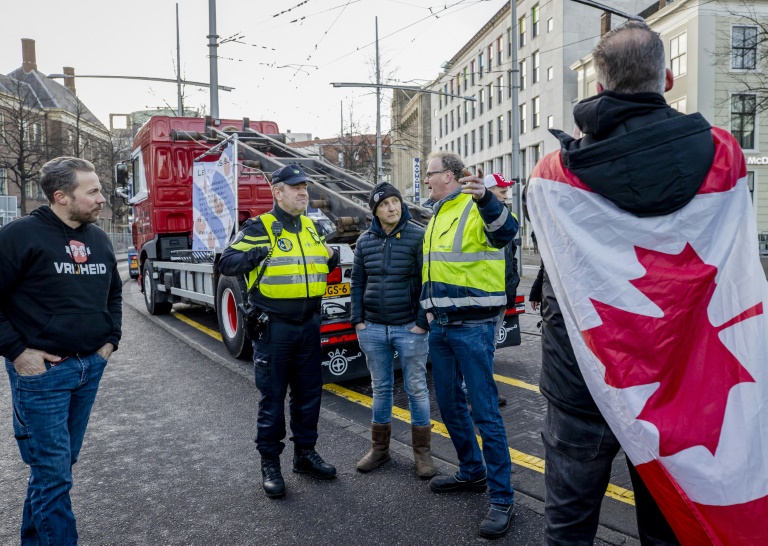
A convoy of vehicles from across the Netherlands brought The Hague’s city centre to a brief standstill on Saturday, protesting coronavirus restrictions.

Inspired by Canadian truckers who congested the capital Ottawa, several hundred vehicles during the day blocked access to the Binnehof, seat of the Dutch government, according to a report by public television.

After police warned protesters they would be fined and arrested if they did not leave by mid-afternoon, the drivers withdrew.

“The protesters who were blocking the city centre with trucks… have now left,” police posted on Twitter in the evening.

The protesters had started to arrive in the early morning in trucks, cars, tractors and even caravans.

At first they refused to leave, organisers said, until “fundamental and long-lasting change” was enacted and all Covid restrictions were lifted nationwide.

“The protest… is quietly ending,” organisers posted on Telegram later in the afternoon. “Tomorrow is another day.”

Dutch press agency ANP said most left the area calmly, but minor skirmishes broke out after the trucks drove away.

“Horseback police dispersed a group of people and dealt blows…,” it reported. “At least two people were arrested.”

Rutger van Lier, a 46-year-old entrepreneur, earlier told AFP the protest was “of course inspired by Canada.

“There too, people are very unhappy with public policy,” he said.

Several other protesters earlier said they would drive on to the Belgian capital Brussels, or even to Paris, where French police issued fines and fired tear gas Saturday to disperse similar protests.

Some said they would be back in The Hague on Sunday.

The Canada-style convoy is just the latest demonstration against the government’s anti-Covid restrictions in the Netherlands.

Anger spilled over into violence in January last year and again in November when riots erupted in cities including The Hague and Rotterdam.

Canadian police evacuate key border bridge as Ottawa protest again grows

Canadian police on Saturday began clearing a key bridge of truckers protesting Covid-19 restrictions, even as authorities in Ottawa braced for renewed demonstrations expected to bring thousands to the federal capital.

The provincial supreme court in Ontario had ordered truckers to end their blockade of the strategic Ambassador Bridge, which links the city of Windsor in Canada to Detroit, Michigan in the US. 

The protest has forced major automakers in both countries to halt or scale back production, and Washington on Friday urged Ottawa to use its federal powers to end the blockade.

Prime Minister Justin Trudeau promised “an increasingly robust police intervention,” adding that borders cannot remain closed and “this conflict must end.”

Ontario province, heavily dependent on the auto industry, has declared a state of emergency.

But while Canadian police began the process of clearing the Ambassador Bridge — tents erected in traffic lanes were taken down, and some trucks had left the scene by mid-morning Saturday — protests continued, there and elsewhere.

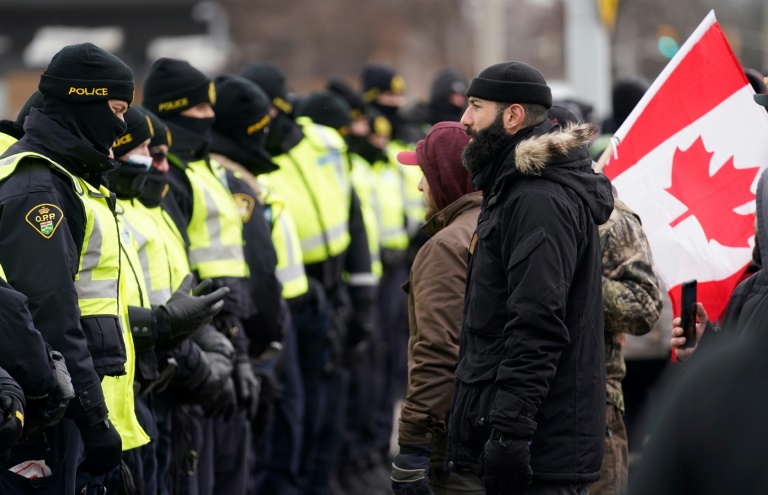
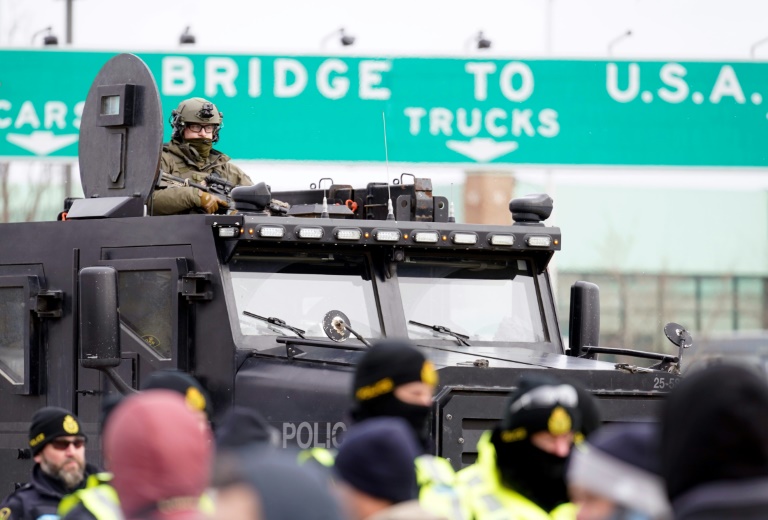
As police backed by armored vehicles advanced slowly on the bridge, dozens of demonstrators continued to block the way. 

“Enforcement continuing, individuals who are located within the demonstration area are subject to arrest,” the Windsor police warned on Twitter. “People are advised to immediately vacate the area.”

The protesters have been warned that they could face heavy fines, jail time and loss of their driver’s licenses if they continue obstructing traffic.

The Ambassador Bridge is vital to the US and Canadian auto industries, carrying more than 25 percent of merchandise exported by both countries. 

Two other US-Canada border crossings remain blocked by protests: one linking Manitoba province to the US state of North Dakota, and a second one in Alberta province.

 – ‘I’m not dead’ –

On Saturday morning, crowds of protesters were collecting in Ottawa — the epicenter of the movement — for the third consecutive weekend.

Hundreds of people, some waving Canadian flags, again occupied the city center, walking under snowy skies between the huge trucks that have paralyzed the capital and infuriated many locals. 

“I’ve been supporting the cause from the beginning,” said 38-year-old Marc-Andre Mallette, whose backpack bore patches representing both the Canadian and the Quebec flags. 

“I’m not vaccinated, and I’m not dead,” added Mallette, a sewer worker from the town of St.-Armand, near the US border.

John Pacheco, who said he has been coming to the demonstrations three times a week, brought his 15-year-old daughter Sophia on Saturday.

Describing himself as a “Catholic activist,” he said he is happy to see that the truckers’ movement has spread, with copycat protests in France, the Netherlands and New Zealand.

Protests began about two weeks ago when demonstrators drove into Ottawa to demand an end to a vaccination requirement affecting truckers crossing the international border.

But the movement has spread, as the protesters — mostly insisting they want to protect their freedoms, but some displaying swastikas or Confederate flags — are now demanding an end to all vaccine mandates, whether imposed by the federal or provincial governments. 

Anti-Trudeau signs and chants have become common along the clogged Ottawa streets.

The prime minister is facing heavy criticism as political opponents say he has been too slow to bring the  protests to an end.

Trudeau has repeatedly insisted that the protesters represent a small — if noisy — fraction of a population that has largely gone along with vaccination requirements and guidance.

But in several Canadian provinces anti-Covid measures have been more restrictive than in much of the world, and the truckers’ message has resonated more widely than the authorities expected. 

One opinion survey found that one-third of Canadians support the protest movement, while 44 percent say they at least understand the truckers’ frustrations.

  – Protest in Paris –

Since the movement began, some central Canadian provinces have announced plans to end mask and vaccine requirements in coming weeks, with the numbers of Covid-19 cases falling.

But the two most populous provinces — Ontario and Quebec — have yet to follow suit.

The truckers have found support among conservatives and vaccine mandate opponents across the globe.

In Paris on Saturday, police fired teargas and issued hundreds of fines in an effort to break up convoys of vehicles from across France that were attempting to converge on the Champs-Elysees in a protest over Covid restrictions and rising living costs.

And in the Netherlands, a vehicle convoy brought The Hague’s city center to a standstill in another protest against coronavirus restrictions.

'Unite and fight': Ukrainians march in face of Russia threat

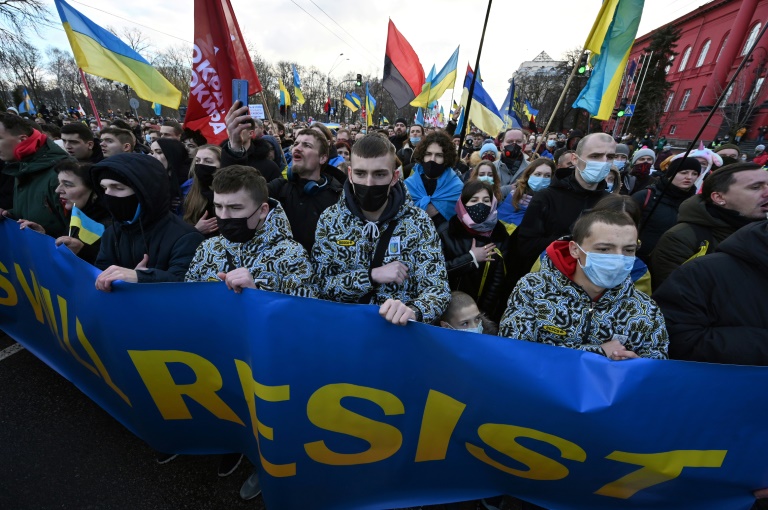
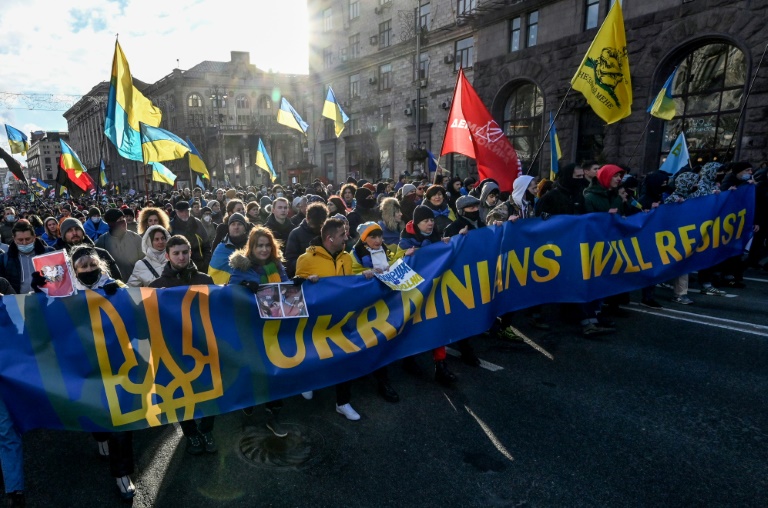
Waving flags and singing the national anthem, thousands of Ukrainians braved the winter cold to march across Kyiv on Saturday to show unity in the face of a feared Russian invasion.

“Panic is useless. We must unite and fight for independence,” said student Maria Shcherbenko, expressing a sentiment similar to that voiced by Ukranian President Volodymyr Zelensky earlier in the day.

“I remain calm. I love Ukraine,” said Shcherbenko’s sign as the sun briefly peeked through the clouds on a cold and blustery day.

Some carried signs reading “war is not the answer”, while others held banners calling on the nation to “resist”.

Riven by an eight-year conflict that has claimed more than 14,000 lives across its Moscow-backed separatist east, Ukraine is now facing the threat of an all-out invasion by Russia.

The Kremlin has massed more than 100,000 troops around its western neighbour, staging war games across Belarus to its north and navy drills in the Black Sea to its south.

Washington has warned that war could break out any day. Western countries are pulling their diplomats out of Kyiv and ordering citizens to immediately get out of Ukraine.

Even Kyiv, despite calls for calm from Zelensky and a range of other leaders, has prepared a plan to evacuate the capital’s three million residents.

– No fear –

“We are here to show that we are not afraid,” said Nazar Novoselsky, who joined the march across Kyiv’s central avenues with his two little children.

“We will lay our soul and body for the cherished freedom,” the crowd sang — words from the national anthem — just as they had done en masse in the months leading to Ukraine’s 2014 pro-EU revolution.

After the 2014 revolt the Kremlin annexed Ukraine’s Crimea peninsula and backed an insurgency across parts of the former Soviet republic’s Russian-speaking industrial east.

Relations between Moscow and Kyiv have been severely strained ever since, with that tension showing in the crowd.

Many showed their support for NATO — the Western defence alliance at the heart of Russia’s dispute with the West.

Russian President Vladimir Putin wants binding security guarantees that NATO will never expand into Ukraine, also demanding that it pull out of eastern European countries that were under the Kremlin’s influence during the Cold War.

But a pledge to join NATO is written into Ukraine’s new constitution, and Washington has rejected the Kremlin’s demands.

“Into NATO, immediately,” said one sign, held up by Oleksiy Tkachenko, a 70-year-old retiree.

“Why should Putin be telling us what to do,” Natalia Savostikova, a 67-year-old doctor, demanded.

Biden, Putin discuss Ukraine as Kremlin slams 'provocations'

Russian leader Vladimir Putin on Saturday slammed Western claims of an imminent Moscow invasion of Ukraine as a “provocation” as he began new crisis talks with US President Joe Biden.

Weeks of tensions that have seen Russia surround its western neighbour with more than 100,000 troops intensified after Washington warned that an all-out invasion could begin “any day” and Russia launched its biggest naval drills in years across the Black Sea.

Russia’s defence ministry added to the febrile atmosphere by announcing that it had chased off a US submarine that it alleged had crossed into its territorial waters near the Kuril Islands in the Pacific. The ministry said it had summoned the US defence attache in Moscow over the incident.

The military manoeuvres gave added urgency to a hastily arranged call Saturday between Biden and Putin aimed at defusing one of the gravest crises in East-West relations since the Cold War.

“President Biden’s secure call with Russian President Putin convened” at 1604 GMT, a White House official told reporters. 

Putin began his afternoon by holding talks with France’s Emmanuel Macron that the French presidency said lasted one hour, 40 minutes.

Macron’s office said “both expressed a desire to continue dialogue” but reported no clear progress.

The Kremlin said Putin told Macron that Western claims of a planned Russian invasion were “provocative speculation” and could spark a conflict in Ukraine.

– ‘Possible provocations’ –

Russia on Saturday added to the ominous tone by pulling some of its diplomatic staff out of Ukraine.

The foreign ministry in Moscow said its decision was prompted by fears of “possible provocations from the Kyiv regime”.

But Washington and a host of European countries cited the growing threat of a Russian invasion as they called on their citizens to leave Ukraine as soon possible.

Britain and the United States also pulled out most of their remaining military advisers while the US embassy ordered “most” of its Kyiv staff to leave. 

Dutch carrier KLM announced that it was suspending commercial flights to Ukraine until futher notice. 

The prospect of frightened Westerners fleeing their country prompted Kyiv to issue an appeal to its citizens to “remain calm”.

“Right now, the people’s biggest enemy is panic,” Ukrainian President Volodymyr Zelensky said on a visit to troops stationed near the Russian-annexed peninsula of Crimea.

Several thousands also braved the winter call to march through Kyiv in a show of unity in the face of the growing fears of war.

“Panic is useless,” said student Maria Shcherbenko as the crowd waved Ukraine’s blue-and-yellow flags and sang the national anthem. “We must unite and fight for independence.” 

– ‘Any day now’ –

Washington on Friday issued its most dire warning yet that Russia had assembled enough forces to launch a serious assault.

“Our view that military action could occur any day now, and could occur before the end of the Olympics, is only growing in terms of its robustness,” US National Security Advisor Jake Sullivan warned.

US military assessments had earlier said the Kremlin may want to wait for the Beijing Winter Olympic Games to end on February 20 before launching an offensive so as not to offend Russia’s ally China.

Ukrainian leaders have been trying to talk down the prospects of an all-out war because of the damaging effect it was having on the country’s teetering economy and public morale.

But the mood across the country remained tense.

The mayor’s office of Kyiv announced that it had prepared an emergency evacuation plan for the capital’s three million residents as a precaution.

Sullivan stopped short on Friday of saying that the United States has concluded that Putin has made the decision to attack. 

But some US and German media cited intelligence sources and officials as saying that a war could begin at some point after Putin concludes talks with German Chancellor Olaf Scholz in Moscow on Tuesday.

The German leader is due to travel to Kyiv on Monday and then visit Putin as part of Europe’s efforts to keep lines of communication open with Moscow.

Russia is seeking binding security guarantees from the West that include a pledge to roll NATO forces out of eastern Europe and to never expand into Ukraine.

Washington has flatly rejected the demands while offering to discuss a new European disarmament agreement with Moscow.

Russia has called the US proposal woefully insufficient.

– ‘Pivotal moment’ –

The diplomatic push continued on Saturday with a new round of inconclusive talks between US Secretary of State Antony Blinken and Russian Foreign Minister Sergei Lavrov.

The State Department said Blinken told Lavrov that diplomatic channels “remained open” but required “Moscow to deescalate and engage in good-faith discussions”.

Lavrov countered that the West had ignored “key” Moscow demands and accused the United States of seeking to provoke a conflict in Ukraine.

Sullivan also repeated warnings that Russia risked severe Western sanctions and said that NATO is now “more cohesive, more purposeful, more dynamic than any time in recent memory”.

Germany’s Scholz has added his voice to European pledge to punish Russia with severe economic sanctions targeting its financial and energy sector if it attacks.

burs-zak/as/jm

'Unite and fight': Ukrainians march in face of Russia threat

Waving flags and singing the national anthem, thousands of Ukrainians braved the winter cold to march across Kyiv on Saturday to show unity in the face of a feared Russian invasion.

“Panic is useless. We must unite and fight for independence,” said student Maria Shcherbenko, expressing a sentiment similar to that voiced by Ukranian President Volodymyr Zelensky earlier in the day.

“I remain calm. I love Ukraine,” she said as the sun briefly peeked through the clouds on a cold a blistery day.

Some carried signs reading “war is not the answer”, while others carried banners calling on the nation to “resist”.

Riven by an eight-year conflict that has claimed more than 14,000 across its Moscow-backed separatist east, Ukraine is now facing the threat of an all-out invasion by Russia.

The Kremlin has massed more than 100,000 troops around its western neighbour, staging war games across Belarus to its north and navy drills to in the Black Sea its south.

Washington has warned that war could break out “any day”. Western countries are pulling their diplomats out of Kyiv and ordering citizens to immediately get out of Ukraine.

And even Kyiv, despite calls for calm from the Zelensky and a range of other leaders, has prepared a plan to evacuate the capital’s three million residents, just in case.

But the people marching across Kyiv’s central avenues said they had no fear.

“We are here to show that we are not afraid,” said Nazar Novoselsky, who came to the march with his two little children.

“We will lay our soul and body for the cherished freedom,” the crowd sang, voicing the words of the national anthem, just as they had done en masse in the months leading to Ukraine’s 2014 pro-EU revolution.

The 2014 revolt provoked the Kremlin into annexing Ukraine’s Crimea peninsula and then backing an insurgency across parts of the the former Soviet republic’s mostly Russian-speaking industrial east.

Relations between Moscow and Kyiv have been severely strained ever since, with that tension showing in the crowd.

“Why should Putin be telling us what to do,” Natalia Savostikova, a 67-year-old doctor demanded.

Police fire tear gas, fine Paris protest convoy

Paris police fired teargas and issued hundreds of fines on Saturday to break up a convoy of vehicles that attempted to block traffic in a protest over Covid restrictions and rising living costs.

Inspired by the truckers that shut down the Canadian capital Ottawa, thousands of demonstrators from across France made their way to Paris in a self-proclaimed “freedom convoy” of cars, trucks and vans.

The police, which had banned the protest, moved quickly to try to clear the cars at entry points to the city, handing out 283 fines for participation in an unauthorised protest.

But over 100 vehicles managed to converge on the famous Champs-Elysees avenue, where police used teargas to disperse protesters in scenes reminiscent of the “yellow vest” anti-government riots of 2018-2019.

The demonstrators oppose the Covid vaccine pass required to access many public venues but some also took aim at rising energy and food prices, issues which ignited the “yellow vest” protests that shook France in late 2018 and early 2019.

Aurelie M., a 42-year-old administrative assistant in a Parisian company, complained that the health pass meant she could no longer take a long-distance TGV train even if she tested negative for Covid in a home test.

“There’s so much inconsistency and unfairness,” she told AFP, noting that commuters could still cram onto a crowded Paris metro without proof of vaccination.

Sixty-five-year-old factory worker Jean-Paul Lavigne said he travelled across the country from the southwestern town of Albi to protest fuel, food and electricity price hikes as well as the pressure on people to get vaccinated.

The demonstrations come two months ahead of presidential elections, in which President Emmanuel Macron is expected to seek re-election.

On Friday, the centrist French leader, who is a figure of hate for the far left, said he understood the “fatigue” linked  to the Covid-19 pandemic.

– ‘Fatigue leads to anger’ –

“This fatigue also leads to anger. I understand it and I respect it. But I call for the utmost calm,” he told the Ouest-France newspaper. 

Nearly 7,200 officers equipped with armoured vehicles and water cannon were deployed to keep the peace in Paris.

Police showed off their arsenal on Twitter, publishing photographs of loader tractors for the removal of barricades.

The convoys set out from Nice in the south, Lille and Vimy in the north, Strasbourg in the east and Chateaubourg in the west.

– ‘It’s a betrayal’ –

They are demanding the withdrawal of the government’s vaccine pass and more help with their energy bills.

“People need to see us, and to listen to the people who just want to live a normal and free life,” said Lisa, a 62-year-old retired health worker travelling in the Chateaubourg convoy, who did not want to give her surname.

Paris police banned the gathering saying it posed a threat to public order and said protesters who tried to block roads would face fines or arrest.

The order prohibiting the assembly of convoys was upheld on Friday by the courts, which rejected two appeals.

“It’s a betrayal. The basis of the order is not respectful of the law, of the freedom to demonstrate,” anti-vaccine and “yellow vest” activist Sophie Tissier told AFP.

The prime minister defended the clampdown.

“The right to demonstrate and to have an opinion are a constitutionally guaranteed right in our republic and in our democracy. The right to block others or to prevent coming and going is not,” he said.

From Paris, some of the protesters plan to travel on to Brussels for a “European convergence” of protesters planned there for Monday. 

Phil, a 58-year-old on his way by truck from Brittany, said his refusal to get vaccinated had created “upheaval” in his family and work relations.

“When you join a demonstration you feel less alone,” he told AFP.

burs-ao/cb/har

Police positioned to clear key border bridge of protesters in Canada: AFP journalist

Police in Canada were positioning Saturday to clear a key bridge on the US border, snarled for days by truckers protesting against vaccination rules, an AFP journalist observed.

“We urge all demonstrators to act lawfully & peacefully,” police in Windsor, Ontario tweeted in announcing the deployment. 

The normally busy Ambassador Bridge links Windsor to the US city of Detroit, Michigan.

Dozens of police officers and vehicles had arrived on the scene by 8:00 am (13H00 GMT) and begun taking positions near the approximately 50 protesters whose big trucks, vans and pick-ups have blocked the major trade link for six days.

On Friday, the Supreme Court of Ontario province ordered the demonstrators to end their blockade.

With the protests increasingly impacting the US auto industry, US President Joe Biden’s administration has implored the government of Prime Minister Justin Trudeau to end the blockage.

But those occupying the Ambassador Bridge seemed largely unmoved. 

The protest has affected automakers on both sides of the border, prompting Toyota to pause some production in Canada and Ford Motor Company to fly parts in, the Windsor Star newspaper reported. 

The industry, one of the most important in Ontario, was already facing serious challenges from Covid-19, supply-chain disruption and bad weather.

Ontario premier Doug Ford has warned protesters that they could face fines of up to Can$100,000 ($78,500), up to a year in prison and revocation of their driver’s licenses if they continue blocking traffic.

Protests began about two weeks ago when truckers drove into capital city Ottawa to demand an end to a vaccination requirement affecting truckers crossing the international border.

But the movement has spread to several other cities and border crossings, and copycat protests have now sprung up in other countries such as France and New Zealand.

The Canadian protesters — mostly insisting they want to protect their freedoms, but some displaying swastikas or Confederate flags — are now demanding an end to all vaccine mandates, whether imposed by the federal or the provincial governments.

Indian industrialist Rahul Bajaj dies at 83

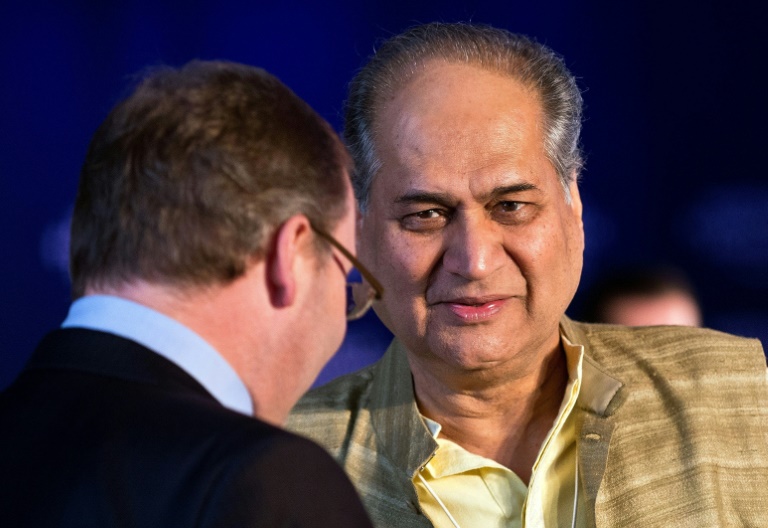
Veteran industrialist Rahul Bajaj, whose name was synonymous with road transport in India, died Saturday aged 83, his company said.

He “had not been keeping well”, the Bajaj Group said in a statement, adding he would be cremated on Sunday in Pune, western India.

Bajaj was born into the Indian elite — his grandfather was one of Mahatma Gandhi’s closest aides.

He led the eponymous family-owned conglomerate for more than 40 years, and was best known for overseeing the stratospheric success of the Bajaj Chetak scooter in the 1970s and ’80s.

The sturdy and affordable vehicle — based on a design by Italy’s Vespa and named after the legendary horse ridden into battle by a Hindu Rajput king in the 1500s — became wildly popular with the Indian middle class following its 1972 launch.

But in the heavily regulated economy of the time the firm was only allowed to make 6,000 units a year, leading at one point to a 10-year waiting list.

Bajaj was considered relatively clean in a country where corruption is widespread.

After stepping down as head of the firm in 2005, he served a term in the upper house of the Indian parliament, for the Congress party.

He was unusually outspoken for an Indian billionaire, many of whom seek to avoid conflict with the authorities.

After Prime Minister Narendra Modi’s Bharatiya Janata Party came to power in 2014, Bajaj said industrialists feared criticising the government despite a plunging growth rate and weak economy.

“If we criticise you there is no confidence that you will appreciate that,” Bajaj had reportedly said at a private event in 2019 in the presence of home minister Amit Shah.

Last year, he expressed concerns over the impact of strict lockdowns imposed by the government to curb the spread of the coronavirus.

But Modi tweeted on Saturday that he was “pained” by Bajaj’s demise, adding that he would be remembered for his “noteworthy contributions to the world of commerce and industry” and was a “great conversationalist”.

Fellow industrialists paid tribute, with Harsh Goenka, chairman of conglomerate RPG Group, tweeting: “The ‘spine’ of Indian business cracks.”

Bajaj, he added, “was a visionary, straight talking and very respected for his value systems. An era ends!” 

Kiran Mazumdar-Shaw, the billionaire founder of Indian biotechnology company Biocon, said the country had “lost a great son & nation builder”.

“I am devastated – he was a dear dear friend and will miss him dearly,” she tweeted.

Bajaj was born on June 10, 1938 in the eastern Indian city of Kolkata.

After studying economics in New Delhi and law in Mumbai, he took an MBA from Harvard Business School in 1964 before joining the family business in Pune a year later.

The conglomerate was split into separate units in the 2000s following a family dispute.

But Bajaj Auto is now among the world’s top 10 motorcycle-makers, and number one in three-wheelers, with a 72 percent market share according to Autocarpro.

“Rahul Bajaj’s passing is a big loss to India,” tweeted Rahul Gandhi, the de facto head of Congress, now the main opposition party.

“We have lost a visionary whose courage made us proud.”

Close Bitnami banner
Bitnami