World

Myanmar junta says to free over 800 prisoners

Myanmar’s junta on Saturday announced an amnesty for more than 800 prisoners to mark the country’s Union Day, as it held a parade and show of force in the capital.

The country has been in turmoil since last year’s coup, with mass protests and a subsequent military crackdown that has killed more than 1,500 civilians, according to the UN’s human rights office.

Junta chief Min Aung Hlaing issued the “pardon order” — a regular feature of major holidays in the country — for 814 prisoners to commemorate Union Day’s 75th anniversary, state media said.

Those given amnesty will be mostly from prisons in commercial hub Yangon, junta spokesperson Zaw Min Tun told AFP. 

He did not say whether detained Australian academic Sean Turnell — who has been detained for more than a year — would be among those released.

Turnell, an Australian economics professor, was working as an adviser to ousted civilian leader Aung San Suu Kyi when he was arrested last February, just days after a military coup.

He has been charged with violating Myanmar’s official secrets law and faces a maximum penalty of 14 years in prison if found guilty.

The junta released about 23,000 prisoners last April, with some rights groups at the time fearing the move was to free up space for opponents of the military and cause chaos.

A similar number were released on last year’s Union Day as well.

– ‘Performance art’ –

Around two dozen people gathered outside Yangon’s colonial-era Insein prison on Saturday morning hoping to be reunited with loved ones, some holding umbrellas against the sun.

Daw Lwin Lwin Moe said she was waiting for her 19-year-old daughter, who was arrested for incitement against the military last year.

“She has been in prison for 11 months already,” she told AFP.

Daw Khine was returning to Insein after her 18-year-old son was left out of a previous amnesty in October.

“I only have one son and I’m happy and hope to see him today,” she said.

The junta marked Union Day with a show of force in the military-built capital Naypyidaw, known for its broad and often empty thoroughfares.

Hundreds of troops paraded alongside civil servants waving national flags in unison and troupes performed choreographed dances. 

Helicopters carrying the country’s yellow, green and red flag flew overhead, followed by jets trailing the same colours in smoke.

Independent Myanmar analyst David Mathieson characterised the parade as “performance art”. 

“The message for Union Day is at complete odds with the reality that is Myanmar,” he told AFP, adding the junta was not sincere about peace.

“It’s pretty absurd that on the 75th anniversary of Union Day the country is more divided than at any point in its history.”

In a speech to troops, Min Aung Hlaing repeated the military’s claim of massive fraud in 2020 elections won by Suu Kyi’s party.

He also invited the myriad ethnic armed organisations that have been fighting Myanmar’s military — and each other — for decades to sit for peace talks.

In an announcement carried by state media, he said the junta would also halt ongoing “criminal proceedings” against members of Rakhine state’s Arakan Army, which for years has fought a war for autonomy for the ethnic Rakhine population. 

Struggling to contain the backlash and contending with daily clashes, swathes of the country are under the control of anti-coup fighters.

An anti-junta group told local media it was behind an explosion in Naypyidaw hours before Union Day celebrations were due to start. AFP was unable to confirm the reports.
Biden and Putin to speak as US warns Russia could attack Ukraine 'any day'

US President Joe Biden will speak to Vladimir Putin on Saturday after the United States warned that a Russian invasion of Ukraine could begin in days.

The US had dramatically raised the alarm over Ukraine on Friday, saying a Russian invasion starting with civilians caught under aerial bombing could begin in days and telling US citizens to leave within 48 hours.

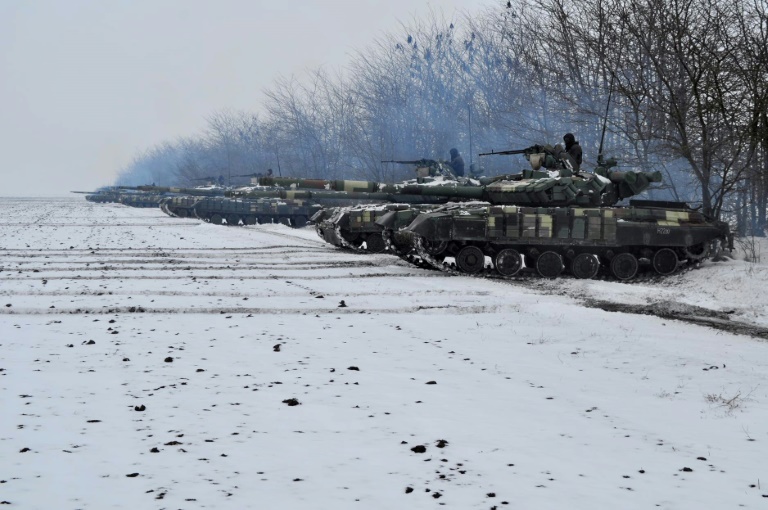
An attack by the more than 100,000 Russian troops currently massed next to Ukraine “could occur any day now,” White House National Security Advisor Jake Sullivan told reporters in Washington.

Dismissing speculation that the Kremlin would never trigger the crisis while the Beijing Olympics were still underway in close Russian ally China, Sullivan said such an attack “could occur” before the Games end on February 20.

The scenario of an imminent attack is “a very, very distinct possibility,” Sullivan added.

While stressing that it was not yet known whether Russian President Vladimir Putin had taken a decision, saying “we can’t predict the exact determination,” Sullivan made clear the United States was bracing for the worst, including a “rapid assault” on the capital Kyiv.

“If a Russian attack on Ukraine proceeds, it is likely to begin with aerial bombing and missile attacks that could obviously kill civilians,” he said. “Any American in Ukraine should leave as soon as possible, and in any event in the next 24 to 48 hours.”

Sullivan spoke shortly after President Joe Biden and six European leaders, the heads of NATO and the European Union held talks on the worst crisis between the West and Russia since the end of the Cold War.

A US official said Biden would speak with Putin on Saturday, while the French government said that President Emmanuel Macron would also be calling the Russian leader on Saturday.

Underlining the bleak outlook, a string of countries joined the exodus of diplomats and citizens from Ukraine, while oil prices surged and US equities tumbled.

– Western, NATO unity –

Sullivan repeated warnings that Russia risks severe Western sanctions and said that NATO, which Putin wants to push back from eastern Europe, is now “more cohesive, more purposeful, more dynamic than any time in recent memory.”

The Pentagon announced it was sending 3,000 more troops to bolster ally Poland.

And US Secretary of State Antony Blinken told his Ukrainian counterpart Dmytro Kuleba in a phone call “that Ukraine continues to have the United States’ enduring and steadfast support for its sovereignty and territorial integrity,” the State Department said.

Following the earlier group phone call between US and European leaders, German Chancellor Olaf Scholz’s spokesman said “the aim is to prevent a war in Europe.” But if Moscow fails to pull back, “the allies are determined to jointly take swift and deep sanctions against Russia.”

These sanctions would target the financial and energy sectors, EU chief Ursula von der Leyen said.

Sullivan spoke to der Leyen’s chief of staff Bjoern Seibert by video call on Friday to coordinate “the details of a potential transatlantic response, including both financial sanctions and export controls,” according to a White House statement.

– Russia surrounding Ukraine –

Russian naval forces and troops, including units brought in from all over the vast country, now surround Ukraine to the south, east and north. 

Russia, which denies any plan to attack Ukraine, already controls the Crimea territory seized in 2014 and supports separatist forces controlling Ukraine’s Donbas region in the east.

The Kremlin says its goal is to get NATO to agree to never give Ukraine membership and also to withdraw from eastern European countries already in the alliance, effectively carving Europe into Cold War-style spheres of influence. The United States and its European allies reject the demands, insisting that NATO poses no threat to Russia.

Adding to tensions, large-scale Russian military drills were underway Friday with authoritarian ally Belarus, which lies just north of Kyiv and also borders the European Union.

Russia’s defense ministry said Friday it was also holding military exercises near Ukraine’s border in the Black Sea. 

According to the head of Norway’s military intelligence service, Russia is operationally ready to conduct a wide range of military operations in Ukraine and the Kremlin just needs to make the call.

The top US general and his Russian counterpart talked Friday by phone, the Pentagon said, giving no details of the discussion.

And the European Union said its non-essential staff should leave Ukraine, while Israel said families of its diplomats were being pulled out. Norway joined Britain in telling its nationals to leave.

– Shuttle diplomacy –

The growing alarm comes despite efforts at shuttle diplomacy by European officials.

Macron visited both Moscow and Kyiv earlier this week and Scholz is expected to do the same in the coming days. Scholz will also hold his first in-person meeting with Putin in Moscow.

British Defense Secretary Ben Wallace was in Moscow Friday for rare talks with his Russian counterpart Sergei Shoigu. 

He was accompanied by the UK’s Chief of Defense Staff Tony Radakin, and the pair will also meet Russia’s top army general Valery Gerasimov. 

burs-sms/md/dw

Paris deploys police as protest convoy approaches capital

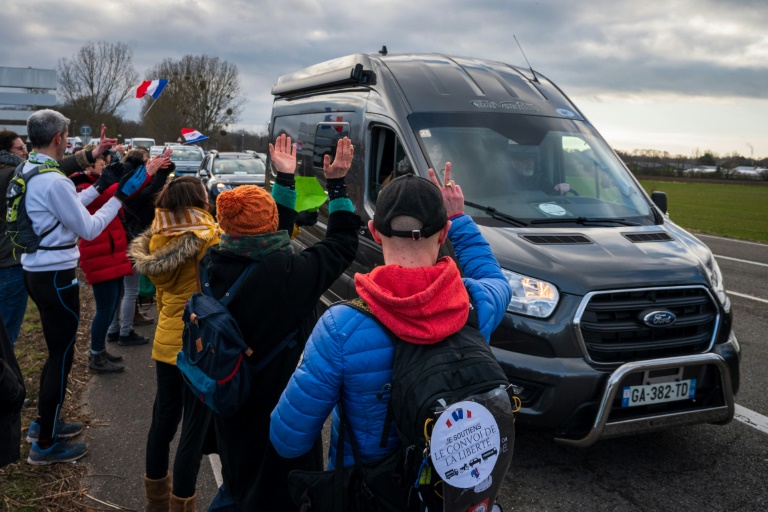
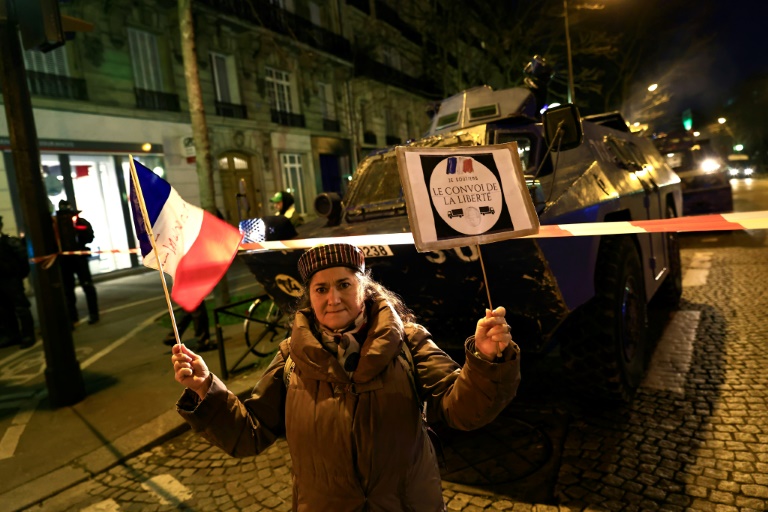
Thousands of opponents of Covid rules were encamped on the outskirts of Paris early Saturday after driving in convoys from across France, intent on entering the city in defiance of a ban by authorities who are determined to prevent any blockade of the capital.

Nearly 7,200 police and gendarmes “are being deployed over the next three days to enforce the ban on vehicle convoys,” Paris police headquarters said.

The prefect of the Paris police, Didier Lallement, said they had created a temporary car pound which, together with dozens of tow trucks, “will … put an end to any blockage”.

Police showed off their anti-blockage arsenal on Twitter, publishing photographs of loader tractors for the removal of barricades as well as trucks equipped with cranes or water cannon.

Gendarmerie armoured vehicles have also been deployed in the streets of the capital for the first time since the “yellow vest” protests at the end of 2018.

Prime Minister Jean Castex vowed to remain steadfast.

“If they block traffic or if they try to block the capital, we must be very firm about this,” he insisted on France 2 television channel on Friday.

Inspired by Canadian truckers paralysing border traffic with the United States, the demonstrators include anti-Covid vaccination activists, but also people angry at fast-rising energy prices.

Hundreds of cars, motorhomes and vans from Lille, Strasbourg, Chateaubourg and elsewhere stopped Friday evening at the gates of Paris, but a police source said no convoy had entered the capital.

They are demanding a withdrawal of the government’s vaccine pass, which is required for access to many public spaces, and more help with their energy bills.

“People need to see us, and to listen to the people who just want to live a normal and free life,” said Lisa, a 62-year-old retired health worker who joined a convoy of more than 1,000 vehicles leaving Chateaubourg in the western Brittany region early Friday.

Like other protesters, Lisa has been active in the “yellow vest” movement that erupted over a fuel tax hike before becoming a platform for other complaints against President Emmanuel Macron.

Just two months ahead of presidential elections and with the government desperate to avoid violent scenes in the capital, Macron said Friday he understood the “fatigue” linked to the Covid-19 pandemic.

“This fatigue also leads to anger. I understand it and I respect it. But I call for the utmost calm,” he told the Ouest-France newspaper. 

– ‘It’s a betrayal’ –

Police estimated 3,300 vehicles were involved in the various convoys by Friday afternoon.

Paris police banned the gathering because of feared “public order disturbances” and said protesters who tried to block roads would face fines or arrest.

The order prohibiting the assembly of convoys was upheld on Friday by the courts, which rejected two appeals.

“It’s a betrayal. The basis of the order is not respectful of the law, of the freedom to demonstrate,” anti-vaccine and “yellow vest” activist Sophie Tissier told AFP.

“The right to demonstrate and to have an opinion are a constitutionally guaranteed right in our republic and in our democracy. The right to block others or to prevent coming and going is not,” the prime minister said.

Refuting any desire to block the capital, the demonstrators were hoping to swell the ranks of the regular Saturday protests against the government’s vaccine pass.

“It’s important that we don’t interfere with other people on the roads,” said one activist, Robin, on his way from Illkirch-Graffenstaden in the eastern Alsace region. “That way we’ll keep the population on our side, like they did in Canada.”

Some then want to travel on to Brussels for a “European convergence” of protesters planned there for Monday. 

Phil, a 58-year-old on his way by truck from Brittany, said his refusal to get vaccinated had created “upheaval” in his family and work relations.

“When you join a demonstration you feel less alone,” he told AFP.

The government has expressed some sympathy for the protesters, with spokesman Gabriel Attal attributing their anger to “fatigue and weariness” after long-lasting Covid restrictions.

The government also announced Friday a further easing of Covid rules.

burs-ao/roc/mtp/oho

US to reopen Solomon Islands embassy after 29 years

The United States plans to re-establish an embassy in the Solomon Islands, a senior State Department official said Saturday, as Washington seeks to beef up its presence in a region where China is rapidly expanding its influence.

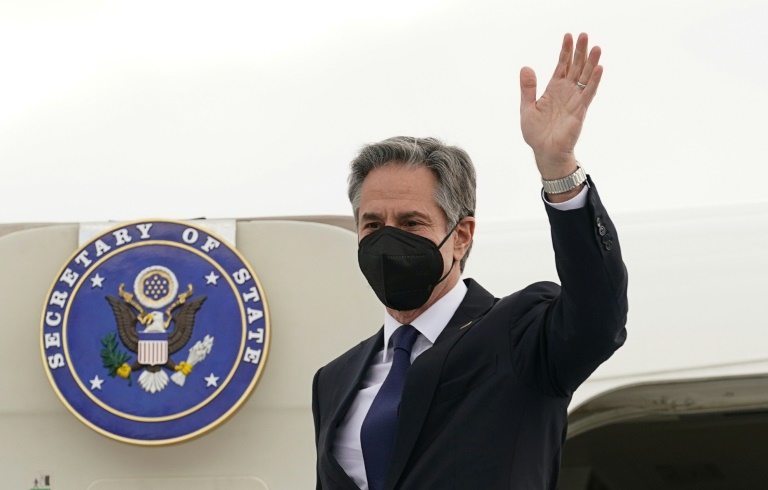
Secretary of State Antony Blinken is set to announce the opening of a new embassy on the Pacific island state during a visit to nearby Fiji — 29 years after the United States downgraded its diplomatic presence in Honiara.

The move comes just a few months after riots in the island chain of 800,000 people in November when protesters tried to storm parliament and then went on a three-day rampage, torching much of the capital Honiara’s Chinatown.

The unrest was sparked by opposition to veteran Prime Minister Manasseh Sogavare and partly fuelled by poverty, unemployment and inter-island rivalries, but anti-China sentiment also played a role.

The United States closed its embassy in the Solomons Island capital in 1993 and is now represented by a consulate there, with an embassy in the Papua New Guinea capital of Port Moresby.

While in the Fijian city of Nadi, Blinken will hold a virtual meeting with leaders from around 18 Pacific island states as Washington seeks to up its diplomatic and security game in the region to blunt a push by China for a stronger presence of its own.

According to US officials, China has made a particular push to gain influence and a presence in a number of island countries in the region.

– Poverty, unemployment –

China said in December it would send police advisors and riot gear to the Solomon Islands as foreign peacekeepers began leaving the Pacific nation after being deployed during the deadly protests.

A subplot to November’s unrest was Sogavare’s efforts to forge closer ties with Beijing after abruptly breaking off the island’s long-time ties with Taiwan in 2019.

China baulks at any official exchanges between other countries and self-ruled Taiwan, which it sees as its own territory awaiting reunification.

The Solomons government said in December it had accepted Beijing’s offer of six “liaison officers” to train its police force and equipment including shields, helmets, batons and other “non-lethal” gear.

In recent years China has stepped up pressure to isolate Taiwan internationally, getting eight nations to switch diplomatic recognition from Taipei to Beijing since 2016.

A  diplomat at the US embassy in Port Moresby said the reopening of the mission in the Solomons Islands would build on US efforts to place more diplomatic staff throughout the region.

The aim was to “further engage with our Pacific neighbors, connect US programs and resources with needs on the ground, and build people-to-people ties,” the diplomat said.

The US government had provided vaccines and other help to Solomon Islands in combating the COVID-19 pandemic, the diplomat said. 

The US Congress and the White House will need to approve the embassy proposal.

US warns Russia could attack Ukraine 'any day'

The United States dramatically raised the alarm Friday over Ukraine, warning that a Russian invasion starting with civilians caught under aerial bombing could begin in days and telling US citizens to leave within 48 hours.

An attack by the more than 100,000 Russian troops currently massed next to Ukraine “could occur any day now,” White House National Security Advisor Jake Sullivan told reporters in Washington.

Dismissing speculation that the Kremlin would never trigger the crisis while the Beijing Olympics were still underway in close Russian ally China, Sullivan said such an attack “could occur” before the Games end on February 20.

The scenario of an imminent attack is “a very, very distinct possibility,” Sullivan said.

While stressing that it was not yet known whether President Vladimir Putin had taken a decision, saying “we can’t predict the exact determination,” Sullivan made clear that the United States was bracing for the worst, including a “rapid assault” on the capital Kyiv.

“If a Russian attack on Ukraine proceeds, it is likely to begin with aerial bombing and missile attacks that could obviously kill civilians,” he said. “Any American in Ukraine should leave as soon as possible, and in any event in the next 24 to 48 hours.”

Sullivan spoke shortly after President Joe Biden and six European leaders, the heads of NATO and the European Union held talks on the worst crisis between the West and Russia since the end of the Cold War.

A US official said Biden would speak with Putin on Saturday, while the French government said that President Emmanuel Macron would also be calling the Russian leader on Saturday.

Underlining the bleak outlook, a string of countries joined the exodus of diplomats and citizens from Ukraine, while oil prices surged and US equities tumbled.

– Western, NATO unity –

Sullivan repeated warnings that Russia risks severe Western sanctions and said that NATO, which Putin wants to push back from eastern Europe, is now “more cohesive, more purposeful, more dynamic than any time in recent memory.”

The Pentagon announced it was sending 3,000 more troops to bolster ally Poland.

And US Secretary of State Antony Blinken told his Ukrainian counterpart Dmytro Kuleba in a phone call “that Ukraine continues to have the United States’ enduring and steadfast support for its sovereignty and territorial integrity,” the State Department said.

Following the earlier group phone call between US and European leaders, German Chancellor Olaf Scholz’s spokesman said “the aim is to prevent a war in Europe.” But if Moscow fails to pull back, “the allies are determined to jointly take swift and deep sanctions against Russia.”

These sanctions would target the financial and energy sectors, EU chief Ursula von der Leyen said.

Sullivan spoke to der Leyen’s chief of staff Bjoern Seibert by video call on Friday to coordinate “the details of a potential transatlantic response, including both financial sanctions and export controls,” according to a White House statement.

– Russia surrounding Ukraine –

Russian naval forces and troops, including units brought in from all over the vast country, now surround Ukraine to the south, east and north. 

Russia, which denies any plan to attack Ukraine, already controls the Crimea territory seized in 2014 and supports separatist forces controlling Ukraine’s Donbass region in the east.

The Kremlin says its goal is to get NATO to agree to never give Ukraine membership and also to withdraw from eastern European countries already in the alliance, effectively carving Europe into Cold War-style spheres of influence. The United States and its European allies reject the demands, insisting that NATO poses no threat to Russia.

Adding to tensions, large-scale Russian military drills were underway Friday with authoritarian ally Belarus, which lies just north of Kyiv and also borders the European Union.

Russia’s defense ministry said Friday it was also holding military exercises near Ukraine’s border in the Black Sea. 

According to the head of Norway’s military intelligence service, Russia is operationally ready to conduct a wide range of military operations in Ukraine and the Kremlin just needs to make the call.

The top US general and his Russian counterpart talked Friday by phone, the Pentagon said, giving no details of the discussion.

And the European Union said its non-essential staff should leave Ukraine, while Israel said families of its diplomats were being pulled out. Norway joined Britain in telling its nationals to leave.

– Shuttle diplomacy –

The growing alarm comes despite efforts at shuttle diplomacy by European officials.

Macron visited both Moscow and Kyiv earlier this week and Scholz is expected to do the same in the coming days. Scholz will also hold his first in-person meeting with Putin in Moscow.

British Defense Secretary Ben Wallace was in Moscow Friday for rare talks with his Russian counterpart Sergei Shoigu. 

He was accompanied by the UK’s Chief of Defense Staff Tony Radakin, and the pair will also meet Russia’s top army general Valery Gerasimov. 

Wallace’s visit comes a day after Britain’s Foreign Secretary Liz Truss met with her Russian counterpart Sergei Lavrov in Moscow for talks ending in public recriminations. 

There was also disappointment after a separate meeting between Russian and Ukrainian negotiators, under the mediation of Germany and France. Sources described the meeting as “difficult.”

burs-sms/md/dw

Carrie Johnson: Tory activist faces unwelcome limelight

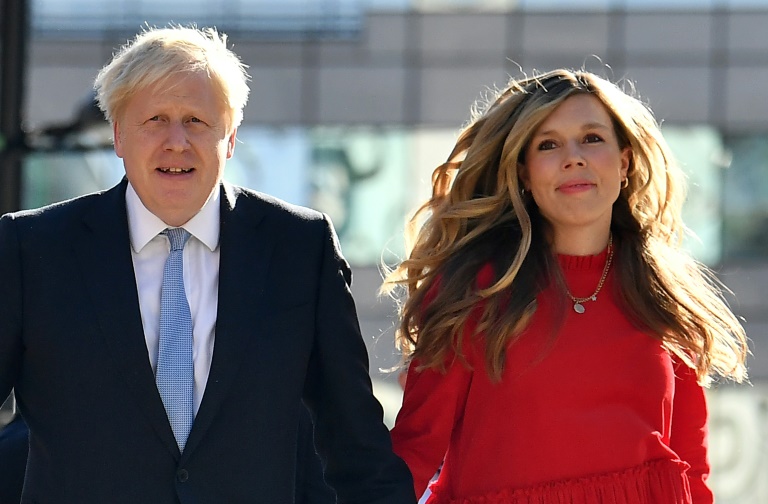
Carrie Johnson, the wife of Britain’s prime minister, is an experienced political operative in her own right who has been thrust from the shadows as allegations of sleaze and scandal envelop Downing Street.

The 33-year-old former head of communications for the Conservative party has kept a low public profile since Boris Johnson entered Number 10 in 2019.

She has given no interviews, and only appeared by Johnson’s side at marquee events such as international summits and last October’s annual Tory conference.

But she has increasingly been accused of holding too much sway over issues close to her heart — especially the environment and animal rights — and over staff appointments.

Much of the offensive has come from the prime minister’s embittered former chief aide, Dominic Cummings, and has taken on new prominence in a new biography by Michael Ashcroft.

“My book shows Carrie’s behaviour is preventing the prime minister leading Britain as effectively as the voters deserve,” Ashcroft, a former deputy chairman of the Conservatives, wrote last weekend.

Supporters say the charges smack of sexism, and political opponents of Johnson say he and not his wife must be held to account.

After the first instalment of Ashcroft’s book was published in the Mail on Sunday newspaper, her spokeswoman dismissed the claims as part of a smear campaign against the couple by “bitter ex-officials”. 

Carrie Johnson, she said, was a “private individual who plays no role in government”.

– Off-limits? –

Most recently, the Johnsons have been accused of attending, or even hosting, some of the lockdown-breaking parties under police investigation at Downing Street. 

Both are expected to face questioning from London’s Metropolitan Police force.

That comes on top of a Caribbean holiday and the redecoration of the Downing Street flat funded by rich backers, along with a controversy about the evacuation from Kabul of pets sheltered by a British former soldier being allegedly prioritised over people.

“The Mustique holiday, Downing Street wallpaper, Afghan dogs, at least one Downing Street party… Carrie Johnson’s name keeps coming up in relation to all these, sometimes unfairly, sometimes not,” Paul Goodman, editor at the influential blog ConservativeHome, has noted.

Others have rallied to her defence, including Health Secretary Sajid Javid, who employed her as a special adviser in 2016. He branded her treatment unfair, “undignified” and rooted in sexism.

“I think the partners of politicians should be off-limits,” he said.

However, Cummings has claimed she wanted to “get rid” of him from Number 10, and alleged she tried “to change a whole bunch of different appointments”.

Ash Sarker, from the left-wing outlet Novara Media, agreed some of the criticisms were “motivated by misogyny”.

“But she is also a political operator in her own right… and we don’t have the normal methods of holding her accountable,” she told Sky News.

– Wed in secret –

Born Carrie Symonds, she is the daughter of the co-founder of The Independent newspaper and a former lawyer. She grew up in southwest London and attended a private school before studying theatre and art history at university.

She began working for the Conservatives in 2010, in marketing, and first came into contact with Johnson working on his 2012 re-election campaign for London mayor.

She then held various jobs in politics and at Tory party headquarters, including director of communications, but left that role in 2018 after a reported dispute over her expenses.

She joined the marketing team at conservation group Oceana, before moving to a role at The Aspinall Foundation, an animal welfare charity.

The Johnsons reportedly began dating in 2018 when the prime minister, now 57, was still married to his second wife.

When he succeeded Theresa May in July 2019, Carrie Symonds looked on with staff as he became the first British prime minister since Edward Heath in 1970 to take office without a spouse by his side.

She initially remained living elsewhere.

But the couple announced their engagement in early 2020, once his divorce was finalised, and wed in a “secret ceremony” in May last year.

In between, the couple’s first child together, Boris Johnson’s sixth, was born in April 2020, soon after he recovered from Covid.

The couple named him Wilfred. A baby girl called Romy followed in December. 

The Johnsons own a rescue dog, called Dilyn, who also stands accused of varying degrees of misbehaviour in Downing Street.

Mexico on track for one of deadliest years for media

Mexico is on course for one of its deadliest years yet for the press, with five journalists murdered already in 2022, prompting calls for authorities to end a culture of impunity.

Reporters in the Latin American country are killed “because it’s cheap,” Juan Vazquez, spokesman for media rights group Article 19, told AFP.

“Those who run the greatest risk are the journalists with their pen, computer, recorder or microphone. In the end those who run the least risk are those who pull the trigger,” he said.

The latest victim was Heber Lopez Vazquez, the 39-year-old manager of news website Noticias Web in the southern state of Oaxaca who was shot dead on Thursday.

Two suspects were arrested as they tried to flee the scene of the crime, according to prosecutors.

Lopez had previously received threats that he believed were linked to allegations of corruption against a local mayor, said Balbina Flores, representative for media watchdog Reporters Without Borders (RSF).

Even so, he was not part of a government program providing protection for around 500 journalists.

His murder puts Mexico on course to surpass the toll of seven journalists killed in 2021.

“The first six weeks of 2022 have been the deadliest for the Mexican press in over a decade,” said Jan-Albert Hootsen, representative of the Committee to Protect Journalists.

The media rights group said it “urges Mexican authorities to immediately and transparently investigate all murders and bring the perpetrators to justice.”

Mexican authorities said Wednesday that three men had been arrested over the murder of journalist Lourdes Maldonado last month in Tijuana.

Her death came in the wake of the shooting of photographer Margarito Martinez in the same northwestern border city.

Roberto Toledo, who worked with a news site in the central state of Michoacan, as well as Jose Luis Gamboa, a journalist and social media activist in eastern Veracruz state, were also killed in January.

– ‘Zero impunity’

Around 150 journalists have been murdered since 2000 in Mexico, and only a fraction of the crimes have resulted in convictions, according to RSF.

Around 100 of them were killed under presidents Felipe Calderon (2006-2012) and Enrique Pena Nieto (2012-2018), whose terms were marked by a bloody war on drug trafficking.

Another 29 murders have been registered since President Andres Manuel Lopez Obrador took office in 2018 championing a “hugs not bullets” strategy to tackle violent crime at its roots by fighting poverty and inequality.

“This six-year term (of Lopez Obrador) will be classified as one of the bloodiest” for the press, Flores predicted.

Mexico’s president on Friday promised “zero impunity” for the latest murder.

His critics argue that his outspoken attacks against a media that he calls “mercenary” and accuses of serving the interests of his opponents only add to the difficulties facing journalists.

The fact that more than 90 percent of the murders of media workers go unpunished in Mexico is a major driver of the violence, according to activists.

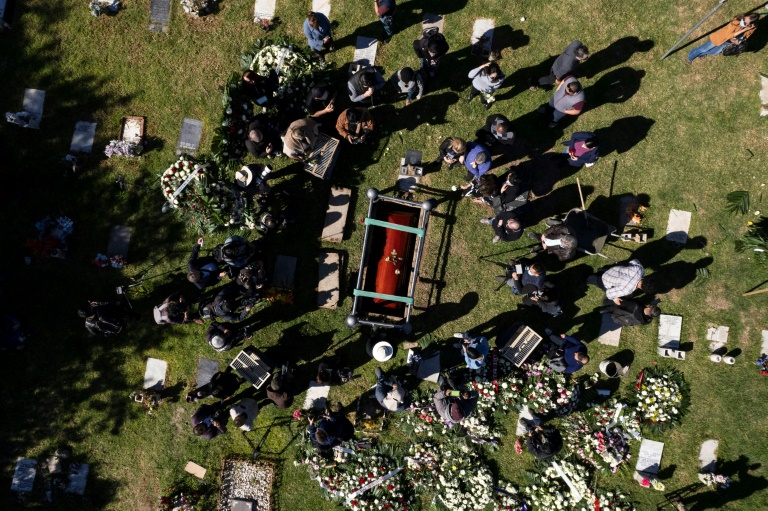
If the authorities had taken tougher action to prevent such crimes, relatives would not be burying more victims, said Vazquez.

Mexico was failing to comply with its obligations in terms of protection and prevention of deadly attacks against journalists, he said.

This country of 126 million people plagued by drug cartel-related violence, ranks 143rd out of 180 nations in RSF’s World Press Freedom Index.

Most of the crimes against Mexican media involve small outlets whose journalists are “very vulnerable” and sometimes unaware of the protection mechanisms available to them, Flores said.

Given the poor pay this kind of work offers, they often combine journalism with other jobs.

This means authorities can sometimes be quick to separate the crimes from the victims’ media activities and not to investigate them as violations of press freedom.

Journalism is a “very precarious” way of eking out a living in Mexico, said Flores.

Canada truckers defy order to clear key bridge

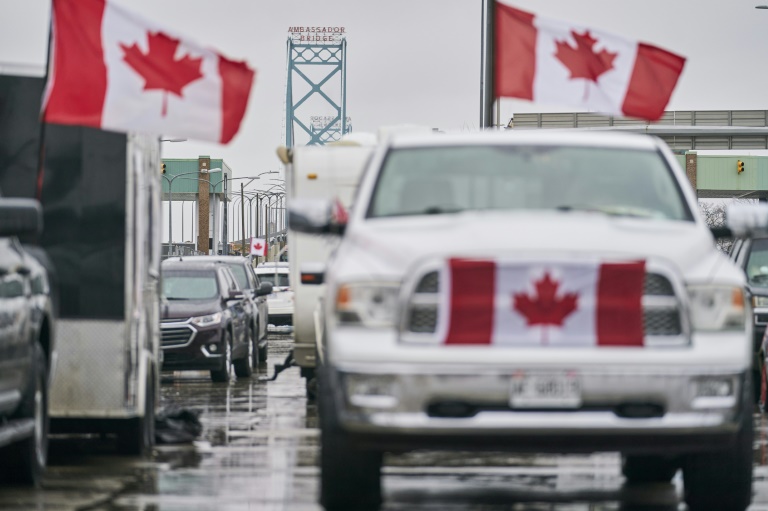
Truckers snarling a key bridge between Canada and the United States in protest at Covid rules defied a judge’s order to leave Friday night, with the crowd getting even bigger two weeks into the snowballing protest movement.

The days-long blockade of the Ambassador Bridge that connects Windsor, Ontario and the US city of Detroit, has paralyzed a key North American trade route, piling pressure on Prime Minister Justin Trudeau to resolve the crisis.

A Canadian judge granted an injunction ordering the protesters — estimated to number a few hundred, along with several dozen trucks — to leave the bridge by 7:00 pm (0000 GMT), according to Windsor mayor Drew Dilkens.

But as the deadline passed, more protesters joined in to block the suspension bridge. Others piled into the capital Ottawa where the demonstration turned festive.

Authorities are under increasing pressure to crack down on the demonstrations that have paralyzed Ottawa, triggering a state of emergency in Ontario province and copycat demonstrations as far away as France and New Zealand.

Upping the stakes, President Joe Biden Friday reiterated his “concern” to Trudeau, telling him the blockade of the Ambassador Bridge and two other border crossings was having serious effects on US firms.

The vital Windsor-Detroit span is used daily by more than 40,000 people, along with trucks carrying $323 million worth of goods on average — about one-quarter of all Canada-US trade.

Addressing reporters in Ottawa, Trudeau said all options were “on the table” for ending the protests, though he stressed that calling in the military was a distant final resort, and “something to avoid having to do at all costs.”

“This unlawful activity has to end and it will end,” the prime minister said, adding that it was up to police to “enforce the law and protect public order.”

The Canadian capital has been clogged with hundreds of big rigs for two weeks. The self-styled “Freedom Convoy” began in the country’s west in anger at requirements that truckers either be vaccinated, or test and isolate, when crossing the US-Canada border.

But the movement has morphed into a broader protest against pandemic health rules and Trudeau’s government.

The days-long blockades have already had significant economic impact, with automakers forced to cut back production on both sides of the border, triggering fears it could undermine Canada’s recovery from the pandemic.

In his call with Trudeau, Biden said the movement was impacting US companies and workers with “slowdowns in production, shortened work hours, and plant closures.”

– State of emergency –

The premier of Ontario province — the epicenter of the protests — announced a state of emergency on Friday, threatening steep fines of up to Can$100,000 ($80,000) and jail unless protesters end their “illegal occupation.”

“To the people of Ottawa under siege, I say we will ensure you’re able to resume life and business as soon as possible,” said Ontario premier Doug Ford, who like Trudeau has been accused of inaction over the protests.

The Ontario emergency came as a coalition of protesters — an estimated 1,800 vehicles according to a police source — were closing in on Paris after setting off in convoy from across France.

Defying police warnings, the French protesters included opponents of Covid vaccination, but also people angry at fast-rising energy prices — in an echo of the “yellow vest” grievances that sparked widespread protests in 2018 and 2019.

Protesters have likewise set up a makeshift camp outside New Zealand’s parliament, scene of violent clashes earlier this week as police sought to clear anti-vaccine demonstrators.

– ‘Intimidation’ –

The Ontario premier acknowledged the “right to peacefully protest” and said he understood “frustrations have reached a boiling point for many Canadians.” 

But he warned: “This is no longer a protest.”

Ford accused the truckers of “targeting our lifeline for food, fuel and goods across our borders” while “trying to force a political agenda through disruption, intimidation, and chaos.”

“We’re in a critical situation worldwide economically… the last thing we need is an anchor around our neck,” he said. 

On Thursday evening, Ford’s government separately obtained a court order barring anyone from tapping the millions of dollars raised by the convoy through the fundraising platform GiveSendGo. 

The protesters had switched their fundraising efforts to the platform after GoFundMe terminated their original campaign, claiming it violated terms of service that “prohibit user content that reflects or promotes behavior in support of violence.” 

Trudeau said Friday: “Canadian banks are monitoring financial activity very closely and taking action as necessary.” 

amc-ec/dw

Paris braces for Canada-style convoys against Covid rules

Thousands of people drove towards Paris on Friday in convoys from across France, with many hoping to blockade the capital to protest against Covid vaccination rules and other restrictions despite police warnings to back off.

Inspired by Canadian truckers paralysing border traffic with the United States, the French protesters set off from Bayonne, Perpignan, Lyon, Lille, Strasbourg and elsewhere with the aim of converging on Paris by Friday evening.

A police source said around 1,800 vehicles were estimated to be closing in on the capital.

The demonstrators include anti-Covid vaccination activists, but also people angry at fast-rising energy prices.

They are demanding a withdrawal of the government’s vaccine pass, which is required for access to many public spaces, and more help with their energy bills.

“People need to see us, and to listen to the people who just want to live a normal and free life,” said Lisa, a 62-year-old retired health worker who joined a convoy of more than 1,000 vehicles leaving Chateaubourg in the western Brittany region early Friday.

Like other protesters, Lisa has been active in the “yellow vest” movement that erupted over a fuel tax hike before becoming a platform for other complaints against President Emmanuel Macron.

Just two months ahead of presidential elections and with the government desperate to avoid violent scenes in the capital, Macron said Friday he understood the “fatigue” linked to the Covid-19 pandemic.

“This fatigue also leads to anger. I understand it and I respect it. But I call for the utmost calm,” he told the Ouest-France newspaper. 

– ‘United against the government’ –

The yellow vests often clashed with police, but Lisa said she hoped the protests on Friday would go off peacefully. “It would really annoy me if things got out of hand,” she told AFP.

After spending a cold night in a parking lot, the drivers in Chateaubourg set off in a long single file of trucks, passenger cars and campers as sympathetic passers-by waved from bridges.

A contingent from Brittany arrived late Friday in the carpark of a shopping centre outside Chartres, 100 kilometres (60 miles) southwest of Paris.

“We’re citizens, we have families, we work and we’re all united against the government,” said Sarah, a 40-year-old tattoo artist from the northern city of Lens. 

Paris police banned the gathering because of feared “public order disturbances” and said protesters who tried to block roads would face fines or arrest.

“We must be very firm about this,” Prime Minister Jean Castex said.

Police showed off their anti-blockage arsenal on Twitter, publishing photographs of loader tractors for the removal of barricades as well trucks equipped with cranes or water cannon.

The protesters meanwhile shared information about police deployments around Paris.

“It’s important that we don’t interfere with other people on the roads,” said one activist, Robin, on his way from Illkirch-Graffenstaden in the eastern Alsace region. “That way we’ll keep the population on our side, like they did in Canada.”

– ‘You feel less alone’ –

Many demonstrators are planning to stay in Paris overnight, and then join one of the regular Saturday protests against the government’s vaccine pass.

Some then want to travel on to Brussels for a “European convergence” of protesters planned there for Monday.

Phil, a 58-year-old on his way by truck from Brittany, said his refusal to get vaccinated had created “upheaval” in his family and work relations.

“When you join a demonstration you feel less alone,” he told AFP.

The government has expressed some sympathy for the protesters, with spokesman Gabriel Attal attributing their anger to “fatigue and weariness” after long-lasting Covid restrictions.

The government also announced Friday a further easing of Covid rules.

burs-jh/js/bsp/gw

Venezuela says eight civilians killed by armed groups

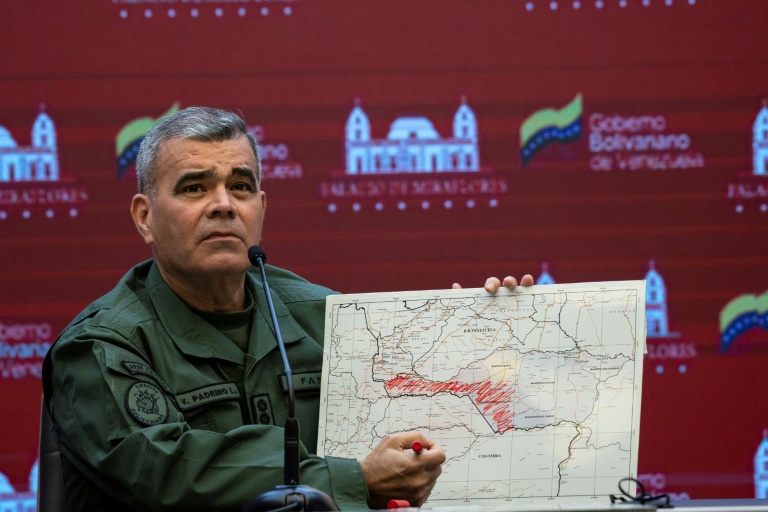
Eight civilians were killed by armed groups in recent days in Venezuela’s restive southwest region that borders Colombia, the country’s defense minister said Friday.

Vladimir Padrino also said that nine “terrorists” had been killed and 56 captured in military operations in Apure state without the loss of “one single” soldier.

“Unfortunately, last week we received news of eight civilian deaths,” Padrino said in a press conference.

He also played a video denouncing the use of “improvised” land mines by armed groups, but did not say if they were the cause of the civilian deaths.

The military operations were aimed at expelling Colombian gangs the government describes as “armed drug-trafficking terrorists.”

Left-wing Colombian rebels freely cross the porous 2,000-kilometer border between the two countries.

Bogota accuses Venezuela President Nicolas Maduro of providing shelter for dissidents of the disbanded Revolutionary Armed Forces of Colombia (FARC) and militants belonging to the National Liberation Army (ELN).

The two groups are among numerous armed militants battling for control of drug-trafficking routes through Colombia.

Caracas denies the accusations.

Padrino said authorities seized 1,200 kilograms of cocaine and 800 kilograms of marihuana, dismantled 16 camps and confiscated three airplanes and numerous assault rifles in the operations.

In March 2021, 16 soldiers died in clashes between the Venezuelan military and Colombian rebels that also left thousands of civilians displaced.

Javier Tarazona, a Venezuelan activist from an NGO that reports on such clashes and accuses the government of links to FARC dissidents, has been held since July 2021.

On Thursday, Colombian authorities said four people traveling in a truck close to the border were killed by attackers on motorcycles.

The victims were themselves armed but seemingly did not have time to react to the attack. Authorities are yet to determine who were the perpetrators and victims of the attack.

Close Bitnami banner
Bitnami