World

Why has a Chinese city's lockdown sent aluminium prices surging?

The Covid lockdown this week of a relatively unknown Chinese city sent global prices of aluminium rocketing to a 14-year high.

Why did the outbreak in Baise spark fears around the world about the key metal? 

– Where is Baise? –

Located near the border with Vietnam, Baise is nicknamed the “aluminium capital of southern China”.

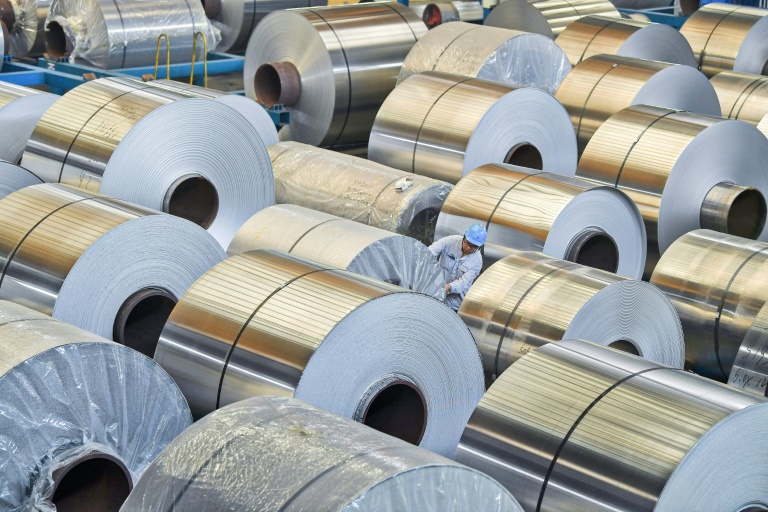
Home to around 3.5 million people, Baise is a hub for aluminium mining and production.

It produces about 2.2 million tonnes of the commodity per year — more than 80 percent of the output in the resource-rich Guangxi region.

Guangxi is China’s main alumina-exporting region, shipping out around 500,000 tonnes of the aluminium component per month.

China is the world’s biggest producer of aluminium, a crucial component in major industries including automobiles, construction and consumer goods.

– Why was Baise locked down? –

At just under 190 cases, the Baise coronavirus outbreak is tiny compared with caseloads in other parts of the world.

China, however, has a zero Covid strategy, using strict, targeted lockdowns, travel restrictions and mass testing to eliminate infections.

Baise was locked down Monday, leaving most of its residents under home confinement and others unable to leave rural counties and townships under the city’s jurisdiction.

The national Covid strategy has helped maintain some economic growth during the pandemic, but its enforcement has caused frequent disruptions at key manufacturing and shipping hubs in recent months.

– How did it impact aluminium? –

Baise’s local industry association said Tuesday that while aluminium production was largely at normal levels, the transportation of ingots and raw materials was seriously impacted by travel restrictions during the lockdown.

That in turn sparked fears about supply that cascaded through China and then around the world.

“The sudden outbreak in our city has exacerbated market expectations of hindered logistics flows, as well as expectations of phased supply tightening caused by an output drop,” the association said.

A major industrial park in Baise containing several factories has been sealed, affecting the movement of workers, raw materials and aluminium ingots, it added. 

On Wednesday, some aluminium smelters in southwest China resumed production, monitor Shanghai Metals Market (SMM) reported.

But some refineries of the component alumina in Guangxi have stopped production because of the outbreak, it said.

Huayin Aluminium, a major smelter in Baise, slashed production capacity by about 1.2 million tonnes owing to transportation blockages, according to Chinese commodity research firm Antaike. 

– Was Baise the only driver of the price surge? –

The global aluminium price surge was sparked by the Baise lockdown but other major factors were already at play too, analysts said.

The timing of the lockdown also played a part.

China’s domestic aluminium shortage had already been exacerbated by the Lunar New Year holidays, during which most factories nationwide ground to a halt or reduced output.

The break was followed by the Baise lockdown, meaning inventories could not be replenished normally.

Prices of aluminium were already expected to rise after the holidays, which concluded Monday, because of low domestic inventories and solid demand from manufacturers, according to the SMM.

Furthermore, Antaike said Tuesday that alumina industries in three other provinces have also reduced production.

– What about the rest of the world? –

The global aluminium market is already facing a large production deficit this year, with demand outstripping supply as the world economy recovers from the pandemic.

Further, aluminium production is linked to the stability of other supplies.

Analysts said the ongoing Russia-Ukraine crisis had caused widespread fear that Europe’s gas supply from major producer Russia will be hit if the situation escalates.

US President Joe Biden made a categorical vow Monday at a meeting with Germany’s Chancellor Olaf Scholz that the massive Nord Stream 2 gas pipeline from Russia to Europe will “end” if Moscow invades Ukraine.

“Aluminium production requires significant amounts of energy and gas is the primary fuel source. Fears that Nord Stream 2 could be halted are pushing prices higher,” City Index analyst Fiona Cincotta told AFP.

“Secondly, Russia is a key producer of aluminium… Threats of sanction from the West (are) also driving up prices.”

Fresh hopes for landmark treaty to rescue ocean life

World leaders are under pressure to conclude years of talks on an agreement to protect open oceans that help sustain life on Earth, cover almost half the planet and currently fall under no country’s laws.

As plans to protect and restore ecosystems across the world are mainstreamed, conservationists hope an oceans summit in France this week will give fresh momentum to efforts to finalise a legally binding UN treaty on the high seas.

The issue could not be more urgent, they say. 

Oceans produce half the oxygen we breathe, regulate the weather and provide humanity’s single largest source of protein.

But they are being pushed to the brink by human activities. 

Carbon dioxide emissions and global warming drive devastating heatwaves and acidification, while humans have fished some marine species to the edge of extinction and used the world’s waters as a garbage dump.  

“The oceans as a whole are becoming warmer, the salinity levels are increasing. There’s less oxygen for marine life,” said Liz Karan, an expert with The Pew Charitable Trusts. 

Even if a new treaty cannot solve all these problems, she said the accord was “more important than ever”.

“What it can do is to ensure that there are refuges in place, great protected areas in place, that can give marine species a chance to breathe, an opportunity to survive and adapt to climate change.”

– ‘Greatest opportunity’ –

Today, a patchwork of agreements and regulatory bodies govern shipping, fishing, and mineral extraction, while the UN Convention on the Law of the Sea, negotiated in the 1970s, lays out rules for how far a nation’s zone of influence extends beyond its shores. 

But despite two decades of consultations and negotiations, there is still no treaty protecting international waters — those marine areas beyond national jurisdiction, accounting for about two-thirds of the world’s oceans. 

A new round of UN talks in March will aim to conclude the agreement. 

“We sometimes say this is the most important environmental treaty that most people haven’t even heard of,” said Peggy Kalas, director of the High Seas Alliance, which brings together some 40 NGOs and the International Union for Conservation of Nature (IUCN). 

The issue is finally gathering wider attention, she said, adding that meetings like the One Ocean Summit being held this week in the north-western French port city of Brest can help add to the pressure on governments to reach an agreement. 

“It is really the greatest opportunity in a generation to conserve ocean life and diversity on a global scale,” she told AFP.

– Shared responsibility –

Several issues divide nations on how best to manage the world’s vast expanse of open ocean. 

Among the chief issues up for debate are the creation of marine protected areas and the scope for curbing large-scale commercial fishing.  

Another contentious question is who gets a share of the benefits from the exploitation of what are known as “marine genetic resources”.     

Poorer countries fear they will be sidelined as wealthier nations scour the seas for the next wonder ingredients for the pharmaceutical, chemical or cosmetic industries, and lock up the spoils in trademarks and patents. 

“They want any financial gain originating from the resources of the high seas to fall under a benefit-sharing regime,” said Andre Abreu, of the Tara Ocean Foundation.

An indication of the continued wrangling is the sheer number of sections in the latest treaty draft from 2019 still in tentative square brackets. 

These include several overarching statements for the high seas, like the reference to the “polluter pays principle” and the “common heritage of mankind”, a designation that currently only applies to the world’s sea beds.   

Other issues on the table include how to set up environmental impact assessments, enforcement and technology transfer.

The concept of marine protected areas has gathered significant international support, with more than 75 countries backing a plan to create conservation areas covering 30 percent of the world’s land and oceans by 2030.

But the High Seas Alliance said a key issue will be if the treaty allows individual states to be able to veto the creation of a marine protected area. 

“We’re at the stage where we really need leadership from the highest level,” Kalas said.    

“This is urgent, every day and year it is delayed, there is biodiversity loss. We need to conclude these negotiations.”

Australian PM condemned for 'shocking' response to sexual abuse claims

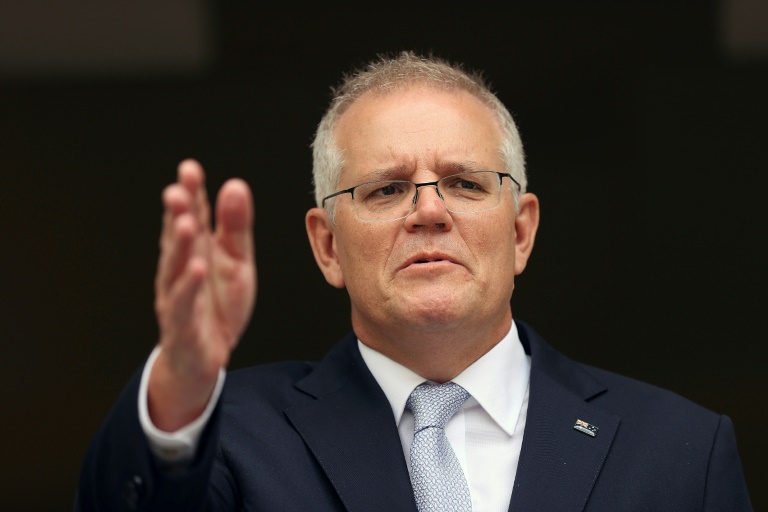
Two prominent advocates for sexual abuse survivors pilloried Australia’s prime minister Wednesday, decrying “weasel words” and a response to widespread abuse that had not “measured up”.

Former government aide Brittany Higgins — whose allegation she was raped by a colleague, in parliament, sparked national protests — said “too little has changed” since she went public a year ago.

In a widely watched speech, Higgins was sorrowful and withering about the actions of a conservative government she once served.

Higgins said Prime Minister Scott Morrison’s response, which invoked his own daughters and wife, had been “shocking and at times, admittedly, a bit offensive”.

“I didn’t want his sympathy as a father. I wanted him to use his power as prime minister,” she said. 

“But his words wouldn’t matter if his actions had measured up.”

Higgins said the national conversation about ending abuse, harassment and assault had not progressed beyond “trading off offensive, tone-deaf statements for a convoluted mix of appeasing weasel-words”.

Higgins was joined in her address by child sexual abuse survivor Grace Tame, the 2021 “Australian of the Year”, who also took aim at the prime minister’s leadership over the past year.

“It rots from the top,” Tame said.

“Unless our leaders take full responsibility for their own failings, abuse culture will continue to thrive inside parliament, setting a corrupt standard for the rest of the nation.”

The plight of both women had fuelled national debate and soul searching in Australia, as well as multiple government investigations.

One of those, the 450-page Jenkins Review, found that one in three people currently working in parliament and other federal government workplaces have experienced sexual harassment while there.

– Political pressure –

Tame piled further pressure on the government during her speech by alleging she was asked not to publicly criticise the prime minister.

She recalled a “threatening phone call from a senior member of a government-funded organisation asking for my word that I wouldn’t say anything damning about the prime minister” at a recent award ceremony.

Tame said the caller told her the prime minister “would have a fear… with an election coming soon”.

Australia’s next federal election must be held by mid-May.

Minister for families Anne Ruston said the government was looking into Tame’s claim, adding that, if true, such a warning would be “completely unacceptable”. 

Morrison did not attend Higgins and Tame’s address, citing other commitments, but several members of his government including Ruston were in the audience.

Speaking in parliament later Wednesday, Morrison was asked about the progress his government had made on the issue of women’s safety.

He cited an upcoming 10-year plan for women’s safety, among other measures.

Higgins said the plan’s “aims are so lofty and vague that it’s impossible to disagree with and equally difficult to examine”.

Tame called for more funding for consent training in schools. She said between 2020 and 2022, the government “planned to spend 11 cents per student per year on prevention education”.

Both women ruled out any plans to run for political office.

Somaliland minister hails 'milestone' visit to Taiwan

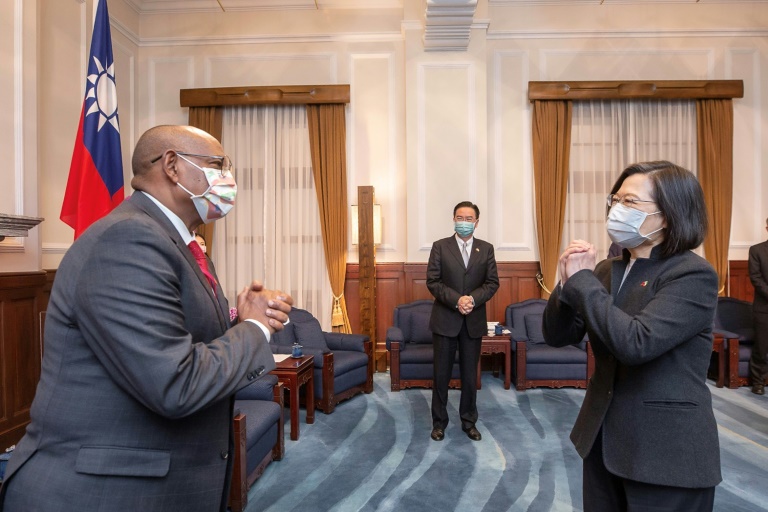
Taiwan’s push to grow its presence on the world stage as China poaches its diplomatic allies saw Taipei roll out the red carpet on Wednesday to a new friend in a similar position — Somaliland.

Taiwan and Somaliland are both thriving, self-run democracies that remain mostly unrecognised by the wider world. 

Finding common ground in their peculiar and isolated international status, the two have forged strong ties since swapping de facto embassies in 2020 — moves that sparked anger from both China and Somalia.

On Wednesday Somaliland foreign minister Essa Kayd Mohamoud described ties with Taiwan as “a special and historical relationship between two champions of democracies in Africa and Asia” during his government’s first cabinet-level visit.

“This historic visit marks an important milestone in the strong and cordial relationship between our two countries,” he said while meeting Taiwan’s President Tsai Ing-wen. 

“All coercive or threatening measures to deny such collaboration between international partners… do little to promote the peace and security that the region and the world require.”

Somaliland declared independence from Somalia during the 1991 civil war. 

Although the move has remained unrecognised by the international community, the territory has thrived as a comparative beacon of stability while Somalia has been racked by decades of political violence. 

Somalia blasted the swapping of offices between Taiwan and Somaliland as a “reckless attempt” to infringe on its sovereignty, while Beijing accused Taipei of separatism and “acting with desperation.”

China views Taiwan as its own territory and has vowed to one day re-seize it, by force if needed.

Asked to comment on Somaliland’s visit Wednesday, Chinese foreign ministry spokesman Zhao Lijian said Taiwan was “trying to seek separatism but also fanning flames to undermine other countries’ independence and unity”.

Beijing’s sabre-rattling towards Taiwan has increased markedly under President Xi Jinping.

The two sides have for decades been engaged in a diplomatic tug-of-war trying to woo the other’s allies with financial and other incentives.

Only 14 countries now diplomatically recognise Taiwan over China, after Nicaragua became the latest to switch sides in December.

However some nations maintain embassy equivalent trade offices in Taipei, and Taiwan has been increasingly embraced on the world stage by many western powers in response to Beijing’s more hostile rhetoric.

'My work is not done': jailed Duterte critic runs for Senate

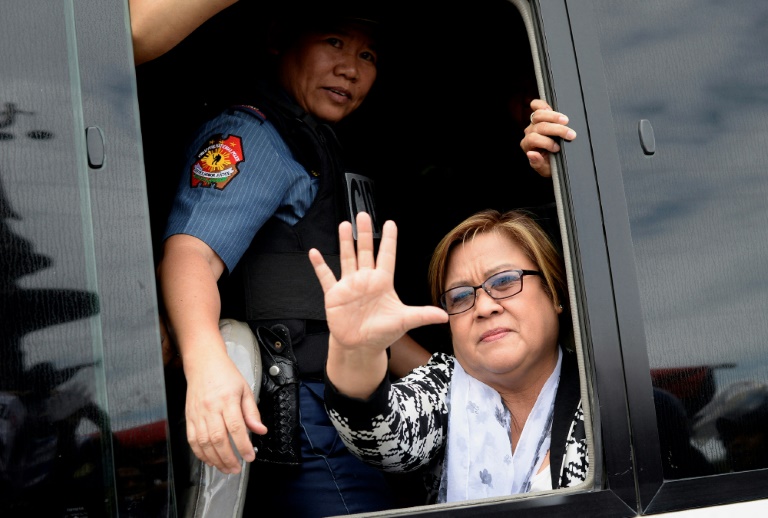
From behind bars, Philippine senator and human rights campaigner Leila de Lima is running for re-election in an against-the-odds campaign that gives her the chance to once again “go after” President Rodrigo Duterte.

De Lima was one of the most vocal and powerful local critics of Duterte after he took power in 2016 and launched a deadly drug war — until he and his allies tried to stifle her. 

But despite being forced from the Senate and into a jail cell for the past five years on drug trafficking charges she and human rights groups call a mockery of justice, de Lima has not been “destroyed” as Duterte vowed.

Instead, the 62-year-old is running again for the Senate in May’s national elections, determined to continue her campaign against him.

“I am running because, to put it plainly, my work is not done,” she told AFP in handwritten notes on Senate stationery sent from Manila’s national police headquarters, where she is being held.

“I was jailed because I fought for truth and justice against tyranny and impunity. I was not wrong to do so and I will keep fighting to prove that what I have been fighting for is worth the sacrifice.”

Before her arrest on February 24, 2017, de Lima had spent a decade investigating “death squad” killings allegedly orchestrated by Duterte during his time as Davao City mayor and then in the early days of his presidency.

She conducted the probes while serving as the nation’s human rights commissioner, then from 2010 to 2015 as justice secretary in the Benigno Aquino administration that preceded Duterte’s rule.

De Lima won a Senate seat in 2016, becoming one of the few opposition voices as the populist enjoyed a landslide win.

But Duterte then accused her of running a drug trafficking ring with criminals inside the nation’s biggest prison while she was justice secretary.

The charges were “an act of vengeance” by Duterte to silence her and warn others not to oppose him, said de Lima, who is not allowed bail.

But de Lima hopes she will soon get justice.

Duterte, constitutionally barred from seeking re-election and facing an international probe into his drug war, will lose protection from criminal charges when he leaves office.

“Justice for me is the dismissal of my cases and the prosecution of Duterte and all those who knowingly fabricated and filed fake charges against me,” she said.

– ‘I’m stronger than I thought’ –

De Lima is being held in a compound for high-profile detainees, rather than one of the Philippines’ notoriously overcrowded jails.

Her relatively comfortable conditions give her access to outdoor space where she can exercise, tend a small garden and feed more than 10 stray cats.

She is allowed newspapers, has a collection of books given to her by friends, and a Bible that she reads in the evening.

But it is a solitary life. 

Before the pandemic she was allowed to see “almost anyone”, she said. Now, she is largely limited to brief visits from her two sons, lawyers, doctors, priests and selected staff.

De Lima, whose marriage was annulled, has not seen her teenage grandchildren in two years, nor her ailing 89-year-old mother in more than three years.

She still works, but with no access to a mobile phone or internet, she cannot participate in Senate debates and hearings.

Instead, she handwrites messages, letters and other documents that her aides pick up.

Routine keeps her sane.

“I learned not to entertain negative thoughts and instead think of my family and the people who believe in me and are fighting with me,” she said.

“I’m much stronger than I thought.”

– ‘Crimes against humanity’ –

Since her arrest, one of the three charges against her has been dismissed and two prosecution witnesses have died.

That her court cases have dragged on for so long is not unusual in the Philippines, where even minor cases take years to work their way through the creaky justice system.

Covid-19 has made the process even slower.

De Lima said she is optimistic that no matter who succeeds Duterte, she will be freed soon afterwards.

The next justice secretary “will not have the motivation to continue fabricating evidence against me,” she said.

And she said she had no regrets in seeking to shine a light on Duterte.

“A public official like him who has committed crimes against humanity should be brought to justice,” she said.

At least 6,225 people have died in anti-drug operations since July 2016, according to the latest official Philippine data. Rights groups say the number is in the tens of thousands.

De Lima said her run for a second Senate term is driven by a desire to “help salvage” human rights, democracy and rule of the law in the country — but also revenge.

“I also want to have the opportunity to go after Duterte and all those responsible for my fate, aside from making them accountable for the thousands of murders they have committed and the billions they have plundered,” she said.

But de Lima conceded winning one of the 12 Senate seats would be hard, and polls show she is unlikely to succeed. 

While she was allowed to record campaign videos in late December, she has to rely on proxies to attend rallies — and whatever radio and television advertising she can afford.

Yet she remains characteristically defiant.

“I draw strength from the truth of my innocence,” she said.

Hindu pride and Muslim fears overshadow key Indian poll

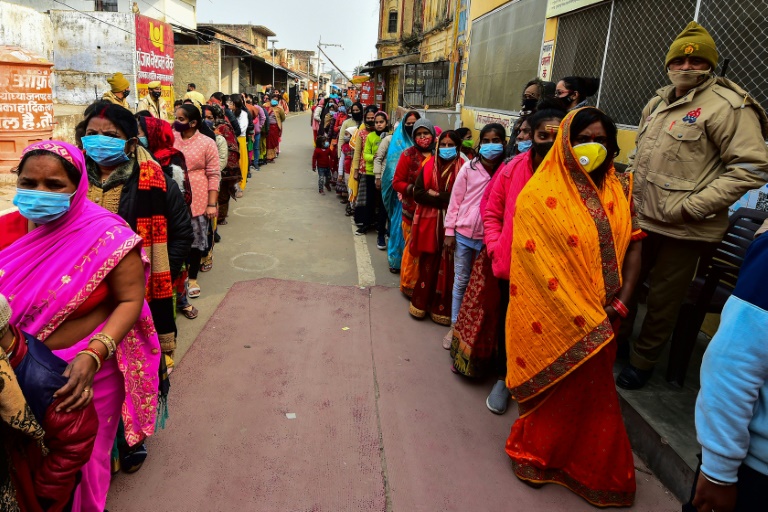
Hindu worshippers from across India gather each morning to pray in Ayodhya, near where a historic mosque was torn down three decades ago by religious zealots — triggering inter-faith riots that killed thousands of people.

The demolition of the centuries-old Babri Masjid shook the country’s secular foundations and paved the way for the rise of Hindu nationalism as its dominant political force.

Workers are now erecting a Hindu shrine where the mosque once stood, and Muslims fear a coming election in India’s most populous state could see such endeavours repeated elsewhere. 

“This is no ordinary temple,” Anil Mishra, a member of the trust overseeing the construction project, told AFP.

“This is a national temple that carries the emotions and feelings of the masses.”

In a cordoned off area nearby, a crowd of devotees chant mantras to Ram, one of the most worshipped deities in the Hindu pantheon, who is said to have been born at the site thousands of years ago. 

Prime Minister Narendra Modi’s Bharatiya Janata Party was instrumental in campaigning against the mosque, built by the Muslim Mughal dynasty which ruled much of the Indian subcontinent centuries ago.

Since its 1992 destruction, the party has enthusiastically backed the construction of a temple to Ram in its stead and the rejuvenation of several other religious sites.

It is now banking on efforts to style itself as the custodian of India’s majority faith to secure re-election in Uttar Pradesh when the state of more than 200 million people votes in marathon seven-week polls starting Thursday.

– ‘They have jailed young Muslims’ –

Political analysts say Uttar Pradesh is a petri dish for hardline Hindu governance and the blunt edge of the BJP’s efforts to refashion secular India into a Hindu nation.

Its chief minister, Yogi Adityanath, has been accused of encouraging vigilante violence against the state’s Muslim population and introducing discriminatory laws to marginalise the community.

The saffron-robed hardliner, 49, is known for his inflammatory religious rhetoric and is considered a possible successor to Modi, more than two decades his senior.

His administration has introduced a law to make interfaith marriages more difficult and closed Muslim-run slaughterhouses to protect cows — a sacred animal in Hinduism — while critics say it has turned a blind eye to mob violence directed at those accused of eating beef.

The city of Mathura, near the capital New Delhi, is popularly held to be the birthplace of Krishna — another senior god — and Hindu hardliners claim another Mughal-era mosque there was partially built over a temple to the deity.

Comments from senior BJP figures have foreshadowed another looming religious confrontation in the city.

“Grand temple construction ongoing in Ayodhya…(now) getting ready for Mathura,” Yogi’s deputy Keshav Prasad Maurya said last month. 

Muslims in the city are already angry after years of discrimination under the BJP and fearful of what another election victory could bring.

“They have jailed young Muslims for treason, are stopping us from eating what we want and have compounded our job losses by shutting meat shops and restaurants,” said resident Mohammad Yameen. 

– ‘National pride and self-respect’ –

Uttar Pradesh has struggled through India’s recent economic downturn, with widespread unemployment in the wake of the Covid-19 pandemic.

But the BJP has managed to galvanise support from legions of the Hindu faithful who have praised the party for delivering on its promise to build the Ayodhya temple.

“We are really happy and hope that it is a grand structure,” said Kusum Gupta, 59, a pilgrim who travelled more than 1,000 kilometres (600 miles) to visit the site.

Champat Rai, another member of the trust managing the temple work, said its construction was the culmination of “500 years of struggle” and rivalled India’s independence from the British in national significance.

The temple will be “a symbol of national pride and self-respect”, Rai told AFP, adding that the mosque’s demolition had symbolically cast off the historical shackles of Muslim rule during the Mughal dynasty.

“No other country in the world keeps the symbols of its slavery alive,” he said.

An army of construction workers have toiled around the clock since Modi laid the foundation stone at a ceremony 18 months ago.

One of them, 23-year-old Manikandan, told AFP it was the “luckiest day” of his life when he was asked to help build the temple.

“What else could you ask for as a Hindu?”

'My heart and body shake': Afghan women defy Taliban

One after the other, quickly, carefully, keeping their heads down, a group of Afghan women step into a small Kabul apartment block — risking their lives as a nascent resistance against the Taliban. 

They come together to plan their next stand against the hardline Islamist regime, which took back power in Afghanistan in August and stripped them of their dreams.

At first, there were no more than 15 activists in this group, mostly women in their 20s who already knew each other.

Now there is a network of dozens of women –- once students, teachers or NGO workers, as well as housewives -— that have worked in secret to organise protests over the past six months.

“I asked myself why not join them instead of staying at home, depressed, thinking of all that we lost,” a 20-year-old protester, who asked not to be named, tells AFP. 

They know such a challenge to the new authorities may cost them everything: four of their comrades have already been seized.

But those that remain are determined to battle on.

When the Taliban first ruled Afghanistan between 1996 and 2001, they became notorious for human rights abuses, with women mostly confined to their homes. 

Now back in government and despite promising softer rule, they are cracking down on women’s freedoms once again. 

There is enforced segregation in most workplaces, leading many employers to fire female staff and women are barred from key public sector jobs. 

Many girls’ secondary schools have closed, and university curriculums are being revised to reflect their hardline interpretation of Islam.

Haunted by memories of the last Taliban regime, some Afghan women are too frightened to venture out or are pressured by their families to remain at home.

For mother-of four Shala, who asked AFP to only use her first name, a return to such female confinement is her biggest fear.

A former government employee, her job has already been taken from her, so now she helps organise the resistance and sometimes sneaks out at night to paint graffiti slogans such as ‘Long Live Equality’ across the walls of the nation’s capital.  

“I just want to be an example for young women, to show them that I will not give up the fight,” she explains.

The Taliban could harm her family, but Shala says her husband supports what she is doing and her children are learning from her defiance — at home they practise chants demanding education.

– ‘Fear can’t control me’ –

AFP journalists attended two of the group’s gatherings in January.

Despite the risk of being arrested and taken by the Taliban, or shunned by their families and society more than 40 women came to one event.

At another meeting, a few women were fervently preparing for their next protest. 

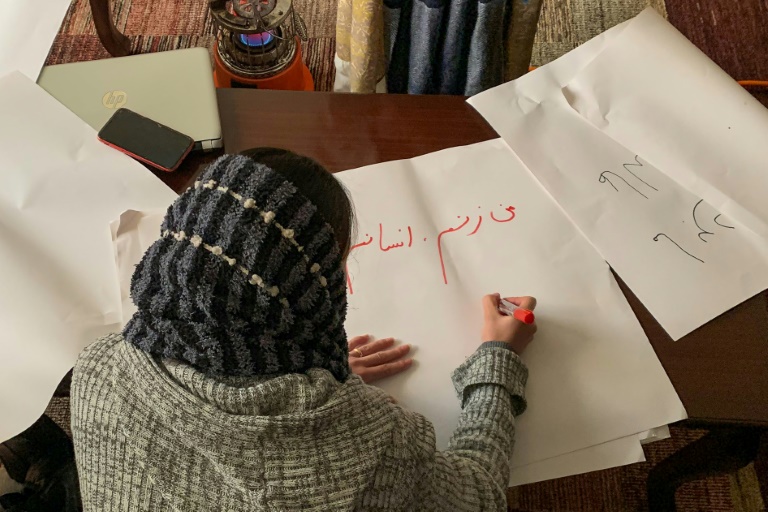
One activist designed a banner demanding justice, a cellphone in one hand and her pen in the other. 

“These are our only weapons,” she says. 

A 24-year-old, who asked not to be named, helped brainstorm ideas for attracting the world’s attention.

“It’s dangerous but we have no other way. We have to accept that our path is fraught with challenges,” she insists. 

Like others, she stood up to her conservative family, including an uncle who threw away her books to keep her from learning.

“I don’t want to let fear control me and prevent me from speaking and telling the truth,” she insists. 

Allowing people to join their ranks is a meticulous process.

Hoda Khamosh, a published poet and former NGO worker who organized workshops to help empower women, is tasked with ensuring newcomers can be trusted. 

One test she sets is to ask them to prepare banners or slogans at short notice — she can sense passion for the cause from women who deliver quickly.

Other tests yield even clearer results. 

Hoda recounts the time they gave a potential activist a fake date and time for a demonstration. 

The Taliban turned up ahead of the supposed protest, and all contact was cut with the woman suspected of tipping off officials. 

A core group of the activists use a dedicated phone number to coordinate on the day of a protest. That number is later disconnected to ensure it is not being tracked.

“We usually carry an extra scarf or an extra dress. When the demonstration is over, we change our clothes so we cannot be recognised,” Hoda explains. 

She has changed her phone number several times and her husband had received threats. 

“We could still be harmed, it’s exhausting. But all we can do is persevere,” she adds.

The activist was one of a few women flown to Norway to meet face to face with the Taliban’s leadership last month, alongside other civil society members, when the first talks on European soil were held between the West and Afghanistan’s new government. 

– Crackdown on dissent –

In the 20 years since the Taliban last held power, a generation of women — largely in major cities — became business owners, studied PHDs, and held government positions.

The battle to defend those gains requires defiance.

On protest days, women turn up in twos or threes, waiting outside shops as if they are ordinary shoppers, then at the last minute rush together: some 20 people chanting as they unfurl their banners. 

Swiftly, and inevitably, the Taliban’s armed fighters surround them — sometimes holding them back, other times screaming and pointing guns to scare the women away. 

One activist recalls slapping a fighter in the face, while another led protest chants despite a masked gunman pointing his weapon at her. 

But it is becoming increasingly dangerous to protest as authorities crack down on dissent.  

A few days after the planning meeting attended by AFP, Taliban fighters used pepper spray on the resistance demonstrators for the first time, angry as the group had painted a white burqa red to reject wearing the all-covering dress. 

Activists said two of the women who took part in the protests — Tamana Zaryabi Paryani and Parwana Ibrahimkhel — were later rounded up in a series of night raids on January 19. 

Shortly before she was taken, footage of Paryani was shared on social media showing her in distress, warning of Taliban fighters at her door.

In the video, Tamana calls out: “Kindly help! Taliban have come to our home in Parwan 2. My sisters are at home.” 

It shows her telling the men behind the door: “If you want to talk, we’ll talk tomorrow. I cannot meet you in the night with these girls. I don’t want to (open the door)… Please! help, help!” 

Several women interviewed by AFP before the raids, who spoke of “non-stop threats”, have since gone into hiding.

Taliban government spokesman Zabihullah Mujahid denied any women were being held, but said authorities had the right “to arrest and detain dissidents or those who break the law”, after the government banned unsanctioned protests soon after coming to power. 

Three weeks on and they have still not been found, with the United Nations and Human Rights Watch among those calling on the Taliban to investigate the disappearances.

The UN has also demanded information about two more female activists allegedly detained last week, named by rights advocates as Zahra Mohammadi and Mursal Ayar.

– Starting from scratch –

The women are learning to adapt quickly.

When they began the movement last September, demonstrations would end as soon as one of the participants was pushed or threatened by the Taliban.

Hoda says they have now developed a system where two activists take care of the victim, allowing the others — and the protest — to continue.

As the Taliban prevents media coverage of protests, many of the female activists use high quality phones to take photos and videos to post on social media.

The content, often featuring them defiantly showing their faces, can then reach an international audience.

“These women… had to create something from scratch,” says Heather Barr of Human Rights Watch.

“There are a lot of very experienced women activists who have been working in Afghanistan for many years… but almost all of them left after August 15.”

“(The Taliban) don’t tolerate dissent. They have beaten other protesters, they have beaten journalists who cover the protests, very brutally. They’ve gone and looked for protesters and protest organisers afterwards,” she adds.

Barr believes it is “almost certain” those involved with this new resistance will experience harm.

A separate, smaller woman’s group is now trying to focus on protest that avoids direct confrontation with the Taliban.

“When I am out on the streets my heart and body shake,” said Wahida Amiri.

The 33-year-old used to work as a librarian. Sharp and articulate, she is used to fighting for justice having previously campaigned against corruption in the previous government.  

Now that is no longer possible, she sometimes meets a small circle of friends in the safety of their homes, where they film of themselves holding candlelit vigils and raising banners demanding the right to education and work.

They write articles and attend debates on audio apps Clubhouse or Twitter, hoping social media will show the world their story. 

“I have never worked as hard as I have in the past five months,” she says. 

Hoda’s biggest dream was to be Afghanistan’s president, and it’s difficult for her to accept that her political work is now limited. 

“If we do not fight for our future today, Afghan history will repeat itself,” the 26-year-old told AFP from her home.

“If we do not get our rights we will end up stuck at home, between four walls. This is something we cannot tolerate,” she said.

Kabul’s resistance is not alone. There have been small, scattered protests by women in other Afghan cities, including Bamiyan, Herat and Mazar-i-Sharif. 

“(The Taliban) have erased us from society and politics,” Amiri says.

“We may not succeed. All we want is to keep the voice of justice raised high, and instead of five women, we want thousands to join us.”

Pfizer sees Covid-19 drug sales topping $50 bn in 2022

Pfizer forecast more than $50 billion in 2022 sales for its Covid-19 vaccine and therapeutic on Tuesday as the pharmaceutical giant reported a more than doubling of annual profits on strong sales of its innoculation.

Pfizer, whose vaccinee developed with German company BioNTech was the first approved in the United States to counter the deadly virus, sees slightly lower 2022 revenues for the vaccine compared with the just-finished year, but a big infusion of revenues from Paxlovid, the company’s pill for Covid-19.

Chief Executive Albert Bourla described 2021 as a “watershed year” for Pfizer, adding that the company’s efforts in the pandemic “have fundamentally changed our company forever.”

Still, shares fell Tuesday following the results, which lagged estimates in terms of fourth-quarter revenues.

Besides vaccines, sales were mixed across Pfizer’s other divisions. Revenues dipped for internal medicine and inflammation and immunology, but rose for oncology, hospitals and rare disease.

Analysts have also projected higher 2022 profits compared with the company’s forecasts.

– Heavy interest in therapeutic –

Pfizer reported annual profits of $22 billion, more than double the 2020 level. Annual revenues nearly doubled to $81.3 billion, with $36.8 billion from the Covid-19 vaccine.

The company projected 2022 revenues of between $98 and $102 billion.

The results are the latest to show how the coronavirus has transformed Pfizer, which a year ago had projected just $15 billion in Covid-19 vaccines sales in 2021 and ended up selling more than twice that amount after repeatedly lifting the forecast. 

For 2022, Pfizer expects $32 billion in revenue from Covid-19 vaccines and $22 billion in revenues from Paxlovid.

Bourla said the company is currently working on a new vaccine candidate based on the Omicron variant of Covid-19, as well as a new “potential next-generation oral Covid-19 treatment.”

The company expects to produce 120 million treatment courses for Paxlovid, with six million in the first quarter and 30 million the first half of 2022. 

Pfizer executives described heavy interest in Paxlovid, with ongoing contract talks with about 100 governments around the world. The treatment has so far been approved in about 40 countries.

Bourla said the sales for Paxlovid “could be way bigger” than current forecasts. The 2022 estimate of $22 billion is based on signed contracts and negotiations where there is essentially an agreement, he said.

However, Chief Financial Officer Frank D’Amelio cautioned that there was “less potential upside” to 2022 estimates for Covid-19 vaccine revenues, compared with 2021 “when the vaccine was newly available and few people had received any doses of the vaccine.”

Morningstar’s Damien Conover estimated that Covid-19-related products will account for $60 billion in revenues in 2022, but fall to close to $5 billion by 2025. 

“We expect increased near-term utilization of Covid vaccines will reduce the demand for these vaccines and treatments over the long term,” Conover said in a note. “We view Pfizer as slightly overvalued, with the market likely extrapolating strong Covid vaccine and treatment sales too far into the future.”

Bourla said the company’s scientists “continue to monitor the Covid-19 virus and believe it is unlikely that it will be fully eradicated in the foreseeable future.” 

“That said, we now have the tools — in the forms of vaccines and treatments — that we believe will help enable us to not only better manage the pandemic but also help countries move into the endemic phase,” he said.

Shares fell 2.8 percent to $51.70.

Europe to cut funds for Poland over unpaid fine

The European Commission said Tuesday it would take the unprecedented step of tapping into EU funding earmarked for Poland to collect a fine imposed on Warsaw for refusing to close a coal mine, one of several points of friction between Brussels and the eastern European nation.

EU Commission spokesman Balazs Ujvari said the EU had informed Poland of its decision, which will be carried out next week.

Polish government spokesman Piotr Muller said Warsaw would use “all possible legal means to appeal against this,” Poland’s PAP news agency reported.

The cut will amount to nearly 15 million euros ($17 million) for the period between September 20 and October 19 last year. The total unpaid fine amounts to around 70 million euros including interest, according to an AFP calculation. 

The row is the latest to afflict relations between Brussels and one of the EU’s biggest members, already on a knife edge over controversial judicial reforms enacted by Poland’s conservative government.

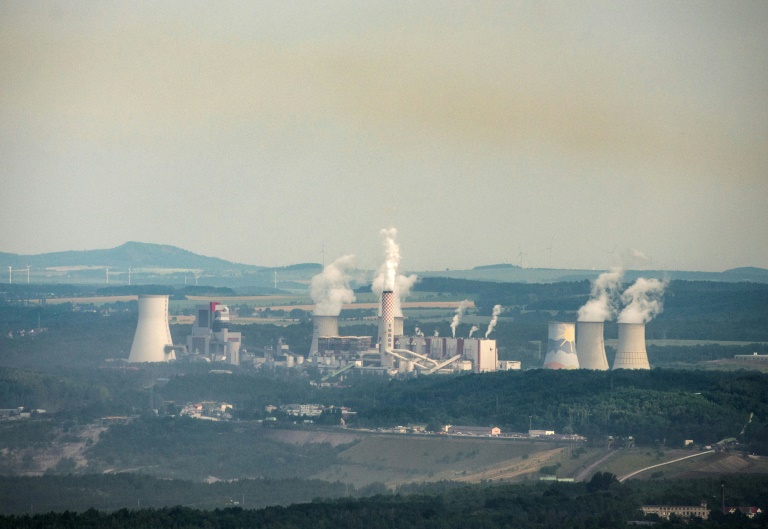
The Court of Justice of the European Union (CJEU) hit Poland with the 500,000-euro a day fine last September for refusing to comply with an order to close its Turow mine producing lignite, or brown coal.

Poland’s neighbours, the Czech Republic and Germany, had complained of environmental damage from the mine, including groundwater pollution as well as dust and noise.

Last week, Poland signed a deal with the Czech Republic to end the dispute over the mine, which was confirmed by the court on Tuesday.

But that did not erase the fine, which Warsaw has insisted it will not pay.

– Test of EU will –

Poland argues that decisions taken by the EU court violate the country’s right to ensure its energy supply.

But the EU justice commissioner, Didier Reynders, insisted that the European Commission — the guardian of the EU treaties — must be seen to uphold the decisions of the EU court.

“If the member state does not pay, it is obvious that we must organise, as we have said from the start, the withholding of funds,” he told AFP.

“If we don’t do this, no one would pay their fines anymore, obviously,” he said.

Ujvari said the levied amount covering the period September 20 to October 19 would be recovered from Poland’s EU funding. That comes to 14.5 million euros plus interest, which takes it close to a total of 15 million euros.

– Another fine –

Poland has been hit with another CJEU fine, of one million euros per day, for refusing to suspend a national Supreme Court chamber contested by Brussels.

The EU accuses Warsaw of undermining judicial independence and rolling back democratic norms.

There, too, the commission has warned it will recover the fine amount — currently over 100 million euros — from Poland’s EU funding if it goes unpaid. 

Poland’s President Andrzej Duda has proposed a law to scrap the Supreme Court chamber in hopes of drawing a line under the dispute.

But the changes still have to be approved by Polish lawmakers, and legal observers queried whether it is merely a rebranding exercise.

On Tuesday, Warsaw was also taken to task by the European Court of Human Rights, a continent-wide body that rules on alleged violations of the European Convention on Human Rights.

The court demanded that Poland guarantee a “fair trial” to a Supreme Court judge critical of the country’s judicial reforms, Wlodzimierz Wrobel, who is targeted by disciplinary proceedings.

Poland’s populist government insists its reforms are needed for the judiciary to root out corruption and the legacy of judges appointed while the country was still under communist rule.

On the Turow mine deal with the Czech Republic, Poland has agreed to pay the Czechs 45 million euros in compensation in return for Prague withdrawing its complaint.

The European Court of Justice tweeted on Tuesday confirmation that it had closed the case “following an amicable agreement between the Czech Republic and Poland”.

Poland is reluctant to close the mine as it feeds a power station that provides around seven percent of the country’s electricity needs.

Poland relies on coal to meet up to 80 percent of its energy, but has vowed to develop green energy sources and to shut its last mine by 2049, in line with EU emissions targets.

NGO files complaint over dead fish deluge off French coast

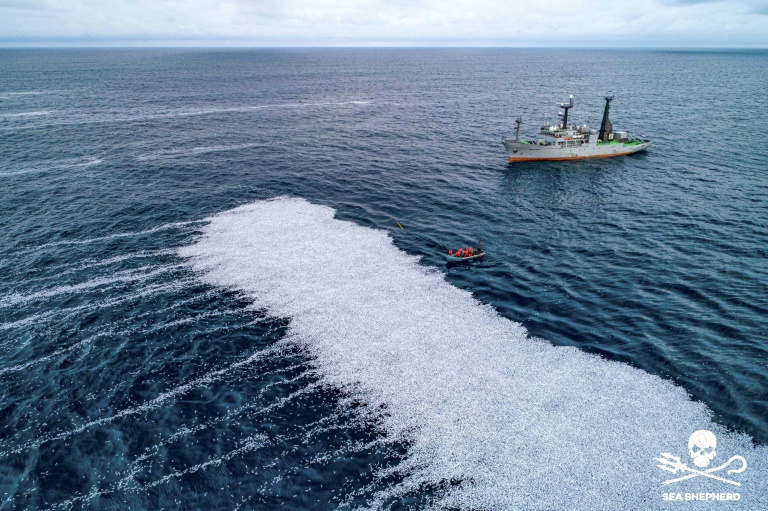
Environmental organisation Sea Shepherd on Tuesday filed a legal complaint against the owners of a large fishing vessel after tens of thousands of dead fish were spotted off France’s Atlantic coast.

The NGO last week published footage of what it said were more than 100,000 dead fish floating in the sea some 300 kilometres (186 miles) off the southwestern port city of La Rochelle in the Bay of Biscay.

The fish, of the cod species blue whiting, had been caught by the Margiris, one of the world’s biggest fishing trawlers at 143 metres (470 feet) long.

On Thursday, the Margiris logged a “fishing incident” with the freezer-trawler association PFA, saying its net had ruptured, causing the involuntary release of the fish into the sea.

The PFA said the breakage, “a rare occurrence” had been due to “the unexpectedly large size of the fish caught”.

The incident had also been reported to the vessel’s flag state, Lithuania, it said.

But Sea Shepherd said it suspected the blue whiting, an abundant species in the northeast Atlantic, might have been discarded deliberately.

“Some vessels, when they catch a great number of fish of low commercial value like blue whiting, discard them to make room for higher-value fish,” said Lamya Essemlali, president of Sea Shepherd France.

This practice, she told AFP, “is completely illegal”.

Sea Shepherd’s case was based on the Margiris’s failure to bring the fish it caught to shore in accordance with fishing rules, she said. The organisation had backed up its claim “with various elements of what we found at the site”, she added.

France’s maritime minister, Annick Girardin, said on Friday there would be an inquiry into the incident, and that the dead fish would be subtracted from the Margiris’s fishing quota.

“This was a non-authorised discarding of fish,” a spokesperson at her ministry said.

The EU’s commissioner for oceans and fisheries Virginijus Sinkevicius — himself a Lithuanian national — said the European Commission would also look into the matter.

burs/jh/jj

Close Bitnami banner
Bitnami