World

Original 'Fight Club' ending restored in China after online backlash

The original, iconic ending of cult US film Fight Club has been restored to screens in China after a censored version that brought all criminals to book sparked outrage online.

Beijing has some of the world’s most restrictive censorship rules with authorities only approving a handful of foreign films for release each year — sometimes with major cuts.

But reversing endings is rare, and there was widespread anger after censors replaced the original finale of Fight Club on a version streaming on platform Tencent Video.

In the original closing scenes, star Edward Norton’s narrator kills his imaginary alter-ego Tyler Durden, played by Brad Pitt, before watching multiple buildings explode, suggesting his character’s plan to bring down modern civilisation.

But the version on Tencent instead closed with a line of text on a black screen to say the police “rapidly figured out the whole plan and arrested all criminals”.

In a rare censorship reversal, however, Tencent this week began to air the original conclusion of David Fincher’s film, including the iconic explosive ending that was trimmed last month.

The ending in which the state triumphs had sparked head scratching and outrage among some Chinese viewers — many of whom would likely have seen pirated versions of the unadulterated film.

Human Rights Watch described the cuts as “dystopian”.

Author Chuck Palahniuk, who wrote the 1996 novel that Fight Club was adapted from, tweeted that China had “done the right thing”.

Tencent did not reply to questions on what led to the censorship, nor its abrupt reversal, which prompted more debate online.

“Now, I’m speechless!” wrote one Chinese film fan, with the sentiment echoed across social media.

Ex-leader ahead as Costa Ricans elect new president

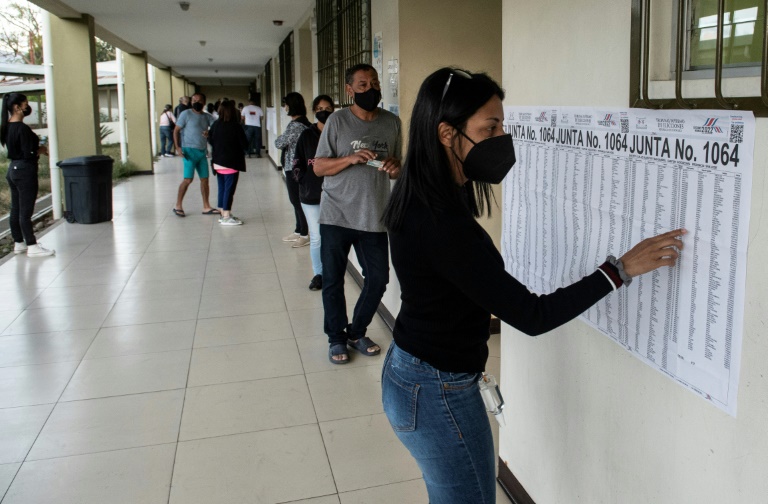
Costa Ricans voted for a new president Sunday from a crowded field of candidates, with a center-left former leader ahead of the pack with about 60 percent of ballots counted in one of Latin America’s stablest democracies.

Twelve hours of voting closed at 6 pm (midnight GMT) in what is frequently rated the region’s “happiest” country, a tourist mecca and a leading green economy.

However, polls show unemployment, corruption and creeping living costs topping the concerns of 3.5 million eligible voters in the country of five million people.

Jose Maria Figueres, 67, of the center-left National Liberation Party (PLN), had roughly 27 percent of the vote with 63 percent of ballots counted, the Supreme Electoral Tribunal said.

To win in the first round, one candidate must take 40 percent of the vote — otherwise the two leading contenders will face each other in an April 3 run-off.

The eventual winner will be expected to tackle a worsening economy where unemployment has been steadily rising for more than a decade and reached 14.4 percent in 2021.

The poverty rate stood at 23 percent last year while the public debt was 70 percent of GDP.

Costa Rica’s problems have worsened with the coronavirus pandemic dealing a hard blow to its critical tourism sector.

On Sunday, Figueres, who led the country from 1994 to 1998, condemned the levels of poverty as well as housing shortages.

“We have never experienced these things in this magnitude,” he said.

For Francisco Zeledon, the first voter in line at one polling station, “voting is the most important weapon we have to solve problems.”

“We have to solve poverty and create jobs for people,” the 35-year-old said.

Polls have showed about a third of voters are undecided, faced with a choice of 25 presidential candidates.

But one outcome looked likely: the ruling Citizens’ Action Party (PAC) appeared set for a bruising defeat with anti-government sentiment sky-high.

– Record unpopularity –

“The ruling party is completely weakened and has no chance” after two successive terms in office, said political analyst Eugenia Aguirre.

“The presidential unpopularity figure of 72 percent is the highest since the number was first recorded in 2013,” she added.

This means the country’s traditional political heavyweights — the PLN and the Social Christian Unity Party — could return to the fore after decades of a near political duopoly only recently broken by the PAC.

With results trickling in around 0600 GMT, second place remained closely contested between the economist Rodrigo Chaves (16 percent) and conservative evangelical preacher Fabricio Alvarado Munoz (15 percent).

Munoz commands support from the evangelical community, which makes up about 20 percent of Costa Rica’s population.

Meanwhile, center-right Lineth Saborio of the PUSC garnered 12 percent.

Presidents in Costa Rica cannot seek immediate re-election, leaving incumbent Carlos Alvarado Quesada out of the running.

– Problems ‘worsened’ –

Costa Rica is known for its eco-tourism and green policies, with its energy grid run entirely on renewable sources.

Unlike many of its volatile Central American neighbors, Costa Rica has no army, has had no armed conflicts since 1948 and no dictator since 1919.

But the worsening economic situation has hit confidence in the political class.

Voters under 40 have only known “periods in which not only problems have not been resolved, but they have worsened,” university student Edgardo Soto, an undecided voter, told AFP.

Apathy and abstentionism are features of Costa Rican elections.

In 2018, 34 percent of voters stayed away, though participation is technically obligatory.

Eugenia Zamora, president of Costa Rica’s electoral tribunal, said Sunday’s vote kicked off with high turnout in the morning, and proceeded without incident.

“This is a country with a robust democracy… It offers lessons for other countries,” added Isabel de Saint Malo, head of the Organization of American States observer mission.

Outgoing president Alvarado said the vote was an affirmation of Costa Rica’s place among “the world’s strongest democracies.”

Costa Ricans also cast their vote Sunday for the 57-member Congress.

“I hope that whoever wins really thinks of the people,” said 77-year-old Mayra Sanchez after voting in Moravia, “and not of themselves.”

Australia to reopen borders to tourists on February 21

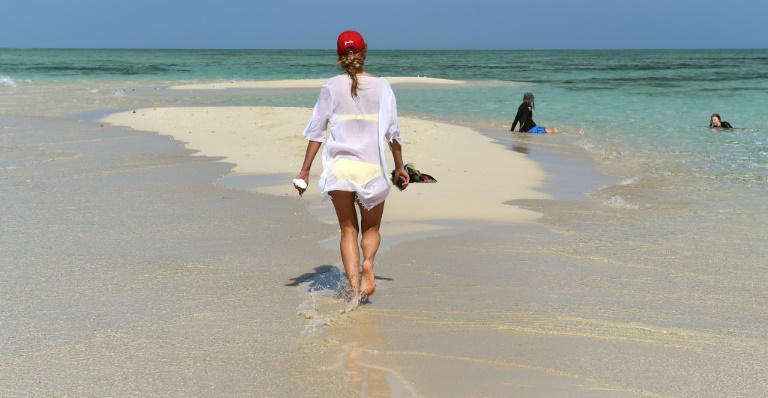
Australia will reopen its borders to tourists from February 21, Prime Minister Scott Morrison announced Monday, ending some of the world’s strictest and longest-running pandemic travel restrictions.

“It’s almost two years since we took the decision to close the borders to Australia,” Morrison said after a meeting of the national security cabinet.

He announced the borders will reopen to all visa holders “on the 21st of February of this year,” adding, “if you’re double vaccinated, we look forward to welcoming you back to Australia.”

Australia’s borders slammed shut in March 2020 in the hope of protecting the island continent against a surging global pandemic.

For most of the time since then, Australians have been barred from leaving and only a handful of visitors have been granted exemptions to enter.

The rules have stranded nationals overseas, split families, hammered the country’s multi-billion-dollar tourist industry, and prompted often bitter debates about Australia’s status as a modern, open and outward-looking nation.

Every month of border closures has cost businesses an estimated US$2.6 billion, according to the Australian Chamber of Commerce and Industry.

In recent months, rules have been gradually relaxed for Australians, long-term residents and students.

The latest decision will see almost all remaining caps lifted.

It comes after the country’s long-standing “Covid-zero” policy was abandoned, vaccination rates rose and the once stellar track-and-trace system collapsed under a wave of Omicron cases.

Only a handful of countries remain closed to tourists — among them Japan, China, New Zealand and several Pacific Island nations.

– ‘Come visit’ –

For Australia’s travel and tourism sector — which struggled as visitor numbers fell almost 98 percent compared to pre-pandemic levels — the news brought elation.

“We’re very excited about being able to reopen,” said Tony Walker, managing director of the Quicksilver Group, which operates cruises, diving and resorts across the Great Barrier Reef.

“The last couple of years have been incredibly difficult for us,” he told AFP, urging people overseas to “come visit”.

During the pandemic the firm went from 650 employees down to the 300 it has today.

Walker said he expected “it will take some time to recover” from the past two years. 

Many tourism operators around Australia are experiencing staff shortages, given how few backpackers and working holidaymakers are coming to Australia.

Despite the announcement, travel within Australia will still be restricted.

The vast state of Western Australia remains closed to most non-residents. It is currently easier to travel from Sydney to Paris than Sydney to Perth.

Indonesia bus crash kills 13, injures dozens

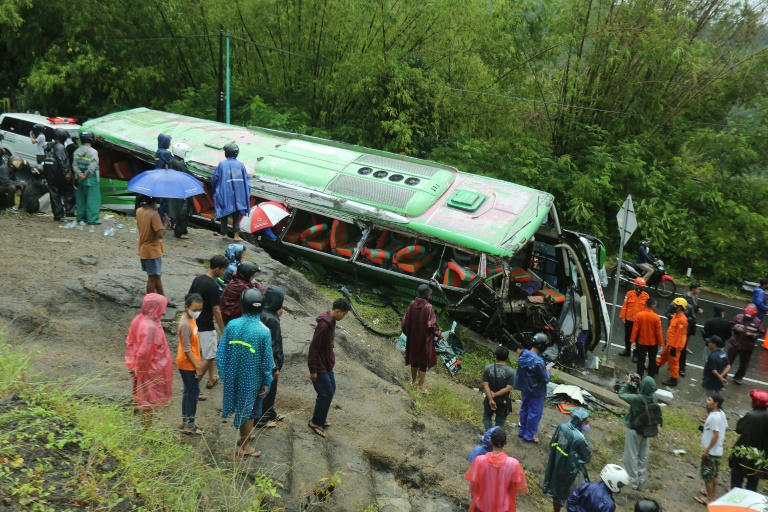
At least 13 people were killed and dozens more injured after a tour bus carrying factory workers to a beach holiday crashed on Indonesia’s Java island, according to police.

The bus and its 47 passengers were headed from Sukoharjo in Central Java to a family gathering in neighbouring Yogyakarta province when the driver lost control going downhill, officers said late Sunday.

“Witnesses we questioned said they saw the driver panicking as he tried to manage the gear stick, so there’s an indication the brake was not functioning or faulty,” Bantul district police chief Ihsan, who like many Indonesians uses only one name, told a media briefing.

Deadly traffic accidents are common in the archipelago nation of 270 million, where vehicles are often old and poorly maintained and road rules are routinely ignored. 

“Thirteen people died. Some died on the scene and others died while being treated in the hospital, while 34 others were injured,” Ihsan said, adding the injured had been taken to three nearby hospitals.

The driver was among those who died when the bus tipped over and slammed into the side of the road, destroying the front of the vehicle and badly damaging its right side.

Multiple passengers sustained head injuries and three toddlers were also hurt, according to the police chief.

Shortly before the crash, passengers had been asked to temporarily disembark, as the bus was having difficulty going uphill, Ihsan said. 

In March last year, a bus carrying dozens of pilgrims plunged into a deep ravine in Sumedang, West Java province, killing 29 people. 

In late 2019, at least 35 people were killed when a bus plunged into a ravine on the island of Sumatra.

Diplomatic flurry to avert Russia-NATO clash over Ukraine

With war clouds gathering over Ukraine, international diplomacy goes into overdrive on Monday with the French and Russian presidents to talk in Moscow and the German chancellor heading to the White House to meet with US leader Joe Biden.

Also on Monday, the German, Czech, Slovak and Austrian foreign ministers were expected in Kyiv, which has played down dire US warnings that Moscow had stepped up preparations for a major incursion into Ukraine.

US officials have said the Kremlin has assembled 110,000 troops along the border with its pro-Western neighbour but intelligence assessments have not determined whether President Vladimir Putin has actually decided to invade.

They said Russia is on track to amass a large enough force — some 150,000 soldiers — for a full-scale invasion by mid-February.

Such a force would be capable of taking the capital Kyiv in a matter of 48 hours in an onslaught that would kill up to 50,000 civilians, 25,000 Ukrainian soldiers and 10,000 Russian troops and trigger a refugee flood of up to five million people, mainly into Poland, the officials added.

On top of the potential human cost, Ukraine fears further damage to its already struggling economy.

And if Moscow attacks Ukraine it could face retaliation over the Nord Stream 2 pipeline — set to double natural gas supplies from Russia to Germany — with Berlin threatening to block it.

Russia is seeking a guarantee from NATO that Ukraine will not enter the alliance and wants the bloc to withdraw forces from member states in eastern Europe. 

– ‘Apocalyptic predictions’ –

Moscow denies that it is planning to invade Ukraine, and Kyiv’s presidency advisor said the chances of a diplomatic solution to the crisis remained “substantially higher than the threat of further escalation”.

On Twitter, Ukraine’s Foreign Minister Dmytro Kuleba sought to calm tensions, saying: “Do not believe the apocalyptic predictions. Different capitals have different scenarios, but Ukraine is ready for any development.”

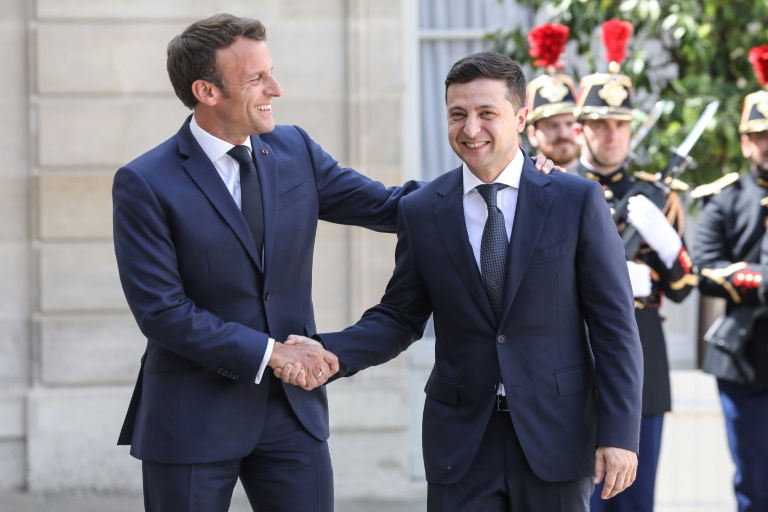
President Emmanuel Macron of France, which currently holds the rotating presidency of the EU, will be in Moscow on Monday and Kyiv on Tuesday to spearhead efforts to de-escalate the crisis.

He is expected to push forward a stalled peace plan for the festering conflict with Russian-backed separatists in eastern Ukraine. 

The trip will be a political gamble for Macron, who faces a re-election challenge in April.

Also on Monday, German Chancellor Olaf Scholz will meet with Biden in Washington.

“We worked hard to send a clear message to Russia that it will have a high price if they were to intervene into Ukraine,” Scholz told the Washington Post in an interview ahead of his meeting.

“I really appreciate what President Biden is doing in the bilateral talks between the United States and Russia. They are very difficult.”

Biden has reacted to the Russian troop buildup by offering 3,000 American forces to bolster NATO’s eastern flank, with a batch of the troops promised arriving in Poland on Sunday.

But US National Security Advisor Jake Sullivan told Fox News Sunday that Biden “is not sending forces to start a war or fight a war with Russia in Ukraine”.

“We have sent forces to Europe to defend NATO territory,” he said.

Scholz said Sunday that Berlin was prepared to send extra troops to the Baltics in addition to 500 soldiers already stationed in Lithuania under a NATO operation.

While he is in Washington, his foreign minister, Annalena Baerbock, will be in Kyiv along with her Czech, Slovak and Austrian counterparts for a two-day visit.

Scholtz will be in Moscow and Kyiv next week for talks with Putin and Ukrainian President Volodymyr Zelensky. 

burs/gd/har/mtp/ssy

China locks down city of 3.5 million near Vietnam border

A Chinese city of 3.5 million near the border with Vietnam was on lockdown Monday after more than 70 coronavirus cases were discovered there over the past three days.

China, the only major world economy still sticking to a staunch zero-Covid policy, is on high alert for any outbreaks as it hosts the Beijing Winter Olympics.

Local officials in the city of Baise in the southern Guangxi region announced Sunday that no one would be allowed to leave the city, while residents of some districts would be confined to their homes.

“Citywide traffic controls will be implemented,” vice-mayor Gu Junyan told a briefing.

“In principle, vehicles and people cannot enter or leave the city… with personnel control strictly enforced and no unnecessary movement of people.”

Residents of some neighbourhoods in smaller rural cities and counties under Baise’s jurisdiction have been placed under strict home confinement, while others cannot leave their district, Gu added.

Baise, located about 100 kilometres (62 miles) from the Vietnamese border, on Friday discovered its first local case — a traveller who had returned home for the week-long Lunar New Year holiday, according to officials.

Since the pandemic, China has built a heavily enforced wire mesh fence along its southern border to keep out illegal migrants from Vietnam and Myanmar — as well as potential Covid-19 infections.

Mass testing is already under way for residents, authorities said.

Since the coronavirus pandemic first emerged two years ago in Hubei province’s Wuhan, China has used strict local lockdowns, mass testing and contact-tracing apps to try and eliminate outbreaks as soon as cases are detected, sparing the country the mass deaths witnessed around the rest of the world. 

Millions were confined to their homes in multiple Chinese cities in the run-up to the Olympics after cases involving both the Delta and Omicron coronavirus variants flared. The outbreaks were mostly stamped out.

In December, 13 million residents of the northern megacity of Xi’an were placed under strict home confinement for over a month after an outbreak of more than 2,000 cases.

Residents complained of grocery shortages and overly harsh enforcement of lockdown measures by local officials, which saw patients blocked from receiving critical medical treatment, leading to deaths in some cases.

China reported 79 new cases nationwide Monday, of which 37 were in Guangxi.

Meanwhile, Hong Kong’s zero-Covid policy is on the ropes after a record number of new infections was announced over the weekend, sending officials scrambling to ramp up testing capacity and warning that a tightening of virus-control measures could be needed.

China’s borders with the rest of the world, including Hong Kong, are largely sealed. 

Chinese tennis star Peng Shuai repeats sexual assault denial

Chinese tennis star Peng Shuai said she never accused anyone of sexual assault, according to an interview published Monday, again walking back an allegation that sparked worldwide concern about her safety.

The former doubles world number one alleged in a social media post in November that former Chinese vice-premier Zhang Gaoli forced her into sex during a years-long relationship.

The post was swiftly deleted and Peng was not heard from for nearly three weeks. She has since emerged at some public events, denying in December that she ever made the accusation.

“I never said anyone had sexually assaulted me in any way,” Peng told the French sports daily L’Equipe, reiterating a similar comment she gave to a Singaporean newspaper back in December.

The 36-year-old added that she was the one who deleted her allegation from Weibo, China’s Twitter-like platform.

It was widely suspected that the country’s strict internet censors, sensitive about any criticism of the ruling Communist Party, had removed it.

When L’Equipe asked her why she deleted it, Peng said: “Because I wanted to.”

“There was a huge misunderstanding in the outside world following this post,” she said during the interview in the Beijing Winter Olympics bubble.

“I don’t want the meaning of this post to be twisted anymore. And I don’t want any further media hype around it.”

– ‘Never disappeared’ –

Some of the world’s biggest tennis stars, including Serena Williams, Naomi Osaka and Novak Djokovic, spoke out about the Peng case. The United Nations and the White House also expressed concern.

The Women’s Tennis Association (WTA) suspended its tournaments in China over the matter.

When asked about the worries her absence sparked, Peng said she had “never disappeared”.

“It’s just that many people, like my friends or people from the IOC messaged me, and it was simply impossible to answer so many messages.”

Peng was accompanied by Chinese Olympic Committee chief of staff Wang Kan during the interview.

Concerns have swirled about Peng’s safety despite her appearances following the three-week absence, which showed her attending sporting events.

After she denied making any sexual assault allegations in December, the WTA said it was still not convinced of her well-being.

At the Australian Open last month, activists handed out 1,000 “Where is Peng Shuai?” T-shirts to spectators ahead women’s final to highlight the case.

– Bach meeting –

International Olympic Committee (IOC) President Thomas Bach held a video conference with Peng on November 21, but that led to accusations that he was trying to protect the hosts of the 2022 Winter Games.

Bach said ahead of the Games that the IOC would back an inquiry into her allegations if she wanted one, saying he would hold a meeting with Peng to “know better about her physical integrity and her mental state”.

Bach, along with IOC member Kirsty Coventry, met Peng over dinner at the Olympic Club in Beijing on Saturday, the body said in a statement.

“We had dinner together on Saturday and we had a nice discussion and exchange,” Peng told L’Equipe, also announcing her retirement from tennis in the interview.

“He asked me whether I am considering competing again, what my projects are, what I’m planning to do, and so on.”

The IOC said Peng shared with Bach and Coventry “her intention to travel to Europe with the COVID-19 pandemic is over”.

“All three agreed that any further communication about the content of the meeting would be left to her discretion,” the IOC statement added.

Ottawa mayor declares state of emergency over 'out of control' truckers' protest

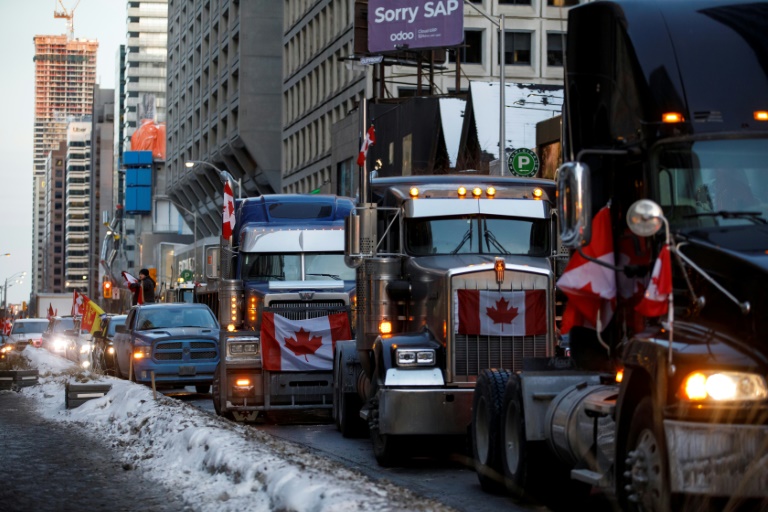
The ongoing truckers’ protest in the Canadian capital is “out of control,” the Ottawa mayor said Sunday, announcing a state of emergency as the city center remained blocked by opponents of anti-Covid measures.

The protesters, who first reached the capital on January 29, have parked their big rigs on city streets and put up tents and temporary shacks — paralyzing the capital to the consternation of officials and the mounting frustration of many residents.

Mayor Jim Watson announced a state of emergency that “reflects the serious danger and threat to the safety and security of residents posed by the ongoing demonstrations and highlights the need for support from other jurisdictions and levels of government,” a statement from the city said.

Earlier in the day, Watson had described the situation as “completely out of control,” adding that the protesters “have far more people than we have police officers.”

“Clearly, we are outnumbered and we are losing this battle,” he told CFRA radio. “This has to be reversed; we have to get our city back.”

Watson called the truckers “insensitive,” as they have continued “blaring horns and sirens and fireworks, and turning it into a party.”

The demonstrations began as protests by truckers angry with vaccine requirements when crossing the US-Canadian border, but have morphed into broader protests against Covid-19 health restrictions and the government of Prime Minister Justin Trudeau.

Locals have complained of the ceaseless sound of air horns and of being harassed, insulted or blocked by the protesters.

The truckers and their supporters have dug in, however, saying the protests will continue until the Covid-related restrictions are lifted.

Police on Sunday announced new measures to stop people from helping the protesters keep up their sit-in. 

“Anyone attempting to bring material supports (gas, etc.) to the demonstrators could be subject to arrest,” the force tweeted, adding Sunday night that several arrests had been made.

– ‘Extremely disruptive’ –

Similar, if smaller, demonstrations hit the cities of Toronto, Quebec City and Winnipeg on Saturday. 

Police in Quebec City said some 30 big trucks were blocking a major artery and had been warned they would face fines if they did not move soon. 

Later Sunday police said on Twitter that all the trucks had left but protest organizers promised to return in two weeks, once the ongoing Quebec Winter Carnival was over.

In an emergency meeting Saturday with Ottawa officials, police chief Peter Sloly complained that he lacked the resources to end what he called a “siege,” and asked for reinforcements.

Ottawa police are due to soon be reinforced by some 250 Royal Canadian Mounted Police — a federal force.

“This group is a threat to our democracy,” city council member Diane Deans said of the protesters on Saturday. “What we’re seeing is bigger than just a city of Ottawa problem, this is a nationwide insurrection. This is madness.”

The police said Sunday that they had issued some 450 tickets since Saturday morning, for a variety of mostly minor infractions including excessive noise and use of fireworks, though one truck that turned out to be stolen was seized.

They said “extremely disruptive” protesters had in some cases endangered public safety, causing “unacceptable distress” to local residents. 

Police have opened 97 investigations into possible criminal offenses, the statement said.

In addition, it said, the police are “actively working with Canadian, US and international security agencies/authorities to investigate email-based threats to public officials.”

Morocco to bury 'little Rayan' who died trapped in well

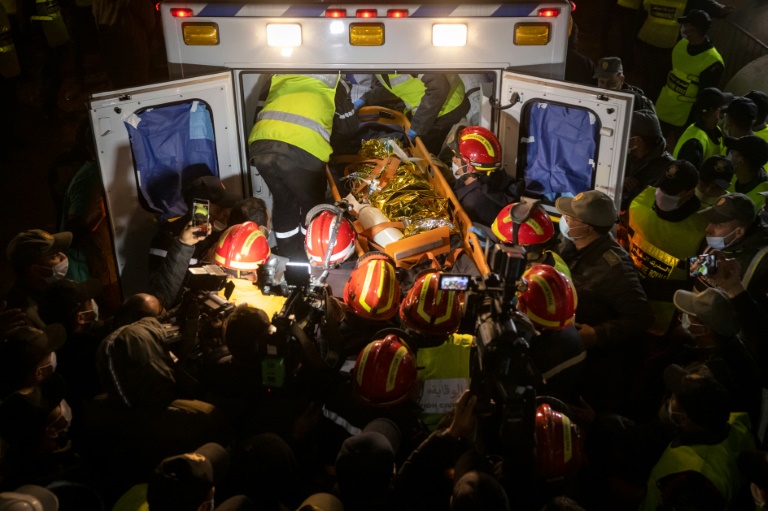
Morocco prepared Monday to bury “little Rayan”, the five-year-old boy who died trapped in a well despite a days-long rescue operation that gripped the world.

The child’s fate drew global attention after he fell down a narrow, 32-metre (100-foot) dry well last Tuesday, and sparked an outpouring of sympathy online.

His funeral is to be held in his home village of Ighrane, in the impoverished Rif mountains of northern Morocco where the tragedy took place, a local official and a relative told AFP.

On Saturday night, crowds had cheered in joy when rescue workers reached Rayan after a round-the-clock digging operation, clearing away the final handfuls of dirt.

But hope turned to grief as news spread that the rescue was too late, and Rayan was dead.

“The silence is terrible this morning in the village,” a relative said.

The news was announced by the royal cabinet of the North African nation, after King Mohammed VI called the parents with his condolences.

“We thank his majesty the king, the authorities and all those who have helped us,” Rayan’s father Khaled Aourram said on Saturday evening. “Praise God, have mercy on the dead.”

Rayan’s body was taken to a military hospital in Rabat, according to a cousin, although no report has been given of any autopsy.

The race to rescue Rayan was followed live across the world, and as soon as the tragic conclusion was announced, tributes poured in.

Pope Francis, while mourning the boy’s loss, praised the “beautiful” sight of “how all the people gathered together” to try to save a child.

– Nation in shock –

Aourram said he had been repairing the well when the boy fell in, close to the family home.

The shaft, just 45 centimetres (18 inches) across, was too narrow for Rayan to be reached directly, and widening it was deemed too risky — so earth movers dug a wide slope into the hill.

Rescue crews, using bulldozers and front-end loaders, excavated the surrounding red earth down to the level where the boy was trapped, before drill teams created a horizontal tunnel to reach him from the side to avoid causing a landslide.

Vast crowds came to offer their support, singing and praying to encourage the rescuers who worked around the clock.

Moroccans were in shock after the news of the boy’s death.

Mourad Fazoui in the capital Rabat called it a disaster. “May his soul rest in peace and may God open the gates of heaven to him,” the salesman said.

Social media users from regional rival Algeria to France and the United States flooded the internet with messages of support and grief, along with praise for the rescue workers.

“He has brought people together around him,” a Twitter user said.

But some saw the situation differently, with one internet user deploring a “dystopic world” where “Arab nations are moved by the rescue of a child in Morocco” while others die due to famine or conflict in Yemen and Syria.

The boy’s ordeal echoed a tragedy in Spain in early 2019 when a two-year-old child died after falling into an abandoned well more than 70 metres deep.

Julen Rosello’s body was recovered after a search and rescue operation that lasted 13 days.

Senegal declares national holiday to celebrate Cup of Nations win

Senegal’s President Macky Sall declared Monday a public holiday to celebrate the national football team’s first ever African Cup of Nations crown following their victory against Egypt, public television announced.

Sall, who had been due to visit Comoros at the end of a trip that took in Egypt and Ethiopia, cancelled the last leg in order to welcome the triumphant Lions on their return to Dakar at 1300 GMT Monday, RTS said.

Led by Liverpool star Sadio Mane, Senegal overcame Mohamed Salah’s Egypt 4-2 in a penalty shoot-out at Sunday’s final in Cameroon. The game had finished goalless after extra time.

After two previous final defeats in 2002 and 2019, Senegal finally claimed their first Cup of Nations title.

The Lions will be decorated by Sall on Tuesday at the presidential palace in Dakar, RTS television said.

“The president of the republic declared Monday a public holiday, a paid day off, following the brilliant victory of the Lions,” RTS said, citing a presidential decree.

Close Bitnami banner
Bitnami